Spatial autocorrelation in Drosophilidae (Diptera) assemblages sampled in forest and pasture areas of the Cerrado Biome
Abstract
Spatial autocorrelation reflects the non-independence of observation sites due to their physical proximity. Evaluating this factor in a sampling design is essential to avoid pseudoreplication. Drosophilidae sampling, often conducted using banana and yeast traps for taxonomic surveys or ecological analyses, enables data comparison across various studies in different locations and seasons. However, the potential autocorrelation of sampling units due to trap spacing has seldom been tested, despite the widespread use of this methodology. In this study, we assessed the effects of spatial autocorrelation on Drosophilidae sampled using banana-baited traps placed 30 m and 60 m apart in forest and pasture settings during both dry and rainy seasons. The randomized accumulation curve indicated that the rainy season has a higher species richness, and traps spaced 60 m apart capture a broader species range. Species compositions were analyzed using Similarity Analysis (ANOSIM) with Jaccard and Bray-Curtis dissimilarity indexes. Distinct Drosophilidae compositions were observed across different phytophysiognomies and seasons. In evaluating species composition using 30 m and 60 m spacing across various areas and seasons, there is a tendency to sample similar assemblages, but with different dominances. No autocorrelation was detected in the Mantel test with the Jaccard index. These results suggest maintaining a minimum distance of 30 m between traps in taxonomic surveys and ecological studies of Drosophilidae.
Keywords:
Banana-baited trap; Drosophila; Pasture; Pseudoreplication; Sampling protocol
INTRODUCTION
Drosophilidae, one of the largest family within the Diptera, comprises about 4,700 described species (Bächli, 2023). Taxonomic surveys and ecological studies of this family are commonly conducted using banana and yeast-baited traps. These traps have been instrumental in studies across various Brazilian biomes, under different climatic conditions. Such studies have significantly contributed to our understanding of the distribution and ecological characteristics of Drosophilidae species (Bizzo et al., 2010; Chaves & Tidon, 2008; De Toni & Hofmann, 1995; Döge et al., 2008; Garcia et al., 2012; Gottschalk et al., 2007, Hochmüller et al., 2010; Martins 1987; Mata et al., 2008a; Mateus et al., 2006; Medeiros & Klaczko, 2004; Mendes et al., 2017; Penariol et al., 2008; Penariol & Maddi-Ravazi, 2013; Poppe et al., 2012; Poppe et al., 2013; Roque et al., 2013; Schmitz et al., 2007; Schmitz et al., 2010; Torres & Madi-Ravazzi, 2006). These traps have not only facilitated the collection of previously undescribed species (Gottschalk et al., 2012; Junges & Gottschalk, 2014; Poppe et al., 2014) but have also highlighted the potential of Drosophilidae species as bioindicators (Emerich et al., 2012; Ferreira & Tidon, 2005; Mata et al., 2008b; Mata et al., 2010). Moreover, they have enabled the prompt detection of invasive species and provided insights into their dispersion (Bitner-Mathé et al., 2014; Deprá et al., 2014; Leão et al., 2017; Paula et al., 2014).
The widespread adoption of this methodology in Brazilian studies has greatly facilitated comparison of described Drosophilidae assemblages. However, the spacing between traps, a critical factor in avoiding pseudoreplication and ensuring the independence of sampling units, has not been extensively examined. Typically, trap placement in the field has been dictated by the size of the area or the intensity of sampling efforts, rather than by methodological considerations of trap spacing.The distance between traps is vital to obtain data that adequately represent the study area in taxonomic or ecological research. Appropriate spacing helps to avoid pseudoreplication by ensuring the independence of sampling units (typically the traps) and producing more accurately results reflecting spatial variation. Spatial autocorrelation, as described by Hurlbert (1984), indicates that neighboring locations may share and duplicate part of the same information, which can bias analyses if not properly considered. This can lead to redundancy in an entire dataset (Shekhar et al., 2017; Legendre & Legendre, 1998). Furthermore, the presence of positive autocorrelation can skew traditional statistical tests, potentially underestimating the standard error and increasing the risk of type I errors (Diniz-Filho et al., 2003; Legendre & Fortin, 1989).
The autocorrelation between traps in Drosophilidae collections was investigated by Mata et al. (2014), with the goal of developing a method to estimate the diversity of an area. In their study, they proposed a spacing of 50 m between traps in cerrado and 30 m in forested areas to ensure the independence of sampling units. This recommendation was supported by the findings of Roque et al. (2013), who confirmed the independence of sampling units with traps placed 30 m apart in a forested environment.
Recognizing the importance of autocorrelation, we evaluated this parameter using the traditional Drosophilidae collection methodology. We considered traps distances of 30 m and 60 m in two distinct phytophysiognomic areas and during the two characteristic seasons of central Brazil. This assessment was undertaken to contribute to the development of a standardized sampling design in line with the recommendations of Costa & Magnusson (2010) and Wiens (1989).
MATERIAL AND METHODS
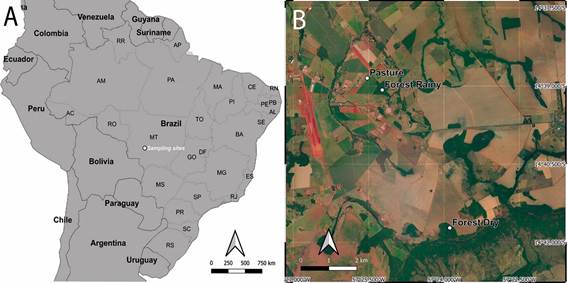
The study areas were situated in the Municipality of Tangará da Serra (14°37′55″S, 57°28′05″W, altitude 488 m), Mato Grosso State, Brazil (Fig. 1).
Location of study area. (A) Political map of Brazil indicating the municipality of Tangará da Serra, MT (white circle). (B) Location of pasture and forest sampling sites (white circle). Forest collection sites varied between the rainy and dry seasons.
Although officially part of the Cerrado Biome, these areas are at the confluence of the Cerrado and Amazon Biome (IBGE, 2019). The regional climate, classified as Aw in the Köppen-Geiger system, is characterized by two distinct seasons: dry season from May to September and a rainy season from October to April (Dallacort et al., 2011). The monthly rainfall averages are as follows: June, July, and August receive an average of 14.56 mm, May and September average 67.3 mm, and the month of December through March each exceed an average of 250 mm (Dallacort et al., 2011; data from 1970 to 2007). The highest average temperature is 26.1℃ in November, while the lowest is to 22.6℃ in June (Climate-data.org, data from 1982 to 2012).
Collections were carried out in the locations and on the dates detailed in Table 1. For logistical reasons, the forest sampling sites differed between the rainy and dry seasons, with a distance of approximately 5 km between them.
Collection was conducted using traps baited with banana and biological yeast, adhering to the methodology described by Tidon & Sene (1988). A total of twenty traps were deployed across three transects: one transect featured 10 traps spaced in intervals of 30 m, while the other two transects had five traps each, positioned 60 m apart. These traps were left in the field for a duration of three days.
The drosophilids were identified based on their external morphology, and the males of sibling species were distinguished by their terminalia, following the protocol established by Wheeler & Kambysellis (1966) with modifications by Kaneshiro (1969). Morphological characteristics and terminalia were cross-referenced with specialized literature (Freire-Maia & Pavan, 1949; Vilela & Bächli, 1990). Some individuals within the D. willistoni group were identified as D. willistoni and D. paulistorum, but for ecological analysis purposes, they were grouped together as D. willistoni. Similarly, although variations in aedeagus morphology is noticiable within the D. sturtevanti subgroup, all were considered as D. sturtevanti species for the purpose of our study.
Data analysis
The richness and abundance of each trap were determined. Species composition between the two phytophysiognomies (forest and pasture) and across seasonal variation (dry and rainy) were analyzed using Similarity Analysis (ANOSIM), employing the dissimilarity indexes of Jaccard and Bray-Curtis (Magurran, 2004). The Jaccard index, a qualitative measure, was used to assess the influence of phytophysiognomy and season on species composition, whereas the Bray-Curtis index, a quantitative measure, considered both species composition and dominance. These analyses aimed to confirm differences across areas and seasons and were performed with 10,000 permutations, using the PAST version 1.82b software (Hammer et al., 2001). Similar analyses were performed to evaluate the effects of sampling design (30 m and 60 m distances between traps) across areas and seasons (FD, FR, PD, PR) in Drosophilidae sampling.
A randomized accumulation curve for the species was generated, along with 95% confidence intervals, using EstimateS v.8.0 software (Colwell, 2005) to assess species richness estimators and determine the extent of sampling effort (Magurran, 2004).
Spatial autocorrelation between the sampling units (each trap) was tested using the Mantel test (Legendre & Fortin, 1989) and the software R version 2.11.1, with 5,000 randomizations (R Development Core Team, 2010).
RESULTS
Drosophilidae assemblage
A total of 29,362 drosophilids, representing 36 species and seven genera (Table 2), were collected. The most abundant species were the exotics species Scaptodrosophila latifasciaeformis (20,764 individuals), Zaprionus indianus (3,103 individuals), and Drosophila malerkotliana (2,324 individuals). This study marks the first record of D. aldrichi, D. carolinae, and D. parasaltans in Mato Grosso State (Blauth & Gottschalk, 2007; Blauth et al., 2013; Paula et al., 2014; Roque et al., 2015).
Total number of Drosophilidae species collected in the Forest and Pasture during the dry and rainy seasons, using banana and yeast-baited traps in the Municipality of Tangará da Serra, Mato Grosso State, Brazil, within the Cerrado Biome. Species marked with ‘1’ were sampled for the first time in the State of Mato Grosso, Brazil, and species marked with ‘2’ were referred to as Rhinoleucophenga sp.1 in Blauth & Gottschalk (2007).
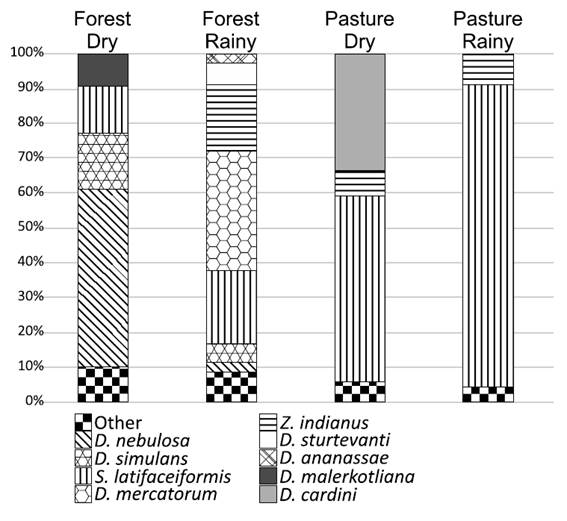
The highest Drosophilidae abundance was recorded in PR, with 21,007 individuals, while the highest species richness was observed during the rainy season, with 27 species in FR and 26 species in PR. Figure 2 displays ~ 90% of the most abundant species from each phytophysiognomy and season.
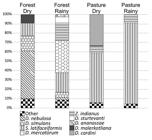
Relative frequency of Drosophilidae species collected across dif ferent phytophysiognomies and seasons. The graph displays the 90% most abundant species, while the “others” category groups the approximately 10% less abundant species.
Out of the 36 taxa collected, six were singletons and an additional six were doubletons. PR recorded six single/doubletons, while PD and FR each had three, and FD had none (Table 2).
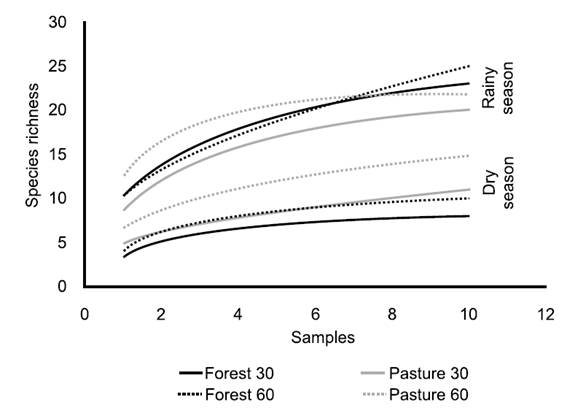
The species accumulation curve approaches an asymptote, indicating adequate sampling (Fig. 3). Furthermore, it underscores the disparity in richness between the dry and rainy seasons.
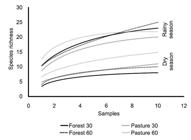
Randomized accumulation curves for each area are shown: Forest is represented by a black line and Pasture by a gray line. Within these, the season and trap spacing are differentiated with the 30 m distance indicated by a continuous line, and the 60 m distance by a dashed line.
The ANOSIM test results are shown in Table 3. The areas and seasons yield varying abundance and richness of the Drosophilidae assemblage. When comparing the collection methodologies of 30 m and 60 m distances, no difference was observed in FD. However, in FR, the methodologies showed a difference for both indices. Additionally, in the pasture area, the methodology with a 60 m distance resulted in a greater abundance during the rainy season.
Spatial autocorrelation
None of the eight Mantel tests conducted to assess the spatial autocorrelation of the sampled units yielded significant results (Table 4).
Results from the Mantel test evaluating spatial autocorrelation among sampling units (traps) at 30 m and 60 m distances, in both Forest and Pasture environments during Dry and Rainy seasons.
DISCUSSION
The Drosophilidae assemblage
In the Drosophilidae assemblage, it’s typical for a few species to dominate in terms of abundance, as noted by Mendes et al. (2017) and Roque et al. (2013). The most frequent species in our study were exotics: D. ananassae, D. malerkotliana, D. melanogaster, D. simulans, S. latifasciaeformis, and Z. indianus, which aligns with observations made by Roque et al. (2013). Our samples included D. aldrichi, D. carolinae, and D. parasaltans, marking their first recorded presence in the Mato Grosso State. This finding, as noted in previous works (Blauth & Gottschalk, 2007; Blauth et al., 2013; Chaves & Tidon, 2008; Junges & Gottschalk, 2014; Val & Marques, 1996), underscores the need for more extensive biodiversity research in the region.
The greater abundance of Drosophilidae was collected during the rainy season, which could be related to the availability of fruits (Valadão et al., 2010) or microorganisms upon which these insects rear their larvae and feed (Yoshimoto & Nishida, 2005). Additionally, species richness is greater in the rainy season, as evidenced in the Accumulation Curve analysis. Observing the collections made at the same time, but comparing the 30 m and 60 m trap distance methodologies, the 60 m approach collected more species than the 30 m methodology.
Finally, the Jaccard and Bray-Curtis indices yielded statistically different values, confirming that Drosophilidae sampling was conducted across distinct phytophysiognomies and climatic conditions.
The autocorrelation test
The spatial autocorrelation between banana and yeast-baited traps (Tidon & Sene, 1988), used in a Drosophilidae taxonomic survey, was tested considering distances of 30 m and 60 m, and the variables of forest and pasture, as well as rainy and dry seasons, representing different environmental conditions. The distance between observational sites (trap locations in our procedure) is a crucial parameter in sampling design. Physical proximity of the traps can lead to pseudoreplication. Our goal was to propose a Drosophilidae sampling methodology that provides a more accurate representation of the studied area for both taxonomic surveys and ecological analyses. A similar approach was undertaken by Mata et al. (2014) in four Cerrado Biome areas: conserved cerrado, disturbed cerrado, conserved forest, and disturbed forest. They used a group of three traps as a sampling unit, with each unit at least 30 m from another. This minimal distance of 30 m was also validated by Roque et al. (2013) in a study conducted in a gallery forest within an Ecological Reserve, which confirmed the spatial independence of the traps, irrespective of the season. We included the pasture area in our approach not only because it represents the most open phytophysiology but also due to its dominance in the Mato Grosso States. When considering all variables (phytophysiognomy, season, and distance between traps), spatial autocorrelation was not detected, corroborating prior studies that a distance of 30 m prevents pseudoreplication (Mata et al., 2014), even in open and disturbed environments.
Another study that performed the autocorrelation test was by Mendes et al. (2017), who used traps spaced 20 m apart in a Restinga Forest in southern Brazil. They detected only one positive autocorrelation, during winter, in 12-trap samplings carried out monthly over the course of a year.
The distance between traps (30 m or 60 m) influenced sampling outcomes, with significant differences in abundance across three collections (FR, PD, and PR), as detected by the ANOSIM test based on the Bray-Curtis index. Differences in species composition were also observed in FR, as indicated by the ANOSIM test using the Jaccard index. Together with the absence of spatial autocorrelation, these findings suggest that trap spacing may affect survey results, particularly regarding assemblage dominance. Numerous environmental, ecological, and physiological variables are likely to influence this spatial structure. Bonada et al. (2012) demonstrated that both exogenous (e.g., elevation, climate, water chemistry) and endogenous factors (e.g., reproduction, morphology, dispersal capacity) shape the spatial structure of stream invertebrates. We recognize the limitations of the present analysis and the need to incorporate additional variables. For Drosophilidae, olfactory capacity may play a central role (Breugel & Dickinson, 2014), as it mediates attraction to trophic, mating, and oviposition resources near baits. Regarding dispersal ability, although it likely varies among species, it is probably superior to the distance of the sampling transect, as the capacity of displacement of D. melanogaster was up to 12 km (Leitch et al., 2021).
For optimizing survey and ecological study logistics, we propose a sampling protocol for Drosophilidae with at least 30 m distance between traps methodology. This recommendation is for both open and closed vegetation, given the absence of autocorrelation, the numerous studies already conducted with 30 m trap distribution, and because the richness observed using the 60 m method was not significantly different from the 30 m method.
ACKNOWLEDGMENTS:
To Dr. Diogo Andrade Costa for discussions about methodology and data analysis. To an anonymous reviewer for its constructive and valuable comments on the manuscript.
REFERENCES
-
Bächli, G. 2023. TaxoDros: the database on taxonomy of Drosophilidae. Available: https://www.taxodros.uzh.ch Access: 16/01/2023.
» https://www.taxodros.uzh.ch - Bitner-Mathé, B.C.; Victorino, J. & Faria, F.S. 2014. Drosophila suzukii has been found in tropical Atlantic Rainforest in southeastern Brazil. Drosophila Information Service, 97: 136-137.
-
Bizzo, L.; Gottschalk, M.S.; De Toni, D.C. & Hofmann, P.R.P. 2010. Seasonal dynamics of a drosophilid (Diptera) assemblage and its potential as bioindicator in open environments. Iheringia, Série Zoológica, 100: 185-191. https://doi.org/10.1590/S0073-47212010000300001
» https://doi.org/10.1590/S0073-47212010000300001 -
Blauth, M.L. & Gottschalk, M.S. 2007. A novel record of Drosophilidae species in the Cerrado biome of the state of Mato Grosso, west-central Brazil. Drosophila Information Service, 90: 90-96. https://www.ou.edu/journals/dis/DIS90/index.html
» https://www.ou.edu/journals/dis/DIS90/index.html -
Blauth, M.L.; Lima, D.P.; De Araújo, D.S.; Moysés, J.B. & Gottschalk, M.S. 2013. New distribution records of four Drosophila species (Diptera, Drosophilidae) in Mato Grosso, Brazil. Drosophila Information Service, 96: 58-60. https://www.ou.edu/journals/dis/DIS96/DIS96.html
» https://www.ou.edu/journals/dis/DIS96/DIS96.html -
Bonada, N.; Dolédec, S. & Statzner, B. 2012. Spatial autocorrelation patterns of stream invertebrates: exogenous and endogenous factors. Journal of Biogeography, 39: 56-68. https://doi.org/10.1111/j.1365-2699.2011.02562.x
» https://doi.org/10.1111/j.1365-2699.2011.02562.x -
Breugel, F. van & Dickinson, M.H. 2014. Plume-tracking behavior of flying Drosophila emerges from a set of distinct sensory-motor reflexes. Current Biology, 24: 274-286. https://doi.org/10.1016/j.cub.2013.12.023
» https://doi.org/10.1016/j.cub.2013.12.023 -
Chaves, N.B. & Tidon, R. 2008. Biogeographical aspects of drosophilids (Diptera, Drosophilidae) of the Brazilian savanna. Revista Brasileira de Entomologia, 52(3): 340-348. https://doi.org/10.1590/S0085-56262008000300005
» https://doi.org/10.1590/S0085-56262008000300005 -
Climate-data.org. Available: https://pt.climate-data.org Access: 16/01/2023.
» https://pt.climate-data.org -
Colwell, R.K. 2005. ESTIMATES: Statistical Estimation of Species Richness and Shared Species from Samples Version 7.5.0. Available: http://purl.oclc.org/estimates Access: 10/11/2010.
» http://purl.oclc.org/estimates -
Costa, F.R.C. & Magnusson, W.E. 2010. The need for large-scale integrated studies of biodiversity - the experience of the program for biodiversity research in Brazilian Amazônia. Nature Conservation, 8: 1-5. https://doi.org/10.4322/natcon.00801001
» https://doi.org/10.4322/natcon.00801001 -
Dallacort, R.; Martins, J.A.; Inoue, M.H.; Freitas, P.S.L. & Coletti, A.J. 2011. Distribuição das chuvas no município de Tangará da Serra, médio norte do Estado de Mato Grosso, Brasil. Acta Scientiarum. Agronomy, 33(2): 193-200. https://doi.org/10.4025/actasciagron.v33i2.5838
» https://doi.org/10.4025/actasciagron.v33i2.5838 -
De Toni, D.C. & Hofmann, P.R.P. 1995. Preliminary taxonomic survey of the genus Drosophila (Diptera, Drosophilidae) at Morro da Lagoa da Conceição; Santa Catarina Island. Revista Brasileira de Biologia, 55(3): 347-350. https://link.springer.com/article/10.1007/s13744-011-0004-x
» https://link.springer.com/article/10.1007/s13744-011-0004-x -
Deprá, M.; Poppe, J.L.; Schmitz, H.J.; De Toni, D.C. & Valente, V.L.S. 2014. The first records of the invasive pest Drosophila suzukii in the South American continent. Journal of Pest Science, 87(3): 379-383. https://doi.org/10.1007/s10340-014-0591-5
» https://doi.org/10.1007/s10340-014-0591-5 -
Diniz-Filho, J.A.F.; Bini, L.M. & Hawkin, B.A. 2003. Spatial autocorrelation and red herrings in geographical ecology. Global Ecology and Biogeography, 12: 53-64. https://doi.org/10.1046/j.1466-822X.2003.00322.x
» https://doi.org/10.1046/j.1466-822X.2003.00322.x -
Döge, J.S.; Valente, V.L.S. & Hofmann, P.R.P. 2008. Drosophilids (Diptera) from an Atlantic Forest area in Santa Catarina, southern Brazil. Revista Brasileira de Entomologia, 52(4): 615-624. https://doi.org/10.1590/S0085-56262008000400013
» https://doi.org/10.1590/S0085-56262008000400013 -
Emerich, P.P.; Valadão, H.; Silva, J.R.V.P. & Tidon, R. 2012. High abundance of Neotropical Drosophilids (Diptera: Drosophilidae) in four cultivated areas of central Brazil. Neotropical Entomology, 41: 83-88. https://doi.org/10.1007/s13744-011-0004-x
» https://doi.org/10.1007/s13744-011-0004-x -
Ferreira, L.B. & Tidon, R. 2005. Colonizing potential of Drosophilidae (Insecta, Diptera) in environments with different grades of urbanization. Biodiversity Conservation, 14(8): 1809-1821. https://doi.org/10.1007/s10531-004-0701-4
» https://doi.org/10.1007/s10531-004-0701-4 - Freire-Maia, N. & Pavan, C. 1949. Introdução ao estudo da Drosófila. Cultus, 5: 2-69.
-
Garcia, C.F.; Hochmüller, C.J.C.; Valente, V.L.S. & Schmitz, H.J. 2012. Drosophilid assemblages at different urbanization levels in the city of Porto Alegre, State of Rio Grande do Sul, Southern Brazil. Neotropical Entomology, 41: 32-41. https://doi.org/10.1007/s13744-011-0007-7
» https://doi.org/10.1007/s13744-011-0007-7 -
Gottschalk, M.S.; De Toni, D.C.; Hofmann, P.R.P. & Valente, V.L.S. 2007. Changes in Brazilian Drosophilidae (Diptera) assemblages across an urbanisation gradient. Neotropical Entomology, 36(6): 848-862. https://doi.org/10.1590/S1519-566X2007000600005
» https://doi.org/10.1590/S1519-566X2007000600005 -
Gottschalk, M.S.; Martins, M.B.; Praxedes, C. & Medeiros, H.F. 2012. A new Amazonian species from the Drosophila annulimana species group (Diptera: Drosophilidae). Revista Brasileira de Entomologia, 56(4): 431-435. https://doi.org/10.1590/S0085-56262012000400006
» https://doi.org/10.1590/S0085-56262012000400006 -
Hammer, Ø.; Harper, D.A.T. & Ryan, P.D. 2001. PAST: Paleontological statistics software package for education and data analysis. Palaeontologia Electronica, 4: 4. https://palaeo-electronica.org/2001_1/past/issue1_01.htm
» https://palaeo-electronica.org/2001_1/past/issue1_01.htm -
Hochmüller, C.J.C.; Silva, L.M.; Valente, V.L.S. & Schmitz, H.J. 2010. The drosophilid fauna (Diptera, Drosophilidae) of the transition between the Pampa and Atlantic Forest Biomes in the state of Rio Grande do Sul, southern Brazil: first records. Papéis Avulsos de Zoologia, 50(19): 285-295. https://doi.org/10.1590/S0031-10492010001900001
» https://doi.org/10.1590/S0031-10492010001900001 -
Hurlbert, S.H. 1984. Pseudoreplication and the design of ecological field experiments. Ecological Monographs, 54(2): 187-211. https://doi.org/10.2307/1942661
» https://doi.org/10.2307/1942661 - Instituto Brasileiro de Geografia e Estatística (IBGE). 2019. Biomas e Sistema Costeiro-Marinho do Brasil: compatível com a escala 1:250000 Rio de Janeiro, IBGE. (Série: Relatos Metodológicos. Vol. 45).
-
Junges, J. & Gottschalk, M.S. 2014. Two new species of the new world genus Rhinoleucophenga (Diptera: Drosophilidae). Journal of Insect Science, 14: 157. https://doi.org/10.1093/jisesa/ieu019
» https://doi.org/10.1093/jisesa/ieu019 - Kaneshiro, K.Y. 1969. A study of the relationships of Hawaiian Drosophila species based on the external male genitalia. The University of Texas Publication, 6918: 55-69.
- Leão, B.F.D.; Roque, F.; Deus, P. & Tidon, R. 2017. What happens when exotic species arrive in a new area? The case of drosophilids in the Brazilian Savanna. Drosophila Information Service, 100: 65-69.
-
Legendre, P. & Fortin, M.J. 1989. Spatial pattern and ecological analysis. Vegetatio, 80: 107-138. https://doi.org/10.1007/BF00048036
» https://doi.org/10.1007/BF00048036 - Legendre, P. & Legendre, L. 1998. Numerical ecology. Amsterdam, Elsevier.
-
Leitch, K.J.; Ponce, F.V.; Dickson, W.B.; van Breugel, F. & Dickinson, M.H. 2021. The long-distance flight behavior of Drosophila supports an agent-based model for wind-assisted dispersal in insects. Proceedings of the National Academy of Sciences of the United States of America, 118: e2013342118. https://doi.org/10.1073/pnas.2013342118
» https://doi.org/10.1073/pnas.2013342118 - Magurran, A.E. 2004. Measuring biological diversity Oxford, Blackwell Publishing.
-
Martins, M.B. 1987. Variação espacial e temporal de algumas espécies e grupos de Drosophila (Diptera) em duas reservas de matas isoladas, nas vizinhanças de Manaus (Amazonas, Brasil). Boletim do Museu Paraense Emílio Goeldi, série Zoológica, 3: 195-218. https://repositorio.museu-goeldi.br/handle/mgoeldi/386
» https://repositorio.museu-goeldi.br/handle/mgoeldi/386 -
Mata, R.A.; Roque, F. & Tidon, R. 2008a. Drosophilids (Insecta, Diptera) of the Paranã Valley: eight new records for the Cerrado Biome. Biota Neotropical, 8: 55-60. https://doi.org/10.1590/S1676-06032008000100006
» https://doi.org/10.1590/S1676-06032008000100006 -
Mata, R.A.; McGeoch, M.A. & Tidon, R. 2008b. Drosophilid assemblages as a bioindicador system of human disturbance in the Brazilian Savanna. Biodiversity Conservation, 17: 2899-2916. https://doi.org/10.1007/s10531-008-9403-7
» https://doi.org/10.1007/s10531-008-9403-7 -
Mata, R.A.; McGeoch, M.A. & Tidon, R., 2010. Drosophilids (Insecta, Diptera) as tools for conservation biology. Nature Conservation, 8: 60-65. https://doi.org/10.4322/natcon.00801009
» https://doi.org/10.4322/natcon.00801009 - Mata, R.A.; Santos, G.A.; Uehara-Prado, M. & Tidon, R. 2014. Improving sampling protocol for assessing drosophilid diversity: spatial independence and sample size. Drosophila Information Service, 97: 161-162.
-
Mateus, R.P.; Buschini, M.L.T. & Sene, F.M. 2006. The Drosophila community in xerophytic vegetation of the upper Parana-Paraguay river basin. Brazilian Journal of Biology, 66: 719-729. https://doi.org/10.1590/S1519-69842006000400016
» https://doi.org/10.1590/S1519-69842006000400016 -
Medeiros, H.F. & Klaczko, L.B. 2004. How many species of Drosophila (Diptera, Drosophilidae) remain to be described in the forests of São Paulo, Brasil? Species lists of tree forest remnats. Biota Neotropica, 4: 1-12. https://doi.org/10.1590/S1676-06032004000100005
» https://doi.org/10.1590/S1676-06032004000100005 -
Mendes, M.F.; Valer, F.B.; Aleixo, J.G.V.; Blauth, M.L. & Gottschalk, M.S. 2017. Diversity of Drosophilidae (Insecta, Diptera) in the Restinga forest of southern Brazil. Revista Brasileira de Entomologia, 61(3): 248-256. https://doi.org/10.1016/j.rbe.2017.05.002
» https://doi.org/10.1016/j.rbe.2017.05.002 - Paula, M.A.; Lopes, P.H.S. & Tidon, R. 2014. First record of Drosophila suzukii in the Brazilian savanna. Drosophila Information Service, 97: 113-115.
-
Penariol, L.V. & Madi-Ravazzi, L. 2013. Edge-interior differences in the species richness and abundance of drosophilids in a semideciduous forest fragment. Springer Plus, 2: 114. https://doi.org/10.1186/2193-1801-2-114
» https://doi.org/10.1186/2193-1801-2-114 -
Penariol, L.; Bicudo, H.E.M.C. & Madi-Ravazzi, L. 2008. On the use of open or closed traps in the capture of drosophilids. Biota Neotropica, 8: 47-51. https://doi.org/10.1590/S1676-06032008000200004
» https://doi.org/10.1590/S1676-06032008000200004 -
Poppe, J.L.; Schmitz, H.J.; Grimaldi, D. & Valente, V.L.S. 2014. High diversity of Drosophilidae (Insecta, Diptera) in the Pampas Biome of South America, with descriptions of new Rhioleucophenga species. Zootaxa, 3779: 215-245. https://doi.org/10.11646/zootaxa.3779.2.6
» https://doi.org/10.11646/zootaxa.3779.2.6 -
Poppe, J.L.; Valente, V.L.S. & Schmitz, H.J. 2012. Structure of Drosophilidae assemblage (Insecta, Diptera) in Pampa Biome (São Luís Gonzaga, RS). Papéis Avulsos de Zoologia, 52(16): 185-195. https://doi.org/10.1590/S0031-10492012001600001
» https://doi.org/10.1590/S0031-10492012001600001 -
Poppe, J.L.; Valente, V.L.S. & Schmitz, H.J. 2013. Population dynamics of Drosophilids in the Pampa Biome in response to temperature. Neotropical Entomology, 42(3): 269-277. https://doi.org/10.1007/s13744-013-0125-5
» https://doi.org/10.1007/s13744-013-0125-5 -
R Development Core Team. 2010. R: A language and environment for statistical computing Vienna, R Foundation for Statistical computing, Austria. Available: http://www.R-project.org Access: 10/11/2010.
» http://www.R-project.org -
Roque, F.; Mata, R.A. & Tidon, R. 2013. Temporal and vertical drosophilid (Insecta; Diptera) assemblage fluctuations in a neotropical gallery forest. Biodiversity Conservation, 22(3): 657-672. https://doi.org/10.1007/s10531-013-0433-4
» https://doi.org/10.1007/s10531-013-0433-4 - Roque, F.; Mencarini, L. & Tidon, R. 2015. Revised list of drosophilid species recorded in the Brazilian Savanna. Drosophila Information Service, 98: 70-74.
-
Schmitz, H.J.; Hofmann, P.R.P. & Valente, V.L.S. 2010. Assemblages of drosophilids (Diptera, Drosophilidae) in mangrove forests: community ecology and species diversity. Iheringia, Série Zoológica, 100: 133-140. https://doi.org/10.1590/S0073-47212010000200008
» https://doi.org/10.1590/S0073-47212010000200008 -
Schmitz, H.J.; Valente, V.L.S. & Hofmann, P.R.P. 2007. Taxonomic survey of Drosophilidae (Diptera) from mangrove forests of Santa Catarina Island, Southern Brazil. Neotropical Entomology, 36: 53-64. https://doi.org/10.1590/S1519-566X2007000100007
» https://doi.org/10.1590/S1519-566X2007000100007 -
Shekhar, S.; Xiong, H. & Zhou, X. 2017. Encyclopedia of GIS Cham, Springer. https://doi.org/10.1007/978-3-319-17885-1
» https://doi.org/10.1007/978-3-319-17885-1 - Tidon, R. & Sene, F.M. 1988. A trap that retains and keeps Drosophila alive. Drosophila Information Service, 67: 89.
-
Torres, F.R. & Madi-Ravazzi, L. 2006. Seasonal variation in natural populations of Drosophila spp. (Diptera) in two woodlands in the state of São Paulo, Brazil. Iheringia, Série Zoológica, 96(4): 437-444. https://doi.org/10.1590/S0073-47212006000400008
» https://doi.org/10.1590/S0073-47212006000400008 -
Val, F.C. & Marques, M.D. 1996. Drosophilidae (Diptera) from the Pantanal of Mato Grosso (Brazil), with the description of a new species belonging to the bromeliae group of the genus Drosophila Papéis Avulsos de Zoologia, 39(11): 223-230. https://doi.org/10.11606/0031-1049.1994.39.p223-230
» https://doi.org/10.11606/0031-1049.1994.39.p223-230 -
Valadão, H.; Hay, J.D.V. & Tidon, R. 2010. Temporal dynamics and resource availability for drosophilid fruit flies (Insecta, Diptera) in a gallery forest in the Brazilian Savanna. International Journal of Ecology, 2010: 1-7, 152437. https://doi.org/10.1155/2010/152437
» https://doi.org/10.1155/2010/152437 - Vilela, C.R. & Bächli, G. 1990. Taxonomic studies on Neotropical species of seven genera of Drosophilidae (Diptera). Mitteilungen der Schweizerischen Entomologischen Gesellschaft, 63: 1-332.
- Wheeler, M.R. & Kambysellis, M.P. 1966. Notes on the Drosophilidae (Diptera) of Samoa. The University of Texas Publication, 6615: 533-565.
-
Wiens, J.A. 1989. Spatial scaling in ecology functional ecology. Functional Ecology, 3(4): 385-397. https://doi.org/10.2307/2389612
» https://doi.org/10.2307/2389612 -
Yoshimoto, J. & Nishida, T.K.T. 2005. Influence of resource abundance on the structure of the insect community attracted to fermented tree sap. Ecological Research, 20(4): 405-414. https://doi.org/10.1007/s11284-005-0054-9
» https://doi.org/10.1007/s11284-005-0054-9