Otolith as a tool to differentiate juveniles of two species Centropomidae
Abstract
Centropomus undecimalis and Centropomus ensifurus are a species belonging to the family Centropomidae, which has an important role in estuarine ecosystem. The present study aimed at comparing the otoliths shape of juveniles both species collected in in the lower São Francisco River (10°28′34.02″S, 36°24′27.02″W). In the laboratory, 52 otoliths were extracted, photographed, measured and the contour was analyzed by the wavelet method. The otolith contours varied between species (n = 28 C. ensiferus and n = 24 C. undecimalis). The Linear Discriminant Analysis correctly reclassified 92.3% of all otoliths among species. MANOVA also evidenced significant differences in contour between species (F = 3.73; p < 0.0001). The results suggest that C. ensiferus is adapted to enviroments with higher turbidity and the C. undecimalis tends to colonize environments with lower turbidity and spends more time in the water column.
Keywords
Common snook; Swordspine snook; Estuary; Use habitat; River; Beach seine net.
INTRODUCTION
Otoliths are metabolically inert structures composed by calcium carbonate in a protein matrix, precipitated mainly in the form of aragonite (Campana, 1999; Schulz-Mirbach et al., 2019). They are located in the inner ear of the bony fishes, being an important component of their mechanoreceptor system (Assis et al., 2003). They have interspecific patterns among species and some morphological changes may occur influenced by various physiological or external factors (Popper & Fay, 2011). Growth, sex, reproduction and feeding are examples of physiological factors that influence the morphology of the otolith (Gagliano & McCormick, 2004; Tombari et al., 2005; Carvalho et al., 2020; Medeiros et al., 2021). Environmental factors can also influence the morphology and morphometry of the otoliths as for example: depth is related to alterations in the sulcus acusticus area, allowing a greater sound perception (Torres et al., 2000; Cruz & Lombarte, 2004) and salinity influences in the biomineralization of the otoliths (Avigliano et al., 2014). Otoliths are excellent tools for understanding the connectivity and patterns of fishes through analysis of their chemical concentrations (Morissette & Whitledge, 2022). Using morphology and morphometry it is possible to identify patterns of habitat use and patterns of growth (Verocai et al., 2023). For example, studies using otoliths have helped to identify patterns of habitats use and patterns of growth of Centropomidae species (Daros et al., 2016; Medeiros et al., 2021).
The family Centropomidae comprises 12 species, commonly called “snooks”, they occur in tropical and subtropical regions of the Pacific and Atlantic Ocean (Froese & Paully, 2023). Five of this species are present on the Brazilian coast: Centropomus undecimalis (Bloch, 1792), Centropomus parallelus (Poey, 1860), Centropomus ensiferus (Poey, 1860), Centropomus pectinatus (Poey, 1860), Centropomus poeyi (Chavez, 1961) and Centropomus irae (Carvalho-Filho, Oliveira, Soares & Araripe, 2019) (Carvalho-Filho et al., 2019; Figueiredo-Filho et al., 2021). The species from the genera Centropomus are stenothermic and thermophilic and they are not found in temperatures below 15℃ (Rivas, 1986). Snooks are predators feeding fishes and/or invertebrates, use estuaries for growth and feeding, and have a complex life cycle, with some species being sequential hermaphroditic (Daros et al., 2016; Lira et al., 2017; Medeiros et al., 2021). Centropomus species are an important fishery resource mainly by sport fishers (Freire et al., 2016). Species of this family also are important because of their high commercial value and the potential for aquaculture (Junior et al., 2007; Ostini et al., 2007).
In the Northeast Brazilian coastal environment, the largest number of Centropomus species are: C. parallelus, C. pectinatus, C. undecimalis and C. ensiferus (Figueiredo-Filho et al., 2021). The focus of the present study was C. undecimalis and C. ensiferus, because both species use shallow estuarine environments for growth and feeding fishes and/or invertebrates (Bot Neto et al., 2023; Froese & Pauly, 2023). C. undecimalis presents immature individuals smaller than 10 cm, but for C. ensiferus there is no information about the length at first maturation (Medeiros, et al., 2021; Froese & Pauly, 2023) and habitat use by juveniles of these species is unknown. There is a lack of knowledge about the habitat use of C. undecimalis and C. ensiferus juveniles, due to this the aims are to use the otolith shape of juveniles from both species and correlate with the habitat use of these species in a tropical environment.
MATERIAL AND METHODS
Ethical Statement
The capture complied with animal welfare laws, guidelines and policies, approved by the national licensing authority the “Instituto Brasileiro do Meio Ambiente e dos Recursos Naturais Renováveis, IBAMA” with license number 56379.
Study area
The Brazilian Northeast Coast is characterized by water temperatures ranging between 25.5℃ and 29.6℃ and is also considered an oligotrophic environment (Heileman, 2009). This coast is subjected to a marked period of high precipitation in the austral winter (rainy season, June/July to August/September) (Oliveira et al., 2018). The São Francisco River Basin is located between geographical coordinates of 7.0° 21.0°S and 35.0° 47.7°W, has an area of 638,576 km2 and an extension of 2,860 km. This river has its origins in the Canastra National Park and the outfall is on the Atlantic Ocean. The flow average annual of 2,850 m3.s⁻1, ranging from 1,077 to 5,290 m3.s⁻1 (Bezerra et al., 2019).
Sample processing
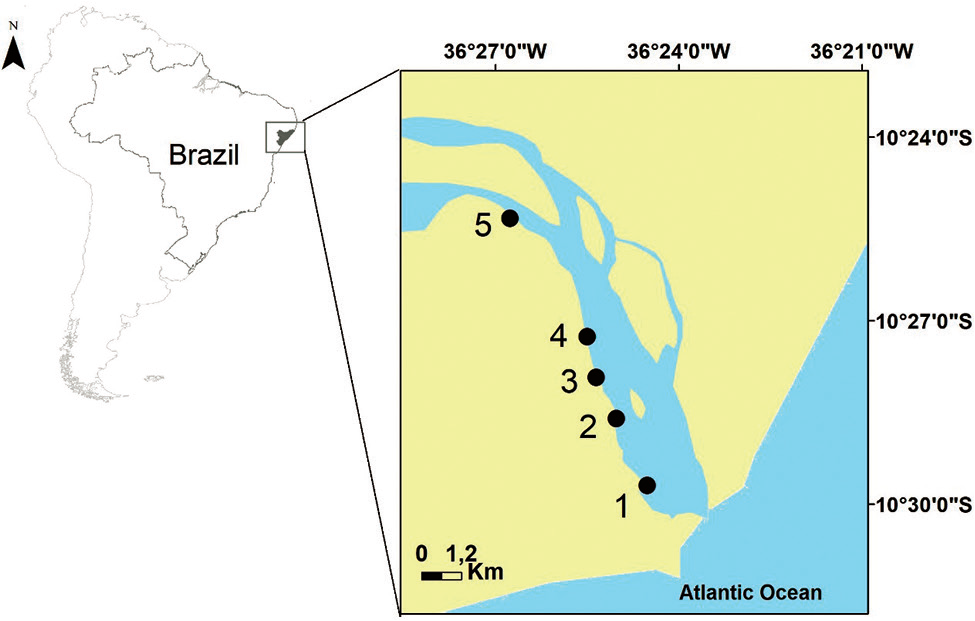
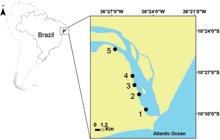
The specimens of Centropomus undecimalis and C. ensiferus was sampled monthly, between May 2017 and April 2018, at five sampling sites distributed between the mouth of the São Francisco River and the municipality of Brejo Grande (Fig. 1), in the region of lower São Francisco River (10°28′34.02″S, 36°24′27.02″W). For collection, a beach seine (30 m long, 2.8 m high, and 5 mm mesh between opposite knots) was used. Subsequently, the caught fish individuals were refrigerated, identified to the species taxonomic level using specialized literature (Figueiredo & Menezes, 1980), measured (total length TL; 0.01 cm and standard-length SL; 0.01 cm), weighed (total weight TW; 0.1 g). The sagitta otoliths were extracted, packed in identified plastic bags and subsequently photographed.
Otolith contour analysis
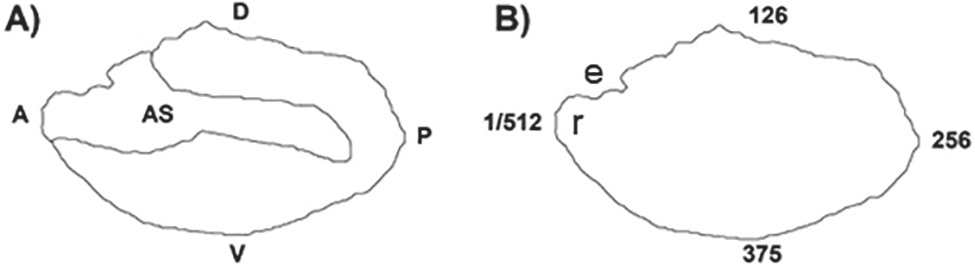
The right otolith was photographed and the otolith length (OL, in mm), height (OH, in millimeters) and area of the sulcus acusticus (AS, in mm2) were measured through these images (Fig. 2A). The classification of the otolith shape was performed according to Tuset et al. (2008) and Brenha-Nunes et al. (2016).
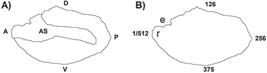
(A) Schematic drawing of the sagitta otolith of Centropomus undecimalis and Centropomus ensiferus caught in the lower São Francisco River, Sergipe, Brazil; (B) Contour of the otolith using 512 equidistant coordinates in the sagitta otolith; Abbreviations: A = anterior region, D = dorsal region, V = ventral region, P = posterior part of the otolith, AS = sulcus acusticus, r = rostrum and e = excisura.
The wavelet function was used to define the otolith contour (Parisi-Baradad et al., 2010; Sadighzadeh et al., 2014) (Fig. 2B). The wavelet is the result of the expansion of a signal in a family of functions representing expansions and translations of a mother function, i.e.: Ψs(x) = 1/sΨ(φ/s), where Ψ is a function with local support in a limited amplitude on the abscissa axis; φ lower the step filter; s is a scale parameter (Mallat, 1991). A total of 512 points, with equidistant coordinates from each otolith, were extracted with the rostrum as the contour origin (Parisi-Baradad et al., 2010). The fourth and fifth wavelet are more appropriate for identifying stocks or populations, as they describe the contour of the otoliths more sensitively (Sadighzadeh et al., 2014). The image processing was performed using AFORO (http://aforo.cmima.csic.es) (Parisi-Baradad et al., 2010).
A Principal Component Analysis (PCA), based on the variance-covariance matrix, was applied to reduce wavelet functions without losing information (Tuset et al., 2015). Principal components (PCs) explaining data variability were selected by the Broken-stick method (Gauldie & Crampton, 2002). Subsequently, the effect of the allometry of fish size was removed using the residuals of the linear regression between the significant principal components and the otolith length. From these, a new PCA was run (Stransky & MacLellan, 2005) to check for variations in the otolith contour for each species. The allometry was testes and no significance difference was found. A Linear Discriminant Analysis (LDA) was applied between sites to verify the correct percentage of otolith reclassification. A multivariate analysis of variance (MANOVA) was performed with the length and height of otoliths and the PC without the effect of allometry, to check for differences in the shape of otoliths collected in those three states. All statistical analyses were performed using the Past software version 4.03 (Hammer et al., 2001).
RESULTS
A total of fifty-two otoliths of C. ensiferus (n = 28) and C. undecimalis (n = 24) from Sergipe were analyzed (Table 1). OL (U = 191,5; p < 0.05), OH (U = 183; p < 0.05) and AS (U = 174; p < 0.05) showed significant variations between species. TL (U = 250; p > 0.05), SL (U = 353; p > 0.05) and OH/OL*100 (U = 309; p > 0,05) did not show significant variations between species.
Mean and standard deviation of fish total length (TL), standard-length (SL) and otolith length (OL), height (OH) and areas of the sulcus acusticus (AS) of Centropomus ensiferus and Centropomus undecimalis by location and “n” number of specimens analyzed in Sergipe (SE), northeastern Brazil.
Otoliths of C. ensiferus and C. undecimalis presented some morphological variations. Centropomus ensiferus have a trapezoidal shape, rostrum and excisura (Fig. 3A and B), specimens above TL 7.5 cm present closed excisura (Fig. 3C). Centropomus undecimalis have an elliptic shape, rostrum and excisura presented in all specimens with length less than 7 cm (Fig. 3D).
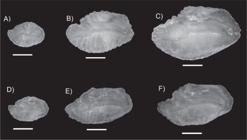
Rigth sagitta otoliths Centropomus ensiferus (A) 3.9 cm, (B) 7.6 cm, (C) 9.8 cm and Centropomus undecimalus (D) 3.9 cm, (E) 7.5 cm, (F) 9.9 cm caught in the lower São Francisco River, Sergipe, Brazil. Scale bars = 1 mm.
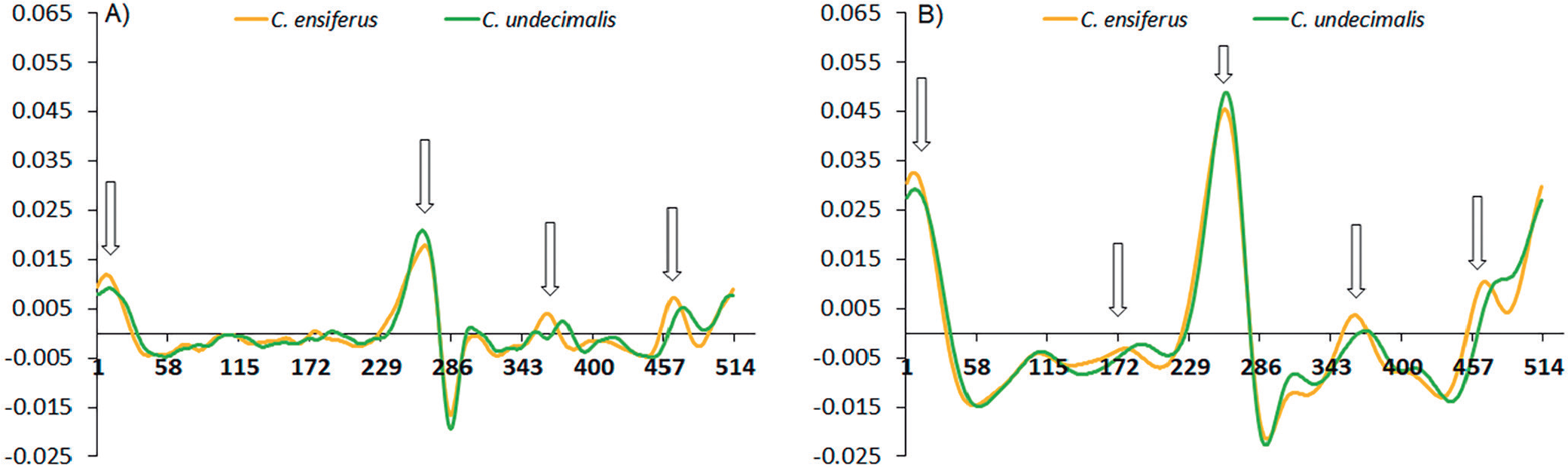
The reconstruction of the otolith contour using wavelets 4 and 5 showed variability (Fig. 4). The wavelet 4 showed greater variation between the species in the anterior rostrum (1-10), posterior (229-286), ventroposterior (290-400), ventroanterior (457-512) (Fig. 4 A). Wavelet 5 presented variation between the species in the anterior rostrum (1-10), dorsal (115-220 posterior (229-286), ventroposterior (290-400), ventroanterior (457-512) (Fig. 4B).
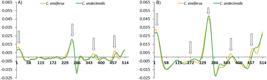
Contour decomposition of the sagittae otolith of Centropomus ensiferus and Centropomus undecimalis collected in Sergipe (SE), northeastern Brazil: (A) Wavelet 4 and (B) Wavelet 5.
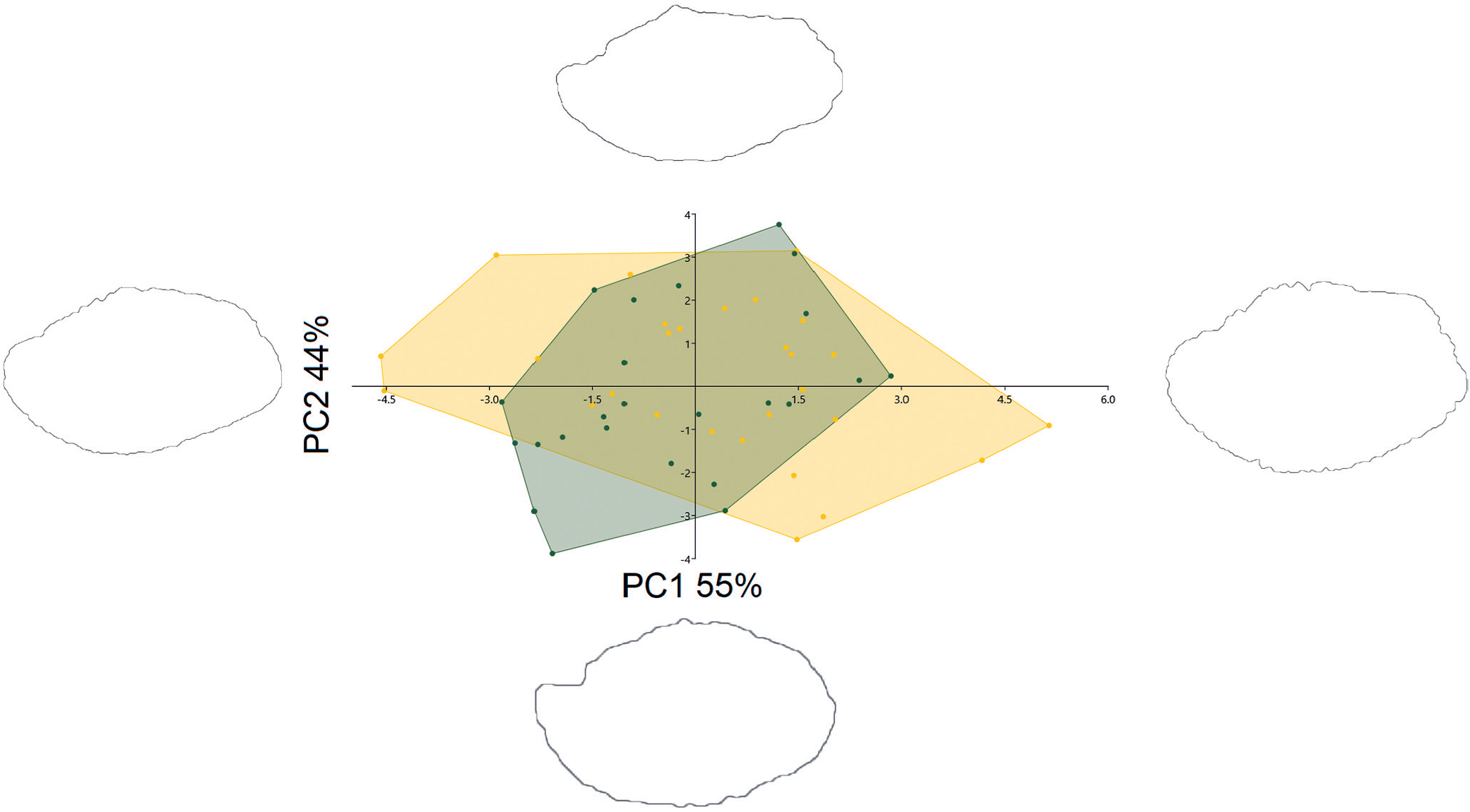
The PCA showed high variability in the otolith shape (Fig. 5). PC1 explained 52% and PC2 explained 44% of the otolith shape variability. Along PC1 are distributed more rounded otoliths mainly specimens C. ensiferus and on PC2 are distributed more elongated otoliths, with rostrum and excisura mainly specimens C. undecimalis (Fig. 5).
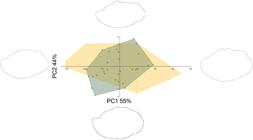
Principal Component Analysis (PCA) scatterplot for the sagittae otolith contour of Centropomus ensiferus (dots yellow) and Centropomus undecimalis (dots green) collected in Sergipe (SE), northeastern Brazil.
The LDA showed correct reclassification of 92.3% of all otoliths among species. Centropomus ensiferus otoliths showed the highest reclassification percentage (96.42%) and C. undecimalis otoliths showed a smaller percentage of reclassification (87.5%) (Table 2). MANOVA evidenced a significant difference in otolith shape among species (F = 3.73; p < 0.0001).
Reclassification of sagittae otolith of Centropomus ensiferus and Centropomus undecimalis between those collected in the northeastern (Sergipe, SE) by the linear discriminant analysis (LDA).
DISCUSSION
In this study, we examined the morphometric variation and contour of the sagittae otolith from juveniles specimens of two species from the genus Centropomus (C. undecimalis and C. ensiferus). The species showed otolith shape that varied from elliptical to trapezoidal, rostrum and excisura present as a characteristic diagnostic trait for the genus Centropomus (Brenha-Nunes et al., 2016; Bot Neto et al., 2020; Granados-Amores et al., 2020). The areas of the sulcus acusticus showed significant variations between species, juveniles C. ensiferus showed a larger area of the sulcus acusticus indicating greater auditory sensitivity compared to C. undecimalis juveniles. This difference suggests that in the early-stage C. ensiferus can adapt to environments with greater turbidity due to its better hearing ability, whereas C. undecimalis would use environments with less turbidity, avoiding competition between species in the initial stages. Through otolith morphometry, it was possible to identify patterns of habitat use in relation to turbidity as saw before for Menticirrhus americanus (Carvalho et al., 2020). In future studies of trophic ecology, this difference in the area of sulcus acusticus could allow differentiation between C. ensiferus and C. undecimalis when they were the prey, as evidenced in other species (Carvalho et al., 2019; Assis et al., 2020). Species adapted to environments with elevated turbidity present a greater heating ability compared to species in regions with lower turbidity, major otoliths are usually correlated with species greater hearing ability for examples species of Sciaenidae family (Verocai, et al., 2023).
According to Volpedo & Echeverria (2003), values in the aspect ratio (OH/OL*100) between 41 and 67 indicate species associated with unconsolidated substrates (composed of silt, clay and sand) and between 35-50 indicate pelagic species. The present study demonstrates that the aspect ratio of juveniles of C. ensiferus and C. undecimalis fits the definitions of Volpedo & Echeverría (2003). Analyzing larger specimens of C. undecimalis (LT between 14.0 and 38.0 cm), the aspect ratio presents lower values than the juveniles analyzed in the present study (OH/OL*100 between 51.66-57.46; Brenha-Nunes et al., 2016). This value of aspect ratio indicates that there is no variation in habitat use between juveniles and adults the C. undecimalis, in both life stages C. undecimalis uses habitats with unconsolidated sediment and frequents the water column due to the presence of rostrum in juveniles and adults (Bot Neto et al., 2020). For C. ensiferus, it is not possible to make correlations of habitat use patterns between juveniles and adults due to the lack of studies otoliths of adults individuals.
Wavelet analysis is more sensitive to small contour variations, than otolith morphometry and aspect ratio. In this study, it was possible to verify greater variation in the contour of the rostrum between the two species analyzed by the Wavelet method. The rostrum is more developed in pelagic species, it also presents a great ontogenetic variation and is correlated with the migratory capacity of several species (Volpedo & Echeverría, 2003; Volpedo et al., 2008; Jaramillo et al., 2014). Centropomus undecimalis presents more developed rostrum in the otolith analyzed by wavelet in the relation C. ensiferus (Fig. 5), this characteristic suggests that juveniles of C. undecimalis in the Brazilian northeast coast remains longer in the water column and probably in less turbid water. The analysis of the contour and morphometry of otolith shape is an important tool which helped to suggests the pattern use habitat within the species of the family Centropomidae along the Brazilian coast. We further recommend studies involving the otolith chemistry and genetics to assess possible migration between the populations that inhabit rivers and/or estuaries.
Acknowledgments:
BMC is thankful to the National Council for Scientific and Technological Development (CNPq #168196/2022-0). RLB is thankful to the Coordination for the Improvement of Higher Education Personnel (CAPES).
-
FUNDING INFORMATION:
National Council for Scientific and Technological Development and Coordination for the Improvement of Higher Education Personnel.
-
Published with the financial support of the “Programa de Apoio às Publicações Científicas Periódicas da Universidade de São Paulo”
REFERENCES
-
Assis, C.A. 2003. The lagenar otoliths of teleosts: their morphology and its application in species identification, phylogeny and systematics. Journal of Fish Biology, 62(6): 1268-1295. https://doi.org/10.1046/j.1095-8649.2003.00106.x
» https://doi.org/10.1046/j.1095-8649.2003.00106.x -
Assis, I.O.; Silva, V.E.L.; Souto-Vieira, D.; Lozano, A.P.; Volpedo, A.V. & Fabré, N.N. 2020. Ecomorphological patterns in otoliths of tropical fishes: assessing trophic groups and depth strata preference by shape. Environmental Biology of Fishes, 103(4): 349-361. https://doi.org/10.1007/s10641-020-00961-0
» https://doi.org/10.1007/s10641-020-00961-0 -
Avigliano, E.; Martinez, C.F.R. & Volpedo, A.V. 2014. Combined use of otolith microchemistry and morphometry as indicators of the habitat of the silverside (Odontesthes bonariensis) in a freshwater-estuarine environment. Fisheries Research, 149: 55-60. https://doi.org/10.1016/j.fishres.2013.09.013
» https://doi.org/10.1016/j.fishres.2013.09.013 -
Bezerra, B.; Silva, L.L.; Santos-Silva, C.M. & Carvalho, G.G. 2019. Changes of precipitation extremes indices in São Francisco River Basin, Brazil from 1947 to 2012. Theoretical and Applied Climatology, 135(1-2): 565-576. https://doi.org/10.1007/s00704-018-2396-6
» https://doi.org/10.1007/s00704-018-2396-6 -
Bot Neto, R.L.; Carvalho, B.M.; Schwarz Júnior, R. & Spach, H.L. 2020. Ontogenetic variation in the sagitta otolith of Centropomus undecimalis (Actinopterygii: Perciformes: Centropomidae) in a tropical estuary. Acta Ichthyologica et Piscatoria, 50(4): 433-443. https://doi.org/10.3750/AIEP/03014
» https://doi.org/10.3750/AIEP/03014 -
Bot Neto, R.L.; Cattani, A.P.; Spach, H.L.; Contente, R.F.; Cardoso, O.R.; Marion, C. & Schwarz Júnior, R. 2023. Patterns in composition and occurrence of the fish fauna in shallow areas of the São Francisco River mouth. Biota Neotropica, 23(2):1-16, https://doi.org/10.1590/1676-0611-bn-2022-1387
» https://doi.org/10.1590/1676-0611-bn-2022-1387 -
Brenha-Nunes, M.R.; Santificetur, C.; Conversani, V.R.M.; Giaretta, M.B.; Rossi-Wongtschowski, C.L.D.B. & Siliprandi, C.C. 2016. Atlas of marine bony fish otoliths (sagittae) of southeastern-southern Brazil Part IV: Perciformes (Centropomidae, Acropomatidae, Serranidae, Priacanthidae, Malacanthidae, Pomatomidae, Carangidae, Lutjanidae, Gerreidae and Haemulidae). Brazilian Journal of Oceanography, 64(Sp.1): 23-75. https://doi.org/10.1590/S1679-875920161100064(sp1).
» https://doi.org/10.1590/S1679-875920161100064(sp1 -
Campana, S.E. 1999. Chemistry and composition of fish otoliths: pathways, mechanisms and applications. Marine Ecology Progress Series, 188: 263-297. https://doi.org/10.3354/meps188263
» https://doi.org/10.3354/meps188263 -
Carvalho, B.M.; Spach, H.L.; Vaz-dos-Santos, A.M. & Volpedo, A.V. 2019. Otolith shape index: is it a tool for trophic ecology studies? Journal of the Marine Biological Association of the United Kingdom, 99(7): 1675-1682. https://doi.org/10.1017/S0025315419000729
» https://doi.org/10.1017/S0025315419000729 -
Carvalho, B.M.; Volpedo, A.V. & Fávaro, L.F. 2020. Ontogenetic and sexual variation in the sagitta otolith of Menticirrhus americanus (Teleostei; Sciaenidae) (Linnaeus, 1758) in a subtropical environment. Papéis Avulsos de Zoologia, 60(9): 1-12, e20206009. https://doi.org/10.11606/1807-0205/2020.60.09
» https://doi.org/10.11606/1807-0205/2020.60.09 -
Carvalho-Filho, A.; Oliveira, J.; Soares, C. & Araripe J. 2019. A new species of snook, Centropomus (Teleostei: Centropomidae), from northern South America, with notes on the geographic distribution of other species of the genus. Zootaxa, 4671: 81-92. https://doi.org/10.11646/zootaxa.4671.1.6
» https://doi.org/10.11646/zootaxa.4671.1.6 -
Cruz, A. & Lombarte, A. 2004. Otolith size and its relationship with colour patterns and sound production. Journal of Fish Biology, 65(6): 1512-1525. https://doi.org/10.1111/j.0022-1112.2004.00558.x
» https://doi.org/10.1111/j.0022-1112.2004.00558.x -
Daros, F.A.; Spach, H.L. & Correia, A.T. 2016. Habitat residency and movement patterns of Centropomus parallelus juveniles in a subtropical estuarine complex. Journal of Fish Biology, 88(5): 1796-1810. https://doi.org/10.1111/jfb.12944
» https://doi.org/10.1111/jfb.12944 - Figueiredo, J.L. & Menezes, N.A. 1980. Manual de Peixes Marinhos do Sudeste do Brasil, III Teleostei (2), São Paulo, Museu de Zoologia, Universidade de São Paulo.
-
Figueiredo-Filho, J.M.; Marceniuk, A.P.; Feijó, A.; Siccha-Ramirez, R.; Ribeiro, G.S.; Oliveira, C. & Rosa, R.S. 2021. Taxonomy of Centropomus Lacépède, 1802 (Perciformes: Centropomidae), with focus on the Atlantic species of the genus. Zootaxa, 4942: 301-338. https://doi.org/10.11646/zootaxa.4942.3.1
» https://doi.org/10.11646/zootaxa.4942.3.1 -
Freire, K.M.F.; Tubino, R.A.; Monteiro-Neto, C.; Andrade-Tubino, M.F.; Belruss, C.G.; Tomas, A.R.G.; Tutui, S.L.S.; Castro, P.M.G.; Maruyama, L.S.; Catella, A.C.; Crepaldi, D.V.; Daniel, C.R.A.; Machado, M.L.; Mendonça, J.T.; Moro, P.S.; Motta, F.S.; Ramires, M.; Silva, M.H.C. & Vieira, J. 2016. Brazilian recreational fisheries: current status, challenges and future Direction. Fisheries Management and Ecology, 23(2-3): 276-290. https://doi.org/10.1111/fme.12171
» https://doi.org/10.1111/fme.12171 -
Froese, R. & Pauly, D. 2023. FishBase. World Wide Web electronic publication.https://fishbase.org, version 08/2023.
» https://fishbase.org -
Gagliano, M. & McCormick, M.I. 2004. Feeding history influence otolith shape in tropical fish. Marine Ecology Progress Series, 278: 291-296. https://doi.org/10.3354/meps278291
» https://doi.org/10.3354/meps278291 -
Gauldie, R.W. & Crampton, J.S. 2002. An eco-morphological explanation of individual variability in the shape of the fish otolith: comparison of the otolith of Hoplostethus atlanticus with other species by depth. Journal of Fish Biology, 60(5): 1204-1221. https://doi.org/10.1006/jfbi.2002.1938
» https://doi.org/10.1006/jfbi.2002.1938 -
Granados-Amores, E.; Granados-Amores, J.; Zavala-Leal, O.I. & Flores-Ortega, J.R. 2020. Geometric morphometrics in the sulcus acusticus of the sagittae otolith as tool to discriminate species of the genus Centropomus (Centropomidae: Perciformes) from the southeastern Gulf of California. Marine Biodiversity, 50(1): 1-7. https://doi.org/10.1007/s12526-019-01030-1
» https://doi.org/10.1007/s12526-019-01030-1 - Hammer, O.; Harper, D.A.T. & Ryan, P.D. 2001. Past: Paleontological Statistics Software Package for Education and Data Analysis. Palaeontologia Electronica, 4: 1-9.
- Heileman, S. 2009. XVI 53 East Brazil Shelf: LME #16. In: Sherman, K. & Hempel, G. (Eds.). The UNEP Large Marine Ecosystems Report: a perspective on changing conditions in LMEs of the world’s regional seas. Nairobi, UNEP Regional Seas Report and Studies, 182: 711-721.
- Jaramillo, A.M.; Tombari, A.D.; Benedito Dura, V.; Rodrigo Santamalia, M. & Volpedo, A.V. 2014. Otolith eco-morphological patterns of benthic fishes from the coast of Valencia (Spain). Thalassas. Revista de Ciencias del Mar, 30(1): 57-66.
- Junior, J.; Almeida, V.G. & Souza-Filho, J.J. 2007. Adaptação de juvenis selvagens de Centropomus undecimales (Bloch, 1792) (Pisces, Centropomidae) ao ambiente controlado. [Adaptation of wild juveniles of Centropomus undecimales (Bloch, 1792) (Pisces, Centropomidae) to the controlled environment.] Candombá-Revista Virtual, 3(1): 15-26.
- Lira, A.S.; Frédou, F.L.; Viana, A.P.; Eduardo, L.N. & Frédou, T. 2017. Feeding ecology of Centropomus undecimalis (Bloch, 1792) and Centropomus parallelus (Poey, 1860) in two tropical estuaries in Northeastern Brazil. Pan-American Journal of Aquatic Sciences, 12: 123-135.
-
Mallat, S. 1991. Zero crossings of a wavelet transform. IEEE Transaction on Information Theory, 37(4): 1019-1033. https://doi.org/10.1109/18.86995
» https://doi.org/10.1109/18.86995 -
Medeiros, R.; Oliveira, C.D.; Souto, D.; Rangely, J. & Fabré, N.N. 2021. Growth stanza in fish life history using otoliths shape: the protandric Centropomus case (Carangaria: Centropomidae). Neotropical Ichthyology, 19(4): 1-19, e200145. https://doi.org/10.1590/1982-0224-2020-0145
» https://doi.org/10.1590/1982-0224-2020-0145 -
Morissette, O. & Whitledge, G.W. 2022. Listening with the invasive fish ear: applications and innovations of otolith chemistry analysis in invasive fish biology. Environmental Biology of Fishes, 105: 1-17. https://doi.org/10.1007/s10641-022-01217-9
» https://doi.org/10.1007/s10641-022-01217-9 -
Oliveira, J.C.; Aguiar, W.; Cirano, M.; Genz, F. & Amorim, F.N. 2018. A climatology of the annual cycle of river discharges into the Brazilian continental shelves: from seasonal to interannual variability. Environmental Earth Sciences, 77: 1-17. https://doi.org/10.1007/s12665-018-7349-y
» https://doi.org/10.1007/s12665-018-7349-y - Ostini, S.; Oliveira, I.R.; Serralheiro, P.C.S. & Sanches, E.G. 2007. Criação do robalo-peva (Centropomus parallelus) submetido a diferentes densidades de estocagem. [Rearing of fat snook (Centropomus parallelus) at different stocking densities.] Revista Brasileira de Saúde e Produção Animal, 8(3): 250-257.
-
Parisi-Baradad, V.; Manjabacas, A.; Lombarte, A.; Olivella, R.; Chic, Ò.; Piera, J. & García-Ladona, E. 2010. Automatic taxon identification of teleost fishes in an otolith online database. Fisheries Research, 105: 13-20. https://doi.org/10.1016/j.fishres.2010.02.005
» https://doi.org/10.1016/j.fishres.2010.02.005 -
Popper, A.N. & Fay, R.R. 2011. Rethinking sound detection by fishes. Hearing Research, 273: 25-36. https://doi.org/10.1016/j.heares.2009.12.023
» https://doi.org/10.1016/j.heares.2009.12.023 -
Rivas, L.R. 1986. Systematic review of the perciform fishes of the genus Centropomus. Copeia, (3): 579-611. https://doi.org/10.2307/1444940
» https://doi.org/10.2307/1444940 -
Sadighzadeh, Z.; Valinassa, T.; Vosugi, G.; Motallebi, A.A.; Fatemi, M.R.; Lombarte, A. & Tuset, V.M. 2014. Use of otolith shape for stock identification of John’s 74 snapper, Lutjanus johnii (Pisces: Lutjanidae), from the Persian Gulf and the Oman Sea. Fisheries Research, 155: 59-63. https://doi.org/10.1016/j.fishres.2014.02.024
» https://doi.org/10.1016/j.fishres.2014.02.024 -
Schulz-Mirbach, T.; Ladich, F.; Plath, M. & Heb, M. 2019. Enigmatic ear stones: what we know about the functional role and evolution of fish otoliths. Biological Reviews, 94(2): 457-482. https://doi.org/10.1111/brv.12463
» https://doi.org/10.1111/brv.12463 -
Stransky, C. & MacLellan, S.E. 2005. Species separation and zoogeography of redfish and rockfish (genus Sebastes) by otolith shape analysis. Canadian Journal of Fisheries and Aquatic Science, 62(10): 2265-2276. https://doi.org/10.1139/f05-143
» https://doi.org/10.1139/f05-143 -
Tombari, A.D.; Volpedo, A.V. & Echeverria, D.D. 2005. Desarrollo de la sagitta en juveniles y adultos de Odontesthes argentinensis (Valenciennes, 1835) y O. bonariensis (Valenciennes, 1835) de la provincia de Buenos Aires, Argentina (Teleostei: Atheriniformes). Revista Chilena de História Natural, 78(4): 623-633. https://doi.org/10.4067/S0716-078X2005000400003
» https://doi.org/10.4067/S0716-078X2005000400003 -
Torres, G.J.; Lombarte, A. & Morales-Nin, B. 2000. Variability of the sulcus acusticus in the sagitta otolith of the genus Merluccius (Merlucciidae). Fisheries Research, 46: 5-13. https://doi.org/10.1016/S0165-7836(00)00128-4
» https://doi.org/10.1016/S0165-7836(00)00128-4 -
Tuset, V.M.; Imondi, R.; Aguado, G.; Otero-Ferrer, J.L.; Santschi, L.; Lombarte, A. & Love, M. 2015. Otolith Patterns of Rockfishes from the Northeastern Pacific. Journal of Morphology, 276(4): 458-469. https://doi.org/10.1002/jmor.20353
» https://doi.org/10.1002/jmor.20353 -
Tuset, V.M.; Lombarte, A. & Assis, C.A. 2008. Otolith atlas for the western Mediterranean, north and central eastern Atlantic. Scientia Marina, 72(1): 7-198. https://doi.org/10.3989/scimar.2008.72s17
» https://doi.org/10.3989/scimar.2008.72s17 -
Verocai, J.E.; Lombarte, A. & Norbis, W. 2023. Ontogenetic changes in sagitta otoliths of whitemouth croaker Micropogonias furnieri (Acanthuriformes: Sciaenidae) and its implication in acoustic communication. Animal Biology, 73(2): 195-211. https://doi.org/10.1163/15707563-bja10105
» https://doi.org/10.1163/15707563-bja10105 -
Volpedo A.V. & Echeverría D.D. 2003. Ecomorphological patterns of the sagitta in fish on the continental shelf off Argentine. Fisheries Research, 60(2-3): 551-560. https://doi.org/10.1016/S0165-7836(02)00170-4
» https://doi.org/10.1016/S0165-7836(02)00170-4 -
Volpedo, A.V.; Tombari, A.D. & Echeverría, D.D. 2008. Eco-morphological patterns of the sagitta of Antarctic fish. Polar Biology, 31(5): 635-640. https://doi.org/10.1007/s00300-007-0400-1
» https://doi.org/10.1007/s00300-007-0400-1
Edited by
-
Edited by: Murilo Nogueira de Lima Pastana