A new Hyphessobrycon (Characiformes: Acestrorhamphidae) from the Central Amazon basin, Brazil
Abstract
A new species of Hyphessobrycon is described from the region of the lower rioTapajós basin, state ofPará, and tributaries of the northern bank of the Amazon River from the rio Itapiranga basin westward to the lower rio Negro basin, states of Amazonas and Roraima, Brazil. The new species exhibits a color pattern consisting in a conspicuous single humeral blotch and a conspicuous caudal peduncle blotch, a pattern shared with several congeners. It can be diagnosed from those congeners by some other pigmentary features, and from some of them by maxillary teeth, and/or branched anal-fin rays counts, anal-fin morphology, and fin hooks arrangement in matures males.The new species is most similar morphologically to a non-congener, Hemigrammus schmardae, with which it was found syntopically at the lower rio Negro but can be distinguished from it by some color pattern features. An analysis based on the cytochrome c oxidase I gene indicates that the new species is closely related to Hyphessobrycon ericae.
Keywords
Barcoding;
Hemigrammus schmardae
;
Hyphessobrycon ericae
; rio Tapajós; rio Negro
INTRODUCTION
The genus Hyphessobrycon Durbin, as presently defined, is the most speciose within the recently defined family Acestrorhamphidae (see Melo et al., 2024), with 146 species currently recognized as valid (Marinho & Dagosta, 2024; Melo et al., 2024; Toledo-Piza et al., 2024). The genus is diagnosed by the following combination of morphological characters: two teeth rows on the premaxilla with the innermost row bearing five teeth, lateral line incompletely pored, and caudal fin lacking scales at its basis (Eigenmann, 1918). The non-monophyly of the genus is largely indicated by both molecular and total evidence phylogenies (Javonillo et al., 2010; Mirande, 2019; Lima et al., 2021; Melo et al., 2024). Recently, Elias et al. (2023) proposed that Hyphessobrycon sensu stricto should only be composed by species occurring in transandean river drainages from northern South America and Central America which are related to the type species, Hyphessobrycon compressus Meek. However, Melo et al. (2024), in his broad phylogenetic analysis of the former family Characidae, demonstrated the unfeasibility of establishing a strictly monophyletic Hyphessobrycon at the moment as the vast majority of the species currently assigned to the genus cannot be simply transferred to other genera without further studies. On the other hand, Mirande (2019) and Melo et al. (2024) showed a way forward to gradually clarify the relationships of species historically assigned to Hyphessobrycon by transferring species formerly assigned to the genus to genera for which there is now unequivocal evidence that these species actually belong to, as for example the reassignment of Hy. luetkenii to the genus Deuterodon by Mirande (2019) and Hy. balbus, Hy. hamatus, and H. uaiso to the genus Psalidodon by Melo et al. (2024), a process that will make easier to circumscribe a monophyletic genus Hyphessobrycon in the future.
Additionally, there are some attempts in the literature to identify putative monophyletic groups among the species of Hyphessobrycon, mostly through morphological similarities, mainly color pattern and sexually dimorphic characters (e.g., Weitzman & Palmer, 1997; Ingenito et al., 2013; Lima et al., 2014). In fact, Melo et al. (2024) recently resurrected the genus Megalamphodus to include species that were hypothesized to form a monophyletic group (the ‘rosy tetra clade’) by Weitzman & Palmer (1997). Another case in point is the Hyphessobrycon heterorhabdus species group, which includes species that share a relatively complex color pattern feature, viz., the presence of a tricolor longitudinal pattern composed by a red or reddish dorsal stripe, an iridescent intermediary stripe, and ventrally by a dark longitudinal pattern composed by a horizontally elongated humeral blotch continuous with a midlateral stripe that becomes blurred towards the caudal peduncle (Faria et al., 2020, 2021).
In the present contribution we describe a new Hyphessobrycon species from the lower rio Tapajós and tributaries of the left bank of the Amazon River, westward to the lower rio Negro, based on both morphological and genetic (cytochrome c oxidase subunit I, COI) data. The putative relationships of the new species with species currently assigned to the Hyphessobrycon heterorhabdus species group is also discussed.
MATERIAL AND METHODS
Morphological analysis
Counts and measurements follow Fink & Weitzman (1974), except for the number of horizontal scale rows below lateral line, which are counted to the pelvic-fin insertion (excluding the axillary scale) rather than to the anal-fin origin, and the addition of three measurements: distance from pelvic-fin origin to anal-fin origin, dorsal-fin base length, and anal-fin base length. Standard length (SL) is expressed in millimeters (mm) and all other measurements are expressed as percentages of SL, except subunits of the head, which are expressed as percentages of head length (HL). In the description, counts are followed by their absolute frequency in parentheses. Asterisks indicate the counts of the holotype. Circulii and radii were counted on scales from the row immediately dorsal to the lateral line at the vertical through the dorsal-fin origin. Counts of supraneurals, branchiostegal rays, gill-rakers of the first branchial arch, teeth cusps, minute dentary teeth, unbranched anal-fin rays, procurrent caudal-fin rays, and position of pterygiophores were taken from cleared and stained (CS) specimens prepared according to Taylor & Van Dyke (1985). Vertebrae of the Weberian apparatus were counted as four elements and the compound caudal centrum (PU1+U1) as a single element. Comparative data from species not listed in the comparative material was taken from the literature (Ellis, 1911; Géry, 1963, 1964; Carvalho et al., 2008). Institutional abbreviations follow Sabaj (2020).
Molecular analysis
DNA extraction followed Ivanova et al. (2006) and partial sequences of the mitochondrial gene cytochrome c oxidase subunit I (COI) were amplified by polymerase chain reaction (PCR), with primers FishF1/R1 described by Ward et al. (2005). Reactions were carried out in a 12.5 μL reaction volume containing 1.25 μL of 10× PCR buffer, 0.40 μL MgCl2 (50 mM), 0.30 μL dNTPs (2 mM), 0.25 μL of each primer (5 μM), 0.20 μL of PHT Taq DNA polymerase (Phoneutria), and 2 μL DNA template (200 ng), and 7.85 μL of ddH2O. The PCR consisted of denaturation (5 min at 95°C) followed by 30 cycles of denaturation (1 min at 95°C), primer hybridization (45 sec at 52°C), nucleotide extension (1 min at 68°C), and a final extension (10 min at 68°C). All PCR products were checked using 1% agarose gel and purified with ExoSap-IT (USB Corporation) following the manufacturer’s instructions. The purified PCR products were sequenced using the Big DyeTM Terminator v. 3.1 Cycle Sequencing Ready Reaction Kit (Applied Biosystems, Austins, USA), and purified through ethanol precipitation. Amplified fragments were then loaded into an ABI 3500 Genetic Analyzer (Applied Biosystems), in the Instituto de Biotecnologia (IBTEC), Instituto de Biociências, Universidade Estadual Paulista Júlio de Mesquita Filho, Botucatu, Brazil. For this study, we generated five sequences of the new species and eight sequences of the other six currently valid species of Hyphessobrycon. We also used one sequence obtained from BOLD (Barcode of Life Data System), Hyphessobrycon heterorhabdus. For more details about sequences, BOLD and Genbank numbers, see Table S1. The sequences were assembled using the software Geneious 7.1.4 (Kearse et al., 2012) and aligned with Muscle (Edgar, 2004) under default parameters. The best-fit model of nucleotide evolution was selected according to Akaike Information Criterion with corrections for small sample sizes (AICc). The interspecific mean genetic distances (among species group) were estimated with 1.000 pseudoreplicates and without root. These previous analyses were estimated using MEGA v. 11 (Tamura et al., 2021). Maximum likelihood (ML) analysis was performed in RAxML-HPC v. 8 on ACCESS using the GTRGAMMA model in the CIPRES server. The best tree was accessed through ten random searches with 1,000 bootstrap pseudoreplicates. The resulting ML tree was used as an input tree for the Poisson Tree Process model (PTP) analysis (Zhang et al., 2013), which was performed on the PTP web server (https://species.h-its.org), with the option “remove outgroup” and the other parameters in default. The analysis of Assemble Species by Automatic Partitioning (ASAP) (ASAP; Puillandre et al., 2021) is available in the ASAP webserver (https://bioinfo.mnhn.fr/abi/public/asap/asapweb.html) with model Jukes-Cantor (JC69).
Comparative material
All from Brazil except if otherwise noticed.
Hemigrammus bellottii (Steindachner, 1882): ZUEC 7237, 39, 20.0-30.7 mm SL, Rondônia, Porto Velho, rio Madeira basin; ZUEC 11407, 5, 27.8-34.3 mm SL, Amazonas, Manaus, rio Urubu basin; ZUEC 13717, 122, 16.5-31.5 mm SL, Acre, Cruzeiro do Sul, rio Juruá basin. ZUEC 15338, 145, 22.2-30.1 mm SL, Amazonas, Tabatinga, rio Solimões basin; ZUEC 15360, 136, 20.1-32.3 mm SL, Amazonas, Tefé, rio Tefé basin; ZUEC 16987, 206, 19.8-31.7 mm SL, Amazonas, Benjamin Constant, rio Javari basin; ZUEC 18232, 45, 21.1-27.1 mm SL, Amazonas, Barcelos, rio Negro basin.
Hemigrammus hyanuary Durbin, 1918: ZUEC 8327, 12, 16.4-38.5 mm SL, Amazonas, Iranduba, rio Solimões basin; ZUEC 8879, 28, 24.1-31.0 mm SL, Pará, Santarém, rio Tapajós basin; ZUEC 13813, 141, 25.4-31.5 mm SL, Amazonas, Guajará, rio Juruá basin; ZUEC 15314, 20, 31.2-36.5 mm SL, Amazonas, Tefé, rio Tefé; ZUEC 18145, 1, 32.1 mm SL, Amazonas, Barcelos, rio Negro basin.
Hemigrammus levis Durbin, 1908: ZUEC 7971, 30, 39.1-47.8 mm SL, Amazonas, Barcelos, rio Negro basin; ZUEC 8310, 136, 24.6-41.3 mm SL, Amazonas, Iranduba, lago Janauari; ZUEC 8905, 308, 26.0-42.7 mm SL, Pará, Santarém, rio Tapajós basin; ZUEC 11813, 23, 23.5-47.4 mm SL, Pará, Santarém, rio Arapiuns basin; ZUEC 15313, 296, 15.8-30.5 mm SL, Amazonas, Tefé, rio Tefé; ZUEC 16529, 62, 25.0-40.3 mm SL, Amapá, Calçoene, rio Amapá Grande; ZUEC 16746, 166, 23.4-35.4 mm SL, Amapá, Tartarugalzinho, rio Araguari basin.
Hemigrammus melanochrous Fowler, 1913: ZUEC 13128, 62, 14.9-25.8 mm SL; ZUEC 13718, 14, 17.5-27.4 mm SL, Acre, Cruzeiro do Sul, rio Juruá basin; ZUEC 15093, 33, 21.6-23.8 mm SL; ZUEC 15395, 13, 21.2-27.8 mm SL, Amazonas, Tabatinga, rio Solimões basin.
Hemigrammus schmardae (Steindachner, 1882): MPEG 15119, 39, not measured, Pará, Faro, rio Nhamundá basin. MZUSP 52672, 3, 20.1-22.1 mm SL, Pará, Oriximiná, rio Trombetas basin. MZUSP 130369, 51, 19.9-26.4 mm SL, Amazonas, Manaus, rio Negro basin; ZUEC 13547, 159, 16.2-28.1 mm SL, Acre, Cruzeiro do Sul, rio Juruá basin; ZUEC 15091, 38, 21.0-31.1 mm SL, Amazonas, Tabatinga, rio Solimões basin; ZUEC 15149, 61, 26.0-33.1 mm SL, Amazonas, Tefé, rio Tefé basin; ZUEC 16989, 733, 12.7-26.6 mm SL, Amazonas, Tabatinga, rio Solimões basin.
Hemigrammus vorderwinkleriGéry, 1963: ZUEC 7255, 6, 24.7-26.8 mm SL; ZUEC 7256, 5, 24.4-26.1 mm SL; ZUEC 9897, 3, 27.2-27.5 mm SL, Rondônia, Porto Velho, rio Madeira basin; ZUEC 13530, 161, 14.7-17.3 mm SL, Acre, Cruzeiro do Sul, rio Juruá basin.
Hyphessobrycon eos Durbin, 1909: ZUEC 6584, 10, 19.8-33.3 mm SL; ZUEC 6587, 20, 18.6-32.6 mm SL, Guyana, Potaro-Siparuni, Kuribrong River.
Hyphessobrycon ericaeMoreira & Lima, 2017: LBP 32946, 108, 15.4-25.4 mm SL, Amazonas, Apuí, rio Canumã basin. ZUEC 7529, 5, 30.3-39.1 mm SL, para-types: Pará, Porto Trombetas, rio Trombetas basin; ZUEC 15871, 25, 16.5-29.1 mm SL, Pará, Belterra, rio Curuá-Una basin; ZUEC 7242, 5, 21.6-26.8 mm SL, Rondônia, Porto Velho, rio Jamari basin; ZUEC 7654, 3, 18.9-27.0 mm SL, Rondônia, Machadinho d’Oeste, rio Madeira basin.
Hyphessobrycon frankei Zarske & Géry, 1997: MUSM 7262, 3 of 10, 26.3-32.5 mm SL, Peru, Ucayali, Padre Abad, río Aguaytia basin.
Hyphessobrycon langeanii Lima & Moreira, 2003: ZUEC 6174, 5, 26.7-31.7 mm SL, paratypes: Mato Grosso, Alto Araguaia, rio Araguaia basin; ZUEC 14602, 54, 14.5-31.2 mm SL, Mato Grosso, Alto Taquari, rio Araguaia basin.
Hyphessobrycon reticulatusEllis, 1911: ZUEC 4404, 2, 41.0-44.4 mm SL, São Paulo, Mongaguá, rio Mongaguá; ZUEC 4625, 13, 19.8-48.2 mm SL, São Paulo, Praia Grande; ZUEC 5632, 2, 37.4-41.7 mm SL, São Paulo, Mongaguá, rio Itinga; ZUEC 12273, 1, 43.0 mm SL, São Paulo, Mongaguá, rio Aguapeí.
Hyphessobrycon santae Eigenmann, 1907: ZUEC 6888, 29, 33.7-65.5 mm SL, Minas Gerais, Barão dos Cocais, rio Doce basin; ZUEC 7117, 45, 24.2-49.5 mm SL, Minas Gerais, Três Marias, rio São Francisco basin.
Hyphessobrycon wosiackiiMoreira & Lima, 2017: ZUEC 14199, 5, 23.3-33.7 mm SL, paratypes: Pará, Juruti, rio Amazonas basin.
Hyphessobrycon zoeFaria, Lima & Wosiacki, 2020: ZUEC 17128, 5, 23.0-28.5 mm SL; ZUEC 17129, 5, 23.5-28.3 mm SL, paratypes: Pará, Óbidos rio Trombetas basin.
Hyphessobrycon ribeiroi, new species (Figs. 1 2)
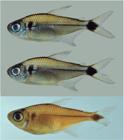
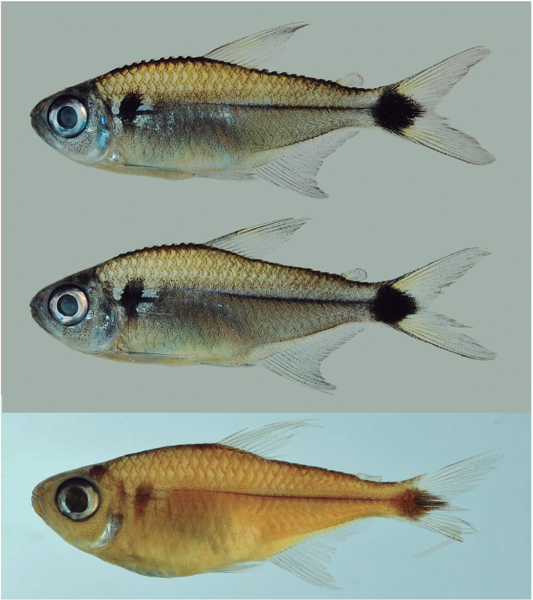
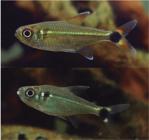
Hyphessobrycon ribeiroi, new species: upper photo, holotype, ZUEC 18037, 32.6 mm SL: Brazil, Pará, Santarém, igarapé Sonrisal, rio Tapajós basin; middle photo, paratype, LBP 34224, 31.1 mm SL: same locality; lower photo, MZUSP 85704, 31.2 mm SL: Brazil, Amazonas, Rio Preto da Eva, rio Preto da Eva basin.
Hemigrammus cf. vorderwinkleri (not Géry) – Guimarães et al., 2018: 7-9 [“Sonrisal stream”, Santarém, Pará, Brazil; barcoding].
Holotype: ZUEC 18037, 32.6 mm SL, Brazil, Pará, Santarém, igarapé Sonrisal, tributary of lago Verde, rio Tapajós basin, 02°32′05″S, 54°55′25″W; T.C. Faria, L. Perez and M. Klédson, 19 Aug 2023.
Paratypes: All from Brazil, Pará state, rio Tapajós basin. LBP 34224, 103, 21.1-31.8 mm SL; INPA 61073, 10, 22.5-30.9 mm SL; ROM 114794, 10, 20.2-30.7 mm SL, same data as holotype. ZUEC 18045, 79, 20.1-36.1 mm SL, same locality as holotype; T.C. Faria & K.L.A. Guimarães, 12 Aug 2018. MCP 55311, 20, 19.3-33.1 mm SL; MZUSP 130370, 10, 18.5-31.3 mm SL; ZUEC 12438, 317, 18.2-32.6 mm SL, 11 CS, 17.3-31.0 mm SL, Santarém, igarapé tributary of lago Verde, 6 km west of Santarém-Alter do Chão road, 02°31′19″S, 54°54′58″W; J.D. Bogotá-Gregory, 08 Jul 2015. ANSP 212111, 10, 19.8-28.5 mm SL; UF 249811, 20, 19.7-28.4 mm SL; ZUEC 11668, 196, 18.8-30.7 mm SL, Santarém, igarapé Jandá, comunidade Piquiatuba, 03°00′48″S, 55°06′21″W; W.G.R. Crampton, J.A. Oliveira, F.C.T. Lima, B.B. Calegari & E. Cerdeira, 14-15 Nov 2015. UFOPA-I 373, 18, 20.6-29.7 mm SL, 7 CS, 26.1-28.4 mm SL, Belterra, igarapé Corredor Ecológico, 03°06′15″S, 55°05′23″W; A. Canto, C. Silva-Oliveira & F. Ribeiro, 12 Nov 2012. ZUEC 11726, 5, 23.5-27.5 mm SL, Belterra, igarapé Dominguinho, comunidade Piquiatuba, 03°00′48″S, 55°06′21″W; W.G.R. Crampton, J.A, Oliveira, F.C.T. Lima, B.B. Calegari & E. Cerdeira, 15-16 Nov 2015. ZUEC 8988, 42, 19.5-31.8 mm SL, Belterra, igarapé de Aramanaí, 02°43′05″S, 55°00′13″W; W.G.R. Crampton, J.S. Ready et al., 24 Nov 2013. ZUEC 11702, 8, 16.5-36.9 mm SL, Santarém, igarapé Mato Grosso (trib. rio Tapajós), Jaguarari village, 02°55′00″S, 55°03′53″W; W.G.R. Crampton, J.A. Oliveira, F.C.T. Lima, B.B. Calegari & E. Cerdeira, 13 Nov 2015. ZUEC 8909, 195, 17.7-29.5 mm SL, 7 CS, 19.8-23.5 mm SL, Santarém, igarapé Capixauã (or Vista Alegre), Vista Alegre village, 02°37′23″S, 55°10′58″W; F.C.T. Lima, J.S. Ready et al., 14-15 Nov 2013. ZUEC 12141, 54, 17.6-26.6 mm SL, Santarém, igarapé Santo Amaro, Santo Amaro village, 02°58′17″S, 55°14′1″W; F.C.T. Lima & B.B. Calegari, 19 Nov 2015. ZUEC 12109, 114, 14.0-31.3 mm SL, 5 CS, 18.8-26.1 mm SL, Santarém, rio Mentaí, Cachoeirinha village, 02°43′49″S, 55°35′34″W; F.C.T. Lima, B.B. Calegari, W.G.R. Crampton & E. Cerdeira, 26-27 Nov 2015. ZUEC 8499, 41, 10.6-29.2 mm SL, Santarém, rio Maró, sítio Piracuí, above the village of Fé em Deus, 02°51′17″S, 55°41′8″W; F.C.T. Lima, R.E. Reis, W.G.R. Crampton, B.B. Calegari & J.D. Bogotá-Gregory, 28 May 2014. ZUEC 8538, 16, 16.7-30.6 mm SL, Santarém, stream trib. rio Maró, Fé em Deus village, 02°50′58″S, 55°41′06″W; F.C.T. Lima, R.E. Reis, W.G.R. Crampton, B.B. Calegari & J.D. Bogotá-Gregory, 27-28 May 2014. MPEG 27492, 216, 14.9-29.4 mm SL, Juruti, Lago São Francisco, rio Arapiuns basin, 02°36′39″S, 55°54′21″W; M. Sudário, 23 May 2011. MPEG 32430, 12, 17.9-27.7 mm SL, Juruti, igarapé rio Branco, 02°20′58″S, 56°01′28″W; M. Mendonça, 18 Sep 2014. MPEG 27491, 11, 16.3-27.0 mm SL, Juruti, igarapé rio Branco, 02°20′58″S, 56°01′28″W; R. Raiol, 20 May 2011. MPEG 30213, 62, 16.2-29.6 mm SL, Juruti, igarapé rio Branco, 02°20′58″S, 56°01′28″W; M. Mendonça, 12 Dec 2013. MPEG 30211, 80, 13.7-24.6 mm SL, Juruti, Lago São Francisco, 02°36′39″S, 55°54′21″W; M. Mendonça, 11 Dec 2013. MPEG 27490, 1, 26.4 mm SL, Juruti, Lago Capiranga, 02°28′12″S, 56°12′49″W; R. Raiol, 16 May 2011.
Non-types: All from Brazil. Pará state: MPEG 13021, 102, 22.0-37.1 mm SL, Juruti, igarapé São Francisco, L.F.A. Montag, 16 Dec 2006. MPEG 13022, 349, 21.4-32.9 mm SL, Juruti, igarapé Itapiranga, Igarapé Juruti Grande, L.F.A. Montag, 16 Dec 2004. MPEG 13575, 397, 20.3-37.6 mm SL, Juruti, Igarapé Juruti Grande, 02°22′48.9″S, 56°11′18.5″W, W.B. Wosiacki, 07 Sep 2002. MPEG 14294, 68, 26.5-38.9 mm SL, Juruti, igarapé Itapiranga, igarapé Juruti Grande, 02°28′06″S, 56°13′50.6″W, A. Hercos, 13 May 2007. MPEG 14731, 207, 23.6-36.5 mm SL, Juruti, igarapé Itapiranga, igarapé Juruti Grande, 02°28′06″S, 56°11′30.8″W, A. Hercos, 18 May 2007. MPEG 14737, 250, 18.8-32.4 mm SL, Juruti, igarapé Guaraná, igarapé Juriti Grande, 02°29′42″S, 56°13′50.6″W, A. Hercos, 28 Nov 2007. MPEG 27494, 35, 12.4-23.6 mm SL, Juruti, Lago São Francisco, 02°36′39″S, 55°54′21″W; R. Raiol, 12 Oct 2011. MPEG 26099, 46, 13.3-27.1 mm SL; MPEG 26102, 2, 18.7-19.8 mm SL, Juruti, igarapé Branco, 02°20′58″S, 56°1′28″W; M. Mendonça, 27 Nov 2012. MPEG 26100, 5, 14.9-23.5 mm SL, Juruti, Lago São Francisco, 02°36′39″S, 55°54′21″W; M. Mendonça, 03 Dec 2012. MPEG 26101, 26, 15.2-26.2 mm SL, Juruti, Lago São Francisco, 02°36′39″S, 55°54′21″W; M. Mendonça, 03 Dec 2012. MPEG 27486, 2, 23.2-24.9 mm SL, Juruti, igarapé rio Branco, 02°20′58″S, 56°1′28″W; W.B. Wosiacki, 18 Feb 2008. MPEG 27487, 11, 20.6-25.8 mm SL, Juruti, Lago São Francisco, 02°34′52″S, 56°54′15″W; W.B. Wosiacki, 20 Feb 2008. MPEG 27488, 1, 20.1 mm SL, Juruti, igarapé rio Branco, 02°20′58″S, 56°1′28″W; R. Raiol, 08 Sep 2009. MPEG 27489, 17, 16.6-35.1 mm SL, Juruti, igarapé São Francisco, 02°34′52″S, 56°54′15″W; R. Raiol, 04 Jun 2010. MPEG 27493, 55, 10.0-19.8 mm SL, Juruti, igarapé São Francisco, 02°34′52″S, 56°54′15″W; R. Raiol, 12 Oct 2011. MPEG 32710, 14, 16.6-22.8 mm SL, Juruti, Lago São Francisco, 02°36′39″S, 55°54′21″W; M. Mendonça, 26 Mar 2015. ZUEC 12234, 10, 19.3-25.9 mm SL, Santarém, igarapé do Macaco (trib. Rio Mentaí), near Boca do Mentaí village, 02°40′11″S, 55°35′31″W; W.G.R. Crampton, F.C.T. Lima, B.B. Calegari & E. Cerdeira, 22 Nov 2015. ZUEC 8854, 15, 13.6-20.7 mm SL, Santarém, rio Mentaí, Cachoeirinha village, 02°43′22″S, 55°36′14″W; W.G.R. Crampton, F.C.T. Lima, J.S. Ready et al., 17 Nov 2013. ZUEC 8865, 4, 22.6-28.0 mm SL, Belterra, igarapé Jamaracuá (trib. rio Tapajós), 02°49′21″S, 55°2′1″W; F.C.T. Lima, J.S. Ready, et al., 13 Nov 2013. ZUEC 11749, 6, 18.0-23.1 mm SL, Santarém, igarapé Aramanaí (trib. rio Tapajós), Aramanaí village, 03°0′48″S, 55°6′21″W; F.C.T. Lima, B.B. Calegari, W.G.R. Crampton, J.A. Oliveira & E. Cerdeira, 11-12 Nov 2015. Amazonas state: INPA 31738, 4, 22.7-23.4 mm SL, Itacoatiara, stream trib. rio Arubá, rio Urubu basin, 02°48′15″S, 58°52′15″W; M.S. Dias, 20 Jun 2007. LBP 17981, 17, 20.0-26.4 mm SL, Rio Preto da Eva, stream trib. rio Preto da Eva, 02°47′24.7″S, 59°30′10.8″W; R. Britzke & S. Marburger, 16 Aug 2013. LBP 17973, 50, 16.3-25.7 mm SL, Rio Preto da Eva, beach at the rio Preto da Eva, 02°41′59.4″S, 59°42′16″W; R. Britzke & B. Melo, 16 Aug 2013. MZUSP 85705, 111, 16.5-35.6 mm SL, Rio Preto da Eva, rio Preto da Eva, below Encanto da Mata, 02°38′58″S, 59°43′50″W; M.T. Piza, O.T. Oyakawa, et al., 09 Jul 2003. MZUSP 85704, 223, 10.9-34.9 mm SL, Rio Preto da Eva, igarapé Castanhalzinho, Francisca Mendes road, rio Preto da Eva basin, 02°45′15.8″S, 59°37′29.6″W; M.T. Piza, O.T. Oyakawa et al., 04 Jul 2003. MZUSP 74777, 30 of 194, 25.4-32.4 mm SL, Manaus, igarapé Arraia, trib. rio Cuieiras, c. 25 km from its mouth at the rio Negro, c. 02°42′S, 60°20′W; Alpha Helix Amazon Expedition, 27 Jan 1977. MZUSP 77747, 76, 25.0-36.2 mm SL, 5 CS, 25.2-30.3 mm SL, Manaus, igarapé Sirinau, trib. rio Cuieiras, c. 25 km from its mouth at the rio Negro, c. 02°42′S, 60°20′W; Alpha Helix Expedition, 30 Jan 1977. Roraima state: LBP 15462, 5, 23.5-28.0 mm SL, Alto Alegre, igarapé Tucumã, rio Cauamé basin, rio Branco basin, 02°54′01.6″N, 60°54′02.6″W; R. Britzke & B. Melo, 26 Apr 2012.
Diagnosis:Hyphessobrycon ribeiroi can be distinguished from most species currently assigned to the genera Hyphessobrycon and Hemigrammus, except He. hyanuary, He. levis, He. melanochrous, He. schmardae, He. vorderwinkleri, Hy. duragenys, Hy. eos, Hy. ericae, Hy. frankei, Hy. langeanii, Hy. santae, Hy. reticulatus, Hy. rutiliflavidus, Hy. tenuis, Hy. tropis, Hy. uaiso, Hy. wosiackii, and Hy. zoe by the presence of single humeral blotch and a caudal peduncle blotch extending into the basis of the middle caudal fin rays (vs. two humeral blotches or absence of a blotch in the humeral region or caudal peduncle). It can be distinguished from aforementioned species, except Hy. ericae and Hy. wosiackii, by possessing a vertically elongated humeral blotch with a posterior backward extension (vs. humeral blotch never presenting a posterior backward extension). The new species can be diagnosed from Hyphessobrycon ericae by presenting a considerably larger caudal peduncle blotch, occupying most of the caudal peduncle (vs. caudal peduncle blotch only moderately developed, restricted to the central portion of the caudal peduncle), and by possessing a humeral blotch with a relatively short and very narrow backward extension (vs. humeral blotch backward extension relatively long and thick). Hyphessobrycon ribeiroi can be diagnosed from Hy. wosiackii by possessing a considerably larger caudal peduncle blotch, occupying most of the caudal peduncle (vs. caudal peduncle blotch relatively small and elongated, concentrated at the middle portion of caudal peduncle), and a humeral blotch presenting a well-developed vertical component, and presenting a relatively short and narrow backward extension (vs. humeral blotch roundish, with a thick, elongated backward extension). The new species can be additionally distinguished from He. hyanuary and He. levis by presenting very conspicuous and well-defined humeral blotch (vs. an inconspicuous, relatively small humeral blotch), and a considerably larger caudal peduncle blotch, occupying most of the caudal peduncle (vs. an elongated, typically assymetric caudal peduncle blotch mostly concentrated at the lower half of the caudal peduncle in He. hyanuary, and an elongated caudal peduncle blotch concentrated at the middle portion of the caudal peduncle in He. levis). It can be additionally distinguished from He. hyanuary by presenting a considerably longer anal fin, with a higher number of branched anal-fin rays (17-21 vs. 11-14). Hyphessobrycon ribeiroi can be additionally distinguished from He. melanochrous and He. vorderwinkleri by possessing a considerably larger caudal peduncle blotch, occupying most of the caudal peduncle (vs. caudal peduncle blotch relatively small, occupying only the middle portion of the caudal peduncle). Hyphessobrycon ribeiroi can be additionally distinguished from He. vorderwinkleri by mature males lacking anal-fin hooks or any other dimorphic feature in that fin (vs. mature males presenting anterior basis of the anal fin expanded, with corresponding portion of anal fin presenting a lobe with well-developed fin rays bearing hooks) and by lacking a conspicuous dark midlateral stripe (vs. a conspicuous dark midlateral stripe present, connecting with the caudal peduncle blotch). Hyphessobrycon ribeiroi can be additionally distinguished from He. schmardae by presenting by the presence, in life, of an iridescent greenish midlateral thin stripe that becomes slightly thicker on the caudal peduncle (vs. absence of iridescent thin stripe), the presence of roughly oblong caudal-peduncle blotch, with a medial posterior extension (vs. an approximately square-shaped caudal peduncle blotch), lack of a clear area anterior to the caudal-fin (vs. presence of a clear area anterior to the caudal-fin). The new species can be distinguished from Hy. eos by presenting a very conspicuous and well-defined humeral blotch (vs. an inconspicuous, blurred humeral blotch) and by presenting a considerably larger caudal peduncle blotch, occupying most of the caudal peduncle (vs. a horizontally elongated, assymetric caudal peduncle blotch confined to the caudal peduncle lower half). Hyphessobrycon ribeiroi can be additionally diagnosed from Hy. frankei by possessing a sharply defined, roughly oblong caudal-peduncle blotch (vs. caudal peduncle blotch horizontally elongated, with diffuse margins). The new species can be additionally distinguished from Hy. langeanii by presenting a vertically elongated humeral blotch (vs. humeral blotch oval-shaped), by presenting 2-6 conical to tricuspid maxillary teeth (vs. a single tri- to pentacuspid tooth on the maxillary), and by presenting an anal fin with a well-developed anterior lobe (vs. anal fin with distal margin approximately straight, lacking an anterior lobe). Hyphessobrycon ribeiroi can be additionally distinguished from Hy. duragenys, Hy. rutiliflavidus, and Hy. santae by presenting a roughly oblong, conspicuous, broad caudal-peduncle dark blotch (vs. horizontally elongated, relatively inconspicuous caudal-peduncle blotch in Hy. rutiliflavidus and Hy. uaiso), by presenting an anal fin with a well-developed anterior lobe (vs. anal fin with distal margin approximately straight, lacking an anterior lobe), and from Hy. rutiliflavidus and Hy. uaiso by presenting fins mostly hyaline in living specimens (vs. fin yelowish to reddish in living specimens). The new species can be additionally diagnosed from Hy. reticulatus by lacking a reticulate color pattern (vs. presence of a reticulate color pattern), and by presenting an anal fin with a well-developed anterior lobe (vs. anal fin with distal margin approximately straight, lacking an anterior lobe). Hyphessobrycon ribeiroi can be diagnosed from Hy. tenuis by presenting a considerably larger caudal peduncle blotch, occupying most of the caudal peduncle (vs. caudal peduncle blotch tiny, occupying only the middle portion of the caudal peduncle). The new species can be diagnosed from Hy. tropis by presenting a very conspicuous and well-defined humeral blotch (vs. an inconspicuous, blurred humeral blotch), by presenting 2-6 conical to tricuspid maxillary teeth (vs. 6-8 conical maxillary teeth), largest teeth of the inner premaxillary row pentacuspid (vs. largest teeth of the inner premaxillary row tricuspid), and by lacking anterior keel at the basis of the anal fin in mature males (vs. presence of a anterior keel at the basis of the anal fin in mature males). Hyphessobrycon ribeiroi can be additionally diagnosed from Hy. zoe by possessing presenting a considerably larger caudal peduncle blotch, occupying most of the caudal peduncle (vs. caudal peduncle blotch small and blurred, occupying only the middle portion of the caudal peduncle).
Description: Morphometric data for holotype and paratypes in Table 1. Body compressed, greatest body height at vertical through dorsal-fin origin. Dorsal profile of head slightly convex from upper lip to vertical through posterior nostril, straight from that point to tip of supraoccipital spine. Dorsal profile of body slightly convex from tip of supraoccipital spine to dorsal-fin origin. Dorsal-fin base straight, posteroventrally slanted, approximatelly straight to slightly convex from dorsal-fin terminus to adipose-fin insertion, and slightly concave from latter point to anteriormost dorsal procurrent caudal-fin ray. Ventral profile of head and body convex from tip of lower jaw to vertical through pectoral-fin insertion, straight to slightly convex from latter point to anal-fin origin. Anal fin base posterodorsally slanted. Ventral profile of caudal peduncle slightly concave.
Morphometric data for Hyphessobrycon ribeiroi. N (number of specimens measured). SD = standard deviation.
Jaws equal, mouth terminal. Posterior terminus of maxilla reaching vertical through anterior margin of pupil. Maxilla approximately at 45 degrees angle relative to longitudinal axis of body. Nostrils close to each other, anterior opening oval, posterior opening crescent-shaped. Premaxillary teeth in two rows. Outer teeth row with 2(8), 3(26), or 4(5) tricuspid teeth. Inner teeth row with 4(1), 5(38) or 6(3) tri- to pentacuspid teeth. Maxilla with 2(5), 3(13), 4(11), 5(5), or 6(2) teeth, anteriormost tooth bi- to tricuspid, remaining teeth conical. Dentary with 10(1), 11(1), 12(4), 13(1), 14(6), 15(6), 16(3), 17(1), 19(2), or 20(1) teeth, anteriormost three to four teeth larger, tri- to pentacuspid, typically one intermediary tooth, bi to tetracuspid, remaining teeth considerably smaller and conical. Central cusp of all teeth more developed than remaining lateral cusps.
Scales cycloid. One to nine radii strongly marked, circulii well marked anteriorly, absent posteriorly (“Hemigrammus type” sensu Cockerell, 1915). Lateral line slightly deflected downward and incompletely pored, with 6(1), 7(2), 8*(37), 9(21), 10(3) or 11(1) perforated scales. Longitudinal scales series including lateral-line scales 31(5), 32(20), 33*(27) or 34(7). Longitudinal scale rows between dorsal-fin origin and lateral line 5*(70). Longitudinal scale rows between lateral line and pelvic-fin origin 3*(41) or 4(28). Predorsal scales 8(1), 9(5), 10*(63) or 11(2). Circumpeduncular scales 11(1) or 12*(61). Caudal fin with small scales at its basis (missing in most specimens).
Dorsal-fin rays ii, (not including small ossification immediately anterior to first unbranched ray, discernible only in CS specimens, present in all cleared and stained specimens examined), 9*(71) or 10(1). Dorsal-fin origin slightly anterior from middle of standard length. First dorsal-fin pterygiophore inserting behind neural spine of 9th(29) vertebrae. Adipose fin present. Anteriormost anal-fin pterygiophore inserting posterior to haemal spine of 15th(7), 16th(22), or 17th(1) vertebrae. Anal-fin rays iv,17(2), 18(14), 19(38), 20*(16) or 21(2). Last unbranched and first to third anteriormost branched rays distinctly longer than remaining rays, subsequent rays gradually decreasing in size. Pectoral-fin rays i, 10(26) or 11*(46). Pelvic-fin rays i, 6(1) or 7*(70). Tip of pelvic fin reaching anteriormost anal-fin rays. Caudal fin forked, lobes roughly rounded and of similar size. Nine(2), 10(16), or 11(1) dorsal procurrent caudal-fin rays, and 7(6), 8(20), or 9(5) ventral procurrent caudal-fin rays. Vertebrae 32(4) or 33(32). Supraneurals 4(30) or 5(5). Branchiostegal rays 4. First gill arch with 1(3), 2(9), or 3(1) hypobranchial, 0(2) or 1(11) on cartilage between hypobranchial and ceratobranchial, 7(3), 8(8), or 9(2) ceratobranchial, 1(12) on cartilage between ceratobranchial and epibranchial, and 5(2), 6(10), or 7(1) epibranchial gill-rakers.
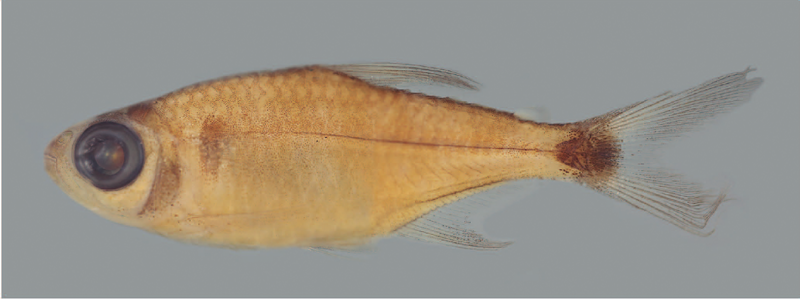
Color in alcohol: Overall body color light brown to light grey. Top of head, snout and dentary tip dark as a result of dense concentration of dark chromatophores. Opercle and infraorbitals silvery in specimens retaining guanine, with moderate to relatively dense punctuation of dark melanophores. Lower surface of head clear. Middorsal line along predorsal, preadipose and precaudal areas dark as a result of dense concentration of dark chromatophores, with melanophores concentrated at middle portion of scales forming a dotted pattern, especially at predorsal region. Scales above midline, especially the ones at predorsal area, with dark chromatophores concentrated on scales margins, rendering a reticulated pattern. Humeral blotch conspicuous, with two components, main component vertically elongated, slightly curved forward, with ventral- and dorsalmost region inclined posteriorly, extending vertically three and half to four scale rows above lateral line and half to one scale row below lateral line, and horizontally two to two and half scale rows at its widest point. Humeral blotch diffuse on dorsal- and ventralmost region, with ventralmost region thinner and dorsalmost region more well-defined. Second component of humeral blotch consisting in an anterior and a posterior narrow, short, straight stripes, lying at the middle portion of humeral blotch main component. Anterior extension diffuse and short, posterior extension sharply defined and relatively elongated. Area surrounding humeral blotch and middle portion of body plumbeous in specimens retaining guanine, with dense speckling of dark melanophores after terminus of humeral blotch posterior extension. Lateral septum with narrow midlateral dark stripe, starting at vertical through middle portion of dorsal fin, and extending to caudal peduncle blotch. Abdominal region clear, with increasing number of scattered dark melanophores towards midline. Area above anal fin with dense concentration of dark melanophores, many aligned along myosepta forming thin, curved vertical lines. Dark, narrow stripe dorsal to anal-fin base extending approximately where hypaxial muscles and anal-fin muscles meet, more conspicuous slightly after anal-fin origin. Area between dark stripe and anal-fin base clear, with relatively few, scattered melanophores. Caudal peduncle blotch well-developed, occupying caudal-peduncle posterior third, and extending into middle caudal-fin rays, forming an overall oblong blotch. Caudal fin, other than middle portion, hyaline, with small, scattered dark melanophores, mostly on interradial membranes. Dorsal, adipose, pectoral, and pelvic fins hyaline, with small scattered dark chromatophores.
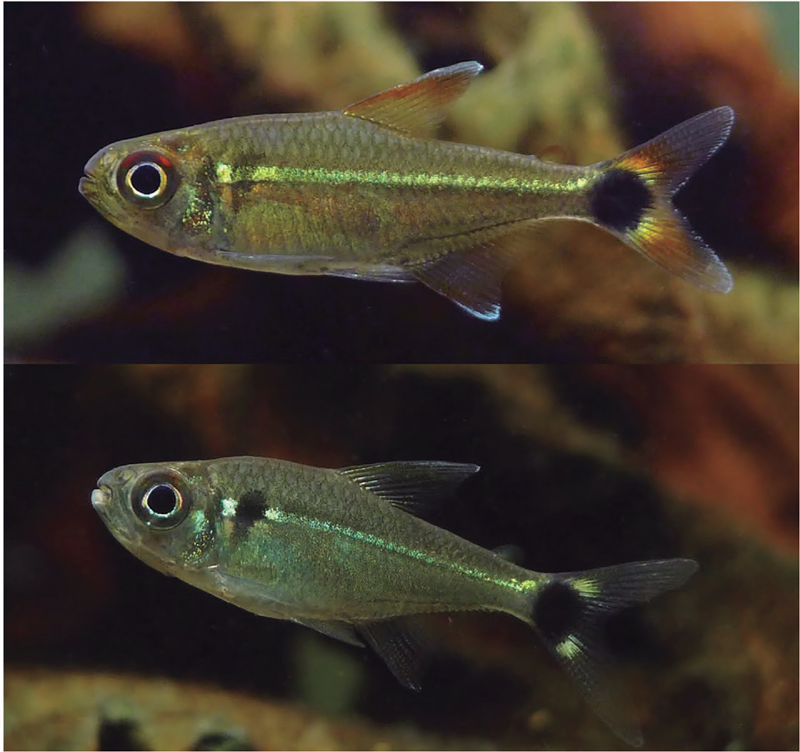
Color in life: Based on pictures of live aquarium specimens (Fig. 2), provided by Man Cham Lan, and field observations. Overall body light grey, with olivaceous hue. Lower half of head and abdominal region silvery, with a greenish hue. Posteroventral region of opercle with green iridescent chromatophores. Dorsal portion of eye reddish to red, silvery ring around iris. Green iridescent longitudinal stripe extending from immediately behind opercle to caudal peduncle blotch, overlapped by the humeral blotch, wider anteriorly and tapering slightly posteriorly. Caudal fin with yellowish to reddish blotches on upper and lower lobes, lying immediately after caudal peduncle blotch. Dorsal fin with anterior and apical portions reddish (Fig. 2, upper photo) or hyaline (Fig. 2, lower photo). Distal region of anterior lobe of anal fin and distal region of dorsal fin rays whitish (Fig. 2, upper photo) or hyaline (Fig. 2, lower photo). We are not aware if this variation in the intensity of the color pattern in the fins is related to sexual dimorphism.
Sexual dimorphism: Mature males present small bony hooks restricted to the pelvic fins. Pelvic-fin hooks are present on the unbranched ray, plus anteriormost 3-4 branched rays, in both anterior and posterior branches, with 2-4 hooks per ray segment. Specimens presenting pelvic-fin bony hooks ranged from 24.1 to 29.4 mm SL (LBP 34224, MPEG 14294, MPEG 14731, MZUSP 74777, MZUSP 77747, MZUSP 85704, ZUEC 8499, ZUEC 8538, and ZUEC 12438). Females lack fin hooks and reach considerably larger sizes, as exemplified by the lot MZUSP 77747, where 21 males presenting pelvic-fin hooks ranged from 25.7 to 29.0 mm SL, while 30 females with ripe gonads ranged from 29.7 to 36.2 mm SL. Indeed, the largest specimen examined (38.9 mm SL: MPEG 14294) is a female.
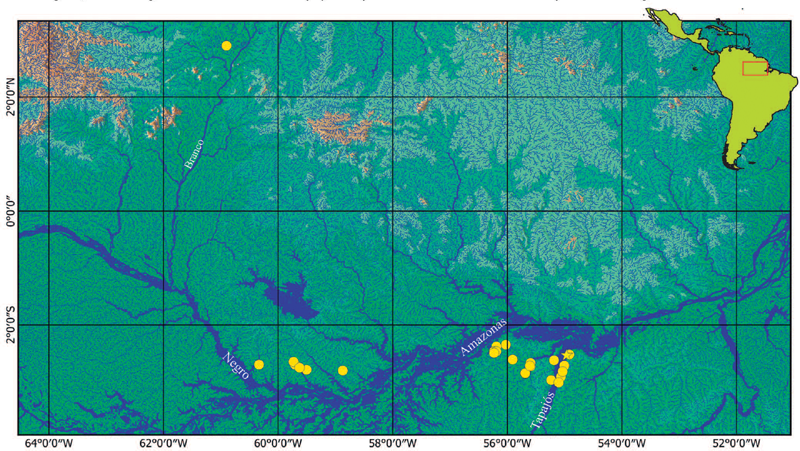
Distribution:Hyphessobrycon ribeiroi is known from the central portion of the Amazon basin, from the lower rio Tapajós basin (including the rio Arapiuns basin), and left bank tributaries of the Amazon River, from the rio Urubu basin to the lower rio Negro basin (including the lower rio Branco basin), states of Pará, Amazonas and Roraima, Brazil (Fig. 3).
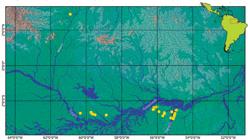
Map of the Central and Lower Amazon basin showing the known distribution of Hyphessobrycon ribeiroi, new species. Yellow star indicates the type locality.
Ecological notes:Hyphessobrycon ribeiroi is a common and abundant species in the lower rio Tapajós (including tributaries of the rio Arapiuns such as rio Mentaí and tributaries of the rio Maró) in clearwater forest streams. Physical and chemical water parameters from localities inhabited by the species ranged between 26.9-27.6X, pH 4.02-5.51, dissolved oxygen 2.8-5.5 mg/l, and conductivity 9.5-15.4 μS cm−1. In the area of Manaus, the species also occurs in streams with dark water (i.e., tributaries of the rio Cuieiras at lower rio Negro, and rio Preto da Eva basin). Gut contents of 10 specimens contained mostly insect remains, from which ants, a small beetle, and a small aquatic hemipteran could be identified, as well as unidentified vegetal matter. Mature males (judging for the presence of pelvic-fin hooks) were detected in the months of January and July in the tributaries of the northern bank of the Amazon River, and May, July and August, in the region of the lower rio Tapajós. Ripe females with fully formed oocytes ranging from 29.7 to 36.2 mm SL were collected in January at the lower rio Negro basin (MZUSP 77747).
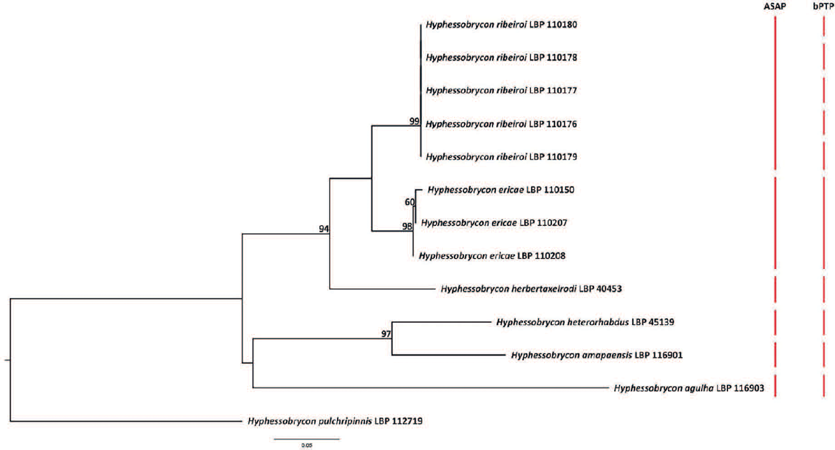
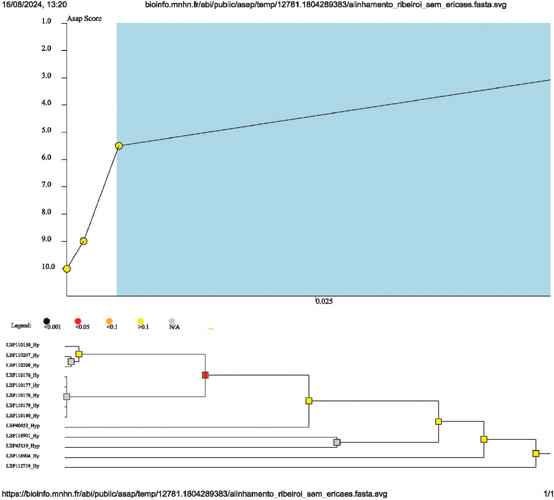
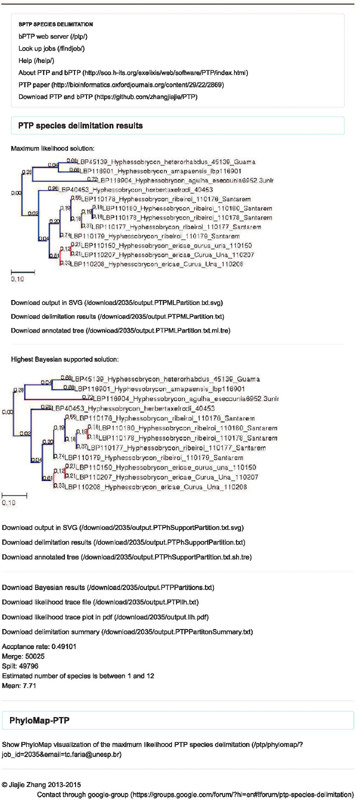
Molecular results: Our resulting tree recovers Hyphessobrycon ribeiroi as the sister species of Hy. ericae. In two molecular species delimitation methods, ASAP (Fig. S1) and bPTP (Fig. S2), Hy. ribeiroi was recovered as distinct from Hy. ericae, but bPTP also separates each individual of Hy. ribeiroi as a single species. Two main highly supported groups were recovered, one with Hy. ribeiroi, Hy. ericae, and Hy. herbertaxelrodi, and the other with Hy. heterorhabdus and Hy. amapaensis. Genetic distances between species of these groups range between 8.93% to 9.9%, while the genetic distance between species of the clade of Hy. ribeiroi range between 3.24% (between Hy. ribeiroi and Hy. ericae) and 6.14% (between Hy. ribeiroi and Hy. herbertaxelrodi) (Fig. 4; Table S4).
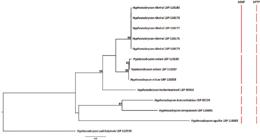
Maximum-likelihood tree including Hyphessobrycon ribeiroi and additional Hyphessobrycon species derived from COI sequences.
Etymology: The specific epithet is a homage to Frank Raynner Ribeiro, professor of the Universidade Federal do Oeste do Pará, as a recognition of its contribution to the knowledge of South American Siluriformes and also the fishes from the rio Tapajós basin.
DISCUSSION
Hyphessobrycon ribeiroi match the diagnosis of the genus Hemigrammus due to the presence of scales at the basis of the caudal fin (present only in the better preserved specimens as they are very deciduous). Our decision to allocate Hy. ribeiroi in Hyphessobrycon is based on a phylogeny using ultraconserved elements that indicates that the species belongs to the clade defined as Hyphessobryconinae by Melo et al. (2024) (T.C. Faria & C. Oliveira, work in progress). Hyphessobrycon ribeiroi is genetically similar to Hy. ericae, presenting only 4.2 to 5.9% of genetic distance on cytochrome c oxidase I (COI) according to our data and Guimarães et al. (2018; with Hy. ribeiroi misidentified as He. cf. vordenwinkleri). This value is low enough to allow us to assume a close relationship despite the inability of COI phylogenies to track precise phylogenetic trees when used as the only molecular marker. It is noteworthy, however, that Hyphessobrycon ribeiroi lack the diagnostic features proposed for the Hy. heterorhabdus species group (as defined by Faria et al., 2021), which includes Hy. ericae, i.e., the presence of a tricolor longitudinal pattern composed by a red dorsal stripe, an iridescent intermediary stripe and a ventral black longitudinal pattern composed by an anteriorly well-defined horizontally elongated humeral blotch that becomes blurred posteriorly, coalescing with a midlateral stripe that becomes blurred towards the caudal peduncle (Faria et al., 2021). However, Hyphessobrycon ribeiroi does indeed present a similar color pattern to Hy. ericae that set them apart from the remaining species included in the Hy. heterorhabdus species group, by presenting a humeral blotch composed by two components, one vertical and one longitudinal, and a well-defined caudal peduncle blotch (see the Diagnosis, above).
As remarked above, Hyphessobrycon ribeiroi was previously misidentified by Guimarães et al. (2018) as Hemigrammus cf. vorderwinkleri. This misidentification was due to the fact that both species share a single, vertically elongated humeral blotch and a caudal peduncle blotch, and the presence of scales at the caudal-fin basis. However, as noted in the “Diagnosis” section above, the humeral and caudal peduncle blotches in Hyphessobrycon ribeiroi are quite distinct in shape compared to the same features in Hemigrammus vorderwinkleri. Furthermore, Hyphessobrycon ribeiroi lacks the unique dimorphic anal fin seen in mature males of Hemigrammus vorderwinkleri (see Lima et al., 2013: 270-271).
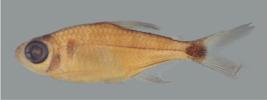
The most similar species in overall appearance to Hyphessobrycon ribeiroi is Hemigrammus schmardae, with which it shares a remarkably similar color pattern. However, as noticed in the item “Diagnosis”, above, the humeral and caudal-peduncle blotches have a distinct shape in both species, and Hyphessobrycon ribeiroi possess an iridescent green longitudinal stripe in living specimens which is absent in living specimens of Hemigrammus schmardae. Both species are mostly allopatric, since the easternmost record for Hemigrammus schmardae is the rio Trombetas at Pará state, Brazil (MZUSP 52672). Hyphessobrycon ribeiroi was collected syntopically with Hemigrammus schmardae at one site, the rio Cuieiras in the lower rio Negro basin (lots MZUSP 77747 and MZUSP 130369, respectively; Fig. 5). However, according to a phylogeny based on ultraconserved elements Hemigrammus schmardae is distantly related to Hyphessobrycon ribeiroi as it does not belong to Hyphes-sobryconinae (T.C. Faria & C. Oliveira, work in progress).
As noticed in the section “Sexual dimorphism”, above, mature males of Hyphessobrycon ribeiroi present fin hooks restricted to the pelvic fin. This is an unusual condition among acestrorhamphids, being only reported as far as we know for Paracheirodon axelrodi (Weitzman & Fink, 1983: 372). We have also recorded fin hooks restricted to the pelvic fin in a single lot of Hyphessobrycon ericae (LBP 32946), a species for which fin hooks were previously unreported (Moreira & Lima, 2017). Additionally, Weitzman & Malabarba (1999) noticed that the species of Spintherobolus (now in the family Spintherobolidae; Melo et al., 2024) have hooks on pelvic-fin rays but rarely (and when present, very few) on anal-fin rays.
The humeral blotch in Hyphessobrycon ribeiroi is quite unique shaped among characids, by presenting a short, very narrow, straight backward extension.The only characid with a similar shaped humeral blotch is Hemigrammus bellottii, which also displays a humeral blotch with a short, straight extension directed backwards (see Géry, 1963: 58, fig. 4). However, Hemigrammus bellottii can be easily diagnosed from Hyphessobrycon ribeiroi by lacking a caudal-peduncle blotch. Hemigrammus bellottii was recovered in clade that is sister to a clade containing Hyphessobrycon amapaensis and Hy. heterorhabdus in a phylogeny employing ultraconserved elements (Melo et al., 2024). However, an unpublished phylogeny employing ultraconserved elements does not shown it to be closely related to Hy. ribeiroi (T.C. Faria & C. Oliveira, work in progress).
NOTE ADDED IN PROOF
Living specimens depicted in Fig. 2 were stated by the author of the photos, Man Cham Lam, to have originated from the rio Uatumã basin (upper photo) and rio Aruã basin, a tributary of rio Arapiuns (lower photo). Although no specimens of Hyphessobrycon ribeiroi from the rio Uatumã basin were available in the present study, this river basin lies immediately east to the rio Urubu basin, from where specimens of the species were examined, and consequently we consider the putative occurrence of the species in the rio Uatumã basin as very plausible.
-
FUNDING INFORMATION:
Funding was provided by National Science Foundation (project NSF Grant DEB-1146374), Fundação de Amparo à Pesquisa do Estado de São Paulo (FAPESP, grants #2011/51532-7 and 2013/20936-0, FCTL; #2020/13433-6 and #2021/00242-0, TCF); Conselho Nacional de Desenvolvimento Científico e Tecnológico (CNPq, grant #317781/2021-9, CSO; grants #306054/2006-0 and #441128/2020-3, CO).
APPENDICES
ACKNOWLEDGMENTS:
The first author is grateful to William G.R. Crampton, Juan David Bogota-Gregory, Jonathan S. Ready, Roberto E. Reis, Bárbara B. Calegari, Jonas A. Oliveira, and Elias Cerdeira for help during field trips of the project “Aquatic Faunal Survey of the Lower Amazon”; when the new species was first identified and a sizable portion of the material herein studied was collected. The last author is grateful to Karen L.A. Guimarães, Lucas F.P. Ramos, Manoel K.A. Barbosa and Claudio P. de Souza for their aid with the collection of additional material of the species. We are grateful to Wolmar B. Wosiacki (MPEG), Hernan Ortega, Max Hildalgo (MUSM), Osvaldo T. Oyakawa, Michel D. Gianeti, Alessio Datovo, Mário C.C. de Pinna, and Murilo Pastana (MZUSP) for allowing the examination of material under their care. We thank Man Cham Lam (manchalam.blogspot) for allowing us to use his excellent pictures of living specimens (Fig. 2), and to Gustavo C. Bortolo for editing Fig. 5. Finally, we are greaful to Túlio F. Teixeira for discussions concerning fin hook presence in characids, and to André Esguícero and Fernando Dagosta for their critical review of the manuscript.
REFERENCES
-
Carvalho, F.R.; Langeani, F.; Miyazawa, C.S. & Troy, W.P. 2008. Hyphessobrycon rutiliflavidus n. sp., a new characid fish from the upper rio Paraguai, State of Mato Grosso, Brazil (Characiformes: Characidae). Zootaxa, 1674: 39-49. https://doi.org/10.11646/zootaxa.1674.L3
» https://doi.org/10.11646/zootaxa.1674.L3 -
Cockerell, T.D.A. 1915. The scales of the South American characinid fishes. Annals of the Carnegie Museum, 9: 92-113, pls. 23-28. https://doi.org/10.5962/p.331043
» https://doi.org/10.5962/p.331043 -
Edgar, R.C. 2004. Muscle: A multiple sequence alignment method with reduced time and space complexity. BMC Bioinformatics, 5: 113. https://doi.org/10.1186/1471-2105-5-113
» https://doi.org/10.1186/1471-2105-5-113 - Eigenmann, C.H. 1918. The American Characidae (II). Memoirs of the Museum ofComparativeZoology, 43(2): 103-208, pls. 9-11, 13, 17-29, 33, 78-80, 93.
-
Elias, D.J.; McMahan, C.D.; Alda, F.; García-Alzate, C.; Hart, P.B. & Chakrabarty, P. 2023. Phylogenomics of trans-Andean tetras of the genus Hyphessobrycon Durbin 1908 (Stethaprioninae: Characidae) and colonization patterns of Middle America. PloS ONE, 18(1): e0279924 [1-25]. https://doi.org/10.1371/journal.pone.0279924
» https://doi.org/10.1371/journal.pone.0279924 -
Ellis, M.D. 1911. On the species of Hasemania, Hyphessobrycon, and Hemigrammus collected by J.D. Haseman for the Carnegie Museum. Annals of the Carnegie Museum, 8: 141-162, 3 pls. https://doi.org/10.5962/p.14706
» https://doi.org/10.5962/p.14706 -
Faria, T.C.; Bastos, D.A.; Zuanon, J. & Lima, F.C.T. 2020. A new Hyphessobrycon (Characiformes: Characidae) of the Hyphessobrycon heterorhabdus species-group from the Central Amazon basin, Brazil. Zootaxa, 4859(2): 275-284. https://doi.org/10.11646/zootaxa.4859.2.6
» https://doi.org/10.11646/zootaxa.4859.2.6 -
Faria, T.C.; Guimarães, K.L.A.; Rodrigues, L.R.R.; Oliveira, C. & Lima, F.C.T. 2021. A new Hyphessobrycon (Characiformes; Characidae) of the Hyphessobrycon heterorhabdus species-group from the lower Amazon basin, Brazil. Neotropical ichthyology, 19(1): 1-18, e200102. https://doi.org/10.1590/1982-0224-2020-0102
» https://doi.org/10.1590/1982-0224-2020-0102 -
Fink, W.L. & Weitzman, S.H. 1974. The so-called cheirodontin fishes of Central America with descriptions of two new species (Pisces: Characidae). Smithsonian Contributions of Zoology, 172: 1-46. https://doi.org/10.5479/si.00810282.172
» https://doi.org/10.5479/si.00810282.172 - Géry, J. 1963. Three new tetras from the upper Rio Negro near Tapurucuara. Tropical Fish Hobbyist, 12(3): 9, 11, 13-15, 57-59, 62-63.
-
Géry, J. 1964. Poissons characoides de l’Amazonie péruvienne. Beiträge zur NeotropischenFauna, 4(1):1-44.https://doi.org/10.1080/01650526409360375
» https://doi.org/10.1080/01650526409360375 -
Guimarães, K.L.A.; Sousa, M.P.A.; Ribeiro, F.R.V.; Porto, J.I.R. & Rodrigues, L.R.R. 2018. DNA barcoding of fish fauna from lower order streams of Tapajós river basin. PLoS ONE, 13(12): e0209430 [1-16]. https://doi.org/10.1371/journal.pone.0209430
» https://doi.org/10.1371/journal.pone.0209430 -
Ingenito, L.F.S.; Lima, F.C.T. & Buckup, P.A. 2013. A new species of Hyphessobrycon (Characiformes: Characidae) from rio Juruena basin, Central Brazil, with notes on H. loweae Costa & Géry. Neotropical Ichthyology, 11(1): 33-44. https://doi.org/10.1590/S1679-6225201300010004
» https://doi.org/10.1590/S1679-6225201300010004 -
Ivanova, N.V.; Dewaard, J.R. & Hebert, P.D.N. 2006. An inexpensive, automation-friendly protocol for recovering high-quality DNA. Molecular Ecology Notes, 6(4): 998-1002. https://doi.org/10.1111/j.1471-8286.2006.01428.x
» https://doi.org/10.1111/j.1471-8286.2006.01428.x -
Javonillo, R.; Malabarba, L.R.;Weitzman, S.H. & Burns, J.R. 2010. Relationships among major lineages of characid fishes (Teleostei: Ostariphysi: Characiformes), based on molecular sequence data. Molecular Phylogenetics and Evolution, 54(2): 498-511. https://doi.org/10.1016/j.ympev.2009.08.026
» https://doi.org/10.1016/j.ympev.2009.08.026 -
Kearse, M.; Moir, R.; Wilson, A.; Stones-Havas, S.; Cheung, M.; Sturrock, S.; Buxton, S.; Cooper, A.; Markowitz, S.; Duran, C.; Thierer, T.; Ashton, B.; Meintjes, P. & Drummond, A. 2012. Geneious Basic: an integrated and extendable desktop software platform for the organization and analysis of sequence data. Bioinformatics, 28(12): 1647-1649. https://doi.org/10.1093/bioinformatics/bts199
» https://doi.org/10.1093/bioinformatics/bts199 -
Lima, F.C.T.; Caires, R.A.; Conde-Saldaña, C.C.; Mirande, J.M. & Carvalho, F.R. 2021. A new miniature Pristella (Actinopterygii: Characiformes: Charac-idae) with reversed sexual dimorphism from the rio Tocantins and rio São Francisco basins, Brazil. Canadian Journal of Zoology, 99(5): 339-348. https://doi.org/10.1139/cjz-2020-0241
» https://doi.org/10.1139/cjz-2020-0241 -
Lima, F.C.T.; Coutinho, D.P. & Wosiacki, W.B. 2014. A new Hyphessobrycon (Ostariophysi: Characiformes: Characidae) from the middle Amazon basin, Brazil. Zootaxa, 3872: 167-179. https://doi.org/10.11646/zootaxa.3872.2.3
» https://doi.org/10.11646/zootaxa.3872.2.3 - Lima, F.C.T.; Pires, T.H.S.; Ohara, W.M.; Jerep, F.C.; Carvalho, F.R.; Marinho, M.M.F. & Zuanon, J. 2013. Characidae. In: Queiroz, L.J.; Torrente-Vilara, G.; Ohara, W.M.; Pires, T.H.S.; Zuanon, J. & Doria, C.R.C. (Eds.). Peixes do rio Madeira. São Paulo, Dialeto. p. 213-395.
- Marinho, M.M.F. & Dagosta, F.C.P. 2024. Redescription of Hyphessobrycon cachimbensis (Characiformes: Characidae) with the description of a new congener from the Serra do Cachimbo, Brazil. Neotropical Ichthyology, 22(2): 1-20, e230127.
-
Melo, B.F.; Ota, R.P.; Benine, R.C.; Carvalho, F.R.; Lima, F.C.T.; Mattox, G.M.T.; Souza, C.S.; Faria, T.C.; Reia, L.; Roxo, F.F.; Valdez-Moreno, M.; Near, T.J. & Oliveira, C. 2024. Phylogenomics of Characidae, a hyper-diverse Neotropical fish lineage, with a phylogenetic classification including four families (Teleostei: Characiformes). Zoological Journal of the Linnean Society, 202: 1-37, zlae101. https://doi.org/10.1093/zoolinnean/zlae101
» https://doi.org/10.1093/zoolinnean/zlae101 -
Mirande, J.M. 2019. Morphology, molecules, and the phylogeny of Characidae (Teleostei, Characiformes). Cladistics, 35(3): 282-300. https://doi.org/10.1111/cla.12345
» https://doi.org/10.1111/cla.12345 -
Moreira, C.R. & Lima, F.C.T. 2017. Two new Hyphessobrycon species from Central Amazon basin, Brazil. Zootaxa, 4318(1): 123-134. https://doi.org/10.11646/zootaxa.4318.1.5
» https://doi.org/10.11646/zootaxa.4318.1.5 -
Puillandre, N.; Brouillet, S. & Achaz, G. 2021. ASAP: assemble species by automatic partitioning. Molecular Ecology Resources, 21(2): 609-620. https://doi.org/10.1111/1755-0998.13281
» https://doi.org/10.1111/1755-0998.13281 -
Sabaj, M.H. 2020. Codes for natural history collections in ichthyology and herpetology. Copeia, 108(3): 593-669. https://doi.org/10.1643/ASIHCODONS2020
» https://doi.org/10.1643/ASIHCODONS2020 -
Tamura, K.; Stecher, G. & Kumar, S. 2021. MEGA11: Molecular Evolutionary Genetics Analysis version 11. Molecular Biology and Evolution, 38(7): 3022-3027. https://doi.org/10.1093/molbev/msab120
» https://doi.org/10.1093/molbev/msab120 - Taylor, W.L. & Van Dyke, G.C. 1985. Revised procedures for staining and clearing small fishes and other vertebrates for bone and cartilage study. Cybium, 9(2): 107-119.
-
Toledo-Piza, M.; Baena, E.G.; Dagosta, F.C.P.; Menezes, N.A.; Ândrade, M.; Benine, R.C.; Bertaco, V.A.; Birindelli, J.L.O.; Boden, G.; Buckup, P.A.; Camelier, P.; Carvalho, F.R.; Castro, R.M.C.; Chuctaya, J.; Decru, E.; Derijst, E.; Dillman, C.B.; Ferreira, K.M.; Merxem, D.G.; Giovannetti, V.; Hirschmann, A.; Jégu, M.; Jerep, F.C.; Langeani, F.; Lima, F.C.T.; Lucena, C.A.S.; Lucena, Z.M.S.; Malabarba, L.R.; Malabarba, M.C.S.L.; Marinho, M.M.F.; Mathubara, K.; Mattox, G.M.T.; Melo, B.F.; Moelants, T.; Moreira, C.R.; Musschoot, T.; Netto-Ferreira, A.L.; Ota, R.P.; Oyakawa, O.T.; Pavanelli, C.S.; Reis, R.E.; Santos, O.; Serra, J.P.; Silva, G.S.C.; Silva-Oliveira, C.; Souza-Lima, R.; Vari, R.P. & Zanata, A.M. 2024. Checklist of the species of the order Characi-formes (Teleostei: Ostariophysi). Neotropical Ichthyology, 22(1): 1-548, e230086. https://doi.org/10.1590/1982-0224-2023-0086
» https://doi.org/10.1590/1982-0224-2023-0086 -
Ward, R.D.; Zemlak, T.S.; Innes, B.H.; Last, P.R. & Hebert, P.D.N. 2005. DNA barcoding Australia’s fish species. Philosophical Transactions of the Royal Society B Biological Sciences, 360(1462): 1847-1857. https://doi.org/10.1098/rstb.2005.1716
» https://doi.org/10.1098/rstb.2005.1716 - Weitzman, S.H. & Fink, W.L. 1983. Relationships of the neon tetras, a group of South American freshwater fishes (Teleostei, Characidae), with comments on the phylogeny of New World characiforms. Bulletin of the Museum of Comparative Zoology, 150(6): 339-395.
- Weitzman, S.H. & Malabarba, L.R. 1999. Systematics of Spintherobolus (Teleostei: Characidae: Cheirodontinae) from eastern Brazil. Ichthyological Exploration of Freshwaters, 10(1): 1-43.
- Weitzman, S.H. & Palmer, L. 1997. A new species of Hyphessobrycon (Teleostei: Characidae) from the Neblina region of Venezuela and Brazil, with comments on the putative ‘rosy tetra clade’. Ichthyological Exploration of Freshwaters, 7(3): 209-242.
-
Zhang, J.; Kapli, P.; Pavlidis, P. & Stamatakis, A. 2013. A general species delimitation method with applications to phylogenetic placements. Bioinformatics, 29(22): 2869-2876. https://doi.org/10.1093/bioinformat-ics/btt499
» https://doi.org/10.1093/bioinformat-ics/btt499
Edited by
-
Edited by:
Murilo Nogueira de Lima Pastana