Increasing the knowledge of Ecuador’s biodiversity: new species and new records in Cerambycinae and Lamiinae (Coleoptera, Cerambycidae)
Abstract
Three new species and one new genus are described from Ecuador: Hemilissa striatothorax sp. nov. (Cerambycinae, Piezocerini); Rosalba luteomaculata sp. nov. (Lamiinae, Apomecynini); and Albasor formicosus gen. nov., sp. nov. (Lamiinae, Apomecynini). Hammatoderus thoracicus (White, 1858) (Lamiinae, Lamiini) is recorded from Ecuador for the first time. The female of Hesychotypa punctataMartins, 1979 is illustrated for the first time and a new Ecuadorian province record is reported. Additionally, notes on RosalbaThomson, 1864 and Paraesylacris Breuning, 1940 are provided.
Keywords
Diversity; Longhorned beetles; South America; Taxonomy
INTRODUCTION
In this work, we continue to expand our knowledge of the geographical distribution of some species of Cerambycidae in South America. Ecuador has revealed a large presence of species that were not recorded for the country or for some of its provinces.
Hemilissa Pascoe, 1858 has 14 known species (excluding Acanthoptera violascens Perty, 1832, currently considered as incertae sedis in Cerambycinae) distributed from Costa Rica to southern South America (Monné, 2024a; Tavakilian & Chevillotte, 2024). Here we are describing a new species from Ecuador.
According to Roguet (2024), Apomecynini Thomson, 1860 includes 1,830 species plus 45 subspecies in 234 genera and 18 subgenera. Here we are describing a new genus and two new species, one in the new genus and another in RosalbaThomson, 1864. Taxonomical notes on Rosalba are also provided.
New geographical records for Hammatoderus thoracicus (White, 1858) and Hesychotypa punctataMartins, 1979 are provided and the female of the latter is illustrated for the first time.
MATERIAL AND METHODS
Photographs were taken with a Canon EOS Rebel T3i DSLR camera, Canon MP E 65 mm f/2.8-1-5× macro lens. Specimens were illuminated with Dome of light (RK Science Factory, Brazil). The specimens were examined with a stereomicroscope at 30× magnification. Measurements were taken in “mm.”
References on known taxa are restricted to the original description. For full references, see Monné (2024a, b) and Tavakilian & Chevillotte (2024). The acronyms used in the text are as follows: DHCO - Daniel Heffern Collection, Houston, Texas, USA; JVCO - Josef Vlasak Collection, Schwenksville, Pennsylvania, USA; MZSP - Museu de Zoologia, Universidade de São Paulo, São Paulo, Brazil.
RESULTS
CERAMBYCINAE Latreille, 1802 PIEZOCERINI Lacordaire, 1868 Hemilissa Pascoe, 1858 Hemilissa striatothorax sp. nov. (Fig. 1)
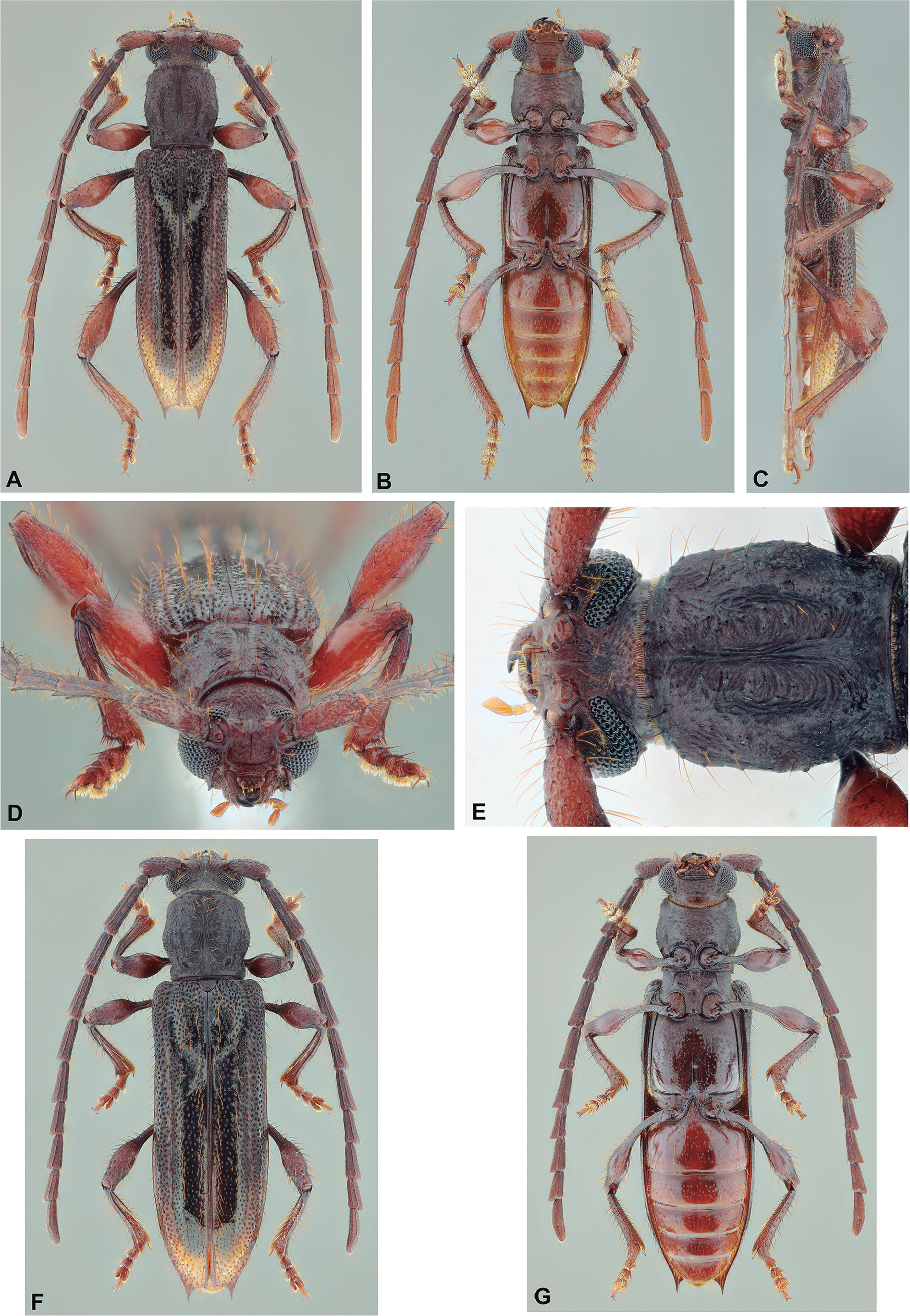
Description: Holotype male (Figs. 1A E): Head capsule dark reddish brown on frons, antennal tubercles, and area between antennal tubercle, except blackish median groove and apex of antennal tubercles, reddish brown ventrally, and irregularly dark-brown areas on sides of frons and genae, and mostly dark brown on remaining surface of vertex and area behind eyes; mandibles mostly reddish brown on basal ¾, more orangish brown depending on light intensity, blackish on apical quarter; ventral mouthparts reddish brown, except palpomeres yellowish brown with pale apex; anteclypeus reddish brown; labrum dark brown except reddish-brown sides and anterior quarter; scape reddish brown with irregular dark-brown areas dorsally and ventrally; pedicel and antennomeres III V reddish brown with large, irregular dark-brown areas on basal ⅔, gradually slightly lighter toward V, and entire carinae dark brown; antennomeres VI XI almost entirely light reddish brown, slightly darkened on carinae and slightly lighter toward apex of antennomeres. Pronotum dark brown with irregular dark reddish-brown areas. Sides of prothorax mostly dark reddish brown with irregular darker areas. Prosternum reddish brown except dark-brown anterior margin and margins close to procoxal cavities. Prosternal process dark brown with irregular dark reddish-brown areas. Ventral surface of mesothorax dark reddish brown with irregular darker areas. Metanepisterna dark reddish brown. Metaventrite reddish brown except blackish anterior margin and metathoracic discrimen. Scutellum dark reddish brown except dark-brown area close to margins. Elytra with blackish longitudinal band, from blackish circum-scutellar area to posterior quarter, not reaching sutural margin, then brown to apical sixth; with blackish longitudinal band on anterior half close to epipleural margin; remaining anterior ¾ dark reddish brown; posterior quarter light yellowish-brown except brownish sutural, epipleural, and apical margins. Femoral peduncles mostly reddish black with irregular reddish-brown areas; femoral club’s light reddish brown. Tibiae dark reddish brown on basal third, reddish brown on remaining surface, except dark-brown carinae and orangish-brown apical region of metatibiae. Tarsi mostly reddish brown. Ventral surface of abdomen reddish brown basally, gradually orangish brown toward apex, except partially pale yellowish-brown apex of ventrites 1-4.
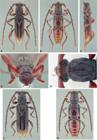
Hemilissa striatothoraxsp. nov. (A E) Holotype male: (A) Dorsal habitus; (B) Ventral habitus; (C) Lateral habitus; (D) Head, frontal view; (E) Head and pronotum. (F G) Paratype female: (F) Dorsal habitus; (G) Ventral habitus.
Head: Frons densely microsculptured; coarsely, shallowly, partially confluently punctate, with a few moderately coarse punctures interspersed; with moderately deep, U shaped sulcus anteriorly, arched longitudinal carina from anterior sulcus to apex of antennal tubercle, and depressed from carina to antennal socket; with a few short, decumbent yellowish-white setae, a few moderately long, erect, thick, yellowish-brown setae on wide central area, and one long, erect yellowish-brown seta on each side near eyes. Median groove well marked from clypeus to area between antennal tubercles and upper eye lobes. Area between antennal tubercles and upper eye lobes depressed. Area between antennal tubercles densely microsculptured, except smooth median groove; coarsely, shallowly punctate laterally, with a few deeper and finer punctures interspersed; with moderately short, thick dark-brown setae and a few moderately short, erect yellowish-brown setae close to antennal tubercles, glabrous on remaining surface. Area between antennal tubercles and upper eye lobes, densely microsculptured, finely, obliquely striate-punctate between eyes; with a few short, decumbent, yellowish-white setae and a few long, erect, thick yellowish-brown setae close to posterior margin of eyes. Remaining surface of vertex densely microsculptured; with abundant, coarse, shallow punctures; nearly all punctures with short, decumbent yellowish-white seta. Area behind upper eye lobes moderately sparsely, coarsely, shallowly punctate; with a few short, decumbent yellowish-white setae near eyes, glabrous on remaining surface. Area behind lower eye lobes abruptly narrowed about middle; moderately coarsely, shallowly punctate close eye, smooth on remaining surface; with a few short, decumbent yellowish-white setae and long, erect, thick dark-brown setae close to eye, glabrous on remaining surface. Genae densely microsculptured, except smooth apex; with a few long, erect, thick yellowish-brown setae. Mandibles striate-punctate on basal ¾ of dorsal and outer surface, smooth on apical quarter; with sparse, decumbent yellowish-white setae and long, erect, thick yellowish-brown setae interspersed on basal ¾, glabrous on apical quarter. Antennal tubercles densely microsculptured; coarsely, shallowly punctate on depressed region between inner area and longitudinal carina, punctures absent close to antennal socket; with a few short, decumbent yellowish-white setae on posterior region, glabrous on remaining surface. Wide central area of postclypeus densely microsculptured; with moderately abundant, long yellowish-brown setae and a few long, erect, thick yellowish-brown setae interspersed. Sides of postclypeus mostly smooth, glabrous. Labrum moderately abundantly, minutely punctate, with coarse, shallow punctures interspersed on wide posterocentral area, smooth laterally, and moderately coarsely punctate anteriorly; with a few short, decumbent yellowish-white setae on wide central area of posterior half, glabrous laterally, with abundant, short, yellowish-brown setae directed forward on wide central area of anterior half, these setae longer anterocentrally, and a few long, erect, thick yellowish-brown setae sides close to smooth lateral area. Gulamentum smooth, glabrous on posterior half; anterior half somewhat rugose-punctate, transversely depressed close to intermaxillary process, with sparse, decumbent yellowish-white setae and a few moderately short, erect yellowish-brown setae laterally. Upper eye lobes with four rows of ommatidia on its widest area; distance between upper eye lobes 0.29 times distance between outer margins of eyes; in frontal view, distance between lower eye lobes 0.43 times distance between outer margins of eyes. Antennae 1.6 times elytral length, reaching elytral apex at base of antennomere XI. Scape abundantly, coarsely, shallowly, partially confluently punctate; with sparse, decumbent yellowish setae and long, erect, thick yellowish-brown setae, some setae partially dark brown near base of scape. Pedicel with a few minute, decumbent yellowish-white setae on basal half; apical half with moderately long, erect, both pale-yellow and yellowish-brown setae on dorsal and outer surface; ventral surface with long, erect, thick yellowish-brown setae. Antennomeres III XI with yellowish pubescence not obscuring integument, pubescence denser on outer dorsal and ventral surfaces, and denser throughout from antennomere X; III IX with long, erect yellowish-brown setae on inner margin of ventral surface; III IX with moderately long, erect yellowish-brown setae dorsally between longitudinal carinae, setae gradually sparser and shorter toward IX; outer apex of III X and entire apex of XI with short pale-yellow setae. Antennal formula (ratio) based on length of antennomere III: scape = 0.67; pedicel = 0.26; IV = 0.67; V = 0.82; VI = 0.73; VII = 0.70; VIII = 0.62; IX = 0.59; X = 0.56; XI = 0.82.
Thorax: Prothorax longer than wide; anterior constriction narrow, well-marked; sides slightly rounded, sinuous between anterior constriction and posterior fifth, then subparallel-sided toward posterolateral angles. Pronotum velvety; longitudinally sulcate from anterior to posterior margin, sulcus distinctly widened close to posterior margin; each side of central area with striae forming J shaped area filled with transverse, slightly arched striae and sparse, fine punctures interspersed between its posterior ⅔; remaining surface somewhat rugose, with fine punctures interspersed, punctures asperate on some areas, especially anterocentrally; with sparse, short, decumbent yellowish-white setae, and long, erect setae interspersed, except on longitudinal sulcus, setae entirely yellowish brown or dark brown basally and gradually yellowish brown toward their apex. Sides of prothorax somewhat rugose-punctate, except area close to pronotum with sparse, asperate punctures; with sparse yellowish-white setae and long, erect yellowish-brown seta inside each asperate puncture. Prosternum somewhat rugose; moderately sparsely, coarsely punctate, punctures almost absent close to anterior margin; with short, decumbent yellowish-white seta inside nearly all punctures. Prosternal process longitudinally sulcate on anterior half; glabrous; narrowest area 0.25 times procoxal width. Mesoventrite slightly depressed on each side of anterocentral region; with sparse, short, decumbent yellowish-white setae centrally, glabrous on remaining surface. Mesanepisterna with sparse, short, decumbent whitish setae. Mesepimera with abundant yellowish-white pubescence not obscuring integument. Mesoventral process slightly narrowed from base to apex; apex strongly notched centrally; anterior half with sparse, both short, decumbent yellowish-white setae and moderately long, erect yellowish-brown setae; apical width 0.75 times mesocoxal width. Metanepisterna with abundant yellowish pubescence not obscuring integument, pubescence denser from middle. Metaventrite densely microsculptured anteriorly, this area longer laterally, sparsely, coarsely, shallowly punctate on sides, smooth close to metathoracic discrimen; with sparse, short, decumbent yellowish setae laterally and sparse, both moderately short, decumbent yellowish-white setae and long, erect yellowish-brown setae centrally, except glabrous area close to metathoracic discrimen. Scutellum depressed, microsculptured, with a few short, decumbent yellowish setae centrally, smooth, glabrous close to margins. Elytra: Shiny on blackish dorsal band and yellowish-brown area, opaque on remaining surface; abundantly, coarsely punctate, punctures partially tuberculiform on anterior quarter, gradually finer and sparser from posterior third; widely, longitudinally, moderately deeply sulcate dorsally near suture, from near base to near apex, and slightly longitudinally sulcate on outer side of dorsal surface; most punctures with short, decumbent yellowish-white seta inside and some punctures with long, erect, thick seta inside, partially longitudinally aligned, especially near suture, erect setae entirely yellowish brown or dark brown basally and gradually yellowish brown toward their apex; apex slightly obliquely concave, with long triangular projection on outer angle and short triangular projection on sutural angle. Legs: Femoral peduncles sulcate laterally and ventrally, almost flat dorsally; femoral clubs sparsely, somewhat coarsely punctate, punctures coarser and partially confluent on dorsal area close to apex; with a few minute, decumbent yellowish setae, absent on some areas, and sparse, long, erect yellowish-brown setae throughout. Tibiae with two longitudinal carinae laterally, making all surfaces longitudinally sulcate; not distinctly flattened laterally, gradually widened from base to near apex, distinctly widening close to apex; with sparse, long, erect yellowish-brown setae dorsally, laterally, basal third of ventral surface of protibiae, and basal half of ventral surface of mesoand metatibiae; remaining ventral surface of tibiae with dense, bristly yellowish-brown setae and long, erect setae of same color interspersed on mesoand metatibiae. Dorsal surface of tarsomeres with sparse yellowish-white pubescence and a few long, erect yellowish-brown setae.
Abdomen: Ventrites with sparse, short, decumbent yellowish setae and long, erect yellowish-brown setae interspersed, except glabrous apex of ventrites 1-4. Apex of ventrite 5 rounded.
Female (Figs. 1F G): Similar to males, differing by shorter antennae, 1.3 times elytral length, almost reaching elytral apex.
Variation: Head capsule dark reddish brown, except dark-brown vertex; antennae dark brown with outer surface reddish brown, except almost entirely reddish-brown distal segments; elytra dark brown except blackish longitudinal band dorsally and yellowish-brown apex; ventral surface of thorax dark reddish brown; femora and tibiae dark reddish brown.
Dimensions (mm) (holotype male/paratype males/paratype females): Total length, 9.70/7.55-9.45/ 9.00-11.45; prothoracic length, 1.95/1.50-1.85/1.70-2.15; anterior prothoracic width, 1.40/1.05-1.30/1.20-1.70; posterior prothoracic width, 1.50/1.20-1.45/1.35-1.95; maximum prothoracic width, 1.75/1.45-1.80/1.65-2.25; humeral width, 2.25/1.70-2.15/2.10-2.85; elytral length, 6.70/5.30-6.35/6.40-8.55.
Type material: Holotype male from ECUADOR, Napo: Pacto Sumaco, 1,500 m, 00°40′10″S, 77°35′52″W, 23 Nov 2022, J. Vlasak leg. (MZSP, formerly JVCO). Paratypes: same data as holotype, 1 male (DHCO), 5 males (JVCO), 4 females (JVCO), 1 female (MZSP).
Etymology: From “striatus” (Latin, striated) + thorax (Latin); alluding to the striated sculpturing of the pronotal disc. The species-group name is a noun phrase in apposition, in which “thorax” (masculine gender) agrees with “striatus” (masculine gender) and does not need to agree with the gender of the genus.
Remarks: The separation between Hemilissa and GorybiaPascoe, 1866 is problematic. Pascoe (1866) did not compare these two genera described by him. According to Martins (2003) (translated): “Hemilissa and Gorybia were proposed by Pascoe (1858, 1866). In 1858, Pascoe justified the establishment of Hemilissa by stating: “This genus is formed for the Acanthoptera gummosa of Perty. What Acanthoptera is intended it is difficult to say, since Latreille used the word to include Purpuricenus, Callichroma and the Stenocori of Fabricius, but this arrangement was never adopted. Hemilissa is closely allied to Piezocera, Serv.” For Gorybia (Pascoe, 1866: 481) he made no comments, nor did he compare it with any genus. The two type species, H. gummosa [Perty, 1832] and G. martes [Pascoe, 1866], present features that justify both genera, but the discovery of many other species in both genera, showed intermediate features between the two entities. Martins (1976) deemed it convenient to maintain the two genera, provisionally, because it becomes easier to recognize many species or even that other features can be discovered to separate them. The most conspicuous features to distinguish Hemilissa from Gorybia are the shape of the basal flagellomeres, the shape of the prothorax and the appearance of the protibiae. In Hemilissa, these flagellomeres are wider and more expanded toward the outside from the base to apex, whereas in Gorybia they are little or not expanded toward the external side (Figs. 191-201 [figures from Martins (1976)]) and this expansion is only at the apex. This distinction is very evident in the most typical species of each genus, but it is up to interpretation in others (females of G. simplicior [Bates, 1870], for example). In Hemilissa, the prothorax is generally cylindrical, unlike in Gorybia, where it is bulged on the sides. However, in species of group V [proposed by Martins (1976) - prothorax slightly longer than wide, with sides slightly bulging; central area of the pronotum without distinct longitudinal depression; and punctures on the basal area of the elytra not tuberculiform] of Hemilissa, the prothorax is also rounded on the sides and the distinction that stands out is the shape of the antennae. The protibiae in Hemilissa are flat and in Gorybia they are more cylindrical.” We believe that a genus is not and cannot be a taxon merely used to facilitate species identification. However, finding true differences between Hemilissa and Gorybia or proposing the latter’s synonymy is far from the scope of this work. Therefore, based on the general appearance of the new species being more similar to some species of Hemilissa, but also because it is the older genus, we chose to describe it in this genus.
The key to species of Hemilissa by Martins (2003) leads Hemilissa striatothorax sp. nov. to the alternative of couplet “7” (translated): “Prothorax slightly longer than wide (length, 1.4-2.0 mm; greatest width, 1.3-1.7), with slightly domed sides; center of the pronotum without distinct longitudinal depression; punctures on the anterior area of elytra not tuberculiform,” leading to H. catapotiaMartins, 1976; and “Prothorax longer than wide (length, 1.5-2.8 mm; greatest width, 1.2-2.2), with subparallel sides; center of the pronotum with wide centrolongitudinal depression; punctures on the anterior area of elytra tuberculiform,” leading to the alternative of couplet “8.” As Hemilissa striatothorax has the prothorax slightly longer than wide, center of the pronotum with wide longitudinal depression, and the punctures on the anterior quarter of the elytra partially tuberculiform, the two options of the alternative of couplet “7” do not allow including the new species. Disregarding the prothoracic length, Hemilissa striatothorax can be include in the alternative of couplet “8” modified:
-
8(7). Elytra shiny throughout; pronotal sulcus smooth, shiny. Costa Rica, Colombia, Bolivia, Guyana, French Guiana, Peru, Brazil (Amazonas, Pará, Rondônia, Acre, Maranhão, Rio Grande do Norte, Paraíba, Bahia, Tocantins, Goiás, Mato Grosso, Mato Grosso do Sul, Minas Gerais, Espírito Santo, and São Paulo), and Argentina ........ H. sulcicollis Bates, 1870
-
- Elytra partially or entirely microsculptured on the anterior half; pronotal sulcus opaque and not smooth ........ 8’
-
8’(8). Elytra entirely opaque on anterior half; prothorax distinctly longer than wide; pronotum not velvety. Brazil (Bahia, Espírito Santo) ........ H. undulaticollis Zajciw, 1960
-
- Elytra not entirely opaque on anterior half; prothorax slightly longer than wide; pronotum velvety. Ecuador ........ H. striatothorax sp. nov.
The key to species of Hemilissa by García López et al. (2019) leads H. striatothorax to the alternative of couplet “5:”
-
“5. Elytra with matte finish and entirely microsculptured ........ 6
-
- Elytra shiny, either lacking microsculpture completely or only evident on anterior half ........ 8”
These two options do not allow including the new species, but the second option is better since the elytra are not entirely microsculptured and/or opaque on the anterior half. Then, the key leads H. striatothorax to the alternative of couplet “9.” However, as in the key to species of Hemilissa by Martins (2003), both options do not allow the inclusion of the new species:
-
“9. Prothorax slightly longer than wide (length, 1.4-2.0 mm; largest width, 1.3-1.7 mm) with sides convex; center of pronotum without distinct longitudinal depression. French Guiana, Brazil (Roraima, Amazonas, Amapá, Pará, Mato Grosso) ........ Hemilissa catapotiaMartins, 1976
-
- Prothorax much longer than wide (length, 1.5-2.8 mm; largest width, 1.2-2.2 mm) with sides parallel; center of pronotum with visible wide longitudinal depression ........ 10”
Again, disregarding the length of the prothorax, the key leads the new species to the alternative of couplet “12” with H. sulcicollis and H. undulaticollis (see the modified key above for differentiation).
LAMIINAE Latreille, 1825 APOMECYNINI Thomson, 1860Albasor gen. nov. (Fig. 2)
Type species:Albasor formicosussp. nov., here designated.
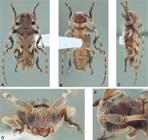
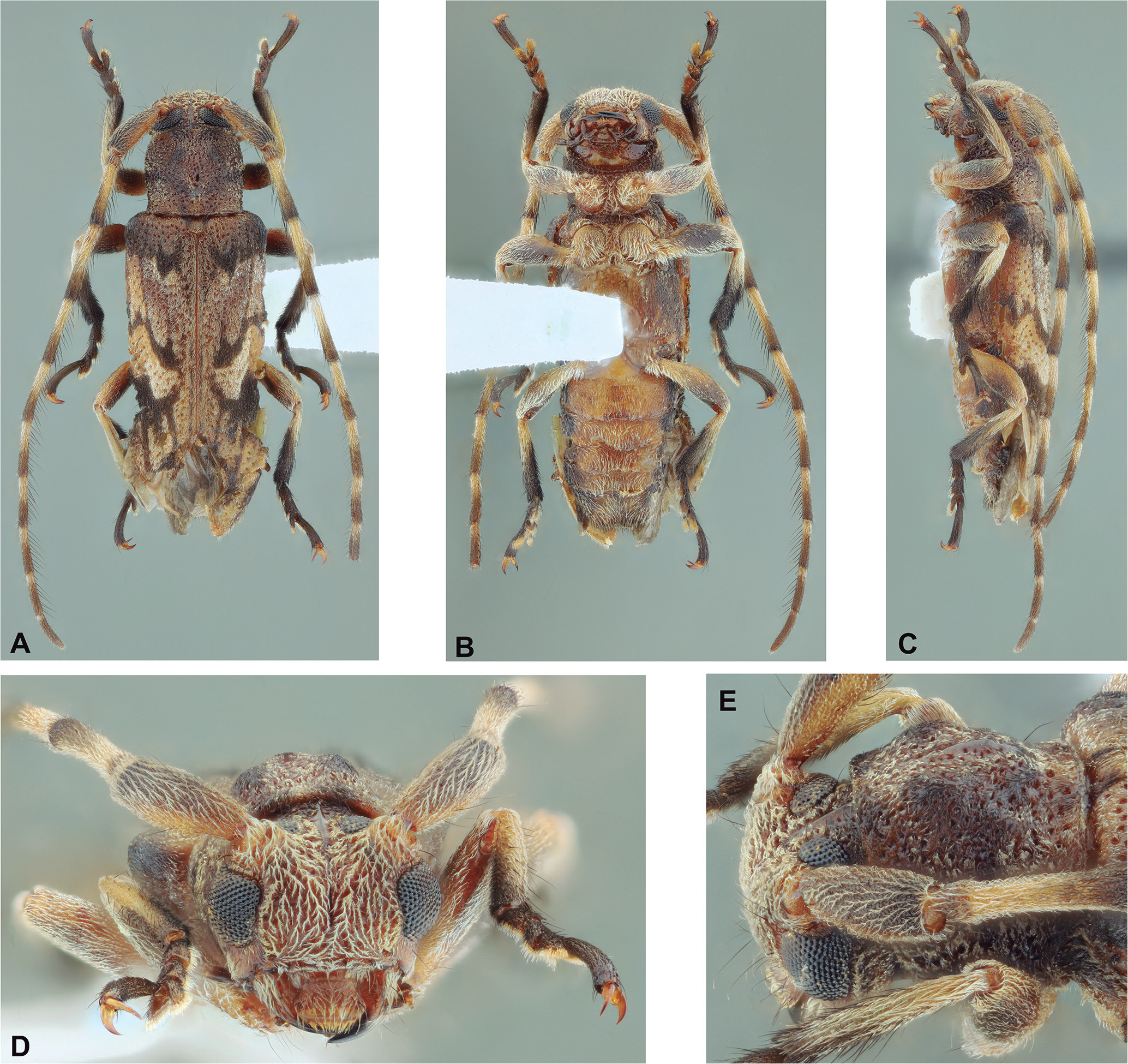
Albasor formicosusgen. nov., sp. nov., holotype female: (A) Dorsal habitus; (B) Ventral habitus; (C) Lateral habitus; (D) Head, frontal view; (E) Pronotum, oblique view.
Etymology: Anagram of Rosalba, genus of Apomecynini. Masculine gender.
Description: Female: Moderately small-sized body, not flattened (Fig. 2C), somewhat slender (Fig. 2A). Head retractile. Frons (Fig. 2D) transverse. Vertex with longitudinal carina close to prothorax. Eyes coarsely faceted; not divided or subdivided; distance between upper eye lobes about as wide as maximum diameter of one upper lobe. Antennae 11 segmented, distinctly longer than body; scape without apical cicatrix, not claviform; antennomere III shorter and not thicker than IV; IV slightly longer than scape and V; ventral surface of antennomeres with moderately abundant erect setae, except on XI. Antennal tubercles not close to each other, elevated. Prothorax without lateral tubercles. Pronotum widely tumid between about anterior and posterior fifths; with large tubercle with rounded apex on each side of anterior half; center with longitudinal, moderately elevated tubercle with rounded apex, located from anterior third to about posterior quarter. Metathorax not shortened. Elytra with short, slightly elevated centrobasal crest, without dense erect setae; apex rounded; humeri not spiniform; with sparse, long, erect setae. Femora not claviform. Metatarsomere V slightly shorter than I III together.
Diagnosis: Frons transverse; antennal tubercles not close to each other; scape without apical cicatrix; flagellomeres III X with somewhat abundant, long, erect dark setae ventrally; pronotum distinctly tumid centrally; metathorax not shortened; humeri not projected; elytra with sparse erect setae; centrobasal crest of elytra slightly elevated, without dense erect setae on top.
Remarks: The set of features of Albasor make it very distinctive among Apomecynini, both from the New and Old World, and it cannot be confused with any other genera. Nevertheless, when using the key to American species of Apomecynini from Breuning (1971)Albasor leads to the alternative of couplet “19” with Paraesylacris Breuning, 1940 and AmphicnaeiaBates, 1866. Albasor differs from Paraesylacris by the antennal tubercles not close to each other (moderately close in Paraesylacris), by the frons transverse (not transverse in Paraesylacris), and centrobasal crest of elytra without dense and short erect setae (present in the type species of Paraesylacris) (see remarks on Rosalba). The new genus differs from Amphicnaeia especially by the pronotum distinctly tumid on the wide central area and with distinct tubercles (not tumid and without tubercles in Amphicnaeia). Of the genera described since Breuning (1971), Albasor is somewhat similar to Vandenbergheius Heffern, Santos-Silva & Botero, 2019 and Eyiaba Galileo & Martins, 2004. Albasor differs from Vandenbergheius especially by the centrobasal crest of elytra slightly elevated (distinctly elevated in Vandenbergheius) and the genae distinctly shorter than the lower eye lobe in frontal view (longer in Vandenbergheius). The new genus differs from Eyiaba by the prothorax without lateral tubercle (with spiniform tubercle in Eyiaba), and the outer apical angle of elytra without spiniform projection (present in Eyiaba).
Albasor formicosus sp. nov. (Fig. 2)
Description: Holotype female: Head capsule brown on frons and dorsal area between antennal tubercles and posterior margin of upper eye lobes, dark brown on remaining surface of vertex and entire area behind eyes, reddish brown on anterior area of ventral surface, dark yellowish brown on remaining ventral surface, orangish brown on wide central area of genae and brown on remaining genal surface, dark brown on antennal tubercles except orangish apex. Ventral mouthparts mostly reddish brown, except yellowish-brown apex of maxillary palpomeres V and reddish-brown apex of labial palpomere III. Anteclypeus reddish brown. Labrum reddish brown except mostly dark yellowish-brown anterior quarter. Mandibles reddish brown on basal ⅔, blackish on apical third. Scape dark brown dorsally and on part of sides; remaining surface orange. Antennomeres III X orangish basally, this area gradually shorter toward X, brown apically, except dark-brown apex of III IV, this area gradually larger toward X; antennomere XI dark orangish brown on a very small portion of base, brown on remaining surface. Pronotum brown, more reddish-brown on some areas, especially depending on light intensity, except large omega-shaped dark-brown macula, from anterior margin to posterior quarter, and dark-brown transverse band on each side about middle, these bands fused to omega-shaped macula. Sides of prothorax reddish brown close to pronotum, dark brown on remaining surface. Prosternum dark brown laterally, dark orangish brown on remaining surface; prosternal process dark orangish brown. Mesoventrite dark brown except dark orangish-brown area close to mesoventral process, coxal cavities, and sides. Mesanepisterna blackish, except dark-orangish brown area close to reddish-brown mesepimeron; mesoventral process orangish brown. Metanepisterna and most of sides of metaventrite dark brown; remaining surface of metaventrite orangish brown. Scutellum reddish brown, except blackish lateroanterior areas. Elytra reddish brown on dorsal surface close to anterior margin, this area not reaching humerus; dark brown, almost blackish from area close to epipleural margin to dorsal area on anterior sixth, this area involving humerus; with V shaped blackish macula on area of centrobasal crest; with oblique dark-brown band from V shaped blackish band to near suture on anterior quarter; dark brown between humerus and V shaped blackish macula, brown close to suture on anterior quarter between V shaped blackish macula and dark-brown oblique band; anterior third with orange, somewhat rectangular macula from epipleural margin to sides of dorsal surface; with orange macula about middle, from epipleural margin to near suture, dorsal region of this macula obliquely inclined backward dorsally; with dark-brown, sinuous band between orange areas, this band obliquely inclined backward dorsally and not reaching suture, with longitudinal projections forward dorsally; remaining dorsal surface between anterior sixth and dark-brown band after middle light reddish brown with irregular orange, orangish-brown, and light-brown areas; with large dark-brown macula close to posterior and inner margin of second orange macula, this macula with longitudinal projections backward on dorsal surface, innermost and outermost fused on posterior sixth; remaining elytral surface orangish-brown except dark-brown, almost blackish area close to epipleural margin. Profemora orange basally and apically, mostly dark brown on remaining surface; mesoand metafemora orange basally, entire dorsal surface, and superior region of sides, dark brown on remaining surface. Protibiae orange on basal third and dorsal surface, except brown apex of dorsal surface, dark brown on remaining surface; mesoand metatibiae orange on basal third, this area reaching about middle dorsally, dark brown on remaining surface. Tarsi dark brown, except orange claws. Abdominal ventrites 1-4 orange except dark brown, almost blackish sides and reddish-brown central apex; ventrite 5 dark brown laterally and on longitudinal central band, orange on remaining surface.
Head: Frons abundantly, moderately coarsely punctate; with abundant yellowish-white pubescence not obscuring integument, except glabrous median groove; with one long, erect dark-brown seta close to eyes. Area between antennal tubercles with sculpturing and pubescence as on frons; with a few long, erect dark-brown setae interspersed. Remaining surface of vertex moderately abundantly, coarsely punctate, except smooth central region, this area wider between eyes; with abundant yellowish-white pubescence not obscuring integument close to eyes, sparse brown pubescence laterally close to prothorax, glabrous on remaining surface; with long, erect dark-brown setae close to eyes. Area behind upper eye lobes with abundant yellowish-white pubescence not obscuring integument and long, erect dark-brown setae interspersed. Area behind lower eye lobes with moderately abundant yellowish pubescence not obscuring integument, and long, erect dark-brown setae interspersed. Genae with moderately sparse yellowish pubescence, except glabrous apex; with a few long, erect dark-brown setae interspersed. Antennal tubercles with pubescence as on frons. Outer surface of mandibles with dense yellowish-white pubescence on basal third, with long, erect dark-brown setae interspersed, glabrous on remaining surface. Wide central area of postclypeus with pubescence as on frons, and abundant yellowish-white setae directed forward laterally close to anteclypeus; with long, erect dark-brown setae interspersed, one longer and thicker seta on each side. Sides of postclypeus mostly glabrous. Labrum with moderately abundant yellowish-white pubescence not obscuring integument on posterior ⅔, glabrous on anterior third, except dense fringe of yellowish-brown setae on anterior margin; with arched row of long, erect, thick dark-brown setae on posterior third, and long yellowish setae directed forward about middle. Gulamentum smooth, glabrous, except moderately sparse yellowish-white pubescence on intermaxillary process. Widest area of upper eye lobes with seven rows of ommatidia; distance between upper eye lobes 0.16 times distance between outer margins of eyes; in frontal view, distance between lower eye lobes 0.64 times distance between outer margins of eyes. Antennae 1.75 times elytral length, reaching elytral apex at base of antennomere IX. Scape with abundant yellowish-white pubescence not obscuring integument; with a few long, erect dark-brown setae interspersed dorsally and laterally. Pedicel with abundant yellowish-white pubescence not obscuring integument. Orange integumental area of antennomeres III XI with abundant white pubescence not obscuring integument; dark integumental area of antennomeres III XI with moderately abundant dark-brown pubescence not obscuring integument; dorsal apex of antennomeres III IV with a few long, erect dark-brown setae; antennomeres V XI with sparse, short, erect whitish setae interspersed, especially dorsally and laterally, setae more abundant toward XI. Antennal formula (ratio) based on length of antennomere III: scape = 1.04; pedicel = 0.18; IV = 1.20; V = 1.00; VI = 0.96; VII = 0.88; VIII = 0.84; IX = 0.76; X = 0.68; XI = 0.74.
Thorax: Prothorax slightly wider than long; sides slightly rounded from anterolateral angles to posterior seventh, then slightly divergent toward posterolateral angles. Pronotum abundantly, coarsely punctate, except smooth central tubercle; with moderately abundant yellowish-white pubescence not obscuring integument, except dark-brown pubescence on dark integumental area and glabrous central tubercle; with a few long, erect dark-brown setae interspersed laterally. Sides of prothorax abundantly, coarsely punctate; with abundant yellowish-white pubescence not obscuring integument close to pronotum and abundant dark-brown pubescence not obscuring integument toward prosternum. Prosternum abundantly, coarsely punctate; with dark-brown pubescence not obscuring integument laterally and moderately sparse yellowish-white pubescence on remaining surface. Prosternal process with abundant, bristly yellowish-white pubescence not obscuring integument; narrowest area 0.2 times procoxal width. Mesoventrite with sparse dark-brown pubescence on dark integumental area and abundant yellowish-white pubescence on orange integumental area, this pubescence denser laterally. Mesanepisterna with abundant dark-brown pubescence with yellowish-white pubescence interspersed, pubescence not obscuring integument, except denser yellowish-white pubescence close to mesepimeron. Mesepimera with moderately abundant yellowish-white pubescence not obscuring integument. Mesoventral process abundantly, coarsely punctate; with abundant, bristly yellowish-white pubescence not obscuring integument; sides slightly concave centrally; narrowest area 0.35 times mesocoxal width. Metanepisterna with abundant, both brown and yellowish-white pubescence not obscuring integument. Sides of metaventrite with pubescence as on metanepisterna; remaining surface with very sparse yellowish-white pubescence. Scutellum sparsely, finely punctate; with yellowish-white pubescence not obscuring integument on light integumental area, this pubescence denser apically, and dark-brown pubescence not obscuring integument on dark integumental area. Elytra: Moderately abundantly, coarsely punctate on anterior quarter, punctures slightly finer and sparser on remaining surface; dark integumental areas with abundant dark-brown pubescence not obscuring integument; reddish-brown basal area and area close to suture with abundant yellowish-white pubescence not obscuring integument, pubescence sparser on reddish-brown basal area; remaining surface with abundant white pubescence not obscuring integument, except dense white pubescence on orange central area. Legs: Femora somewhat sparsely, finely punctate; with abundant yellowish-white pubescence not obscuring integument. Orange integumental area of tibiae with abundant white pubescence not obscuring integument; dark integumental area with moderately sparse dark-brown pubescence, except dense, bristly dark-brown pubescence on ventral surface of protibiae; abundant, short, erect blackish setae on ventral surface of mesoand metatibiae, and dense, short, erect blackish setae on apical dorsal third of mesotibiae; dorsal surface of all tibiae with long, erect blackish setae interspersed; ventral surface of mesoand metatibiae with long, erect blackish setae interspersed. Dorsal surface of tarsomeres with moderately abundant dark-brown pubescence not obscuring integument and long, erect blackish setae interspersed; metatarsomere I shorter than II III together.
Abdomen: Ventrites with abundant whitish pubescence not obscuring integument, except sides of ventrites 1-4 partially with dark-brown pubescence; apex of ventrite 5 concave centrally, with long dark-brown setae directed backward.
Dimensions (mm): Total length, 7.85; prothoracic length, 1.45; anterior prothoracic width, 1.50; posterior prothoracic width, 1.65; maximum prothoracic width, 1.70; humeral width, 2.45; elytral length, 5.75.
Type material: Holotype female from ECUADOR, Loja: Rumi Wilco Ecolodge, 1,600 m, Vilcabamba, 11 Aug 2023, J. Vlasak leg. (MZSP, formerly JVCO).
Etymology: From formica (Latin, ant) + Latin suffix “ osus” (meaning “full of”); alluding to how the holotype was found by the first author: damaged by tiny ants that entered its pupal cell.
Remarks: Although the holotype was seriously damaged by ants, we believe that all the features necessary to describe the species are present.
Rosalba Thomson, 1864
RosalbaThomson, 1864: 108.
AletretiaBates, 1866: 34.
ParhippopsisBreuning, 1973: 653.
ApyratucaGalileo & Martins, 2006.
Remarks:Thomson (1864) did not report the existence of long and erect setae on elytra of Rosalba;Bates (1866) also did not report the existence of erect setae on elytra in Aletretia, currently a junior synonym of Rosalba;Breuning (1973) did not report erect setae on elytra in Parhippopsis, currently a junior synonym of Rosalba; and Galileo & Martins (2006) reported that the body does not have erect setae in Apyratuca, currently a junior synonym of Rosalba.Lacordaire (1872) did not comment on whether there were erect setae on elytra of Rosalba and Aletretia. According to the key in Breuning (1971), the elytra does not have erect setae in Rosalba. Finally, according to Santos-Silva et al. (2018): “The general appearance of Rosalba species is similar to that of AmphicnaeiaBates, 1866. However, Rosalba lacks long and erect setae on elytra, while they are present in Amphicnaeia.” However, some species of Rosalba, including the type species, R. alcidionoidesThomson, 1864, have erect setae on margins and apical region. Therefore, the only reliable difference between Rosalba and Amphicnaeia is the presence of long and erect setae over the entire elytra in Amphicnaeia, while they are absent or present only on the margins and/or apically in Rosalba.
According to the key to genera of American Apomecynini from Breuning (1971) (translated):
-
“16. Surface without erect setae ...... 17
-
- Surface with erect setae ...... 18 [following toward “19”]
-
17. Antennomere III shorter than scape ...... Aletretiopsis Breun.
-
- Antennomere III as long as scape ...... Rosalba Thoms.”
-
“19. Antennal tubercles moderately prominent ...... Paraesylacris Breun.
-
- Antennal tubercles slightly prominent ...... Amphicnaeia Bat.”
However, as the type species of Rosalba has erect setae on elytra, the key is not useful and may lead to misidentification. Furthermore, the antennal tubercles in Paraesylacris are not different from those in Rosalba and also not very different from those in Amphicnaeia. Still, according to Breuning (1971), the frons in Paraesylacris is trapezoidal. As the shape of the frons is very variable in Rosalba, from transverse to trapezoidal, and the length of the antennomere III compared with the length of the scape is also variable, these features do not allow separating these genera either. As the elytra of the type species of Paraesylacris, P. bituberosa Breuning, 1940, has a distinct centrobasal crest with dense and short erect setae on top, this may be the only reliable difference between this genus and Rosalba. However, we do not know if the elytra in P. bituberosa have erect setae throughout or only on margins, which may or may not be an additional differentiating feature. The pronotum in P. bituberosa and P. columbiana (Breuning, 1940) appear to have distinct tubercles on the anterior half, which also may allow the separation from Rosalba. However, apparently, P. columbiana does not have the centrobasal crest of elytra as in P. bituberosa. Paraesylacris candida Martins & Galileo, 2001 (Figs. 4D F) also does not have the centrobasal crest as in P. bituberosa, which suggests that it does not belong to this genus. However, P. candida has distinct erect setae throughout the elytra and the pronotal tubercles are almost absent. For now, it is not possible to provide any formal opinion on Paraesylacris without examining specimens of the type species and P. columbiana. In the same way, it is not possible to provide more detailed differences between Paraesylacris and Albasor, without examining the type species of the former.
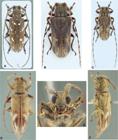
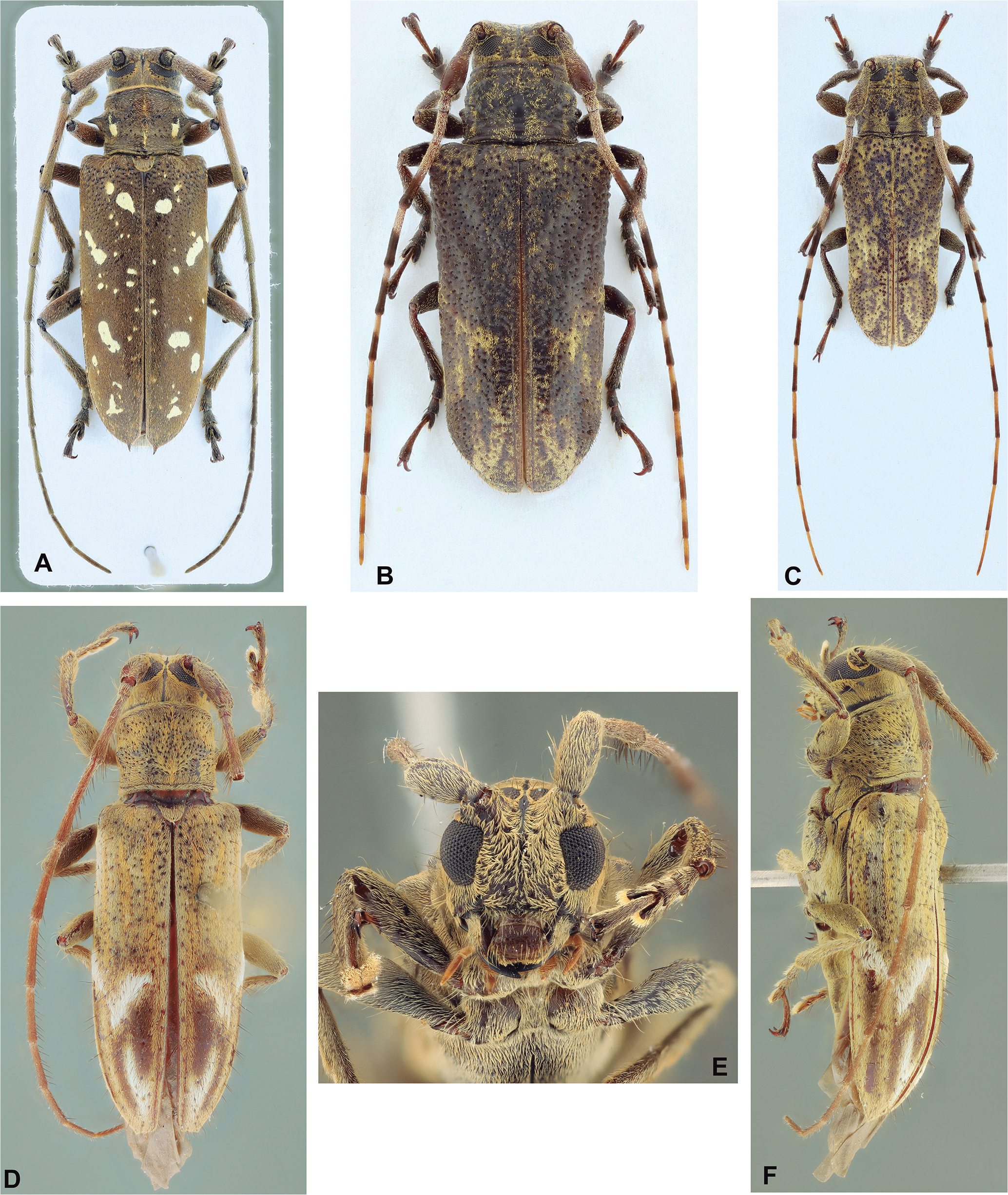
Lamiinae spp. (A) Hammatoderus thoracicus (White, 1858), female from Ecuador, dorsal habitus. (B C) Hesychotypa punctataMartins, 1979, specimens from Ecuador, dorsal habitus: (B) Female; (C) Male. (D F) Paraesylacris candida Martins & Galileo, 2001, holotype female (MZSP 62643): (D) Dorsal habitus; (E) Head, frontal view; (F) Lateral habitus.
Rosalba luteomaculata sp. nov. (Fig. 3)
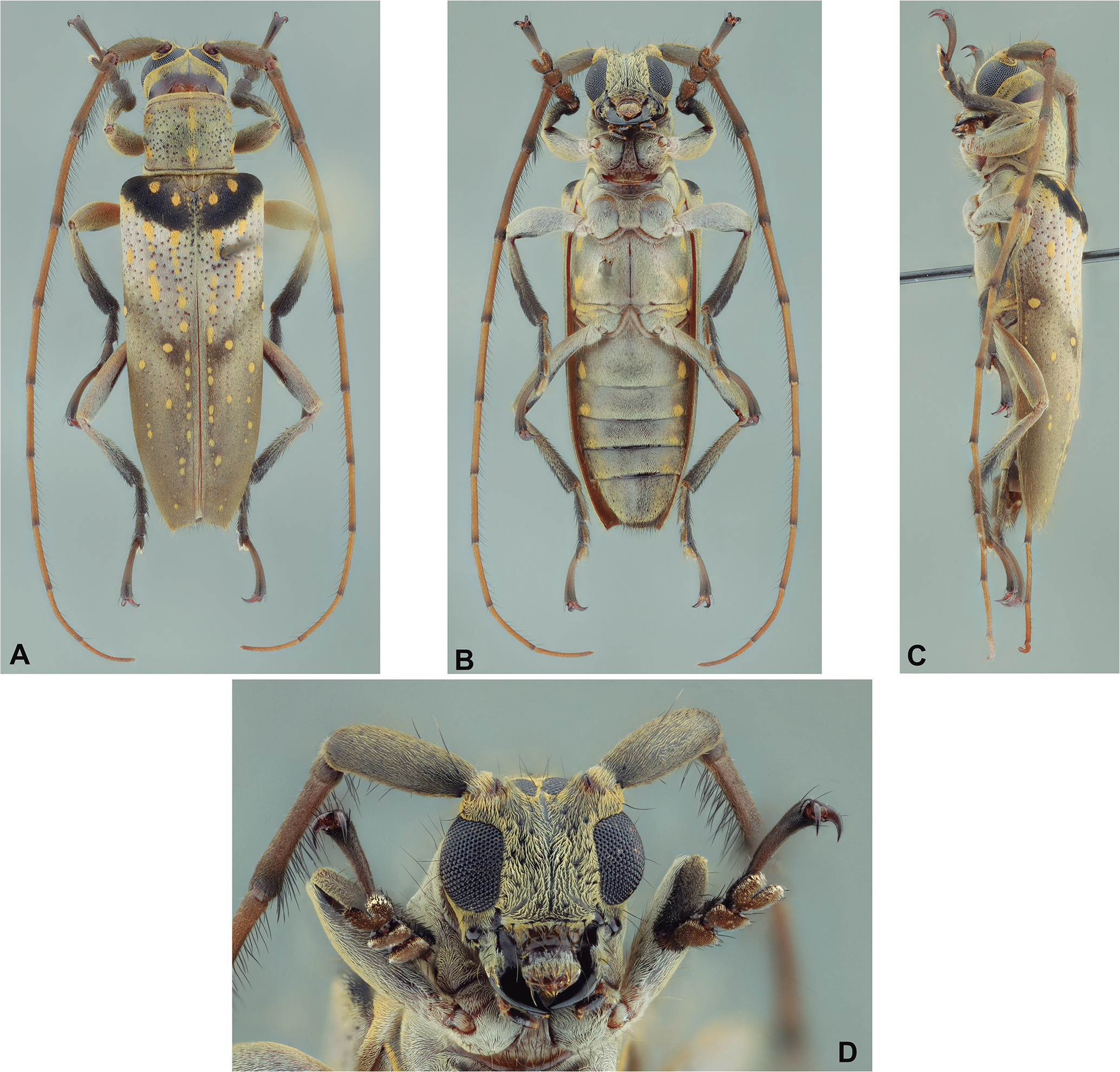
Description: Holotype male: Head capsule dark brown; ventral mouthparts reddish brown except blackish basal ¾ of maxillary palpomere IV and of labial palpomere III; mandibles dark brown, almost black; anteclypeus brown, darker depending on light intensity and source; labrum dark brown on posterior ¾, brown on anterior quarter, darker depending on light intensity and source; scape and pedicel dark brown, slightly lighter depending on light intensity; antennomere III reddish brown, except dark-brown apical fifth; antennomeres IV X orangish brown, except dark-brown apex; antennomere XI orangish brown, slightly darker apically. Prothorax dark brown, darker reddish brown on prosternal process depending on light intensity. Ventral surface of mesoand metathorax dark brown. Scutellum brown. Elytra reddish brown on circum-scutellar area, considering both elytra with semi-circular blackish macula on remaining anterior sixth, involving humeri, not reaching epipleural margin; remaining surface brown, slightly darker on oblique macula about middle of dorsal and lateral surfaces. Femora dark brown. Proand mesotibiae brown on basal third, blackish on remaining surface; metatibiae reddish brown on basal third, blackish on remaining surface. Tarsomeres I IV dark brown; tarsomeres V dark reddish brown except blackish apex. Abdominal ventrites dark brown.
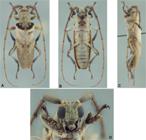
Rosalba luteomaculatasp. nov., holotype male: (A) Dorsal habitus; (B) Ventral habitus; (C) Lateral habitus; (D) Head, frontal view.
Head: Frons sparsely, coarsely punctate; with abundant dull yellowish-brown pubescence not obscuring integument, except glabrous, oblique band on each side close to clypeus; with long, erect dark-brown setae laterally. Vertex and area behind upper eye lobes with abundant yellowish-brown pubescence partially obscuring integument, except dense yellow pubescence close to eyes and glabrous, longitudinal central area on vertex from eyes; with a few long, erect dark-brown setae close to eyes. Area behind lower eye lobes with dense yellow pubescence except glabrous area close to prothorax; with a few long, erect dark-brown setae interspersed on pubescence. Genae with dense yellowish-brown pubescence toward ventral surface, abundant dull yellowish-brown pubescence not obscuring integument toward frons and clypeus, except glabrous apex; with a few long, erect dark-brown setae toward ventral surface. Antennal tubercles with abundant dull yellowish-brown pubescence partially obscuring integument, except yellow pubescence on apex; with long, erect dark-brown setae interspersed on basal half. Wide central area of postclypeus with abundant dull yellowish-brown pubescence not obscuring integument close to frons and abundant yellowish-brown pubescence not obscuring integument close to anteclypeus; with long, erect dark-brown setae interspersed near frons. Sides of postclypeus glabrous. Labrum mostly glabrous close to anteclypeus, with abundant yellowish-brown pubescence not obscuring integument centrally, and glabrous on anterior quarter, except fringe of yellowish-brown setae on anterior margin; with long brown setae directed forward centrally and one very long, erect seta on each side of central region, these setae brown basally, gradually lighter toward their apex. Distance between upper eye lobes 0.03 times distance between outer margins of eyes; in frontal view, distance between lower eye lobes 0.43 times distance between outer margins of eyes. Antennae 2.0 times elytral length, reaching elytral apex near apex of antennomere VII. Scape with abundant brownish pubescence not obscuring integument, pubescence more yellowish-brown depending on light source; with a few long, erect dark-brown setae dorsally and moderately abundant, long, erect dark-brown setae on apical ⅔ of ventral surface. Pedicel with pubescence as on scape; with long, erect dark-brown setae ventrally. Antennomere III with abundant yellowish-brown pubescence not obscuring integument, pubescence sparser on dark integumental apex; with abundant, long, erect dark-brown setae ventrally. Antennomeres IV XI with abundant yellowish-white pubescence not obscuring integument, pubescence slightly sparser on dark integumental area of IV X; with long, erect dark-brown setae ventrally, setae gradually sparser toward XI. Antennal formula (ratio) based on length of antennomere III: scape = 1.00; pedicel = 0.17; IV = 1.38; V = 1.25; VI = 1.17; VII = 1.07; VIII = 1.02; IX = 0.97; X = 0.90; XI = 0.87.
Thorax: Prothorax slightly wider than long; sides with short, somewhat conical tubercles about middle; with narrow, well-marked transverse sulcus anteriorly and posteriorly. Pronotum moderately sparsely, coarsely punctate between anterior and posterior sulci; with abundant dull yellowish-brown pubescence not obscuring punctures, pubescence yellower close to anterior margin, absent on anterior and posterior sulcus, and six dense yellow pubescent maculae, one laterally on anterior and posterior half, reaching superior region of sides of prothorax, one centrally on anterior and posterior half; with a few long, erect dark-brown setae interspersed laterally. Sides of prothorax with abundant dull yellowish-brown pubescence partially obscuring integument, except glabrous sulci and yellow maculae close to pronotum. Sides of prosternum with abundant dull yellowish-brown pubescence not obscuring integument anteriorly and dense yellowish-brown pubescence partially obscuring integument posteriorly; central area with sparse dull yellowish-brown pubescence. Prosternal process sparsely, coarsely punctate, each puncture with long, erect dark-brown seta; with abundant yellowish-white pubescence not obscuring integument; sides slightly convergent anteriorly, divergent toward posterior sixth, then moderately abruptly, distinctly widened; narrowest area 0.23 times procoxal width. Mesoventrite with sparse yellowish-white pubescence centrally, pubescence absent close to mesoventral process, and dense yellowish-white pubescence laterally. Mesanepisterna with dense yellowish-white pubescence. Mesepimera with abundant yellowish-white pubescence not obscuring integument on anterior region close to elytron and part of mesanepisternum and dense yellow pubescence on remaining surface. Mesoventral process with abundant yellowish-white pubescence partially obscuring integument, and moderately long, erect setae of same color interspersed; sides and apex slightly concave; narrowest area 0.53 times mesocoxal width. Metanepisterna with abundant yellowish-white pubescence partially obscuring integument, except dense yellow pubescence posteriorly. Metaventrite with dense yellowish-white pubescence, pubescence whiter on some areas, except slightly sparser pubescence laterocentrally, glabrous metathoracic discrimen, and two dense yellow pubescent maculae on each side, one near anterior margin, another near posterior margin; metatrochantin with dense yellow pubescence except dense yellowish-white pubescence on inner area. Scutellum with narrow, longitudinal yellow pubescent band centrally, pale yellow pubescence laterally, moderately dense yellow pubescence apically, and sparse yellow pubescence on remaining surface. Elytra: Moderately sparsely, coarsely punctate on anterior half, punctures distinctly sparser and finer toward apex, almost absent on posterior quarter; circum-scutellar area with moderately abundant pale-yellow pubescence not obscuring integument; basal area near scutellum with abundant yellowish-white pubescence not obscuring integument; area near inferior margin of scutellum with both yellow and yellowish-white pubescence not obscuring integument; blackish integumental area on anterior sixth with abundant blackish pubescence partially obscuring integument, except abundant yellowish-white pubescence not obscuring integument close to suture, and two dense, semicircular yellow pubescent spots arranged obliquely; laterodorsal area close to posterior margin of blackish integumental area with dense pale-yellow pubescence; area below humeri with dense yellow pubescence; area from blackish integumental region to almost middle with dense grayish-white pubescence partially obscuring integument, not obscuring punctures, posterior margin of this area obliquely inclined backward from epipleural margin to suture, except yellow pubescent macula near epipleural margin, yellow pubescent macula laterodorsally, and two rows of yellow pubescent maculae dorsally, innermost row longer; slightly darker oblique band about middle of dorsal surface with both brownish and yellowish-white pubescence laterally, and abundant brown pubescence on its innermost and outermost areas, except yellow pubescent macula on brown pubescent areas; area close to oblique dark band with dense yellowish pubescence; remaining surface with dense dull yellowish-brown pubescence, more greenish-yellow depending on light intensity and source, except dense yellowish-white pubescence close to suture and yellow pubescent maculae and spots interspersed; apex obliquely truncate, slightly sinuous, with outer angle forming short triangular projection; with sparse, long, erect yellowish-brown setae close to epipleural margin on posterior half and entire posterior seventh, especially close to margin. Legs: Proand mesocoxae with abundant yellowish-white pubescence partially obscuring integument; metacoxae with dense yellow pubescence laterally and dense whitish pubescence on remaining surface. Trochanters with dense whitish pubescence. Profemora with dense yellow pubescence except dense whitish pubescence basally and ventrally; mesofemora with abundant yellowish-brown pubescence dorsally and on inner surface and dense whitish pubescence on remaining surface, pubescence absent on apical third of ventral surface; metafemora with abundant yellowish-brown pubescence on basal half, apex of dorsal surface, and apical half of inner surface, and dense whitish pubescence on remaining surface, except glabrous apical quarter of ventral surface. Protibiae notched ventrally after middle, distinctly widened on apical quarter; with dense yellow pubescence on basal third, gradually sparser toward apical quarter dorsally and laterally, distinctly sparser and partially dark-brown on apical quarter of dorsal and lateral surfaces, and dense, bristly both dark-brown and yellowish-brown on apical ⅔ of ventral surface; with long, erect yellow setae interspersed dorsally and laterally on basal half, and long, erect dark-brown setae interspersed dorsally and laterally on apical half. Mesotibiae with abundant yellow pubescence basally, pubescence gradually whitish toward middle, longitudinal dark-brown pubescent band on middle of lateral surfaces, and dense, short, erect blackish setae on remaining surface; with long, erect yellow setae interspersed dorsally and laterally on basal half. Metatibiae with abundant, both pale-yellow and whitish pubescence partially obscuring integument on basal half and sides of posterior half, and abundant, short, erect blackish setae on remaining surface; anterior half of dorsal and lateral surfaces with long, erect yellow setae interspersed; central third of ventral surface with moderately long, erect blackish setae interspersed. Dorsal surface of tarsomeres I IV mostly with dark-brown pubescence not obscuring integument, and long, erect blackish setae interspersed on I III; tarsomeres V with abundant dull yellowish-brown pubescence not obscuring integument, pubescence distinctly sparser apically, and long, erect blackish setae interspersed apically; tarsomeres V almost as long as I III together.
Abdomen: Ventrites 1-4 with dense pale-yellow pubescence laterally and apically, except glabrous central apex of 2-4 and yellow pubescent macula on posterior half of sides, maculae less dense and more irregular on 3-4, and abundant yellowish-white pubescence on remaining surface; ventrite 5 with dense pale-yellow pubescence laterally and apically and dense whitish pubescence on remaining surface; posterior half of ventrite 5 with long, erect brown setae interspersed laterally and apically; apex of ventrite 5 subtruncate.
Dimensions (mm): Total length, 12.05; prothoracic length, 2.00; anterior prothoracic width, 2.05; posterior prothoracic width, 2.30; maximum prothoracic width, 2.40; humeral width, 3.55; elytral length, 9.10.
Type material: Holotype male from ECUADOR, Pichincha: Yellow House, 1,400 m, San Carlos, Mindo, 5 Jul 2023, J. Vlasak leg. (MZSP, formerly JVCO).
Etymology: From “luteus” (Latin, yellow) + “maculatus” (Latin, spotted); referring to the distinct small yellow maculae on the elytra.
Remarks:Rosalba luteomaculatasp. nov. is similar to R. alcidionoides (see photographs on Bezark (2024) and Santos-Silva et al. (2018)), but differs especially by the absence of yellow pubescent maculae and spots on elytra (present in the new species), elytra with distinct contrasting pubescent areas on posterior half (absent in the new species), and elytral punctures coarser on anterior ⅔ (finer and more distinct only on anterior half in the new species).
The new species can be included in the alternative of couplet “13” in the key from Santos-Silva et al. (2018) (modified):
-
13’(12). Elytra with small yellow pubescent maculae and without longitudinal pubescent bands anteriorly or posteriorly. Ecuador .... R. luteomaculata sp. nov.
-
- Elytra without small yellow pubescent maculae and with longitudinal pubescent bands anteriorly and/or posteriorly .... 13’
-
13(13’). Elytral transverse band placed on anterior half. Brazil (Espírito Santo, Rio de Janeiro, São Paulo, Santa Catarina, Rio Grande do Sul), Paraguay .... R. digna (Melzer, 1934)
-
- Elytral transverse band placed at about middle. Brazil (Espírito Santo, São Paulo, Rio Grande do Sul) .... R. bucki (Melzer, 1934)
New records and taxonomical notes
LAMIINAE Latreille, 1825 LAMIINI Latreille, 1825 Hammatoderus Gemminger, 1873 Hammatoderus thoracicus (White, 1858) (Fig. 4A)
Hammoderus thoracicusWhite, 1858: 275.
Hammoderus spinipennisThomson, 1860: 100.
Hammatoderus jacobyiNonfried, 1894: 141.
Hammoderus quadriplagiatusBreuning, 1943: 262.
Remarks:Hammoderus thoracicus was described based on a single specimen from South America, type locality in doubt [“?”] and without further details; Hammoderus spinipennis based on a single specimen from Mexico (Veracruz); and Hammoderus quadriplagiatus based on several specimens from Venezuela (Mérida). According to Monné (2024a) and Tavakilian & Chevillotte (2024), Hammatoderus jacobyi was described based on syntypes from Honduras (“Sao Paulo,” according to Monné; “San Pablo,” according to Tavakilian & Chevillotte). In fact, Nonfried (1894) reported: “Long. 27 mm. Sao Paulo, Honduras.” However, there is nothing in the original description indicating or even suggesting that there was more than a single specimen when the species was described. In this species, the whitish or yellowish pubescent maculae on elytra are very variable in size and shape.
Currently, it is known from Mexico (Veracruz, Chiapas), Guatemala, Honduras, El Salvador, Nicaragua, Costa Rica, Panama, Colombia, Venezuela, and Peru (Monné, 2024a; Tavakilian & Chevillotte, 2024).
Material examined: ECUADOR (new country record), Pichincha: 1,300 m, Nanegal, 1 female, 8 Jul 2023, J. Vlasak leg. (JVCO).
ONCIDERINI Thomson, 1860Hesychotypa Thomson, 1868 Hesychotypa punctataMartins, 1979 (Figs. 4B C)
Hesychotypa punctataMartins, 1979: 153.
Remarks: This species was described based on a single male from Ecuador (Bolivar) (see photograph on Bezark (2024) and Martins (1979)). Currently, it is known from Ecuador (Bolivar) and Peru (Monné, 2024b; Tavakilian & Chevillotte, 2024). Nearns & Swift (2011) recorded a male from Peru. Therefore, the female remained unknown. The only difference found when comparing the specimens from Ecuador with the holotype is the glabrous central area on the pronotum: large in the Ecuadorian specimens and short in the holotype. We believe that this is just a specific variation. The female (Fig. 4B) examined is similar to males (Fig. 4C) differing by the stouter body (slender in males) and by the antennae distinctly shorter.
Material examined: ECUADOR, Pichincha (new province record): El Séptimo Paraíso hotel, 1,600 m, Mindo, 1 male, 1 female, 4 Jul 2023, J. Vlasak leg. (JVCO).
-
Funding information:
This project did not use any external financial support.
Acknowledgments:
We express our sincere thanks to the anonymous reviewers who improved the original manuscript.
REFERENCES
-
Bates, H.W. 1866. Contributions to an insect fauna of the Amazon Valley. Coleoptera: Longicornes. The Annals and Magazine of Natural History, Serie 3, 17: 31-42. https://doi.org/10.1080/00222936608679473
» https://doi.org/10.1080/00222936608679473 -
Bezark, L.G. 2024. A photographic Catalog of the Cerambycidae of the World. New World Cerambycidae Catalog. Available: http://bezbycids.com/byciddb/wdefault.asp?w=n Access: 02/11/2024.
» http://bezbycids.com/byciddb/wdefault.asp?w=n - Breuning, S. 1943. Études sur les Lamiaires (Col., Cerambycidae). Douzième tribu: Agniini. Novitates Entomologiques, 13(1-4): 137-280.
- Breuning, S. 1971. Révision des espèces américaines de la tribue des Apomecynini Lac. (Coleoptera, Cerambycidae). Entomologische Abhandlungen aus dem Staatliches Museum für Tierkunde, 37(3): 209-335.
-
Breuning, S. 1973. Lamiaires nouveaux ou peu connus du Muséum de Paris (Col., Cerambycidae). Annales de la Société Entomologique de France, Nouvele Serie, 9(3): 647-665. https://doi.org/10.1080/21686351.1973.12278939
» https://doi.org/10.1080/21686351.1973.12278939 -
Galileo, M.H.M. & Martins, U.R. 2006. Novos táxons de Apomecynini (Coleoptera, Cerambycidae, Lamiinae). Papéis Avulsos de Zoologia, 46(2): 11-19. https://doi.org/10.1590/S0031-10492006000200001
» https://doi.org/10.1590/S0031-10492006000200001 -
García López, K.; Botero, J.P. & Martínez, N.J. 2019. New species and new geographical records in South American Piezocerini (Coleoptera: Cerambycidae) with revised keys to species of Alienosternus and Hemilissa. The Canadian Entomologist, 152(1): 18-35. https://doi.org/10.4039/tce.2019.68
» https://doi.org/10.4039/tce.2019.68 - Lacordaire, J.T. 1872. Histoire Naturelle des Insectes. Genera des Coléoptères, ou exposé méthodique et critique de tous les genres proposés jusqu’ici dans cet ordre d’insectes. Paris, Librairie Encyclopédique de Roret. v. 9, pt. 2, p. 411-930.
-
Martins, U.R. 1976. Sistemática e evolução da tribo Piezocerini (Coleoptera, Cerambycidae). Arquivos de Zoologia, 27(3-4): 165-370. https://doi.org/10.11606/issn.2176-7793.v27i3-4p165-370
» https://doi.org/10.11606/issn.2176-7793.v27i3-4p165-370 - Martins, U.R. 1979. Descrições e notas sôbre Onciderini (Coleoptera, Cerambycidae). Revista Brasileira de Entomologia, 23(3): 147-156.
- Martins, U.R. 2003. Tribo Piezocerini, pp. 65-201. In: Martins, U.R. (Org.). Cerambycidae Sulamericanos (Coleoptera). Taxonomia. Volume 6. Curitiba, Sociedade Brasileira de Entomologia. vii + 232 p.
-
Monné, M.A. 2024a. Catalogue of the Cerambycidae (Coleoptera) of the Neotropical region. Part I. Subfamily Cerambycinae. Available: https://cerambycids.com/catalog Access: 02/11/2024.
» https://cerambycids.com/catalog -
Monné, M.A. 2024b. Catalogue of the Cerambycidae (Coleoptera) of the Neotropical region. Part II. Subfamily Lamiinae. Available: https://cerambycids.com/catalog Access: 02/11/2024.
» https://cerambycids.com/catalog - Nearns, E.H. & Swift, I.P. 2011. New taxa and combinations in Onciderini Thomson, 1860 (Coleoptera, Cerambycidae, Lamiinae). Insecta Mundi, 192: 1-27.
-
Nonfried, A.F. 1894. Beschreibungen neuer Lamellicornier, Buprestiden und Cerambyciden aus Central und Sud-Amerika. Entomologisches Nachrichten, 20(9): 129-142. https://doi.org/10.5962/bhl.part.19849
» https://doi.org/10.5962/bhl.part.19849 -
Pascoe, F.P. 1866. Notes on Sphaerion and Mallocera. The Annals and Magazine of Natural History, Serie 3, 18: 477-484. https://doi.org/10.1080/00222936608679688
» https://doi.org/10.1080/00222936608679688 -
Roguet, J.P. 2024. Lamiinae of the World. Available: https://lamiinae.org Access: 05/11/2024.
» https://lamiinae.org -
Santos-Silva, A.; Galileo, M.H.M.; Joly, L.J. & Tavakilian, G.L. 2018. The genus Rosalba Thomson, 1864 (Coleoptera, Cerambycidae, Lamiinae, Apomecynini). Zootaxa, 4387(2): 201-258. https://doi.org/10.11646/zootaxa.4387.2.1
» https://doi.org/10.11646/zootaxa.4387.2.1 -
Tavakilian, G.L. & Chevillotte, H. 2024. Titan: base de données internationales sur les Cerambycidae ou Longicornes. Available: http://titan.gbif.fr Access: 02/11/2024.
» http://titan.gbif.fr -
Thomson, J. 1860. Essai d’une classification de la famille des cérambycides et matériaux pour servir à une monographie de cette famille. Paris, Bouchard-Huzard. xvi + 128p. https://doi.org/10.5962/bhl.title.9206
» https://doi.org/10.5962/bhl.title.9206 -
Thomson, J. 1864. Systema cerambycidarum ou exposé de tous les genres compris dans la famille des cérambycides et familles limitrophes. Liége, H. Dessain. 352p. https://doi.org/10.5962/bhl.title.82379
» https://doi.org/10.5962/bhl.title.82379 -
White, A. 1858. XXVIII. Descriptions of some apparently unrecorded species of Longicorn Beetles, belonging to the genera Phrissoma, Nyphona, & c. The Annals and Magazine of Natural History, Serie 3, 2: 264-276. https://doi.org/10.1080/00222935808697024
» https://doi.org/10.1080/00222935808697024
-
Edited by:
Simone Policena Rosa