Diversity and distribution of aquatic beetles (Insecta: Coleoptera) in Brazilian caves based on the Zoological Collection of the Laboratório de Estudos Subterrâneos (LES) of the Universidade Federal de São Carlos (UFSCar)
Abstract
Water beetles are taxonomically diverse and can colonize different environments. Sixteen families occur in Brazil, most of which have already been recorded in caves. This study presents the diversity and distribution of aquatic coleopterans in Brazilian caves based on the material deposited in the Zoological Collection of the Laboratório de Estudos Subterrâneos (Universidade Federal de São Carlos, Brazil), as well as information about their microhabitats, including cave zones, substrate, and water flow. A total of ten families (Dytiscidae, Gyrinidae, Noteridae, Hydroscaphidae, Elmidae, Dryopidae, Hydraenidae, Hydrophilidae, Psephenidae, and Scirtidae) were identified in 46 caves from 12 karst and three non-karst areas. Only one troglobitic species was recorded, a Hydroscaphidae from Serra da Bodoquena karst area. New distribution records are presented, including genera that were recorded for the first time in Brazilian caves: Rhantus, Megadytes and Laccodytes (Dytiscidae), Hydrocanthus (Noteridae), Huleechius (Elmidae), Helichus (Dryopidae), and Hydrophilus (Hydrophilidae). This study also provides new relevant information on the microhabitats occupied by this fauna in caves, since for most of the taxa little information is available in the literature. The findings highlight the importance of studying material deposited in scientific collections.
Keywords
Cave zones; New records; Substrate; Troglobite; Water flow
INTRODUCTION
In limnic ecosystems, especially in lotic habitats, there is a great diversity of aquatic insects (Hynes, 1970; Bispo & Oliveira, 1998; Aburaya & Callil, 2007). The order Coleoptera is an important group in the aquatic entomofauna, along with Ephemeroptera, Plecoptera, Trichoptera (EPT group), Odonata, Megaloptera, and several Diptera larvae (Merritt & Cummins, 1996; Bispo & Oliveira, 1998; Aburaya & Callil, 2007). These insects play a crucial role in the transformation process of particulate organic matter (Devine & Vanni, 2002).
There are ca. 400,000 species of coleopterans recognized worldwide, of which 6,000 are aquatic and distributed in 27 families (Jäch & Balke, 2008). Sixteen of these families occur in Brazil (Segura et al., 2007; Jäch & Balke, 2008). These insects are abundant and taxonomically diverse, occupying various trophic levels in the food chain of aquatic ecosystems, ranging from primary consumers to predatory species (Merritt & Cummins, 1996). Some are even saproxylophagous (Valente-Neto & Fonseca-Gessner, 2011).
Aquatic beetles can colonize specific environments, including subterranean habitats. The subterranean environment is the set of interconnected spaces of the subsoil, characterized by the absence of light, low-temperature variation, high air relative humidity, and lower amount of organic matter when compared to the surface environment (epigean) (Culver, 1982; Poulson, 1964; Juberthie, 2000).
Caves are subterranean habitats that typically have three distinct zones based on their distance from the epigean environment: the entrance zone, which is close to the cave entrance and receives direct sunlight; the twilight zone, which receives indirect sunlight; and the aphotic zone, which is completely dark (Juberthie, 2000). In the deepest zones, including in aquatic habitats, temperatures tend to stabilize, and resources are typically scarcer than in the entrances (Juberthie, 2000; Howarth & Moldovan, 2018). As a result, each zone can support a distinct community of organisms (Juberthie, 2000).
Cave waters are stable (Poulson, 1964; Howarth & Moldovan, 2018), however, flow rate, velocity, water level, and nutrient input can become variable when in direct contact with surface waters (Howarth & Moldovan, 2018). Furthermore, in fluvial ecosystems, the water flow and the substrate are among the main abiotic factors that influence the species distribution (Allan & Castillo, 2007). Water flow transports resources to organisms and removes residues from the environment (Allan & Castillo, 2007). Substrates, such as clay, sand, gravel, pebbles, rock blocks, and vegetal and animal organic matter, provide surface and space for organisms to settle, forage, and find refuge (Allan & Castillo, 2007).
Subterranean species of beetles can live in interstitial water, submerged logs, or sediments of varying granulometry, such as pebbles, sand, and gravel (Culver, 1982). Troglobitic species, which are restricted to the subterranean environment, can have modifications associated with isolation in this environment, known as troglomorphisms (Christiansen, 1962). Several troglobitic aquatic coleopterans have been described for caves and other subterranean habitats worldwide, including species of the families Dytiscidae, Dryopidae, Elmidae, Hydrophilidae, and Noteridae (e.g., Peck, 1998; Watts & Humphreys, 2009; Barr et al., 2015; Beron, 2015; Moldovan, 2018). However, only one troglobitic aquatic Coleoptera has been described for Brazilian caves, the eyeless Dytiscidae Copelatus cessaima Caetano, Bená & Vanin, 2013 (Caetano et al., 2013). This species occurs in iron ore caves located in the Carajás National Forest, state of Pará (Caetano et al., 2013; Jaffé et al., 2016).
Brazil currently has over 23,000 recorded caves (CECAV, 2023) with the potential to discover more than one million (Auler, 2019). Ecological studies on subterranean aquatic macroinvertebrates in Brazilian caves are still incipient, consisting mainly of fauna inventories conducted in different regions (e.g., Simões et al., 2012; Cordeiro et al., 2014; Souza-Silva et al., 2017) or community studies (e.g., Simões et al., 2013; Pellegrini et al., 2018; Zepon & Bichuette, 2024).
Aquatic beetles of different families have been recorded in Brazilian caves, such as Dryopidae, Ptilodactylidae, Elmidae, Hydrophilidae, Hydraenidae, Hydroscaphidae, Dytiscidae, Noteridae, Gyrinidae, Psephenidae, and Scirtidae (e.g., Pinto-da-Rocha, 1995; Cordeiro et al., 2014; Pellegrini et al., 2018; Bichuette et al., 2019; Souza et al., 2021). Despite their widespread presence in Brazilian caves, these taxonomic groups have received little attention. Aquatic beetles are typically identified at the family level in most studies (e.g., Simões et al., 2012; Cordeiro et al., 2014; Bichuette et al., 2019). However, a few recent studies have identified them, at least partly, at the genus level (e.g., Gallão & Bichuette, 2015; Jaffé et al., 2016; Pellegrini et al., 2018; Martins & Ferreira, 2021). In addition, studies focusing on the microhabitat of this taxon in this environment have not yet been addressed. The study by Martins & Ferreira (2020) is the only one that discusses the niche differentiation among genera of Elmidae.
Aquatic coleopterans play an essential role in the trophic webs of subterranean ecosystems. However, these ecosystems are vulnerable to anthropic impacts, including mining, pollution, hydroelectric power plant construction, deforestation for agriculture and grazing, and uncontrolled tourism (Ferreira et al., 2014; Gallão & Bichuette, 2018; Bichuette et al., 2019). Therefore, studies focusing on the distribution, ecology, and microhabitat preferences of the species are useful in characterizing their occupied niches and proposing conservation strategies.
The aim of this study was to present an inventory of aquatic beetles found in Brazilian caves, based on specimens deposited in the Zoological Collection of the Laboratório de Estudos Subterrâneos (LES) of the Universidade Federal de São Carlos (UFSCar), Brazil. Information on the distribution and occurrence of this fauna is provided, considering cave lithology and microhabitats, such as cave zones (entrance, twilight, and aphotic), substrate types, and water flow conditions (lentic and/or lotic).
MATERIAL AND METHODS
We analyzed the material deposited in the Zoological Collection of the Laboratório de Estudos Subterrâneos (LES) of the Universidade Federal de São Carlos (UFSCar), Brazil (curator: M.E. Bichuette). This official Brazilian scientific collection has preserved fauna specimens from caves and other subterranean habitats in South America, with more than 59,000 specimens deposited. We analyzed the material deposited in the collection up to February 2022. We identified subterranean aquatic coleopterans of the families Dytiscidae, Gyrinidae, Noteridae, Hydroscaphidae, Elmidae, Dryopidae, Hydraenidae, Hydrophilidae, Psephenidae, and Scirtidae at the most specific taxonomic level possible using specific identification keys (Benetti et al., 2003; Manzo, 2005; Passos et al., 2007; Michat et al., 2008; Archangelsky et al., 2009; Segura et al., 2011a, b; Ferreira-Jr. et al., 2014; Benetti et al., 2019). We only included material that was identified at least at the family level.
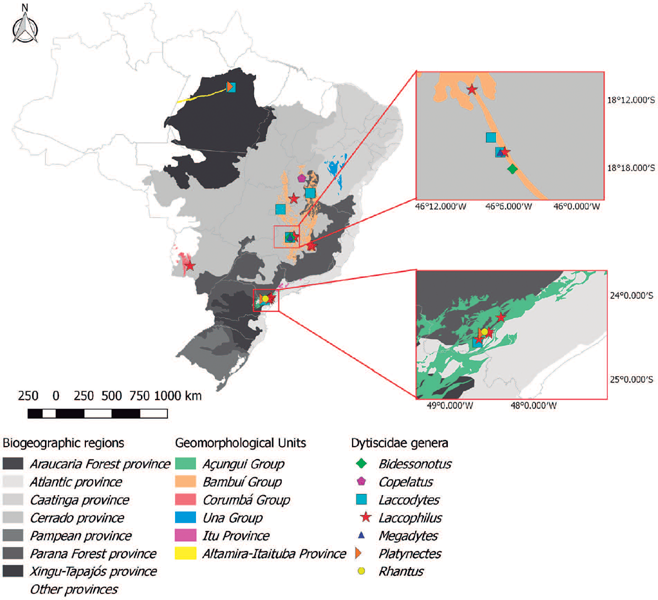
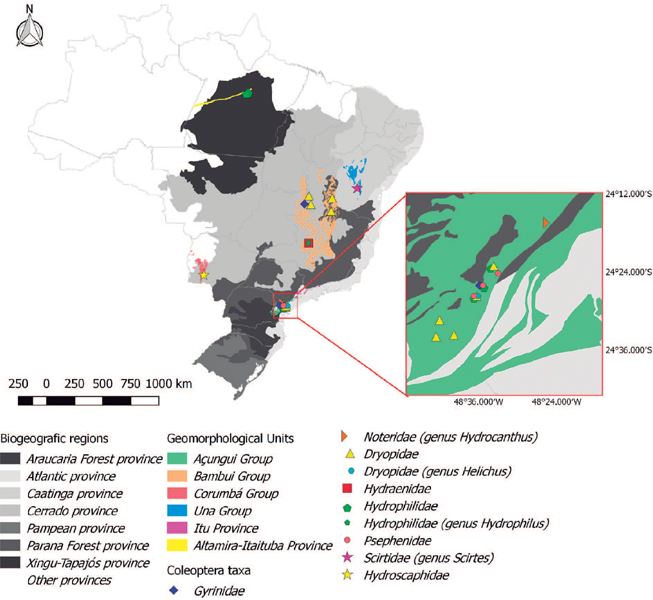
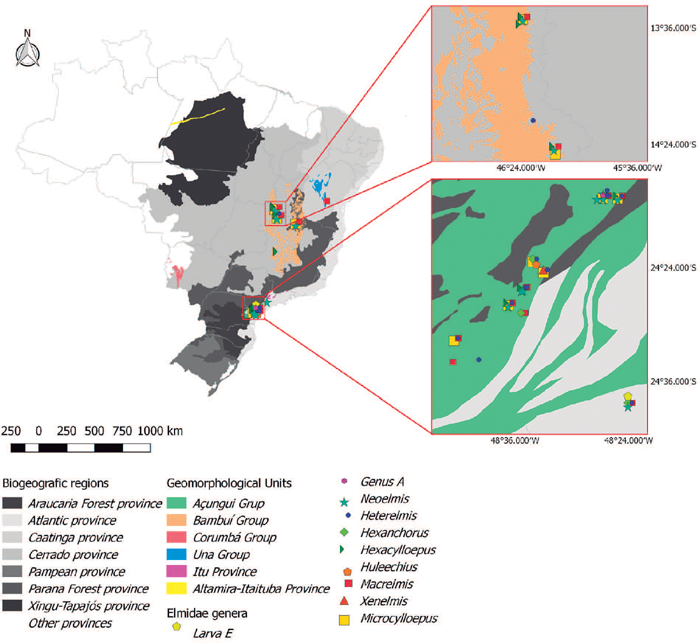
Part of the analyzed material, mainly those collected in the 1980s and 1990s, was donated to the LES collection. After the 2000s, most of the material was collected by the team of the Laboratório de Estudos Subterrâneos. The analyzed material comes from 46 caves from six Brazilian states: Bahia (4 caves), Goiás (8), Minas Gerais (9), Mato Grosso do Sul (2), Pará (5), and São Paulo (18). The caves are located in different biogeographical provinces and karst and non-karst areas of Brazil, including the Chapada Diamantina region, Serra do Ramalho, Serra do Iuiu, and São Desidério karst areas (state of Bahia), São Domingos, Posse, Mambaí, and Formosa karst areas (state of Goiás), Itacarambi, Presidente Olegário, and Cordisburgo karst areas (state of Minas Gerais), Serra da Bodoquena karst area (state of Mato Grosso do Sul), Altamira region (state of Pará), Itu region and Alto Ribeira karst area (state of São Paulo) (Table 1; Figs. 1 2 3 4). The area information, such as Brazilian state, lithology, geomorphology, hydrographic basin, climate, vegetation, and main threats and impacts, is presented in Table 1.
Studied karst and non-karst areas and their respective information, such as Brazilian state, lithology, geomorphology (according to Rubiolli et al., 2019; for Itu region Martins, 2011), hydrographic basin, climate (Alvares et al., 2013), vegetation (Ab’Saber, 1977), and threats and impacts (Gallão & Bichuette, 2018; for Itu region Bichuette et al., 2017).
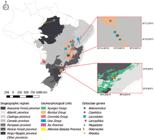
Distribution of Dytiscidae genera sampled in Brazilian caves and deposited in the Zoological Collection of the Laboratório de Estudos Subterrâneos, Universidade Federal de São Carlos (UFSCar), Brazil.
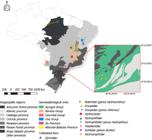
Distribution of Coleoptera taxa (families Gyriπidae, Noteridae, Hydroscaphidae, Dryopidae, Hydraeπidae, Hydrophilidae, Psepheπidae, and Scirtidae) sampled in Brazilian caves and deposited in the Zoological Collection of the Laboratório de Estudos Subterrâneos, Universidade Federal de São Carlos (UFSCar), Brazil.
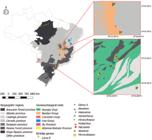
Distribution of Elmidae genera sampled in Brazilian caves and deposited in the Zoological Collection of the Laboratório de Estudos Subterrâneos, Universidade Federal de São Carlos (UFSCar), Brazil.
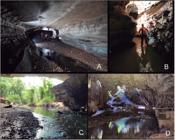
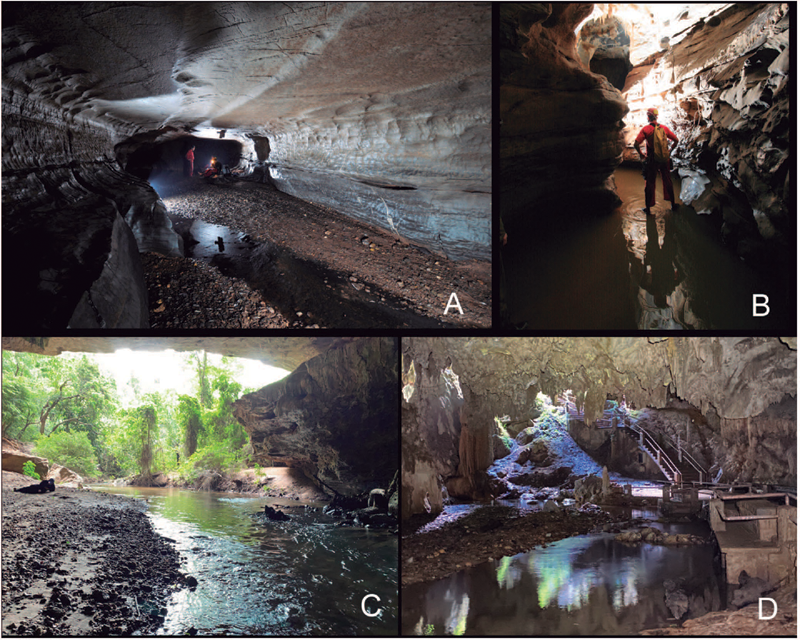
Some examples of caves where aquatic Coleoptera were sampled, Brazil. (A) Gruta Olhos d’Água cave, Itacarambi municipality, state of Minas Gerais, (B) Chico Pernambuco cave, Coribe municipality, state of Bahia, (C) Lapa do Angélica cave, São Domingos municipality, state of Goiás, and (D) Gruta da Tapagem cave (Diabo cave), Eldorado municipality, state of São Paulo. Photos: (A) A. Gambarini; (B) A.O. Lobo, (C) and (D) M.E. Bichuette.
The samplings performed by the LES team were carried out by active search and the use of hand nets and Surber samplers (Surber, 1937), which are 30 cm wide and 30 cm long, with a capture area of 0.09 m2 and a net of 250 μm mesh. The specimens were preserved in situ in 70% ethanol. Notes on microhabitats were recorded in most of the sampling occasions, such as cave zone (entrance, twilight, and aphotic), substrate composition (e.g., clay, sand, gravel, pebbles, rock blocks, vegetal and animal organic matter, and possible combinations of them), and water flow (lentic, lotic). Regarding the donated material, this information was rarely available.
Specimen images were captured using a Leica DFC295 video camera attached to a Leica M205C with a Planapo 1.0x objective. Figures were produced from stacks of images using LAS (Leica Application Suite v. 3.7). Distribution maps of family and genus records were made using QGis software version 2.18 (QGis, 2017) with shapefiles of biogeographical provinces (Löwenberg-Neto, 2014).
The material examined and information on distribution and microhabitats for each taxon are presented as follows:
Material examined: number of specimens and stage (collection number), state: municipality: collection site (cave), date, collector(s). In this subsection, “same data” means “same data as for preceding”, “same location” means “same location as for preceding”, and “same collectors” means “same collectors as for preceding”
Distribution: Cave lithology: Karst/non-karst area (number of caves with records of the taxon).
Notes on microhabitat: cave zones; substrate composition; water flow. Most taxa were collected in streams and a few in other aquatic habitats. In the latter case, this information is given in brackets after “water flow”. All information available for the taxon is given here, not specified for cave.
RESULTS
We identified 356 specimens of aquatic coleopterans belonging to ten families (Dytiscidae, Gyrinidae, Noteridae, Hydroscaphidae, Elmidae, Dryopidae, Hydraenidae, Hydrophilidae, Psephenidae, and Scirtidae) (Table 2). In addition, 22 genera were identified (Table 2). The taxa recorded, their distribution, and information on microhabitat are described below.
Aquatic Coleoptera taxa (number of specimens) collected in Brazilian caves and deposited in the Zoological Collection of the Laboratório de Estudos Subterrâneos, Universidade Federal de São Carlos (UFSCar), Brazil, and literature records for each genus in Brazilian caves. Taxa recorded for the first time in Brazilian caves are indicated with * and troglobitic species with **.
-
Suborder Adephaga Schellenberg Family Dytiscidae Leach
-
Subfamily Agabinae Thomson
-
Tribe Agabini Thomson
-
Genus Platynectes Régimbart
Material examined: Brazil: 1 adult (LES 2104), Pará: Altamira: Kararaô cave, 10.iv.2009, M.E. Bichuette, D.R. Pedroso, F. Pellegatti-Franco, T.L.C. Scatolini leg.; 1 adult (LES 15075), São Paulo: Iporanga: Arataca cave, 08-13. ix.2009, F. Pellegatti-Franco et al. leg.
Distribution: Limestone caves: Alto Ribeira karst area (1 cave); sandstone caves: Altamira region (1 cave) (Fig. 1).
Notes on microhabitat: Aphotic zone; substrate composed of sand and vegetal debris; lentic waters.
-
Subfamily Colymbetinae Erichson
-
Tribe Colymbetini Erichson
-
Genus Rhantus Dejean
Material examined: Brazil: 1 adult (LES 14974), São Paulo: Apiaí: Gruta Chapéu Mirim I cave, 14-16.ix.2009, F. Pellegatti-Franco leg.
Distribution: Limestone caves: Alto Ribeira karst area (1 cave) (Fig. 1).
Notes on microhabitat: Twilight zone, substrate composed of silt and pebbles; lentic-lotic waters.
-
Subfamily Copelatinae Branden
-
Genus Copelatus Erichson
Material examined: Brazil: 1 adult (LES 14928), Bahia: São Desidério: Baixa Fria cave, 02.xi.2011, M.E. Bichuette, J.E. Gallão, C.S. Fernandes, D.R. Pedroso leg.
Distribution: Limestone caves: São Desidério karst area (1 cave) (Fig. 1).
Notes on microhabitat: Aphotic zone, substrate composed of silt; lentic waters.
-
Subfamily Dytiscinae Leach
-
Tribe Cybistrini Sharp
-
Genus Megadytes Sharp
Material examined: Brazil: 2 adults (LES 7377), Minas Gerais: Presidente Olegário: Lapa da Fazenda São Bernardo cave, 11.ix.2014, T. Zepon, L.P.A. Resende leg.
Distribution: Limestone caves: Presidente Olegário karst area (1 cave) (Fig. 1).
Notes on microhabitat: Aphotic zone; substrate composed of clay and roots; lentic waters.
-
Subfamily Hydroporinae Aubé
-
Tribe Bidessini Sharp
-
Genus Bidessonotus Régimbart
Material examined: Brazil: 5 adults (LES 19585), Minas Gerais: Presidente Olegário: Lapa Zé de Sidinei cave, 28.xi.2013, M.E. Bichuette, T. Zepon, L.P.A. Resende, I.A. Ribeiro leg.; 1 adult (LES 19586), same data.
Distribution: Limestone caves: Presidente Olegário karst area (1 cave) (Fig. 1).
Notes on microhabitat: Aphotic zone; substrate composed of clay and rocks; lentic waters.
-
Subfamily Laccophilinae Gistel
-
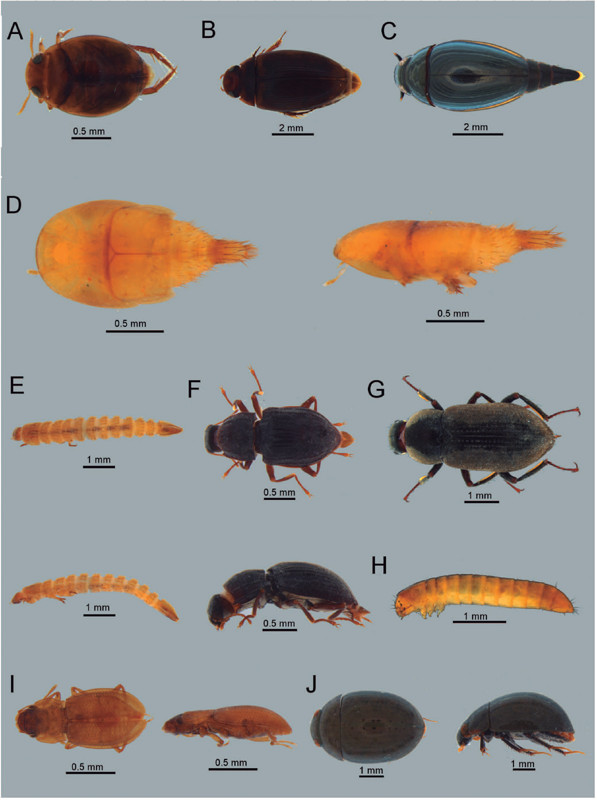
Genus Laccodytes Régimbart (Fig. 5A)
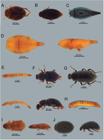
Some aquatic Coleoptera taxa recorded in Brazilian caves. (A) Laccodytes sp. and (B) Laccophilus sp. (Dytiscidae, Laccophilinae), (C) Gyretes sp. (Gyrinidae, Gyrininae, Orectochilini), (D) the troglomorphic and troglobitic Hydroscaphidae (dorsal and lateral view), (E) Heterelmis sp. (Elmidae, Elminae) (larva dorsal and lateral view), (F) Heterelmis sp. (adult dorsal and lateral view), (G) Helichus sp. (Dryopidae), (H) Dryopidae sp., (I) Hydraenidae sp. (dorsal and lateral view), (J) Hydrophilus sp. (Hydrophilinae, Hydrophilini) (dorsal and lateral view). Photos: L.B.R. Fernandes.
Material examined: Brazil: 3 adults (LES 2132), Pará: Altamira: Jacaré cave, 05.iv.2011, M.E. Bichuette, J.E. Gallão, D. Monteiro-Neto, D. Pedroso leg.; 2 adults (LES 15227), Bahia: Coribe: Chico Pernambuco cave, 28.vii.2012, M.E. Bichuette leg.; 1 adult (LES 15228), same data; 1 adult (LES 7508), Goiás: Formosa: Jaguatirica cave, 29.iv.1989, Donated by GREGEO; 3 adults (LES 3423), Minas Gerais: Presidente Olegário: Lapa da Fazenda São Bernardo cave, 09.vii.2019, M.E. Bichuette, J.E. Gallão, T. Zepon, G.C. Rabello leg.; 2 adults (LES 7380), same location, 11.ix.2014, T. Zepon, L.P.A. Resende leg.; 1 adult (LES 19584), same location, 13.iv.2014, M.E. Bichuette, T. Zepon, L.P.A. Resende, J.S. Gallo, G.F. Damasceno leg.; 1 adult (LES 19587), same location, 10.vi.2014, T. Zepon, L.P.A. Resende leg.; 1 adult (LES 3427), Lapa Vereda da Palha cave, 08.vii.2019, M.E. Bichuette, J.E. Gallão, T. Zepon, G.C. Rabello leg.; 5 adults (LES 3555), same data; 3 adults (LES 19583), same location, 15.iv.2014, T. Zepon, L.P.A. Resende, G.F. Damasceno leg.; 2 adults (LES 19648), same location, 12.vi.2014, T. Zepon, L.P.A. Resende leg.; 1 adult (LES 24696), São Paulo: Iporan-ga: Ressurgência das Areias de Água Quente cave, 21.xi.2017, M.E. Bichuette, T. Zepon, J.E. Gallão, J.S. Gallo leg.
Distribution: Limestone caves: Serra do Ramalho (1 cave), Formosa (1 cave), Presidente Olegário (2 caves), and Alto Ribeira karst areas (1 cave); sandstone caves: Altamira region (1 cave) (Fig. 1).
Notes on microhabitat: Twilight and aphotic zones; substrates usually composed of clay, rock blocks, and roots; lentic waters (streams and travertines).
-
Genus Laccophilus Leach (Fig. 5B)
Material examined: Brazil: 1 adult (LES 4304), Mambaí: Gruta da Tarimba cave, 27.x.2012, M.E. Bichuette, J.E. Gallão, D.M. von Schimonsky, C.S. Fernandes, L.S. Bertelli leg.; 1 adult (LES 11241), Gruta Judite cave, 01.v.2013, M.E. Bichuette, D.M. von Schimonsky, R. Borghezan, P.P. Rizzato, J.E. Gallão leg.; 1 adult (LES 2562), Minas Gerais: Cordisburgo: Gruta da Morena cave, 23.v.2008, M.E. Bichuette, M. Granai leg.; 1 adult (LES 7766), Gruta do Salitre cave, 02.ix.2003, M.E. Bichuette, E. Trajano leg.; 1 adult (LES 6620), Presidente Olegário: Toca do Charco cave, 09.vii.2019, M.E. Bichuette, J.E. Gallão, T. Zepon, G.C. Rabello leg.; 1 adult (LES 19582), Lapa da Fazenda São Bernardo cave, 30.xi.2013, M.E. Bichuette, T. Zepon, L.P.A. Resende, I.A. Ribeiro leg.; 5 adults (LES 14757), Mato Grosso do Sul: Bonito: Lago Azul cave, 15.vii.1992, E. Trajano, P. Gnaspini leg.; 1 adult (LES 960), São Paulo: Apiaí: Gruta das Aranhas cave, 30.iii.2009, M.E. Bichuette, T.L.C. Scatolini, P.L. Pereira, D. Monteiro-Neto leg.; 1 larva (LES 4602), Iporanga: Gruta Jane Mansfield cave, 28.iii.2009, same collectors; 2 larvae (LES 3020), Gruta da Água Suja cave, 16-20.ix.2009, F. Pellegatti-Franco leg.; 1 adult (LES 1282), Arataca cave, 30.iii.2009, M.E. Bichuette, J.E. Gallão, D. Monteiro-Neto, T.L. Scatolini leg.
Distribution: Limestone caves: Mambaí (2 caves), Presidente Olegário (2 caves), Cordisburgo (2 caves), Serra da Bodoquena (1 cave), and Alto Ribeira karst areas (4 caves) (Fig. 1).
Notes on microhabitat: Twilight and aphotic zones; substrate composed of clay and roots or clay, sand, gravels, pebbles, and rock blocks; lentic waters (streams and ponds).
-
Family Gyrinidae Thomson
-
Subfamily Gyrininae Régimbart
-
Tribe Orectochilini Régimbart
-
Genus Gyretes Brullé (Fig. 5C)
Material examined: Brazil: 1 adult (LES 4305), Goiás: Mambaí: Gruta da Tarimba cave, 27.x.2012, M.E. Bichuette, J.E. Gallão, D.M. von Schimonsky, C.S. Fernandes, L.S. Bertelli leg.; 4 adults (LES 1386), São Paulo: Apiaí: Gruta das Aranhas cave, 04.xi.2009, M.E. Bichuette, T.L.C. Scatolini, J.E. Gallão, D. Monteiro-Neto, F.F. Franco leg.; 3 adults (LES 7067), same location, 11.x.2005; E. Trajano leg.; 2 adults (LES 14861), same location, 14.vi.2008, M.E. Bichuette leg.; 1 adult (LES 14768), same data; 2 adults (LES 24677), same location, 30.vii.2017, T. Zepon, C.S. Fernandes, D.M. von Schimonsky leg.; 2 adults (LES 24678), same data; 1 adult (LES 24679), same data; 3 adults (LES 24680), same data; 1 adult (LES 24681), same location, 17.xi.2017, M.E. Bichuette, T. Zepon, J.E. Gallão, J.S. Gallo leg.; 3 adults (LES 24682), same data; 1 adult (LES 24683), same data; 2 adults (LES 24684), same data; 2 adults (LES 24685), same location, 03.iv.2018, T. Zepon, C.M. Borges, G.F. Damasceno leg.; 1 adult (LES 24686), same location, 29.vii.2018, T. Zepon, C.S. Fernandes, B.G.O. do Monte leg.; 2 adults (LES 24687), same data; 1 adult (LES 24688), same location, 11.iv.2019, T. Zepon, J.S. Gallo leg.; 1 adult (LES 24689), same location, 15.iv.2019, T. Zepon, J.S. Gallo leg.
Distribution: Limestone caves: Mambaí (1 cave), and Alto Ribeira karst areas (1 cave) (Fig. 2).
Notes on microhabitat: Entrance, twilight, and aphotic zones; substrate composed of sand, gravels, and pebbles; lentic and lentic-lotic waters (surface of stream margins).
-
Family Noteridae Thomson
-
Subfamily Noterinae Thomson
-
Genus Hydrocanthus Say
Material examined: Brazil: 1 larva (LES 1128), São Paulo: Iporanga: Gruta Colorida cave, 09.x.2009, M.E. Bichuette, J.E. Gallão, D. Monteiro-Neto leg.
Distribution: Limestone caves: Alto Ribeira karst area (1 cave) (Fig. 2).
Notes on microhabitat: Aphotic zone; substrate composed of clay, sand, gravels, pebbles, and rock blocks; lotic waters.
-
Suborder Myxophaga Crowson
-
Family Hydroscaphidae LeConte (Fig. 5D)
Material examined: Brazil: 2 adults (LES 7509), Mato Grosso do Sul: Jardim: Abismo do Poço cave, 18.vii.1992, P. Gnaspini, E. Trajano leg.
Distribution: Limestone cave: Serra da Bodoquena karst area (1 cave) (Fig. 2).
Notes on microhabitat: Aphotic zone; lentic waters (flooded cave). There is no information about the sub-strate where the specimens were collected.
-
Suborder Polyphaga Emery
-
Family Elmidae Curtis
-
Morphotype “Larva E” according to Passos et al., 2007
Material examined: Brazil: 2 larvae (LES 1121), São Paulo: Eldorado: Gruta da Tapagem (Diabo cave), 13.x.2009, M.E. Bichuette, J.E. Gallão, D. Monteiro-Neto leg.
Distribution: Limestone cave: Alto Ribeira karst area (1 cave) (Fig. 3).
Notes on microhabitat: Twilight zone, substrate composed of sand, gravels, and pebbles; lentic-lotic waters.
-
Morphotype “Genus A” according to Segura et al., 2011a
Material examined: Brazil: 1 larva (LES 1336), São Paulo: Iporanga: Gruta do Fendão cave, 08.xi.2009, M.E. Bichuette, T.L.C. Scatolini, J.E. Gallão, D. Monteiro-Neto, F.F. Franco leg.
Distribution: Limestone cave: Alto Ribeira karst area (1 cave) (Fig. 3).
Notes on microhabitat: Aphotic zone; substrate composed of clay, sand, gravels, pebbles, and rock blocks; lotic waters.
Material examined: Brazil: 1 adult (LES 14860), Goiás: Posse: Gruta dos Revolucionários cave, 03.v.2013, M.E. Bichuette leg.; 1 adult (LES 994), São Paulo: Apiaí: Gruta Chapéu Mirim II cave, 30.iii.2009, M.E. Bichuette, T.L.C. Scatolini, P.L. Pereira, D. Monteiro-Neto leg.; 1 adult (LES 1266), same location, 07.xi.2009, M.E. Bichuette, T.L.C. Scatolini, J.E. Gallão, D. Monteiro-Neto, F.F. Franco leg.; 1 adult (LES 1289), same data; 1 larva (LES 4603), same data; 1 larva (LES 1430), Gruta da Pescaria cave, 05.xi.2009, M.E. Bichuette, T.L.C. Scatolini, J.E. Gallão, D. Monteiro-Neto, F.F. Franco leg.; 2 larvae (LES 1436), same data; 1 larva (LES 4598), same data; 1 larva (LES 4606), same data; 1 adult (LES 24644), same location, 06.iv.2018, T. Zepon, C.M. Borges, G.F. Damasceno leg.; 1 larva (LES 24657), same location, 28.vii.2018, T. Zepon, C.S. Fernandes, B.G.O. do Monte leg.; 1 adult (LES 24663), same location, 13.iv.2019, T. Zepon, J.S. Gallo leg.; 1 adult (LES 24634), Gruta das Aranhas cave, 03.iv.2018, T. Zepon, C.M. Borges, G.F. Damasceno leg.; 1 adult (LES 24661), same location, 11.iv.2019, T. Zepon, J.S. Gallo leg.; 1 adult (LES 904), Gruta do Temimina II cave, 29.iii.2009, M.E. Bichuette, T.L.C. Scatolini, P.L. Pereira, D. Monteiro-Neto leg.; 1 larva (LES 4617), same data; 1 adult (LES 24635), same location, 04.iv.2018, T. Zepon, C.M. Borges, G.F. Damasceno leg.; 1 adult (LES 24636), same data; 1 larva (LES 24638), same data; 1 larva (LES 24647), same location, 26.vii.2018, T. Zepon, C.S. Fernandes, B.G.O. do Monte leg.; 1 larva (LES 1126), Eldorado: Gruta da Tapagem (Diabo cave), 13.x.2009, M.E. Bichuette, J.E. Gallão, D. Monteiro-Neto leg.; 1 adult (LES 4616), same data; 1 adult (LES 913), Iporanga: Gruta Colorida cave, 10.x.2009, M.E. Bichuette, J.E. Gallão, D. Monteiro-Neto leg.; 1 larva (LES 1141), same data; 6 larvae (LES 1183), same location, 09.x.2009, M.E. Bichuette, J.E. Gallão, D. Monteiro-Neto, T.L. Scatolini leg.; 1 larva (LES 4600), same data; 1 larva (LES 4613), same data; 1 adult (LES 24608), Gruta da Água Suja cave, 31.vii.2017, T. Zepon, C.S. Fernandes, D.M. von Schimonsky leg.; 1 larva (LES 24609), same data; 1 larva (LES 24623), same location, 20.xi.2017, M.E. Bichuette, T. Zepon, J.E. Gallão, J.S. Gallo leg.; 1 adult (LES 24659), same location, 30.vii.2018, T. Zepon, C.S. Fernandes, B.G.O. do Monte, leg.; 1 adult (LES 1444), Gruta da Água Sumida cave, 06.ix.2019, M.E. Bichuette, T.L.C. Scatolini, J.E. Gallão, D. Monteiro-Neto, F.F. Franco leg.; 3 larvae (LES 1473), same data; 3 larvae (LES 1479), same data; 3 larvae (LES 4597), same data, M.E. Bichuette, J.E. Gallão, D. Monteiro-Neto, T.L. Scatolini leg.; 1 larva (LES 4607), same data; 1 larva (LES 4608), same data; 1 larva (LES 4609), same data; 1 adult (LES 4610), same data; 1 larva (LES 14896), same data; 1 adult (LES 24626), 12.xii.2017, T. Zepon, J.S. Gallo, M.P. Bolfarini leg.; 1 larva (LES 24627), same data; 1 adult (LES 24628), same data; 1 adult (LES 24640), same location, 04.iv.2018, T. Zepon, C.M. Borges, G.F. Damasceno leg.; 1 adult (LES 24641), same data; 1 adult (LES 24642), same data; 1 adult (LES 24652), same location, 27.vii.2018, T. Zepon, C.S. Fernandes, B.G.O. do Monte leg.; 1 adult (LES 24653), same data; 1 adult (LES 24655), same data; 1 larva (LES 24665), same location, 14.iv.2019, T. Zepon, J.S. Gallo leg.; 4 adults (LES 1324), Gruta do Fendão cave, 08.xi.2019, M.E. Bichuette, T.L.C. Scatolini, J.E. Gallão, D. Monteiro-Neto, F.F. Franco leg.; 1 larva (LES 1337), same data; 1 larva (LES 1371), same data; 1 adult (LES 1372), same data; 2 adults (LES 14899), same data; 1 larva (LES 4605), Gruta dos Paiva cave, 09.x.1996, M.E. Bichuette, F. Santos leg.; 1 larva (LES 4599), Gruta Jane Mansfield cave, 09.x.2009, M.E. Bichuette, J.E. Gallão, D. Monteiro-Neto, T.L. Scatolini leg.; 1 larva (LES 24646), Ressurgência das Areias de Água Quente cave, 10.iv.2018, T. Zepon, C.M. Borges, G.F. Damasceno leg.
Distribution: Limestone caves: Posse (1 cave), and Alto Ribeira karst areas (12 caves) (Fig. 3).
Notes on microhabitat: Mainly twilight and aphotic zone, but it was also found in the entrance zone; substrate composed of sand, gravels, pebbles, and rock blocks; lentic-lotic and lotic waters.
-
Genus Hexacylloepus Hinton
Material examined: Brazil: 3 larvae (LES 14854), Goiás: Mambaí: Gruta da Tarimba cave, 27.×.2012, M.E. Bichuette, J.E. Gallão, D.M. von Schimonsky, C.S. Fernandes, L.S. Bertelli leg.; 1 adult (LES 14856), same data; 1 adult (LES 11214), São Domingos: Lapa do São Vicente II cave, 06.iv.2016, M.E. Bichuette, M. Rosendo, C.C.P. Paula leg.; 1 adult (LES 14862), Lapa do Angélica cave, 31.×.2012, M.E. Bichuette leg.; 1 adult (LES 3425), Minas Gerais: Presidente Olegário: Lapa Zé de Sidinei cave, 10.vii.2019, M.E. Bichuette, J.E. Gallão, T. Zepon, G.C. Rabello leg.; 1 adult (LES 24633), São Paulo: Apiaí: Gruta das Aranhas cave, 03.iv.2018, T. Zepon, C.M. Borges, G.F. Damasceno leg.; 1 adult (LES 1182), Iporanga: Gruta Colorida cave, 09.×.2009, M.E. Bichuette, J.E. Gallão, D. Monteiro-Neto leg.; 7 adults (LES 7313), same location, 07.×.1989, E. Trajano leg.; 1 adult (LES 24649), Gruta da Água Sumida cave, 27.vii.2018, T. Zepon, C.S. Fernandes, B.G.O. do Monte leg.
Distribution: Limestone caves: São Domingos (2 caves), Mambaí (1 cave), Presidente Olegário (1 cave), and Alto Ribeira karst areas (3 caves) (Fig. 3).
Notes on microhabitat: Aphotic zones; substrate composed of clay, gravels, pebbles, and rock blocks; lotic waters.
-
Genus Huleechius Brown
Material examined: Brazil: 1 adult (LES 908), São Paulo: Apiaí: Gruta do Temimina II cave, 19.iii.2009, M.E. Bichuette, T.L.C. Scatolini, P.L. Pereira, D. Monteiro-Neto leg.
Distribution: Limestone caves: Alto Ribeira karst area (1 cave) (Fig. 3).
Notes on microhabitat: Twilight zone; substrate composed of sand, gravels, pebbles, and rock blocks; lotic waters.
Notes on identification: Identification based on Segura et al., 2011b.
-
Genus Macrelmis Motschulsky
Material examined: Brazil: 1 adult (LES 4612), Bahia: Andaraí (Igatu Village): Gruna Ressurgência Morro do Alvo cave, 16.ii.2010, M.E. Bichuette, J.E. Gallão leg.; 1 adult (LES 14855), Goiás: Mambaí: Gruta da Tarimba cave, 28.×.2012, M.E. Bichuette, J.E. Gallão, D.M. von Schimonsky, C.S. Fernandes, L.S. Bertelli leg.; 1 adult (LES 14863), Lapa do Angélica cave, 31.x.2012, M.E. Bichuette leg.; 2 adults (LES 14864), same location, 01.xi.2012, M.E. Bichuette leg.; 1 adult (LES 14865), same location, 31.×.2012, M.E. Bichuette, L.B. Simões, J.E. Gallão, T. Zepon, C.S. Fernandes leg.; 1 larva (LES 14260), same data; 1 adult (LES 7310), Minas Gerais: Itacarambi: Gruta do Janelão cave, 07.vii.1993, E. Trajano leg.; 1 larva (LES 1277), Gruta do Chapéu-Mirim II cave, 07.xi.2009, M.E. Bichuette, T.L.C. Scatolini, J.E. Gallão, D. Monteiro-Neto, F.F. Franco leg.; 1 adult (LES 1303), same data; 1 larva (LES 24611), Gruta das Aranhas cave, 30.vii.2017, T. Zepon, C.S. Fernandes, D.M. von Schimonsky leg.; 1 larva (LES 24612), same data; 1 larva (LES 24621), same location, 17.xi.2017, M.E. Bichuette, T. Zepon, J.E. Gallão, J.S. Gallo leg.; 1 larva (LES 24622), same data; 1 adult (LES 24632), same location, 03.iv.2018, T. Zepon, C.M. Borges, G.F. Damasceno leg.; 1 adult (LES 7513), Iporanga: Casa de Pedra cave, 21.iv.1991, E. Trajano leg.; 1 larva (LES 24613), Passoca cave, 02.viii.2017, T. Zepon, C.S. Fernandes, D.M. von Schimonsky leg.; 1 larva (LES 24614), same data; 1 larva (LES 24615), same data; 1 larva (LES 24616), same data; 1 larva (LES 24617), same data; 1 larva (LES 24618), same data; 1 larva (LES 24619), same data; 1 adult (LES 24620), same data; 1 larva (LES 15025), same location, 03.viii.2013, M.E. Bichuette leg.; 1 larva (LES 1164), Gruta Colorida cave, 10.x.2009, M.E. Bichuette, J.E. Gallão, D. Monteiro-Neto leg.; 1 larva (LES 1214), Gruta da Água Suja cave, 11.×i.2009, same collectors; 1 larva (LES 24610), same location, 31.vii.2017, T. Zepon, C.S. Fernandes, D.M. von Schimonsky leg.; 1 larva (LES 24645), same location, 09.iv.2018, T. Zepon, C.M. Borges, G.F. Damasceno leg.; 1 larva (LES 24660), same location, 30.vii.2018, T. Zepon, C.S. Fernandes, B.G.O. do Monte leg.; 1 larva (LES 24605), Gruta da Água Sumida cave, 28.vii.2017, T. Zepon, C.S. Fernandes, D.M. von Schimonsky leg.; 1 larva (LES 24606), same data; 1 larva (LES 24624), same location, 12.xii.2017, T. Zepon, J.S. Gallo, M.P. Bolfarini leg.; 1 larva (LES 24639), same location, 05.iv.2018, T. Zepon, C.M. Borges, G.F. Damasceno leg.; 2 adults (LES 24650), same location, 27.vii.2018, T. Zepon, C.S. Fernandes, B.G.O. do Monte leg.; 1 larva (LES 4618), Gruta do Fendão cave, 08.xi.2009, M.E. Bichuette, J.E. Gallão, D. Monteiro-Neto, T.L. Scatolini leg.; 1 larva (LES 15025), Passoca System, 03.viii.2013, M.E. Bichuette leg.
Distribution: Limestone caves: Mambaí (1 cave), São Domingos (1 cave), Itacarambi (1 cave), and Alto Ribeira karst areas (9 caves); sandstone caves: Una karst area (1 cave) (Fig. 3).
Notes on microhabitat: Twilight and aphotic zones; substrate composed of sand, gravels, pebbles, rock blocks (mainly), and vegetal organic matter; lentic, lotic, and lentic-lotic waters.
-
Genus Microcylloepus Hinton
Material examined: Brazil: 1 adult (LES 11527), Goiás; Mambai: Gruta Pasto de Vacas I cave, 02.v.2013, M.E. Bichuette, J.E. Gallão, D.M. von Shimonsky, P.P. Rizzato, R. Borghezan leg.; 2 adults (LES 14901), São Domingos: Lapa do Angélica cave, 18.v.2015, M.E. Bichuette leg.; 4 adults (LES 12953), Minas Gerais: Itacarambi: Lapa do Cipó cave, 10.iv.2016, B.G.O. do Monte, J.E. Gallão leg.; 1 larva (LES 1416), São Paulo: Apiai: Gruta da Pescaria cave, 05.xi.2009, M.E. Bichuette, T.L.C. Scatolini, J.E. Gallão, D. Monteiro-Neto, F.F. Franco leg.; 1 adult (LES 24631), Gruta da Pescaria cave, 13.xii.2017, T. Zepon, J.S. Gallo, M.P. Bolfarini leg.; 1 adult (LES 24637), Gruta do Temimina II cave, 04.iv.2018, T. Zepon, C.M. Borges, G.F. Damasceno leg.; 1 adult (LES 24648), same location, 26.vii.2018, T. Zepon, C.S. Fernandes, B.G.O. do Monte leg.; 2 adults (LES 1163), Iporanga: Gruta Colorida cave, 10.×.2009, M.E. Bichuette, J.E. Gallão, D. Monteiro-Neto leg.; 1 adult (LES 14898), same data; 1 larva (LES 4614), same data; 1 larva (LES 1435), Gruta da Água Suja cave, 11.x.2009, same collectors; 1 adult (LES 24607), same location, 31.vii.2017, T. Zepon, C.S. Fernandes, D.M. von Schimonsky leg.; 1 adult (LES 24658), same location, 30.vii.2018, T. Zepon, C.S. Fernandes, B.G.O. do Monte leg.; 1 larva (LES 1464), Gruta da Água Sumida cave, 06.xi.2009, M.E. Bichuette, T.L.C. Scatolini, J.E. Gallão, D. Monteiro-Neto, F.F. Franco leg.; 1 adult (LES 24625), same location, 12.xii.2017, T. Zepon, J.S. Gallo, M.P. Bolfarini leg.; 1 adult (LES 24651), same location, 27.xii.2018, T. Zepon, C.S. Fernandes, B.G.O. do Monte leg.; 1 adult (LES 24654), same data; 2 adults (LES 24664), same location, 14.iv.2019, T. Zepon, J.S. Gallo leg.; 1 larva (LES 1364), Gruta do Fendão cave, 08.xi.2009, M.E. Bichuette, T.L.C. Scatolini, J.E. Gallão, D. Monteiro-Neto, F.F. Franco leg.
Distribution: Limestone caves: São Domingos (1 cave), Mambai (1 cave), Itacarambi (1 cave), and Alto do Ribeira karst areas (6 caves) (Fig. 3).
Notes on microhabitat: Mainly twilight and aphotic zones, but it was also found in the entrance zone; substrate composed of sand, gravels, pebbles, and rock blocks; lotic (mainly) and lentic-lotic waters.
-
Genus Neoelmis Musgrave
Material examined: Brazil: 1 larva (LES 14857), Mambai: Goiás; Gruta da Tarimba cave, 27.x.2012, M.E. Bichuette, J.E. Gallão, D.M. von Schimonsky, C.S. Fernandes, L.S. Bertelli leg.; 2 adults (LES 27869), São Domingos: Lapa do Angélica cave, 18.iv.2015, M.E. Bichuette leg.; 10 adults (LES 7317), Minas Gerais: Itacarambi: Gruta Olhos d’Água cave, 15.vii.1994, E. Trajano leg.; 1 larva (LES 1264), São Paulo: Apiai: Gruta Chapéu Mirim II cave, 07.xi.2009, M.E. Bichuette, T.L.C. Scatolini, J.E. Gallão, D. Monteiro-Neto, F.F. Franco leg.; 1 adult (LES 1384), Gruta das Aranhas cave, 04.xi.2009, same collectors; 1 adult (LES 24662), same location, 15.iv.2019, T. Zepon, J.S. Gallo leg.; 2 adults (LES 1127), Iporanga: Gruta Colorida cave, 09.x.2009, M.E. Bichuette, J.E. Gallão, D. Monteiro-Neto leg.; 1 larva (LES 1193), Gruta Jane Mansfield cave, 09.x.2009, same collectors; 1 larva (LES 1365), Gruta do Fendão cave, 08.xi.2009, M.E. Bichuette, T.L.C. Scatolini, J.E. Gallão, D. Monteiro-Neto, F.F. Franco leg.; 1 larva (LES 4601), same data; 1 adult (LES 7507), Gruta do Minotauro cave, 19.v.1990, E. Trajano leg.; 2 larvae (LES 14900), same location, 10.x.2009, M.E. Bichuette, J.E. Gallão, D. Monteiro-Neto leg.; 1 adult (LES 24643), Gruta da Água Sumida cave, 05.iv.2018, T. Zepon, C.M. Borges, G.F. Damasceno leg.; 1 adult (LES 24656), same location, 27.vii.2018, T. Zepon, C.S. Fernandes, B.G.O. do Monte leg.; 1 larva (LES 4604), Eldorado: Gruta da Tapagem (Diabo cave), 13.x.2009, M.E. Bichuette, J.E. Gallão, D. Monteiro-Neto, T.L. Scatolini leg.; 1 larva (LES 14858), Itu: Gruta do Riacho Subterrâneo cave, 27.ix.2010, Bichuette, M.E. leg.
Distribution: Limestone caves: São Domingos (1 cave), Mambai (1 cave), Itacarambi (1 cave), and Alto do Ribeira karst areas (8 caves); granitic caves: Itu (1 cave) (Fig. 3).
Notes on microhabitat: Twilight and aphotic zones; substrate composed of gravels, pebbles, rock blocks, and wood; lentic, lentic-lotic, and lotic waters.
-
Genus Xenelmis Hinton
Material examined: Brazil: 1 adult (LES 24629), São Paulo: Apiai: Gruta da Pescaria cave, 13.xii.2017, T. Zepon, J.S. Gallo, M.P. Bolfarini leg.; 1 adult (LES 24630), same data.
Distribution: Limestone caves: Alto Ribeira karst area (1 cave) (Fig. 3).
Notes on microhabitat: Twilight zone; substrate composed of sand, pebbles, and rock blocks; lentic-lotic waters.
-
Subfamily Larainae LeConte
-
Genus Hexanchorus Sharp
Material examined: Brazil: 1 adult (LES 12125), São Paulo: Eldorado: Gruta da Tapagem cave (Diabo cave), 24.viii.2013, J.E. Gallão, T. Zepon leg.; 1 adult (LES 14414), Iporanga: Casa de Pedra cave, 14.iv.1990, E. Trajano leg.; 1 adult (LES 15034), Apiai: Gruta do Temimina II cave, vii.2009, F. Pellegatti-Franco leg.
Distribution: Limestone caves: Alto Ribeira karst area (3 caves) (Fig. 3).
Notes on microhabitat: Twilight and aphotic zones; substrate composed of clay, gravels, pebbles, and rock blocks; lotic waters.
-
Suborder Polyphaga Emery
-
Family Dryopidae Billberg (Fig. 5H)
Material examined: Brazil: 1 adult (LES 15220), Bahia: Coribe: Chico Pernambuco cave, 28.vii.2012, M.E. Bichuette leg.; 1 larva (LES 15243), same data; 6 adults (LES 15224), same data; 1 larva (LES 11509), Goiás: Mambaí: Gruta Pasto de Vacas I cave, 02.v.2013, M.E. Bichuette, J.E. Gallão, D.M. von Shimonsky, P.P. Rizzato, R. Borghezan leg.; 2 adults (LES 2356), São Domingos: Lapa do Passa Três cave, 24.iv.2010, M.E. Bichuette, J.E. Gallão, L.B. Simões leg.; 5 adults (LES 7503), Minas Gerais: Itacarambi: Gruta Olhos d’Água cave, 15.ix.1994, E. Trajano leg.; 1 adult (LES 7521), same location, 13.vii.1994, same collectors; 2 adults (LES 12877), same location, 24.vii.2012, M.E. Bichuette, J.E. Gallão, P.P. Rizzato leg.; 1 adult (LES 12883), same data; 1 adult (LES 24672), São Paulo: Apiaí: Gruta do Temimina II cave, 04.iv.2018, T. Zepon, C.M. Borges, G.F. Damasceno leg.; 1 adult (LES 15056), same location, 26-30.iii.2009, F. Pellegatti-Franco leg.; 1 larva (LES 24676), Iporanga: Gruta da Água Suja cave, 16.iv.2019, T. Zepon, J.S. Gallo leg.; 1 adult (LES 24667), same location, 31.vii.2017, T. Zepon, C.S. Fernandes, D.M. von Schimonsky leg.; 1 adult (LES 24668), Passoca cave, 02.viii.2017, same collectors; 1 adult (LES 24669), same data; 1 adult (LES 24666), Ressurgência das Areias de Água Quente cave, 02.vii.2017, same collectors; 1 adult (LES 24670), same location, 21.xi.2017, M.E. Bichuette, T. Zepon, J.E. Gallão, J.S. Gallo leg.; 1 adult (LES 24671), Gruta da Água Sumida cave, 12.xii.2017, T. Zepon, J.S. Gallo, M.P. Bolfarini leg.; 1 adult (LES 24674), same data; 1 adult (LES 24675), same location, 27.vii.2018, T. Zepon, C.S. Fernandes, B.G.O. do Monte leg.
Distribution: Limestone caves: Serra do Ramalho (1 cave), Mambaí (1 cave), São Domingos (1 cave), Itacarambi (1 cave), and Alto Ribeira karst areas (5 caves) (Fig. 2).
Notes on microhabitat: Aphotic (mainly) and twilight zones; substrate composed of sand, gravels, pebbles, and rock blocks; lotic waters.
-
Genus Helichus Erichson (Fig. 5G)
Material examined: 1 adult (LES 24673), Gruta da Água Sumida cave, 05.iv.2018, T. Zepon, C.M. Borges, G.F. Damasceno leg.
Distribution: Limestone caves: Alto Ribeira karst area (1 cave) (Fig. 2).
Notes on microhabitat: Aphotic zone; substrate composed of rock blocks; lotic waters.
Notes on identification: Determined by Dr. Thiago T.S. Polizei in August 2024.
-
Family Hydraenidae Mulsant (Fig. 5I)
Material examined: Brazil: 1 adult (LES 19553), Minas Gerais: Presidente Olegário: Lapa da Fazenda São Bernardo cave, 10.vi.2014, T. Zepon, L.P.A. Resende leg.
Distribution: Limestone caves: Presidente Olegário karst area (1 cave) (Fig. 2).
Notes on microhabitat: Twilight zones; substrate composed of clay and roots; lentic waters.
-
Family Hydrophilidae Latreille
Material examined: Brazil: 5 adults (LES 2159), Pará: Altamira: Leonardo da Vinci cave, 17.xii.2010, M.E. Bichuette, J.E. Gallão, D. Monteiro-Neto leg.; 3 adults (LES 2164), Jacaré cave, 14.xii.2010, same collectors; 1 adult (LES 2165), same data; 3 adults (LES 2167), Cama de Vara cave, 12.xii.2010, same collectors; 1 adult (LES 2168), Abrigo Cama de Vara cave, 12.xii.2010, same collectors; 1 adult (LES 866), São Paulo: Apiaí: Gruta do Temimina II cave, 29.iii.2009, M.E. Bichuette, T.L.C. Scatolini, P.L. Pereira, D. Monteiro-Neto leg.; 1 adult (LES 914), same data; 1 adult (LES 915), same data; 1 adult (LES 15070), same location, 26-30.iii.2009, F. Pellegatti-Franco leg.; 1 adult (LES 15069), Gruta Chapéu Mirim I cave, 08-13.ix.2009, same collectors; 1 larva (LES 24698), Iporanga: Gruta da Água Sumida cave, 12.xii.2017, T. Zepon, J.S. Gallo, M.P. Bolfarini leg.; 2 larvae (LES 24697), same data.
Distribution: Limestone caves: Alto Ribeira karst area (3 caves); sandstone caves: Altamira region (4 caves) (Fig. 2).
Notes on microhabitat: Entrance, twilight, and aphotic zones; substrate composed of sand, pebbles, and vegetal organic matter; lotic waters.
-
Subfamily Hydrophilinae Latreille
-
Tribe Hydrophilini Latreille
-
Genus Hydrophilus Geoffroy (Fig. 5J)
Material examined: Brazil: 1 adult (LES 14883), Minas Gerais: Presidente Olegário: Lapa Vereda da Palha cave, 02.v.2008, M.E. Bichuette leg.
Distribution: Limestone caves: Presidente Olegário karst area (1 cave) (Fig. 2).
Notes on microhabitat: Twilight zone; substrate composed of clay and rock blocks; lentic waters.
-
Family Psephenidae Lacordaire
-
Subfamily Psepheninae Lacordaire
Material examined: Brazil: 1 larva (LES 24690), São Paulo: Apiaí: Gruta das Aranhas cave, 26.vii.2017, T. Zepon, C.S. Fernandes, D.M. von Schimonsky leg.; 1 larva (LES 24693), Gruta da Pescaria cave, 28.vii.2018, T. Zepon, C.S. Fernandes, B.G.O. do Monte leg.; 1 larva (LES 24691), Iporanga: Gruta da Água Sumida cave, 05.iv.2018, T. Zepon, C.M. Borges, G.F. Damasceno leg.
Distribution: Limestone caves: Alto Ribeira karst area (3 caves) (Fig. 2).
Notes on microhabitat: Aphotic zone; substrate composed of gravel and rock blocks; lentic-lotic and lotic waters.
-
Family Scirtidae Fleming
-
Subfamily Scirtinae Fleming
-
Genus Scirtes Illiger
Material examined: Brazil: 1 larva (LES 14954), Bahia: Andaraí (Igatu Village): Gruna do Cantinho cave, 01.iv.2013, J.E. Gallão leg.
Distribution: Sandstone caves: Andaraí region (1 cave) (Fig. 2).
Notes on microhabitat: Aphotic zone, substrate composed of sand; lentic waters.
DISCUSSION
All the families recorded in this study have a cosmopolitan distribution, except for Hydroscaphidae and Dryopidae, which do not occur in Australia (Jäch & Balke, 2008). Little information is available on water beetles in caves worldwide, with the exception of the Dytiscidae. Microhabitat information is mainly available in studies focused on troglobitic species description (e.g., Spangler, 1996; Ribera & Reboleira, 2019) or cave inventories (e.g., Moseley, 2009; Çetin et al., 2021); and studies focused on cave aquatic communities rarely provide information on specific taxa, such as Coleoptera (e.g., Knight et al., 2018; Souza-Silva et al., 2020a).
Dytiscidae (diving beetles) is represented by ten subfamilies (Jäch & Balke, 2008), eight of which occur in Brazil (Agabinae, Colymbetinae, Copelatinae, Dytiscinae, Hydrodytinae, Hydroporinae, Laccophilinae, and Lancetinae) (Casari et al., 2024). Six of these subfamilies were recorded in this study (Table 2). Dytiscidae are expected to occur in caves because this family dominates the diversity of cave aquatic beetles (Faille, 2019). Some of the most common subfamilies occurring in caves in different regions of the world are Hydroporinae (e.g., Young & Longley, 1975; Spangler, 1996; Longing & Haggarg, 2009; Ribera & Reboleira, 2019; Queney et al., 2020) and Agabinae (e.g., Young & Longley, 1975; Moseley, 2009; Çetin et al., 2021), which were also recorded in our study.
According to literature, diving beetles occur in Brazilian caves from various regions (Pinto-da-Rocha, 1995). For instance, Dytiscidae has been recorded in limestone caves from Serra da Bodoquena (Gnaspini et al., 1994; Cordeiro et al., 2014), São Domingos (Bichuette et al., 2019), Mambaí (Souza-Silva et al., 2011), Cordisburgo karst areas (Souza et al., 2021), and Jandaíra Formation, state of Rio Grande do Norte (Bento et al., 2021); sandstone caves from Andaraí (Gallão & Bichuette, 2015) and Chapada dos Guimarães, state of Mato Grosso, regions (Ferreira et al., 2009); and quartzite caves from Ibitipoca province, southern state of Minas Gerais (Souza-Silva et al., 2020a).
However, only a few studies have identified them at the genus level. The genera Bidessonotus, Copelatus, and Laccophilus were recorded in limestone caves from Montes Claros karst area, Minas Gerais (Martins & Ferreira, 2021), and quartzite caves from southern Minas Gerais (Pellegrini et al., 2018; Pellegrini et al., 2020). Pellegrini et al. (2020) also recorded the genus Desmopachria. Jaffé et al. (2016) recorded the genera Platynectes, Copelatus, and Laccophilus and Vasconcelos et al. (2021) recorded Desmopachria in iron ore caves from Carajás mineral province, state of Pará, where the troglobitic Copelatus cessaima occur (Caetano et al., 2013). Our study reports the presence of all these genera, except Desmopachria, in caves” from different karst and non-karst areas, expanding their known distribution. Furthermore, the occurrence of Rhantus, Laccodytes, and Megadytes in Brazilian caves is reported for the first time.
Dytiscidae have been recorded in caves in lentic habitats, such as ponds and pools (Spangler, 1996; Queney et al., 2020; Çetin et al., 2021) with substrates composed of clay (Ribera & Reboleira, 2019), and small streams and springs (Young & Longley, 1975; Longing & Haggarg, 2009) with substrates composed of sand, gravel and cobble (Young & Longley, 1975; Longing & Haggarg, 2009) or associated with plant flood debris (Moseley, 2009), which are corroborated by our findings. Moreover, Dytiscidae, including accidental species, were also found in aphotic zones (Çetin et al., 2021).
Gyrinidae (whirligig beetles) is divided into two subfamilies, of which only Gyrininae occurs in Brazil (Casari et al., 2024). This family has also been recorded in limestone caves from Alto Ribeira (Pinto-da-Rocha, 1995), Cordisburgo (Souza et al., 2021), and Arinos (Minas Gerais) (Simões et al., 2012) karst areas; sandstone caves from Altinópolis region, state of São Paulo (Zeppelini et al., 2003); and quartzite caves from Ibitipoca province (Souza-Silva et al., 2020a, b). Previously, the genera Gyretes and Gyrinus Geoffroy were recorded in iron ore caves from Carajás mineral province (Jaffé et al., 2016). Additionally, Gyretes was also recorded in quartzite caves from Minas Gerais (Pellegrini et al., 2018; Pellegrini et al., 2020) and caves from Alto Ribeira karst area (Zepon & Bichuette, 2024). Adult Gyrinidae inhabit lentic and lotic habitats and are usually found in protected areas without flow, using the water film surface as a holder (Casari et al., 2024), as we observed in caves.
Noteridae (burrowing water beetles) is divided into two subfamilies (Jäch & Balke, 2008), and only Noterinae occurs in Brazil (Casari etal., 2024). Adult Noteridae inhabit the shores of lakes or shallow water reservoirs (Casari et al., 2024) and were found in a puddle in a cave (Spangler, 1996), in contrast to our study, which recorded a specimen in lotic waters.
Hydroscaphidae (skiff beetles) is represented by four genera (Short et al., 2015), two of which occur in Brazil (Casari et al., 2024; Sampaio, 2024). The Hydroscaphidae species recorded here occurs in a flooded cave and has troglomorphisms, such as absent eyes, thin cuticle, and a large number of setae (Fig. 5D). Therefore, it can be classified as a troglobite.
The occurrence of hydroscaphids in the Serra da Bodoquena karst area, state of Mato Grosso do Sul, represents a new distribution record for the family, considering both epigean and hypogean environments. Previously, Hydroscaphidae has only been recorded in epigean localities in the states of Espírito Santo, Minas Gerais, Rio de Janeiro (Sampaio, 2024), and in a cave in the Posse karst area, Goiás (Bichuette et al., 2019). Although the subterranean fauna of the Serra da Bodoquena karst area is considered well known (Cordeiro et al., 2014; Trajano et al., 2016), the troglobitic Hydroscaphidae was only found in a single flooded cave, indicating that it is a rare species. Hydroscaphidae inhabit hygropetric habitats, hot springs, or the interstitial gravel banks of streams and rivers (Jäch & Balke, 2008), preferring well-oxygenated and lotic habitats (Casari et al., 2024). However, the specimens recorded in this study were found in lentic waters.
Elmidae (riffle beetles) is represented by two subfamilies, Elminae and Larainae (Jäch & Balke, 2008). Both subfamilies occur in Brazil (Passos et al., 2009; Passos et al., 2010; Casari et al., 2024) and were also recorded in this study. Elmids are commonly found in Brazilian caves and have been recorded in different regions and lithologies, e.g., limestone caves from Cordisburgo (Souza et al., 2021), Itacarambi (Pinto-da-Rocha, 1995), Mambaí (Souza-Silva et al., 2011), Arinos (Simões et al., 2012) karst areas, and Jandaíra Formation (Bento et al., 2021); quartzite caves from Ibitipoca (Souza-Silva et al., 2020a, b); granitic caves from southern Minas Gerais (Souza-Silva, 2020b); and iron ore caves from Carajás mineral province (Jaffé et al., 2016).
Most of the genera of Elmidae recorded here have also been previously recorded in Brazilian caves. The genera Hexanchorus, Phanocerus (Pinto-da-Rocha, 1995), Heterelmis, Hexacylloepus, Macrelmis, Microcylloepus, Neoelmis, and Xenelmis (Zepon & Bichuette, 2024) were recorded in Alto Ribeira karst area; Heterelmis, Hexacylloepus (Martins & Ferreira, 2020; Martins & Ferreira, 2021), Macrelmis, Microcylloepus, and Xenelmis in Montes Claros karst area (Martins & Ferreira, 2021); Heterelmis, Hexacylloepus, Macrelmis, Microcylloepus, Neoelmis, Phanocerus, Xenelmis (Pellegrini et al., 2018; Pellegrini et al., 2020), Austrolimnius, and Gyrelmis in quartzite caves from Minas Gerais (Pellegrini et al., 2020); and Macrelmis in sandstone caves from Andaraí region (Gallão & Bichuette, 2015). However, we recorded the genus Huleechius in Brazilian caves for the first time. This genus is rare and was included in an Elmidae identification key for Brazil for the first time in the study carried out by Segura et al. (2011a).
Larvae and adults of Elmidae usually inhabit riffle areas of lotic ecosystems, such as rivers and streams in epigean (Seagle, 1982) and subterranean environments (Spangler, 1996; Martins & Ferreira, 2020). In this study, elmids occurring in caves were mainly found in lotic or lentic-lotic waters, except for some specimens of the genera Macrelmis and Neoelmis, which were also found in lentic waters. In addition, as we observed, Elmidae were found in caves in different substrates and also associated with organic matter (Martins & Ferreira, 2020).
There are 16 genera of Dryopidae (long-toe water beetles) occurring in the Neotropical region, seven of which occur in Brazil (Sampaio et al., 2024). However, studies on this family have been neglected in the country (Polizei et al., 2022). Dryopidae has been recorded in limestone caves from Alto do Ribeira (Pinto-da-Rocha, 1995; Zepon & Bichuette, 2024), Mambaí (Souza-Silva et al., 2012), Cordisburgo (Souza et al., 2021), and Arinos regions (Simões et al., 2012), in a carbonatic region in the state of Espírito Santo (Souza-Silva & Ferreira, 2015), and in sandstone caves from Chapada dos Guimarães (Ferreira et al., 2009). The genera Dryops Oliver and Pelonomus Erichson were recorded in caves in the Alto Ribeira karst area, and the last one was also recorded in the Cordisburgo, Montes Claros, and São Domingos karst areas (Pinto-da-Rocha, 1995). In addition, our study identified the genus Helichus in Brazilian caves for the first time. Larvae of dryopids are generally found in riparian or terrestrial habitats, while adults mainly occur in lotic and lentic habitats (Jäch & Balke, 2008). In the Brazilian caves, this fauna was predominantly found in lotic habitats.
Hydraenidae (minute moss beetles) is classified into four subfamilies, two of which (Hydraeninae and Ochthebiinae) occur in Brazil (Casari et al., 2024). Hydraenidae has only been recorded in caves from the Cordisburgo karst area (Souza et al., 2021). This family of aquatic beetles is one of the least studied (Jäch & Balke, 2008), with most species inhabiting waterfalls, cascades, and hygropetric stream sections, and some species living in stagnant or slow-flowing waters (Casari et al., 2024). We only recorded one specimen in a lentic habitat.
Hydrophilidae (water scavenger beetles) comprises six subfamilies, five of which occur in Brazil: Acidocerinae, Chaetarthriinae, Enochrinae, Hydrophilinae, and Sphaeridiinae (Casari et al., 2024). Hydrophilidae has only been recorded in caves in Cordisburgo (Souza et al., 2021) and Alto Ribeira karst areas (Pinto-da-Rocha, 1995; Zepon & Bichuette, 2024) and in Carajás mineral province (Jaffé et al., 2016). The genus Hydrobius was recorded in quartzite caves from Minas Gerais (Pellegrini et al., 2020). Furthermore, we recorded for the first time in Brazilian caves the genus Hydrophilus, which was collected in lentic habitats, as expected for Hydrophilidae (Casari et al., 2024). However, we also recorded other specimens in lotic habitats.
Psephenidae (water-penny beetles) comprises five subfamilies, and only Psepheninae occurs in Brazil (Casari et al., 2024). We only recorded this family in the Alto Ribeira karst area, the same region where it was previously recorded (Pinto-da-Rocha, 1995; Zepon & Bichuette, 2024). Larvae of psephenids can be found in lentic or lotic habitats under rocks or other smooth substrates where they scrape algae for food (Casari et al., 2024), and we found this taxon in similar habitats. The presence of herbivorous taxa, such as the Psephenidae, in caves may be explained by high flow rates that carry organic matter into the caves and, consequently, may destabilize the constancy of these habitats and promote short-term colonization by epigean species (Howarth & Moldovan, 2018).
Scirtidae (marsh beetles) comprises three subfamilies, and only the subfamily Scirtinae occurs in Brazil (Benetti, 2024; Casari et al., 2024). Scirtidae is also one of the least studied families of aquatic beetles (Jäch & Balke, 2008). This family has been recorded in Cordisburgo (Souza et al., 2021) and Pains karst areas, Minas Gerais (Souza-Silva et al., 2017), and in Carajás mineral province (Jaffé et al., 2016). The genus Scirtes was recorded in quartzite caves from Minas Gerais (Pellegrini et al., 2018; Pellegrini et al., 2020) and sandstone caves from Andarai region (Gallão & Bichuette, 2015), as here recorded. Larvae are typically found in lentic habitats (Casari et al., 2024), which is the same habitat where the specimen recorded here was found.
In addition to the 12 karst and three non-karst areas where the aquatic beetles from the LES Zoological Collection were sampled, the literature records also provide information from five other karst areas and five non-karst areas (see discussion above). Some of these areas overlap with the well-known regions for Brazilian subterranean fauna, such as Alto Ribeira, São Domingos, Serra da Bodoquena, Serra do Ramalho, Chapada Diamantina, Itacarambi, and Cordisburgo (Trajano & Bichuette, 2010; Trajano et al., 2016).
For most taxa, the occurrence data presented here represent new distribution records for Brazilian caves, including seven genera recorded for the first time. Considering that information on the systematic, ecology, and distribution of some aquatic Coleoptera taxa, even in the surface environments, is scarce or incomplete in Brazil (Benetti et al., 2019; Segura et al., 2011a; Polizei et al., 2022), our findings provide relevant information on the distribution and microhabitats occupied by this fauna in caves, highlighting the importance of studying material deposited in scientific collections.
-
FUNDING INFORMATION:
This study was financed in part by the Coordenação de Aperfeiçoamento de Pessoal de Nível Superior – Brasil (CAPES) – Finance Code 001 (TZ scholarship). MEB acknowledges the financial support received for her projects: Fundação de Amparo à Pesquisa do Estado de São Paulo (FAPESP, #2008/05678-7 and #2010/08459-4), Conselho Nacional de Desenvolvimento Científico e Tecnológico (CNPq, productivity fellowships #308557/2014-0 and #310378/2017-6; research project #457413/2014-0), Fundação o Boticário de Proteção à Natureza (FBPN), and Eletronorte and Leme Engenharia (caves from the state of Pará).
ACKNOWLEDGMENTS:
We thank the Laboratório de Estudos Subterrâneos of the Universidade Federal de São Carlos (LES/UFSCar) team, especially JE Gallão, DM von Schimonsky, and CS Fernandes for their assistance during field trips when specimens were collected; A Gambarini, AO Lobo, and LBR Fernandes for the permission to use the photographs; AMP Martins-Dias, coordinator of the Instituto Nacional de Ciência e Tecnologia dos Hymenoptera Parasitoides da Região Sudeste Brasileira (INCT Hympar Sudeste – Process FAPESP 2008/57949-4 and CNPq 573802/2008-4) who provided the use of stereomicroscope; TTS Polizei for identifying Dryopidae specimens; TTS Polizei and an anonymous reviewer for their constructive suggestions; the Programa de Pós-Graduação em Ecologia e Recursos Naturais – UFSCar (PPG-ERN) for the infrastructure to develop the study; collection permit was given to MEB by Sistema de Autorização e Informação em Biodiversidade, Instituto Chico Mendes de Conservação da Biodiversidade (SISBIO/ICMBIO, #28992; #20165), Fundação Florestal do Estado de São Paulo (COTEC, #260108 – 002.120/2017), and Secretaria do Estado do Meio Ambiente e dos Recursos Hídricos de Goiás (SEMARH #0 63/2012). We are especially grateful to Dr. Alaide Aparecida Fonseca-Gessner for identifying part of the material and contributing to the initial text, and for supervising Roberta M.F. da Silva with aquatic Coleoptera during her undergraduate studies.
REFERENCES
- Ab’Saber, A.N. 1977. Os domínios morfoclimáticos da América do Sul. Geomorfologia, 52: 1-21.
-
Aburaya, F.H. & Callil, C.T. 2007. Variação temporal de larvas de Chironomidae (Diptera) no Alto Rio Paraguai (Cáceres, Mato Grosso, Brasil). Revista Brasileira de Zoologia, 24(3): 565-572. https://doi.org/10.1590/S0101-81752007000300007
» https://doi.org/10.1590/S0101-81752007000300007 -
Allan, J.D. & Castillo, M.M. 2007. Stream ecology: structure and function of running waters. Netherlands, Springer. https://doi.org/10.1007/978-1-4020-5583-6
» https://doi.org/10.1007/978-1-4020-5583-6 -
Alvares, C.A.; Stape, J.L.; Sentelhas, P.C.; Gonçalves, P.C.M. & Sparovek, G. 2013. Köppen’s climate classification map for Brazil. Meteorologische Zeitschrift, 22(6): 711-728. https://doi.org/10.1127/0941-2948/2013/0507
» https://doi.org/10.1127/0941-2948/2013/0507 - Archangelsky, M.; Verónica, M.; Michat, M.C. & Torres, L.M. 2009. Coleoptera. In: Domínguez, E. & Fernández, H.R. (Eds.). Macroinvertebrados bentónicos sudamericanos: sistemática y biologia. Tucumán, Fundación Miguel Lillo. p. 411-468.
- Auler, A. 2019. Histórico, ocorrência e potencial de cavernas no Brasil. In: Rubiolli, E.; Auler, A.; Menin, D. & Brandi, R. (Eds.). Cavernas – Atlas do Brasil Subterrâneo. Brasília, ICMBio. p. 14-51.
-
Barr, C.B.; Gibson, J.R. & Diaz, P.H. 2015. Typhloelmis Barr (Coleoptera: Elmidae: Elminae), a new stygobiontic riffle beetle genus with three new species from Texas, USA. The Coleopterists Bulletin, 69(4): 531-558. https://doi.org/10.1649/0010-065X-69.4.531
» https://doi.org/10.1649/0010-065X-69.4.531 -
Benetti, C.J. 2024. Scirtidae in Catálogo Taxonômico da Fauna do Brasil. Available: http://fauna.jbrj.gov.br/fauna/faunadobrasil/157231. Access: 18/01/2023.
» http://fauna.jbrj.gov.br/fauna/faunadobrasil/157231 -
Benetti, C.J.; Cueto, J.A.R. & Fiorentin, G.L. 2003. Gêneros de Hydradephaga (Coleoptera: Dytiscidae, Gyrinidae, Haliplidae, Noteridae) citados para o Brasil, com chaves para identificação. Biota Neotropica, 3(1): 1-20. https://doi.org/10.1590/S1676-06032003000100010
» https://doi.org/10.1590/S1676-06032003000100010 -
Benetti, C.J.; Michat, M.C.; Ferreira-Jr., N.; Braga, R.B.; Megna,Y.S. &Toledo, M. 2019. Family Dytiscidae. In: Hamada, N.; Thorp, J.H. & Rogers, D.C. (Eds.). Thorp and Covich’s Freshwater Invertebrates. London, Academic Press, p. 539-560. https://doi.org/10.1016/B978-0-12-804223-6.00024-X
» https://doi.org/10.1016/B978-0-12-804223-6.00024-X -
Bento, D.M.; Souza-Silva, M.; Vasconcellos, A.; Bellini, B.C.; Prous, X. & Ferreira, R.L. 2021. Subterranean “oasis” in the Brazilian semiarid region: neglected sources of biodiversity. Biodiversity and Conservation, 30(13): 3837-3857. https://doi.org/10.1007/s10531-021-02277-6
» https://doi.org/10.1007/s10531-021-02277-6 - Beron, P. 2015. Comparative study of the invertebrate cave faunas of Southeast Asia and New Guinea. Historia Naturalis Bulgarica, 21: 169-210.
-
Bichuette, M.E.; Nascimento, A.R.; von Schimonsky, D.M.; Gallão, J.E.; Resende, L.P. & Zepon, T. 2017. Terrestrial fauna of the largest granitic cave from Southern Hemisphere, southeastern Brazil: A neglected habitat. Neotropical Biology and Conservation, 12(2): 75-90. https://doi.org/10.4013/nbc.2017.122.01
» https://doi.org/10.4013/nbc.2017.122.01 -
Bichuette, M.E.; Simões, L.B.; Zepon, T.; von Schimonsky, D.M. & Gallão, J.E. 2019. Richness and taxonomic distinctness of cave invertebrates from the northeastern state of Goiás, central Brazil: a vulnerable and singular area. Subterranean Biology, 29: 1-33. https://doi.org/10.3897/subtbiol.29.30418
» https://doi.org/10.3897/subtbiol.29.30418 - Bispo, P.C. & Oliveira, L.G. 1998. Distribuição espacial de insetos aquáticos (Ephemeroptera, Plecoptera e Trichoptera) em córregos de Cerrado do Parque Ecológico de Goiânia, Estado de Goiás. In: Neissmian, J.L. & Carvalho, A.L. (Eds.). Ecologia de Insetos Aquáticos. Rio de Janeiro, PPGE-UFRJ. p. 175-189. (Série Oecologia Brasiliensis).
-
Caetano, D.S.; Bená, D.D.C. & Vanin, S.A. 2013. Copelatus cessaima sp. nov. (Co-leoptera: Dytiscidae: Copelatinae): first record of a troglomorphic diving beetle from Brazil. Zootaxa, 3710(3): 226-232. https://doi.org/10.11646/zootaxa.3710.3.2
» https://doi.org/10.11646/zootaxa.3710.3.2 -
Casari, S.A.; Biffi, G. & Ide, S. 2024. Coleoptera Linnaeus, 1785. In: Rafael, J.A.; Melo, G.A.R.; Carvalho, C.J.B. de; Casari, S.A. & Constantino, R. (Eds.). Insetos do Brasil: Diversidade e Taxonomia. Manaus, Instituto Nacional de Pesquisas da Amazônia. p. 575-698. https://doi.org/10.61818/56330464c31
» https://doi.org/10.61818/56330464c31 -
CECAV (Centro Nacional de Pesquisa e Conservação de Cavernas). 2023. Anuário estatístico do patrimônio espeleológico brasileiro 2022. Brasília, ICMBio. Available: https://www.gov.br/icmbio/pt-br/assuntos/centros-de-pesquisa/cecav/anuario-estatistico-do-patrimonio-espeleologico-brasileiro/cecav-anuario-estatistico-espeleologico-2022.pdf. Access: 24/04/2023.
» https://www.gov.br/icmbio/pt-br/assuntos/centros-de-pesquisa/cecav/anuario-estatistico-do-patrimonio-espeleologico-brasileiro/cecav-anuario-estatistico-espeleologico-2022.pdf -
Çetin, C.Ç.; Turantepe, E. & Gürbüz, M.F. 2021. Arthropoda fauna of Zindan Cave (Isparta, Turkey) with notes on new records and some ecological characteristics. Turkish Journal of Entomology, 45(2): 229-243. https://doi.org/10.16970/entoted.889779
» https://doi.org/10.16970/entoted.889779 - Christiansen, K.A. 1962. Proposition pour la classification des animaux cavernicoles. Spelunca, 2: 76-78.
-
Cordeiro, L.M.; Borghezan, R. & Trajano, E. 2014. Subterranean biodiversity in the Serra da Bodoquena karst area, Paraguay river basin, Mato Grosso do Sul, Southwestern Brazil. Biota Neotropica, 14(3): 1-28. https://doi.org/10.1590/1676-06032014011414
» https://doi.org/10.1590/1676-06032014011414 - Culver, D.C. 1982. Cave life: evolution and ecology. Cambridge, Harvard University Press.
-
Devine, J.A. & Vanni, M.J. 2002. Spatial and seasonal variation in nutrient excretion by benthic invertebrates in a eutrophic reservoir. Freshwater Biology, 47(6): 1107-1121. https://doi.org/10.1046/j.1365-2427.2002.00843.x
» https://doi.org/10.1046/j.1365-2427.2002.00843.x - Faille, A. 2019. Beetles. In: White, W.B.; Culver, D.C. & Pipan, T. (Eds.). Encyclopedia of caves. New York, Academic Press. p. 102-108.
-
Ferreira, J.; Aragão, L.E.O.C.; Barlow, J.; Barreto, P.; Berenguer, E.; Bustamante, M.; Gardner, T.A.; Lees, A.C.; Lima, A.; Louzada, J.; Pardini, R.; Parry, L.; Peres, C.A.; Pompeu, P.S.; Tabarelli, M. & Zuanon, J. 2014. Brazil’s environmental leadership at risk. Science, 346(6220): 706-707. https://doi.org/10.1126/science.1260194
» https://doi.org/10.1126/science.1260194 - Ferreira, R.L.; Bernardi, L.F.O. & Souza-Silva, M. 2009. Caracterização dos ecossistemas das Grutas Aroê Jari, Kiogo Brado e Lago Azul (Chapada dos Guimarães, MT): subsídios para o turismo nestas cavidades. Revista de Biologia e Ciências da Terra, 9: 41-58.
- Ferreira-Jr., N.; Sampaio, B.H.L.; Fernandes, A.S.; Clarkson, B.; Braga, R.B.; Passos, M.I.S. & Santos, A.D. 2014. Ordem Coleoptera. In: Hamada, N.; Nessimian, J.L. & Querino, R.B. (Eds.). Insetos aquáticos na Amazônia brasileira: taxonomia, biologia e ecologia. Manaus, Editora do Instituto Nacional de Pesquisas da Amazônia: p. 349-375.
-
Gallão, J.E. & Bichuette, M.E. 2015. Taxonomic distinctness and conservation of a new high biodiversity subterranean area in Brazil. Anais da Academia Brasileira de Ciências, 87(1): 209-217. https://doi.org/10.1590/0001-3765201520140312
» https://doi.org/10.1590/0001-3765201520140312 -
Gallão, J.E. & Bichuette, M.E. 2018. Brazilian obligatory subterranean fauna and threats to the hypogean environment. ZooKeys, 746: 1-23. https://doi.org/10.3897/zookeys.746.15140
» https://doi.org/10.3897/zookeys.746.15140 - Gnaspini, P.; Trajano, E. & Sánchez, L.E. 1994. Província espeleológica da Serra da Bodoquena, MS: exploração, topografia e biologia. Espeleo-Tema, 17: 19-44.
-
Howarth, F.G. & Moldovan, O.T. 2018. Where cave animals live. In: Moldovan, O.T.; Kováč, L. & Halse, S. (Eds.). Cave ecology. Switzerland, Springer. p. 23-36. https://doi.org/10.1007/978-3-319-98852-8
» https://doi.org/10.1007/978-3-319-98852-8 -
Hynes, H.B.N. 1970. The ecology of running waters. Toronto, University of Toronto Press. https://doi.org/10.4319/lo.1971.16.3.0593
» https://doi.org/10.4319/lo.1971.16.3.0593 -
Jäch, M.A. & Balke, M. 2008. Global diversity of water beetles (Coleoptera) in freshwater. Hydrobiologia, 595: 419-442. https://doi.org/10.1007/s10750-007-9117-y
» https://doi.org/10.1007/s10750-007-9117-y -
Jaffé, R.; Prous, X.; Zampaulo, R.; Giannini, T.C.; Imperatriz-Fonseca, V.L.; Maurity, C. & Siqueria, J.O. 2016. Reconciling mining with the conservation of cave biodiversity: a quantitative baseline to help establish conservation priorities. PloS One, 11: 1-16. https://doi.org/10.1371/journal.pone.0168348
» https://doi.org/10.1371/journal.pone.0168348 - Juberthie, C. 2000. The diversity of the karstic and pseudokarstic hypogean habitats in the world. In: Wilkens, H.; Culver, D.C. & Humphreys, W.F. (Eds.). Ecosystems of the World. Subterranean Ecosystems. Amsterdan, Elsevier Science. p. 17-39.
- Karmann, I. & Sánchez, L.E. 1979. Distribuição das rochas carbonáticas e províncias espeleológicas do Brasil. Espeleo-tema, 13: 105-167.
- Knight, L.R.F.D.; Brancelj, A.; Edwards, F. & Maurice, L. 2018. The aquatic invertebrate fauna of the Ogof Draenen cave system in South Wales, UK. Cave and Karst Science, 45(1): 19-30.
- Longing, S.D. & Haggard, B.E. 2009. New distribution records of an endemic diving beetle, Heterosternuta sulphuria (Coleoptera: Dytiscidae: Hydroporinae), in Arkansas with comments on habitat and conservation. The Southwestern Naturalist, 54(3): 357-36.
-
Löwenberg-Neto, P. 2014. Neotropical region: a shapefile of Morrone’s (2014) biogeographical regionalisation. Zootaxa, 3802(2): 300-300. https://doi.org/10.11646/zootaxa.3802.2.12
» https://doi.org/10.11646/zootaxa.3802.2.12 -
Manzo, V. 2005. Key to the South America genera of Elmidae (Insecta: Coleoptera) with distributional data. Studies on Neotropical Fauna and Environment, 40(3): 201-208. https://doi.org/10.1080/01650520500140619
» https://doi.org/10.1080/01650520500140619 - Martins, C.E. 2011. Caracterização fisiográfica do entorno da Gruta do Riacho Subterrâneo, Itu-SP. Teto Baixo, 2: 10-11.
-
Martins, V.M. & Ferreira, R.L. 2020. Limiting similarity in subterranean ecosystems: a case of niche differentiation in Elmidae (Coleoptera) from epigean and hypogean environments. Hydrobiologia, 847: 593-604. https://doi.org/10.1007/s10750-019-04123-x
» https://doi.org/10.1007/s10750-019-04123-x -
Martins, V.M. & Ferreira, R.L. 2021. Environmental factors structuring the assemblage of aquatic insects in an epigean and hypogean stretch of a Neotropical karst stream. Marine and Freshwater Research, 72(7): 1027-1032. https://doi.org/10.1071/MF20229
» https://doi.org/10.1071/MF20229 - Merritt, R.W. & Cummins, K.W. 1996. An introduction to the aquatic insects of North America. Iowa, Kendall/Hunt Publishing Company.
- Michat, M.C.; Archangelsky, M. & Bachmann, A.O. 2008. Generic keys for the identification of larval Dytiscidae from Argentina (Coleoptera: Adephaga). Revista de la SociedadEntomológica Argentina, 67(3-4): 17-36.
-
Moldovan, O.T. 2018. An overview on the aquatic cave fauna. In: Moldovan, O.T.; Kováč, L. & Halse, S. (Eds.). Cave Ecology. Switzerland, Springer. p. 173-194. https://doi.org/10.1007/978-3-319-98852-8
» https://doi.org/10.1007/978-3-319-98852-8 -
Moseley, M. 2009. Observations on the cave-associated beetles (Coleoptera) of Nova Scotia, Canada. International Journal of Speleology, 38: 163-172. https://doi.org/10.5038/1827-806X.38.2.7
» https://doi.org/10.5038/1827-806X.38.2.7 -
Passos, M.I.S.; Fernandes, A.S.; Hamada, N. & Nessimian, J.L. 2010. Insecta, Coleoptera, Elmidae, Amazon region. Check List, 6(4): 538-545. https://doi.org/10.15560/6.4.538
» https://doi.org/10.15560/6.4.538 -
Passos, M.I.S.; Nessimian, J.L. & Junior, N.F. 2007. Chaves para identificação dos gêneros de Elmidae (Coleoptera) ocorrentes no Estado do Rio de Janeiro. Revista Brasileira de Entomologia, 51(1): 42-53. https://doi.org/10.1590/S0085-56262007000100008
» https://doi.org/10.1590/S0085-56262007000100008 - Passos, M.I.S.; Sampaio, B.H.L.; Nessimian, J.L. & Ferreira-Jr., N. 2009. Elmidae (Insecta: Coleptera) do Estado do Rio de Janeiro: Lista de espécies e novos registros. Arquivos do Museu Nacional, 67(3-4): 377-382.
- Peck, S.B. 1998. A summary of diversity and distribution of the obligate cave-inhabiting faunas of the United States and Canada. Journal of Cave and Karst Studies, 60(1): 18-26.
-
Pellegrini, T.G.; Faria, L.D.B. & Ferreira, R.L. 2020. Temporal diversity patterns of benthic insects in subterranean streams: a case study in Brazilian quartzite caves. Hydrobiologia, 847: 2417-2431. https://doi.org/10.1007/s10750-020-04262-6
» https://doi.org/10.1007/s10750-020-04262-6 -
Pellegrini, T.G.; Pompeu, P.S. & Ferreira, R.L. 2018. Cave benthic invertebrates in south-eastern Brazil: are there ‘key’ factors structuring such communities? Marine and Freshwater Research, 69(11): 1762-1770. https://doi.org/10.1071/MF18025
» https://doi.org/10.1071/MF18025 -
Pinto-da-Rocha, R. 1995. Sinopse da fauna cavernícola do Brasil (1907-1994). Papéis Avulsos de Zoologia, 39(6): 170-173. https://doi.org/10.11606/0031-1049.1994.39.p61-173
» https://doi.org/10.11606/0031-1049.1994.39.p61-173 -
Polizei, T.T.S.; Fernandes, A.S. & Hamada, N. 2022. “Out of the Shield”: The discovery of Platyparnus Shepard and Barr, 2018 (Coleoptera: Dryopidae) in Brazil with new species. Neotropical Entomology, 51: 256-269. https://doi.org/10.1007/s13744-022-00943-0
» https://doi.org/10.1007/s13744-022-00943-0 - Poulson, T.L. 1964. Animals in aquatic environments: Animals in caves. In: Dill, D.B.; Adolph, E.F. & Wilber, C.G. (Eds.). Handbook of physiology. Washington, American Physiological Society. p. 749-771.
-
QGIS. 2017. QGIS – Geographic Information System. QGIS Association. Available: https://www.qgis.org
» https://www.qgis.org -
Queney, P.; Lemaire, J.M. & Ferrand, M. 2020. A new genus and species of subterranean diving beetle from Laos (Coleoptera, Dytiscidae, Hydroporinae, Hydroporini). Bulletin de la Société entomologique de France, 125(4): 407-416. https://doi.org/10.32475/bsef 2144
» https://doi.org/10.32475/bsef 2144 -
Ribera, I. & Reboleira, A.S.P.S. 2019. The first stygobiont species of Coleoptera from Portugal, with a molecular phylogeny of the Siettitia group of genera (Dytiscidae, Hydroporinae, Hydroporini, Siettitiina). ZooKeys, 813: 21-38. https://doi.org/10.3897/zookeys.813.29765
» https://doi.org/10.3897/zookeys.813.29765 - Rubiolli, E.; Auler, A.; Menin, D. & Brandi, R. 2019. Cavernas – Atlas do Brasil Subterrâneo. Brasília, ICMBio.
-
Sampaio, B.H.L. 2024. Hydroscaphidae in Catálogo Taxonômico da Fauna do Brasil. Available: http://fauna.ibri.gov.br/fauna/faunadobrasil/108143. Access: 18/01/2024.
» http://fauna.ibri.gov.br/fauna/faunadobrasil/108143 -
Sampaio, B.H.L.; Polizei, T.T.S. & Fernandes, A.S. 2024. Dryopidae. In: Catálogo Taxonômico da Fauna do Brasil. Available: http://fauna.ibri.gov.br/fauna/faunadobrasil/144209. Access: 18/01/2024.
» http://fauna.ibri.gov.br/fauna/faunadobrasil/144209 -
Seagle, H.H. 1982. Comparison of the food habits of three species of riffle beetles, Stenelmis crenata, Stenelmis mera, and Optioservus trivittatus (Coleoptera: Dryopoidea: Elmidae). Freshwater Invertebrate Biology, 1(2): 33-38. https://doi.org/10.2307/3259452
» https://doi.org/10.2307/3259452 - Segura, M.O.; Fonseca-Gessner, A.A. & Tanaka, M.O. 2007. Composition and distribution of aquatic Coleoptera (Insecta) in low-order streams in the state of São Paulo, Brazil: Influence of environmental factors. Acta Limnologica Brasiliensia, 19(3): 247-256.
-
Segura, M.O.; Valente-Neto, F. & Fonseca-Gessner, A.A. 2011a. Chave de famílias de Coleoptera aquáticos (Insecta) do estado de São Paulo, Brasil. Biota Neotropica, 11(1): 393-412. https://doi.org/10.1590/S1676-06032011000100037
» https://doi.org/10.1590/S1676-06032011000100037 -
Segura, M.O.; Valente-Neto, F. & Fonseca-Gessner, A.A. 2011b. Elmidae (Coleoptera, Byrrhoidea) larvae in the state of São Paulo, Brazil: Identification key, new records and distribution. ZooKeys, 151: 53-74. https://doi.org/10.3897/zookeys.151.1879
» https://doi.org/10.3897/zookeys.151.1879 -
Short, A.E.Z.; Joly, L.J.; Garcia, M.; Wild, A.L.; Bloom, D.D. & Maddison, D.R. 2015. Molecular phylogeny of the Hydroscaphidae (Coleoptera: Myxophaga) with description of a remarkable new lineage from the Guiana Shield. Systematic Entomology, 40: 214-229. https://doi.org/10.1111/syen.12097
» https://doi.org/10.1111/syen.12097 -
Simões, L.B.; Ferreira, T. & Bichuette, M.E. 2013. Aquatic biota of different karst habitats in epigean and subterranean systems of Central Brazil-visibility versus relevance of taxa. Subterranean Biology, 11: 55-74. https://doi.org/10.3897/subtbiol.11.5981
» https://doi.org/10.3897/subtbiol.11.5981 - Simões, M.H.; Souza-Silva, M. & Ferreira, R.L. 2012. Species richness and conservation of caves in the Urucuia River sub-basin, a tributary of the San Francisco River: a case study in caves of Arinos, Minas Gerais, Brazil. Revista Brasileira de Espeleologia, 2(2): 1-17.
-
Souza, M.F.V.R.; Alvarenga, D.A.; Souza-Silva, M. & Ferreira, R.L. 2021. Do different relevance attributes indicate the same conservation priorities? A case study in caves of southeastern Brazil. International Journal of Speleology, 50(3): 223-238. https://doi.org/10.5038/1827-806X.50.3.2350
» https://doi.org/10.5038/1827-806X.50.3.2350 -
Souza-Silva, M. & Ferreira, R.L. 2015. Cave invertebrates in Espírito Santo state, Brazil: a primary analysis of endemism, threats and conservation priorities. Subterranean Biology, 16: 79-102. https://doi.org/10.3897/subtbiol.16.5227
» https://doi.org/10.3897/subtbiol.16.5227 - Souza-Silva, M.; Bernardi, L.F.O.; Martins, R.P. & Ferreira, R.L. 2012. Transport and consumption of organic detritus in a neotropical limestone cave. Acta Carsologica, 41(1): 139-150.
-
Souza-Silva, M.; Iniesta, L.F.M. & Ferreira, R.L. 2020a. Invertebrates diversity in mountain Neotropical quartzite caves: which factors can influence the composition, richness, and distribution of the cave communities? Subterranean Biology, 33: 23-43. https://doi.org/10.3897/subtbiol.33.46444
» https://doi.org/10.3897/subtbiol.33.46444 -
Souza-Silva, M.; Iniesta, L.F.M. & Ferreira, R.L. 2020b. Cave lithology effect on subterranean biodiversity: A case study in quartzite and granitoid caves. Acta Oecologica, 108: 1-10, 103645. https://doi.org/10.1016/i.actao.2020.103645
» https://doi.org/10.1016/i.actao.2020.103645 -
Souza-Silva, M.; Martins, R.P. & Ferreira, R.L. 2011. Trophic dynamics in a neotropical limestone cave. Subterranean Biology, 9: 127-138. https://doi.org/10.3897/subtbiol.9.2515
» https://doi.org/10.3897/subtbiol.9.2515 - Souza-Silva, M.; Raton, P.; Ferreira, R.L. & Almeida, R.Z. 2017. Is an outstanding environment always preserved? When the most diverse cave in subterranean species becomes one of the most endangered in a landscape. Revista Brasileira de Espeleologia, 2(8): 26-48.
- Spangler, P.J. 1996. Four new stygobiontic beetles (Coleoptera: Dytiscidae; Noteridae; Elmidae). Insecta Mundi, 10(1-4): 241-259.
-
Surber, E.W. 1937. Rainbow trout and bottom fauna production in one mile of stream. Transactions of the American Fisheries Society, 66(1): 193-202. https://doi.org/10.1577/1548-8659(1936)66[193:RTABFP]2.0.CO;2
» https://doi.org/10.1577/1548-8659(1936)66[193:RTABFP]2.0.CO;2 - Trajano, E. & Bichuette, M.E. 2010. Diversity of Brazilian subterranean invertebrates, with a list of troglomorphic taxa. Subterranean Biology, 7: 1-16.
-
Trajano, E.; Gallão, J.E. & Bichuette, M.E. 2016. Spots of high diversity of troglobites in Brazil: the challenge of measuring subterranean diversity. Biodiversity and Conservation, 25: 1805-1828. https://doi.org/10.1007/s10531-016-1151-5
» https://doi.org/10.1007/s10531-016-1151-5 -
Valente-Neto, F. & Fonseca-Gessner, A.A. 2011. Larvae of Lutrochus germari (Lutrochidae: Coleoptera) and Stegoelmis sp. (Elmidae: Coleoptera): bore submerged woody debris in Neotropical streams. Zoologia, 28(5): 683-686. https://doi.org/10.1590/S1984-46702011000500018
» https://doi.org/10.1590/S1984-46702011000500018 -
Vasconcelos, S.; Oliveira, R.R.M.; Pires, E.S.; Pietrobon, T.; Prous, X.; Asenjo, A. & Oliveira, G. 2021. Complete mitochondrial genome of a cave dwelling Desmopachria (Insecta: Coleoptera: Dytiscidae) from the Eastern Amazon. Mitochondrial DNA Part B, 6(2): 415-417. https://doi.org/10.1080/23802359.2020.1870885
» https://doi.org/10.1080/23802359.2020.1870885 -
Watts, C.H.S. & Humphreys, W.F. 2009. Fourteen new Dytiscidae (Coleoptera) of the genera Limbodessus Guignot, Paroster Sharp and Exocelina Broun, from underground waters in Australia. Transactions of the Royal Society of South Australia, 133(1): 62-107. https://doi.org/10.1080/03721426.2009.10887112
» https://doi.org/10.1080/03721426.2009.10887112 - Young, F.N. & Longley, G. 1975. A new subterranean aquatic beetle from Texas (Coleoptera: Dytiscidae: Hydroporinae). Annals of the Entomological Society of America, 69(5): 787-792.
-
Zepon, T. & Bichuette, M.E. 2024. The role of turnover in structuring subterranean aquatic communities in Southeastern Brazil. Anais da Academia Brasileira de Ciências, 96(2): 1-19, e20230194. https://doi.org/10.1590/0001-3765202420230194
» https://doi.org/10.1590/0001-3765202420230194 -
Zeppelini, D.; Ribeiro, A.C.; Ribeiro, G.C.; Fracasso, M.P.A.; Pavani, M.M.; Oliveira, O.M.P. & Marques, A.C. 2003. Faunistic survey of sandstone caves from Altinópolis region, São Paulo State, Brazil. Papéis Avulsos de Zoologia, 43(5): 93-99. https://doi.org/10.1590/S0031-10492003000500001
» https://doi.org/10.1590/S0031-10492003000500001
Edited by
-
Edited by:
Simone Policena Rosa