
 PERCEPTIONS AND ATTITUDES OF SCHOOL ADOLESCENTS REGARDING DATING VIOLENCE
 ABSTRACT:
This study aimed to identify perceptions and attitudes of school-aged adolescents regarding dating violence. It was a descriptive, exploratory, qualitative study in which 502 participants completed a questionnaire about affectionate relationships and dating violence. The data were analyzed using NVivo software. The results indicate that, while adolescents recognize situations of violence, they tolerate abusive behaviors in romantic relationships. Therefore, simply possessing knowledge of violent manifestations and recognizing these abusive practices alone is insufficient to end the cycle of violence. Further studies are needed to better understand this phenomenon and encourage the positive resolution of conflicts and the maintenance of healthy relationships in a harmonious context between couples.
Keywords:
Attitudes of teenagers; perception of violence; abusive relationship
RESUMO:
Objetivou-se identificar percepções e atitudes acerca da violência no namoro de adolescentes escolares. Estudo descritivo, exploratório e qualitativo desenvolvido com 502 participantes que preencheram questionário sobre relações afetivas e violência no namoro. Realizou-se a análise do material através do software NVivo. Os resultados indicam que os adolescentes reconhecem situações de violência, contudo toleram a prática de comportamentos abusivos nas relações afetivas. Dessa maneira, apenas a detenção de conhecimento acerca das manifestações violentas e o reconhecimento dessas práticas abusivas são insuficientes para contribuir na cessação do ciclo de violência. Os dados incitam a necessidade de novos estudos para maior compreensão do fenômeno, bem como para estimular a resolução positiva de conflitos e a manutenção de relacionamentos saudáveis em uma perspectiva harmônica entre o casal
Palavras-chave:
Atitudes de adolescentes; percepção da violência; relacionamento abusivo
RESUMEN:
El objetivo fue identificar percepciones y actitudes sobre la violencia en el noviazgo de adolescentes escolares. Estudio descriptivo-exploratorio y cualitativo desarrollado con 502 participantes que completaron un cuestionario sobre relaciones afectivas y violencia en el noviazgo. O material foi analisado utilizando o software NVivo. Los resultados indican que los adolescentes reconocen situaciones de violencia, sin embargo toleran la práctica de conductas abusivas en las relaciones afectivas. De esta forma, solo la posesión de conocimientos sobre manifestaciones violentas y el reconocimiento de estas prácticas abusivas son insuficientes para contribuir al cese del ciclo de violencia. Los datos incitan a la necesidad de realizar más estudios para comprender mejor el fenómeno, así como para estimular la resolución positiva de conflictos y el mantenimiento de relaciones saludables en una perspectiva armoniosa entre la pareja.
Palabras clave:
Actitudes de los adolescentes; percepción de la violencia; relación abusiva
Introduction
Healthy relationships are characterized by affection, common interests, physical proximity, mutual respect, and trust. However, affectionate relationships can become abusive when violence and controlling behaviors emerge (Ataíde, 2015).
The manifestation of jealousy has been perceived as an instigating force of violence in dating relationships and is understood as essential to maintaining a bond (Caridade, 2011). The idealization of romantic love, in which lovers create an apparently perfect reality, the belief that only physical aggression constitutes violence, and the perception of certain aggressive acts as a means of protecting the relationship can lead to the acceptance and concealment of violence within what was previously considered a loving relationship (Nascimento & Cordeiro, 2011).
Most adolescents do not recognize themselves as victims of an abusive relationship. They remain in the relationship and only perceive the violence after the relationship ends (Nascimento & Cordeiro, 2011). The decision to leave and seek help is complex and multifactorial, rooted in perceptions and attitudes about abusive intimate experiences (Caridade et al., 2019).
However, dating relationships with a history of aggression are projected to perpetuate this behavior in marriage (Fernandes, 2013). This risk of abusive dynamics continuing into adulthood is based on the fact that this type of intimate abuse begins when adolescents awaken an interest in forming affectionate relationships, learn and develop interactional patterns (Caridade, 2018).
From this perspective, the present study aimed to contribute to the literature by identifying perceptions and attitudes about dating violence among school adolescents.
Method
This descriptive, exploratory, qualitative study was conducted in four educational institutions in an urban area spanning two municipalities in the interior of Rio Grande do Norte in northeastern Brazil. These institutions included high school-level education in their curricula.
The selection criteria were: being regularly enrolled; being between 10 and 19 years old, as defined by the World Health Organization; and having/being in/experiencing an affectionate relationship. Adolescents who were married or in a stable relationship were excluded from the sample.
Data were collected in the classroom during the second semester of 2018. The instrument captured sociodemographic, affective, and dating violence-related data. The material was transcribed, and data analysis was performed using NVivo Qualitative Solution Research software version 10, which generates a word cloud displaying the most frequent words in the reports.
Each cloud, or node, represents how the data is interpreted. When processing the data, priority was given to statements that answered the question before entering them into the software. Words with three or more letters were included.
This study was submitted to the Research Ethics Committee of Universidade do Estado do Rio Grande do Norte and was approved in July 2018, under Opinion No.
2.716.885 and Certificate of Presentation for Ethical Review No. 83186818.3.0000.5294.
Participants were identified by the letter A (for adolescent) followed by Arabic numerals representing the order of the questionnaires. Example: A1.
Results Sample characterization
A total of 502 students participated in the study, with an average age of 16.31 years. Among them, 77.3% were from the public school system. Most students were in their first year (45.5%), female (59.4%), and self-identified as either White (44.5%) or Brown (44.3%). Most students had harmonious relationships with family members (74.3%) and a family income greater than the Brazilian minimum wage at the time of the survey, which was BRL 954.00 (63.9%).
Data related to affectionate bonds indicated that 47.9% of the students were in a committed relationship, either dating or in a situationship. For 84.9%, their current or last relationship lasted up to 12 months, with 79.4% experiencing harmonious coexistence with their partner; 65.9% began their romantic relationships between the ages of 13 and 19; 64.6% reported having between one and five relationships, both short-term and long-term.
Node coding
The discursive responses were coded into five nodes, based on the grouping of similar questions, namely: Dating Perception, Ideal Dating versus Real Dating, Perceptions of Dating Violence, Experiences in Dating and Witnessing Violence, and Attitudes. The 10 most frequent words in the students’ discourse were highlighted in each node from the word clouds.
Dating perception
This node sought to capture young people’s perceptions of dating and its developments. The questions that generated the word cloud were: “What do you think about your current or the last dating relationship you had?” and “What are your expectations for the future with your boyfriend/girlfriend? If you don’t have one, what are your expectations for a future relationship?”
These thoughts, related to past, present, and intended relationships, were presented in the word cloud depicting dating perceptions (Figure 01):

The words that appeared highlighted were: good, together, marry, healthy, well, good, respect, family, love, and future. These words are associated with evaluating affectionate relationships, demonstrating harmonious coexistence with a partner, and conveying positive expectations for future relationships.
I think it’s wonderful, we get along very well despite the distance. I expect to marry my current boyfriend, start a family, and fulfill our dreams (A190).
I want to live well in every sense: to marry, build a family, and succeed together in life (A355).
A healthy dating, with respect, companionship, admiration, and lots of love! (A437).
May it be good! May it last a long time. May there always be respect. May we be happy (A394).
Some expressed opposing views, reflecting on previous relationships as intermediate or negative. In this sense, they recounted experiences of violence, which they used to justify the breakup. They also denied future experiences and/or vowed to be more selective when choosing their next partner:
Disappointment. I’m not thinking about dating right now (A12).
It was good, but we weren’t in sync. In the future, I want something more serious and mature (A99). It was good at first, but it got really bad over time. She wouldn’t let me go out with friends and tried to manipulate me (A150).
Despite the fights and the breakup, we experienced many good things. I hope we can learn to treat each other with respect and love (A168).
I wasted a lot of time on an unhealthy relationship. I intend to find the right person and not force it (A174).
Ideal dating versus real dating
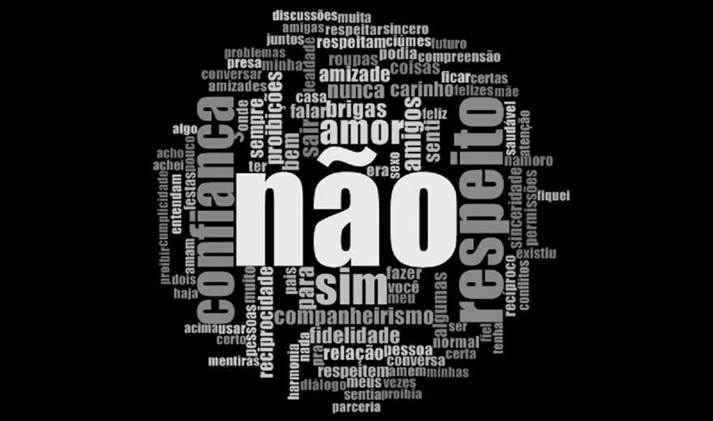
The node was formed by the following questions: “What constitutes an ideal dating relationship?” and “Are there/were prohibitions or permissions in your relationship? Which ones? How did you feel?”
The word cloud regarding ideal versus real dating revealed that the participants’ thinking entered the realm of beliefs and seeking recognition of violent attitudes in dating (Figure 02):

The most frequent words were: no, respect, trust, yes, love, friends, going out, fights, companionship, and never. The terms related to the idealization of the partner were desired characteristics in an affectionate bond, which can provide durability to a couple, provided that the relationship is pleasant and healthy for both.
There aren’t many fights; one trusts the other, and, above all, they respect each other (A14).
Without fights or disagreements. Where love, affection, and trust reign (A48).
Respect, trust, and love. People know how to communicate and act together rather than impulsively (A84).
Love, trust, and companionship, where the couple is very good friends (A149).
However, there was also recognition of abusive situations, even when the denial of the events was evident, through the word no highlighted in the cloud. The main prohibitions consisted of preventing the partner from doing something or behaving in a certain way.
These impositions generally generated negative feelings, even when the victim complied with the requests:
There were prohibitions such as not talking to certain people and not wearing certain clothes, among other things. I felt trapped and lacked the courage to end it. One time when I tried to end it, he used psychological manipulation to prevent me from doing so (A164).
Yes. He controlled my friendships and where I could go. It was uncomfortable, but I know it’s normal (A401).
Yes. I wasn’t allowed to leave the house without him or wear short clothes. I always had to check my cell phone, too. I reacted normally because I liked him and didn’t realize it (A407).
Yes. I couldn’t go out with my friends without him, and I had to lose contact with them. I felt awful, but I gave in (A443).
There are cases where, despite recognizing the violent attitudes, they considered the imposition of prohibitions and permissions natural: Yes, I thought it was normal at the beginning of a relationship. Today we are quite free (A16).
Yes. However, I think every relationship should have, because you’ll be giving up your single life, and things automatically change (A125).
Perception of dating violence
This category sought to identify whether school adolescents had knowledge about the topic, as well as whether they could recognize (types of) violations committed.
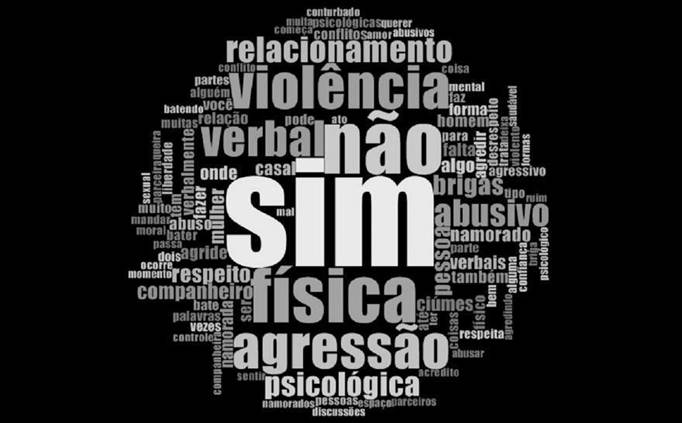
The node was constructed using the guiding questions: “Have you ever heard the expression ‘Dating Violence’? What do you think it is?’ The word cloud on perceptions of dating violence aimed to capture adolescents’ knowledge of violence within affectionate relationships (Figure 03):

The most frequent words in the discourses were: yes, no, physical, violence, aggression, verbal, abusive, relationship, psychological, and fights. The high frequency of the word yes indicates that the students were familiar with the expression, recognizing the term as referring to violations committed by an abusive partner. They listed fights involving aggression of a physical, psychological, and verbal nature as consequences of this phenomenon.
Yes. The worst situation is when physical violence occurs, but verbal abuse hurts too, not to mention the deprivation of the partner (A4).
Yes, something abusive and lacking trust. Abusers think they own their partners and can control their actions and clothing. They always blame their partners in a fight and belittle them (A222).
Yes. Violence from the partner through gestures is bothersome and generates major conflicts, sometimes resulting in death. This mainly affects women (A268).
Yes. Many fights and conflicts interfere with the psychological well-being of the abused person, in addition to sexual violence (A462).
Those who said they had not heard the expression still demonstrated an understanding of the topic by describing situations and important points about abusive relationships, such as manipulation and control:
No. Preventing her from doing things she enjoys and beating her when she does (A65).
No. Aggressing against the other person, both verbally and physically (A88). I believe it’s not a healthy relationship (A161).
No. Mistrust, fights, and aggression (A245).
No. Not allowing a woman to wear something because it’s too short, fighting, and lowering the partner’s morale (A315).
No. She was violated within her own dating relationship by her partner (A363).
Experiences in dating and witnessing violences
The node was formed by the following questions: “Considering what you know about dating violence, do you consider yourself to be currently, or to have ever been, a victim or aggressor in a dating relationship?” and “Have you ever witnessed, at any point in your life, a situation of violence between people you know?”
The word cloud about experiences with dating and witnessing violence presented participants’ discourses from the perspective of both characters and witnesses and aims to help participants recognize themselves as victims or aggressors in relationships, as well as describe violent acts (Figure 04):
The words highlighted in the image are: no, people, friends, neighbors, parents, family, never, yes, boyfriend, and fights. Accounts from participants in abusive relationships encompassed both recognizing themselves as victims and assessing themselves as aggressors. Participants described violent behaviors and situations, as well as the difficulty of breaking the emotional bond with the abuser.
Yes. My ex-boyfriend was sexist; he wouldn’t let me wear red lipstick or nail polish or very short shorts. He said that only sluts wore those things (A179).
Yes. I allowed my relationship to become abusive. I was beaten, but I didn’t care because I thought losing him would cause me more suffering (A286).
Yes. In a moment of anger, I had a jealous outburst [...] and ended up hitting him (A458).
He wanted to control my life. He could go out whenever he wanted, but he complained whenever I went out. He would touch me without my permission, grab my arm forcefully, and raise his voice out of jealousy […]. One time when I tried to break up with him, he became desperate, saying he was going to kill himself, and resorting to psychological manipulation (A477).

In the position of witnessing abusive behaviors and acts in everyday situations, participants reported witnessing violations, mainly between people close to them, notably those with family ties:
For example, my father would hit my mother and me and insult us. He was quite aggressive. With my sister, her boyfriend wouldn't let her dress the way she wanted and forbade her from talking to friends (A157).
Other family members, friends, and neighbors. There were abusive people who tried to control what they wore, put them down, forbade them from doing things they liked, and humiliated them in public by yelling and talking about their partners’ appearances (A180).
Parents, other family members, friends, neighbors, and strangers. Throwing objects, forbidding them from walking in public places, and/or going out with friends, and engaging in physical and verbal fights (A372).
Attitudes
This node sought to understand how protagonists in abusive relationships react to the cessation of these acts. This can be achieved by telling someone to seek help or by talking to their partner so that the abusive behavior stops.
The questions were: “If you experienced violence, did you tell someone? How did they react to your account?” and “Have you and your boyfriend/girlfriend ever discussed these behaviors in your relationship?” The word cloud on attitudes represents the responses regarding attitudes toward situations of violence (Figure 05):

The words highlighted in the word cloud are: no, yes, never, we talked, always, I told, we, people, relationship, and violence.
Victims experience psychological conflict when abusive situations occur, wondering whether or not to tell someone. The most common circumstances involve telling others about the negative experience, seeking support to leave the relationship, and finding comfort after leaving a toxic relationship:
Yes. People were surprised and told me to be more careful in my relationship, warning me not to stop loving out of fear (A180).
I told some friends after the breakup, and they almost didn’t believe me. They thought he was ‘too good’ to do what he did (A241).
Yes, I told a friend. She helped me get over it and leave the relationship (A370).
Others revealed discomfort in reporting the events. Their justifications were fear of judgment, fear of the aggressor, and believing the event was accidental:
I didn’t even need to tell anyone. The marks appeared right away, but I lied and said that I had bumped into something. I was afraid (A192).
I think that, if I had suffered, I wouldn’t have told right away; I would have only told if it happened again (A411).
The attitude of not discussing abusive behaviors with a partner can mean one of two things: either these behaviors do not exist, which is a kind of denial of the events in the relationship, or they are considered a joke, depending on the severity. However, the victim remains uncomfortable in the relationship while the abuser intensifies and perpetuates their actions.
There were never any conversations about it (A143).
No, because everything we did was in jest. Nothing was intended to hurt or offend (A333). No, it was a joke. It was not a real threat (A451).
Following this logic, when discussing abusive behavior in dating, one must acknowledge the existence of a victim and a perpetrator. Sometimes, the perpetrator refuses to have the conversation because they do not recognize themselves as such and because of the social stigma associated with abuse. Nevertheless, the participants recognize that violence in a relationship should first be resolved by the couple:
Yes, but it always ended in fights, and the only way out was to accuse someone of being wrong, which generated resentment (A77).
Yes, everything was resolved amicably after a discussion, and it never happened again (A250).
Yes. I always wanted to talk, but he didn’t want to (A337).
Discussion
Dating, symbolically, should be surrounded by romance. This idealization stems from the socially constructed notion that these relationships must be monogamous and conflictfree (Oliveira & Fonseca, 2019). The study examined the perceptions of dating among school adolescents, who viewed their relationships positively and idealized a promising future with their current or desired partner.
These future expectations involve consolidating affectionate bonds, spending more time with their partners, yearning for increased intimacy, and sharing dreams. This projection reveals an interest in starting a family, building a home together, and having children. Marriage is considered synonymous with happiness (Fonseca & Duarte, 2014).
However, some participants reported experiencing violence in previous relationships. For this reason, their perception of the ideal dating relationship was influenced by these negative experiences. Consequently, they sidelined the development of emotional bonds and imagined a promising future alone, prioritizing personal plans before becoming emotionally involved.
Maintaining emotional bonds with seemingly perfect partners can be frustrating due to behaviors that are detrimental to consolidating the relationship. These behaviors include excessive jealousy, betrayal, disrespect, a lack of trust, irresponsibility, a loss of individuality, unilateral effort, and prioritizing one’s personal life (Smeha & Oliveira, 2013).
Identifying violence in these relationships includes recognizing behaviors that seem appropriate for the new status but are unpleasant. A situationship becomes valued for allowing involvement without commitment (Bittar & Nakano, 2017). Thus, the desire to date is often resumed at a later age, after enjoying freedom and professional stability (Smeha & Oliveira, 2013).
Considerations about ideal dating focus on romanticizing this affectionate bond and reveal an interest in being involved with people who have agreeable characteristics. This desire, primarily among women, stems from projecting a companion with similar ideals in a relationship with mutual feelings. Desirable qualities include respect, trust, sincerity, fidelity, responsibility, and dialogue (Smeha & Oliveira, 2013).
Nevertheless, believing in an ideal partner can be dangerous because it normalizes abusive attitudes in relationships that are no longer healthy. In the study, participants revealed that prohibitions and permissions existed to maintain their relationships. Thus, it is evident that adolescents recognize violent attitudes in dating relationships but tolerate these acts and remain in the relationship. These abusive practices often become reciprocal between partners.
Bittar & Nakano (2017) clarified that, although adolescents recognize the existence of impositions in dating, this type of violence is sometimes not understood as such. This is evident in the trivialization of the event. These attitudes, considered acceptable, are marked by unequal power struggles in which the abuser exploits the victim’s trust and the victim submits to seemingly protective situations.
Youth relationships are influenced by gender norms. Jealousy emerges in this context and motivates dominant behaviors, becoming inherent in affectionate relationships, especially to ensure durability (Cecchetto et al., 2016). Jealousy is also the main justification for violence in affectionate relationships and is often tolerated by both partners (Carvalho et al., 2018).
These characteristics contradict the belief that this stage of life is ideal for forming romantic relationships. Dating violence is associated with aggressive behavior in marriages because abuse does not arise spontaneously but rather is consolidated during adolescence (Ataíde, 2015).
Therefore, young people need to have knowledge about violence in the context of affectionate relationships in order to develop intervention proposals that promote healthy relationships (Ventura et al., 2013). However, attention must be paid to the language and terms used to report abusive situations.
In the present study, participants, in general, referred to the notion of violence, both those who stated they knew the expression ‘dating violence’ and those who had their own understanding of the phenomenon. They clearly described the nature of the violations and identified warning signs of abuse. They noted that violent attitudes can be exhibited by either partner, though they still identified women as the primary victims, including of fatal crimes.
Dating violence refers to violations committed within the scope of affectionate relationships and manifests in various ways. The expression Dating Violence has become more widely known worldwide (Pérez, 2015). In the scientific literature, dating violence is described as an interpersonal form of violence present in both heterosexual and homosexual relationships. These harmful practices are part of a cycle that must be broken (Martins, 2017).
Campeiz et al. (2017) emphasized that violence in affectionate relationships is common and can manifest as physical, psychological, or verbal abuse. Psychological and verbal abuse are the most frequent forms of abuse in romantic relationships, and both partners can be both the perpetrator and victim. Sexual abuse related to coercion was rarely mentioned. However, restricting freedom in using social networks and controlling friendships were recognized as forms of abuse.
The representations of violence reported in a Portuguese study (Capelo et al., 2019) included physical, psychological/verbal, and sexual aggression; control; mistreatment; and disrespect; however, a considerable portion of those participants (31.30%) did not express their understanding of this phenomenon. These findings suggest that violent behaviors of a psychic nature are the most common.
Psychological abuse is used as a tool to control the partner, with the aim of preventing alleged betrayals. Controlling behaviors, as harmful as physical aggression, are frequently practiced by men to impose authority (Souza et al., 2018).
In the social sphere, gender-based violations arise, especially in intimate relationships, where women are considered fragile and men are seen only as aggressors (Cecchetto et al., 2016). Although women are considered the main victims in social discourses, it is important to acknowledge that men are not exclusively aggressors, given the bidirectional nature of dating violence.
Regarding experiences of violence in affectionate relationships, people affirm and deny being characters in violent scenes, and there are reports and testimonies of such scenes. The most commonly witnessed situations were fights between couples involving physical and verbal aggression, especially among people in the social, family, and romantic circles who reported witnessing more than one violent incident, whether at home or in public.
Barreira et al. (2013) demonstrated that dating couples exposed to community violence are more likely to perpetrate these acts in their relationships. The relationship durability also increases the possibility of abusive behaviors. Physical and psychological aggression often occur simultaneously; of the 60 participants who admitted to perpetrating physical aggression, 57 also exercised psychological violence.
Psychological violence is the most common form of aggression in the daily lives of young people in affectionate relationships (Bittar & Nakano, 2017). Prevalent attitudes in abusive relationships include raising one’s voice, making threats, stalking, and controlling one’s partner’s life, among other condemnable behaviors with devastating effects (Bittar & Nakano, 2017).
Sexual assaults are generally underreported in studies, seemingly due to the fear of personal exposure for having suffered or perpetrated this abuse, as well as the lack of recognition of this practice within affectionate relationships (Costa et al., 2018).
Reports of witnessing situations of violence include asymmetrical power relations between people of the opposite sex and witnessed violations, especially among family members. These violations result from ineffective conflict resolution and emotional upheavals, such as impulsivity and forced sexual relations (Valdivia-Peralta et al., 2018). The most commonly witnessed type of violence is verbal and includes humiliation, insults, and yelling (Rey-Anacona, 2015). This type of violence is predominantly perpetrated by males against females (Cecchetto et al., 2016).
Adolescents from ten Brazilian cities corroborated these findings by demonstrating different representations of violence, ranging from motivations (e.g., jealousy and alcohol consumption) to consequences observed during the aggressions. The perpetrators of the witnessed violations were often people close to the victims, including relatives, friends, and neighbors (Cecchetto et al., 2016).
The violent experience directly interferes with the development of the aggressor’s relational profile. Situations of abuse between parents, family members, friends, and neighbors are as harmful as violent experiences in previous relationships and favor the continuation of these acts (Carvalho et al., 2018). Indeed, a study by Faias et al. (2016) demonstrated that young people who experienced violence in dating relationships had also witnessed and experienced violence within their families.
In abusive situations, revealing the violations suffered in affectionate relationships to someone can help the victim build a support network, which can help them leave the relationship and overcome the trauma. Friends and family are often the listeners.
Asking for help is crucial for mitigating the risks associated with adolescents’ mental health, managing anxiety and depression, and promoting conflict management, resolution, self-protection, and preventing future violence (Caridade, 2018). A study by Santos et al. (2019) with victims of abusive relationships demonstrated that adolescents react differently to the violence suffered. The most common responses were talking to the partner, becoming sad and crying, leaving the environment, leaving the aggressor alone, and/or being alone. Other responses included retaliating to defend themselves and/or reaching out to family and friends after experiencing violence.
Fonseca et al. (2018) found that the immediate coping mechanisms of adolescents ranged from two extremes: dialoguing or retaliating against violent behaviors, whether physical and/or verbal. Nevertheless, the study also emphasized the importance of seeking professional help and strengthening the support network, which is usually composed of friends and parents.
In relation to the recognition of abusive practices, adolescents identified anger and jealousy as triggers for such behaviors in relationships. They also emphasized the importance of staying calm, managing emotions, avoiding rash decisions, and socializing with trusted individuals (Murta et al., 2016).
Regarding talking to their partner, discussing abusive situations was emphasized; however, some noted their partner’s lack of interest in resolving the situation. Fear of recognizing oneself as a victim and/or aggressor in the relationship negatively interferes with reducing these behaviors, making the relationship more dangerous due to the desire to remain in the relationship.
The trivialization of violence in the context of affectionate relationships occurs through the idealization of romanticism; disagreements caused by jealousy are considered not only acceptable but also healthy (Cecchetto et al., 2016). Although different types of violence frequently appear in adolescents’ discourse, they minimize them as commonplace acts and/or jokes in an affective context. Therefore, they are not considered violence. When they are considered violence, there is blame placed on the female partner (Oliveira & Fonseca, 2019).
However, these violent practices constitute a serious social problem that must be denormalized since these hostile acts violate rights. Couples need to adopt less coercive and more egalitarian attitudes to maintain their relationships (Souza et al., 2018).
In a prevention program developed with school adolescents in Brasília, the impact of demonstrating empathy was highlighted. The participants decided to change their attitudes, such as avoiding conflicts in relationships and developing positive skills to cope with violence (Murta et al., 2016).
Final considerations
When identifying adolescents’ perceptions and attitudes about dating violence, a worrying fact stands out: the normalization and tolerance of violence in affectionate relationships. Participants are familiar with the expression and recognize themselves in the situations, yet attitudes against it are scarce. It is common to remain in a toxic relationship.
Therefore, simply having knowledge of violent manifestations in affectionate relationships and recognizing these abusive practices, attitudes, and behaviors is insufficient to end the cycle of violence, which tends to perpetuate itself throughout the relationship and/or in future romantic relationships.
Given this, beliefs about how romantic relationships should be hinder the approach to dating violence, even when there is a history of violence in previous relationships. Strategies must be developed to break and/or confront dating violence, such as active listening and raising awareness about this issue, especially among adolescents.
The data suggest the need for further studies to better understand this phenomenon and support the creation and strengthening of support networks for victims and perpetrators. Assuming both parties are interested in continuing the relationship, the couple needs intervention to restore balance, eliminate signs of violence, encourage positive conflict resolution, and maintain healthy relationships within a harmonious framework.
References
-
Ataíde, M. A. (2015). Namoro: uma relação de violência entre jovens casais. Revista Internacional Interdisciplinar INTERthesis, 12(1), 248-270. https://periodicos.ufsc.br/index.php/interthesis/article/view/1807-1384.2015v12n1p248
» https://periodicos.ufsc.br/index.php/interthesis/article/view/1807-1384.2015v12n1p248 -
Barreira, A. K., Lima, M. L. C., & Avanci, J. Q. (2013). Coocorrência de violência física e psicológica entre adolescentes namorados do Recife, Brasil: prevalência e fatores associados. Ciência & Saúde Coletiva, 18(1), 233-243. https://www.scielo.br/pdf/csc/v18n1/24.pdf
» https://www.scielo.br/pdf/csc/v18n1/24.pdf -
Bittar, D. B., & Nakano, A. M. S. (2017). Symbolic violence among adolescents in affective dating relationships. Revista da Escola de Enfermagem da USP, 51. http://www.scielo.br/pdf/reeusp/v51/pt_1980-220X-reeusp-S1980-220X2017003003298.pdf
» http://www.scielo.br/pdf/reeusp/v51/pt_1980-220X-reeusp-S1980-220X2017003003298.pdf - Campeiz, A. B., Carlos, D. M., Campeiz, A. F., Silva, J. L., Freitas, L. A., & Ferriani, M. G. C. (2017). Percepções de adolescentes que vivenciaram a violência no relacionamento íntimo à luz da Complexidade [Atas]. In 6ºCongresso Ibero-Americano em Investigação Qualitativa(pp. 909-918). Salamanca.
- Capelo, M. R. T. F., Varela, J. M. C., Jardim, M. H. A. G., Brasil, C. C. P., Díaz, N. S., & Pereira, J. A. V. (2019). Violências no namoro: as representações de estudantes do ensino secundário profissionalizante [Atas].In 8ºCongresso Ibero-Americano em Investigação Qualitativa (pp. 28-39). Lisboa.
- Caridade, S. (2011). Vivências íntimas violentas: uma abordagem científica(1a ed.). Almedina.
- Caridade, S. (2018). Violência no namoro: contextualização teórica e empírica. In A. Neves & A. Correia. Violências no namoro(pp. 9-40). Edições ISMAI.
- Caridade, S., Pinheiro, I., & Dinis, M. A. P. (2019). Disclosure in victims of dating violence: Strategies and reasons for help-seeking. In W. Spencer. Dating violence: prevalence, risk factors and perspectives (pp. 85-106). Nova Science Publishers.
-
Carvalho, J. L., Souza, M. B., & Souza, N. F. (2018). A violência nas relações afetivas de adolescentes: uma revisão sistemática. Revista Sociais & Humanas, 31(2), 24-38. https://periodicos.ufsm.br/sociaisehumanas/article/view/31406/pdf_1
» https://periodicos.ufsm.br/sociaisehumanas/article/view/31406/pdf_1 -
Cecchetto, F., Oliveira, Q. B. M., Njaine, K., & Minayo, M. C. S. (2016). Violências percebidas por homens adolescentes na interação afetivo-sexual em dez cidades brasileiras. Interface,20, (59), 853-864. http://www.scielo.br/pdf/icse/v20n59/1807-5762icse-1807-576220150082.pdf
» http://www.scielo.br/pdf/icse/v20n59/1807-5762icse-1807-576220150082.pdf -
Costa, A. M., Costa, M. C. O., & Nascimento, O. C. (2018). Percurso amoroso e eventos violentos nas relações de namoro de jovens. Revista de Saúde Coletiva da. UEFS, 8, 39-45. http://periodicos.uefs.br/ojs/index.php/saudecoletiva/article/view/2973/2919
» http://periodicos.uefs.br/ojs/index.php/saudecoletiva/article/view/2973/2919 -
Faias, J., Caridade, S., & Cardoso, J. (2016). Exposição à violência familiar e abuso íntimo em jovens: que relação? Psychologica, 59(1), 7-23. https://impactumjournals.uc.pt/psychologica/article/view/1647-8606_59-1_1/3130
» https://impactumjournals.uc.pt/psychologica/article/view/1647-8606_59-1_1/3130 - Fernandes, A. F. (2013). Programas de sensibilização de violência no namoro: impactos nos jovens [Dissertação de mestrado]. Programa de Pós-graduação em Psicocriminologia, ISPA - Instituto Universitário de Ciências Psicológicas, Sociais e da Vida.
-
Fonseca, R. M. G. S., Santos, D. L. A., Gessner, R., Fornari, L. F., Oliveira, R. N. G., & Schoenmaker, M. C. (2018). Gender, sexuality and violence: perception of mobilized adolescents in an online game. Revista Brasileira de Enfermagem, 71, 652-659. http://www.scielo.br/pdf/reben/v71s1/pt_0034-7167-reben-71-s1-0607.pdf
» http://www.scielo.br/pdf/reben/v71s1/pt_0034-7167-reben-71-s1-0607.pdf -
Fonseca, S. R. A., & Duarte, C. M. N. (2014). Do namoro ao casamento: significados, expectativas, conflito e amor. Psicologia: Teoria e Pesquisa, 30(2), 135-143. http://www.scielo.br/pdf/ptp/v30n2/02.pdf
» http://www.scielo.br/pdf/ptp/v30n2/02.pdf -
Martins, A. P. A. (2017). Violência no namoro e nas relações íntimas entre jovens: considerações preliminares sobre o problema no Brasil. Gênero, 17(2), 9-28. https://periodicos.uff.br/revistagenero/article/view/31261/18350
» https://periodicos.uff.br/revistagenero/article/view/31261/18350 -
Murta, S. G., Moore, R. A., Miranda, A. A. L., Cangussú, E. D. A., Santos, K. B., Bezerra, K. L. T., & Veras, L. G. (2016). Efeitos de um programa de prevenção à violência no namoro. Psico-USF, 21(2), 381-393. http://www.scielo.br/pdf/pusf/v21n2/2175-3563pusf-21-02-00381.pdf
» http://www.scielo.br/pdf/pusf/v21n2/2175-3563pusf-21-02-00381.pdf -
Nascimento, F. S., & Cordeiro, R. L. M. (2011). Violência no namoro para jovens moradores de Recife. Revista Psicologia & Sociedade, 23(3), 516-525. http://www.scielo.br/pdf/psoc/v23n3/09.pdf
» http://www.scielo.br/pdf/psoc/v23n3/09.pdf -
Oliveira, R. N. G., & Fonseca, R. M. G. S. (2019). Amor e violência em jogo: descortinando as relações afetivo-sexuais entre jovens à luz de gênero. Interface, 23, 1-16. https://www.scielo.br/pdf/icse/v23/1807-5762-icse-23-e180354.pdf
» https://www.scielo.br/pdf/icse/v23/1807-5762-icse-23-e180354.pdf -
Pérez, S. R. (2015). Violencia en parejas jóvenes: estudio preliminar sobre su prevalencia y motivos. Pedagogía Social: Revista Interuniversitaria, 25, 251-275. https://www.redalyc.org/pdf/1350/135043709011.pdf
» https://www.redalyc.org/pdf/1350/135043709011.pdf -
Rey-Anacona, C. A. (2015). Variables asociadas a los malos tratos en el noviazgo en adolescentes y adultos jóvenes. Acta Colombiana de Psicología, 18(1), 159-171. https://actacolombianapsicologia.ucatolica.edu.co/article/view/151/192
» https://actacolombianapsicologia.ucatolica.edu.co/article/view/151/192 -
Santos, A. P., Caridade, S., & Cardoso, J. (2019). Violência nas relações íntimas juvenis: (des)ajustamento psicossocial e estratégias de coping. Contextos Clínicos, 12(1), 1-25. http://revistas.unisinos.br/index.php/contextosclinicos/article/view/ctc.2019.121.01/607 46837
» http://revistas.unisinos.br/index.php/contextosclinicos/article/view/ctc.2019.121.01/607 46837 -
Smeha, L. N., & Oliveira, M. V. (2013). Os relacionamentos amorosos na contemporaneidade sob a óptica dos adultos jovens. Psicologia: Teoria e Prática, 15(2), 33-45. http://pepsic.bvsalud.org/scielo.php?script=sci_arttext&pid=S151636872013000200003&lng=en&tlng=pt
» http://pepsic.bvsalud.org/scielo.php?script=sci_arttext&pid=S151636872013000200003&lng=en&tlng=pt -
Souza, T. M. C., Pascoaleto, T. E., & Mendonça, N. D. (2018). Violência contra mulher no namoro: percepções de jovens universitários. Revista Psicologia e Saúde, 10(3), 31-43. https://pssaucdb.emnuvens.com.br/pssa/article/view/695/pdf
» https://pssaucdb.emnuvens.com.br/pssa/article/view/695/pdf -
Valdivia-Peralta, M., Paino, M., Fonseca-Pedrero, E., & González-Bravo, L. (2018). Attitudes toward dating violence in early and late adolescents in Concepción, Chile. Journal of Interpersonal Violence, 2018. https://journals.sagepub.com/doi/10.1177/0886260518815724
» https://journals.sagepub.com/doi/10.1177/0886260518815724 -
Ventura, M. C. A. A., Ferreira, M. M. F., & Magalhães, M. J. S. (2013). Violência nas relações de intimidade: crenças e atitudes de estudantes do ensino secundário. Revista de Enfermagem Referência, (11), 95-103. https://www.fpce.up.pt/love_fear_power/pdfs/Ventura_FredericoFerreira_Magalhaes_2013_dating_violence.pdf
» https://www.fpce.up.pt/love_fear_power/pdfs/Ventura_FredericoFerreira_Magalhaes_2013_dating_violence.pdf
The dataset supporting the results of this study is available within the article.

 Source: the authors.
 Source: The authors.
 Source: The authors.
 Source: The authors.
 Source: The authors