 Assessment of modified poly(ethylene terephthalate) films under anaerobic conditions
Abstract
Single-use plastics represent almost a fifth of the global plastics market, leading to high residual accumulation. The study aimed to evaluate the biodegradability, under anaerobic conditions, of additivated polyethylene terephthalate (PET-ad), marketed by a company in Brazil. The polymeric films were submerged in digesters in sludge from sewage treatment plants. Films were characterized throughout time, as were the biogas and microorganisms in the medium. The results indicated weight and microscopic differences attributed to sludge components and microbial colonization on films’ surfaces. The thermal properties did not show changes. Moreover, at the end of the research, the microorganisms still had considerable concentration – 106 and 109 NMP/ml, anaerobic and aerobic, respectively. The production of methane (60% v/v) and carbon dioxide (30% v/v) gases peaked in the first month and decreased subsequently. At eighteen months, PET-ad has been proven to undergo the initial degradation process faster than negative control.
Keywords:
anaerobic digestion; biodegradable polymers; PET-ad; sludge
1. Introduction
Poly(ethylene terephthalate) is one of the most widely used fossil-based thermoplastics worldwide, mainly due to its desirable properties, such as lightweight, impact resistance, high transparency, and impermeability[1,2]. Biodegradation of this thermoplastic is a desirable process, given the non-toxicity of the by-products[3,4]. Nevertheless, the rate of degradation of PET under natural conditions is too slow, and, combined with high levels of production, it causes negative impacts on terrestrial and aquatic environments[5-8].
An alternative to mitigate these impacts comes from pro-degradant additives incorporated into polymers. These substances can facilitate microorganisms activities that can use the carbon present in the polymer chains as an energy source[9]. They act by reducing the molar mass of the chains, altering their polarity, providing a substrate to attract microorganisms, or acting as catalysts[2,10]. Considering the rapid increase in the production of additive PET, it is necessary to evaluate the actual impact of additives on this material's disposal to verify its biodegradation effectiveness[9].
This paper presents the progress of the biodegradation of a commercial polymer, called PET-ad, by the authors in sludge from a sewage treatment plant under an anaerobic regime for eighteen months. The evaluations were carried out considering the surface modifications, the chemical bonds in the material's structure and thermal properties, as well as biogas production and microorganisms in biodigesters.
2. Materials and Methods
2.1 Biodigester preparation
PET and PET-ad films, with a thickness of 12 µm, were supplied by a company and sized at 5x2 cm2. The biodigesters were made up of penicillin-type flasks in which 90 ml of sludge and three films were added. They were hermetically sealed with rubber lids and metal seals. To capture the produced gas, syringes (10 ml) were inserted through the rubber lids.
2.2 Film characterization
The mass variation of the films was quantified with an analytical balance (CELTAC, model FA-2104N), after being washed with distilled water and dried in a desiccator. The material’s surface was studied through Scanning Electron Microscopy (SEM) (model MIRA-3, Tescan Mira, with a high-brightness, high-vacuum FEG source).
Thermogravimetry analysis was carried out in the range of 30 to 600°C, with a heating rate of 10 °C/min (Mettler Toledo TGA 2 Star System). Differential Scanning Calorimetry was performed in the temperature range of 30 to 300 °C, with a heating rate of 10 °C/min, using the STARc software. The crystallinity index (Xc) was calculated based on the melting enthalpy (∆Hf), the mass fraction of PET in the film (f) and the theoretical enthalpy of 100% crystalline PET (∆Hf0), equivalent to 140 J/g[11], as shown in expression 1.
Fourier Transform Infrared Spectroscopy (FTIR) was carried out in the spectral range from 400 to 4000 cm-1, on the Perkin Elmer 400 FTIR equipment. The carbonyl, hydroxyl and ester indices were calculated by the ratio between the absorbances (Abs) of the respective peaks and the absorbance of the reference peak (C-H bond), as shown in expression 2.
2.3 Microorganisms
Sludge samples were inoculated into appropriate culture media for each group of microorganisms (Heterotrophic Aerobic Bacteria, Acid-Producing Bacteria, Heterotrophic Anaerobic Bacteria and Sulfate-Reducing Bacteria) by successive dilutions. The culture media used were Nutrient Broth, Phenol Red Broth, Thioglycolate Fluid Medium, and Modified Postgate E, respectively. Identification and quantification were carried out using the color change and medium's turbidity, and the Most Probable Number method.
2.4 Biogas production
The resulting gas was analyzed via gas chromatography (Hewlett Packard 5890) at a temperature of 90 ºC. Nitrogen gas was used as a mobile phase and Porapak-N column (solid phase thickness between 50 and 60 mesh), with thermal conductivity detectors. Biodegradation was assessed according to ASTM D5511, from expression 3, considering methane and carbon dioxide gases. The peaks were obtained using the N2000 software.
Where “Cg” is the amount of carbon present in the gas produced, in grams, and “Ci” is the amount of carbon in the films.
3. Results and Discussions
3.1 Mass variation
Figure 1 shows the monthly mass variation of the films over a period of eighteen months.

Throughout the study, a constant loss of mass was not noticeable, but there was a slight tendency to increase mass, reaching up to around 2% of the film's mass. The mass increase can be explained by the adherence of the material present in the sludge or by the formation of biofilms that became impregnated in the film. This adherence of microbial biomass to the film is the first stage of polymer biodegradation. At this point, enzymes are excreted and the process of biocatalysis begins in the polymer structure[12,13].
Zafiu et al.[14] and Selke et al.[15] also observed a small increase in mass when studying the degradation of PET and attributed this result mainly to the water absorption by the material and to surface impurities.
3.2 Scanning electron microscopy
Figure 2 shows the SEM images of the surface of the films before they were placed in the biodigesters, after 9 and 18 months of being immersed in the sludge.

SEM images of film surfaces of PET (a) initial; (b) 9 months aging; (c) 18 months aging; and PET-ad (d) initial; (e) 9 months aging; (f) 18 months aging.
PET film's surface is smooth and relatively homogeneous (Figure 2a), while PET-ad film shows the presence of uniformly distributed particles (Figure 2d), which correspond to the pro-degradant additive incorporated into the material. After nine months in contact with sludge, no significant changes were observed in the PET films (Figure 2b). It was not possible to identify the charges in the PET-ad films (Figure 2e), but the sludge slightly interacted with the surface, indicating a greater affinity with the sludge components.
This suggests that the additive was consumed, facilitating contact between the film and the microorganisms present in the environment. At the end of eighteen months, there were few sludge components on the surface of the PET film’s (Figure 2c), while a large amount of matter covered the surface of the PET-ad film’s (Figure 2f), which made it appearance rough and heterogeneous.
Maheswaran et al.[16] studied the interactions of some microorganisms of the Sarcina, Bacillus and Aspergillus genera with PET films. They observed more relevant signs of degradation, such as rough surfaces, holes, pores, surface erosion and cracks. Regarding microorganisms, the surface images in both cases are similar to those obtained in the present work, indicating a possible adhesion of microorganisms to the films[17].
Other authors have also evaluated microorganism colonization, especially bacteria, on polymer surfaces. The images were similar to the results obtained in this study[18-22]. Therefore, it can be inferred that the additive facilitated the incorporation of substances from the sludge and, consequently, microorganisms onto the surface of the films, thus, accelerating the beginning of the biodegradation process[17-19,21].
3.3 Thermogravimetric analysis
The mass variation under heating is illustrated in Figure 3, which shows similar curves between the initial and final samples in both cases, indicating the slow degradation of the polymers. Comparing the curves for PET and PET-ad, the equipment detected an increase in mass - of around 9% - before the degradation peak, in the PET-ad films before being put into the biodigester; in nine months, a 5% increase in mass was detected; and finally, at eighteen months, there was a 1% mass increase. This phenomenon provides information on the action mechanism of the additive present in the PET-ad formulation. Among the compounds used to promote biodegradation, it is worth highlighting chemo-taxis pro-degradants, which are capable of attracting microorganisms to the inside of the films by providing substrate. Additionally, they can expand the structure of the polymer to facilitate the penetration of microorganisms and other components, thus accelerating the consumption of carbon chains. The decrease in mass gain during the tests could indicate the consumption of these additives in the biodigesters, as observed in the SEM analysis[2].

The loss of mass begins near the temperature of 400 ºC and, after a single stage, ends at 450 ºC, resulting in a single peak in the DTG curve. Thermal degradation of PET is initiated by the scission of the alkyl-oxygen bond, followed by successive scissions[23]. This thermal behavior, except for the mass increase, is in accordance with literature data, according to Santos et al.[24], Lima et al.[25] and Bannach et al.[26].
During the start of the biodegradation process, there are no significant changes in TGA curves. In addition, the difficulty of consuming the polymer chains - especially the aromatic fraction - means that the generation of these compounds occurs gradually, minimizing the influence on the parameters of this analysis, such as the initial, final and highest degradation rate temperatures[27]. Recent literature about thermal analysis of virgin and residual polymers corroborates these results, considering the exposure time of residues to environmental conditions from months to a few years[28-30].
3.4 Differential scanning calorimeter
The heat flow curves as a function of temperature obtained by differential scanning calorimetry make it possible to determine the melting temperature, melting enthalpy, crystallization enthalpy, crystallinity and glass transition temperature are shown in Tables 1 and 2.
For data processing purposes, the first heating – referring to the thermal history – was disregarded. In the cooling stage, there are exothermic crystallization peaks, where the crystalline domain was formed; in the second heating, there are subtle changes in the baselines (relating to glass transitions) and melting peaks, both of which are endothermic.
The results show that the thermal properties of PET and PET-ad were similar throughout the study. Therefore, there were no significant changes in the mobility of the carbon chains or in the intermolecular bonds of the polymers – additive or not – over time[31].
As discussed by Mróz et al.[32], evidence of changes in thermal properties would be indicated by a reduction in glass transition and melting temperatures, resulting from the decrease in the molecular mass. These modifications in thermal properties would be detected in more advanced stages of the biodegradation process. In addition, an increase in crystallinity is expected, due to degradation being initiated by the amorphous domain – as it is a more accessible region[32,33].
3.5 Fourier-transform infrared spectroscopy
Figure 4 shows the films’ spectrums, indicating the samples’ main absorption bands.

Both samples' spectrums are similar, due to the low concentration of the additive incorporated. The characteristic absorption bands of PET can be seen: around 1720 cm-1 corresponds to the stretching of the carboxylic group -C=O, at 1240 cm-1 is the ester group stretching O=C-O-, 1100 cm-1 indicates the torsion angle of the ester group and 720 cm-1 is related to the out-of-plane C-H bond (Figure 4)[34,35].
Regarding the intensities of the C-H band at a wavelength of 1470 cm-1, it was possible to evaluate the changes in the most relevant groups in the biodegradation process, according to expression 2. In later stages of degradation, it is expected that there will be a reduction in the intensity of the ester group, given that the enzymes excreted by the microorganisms break this bond, forming carbonyl and hydroxyl groups[36]. As can be seen in Figure 5 (a) and 5 (b), the carbonyl and ester functional groups occur in greater quantity, given their presence in the PET repetition structure, while the hydroxyl group comes from eventual terminal hydroxyls. Also, the relative intensities of these groups were similar between the PET and PET-ad films; there was a slight increase in the amount of ester and carbonyl groups and a maintenance of the few hydroxyl groups present in the films. However, there was a wider standard deviation between the calculated indices, which corresponds to the greater diversity of compounds from the sludge that are present on the films' surface[16,36].

Torena, Alvarez-Cuenca and Reza (2019) evaluated the PET biodegradation in sludge. In the FTIR spectrum, they found that there were small band shifts and intensity variations; the carbonyl index increased, which was caused both by the formation of terminal carbonyls after breaking ester bonds and by products from oxidation reactions[37-40]. Ioakeimidis et al.[41] concluded that the degradation rate slowed down after the disappearance of the ester functional group, given that this group is one of the primary targets of the action of enzymes excreted by microorganisms. The remaining aromatic groups remained unchanged[41]. In addition, principal component analysis (PCA) was carried out as a statistical test, but it was not possible to see any significant group separation. This corroborates the reported non-distinction in the values of the above-mentioned indices.
3.6 Microorganism groups in biodigesters
Figures 6 and 7 illustrate the behavior of the microorganism groups that are present in the sludge and have an influence on the film’s biodegradation.

Most Probable Number of Aerobic Heterotrophic Bacteria and Acid-producing Bacteria over time.
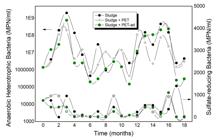
Most Probable Number of Anaerobic Heterotrophic Bacteria and Sulfate-reducing Bacteria over time.
Comparing the three systems, similar behaviors can be seen in the evolution of the microbial groups analyzed. The groups that require oxygen for growth (Heterotrophic Aerobic Bacteria and Acid-producers) showed a decline shortly after the start of the study, while the Heterotrophic Anaerobic Bacteria reached the peak of the exponential growth phase in the second month, due to the predominance of the anaerobic regime and the decrease in the other groups, which reduced competition for the substrates.
The Heterotrophic Aerobic Bacteria reached a growth peak of around 1023 MPN/ml, while the anaerobic group reached 109 MPN/ml, reflecting the lower efficiency of substrate consumption in the absence of oxygen and, consequently, slower biodegradation. At the end of the 18 months, the aerobic group's population reached 107 MPN/ml and the anaerobic groups remained stable between 107 and 106 MPN/ml.
The low order of magnitude for Sulphate Reducing Bacteria (103 MPN/ml to close to zero) is desirable, since sulphur compounds - hydrogen sulphide and volatile fatty acids - have a negative impact on microorganism growth, especially acetogenic and methanogenic microorganisms, which are fundamental for methane gas production. The logic for Acid-Producing Bacteria is equivalent, since a low pH will slow down the growth of microorganisms. The order of magnitude of this group ranged from 1017 to105 MPN/ml[42,43].
Torena et al.[37] evaluated PET biodegradation in activated sludge. They concluded that bacterias were able to consume the amorphous phase of the material[37]. Studies with ideal and controlled conditions to optimize microbial growth are important to quantify the biodegradation capacity of the microorganisms in question. However, materials are not usually disposed of under such conditions and there are other sources of nutrients that are more available than polymer chains, which further delays the consumption of PET and other thermoplastics[37,44,45].
Despite the eighteen months of anaerobic regime, aerobic microorganisms, when subjected to favorable conditions, were able to develop, reaching significant concentrations. Anaerobic groups remained at relevant concentrations. Therefore, potentially PET-degrading microorganisms can persist even when temporarily subjected to adverse situations[46].
3.7 Biogas composition
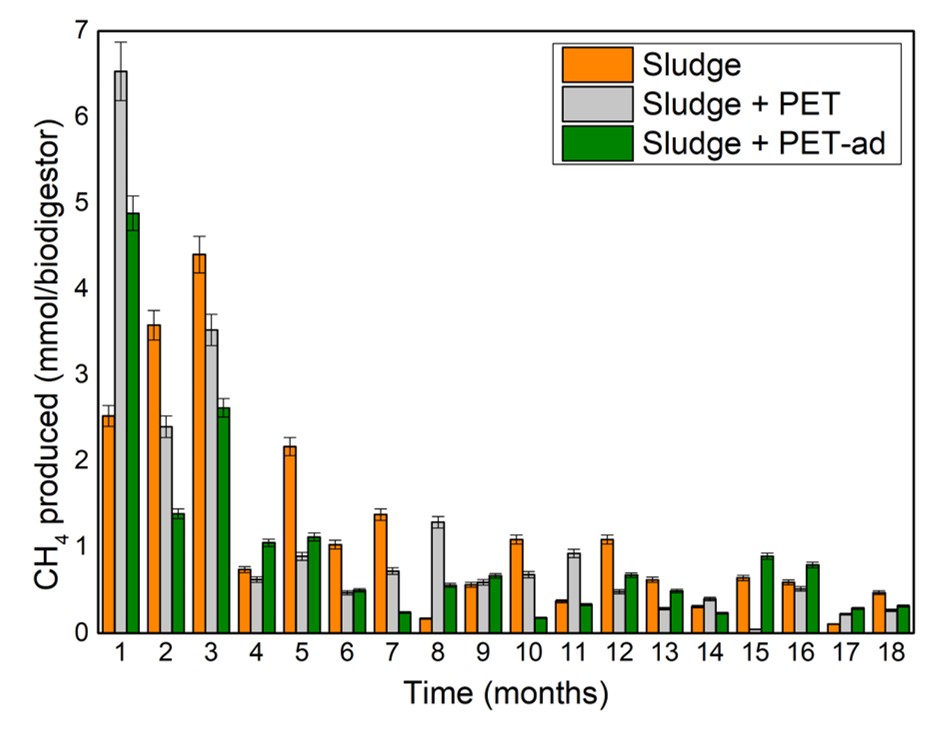
The sludge initially has a significant number of microorganisms in it, which are responsible for biogas production. As the systems were not continuously fed, the number of microorganisms was reduced over time, as shown in Figures 8 and 9. Methane gas production peaked in the first month of the study, reaching an average of 45% (v/v) of the biogas, while carbon dioxide gas started to decline after the second month (at an average of 25% (v/v)).


In the end, the total amount of methane in the “Sludge”, “Sludge + PET” and “Sludge + PET-ad” systems were 128.86, 101.96 and 100.36 mmol, respectively, while the amount of carbon dioxide was 215.83, 184.30 and 156.36 mmol, respectively. This oscillation in biogas production between the systems is expected, considering the heterogeneity of the sludge[46].
According to the ASTM D5511 standard, it was possible to quantify biodegradation using the ratio of the carbon in the polymer chains and the carbon present in the biogas (methane or carbon dioxide), according to expression 3. Figure 10 shows the percentage of biodegradation over eighteen months. Theoretically, 100% biodegradation would be equivalent to 2.655 mmol of methane gas and carbon dioxide produced, which represents less than a fifth of the biogas generated in the first month analyzed. Therefore, considering the low rate of consumption of the polymer as well as the small mass of the films, it is difficult to accurately quantify their conversion into biogas in the initial months, given the high production of these gases that are inherent to the sludge[46-48].

The results obtained are in accordance with what is expected in the literature. As an example, Cremonez et al.[46] studied methane gas production in systems containing sludge and found a peak in CH4 production after two weeks, reaching values close to 50% (v/v), during the 20-day analysis period. These results are associated only with the activity of the microorganisms present in the sludge, since no polymers were present in that research[46].
4. Conclusions
The incorporation of the pro-degradant additive into the PET films did not lead to carbon chains breaking over eighteen months under anaerobic conditions, but it was possible to observe the presence of microorganisms and sludge components on the surface, which is a possible start to the process. Since thermal properties have not changed, the biodegradation process still is in its early stages. The quantification of degradation from biogas is more relevant when the production of biogas from biodegradation is considerably higher than the production inherent in the sludge. Finally, considering that the half-life of PET reaches hundreds of years under certain conditions, it is possible that the additive may promote a noticeable reduction in decomposition time in the medium or long term, as it promotes a faster initiation of this process.
6. Acknowledgements
The authors would like to express their gratitude to the Postgraduate Program in Materials Science, the Petroleum and Energy Research Institute and the Chemical Engineering Department of the Federal University of Pernambuco for their support in carrying out the activities, to the company for providing the material and to Conselho Nacional de Desenvolvimento Científico e Tecnológico for its financial support.
-
Data Availability:
All data supporting the findings of this study are available at ATTENA -https://repositorio.ufpe.br/handle/123456789/62322.
-
How to cite:
Avellar, J. G. M., Silva, G. A., Souza, R. R. O., Henrique, M. A., Cavalcanti, J. V. F. L., Almeida, Y. M. B., Fernandez, M. L. A. P., & Vinhas, G. M. (2025). Assessment of modified poly(ethylene terephthalate) films under anaerobic conditions. Polímeros: Ciência e Tecnologia, 35(3), e20250026. https://doi.org/10.1590/0104-1428.20240106
7. References
- 1 Canevaloro, S. V., Jr. (2006). Ciência dos Polímeros São Paulo: Artliber.
-
2 Kushwaha, A., Goswami, L., Singhvi, M., & Kim, B. S. (2023). Biodegradation of poly(ethylene terephthalate): mechanistic insights, advances, and future innovative strategies. Chemical Engineering Journal, 457, 141230. http://doi.org/10.1016/j.cej.2022.141230
» http://doi.org/10.1016/j.cej.2022.141230 -
3 Benyathiar, P., Kumar, P., Carpenter, G., Brace, J., & Mishra, D. K. (2022). Polyethylene Terephthalate (PET) bottle-to-bottle recycling for the beverage industry: a review. Polymers, 14(12), 2366. http://doi.org/10.3390/polym14122366 PMid:35745942.
» http://doi.org/10.3390/polym14122366 -
4 Kim, N.-K., Lee, S.-H., & Park, H.-D. (2022). Current biotechnologies on depolymerization of polyethylene terephthalate (PET) and repolymerization of reclaimed monomers from PET for bio-upcycling: a critical review. Bioresource Technology, 363, 127931. http://doi.org/10.1016/j.biortech.2022.127931 PMid:36100185.
» http://doi.org/10.1016/j.biortech.2022.127931 -
5 Janczak, K., Dąbrowska, G. B., Raszkowska-Kaczor, A., Kaczor, D., Hrynkiewicz, K., & Richert, A. (2020). Biodegradation of the plastics PLA and PET in cultivated soil with the participation of microorganisms and plants. International Biodeterioration & Biodegradation, 155, 105087. http://doi.org/10.1016/j.ibiod.2020.105087
» http://doi.org/10.1016/j.ibiod.2020.105087 -
6 Sang, T., Wallis, C. J., Hill, G., & Britovsek, G. J. P. (2020). Polyethylene terephthalate degradation under natural and accelerated weathering conditions. European Polymer Journal, 136, 109873. http://doi.org/10.1016/j.eurpolymj.2020.109873
» http://doi.org/10.1016/j.eurpolymj.2020.109873 -
7 Webb, H., Arnott, J., Crawford, R. J., & Ivanova, E. P. (2012). Plastic degradation and its environmental implications with special reference to poly(ethylene terephthalate). Polymers, 5(1), 1-18. http://doi.org/10.3390/polym5010001
» http://doi.org/10.3390/polym5010001 -
8 Nisticò, R. (2020). Polyethylene terephthalate (PET) in the packaging industry. Polymer Testing, 90, 106707. http://doi.org/10.1016/j.polymertesting.2020.106707
» http://doi.org/10.1016/j.polymertesting.2020.106707 -
9 Mohanan, N., Montazer, Z., Sharma, P. K., & Levin, D. B. (2020). Microbial and enzymatic degradation of synthetic plastics. Frontiers in Microbiology, 11, 580709. http://doi.org/10.3389/fmicb.2020.580709 PMid:33324366.
» http://doi.org/10.3389/fmicb.2020.580709 - 10 Rabello, M. (2000). Aditivação de Polímeros São Paulo: Artliber.
-
11 Gaonkar, A. A., Murudkar, V. V., & Deshpande, V. D. (2020). Comparison of crystallization kinetics of polyethylene terephthalate (PET) and reorganized PET. Thermochimica Acta, 683, 178472. http://doi.org/10.1016/j.tca.2019.178472
» http://doi.org/10.1016/j.tca.2019.178472 -
12 Ruggero, F., Gori, R., & Lubello, C. (2019). Methodologies to assess biodegradation of bioplastics during aerobic composting and anaerobic digestion: a review. Waste Management & Research, 37(10), 959-975. http://doi.org/10.1177/0734242X19854127 PMid:31218932.
» http://doi.org/10.1177/0734242X19854127 -
13 Djapovic, M., Milivojevic, D., Ilic-Tomic, T., Lješević, M., Nikolaivits, E., Topakas, E., Maslak, V., & Nikodinovic-Runic, J. (2021). Synthesis and characterization of polyethylene terephthalate (PET) precursors and potential degradation products: toxicity study and application in discovery of novel PETases. Chemosphere, 275, 130005. http://doi.org/10.1016/j.chemosphere.2021.130005 PMid:33640747.
» http://doi.org/10.1016/j.chemosphere.2021.130005 -
14 Zafiu, C., Binner, E., Höck, L., Świechowski, K., & Huber-Humer, M. (2023). Study on the degradability of plastics with prodegradant additives during anaerobic and aerobic biological waste treatment processes. Journal of Material Cycles and Waste Management, 25(6), 3545-3556. http://doi.org/10.1007/s10163-023-01777-7
» http://doi.org/10.1007/s10163-023-01777-7 -
15 Selke, S., Auras, R., Nguyen, T. A., Aguirre, E. C., Cheruvathur, R., & Liu, Y. (2015). Evaluation of biodegradation-promoting additives for plastics. Environmental Science & Technology, 49(6), 3769-3777. http://doi.org/10.1021/es504258u PMid:25723056.
» http://doi.org/10.1021/es504258u -
16 Maheswaran, B., Al-Ansari, M., Al-Humaid, L., Raj, J. S., Kim, W., Karmegam, N., & Rafi, K. M. (2023). In vivo degradation of polyethylene terephthalate using microbial isolates from plastic polluted environment. Chemosphere, 310, 136757. http://doi.org/10.1016/j.chemosphere.2022.136757 PMid:36228720.
» http://doi.org/10.1016/j.chemosphere.2022.136757 -
17 Wolf, P., Reimer, M., Maier, M., & Zollfrank, C. (2023). Biodegradation of polysaccharides, polyesters and proteins in soil based on the determination of produced carbon dioxide. Polymer Degradation & Stability, 217, 11053. http://doi.org/10.1016/j.polymdegradstab.2023.110538
» http://doi.org/10.1016/j.polymdegradstab.2023.110538 -
18 Bonhomme, S., Cuer, A., Delort, A.-M., Lemaire, J., Sancelme, M., & Scott, G. (2003). Environmental biodegradation of polyethylene. Polymer Degradation & Stability, 81(3), 441-452. http://doi.org/10.1016/S0141-3910(03)00129-0
» http://doi.org/10.1016/S0141-3910(03)00129-0 -
19 Hakkarainen, M., Karlsson, S., & Albertsson, A.-C. (2000). Rapid (bio)degradation of polylactide by mixed culture of compost microorganisms: low molecular weight products and matrix changes. Polymer, 41(7), 2331-2338. http://doi.org/10.1016/S0032-3861(99)00393-6
» http://doi.org/10.1016/S0032-3861(99)00393-6 -
20 Brdlík, P., Borůvka, M., Běhálek, L., & Lenfeld, P. (2021). Biodegradation of poly(Lactic Acid) biocomposites under controlled composting conditions and freshwater biotope. Polymers, 13(4), 594. http://doi.org/10.3390/polym13040594 PMid:33669420.
» http://doi.org/10.3390/polym13040594 -
21 Nowak, B., Pająk, J., Drozd-Bratkowicz, M., & Rymarz, G. (2011). Microorganisms participating in the biodegradation of modified polyethylene films in different soils under laboratory conditions. International Biodeterioration & Biodegradation, 65(6), 757-767. http://doi.org/10.1016/j.ibiod.2011.04.007
» http://doi.org/10.1016/j.ibiod.2011.04.007 -
22 Dong, H., Wang, X., Lu, S., Ma, Y., Song, C., Wang, S., & Liu, H. (2023). Microbial fuel cell-based biosensor for monitoring anaerobic biodegradation of poly(3-hydroxybutyrate-co-4-hydroxybutyrate). Polymer Degradation & Stability, 214, 110409. http://doi.org/10.1016/j.polymdegradstab.2023.110409
» http://doi.org/10.1016/j.polymdegradstab.2023.110409 -
23 Ray, S., & Cooney, R. P. (2018). Thermal degradation of polymer and polymer composites. In M. Kutz (Ed.), Handbook of environmental degradation of materials (pp. 185-206). Amsterdam: Elsevier Inc. doi:http://doi.org/10.1016/B978-0-323-52472-8.00009-5
» http://doi.org/10.1016/B978-0-323-52472-8.00009-5 -
24 Santos, R. M., Costa, A. R. M., Almeida, Y. M. B., Carvalho, L. H., Delgado, J. M. P. Q., Lima, E. S., Magalhães, H. L. F., Gomez, R. S., Leite, B. E., Rolim, F. D., Figueiredo, M. J., & Lima, A. G. B. (2022). Thermal and rheological characterization of recycled PET/Virgin HDPE blend compatibilized with PE-g-MA and an epoxy chain extender. Polymers, 14(6), 1144. http://doi.org/10.3390/polym14061144 PMid:35335475.
» http://doi.org/10.3390/polym14061144 -
25 Lima, J. C., Costa, A. R. M., Sousa, J. C., Arruda, S. A., & Almeida, Y. M. B. (2020). Thermal behavior of polyethylene terephthalate/organoclay nanocomposites: investigating copolymers as matrices. Polymer Composites, 42(2), 849-864. http://doi.org/10.1002/pc.25870
» http://doi.org/10.1002/pc.25870 - 26 Bannach, G., Perpétuo, G. L., Cavalheiro, É. T. G., Cavalheiro, C. C. S., & Rocha, R. R. (2011). Efeitos da história térmica nas propriedades do polímero pet: um experimento para ensino de análise térmica. Quimica Nova, 34(10), 1825-1829. http://doi.org/10.1590/S0100-40422011001000016.
-
27 Tuffi, R., D’Abramo, S., Cafiero, L. M., Trinca, E., & Ciprioti, S. V. (2018). Thermal behavior and pyrolytic degradation kinetics of polymeric mixtures from waste packaging plastics. Express Polymer Letters, 12(1), 82-99. http://doi.org/10.3144/expresspolymlett.2018.7
» http://doi.org/10.3144/expresspolymlett.2018.7 -
28 Singh, R. K., Ruj, B., Sadhukhan, A. K., & Gupta, P. (2019). A TG-FTIR investigation on the co-pyrolysis of the waste HDPE, PP, PS and PET under high heating conditions. Journal of the Energy Institute, 93(3), 1020-1035. http://doi.org/10.1016/j.joei.2019.09.003
» http://doi.org/10.1016/j.joei.2019.09.003 -
29 Chowdhury, T., & Wang, Q. (2023). Study on thermal degradation processes of polyethylene terephthalate microplastics using the kinetics and artificial neural networks models. Processes, 11(2), 496. http://doi.org/10.3390/pr11020496
» http://doi.org/10.3390/pr11020496 -
30 Belioka, M. P., Siddiqui, M. N., Redhwi, H. H., & Achilias, D. S. (2023). Thermal degradation kinetics of recycled biodegradable and non-biodegradable polymer blends either neat or in the presence of nanoparticles using the random chain-scission model. Thermochimica Acta, 726, 179542. http://doi.org/10.1016/j.tca.2023.179542
» http://doi.org/10.1016/j.tca.2023.179542 -
31 Karimpour-Motlagh, N., Khonakdar, H. A., Jafari, S. M. A., Mahjub, A., Panahi-Sarmad, M., Kasbi, S. F., Shojaei, S., Goodarzi, V., & Arjmand, M. (2020). Influence of polypropylene and nanoclay on thermal and thermo-oxidative degradation of poly(lactide acid): TG-FTIR, TG-DSC studies and kinetic analysis. Thermochimica Acta, 691, 178709. http://doi.org/10.1016/j.tca.2020.178709
» http://doi.org/10.1016/j.tca.2020.178709 -
32 Mróz, P., Białas, S., Mucha, M., & Kaczmarek, H. (2013). Thermogravimetric and DSC testing of poly(lactic acid) nanocomposites. Thermochimica Acta, 573, 186-192. http://doi.org/10.1016/j.tca.2013.09.012
» http://doi.org/10.1016/j.tca.2013.09.012 -
33 Bandini, F., Frache, A., Ferrarini, A., Taskin, E., Cocconcelli, P. S., & Puglisi, E. (2020). Fate of biodegradable polymers under industrial conditions for anaerobic digestion and aerobic composting of food waste. Journal of Polymers and the Environment, 28(9), 2539-2550. http://doi.org/10.1007/s10924-020-01791-y
» http://doi.org/10.1007/s10924-020-01791-y -
34 Mecozzi, M., & Nisini, L. (2019). The differentiation of biodegradable and non-biodegradable polyethylene terephthalate (PET) samples by FTIR spectroscopy: A potential support for the structural differentiation of PET in environmental analysis. Infrared Physics & Technology, 101, 119-126. http://doi.org/10.1016/j.infrared.2019.06.008
» http://doi.org/10.1016/j.infrared.2019.06.008 -
35 Chen, Z., Hay, J. N., & Jenkins, M. J. (2012). FTIR spectroscopic analysis of poly(ethylene terephthalate) on crystallization. European Polymer Journal, 48(9), 1586-1610. http://doi.org/10.1016/j.eurpolymj.2012.06.006
» http://doi.org/10.1016/j.eurpolymj.2012.06.006 -
36 Zhang, Y., Pedersen, J. N., Eser, B. E., & Guo, Z. (2022). Biodegradation of polyethylene and polystyrene: from microbial deterioration to enzyme discovery. Biotechnology Advances, 60, 107991. http://doi.org/10.1016/j.biotechadv.2022.107991 PMid:35654281.
» http://doi.org/10.1016/j.biotechadv.2022.107991 -
37 Torena, P., Alvarez‐Cuenca, M., & Reza, M. (2021). Biodegradation of polyethylene terephthalate microplastics by bacterial communities from activated sludge. Canadian Journal of Chemical Engineering, 99(S1), S69-S82. http://doi.org/10.1002/cjce.24015
» http://doi.org/10.1002/cjce.24015 -
38 Auta, H. S., Emenike, C. U., & Fauziah, S. H. (2017). Screening of Bacillus strains isolated from mangrove ecosystems in Peninsular Malaysia for microplastic degradation. Environmental Pollution, 231(Pt 2), 1552-1559. http://doi.org/10.1016/j.envpol.2017.09.043 PMid:28964604.
» http://doi.org/10.1016/j.envpol.2017.09.043 -
39 Skariyachan, S., Setlur, A. S., Naik, S. Y., Naik, A. A., Usharani, M., & Vasist, K. S. (2017). Enhanced biodegradation of low and high-density polyethylene by novel bacterial consortia formulated from plastic-contaminated cow dung under thermophilic conditions. Environmental Science and Pollution Research International, 24(9), 8443-8457. http://doi.org/10.1007/s11356-017-8537-0 PMid:28188552.
» http://doi.org/10.1007/s11356-017-8537-0 -
40 Khatoon, N., Naz, I., Ali, M. I., Ali, N., Jamal, A., Hameed, A., & Ahmed, S. (2013). Bacterial succession and degradative changes by biofilm on plastic medium for wastewater treatment. Journal of Basic Microbiology, 54(7), 739-749. http://doi.org/10.1002/jobm.201300162 PMid:24115187.
» http://doi.org/10.1002/jobm.201300162 -
41 Ioakeimidis, C., Fotopoulou, K. N., Karapanagioti, H. K., Geraga, M., Zeri, C., Papathanassiou, E., Galgani, F., & Papatheodorou, G. (2016). The degradation potential of PET bottles in the marine environment: an ATR-FTIR based approach. Scientific Reports, 6(1), 23501. http://doi.org/10.1038/srep23501 PMid:27000994.
» http://doi.org/10.1038/srep23501 -
42 Chinaglia, S., Esposito, E., Tosin, M., Pecchiari, M., & Innocenti, F. D. (2024). Biodegradation of plastics in soil: the effect of water content. Polymer Degradation & Stability, 222, 110691. http://doi.org/10.1016/j.polymdegradstab.2024.110691
» http://doi.org/10.1016/j.polymdegradstab.2024.110691 -
43 Szymanski, M. S. E., Balbinot, R., & Schirmer, W. N. (2010). Biodigestão anaeróbia da vinhaça: aproveitamento energético do biogás e obtenção de créditos de carbono – estudo de caso. Semina: Ciências Agrárias, 31(4), 901-912. http://doi.org/10.5433/1679-0359.2010v31n4p901
» http://doi.org/10.5433/1679-0359.2010v31n4p901 -
44 Battista, F., Frison, N., & Bolzonella, D. (2021). Can bioplastics be treated in conventional anaerobic digesters for food waste treatment? Environmental Technology & Innovation, 22, 101393. http://doi.org/10.1016/j.eti.2021.101393
» http://doi.org/10.1016/j.eti.2021.101393 -
45 Ahmed, T., Shahid, M., Azeem, F., Rasul, I., Shah, A. A., Noman, M., Hameed, A., Manzoor, N., Manzoor, I., & Muhammad, S. (2018). Biodegradation of plastics: current scenario and future prospects for environmental safety. Environmental Science and Pollution Research International, 25(8), 7287-7298. http://doi.org/10.1007/s11356-018-1234-9 PMid:29332271.
» http://doi.org/10.1007/s11356-018-1234-9 -
46 Cremonez, P. A., Sampaio, S. C., Teleken, J. G., Meier, T. W., Frigo, E. P., Rossi, E., Silva, E., & Rosa, D. M. (2020). Effect of substrate concentrations on methane and hydrogen biogas production by anaerobic digestion of a cassava starch-based polymer. Industrial Crops and Products, 151, 112471. http://doi.org/10.1016/j.indcrop.2020.112471
» http://doi.org/10.1016/j.indcrop.2020.112471 -
47 Caporgno, M. P., Trobajo, R., Caiola, N., Ibáñez, C., Fabregat, A., & Bengoa, C. (2015). Biogas production from sewage sludge and microalgae co-digestion under mesophilic and thermophilic conditions. Renewable Energy, 75, 374-380. http://doi.org/10.1016/j.renene.2014.10.019
» http://doi.org/10.1016/j.renene.2014.10.019 -
48 Benhami, V. M. L., Longatti, S. M. O., Moreira, F. M. S., & Sena, A. R., No. (2024). Biodegradation of poly(lactic acid) waste from 3D printing. Polímeros: Ciência e Tecnologia, 34(2), e20240013. http://doi.org/10.1590/0104-1428.20230058
» http://doi.org/10.1590/0104-1428.20230058
Edited by
-
Associate Editor:
Artur J. M. Valente
All data supporting the findings of this study are available at ATTENA -https://repositorio.ufpe.br/handle/123456789/62322.