 Crosslinking agent in the production of biodegradable whey-gelatin films
Abstract
This study assessed films of different formulations produced from whey protein and gelatin by casting. The results were compared with synthetic polycrystalline wool (PCW) polymer. Citric acid was used as a crosslinker at 10 wt.% - 40 wt.% relative to whey mass. Adding citric acid increased the films’ thickness and solubility. Only the formulations with the highest concentration of citric acid were hydrophilic. The morphological analysis showed that all films have uniform and dense structures. The films had lower thermal stability concerning the standard, and the increase in the citric acid concentration decreased the mass loss in the films. The characterization revealed that the films produced with 10 wt.% and 20 wt.% citric acid have the potential to be used as packaging for feminine pads. The study of the proposed application for films produced based on whey and gelatin is promising since there is little literature regarding the suggested application.
Keywords:
biodegradable polymer; biopolymer; blend; cross-linking
1. Introduction
An alternative to classic polymers is the production of biodegradable polymers, which decompose more quickly in the environment and are obtained from biomass. The degradation of biodegradable materials occurs through the action of microorganisms, such as fungi, bacteria, and algae, which generate carbon dioxide, water, and residual biomass. The main application of biodegradable materials is in disposable packaging[1]. Paoli also mentions other uses in the agribusiness sector, such as seed encapsulation, controlled release of pesticides, covering crops, and containing slopes to prevent erosion[2].
Whey is an industrial effluent generated on a large scale from manufacturing dairy products. Because it has a high organic load, whey is a pollutant with a high potential for contamination. Depending on the type of cheese and the process used for its production, whey has a chemical oxygen demand (COD) between 50-80 g∙L-1, a value 100 times higher than domestic sewage, making its inadequate disposal in water problematic[3]. In contrast, whey has desirable characteristics and high nutritional quality, being an important source of proteins, lactose, minerals, and vitamins, which can make it a raw material for the development of new products[4]. Due to the relatively low cost of this effluent, whey can be reinserted into the economic chain in several fields[5].
Gelatins are combinations of high molar mass proteins produced from collagen denaturation. It is used to stabilize dairy products, clarify beverages, as a thickening agent in yogurts, vitamin supplements, and medicine capsules, edible films for confectionery, and food stabilizers, among other uses[6].
Crosslinking occurs through chemical, physical, or enzymatic processes. In addition, the process can occur with combinations of processes when, for example, proteins are exposed to heat, which is a physical process, causing the breaking of bonds and the denaturation of the protein itself[7].
As examples of cross-linking agents, Shi et al.[8] mention glutaraldehyde, boric acid, and epichlorohydrin, which have limited applications because they generate a cross-linked matrix that presents toxicity. Within this context, research cites citric acid as an object of study to improve the mechanical properties of biopolymers enhanced with this crosslinker, in addition to being renewable, biodegradable, and non-toxic[8,9].
Due to its structure, citric acid is an intermediary in crosslinking by inserting covalent bonds that strengthen intermolecular bonds and improve properties[10]. Shi et al.[8] also comment on this characteristic, citing the insertion of covalent bonds to complete the already existing intermolecular hydrogen bonds. This crosslinking agent has a chemical chain suitable for forming esters[10].
Kumar et al.[11] mention using biodegradable polymers in the agroindustry through a thin film of this material to protect crops during frost. Deng et al.[12] mention the functionality of biodegradable polymers in biomedicine and tissue engineering because they present biocompatibility, hydrophilicity, and bioactivity, which help support the encapsulation of bioactive compounds. Despite this, the largest portion of biodegradable polymer production is aimed at packaging production, especially in the food sector. Jesus reports that several studies related to this area point to improving the quality and preservation of food by becoming an obstacle to adversities such as humidity and gases[4]. In this sense, whey and gelatin become an antimicrobial agent to slow the development of microorganisms in the packaging content.
In this context, the objective of this work was the production of biodegradable films produced from whey and gelatin, adding different concentrations of the crosslinker citric acid, aiming to compare the properties of the films produced with synthetic feminine pad packaging.
2. Material and Methods
For the production of the films, demineralized whey powder (Sooro, Brazil), PA gelatin (Dinâmica, Brazil), sodium hydroxide (99 %, Dinâmica, Brazil), glycerol (99 %, Vetec, Brazil), chitosan (85 %, Sigma-Aldrich, USA), glacial acetic acid (99 %, Sigma-Aldrich, USA) and citric acid (99 %, Dinâmica, Brazil) and distilled water were used. The whey powder was mainly composed of 80.0 wt.% de protein, 4.5 wt.% lactose, 2.0 wt.% fat, and 5.0 wt.% ash, among other components.
Chitosan was used in film preparation as an additive because it favors the formation of films and has an antimicrobial effect, helping to increase the shelf life of the biopolymer. The incorporation of this additive must be done in its liquid form, since the dissolution of solid chitosan in an acidic medium interferes with the formation and properties of the films[6].
The 1.0 % w/v chitosan suspension was previously prepared by mixing 1.0 g of chitosan, 50 mL of distilled water, and 50 mL of 2.0 % w/v citric acid under continuous stirring on a magnetic stirrer for 3 h[4]. An aqueous solution of 200 mL of distilled water, 6 g of demineralized whey powder, and 6 g of gelatin powder was prepared under constant stirring at 23±2 °C. If the pH was not neutral (7.0), it was corrected with NaOH solution.
Subsequently, protein denaturation was performed on a magnetic stirrer at 90 °C for 30 min. At the end of the process, with the temperature reduced to room temperature (23±2 °C), 0.6 mL of glycerol and 1.0 mL of the previously prepared chitosan solution were added under magnetic stirring for 30 min. Finally, the solution was subjected to an ultrasound bath for 15 min[4].
2.1 Preparation of biopolymers with addition of citric acid
The biopolymers have a production process similar to that of the control sample. The preparation differs in adding chitosan and glycerol, where citric acid is added in the desired percentage, as explained in Figure 1, remaining under magnetic stirring for 30 min. The proportions of citric acid used for the work were 10 wt.%, 20 wt.%, 30 wt.%, and 40 wt.% relative to the whey mass.

2.2 Film preparation
The solution formed is liquid; for this reason, it is commonly cooled and spread with or without the aid of equipment that influences the thickness. During drying, the solvent evaporates, leading to the film's formation[4]. The experiment used the Petri dish spreading technique, where samples of each formulation were produced in 10 cm and 12 cm diameter Petri dishes coated with Teflon, in the amount of 10 mL, which were placed on a level surface for 48 h at room temperature (23 °C) to obtain a homogeneous film. Afterward, the films were put on Teflon-coated glass plates and subjected to heat treatment. Before testing, the biopolymeric films were stored in a desiccator at room temperature (23±2 °C) for 48 h[4].
2.3 Film characterization
The films were characterized through physical, mechanical, and morphological properties, chemical composition, and thermal stability to analyze the influence of the cross-linking agent content added to the films produced and compare the efficiency of the polymer produced with the standard. Two samples of each formulation were measured at five different points to measure the average thickness of the films with the aid of a 150 mm digital caliper from Digimess.
For the solubility test in distilled water, the methodology adapted from Jesus was used. Triplicate samples measuring 2.0 cm × 2.0 cm were dried in a Tecnolab electric oven at 60 °C. After 24 h of drying, the initial mass of the samples was determined, and they were submerged in distilled water in a container composed of polystyrene (PS) for 24 h[4].
Subsequently, the samples that remained intact were removed with the aid of a spatula, and the samples that did not remain intact were filtered. The retained materials were dried again, at the same temperature and time as the first drying, to determine the final mass and calculate the percentage of dry matter solubilized in water using Equation 1, presented below.
At this stage, the pH and electrical conductivity of the filtered water were also analyzed to verify acidification and the transfer of ions from the crosslinker to the water. For this purpose, a digital pH meter from MS Tecnopon Instrumentação and a conductivity meter model DM-3P from Digimed were used.
In order to estimate the affinity of the films with water, a microdrop of deionized water was superimposed on three different points of each film sample to evaluate the contact angle between water and film. The analysis was performed in an environment with a controlled temperature of 23 °C and relative humidity of 60 %. Images of each drop were captured immediately after being deposited with a high-focus digital camera, and the contact angle was obtained using the Surftens software.
The ASTM D882-2018 standard was used to determine tensile strength and elongation at break[13]. For this purpose, a 2 cm × 10 cm sample of the standard polymer, the reference sample, and the polymeric films produced were stored for 48 h in an environment with a temperature of 23±2 °C and relative humidity controlled with a saturated Mg(NO3)2 solution. The tests were performed on an Emic universal machine, model DL2000, submitted to a speed of 25 mm∙min-1, and a 20 kN capacity cell.
A sample of the standard, control, and produced films was attached to metal stubs with carbon adhesive tape for field emission scanning electron microscopy. For cross-section microscopy, liquid nitrogen was used to fracture the samples. After the samples were coupled, the metallization technique was applied using the Desk V equipment from Denton Vacuum. The SEM analysis was performed using the MIRA 3 equipment from Tescan to reveal the analyzed material's three-dimensional topographic and microstructural information, with magnifications of 250x, 1000x, 2000x, and 5000x.
Fourier transform infrared spectroscopy (FTIR) was performed using a Nicolet IS10 equipment, Thermo Scientific model, in the wavenumber range of 550-4500 cm-1 and a resolution of 4.0 cm-1.
Thermogravimetric analysis (TG) was performed using a Shimadzu TGA-50 equipment in an atmosphere with a nitrogen flow rate of 50 mL∙min-1. The initial mass of the samples was approximately 10 mg, which were heated from room temperature (25 °C) to 800 °C at a heating rate of 10 °C∙min-1. The equipment software generated the differential thermogravimetry (DTG) curve using the TG data.
2.4 Experimental design and statistical analysis
All films were produced and analyzed in triplicate, in a completely randomized design, with the amount of crosslinker added to the formulation as the factor. The results were analyzed for homoscedasticity (Levene's test) and normality of residues (Shapiro-Wilk test) and were subjected to Analysis of Variance (ANOVA), and the means were compared by Tukey's test at a significance level of 5 %, using the Statistica 13 software (Tibco, USA).
3. Results and Discussions
Adding citric acid was expected to reduce degradation time and make the final product intact throughout its useful life. Furthermore, the biodegradable polymer film is also likely to be effective in replacing the packaging of traditional external absorbents produced from non-renewable sources. Finally, the best formulation was selected based on the properties required for the desired application.
The formulations produced without citric acid and with 10 wt.%, 20 wt.%, and 30 wt.% of the crosslinker formed films that were apparently stable and easy to handle, enabling all characterization tests to be carried out.
In turn, the films produced with 40 wt.% citric acid formed sticky films that were difficult to handle, making it impossible to perform tensile strength and elongation at break tests. During the production of these films, it was noted that when the samples were removed from the heat treatment, the films were stable, given their low moisture content. However, during the exposure of the films to the environment, they absorbed moisture, resulting in the binding of the hydroxyls of the citric acid with the water in the ambient atmosphere, giving the samples a sticky feel.
3.1 Thickness, solubility, and contact angle
The thickness results for the different formulations of the polymeric films obtained are presented in Table 1. Comparing the thickness of the blank samples with that of the films with citric acid, adding the crosslinker reduced the amount of evaporated solvent without causing significant changes in most thicknesses.
Results of average thickness, solubility, and average contact angle of films produced with increasing concentrations of citric acid as crosslinker.
Relating the films produced to the standard synthetic polymer, the films made with 10 mL of solution and different percentages of citric acid on a mass basis presented thicknesses greater than that of the standard, which is 36 mm thick. To obtain smaller thickness, it would be necessary to reduce the volumes of film-forming solution applied to the plate to obtain thickness closer to that presented by the standard sample.
The standard, blank samples and formulations with 10 wt.% citric acid maintained their integrity after 24 h of immersion, while the other films disintegrated. Despite the low water solubility of whey proteins caused by strong intermolecular bonds during the denaturation process, gelatin has a high absorption capacity and solubility in water, which may have caused disintegration[14].
Table 1 shows the average mass of the triplicates after the first and second drying of the standard, control, and films produced based on whey and gelatin for different formulations, as well as the percentage of solubility in water of all samples.
In general, the solubility values obtained for the films made from whey and gelatin are higher than the standard, and the films produced without the addition of citric acid presented the lowest solubility content. The increased solubility of the films made with citric acid is due to the interactions of the hydroxyl functional groups present in citric acid and water.
The films produced with 10 wt.% citric acid showed a gradual increase in water solubility as the film thickness increased, which occurred inversely for the films made with 20 wt.% citric acid, which had their solubility percentage reduced with increasing thickness. The AC30 formulation showed high solubility, and the other films produced with 30 wt.% and 40 wt.% citric acid showed complete solubility in water. The increase in the degree of solubility of the films produced suggests that citric acid acted as a plasticizer.
Concerning the standard, the films produced with the addition of citric acid showed an increase in the solubilization capacity in water. It is possible to establish a direct proportional relationship between the concentration of citric acid and the degree of solubility since when there is an increase in the additive in the formulations, there is an increase in the percentage of solubility of the films due to the hydrogen bonds between citric acid and water.
Jesus reported that films produced with whey, gelatin, glycerol, and chitosan remained intact after 24 h of immersion in water, resulting in a solubility of 58.4 %, confirming the values obtained for the tests on the blank samples[4]. Kaewprachu et al.[15] reported water solubility of 71.8 % for films based on bovine gelatin and glycerol.
By analyzing Table 2, it is possible to see the increase in the migration of film components into the water, together with the decrease in pH and the increase in electrical conductivity of the filtrate, as there is a higher citric acid content in the formulations.
Results of pH and electrical conductivity of the filtered liquid referring to the solubility tests of the films produced.
From the readings, acidification of the distilled water used to immerse the samples can be seen, suggesting an increase in the migration of citric acid into the water with the increase in the cross-linking agent content in the formulations. The increased electrical conductivity of the filtered water occurs due to the transfer of ions from the citric acid to the water.
Since the function of citric acid is to cross-link the films, it should form covalent bonds with the polymer chain and, consequently, become insoluble. Still, it was observed that citric acid acts as a plasticizing agent and, therefore, its solubilization may indicate excess acid in the formulation.
For each sample, a static measurement of the contact angle was performed since the films with the addition of citric acid swelled at the site of microdrop deposition and solubilized, making it impossible to evaluate the contact angle over time. Kurek et al.[16] reported that this fact may have occurred due to the presence of glycerol in the formulation since this is a hygroscopic additive. In addition, because proteins and carbohydrates predispose to hydrophilicity, the water/film interaction can cause changes in the film surface[4].
Taking into account hydrophilicity at θ < 90° and hydrophobicity at θ > 90°, Table 1 presents the average contact angle for each film formulation, estimating the affinity of each film with water. The films of the standard, the BR (control) sample, and the formulations with 10 wt.%, 20 wt.%, and 30 wt.% citric acid resulted in a contact angle greater than 90º and, although some films presented points of hydrophilicity, there was a predominance of hydrophobicity. The samples of the AC40 formulation had a hydrophilic character on the film's surface, which confirms the high degree of solubility of these samples.
This behavior may be associated with the effect of surface energy and surface tension since, according to Lima, the interactions at the liquid-solid interface are decisive in various phenomena, such as adhesion[17]. A drop of water tends to be spherical, as this is the geometric shape that uses the lowest energy state of the molecule, using a volume with contact in a smaller area. The term wettability of solid surfaces by liquids also helps in understanding the physical attraction between neutral surfaces, where effective wettability occurs when the elevations and depressions of the solid surface are covered by the liquid, displacing the air present in the contact area[17].
Jesus reported a contact angle of 91.5º for films produced from whey, gelatin, glycerol, and chitosan, confirming the values obtained for the BR samples[4]. The values obtained are also similar to the values cited for gelatin-based films, around 85-105º[18,19].
3.2 Mechanical properties
Table 3 presents the values of the modulus of elasticity (E), elongation at break (εb), and stress at break (σb) of the standard, control, and films produced from whey and gelatin with the addition of citric acid. Data for the films made with 40 wt.% citric acid were not obtained due to the impossibility of handling the sample during coupling to the equipment since the formulation presented a sticky consistency.
Results of tensile strength, elongation at break, and stress at break for whey and gelatin films produced with increasing concentrations of citric acid as a cross-linking agent.
The discrepancies between the values obtained are the result of the formulations of each film, that is, the synergy between the reagents used and the characteristics of each component. Through the characterizations seen in Table 3, it is possible to see the action of citric acid as a plasticizer due to the agent's interactions with water (ambient humidity). Thus, the increase in the concentration of citric acid in the samples presented a relationship directly proportional to the elongation at break and inversely proportional to Young's modulus and the stress at break. Results with low stress values at break and Young's modulus indicate flexible characteristics of the films, consequently increasing the film's stretching.
Relating the blank to the literature, Jesus found close values for Young's modulus and stress at break and higher values for elongation at break for films produced with the same reagents[4]. Kaewprachu et al.[15] made a film based on whey protein concentrate (WPC) and glycerin, finding a very similar value for elongation at break (0.84 %) and a lower value for stress at break (6.14 MPa). Films produced based on WPC, potassium sorbate, and beeswax also showed similar values for elongation at break and lower values for stress at break[20].
The elongation at break characteristic was the principal value listed in the comparison between the films produced and the standard since, in the suggested application, the film will become an “envelope” with the edges joined by heating the films. This envelope will be opened completely to remove the feminine pad, and for this, the film does not need to stretch too much. The AC20 film presented the closest result concerning the standard, followed by the AC30, AC10, and BR (control) films.
3.3 Morphological properties
Figure 2 shows the micrographs of the surfaces at 10 kV with 250x magnification of the sample BR (control) and samples of formulations AC10, AC20, AC30, AC40, and standard. The analysis made it possible to verify that all the films produced have dense structures, regardless of the composition. The samples produced with citric acid in the formulation show a volume growth.

Micrograph of the surface at 250x magnification of samples BR (A), AC10 (B), AC20 (C), AC30 (D), AC40 (E) and the standard sample (F).
The addition of crosslinker to the formulations showed that the empty spaces were filled, suggesting possible crystallization. The crystallization mechanism is influenced by the concentration and/or excess of solute in the solution, and crystal growth occurs by transporting solute ions to the surface[21].
Grains in some films suggest incomplete solubility of the reagents. Minor discrepancies in the films may be attributed to glycerol and impurities in the solids that make up the formulations[4]. The standard sample presents a dense, uniform, homogeneous surface with few pores, as shown in Figure 2F.
Figure 3 shows the micrographs of the cross sections at 10 kV and with 1000 times magnification of the samples BR (control), AC10, AC20, AC30, AC40, and standard.

Cross-section micrograph at 1000x magnification of samples BR (A), AC10 (B), AC20 (C), AC30 (D), AC40 (E) and the standard sample (F).
In general, micrographs have characteristics like those of rough films due to the volume growth observed in surface microscopy and the presence of some bubbles. The micrographs also reveal an increase in film thickness as the citric acid concentration in the samples increases. The apparent cracks in samples AC10 and AC40 may occur for two reasons: they may have been generated during the fracturing of the sample with liquid nitrogen, or the excess citric acid may have caused the crystallization of the film, making it brittle. Figure 3F shows the micrograph of the cross-section at 10 kV and with a magnification of 1000 X of the standard, and it also reveals a very uniform film.
3.4 Fourier-transform infrared spectroscopy
Figure 4A shows the FTIR spectrum for the films produced from whey and gelatin with the addition of glycerol and chitosan in the same proportions and the addition of citric acid in different proportions on a mass basis. The spectra of the five samples show bands positioned in the same regions. Thus, it can be seen that the incorporation of the crosslinker does not significantly alter the FTIR spectrum.

FTIR spectra of the samples produced from whey and gelatin (A) and the standard sample (B).
The region around 3000-3600 cm-1 has bands corresponding to the -OH and -NH groups, which can bond hydrogen with the protein peptide bond through the carbonyl group[22]. According to Jesus, the stretching and vibration of the -OH and -NH groups in the spectra of whey powder and gelatin powder cause their bands to have higher intensities than those of the films[4]. Jesus also reports that “this change suggests that hydrogen bonds occur between the amino group and -OH of the protein molecules”, indicating a reduction in hydrophilicity since the free -OH groups of gelatin are associated with hydrogen bonds so that they are less exposed to hydration[4,23].
Amides are identified in the bands located around 1500-1725 cm-1. The region close to 1625 cm-1, here indicated as amide I, indicates the presence of the C-N amide group and, above all, the presence of stretching of the C=O bond. The region close to 1525 cm-1 indicates the presence of angular deformation in the NH plane and stretching of the CN bond.
The bands around 800 and 1150 cm-1 are related to the axial vibrations of the C-C and C-O bond of the plasticizing agent[14]. Abedinia et al.[24] and Oliveira et al.[23] reported that the band formed around 1050 cm-1 indicates interaction between the OH group of glycerol and the film proteins.
The films' spectra were very similar to the spectra of whey and gelatin. The predominant influence comes from gelatin, observed between the bands from 3750-1500 cm-1, while the similarity with whey powder can be observed in the fingerprint region, from 1500 cm-1 and below. The presence of citric acid in the samples results in subtle changes, with Shi et al.[8] reporting partial esterification during mixing and an increase in the degree of esterification as the citric acid content increases when studying samples of cornstarch plasticized only with glycerol and plasticized with glycerol and citric acid. A possible CO binding can be observed by the presence of a broad band between 1280-1160 cm-1 and an increase in the peak height in the region between 1710-1720 cm-1, which may suggest an increase in the number of ester-type bonds.
Figure 5B shows the spectrum of the standard sample, with the predominance of bands occurring in the fingerprint region that extends from 1800-400 cm-1. The presence of the Si-H bond is indicated by almost imperceptible bands in the region between 2300-2100 cm-1, in addition to the bands between 950-800 cm-1, confirming the presence of the raw material. The produced films and the synthetic standard have no apparent similarities.
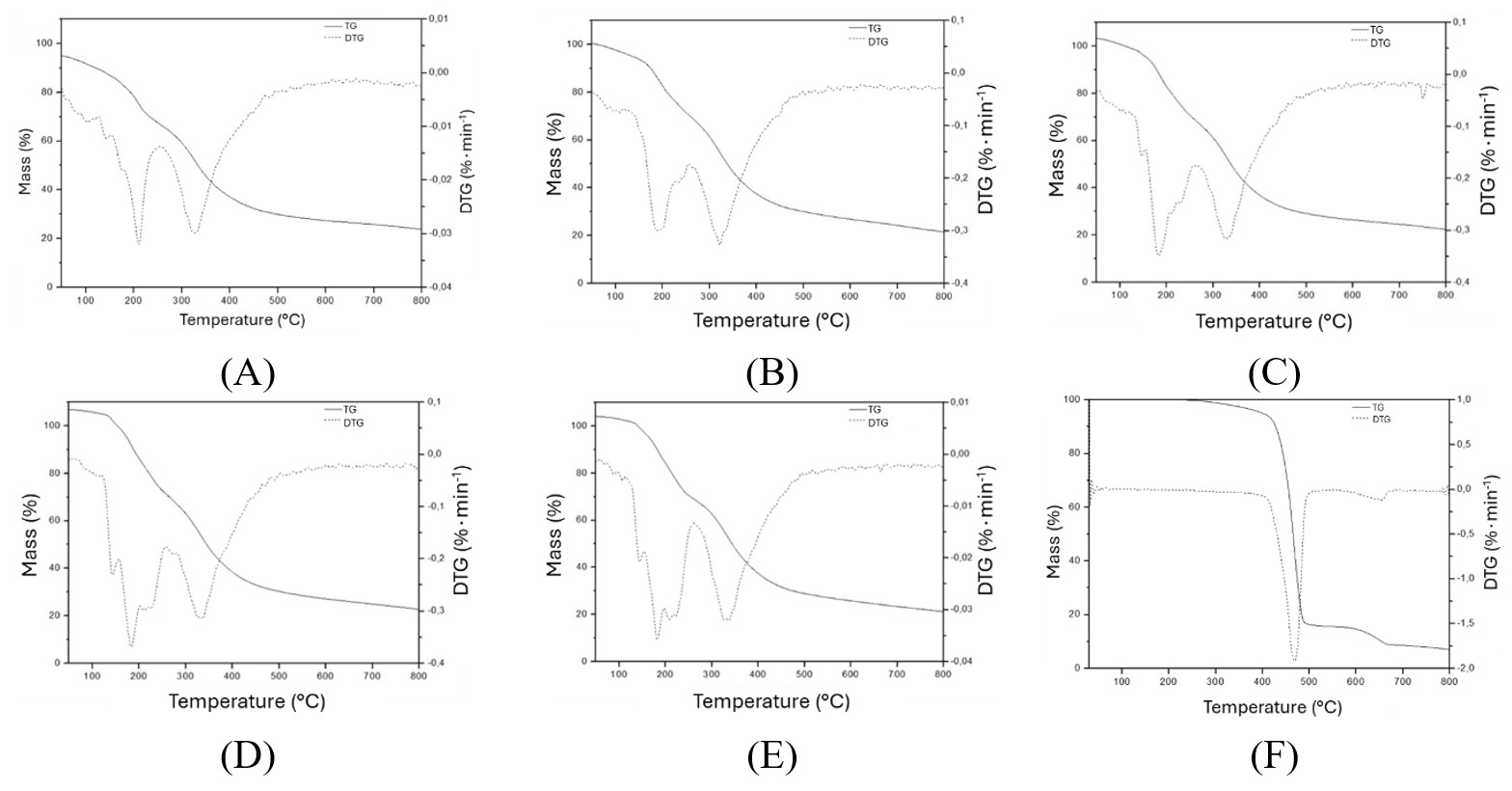
TGA and DTG curves of samples BR (A), AC10 (B), AC20 (C), AC30 (D), AC40 (E), and standard (F).
3.5 Thermogravimetric analysis
Based on the thermogravimetric data presented, it is possible to verify that all films produced with different concentrations of citric acid have similar behaviors, and the addition of the crosslinker influenced the decrease in Td and the increase in mass loss. The decline in thermal stability may be related to the reduction in the interaction between proteins caused by the addition of citric acid, which probably stabilizes the structure of the polymer network[4].
Three degradation stages can also be analyzed from the thermograms of the films produced from whey and gelatin, presented in Figure 5.
Presenting a mass reduction of around 15% for the BR, AC10, and AC20 films and around 40% for the AC30 and AC40 films, the first stage of degradation may be related to the loss of free water adsorbed on the films.
Depending on the sample, the second stage begins at 160 °C and ends at around 230 °C. Since the Td of glycerol is in tune with these temperatures, this decomposition stage may concern the glycerol incorporated into the polymer matrix[6]. The last stage starts from 250 °C until the end of the test (800 °C). It is mainly related to the degradation of whey and gelatin, resulting in the complete degradation of the organic part and the generation of waste composed of organic material[4]. According to Ramos et al.[14], the presence of a single initial decomposition temperature, Td, suggests the compatibility between the reagents selected for the composition of the films[13]. The percentage of residues of the films at 800 °C was between 20-25%.
In the literature, films produced based on whey and/or gelatin are also found, which present the same pattern of three stages of thermal decomposition and only one Td [4,14]. For example, Jesus obtained similar values for Td and slightly lower values for Tmax and mass loss[4]. Shi et al.[8] report a decrease in mass loss when comparing films produced based on thermoplastic starch plasticized only with glycerol and plasticized with glycerol and citric acid.
Figure 6F shows the thermogram for the synthetically produced standard sample, which presents a well-defined thermal event and a second event, which occurs more slowly. The first stage of degradation can also be related to the loss of water from the material and begins at around 250 °C and ends at around 500 °C. The second stage starts at around 575 °C and stabilizes at around 675 °C.
Comparing all the films analyzed, the standard is the film that presented greater thermal stability and mass loss. In contrast, the other films produced based on whey and gelatin with and without the addition of citric acid presented very similar behaviors.
3.6 Differential scanning calorimetry
The glass transition temperature (Tg) is important for checking the mobility of the chains. Polymers below their Tg exhibit rigid solid behavior and are often fragile. Those that are above Tg have a flexible amorphous structure.
The glass transition temperature values of the standard film samples and the films produced based on whey and gelatin with and without the addition of citric acid are presented in Table 4.
Glass transition temperatures of gelatin and whey-based films with increasing concentrations of citric acid as a cross-linking agent.
The glass transition temperature of the BR (control) sample is the highest among the films produced based on whey and gelatin. Even though there is a subtle difference, the behavior of the films reveals a decrease in Tg with the addition of citric acid.
Figure 6 shows the differential scanning calorimetry of films produced with whey and gelatin.
The DSC curves of the film samples demonstrate the compatibility of glycerol with whey and gelatin and the effectiveness of the plasticization process[4]. The incorporation of citric acid into the films produced caused a slight reduction in Tg, which remained between the Tg of whey powder and gelatin, indicating the formation of a miscible blend between the two biopolymers used in the film's production.
Shi reports that in films produced based on cornstarch, glycerol, and citric acid, Tg decreased as the citric acid content increased, having found temperatures below zero. Therefore, at room temperature, the films are flexible[8]. The decrease in the glass transition temperature may be related to the reduction in molar mass as citric acid is incorporated into the formulation.
In contrast, Dabove reported a glass transition temperature of around 80 °C for films produced with glycerol and citric acid, and the high Tg may be associated with the multifunctionality of the molecules of these additives, forming a rigid and voluminous three-dimensional network[25].
Figure 6F shows the DSC of the standard sample, revealing a glass transition temperature of around 23.27 °C, very close to the Tg of gelatin and slightly higher than that of whey powder and the films produced.
The thermograms presented also reveal that the films produced remained homogeneous during the heating and cooling cycles due to the absence of phase separation, i.e., melting and crystallization peaks in the temperature range tested.
4. Conclusions
Based on the experimental results obtained, it can be noted that a homogeneous blend was formed between whey and gelatin. The films produced with 10 wt.% and 20 wt.% citric acid relative to the amount of whey proved promising for potential use as packaging for feminine pads. The films with 30 wt.% and 40 wt.% crosslinker were discarded as options for the suggested application, mainly because they presented a high degree of solubility, which could cause problems in practical and/or commercial applications.
6. Acknowledgements
The authors would like to thank the National Council for Scientific and Technological Development (CNPq - Brazil) for the financial support as scholarships.
-
Data Availability:
Research data is available upon request from the corresponding author.
-
How to cite:
Antoniazzi, C., Duarte, J., Silvestre, W. P., & Baldasso, C. (2025). Crosslinking agent in the production of biodegradable whey-gelatin films. Polímeros: Ciência e Tecnologia, 35(3), e20250034. https://doi.org/10.1590/0104-1428.20250008
7. References
-
1 Borschiver, S., Almeida, L. F. M., & Roitman, T. (2008). Technological and market monitoring of biopolymers. Polímeros: Ciência e Tecnologia, 18(3), 256-261. http://doi.org/10.1590/S0104-14282008000300012
» http://doi.org/10.1590/S0104-14282008000300012 - 2 Paoli, M. A. (2008). Biodegradation of polymers: introduction: what is biodegradation? In J. C. Andrade (Ed.), Degradação e estabilização de polímeros (pp. 107-208). Campinas: Chemkeys.
-
3 Murari, C. S., Moraes, D. C., Bueno, G. F., & Del Bianchi, V. L. (2013). Evaluation of the reduction in pollution of dairy products from whey fermentation in ethanol by yeast Kluyveromyces marxianus 229. Revista do Instituto de Latícinios Cândido Tostes, 68(393), 42-50. http://doi.org/10.5935/2238-6416.20130034
» http://doi.org/10.5935/2238-6416.20130034 - 4 Jesus, G. L. (2020). Obtaining, characterizing and comparison of whey protein-based films (Doctoral thesis). Universidade Federal do Rio Grande do Sul, Porto Alegre.
- 5 Faria, E. F. (2004). Study of the environmental impact generated in water bodies by effluent from the dairy industry in Minas Gerais (Master’s dissertation). Universidade Federal de Minas Gerais, Belo Horizonte.
-
6 Sarbon, N. M., Badii, F., & Howell, N. K. (2015). The effect of chicken skin gelatin and whey protein interactions on rheological and thermal properties. Food Hydrocolloids, 45, 83-92. http://doi.org/10.1016/j.foodhyd.2014.10.008
» http://doi.org/10.1016/j.foodhyd.2014.10.008 - 7 Oliveira, M. J. A., Almeida, M., Amato, V. A., Parra, D. F., & Lugão, A. B. (2009). Membranas de hidrogéis de PVAL/PVP/ácido cítrico para liberação de droga. In Anais do 10º Congresso Brasileiro de Polímeros, Foz do Iguaçu, Brazil. São Carlos: ABPol.
-
8 Shi, R., Bi, J., Zhang, Z., Zhu, A., Chen, D., Zhou, X., Zhang, L., & Tian, W. (2008). The effect of citrus acid on the structural properties and cytotoxicity of the polyvinyl alcohol/starch films when molding at high temperature. Carbohydrate Polymers, 74(4), 763-770. http://doi.org/10.1016/j.carbpol.2008.04.045
» http://doi.org/10.1016/j.carbpol.2008.04.045 -
9 Jiang, Y., Li, Y., Chai, Z., & Leng, X. (2010). Study of the physical properties of whey protein isolate and gelatin composite films. Journal of Agricultural and Food Chemistry, 58(8), 5100-5108. http://doi.org/10.1021/jf9040904 PMid:20356044.
» http://doi.org/10.1021/jf9040904 -
10 Yang, J., Webb, A. R., & Ameer, G. A. (2004). Novel citric acid- based biodegradable elastomers for tissue engineering. Advanced Materials, 16(6), 511-516. http://doi.org/10.1002/adma.200306264
» http://doi.org/10.1002/adma.200306264 -
11 Kumar, A. A., Karthick, K., & Arumugam, K. P. (2011). Biodegradable Polymers and Its Applications. International Journal of Bioscience, Biochemistry, Bioinformatics, 1(3), 173-176. http://doi.org/10.7763/IJBBB.2011.V1.32
» http://doi.org/10.7763/IJBBB.2011.V1.32 -
12 Deng, L., Zhang, X., Li, Y., Que, F., Kang, X., Liu, Y., Feng, F., & Zhang, H. (2018). Characterization of gelatin/zein nanofibers by hybrid electrospinning. Food Hydrocolloids, 75, 72-80. http://doi.org/10.1016/j.foodhyd.2017.09.011
» http://doi.org/10.1016/j.foodhyd.2017.09.011 - 13 American Society for Testing and Materials – ASTM. (2018). ASTM D882-18: standard test method for tensile properties of thin plastic sheeting West Conshohocken: ASTM International.
-
14 Ramos, Ó. L., Reinas, I., Silva, S. I., Fernandes, J. C., Cerqueira, M. A., Pereira, R. N., Vicente, A. A., Poças, M. F., Pintado, M. E., & Malcata, F. X. (2013). Effect of whey protein purity and glycerol content upon physical properties of edible films manufactured therefrom. Food Hydrocolloids, 30(1), 110-122. http://doi.org/10.1016/j.foodhyd.2012.05.001
» http://doi.org/10.1016/j.foodhyd.2012.05.001 -
15 Kaewprachu, P., Osako, K., Benjakul, S., Tongdeesoontorn, W., & Rawdkuen, S. (2015). Biodegradable protein-based films and their properties: a comparative study. Packaging Technology & Science, 29(2), 77-90. http://doi.org/10.1002/pts.2183
» http://doi.org/10.1002/pts.2183 -
16 Kurek, M., Galus, S., & Debeaufort, F. (2014). Surface, mechanical and barrier properties of bio-based composite films based on chitosan and whey protein. Food Packaging and Shelf Life, 1(1), 56-67. http://doi.org/10.1016/j.fpsl.2014.01.001
» http://doi.org/10.1016/j.fpsl.2014.01.001 - 17 Lima, J. E. S. (2019). Determination of contact angle, surface tension and adhesion work of a urethane adhesive primer. Revista Caleidoscópio, 11, 1-6.
-
18 Flaker, C. H. C., Lourenço, R. V., Bittante, A. M. Q. B., & Sobral, P. J. A. (2015). Gelatin-based nanocomposite films: a study on montmorillonite dispersion methods and concentration. Journal of Food Engineering, 167, 65-70. http://doi.org/10.1016/j.jfoodeng.2014.11.009
» http://doi.org/10.1016/j.jfoodeng.2014.11.009 -
19 Wang, W., Li, C., Zhang, H., & Ni, Y. (2016). Using liquid smoke to improve mechanical and water resistance properties of gelatin films. Journal of Food Science, 81(5), E1151-E1157. http://doi.org/10.1111/1750-3841.13282 PMid:27061211.
» http://doi.org/10.1111/1750-3841.13282 -
20 Soazo, M., Rubiolo, A. C., & Verdini, R. A. (2011). Effect of drying temperature and beeswax content on physical properties of whey protein emulsion films. Food Hydrocolloids, 25(1), 1251-1255. http://doi.org/10.1016/j.foodhyd.2010.11.022
» http://doi.org/10.1016/j.foodhyd.2010.11.022 -
21 Guerrero, P., Stefani, P. M., Ruseckaite, R. A., & de la Caba, K. (2011). Functional properties of films based on soy protein isolate and gelatin processed by compression molding. Journal of Food Engineering, 105(1), 65-72. http://doi.org/10.1016/j.jfoodeng.2011.02.003
» http://doi.org/10.1016/j.jfoodeng.2011.02.003 -
22 Le Tien, C., Letendre, M., Ispas-Szabo, P., Mateescu, M. A., Delmas-Patterson, G., Yu, H.-L., & Lacroix, M. (2000). Development of biodegradable films from whey proteins by cross- linking and entrapment in cellulose. Journal of Agricultural and Food Chemistry, 48(11), 5566-5575. http://doi.org/10.1021/jf0002241 PMid:11087520.
» http://doi.org/10.1021/jf0002241 -
23 Oliveira, A. C. S., Ugucioni, J. C., Rocha, R. A., & Borges, S. V. (2018). Development of whey protein isolate/polyaniline smart packaging: morphological, structural, thermal, and electrical properties. Journal of Applied Polymer Science, 136(14), 47316. http://doi.org/10.1002/app.47316
» http://doi.org/10.1002/app.47316 -
24 Abedinia, A., Ariffin, F., Huda, N., & Mohammadi Nafchi, A. (2018). Preparation and characterization of a novel biocomposite based on duck feet gelatin as alternative to bovine gelatin. International Journal of Biological Macromolecules, 109, 855-862. http://doi.org/10.1016/j.ijbiomac.2017.11.051 PMid:29133087.
» http://doi.org/10.1016/j.ijbiomac.2017.11.051 - 25 Dabove, D. A. C. (2013). Development of gycerol-based polymers (Master’s dissertation). Universidade Federal de São Carlos, São Carlos.
Edited by
-
Editor-in-Chief:
Sebastião V. Canevarolo
Research data is available upon request from the corresponding author.