 Teaching ergonomics in undergraduate production engineering programs in Brazil: a study on course content and structure
Abstract
Paper aims This study aims to propose minimum ergonomics course content based on the current situation in top-tier production engineering programs in Brazil.
Originality This is a groundbreaking study that brings together two fields of production engineering: engineering education and ergonomics. The findings contribute to the theoretical foundation of ergonomics by demonstrating a standard for the characteristics of teaching plans.
Research method A methodological procedure composed of five steps was developed: defining the research problem, identifying universities, investigating the ergonomics course, analyzing data, and proposing a teaching plan. An investigation in online databases of undergraduate production engineering programs aimed to identify course content, teaching strategies, and professors’ qualifications.
Main findings This study evaluated 88 courses, and the results showed a trend of programs with only one course with 60 class hours, focusing on general definitions, physical ergonomics, and Ergonomic Work Analysis. Ergonomics courses mainly use traditional teaching approaches, and professors have diverse educational backgrounds, but most have some production engineering in their curriculum.
Implications for theory and practice This study provides two standardized plans for teaching ergonomics, as well as an updated overview of how the course is currently taught in production engineering programs.
Keywords:
Ergonomics; Production engineering; Teaching strategies; Program content; Professors’ qualification
1. Introduction
The organization of undergraduate engineering programs is a complex task. Including essential content for future professionals within a short period requires specific knowledge and must comply with standards and regulations set by higher authorities (Meixell et al., 2015). Engineering programs demand this complex organization due to the intrinsic introductory knowledge courses of the exact sciences and their specific emphases.
Among the challenges of organizing different engineering curricula, production engineering requires the development of aspects related to productivity, cost reduction, components of production systems, and human aspects related to work (Sturm et al., 2015). Among these necessary aspects, ergonomics is essential in this curriculum, but it is complex due to differences from other areas (Naeini & Mossaddad, 2013). This demand is explained by its concept, which studies the adaptation of work to the worker to increase productivity and psychophysiological well-being (International Ergonomics Association, 2021).
The complexity of distributing content for teaching ergonomics is mainly due to its multidisciplinary nature (Caple, 2008; Zhang et al., 2023). Ergonomics is a science that encompasses different concepts related to work, worker health, and the design of products and systems suitable for the worker (Thatcher et al., 2017). Thus, due to the excessive content to be covered there are difficulties in developing education plans that address the main ergonomics topics. Another factor contributing to the difficulty of organizing the ergonomics course is the little attention given to human factors at work. The programs focus on increasing productivity and reducing costs but invariably forget to invest in the worker as a source of improvements in the company (Alves et al., 2019).
Despite these difficulties, ergonomics courses are necessary for the current training of an engineer in the job market. This need is explained by the importance of humanizing engineering professionals (Andrade et al., 2010), but also that this professional understands their contribution and responsibility to society (Brasil, 2019) and the reduction of alarming data on work accidents and illnesses (Benjaoran & Bhokha, 2010).
It is essential, therefore, to understand the main characteristics of a course, such as ergonomics, which due to its multidisciplinary nature, could be better structured. The Brazilian Association of Production Engineering presents the main areas of the course and their primary knowledge (Associação Brasileira de Engenharia de Produção, 2023). However, it does not suggest a curriculum or the expectations of companies for professionals. Furthermore, to structure a course in this area, its current context is necessary, both in the literature (Arezes & Swuste, 2013) and in practice of work situations and with the competencies of an ergonomist (Read et al., 2022).
Given the above, the objective of this study was to propose minimum ergonomics content based on the current situation of courses in top-tier production engineering programs in Brazil. Additionally, we analyzed the teaching strategies and the professors' qualifications. These points guide the main research question: Considering the multidisciplinary nature of ergonomics, what are the main characteristics of a standard ergonomics teaching plan in production engineering programs in Brazil?
2. Theoretical background
2.1. The multidisciplinary nature of ergonomics in production engineering
Ergonomics has evolved as a scientific field focused on optimizing human–system interactions to improve well-being and performance (Richardson & Thatcher, 2023; International Ergonomics Association, 2021). Its multidisciplinary scope enables applications in physiotherapy, psychology, design, and architecture (Gielo-Perczak et al., 2012). In production engineering, the focus is on analyzing work in production systems across physical, cognitive, and organizational dimensions (Dul et al., 2012; Kadir et al., 2019).
An essential concern in physical ergonomics is the reduction of so-called Work-Related Musculoskeletal Disorders (WMSDs), a source of temporary and permanent absences for different workers (Colim et al., 2021). According to the evaluation of work based on concepts of biomechanics, physiology, and anthropometry, physical ergonomics applies various methods to assess the workers' force exertion, as well as the postures the conditions of the working space and tool conditions, and the repetitiveness of movements (Garneau & Parkinson, 2016).
With the development of technology and its use in work situations, cognitive ergonomics began to gain space through studies evaluating workers' decision-making (Cardoso & Gontijo, 2012). These studies focus on information processing, mental workload, and disorders arising from excesses used in carrying out activities (Bridger & Brasher, 2011; Young et al., 2015). In addition to focusing on the worker, different problems can arise from irregularities in the macro ergonomic system due to its complexity in organizing work (Branco et al., 2021). Organizational ergonomics optimizes socio-technical systems based on their structure, procedures and rules (Rocha & Baú, 2023). Its application brings a mutual benefit: by reducing the risk of occupational diseases, it provides a favorable environment for working (Soares & Soares, 2020).
The methodology widely used in teaching ergonomics in Production Engineering is Ergonomic Work Analysis (EWA), mainly in case studies of different work segments (Custódio et al., 2012; Losekan et al., 2019). Having the main objective of investigating discrepancies between actual work and prescribed work, EWA investigates how the worker performs his activities based on the requested standard (Pizo & Menegon, 2010).
From EWA's perspective, the environment can also bring a series of complications related to its characteristics, contributing to discomfort and reduced worker productivity. Research on lighting, noise, vibration, and temperature indicates that workers can develop a series of disorders when these environmental factors are inadequate to the necessary control limits (Merbah et al., 2020; Broday et al., 2017).
Other insights are also essential and taught in more minor aspects of production engineering. For example, product ergonomics and its relationship with the Product Development Process (PDP) is applied across courses, highlighting its bias towards the design area (Luque et al., 2022). Occupational safety, from its accident prevention and investigation aspects and its relation to ergonomics, demonstrates how adapting working conditions to the characteristics of the worker (Lallemand, 2012). Finally, accessibility shows in the ergonomics of the built environment by eliminating different types of barriers and adapting them to environments for all individuals (Acioly et al., 2012).
2.2. Essential points in the design of a course
A series of factors must be investigated for the design of a course, bringing complexity to organizing them. When designing a course in an undergraduate program, it is necessary to evaluate different issues related to the organization of the curriculum and workload (Garcia & Bizzo, 2013) to obtain better acceptance between professors and students (Andrade et al., 2012). The organization of courses demonstrates how and at what moment students complete the whole program and obtain the necessary knowledge (Digiampietri et al., 2016).
As for the program content, one must think about the technical and transversal competencies that the course in focus can provide. Competencies are attitudes, expected to develop in students throughout the course (Passow, 2012). The techniques are related to the theoretical content of a given area, while the transversal ones are how professional and social students behave (Cordeiro et al., 2020). Planning them in the project is necessary, especially for what the market expects from the professional (Borchardt et al., 2009), as these skills result from the teaching process. Additionally, it is essential that professors have academic and professional experience in the course area, as a lack of experience may negatively affect student performance and retention (Costa et al., 2020).
Finally, the professor must reflect on learning strategies to develop students' competencies. Active learning strategies, for example, must be student-centered, where real work problems and situations are brought to the classroom to discuss knowledge (Din & Gibson Junior, 2019). The insertion of these seeks to reduce the application of traditional strategies (Freeman et al., 2014; Colim et al., 2022), in which the focus and holder of knowledge is the professor who, through speech and explanation, achieves few student skills due to being more passive through speaking and listening on the part of the student (Daouk et al., 2016).
Thus, active learning strategies have been increasingly used in engineering as they seek to ensure greater student engagement (Grohs et al., 2018; Dunai et al., 2023), for lasting and more complete knowledge (Qian et al., 2023), as well as the development of essential skills (Freeman et al., 2014; Colim et al., 2022). Despite its advantages, its application still needs to be improved, mainly due to professors' lack of qualifications and training and possible student resistance (Belwal et al., 2020). Table 1 highlights examples of active learning strategies applied in Occupational Health and Safety (Rodeghiero Neto & Amaral, 2024).
In addition to the aspects mentioned above, it is essential to define assessment methods with the knowledge addressed in the course (Biggs & Tang, 2011). The Backward Design approach, for example, proposes an instructional planning model that aligns the intended learning outcomes with the course objectives (Wiggins & McTighe, 2005). When designing a course structure, it is crucial to consider several interrelated elements: the theoretical content to be covered, the specific characteristics of the course, the professor’s academic background, the selected teaching methodology, and the expected learning outcomes.
2.3. Teaching ergonomics in an international context
Teaching ergonomics in production engineering programs shows significant variability worldwide, mainly due to differences in curricular approaches. Dul et al. (2012) report that ergonomics education can adopt distinct perspectives, ranging from technical approaches to sociotechnical and participatory ones. Complementarily, Kadir et al. (2019) proposed a classification of ergonomics that is also used in education to address general aspects of the field.
Not all universities include these approaches. To support the theoretical discussion in this article, the authors conducted an exploratory analysis of ergonomics education in production engineering programs across different countries. Based on a list of active researchers in ergonomics and human factors obtained from the Scopus database, twelve professors were selected from Higher Education Institutions (HEI) in the United States, Portugal, Peru, Mexico, China, Indonesia, Canada, the Netherlands, and Italy. Ergonomics courses from these universities were analyzed due to their influential researchers.
All the HEIs analyzed offered at least one course dedicated to ergonomics, with an average workload of four credits, corresponding to approximately 60 contact hours. The course titles reflected a diversity of approaches, including topics such as work analysis, workstation design, occupational safety, and biomechanics.
Although general ergonomics concepts, such as history and classifications, were included in all programs, the most prominent content was focused on work analysis and its physiological aspects. Topics such as anthropometry, biomechanics, and work physiology were widely covered, along with ergonomic tools applied in design projects. In contrast, organizational and environmental ergonomics topics were found in only half of the courses analyzed, while cognitive ergonomics appeared sporadically. Accessibility and product ergonomics were not found in the reviewed syllabi.
Moraes & Bitencourt (2021) also pointed out this issue in their study, reporting the predominance of physical ergonomics in course content. Young et al. (2015) emphasized the need to incorporate cognitive ergonomics, and the importance of organizational ergonomics. Nonetheless, a clear gap remains regarding essential and comprehensive content for ergonomics education in production engineering.
3. Methodology
This study is a qualitative and descriptive research. The qualitative approach focuses on explaining concepts and delving into essential topics for understanding the problem and the reason for such a phenomenon (Johnston & Dowling, 2023). It can also be descriptive, as it seeks to describe a population according to its characteristics and relationships (Sandelowski, 2009). Similar studies, such as those by Boaventura et al. (2018), Fonseca et al. (2020), and Paravizo et al. (2021), showed significant results for curricular analysis and changes using similar methodological procedures. The data collection and analysis structures from these studies were adapted for this research, which employed its own methodological procedure for the design of the proposed curricula.
The first stage investigated the absence of a minimum curriculum for ergonomics courses in production engineering courses and their main characteristics. The investigation, therefore, was limited to active courses in production engineering in a face-to-face system in public and private non-profit Higher Education Institutions (HEI). We also sought courses in excellence according to the classification of the National Student Performance Exam (ENADE), which is a scale developed by the Ministry of Education (MEC) of Brazil to evaluate undergraduate programs, those with concepts five and four (highest notes on the scale).
The second stage used the National Register of Higher Education Courses and Institutions – e-MEC Register, to search the HEI. After inserting the characteristics of production engineering programs, the platform returned 29 HEIs with grade five and another 59 with grade four in ENADE, totaling 88 HEIs.
The third stage consisted of searching for data in production engineering courses, electronic addresses, and digital platforms of the HEIs. The programmatic content, responsible professor, and teaching strategies were the data sought and collected in the course's teaching plans and proposals. After identifying the name of the professor responsible for the course, we investigated his academic background on the Lattes Platform, a virtual CV system created by the National Council for Scientific and Technological Development (CNPq) in Brazil.
The researchers made telephone calls and emailed production engineering committees and their coordinators for data not found on the platforms. By the end of this stage, they had identified 32 ergonomics courses in HEIs with an ENADE 5 rating and 65 ergonomics courses for HEIs with ENADE 4. Table 2 shows the main findings for the HEIs and courses.
In the fourth stage, after registering and categorizing all the characteristics found, NVivo software version 15 was used to conduct a content analysis (Bardin, 2015) through an inductive approach. This method allowed the identification of the most significant themes within the raw data collected (Thomas, 2006). Initially, an open coding process was employed to identify meaningful units directly from the curricula. These initial codes were then grouped interactively based on thematic similarities.
After the initial inductive coding process, the preliminary codes were reviewed and grouped. Subsequently, well-established ergonomics classification frameworks (Dul et al., 2012; Salvendy & Karwowski, 2021) were employed as theoretical references to refine, validate, and consolidate these codes, resulting in nine final categories that represent essential content areas for ergonomics instruction. These categories were general definition, physical ergonomics, cognitive ergonomics, organizational ergonomics, Ergonomic Work Analysis (EWA), environmental factors, product ergonomics, work safety, and accessibility. The learning strategies used to teach ergonomics were further analyzed using descriptive statistics, allowing the quantification and grouping of similar instructional practices.
For professor qualification, the analysis was carried out according to their academic professional trajectory, emphasizing the main stages: graduation, specialization, masters, and doctorate, as well as a discussion on the themes of academic research. We use the ERG BR 1003 Standard, which categorizes the evaluation of the teaching staff of courses based on their most important academic work: work in ergonomics, work in related areas, and work in other areas (Associação Brasileira de Ergonomia, 2006).
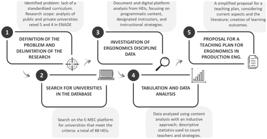
The fifth stage focused on developing two teaching plans based on the preceding analyses. These plans took into consideration the average class time dedicated to ergonomics in production engineering programs, aiming to suggest a realistic and applicable curriculum. Each area of ergonomics, as previously classified, was allocated a specific number of classes, along with recommended teaching methodologies. This represents the study's main contribution. The plans were structured using the Backward Design approach (Wiggins & McTighe, 2005), which defined expected learning outcomes and how they would be assessed. Figure 1 summarizes the procedures of this study, developed based on the adaptation of the research.
4. Results
The results are organized into five subsections (4.1 to 4.4), each corresponding to a key theme identified during data analysis. These categories were primarily derived through an inductive coding process, in which patterns and recurring topics were identified across institutional documents and teaching plans. Each subsection focuses on a specific dimension: (1) initial course characteristics, (2) curricular content, (3) faculty qualifications, and (4) pedagogical approaches.
4.1. Initial characteristics
After collecting the data described in the methodology, Table 3 presents the initial results of the characteristics of the ergonomics courses. The data show similarities between the ENADE 5 and 4 HEIs, where most of these (67) present an ergonomics course in the curriculum.
Most (61) of these courses have sixty hours or four credits, which is HEIs with ENADE 5 (81%) than in ENADE 4 (54%). Their location is diverse, but those between the fifth and sixth semesters (40%) stand out. Most do not have physical laboratories and ergonomics research (80%), making it challenging to develop academic projects. The results found other distinct characteristics: three distance learning courses (EAD), an IES that presents four ergonomics courses, an ergonomics course in the first semester, and only four undergraduate courses linked to postgraduate programs.
Table 3 also shows a classification of the courses based on the names presented in the pedagogical projects of the courses. It is possible to highlight the focus that the courses already direct their concepts and interrelate them with ergonomics. Approximately 50% of the HEI present the course's name as 'Ergonomics.' However, 17 courses presented the name in conjunction with occupational safety, and another seven are related to occupational engineering. Finally, some nomenclatures to call ergonomics were found, such as man-machine adequacy and occupational biomechanics.
4.2. Program content of the courses
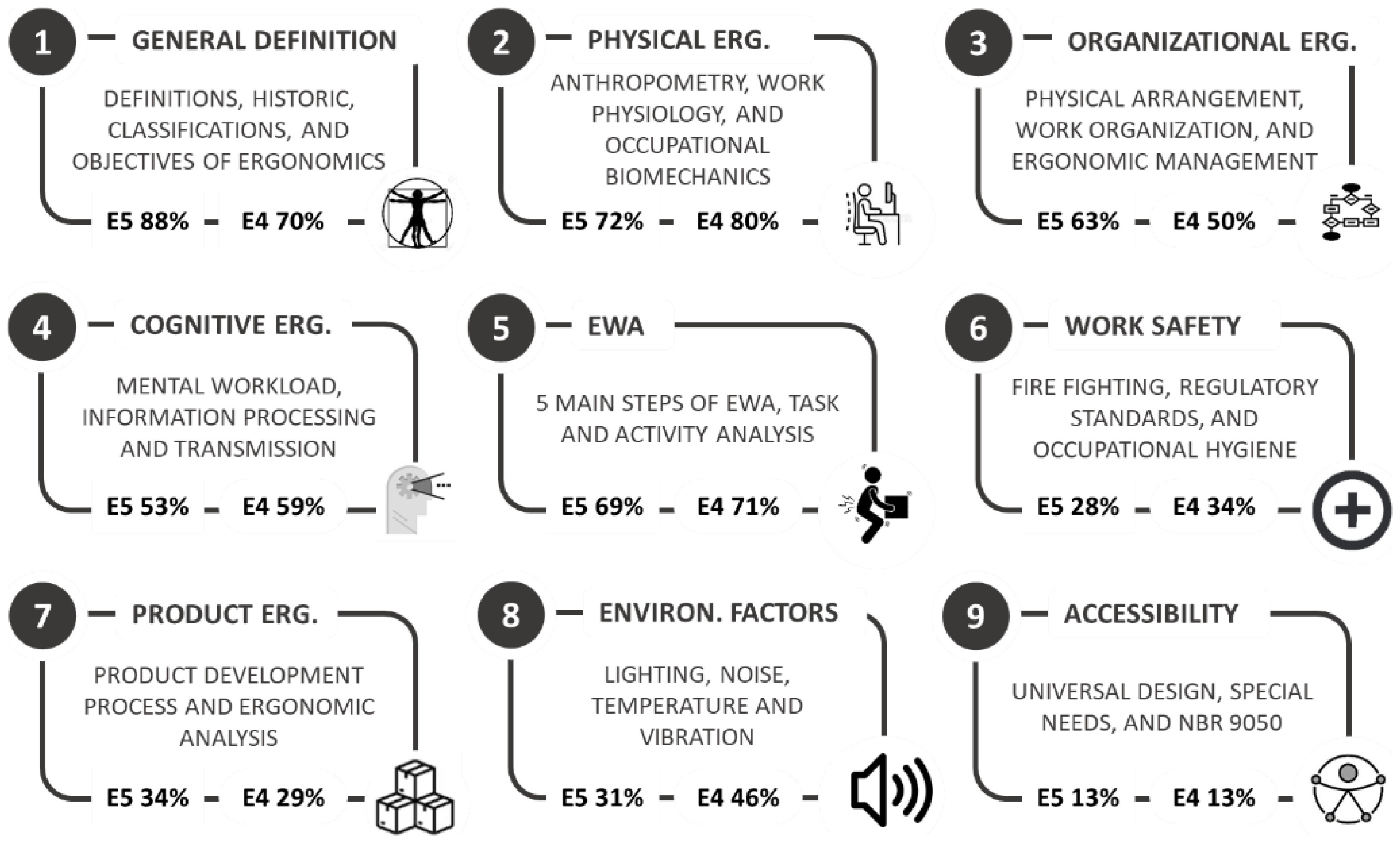
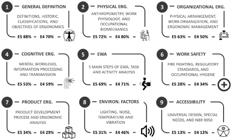
According to the methodology, the program contents in the teaching plans were divided into nine main categories. In ENADE 5 courses, the topics that stood out most were the general concept of ergonomics (88%) and physical ergonomics (72%); and, for ENADE 4, the highlights were in the topics of physical ergonomics (80%) and EWA (71%). Figure 2 shows the percentage of courses that cover the main categories adopted by the study and the main topics found.
The general definition category showed the introductory concepts and definitions of ergonomics, their history, and their field of application. It also mentioned the objective of ergonomics, Brazilian Regulatory Standard 17 (NR17), and the panorama of ergonomics in Brazil. Finally, teaching plans presented the general classifications of ergonomics dimensions, the types of ergonomics, and the concepts of workload.
The teaching plans for the Physical Ergonomics category covered main topics in physiology, biomechanics, and anthropometry. Regarding the physiology of work, the teaching plans include concepts of energetic aspects of the human organism, as well as static and dynamic work with efforts and pauses. For occupational biomechanics, the topics covered the concepts of postures, heavy work, manual lifting and transport of loads, repetitive movements, and postural analysis tools. Finally, for anthropometry, the concepts found were static and dynamic measurements, range zones, biotypes, and job-sizing applications.
In the cognitive ergonomics category, the teaching plans include concepts of transmitting and processing information, sensations, perceptions, and human memory. Concepts related to analyzing mental workload and the consequences were reported, such as work stress, monotony, fatigue, and motivation. Organizational Ergonomics presented definitions through work organization and studies of physical arrangement, selection, training, and flexible work, shifts, and night shifts. Issues linked to ergonomic management, job rotation, and working hours studies showed the organizational bias of ergonomics.
The Ergonomic Work Analysis category presented shows its five main stages and the specific analysis of the task and activity. Furthermore, the consequences of carrying out EWA stand out, such as ergonomic demands and instructions, ergonomic reports, use of Software, and Preliminary Ergonomic Analysis (PEA). Environmental factors presented definitions such as lighting, temperature, noise, vibration, chemical agents, and humidity, with their concepts, measurement scales, and impacts on worker health.
The Product Ergonomics category covered the concepts of adaptation and ergonomic analysis of products, product development process, user-centered design, and survey. The highlighted topics for the occupational safety category are fire prevention and fighting measures, first aid, Brazilian Regulatory Standards (NR), and occupational hygiene. The Accessibility category brought concepts of universal design, special needs, and NBR 9050 (Accessibility to buildings, furniture, spaces, and urban equipment).
4.3. Qualification of ergonomics professors
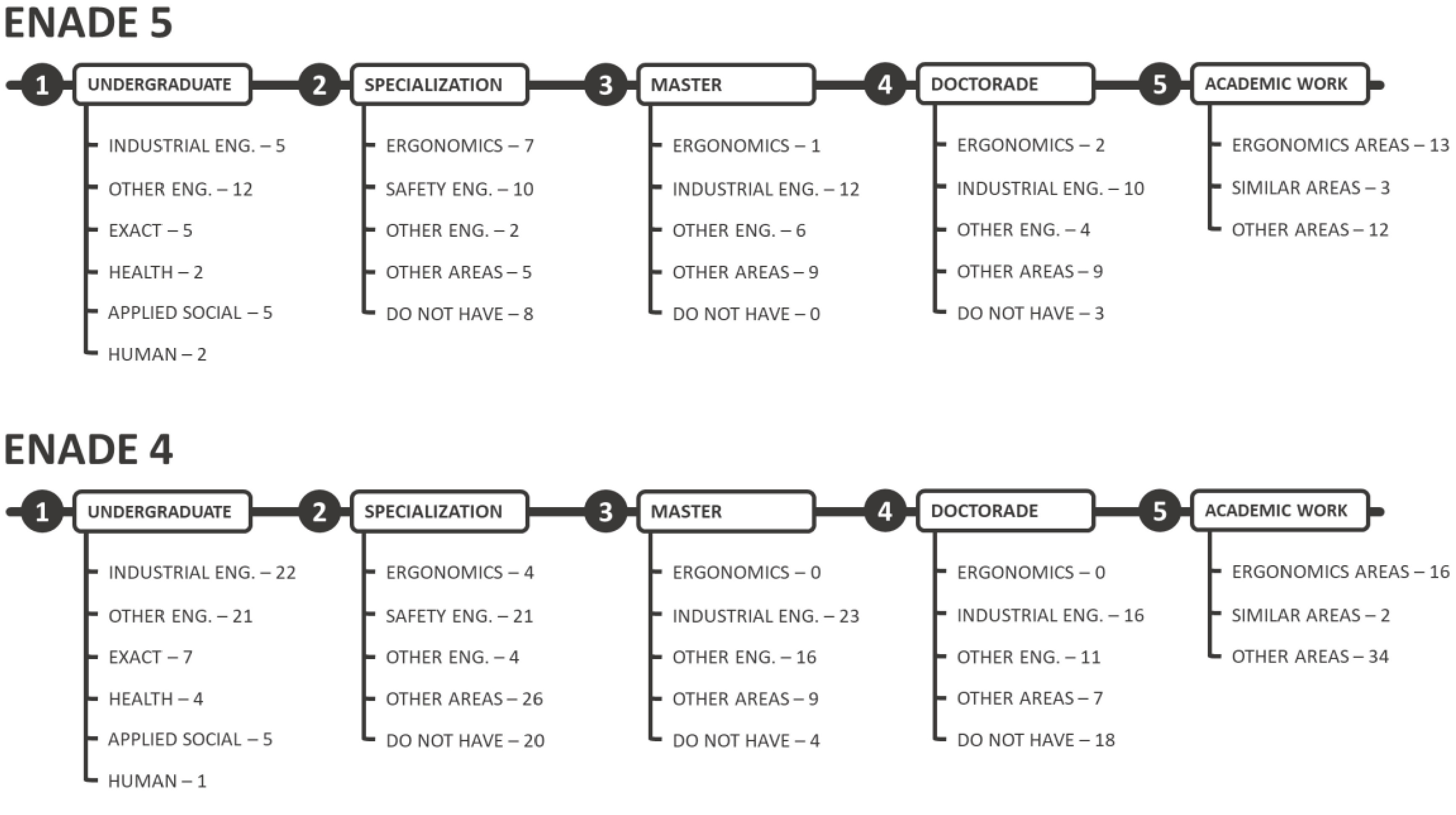
Figure 3 shows the academic qualifications of professors in ergonomics. It is worth mentioning that there is no undergraduate or doctoral degree in ergonomics in Brazil, only master's degrees in ergonomics (Professional Master's Degree in Ergonomics – Federal University of Pernambuco) with a focus on design.
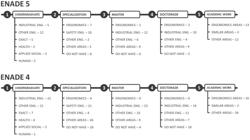
Few professors graduated in production engineering, but many undergraduates in other engineering areas, such as Civil, Mechanical, and Forestry Engineering. Work safety concepts are seen in these, but reduced and focused on their respective areas. Architecture, Physiotherapy, and Design courses address ergonomics topics related to their areas, such as worker rehabilitation and the development of comfortable products, space, and furniture. Finally, undergraduates without ergonomics courses in the curriculum appeared in professor qualifications, such as Pedagogy, Tourism, and Administration.
Eleven professors specialized in ergonomics at the lato senso specialization level at HEIs. Another 31 professors completed a specialization in occupational safety engineering. Finally, 28 of the professors analyzed do not have a specialization. Only nine professors have a specialization in higher education teaching. Other specializations, such as Neuropsychology, and Data Science, also appeared.
Only one professor held a master's degree in ergonomics in another country. Most professors have a master's degree in production engineering (35). Other master's degrees in engineering, such as mechanical, civil, environmental, and agricultural, appeared for 22 professors. Other master's courses, such as Design, Forestry Sciences, Architecture, and Technology, were also found.
Two professors have a doctorate in ergonomics and, analogously to the master's degree, the doctoral course most found among these professors was Production Engineering (26). Another fact that stood out was the number of professors pursuing a doctorate in different areas, such as Design, Health Sciences, Geography, and Memory and Conservation (16). Other Engineering areas also identified were Mechanical, Civil Construction, Electrical, and Agricultural (15). Four professors completed doctorates in other countries, such as France, Belgium, Canada, and Portugal. Notably, 21 professors did not have a doctorate at the time of collection, with 10 of them in this training process.
Regarding academic work, 26 professors have a dissertation or thesis in ergonomics. Five professors conducted their academic work in similar areas, such as occupational safety. Finally, 46 professors did their academic work in other areas unrelated to ergonomics.
4.4. Teaching strategies in ergonomics course
The teaching plans that address learning strategies in ergonomics courses show that the most used forms are traditional (lectures, video presentations, article readings, oral demonstration of content, and use of slide shows). In these teaching plans, it is possible to observe that the primary assessment is conducted through exams and tests, investigating whether the student is able to describe, in written form, the theoretical contents presented in class.
However, other activities demonstrate the professors' intention to make the class more dynamic. Regarding student teamwork, teaching plans present some strategies used to complement the teaching of theories, such as group discussions, online forums, collaborative activities, dialogue classes, and seminars. To conduct theoretical content, professors carry out exercises and guided studies, incorporate software and experimental practices, and read and analyze scientific articles.
In some teaching plans, it is possible to observe the attempt to integrate the job market and ergonomics content. To this end, professors assign group work in different companies to investigate issues related to workers and to understand organizational structures, aiming to propose relevant improvements to the context of the company visited. These activities allow students to develop competencies distant beyond the content, such as team management, communication, and problem-solving.
In ENADE 5 courses, only one curriculum mentions the possibility of using active learning strategies in ergonomics classes, even though it does not present how to implement them throughout the semester. It is also possible to observe that only one teaching plan presents the need to develop competencies related to production engineering. In ENADE 4 courses, a curriculum presents active learning strategies described and explained throughout the semester: Project-based Learning and Gamification for teaching ergonomics. Finally, three courses describe the competencies expected for each student to develop.
5. Discussion
The research found 88 undergraduate courses in production engineering on the MEC platform, meeting the research delimitations. The first challenge was finding data for this research from the information collected. It was very difficult to locate the data that must be published and public knowledge. Many do not explain these essential items in a way that makes them easier to find, requiring intense and careful investigation.
Another concerning aspect stands out in this line: Eight HEIs do not have specific ergonomics courses. In a science where the focus is to increase productivity and reduce costs, production engineering must include concepts that promote concern for the workers’ psychophysiological well-being, as these are the ones responsible for guaranteeing the production and assets of companies (Neumann & Dul, 2010). Engineers are responsible for making the work environment productive and adapted to the worker, highlighting the importance of ergonomics (Dul et al., 2012).
From the results, it is possible to analyze the most addressed content in ergonomics courses: EWA, general definitions, and physical ergonomics. These contents are essential for understanding ergonomics focused on production engineering, relating physical efforts and work activities (Dul et al., 2012; Bures, 2015). However, these three topics represent some of the realities faced by a production engineer. The trends in the job market are focused on office activities and using the computer in sitting positions. These environments should be improved due to the high risk of developing WMSDs (Bao & Lin, 2018) so that future professionals can understand the role of ergonomics in these contexts.
Given these market changes, it is worth highlighting that occupational illnesses are also changing (Ramos et al., 2022; Zorzenon et al., 2022). In the past, more diseases were associated with excessive manual activities involving workers' exertion and repetitive tasks. However, there is a more significant concern with cognitive activities and mental work (Young et al., 2015). Therefore, it is necessary to know how to adapt work according to cognitive characteristics, using ergonomics to avoid problems such as depression, anxiety, and burnout (Bridger & Brasher, 2011). It is essential to understand that the ergonomics concepts taught must meet the contexts of each country and the entire complex work situation.
The three dimensions (physical, cognitive, and organizational) must be worked on in the classroom with practical examples and activities. Nevertheless, more than 40% of the courses analyzed do not adress on concepts of cognitive and organizational ergonomics, resulting in a limited view of ergonomics to aspects of load handling and postures. Furthermore, different curricula link occupational safety to ergonomics. While occupational safety teaches worker protection and accident analysis concepts, ergonomics focuses on the same factors but aims at worker comfort (Hernández et al., 2018). However, these areas can provide different knowledge in certain situations, such as comfort and safety reference limits.
In addition to the program content studied, it is essential to analyze the academic trajectory that ergonomics professors follow during their qualification and the development of the technical competencies necessary for teaching (Barbosa & Pinheiro, 2012). The most important fact in this case is that these professors’ qualifications do not follow a standard. Most of these professors have specializations in ergonomics or occupational safety engineering and undergraduate degrees in production engineering.
Fifty professors had academic experience in the production engineering program during their academic training, at the undergraduate, master's, or doctoral level. The remaining 31 professors lacked academic experience with the area, and currently teach ergonomics courses to production engineering undergraduate students. Contact with ergonomics may occur at different stages, either in courses explicitly named “Ergonomics” or through implicit exposure: production engineering undergraduate courses, specialization in occupational safety engineering, or academic work. In this sense, eight professors had no contact with ergonomics at any of these stages.
It is necessary to investigate whether this contact with production engineering or the specialization of occupational safety engineering is enough to be able to teach ergonomics to other students. Even so, 12 professors only had academic experience through their specialization in occupational safety engineering, and 24 only had experience through production engineering undergraduate. In these places, ergonomics is presented in just one course (on average, around 2% of the workload of an undergraduate, as indicated in the initial results section of this research).
An important aspect worth emphasizing is the pedagogical training of higher education faculty — that is, how they acquire the necessary skills to teach (Seno & Belhot, 2009). Only eight professors have specialized qualifications or education for teaching in higher education. It is essential to highlight knowledge to teach other students in engineering, as it is not a course that develops teaching skills in its professionals (Barbosa & Moura, 2014; Chamlian, 2003).
This study demonstrates the diversity of qualifications among ergonomics professors in Brazil, following studies on the diversity of teacher training in engineering undergraduate programs (Wankat, 1999; Matos et al., 2014). None of these professionals have the same qualifications, with the same undergraduate, specialization, master's, and doctoral programs. This finding proves the difficulty of creating a standard for ergonomic professor qualification as different areas contemplate it and develop different essential content for the academic profession. In addition, it is impossible to observe academic works in the literature presenting the complexity of ergonomic professor qualifications.
Regarding the teaching strategies used in ergonomics, it is evident that the predominant approach used by professors is traditional. Studies indicate that this teaching approach is not the most effective, as it does not lead the student to put into practice what has been learned, in addition to not develop different skills required in the professional environment (Colim et al., 2022; Johnson & Ulseth, 2014; Nikolic et al., 2021). The strategies used in the analyzed teaching plans include videos, projectors, and whiteboards.
It is also possible to observe that regardless of the number of approaches and practices in the classroom, there are no references to active learning strategies in the teaching plans. The application of guided studies, visits to company visits, and resolutions of literature theoretical issues contribute to a dynamic approach to classes. However, these approaches do not assure the same performance that active learning strategies do, such as the ones found in other researches, the use of Problem-based Learning, Gamification, and Project-based Learning (Moody, 2011; Lima et al., 2017; Colim et al., 2022). For this to occur, the recently proposed strategies and others already studied in the literature must be incorporated into the courses.
However, integrating the perspectives of companies and universities may be positive. This approach is essential for the professionals’ development, leading them to understand the theory presented in the classroom and implement in their practice and everyday market life (Freeman et al., 2014). Furthermore, explanations of other strategies to promote this process such as the systematic ones to assure the resolution of problems that may arise are incipient.
The development of professional competencies in teaching plans still needs to be discussed. A suitable professional must develop essential competencies throughout their learning, including teamwork, ethics, social responsibility, problem-solving, and communication (Belwal et al., 2020; Kunrath et al., 2020). The teaching plans do not show concern for these topics due to the sole use of traditional strategies and the lack of mention of skills for passing the courses and assessing them (Rodeghiero Neto et al., 2025).
6. General contributions and conclusion
The contribution of this study provides teaching plans for ergonomics courses, prepared with essential topics seen in the literature and in ergonomics courses at an international level, in addition to being plausible to be applied in Brazilian HEIs, as highlighted in the justification of the study (Figure 4). These plans cover essential points highlighted in this research.

This study emphasizes the need for at least one mandatory 60-hour ergonomics course. While prerequisites for Ergonomics 1 are unnecessary, a dedicated physical space is recommended to support active learning and practical activities. The ideal placement is in the sixth semester, after completion of core engineering courses. The responsible professor should hold a degree in Production Engineering, with additional training in Occupational Safety or Ergonomics.
The syllabus should include the four main ergonomics classifications, beginning with conceptual foundations and EWA. Physical and organizational ergonomics should compose the core, emphasizing the workers’ well-being and ergonomics management in production systems. As expected learning outcomes, students should be able to evaluate working conditions across different occupational contexts, considering both physical and organizational ergonomics, and apply an ergonomic work analysis in real situations.
Active learning strategies are recommended, such as problem-based learning, gamification, and flipped classrooms. Techniques like Think-Pair-Share can promote discussion and knowledge exchange. Traditional methods should be used less frequently than in current practice. The products resulting from these strategies can be used as means of assessing the knowledge acquired, as well as tests conducted throughout the semester.
Considering the breadth of content, we strongly recommend a second ergonomics course for Production Engineering students. With a reduced workload (30h), its structure and professor qualifications should align with Ergonomics 1. As this course addresses various applied topics, it is suggested as a prerequisite for the Final Undergraduate Project. The syllabus should begin with a brief review of general concepts, followed by modules on cognitive ergonomics, environmental work factors, and the relationship between ergonomics and occupational safety—covered over three sessions combining theory and practice. The course concludes with product ergonomics and accessibility.
Active learning strategies are emphasized, with Project-Based Learning as the core method, allowing students to address real-world problems identified in companies. Supporting strategies include Team-Based Learning, Problem-Based Learning, Flipped Classroom, Jury Dynamics, and selective use of traditional methods for theoretical and debate-oriented sessions. As a learning outcome, students are expected to develop a work analysis based on current problems and ergonomic solutions, applying topics such as cognitive ergonomics, accessibility, occupational safety, and product ergonomics.
The current situation of ergonomics courses seen in production engineering undergraduates, previously unknown and without a standard, was analyzed based on the professor's training, the content taught, and the strategy used for teaching. As limitations of this study, the main one is the use of data available on the internet. Thus, the analysis was based on published information, without confirming of whether the data are, in fact, up to date.
For future work, we suggest extrapolating the data, researching other Brazilian and international HEIs, and allowing other to consider the issues collected. As a complement to the teaching plans developed, we suggest research highlighting the primary technical and transversal skills necessary for graduates of ergonomics courses in production engineering. Additionally, to support and validate the developed teaching plans, it is recommended to evaluate their effectiveness based on the perceptions of students and professors.
Acknowledgements
The authors thank the Brazilian National Council for Scientific and Technological Development (Conselho Nacional de Desenvolvimento Científico e Tecnológico - CNPq) and the Coordination for the Improvement of Higher Education Personnel in Brazil (Coordenação de Aperfeiçoamento de Pessoal de Nível Superior - CAPES).
Data availability
Research data is only available upon request.
-
How to cite this article:
Rodeghiero Neto, I., Amaral, F. G., Schimit, T. A., Gonçalves, M. R., & Bispo, L. G. M. (2026). Teaching ergonomics in undergraduate production engineering programs in Brazil: a study on course content and structure. Production, 36, e20250008. https://doi.org/10.1590/0103-6513.20250008
-
Financial Support
This research was financially funded by the Brazilian National Council for Scientific and Technological Development (CNPq - Conselho Nacional de Desenvolvimento Científico e Tecnológico), and the Coordination for the Improvement of Higher Education Personnel in Brazil (CAPES – Coordenação de Aperfeiçoamento de Pessoal de Nível Superior).
-
Ethical Statement
This research did not require formal approval from an ethics committee according to the guidelines of our institution, as it involved only non-sensitive data and non-invasive methods.
References
-
Acioly, A. S. G., Oliveira, M. D., & Freitas, V. H. F. (2012). Analysis of accessibility for buildings of a graduation school – an experiment in ergonomics training curriculum. Work: A Journal of Prevention, Assessment, and Rehabilitation, 41(Suppl 1), 4124-4129. https://doi.org/10.3233/WOR-2012-0707-4124 PMid:22317354.
» https://doi.org/10.3233/WOR-2012-0707-4124 -
Alves, A. C., Ferreira, A. C., Maia, L. C., Leão, C. P., & Carneiro, P. (2019). A symbiotic relationship between Lean Production and Ergonomics: insights from Industrial Engineering final year projects. International Journal of Industrial Engineering and Management, 10(4), 243-256. https://doi.org/10.24867/IJIEM-2019-4-244
» https://doi.org/10.24867/IJIEM-2019-4-244 -
Andrade, J. H., Mendes, J. V., & Escrivão Filho, E. (2010). A perspectiva administrativa na atuação do engenheiro de produção: estudo de caso em uma pequena empresa metalúrgica. GEPROS: Gestão da Produção, Operações e Sistemas, 5(1), 11-25. https://doi.org/10.15675/gepros.v0i1.235
» https://doi.org/10.15675/gepros.v0i1.235 - Andrade, P. R. L., Scarpin, C. T., & Steiner, M. T. A. (2012). Geração da grade horária do curso de engenharia de produção da UFPR através de programação linear binária. In Proceedings of Congreso Latino-Iberoamericano de Investigación Operativa (CLAIO) Rio de Janeiro.
-
Arezes, P. M., & Swuste, P. (2013). The emergence of (post) academic courses in occupational safety and health: the example of Portugal. Industrial and Commercial Training, 45(3), 171-179. https://doi.org/10.1108/00197851311320595
» https://doi.org/10.1108/00197851311320595 -
Associação Brasileira de Engenharia de Produção – ABEPRO. (2023). Áreas e Sub-áreas de Engenharia de Produção Retrieved in 21 February 2023, from https://abepro.org.br/interna.asp?p=399&m=424&ss=1&c=362
» https://abepro.org.br/interna.asp?p=399&m=424&ss=1&c=362 -
Associação Brasileira de Ergonomia – ABERGO. (2006). Norma ERG BR 1003: Padrões para a Acreditação de Programas de Pós-Graduação Lato Sensu [Especializações] em Ergonomia Retrieved in 21 February 2023, from https://www.abergo.org.br/_files/ugd/18ffee_ef4228ccecdb45bfbcdddd7cb39096c2.pdf
» https://www.abergo.org.br/_files/ugd/18ffee_ef4228ccecdb45bfbcdddd7cb39096c2.pdf -
Bao, S., & Lin, J. (2018). An investigation into four different sit–stand workstation use schedules. Ergonomics, 61(2), 243-254. https://doi.org/10.1080/00140139.2017.1353139 PMid:28689467.
» https://doi.org/10.1080/00140139.2017.1353139 -
Barbosa, E. F., & Moura, D. G. (2014). Metodologias ativas de aprendizagem no ensino de engenharia. In Proceedings of XIII International Conference on Engineering and Technology Education (INTERTECH) 2014 Portugal. https://doi.org/10.14684/intertech.13.2014.111-117
» https://doi.org/10.14684/intertech.13.2014.111-117 -
Barbosa, L. H., & Pinheiro, M. (2012). Teaching ergonomics to undergraduate physical therapy students: new methodologies and impressions of a Brazilian experience. Work: A Journal of Prevention, Assessment, and Rehabilitation, 41(Suppl 1), 4790-4794. https://doi.org/10.3233/WOR-2012-0765-4790 PMid:22317458.
» https://doi.org/10.3233/WOR-2012-0765-4790 - Bardin, L. (2015). Análise de conteúdo (288 p.). Lisboa: Edições 70.
-
Behm, M., Culvenor, J., & Dixon, G. (2014). Development of safe design thinking among engineering students. Safety Science, 63, 1-7. https://doi.org/10.1016/j.ssci.2013.10.018
» https://doi.org/10.1016/j.ssci.2013.10.018 -
Belwal, R., Belwal, S., Sufian, A., & Badi, A. (2020). Project-based learning (PBL): outcomes of students’ engagement in an external consultancy project in Oman. Education + Training, 63(3), 336-359. https://doi.org/10.1108/ET-01-2020-0006
» https://doi.org/10.1108/ET-01-2020-0006 -
Benjaoran, V., & Bhokha, S. (2010). An integrated safety management with construction management using 4D CAD model. Safety Science, 48(3), 395-403. https://doi.org/10.1016/j.ssci.2009.09.009
» https://doi.org/10.1016/j.ssci.2009.09.009 - Biggs, J., & Tang, C. (2011). Teaching for quality learning at university: what the student does (4th ed). Ohio: McGraw Hill.
-
Boaventura, P. S. M., Souza, L. L. F., Gerhard, F., & Brito, E. P. Z. (2018). Desafios na formação de profissionais em Administração no Brasil. Revista Administração: Ensino & Pesquisa, 19(1), 1-31. https://doi.org/10.13058/raep.2018.v19n1.775
» https://doi.org/10.13058/raep.2018.v19n1.775 -
Bodnar, C. A., Anastasio, D., Enszer, J. A., & Burkey, D. D. (2016). Engineers at play: games as teaching tools for undergraduate engineering students. Journal of Engineering Education, 105(1), 147-200. https://doi.org/10.1002/jee.20106
» https://doi.org/10.1002/jee.20106 -
Borchardt, M., Vaccaro, G. L. R., Azevedo, D., & Ponte Junior, J. (2009). O perfil do engenheiro de produção: a visão de empresas da região metropolitana de Porto Alegre. Production, 19(2), 230-248. https://doi.org/10.1590/S0103-65132009000200002
» https://doi.org/10.1590/S0103-65132009000200002 - Branco, R. P. S., Ollay, C., & Kanazawa, F. (2021). Análise da atividade e sua contribuição na identificação das exigências de trabalho de um enfermeiro do trabalho. Ação Ergonômica, 15(2), 1-16.
- Brasil. Ministério da Educação. (2019). Institui as Diretrizes Curriculares do Curso de Graduação em Engenharia (Resolução nº 2, de 24 de abril de 2019) Diário Oficial da República Federativa do Brasil. Seção 1.
-
Bridger, R. S., & Brasher, K. (2011). Cognitive task demands, self-control demands and the mental well-being of office workers. Ergonomics, 54(9), 830-839. https://doi.org/10.1080/00140139.2011.596948 PMid:21846282.
» https://doi.org/10.1080/00140139.2011.596948 -
Broday, E. E., Xavier, A. A. P., & Oliveira, R. (2017). Comparative analysis of methods for determining the clothing surface temperature (tcl) in order to provide a balance between man and the environment. International Journal of Industrial Ergonomics, 57, 80-87. https://doi.org/10.1016/j.ergon.2016.12.002
» https://doi.org/10.1016/j.ergon.2016.12.002 -
Bures, M. (2015). Efficient education of ergonomics in industrial engineering study program. Procedia: Social and Behavioral Sciences, 174, 3204-3209. https://doi.org/10.1016/j.sbspro.2015.01.983
» https://doi.org/10.1016/j.sbspro.2015.01.983 -
Caple, D. (2008). Emerging challenges to the ergonomics domain. Ergonomics, 51(1), 49-54. https://doi.org/10.1080/00140130701800985 PMid:18097830.
» https://doi.org/10.1080/00140130701800985 -
Cardoso, M. S., & Gontijo, L. A. (2012). Avaliação da carga mental de trabalho e do desempenho de medidas de mensuração: NASA TLX e SWAT. Gestão & Produção, 19(4), 873-884. https://doi.org/10.1590/S0104-530X2012000400015
» https://doi.org/10.1590/S0104-530X2012000400015 -
Chamlian, H. C. 2003. Docência na universidade: professores inovadores na USP. Cadernos de Pesquisa, 118, 41-64. https://doi.org/10.1590/S0100-15742003000100003
» https://doi.org/10.1590/S0100-15742003000100003 -
Colim, A., Carneiro, P., Carvalho, J. D., & Teixeira, S. (2022). Occupational safety & ergonomics training of future industrial engineers: a project-based learning approach. Procedia Computer Science, 204, 505-512. https://doi.org/10.1016/j.procs.2022.08.119
» https://doi.org/10.1016/j.procs.2022.08.119 -
Colim, A., Faria, C., Cunha, J., Oliveira, J., Sousa, N., & Rocha, L. A. (2021). Physical ergonomic improvement and safe design of an assembly workstation through collaborative robotics. Safety (Basel, Switzerland), 7(1), 14. https://doi.org/10.3390/safety7010014
» https://doi.org/10.3390/safety7010014 -
Cordeiro, F. R., Paslauski, C. A., Wachs, P., & Tinoco, M. A. C. (2020). Production engineers profiling: competences of the professional the market wants. Production, 30, e20190093. https://doi.org/10.1590/0103-6513.20190093
» https://doi.org/10.1590/0103-6513.20190093 -
Costa, R., Britto, A., & Waltenberg, F. (2020). Efeitos da formação docente sobre resultados escolares do ensino médio. Estudos Econômicos (São Paulo), 50(3), 369-409. https://doi.org/10.1590/0101-41615031raf
» https://doi.org/10.1590/0101-41615031raf -
Custódio, R. A. R., Silva, C. E. S., & Brandão, J. G. T. (2012). Ergonomics work analysis applied to dentistry - a Brazilian case study. Work: A Journal of Prevention, Assessment, and Rehabilitation, 41(Suppl 1), 690-697. https://doi.org/10.3233/WOR-2012-0227-690 PMid:22316802.
» https://doi.org/10.3233/WOR-2012-0227-690 -
Daouk, Z., Bahous, R., & Bacha, N. N. (2016). Perceptions on the effectiveness of active learning strategies. Journal of Applied Research in Higher Education, 8(3), 306-375. https://doi.org/10.1108/JARHE-05-2015-0037
» https://doi.org/10.1108/JARHE-05-2015-0037 - Digiampietri, L., Lauretto, M., & Nakano, F. (2016). Estratégia de análise quantitativa para revisão de pré-requisitos em uma Matriz Curricular do Curso de Bacharelado em Sistemas de Informação. ISys - Brazilian. Journal of Information Systems, 9(2), 53-70. https://doi.org/10.5753/isys.2016.309.
-
Din, Z., & Gibson Junior, G. (2019). Serious games for learning prevention through design concepts: An experimental study. Safety Science, 115, 176-187. https://doi.org/10.1016/j.ssci.2019.02.005
» https://doi.org/10.1016/j.ssci.2019.02.005 -
Dul, J., Bruder, R., Buckle, P., Carayon, P., Falzon, P., Marras, W. S., Wilson, J. R., & van der Doelen, B. (2012). A strategy for human factors/ergonomics: Developing the discipline and profession. Ergonomics, 55(4), 377-395. https://doi.org/10.1080/00140139.2012.661087 PMid:22332611.
» https://doi.org/10.1080/00140139.2012.661087 - Dunai, L., Daviu, J. A., Sava, L., & Dura, P. F. (2023). Experiences on project based learning education. In 2023 IEEE 10th International Conference on E-Learning in Industrial Electronics (ICELIE) USA: IEEE. https://doi.org/10.1109/ICELIE58531.2023.10313096.
-
El-Zein, A. H., & Hedemann, C. (2016). Beyond problem solving: engineering and the public good in the 21st century. Journal of Cleaner Production, 137, 692-700. https://doi.org/10.1016/j.jclepro.2016.07.129
» https://doi.org/10.1016/j.jclepro.2016.07.129 - Fonseca, M. L. F., Paravizo, E., Lima, F. T., Simões, R. R., & Braatz, D. (2020). Análise da presença das disciplinas das ciências do trabalho em cursos de Engenharia de Produção. In Anais do Encontro Nacional de Engenharia de Produção Rio de Janeiro: ABERGO. https://doi.org/10.14488/ENEGEP2020_TN_SD_353_1819_41505.
-
Freeman, S., Eddy, S. L., McDonough, M., Smith, M. K., Okoroafor, N., Jordt, H., & Wenderoth, M. P. (2014). Active learning increases student performance in science, engineering, and mathematics. Proceedings of the National Academy of Sciences of the United States of America, 111(23), 8410-8415. https://doi.org/10.1073/pnas.1319030111 PMid:24821756.
» https://doi.org/10.1073/pnas.1319030111 -
Garcia, P. S., & Bizzo, N. (2013). Formação contínua a distância: gestão da aprendizagem e dificuldades dos professores. Cadernos de Pesquisas (Fundação Carlos Chagas), 43(149), 662-681. https://doi.org/10.1590/S0100-15742013000200014
» https://doi.org/10.1590/S0100-15742013000200014 -
García-Fayos, B., Arnal, J., Sancho, M., & Ruvira, B. (2020). Process safety training for chemical engineers in Spain: overview and the example of the polytechnic university of Valencia. Education for Chemical Engineers, 33, 78-90. https://doi.org/10.1016/j.ece.2020.08.001
» https://doi.org/10.1016/j.ece.2020.08.001 -
Garneau, C. J., & Parkinson, M. B. (2016). A survey of anthropometry and physical accommodation in ergonomics curricula. Ergonomics, 59(1), 143-154. https://doi.org/10.1080/00140139.2015.1052853 PMid:26849430.
» https://doi.org/10.1080/00140139.2015.1052853 -
Gielo-Perczak, K., Karwowski, W., Hancock, P. A., Marras, W. S., & Bonato, P. (2012). Multidisciplinary concepts in ergonomic design and individual differences in performance. Proceedings of the Human Factors and Ergonomics Society Annual Meeting, 56(1), 1034-1038. https://doi.org/10.1177/1071181312561226
» https://doi.org/10.1177/1071181312561226 -
Grohs, J. R., Kirk, G. R., Soledad, M. M., & Knight, D. B. (2018). Assessing systems thinking: a tool to measure complex reasoning through ill-structured problems. Thinking Skills and Creativity, 28, 110-130. https://doi.org/10.1016/j.tsc.2018.03.003
» https://doi.org/10.1016/j.tsc.2018.03.003 -
Hassall, M. E., Lant, P., & Cameron, I. T. (2020). Student perspectives on integrating industrial practice in risk and process safety education. Education for Chemical Engineers, 32(4), 59-71. https://doi.org/10.1016/j.ece.2020.04.002
» https://doi.org/10.1016/j.ece.2020.04.002 -
Hernández, A. R. G., Xavier, A. A. P., & Picinin, C. T. (2018). Análise bibliométrica da produção científica nacional em ergonomia e segurança do trabalho: SIMPEP 2010-2015. GEPROS: Gestão da Produção, Operações e Sistemas, 14(3), 101-118. https://doi.org/10.15675/gepros.v13i3.1930
» https://doi.org/10.15675/gepros.v13i3.1930 -
International Ergonomics Association – IEA. (2021). What is ergonomics (HFE)? Retrieved in 21 March 2023, from https://iea.cc/about/what-is-ergonomics/
» https://iea.cc/about/what-is-ergonomics/ - Johnson, B., & Ulseth, R. (2014). Professional competency attainment in a project based learning curriculum: a comparison of project based learning to traditional engineering education. In Proceedings of 2014 IEEE Frontiers in Education Conference (FIE) (pp. 1-4). USA: IEEE. https://doi.org/10.1109/FIE.2014.7044124.
-
Johnston, B., & Dowling, M. (2023). Qualitative research and cancer nursing: a guide for novice researchers. Seminars in Oncology Nursing, 39(2), 151397. https://doi.org/10.1016/j.soncn.2023.151397 PMid:36813627.
» https://doi.org/10.1016/j.soncn.2023.151397 -
Kadir, B. A., Broberg, O., & Conceição, C. S. (2019). Current research and future perspectives on human factors and ergonomics in Industry 4.0. Computers & Industrial Engineering, 137, 106004. https://doi.org/10.1016/j.cie.2019.106004
» https://doi.org/10.1016/j.cie.2019.106004 -
Kiritsis, D., Bufardi, A., Mavrikios, D., Knothe, T., Szigeti, H., & Majumdar, A. (2013). A competence-based industrial learning approach for factories of the future. Education and Information Technologies, 18(2), 331-350. https://doi.org/10.1007/s10639-012-9247-3
» https://doi.org/10.1007/s10639-012-9247-3 -
Kunrath, K., Cash, P., & Kleinsmann, M. (2020). Designers’ professional identity: personal attributes and design skills. Journal of Engineering Design, 31(6), 297-330. https://doi.org/10.1080/09544828.2020.1743244
» https://doi.org/10.1080/09544828.2020.1743244 -
Kuo, H., Tseng, Y., & Yang, Y. (2019). Promoting college student’s learning motivation and creativity through a STEM interdisciplinary PBL human-computer interaction system design and development course. Thinking Skills and Creativity, 31, 1-10. https://doi.org/10.1016/j.tsc.2018.09.001
» https://doi.org/10.1016/j.tsc.2018.09.001 -
Lallemand, C. (2012). Contributions of participatory ergonomics to the improvement of safety culture in an industrial context. Work: A Journal of Prevention, Assessment, and Rehabilitation, 41(Suppl 1), 3284-3290. https://doi.org/10.3233/WOR-2012-0595-3284 PMid:22317217.
» https://doi.org/10.3233/WOR-2012-0595-3284 -
Lima, R. M., Dinis-Carvalho, J., Sousa, R., Arezes, P., & Mesquita, D. (2017). Project-based learning as a bridge to the industrial practice. In: Viles, E., Ormazábal, M., Lleó, A. (Eds.), Closing the Gap Between Practice and Research in Industrial Engineering. Lecture Notes in Management and Industrial Engineering (pp. 371-379). Cham: Springer. https://doi.org/10.1007/978-3-319-58409-6_41
» https://doi.org/10.1007/978-3-319-58409-6_41 -
Losekan, I., Dias, J. P. S., Dias Neta, C. T., Bagiotto, J. R. M., & Franz, L. A. S. (2019). Desenvolvimento da AET quando o trabalho prescrito não está claro: o caso de uma indústria alimentícia. Revista Produção Online, 19(4), 1369-1397. https://doi.org/10.14488/1676-1901.v19i4.3485
» https://doi.org/10.14488/1676-1901.v19i4.3485 -
Luque, E. P., Brolin, E., Högberg, D., & Lamb, M. (2022). Challenges for the consideration of ergonomics in product development in the swedish automotive industry – an interview study. Proceedings of the Design Society, 2, 2165-2174. https://doi.org/10.1017/pds.2022.219
» https://doi.org/10.1017/pds.2022.219 - Matos, M. M., Pereira, R. M., Iaochite, R. T., & Fernandes, R. S. (2014). A formação do professor em nível superior de engenharia: uma visão a partir da leitura da revista de ensino de engenharia. In Anais do do XLII Congresso Brasileiro de Educação em Engenharia Minas Gerais.
-
Meixell, M. J., Buyurgan, N., & Kiassat, C. (2015). Curriculum innovation in industrial engineering: developing a new degree program. In Proceedings of 2015 ASEE Annual Conference & Exposition Washington: ASEE. https://doi.org/10.18260/p.23775
» https://doi.org/10.18260/p.23775 -
Merbah, J., Gorce, P., & Jacquier-Bret, J. (2020). Effects of environmental illumination and screen brightness settings on upper limb and axial skeleton parameters: how do users adapt postures? Ergonomics, 63(12), 1561-1570. https://doi.org/10.1080/00140139.2020.1808248 PMid:32779968.
» https://doi.org/10.1080/00140139.2020.1808248 -
Moody, L. (2011). A studio-based approach to teaching ergonomics and human factors. Proceedings of the Human Factors and Ergonomics Society 55th Annual Meeting, 55(1), 545-549. https://doi.org/10.1177/1071181311551111
» https://doi.org/10.1177/1071181311551111 -
Moraes, G., & Bitencourt, R. S. (2021). Ergonomia na engenharia de produção: um panorama da prática e do ensino em cursos de graduação no Brasil. Revista Ação Ergonômica, 15(2), 1-11. https://doi.org/10.4322/rae.v15n2.e202107
» https://doi.org/10.4322/rae.v15n2.e202107 -
Naeini, H. S., & Mossaddad, S. H. (2013). The role of ergonomics issues in engineering education. Procedia: Social and Behavioral Sciences, 102, 587-590. https://doi.org/10.1016/j.sbspro.2013.10.775
» https://doi.org/10.1016/j.sbspro.2013.10.775 -
Neumann, W. P., & Dul, J. (2010). Human factors: spanning the gap between OM and HRM. International Journal of Operations & Production Management, 30(9), 923-950. https://doi.org/10.1108/01443571011075056
» https://doi.org/10.1108/01443571011075056 -
Nikolic, S., Ros, M., Jovanovic, K., & Stanisavljevic, Z. (2021). Remote, simulation or traditional engineering teaching laboratory: a systematic literature review of assessment implementations to measure student achievement or learning. European Journal of Engineering Education, 46(6), 1141-1162. https://doi.org/10.1080/03043797.2021.1990864
» https://doi.org/10.1080/03043797.2021.1990864 -
Paravizo, E., Fonseca, M. L. F., Lima, F. T., Gemma, S. F. B., Rocha, R., & Braatz, D. (2021). How Ergonomics and related courses are distributed in engineering programs? An analysis of courses from Brazilian Universities. In N. L. Black, W. P. Neumann, & I. Noy (Eds.), Proceedings of the 21st Congress of the International Ergonomics Association (IEA 2021) (pp. 567-574). Cham: Springer. https://doi.org/10.1007/978-3-030-74602-5_78
» https://doi.org/10.1007/978-3-030-74602-5_78 -
Passow, H. J. (2012). Which ABET Competencies Do Engineering Graduates Find Most Important in their Work? Journal of Engineering Education, 101(1), 95-118. https://doi.org/10.1002/j.2168-9830.2012.tb00043.x
» https://doi.org/10.1002/j.2168-9830.2012.tb00043.x -
Pizo, C. A., & Menegon, N. L. (2010). Análise ergonômica do trabalho e o reconhecimento científico do conhecimento gerado. Production, 20(4), 657-668. https://doi.org/10.1590/S0103-65132010005000058
» https://doi.org/10.1590/S0103-65132010005000058 -
Qian, Y., Vaddiraju, S., & Khan, F. (2023). Safety education 4.0 – A critical review and a response to the process industry 4.0 need in chemical engineering curriculum. Safety Science, 161, 106069. https://doi.org/10.1016/j.ssci.2023.106069
» https://doi.org/10.1016/j.ssci.2023.106069 -
Ramos, D., Cotrim, T., Arezes, P., Baptista, J., Rodrigues, M., & Leitão, J. (2022). Frontiers in occupational health and safety management. International Journal of Environmental Research and Public Health, 19(17), 10759. https://doi.org/10.3390/ijerph191710759 PMid:36078478.
» https://doi.org/10.3390/ijerph191710759 -
Read, G., Schultz, K., Goode, N., & Salmon, P. (2022). Using cognitive work analysis to identify competencies for human factors and ergonomics practitioners. Ergonomics, 65(3), 348-361. https://doi.org/10.1080/00140139.2021.1955979 PMid:34266371.
» https://doi.org/10.1080/00140139.2021.1955979 -
Richardson, M., & Thatcher, A. (2023). State of science: refitting the human to nature. Ergonomics, 67(4), 582-596. https://doi.org/10.1080/00140139.2023.2236340
» https://doi.org/10.1080/00140139.2023.2236340 - Rocha, R., & Baú, L. M. (2023). Dicionário de ergonomia e fatores humanos: o contexto brasileiro em 110 verbetes (350 p.). Rio de Janeiro: ABERGO. https://doi.org/10.4322/978-65-981493-1-4.
-
Rodeghiero Neto, I., & Amaral, F. G. (2024). Teaching occupational health and safety in engineering using active learning: a systematic review. Safety Science, 171, 106391. https://doi.org/10.1016/j.ssci.2023.106391
» https://doi.org/10.1016/j.ssci.2023.106391 -
Rodeghiero Neto, I., Schimit, T. A., Bispo, L. G. M., & Amaral, F. G. (2025). Methods of assessment of students in active learning strategies in occupational health and safety teaching in engineering. In S. Jin, J. H. Kim, Y. K. Kong, J. Park, & M. H. Yun (Eds.), Proceedings of the 22nd Congress of the International Ergonomics Association - IEA 2024 (Vol. 4). Singapore: Springer. https://doi.org/10.1007/978-981-95-0289-9_8
» https://doi.org/10.1007/978-981-95-0289-9_8 -
Salvendy, G., & Karwowski, W. (2021). Handbook of human factors and ergonomics (5th ed., 1600 p.). New York: Wiley. https://doi.org/10.1002/9781119636113
» https://doi.org/10.1002/9781119636113 -
Sandelowski, M. (2009). What’s in a name? Qualitative description revisited. Research in Nursing & Health, 33(1), 77-84. https://doi.org/10.1002/nur.20362 PMid:20014004.
» https://doi.org/10.1002/nur.20362 -
Seno, W. P., & Belhot, R. V. (2009). Delimitando a fronteira para a identificação de competências para a capacitação de professores de engenharia para o ensino a distância. Gestão & Produção, 16(3), 502-514. https://doi.org/10.1590/S0104-530X2009000300015
» https://doi.org/10.1590/S0104-530X2009000300015 -
Silva, R., Garcez, A., Gomes, M., Morais, A., Lima, T., Santos, F., & Franco, M. (2021). Active learning “factory of boxes” in the teaching-learning processes in engineering and entrepreneurship. Journal of Technical Education and Training, 13(3), 1-14. https://doi.org/10.30880/jtet.2021.13.03.001
» https://doi.org/10.30880/jtet.2021.13.03.001 - Soares, S. C. A., & Soares, I. M. M. (2020). Direito do trabalho e ergonomia organizacional: prevenção do assédio moral e da síndrome de Burnout por contribuição do modelo demanda-controle de Karasek. Ação Ergonômica, 14(2), 1-10.
-
Sturm, C. H., Schrippe, P., Medeiros, F. S. B., Koschek, J. F., & Weise, A. D. (2015). Mapeamento e análise de desempenho da graduação e da pós-graduação em Engenharia de Produção no Brasil. Gestão & Produção, 22(1), 149-163. https://doi.org/10.1590/0104-530X956-13
» https://doi.org/10.1590/0104-530X956-13 -
Swallow, M., & Zulu, S. (2020). Students’ awareness and perception of the value of BIM and 4D for site health and safety management. Journal of Engineering, Design and Technology, 18(2), 414-430. https://doi.org/10.1108/JEDT-07-2019-0174
» https://doi.org/10.1108/JEDT-07-2019-0174 -
Thatcher, A., Waterson, P., Todd, A., & Moray, N. (2017). State of Science: ergonomics and global issues. Ergonomics, 61(2), 197-213. https://doi.org/10.1080/00140139.2017.1398845 PMid:29076757.
» https://doi.org/10.1080/00140139.2017.1398845 -
Thomas, D. R. (2006). A general inductive approach for analyzing qualitative evaluation data. The American Journal of Evaluation, 27(2), 237-246. https://doi.org/10.1177/1098214005283748
» https://doi.org/10.1177/1098214005283748 -
Wankat, P. C. (1999). Educating engineering professors in education. Journal of Engineering Education, 88(4), 471-475. https://doi.org/10.1002/j.2168-9830.1999.tb00476.x
» https://doi.org/10.1002/j.2168-9830.1999.tb00476.x - Wiggins, G., & McTighe, J. (2005). Understanding by design (2nd ed.). Expanded.
-
Young, M. S., Brookhuis, K. A., Wickens, C. D., & Hancock, P. A. (2015). State of science: mental workload in ergonomics. Ergonomics, 58(1), 1-17. https://doi.org/10.1080/00140139.2014.956151 PMid:25442818.
» https://doi.org/10.1080/00140139.2014.956151 -
Zhang, M., Li, H., & Tian, S. (2023). Visual analysis of machine learning methods in the field of ergonomics — Based on Cite Space V. International Journal of Industrial Ergonomics, 93, 103395. https://doi.org/10.1016/j.ergon.2022.103395
» https://doi.org/10.1016/j.ergon.2022.103395 -
Zorzenon, R., Lizarelli, R. L., & Moura, D. B. A. A. (2022). What is the potential impact of industry 4.0 on health and safety at work? Safety Science, 153, 105802. https://doi.org/10.1016/j.ssci.2022.105802
» https://doi.org/10.1016/j.ssci.2022.105802
Edited by
-
Editor
Adriana Leiras