
 Emotional maltreatment during childhood impacts the perception of neutral faces
Abstract
The evaluation of neutral faces can be influenced by many factors, including trauma history and contextual manipulation. This study sought to understand whether a history of childhood emotional maltreatment (CEM) or childhood physical maltreatment (CPM) could be associated with increased negative ratings for neutral faces after context manipulation. Participants were assigned to evaluate negative or neutral text in the first experiment. In the subsequent experiment, participants performed two tasks: an attentional judgment task and an emotional judgment task. CEM was associated with a greater number of neutral faces judged as negative in a negative context. CPM did not influence the ratings. It is important to pay attention to CEM to increase awareness of its far-reaching impact on the lives of individuals.
Keywords:
Childhood emotional maltreatment; neutral faces; context modulation
Resumo
A avaliação das faces neutras pode ser influenciada por muitos fatores, incluindo histórico de trauma e manipulação contextual. Este estudo procurou compreender se o histórico de maus-tratos emocionais (CEM) ou maus-tratos físicos na infância (CPM) poderiam estar associados a uma maior classificação negativa das faces neutras após uma manipulação contextual. No primeiro experimento, os participantes avaliaram um texto negativo ou neutro. No experimento subsequente, os participantes realizaram duas tarefas: uma de atenção e outra de julgamento emocional. No contexto negativo, CEM foi associado a mais faces neutras julgadas como negativas. O CPM não teve influência nas classificações. É importante prestar atenção ao CEM para uma maior conscientização sobre seu impacto a longo prazo na vida dos indivíduos.
Palavras chaves
:
Maus-tratos emocionais na infância; faces neutras; modulação contextual
Neutral facial expressions can be evaluated in different ways, especially due to the ambiguity of information about the emotional state of the person who is being portrayed. Usually, studies addressing the interpretation of facial expressions focus on emotion recognition, whereas less attention is given to the interpretation of neutral faces. The ability to interpret neutral facial expressions can be influenced by many factors, including contextual factors. For example, in a prior study, our group examined whether an emotional text shown in one experiment could pervasively influence neutral face judgment in a subsequent experiment (Nudelman et al., 2022). This study demonstrated that the emotional information available in a negative context could lead participants to interpret neutral faces more negatively than they would in a neutral context. The contextual modulation of neutral faces has also been observed in studies using electrocortical and neuroimaging techniques (Davis et al., 2010; Schwarz et al., 2013; Suess et al., 2015).
Likewise, the interpretation of neutral facial expression might also be influenced by the experience of childhood maltreatment (CM), which consists of abusive or neglectful acts perpetrated by parents or caregivers who have the potential to “harm or threaten a child” (Gilbert et al., 2009). There is evidence that CM is linked to negative judgments of neutral facial expressions in children (Pollak, Cicchetti, Hornung & Reed, 2000) and adults (Wagner & Linehan, 1999), as well as an increased neural response to ambiguous information in faces (Sandre et al., 2018). Previous research has focused mainly on populations with specific mental disorders, which makes it unclear whether the negative judgment of neutral faces is related to either CM or the presence of mental disorders or even to the combination of both. Furthermore, recent findings add to the literature, showing that subjects with a history of CM had negative interpretations of neutral facial expressions even when accounting for mental disorders (Catalan et al., 2020; Hautle et al., 2023). Finally, in a recent systematic review, Bérubé et al. (2023) reported that CM is related to increased recognition of negative emotions such as fear and anger. This body of evidence suggests that CM is linked to the tendency to interpret neutral facial expressions as negative.
Importantly, not all forms of CM are physical or sexual. Five subtypes of CM have been recognized: physical abuse (e.g., parents or caregivers who beat their children), physical neglect (e.g., failure to provide food or appropriate health care), sexual abuse, emotional abuse (e.g., parents or caregivers who constantly criticize, threaten, or reject their children), and emotional neglect (e.g., parents or caregivers who withhold love or fail to provide emotional support). Childhood emotional maltreatment (CEM) is a relevant, albeit less studied, form of CM since it is highly prevalent and significantly increases adult vulnerability to mental disorders (Gama et al., 2021; Gibb, 2007; Gilbert et al., 2009; Scher et al., 2004; Stoltenborgh et al., 2015; Teicher et al., 2006). Recent evidence suggests that CEM has an impact on the evaluation of neutral faces. In an adult sample ranging from nontraumatized healthy controls to posttraumatic stress disorder (PTSD) participants, Pfaltz et al. (2019) reported that higher levels of emotional abuse were associated with more negative interpretations of neutral facial expressions. Interestingly, the results show that negative interpretations of neutral facial expressions are linked specifically to CM but not to PTSD diagnosis. Concerning neural mechanisms, enhanced amygdala reactivity to neutral faces in adults reporting CEM was observed independent of psychiatric status (Van Harmelen et al., 2013).
However, no research has examined whether participants' tendency to interpret neutral faces negatively following context modulation is greater in those who have experienced either childhood physical maltreatment (CPM, abuse, and neglect) or CEM (abuse and neglect). Hence, the extent to which childhood maltreatment accounts for differences in susceptibility to interpreting neutral faces more negatively after context modulation remains an open question. Specifically, the present study aimed to assess whether individuals who reported CEM or CPM interpret neutral facial expressions more negatively than participants who did not meet the cut-off criteria for the specific CM. For context modulation, we used an experimental approach devised by our group wherein we evaluated the ability of an emotional text displayed in one experiment to ascribe negative emotion to neutral faces displayed in a subsequent experiment. (Nudelman et al., 2022). In this paradigm, participants were exposed to neutral faces and objects in two contexts: “negative” and “neutral”. In the negative context, participants read a negative text about child sexual abuse, and in the neutral context, participants read a neutral text about the loss of an identity card. Participants subsequently performed a second experiment (an emotional judgment task) unrelated to the previous experiment. The emotional judgment task consisted of judging the valence of the pictures (neutral faces or objects), while bars were shown as distractors. Since the text used in the negative context dealt with sexual abuse, we decided not to investigate participants who had a history of such abuse. We hypothesized that participants with both CEM and CPM histories would have a greater propensity to interpret neutral faces more negatively after reading the negative text. It is important to identify individuals prone to misinterpreting neutral expressions as negative after context modulation because negative bias could extend to real-life situations.
Method
Participants
One hundred fifty-five women participated in this study. Twenty-four participants who met the criteria for childhood sexual abuse (CSA) were excluded from the study for two main reasons: 1) this type of trauma was related to the negative text discussing child sexual abuse, and 2) the low prevalence (n = 24; n = 9 in the negative context) of this type of CM in the negative context prevented its inclusion in the following statistical analysis. Furthermore, this exclusion also avoided confounding effects on the emotional impact of text about child sexual abuse (stimuli related to these participants) on task performance. Because of data acquisition problems during the attention task, 17 participants were excluded. Finally, one participant was excluded for failing to fully complete the questionnaire battery (n = 1), leaving final data on 113 subjects (all women) with a mean age of 21.8 years and a standard deviation (SD) of 4.1 years (18-44 years old). In the final sample, 61 participants (M = 22, SD = 3.8) were in the negative context, and 52 participants (M = 21, SD = 4.8) were in the neutral context.
All participants were undergraduate students from Federal Fluminense University, Niteroi, Brazil, who reported no history of neurological or psychiatric disorders and were not taking any medications that act on the central nervous system. All participants had normal or corrected-to-normal vision. We tested only women to avoid wide variations in the emotional impact of the earlier text shown in the first experiment. The local ethics committee approved the experimental protocol (2.069.723, CAAE: 63076316.3.0000.5243), and each participant provided written informed consent before participation. In our previous study (Nudelman et al., 2022), we reported findings using ninety-nine subjects from the sample reported here, but investigated a different question.
Apparatus and Stimuli
Participants were tested in a sound-attenuated room under dim ambient light. Eprime v2.0 software (E-PrimeVR software, Psychology Software Tools Inc., Pittsburgh, PA, United States) was used to control the stimulus timing and presentation as well as for the collection of responses. Participants positioned themselves on a head-and-chin rest 57 cm from the screen.
Two classes of pictures, presented in grayscale (45 neutral faces and 45 neutral objects), were used in the behavioral experiment. Neutral faces were photographs of a man; each photograph had a different identity. Neutral faces were obtained from research databases of human facial expressions containing a valid set of affective and neutral facial pictures, such as 16 photographs from Karolinska Directed Emotional Faces (KDEF) (Goeleven et al., 2008) and 29 photographs from the Dallas DataBase (Minear & Park, 2004). The 45 objects were obtained from the World Wide Web and consisted of photographs of daily life objects (Supplementary Material).
As previously described by Nudelman et al. (2022), pictures depicting faces and objects were matched according to the procedure described by Bradley et al. (2007) in terms of brightness, contrast, and spatial frequency to avoid confounding effects unrelated to our purpose.
Design and Procedure
The design and procedure of this study have been described previously (Nudelman et al., 2022). Briefly, the experimental session consisted of two independent experiments, a “text rating” experiment (“context modulation”) and a “behavioral” experiment, which were conducted on the same day. Participants were told that they had to perform two independent and unrelated experiments on the same day.
Context Modulation
The first experiment, the “text rating task,” consisted of reading and rating a negative or a neutral text. The negative text discussed child sexual abuse, and the neutral text discussed the loss of an identity card. The texts were matched regarding the number of phrases, verbs, verbal locations, pronouns, substantives, adjectives, and words. Participants were randomly assigned to the negative or neutral text group. The text was assessed on a 1-9 scale in terms of valence (from negative to positive) and arousal (from low to high) by using the paper‒and‒pencil version of the SAM (Self-Assessment Manikin) scale (Bradley & Lang, 1994). There was no time limit to complete the SAM task, but the participants took approximately 10 minutes on average to complete this task. A previous study from our group reported that the negative text was rated as more unpleasant and arousing than the neutral text, suggesting that this context manipulation was successful (Nudelman et al., 2022).
Behavioral Experiment
The interval between the experiments was approximately 5 minutes. The second experiment consisted of an emotional judgment task in which the participants had to decide whether the image of the face that was shown in the center of the screen was neutral or unpleasant. In addition, the participants also performed an attentional task (the bar orientation task), in which they had to decide whether two peripheral bars had the same orientation (the orientation varied by 90°). The data acquisition problems occurred during this task; 14 were excluded due to error rates higher than 20%, and 3 were excluded as object outliers (judging more than 20% of the objects as negative stimuli). Note that in the bar orientation task, the central image was task-irrelevant and acted as a distractor, whereas in the emotional judgment task, the central image was task-relevant. We chose these two tasks to evaluate two different aspects: their declarative judgment about the valence of neutral stimuli (emotional judgment task) and the ability of distractive neutral faces or objects to grab attention and interfere with the performance of the main task (attentional task). However, based on our previous findings (Nudelman et al., 2022) that the reaction time (RT) for both tasks obtained in the negative context was not significantly different from that obtained in the neutral context, we decided to focus our analyses on the judgment of neutral faces during the emotional judgment task. Please see the supplemental material for the RT results obtained in both tasks. As mentioned previously, the design and procedure of this study have been described previously (Nudelman et al., 2022).
Childhood Trauma Questionnaire - Short Form (CTQ-SF)
Childhood maltreatment was quantitatively assessed with the 28-item Childhood Trauma Questionnaire (CTQ) (Bernstein & Fink, 1998; Bernstein et al., 2003), which was translated and adapted to Portuguese (Grassi-Oliveira et al., 2006). It measures childhood exposure to physical, emotional, and sexual abuse and physical and emotional neglect. The instrument has five items exploring each of these five subtypes of CM, yielding 25 items for analysis and three more items to investigate minimization and denial. Participants responded to each item on a scale from 1 (“Never”) to 5 (“Always”), which indicates the frequency at which they had these experiences. Responses are converted into a maltreatment severity subtype: “None to Minimal”, “Low to Moderate”, “Moderate to Severe”, or “Severe to Extreme” (Bernstein & Fink, 1998). We used Bernstein and Fink's (1998) cut-off points for “Low to Moderate” severity to classify the presence of CM (physical abuse ≥ 8; sexual abuse ≥ 6; emotional abuse ≥ 9; physical neglect ≥ 8; emotional neglect ≥ 10; Bernstein & Fink, 1998). Thus, the presence of maltreatment was considered if a participant had a CTQ score equal to or higher than the low-to-moderate cut-off point for each maltreatment type. To increase the statistical power of the sample, we created two groups of maltreatment: emotional and physical maltreatment. Emotional maltreatment comprised the presence of emotional abuse and/or emotional neglect, and physical maltreatment comprised the presence of physical abuse and/or physical neglect. It is important to mention that the participants were instructed to answer the CTQ based only on their childhood experiences (not including adolescence or adult life). Childhood is locally defined as the period before the age of 12 years (Brazil, Law 8069 - Child and Adolescence Statute; Eisenstein, 2005).
Sexual abuse during adolescence/adulthood (Trauma History Questionnaire)
Through 26 self-administered questions, the Trauma History Questionnaire (THQ) was used to investigate the occurrence of different types of traumatic events, such as crimes of urban violence, sexual violence, domestic violence, and even natural disasters (landslides and floods), throughout each participant’s lifetime. Participants with THQ scale results that indicated that they had experienced at least one of the situations of sexual violence described in questions 18, 19, and 20 at age 13 or higher were considered victims of sexual abuse in adolescence and adulthood (n = 32, neutral context = 18, negative context = 14). As mentioned before, we did not include participants with a history of childhood sexual abuse in the statistical analyses; however, the participants with a history of adolescence and/or adulthood sexual abuse were included in the multiple linear regression as a controlling variable.
Data Analyses
Statistical analyses were carried out in Statistica 12.0, R version 3.6.1 (R Core Team, 2019), and Stata 12.0.
Emotional Judgment Task in the Second Experiment
For each participant, we calculated the number of faces and objects rated as negative in the negative and neutral contexts. Furthermore, we created an index for each context by subtracting the number of objects rated as negative from the number of faces rated as negative. Positive values indicate that more faces were rated as negative than objects, and negative values indicate that more objects were rated as negative than faces. To compare the indices between participants who experienced childhood emotional maltreatment (CEM) and those who have not experienced CEM and between participants who experienced childhood physical maltreatment (CPM) and those who have not experienced this type of CM in each context, we performed four Mann‒Whitney tests. The alpha level for statistical significance was p ≤ .05.
Regression
We performed a series of multiple linear regression models to evaluate whether the presence of CEM or CPM could predict negative ratings in the negative or neutral context. As mentioned previously, we excluded participants who met the criteria for childhood sexual abuse (CSA) to avoid confounding effects on the emotional impact of the text about child sexual abuse (stimuli related to these participants) on task performance. However, in our sample, 32 participants (n = 14 in the negative context) were exposed to sexual trauma during adolescence or adulthood. To ensure that this experience would not be a confounding effect, we included information about adulthood/adolescence sexual trauma as a control variable in all regression models. Thus, we performed three (raw and adjusted) models for each context.
For every model, the outcome (dependent variable) was the index created in the emotional judgment task (obtained by subtracting the number of objects rated as negative from the number of faces rated as negative). As stated above, positive values of this index indicate that more faces were rated as negative than objects. Thus, positive associations between CEM or CPM and the index in the regression models would indicate that the presence of these types of maltreatment is associated with increased negative ratings for faces. In Model 1, the independent variable was the presence of CEM. In Model 2, the independent variable was the presence of childhood physical maltreatment (CPM). For both, we also ran adjusted models to control for any possible effect of sexual trauma in adulthood/adolescence. Finally, as some of the participants reported experiencing both CEM and CPM, we ran a third model in which both types of maltreatment were included as independent variables (Model 3). Sexual trauma in adolescence/adulthood was also included as a control variable. Inspection of the linear regression assumption was carried out and can be found in the Supplementary Material.
Results
Childhood Maltreatment Distribution
Based on Bernstein and Fink’s (1998) cut-off points, 67 individuals (59.3%) from our final sample (n = 113 participants) met the criteria for childhood emotional maltreatment (neutral context n = 33, negative context n = 34), and 32 individuals (28.3%) met the criteria for physical maltreatment (neutral context n = 18, negative context n = 14). Among the 67 individuals who met the criteria for emotional maltreatment, 27 also met the criteria for childhood physical maltreatment (neutral context n = 14, negative context n = 13). In this sample, 41 individuals did not meet the criteria for any form of maltreatment. Table 1 provides information about the amount of CM in each context, both separately and in combination (see the Supplementary Material (Figure S05) for a Venn diagram depicting the numbers of volunteers from the whole sample who reported only one type of CM, as well as the overlap between the maltreatment types).
Quantity of Types of CM in Isolation and Overlap for Each Context (Negative and Neutral Contexts)
According to the cut-off points for severity, 10 participants reported severe to extreme levels of CEM, 13 reported moderate to severe levels of CEM, and 38 reported low to moderate levels of CEM. Regarding CPM, 2 participants reported severe to extreme levels, 4 reported moderate to severe levels, and 19 reported low to moderate levels of CPM according to the cut-off points. These results indicated that our sample comprised participants with milder intensities of maltreatment.
Judgments of the text in the first experiment
The mean values obtained for valence and arousal ratings for each context (negative and neutral) and the results of the Mann‒Whitney test are described in Table 2. As previously reported by Nudelman et al. (2022), regardless of group, the negative text was rated as more unpleasant (p < 0.0001) and arousing (p < 0.0001) than the neutral text.
Emotional Judgment task in the second experiment
History of Emotional Maltreatment
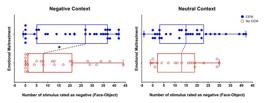
We compared the judgment index (subtraction of the number of objects rated as negative from the number of faces rated as negative) obtained in the negative and neutral contexts to test whether the indices were significantly different between participants who experienced CEM (n = 34 participants, 21 with CEM exclusively) and those who did not experience CEM (n = 27 participants, 26 with no history of CM). The results of the Mann‒Whitney test demonstrated that, in the negative context, the group with a history of CEM significantly judged more neutral faces as negative (z = -198.9, p = 0.046). Further Mann‒Whitney analyses revealed that the same pattern was not observed in the neutral context (z = -0.7, p > 0.1). Please see Figure 1 and Table 3.
History of Physical Maltreatment
Unexpectedly, we did not find the same pattern when comparing individuals with a history of CPM with those without CPM in both contexts: negative (z = 0.7, p > 0.1) and neutral (z = -1.0, p > 0.1). These results may be because a sample without CPM is composed of a relatively large number of CEM-positive individuals for both contexts (negative context = 21 and neutral context = 19; see Table 01). To address this limitation, we ran an additional analysis with participants who had experienced CPM and participants without any history of CM. The results showed that there was no significant difference in the negative (z = 1.2, p > 0.1) and neutral (z = -0.6, p > 0.1) contexts.
Regression Results
Negative context
The presence of CEM (childhood emotional maltreatment) was a significant predictor of the index score in the negative context, even when accounting for experienced sexual abuse during adolescence and adulthood (Model 1 (adjusted sexual trauma), ẞ = 0.31, p = 0.02). However, no association was observed between the presence of childhood physical maltreatment (CPM) and the index score in the negative context (Model 2 raw ẞ = 0.19, p > 0.1; adjusted by sexual trauma ẞ = 0.22, p > 0.1). See Table 4 for the raw and adjusted models.
In the third model, CEM and CPM were included as independent variables. We observed that the presence of CEM remained positively associated with the index ratings (raw: ẞ = 0.29, p = 0.02; adjusted sexual trauma, ẞ = 0.33, p = 0.02). Interestingly, as both types of maltreatment (CEM and CPM) were included in the same regression model, this result suggests that the impact of CEM remains significant when adjusting for the occurrence of CPM. Thus, participants who experienced CEM judged more faces as negative than participants without CEM, even after “removing” the possible effects of sexual trauma and the presence of childhood physical maltreatment. We observed no significant association between CPM and the index score (raw: ẞ = -0.08, p > 0.1; adjusted for sexual trauma, ẞ = -0.07, p > 0.1). Please see Table 4 for the raw and adjusted results obtained for the three models.
Finally, we run a complementary regression model after excluding participants who had other types of childhood maltreatment than emotional maltreatment (CEM only group). The results were similar (raw = ẞ = 0.30, p = 0.04; adjusted for sexual trauma, ẞ = 0.31, p= 0.03), confirming the association between CEM experience and increased negative ratings for faces in the negative context in participants who were not exposed to other types of maltreatment.
Neutral context
No significant results were obtained for the three regression models carried out in the neutral context index. These results are presented in the supplementary material (Table S2).
Discussion
As previously shown, we found evidence that individuals with a history of CEM are more susceptible to interpreting neutral faces in a more negative way (compared with participants without a history of CEM) after reading a negative text in a previous experiment. This is the first study to demonstrate that negative information available in a previous experiment could increase the propensity of participants with a history of CEM to attribute emotion to neutral faces. Unexpectedly, CPM did not influence the ratings. Finally, in the neutral context, there was no significant difference between the groups.
CEM is highly prevalent and often co-occurs with other forms of childhood maltreatment, including CPM (Hornor, 2012). Specifically, previous studies have shown that emotional maltreatment was the most common form of maltreatment in a Brazilian sample (Gama et al., 2021; Grassi-Oliveira and Stein, 2008). These findings are in line with our results, as 59.3% of our final sample (n = 113 participants) met the criteria for CEM, and 20.9% showed co-occurrence of CEM and CPM, with only five participants showing CPM exclusively.
Our results are in line with those of previous studies showing that individual differences could affect the extent to which participants use emotional context information in facial judgments (Iffland et al., 2021; Lee et al., 2012; Wieser & Moscovitch, 2014). For example, Wieser and Moscovitch (2015) reported that participants with high social anxiety symptoms rated neutral faces in a negative context as more negative than did participants with low social anxiety symptoms. Further insight into how context information and individual difference interactions could impact neutral face processing stems from one study utilizing electroencephalography (EEG; Iffland et al., 2021). The authors reported increased late positive potential (LPP) responses, an emotional reactivity index, to neutral faces in negative contexts (after threatening sentences) compared with neutral faces in neutral contexts (neutral sentences) in patients with depression (Iffland et al., 2021). To date, previous research has mainly focused on populations with specific mental disorders to explore the impact of emotional context information on neutral face evaluations. Our results extend these findings, showing for the first time that individuals with a history of CEM were associated with increased negative ratings for neutral faces after negative context manipulation.
As observed by Nudelman et al. (2022), no significant result was found for reaction times in the attentional task (supplemental material). Nudelman et al. (2022) reported that the reaction time index obtained in the negative context was not significantly different from that obtained in the neutral context for a bar judgment task (Nudelman et al., 2022). We conjecture that incidental information can more easily modulate cognitively assessed affective content (judgment of a neutral face) than less cognitively assessed emotional content, such as that determined by reaction time. In line with this possibility, Qiao-Tasserit et al. (2017) reported that induced negative transient states biased the recognition of facial expressions in perceptual decision-making tasks, but no effect was observed on reaction time measures. Conversely, evidence from work using an experimental approach different from that used in this study reported the impact of the occurrence of CEM on the reaction time (Iffland & Neuner, 2020).
On the other hand, we did not observe a negative bias for neutral faces in the neutral context. Our null finding is surprising, given that other studies with clinical populations have shown that individuals with CM tend to interpret neutral facial expressions as negative (Catalan et al., 2020; Hautle et al., 2023; Pfaltz et al., 2019). According to their findings, CM might be a more important predictor of this negativity bias than the presence of mental disorders such as PTSD or borderline personality disorder (Catalan et al., 2020; Hautle et al., 2023; Pfaltz et al., 2019). One possible explanation for these null findings might be the differences between the samples; here, we focused on a nonclinical sample of students, which, consequently, included participants with milder intensities of maltreatment. Similarly, we were unable to find any significant results for the comparison between participants with and without a history of CPM in both contexts. The main reason that could explain our null results is that most individuals with CPM had low to moderate levels of this type of maltreatment (76%).
We speculate that people with a history of CEM are more prone to emotional context modulation, which leads to a propensity to read neutral faces negatively. This could be because the emotional trauma experienced as children may have had a subtle effect on neurodevelopment, altering emotional processes. In line with this possibility, evidence shows enhanced reactivity of the amygdala, a key brain region involved in the primary processing of emotional faces, to neutral faces in adults reporting CEM, irrespective of psychiatric status (Van Harmelen et al., 2013). CEM is associated with increased emotional sensitivity in adulthood, as evidenced by increased negative self-associations, depressive symptoms, and difficulties in interpersonal relationships (Horner, 2012; Spertus et al., 2003; van Harmelen et al., 2010).
There were also several limitations in the present study. A first limitation is the retrospective self-reported assessment of CM by adults using the CTQ, as prospective and retrospective measures of CM have been shown to identify different groups of individuals (Baldwin et al., 2019). Second, we cannot exclude the possibility that our results could be driven by the cumulative effect of the co-occurrence of CEM and CPM. To address this limitation, we performed additional analyses using regression models to account for CPM effects. The results showed that the presence of CEM was a significant predictor of the index score in the negative context, even when accounting for CPM and sexual trauma (Model 3 adjusted). Third, our sample of CPM only was fairly small compared with that of CEM alone, which could have been the reason why we could not find significant results in the behavioral task. Further research with a larger sample is needed to understand its role and determine whether CPM alone can also affect the perception of neutral faces. Finally, the main limitation was that after the experiment, we did not directly assess whether any participant guessed that the experiments were linked.
Overall, the present work adds important evidence to the literature that individuals with CEM are more prone to attribute emotion to neutral faces after reading a previous negative text presented several minutes before. As Pfaltz et al. (2019) discuss, it is critical to identify individuals who are prone to misinterpreting neutral expressions as negative following context modulation, considering this negative bias may carry over to real-life situations. This could negatively affect relationships by making them uncomfortable in social situations, including those that involve psychotherapy.
References
-
Baldwin, J. R., Reuben, A., Newbury, J. B., & Danese, A. (2019). Agreement Between Prospective and Retrospective Measures of Childhood Maltreatment: A Systematic Review and Meta-analysis. JAMA Psychiatry, 76(6), 584-593. https://doi.org/10.1001/jamapsychiatry.2019.0097
» https://doi.org/10.1001/jamapsychiatry.2019.0097 - Bernstein, D. P., & Fink, L. (1998). Childhood Trauma Questionnaire: A retrospective self-report manual San Antonio, TX: The Psychological Corporation.
-
Bernstein, D. P., Stein, J. A., Newcomb, M. D., Walker, E., Pogge, D., Ahluvalia, T., Stokes, J., Handelsman, L., Medrano, M., Desmond, D., & Zule, W. (2003). Development and validation of a brief screening version of the Childhood Trauma Questionnaire. Child Abuse & Neglect, 27(2), 169-190. https://doi.org/10.1016/s0145-2134(02)00541-0
» https://doi.org/10.1016/s0145-2134(02)00541-0 -
Bérubé, A., Turgeon, J., Blais, C., & Fiset, D. (2023). Emotion recognition in adults with a history of childhood maltreatment: a systematic review. Trauma, Violence & Abuse, 24(1), 278-294. https://doi.org/10.1177/15248380211029403
» https://doi.org/10.1177/15248380211029403 -
Bradley, M. M., & Lang, P. J. (1994). Measuring emotion: The Self-Assessment Manikin and the semantic differential. Journal of Behavior Therapy and Experimental Psychiatry, 25(1), 49-59. https://doi.org/10.1016/0005-7916(94)90063-9
» https://doi.org/10.1016/0005-7916(94)90063-9 -
Bradley, M. M., Hamby, S., Löw, A., & Lang, P. J. (2007). Brain potentials in perception: picture complexity and emotional arousal. Psychophysiology, 44(3), 364-373. https://doi.org/10.1111/j.1469-8986.2007.00520.x
» https://doi.org/10.1111/j.1469-8986.2007.00520.x -
Brazil. Child And Adolescence Statute (Estatuto da Criança e do Adolescente), no. 8.069. In: Diário Oficial da República Federativa do Brasil. 1990. Available from: http://www.planalto.gov.br/ccivil_03/leis/l8069.htm
» http://www.planalto.gov.br/ccivil_03/leis/l8069.htm -
Catalan, A., Díaz, A., Angosto, V., Zamalloa, I., Martínez, N., Guede, D., Aguirregomoscorta, F., Bustamante, S., Larrañaga, L., Osa, L., Maruottolo, C., Fernández-Rivas, A., Bilbao, A., & Gonzalez-Torres, M. A. (2020). Can childhood trauma influence facial emotion recognition independently from a diagnosis of severe mental disorder? ¿Influye el trauma infantil en el reconocimiento de las emociones faciales independientemente del diagnóstico de trastorno mental grave? Revista de Psiquiatria y Salud Mental, 13(3), 140-149. https://doi.org/10.1016/j.rpsm.2018.10.003
» https://doi.org/10.1016/j.rpsm.2018.10.003 -
Davis, F. C., Johnstone, T., Mazzulla, E. C., Oler, J. A., & Whalen, P. J. (2010). Regional response differences across the human amygdaloid complex during social conditioning. Cerebral Cortex, 20(3), 612-621. https://doi.org/10.1093/cercor/bhp126
» https://doi.org/10.1093/cercor/bhp126 - Eisenstein, E. (2005). Adolescência: definições, conceitos e critérios. Adolescência & Saúde, 2(2), 6-7.
-
Egeland B. (2009). Taking stock: childhood emotional maltreatment and developmental psychopathology. Child Abuse & Neglect, 33(1), 22-26. https://doi.org/10.1016/j.chiabu.2008.12.004
» https://doi.org/10.1016/j.chiabu.2008.12.004 - Gama, C. M. F., Portugal, L. C. L., Gonçalves, R. M., de Souza Junior, S., Vilete, L. M. P., Mendlowicz, M. V., Figueira, I., Volchan, E., David, I. A., de Oliveira, L., & Pereira, M. G. (2021). The invisible scars of emotional abuse: a common and highly harmful form of childhood maltreatment. BMC Psychiatry, 21(1), 156. https://doi.org/10.1186/s12888-021-03134-0
-
Gibb, B. E., Chelminski, I., & Zimmerman, M. (2007). Childhood emotional, physical, and sexual abuse, and diagnoses of depressive and anxiety disorders in adult psychiatric outpatients. Depression and Anxiety, 24(4), 256-263. https://doi.org/10.1002/da.20238
» https://doi.org/10.1002/da.20238 -
Gilbert, R., Widom, C. S., Browne, K., Fergusson, D., Webb, E., & Janson, S. (2009). Burden and consequences of child maltreatment in high-income countries. Lancet (London, England), 373(9657), 68-81. https://doi.org/10.1016/S0140-6736(08)61706-7
» https://doi.org/10.1016/S0140-6736(08)61706-7 -
Goeleven, E., De Raedt, R., Leyman, L., & Verschuere, B. (2008). The Karolinska Directed Emotional Faces: A validation study. Cognition and Emotion, 22(6), 1094-1118. https://doi.org/10.1080/02699930701626582
» https://doi.org/10.1080/02699930701626582 -
Grassi-Oliveira, R., Stein, L. M, & Pezzi, J. C. (2006). Tradução e validação de conteúdo da versão em português do Childhood Trauma Questionnaire. Revista de Saúde Pública, 40(2), 249-55. https://doi.org/10.1590/S0034-89102006000200010
» https://doi.org/10.1590/S0034-89102006000200010 -
Grassi-Oliveira, R., & Stein, L. M. (2008). Childhood maltreatment associated with PTSD and emotional distress in low-income adults: the burden of neglect. Child Abuse & Neglect, 32(12), 1089-1094. https://doi.org/10.1016/j.chiabu.2008.05.008
» https://doi.org/10.1016/j.chiabu.2008.05.008 -
Hautle, L. L., Jellestad, L., Schenkel, S., Wingenbach, T. S. H., Peyk, P., Schnyder, U., Weilenmann, S., & Pfaltz, M. C. (2023). Adults with a history of childhood maltreatment with and without mental disorders show alterations in the recognition of facial expressions. European Journal of Psychotraumatology, 14(2), 2214388, 1-12. https://doi.org/10.1080/20008066.2023.2214388
» https://doi.org/10.1080/20008066.2023.2214388 -
Hornor G. (2012). Emotional maltreatment. Journal of Pediatric Health Care: Official Publication of National Association of Pediatric Nurse Associates & Practitioners, 26(6), 436-442. https://doi.org/10.1016/j.pedhc.2011.05.004
» https://doi.org/10.1016/j.pedhc.2011.05.004 -
Iffland, B., & Neuner, F. (2020). Varying cognitive scars - differential associations between types of childhood maltreatment and facial emotion processing. Frontiers in Psychology, 11, 732. https://doi.org/10.3389/fpsyg.2020.00732
» https://doi.org/10.3389/fpsyg.2020.00732 -
Iffland, B., Klein, F., Schindler, S., Kley, H., & Neuner, F. (2021). “She finds you abhorrent”-The impact of emotional context information on the cortical processing of neutral faces in depression. Cognitive, Affective, & Behavioral Neuroscience, 21, 426-444. https://doi.org/10.3758/s13415-021-00877-x/
» https://doi.org/10.3758/s13415-021-00877-x/ -
Lee, T. H., Choi, J. S., & Cho, Y. S. (2012). Context modulation of facial emotion perception differed by individual difference. PloS One, 7(3), 1-6. https://doi.org/10.1371/journal.pone.0032987
» https://doi.org/10.1371/journal.pone.0032987 -
Minear, M., & Park, D. C. (2004). A lifespan database of adult facial stimuli. Behavior Research Methods, Instruments, & Computers: A Journal of the Psychonomic Society, Inc. , 36(4), 630-633. https://doi.org/10.3758/bf03206543
» https://doi.org/10.3758/bf03206543 -
Nudelman, M. F., Portugal, L., Mocaiber, I., David, I. A., Rodolpho, B. S., Pereira, M. G., & de Oliveira, L. (2022). Long-term influence of incidental emotions on the emotional judgment of neutral faces. Frontiers in Psychology, 12, 772916, 1-8. https://doi.org/10.3389/fpsyg.2021.772916
» https://doi.org/10.3389/fpsyg.2021.772916 -
Pfaltz, M. C., Passardi, S., Auschra, B., Fares-Otero, N. E., Schnyder, U., & Peyk, P. (2019). Are you angry at me? Negative interpretations of neutral facial expressions are linked to child maltreatment but not to posttraumatic stress disorder. European Journal of Psychotraumatology, 10(1), 1682929, 1-15. https://doi.org/10.1080/20008198.2019.1682929
» https://doi.org/10.1080/20008198.2019.1682929 -
Pollak, S. D., Cicchetti, D., Hornung, K., & Reed, A. (2000). Recognizing emotion in faces: Developmental effects of child abuse and neglect. Developmental Psychology, 36 (5), 679-688. https://doi.org/10.1037/0012-1649.36.5.679
» https://doi.org/10.1037/0012-1649.36.5.679 -
Qiao-Tasserit, E., Garcia Quesada, M., Antico, L., Bavelier, D., Vuilleumier, P., & Pichon, S. (2017). Transient emotional events and individual affective traits affect emotion recognition in a perceptual decision-making task. PloS one, 12(2),1-16. https://doi.org/10.1371/journal.pone.0171375
» https://doi.org/10.1371/journal.pone.0171375 -
Sandre, A., Ethridge, P., Kim, I., & Weinberg, A. (2018). Childhood maltreatment is associated with increased neural response to ambiguous threatening facial expressions in adulthood: Evidence from the late positive potential. Cognitive, Affective & Behavioral Neuroscience, 18(1), 143-154. https://doi.org/10.3758/s13415-017-0559-z
» https://doi.org/10.3758/s13415-017-0559-z -
Scher, C. D., Forde, D. R., McQuaid, J. R., & Stein, M. B. (2004). Prevalence and demographic correlates of childhood maltreatment in an adult community sample. Child Abuse & Neglect, 28(2), 167-180. https://doi.org/10.1016/j.chiabu.2003.09.012
» https://doi.org/10.1016/j.chiabu.2003.09.012 -
Schwarz, K. A., Wieser, M. J., Gerdes, A. B., Mühlberger, A., & Pauli, P. (2013). Why are you looking like that? How the context influences evaluation and processing of human faces. Social Cognitive and Affective Neuroscience, 8(4), 438-445. https://doi.org/10.1093/scan/nss013
» https://doi.org/10.1093/scan/nss013 -
Spertus, I. L., Yehuda, R., Wong, C. M., Halligan, S., & Seremetis, S. V. (2003). Childhood emotional abuse and neglect as predictors of psychological and physical symptoms in women presenting to a primary care practice. Child Abuse & Neglect, 27(11), 1247-1258. https://doi.org/10.1016/j.chiabu.2003.05.001
» https://doi.org/10.1016/j.chiabu.2003.05.001 -
Stoltenborgh, M., Bakermans‐Kranenburg, M. J., Alink, L. R. A., & van IJzendoorn, M. H. (2015). The prevalence of child maltreatment across the globe: Review of a series of meta‐analyses. Child Abuse Review, 24(1), 37-50. https://doi.org/10.1002/car.2353
» https://doi.org/10.1002/car.2353 -
Suess, F., Rabovsky, M., & Abdel Rahman, R. (2015). Perceiving emotions in neutral faces: expression processing is biased by affective person knowledge. Social Cognitive and Affective Neuroscience, 10(4), 531-536. https://doi.org/10.1093/scan/nsu088
» https://doi.org/10.1093/scan/nsu088 -
Teicher, M. H., Samson, J. A., Polcari, A., & McGreenery, C. E. (2006). Sticks, stones, and hurtful words: relative effects of various forms of childhood maltreatment. The American Journal of Psychiatry, 163(6), 993-1000. https://doi.org/10.1176/ajp.2006.163.6.993
» https://doi.org/10.1176/ajp.2006.163.6.993 -
van Harmelen, A. L., de Jong, P. J., Glashouwer, K. A., Spinhoven, P., Penninx, B. W., & Elzinga, B. M. (2010). Child abuse and negative explicit and automatic self-associations: the cognitive scars of emotional maltreatment. Behaviour Research and Therapy, 48(6), 486-494. https://doi.org/10.1016/j.brat.2010.02.003
» https://doi.org/10.1016/j.brat.2010.02.003 -
van Harmelen, A. L., van Tol, M. J., Demenescu, L. R., van der Wee, N. J., Veltman, D. J., Aleman, A., van Buchem, M. A., Spinhoven, P., Penninx, B. W., & Elzinga, B. M. (2013). Enhanced amygdala reactivity to emotional faces in adults reporting childhood emotional maltreatment. Social Cognitive and Affective Neuroscience, 8(4), 362-369. https://doi.org/10.1093/scan/nss007
» https://doi.org/10.1093/scan/nss007 -
Wagner, A. W., & Linehan, M. M. (1999). Facial expression recognition ability among women with borderline personality disorder: implications for emotion regulation? Journal of Personality Disorders, 13(4), 329-344. https://doi.org/10.1521/pedi.1999.13.4.329
» https://doi.org/10.1521/pedi.1999.13.4.329 -
Wieser, M. J., Gerdes, A. B., Büngel, I., Schwarz, K. A., Mühlberger, A., & Pauli, P. (2014). Not so harmless anymore: how context impacts the perception and electrocortical processing of neutral faces. NeuroImage, 92, 74-82. https://doi.org/10.1016/j.neuroimage.2014.01.022
» https://doi.org/10.1016/j.neuroimage.2014.01.022
-
Data Availability Statement
The data supporting the findings of this study can be requested from the corresponding author upon reasonable request
-
Funding information
This study was supported by the federal and state Brazilian research agencies Fundação Carlos Chagas Filho de Amparo à Pesquisa do Estado do Rio de Janeiro (FAPERJ), Coor-denação de Aperfeiçoamento de Pessoal de Nível Superior (CAPES) (Grant No. 001), Conselho Nacional de Desenvolvimento Científico e Tecnológico (CNPq).
The data supporting the findings of this study can be requested from the corresponding author upon reasonable request

 Note: The impact of negative and neutral contexts on emotional judgment in participants with and without emotional maltreatment. A) Values represent the emotional judgment index (face-object) per group (participants with a history of CEM and without it) in the negative context. Note that we found an increase in neutral faces judged as negative in the group with a history of CEM. B) Values represent the emotional judgment index (face-object) per group (participants with a history of CEM and without it) in the neutral context. Boxplots show the median, the interquartile range, and the minimum and maximum values. The circles represent the data for each subject per group, the dashed line marks the shift between medians, and *p ≤ 0.05.