 Emotion Hunters: Efficacy of an online facial emotion recognition training game for adolescents
Abstract
Facial emotion recognition (FER) is a key part of effective interpersonal communication, particularly during childhood and adolescence. Technology-based interventions have emerged as promising tools for skill training, especially post-COVID-19. This study aimed to investigate the effect of Emotion Hunters - a skill enhancement game - on the accuracy of emotional facial recognition in a sample of neurotypical teenagers. This longitudinal study had 66 participants aged 11-15 years old randomly allocated between the intervention and control groups. Measures were taken at T1 (baseline) and T2 (post-intervention) using a FER task. Results revealed notable improvements in general accuracy and anger recognition in the intervention group. It is estimated that the intervention may offer additional benefits, especially in clinical populations with deficits in emotional recognition.
Keywords:
Emotional Recognition; Facial Expressions; Online Training; Adolescents; Anger
Resumo
O reconhecimento de emoções faciais é uma habilidade fundamental para uma comunicação interpessoal eficaz, especialmente durante a infância e a adolescência. As intervenções mediadas pela tecnologia surgiram como ferramentas promissoras para o aprimoramento de competências, especialmente relevantes no contexto pós-COVID-19. Este estudo teve como objetivo investigar o efeito do jogo Emotion Hunters - uma intervenção que incluiu psicoeducação e modelagem e visa melhorar o reconhecimento de faces emocionais em uma amostra de adolescentes neurotípicos. Ao todo, 66 participantes com idades entre 11 e 15 anos participaram do estudo (33 grupos de intervenção). Os resultados revelaram melhorias significativas na acurácia geral e no reconhecimento da raiva no grupo de intervenção. Estima-se que a intervenção possa oferecer benefícios adicionais, especialmente em populações clínicas com défices de reconhecimento emocional.
Palavras-Chave:
reconhecimento de emoções; expressão facial; treinamento online; adolescente; raiva
Emotional recognition based on facial expressions is an important part of social interactions (Zupan, 2023), in particular given that the content of the speech does not often match the speaker's emotional state. Thus, the ability to correctly identify others’ emotions is a core mechanism to infer emotional states from other people (Saure et al., 2020), and deficits in the ability to recognize emotions are associated with several mental and neurological health problems, such as autism spectrum disorder (Leung et al., 2022), schizophrenia (Gao et al., 2021), bipolar affective disorder (Halac et al., 2021), depression (Krause et al., 2021), anxiety disorders (Bottinelli et al., 2021; Couette et al., 2020), and Huntington's disease (Kempnich et al., 2018). There is some cohesion regarding the developmental pathway of the ability to recognize emotions with observed improvements from childhood to adulthood, correlations with neural maturation and cognitive processes (Poenitz & Román, 2020; Johnston et al., 2011), and its decay during old age (Gonçalves, 2018).
Ekman (1992) proposed an initial model with six basic emotions named happiness, sadness, disgust, fear, anger, and surprise. Out of these, happiness is the most easily recognized emotion (Airdrie et al., 2018; Rodger, 2018), with children already showing good rates of accuracy (Garcia & Tully, 2020). Surprise is the least investigated basic emotion, and this may be associated with a certain ambiguity of this isolated stimulus modality, since elements that trigger surprise can be both pleasant and unpleasant. Nevertheless, Richoz (2018) found relatively good accuracy rates (60% accuracy for the dynamic stimuli and 55% for static images) for surprise in a sample of children aged 5 to 6 years old. Furthermore, evidence that fear encoding skills would be mature by the age of five (Rodger et al., 2018) contrasts with a proposed linear trajectory that suggests improvements of around 35% from the age of six to the age of 16 (Lawrence et al., 2015). Similarly, findings on anger indicating over 92% of recognition in preadolescents (Mancini et al, 2018) coexist with results that anger is the hardest emotion to be identified (Herba et al., 2006).
For sadness, accuracy rates above 70% are observed in children between six and sixteen years old (Lawrence et al., 2015). When it comes to high-intensity facial sadness, ten-year-olds can perform similarly to adults, and high levels of accuracy seem to be reached at some point between five and ten years old (Gao & Maurer, 2010). Contradictions are part of the scientific literature on disgust, and Gao and Maurer (2010) suggested that the accuracy of this emotion varies between 60% and 70% and those levels are already achieved during childhood. On the other hand, Lawrence et al. (2015) proposed a linear improvement with children depicting accuracy rates of 30 to 35% and adolescents peaking at around 75% and 84%.
Another important aspect to consider is that most studies about facial emotion recognition development utilize static images or morphed expressions in various stimuli intensities. Intensity is an important factor that influences facial emotion recognition. Rodger et al. (2018) highlight that the quantities of signal and intensity needed to recognize most expressions decrease with age for sad, angry, disgust, and surprise faces, respectively. As for fear and happiness, the same study showed that age did not have a major impact on the quantities of signal and intensity use, both being the most difficult and easiest expressions to recognize, respectively, in both measures. Another study showed children's accurate recognition of happy, sad, and angry expressions improved steeply in moderate intensities, and the recognition rate was higher for anger when compared to sadness, except at low intensities (Garcia, 2020).
Interventions to improve the ability to recognize emotional faces have been a target for social cognition studies, with most interventions designed for specific populations such as individuals with schizophrenia (Mirzai et al., 2023) and autism spectrum disorder (Garcia-Villamisar & Dattilo, 2018; Vasilevska & Trajkovski, 2019). Although scarce, there is also some evidence that the ability to recognize emotions can be trained in neurotypical individuals (Golan et al., 2010). Interventions mediated by technologies are especially relevant, allowing training to be applied in various contexts, including remotely (Rawdon et al., 2018).
Studies of interventions for emotional face recognition mediated by technology are recent, but initial findings point towards favorable results (Miley et al., 2019). SocialVille, for example, is an online social cognition training program that utilizes the principles of neuroplasticity to improve social functioning. The program was designed to train both lower-level cognition skills, such as emotion face recognition, and higher-level cognition skills, such as Theory of the Mind. The program becomes progressively more difficult as participants show improvement in their performance, and it uses a reward strategy for correct responses. Ucime Emocii is another computer program for children and adolescents with autism spectrum disorder that has found significant positive effects (Petrovska & Trajkovski, 2019). The intervention includes “memory” games, exercises to attribute emotion to a character, and categorization tasks with emotional photos and cartoons. In a randomized control study with children and adolescents aged 7 to 15 years old, participants in the intervention group obtained significant improvements in the task of recognizing emotional faces compared to controls after 720 minutes of training over eight weeks.
To accumulate evidence of interventions for emotional face recognition mediated by technology is particularly relevant in the post-pandemic context, given the amount of time that people had to use face masks (Barrick et al., 2021; Carbon, 2020; Ramachandra & Longacre, 2022; Parada-Fernández et al., 2022; Marini et al., 2021; Pazhoohi et al., 2021). Thus, the main objective of this work is to provide data on the effects of the "Emotion Hunters" training program on neurotypical adolescents’ ability to recognize facial emotional expressions. “Emotion Hunters” is an online self-guided intervention based on psychoeducation and training to buffer teenagers’ skills in emotion recognition of anger, fear, sadness, and neutrality through a gamified interface. Happiness was not included, given that the rates of accuracy of this emotion tend to have a ceiling effect. Surprise was not included, given its somewhat ambiguous stimuli. The primary outcome of the study was accuracy in recognizing emotions in faces, whereas the secondary outcome was the Theory of Mind skill. It was hypothesized that training would promote (a) improvements in the ability to recognize emotions and (b) increases in Theory of Mind levels.
Method
Design
Randomized study with two assessments: baseline (T1) and post-intervention (T2).
Participants
A total of 118 participants aged 11 to 15 years old (M1 = 13.8; SD2 = 1.10) were authorized by their legal caretakers to participate. Of these, 66 (M = 13.6 years; SD = 1.07) completed pre-intervention measures. Those were randomly allocated to either the control or intervention group using a block randomization software called Research Randomizer (Urbaniak & Plous, 2013). The final sample included 36 participants (control n = 19; M = 13.5 years; SD = 0.97; intervention n = 17; M = 13.1 years; SD = 1.01) who completed the study's second phase. None of the participants had a previous diagnosis of Autism Spectrum Disorder or schizophrenia, as informed by their guardians.
Instruments
2.2.1 Sociodemographic Data Sheet: questionnaire completed by those responsible for collecting sociodemographic data from participants, such as age and sex.
2.2.2 Socioeconomic Questionnaire: a questionnaire that collects socioeconomic data from adolescents' families, such as the number of cars, computers, and refrigerators at home.
2.2.3 Facial expression recognition task: developed to assess emotional recognition using images from Dartmouth Database of Children's Faces (Dalrymple et al., 2013) and NIMH Child Emotional Faces Picture Set (NIMH-ChEFS) (Egger et al., 2011). In each phase, 32 different photographs (8 photographs per emotion) of adolescents displaying anger, fear, sadness (high intensity), and neutrality were displayed for 200 ms after a fixation cross. A list of emotions later appeared, and the participant responded by selecting one of them. Each correct answer equals one point and each error equals zero points. Emotional recognition scores were calculated considering the proportion of correct answers. The overall accuracy was computed using the average accuracy rates of anger, fear, sadness, and neutrality.
2.2.2 Depression, Anxiety and Stress Scale for Adolescents (EDAE-A) (Patias et al., 2016): adapted version of the Depression, Anxiety and Stress Scale - Short Form (DASS-21) instrument (Antony et al., 1998) for teenagers. Composed of 21 items, it maps symptoms of depression, anxiety, and stress through three subscales of seven items each. Responses are in a four-point Likert format and scores are calculated based on the total sum of scores. The following cutoff points were adopted for clinical groups: depression (≥10), anxiety (≥8), and stress (≥15) (Lovibond & Lovibond, 1996, as seen in Kannampallil et al., 2020). Patias et al.’s (2016) study with Brazilian adolescents showed adequate levels of internal consistency (between 0.83 and 0.90) and good adjustment rates for a three-factor model.
2.2.3 Reading the Mind in the Eyes Test (RMET) (Brazilian version Sanvicente-Vieira et al., 2013; original instrument Baron-Cohen et al., 2001). It consists of a task to measure the ability to infer emotional states from photos of the eye region (one of the important processes involved in ToM). Photos were presented along with four written alternatives that characterize the individual's mental state, and the participant must choose one of them. In the revised version, 36 items and one training item make up the mental state characterization activity. To make the intervention shorter, cards 1-12 were applied during the pre-intervention, and cards 13-24 were applied during the post-intervention. Each correct answer equals one point and each error equals zero points.
Emotion Hunters Intervention
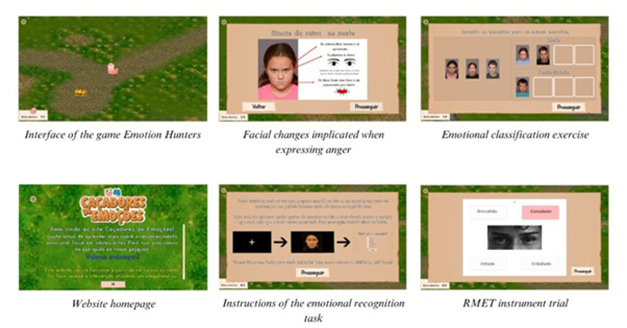
The training consists of an online adapted version of the computer game Caçadores de Emoções (game name in Portuguese; “Emotion Hunters” in English) developed for children (Moura, 2019) and adults (Rebeschini, 2018). The adaptation was developed considering guidelines for the implementation of internet-based interventions proposed by Proudfoot et al. (2011), as it is offered through a website. The game consists of a self-guided intervention program for emotion recognition of anger, sadness, fear, and neutrality in adolescents. The game presents Alfred, an extraterrestrial creature who needs help learning about human emotions. Through an interactive map, teenagers are required to help Alfred in his journey on earth by finding chests containing tutorials (which provide explanations and typical muscle changes for each emotion), emotional modulation exercises (“mimicry” of emotion), and emotional classification with feedback. The game includes visual elements (photos, videos, and texts) and sound (music and narration of all texts) and is designed to be completed in less than 20 minutes. The intervention was piloted in a sample of three adolescents (two boys and one girl aged between 13 and 16 years old; M = 14.46; SD = 1.84) in order to verify the suitability of the interface. The answers to a usability questionnaire indicated that participants of the pilot study found the website adequate, with easy instructions and very accessible visual and sound elements. In order to maximize the security of the data collected online, the intervention underwent an evaluation by a computing professional. Figure 1 displays the Emotion Hunter interface.
Procedures
Data collection was structured in a gamified way via a website to make participation in this research more appealing to adolescents. While the intervention group played the “Emotion Hunters” game at T2, the control group watched a video about plants. To this end, two identical websites were created with the same interface - while one invited participants to play in T2, the other showed them a video about plants. Users, however, did not know which group they belonged to.
Participants were recruited based on the research dissemination on social networks (for guardians) and in schools. In schools, invitations took place via email to caregivers and by online engagement of the research team and adolescents in remote classes. The intervention website offered teens and guardians the opportunity to create a registration, provide consent, and the research team made regular contact via email and WhatsApp with parents and guardians to remind adolescents to complete all research phases. There was a one-week interval between each research phase. Email support was provided for all participants who required assistance with technological issues.
Ethical Aspects
The research was approved by the Research Ethics Committee of the Pontifical Catholic University of Rio Grande do Sul (CAEE - Comitê de Ética em Pesquisa: 40830620.9.0000.5336) and in accordance with Resolution No. 510 (National Health Council [CNS], 2016). Participants had access to important information about participating in research, and, through registration on the website, the Free and Informed Assent Term and Free and Informed Consent Term were presented to them. Access to research first phase by the adolescent only occurred if a person in charge (parent or guardian) had authorized it (otherwise, a warning was issued on the login page when trying to proceed). Survey data was updated via Firebase in real time as records were created and instruments were answered. Only people related to the survey had access to the responses of the participants, whose identities were protected in the dissemination of results.
Data Analysis Plan
Data collected in this research were analyzed by Jamovi 2.2.0 software. Initially, differences between groups were investigated about sociodemographic characteristics through chi-square analysis and t tests. In addition to sample characterization by descriptive statistics, the equivalence of groups in the pre-intervention was also evaluated. Then, differences in demographic variables were investigated among the authorized participants: those who performed only T1 and those who performed T1 and T2. No significant differences were found in any variables evaluated (all p's > 0.05). Subsequently, descriptive analyses were carried out to characterize accuracy in recognizing different emotions of the initial sample. Furthermore, inspections of kurtosis, asymmetry, normality (Shapiro-Wilk), and variance (Levene) of emotional recognition scores and RMET were carried out. The overall accuracy reported was calculated from the accuracies of angry, fearful, sad, and neutral faces, while the performance of participants in the RMET was measured from the total number of correct answers. The results indicated that most variables had a non-normal distribution with a tendency towards asymmetry to the right. In results related to facial emotions, only general accuracy (p = 0.056) and sadness (p = 0.093) scores in the intervention group followed a normal distribution. Moreover, Levene's tests indicated non-homogeneous variances in pre-test anger (p = 0.023), pre-test (p = 0.006), and post-test (p = 0.024) neutrality accuracy. Regarding RMET results, data followed a normal distribution with homogeneous variances in both groups at both survey times (all p's > 0.05).
To achieve the study’s main objective, repeated measure analyses (ANOVAs) were conducted to investigate the effects of training on emotion recognition and Theory of Mind scores. Considering the results of Levene's tests, Greenhouse-Geisser corrections were adopted in ANOVAs with emotional recognition scores. Significant main effects were followed by post hoc inspection when deemed appropriate. Finally, the analyses were also conducted with depression, anxiety, and stress scores as covariates.
Results
Sociodemographic Information
Sociodemographic information, as well as levels of anxiety, stress, and depression of the initial sample (and the corresponding results of the association tests between control and intervention groups) are shown in Tables 1 and 2:
Emotional Accuracy
Considering the adolescents who were part of the study’s initial sample (n = 66), neutrality was the most easily recognized emotion, identified on average 85% of the time. Fear also presented a high average of correct answers (82%), followed by sadness (73.5%) and, finally, anger (65.2%) (see Table 3).
Intervention’s effect on emotional accuracy
Table 4 presents the final sample (n = 36) emotion recognition accuracy means at T1 and T2 by group.
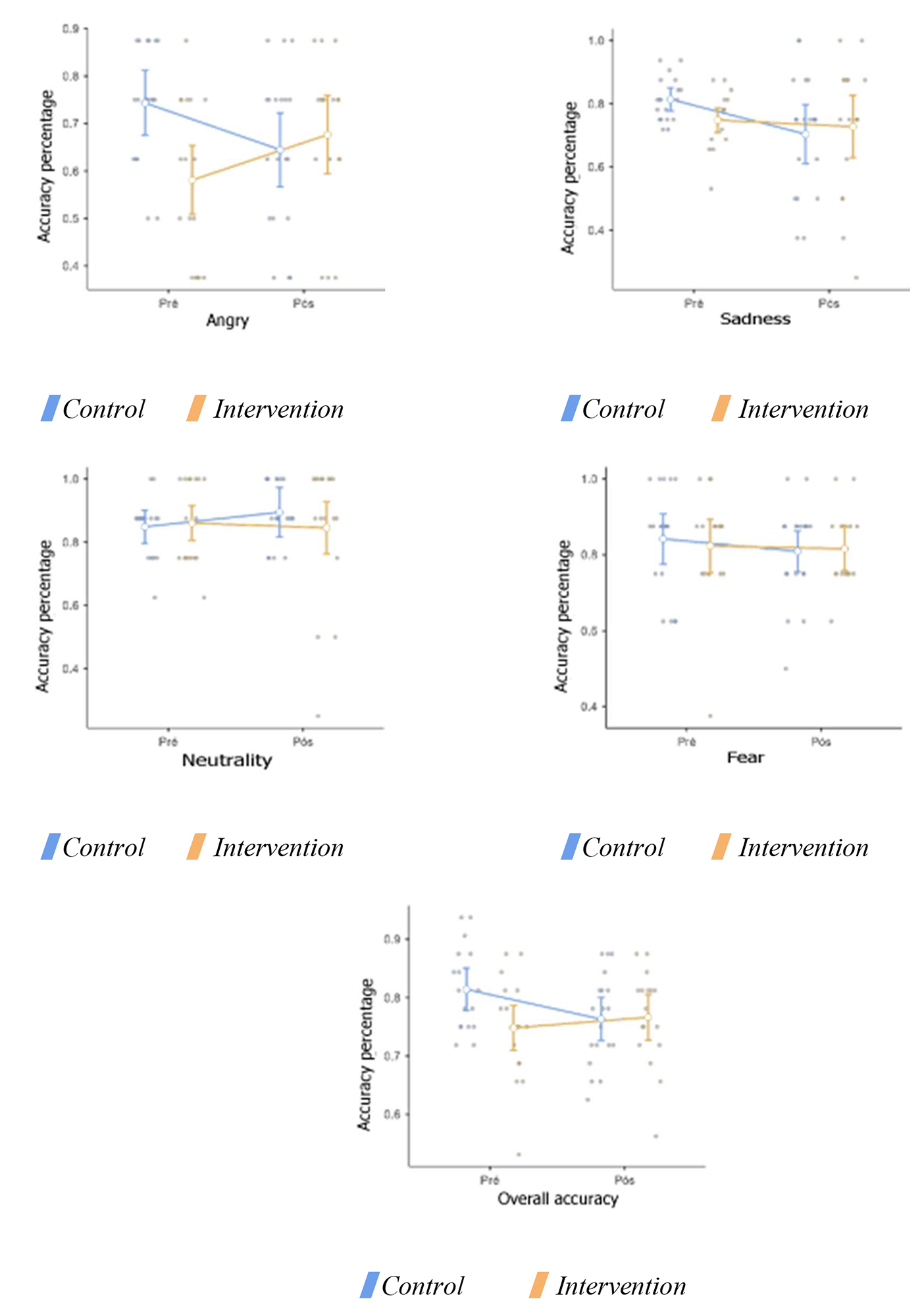
As seen in Table 5, repeated measures analysis results indicated significant differences in overall accuracy (p = 0.020, η²p = 0.149) and anger (p = 0.003, η²p = 0.226) between control and intervention groups. In turn, effect sizes associated with significant changes in overall accuracy (η²p = 0.149) and anger (η²p = 0.226) were considerable. There were no effects of intervention on sadness, fear, and neutrality recognition. Figure 2 illustrates these results. When levels of depression, anxiety, and stress were placed as outcome covariates, findings remained unchanged.
Table 6 presents the results of post hoc analyses. In turn, these indicated that the worsening in the control group was significant for both overall accuracy and anger. Regarding the improvement in the intervention group, only the one regarding categorizing anger was significant.
Theory of Mind
The instrument's positive outcomes, considering only the participants who completed the post-data collection in each phase of the intervention by group, are represented below. Two participants (one in each group) did not complete the second RMET collection, and their scores were not included in the database. Despite trends towards improvement in both groups, mean group differences were not significant (F(1.37) = 0549, p = 0.46, η²p = 0.017; Control T1 M = 7.74, SD = 2.10; T2 M = 8.22, SD = 1.56; Intervention M = 6.82, SD = 1.29; T2 M = 7.88, SD = 1.63).
Discussion
The current study consisted of an investigation into the efficacy of a game-format online training focused on facial emotions in an adolescent sample. The game Emotion Hunters is based on psychoeducation and modeling through the control of an extraterrestrial character, who finds chests containing information and games about anger, sadness, fear, and neutrality on an interactive map. Completely self-guided, its only requirements are a computer and internet access. In a complementary way, this investigation also aimed to contribute to the literature on emotional recognition from facial expressions in adolescence, considering data collected during the pandemic by the study’s initial sample, which did not carry out any types of interventions prior to data collection.
The first hypothesis established in this study was that the Emotion Hunters intervention would promote accuracy improvements in emotional recognition of angry, sad, fearful, and neutral faces in intervention group adolescents. This hypothesis was partially corroborated, since a significant effect was observed following the intervention in general accuracy and angry faces recognition. However, no significant differences were found between groups in fear, sadness, and neutrality accuracy, nor the Theory of Mind scores. Furthermore, it is understood that the difference observed between groups in general accuracy scores (p = 0.020, η²p = 0.149) is predominantly due to effects observed in anger (p = 0.003, η²p = 0.226). This result is particularly interesting, since preadolescents and adolescents need a greater volume of information from facial regions to identify anger compared to other emotions, since the recognition of lower intensity expressions of anger tends to develop more steeply (Barisnikov et al., 2021).
In the present study, angry faces obtained the lowest accuracy averages by the initial sample (65.2%) in T1. In contrast, the other emotions presented higher accuracies, especially those of fear and neutrality, with an average of correct answers greater than 80%. Thus, one hypothesis is that the intervention’s effects were limited to anger, as this was the emotion that presented the greatest amplitude for improvement, while other emotions may have suffered a ceiling effect. These data are reinforced by studies in which anger had a lower accuracy associated with emotional recognition, when compared to fear and sadness (Ewing et al., 2017; Hauschild et al., 2020). Furthermore, this information suggests that, in clinical groups such as those with ASD and schizophrenia (who have an impaired ability to recognize emotions), the intervention may have an even better potential.
It is noteworthy that, when control group means were observed, significant worsening of performance in terms of general accuracy and anger was seen. It is understood that these may result from methodological processes involved in the study. Adolescents were randomly allocated to intervention and control groups. Thus, those belonging to the control group were unaware of this condition. Therefore, it is possible that having performed both emotional recognition tasks and not having received training (being aware that the study consisted of an intervention) may have led to the use of more conscious processes attempting to identify emotions. In this way, adolescents in the control group may have made an effort to get the categorization tasks right, and this may have led to a loss in performance. This hypothesis is interesting as it also suggests that the research was not susceptible to practice effects, an effect that had been previously identified when a similar intervention was applied to children and adults (Moura, 2019; Rebeschini, 2018), in addition to being a documented effect in literature when static stimuli are used to assess emotional recognition (Khosdelazad et al., 2020).
When it comes to Theory of Mind effects, despite increases in post-test RMET scores in both groups, no significant intervention effects were observed. The hypothesis of better performance in the ToM task, accompanied by improvements in emotion recognition, considers the understanding of Theory of Mind as a complex construct that contemplates social-cognitive and perceptual processes (Tager-Flusberg & Sullivan, 2000). The result found may indicate that, although processes of emotional accuracy from facial expressions and ToM are related, they should not be generalized as synonyms (Halac et al., 2021; On et al., 2021).
In a complementary manner, an aspect to be analyzed from the results found is the accuracy associated with emotion recognition by the initial sample. Considering the specific emotions studied in this article, different methodologies adopted by previous studies make it difficult to generalize facts about expected difficulty in recognizing anger, fear, sadness, and neutrality. According to our study, neutrality was most easily recognized (85%), followed by fear (82%), sadness (73.5%), and finally anger (65.2%). Regarding the display time of images in the emotional recognition task (200ms), it is understood that it was sufficient to provide adolescents with the visual resources necessary for the categorization of emotions.
It was not possible to locate in existing literature, for example, studies that evaluated the accuracy attributed to images of neutral faces in neurotypical adolescents. When associated with high conditions of somatic, depressive, or anxious symptoms, there are reports of better processing of neutral expressions in samples of young adolescents (n = 40, M = 12.67 years, SD = 0.31) (Simcock et al., 2020). Other than that, stimuli of this type were only found in studies with the age group that included it in emotional discrimination tasks (classifying more than one photo as reflecting the same emotion or not) (Johnston et al., 2011) or as a strategy to produce morphed images (Thomas et al., 2007). It is hypothesized that the discrepancy between high emotional intensity and neutral photos in this study may have facilitated the identification of neutrality, since there were no major changes in facial muscles in the case, in contrast to faces displaying anger, sadness, or fear.
When we compared percentages associated with emotional recognition, considering our study's average participant's age (13.6 years), up to findings in research by Lawrence et al. (2015), the results are not aligned. In this last study, researchers investigated happiness, surprise, disgust, fear, sadness, and anger recognition in children and adolescents aged between 6 and 16 years old (n = 478). In the age group of 13 years (n = 44), fear had the lowest accuracy averages (56.80% for boys, 62.63% for girls), when compared to sadness (77.6% for boys, 71.99% for girls) and anger (72.80% for boys, 76.32% for girls).
On the other hand, in studies that investigated a smaller number of emotions in adolescents, there are several similarities with our results. Ewing et al. (2017) investigated the emotional recognition of happiness, fear, anger, and sadness from facial expressions. Happiness was the most easily recognized emotion, followed by fear, sadness, and anger; the same order found in our study. The average accuracy of the exact emotional recognition task within the group of adolescents aged between 10 and 13 years old (n = 69) is not provided, but from a graph it is possible to associate an estimated accuracy close to 80% for fear, between 70% and 80% for sadness and between 50% and 60% for anger. However, it is worth noting that the studies by Lawrence et al. (2015) and Ewing et al. (2017) use prototypical photos of adults in emotional recognition tasks.
Only one other study was found that investigated the same emotions studied by Ewing et al. (2017) (happiness, anger, fear, and sadness), considering the possibility of own age bias effects - an advantage in identifying emotional faces in individuals of the same age group (Rhodes & Anastasi, 2012). The study carried out by Hauschild et al. (2020) indicated that adolescents (n = 40, M = 12.85 years, SD = 1.07) without autism spectrum disorder (ASD) identified happiness more easily (95.83%), followed by sadness (94.17%), fear (82.50%) and anger (61.67%) based on photos of children. The same order was found according to emotional photos of adults, although the percentage of correct answers was significantly lower (thus, corroborating the own age bias effect). Therefore, despite discrepancies found in studies on emotional facial expressions, it is considered that it is possible to expect a lower accuracy attributed to faces expressing anger in adolescents.
Up until now, several studies have demonstrated a negative impact of mask use on facial emotional accuracy (Carbon, 2020; Grundmann et al., 2021; Marini et al., 2021; Noyes et al., 2021). This is quite understandable, since different processing strategies are used to identify specific emotions (while eyes and eyebrows favor the identification of fear and anger, respectively, the mouth offers great informative potential for the detection of sadness and happiness) (Ewing et al., 2017). It is not known, however, to what extent lower exposure to uncovered faces (as a result of protective measures against COVID-19) may be associated with impairments in the ability of adolescents to recognize emotions, since the advantage in processing faces in people of the same age is related to greater contact with peers (Hauschild et al 2020).
Social isolation measures implied school activities in person restrictions (Vieira et al., 2020), which affects an important period of identity development (Silva & Rosa, 2021). Schools play an important role in terms of social interaction and bonds, which are protective factors against mental illness (Liu et al., 2022; Xiong et al., 2020; Wang et al., 2022). Facial expressions and the ability to recognize them are relevant elements in the construction of these bonds. Not mimicking facial expressions and tailoring vocal responses in response to perceived expressions, for example, can impact the formation of relationships, such as peer friendships (Ramachandra & Longacre, 2022).
Considering the study found, which uses emotional photographs of individuals from the age group closer to the sample studied and whose data collection took place before the pandemic (Hauschild et al., 2020), there is little variation when comparing the accuracies associated with fear and anger (0.5% and 3.52% respectively). However, when comparing the accuracies associated with sadness, the one found in this study was 20.67% lower. Due to differences in methodologies used (different photographs and exposure times), caution is suggested when interpreting such findings. However, there is a possibility that data on emotion recognition accuracy from our initial sample may constitute findings that allow us to understand the degree of impairment (or lack thereof) in the ability to detect emotions from facial expressions found in an adolescent sample whose social exchanges were greatly reduced as a result of the pandemic.
Limitations
The first important limitation of this study refers to the sample size. It is recognized that difficulty in keeping participants engaged in research may have impacted the results. A second limitation considers ecological validity, since it is not known whether the benefits found reflect actual improvements in the real world. Although it is common to assess emotion recognition through static and prototypical images (Cooper et al., 2020), it is recognized that effects may be different when using non-prototypical images, which better represent everyday life situations (Rodger et al., 2018).
Directions for future studies
The game effects on a neurotypical sample encourage replication in clinical groups. The existence of studies favorable to the development of emotional recognition aimed at pathologies with significant losses in emotional accuracy that are significant, such as ASD and schizophrenia, is documented in the scientific literature (Souto et al., 2018). Recently, a systematic review on externalizing behaviors found associations of these with impairments in recognizing happiness, anger, fear, and sadness, on average, 49% of the time they were tested (Cooper et al., 2020). Therefore, one can think of a promising applicability of our intervention in clinical groups with conditions such as Attention Deficit Hyperactivity Disorder (ADHD), which is often neglected by interventions in emotional recognition (Cooper et al., 2020). Furthermore, considering that sample loss was an important difficulty encountered in this study, the development of usability studies that investigate factors associated with retention is considered relevant, since this is a common problem in online interventions (Fleming et al., 2018; Karekla et al., 2019).
Another important thing for future studies to consider is the effect of race and sex in emotional recognition. Studies such as Halbertstadt et al (2018) suggest individuals might be racially biased when recognizing emotions in other people, especially regarding anger, with Black boys being falsely seen as angry more often than White boys. Halberstadt et al (2022) not only confirm the findings of the previous study, but also take sex bias into account, showing an overall greater anger misperception for boys than girls, but black girls were also falsely seen as angry more often than white girls.
Conclusion
Interventions mediated by technologies have appeared to be more relevant after the beginning of the pandemic. The present study provides data on emotional accuracy associated with neutrality, fear, sadness, and anger from a neurotypical sample of adolescents during the global COVID-19 crisis. In turn, the results found based on the game “Emotion Hunters” indicate improvements in emotional accuracy levels from a completely self-guided online gamified intervention for adolescents. Such results, however, were not accompanied by improvements in the Theory of Mind levels. More studies employing longitudinal designs with larger samples, as well as targeting clinical groups, are needed to determine the extent of possible benefits of this intervention. Such efforts are beneficial for the implementation of easily disseminated, evidence-based treatments for adolescents.
References
-
Airdrie, J. N., Langley, K., Thapar, A., & van Goozen, S. H. (2018). Facial emotion recognition and eye gaze in attention-deficit/hyperactivity disorder with and without comorbid conduct disorder. Journal of the American Academy of Child & Adolescent Psychiatry, 57(8), 561-570. https://doi.org/10.1016/j.jaac.2018.04.016
» https://doi.org/10.1016/j.jaac.2018.04.016 -
Antony, M. M., Bieling, P. J., Cox, B. J., Enns, M. W., & Swinson, R. P. (1998). Psychometric properties of the 42-item and 21-item versions of the Depression Anxiety Stress Scales in clinical groups and a community sample. Psychological Assessment, 10(2), 176-181. https://doi.org/10.1037/1040-3590.10.2.176
» https://doi.org/10.1037/1040-3590.10.2.176 -
Barisnikov, K., Thomasson, M., Stutzmann, J., & Lejeune, F. (2021). Sensitivity to Emotion Intensity and Recognition of Emotion Expression in Neurotypical Children. Children (Basel, Switzerland), 8(12), 1108. https://doi.org/10.3390/children8121108
» https://doi.org/10.3390/children8121108 -
Baron-Cohen, S., Wheelwright, S., Hill, J., Raste, Y., & Plumb, I. (2001). The "Reading the Mind in the Eyes" Test revised version: a study with normal adults, and adults with Asperger syndrome or high-functioning autism. Journal of Child Psychology and Psychiatry, and Allied Disciplines, 42(2), 241-251. https://doi.org/10.1111/1469-7610.00715
» https://doi.org/10.1111/1469-7610.00715 -
Barrick, E. M., Thornton, M. A., & Tamir, D. I. (2021). Mask exposure during COVID-19 changes emotional face processing. PloS one, 16(10), e0258470. https://doi.org/10.1371/journal.pone.0258470
» https://doi.org/10.1371/journal.pone.0258470 -
Berggren, S., Fletcher-Watson, S., Milenkovic, N., Marschik, P. B., Bölte, S., & Jonsson, U. (2018). Emotion recognition training in autism spectrum disorder: A systematic review of challenges related to generalizability. Developmental Neurorehabilitation, 21(3), 141-154. https://doi.org/10.1080/17518423.2017.1305004
» https://doi.org/10.1080/17518423.2017.1305004 -
Bottinelli, F., Delvecchio, G., Moltrasio, C., Ferro, A., Diwadkar, V. A., & Brambilla, P. (2021). Facial emotion recognition in panic disorder: a mini-review of behavioural studies. Journal of Affective Disorders, 282, 173-178. https://doi.org/10.1016/j.jad.2020.12.064
» https://doi.org/10.1016/j.jad.2020.12.064 -
Carbon C. C. (2020). Wearing Face Masks Strongly Confuses Counterparts in Reading Emotions. Frontiers in Psychology, 11, 1-8. https://doi.org/10.3389/fpsyg.2020.566886
» https://doi.org/10.3389/fpsyg.2020.566886 -
Conselho Nacional de Saúde. (2016). Resolução Nº 510, de 07 de abril de 2016. http://conselho.saude.gov.br/resolucoes/2016/Reso510.pdf
» http://conselho.saude.gov.br/resolucoes/2016/Reso510.pdf -
Cooper, S., Hobson, C. W., & van Goozen, S. H. (2020). Facial emotion recognition in children with externalising behaviours: A systematic review. Clinical Child Psychology and Psychiatry, 25(4), 1068-1085. https://doi.org/10.1177/1359104520945390
» https://doi.org/10.1177/1359104520945390 -
Couette, M., Mouchabac, S., Bourla, A., Nuss, P., & Ferreri, F. (2020). Social cognition in post-traumatic stress disorder: A systematic review. The British Journal of Clinical Psychology, 59(2), 117-138. https://doi.org/10.1111/bjc.12238
» https://doi.org/10.1111/bjc.12238 -
Dalrymple, K. A., Gomez, J., & Duchaine, B. (2013). The Dartmouth Database of Children's Faces: acquisition and validation of a new face stimulus set. PLOS One, 8(11), 1-7. https://doi.org/10.1371/journal.pone.0079131
» https://doi.org/10.1371/journal.pone.0079131 -
Egger, H. L., Pine, D. S., Nelson, E., Leibenluft, E., Ernst, M., Towbin, K. E., & Angold, A. (2011). The NIMH Child Emotional Faces Picture Set (NIMH-ChEFS): a new set of children's facial emotion stimuli. International Journal of Methods in Psychiatric Research, 20(3), 145-156. https://doi.org/10.1002/mpr.343
» https://doi.org/10.1002/mpr.343 -
Ekman, P. (1992). Facial Expressions of Emotion New Findings, New Questions. Psychological Science, 3(1), 34-38 https://doi.org/10.1111/j.1467-9280.1992.tb00253.x
» https://doi.org/10.1111/j.1467-9280.1992.tb00253.x - Ekman, P. (2011). A linguagem das emoções: Revolucione sua comunicação e seus relacionamentos reconhecendo todas as expressões das pessoas ao redor. / Paul Ekman; tradução Carlos Szlak. - São Paulo: Lua de Papel
- Ekman, P., & Friesen, W. V. (2003). Unmasking the Face. A Guide to Recognizing Emotions from Facial Clues. Los Altos, CA: Malor Books.
-
Ewing, L., Karmiloff-Smith, A., Farran, E. K., & Smith, M. L. (2017). Developmental changes in the critical information used for facial expression processing. Cognition, 166, 56-66. https://doi.org/10.1016/j.cognition.2017.05.017
» https://doi.org/10.1016/j.cognition.2017.05.017 -
Fernandez-Sotos, P., Torio, I., Fernandez-Caballero, A., Navarro, E., Gonzalez, P., Dompablo, M., & Rodriguez-Jimenez, R. (2019). Social cognition remediation interventions: A systematic mapping review. PloS One, 14(6), e0218720. https://doi.org/10.1371/journal.pone.0218720
» https://doi.org/10.1371/journal.pone.0218720 -
Fleming, T., Bavin, L., Lucassen, M., Stasiak, K., Hopkins, S., & Merry, S. (2018). Beyond the Trial: Systematic Review of Real-World Uptake and Engagement With Digital Self-Help Interventions for Depression, Low Mood, or Anxiety. Journal of Medical Internet Research, 20(6), e199. https://doi.org/10.2196/jmir.9275
» https://doi.org/10.2196/jmir.9275 -
Gao, X., & Maurer, D. (2009). Influence of intensity on children’s sensitivity to happy, sad, and fearful facial expressions. Journal of Experimental Child Psychology, 102(4), 503-521. https://doi.org/j.jecp.2008.11.002
» https://doi.org/j.jecp.2008.11.002 -
Gao, X., & Maurer, D. (2010). A happy story: Developmental changes in children's sensitivity to facial expressions of varying intensities. Journal of Experimental Child Psychology, 107(2), 67-86. https://doi.org/10.1016/j.jecp.2010.05.003
» https://doi.org/10.1016/j.jecp.2010.05.003 -
Gao, Z., Zhao, W., Liu, S., Liu, Z., Yang, C., & Xu, Y. (2021). Facial Emotion Recognition in Schizophrenia. Frontiers in Psychiatry, 12, 633717. https://doi.org/10.3389/fpsyt.2021.633717
» https://doi.org/10.3389/fpsyt.2021.633717 -
Garcia, S. E., & Tully, E. C. (2020). Children's recognition of happy, sad, and angry facial expressions across emotive intensities. Journal of Experimental Child Psychology, 197, 104881. https://doi.org/10.1016/j.jecp.2020.104881
» https://doi.org/10.1016/j.jecp.2020.104881 -
Garcia-Villamisar, D., & Dattilo, J. (2018). Effects of computer-facilitated emotion recognition training for adults with autism spectrum disorders and intellectual disabilities. Global Journal of Intellectual & Developmental Disabilities, 5(2), 14-21. DOI: 10.19080/GJIDD.2018.05.555656
» https://doi.org/10.19080/GJIDD.2018.05.555656 - Gerrig, R. J., & Zimbardo, P. G. (2002). Psychology and Life (16th Ed.). Allyn & Bacon.
-
Golan, O., Ashwin, E., Granader, Y., McClintock, S., Day, K., Leggett, V., & Baron-Cohen, S. (2010). Enhancing emotion recognition in children with autism spectrum conditions: an intervention using animated vehicles with real emotional faces. Journal of Autism and Developmental Disorders, 40(3), 269-279. https://doi.org/10.1007/s10803-009-0862-9
» https://doi.org/10.1007/s10803-009-0862-9 -
Gonçalves, A. R., Fernandes, C., Pasion, R., Ferreira-Santos, F., Barbosa, F., & Marques-Teixeira, J. (2018). Effects of age on the identification of emotions in facial expressions: A meta-analysis. PeerJ, 6, Article e5278. https://doi.org/10.7717/peerj.5278
» https://doi.org/10.7717/peerj.5278 -
Grundmann, F., Epstude, K., & Scheibe, S. (2021). Face masks reduce emotion-recognition accuracy and perceived closeness. PLOS One, 16(4), e0249792. https://doi.org/10.1371/journal.pone.0249792
» https://doi.org/10.1371/journal.pone.0249792 -
Halac, E., Ciray, R. O., Turan, S., Tuncturk, M., Agac, N., Elmas, F. N., Rosson, S., & Ermis, C. (2021). Impaired theory of mind and emotion recognition in pediatric bipolar disorder: A systematic review and meta-analysis. Journal of Psychiatric Research, 138, 246-255. https://doi.org/10.1016/j.jpsychires.2021.04.011
» https://doi.org/10.1016/j.jpsychires.2021.04.011 -
Halberstadt, A. G., Castro, V. L., Chu, Q., Lozada, F. T., & Sims, C. M. (2018). Teachers’ racialized emotion recognition, anger bias, and hostility attributions. Contemporary Educational Psychology, 54, 125-138. http://dx.doi.org/10.1016/j.cedpsych.2018.06.004
» http://dx.doi.org/10.1016/j.cedpsych.2018.06.004 -
Halberstadt, A. G., Cooke, A. N., Garner, P. W., Hughes, S. A., Oertwig, D., & Neupert, S. D. (2022). Racialized emotion recognition accuracy and anger bias of children’s faces. Emotion, 22(3), 403. https://doi.org/10.1037/emo0000756
» https://doi.org/10.1037/emo0000756 -
Hauschild, K. M., Felsman, P., Keifer, C. M., & Lerner, M. D. (2020). Evidence of an Own-Age Bias in Facial Emotion Recognition for Adolescents With and Without Autism Spectrum Disorder. Frontiers in Psychiatry, 11, 428. https://doi.org/10.3389/fpsyt.2020.00428
» https://doi.org/10.3389/fpsyt.2020.00428 -
Hayes, G. S., McLennan, S. N., Henry, J. D., Phillips, L. H., Terrett, G., Rendell, P. G., ... & Labuschagne, I. (2020). Task characteristics influence facial emotion recognition age-effects: A meta-analytic review. Psychology and Aging, 35(2), 295. https://doi.org/10.1037/pag0000441
» https://doi.org/10.1037/pag0000441 -
Herba, C. M., Landau, S., Russell, T., Ecker, C., & Phillips, M. L. (2006). The development of emotion‐processing in children: Effects of age, emotion, and intensity. Journal of Child Psychology and Psychiatry, 47(11), 1098-1106. https://doi.org/10.1111/j.1469-7610.2006.01652.x
» https://doi.org/10.1111/j.1469-7610.2006.01652.x -
Hopkins, I. M., Gower, M. W., Perez, T. A., Smith, D. S., Amthor, F. R., Wimsatt, F. C., & Biasini, F. J. (2011). Avatar assistant: improving social skills in students with an ASD through a computer-based intervention. Journal of Autism and Developmental Disorders, 41(11), 1543-1555. https://doi.org/10.1007/s10803-011-1179-z
» https://doi.org/10.1007/s10803-011-1179-z -
Johnston, P. J., Kaufman, J., Bajic, J., Sercombe, A., Michie, P. T., & Karayanidis, F. (2011). Facial Emotion and Identity Processing Development in 5- to 15-Year-Old Children. Frontiers in Psychology, 2(26), 1-9. https://doi.org/10.3389/fpsyg.2011.00026
» https://doi.org/10.3389/fpsyg.2011.00026 -
Kannampallil, T. G., Goss, C. W., Evanoff, B. A., Strickland, J. R., McAlister, R. P., & Duncan, J. (2020). Exposure to COVID-19 patients increases physician trainee stress and burnout. PLOS One, 15(8), e0237301. https://doi.org/10.1371/journal.pone.0237301
» https://doi.org/10.1371/journal.pone.0237301 -
Karekla, M., Kasinopoulos, O., Neto, D. D., Ebert, D. D., Van Daele, T., Nordgreen, T., Höfer, S., Oeverland, S., & Jensen, K. L. (2019). Best practices and recommendations for digital interventions to improve engagement and adherence in chronic illness sufferers. European Psychologist, 24(1), 49-67. https://doi-org.ez94.periodicos.capes.gov.br/10.1027/1016-9040/a000349
» https://doi-org.ez94.periodicos.capes.gov.br/10.1027/1016-9040/a000349 -
Keltner, D., Sauter, D., Tracy, J., & Cowen, A. (2019). Emotion al expression: Advances in basic emotion theory. Journal of Nonverbal Behavior, 43, 133-160. https://doi.org/10.1007/s10919-019-00293-3
» https://doi.org/10.1007/s10919-019-00293-3 -
Kempnich, C., Andrews, S., Fisher, F., Wong, D., Georgiou-Karistianis, N., & Stout, J. (2018). Emotion Recognition Correlates With Social-Neuropsychiatric Dysfunction in Huntington’s Disease. Journal of the International Neuropsychological Society, 24(5), 417-423. doi:10.1017/S1355617717001308
» https://doi.org/10.1017/S1355617717001308 -
KhoSDelazad, S., Jorna, L. S., McDonald, S., Rakers, S. E., Huitema, R. B., Buunk, A. M., & Spikman, J. M. (2020). Comparing static and dynamic emotion recognition tests: Performance of healthy participants. PLOS One, 15(10), e0241297. https://doi.org/10.1371/journal.pone.0241297
» https://doi.org/10.1371/journal.pone.0241297 - Kowalska, M., & Wróbel, M. (2017). Basic Emotions. In V. Zeigler-Hill & T. K. Shackelford (Eds). Encyclopedia of Personality and Individual Differences. Springer.
-
Krause, F. C., Linardatos, E., Fresco, D. M., & Moore, M. T. (2021). Facial emotion recognition in major depressive disorder: A meta-analytic review. Journal of Affective Disorders, 293, 320-328. https://doi.org/10.1016/j.jad.2021.06.053
» https://doi.org/10.1016/j.jad.2021.06.053 -
Lawrence, K., Campbell, R., & Skuse, D. (2015). Age, gender, and puberty influence the development of facial emotion recognition. Frontiers in Psychology, 6(761), 1-14. https://doi.org/10.3389fpsyg.2015.00761
» https://doi.org/10.3389fpsyg.2015.00761 -
Leime, J. L., Rique Neto, J., Alves, S. M., & Torro-Alves, N. (2013). Recognition of facial expressions in children, young adults and elderly people. Estudos de Psicologia (Campinas), 30(2), 161-167. https://doi.org/10.1590/s0103-166x2013000200002
» https://doi.org/10.1590/s0103-166x2013000200002 -
Leung, F., Sin, J., Dawson, C., Ong, J., Zhao, C., Veic, A., & Liu, F. (2022). Emotion recognition across visual and auditory modalities in autism spectrum disorder (ASD): A systematic review and meta-analysis. Developmental Review, 63, 101000. https://doi.org/10.1016/j.dr.2021.101000
» https://doi.org/10.1016/j.dr.2021.101000 -
Liu, S. R., Davis, E. P., Palma, A. M., Sandman, C. A., & Glynn, L. M. (2022). The acute and persisting impact of COVID-19 on trajectories of adolescent depression: Sex differences and social connectedness. Journal of Affective Disorders, 299, 246-255. https://doi.org/10.1016/j.jad.2021.11.030
» https://doi.org/10.1016/j.jad.2021.11.030 -
Mancini Giacomo, Biolcati Roberta, Agnoli Sergio, Andrei Federica, Trombini Elena. (2018). Recognition of Facial Emotion al Expressions Among Italian Pre-adolescents, and Their Affective Reactions. Frontiers in Psychology, 9, doi: 10.3389/fpsyg.2018.01303
» https://doi.org/10.3389/fpsyg.2018.01303 -
Marini, M., Ansani, A., Paglieri, F., Caruana, F., & Viola, M. (2021). The impact of facemasks on emotion recognition, trust attribution and re-identification. Scientific Reports, 11(1), 5577. https://doi.org/10.1038/s41598-021-84806-5
» https://doi.org/10.1038/s41598-021-84806-5 -
Miley, K., Fisher, M., Nahum, M., Howard, E., Rowlands, A., Brandrett, B., Woolley, J., Hooker, C. I., Biagianti, B., Ramsay, I., & Vinogradov, S. (2019). Six-month durability of targeted cognitive training supplemented with social cognition exercises in schizophrenia. Schizophrenia research Cognition, 20, 100171. https://doi.org/10.1016/j.scog.2019.100171
» https://doi.org/10.1016/j.scog.2019.100171 -
Mirzai, N., Polet, K., Morisot, A., Hesse, S., Pesce, A., de la Chapelle, S. L., & Iakimova, G. (2023). Can the Ability to Recognize Facial Emotion s in Individuals With Neurodegenerative Disease be Improved? A Systematic Review and Meta-analysis. Cognitive and Behavioral Neurology, 10-1097. DOI: 10.1097/WNN.0000000000000348
» https://doi.org/10.1097/WNN.0000000000000348 -
Moura, T. C. de (2019). Eficácia de um treinamento computadorizado para reconhecimento de faces emocionais em crianças (Dissertação de mestrado). http://repositorio.pucrs.br/dspace/handle/10923/16529
» http://repositorio.pucrs.br/dspace/handle/10923/16529 -
Noyes, E., Davis, J. P., Petrov, N., Gray, K., & Ritchie, K. L. (2021). The effect of face masks and sunglasses on identity and expression recognition with super-recognizers and typical observers. Royal Society Open Science, 8(3), 201169. https://doi.org/10.1098/rsos.201169
» https://doi.org/10.1098/rsos.201169 -
On, Z. X., Ryan, N. P., Konjarski, M., Catroppa, C., & Stargatt, R. (2022). Social Cognition in Paediatric Traumatic Brain Injury: A Systematic Review and Meta-analysis. Neuropsychology review, 32(1), 127-148. https://doi.org/10.1007/s11065-021-09488-2
» https://doi.org/10.1007/s11065-021-09488-2 -
Parada-Fernández P., Herrero-Fernández D., Jorge R. & Comesaña P. (2022). Wearing mask hinders emotion recognition, but enhances perception of attractiveness. Personality and Individual Differences, 184, 111195. https://doi.org/10.1016/j.paid.2021.111195
» https://doi.org/10.1016/j.paid.2021.111195 -
Patias, N. D., Machado, W. de L., Bandeira, D. R., & Dell'Aglio, D. D. (2016). Depression Anxiety and Stress Scale (DASS-21) - Short Form: Adaptação e Validação para Adolescentes Brasileiros. Psico-USF, 21(3), 459-469. https://doi.org/10.1590/1413-82712016210302
» https://doi.org/10.1590/1413-82712016210302 -
Pazhoohi, F., Forby, L., & Kingstone, A. (2021). Facial masks affect emotion recognition in the general population and individuals with autistic traits. PLOS One, 16(9), e0257740. https://doi.org/10.1371/journal.pone.0257740
» https://doi.org/10.1371/journal.pone.0257740 -
Poenitz, V. & Román, N. (2020). Trajectory of the Recognition of Basic Emotion s in the Neurodevelopment of Children and Its Evaluation Through the “Recognition of Basic Emotion s in Childhood” Test (REBEC). Frontiers in Education 5. 110. 10.3389/feduc.2020.00110.
» https://doi.org/10.3389/feduc.2020.00110 -
Proudfoot, J., Klein, B., Barak, A., Carlbring, P., Cuijpers, P., Lange, A., Ritterband, L., & Andersson, G. (2011). Establishing guidelines for executing and reporting Internet intervention research. Cognitive Behaviour Therapy, 40(2), 82-97. https://doi.org/10.1080/16506073.2011.573807
» https://doi.org/10.1080/16506073.2011.573807 -
Ramachandra, V., & Longacre, H. (2022). Unmasking the psychology of recognizing emotions of people wearing masks: The role of empathizing, systemizing, and autistic traits. Personality and Individual Differences, 185, 111249. https://doi.org/10.1016/j.paid.2021.111249
» https://doi.org/10.1016/j.paid.2021.111249 -
Rawdon, C., Murphy, D., Motyer, G., Munafò, M. R., Penton-Voak, I., & Fitzgerald, A. (2018). An investigation of emotion recognition training to reduce symptoms of social anxiety in adolescence. Psychiatry Research, 263, 257-267. https://doi.org/10.1016/j.psychres.2018.02.023
» https://doi.org/10.1016/j.psychres.2018.02.023 -
Rebeschini, C. (2018). Desenvolvimento e eficácia de um treinamento para reconhecimento de expressões faciais (Dissertação de mestrado). https://repositorio.pucrs.br/dspace/handle/10923/16544
» https://repositorio.pucrs.br/dspace/handle/10923/16544 -
Richoz, A. R., Lao, J., Pascalis, O., & Caldara, R. (2018). Tracking the recognition of static and dynamic facial expressions of emotion across the life span. Journal of vision, 18(9), 5. https://doi.org/10.1167/18.9.5
» https://doi.org/10.1167/18.9.5 -
Rodger, H., Lao, J., & Caldara, R. (2018). Quantifying facial expression signal and intensity use during development. Journal of Experimental Child Psychology, 174, 41-59. https://doi.org/10.1016/j.jecp.2018.05.005
» https://doi.org/10.1016/j.jecp.2018.05.005 -
Sanvicente-Vieira, B., Kluwe-Schiavon, B., Wearick-Silva, L. E., Piccoli, G. L., Scherer, L., Tonelli, H. A., & Grassi-Oliveira, R. (2013). Revised Reading the Mind in the Eyes Test (RMET) - Brazilian version. Revista Brasileira de Psiquiatria, 36(1), 60-67. https://doi.org/10.1590/1516-4446-2013-1162
» https://doi.org/10.1590/1516-4446-2013-1162 -
Saure, E., Laasonen, M., Lepistö-Paisley, T., Mikkola, K., Ålgars, M., & Raevuori, A. (2020). Characteristics of autism spectrum disorders are associated with longer duration of anorexia nervosa: A systematic review and meta-analysis. The International Journal of Eating Disorders, 53(7), 1056-1079. https://doi.org/10.1002/eat.23259
» https://doi.org/10.1002/eat.23259 -
Schoeneman Patel, S. E., Haut, K. M., Guty, E., Dodell-Feder, D., Saxena, A., Nahum, M., & Hooker, C. I. (2022). Social cognition training improves recognition of distinct facial emotions and decreases misattribution errors in healthy individuals. Frontiers in Psychiatry, 13, 1026418. https://doi.org/10.3389/fpsyt.2022.1026418
» https://doi.org/10.3389/fpsyt.2022.1026418 -
Silva, S. M. da, & Rosa, A. R. (2021). O impacto da covid-19 na saúde mental dos estudantes e o papel das instituições de ensino como fator de promoção e proteção. Revista Prâksis, 2, 189-206. https://doi.org/10.25112/rpr.v2i0.2446
» https://doi.org/10.25112/rpr.v2i0.2446 -
Simcock, G., McLoughlin, L. T., De Regt, T., Broadhouse, K. M., Beaudequin, D., Lagopoulos, J., & Hermens, D. F. (2020). Associations between Facial Emotion Recognition and Mental Health in Early Adolescence. International Journal of Environmental Research and Public Health, 17(1), 330. https://doi.org/10.3390/ijerph17010330
» https://doi.org/10.3390/ijerph17010330 -
Souto, Y. M., Campo, M. V., Llenderrozas, F. D., Álvarez, M. R., Mateos, R., & Caballero, A. G. (2018). Randomized Clinical Trial with e-MotionalTraining® 1.0 for Social Cognition Rehabilitation in Schizophrenia. Frontiers in Psychiatry, 9(40), 1-9. https://doi.org/10.3389/fpsyt.2018.00040
» https://doi.org/10.3389/fpsyt.2018.00040 -
Tager-Flusberg, H., & Sullivan, K. (2000). A componential view of theory of mind: evidence from Williams syndrome. Cognition, 76(1), 59-90. https://doi.org/10.1016/s0010-0277(00)00069-x
» https://doi.org/10.1016/s0010-0277(00)00069-x -
Thomas, L. A., De Bellis, M. D., Graham, R., & LaBar, K. S. (2007). Development of emotional facial recognition in late childhood and adolescence. Developmental Science, 10(5), 547-558. https://doi.org/10.1111/j.1467-7687.2007.00614.x
» https://doi.org/10.1111/j.1467-7687.2007.00614.x -
Vasilevska Petrovska, I., & Trajkovski, V. (2019). Effects of a Computer-Based Intervention on Emotion Understanding in Children with Autism Spectrum Conditions. Journal of Autism and Developmental Disorders, 49(10), 4244-4255. https://doi.org/10.1007/s10803-019-04135-5
» https://doi.org/10.1007/s10803-019-04135-5 -
Vieira, K. M., Postiglioni, G. F., Donaduzzi, G., Porto, C. dos S., & Klein, L. L. (2020). Vida de Estudante Durante a Pandemia: Isolamento Social, Ensino Remoto e Satisfação com a Vida. EaD Em Foco, 10(3). https://doi.org/10.18264/eadf.v10i3.1147
» https://doi.org/10.18264/eadf.v10i3.1147 -
Wang, D., Zhao, J., Ross, B., Ma, Z., Zhang, J., Fan, F., & Liu, X. (2022). Longitudinal trajectories of depression and anxiety among adolescents during COVID-19 lockdown in China. Journal of Affective Disorders, 299, 628-635. Advance online publication. https://doi.org/10.1016/j.jad.2021.12.086
» https://doi.org/10.1016/j.jad.2021.12.086 -
Xiong, J., Lipsitz, O., Nasri, F., Lui, L., Gill, H., Phan, L., Chen-Li, D., Iacobucci, M., Ho, R., Majeed, A., & McIntyre, R. S. (2020). Impact of COVID-19 pandemic on mental health in the general population: A systematic review. Journal of Affective Disorders, 277, 55-64. https://doi.org/10.1016/j.jad.2020.08.001
» https://doi.org/10.1016/j.jad.2020.08.001 -
Zupan, B., & Eskritt, M. (2024). Facial and vocal emotion recognition in adolescence: A systematic review. Adolescent Research Review, 9(2), 253-277. https://doi.org/10.1007/s40894-023-00219-7
» https://doi.org/10.1007/s40894-023-00219-7
The data supporting the findings of this study can be requested from the corresponding author upon reasonable request