
 Academic Expectations of First-Year University Quota Students
Abstract
In the pursuit of equity to address ethnic and racial disparities, Brazil has implemented affirmative action policies in higher education. Over the past decade, legislation has reserved slots for historically marginalized groups. This study examined differences in the academic expectations of 29,639 incoming students at a Brazilian public university due to various access pathways: social quotas, racial quotas, and the universal system. The results revealed that self-declared Black, Brown, or Indigenous students from public schools, as well as those entering through the university-specific Black quotas, had lower expectations regarding future professional preparation. This may potentially influence their choice of less socially prestigious courses. This study suggests practical implications for improving the effectiveness of affirmative action policies in promoting equity.
Keywords:
higher education; academic expectations; quota policy; affirmative actions
Resumo
Na busca por equidade em relação às disparidades étnicas e raciais, Brasil implementou políticas de ação afirmativa no ensino superior. Ao longo da última década, reservaram-se vagas para grupos historicamente excluídos. Este estudo examinou diferenças nas expectativas acadêmicas de 29.639 ingressantes em uma universidade pública brasileira, considerando diferentes formas de acesso: cotas sociais, cotas raciais e sistema universal. Os resultados revelaram que autodeclarados negros, pardos ou indígenas de escolas públicas, assim como aqueles ingressantes via cotas específicas para negros, tinham expectativas mais baixas em relação à preparação profissional futura. Isso poderia potencialmente influenciar a escolha por cursos socialmente menos prestigiados. Este estudo aponta implicações objetivas para aprimorar a eficácia das políticas de ação afirmativa na promoção da equidade.
Palavras-chave:
educação superior; expectativas acadêmicas; política de cotas; ações afirmativas
The scenario of higher education in Brazil and the world is characterized by significant complexity, mainly due to the great expansion that occurred in the last decades. According to the United Nations Educational, Scientific and Cultural Organization (UNESCO, 2020), higher education worldwide encompassed 223.7 million students in 2019. In Brazil, the Higher Education Census of 2022 (INEP, 2023) registered 9,443,597 students enrolled in 2,595 higher education institutions (HEIs).
Expansion policies, however, did not follow with the same speed the confrontation of inequalities related to access, permanence, and success rates of students, especially those who entered higher education from socioeconomically disadvantaged strata or from historically excluded minority groups (Faria & Almeida, 2021; Paula, 2017; Porto & Soares, 2017). These studies warn that democratization of access does not always translate into greater social diversity and success rates. Promoting inclusive education in higher education has become a political agenda in many countries that seek to strengthen their commitment to equity.
According to Paula (2017), the process of democratization in Brazilian higher education remains incomplete. This is particularly evident in courses with high demand or social prestige, where students from underprivileged social classes (those who require financial assistance to attend university) and ethnic minorities are underrepresented. Paula argues that the implementation of affirmative action policies, coupled with support and assistance programs, is essential for reducing social inequalities in higher education.
International studies on inclusion also shed light on the influence of ethnic-racial and social background factors on students’ academic performances and trajectories in higher education (Childs et al., 2017; Haas & Hadjar, 2020). According to Childs et al. (2017), students belonging to historically disadvantaged groups are more likely to persist in higher education, even after controlling for various factors. This resilience is often attributed to their strong motivation and desire for improved social and professional opportunities. Conversely, Cosser (2018) found that students from a more privileged social backgrounds frequently changed their original programs of study but exhibited higher completion rates and lower dropout rates. Haas and Hadjar (2020), in their comprehensive review of quantitative research on student trajectories in higher education, concluded that ethnicity significantly influences variations in these trajectories. The authors assert that studies conducted in various countries consistently demonstrate that students from historically disadvantaged groups are more inclined to pursue academic paths characterized by disruptions and instability. Salmi (2019), in a study examining equity promotion policies across 71 countries spanning all continents, concluded that the definition of equity remains traditional in many of these nations. This is evident in the strong emphasis on financial assistance as the primary support mechanism, with limited efforts to effectively enhance the academic success and social mobility of minority groups. The survey revealed that several countries have yet to establish clear strategies for inclusivity among students facing vulnerable conditions. Moreover, some continue to implement restrictions on specific groups, particularly ethnic minorities, through discriminatory or compensatory policies.
To address institutional racism in higher education, Souza-Ferreira and Marinho-Araujo (2017) warn that the strategies are not limited to increase access for the Black population in higher education. Instead, the authors advocate for a broader approach that seeks to create opportunities enabling the Black population to not only access higher education but also to thrive with quality education and receive positive recognition, taking into consideration their unique profiles and needs. In the pursuit of equity for ethnic and racial differences, affirmative action policies are widely embraced to address the underrepresentation of specific groups. Barcellos and Jobim e Souza (2020), Farias (2019) and Mocelin (2020) view affirmative action as a global socio-political educational challenge. Going beyond this perspective, Gomes da Silva and Skovsmose (2019) incorporate a broader and deeper conceptual framework when discussing these actions in higher education, suggesting the notion of “special rights” within the context of interpretations of social justice. They draw an analogy to Runswick-Cole and Hodge’s (2009) proposal to replace the term “students with special educational needs” with “students with special educational rights”. The concept that certain individuals or groups have special rights is more readily accepted, as is the case in specific situations involving elderly people, pregnant women, or those who have experienced physical violence. According to Gomes da Silva and Skovsmose (2019), people who have faced structural violence may also have special rights, and affirmative actions policies serve as an expression of such rights.
The term affirmative action is multifaceted, but it generally refers to a range of public policies and actions designed to provide support and incentives to minority and vulnerable groups. In the context of Brazil, the term is often closely associated with racial quotas. The history of affirmative policies in the country can be traced back to 1931, when vacancies were guaranteed for Brazilian workers in response to the potential influx of European immigrants. The possibility of implementing alternative policies for racial minorities was first raised in Brazil in 1996. Building on this governmental signal, various sectors of civil society, state governments, and the private sector engaged in the debate, leading to the emergence of more specific proposals. Some of these proposals included reserving university vacancies and federal public jobs for Blacks and Browns (Camino et al., 2014).
In 2012, Law n. 12,711, commonly known as the “Quota Law” (Presidência da República, 2012), established the social quota system in Brazilian higher education. This law guaranteed that 50% of the vacancies at federal universities and the Federal Institutes of Education, Science, and Technology were reserved for students who completed their secondary education in public school. It also set aside a portion of these vacancies for ethnic-racial quotas, specifically targeting Black, Brown, or Indigenous students. The mandatory reservation of vacancies aimed to benefit young people from traditionally disadvantaged social groups, who rely solely on the public education system at the basic education level and often face financial obstacles when pursuing higher education. This Law stipulated a progressive annual reservation of places for students (12.5% in 2013; 25% in 2014; 37.5% in 2015; and 50% in 2016). The aim was to allocate at least 50% of the vacancies offered to students graduating from public schools, considering subdivisions by income and race/color. Among the categories defined by this Law, the group with family income less than or equal to 1.5 minimum wage is included, referred to as the group of low-income students.
Recent studies suggest that this factor deserves further investigation. Researchers such as Gomes et al. (2020) and Gomes and Jelihovschi (2019) have analyzed the performance of students in the National High School Exam (ENEM), an entrance exam for higher education. They considered risk variables that indicate a decline in performance in mathematics and natural sciences, in the essay test, and when considering an overall (average) performance factor. Using the tree regression method, they concluded that family income and the cut-off point of 2 minimum wages represent risk factors for performance. Thus, the evidence suggests that the public policy of affirmative action implemented by the Quota Law may exclude a significant number of young people who could benefit from this policy by adopting the cut-off point of 1.5 minimum wage instead of 2 minimum wages.
According to Farias (2019), the quota system represents a significant democratization of access for the Black population to higher education, allowing the entry of historically excluded students. In a study examining the impact of this policy, Farias found that the quota system was successful, resulting in a substantial percentage of Black students gaining access to higher education. However, Farias (2019) also notes that many authors consulted during his research held opposing views on quotas, arguing that this system could be seen as discriminatory against Black individuals, based on the belief that they might not be competent enough to enter this level of education.
Besides opening the doors of higher education to numerous minority students from public schools and disadvantaged social classes, Law n. 12,711 (Presidência da República, 2012) sparked controversy, debates, and opposing viewpoints in the political, legal, social, ethical, and ideological realms. For instance, Vilela et al. (2017) concluded that the adoption of quotas would not significantly impact the average scores of successful candidates, as there were enough high-performing eligible candidates to fill the vacancies. They suggested that the use of a quota system might potentially reduce the overall quality of education at this level. Conversely, Senkevics and Mello (2019) pointed out that the participation of Black, Brown, and Indigenous students, and those from public high schools increased in most institutions, particularly the more selective ones. Despite the rigorous selection process, the authors found that universities had made progress in promoting equity without compromising excellence. Wainer and Melguizo (2018) conducted comparative research using data from the National Student Performance Exam (ENADE), comparing quota students and non-quota students among a dataset of more than 1 million students. The results indicated that there were no significant differences in performance between students admitted through the universal admissions process and those who gained access to higher education through affirmative racial or social actions.
The University of Brasilia (UnB) emerged as a pioneer among the Brazilian Federal Institutions of Higher Education (IFES) in the adoption of racial quotas for undergraduate course admissions. In 2003, UnB introduced its Social, Ethnic, and Racial Integration Goals Plan and, by the second half of the following year, implemented racial quota policies at the University. This initiative allocated 20% of entrance exam vacancies in each offered course to Black or Brown students who self-identified as Black (Assunção et al., 2018). The implementation of this system followed extensive debate and discussion within the academic community. Its primary objective was to establish a mechanism for redressing historical injustices suffered by the Black Brazilian population within the academic sphere. The criterion adopted by the institution for affirmative action was phenotypic rather than genotypic. The University determined that self-declaration alone would not be sufficient as proof of eligibility for the affirmative action policy. Instead, it developed its own methodology to verify whether a candidate qualified for the instituted affirmative action policy. Initially, candidates were required to visit one of the registration sites provided by UnB, where they would be photographed. The photograph would then be attached to the registration form, which was subsequently reviewed by an evaluation committee to determine whether the candidate met the criteria for the quota system. In cases of rejection, candidates had the option to appeal the decision and could be subject to an interview.
From 2008 to 2013, the photo analysis requirement was eliminated, and the registration approval process was replaced by a personal interview. In this scenario, candidates signed up for the quota system, and after taking the required tests, had to attend a personal interview with an evaluation board, if they were within the number of vacancies offered. Starting in 2014, in compliance with the legal provision for reserving vacancies for self-declared Black, Brown, and Indigenous students from public high schools, according to Law n. 12,711/2012, UnB decided to maintain its racial quotas policy as a complement to what the law had already established. This led to a reduction in the percentage of reserved places from 20% to 5%. However, when combined with the legal provision, this percentage remained close to the previous quota system adopted in 2004. Since then, some studies have analyzed the impact of the quota policy on promoting equity of access, academic performance, and overall quality at the University of Brasília. Garcia and Jesus (2015) conducted a comparative study examining the performance of quota and non-quota students across nine different UnB courses, analyzing the academic performance index throughout these courses. They concluded that in five of the nine courses analyzed, there were no significant differences in performance averages. Oliva (2020) investigated the effects of Quota Law as applied at UnB, focusing on the general academic performance index of students. The results indicated that the quotas were indeed promoting greater equity at UnB for Black and public school students. Furthermore, when it came to students’ academic performance indexes, there were no significant discrepancies that could justify negative impacts on the university’s academic quality.
However, despite the positive impact of the quota system in facilitating access for the Black population to higher education, Farias (2019) found that a significant number of students drop out of undergraduate courses. To face this challenge, she suggests conducting more in-depth investigations into the profiles of students, their difficulties, and their aspirations. Faria and Almeida (2021) emphasized that the transition from basic education to higher education is accompanied by numerous positive expectations, but it also brings fears and challenges that are inherent to the university context. It is common for young people to anticipate their entry into higher education with optimism, sometimes having distorted views of the reality they will encounter once they enroll in university.
Araújo and Almeida (2015) defined academic expectations as the objectives or aspirations that students create for their higher education experience. According to Soares et al. (2018), a dissonance between these expectations and the reality encountered at the university can lead to disappointment, lack of motivation, and decreased personal satisfaction. These factors are considered predictive of difficulties in adaptation, resulting in low academic performance and student dropout. Studies have shown that alongside socioeconomic, historical, and political characteristics that impact the entry and retention of students from ethnic minorities, other indicators can significantly influence their permanence and success in higher education. Student expectations are a part of this broader framework (Araújo et al., 2019; Soares et al., 2018).
Expectations among those entering higher education encompass a multidimensional phenomenon, including both cognitive and affective aspects. According to Diniz et al. (2018), this construct can be understood through some categories, including training for employment, personal and social development, student mobility, political engagement and citizenship, social pressure, quality of education, and social interaction. Recent research (Fleith et al., 2020 a ) identified seven categories that represent academic expectations: quality of academic development, social and academic commitment, expansion of interpersonal relationships, the opportunity for exchange and internationalization, perspectives of professional success, concerns about self-image, and the development of transversal competences.
When considering the academic expectations of students entering higher education as predictors of their success, it is crucial to explore the impact of various personal variables and academic backgrounds on these expectations. As noted by Faria and Almeida (2021), investigations have been conducted, especially examining the relationships between personal aspects such as gender and age and students' expectations. However, as indicated by Fleith et al. (2020 b ), there have been relatively few studies comparing different groups of quota students with those entering higher education through the universal system. In their study comparing the expectations of professional success among a group of quota students (Black students from public schools) with non-quota students, they did not identify significant differences between the two groups.
This study aims to understand whether differences exist in the academic expectations of incoming students when considering their academic backgrounds before entering higher education (social criterion) and their mode of entry via affirmative action policies (racial criterion) compared to other students who entered through the universal access process. The research can contribute to a deeper understanding of the various factors involved in the processes of access, adaptation, and persistence among quota students, and may illuminate future strategies for enhancing the effectiveness of affirmative action policies.
Method
Sample
The study was conducted at the University of Brasilia, a federal public institution of higher education located in the country’s capital. The sample consisted of 29,639 students who entered the institution between 2015 and 2019. For this study, the following groups were considered:
-
Students of the universal system (Universal Group), who chose to compete outside the established reservation criteria (n=15,522);
-
Black, Brown, and Indigenous students (PPI Group) from public schools (n=7,435);
-
Non-Black, Brown, and Indigenous students (non-PPI Group) from public schools (n=4,926);
-
Black students, based on the specific quota of UnB (UnB Quota Group), which does not consider the type of school in which the individual attended basic education, but only the phenotypic criterion (n=1,756).
Instrument
We employed the short version of the Brazilian Scale of Academic Expectations for First-Year University Students (Fleith et al., 2020 a ). This version consists of 28 items, each rated on a 6-point scale, ranging from “totally disagree” to “totally agree”. These items cover seven categories that represent academic expectations: (a) Quality of Academic Development, which includes four items focused on achieving a strong preparation for one's future profession; (b) Social and Academic Commitment, which includes four items related to a critical and reflective approach to societal issues, aimed at enhancing overall quality of life; (c) Expansion of Interpersonal Relationships, which includes four items that consider the opportunity to establish new social networks and engage in extracurricular activities; (d) Exchange and Internationalization Opportunity, which includes four items on the experience and expansion of academic experience in international institutions; (e) Perspective of Professional Success, which includes four items on the possibility of getting a good job, which guarantees stability, through a socially valued profession; (f) Concern with Self-image, which includes four items addressing the need to meet the expectations of family and friends and maintain a positive self-perception; and (g) Development of Transversal Competences, which includes four items focused on cultivating the capacity to effectively mobilize resources to deal with unfamiliar professional and personal situations. The alpha reliability indices for the seven categories range from .91 to .82. Evidence validity of the short version of the instrument was obtained by using the structural equation modeling to investigate the dimensionality and the invariance of the scale. The sample consisted of 6,913 university students regularly enrolled in the first academic semester of 2015. The results indicated that (a) the model with seven correlated factors presented good fit to the data, (b) the factor loadings were high, ranging between .72 and .94, and (c) the model with seven correlated factors demonstrated full invariance in the three categories: gender (male and female students), university access modality (students who entered university through the universal selection system and students who entered university through social programs for minorities), and work (e.g., working and non-working students).
Procedures
The questionnaire was administered electronically to students at the time of their university registration. The students were approved shortly after, in the selection process. Both the informed consent form and the questionnaire were made accessible online for participants. Participation in the study was entirely voluntary, and participants' information was treated anonymously. The procedures used were approved by the Research Ethics Committee of the University of Brasilia, under the number 485.272/2013 (CAAE 17799813.2.0000.5540). The study involved comparing the expectations of students in groups 2, 3, and 4 with those in the universal group. The latent variables considered were the general academic expectation and the seven specific academic expectations measured by the instrument used (Fleith et al., 2020 a ).
Data Analysis
The normal multivariate distribution of the questionnaire items was assessed using functions from the MVN package, version 5.8 (Korkmaz et al., 2014), from the R software, version 4.0.2 (R Core Team, 2018). In turn, the psych package, version 2.0.9 (Revelle, 2020) was used to analyze the univariate descriptive statistics of the questionnaire items. The lavaan packages, version 0.6-7 (Rosseel, 2012), semTools, version 0.5-3 (Jorgensen et al., 2018), and semPlot, version 1.1.2 (Epskamp et al., 2019) were applied for the analysis of invariance of the questionnaire. The invariance analysis of the questionnaire involved the following steps:
-
Confirmatory factor analysis of items with the complete sample (2015 to 2019), testing the bifactorial model, which included a general academic expectation and seven specific academic expectations, all orthogonal to each other. Model fit was tested using the CFI and RMSEA indexes. Values equal to or above .10 in the RMSEA and values less than .90 in the CFI indicate that the model should be rejected (Schumacker & Lomax, 2016). Factorial scores were assessed using Cronbach’s alpha and Bollen’s omega (1980);
-
Invariance of the model was tested for groups of the entry variable: universal; self-declared Black, Brown, and Indigenous students from public school; non-self-declared Black, Brown; and Indigenous students from public school; and the specific quota of UnB for self-declared Black students.
The invariance analysis involved the configural, metric, and scalar analysis of the questionnaire. In the case of scalar invariance, the factorial scores of the analyzed groups can be compared (Putnick & Bornstein, 2016). The configural invariance model allows us to identify whether the factorial structure of the model is the same between the groups analyzed. The configural model is rejected if it presents CFI<.90 or RMSEA ≥.10. The metric invariance model, on the other hand, makes it possible to verify whether the factorial structure and the factorial scores are the same between the groups analyzed. Finally, the scalar invariance model allows for verifying if the factorial structure, the factorial scores, and the intercepts are the same between the groups analyzed. Both the metric invariance model and the scalar invariance model are compared to the configural invariance model. They are rejected if they present all together with a difference of CFI>.002 and p<.01 in the statistical test of the chi-square differences of the Satorra-Bentler method (2001). In case of rejection of the scalar invariance model, new analyses are made, seeking to identify the partial scalar invariance model in which the CFI difference, to the configural invariance model, is equal to or less than .002, that is the p-value equal to or greater than .01 in the statistical test of the chi-square differences of the Satorra-Bentler method. If the partial scalar invariance model does not relax more than 20% of the constrained parameters of the full scalar invariance model, the appropriate partial model will be considered capable of comparing scores among the analyzed groups (Putnick & Bornstein, 2016).
Results
Table 1 presents the average and standard deviation of the participants’ responses to the questionnaire items, summarized version, in the years 2015 to 2019, categorized by the entry variable. The participants’ responses to the questionnaire items do not exhibit multivariate normality, as shown in Figure 1. The hypothesis of a multivariate normal distribution was rejected due to significant Mardia kurtosis (617.87; p<.001 and Mardia asymmetry (115299.83; p<.001).

Due to the absence of a multivariate normal distribution, we conducted a confirmatory factor analysis using the maximum likelihood robust (MLR) estimator on the complete sample from 2015 to 2019. The observable variables are the 28 items of the instrument, and the latent variables are the general academic expectation and seven specific academic expectations, all assumed to be orthogonal to each other. A two-factor model was tested and showed an acceptable degree of fit to the data (χ2 [322]=34,151.45; CFI=.936; RMSEA=.060; RMSEA IC 90% lower value=.059; RMSEA IC 90% higher value=.060). Figure 2 shows the structure, as well as the factor loads of the factors towards the items.

The reliability of the factors proved to be adequate, considering Cronbach’s alpha. Only the factors Quality of Academic Development and Development of Transversal Competences did not present acceptable or adequate omega (Quality of Academic Development alpha =.86 and omega =.50; Social and Academic Commitment alpha =.88 and omega =.78; Expansion of Interpersonal Relationships alpha =.82 and omega =.69; Opportunity for Exchange and Internationalization alpha =.91 and omega =.87; Perspective of Professional Success alpha =.88 and omega =.75; Concern with Self-Image alpha =.82 and omega =.76; Development of Transversal Competences alpha = .85 and omega =.35; General Expectation alpha =.94 and omega =.96)
The configural invariance model showed an acceptable fit (χ2 [1,288]=36,211.29; CFI=.934; RMSEA=.060; RMSEA IC 90% lower value =.060; RMSEA IC 90% higher value =.061), indicating that the factorial structure of the bifactorial model of academic expectations is acceptable. The metric invariance model should not be rejected (χ2 [1,432] =36,836.98; CFI=.933; RMSEA=.058; RMSEA IC 90% lower value =.057; RMSEA IC 90% higher value =.058), therefore, concerning the configural model, there was no difference in the CFI (ΔCFI=.001), despite presenting a statistically significant difference in the chi-squares (Δχ2 [144]=310.74; p=2.769e-14). The scalar invariance model must also not be rejected (χ2 [1492]=37,260.14; CFI=.932; RMSEA=.057; RMSEA IC 90% lower value =.056; RMSEA IC 90% higher value =.057). Despite having a chi-square higher than the configural model (Δχ2 [204]=608.61; p<2.2e-16), the difference in CFI is not greater than .002 (ΔCFI=.002). It is concluded, therefore, that the bifactorial model of the questionnaire, short version, is invariant as a measure for the groups of the variable entry and their scores can be compared.
The group of students with universal admission was used as the reference group so that the other groups could be compared to it (see Table 2). The calculated differences came from a standardized scale that has as a reference the scores of the group of students with universal admission. In this sense, these differences are equivalent to Cohen’s d effect size (1988). The biggest differences between public PPI students and the universal group are found in the expectation of Quality of Academic Development (-.222) and the expectation of Development of Transversal Competences (-.250). The negative value indicates that public PPI students have a lower expectation in these dimensions, compared to students with universal admission. In turn, students in the non-public PPI group have the biggest differences relating to the universal group in the expectations of the Development of Transversal Competences and Expansion of Interpersonal Relations. It is noted that the expectation of the Development of Transversal Competences is highlighted in the groups of public students (PPI and non-PPI), showing a little lower in these groups to the universal group (for the cutoff criterion on the magnitude of the values of the effect size, see Cohen, 1988). The UnB quota group presented the greatest difference in the expectation Social and Academic Commitment (.181), indicating that this group has a greater expectation that the university can help them to have a more engaged and effective action with society, compared to the universal group. In turn, there is a lower expectation of the Quality of Academic Development. These differences, on the other hand, are only small and this magnitude must be considered when discussing differences between groups. It is also noteworthy that, despite being small, the groups of self-declared Black, Brown, and Indigenous students had a higher expectation regarding self-image, concerning the universal group. This difference was also significant in the public non-PPI group, but negligible, indicating that possibly the variable of racial self-declaration seems to be associated with a greater expectation of Concern about Self-image.
Differences in Standardized Scores of the Groups of the Admission Variable, taking as a Reference Group the Students of Universal Admission
Discussion
It is essential to examine how different variables in students' academic journeys impact their expectations upon entering higher education, as these expectations can serve as predictors of success. The Brazilian government has implemented specific and universal public policies to intervene in the education sector. One such policy is the Quota Law (Presidência da República, 2012), which reserves places for historically marginalized groups in public universities to promote admission equity without compromising institutional quality and efficiency.
With the introduction of this Law, which, in addition to the rules regarding family income brackets, brought with it the policy of affirmative action for admission to Brazilian public institutions of higher education, it is essential to understand to what extent students’ expectations differ when considering different admission groups. Igue et al. (2008) mention that the students’ expectations upon entry play a significant role in their integration into higher education. The misalignment between these expectations and what the institution offers can be a source of antagonistic feelings that can lead to absenteeism, course changes, and dropouts. This study presents unusual findings and aims to provide unique insights into the multifaceted process of access, adaptation, and permanence of higher education students.
The results suggest that self-declared Black, Brown, and Indigenous students (PPI) from public schools of basic education, as well as those entering through a specific quota for Blacks at the University, hold lower expectations compared to students from the universal system concerning entering the university to obtain a good preparation for future exercise of the profession. This finding may shed light on why Black students tend to pursue courses with lower social prestige. This result aligns with the observations made by Assunção et al. (2018). According to them, the Science field at UnB has low and unstable demand from quota students. This situation contrasts with the findings of Cardoso (2008), who, at that time, identified courses at UnB where no Black students were enrolled.
As noted by Cavalcanti et al. (2019), affirmative action policies in higher education aim to train individuals who are better qualified for the labor market and promote personal and social development by granting access and qualifications to segments of society that would otherwise be excluded from the educational system and professional opportunities. Although the current study does not suggest that quota students have low expectations regarding their university training for the job market, the fact that these expectations are lower than those of students entering higher education through the universal system highlights critical factors that can cause dropout due to difficulties anticipated by quota holders. In this case, we recommend the implementation of institutional strategies aimed at supporting the academic journeys of these students and encouraging their personal, psychological, and social development. This proactive approach can empower Black students to invest in their growth and success.
Faria and Almeida (2021) emphasize the importance of institutional teaching practices for fostering the integration and academic success of students in higher education, especially given the diverse profiles and expectations of students. According to the authors, institutions should proactively implement social inclusion strategies for quota students. This includes providing comprehensive information about the quota system at the institutional level and implementing political and pedagogical strategies that favor the permanence of students.
We believe that high school training should include awareness-raising efforts to inform young candidates about inclusion policies and the valuable opportunities available. Campira et al. (2021) recommend that institutions organize psychosocial and educational support services for new students, along with pedagogical preparation measures for educators that incorporate active and differentiated teaching methodologies.
Conversely, the objective of personal and social development of affirmative action policies, as highlighted by Cavalcanti et al. (2019), is evident in the results of the present research concerning students who entered through a specific quota for Black students at UnB. These students showed higher expectations than those in the universal group, particularly regarding social and academic commitment. In comparison to their peers, Black quota holders exhibit a more critical and reflective attitude, envisioning the university as a catalyst for enhancing their ethical and political engagement, to improve societal well-being. The results also revealed notable differences in expectations compared to the universal group. The most significant was observed among the public PPI group, particularly regarding the development of transversal competences. The second most substantial difference was found in the public non-PPI group, focusing on the opportunities for networking and participation in extracurricular activities offered by the university. Additionally, the public PPI group expressed lower expectations regarding the preparation for future professions when compared to the universal system entrants. However, in all these cases, students’ expectations within the social and racial quota groups were lower in comparison to those entering through the universal system. These findings prompt reflection on the extent to which the development of transversal competences has been encouraged throughout the educational journey of these student groups, underscoring the need for more in-depth, potentially qualitative, studies. Expectations related to transversal competences can be understood as a diversified set of individual and socio-cultural resources, that can intentionally be mobilized by individuals in a situation of training or professional practice (Carneiro, 2014). The opportunities for the development of such competences must be intentionally present in the policy outlined by the managers of higher education institutions, recognizing the potential of quota holders who enter their courses.
Although this study is limited to a single Brazilian public institution, it is a longitudinal research, carried out for a period of five years, involving a very robust sample of students. Consequently, it offers a valuable opportunity to gain insights into the process of academic entry and adaptation to higher education, as well as the various social factors that affect the expectations of first-year university quota students that may impact their future career choices. In 2020-2021, the COVID-19 pandemic caused a serious global health crisis, with unprecedented implications for the lives of the population worldwide. While science and education were valued in this period, social inequalities, in contrast, have become more acute. Higher education students faced significant disruptions to their projects and employability prospects (Perini & Cipriani, 2021) and the quota holders were much more threatened in their conditions of vulnerability (Guerra & Silva, 2023; Lima & Castilho, 2023). This study aligns with inclusion policies and aims to remove from invisibility the identity experiences of quota students, bringing their higher education expectations and aspirations to the forefront.
Considering that the main objective of affirmative action policies is to expand access, permanence, and success in higher education for individuals belonging to historically disadvantaged groups, we suggested that future studies deepen the results presented here, especially concerning the influences and consequences of quota holders’ expectations in the face of the challenges posed by the Covid-19 pandemic. Added to this is the urgency to carry out more research on the expectations of ethnic groups entering through higher education quotas and the expectations of students from public basic education schools, generally belonging to less favored economic classes.
References
-
Araújo, A., & Almeida, L. (2015). Adaptação ao ensino superior: O papel moderador das expectativas acadêmicas. Lumen: Educare, 1(1), 13-32. https://doi.org/10.19141/2447-5432/lumen.v1.n1.p.13-32
» https://doi.org/10.19141/2447-5432/lumen.v1.n1.p.13-32 -
Araújo, A. M., Gomes, C. M. A., Almeida, L. S., & Núñez, J. C. (2019). A latent profile of first-year university students’ academic expectations. Anales de Psicología, 35(1), 58-67. http://dx.doi.org/10.6018/analesps.35.1.299351
» http://dx.doi.org/10.6018/analesps.35.1.299351 -
Assunção, A. V. P., Santos, C. A., & Nogueira, D. X. P. (2018). Política de cotas raciais na UnB: Um estudo sobre o acesso de negros na universidade durante o período 2004 a 2012. Revista HISTEDBR on-line, 18(1), 212-233. https://doi.org/10.20396/rho.v18i1.8645867
» https://doi.org/10.20396/rho.v18i1.8645867 -
Barcellos, L. F., & Jobim e Souza , S. (2020). Políticas de ações afirmativas na educação e as contribuições da psicologia sócio-histórica-cultural. Revista Polis e Psique, 10(1), 206-226. http://doi.org/10.22456/2238-152X.90297
» http://doi.org/10.22456/2238-152X.90297 -
Bollen, K. A. (1980). Issues in the comparative measurement of political democracy.American Sociological Review, 45(3), 370-390. https://doi.org/10.2307/2095172
» https://doi.org/10.2307/2095172 -
Camino, L., Tavares, T. L., Torres, A. R. R., Álvaro, J. L., & Garrido, A. (2014). Repertórios discursivos de estudantes universitários sobre cotas raciais nas universidades públicas brasileiras.Psicologia & Sociedade,26(spe), 117-128. http://doi.org/10.1590/S0102-71822014000500013
» http://doi.org/10.1590/S0102-71822014000500013 -
Campira, F. P., Almeida, L. S., & Araújo, A. M. (2021). Satisfação acadêmica: um estudo qualitativo com estudantes universitários de Moçambique. Educação e Formação, 6(3), 1-16. https://revistas.uece.br/index.php/redufor/article/view/4913
» https://revistas.uece.br/index.php/redufor/article/view/4913 - Cardoso, C. B. (2008). Efeitos da política de cotas na Universidade de Brasília: Uma análise do rendimento e da evasão. Universidade de Brasília.
- Carneiro, R. (2014). Prefácio. In D. A. Vieira & A. P. Marques (Eds.), Preparados para trabalhar? Um estudo com diplomados do ensino superior e empregadores (pp. 15-27). Forum Estudante.
-
Cavalcanti, I. T. N., Andrade, C. S. M., Tiryaki, G. F., & Costa, L. C. C. (2019). Desempenho acadêmico e o sistema de cotas no ensino superior: Evidência empírica com dados da Universidade Federal da Bahia. Avaliação, 24(1), 305-327. http://dx.doi.org/10.1590/S1414-407720190001000016
» http://dx.doi.org/10.1590/S1414-407720190001000016 -
Childs, S. E., Finnie, R., & Martinello, F. (2017). Postsecondary student persistence and pathways: Evidence from the YITS-A in Canada.Research in Higher Education, 58(3), 270-294. https://doi.org/10.1007/s11162-016-9424-0
» https://doi.org/10.1007/s11162-016-9424-0 - Cohen, J. (1988). Statistical power analysis for the behavioral sciences (2nd ed.). Lawrence Erlbaum.
-
Cosser, M. (2018). Differential pathways of South African students through higher education. International Journal of Educational Development, 59, 100-109. https://doi.org/10.1016/j.ijedudev.2017.10.003
» https://doi.org/10.1016/j.ijedudev.2017.10.003 -
Diniz, A. M., Alfonso, S., Araujo, A. M., Deano, M., Costa, A. R., Conde, A., & Almeida, L. S. (2018). Gender differences in first-year college students’ academic expectations. Studies in Higher Education, 43(4), 689-701. https://doi.org/10.1080/03075079.2016.1196350
» https://doi.org/10.1080/03075079.2016.1196350 -
Epskamp, S., Stuber, S., Nak, J., Veenman, M., & Jorgensen, T. D. (2019). Path diagrams and visual analysis of various SEM packages’output R Package, version 1.1.2. https://github.com/SachaEpskamp/semPlot
» https://github.com/SachaEpskamp/semPlot -
Faria, A. A. G. B. T., & Almeida, L.S. (2021). Expectativas e dificuldades acadêmicas em ingressantes o ensino superior: Análise em função do gênero e sistema de cotas. Amazônica, 13(1), 116-133. https://periodicos.ufam.edu.br/index.php/amazonica/article/view/8312/5924
» https://periodicos.ufam.edu.br/index.php/amazonica/article/view/8312/5924 -
Farias, S. R. (2019). As cotas raciais como política de ação afirmativa para a equidade de acesso ao ensino superior. Research, Society and Development, 8(12), e388121762. https://doi.org/10.33448/rsd-v8i12.1762
» https://doi.org/10.33448/rsd-v8i12.1762 -
Fleith, D. S., Almeida, L. S., Marinho-Araujo, C. M., Gomes, C. M. A., Bisinoto, C., & Rabelo, M. L. (2020a). Validity evidence of a Scale on Academic Expectations for Higher Education.Paideia (Ribeirão Preto),30, e3010. https://doi.org/10.1590/1982-4327e3010
» https://doi.org/10.1590/1982-4327e3010 -
Fleith, D. S., Gomes, C. M., Marinho-Araujo, C. M., & Almeida, L. S. (2020b). Expectativas de sucesso profissional de ingressantes na educação superior: Estudo comparativo. Avaliação Psicológica, 19(3), 223-231. http://dx.doi.org/10.15689/ap.2020.1903.17412.01
» http://dx.doi.org/10.15689/ap.2020.1903.17412.01 -
Garcia, F. A. C., & Jesus, G. R. (2015). Uma avaliação do sistema de cotas raciais da Universidade de Brasília. Estudos em Avaliação Educacional, 26(61), 146-165. http://dx.doi.org/10.18222/eae266102773
» http://dx.doi.org/10.18222/eae266102773 -
Gomes, C.M.A., Amantes, A., & Jelihovschi, E.G. (2020). Applying the Regression Tree Method to Predict Students’ Science Achievement.Trends in Psychology, 28(1), 99-117. https://doi.org/10.9788/s43076-019-00002-5
» https://doi.org/10.9788/s43076-019-00002-5 -
Gomes, C.M.A., & Jelihovschi, E.G. (2019). Presenting the Regression Tree Method and its application in a large-scale educational dataset. International Journal of Research & Method in Education, 48(2), 201-221. https://doi.org/10.1080/1743727X.2019.1654992
» https://doi.org/10.1080/1743727X.2019.1654992 -
Gomes da Silva, G. H., & Skovsmose, O. (2019). Affirmative actions in terms of special rights: Confronting structural violence in Brazilian higher education. Power and Education, 11(2), 204-220. https://doi.org/10.1177/1757743819837682
» https://doi.org/10.1177/1757743819837682 -
Guerra, J. S., & Silva, V. R. (2023). Reflexo da covid-19 na permanência de indígenas e quilombolas da Universidade Federal de Pelotas. Serviço Social & Sociedade, 146(1), 139-160. http://dx.doi.org/10.1590/0101-6628.307
» http://dx.doi.org/10.1590/0101-6628.307 -
Haas, C., & Hadjar, A. (2020). Students’ trajectories through higher education: A review of quantitative research. Higher Education,79(6), 1099-1118. https://doi.org/10.1007/s10734-019-00458-5
» https://doi.org/10.1007/s10734-019-00458-5 -
Igue, E. A., Bariani, I. C. D., & Milanesi, P. V. B. (2008). Vivência acadêmica e expectativas de universitários ingressantes e concluintes. Psico-USF, 13(2), 155-164. https://doi.org/10.1590/S1413-82712008000200003
» https://doi.org/10.1590/S1413-82712008000200003 -
INEP. Instituto Nacional de Estudos e Pesquisas Educacionais Anísio Teixeira. (2023). Censo da Educação Superior 2022: notas estatísticas INEP. https://download.inep.gov.br/publicacoes/institucionais/estatisticas_e_indicadores/notas_estatisticas_censo_escolar_2022.pdf
» https://download.inep.gov.br/publicacoes/institucionais/estatisticas_e_indicadores/notas_estatisticas_censo_escolar_2022.pdf -
Jorgensen, T. D., Pornprasertmanit, S., Schoemann, A. M., & Rosseel, Y. (2018). semTools: Useful tools for structural equation modeling. R package version 0.5-0. https://cran.r-project.org/package=semTools
» https://cran.r-project.org/package=semTools -
Korkmaz S., Goksuluk D., & Zararsiz G. (2014). MVN: An R package for assessing multivariate normality. The R Journal, 6(2), 151-162. https://journal.r-project.org/archive/2014/RJ-2014-031/RJ-2014-031.pdf
» https://journal.r-project.org/archive/2014/RJ-2014-031/RJ-2014-031.pdf -
Lima, L. G., & Castilho, S. D. (2023). A permanência de estudantes cotistas quilombolas no Instituto Federal de Mato Grosso no contexto da pandemia de COVID-19. Contribuciones a las Ciencias Sociales, 16(9), 16663-16678. https://doi.org/10.55095/revconv.16n.9-171
» https://doi.org/10.55095/revconv.16n.9-171 -
Mocelin, C. E. (2020). Marxian analysis of quota policy in Brazilian public higher education. Revista Katálysis, 23(1), 101-110. https://doi.org/10.1590/1982-02592020v23n1p101
» https://doi.org/10.1590/1982-02592020v23n1p101 - Oliva, L. M. C. R. (2020). Sistema de cotas na universidade pública brasileira: Avaliação da experiência da UnB após a Lei n. 12.711/2012 Universidade de Brasília.
-
Paula, M. F. C. (2017). Políticas de democratização da educação superior brasileira: Limites e desafios para a próxima década.Avaliação: Revista da Avaliação da Educação Superior,22(2), 301-315. https://doi.org/10.1590/s1414-40772017000200002
» https://doi.org/10.1590/s1414-40772017000200002 -
Perini, E. R., & Cipriani, F. M. (2021). Os reflexos da pandemia do covid-19 na vida de estudantes pretos e pardos do Brasil. Cadernos do Aplicação, 34(2), 443-455. http://doi.org/10.22456/2595-4377.109065
» http://doi.org/10.22456/2595-4377.109065 -
Porto, A. M. S., & Soares, A. B. (2017). Expectativas e adaptação acadêmica em estudantes universitários. Psicologia: Teoria e Prática, 19(1), 208-219. http://doi.org/10.5935/19806906/psicologia.v19n1p208-219
» http://doi.org/10.5935/19806906/psicologia.v19n1p208-219 -
Presidência da República. (2012). Lei n° 12.711, de 29 de agosto de 2012, dispõe sobre o ingresso nas Universidades Federais e nas instituições Federais de ensino técnico de nível médio e dá outras providências. http://www.planalto.gov.br/ccivil_03/_ato2011-2014/2012/lei/l12711.htm
» http://www.planalto.gov.br/ccivil_03/_ato2011-2014/2012/lei/l12711.htm -
Putnick, D. L., & Bornstein, M. H. (2016). Measurement invariance conventions and reporting: The state of the art and future directions for psychological research. Developmental Review, 41(1), 71-90. https://doi.org/10.1016/j.dr.2016.06.004
» https://doi.org/10.1016/j.dr.2016.06.004 -
R Core Team. (2018). R, version 4.0. [Computer software] . R Foundation for Statistical Computing. http://www.r-project.org/
» http://www.r-project.org/ -
Revelle, W. (2020). Psych: Procedures for psychological, psychometric, and personality research R package, version 1.9.12.31. https://CRAN.R-project.org/package=psych
» https://CRAN.R-project.org/package=psych -
Rosseel, Y. (2012). Lavaan: An R package for structural equation modeling R package, version 0.6-5. http://dx.doi.org/10.18637/jss.v048.i02
» http://dx.doi.org/10.18637/jss.v048.i02 -
Runswick-Cole, K., & Hodge N. (2009). Needs or rights? A challenge to the discourse of special education. British Journal of Special Education, 36(4), 198-203. http://shura.shu.ac.uk/6098/
» http://shura.shu.ac.uk/6098/ -
Satorra, A., & Bentler, P. M. (2001). A scaled difference chi-square test statistic for moment structure analysis. Psychometrika, 66(4), 507-514. https://doi.org/10.1007/BF02296192
» https://doi.org/10.1007/BF02296192 - Schumacker, R., & Lomax, R. (2016). A beginner’s guide to structural equation modeling Routledge.
-
Salmi, J. (2019). Higher education equity policies across the globe. International Higher Education , 98(3), 4-5. https://ejournals.bc.edu/index.php/ihe/article/view/11177
» https://ejournals.bc.edu/index.php/ihe/article/view/11177 -
Senkevics, A. S., & Mello, U. M. (2019). O perfil discente das universidades federais mudou pós-lei de cotas? Cadernos de Pesquisa,49(172), 184-208. https://doi.org/10.1590/198053145980
» https://doi.org/10.1590/198053145980 -
Soares, A. B., Leme, V. B. R., Gomes, G., Penha, A. P., Maia, F. A., Lima, C. A., Valdas, S., Almeida, L. S., & Araújo, A. M. (2018). Expectativas acadêmicas de estudantes nos primeiros anos do ensino superior. Arquivos Brasileiros de Psicologia, 70(1), 206-223. http://pepsic.bvsalud.org/scielo.php?script=sci_arttext&pid=S1809-52672018000100015
» http://pepsic.bvsalud.org/scielo.php?script=sci_arttext&pid=S1809-52672018000100015 -
Souza-Ferreira, M. A., & Marinho-Araujo, C. M. (2017). Psicologia escolar e cotas raciais na educação superior: Estudos em periódicos brasileiros. Revista de Estudios e Investigación en Psicología y Educación, extr(12), 50-54. https://doi.org/10.17979/reipe.2017.0.12.2655
» https://doi.org/10.17979/reipe.2017.0.12.2655 -
UNESCO. United Nations Educational, Scientific and Cultural Organization. (2020). Welcome to UIS. Stat [Data set] . UNESCO. https://data.uis.unesco.org/
» https://data.uis.unesco.org/ -
Vilela, L., Tachibana, T. Y., Menezes Filho, N., & Komatsu, B. (2017). As cotas nas universidades públicas diminuem a qualidade dos ingressantes? Estudos em Avaliação Educacional, 28(69), 652-684. https://doi.org/10.18222/eae.v28i69.4427
» https://doi.org/10.18222/eae.v28i69.4427 -
Wainer, J., & Melguizo, T. (2018). Políticas de inclusão no ensino superior: Avaliação do desempenho dos alunos baseado no Enade de 2012 a 2014.Educação e Pesquisa,44, e162807. https://doi.org/10.1590/s1517-9702201612162807
» https://doi.org/10.1590/s1517-9702201612162807
The data supporting the findings of this study can be requested from the corresponding author upon reasonable request.

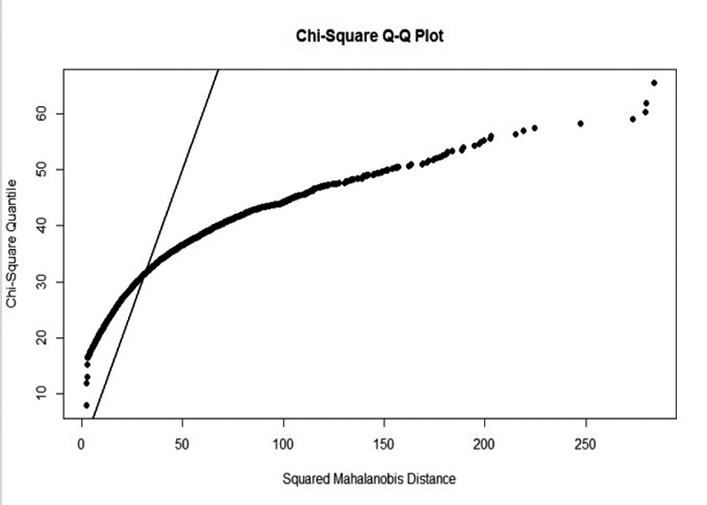 Note. Q-Qplot of the multivariate distribution of respondents' responses to items.
 Note. Dotted lines represent the metric of each latent variable determined by fixing the factor loading of the first indicator to 1.0. Bold lines represent stronger factor loadings.