 Carbapenem resistance and ESBL production in the Acinetobacter calcoaceticus-Acinetobacter baumannii complex in animals: challenges in resistance identification and diagnosis
ABSTRACT:
The Acinetobacter calcoaceticus-Acinetobacter baumannii (Acb) complex is a major concern in veterinary medicine due to its intrinsic resistance to various antimicrobial agents, including ampicillin, amoxicillin, amoxicillin-clavulanate, and carbapenems. The increasing prevalence of multidrug-resistant (MDR) strains, particularly those producing extended-spectrum beta-lactamases (ESBLs) and carbapenemases, has been observed in animals, with a significant number of urinary tract infections being associated with these pathogens. The present study identified Acb complex strains harboring one or more resistance genes for ESBL and carbapenemase production, highlighting the growing issue of bacterial resistance in veterinary clinical practice. Phenotypic resistance profiling revealed that some Acinetobacter complex strains can hydrolyze a wide range of beta-lactams, including penicillins and third- and fourth-generation cephalosporins, while remaining resistant to cephamycins and carbapenems. Most of the ESBLs belong to Ambler’s class A, and these enzymes can be inhibited by clavulanic acid, sulbactam, tazobactam, and avibactam. The spread of these resistant strains is largely attributed to clonal expansion and horizontal gene transfer, with CTX-M, SHV, and TEM-derived ESBLs being the most clinically significant. Despite advances in molecular diagnostic methods, correlating phenotypic and genotypic data remains a significant challenge. The present findings highlight discrepancies between the phenotypic resistance patterns and the presence of resistance genes, illustrating the complexity of diagnosing and treating infections caused by Acinetobacter species. Further studies are necessary to better understand the mechanisms of resistance, improve diagnostic accuracy, and address the increasing threat of MDR bacteria in the veterinary field.
INDEX TERMS:
CTX; NDM; OXA; superbugs; One Health
RESUMO:
O complexo Acinetobacter calcoaceticus-Acinetobacter baumannii (Acb) é uma grande preocupação na medicina veterinária devido à sua resistência intrínseca a diversos agentes antimicrobianos, incluindo ampicilina, amoxicilina, amoxicilina-clavulanato e carbapenêmicos. A crescente prevalência de cepas multirresistentes (MDR), especialmente aquelas produtoras de beta-lactamases de espectro estendido (ESBLs) e carbapenemases, tem sido observada em animais, com um número significativo de infecções do trato urinário associadas a esses patógenos. O presente estudo identificou cepas do complexo Acb que abrigam um ou mais genes de resistência responsáveis pela produção de ESBLs e carbapenemases, destacando o crescente problema da resistência bacteriana na prática clínica veterinária. A análise fenotípica da resistência revelou que algumas cepas do complexo Acinetobacter são capazes de hidrolisar uma ampla gama de beta-lactâmicos, incluindo penicilinas e cefalosporinas de terceira e quarta geração, permanecendo resistentes às cefamicinas e aos carbapenêmicos. A maioria das ESBLs pertence à classe A de Ambler, e essas enzimas podem ser inibidas por ácido clavulânico, sulbactam, tazobactam e avibactam. A disseminação dessas cepas resistentes é atribuída, em grande parte, à expansão clonal e à transferência horizontal de genes, sendo as ESBLs derivadas dos genes CTX-M, SHV e TEM as mais clinicamente relevantes. Apesar dos avanços nos métodos moleculares de diagnóstico, correlacionar os dados fenotípicos e genotípicos ainda é um grande desafio. Os achados deste estudo evidenciam discrepâncias entre os padrões fenotípicos de resistência e a presença de genes de resistência, ilustrando a complexidade do diagnóstico e tratamento de infecções causadas por espécies de Acinetobacter. Estudos adicionais são necessários para compreender melhor os mecanismos de resistência, melhorar a precisão diagnóstica e enfrentar a crescente ameaça das bactérias multirresistentes no campo veterinário.
TERMOS DE INDEXAÇÃO:
CTX; NDM; OXA; superbactérias; Saúde Única
Introduction
Acinetobacter is a genus of Gram-negative bacteria that has gained increasing attention in veterinary medicine and animal health due to its ability to cause infections in various species (Holmström et al. 2022). Over the past decade, Acinetobacter species have emerged as one of the most clinically significant agents due to their nosocomial potential, intrinsic resistance to multiple routine antimicrobials in both veterinary and human medicine, and the rising incidence of multidrug resistance, making infections difficult to control (Vijayakumar et al. 2019, Nocera et al. 2021).
Bacteria of the Acinetobacter genus are Gram-negative coccobacilli, strictly aerobic, non-motile, non-glucose fermenting, catalase-positive, and oxidase-negative (D’Souza et al. 2019). They are associated with numerous pathological conditions, including pneumonia (Nowak et al. 2017), meningitis (Alvarez-Vega et al. 2020), urinary tract infections (Jiménez-Guerra et al. 2018), skin and wound infections (Munier et al. 2019), endocarditis (Ioannou et al. 2021), and even sepsis (Mahich et al. 2021) in both humans and various animal species.
Carbapenems are a treatment option for infections caused by these pathogens. However, Acinetobacter baumannii strains resistant to carbapenems are classified as critical superbugs (priority level 1) by the WHO (2025), posing a major challenge to healthcare systems (Rodríguez et al. 2018). Due to their similarity with all species in the Acb complex, any species exhibiting carbapenem resistance is of significant concern. Additionally, carbapenems serve as a treatment option for bacteria producing extended-spectrum beta-lactamases (ESBLs). ESBLs are enzymes capable of hydrolyzing third- and fourth-generation cephalosporins as well as aztreonam (a monobactam). These enzymes, however, can be inhibited by compounds such as clavulanate, sulbactam, and tazobactam (Bush et al. 1995, BrCAST 2024).
For decades, extensive research has aimed to understand resistance mechanisms and control their spread in clinical settings (D’Souza et al. 2019). Some studies have identified resistance genes in animals such as pigs and cattle (Hamouda et al. 2011, Wareth et al. 2019), as well as in dogs, cats, and horses (Wareth et al. 2019, Maboni et al. 2020). Investigating resistance genes across all species within the Acb complex is essential for understanding their impact and reducing the indiscriminate use of antimicrobials in both clinical practice and animal production (Wong et al. 2017).
The objective of this study was to detect, both phenotypically and genotypically, the presence of carbapenemase resistance genes and ESBL production in Acinetobacter calcoaceticus-Acinetobacter baumannii complex strains circulating in animal production, maintenance, and hospital care environments using a One Health approach.
Materials and Methods
Ethical approval. This study was approved by the Ethics Committee on Animal Use under the number CEUA 8969230919.
Sampling. Ninety-one non-fermenting Gram-negative coccobacilli strains were isolated from urinary tract infections, otitis, piodermitis and pododermatitis in dogs, cats, and horses from 2018 to 2020 from a private laboratory in Rio de Janeiro. These samples were selected for investigation of strains belonging to the Acinetobacter calcoaceticus-Acinetobacter baumannii complex, resulting in a total of 35 strains within this complex.
Acb complex identification. Four simplex polymerase chain reactions (PCRs) were performed for the rpoB gene, covering specific regions of the gene: Zone 1 (Ac696F/Ac1093R) and 2 (Ac1055f/1598R), and flanking regions (AcintLBF/AcintLBR and AcintBCF/AcintBCR). PCR products were purified using the PCR DNA and Gel Band Purification Kit, quantified using a Quantus fluorometer (Promega) from the “Laboratório de Pesquisa em Infecção Hospitalar” (Hospital Infectious Diseases Research Laboratory - LAPIH) of the “Instituto Oswaldo Cruz” (Fiocruz), and finally, sequencing (SANGER) as recommended by La Scola et al. (2006). The sequences were edited using the Bioedit program (Hall et al. 1999) and subsequently compared with other sequences deposited in the NCBI database6.
Acb complex identification and antimicrobial susceptibility testing. Bacterial isolates exhibiting negative results for oxidase and motility, and a positive result for catalase, were selected. Following 18-24 hours of incubation at 35 °C, colonies of interest were suspended in sterile saline until achieving a turbidity equivalent to the 0.5 McFarland standard, corresponding to an approximate bacterial density of 1.5 × 10⁸ CFU/mL (CLSI 2023).
Phenotypic characterization of carbapenem and multidrug resistance and ESBL. Antibiotic susceptibility testing was performed using a panel of antimicrobial agents. To assess carbapenem resistance, meropenem (MPM, 10 µg) was used. For the evaluation of multidrug resistance (MDR), the following antibiotics were tested: ampicillin (AMP, 30 µg), ampicillin-sulbactam (ASB, 20 µg), amikacin (AMI), ciprofloxacin (CIP, 5 µg), gentamicin (GEN, 10 µg), levofloxacin (LEV), doxycycline (DOX, 30 µg), tetracycline (TET, 30 µg), azithromycin (AZI, 15 µg), and sulfamethoxazole-trimethoprim (SUT, 25 µg). To detect extended-spectrum β-lactamase (ESBL) production, the following agents were employed: amoxicillin-clavulanate (AMC, 30 µg), ceftazidime (CAZ), aztreonam (ATM, 30 µg), cefoxitin (CFO, 30 µg), and cefepime (CPM). Antimicrobial susceptibility interpretations were based on CLSI (2023) and BrCAST (2024) guidelines.
Detection of ESBL and carbapenemase genes. The presence of blaTEM (Minarini et al. 2007), blaCTX-M (Geser et al. 2012), and blaSHV (Shahid et al. 2011) genes was investigated for ESBL production. A multiplex PCR assay was employed to detect blaOXA-51, blaOXA-23, and blaOXA-143 (Woodford et al. 2006, Higgins et al. 2010), blaOXA-24 and blaOXA-58 (Higgins et al. 2010), blaIMP and blaVIM (Fallah et al. 2014), as well as blaKPC, blaNDM, and blaOXA-48 (Monteiro et al. 2012). The genes were investigated for carbapenemase (Table 1).
Positive control. CCBH 6556 Klebsiella pneumoniae (blaTEM, blaCTX, blaSHV, blaKPC), CCBH 3174 A. baumannii (blaOXA-51 and blaOXA-23), CCBH 7357 A. baumannii (blaOXA-143), CCBH 8311 A. baumannii (blaOXA-24), CCBH 7740 A. baumannii (blaOXA-48), CCBH 24606 Pseudomonas aeruginosa (blaVIM), CCBH 16302 K. pneumoniae (blaNDM), CCBH 10079 K. pneumoniae (blaOXA-48).
Statistic. The agreement between phenotypic and genotypic results was evaluated using Cohen’s Kappa coefficient, which measures the level of agreement between two observers or methods beyond chance. The results were interpreted according to the following criteria: < 0.20 (poor agreement), 0.21-0.40 (fair), 0.41-0.60 (moderate), 0.61-0.80 (substantial), and > 0.80 (almost perfect). The association between methods was assessed using contingency tables, and Pearson’s chi-square test was applied when expected frequencies were adequate. A significance level of 5% (p < 0.05) was adopted. All analyses were performed using R software (version 4.4.2) and the irr statistical package.
Results
Among the 35 isolates evaluated for resistance profiles, 54.28% (19/35) were classified as multidrug-resistant (MDR). Of these, 31.57% (6/19) were identified as Acinetobacter pittii, 26.32% (5/19) as Acinetobacter nosocomialis, and 10.52% (2/19) corresponded to species outside the Acinetobacter calcoaceticus-baumannii (Acb) complex, specifically Acinetobacter venetianus and Acinetobacter ursingii. Additionally, A. baumannii accounted for 31.57% (6/19) of the MDR isolates. According to CLSI (2020), a bacterium is classified as MDR when it exhibits resistance to at least one representative of three or more classes of antimicrobial agents.
The identified MDR isolates were primarily associated with urinary tract and skin infections in cats and dogs (Table 2). This finding underscores the need for continuous monitoring of these strains in veterinary environments to implement effective control measures and optimize therapeutic protocols.
The prevalence of resistance in the Acb complex for each antimicrobial evaluated was 88.57% (31/35) for ampicillin + sulbactam, 62.86% (22/35) for aztreonam, 57.14% (20/35) for ceftaxime, 40% (14/35) for sulfamethoxazole + trimethoprim, 37.14% (13/35) for gentamicin, 31.42% (11/35) for levofloxacin, amoxicillin + sulbactam, and ciprofloxacin, 22.87% (8/35) for cefepime and ceftazidime, 17.14% (6/35) for meropenem and imipenem, 14.29% (5/35) for tetracycline and amoxicillin + clavulanate, 11.43% (4/35) for cefoxitin, 8.57% (3/35) for amikacin, and 5.71% (2/35) for azithromycin and doxycycline.
Among the 35 strains studied, 48.57% (17/35) harbored one or more ESBL genes. Of these, 23.53% (4/17) carried the blaCTX gene, 5.88% (1/17) carried the blaSHV gene, and 47.06% (8/17) carried the blaTEM gene. Additionally, 17.65% (3/17) harbored both blaCTX and blaTEM, while 5.88% (1/17) carried both blaSHV and blaTEM. Although the identification of these genes is considered relatively rare in A. baumannii (Ghaima 2018), this study identified seven ESBL-producing A. baumannii isolates and ten non-A. baumannii isolates. Among the latter, 70% (7/10) were A. pittii, and 30% (3/10) were A. nosocomialis.
In the current One Health context, the strains in this study were evaluated to produce penicillinase-type carbapenemase with the blaKPC gene, metallo-β-lactamase (MBL)-type carbapenemase for the blaIMP, blaVIM, and blaNDM genes, and OXA-type carbapenemase production for the blaOXA-23, blaOXA-24, blaOXA-51, blaOXA-48, blaOXA-58, and blaOXA-143 genes. Of the 35 strains, 54.28% (19/35) exhibited one or more carbapenemase genes. Among these 19, 36.82% (7/19) exhibited MBL genes, with 28.57% (2/7) carrying blaIMP, 71.43% (5/7) carrying blaVIM, and 14.28% (1/7) carrying both genes. No other MBL or penicillinase-type genes were detected.
Among the 19 strains with carbapenemase genes, 89.47% (17/19) exhibited OXA genes, with 76.47% (13/17) A. baumannii strains carrying blaOXA-51, 5.88% (1/17) A. pittii strains carrying blaOXA-51, 5.88% (1/17) A. nosocomialis strain carrying blaOXA-51, 5.88% (1/17) A. pittii strain carrying blaOXA-23, and 5.88% (1/17) A. baumannii strain carrying both blaOXA-51 and blaOXA-23, which was an environmental sample. Furthermore, 26.31% (5/19) of the strains exhibited both MBL and OXA genes simultaneously, while 52.63% (10/19) harbored both ESBL and carbapenemase genes concurrently (Table 3).
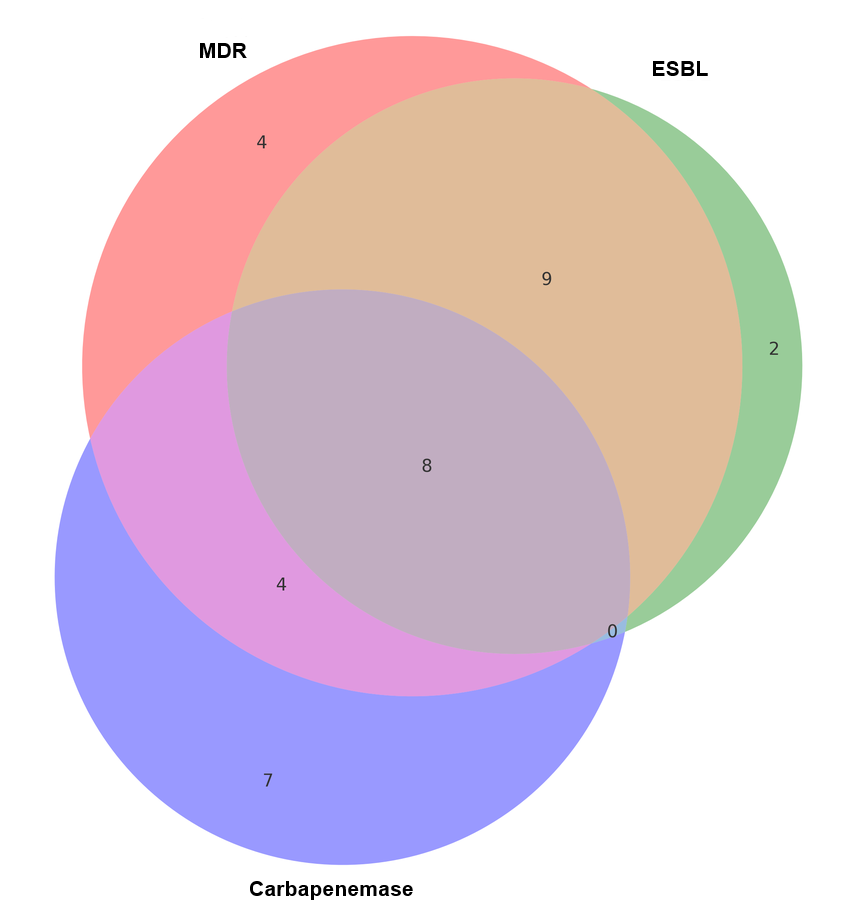
Of the 19 isolates classified as MDR, 68.42% (13/19) exhibited genes for β-lactamase production, either ESBL or carbapenemase (Fig. 1). This finding represents a significant concern in veterinary clinical practice, as prescribing effective treatment for these animals becomes increasingly challenging.
Venn diagram showing the overlap between isolates exhibiting multidrug-resistant (MDR) phenotypes, extended-spectrum β-lactamase (ESBL) genes, and carbapenemase genes.
For ESBL detection, the Cohen’s Kappa coefficient was 0.18 (p= 0.0623), indicating poor agreement between the methods. The phenotypic test showed 100% sensitivity and a negative predictive value (NPV) of 100%; however, it demonstrated low specificity (56%) and a positive predictive value (PPV) of only 18%. These findings suggest that although the phenotypic test for ESBL is effective as a screening tool by minimizing false negatives, its low specificity may result in a high rate of false positives, underscoring the need for confirmatory genotypic testing.
In contrast, for carbapenemase detection, the Kappa coefficient was 0.00, indicating a complete lack of agreement between methods, with a non-calculable p-value (NaN). The association test (chi-square) did not reveal a statistically significant relationship (p= 0.6121). Notably, the phenotypic test failed to detect any of the 19 positive cases identified by the genotypic method, precluding the calculation of accuracy metrics. This result highlights the ineffectiveness of the phenotypic test for carbapenemase detection in the studied population, deeming it unsuitable for both screening and diagnostic confirmation.
Discussion
Bacteria of the Acb complex exhibit intrinsic resistance (IR) to the antimicrobial agents ampicillin (AMP), amoxicillin (AMO), amoxicillin-clavulanate (AMC), aztreonam (AZT), ertapenem (ERT 10 µg), trimethoprim (TRI 10 µg), chloramphenicol (CLO 30 µg), and fosfomycin (FOS 30 µg) (BrCAST 2024), which poses a challenge for routine treatment. Moreover, few antimicrobials have specific cutoff points in disk diffusion manuals (BrCAST 2024, CLSI 2020). BrCAST (2024) classifies resistance to cefotaxime (CTX 30 µg), ceftriaxone (CRO 30 µg), doxycycline (DOX 30 µg), and tetracycline (TET 30 µg) as intrinsic, while CLSI (2020) also considers resistance to cefotaxime and highlights the ability of Acb complex species to acquire additional resistance genes (Poirel et al. 2011), making accurate diagnosis and treatment challenging.
However, few studies have reported the occurrence of other Acb complex species causing infections in animals and exhibiting MDR profiles (Bahr Arias et al. 2013, Guimarães et al. 2013, Smet et al. 2014, Kuzi et al. 2016, Maboni et al. 2019). Our results, along with recent studies, raise concerns about the considerable prevalence of MDR in Acb complex strains associated with infections in animals, which may potentially be transmitted to humans or vice versa (Maboni et al. 2019, Van der Kolk et al. 2019). The MDR pattern is related to the expression of various resistance mechanisms, including β-lactamases, multidrug efflux pumps, aminoglycoside-modifying enzymes, permeability defects, and alterations in target sites (Gallagher & Baker 2020). In a recent study, high MDR resistance rates were found in Acinetobacter spp. isolates from animals, except for imipenem, to which all isolates tested were susceptible (Maboni et al. 2020).
The phenotypic identification of resistance presents challenges, particularly since 2018, since microbiology diagnostic laboratories in Brazil are required to standardize according to the BrCAST manual, which lacks specific data for veterinary medicine. Therefore, a hybrid approach using both BrCAST and CLSI manuals is employed, although significant differences in cutoff points exist between them. For example, when evaluating ESBL, although both manuals consider resistance to similar antimicrobials, their cutoff points differ. BrCAST considers a positive result when the inhibition zones around any of the cephalosporin discs are expanded towards the disc containing clavulanic acid, considering the appearance of a ghost zone and distortion of the cephalosporin halo. In contrast, CLSI considers resistance to any antimicrobial tested.
Regarding the evaluation of carbapenemase production, phenotypic tests for Acinetobacter spp. are not widely recommended, as resistance manuals primarily focus on the Enterobacterales order. This may justify the difficulty in correlating phenotypic tests with the detection of resistance genes. In our study, four isolates did not exhibit a phenotypic ESBL production pattern in the disk diffusion methods recommended by CLSI and BrCAST, although they possessed ESBL genes, demonstrating the challenges of accurate resistance identification in the veterinary clinic.
The production of carbapenemase is highly significant, as carbapenems are considered an effective alternative for treating infections caused by Acinetobacter spp. (WHO 2025). However, intrinsic resistance, MDR, and the production of ESBLs and carbapenemases complicate therapeutic decision-making. Acinetobacter spp. have developed resistance to carbapenems through various mechanisms, including the presence of metallo-β-lactamases (MBLs) (Class B), which hydrolyze all β-lactams and can be horizontally transferred between bacterial species, facilitating their rapid spread both within species and across large geographical distances (Theriault et al. 2021). Additionally, the presence or overexpression of oxacillinase-type carbapenemases (OXA) (Class D), particularly blaOXA-23, blaOXA-24, blaOXA-58, and blaOXA-51 (Poirel et al. 2011, Chen et al. 2018), confers resistance to most β-lactams, including third-generation cephalosporins. These resistance mechanisms may also coexist with resistance to other classes of antimicrobials (Theriault et al. 2021).
While some strains did not demonstrate phenotypic resistance to meropenem, carbapenemase-producing genes were detected. According to CLSI (2020), Acinetobacter spp. exhibits low sensitivity to the CarbaNP, mCIM, and eCIM phenotypic tests that utilize meropenem, which may account for the difficulty in expressing the phenotype during testing.
Although numerous studies have elucidated the genetic basis of antimicrobial resistance AMR and persistence through laboratory evolution and genomic analysis, the direct correlation between genotype and phenotype remains complex. This complexity arises from the multifactorial nature of antibiotic effects and the involvement of mutations outside the canonical resistance pathways. Understanding the interplay between phenotypic resistance and underlying genetic alterations is further complicated in clinical isolates due to the lack of ancestral strain information and the presence of neutral or compensatory mutations (Maeda & Furusawa 2024). Therefore, establishing robust genotype-phenotype correlations requires controlled laboratory evolution experiments that allow systematic tracking of phenotypic traits alongside whole-genome sequencing.
Due to these characteristics, MBLs are frequently reported, particularly in A. baumannii strains (Theriault et al. 2021). Kabir et al. (2016) did not detect blaOXA-23 or blaOXA-24 in A. baumannii, and numerous studies have focused on the blaOXA-51 gene, as it is considered intrinsic (Turton et al. 2006, Takebayashi et al. 2021). However, in the present study, we identified these genes in non-A. baumannii species, highlighting the potential for horizontal gene transfer between species.
Antimicrobial resistance represents a significant public health concern, particularly due to the unclear mechanisms underlying its generation, maintenance, and transmission between humans and animals, with A. baumannii serving as a notable example of this complexity (Maboni et al. 2020). Few veterinary studies have reported the occurrence of different species within the Acb complex beyond A. baumannii, as well as their respective resistance profiles. However, studies such as the present one underscore the increasing clinical relevance of this bacterial complex in routine infections. Continued research in this area is essential for a comprehensive understanding within the veterinary field.
Conclusions
The high intrinsic resistance of species within the Acinetobacter calcoaceticus-Acinetobacter baumannii complex, coupled with the increasing acquisition of carbapenem resistance, poses a significant challenge in veterinary clinical practice. This study identified strains harboring one or more resistance genes associated with extended-spectrum β-lactamase (ESBL) and carbapenemase production, predominantly isolated from urinary infections, highlighting the rising trend of antimicrobial resistance in veterinary settings.
These strains demonstrate notable resistance mechanisms, particularly against β-lactams. Some were found to produce both ESBLs and carbapenemases, enabling the hydrolysis of most penicillins, third- and fourth-generation cephalosporins, and monobactams (e.g., aztreonam), though remaining ineffective against cephamycins and carbapenems.
The emergence of the ESBL-producing strains identified in this study represents a global concern, driven primarily by the clonal expansion of resistant organisms, plasmid-mediated horizontal gene transfer, and the development of novel enzymes. Among ESBLs, CTX-M enzymes are the most clinically relevant, followed by SHV- and TEM-derived variants.
A key challenge identified in this study is the incosistency between genotypic and phenotypic data. While resistance genes were detected in several strains, phenotypic tests did not consistently reflect these findings, complicating diagnosis and treatment selection. This discrepancy highlights the urgent need for improved diagnostic methods to enhance concordance between genotypic and phenotypic results, thereby supporting more accurate management of resistant infections in veterinary medicine.
Acknowledgements
This study received support from the “Fundação de Amparo à Pesquisa do Estado do Rio de Janeiro” (FAPERJ, E-26/210.085/2020 and E-26/202.604/2019), the “Coordenação de Aperfeiçoamento de Pessoal de Nível Superior” (CAPES), “Conselho Nacional de Desenvolvimento Científico e Tecnológico” (CNPq), and the “Fundação de Apoio à Pesquisa Científica e Tecnológica” (FAPUR) of “Universidade Federal Rural do Rio de Janeiro (UFRRJ).
REFERENCES
-
Alvarez-Vega M, Boga JA, Fernandez-Suarez J, Martinez-Sela M, Moran-Suarez N, Rodríguez-Guardado A. Multidrug-resistant Acinetobacter meningitis in neurosurgical patients with intraventricular catheters: assessment of different treatments-authors’ response. J Antimicrob Chemother 2020; https://doi.org/10.1093/jac/dkz541
» https://doi.org/10.1093/jac/dkz541 -
Bahr Arias MV, Aiello G, Battaglia LA, Freitas JC. Estudo da ocorrência de infecção hospitalar em cães e gatos em um centro cirúrgico veterinário universitário. Pesq Vet Bras 2013; https://doi.org/10.1590/S0100-736X2013000600014
» https://doi.org/10.1590/S0100-736X2013000600014 -
BrCAST. Tabelas de pontos de corte para interpretação de CIMs e diâmetros de halos. Versão BrCAST válida a partir de 13-04-2024. Brazilian Committee on Antimicrobial Susceptibility Testing. 2024. Accessed on May 6, 2025. https://brcast.org.br/wp-content/uploads/2022/09/Tabela-pontos-de-corte-BrCAST-13-04-2024.pdf
» https://brcast.org.br/wp-content/uploads/2022/09/Tabela-pontos-de-corte-BrCAST-13-04-2024.pdf -
Bush K, Jacoby GA, Medeiros AA. A functional classification scheme for β-lactamases and its correlation with molecular structure. Antimicrob Agents Chemother 1995; https://doi.org/10.1128/aac.39.6.1211
» https://doi.org/10.1128/aac.39.6.1211 -
Chen L, Yuan J, Xu Y, Zhang F, Chen Z. Comparison of clinical manifestations and antibiotic resistances among three genospecies of the Acinetobacter calcoaceticus-Acinetobacter baumannii complex. Plos One 2018; https://doi.org/10.1371/journal.pone.0191748
» https://doi.org/10.1371/journal.pone.0191748 - CLSI. Performance Standards for Antimicrobial Disk and Dilution Susceptibility Tests for Bacteria Isolated from Animals. 6th ed. VET01S. Wayne: Clinical and Laboratory Standards Institute; 2023.
- CLSI. Performance Standards for Antimicrobial Disk and Dilution Susceptibility Tests for Bacteria Isolated From Animals. 5th ed. VET01S. Wayne: Clinical and Laboratory Standards Institute; 2020.
-
D’Souza R, Pinto NA, Phuong NL, Higgins PG, Vu TN, Byun J-H, Cho YL, Choi JR, Yong D. Phenotypic and genotypic characterization of Acinetobacter spp. panel strains: a cornerstone to facilitate antimicrobial development. Front Microbiol 2019; https://doi.org/10.3389/fmicb.2019.00559
» https://doi.org/10.3389/fmicb.2019.00559 -
Fallah F, Noori M, Hashemi A, Goudarzi H, Karimi A, Erfanimanesh S, Alimehr S. Prevalence of bla NDM , bla PER , bla VEB , bla IMP , and bla VIM genes among Acinetobacter baumannii isolated from two hospitals of Tehran, Iran. Scientifica 2014; https://doi.org/10.1155/2014/245162
» https://doi.org/10.1155/2014/245162 -
Gallagher P, Baker S. Developing new therapeutic approaches for treating infections caused by multi-drug resistant Acinetobacter baumannii: Acinetobacter baumannii therapeutics. J Infect 2020; https://doi.org/10.1016/j.jinf.2020.10.016
» https://doi.org/10.1016/j.jinf.2020.10.016 -
Geser N, Stephan R, Hächler H. Occurrence and characteristics of extended-spectrum β-lactamase (ESBL) producing Enterobacteriaceae in food producing animals, minced meat and raw milk. BMC Vet Res 2012; https://doi.org/10.1186/1746-6148-8-21
» https://doi.org/10.1186/1746-6148-8-21 -
Ghaima KK. Distribution of extended spectrum beta-lactamase (ESBL) genes among Acinetobacter baumannii isolated from burn infections. MOJ Cell Sci Rep 2018; https://medcraveonline.com/MOJCSR/MOJCSR-05-00112.pdf
» https://medcraveonline.com/MOJCSR/MOJCSR-05-00112.pdf -
Guimarães KOP, Barbosa RM, Santos CR, Reimberg JYA, Gonçalves S, Cruz GD. Infecção por Acinetobacter em um cão: relato de um caso. Arch Vet Sci 2013; https://shre.ink/qthO
» https://shre.ink/qthO -
Hall TA. BioEdit: a user-friendly biological sequence alignment editor and analysis program for Windows 95/98/NT. Nucleic Acids Symposium Series 1999; https://shre.ink/qgK2
» https://shre.ink/qgK2 -
Hamouda A, Findlay J, Al Hassan L, Amyes SGB. Epidemiology of Acinetobacter baumannii of animal origin. Vet Microbiol 2011; https://doi.org/10.1016/j.ijantimicag.2011.06.007
» https://doi.org/10.1016/j.ijantimicag.2011.06.007 -
Higgins PG, Lehmann M, Seifert H. Inclusion of OXA-143 primers in a multiplex polymerase chain reaction (PCR) for genes encoding prevalent OXA carbapenemases in Acinetobacter spp. Int J Antimicrob Agents 2010; https://doi.org/10.1016/j.ijantimicag.2009.10.014
» https://doi.org/10.1016/j.ijantimicag.2009.10.014 -
Holmström TCH, David LA, Motta CC, Rocha-de-Souza CM, Maboni G, Coelho IS, Melo DA, Souza MMS. Acinetobacter calcoaceticus-Acinetobacter baumannii complex in animals: identification and antimicrobial resistance profile. Pesq Vet Bras 2022; https://doi.org/10.1590/1678-5150-PVB-7043
» https://doi.org/10.1590/1678-5150-PVB-7043 -
Ioannou P, Mavrikaki V, Kofteridis DP. Infective endocarditis by Acinetobacter species: a systematic review. J Chemother 2021; https://doi.org/10.1080/1120009X.2020.1812804
» https://doi.org/10.1080/1120009X.2020.1812804 -
Jiménez-Guerra G, Heras-Cañas V, Gutiérrez-Soto M, Aznarte-Padial MP, Expósito-Ruiz M, Navarro-Marí JM, Gutiérrez-Fernández J. Urinary tract infection by Acinetobacter baumannii and Pseudomonas aeruginosa: evolution of antimicrobial resistance and therapeutic alternatives. J Med Microbiol 2018; https://doi.org/10.1099/jmm.0.000742
» https://doi.org/10.1099/jmm.0.000742 -
Kabir MH, Meunier D, Hopkins KL, Giske CG, Woodford N. A two-centre evaluation of RAPIDEC® CARBA NP for carbapenemase detection in Enterobacteriaceae, Pseudomonas aeruginosa and Acinetobacter spp. J Antimicrob Chemother 2016; https://doi.org/10.1093/jac/dkv468
» https://doi.org/10.1093/jac/dkv468 -
Kuzi S, Blum SE, Kahane N, Adler A, Hussein O, Segev G, Aroch I. Multi-drug-resistant Acinetobacter calcoaceticus-Acinetobacter baumannii complex infection outbreak in dogs and cats in a veterinary hospital. J Small Anim Pract 2016; https://doi.org/10.1111/jsap.12555
» https://doi.org/10.1111/jsap.12555 -
La Scola B, Gundi VAKB, Khamis A, Raoult D. Sequencing of the rpoB Gene and flanking spacers for molecular identification of Acinetobacter species. J Clin Microbiol 2006; https://doi.org/10.1128/jcm.44.3.827-832.2006
» https://doi.org/10.1128/jcm.44.3.827-832.2006 -
Maboni G, Seguel M, Lorton A, Sanchez S. Antimicrobial resistance patterns of Acinetobacter spp. of animal origin reveal high rate of multidrug resistance. Vet Microbiol 2020; https://doi.org/10.1016/j.vetmic.2020.108702
» https://doi.org/10.1016/j.vetmic.2020.108702 -
Maeda T, Furusawa C. Laboratory evolution of antimicrobial resistance in bacteria to develop rational treatment strategies. Antibiotics 2024: https://doi.org/10.3390/antibiotics13010094
» https://doi.org/10.3390/antibiotics13010094 -
Mahich S, Angurana SK, Suthar R, Sundaram V, Munda VS, Gautam V. Acinetobacter sepsis among out-born neonates admitted to neonatal unit in pediatric emergency of a tertiary care hospital in North India. Indian J Pediatr 2021; https://doi.org/10.1007/s12098-020-03460-3
» https://doi.org/10.1007/s12098-020-03460-3 -
Minarini LAR, Gales AC, Palazzo ICV, Darini ALC. Prevalence of community-occurring extended spectrum β-lactamase-producing Enterobacteriaceae in Brazil. Curr Microbiol 2007; https://doi.org/10.1007/s00284-006-0307-z
» https://doi.org/10.1007/s00284-006-0307-z -
Monteiro J, Widen RH, Pignatari ACC, Kubasek C, Silbert S. Rapid detection of carbapenemase genes by multiplex real-time PCR. J Antimicrob Chemother 2012; https://doi.org/10.1093/jac/dkr563
» https://doi.org/10.1093/jac/dkr563 -
Munier A-L, Biard L, Legrand M, Rousseau C, Lafaurie M, Donay J-L, Flicoteaux R, Mebazaa A, Mimoun M, Molina J-M. Incidence, risk factors and outcome of multi-drug resistant Acinetobacter baumannii nosocomial infections during an outbreak in a burn unit. Int J Infect Dis 2019; https://doi.org/10.1016/j.ijid.2018.11.371
» https://doi.org/10.1016/j.ijid.2018.11.371 -
Nocera FP, Attili A-R, De Martino L. Acinetobacter baumannii: its clinical significance in human and veterinary medicine. Pathogens 2021; https://doi.org/10.3390/pathogens10020127
» https://doi.org/10.3390/pathogens10020127 -
Nowak J, Zander E, Stefanik D, Higgins PG, Roca I, Vila J, McConnell MJ, Cisneros JM, Seifert H, MagicBullet Working Group WP4. High incidence of pandrug-resistant Acinetobacter baumannii isolates collected from patients with ventilator-associated pneumonia in Greece, Italy and Spain as part of the MagicBullet clinical trial. J Antimicrob Chemother 2017; https://doi.org/10.1093/jac/dkx322
» https://doi.org/10.1093/jac/dkx322 -
Poirel L, Bonnin RA, Nordmann P. Genetic basis of antibiotic resistance in pathogenic Acinetobacter species. IUBMB Life 2011; https://doi.org/10.1002/iub.532
» https://doi.org/10.1002/iub.532 -
Rodríguez CH, Nastro M, Famiglietti A. Carbapenemases in Acinetobacter baumannii Review of their dissemination in Latin America. Rev Argent Microbiol 2018; https://doi.org/10.1016/j.ram.2017.10.006
» https://doi.org/10.1016/j.ram.2017.10.006 -
Shahid M, Singh A, Sobia F, Rashid M, Malik A, Shukla I, Khan HM. blaCTX-M, blaTEM, and blaSHV in Enterobacteriaceae from North-Indian tertiary hospital: high occurrence of combination genes. Asian Pac J Trop Med 2011; https://doi.org/10.1016/S1995-7645(11)60046-1
» https://doi.org/10.1016/S1995-7645(11)60046-1 -
Smet A, Cools P, Krizova L, Maixnerova M, Sedo O, Haesebrouck F, Kempf M, Nemec A, Vaneechoutte M. Acinetobacter gandensis sp. nov. isolated from horse and cattle. Int J Syst Evol Microbiol 2014; https://doi.org/10.1099/ijs.0.068791-0
» https://doi.org/10.1099/ijs.0.068791-0 -
Takebayashi Y, Findlay J, Heesom KJ, Warburton PJ, Avison MB, Evans BA. Variability in carbapenemase activity of intrinsic OxaAb (OXA-51-like) β-lactamase enzymes in Acinetobacter baumannii J Antimicrob Chemother 2021; https://doi.org/10.1093/jac/dkaa502
» https://doi.org/10.1093/jac/dkaa502 -
Theriault N, Tillotson G, Sandrock CE. Global travel and Gram-negative bacterial resistance; implications on clinical management. Expert Rev Anti Infect Ther 2021; https://doi.org/10.1080/14787210.2020.1813022
» https://doi.org/10.1080/14787210.2020.1813022 -
Turton JF, Woodford N, Glover J, Yarde S, Kaufmann ME, Pitt TL. Identification of Acinetobacter baumannii by detection of the blaOXA-51-like carbapenemase gene intrinsic to this species. J Clin Microbiol 2006; https://doi.org/10.1128/jcm.01021-06
» https://doi.org/10.1128/jcm.01021-06 -
Van der Kolk JH, Endimiani A, Graubner C, Gerber V, Perreten V. Acinetobacter in veterinary medicine, with an emphasis on Acinetobacter baumannii J Glob Antimicrob Resist 2019; https://doi.org/10.1016/j.jgar.2018.08.011
» https://doi.org/10.1016/j.jgar.2018.08.011 -
Vijayakumar S, Biswas I, Veeraraghavan B. Accurate identification of clinically important Acinetobacter spp.: an update. Future Sci OA 2019; https://doi.org/10.2144/fsoa-2018-0127
» https://doi.org/10.2144/fsoa-2018-0127 -
Wareth G, Neubauer H, Sprague LD. Acinetobacter baumannii - a neglected pathogen in veterinary and environmental health in Germany. Vet Res Commun 2019; https://doi.org/10.1007/s11259-018-9742-0
» https://doi.org/10.1007/s11259-018-9742-0 -
WHO. Antimicrobial Resistance. World Health Organization. Accessed on Feb 1, 2025. https://www.who.int/news-room/fact-sheets/detail/antimicrobial-resistance
» https://www.who.int/news-room/fact-sheets/detail/antimicrobial-resistance -
Wong D, Nielsen TB, Bonomo RA, Pantapalangkoor P, Luna B, Spellberg B. Clinical and pathophysiological overview of Acinetobacter infections: a century of challenges. Clin Microbiol Rev 2017; https://doi.org/10.1128/CMR.00058-16
» https://doi.org/10.1128/CMR.00058-16 -
Woodford N, Ellington MJ, Coelho JM, Turton JF, Ward ME, Brown S, Amyes SGB, Livermore DM. Multiplex PCR for genes encoding prevalent OXA carbapenemases in Acinetobacter spp. Int J Antimicrob Agents 2006; https://doi.org/10.1016/j.ijantimicag.2006.01.004
» https://doi.org/10.1016/j.ijantimicag.2006.01.004
-
6
Accessed on Feb 1, 2025. GenBank: http://www.ncbi.nlm.nih.gov/
-
Data availability statement
The data supporting the findings of this study are not publicly available because they were not deposited in an open repository; however, they can be provided by the corresponding author upon reasonable request.
Edited by
-
Editor-in-Chief
Fabiano José Ferreira de Sant’Ana.
The data supporting the findings of this study are not publicly available because they were not deposited in an open repository; however, they can be provided by the corresponding author upon reasonable request.