
 Learning, entrepreneurship, and culture: Current scenario and future paths
Abstract
Purpose: To connect the theoretical field of Entrepreneurial Learning (EL) with the theory of Cultural Learning (CL), providing conceptual resources for studies examining how entrepreneurs learn in social and cultural contexts that differ from their ethnic and cultural origins.
Originality/value: The main contribution of this study is the introduction of the cultural dimension to the EL literature. By treating culture as a structural element of entrepreneurial learning, the article broadens the scope of theoretical analysis and proposes new avenues for investigation in diverse contexts.
Design/methodology/approach: The research integrates a theoretical discussion with a systematic literature review (SLR) and bibliometric analysis, using the Scopus database. We identified 81 articles for the bibliometric analysis, of which 22 were selected for an in-depth SLR. The selection criteria included thematic relevance, individual-level analysis, and cultural reference. Extracted information was organized and ranked to support subsequent synthesis and interpretation.
Results: EL and CL share core characteristics, including being experiential processes mediated by language, dependent on cognitive skills, and influenced by social interactions. Four theoretical propositions were presented to support this relationship. The analysis also revealed a geographic concentration of scientific outputs in European and North American countries, underscoring the need for further empirical research in underrepresented contexts, such as Brazil.
Contribution/implication: This study advances the conceptual development of EL and suggests promising directions for future research on cultural diversity and on immigrant or ethnic entrepreneurs.
Keywords:
learning; entrepreneurship; culture; social interaction; sociocultural environment
Resumo
Objetivo: Relacionar o campo teórico da Aprendizagem do Empreendedorismo (AE) à teoria da Aprendizagem Cultural (AC), com o intuito de oferecer subsídios conceituais para estudos que investiguem como empreendedores aprendem em contextos sociais e culturais distintos daquele de sua origem étnica e cultural.
Originalidade/relevância: A principal contribuição do estudo reside na introdução da dimensão cultural à literatura sobre AE. Ao considerar a cultura como elemento estruturante da aprendizagem empreendedora, o artigo amplia o escopo de análise teórica e propõe novas possibilidades de investigação em contextos marcados pela diversidade.
Design/metodologia/abordagem: A pesquisa combina uma discussão teórica, uma revisão sistemática da literatura (RSL) e uma análise bibliométrica, utilizando a base de dados Scopus. Foram identificados 81 artigos para a análise bibliométrica, dos quais 22 compuseram a etapa da RSL. A seleção considerou critérios como a relevância temática, o nível de análise individual e a menção à cultura. As informações extraídas foram organizadas e categorizadas para posterior síntese e interpretação.
Resultados: Os resultados indicam que AE e AC compartilham características fundamentais, como serem processos experienciais mediados pela linguagem, dependentes de habilidades cognitivas e influenciados por interações sociais. Foram apresentadas quatro proposições teóricas que fundamentam essa relação. A análise revelou, ainda, a concentração geográfica da produção científica em países europeus e norte-americanos, destacando a necessidade de mais estudos empíricos em contextos como o do Brasil.
Contribuição/implicação: A pesquisa contribui para o avanço conceitual da AE e aponta caminhos promissores para investigações futuras sobre diversidade cultural e sobre empreendedores imigrantes ou de etnia.
Palavras-chave:
aprendizagem; empreendedorismo; cultura; interação social; ambiente sociocultural
INTRODUCTION
Historically, the research field on Entrepreneurial Learning (EL) has been addressed from several theoretical perspectives (Wang & Chugh, 2014). However, the two approaches that stand out - the cognitive and the experiential - disregard the social aspects of learning (Vogt & Bulgacov, 2019; Wang & Chugh, 2014). Therefore, in addition to the lack of a clear definition of EL as a theoretical concept (Nogueira, 2019), the approaches used are insufficient to explain how EL takes place when entrepreneurs are embedded in a social environment with a culture different from their own.
To advance the literature on this topic, the general purpose of this study was to link the theoretical framework of EL to the theory of Cultural Learning (CL), thereby providing a basis for studies of entrepreneurial learning across distinct social and cultural contexts. |From the discussion of both theories and a systematic literature review (SLR) combined with bibliometrics, we present propositions regarding the relationship between EL and CL, at the individual level of analysis, that is, the study of the learning process from entrepreneurs’ perspective (the entrepreneur is the unit of analysis), without disregarding their social and cultural interactions. To do that, we raised several research questions, and, by discussing the theories (EL and CL), we sought to respond to the first one:
-
RQ1: Is there a relationship between the theoretical field of entrepreneurial learning and the theory of cultural learning?
The response to this question required presenting the main theoretical basics and defining the conceptual boundaries of the review. Based on them, the second research question could be answered:
-
RQ2: What does the state of the art in research on entrepreneurial learning reveal about the influence of culture on that process?
To answer the second question, we analyzed: a) the historical evolution of the number of publications; b) the leading authors and the co-authorship network; c) the leading journals; d) the most quoted articles; e) the most cited references and the co-citation network; and f) the co-occurrence of keywords. In addition, we examined the most-cited and most recent articles (published in the last eight years) in the three main journals, as well as studies that addressed the keyword “culture” or similar terms, to deepen the analysis.
The answers to both questions allowed responding to the final research question:
-
RQ3: What are the possible theoretical propositions on the relationship between EL and CL?
These analyses made it possible to understand the approaches used in studies on EL at the individual level of analysis and their potential relationships with CL, leading to four theoretical propositions that provide the necessary basis for studies of EL in social and cultural contexts different from the entrepreneur’s ethnic and cultural background. The following two sections discuss the central theories of this research and outline the conceptual scope of the review.
CULTURAL LEARNING
To discuss CL, it was necessary to define what we consider culture to be. We began with Malinowski’s (1944) definition, that culture is an organized social unit composed of artifacts and a dynamic, internally diverse system of customs (Bandura et al., 2008). It refers to the “theory of the code being followed” in the society in which an individual is born, which guides his/her interpretation of the unknown when interacting with foreigners (Keesing, 1974, p. 89). Therefore, culture is an environment of experience (Adler, 1975).
Hence, CL is a process of adapting to a different culture (Wilson et al., 2013) from the one where the individual was born (Keesing, 1974). Tomasello et al. (1993, p. 495) observe that “many animal species live in complex social groups; only humans live in cultures”. According to these authors, cultures are distinguished from other forms of social organization by the nature of their “products”, that is, material artifacts, social institutions, behavioral traditions, and languages.
Individuals’ unique cognitive abilities enable them to create and participate in complex social organizations and institutions (Tomasello, 1999). They have an exclusive capacity to acquire cultural products through social learning (Tomasello et al., 1993). Based on this concept, CL is related to Albert Bandura’s Social Cognitive Theory (SCT) (formerly known as Social Learning Theory).
It “is individual learning that is influenced, in some way, by the social environment” (Tomasello et al., 1993, p. 496). SCT holds that social structure and human activity are closely and intentionally related, and that individuals do not merely respond automatically to environmental perceptions (Bandura et al., 2008). According to SCT, human beings have developed an advanced capacity for observational (vicarious) learning, which is essential for their personal development, regardless of the culture in which they live.
It is through interaction with the local culture (and its people) that individuals (both foreigners and immigrants) acquire, develop, and eventually master cultural competence (Wilson et al., 2013). However, experiences in very different cultures can be catalysts for learning, provided they do not exceed the individual’s capacity for adaptation (Li et al., 2024). Therefore, CL becomes contextual, since individuals’ development is closely linked to social interactions within their environment, and to the learning experienced in that setting (Tomasello et al., 1993; Vygotsky, 2007).
Hence, there is a positive relationship between the length of residence in a new country and socio-cultural adaptation (Wilson et al., 2013). During the period of contact and adaptation to the new culture, individuals have the opportunity to receive cultural education and also learn through observation. However, intercultural interaction requires the ability to improvise and respond to the moment, rather than relying on previously learned norms of social behavior (DeRobertis & Bland, 2020; Montuori & Fahim, 2004).
Peter Adler (1975) was one of the first to recognize the potential of intercultural meetings for learning and the creation of meaning. The experience of [cultural] transition provides an alternative [and positive] view of cultural shock. This shock is the emotional result of the loss of perceptual reinforcements from one’s own culture and of misunderstanding new cultural incentives that arise from novel and diverse experiences. Although it generates stress, this state of tension can be a source of creativity and learning (Montuori & Fahim, 2004).
As individuals move from a stage of low personal and cultural consciousness (shock) to a state of high awareness, they become independent. That is, they undergo “experiential learning that is holistically incorporated into identity, while at the same time capable of again having preconceptions, assumptions, values, and attitudes challenged” (Adler, 1975, p. 18).
Even if it is the final stage in Adler’s model, CL would not end at the “independence” stage, since personal and cultural discoveries would open opportunities for further deep experiences, yielding new lessons (Adler, 1975). Therefore, beyond cultural shocks, which are often laden with trauma, intercultural meetings can foster learning and personal development (DeRobertis & Bland, 2020; Pacheco, 2020). Hence, the transition experience would be a process of self-discovery and development, rather than adjustment (Adler, 1975).
In addition, Kunst et al. (2024) highlight CL as central to distinguishing genuine cultural change from appropriation. Genuine change is viewed as a deep and transforming process, marked by authentic engagement with another culture, internalization of its values, and reinterpretation of self-concept.
ENTREPRENEURIAL LEARNING
Similar to CL theory, EL can be considered an experiential process resulting from the entrepreneur’s trajectory (Deakins & Freel, 1998; McKelvey, 1998). This was one of the first theoretical perspectives on the phenomenon (Lamont, 1972) and, until recent years, was still being used in studies on the topic (Vogt & Bulgacov, 2019). From this perspective, learning is a process continuously shaped by entrepreneurs’ experience and reflection, at different stages of their lives (Cope, 2005; Kolb, 1984; Thompson & Illes, 2021).
The studies are primarily based on Kolb’s (1984) Experiential Learning Theory. The author proposed that ideas are not unchanging elements but are formed and reshaped by experience. Therefore, learning would be defined in terms of a (continuous) process, rather than outcomes, and is always subject to the (positive) interference of experience. According to the author (p. 38), “learning is the process whereby knowledge is created through the transformation of experience.” Such a change would take place through reflective observation and active experimentation.
Although the experiential aspect of EL has gained prominence over the years (Cope, 2003, 2011; Rae, 2017), Kolb’s work was criticized for allegedly disregarding the contextual (social) factor in the learning process. Kayes (2002) redefined Kolb’s learning process, based on the post-structural analysis of the psychoanalyst Jacques Lacan, arguing that experience is not a privileged category inaccessible to the social world but always depends on context and existing social knowledge. Learning means being “continuously in a process of flux and movement, an interplay between the social and the personal” (Kayes, 2002, p. 146). In that conception, (spoken) language would provide coherence and structure to the social experience of learning.
As it is based on Dewey and Piaget’s studies, Kolb’s (1984) theory of experiential learning is grounded in interactionism and constructivism (learning through interaction with the social environment). However, the author’s proposed learning model does not show the role of social interactions on learning in a given context.
In addition to the experiential stream, the cognitive stream has also been strongly expressed in EL research (Minniti & Bygrave, 2001; St-Jean & Audet, 2012). In this type of learning, thinking, reflection, and understanding (through mental models) are highly relevant (Hager, 2011). That is, entrepreneurs’ ability to combine existing concepts and information into new ideas is essential to the entrepreneurial process, and may be driven by the support and guidance of mentors (St-Jean & Audet, 2012). The main criticism of this perspective concerns analyses of learning that are separated from context and social interactions (Vogt & Bulgacov, 2019; Wang & Chugh, 2014).
For this reason, although both approaches are significant, scholars recommend adopting different perspectives in EL studies. This is the case of Vogt and Bulgacov (2019), who observed that research on EL is still incipient, with gaps to fill, and El-Awad (2023), who advocates that EL is a dynamic process that merges cognitive and social mechanisms, both essential for dealing with the uncertainties that arise during the development of new ventures.
Hence, we considered that entrepreneurs’ experience and cognitive processes (cognitive capacity) play an important role in the EL process (Cope, 2011; El-Awad, 2023; Hager, 2011; Kolb, 1984; Politis, 2005; Rae, 2017), while acknowledging the limitations of both streams. Furthermore, given that the literature in this field is fragmented and inconsistent (Nogueira, 2019), lacking a single and consolidated concept, we drew upon the discussion presented in this section to propose the conceptual limits of EL that guided our review:
-
EL can be individual (the level of analysis is the entrepreneur).
-
It stems from the entrepreneur’s social experiences in developing and managing a venture (action), mediated by language.
-
It can be influenced by reflective observation.
-
It is based on the transformation of experience through reflection and cognitive processes.
Conceptual boundaries are necessary to define the parameters for including studies in an SLR and to ensure the quality of the analyzed literature (Williams Jr. et al., 2021).
METHODOLOGY
This study applied the principles of SLR in management (Williams Jr. et al., 2021) and some principles of bibliometric analysis (Donthu et al., 2021) to achieve its goals. We chose the Elsevier© Scopus database, given its emphasis on the fields of Business and Management (Aksnes & Sivertsen, 2019). The following explanations regard the research protocol used in the first stage (bibliometrics) and the second stage (SLR).
To collect articles, we used the following descriptors in the “title, abstract, and keywords” fields of the Scopus database: entrepreneur* and learn*, which were combined with the Boolean operator AND. The roots (entrepreneur* and learn*) were chosen to obtain more comprehensive results, as they include their variations as well as the original root. These terms were considered quite inclusive for finding the most relevant articles within the established conceptual limits (Wang & Chugh, 2014).
The initial search, conducted in February 2024, found 13,897 documents. Next, we applied the following filters: a) subject area - Business, Management, and Accounting; b) type of document - article; c) type of source - journal; d) keywords - learning, entrepreneur, entrepreneurial learning, experiential learning, and entrepreneurs. The filters limited the number of documents to 886 articles. We present the search strategy below:
( TITLE-ABS-KEY ( entrepreneur* ) AND TITLE-ABS-KEY ( learn* ) ) AND ( LIMIT-TO ( SUBJAREA , “busi” ) ) AND ( LIMIT-TO ( DOCTYPE , “ar” ) ) AND ( LIMIT-TO ( SRCTYPE , “j” ) ) AND ( LIMIT-TO ( EXACTKEYWORD , “learning” ) OR LIMIT-TO ( EXACTKEYWORD , “entrepreneur” ) OR LIMIT-TO ( EXACTKEYWORD , “entrepreneurial learning” ) OR LIMIT-TO ( EXACTKEYWORD , “experiential learning” ) OR LIMIT-TO ( EXACTKEYWORD , “entrepreneurs” ) )
We did not delimit the time frame or language for the study to minimize SLR restrictions (Williams Jr. et al., 2021) and to achieve a more comprehensive overview of the state of the art in EL research, consistent with the other established criteria. Although bibliometric research requires a broader scope and a larger database, we chose not to apply its principles to the 886 articles. Instead, we carried out two stages: 1) reading titles and abstracts; and 2) rereading titles and abstracts from pre-selected texts. These steps were intended to select only texts that met the study’s inclusion criteria and aligned with the review’s goals, while excluding the remaining articles.
-
Inclusion criteria: a) the primary topic is EL; b) the level of analysis is the individual; c) the research subject is the entrepreneur; and d) empirical study.
-
Exclusion criteria: a) not presenting EL as a primary topic, but secondary or as a conclusion of the study; b) addressing the topic of entrepreneurship education as its main goal; c) analysis at the organizational or group level, not individual; d) theoretical essay or purely theoretical articles; e) focus on other types of learning (e.g. organizational; competitive etc.) or on knowledge transfer; and f) research subjects are not entrepreneurs (e.g. investors, managers etc.).
The initial reading of titles and abstracts selected 158 articles. In rereading them, we had to consult their methodology section to ensure they met the inclusion criteria, as the information in the abstracts was insufficient. We then excluded an additional 77 texts, leaving the remaining 81 subject to bibliometric analysis. The Scopus platform enabled initial analyses, such as the evolution of the number of papers, leading authors, and journals. The other analyses (co-authorship network, most quoted articles, most cited references, co-citation network, and co-occurrence of keywords) were done through VOSviewer software version 1.6.20, for which we created a database with the metadata of the 81 articles in “.csv” format.
Figure 1 shows the flowchart for the search and screening of documents.
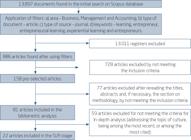
For the second stage of the analysis, resulting from SLR, we selected the 10 most cited articles, the most recent ones (from the last five years) published in the three leading journals (a total of 11 articles), and articles containing the keyword “culture” or similar (only one article). This analysis followed the principles of SLR, with the texts read in full and their contents summarized and grouped (Williams Jr. et al., 2021). The following elements were considered in this synthesis: title; author; journal; year of publication; language; objective; perspective on EL; definition of EL; theoretical perspectives; country; research subjects; method; main results; study contributions; and suggestions for future research.
After arranging these data in an MS Excel spreadsheet, we carried out a detailed review of the information extracted from each article, followed by categorization (most cited, most recent, containing the keyword “culture”). We grouped similar data using the platform’s filters and features. This systematization enabled the identification of patterns, recurrences, and gaps in the studies analyzed, especially regarding the processing of cultural dimensions and the theoretical approaches applied to EL.
Our insights, based on a critical and reflective reading of the content, were recorded in a specific column of the spreadsheet, serving as an additional interpretive resource for the formal analysis. This was essential for deepening our understanding of the current literature, as well as for highlighting the prevalence of certain contexts - notably European and North American - and the consequent need to extend empirical studies to other realities, like the Brazilian one, to foster greater diversity and strength in the field of investigation.
RESULTS OF THE BIBLIOMETRIC ANALYSIS
To understand the evolution of the field of research on EL at the individual level of analysis, this section explores the bibliometric aspects of the topic, based on the 81 selected articles, using VOSviewer.
Historical evolution in the number of publications
According to the survey conducted in Scopus, the first papers on the topic appeared in 2000 (Figure 2) and examined how entrepreneurs learned from experience (Cope & Watts, 2000; Fletcher, 2000) and acted as entrepreneurs (Rae, 2000; Rae & Carswell, 2000). From then on, few texts were published over the next decades, averaging two per year until 2016. Since 2017, the scenario has changed, with six articles published in that year.

That increase was due to the special issue published in 2017 by the International Journal of Entrepreneurial Behavior and Research, named “Entrepreneurial learning dynamics in knowledge-intensive enterprises”. Four of the six identified articles were published by the journal, three in the special issue and one in the next, all in the same year. The number of publications dropped again in 2019 (two articles), then resumed growth in 2020 (seven articles), reaching nine in 2021. This number remained quite stable in the following years, with eight articles published in 2022 and seven in 2023.
It is clear that the field of EL research, at the individual level of analysis, continues to grow. Nearly 38% of the studies (31) found were published in the last five years, and 60% (48) in the last 10 years. There were no special calls for papers on the subject between 2020 and 2023, which could account for that increase. Articles were published in several journals during these years, indicating a potential increase in interest in the topic and organic growth.
Leading authors and co-authorship network
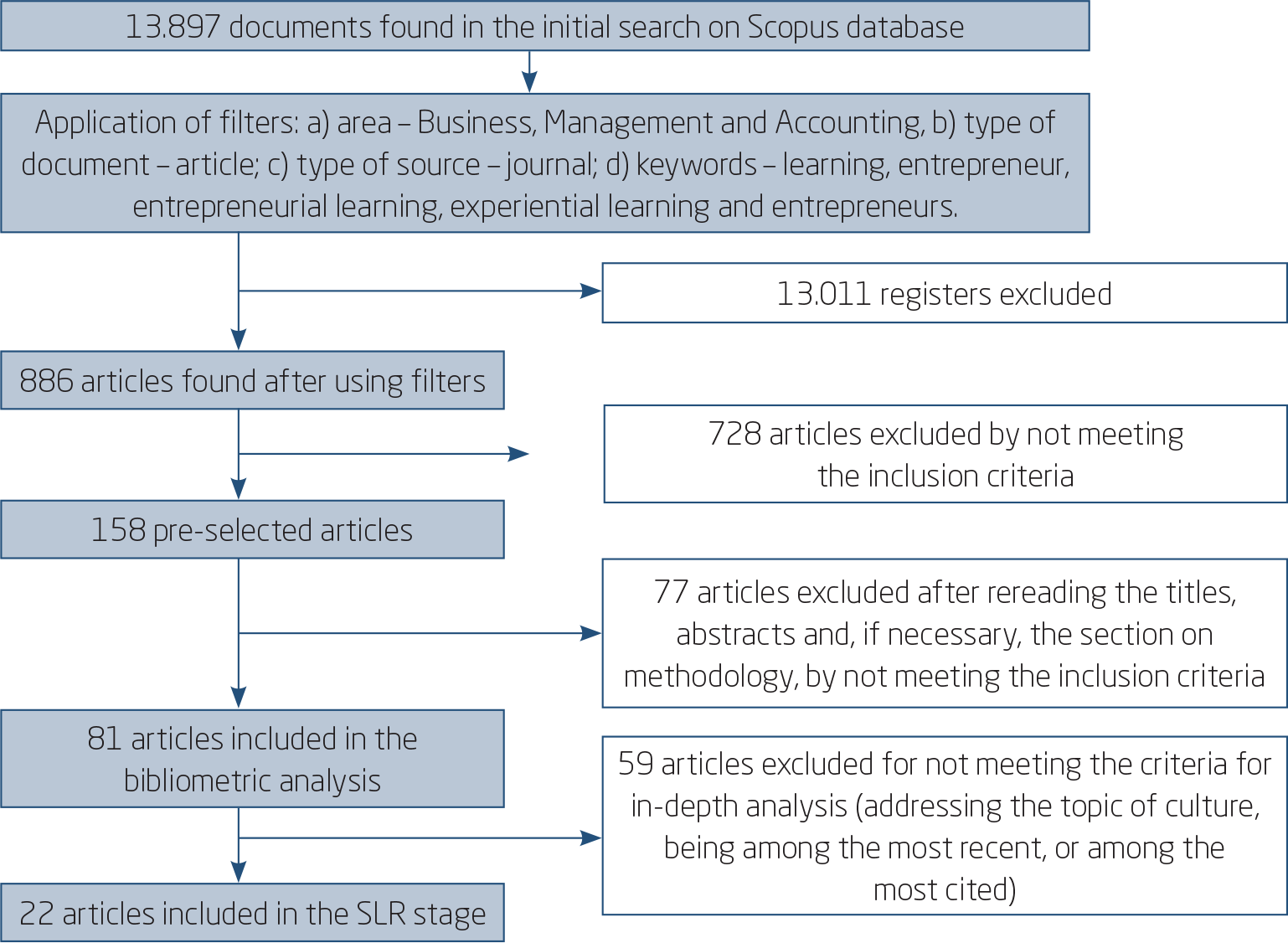
We identified 170 authors in the sample, with David Rae standing out as the leading author on the topic, with eight articles. His first publication listed in the database was in 2000, and the last registered was in 2017. When we analyzed the co-authorship network among researchers (Figure 3), we found 65 clusters, indicating that authors in this field tend to conduct research individually.

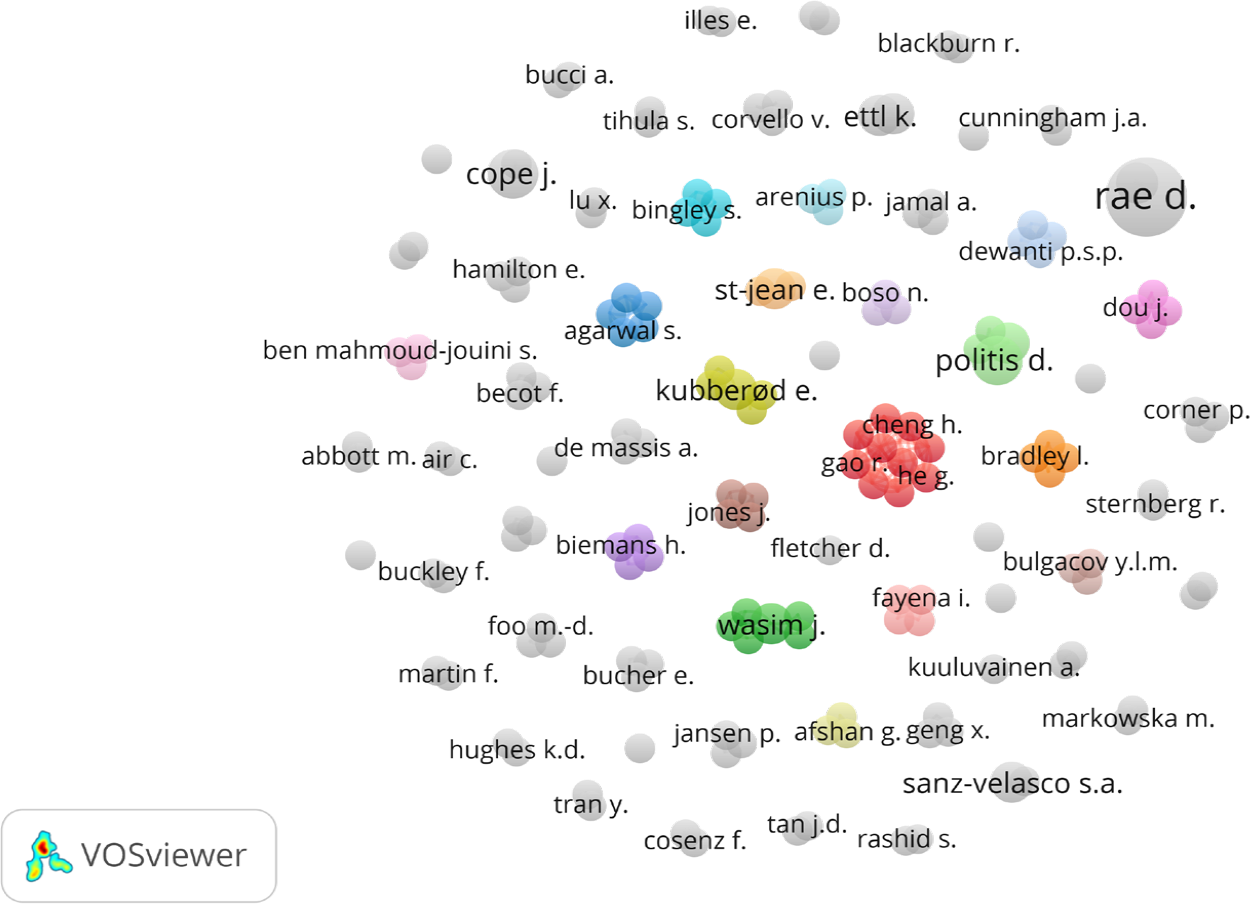
The leading co-authorship network consists of only 10 authors, all from the same article and from the same country (China), reinforcing the isolation in studies on the subject. Authors come from 29 different countries, 14 of which make up the main network (Figure 4): United Kingdom (30 articles) and United States (11), as the main countries in the network, followed by Sweden (9), Germany (6), Australia (6), China (5), Canada (4), Norway (3), Brazil (2), Singapore (2), Spain (1), Iceland (1), Portugal (1), and Vietnam (1).

Brazil had only two articles among those analyzed, which indicates an underrepresentation that limits the diversity of cultural and social perspectives on the topic. Geographical concentration not only restricts the theoretical scope of discussion but also hinders the development of knowledge applicable to realities that differ from those largely studied. It is important to highlight the need to expand empirical studies on EL and CL in Brazil, especially in places marked by ethnic diversity, immigrant-led ventures, or unique social dynamics. Encouraging local research in this field can challenge the observed hegemony and enrich the scientific debate with evidence from little-explored contexts.
Leading journals
The journal with the highest number of articles on EL, based on individuallevel analysis, was the International Journal of Entrepreneurial Behavior and Research, with 10 publications. The Journal of Small Business and Enterprise Development is the second, with seven publications, followed by Entrepreneurship and Regional Development, with four papers. All belong to publishing companies in the United Kingdom, indicating that, in addition to the authors, the main journals publishing this topic also come from that country.
Most quoted articles
The most quoted study on EL at the individual level in the sample (81 articles) is by Jason Cope, titled “Entrepreneurial learning from failure: An interpretative phenomenological analysis”, published in 2011 in the Journal of Business Venturing, and with 635 citations until the date of our study. Although David Rae has the most articles in the sample, Jason Cope stands out as the most-cited author (1,723 citations). Both have more than 1,000 citations in the papers included in the sample. Table 1 lists the most cited ones.
Most quoted references and co-citation network
Also relevant to the bibliometric analysis was identifying which references were most often cited by the articles in the sample, which helped identify the papers and theories that supported those studies. We identified 5,003 references in the 81 articles. By limiting the analysis to those cited at least five times in the sample, we compiled a list of the most-cited references, as presented in Table 2.
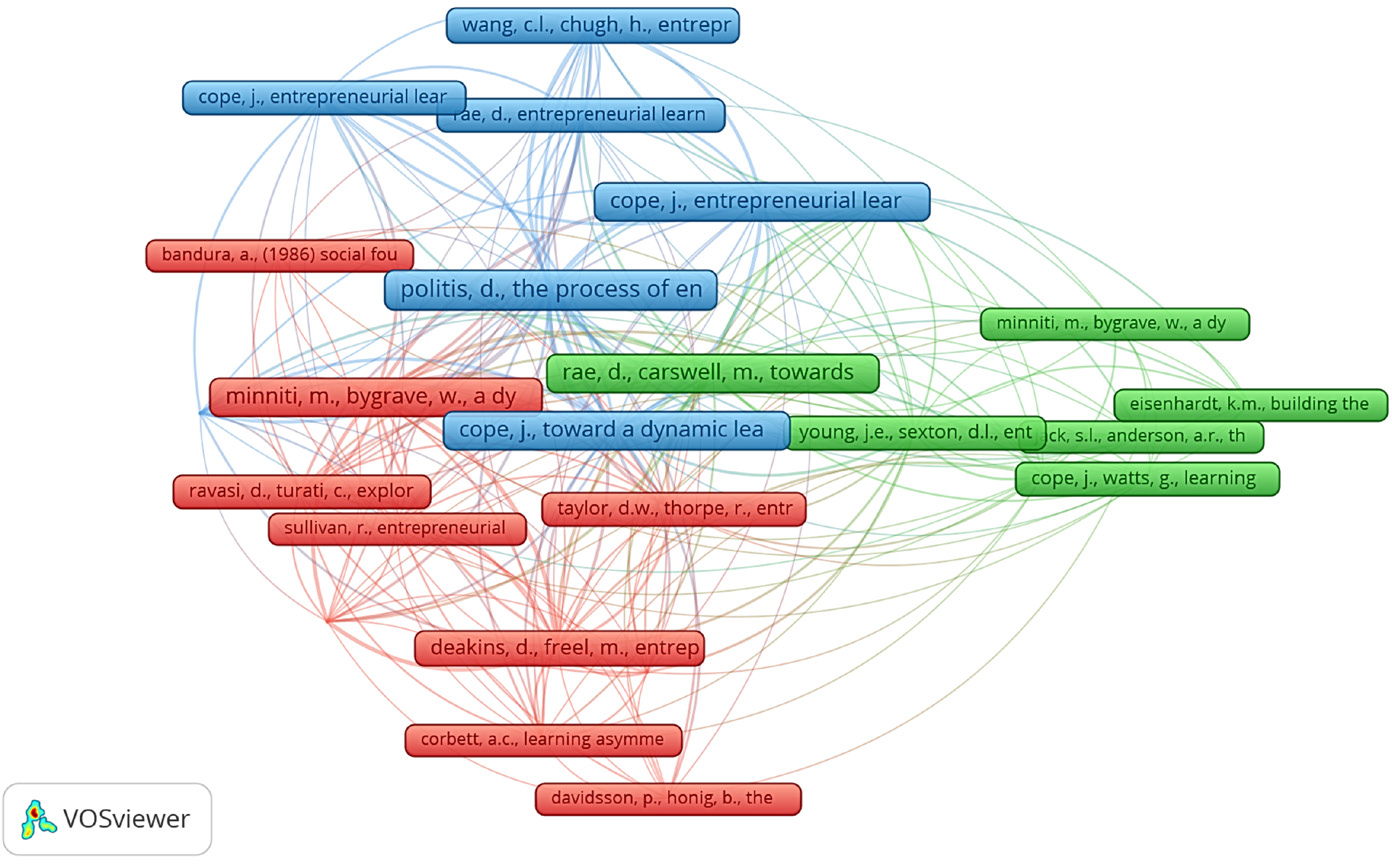
The co-citation network analysis, in turn, enabled the identification of which references in the sample were cited together. By considering references with at least five citations in the sample, we built the map shown in Figure 5.

All the most-cited articles in the sample (Table 2) were generally quoted together, regardless of the paper’s epistemological approach. Moreover, except for Cope (2011), all the others were cited in association with Bandura’s Social Cognitive Theory.
Co-occurrence of keywords
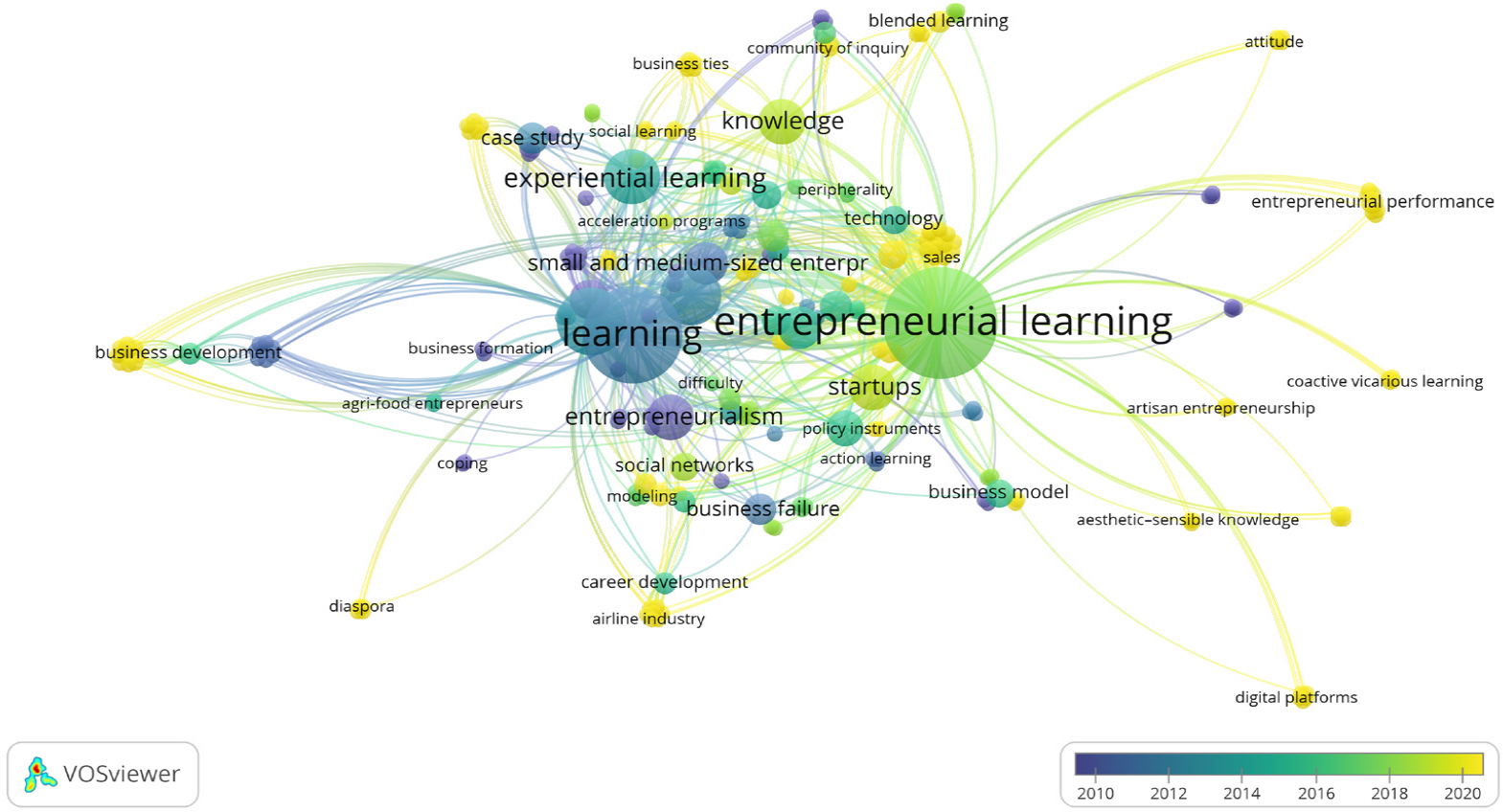
The analysis of keyword co-occurrence in the sample articles, disregarding minimum occurrence and including all keywords - those provided by the authors and those indexed on Scopus - showed the prevalence of the terms “entrepreneurial learning” (49 mentions), “learning” (38), “entrepreneur” (18), “entrepreneurship” (14), and “experiential learning” (12). Focusing on the network connected to the main term - “entrepreneurial learning” - indicated the absence of links between it and other sets of terms (clusters) (Figure 6).

In this figure, the color scale indicates the approximate (average) year of publication for articles containing each keyword. Clusters that do not connect directly to the main term, only touch upon it, and appear in articles published in recent years, suggest potential for future research. Terms present in these non-connected clusters were “cultural diversity” (2018); “ethnic entrepreneurs” (2018); “business ties” (2020), “cognitive learning” (2020), “regional development” (2020), “self-efficacy” (2020), “family firms” (2020), “migrant entrepreneurs” (2022), and “social learning theory” - the same as social cognitive theory - (2022), all with a single event.
This section provided a comprehensive overview of the evolution of the field of EL at the individual level. There was a gradual, yet consistent, growth in publications since the year 2000, with a significant increase in 2017, driven by a special call for papers in a British journal. We observed that scientific production is heavily concentrated in European countries and the United States, with the United Kingdom leading in the number of publications and journals. The co-authorship network is fragmented, suggesting little collaboration between researchers in the field, while the presence of authors and studies from Brazil remains incipient, with only two publications. Such underrepresentation limits the scope of the studies’ theoretical and practical applications.
The analysis highlighted the leading authors, most-cited articles, and key references, demonstrating the relevance of authors such as Jason Cope and David Rae, as well as the frequent use of Social Cognitive Theory. Finally, the co-occurrence of keywords indicates emerging and underexplored topics, such as cultural diversity, ethnic entrepreneurship, and cognitive learning, highlighting gaps and opportunities for future research, especially in more diverse contexts and beyond established production centers. The next section discusses the results of the SLR-based analysis.
RESULTS OF THE ANALYSIS STEMMING FROM SLR
The analysis of 22 articles (the 10 most-cited, 11 published in recent years in leading journals, and 1 containing the keyword “cultural diversity”) provided important insights into the state of the art of research on EL. The publication years of the studies (2000, 2001, 2003, 2005, 2007, 2009, 2011, 2012, 2017, 2020, 2021, and 2022) helped us understand the changes and advances in theory over the past two decades.
The first key point concerns the theoretical perspectives on EL, with two prevailing: one that views EL as an experiential process (11 articles) and another that views it as a social phenomenon (10 studies). Only one study was based on a cognitive perspective. Table 3 summarizes this information.
The only study in the sample that adopted a cognitive perspective (St-Jean & Audet, 2012) analyzed the influence of mentoring on entrepreneurs’ learning. In contrast, studies that used the experiential perspective sought to understand how EL occurs in the case of entrepreneurial failure (Cope, 2003, 2011; Cope & Watts, 2000; Politis & Gabrielsson, 2009; Singh et al., 2007; Walsh & Cunningham, 2017), gender learning experiences (Kubberød et al., 2021), seizing opportunities (Ben Mahmoud-Jouini et al., 2017), and cultural interactions (Elliot et al., 2018). Other papers, although starting from definitions of EL that consider it experiential, also included their intrinsic social aspects (Rae, 2017; Scarmozzino et al., 2017).
The social perspective was used in studies that examined how individuals learn to act as entrepreneurs - entrepreneurial behavior (Rae & Carswell, 2000, 2001), how they develop entrepreneurial capacities through learning (Rae, 2000), and how social networks influence EL (Soetanto, 2017). Also included in this perspective are studies that analyzed EL based on the concept of practice (Rae, 2005; Thompson & Illes, 2021; Vogt et al., 2022), and those that used SCT as a basis (Dou et al., 2020; Markowska & Wiklund, 2020; Zozimo et al., 2017), highlighting two current trends in research on the topic.
As for methodological and contextual aspects, only two quantitative studies (Politis & Gabrielsson, 2009; Scarmozzino et al., 2017) and one mixed-methods study (St-Jean & Audet, 2012) were published on EL, considering the individual as the unit of analysis. All the others stem from qualitative research, with interviews as the main data collection technique. As for the countries where enterprises are located, we observed a prevalence of the United Kingdom (5 articles), the United States (3), Canada (3), Brazil, France, the Netherlands, and Sweden (2 articles each). The other 11 countries were mentioned with one article each, and only five were not located in Europe (Australia, China, New Zealand, Peru, and Singapore). These results strengthen those identified in the bibliometric analysis and show the need for studies examining the phenomenon in contexts beyond Europe and the United States.
Articles also suggest that future research should employ other qualitative instruments, like the use of video in ethnographic studies (Vogt et al., 2022), include other countries and gender dynamics in learning (Kubberød et al., 2021), analyze how social relationships and communities are involved in EL (Thompson & Illes, 2021), and how transferred (learned) values are applied in a venture by younger generations (Dou et al., 2020).
The only paper in the sample that addressed the topic of “culture” (Elliot et al., 2018) provides insight into the CL mechanisms adopted by ethnic artistic entrepreneurs based in the United States. The authors argue that papers on experiential learning and acculturation are related and draw on elements of Kolb’s model to analyze the specific learning processes entrepreneurs undergo as they acculturate and spread market diversity.
They define acculturation as a learning process resulting from the interaction of at least two cultures, in which the individual learns and begins to adopt the norms and values of the local culture. Different from what Elliot et al. (2018) state, the sociological term “transculturation”, proposed by Fernando Ortiz (1940) and endorsed by anthropologist Bronisław Malinowski (1944), is considered more appropriate to the study of complex cultural changes than “acculturation”, since in this process both cultures are considered active, jointly developing a new reality.
This statement confirms Adler’s (1975) argument that CL is an experience of development, rather than adjustment. Therefore, future studies on ethnic entrepreneurs and immigrants’ learning are needed to understand how culture influences the learning process. Other forms of cultural influence, such as those conveyed by parents and other family members, may also offer new avenues for research (Dou et al., 2020).
The analysis further highlighted the need for a better definition of EL as a theoretical concept. Eleven studies did not present definitions of EL. An analysis of the definitions in the remaining articles revealed a lack of conceptual uniformity. This finding reinforced Nogueira’s (2019) perceptions on the absence of a definition of EL as a theoretical concept. However, one element stands out - the term “process”. In the studies, EL is considered a social, negotiated, and relational process, situated in observation, knowledge acquisition, experiential, and continuous.
In light of these results and the discussion in previous sections, we observed that EL and CL share characteristics that align with the main theoretical perspectives adopted in EL studies (Table 4).
Based on these shared attributes, we present four theoretical propositions:
-
P1: EL and CL are experiential and result from action;
-
P2: Both EL and CL can occur through observation and reflection (vicarious learning);
-
P3: EL and CL depend on cognitive skills;
-
P4: In EL and CL, individuals learn while living and interacting in a social environment.
These propositions provide the necessary foundations for studies of EL in social and cultural contexts distinct from entrepreneurs’ ethnic and cultural backgrounds. Also, they have the potential to lay the groundwork for future studies on EL that incorporate the cultural dimension, thereby bringing greater conceptual and theoretical consistency to the field.
CONCLUSIONS
The purpose of this article was to link the theoretical field of EL to CL theory and to support future studies on entrepreneurial learning in social and cultural contexts different from those of entrepreneurs’ ethnic and cultural origins. To this end, we raised and answered three research questions. First, we found that there is a relationship between the theoretical field of EL and the theory of CL, since both can be analyzed at the individual level (the entrepreneur), they stem from experiences in a social environment, they may be influenced by reflective observation, and require cognitive processes to take place so that experience can turn into learning.
On the other hand, the review of the state of the art related to the second research question showed the need for further studies that combine these theories, as it remains unclear what the influence of culture is on entrepreneurs’ learning process. Cultural aspects have seldom been addressed in the literature on EL, especially by individual entrepreneurs. Given the need to understand the social and contextual influences on entrepreneurial learning, the quest to grasp the cultural influence on EL becomes relevant, since this influence should occur in a context of social interactions, mediated by language.
The bibliometric analysis also revealed that research on EL at the individual level is growing. However, there is a need for research in contexts beyond Europe and the United States, as well as for establishing partnerships among authors, to consolidate a concept for this type of learning. Social Cognitive Theory has emerged as one of the most frequently used theories, strengthening the theoretical discussion of its potential for relationships, not just with CL but also with EL. Nevertheless, the bibliometric analysis and SLR also showed that the use of this theory is promising and a current trend in research on the topic.
In addition to those mentioned in the previous section, potential paths for future research on EL should connect it to topics like cultural diversity, ethnic entrepreneurship, immigrant entrepreneurship, family businesses, and, surprisingly, cognitive learning. We found a higher prevalence of studies reporting experiential learning in the sample than of those reporting cognitive learning. In addition, we suggest that the creation of new ventures by immigrants or ethnic entrepreneurs, who undergo the CL process, is an appropriate domain for the joint study of EL and CL.
Given the results of the bibliometric analysis, there is a significant concentration of studies in countries such as the United Kingdom, the United States, and Canada, revealing a major gap for researchers from other contexts that remain underrepresented, such as Brazil. This geographical concentration of scientific production may limit the understanding of the dynamics of entrepreneurial learning in different social and cultural environments. Therefore, expanding empirical studies in the Brazilian context is not only necessary but also strategic for enriching the theoretical and empirical debate and contributing to the consolidation of more diverse and targeted approaches to EL.
Although the main limitation of the study concerns the narrow scope of the qualitative analysis (SLR), the results discussed in this article, particularly the theoretical propositions, which answer the third research question, contribute to advances in EL research, going beyond the duality of cognitive and experiential approaches. Opposite to what Vogt and Bulgacov (2019) suggest, we propose not overcoming the cognitive and experiential perspectives in future EL studies, but rather deepening research on the phenomenon, from a perspective that considers the relationship between entrepreneurs’ experience and its transformation into knowledge through human cognition, within a social and cultural learning environment.
Open Data:
the contents underlying the research text are included in the manuscript.
-
RAM does not have permission from the authors or evaluators to publish this article’s review.
Acknowledgements
This article is situated within the context of the research project “Learning by entrepreneurs in contexts with socioeconomic constraints,” institutionalized at the Federal University of Goiás (UFG) and funded through the Universal Call for Proposals 2021, CNPq Call /MCTI/FNDCT No. 18/2021 - Track A - Emerging Groups (CNPq Process No. 422935/2021-2), completed in December 2025. The authors gratefully acknowledge the financial support provided by the National Council for Scientific and Technological Development (CNPq) - www.gov.br/cnpq. The funders did not influence the study design, data collection and analysis, decision to publish, or preparation of the manuscript.
REFERENCES
-
Adler, P. S. (1975). The transitional experience: An alternative view of culture shock. Journal of Humanistic Psychology, 15(4). https://doi.org/10.1177/002216787501500403
» https://doi.org/10.1177/002216787501500403 -
Aksnes, D. W., & Sivertsen, G. (2019). A criteria-based assessment of the coverage of Scopus and Web of Science. Journal of Data and Information Science, 4(1), 1-21. https://doi.org/10.2478/jdis-2019-0001
» https://doi.org/10.2478/jdis-2019-0001 - Bandura, A., Azzi, R. G., & Polydoro, S. (2008). Teoria Social Cognitiva: Conceitos básicos Artmed.
-
Ben Mahmoud-Jouini, S., Paris, T., & Bureau, S. (2017). Developing knowledge from entrepreneurial actions: Toward a taxonomy. Journal of Small Business and Enterprise Development, 24(4), 793-813. https://doi.org/10.1108/jsbed-10-2016-0155
» https://doi.org/10.1108/jsbed-10-2016-0155 -
Cope, J. (2003). Entrepreneurial learning and critical reflection: Discontinuous events as triggers for ‘higher-level’ learning. Management Learning, 34(4), 429-450. https://doi.org/10.1177/1350507603039067
» https://doi.org/10.1177/1350507603039067 -
Cope, J. (2005). Toward a dynamic learning perspective of entrepreneurship. Entrepreneurship: Theory and Practice, 29(4), 373-397. https://doi.org/10.1111/j.1540-6520.2005.00090.x
» https://doi.org/10.1111/j.1540-6520.2005.00090.x -
Cope, J. (2011). Entrepreneurial learning from failure: An interpretative phenomenological analysis. Journal of Business Venturing, 26(6), 604-623. https://doi.org/10.1016/j.jbusvent.2010.06.002
» https://doi.org/10.1016/j.jbusvent.2010.06.002 -
Cope, J., & Watts, G. (2000). Learning by doing. International Journal of Entrepreneurial Behavior & Research, 6(3), 104-124. https://doi.org/10.1108/13552550010346208
» https://doi.org/10.1108/13552550010346208 -
Deakins, D., & Freel, M. (1998). Entrepreneurial learning and the growth process in SMEs. The Learning Organization: An International Journal, 5(3), 144-155. https://doi.org/10.1108/09696479810223428
» https://doi.org/10.1108/09696479810223428 -
DeRobertis, E. M., & Bland, A. M. (2020). From personal threat to cross-cultural learning: An eidetic investigation. Journal of Phenomenological Psychology, (51), 1-15. https://doi.org/10.1163/15691624-12341368
» https://doi.org/10.1163/15691624-12341368 -
Donthu, N., Kumar, S., Mukherjee, D., Pandey, N., & Lim, W. M. (2021). How to conduct a bibliometric analysis: An overview and guidelines. Journal of Business Research, 133, 285-296. https://doi.org/10.1016/j.jbusres.2021.04.070
» https://doi.org/10.1016/j.jbusres.2021.04.070 -
Dou, J., Su, E., Li, S., & Holt, D. T. (2020). Transgenerational entrepreneurship in entrepreneurial families: What is explicitly learned and what is successfully transferred? Entrepreneurship and Regional Development, 33(5-6), 427-441. https://doi.org/10.1080/08985626.2020.1727090
» https://doi.org/10.1080/08985626.2020.1727090 -
El-Awad, Z. (2023). Explore or exploit? Unpacking the situational conditions and cognitive mechanisms underlying entrepreneurial learning in the new venture development process. Entrepreneurship & Regional Development, 35(1-2), 162-186. https://doi.org/10.1080/08985626.2022.2143573
» https://doi.org/10.1080/08985626.2022.2143573 -
Elliot, E. A., Jamal, A., & Cherian, J. (2018). Artrepreneurship and learning in ethnic markets. Journal of Business Research, 82, 391-399. https://doi:10.1016/j.jbusres.2017.01.018
» https://10.1016/j.jbusres.2017.01.018 -
Fletcher, D. (2000). Learning to “think global and act local”: Experiences from the small business sector. Education + Training, 42(4-5), 211-2020. https://doi.org/10.1108/00400910010373651
» https://doi.org/10.1108/00400910010373651 - Hager, P. (2011). Theories of Workplace Learning. In M. Malloch, K. Evans, & L. Cairns (Eds.). The Sage handbook of workplace learning (pp. 17-31). Sage.
-
Kayes, D. C. (2002). Experiential learning and its critics: Preserving the role of experience in management learning and education. Academy of Management Learning & Education, 1(2), 137-149. https://doi.org/10.5465/amle.2002.8509336
» https://doi.org/10.5465/amle.2002.8509336 -
Keesing, R. M. (1974). Theories of culture. Annual Review of Anthropology, 3, 73-97. https://www.jstor.org/stable/2949283
» https://www.jstor.org/stable/2949283 - Kolb, D. A. (1984). Experiential Learning: Experience as the source of learning and development Prentice Hall, Inc.
-
Kubberød, E., Sally, J., & Beate, P. I. (2021). Learning to not belong: Entrepreneurial learning experiences of women high-tech entrepreneurs. International Journal of Entrepreneurial Behaviour and Research, 27(8), 1983-2008. https://doi.org/10.1108/IJEBR-07-2020-0504
» https://doi.org/10.1108/IJEBR-07-2020-0504 -
Kunst, J. R., Lefringhausen, K., & Zagefka, H. (2024). Delineating the boundaries between genuine cultural change and cultural appropriation in majority-group acculturation. International Journal of Intercultural Relations, 98, 101911. https://doi.org/10.1016/j.ijintrel.2023.101911
» https://doi.org/10.1016/j.ijintrel.2023.101911 - Lamont, L. M. (1972). What entrepreneurs learn from experience. Journal of Small Business Management, 10, 36-41.
-
Li, M. (L.), Jiang, J., & Qi, M. (2024). The mediating role of cultural intelligence to learning flexibility, cultural difference, and expatriate effectiveness. Journal of Global Mobility: The Home of Expatriate Management Research, 12(4), 715-737. https://doi.org/10.1108/JGM-06-2023-0045
» https://doi.org/10.1108/JGM-06-2023-0045 - Malinowski, B. (1944). A scientific theory of culture and other essays University of North Carolina Press; Oxford University Press.
-
Markowska, M., & Wiklund, J. (2020). Entrepreneurial learning under uncertainty: Exploring the role of self-efficacy and perceived complexity. Entrepreneurship and Regional Development, 32(7-8), 606-628. https://doi.org/10.1080/08985626.2020.1713222
» https://doi.org/10.1080/08985626.2020.1713222 -
McKelvey, M. (1998). Evolutionary innovations: Learning, entrepreneurship, and the dynamics of the firm. Journal of Evolutionary Economics, 8(2), 57-175. https://doi.org/10.1007/s001910050060
» https://doi.org/10.1007/s001910050060 -
Minniti, M., & Bygrave, W. (2001). A dynamic model of entrepreneurial learning. Entrepreneurship Theory and Practise, 25(3), 5-16. https://doi.org/10.1177/104225870102500301
» https://doi.org/10.1177/104225870102500301 -
Montuori, A., & Fahim, U. (2004). Cross-cultural encounter as opportunity for personal growth. Journal of Humanistic Psychology, 44(2). https://doi.org/10.1177/0022167804263414
» https://doi.org/10.1177/0022167804263414 -
Nogueira, T. F. (2019). Entrepreneurial learning: What do we mean by it? Learning Organization, 26(6), 560-573. https://doi.org/10.1108/TLO-04-2018-0067
» https://doi.org/10.1108/TLO-04-2018-0067 - Ortiz, F. (1940). Cuban counterpoint: Tobacco and sugar Alfred A. Knopf
-
Pacheco, E. M. (2020). Culture learning theory and globalization: Reconceptualizing culture shock for modern cross-cultural sojourners. New Ideas in Psychology, 58 https://doi.org/10.1016/j.newideapsych.2020.100801
» https://doi.org/10.1016/j.newideapsych.2020.100801 -
Politis, D. (2005). The process of entrepreneurial learning: A conceptual framework. Entrepreneurship Theory and Practice, 29(4), 399-424. https://doi.org/10.1111/j.1540-6520.2005.00091.x
» https://doi.org/10.1111/j.1540-6520.2005.00091.x -
Politis, D., & Gabrielsson, J. (2009). Entrepreneurs’ attitudes towards failure: An experiential learning approach. International Journal of Entrepreneurial Behaviour and Research, 15(4), 364-383. https://doi.org/10.1108/13552550910967921
» https://doi.org/10.1108/13552550910967921 -
Rae, D. (2000). Understanding entrepreneurial learning: a question of how? International Journal of Entrepreneurial Behaviour & Research, 6(3), 145-159. https://doi.org/10.1108/13552550010346497
» https://doi.org/10.1108/13552550010346497 -
Rae, D. (2005). Entrepreneurial learning: A narrative-based conceptual model. Journal of Small Business and Enterprise Development, 12(3), 323-335. https://doi.org/10.1108/14626000510612259
» https://doi.org/10.1108/14626000510612259 -
Rae, D. (2017). Entrepreneurial learning: Peripherality and connectedness. International Journal of Entrepreneurial Behaviour and Research, 23(3), 486-503. https://doi.org/10.1108/IJEBR-05-2016-0132
» https://doi.org/10.1108/IJEBR-05-2016-0132 -
Rae, D., & Carswell, M. (2000). Using a life-story approach in researching entrepreneurial learning: The development of a conceptual model and its implications in the design of learning experiences. Education + Training, 42(4-5), 220-228. https://doi.org/10.1108/00400910010373660
» https://doi.org/10.1108/00400910010373660 -
Rae, D., & Carswell, M. (2001). Towards a conceptual understanding of entrepreneurial learning. Journal of Small Business and Enterprise Development, 8(2), 150-158. https://doi.org/10.1108/EUM0000000006816
» https://doi.org/10.1108/EUM0000000006816 -
Scarmozzino, E., Corvello, V., & Grimaldi, M. (2017). Entrepreneurial learning through online social networking in high-tech startups. International Journal of Entrepreneurial Behavior & Research, 23(3), 406-425. https://doi.org/10.1108/ijebr-12-2015-0302
» https://doi.org/10.1108/ijebr-12-2015-0302 -
Singh, S., Corner, P., & Pavlovich, P. (2007). Coping with entrepreneurial failure. Journal of Management and Organization, 13(4), 331-344. https://doi.org/10.5172/jmo.2007.13.4.331
» https://doi.org/10.5172/jmo.2007.13.4.331 -
Soetanto, D. (2017). Networks and entrepreneurial learning: Coping with difficulties. International Journal of Entrepreneurial Behaviour and Research, 23(3), 547-565. https://doi.org/10.1108/IJEBR-11-2015-0230
» https://doi.org/10.1108/IJEBR-11-2015-0230 -
St-Jean, E., & Audet, J. (2012). The role of mentoring in the learning development of the novice entrepreneur. International Entrepreneurship and Management Journal, 8(1), 119-140. https://doi.org/10.1007/s11365-009-0130-7
» https://doi.org/10.1007/s11365-009-0130-7 -
Thompson, N. A., & Illes, E. (2021). Entrepreneurial learning as practice: A video-ethnographic analysis. International Journal of Entrepreneurial Behaviour and Research, 27(3), 579-599. https://doi.org/10.1108/IJEBR-10-2018-0663
» https://doi.org/10.1108/IJEBR-10-2018-0663 -
Tomasello, M. (1999). The human adaptation for culture. Annual Review of Anthropology, 28, 509-529. https://doi.org/10.1146/annurev.anthro.28.1.509
» https://doi.org/10.1146/annurev.anthro.28.1.509 -
Tomasello, M., Kruger, A. C., & Ratner, H. H. (1993). Cultural learning. Behavioral and Brain Sciences, 16(3), 495-551. https://doi.org/10.1017/S0140525X0003123X
» https://doi.org/10.1017/S0140525X0003123X -
Vogt, S., & Bulgacov, Y. L. M. (2019). Aprendizagem empreendedora: Conhecendo o passado e vislumbrando o futuro. Desenvolvimento em Questão, 17(49), 247-275. https://doi.org/10.21527/2237-6453.2019.49.247-275
» https://doi.org/10.21527/2237-6453.2019.49.247-275 -
Vogt, S., Bulgacov, Y. L. M., & Elias, S. R. S. T.A. (2022). Entrepreneurial learning among practices: Aesthetic and sensible knowledge in the life trajectory of entrepreneurs. International Journal of Entrepreneurial Behaviour and Research, 28(2), 283-305. https://doi.org/10.1108/IJEBR-04-2020-0204
» https://doi.org/10.1108/IJEBR-04-2020-0204 - Vygotsky, L. S. (2007). A formação social da mente: O desenvolvimento dos processos psicológicos superiores Martins Fontes.
-
Walsh, G. S., & Cunningham, J. A. (2017). Regenerative failure and attribution. International Journal of Entrepreneurial Behavior & Research, 23(4), 688-707. https://doi.org/10.1108/ijebr-03-2015-0072
» https://doi.org/10.1108/ijebr-03-2015-0072 -
Wang, C. L., & Chugh, H. (2014). Entrepreneurial learning: Past research and future challenges. International Journal of Management Reviews, 16(1), 24-61. https://doi.org/10.1111/ijmr.12007
» https://doi.org/10.1111/ijmr.12007 -
Williams Jr, R.I., Clark, L.A., Clark, W.R., & Raffo, D.M. (2021). Re-examining systematic literature review in management research: Additional benefits and execution protocols, European Management Journal, 39(4), 521-533. https://doi.org/10.1016/j.emj.2020.09.007
» https://doi.org/10.1016/j.emj.2020.09.007 -
Wilson, J., Ward, C., & Fischer, R. (2013). Beyond culture learning theory: What can personality tell us about cultural competence? Journal of Cross-Cultural Psychology, 44(6), 900-927. https://doi.org/10.1177/0022022113492889
» https://doi.org/10.1177/0022022113492889 -
Zozimo, R., Jack, S., & Hamilton, E. (2017). Entrepreneurial learning from observing role models. Entrepreneurship & Regional Development, 29(9-10), 889-911. https://doi.org/10.1080/08985626.2017.1376518
» https://doi.org/10.1080/08985626.2017.1376518
Edited by
-
EDITORIAL BOARD
Editor-in-chiefAlmir Martins VieiraAssociated editorAlmir Martins VieiraTechnical supportVitória Batista Santos Silva
-
EDITORIAL PRODUCTION
Publishing coordinationAndréia Ferreira CominettiEditorial InternSofia LelisLanguage editorBardo EditorialLayout designerLibroGraphic designerLibro

 Source: Scopus.
 Source: Created by the authors based on data from VOSviewer.
 Source: Created by the authors based on data from VOSviewer.
 Source: Created by the authors based on data from VOSviewer.