
 Study of digital transformation in public nonprofit organizations for the validation of an extensive framework
Abstract
Purpose: To adapt the proposed approach by Vial (2019), which is geared toward the digital transformation of private companies, to develop a digital transformation framework specific to public nonprofit organizations.
Originality/value: The framework developed by adapting four wellestablished academic frameworks (Vial, 2019; Gong et al., 2020; Mergel et al., 2019; Van Veldhoven & Vanthienen, 2022) is innovative because it addresses the specificities of the DT (digital transformation) process in public nonprofit organizations.
Design/methodology/approach: An exploratory descriptive study using both qualitative and quantitative methods was conducted on the current criteria for digital transformation. Following a bibliographic review, four models were used in the development of the new framework, which was evaluated through questionnaires administered to experts in two phases: 1. A committee of nine academic experts, and 2. Field research involving 65 professionals engaged in DT at 30 public companies operating at the federal, state, and municipal levels.
Results: The framework is structured into eight dimensions and 40 criteria and their relationships: ‘use of digital technologies’ (6 criteria), ‘disruptions/motivations/pressures’ (7), ‘strategic responses’ (3), ‘changes in public value creation’ (6), ‘structural changes’ (8), ‘organizational barriers’ (4), ‘negative impacts’ (2), and ‘positive impacts’ (4).
Contribution: The developed framework enhances understanding of digital transformation in public nonprofit organizations and establishes the structure and key elements to consider in these organizations to support the delivery of improved public services.
Keywords:
digital transformation; digital transformation framework; public nonprofit organization; public organization; digital transformation in public organizations.
Resumo
Objetivo: Adaptar o framework de Vial (2019), voltado à transformação digital de empresas privadas, para elaborar um framework específico de transformação digital para companhias públicas sem fins lucrativos.
Originalidade/valor: O framework, criado a partir da adaptação de quatro frameworks acadêmicos bem estabelecidos na literatura (Vial, 2019; Gong et al., 2020; Mergel et al., 2019; Van Veldhoven & Vanthienen, 2022), é inovador por ser aplicável às especificidades do processo de TD de companhias públicas sem fins lucrativos.
Design/metodologia/abordagem: Pesquisa exploratória-descritiva, com abordagem quali-quantitativa, sobre os critérios de TD vigentes. Após a realização de pesquisa bibliográfica, quatro modelos foram utilizados na elaboração do novo framework, que foi avaliado por meio de questionários aplicados a especialistas em duas fases: 1. Comitê de nove especialistas acadêmicos e 2. Pesquisa de campo com 65 profissionais envolvidos na TD de 30 empresas públicas, atuantes nos níveis federal, estadual e municipal.
Resultados: O framework está estruturado em oito dimensões e 40 critérios e suas relações: ‘uso de tecnologias digitais’ (6 critérios), ‘disrupções/motivações/pressões’ (7), ‘respostas estratégicas’ (3), ‘mudanças nos caminhos de criação de valor público’ (6), ‘mudanças organizacionais’ (8), ‘barreiras organizacionais’ (4), ‘impactos negativos’ (2) e, por fim, ‘impactos positivos’ (4).
Contribuição: O framework elaborado contribui para a melhor compreensão do fenômeno da TD em companhias públicas sem fins lucrativos, bem como estipula a estrutura e os elementos da TD a serem observados nessas organizações para a prestação de melhores serviços públicos.
Palavras-chave:
transformação digital; framework de transformação digital; empresas públicas sem fins lucrativos; empresa pública; transformação digital em empresa pública.
INTRODUCTION
Digital transformation (DT) has become an essential process for improving and modernizing service delivery in public organizations. However, in public companies, this process faces particular challenges stemming from their institutional characteristics, such as more bureaucratic organizational structures, lower risk appetite, and heavy reliance on regulations and public policies (Mergel et al., 2025). The work of Hendra et al. (2024) highlights that such specificities make the adoption of digital technologies more complex, requiring strategic approaches that consider not only technical factors but also cultural, organizational, and institutional aspects common in public companies.
Critical elements, such as organizational culture, agility, adaptability, and ambidexterity, are heavily emphasized in recent studies (Ürü et al., 2024; Zhang et al., 2023). These dimensions, although essential for organizations that must simultaneously sustain operational efficiency and drive innovation, have frequently been underrepresented in prior research. Although the literature recognizes the importance of TD in the public sector, a considerable portion of the studies focuses on fragmented analyses or on those specifically aimed at private-sector companies, with little integration of findings and limited attention to the particularities of public nonprofit organizations, as noted in the studies by Jonathan et al., (2023) and Kitsios et al., (2023).
Thus, this study defined public nonprofit organizations as its research subject, given their importance to society. Public nonprofit organizations are legal entities dedicated to the public good that reinvest their financial surplus in their own activities (Bryson et al., 2014) to modernize their models of value creation and social benefits (Osborne et al., 2022). These companies have specific characteristics, such as being entirely publicly owned, being established by state regulations, and serving a social purpose, with dividends returning to the state itself and to society (Brazil, 2024; Kitsios et al., 2023).
According to Osborne et al. (2022), nonprofit public organizations are central to value creation within an inclusive ecosystem that benefits the community. According to Chen et al. (2021), the government plays an essential role in strengthening IT in public companies, driving the modernization of society. Likewise, innovation in public sector companies, mediated by information technologies, emerges as an essential tool for enhancing the delivery of public value that is better suited to the population (Ju et al., 2020; Cubuk et al., 2019).
Given this context, it is necessary to develop a theoretical model that comprehensively addresses the multiple factors influencing DT within nonprofit public organizations. Thus, the research question guiding this study is: What should be the structure, components, and their interrelationships in a digital transformation framework tailored to the specificities of nonprofit public organizations?
To answer this question, this study aimed to adapt the framework of Vial (2019) -which is geared toward the digital transformation of private companies-to develop a digital transformation framework specific to public nonprofit organizations. The choice Vial (2019) was based on its comprehensiveness, high academic impact, and high citation rates (h-index: 13 and over 12,900 citations as of March 2026), according to data from the AIS Library, ScienceDirect, Web of Science, Scopus, and IEEE Xplore databases. In addition, the bibliographic review conducted in this study considered digital transformation frameworks specifically tailored to public organizations that are well-established in the literature, such as the models proposed by Gong et al. (2020), Mergel et al. (2019), and Van Veldhoven and Vanthienen (2022).
The new framework developed in this study incorporates specific perspectives on digital capabilities, public governance, and organizational maturity into its structure and components within the context of public nonprofit organizations. This is because the framework Gong et al. (2020) focuses on the technological infrastructure for digital transformation, but does not address governance. In contrast, the framework Mergel et al. (2019) focuses on governance and social innovation. Meanwhile, the framework proposed by Van Veldhoven and Vanthienen (2022) is concerned with achieving organizational maturity and with providing tools for the practical diagnosis of digital transformation in public enterprises. Thus, it is understood that integrating the elements of these different models, in addition to the framework of Vial (2019), aims to build a more robust, comprehensive framework that is sensitive to the characteristics, demands, and limitations of nonprofit public organizations and capable of guiding their DT journey in a strategic and contextualized manner.
THEORETICAL FRAMEWORK
The literature on digital transformation (DT) in the context of public organizations highlights that this is not merely the adoption of digital tools (Cosa, 2024), but a systemic change involving the adaptation of business objectives Hanelt et al. (2021), the adaptation of more modern organizational culture and practices (Vial, 2019), the resilience of employees to new learning and digital processes (Carroll et al., 2023), integration into legacy systems infrastructure (Verhoef et al., 2021), data and digital platforms, as well as organizational reconfiguration, including the reduction of hierarchical levels associated with traditional management models (Sacavém et al., 2025).
According to Ju et al. (2020), DT is a journey that uses information and communication technology to improve products and processes, focusing on companies’ business operations and the integration of new technologies and processes aimed at organizational governance and management. Stankovski et al. (2020) by contrast, define TD as the pursuit of agility and ambidexterity in processes, a resilient organizational culture, and the search for solutions to enhance efficiency and innovation. In the work of Vial (2019) and Sundberg and Holmström (2024), TD is a process that aims to improve an organization by driving significant change through information technologies, connectivity, and value creation. This DT scenario leads organizations to develop more agile projects, enabling them to continuously adapt and respond more quickly to their surrounding environment, driven by the digital ecosystem of the market, as indicated by (Hanelt et al., 2021), although public, nonprofit organizations are more subject to institutional regulations Mergel et al. (2019).
Mergel et al. (2021) emphasize that e-government in public and nonprofit organizations leads to improved management of internal processes and a greater supply of more effective public services; and, as indicated by Nguyen et al., (2019), it advances the stage of e-government toward digital government, which is more comprehensive and integrated into the contemporary digital world. However, Osborne et al., (2022) and Cubuk et al., (2019) argue that digital initiatives in publicly funded, non-profit organizations should account for public value creation, while also considering the citizen experience (CX - Citizen experience).
Most established theoretical frameworks for TD are based on case studies, with few synthetic or comprehensive studies on this topic in terms of developing structural models for better managing the TD phenomenon in organizations (Kitsios et al., 2023); nevertheless, among the existing TD frameworks in the literature, the importance of the framework by Vial (2019) stands out, as it has a high academic impact and high citation rates. Accordingly, this framework was selected as the reference for this study, along with additional digital transformation frameworks tailored to public-sector organizations. The following section presents the frameworks of Vial (2019), Gong et al. (2020), Mergel et al. (2019), and Van Veldhoven and Vanthienen (2022).
Digital Transformation Framework by Vial (2019)
This DT framework proposed by Vial (2019) was developed for private companies. Its structure comprises eight processes or conceptual dimensions, each with its own criteria. The eight dimensions are interconnected through dotted arrows, which represent global trends that act as stimuli or triggers for subsequent dimensions, and through solid arrows, which delineate a sequence of relationships among the dimensions, enabling, influencing, or generating responses in subsequent dimensions (Vial, 2019). According to the author, this structure is based on the literature on digital technologies and the chain of relationships within companies, involving connections, influences, and triggers among the different dimensions and their respective elements, as shown in Figure 1.
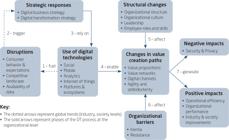
The framework proposed by Vial (2019) has been valued for its comprehensiveness and robustness in analyzing companies’ digital transformation. Costa et al. (2023) highlight that the framework provides a strategic vision that aligns technology and organizational culture. (Das Graças Murici, 2022)reinforces its comprehensiveness by showing how the framework integrates internal and external factors in understanding the impacts of digitalization on the company. Meanwhile, Nguyen et al. (2024) demonstrate the practical applicability of the framework by Vial (2019) using it to assess DT and digitalization in companies. Schwaeke et al. (2025) note that the framework is applicable for analyzing more specific DT contexts within companies.
In contrast, the framework proposed by Vial demonstrates flexibility and strong theoretical grounding, as highlighted by Chen et al. (2021) who emphasize that its structure can be applied across diverse contexts, ranging from startups to large corporations. Karakuş and Yalçin (2024) applied the framework of Vial (2019) in case studies on organizational change management. Meanwhile, Wessel et al. (2021) highlighted its multilevel approach to TD, emphasizing its ability to capture strategic and operational challenges at both the micro and macro levels within the company. Gong and Ribiere (2021) argue that its foundation in theories of organizational change and innovation provides a level of conceptual robustness that distinguishes it from more fragmented approaches.
Digital transformation frameworks specific to public organizations
Since the framework of Vial (2019) was originally designed for private sector organizations, this study sought to identify additional frameworks specifically developed for public sector contexts, such as the frameworks proposed by Gong et al. (2020), Mergel et al. (2019) and Van Veldhoven and Vanthienen (2022). These three frameworks are well-established in the academic literature, as they address digital transformation in a systemic and multidimensional manner within public-sector organizations.
Thus, the frameworks of Gong et al. (2020) and Vial (2019) highlight digital capabilities as a prerequisite for DT and converge on technology as its strategic enabler. Meanwhile, Mergel et al. (2019) align with the proposal of Vial (2019) regarding the need for alignment between strategy, culture, and institutional legitimacy. The frameworks of Van Veldhoven and Vanthienen (2022) and Vial (2019) converge on the processual and evolutionary (journey-like) view of TD in organizations.
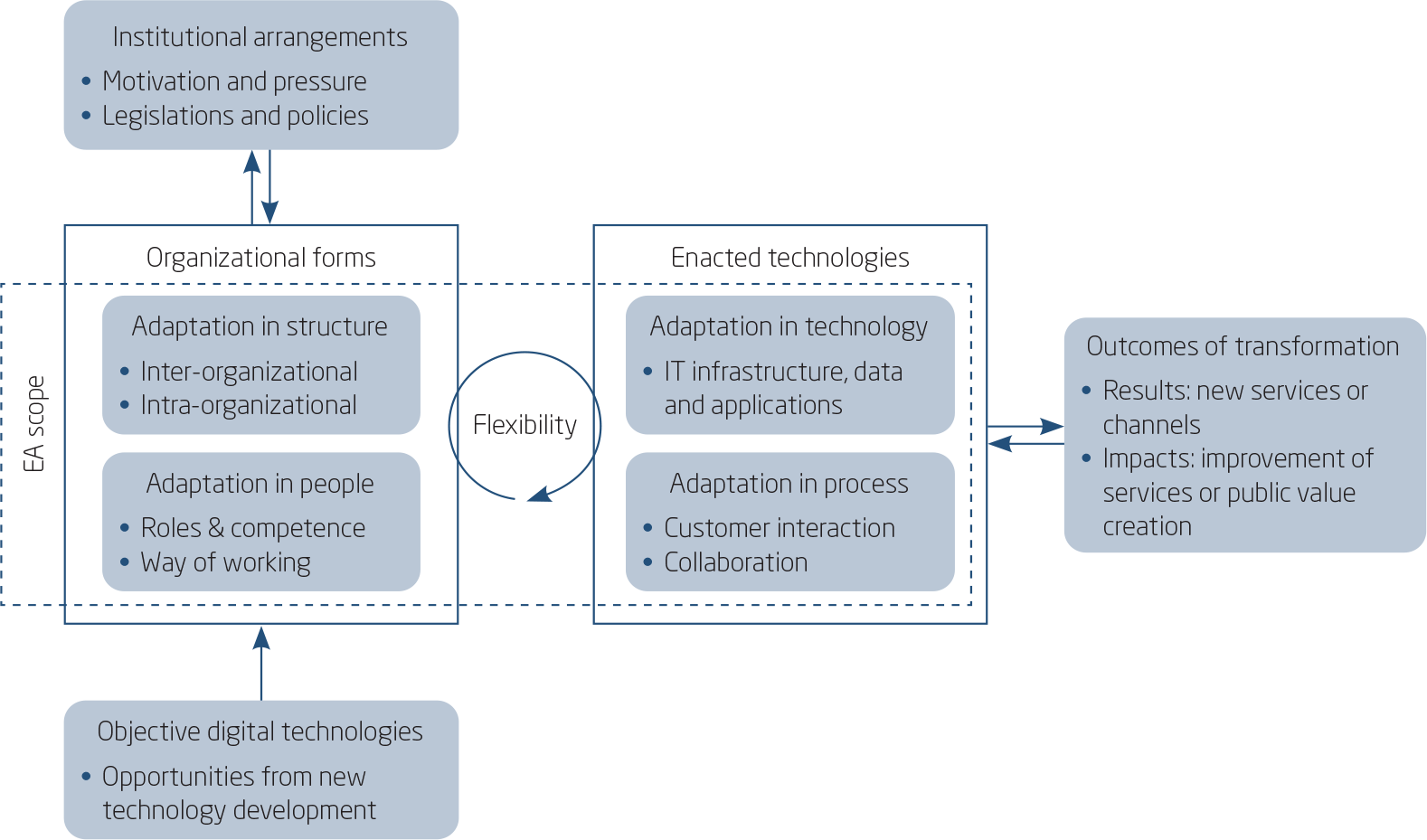
The conceptual framework proposed by Gong et al. (2020) provides a comprehensive model of digital transformation, comprising five core components: institutional regulation, intra-organizational adaptations, inter-organizational adaptations, adaptation to new technologies, and the resulting impacts, as illustrated in Figure 2. The study by Gong et al. (2020) concludes that organizational flexibility and resilience facilitate digital transformation, and indicates that transformation in public sector agencies unfolds over time through successive waves. By adopting a broad and integrative perspective, this framework encompasses internal and external organizational dimensions as well as technological aspects, thereby aligning closely with the framework proposed by Vial (2019).
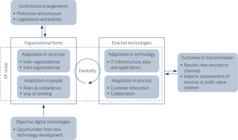
The framework of Gong et al. (2020) is based on the integration of the application objectives of different technologies, linking organizational flexibility and enterprise architecture as pillars of DT. Its construction was based on empirical analyses and interviews with experts, proposing that technological infrastructure is not merely a support but a central element for aligning digital policies and strategies. Subsequent studies, such as those by Rösler et al. (2021), reinforce that this framework is useful for understanding how flexible architectures enable the adoption of emerging technologies and mitigate institutional barriers.
Research on digital government has examined how the digital transformation framework proposed by Gong et al. (2020) supports interoperability and efficiency in public services. Other studies, such as the one presented by Van Noordt et al. (2025), have explored its applicability to AI-enabled digital platforms and public innovation policies, thereby confirming that this framework is a well-established reference for research on TD and the integration of emerging technologies in public organizations.
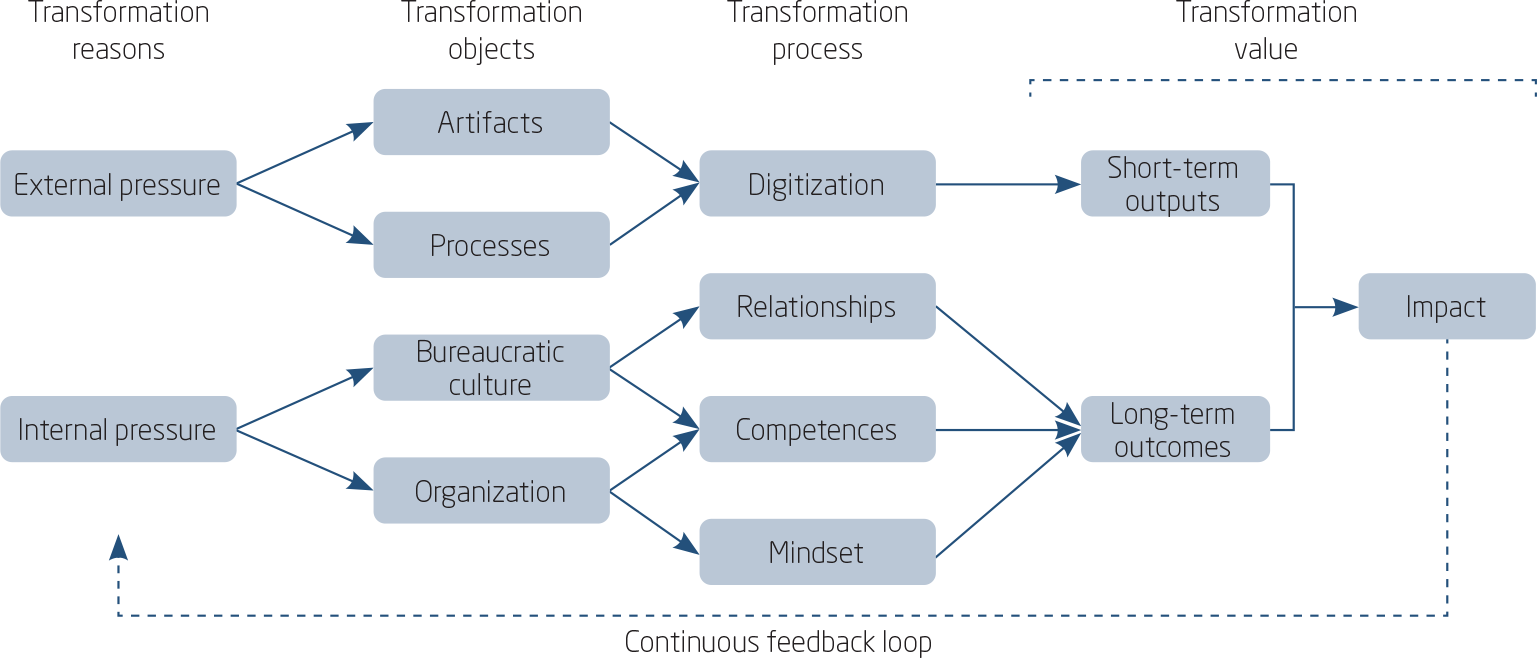
The framework by Mergel et al. (2019) is comprehensive in creating a map of procedural patterns that encompasses four main phases: transformation reasons, transformation objects, transformation processes, and transformation value in public administration, as shown in Figure 3. These phases and their respective elements guide the transformation of value delivery provided by the public organization to society.
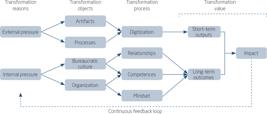
The framework proposed by Mergel et al. (2019) was developed based on interviews with experts and empirical analyses, suggesting that digital transformation (DT) in public enterprises should be understood as a journey or a multidimensional process that encompasses digital technology and governance, with a focus on social aspects. The concept behind this framework involves organizational and social changes, reinforcing its applicability for promoting agile practices in digital government, while Durkiewicz and Janowski (2021) highlight its relevance for sustainable governance platforms.
Other studies have drawn on the framework of Mergel et al. (2019), such as the research conducted by Straub et al. (2023), which analyzed how artificial intelligence can be integrated into the technological structures of public agencies, using the framework as a reference to understand the social impacts of DT. Similarly, Kyriakogkonas et al. (2023) explored how this framework contributes to aligning public policies with technological innovation and social inclusion in public-private partnerships. In their study, Menezes and Vieira (2022) confirmed this framework as a robust foundation for research seeking to investigate the integration between DT, technology, governance, and social innovation.
Finally, the framework findings of Van Veldhoven and Vanthienen (2022) are based on the interaction among three key dimensions of DT that public organizations should consider: digital technologies, business, and society, with each dimension influencing the others. This framework, presented in Figure 4, also considers the role of society (citizens and organizations) in influencing the public organization’s demands, improvements, and new regulations, thereby altering the value the public organization delivers to society.

The DT framework proposed by Van Veldhoven and Vanthienen (2022), developed from a systematic review of more than 150 studies, consolidates practices for assessing organizational maturity in public-sector organizations and aims to support the diagnosis of digital transformation within these entities. This framework enables a comprehensive view of digital readiness of public organizations, identifying gaps in digital competencies and infrastructure, thereby supporting innovation policies and digital governance, as highlighted in the report of UNESCO (2023), which emphasizes the importance of digital transformation competencies and artificial intelligence for public sector digital maturity.
The framework is grounded in principles of information management and organizational transformation and serves as a reference for an integrated digital transformation approach to analyzing the impacts of digitalization, sustainability, and operational efficiency in public sector organizations. Ren and Liu (2025) employed the framework of Van Veldhoven and Vanthienen (2022) in their study on digital value creation in organizational digital transformation, while Qu et al. (2025) applied the framework in their research on the impact factors of artificial intelligence and green technologies on digital transformation.
Adaptation of digital transformation frameworks for public nonprofit organizations
When comparing the three DT frameworks for public organizations highlighted in this study to the structure, dimensions, and criteria of the DT framework established by Vial (2019), it is observed that the frameworks of Gong et al. (2020), Mergel et al. (2019), and Van Veldhoven and Vanthienen (2022) incorporate aspects that are also extensible to public non-profit organizations. These include elements such as government regulation and public policy situated within more dynamic frameworks. A notable similarity across the frameworks of Gong et al. (2020), Mergel et al. (2019), Van Veldhoven and Vanthienen (2022), and that of Vial (2019) centers on the Enterprise Architecture processes detailed by Gong et al. (2020) and also reflected in the frameworks of Mergel et al. (2019) and Van Veldhoven and Vanthienen (2022). These components encompass internal organizational changes that give rise to digital transformation outputs with significant impacts, both positive (enablers) and negative (barriers).
Similarly, the four frameworks mentioned above also incorporate the SMACIT criteria, an acronym for Social (social media), Mobile (mobile devices), Analytics (data analysis for decision-making), Cloud (cloud storage), and Internet of Things (connecting objects to the internet); that is, important accessible digital technologies, including artificial intelligence, blockchain, robotics, and virtual reality. Elements of SMACIT are found scattered throughout the other frameworks, described as digital artifacts at Mergel et al. (2019), digital technology criteria at Van Veldhoven and Vanthienen (2022), or technology adaptation processes at Gong et al. (2020).
In contrast, the framework presented in Mergel et al. (2019) illustrates a process of impact resulting from TD, while the framework in Vial (2019) specifies both positive and negative impacts. The framework in Gong et al. (2020) highlights institutional agreements between the organization and its stakeholders. The criterion of organizational resilience is present in the framework of Mergel et al. (2019), as well as in the criterion of changes in work profiles of Van Veldhoven and Vanthienen (2022), in the concept of flexibility as a response to change, and also appears as part of the business architecture indicated by Gong et al. (2020), as well as in the process of positive impacts in the framework of Vial (2019).
Building on the preceding analysis, a preliminary theoretical framework for DT specific to public nonprofit organizations was developed, based on Vial (2019) and incorporating elements from the other three selected frameworks. This framework provides an overview of DT in public nonprofit organizations by considering the theoretical aspects of organizational implementation, encompassing the driving processes that, in turn, influence strategic responses, which are themselves affected by digital technologies.
The theoretical aspect of organizational change encompasses the processes that constitute the corporate architecture, namely structure, people, processes, and technologies, which are sustained through organizational flexibility, understood as the response of the organization to a constantly changing environment. Another theoretical aspect concerns the impacts generated by digital transformation within the organization, which may be either positive or negative. Negative impacts can create barriers to digital transformation, prompting adjustments that are realigned through new public policies. The following section presents the preliminary theoretical framework for digital transformation in publicly funded, nonprofit organizations.
PRELIMINARY THEORETICAL FRAMEWORK FOR DT IN PUBLIC NONPROFIT ORGANIZATIONS
Based on the similarity and affinity of the components of the DT frameworks considered in this research from Vial (2019), Gong et al. (2020), Mergel et al. (2019), and Van Veldhoven and Vanthienen (2022) it was possible to conceive the preliminary theoretical framework developed in this research stage, which preserves the structure proposed in the model by Vial (2019), as presented in Figure 5.
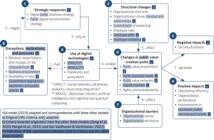
Preliminary theoretical framework for digital transformation in public nonprofit organizations
Although the framework proposed by Vial (2019) is oriented toward market-oriented companies, it was retained as the foundational structure due to its significant academic impact and high citation levels, as previously noted. The adaptations made to the dimensions and criteria of the original framework from Vial (2019), also considering elements from the frameworks of Van Veldhoven and Vanthienen (2022), Gong et al. (2020), and Mergel et al. (2019) are outlined below.
In dimension ‘A - use of digital technologies’, the SMACIT concept (an acronym for Social (social networks), Mobile (mobile devices), Analytics (data analysis for decision-making), Cloud (cloud computing), and Internet of Things (the interconnection of objects via the internet)) and BRAICQ (an acronym for Blockchain, Robotics, Artificial Intelligence, and Cognitive and Quantum Computing) were incorporated. Both sets of technologies are also aligned with those identified in the frameworks of Van Veldhoven and Vanthienen (2022) and Mergel et al. (2019).
In dimension ‘B - disruptions’, the words ‘motivations’ and ‘pressures’ from the framework (Gong et al., 2020) were added to the dimension title. The terms ‘consumer/user’ were also included in the original criterion from Vial (2019) ‘behavior, and expectations’; ‘business environment’ and ‘government regulations’ from the framework by Van Veldhoven and Vanthienen (2022), and ‘legislation and public policies’ from the framework by Gong et al. (2020).
In the ‘C - strategic responses’ dimension, the original criteria from Vial (2019) were considered, with the insertion of the word ‘public’ in the criterion ‘digital public business strategy’ and the word ‘public’ in the criterion ‘public digital transformation strategy’ as found in the framework by Gong et al. (2020).
For the dimension ‘D - changes in public value creation’, originally from Vial (2019), the word ‘public’ was added to the title of this dimension. Similarly, ‘value creation’, ‘value proposition’, ‘business framework’, and ‘value networks’, also from Vial (2019), received the suffix ‘public’ added to the original names of the criteria, as derived from the framework of Van Veldhoven and Vanthienen (2022). The criterion ‘agility and ambidexterity’, being a key characteristic of TD, as indicated by Helbin (2019), Zhang et al. (2023), and Ürü et al. (2024), even though it may occur to a lesser degree in public nonprofit organizations, was retained, as indicated in the original structure of Vial (2019).
Next, in the ‘E - structural changes’ dimension, the ‘organizational structure’ criterion was expanded to include ‘mindset and relationships,’ incorporating the concepts from the framework Van Veldhoven and Vanthienen (2022); as well as the criterion ‘leadership’, which incorporated ‘behavior’, and the criteria ‘employee roles and skills’ and ‘employee resilience’, both originating from the framework proposed by Mergel et al. (2019).
In the ‘F - organizational barriers’ dimension, the word ‘organizational’ was added to the two original criteria (Vial, 2019), resulting in the criteria ‘organizational inertia’ and ‘organizational resistance’, but aligned with the specificities of public nonprofit organizations.
In the ‘G - negative impacts’ dimension, the ‘security and privacy’ criterion originally from Vial (2019) was also aligned with the framework of Mergel et al. (2019).
Finally, in the ‘H - positive impacts’ dimension, the criterion ‘improvements in industry and society’ originally proposed by Vial (2019) was rephrased as ‘Improvements in processes, public services, and society,’ thereby aligning more closely with that indicated in the framework of Mergel et al. (2019). While preserving the structural basis of the TD framework from Vial (2019), the adjustments or adaptations made based on the frameworks from Van Veldhoven and Vanthienen (2022), Gong et al. (2020), and Mergel et al. (2019) have made the preliminary adapted framework outlined here more aligned with the characteristics of public nonprofit organizations.
METHODOLOGY
This is an exploratory-descriptive study using both qualitative and quantitative approaches (Jonathan, 2022). A literature review was conducted in the databases ScienceDirect, Web of Science, Scopus, and IEEE Xplore. In addition, data collection and analysis techniques were applied to support the analysis and validation of the proposed theoretical model. The literature review highlighted the multiplicity and complexity of the DT topic, the existence of identified frameworks in the academic literature for this research, and the interrelationships among the use and application of digital technologies by organizations. Based on the four selected DT frameworks from Vial (2019), Mergel et al. (2019), Gong et al. (2020), and Van Veldhoven and Vanthienen (2022), the correspondence between dimensions and criteria was established, leading to the development of an initial theoretical framework (Figure 5).
The research was conducted in two phases of development of the preliminary theoretical framework. In phase 1, a questionnaire was developed using the Delphi method, which, according to Wright and Giovinazzo (2000), aims to achieve convergence and consensus among experts on a given topic through controlled feedback and iterative rounds that allow participants to reassess their opinions in light of the group’s responses. The experts were identified through non-probabilistic sampling from among tenured faculty members holding doctoral degrees in Stricto Sensu Graduate Programs in Public Administration and Business Administration (concepts 5, 6, and 7) with research lines aligned with the phenomenon of digital transformation. Twelve graduate programs were considered, with a total of 13 researchers who had recently published on the topic. An invitation to participate in phase 1 of the research was sent to all identified researchers, resulting in nine PhD researchers participating.
The framework structure was presented to the academic researchers, with each topic corresponding to one of the eight dimensions of the DT criteria, as shown in Figure 5. A questionnaire was administered with responses arranged on a five-point Likert scale (1 - strongly disagree, 2 - partially disagree, 3 - neither agree nor disagree, 4 - partially agree, and 5 - strongly agree) to indicate the degree of agreement with each presented criterion. The questionnaire questions addressed the validation of the preliminary framework by the expert researchers, namely: 1. ‘Is the content of this dimension and criteria consistent with the reality of public nonprofit organizations?’; 2. ‘Is the content of this dimension/criteria appropriate for the challenges/expectations of public nonprofit organizations?’; 3. ‘Do the items in this dimension/criteria take into account the specific roles of public nonprofit organizations in society?’; and finally 4. ‘Is the content of this dimension/criteria appropriate for the processes and procedures of public nonprofit organizations?’ Based on the analysis of the collected responses and suggestions, the second version of the framework was created, guided by input from the doctoral researchers participating in phase 1 of the study.
An option was also provided for optional qualitative essay responses, with the following guidance: “If you selected ‘partially disagree’ or ‘strongly disagree’ for any criterion described in this dimension, please write your critique or suggestion for improvement here.” The essay responses, which included suggestions for adding, modifying, or removing criteria, were analyzed in accordance with the scope and academic basis of the research and were also presented to the other experts, thereby seeking the analysis and validation of the nine researchers participating in this phase of the research. In this way, it was possible to incorporate additional contributions to the framework initially proposed in this research. The additions and changes were approved by the participating doctoral researchers. This stage was carried out in August and September 2024.
In phase 2, the Design Science Research (DSR) methodology was applied. De Paula Ribeiro and Cappellozza (2022) recommend the application of DSR as an appropriate methodology for researching complex multidisciplinary issues, such as phenomena related to business development and management within the context of digital transformation, the focus of this research. For this purpose, the DSR methodology proposed by Peffers et al. (2007) was applied. The DSR methodology provides methodological robustness, ensuring that the framework proposed in this research can be implemented or refined in future studies, thereby strengthening its potential for application and real-world testing in public and nonprofit organizations.
Thus, considering a non-probabilistic sampling approach, the modified framework presented at the end of Phase 1 was distributed to 468 professionals and managers involved in digital transformation (DT) across 40 Brazilian publicly funded, nonprofit organizations. These included 10 at the federal level, 14 at the state level, and 16 at the municipal level. Regarding the industry sector, the public nonprofit organizations were distributed across seventeen information and communication technology firms, seven sanitation firms, four engineering and urban planning firms, four energy generation and distribution firms, three banks, three transportation firms, and two agricultural research and development firms.
The professionals were identified through the nonprofit public organization’s website and profiles on the LinkedIn social media platform. Participating professionals also expressed their level of agreement with the criteria set forth in the eight dimensions of the framework, using the same Likerttype scale applied in phase 1 of the research. In addition, professionals were also able to submit suggestions for changes to the nomenclature of the presented criteria, as well as suggestions for the inclusion of new criteria. This stage was conducted from October to November 2024.
A total of 65 responses were validated from professionals working in 30 different public organizations. The hierarchical profile of the respondents comprised 6 senior executives, 43 professionals in managerial roles, and 16 technical professionals, all of whom had been involved in digital transformation within their organizations for at least two years. Suggestions for changing the criteria nomenclature or including new criteria provided by market professionals were analyzed by the same academic experts who participated in Phase 1, thereby enabling the creation of the final version of the digital transformation framework for public nonprofit organizations, as presented in the following section.
ANALYSIS AND DISCUSSION OF RESULTS
Following Phase 1 with the academic experts, the terms ‘IT infrastructure’ and ‘government digital services’ were included in Dimension A. In Dimension B, the term ‘consumer’ was changed to ‘citizen’. Dimension C remained unchanged, as did Dimension F. Dimension D included the term ‘scalability of digital governments.’ Similarly, in Dimension E, the term ‘commitment’ was replaced with ‘engagement’, and the term ‘government schools and public IT training policies’ was incorporated. In dimension G, the term “unavailability of digital services” was added. Finally, in dimension H, the term “processes, public services, and society” was changed to “improvement in processes and social impact.” Table 1 presents the detailed results obtained by applying the Delphi method at the end of phase 1 of the research, broken down by each dimension of the conceptual framework under development.
For this study, it is assumed that results equal to or greater than 50.1% (simple majority), as indicated by Dubey and Kothari (2022) of agreement among the consulted experts (sum of responses for the “agree” and “strongly agree”) are sufficient for validating the dimension and respective component criteria of the theoretical framework under construction.
Theoretical framework validated by the committee of academic experts
The adapted digital transformation (DT) framework for publicly funded, non-profit organizations, validated in phase 1 of the study by a committee of expert academic researchers holding PhDs in DT, is presented here. Five inclusion suggestions and three modification proposals were incorporated, resulting in the revised adapted framework shown in Figure 6.

Theoretical framework validated by professionals specializing in digital transformation working in public nonprofit organizations
In the administered questionnaire, professionals from public nonprofit organizations indicated their level of agreement with each component of the theoretical framework presented (dimensions A-H). Table 2 presents all the results obtained for each dimension (A through H), based on the responses of the professionals participating in phase 2 of the research, considering their position on the Likert scale presented (1 - strongly disagree; 2 - partially disagree; 3 - neither agree nor disagree; 4 - partially agree; and 5 - strongly agree).
Note the sum of the results for the “partially agree” and “strongly agree” options (right column). For this study, it is assumed that results equal to or greater than 50.1% (simple majority) of agreement (sum of responses for the “partially agree” and “strongly agree” options) are sufficient to validate the dimension and its component criteria within the analyzed theoretical framework, as indicated by Dubey and Kothari (2022).
The suggestions from professionals at public nonprofit organizations were accepted and incorporated into the framework following final validation by the committee of academic experts who participated in phase 1 of the research. Table 3 presents the eight suggestions included and the four nomenclature modifications incorporated into the framework.
The first change accepted was to remove the term ‘robotics’ from the acronym ‘BRAICQ’ (referring to Blockchain, Robotics, Artificial Intelligence, Cognitive, and Quantum computing) and replace it with the term ‘Automation’ or ‘Bot’ or ‘Chatbots,’ since these are more commonly used in automated customer service at public nonprofit organizations, as indicated by Monteiro et al. (2023)there is still a lack of research examining usability pitfalls in human-chatbot interaction. Therefore, this study aims to fill this research gap by presenting an analysis and comparison of ten electronic government chatbots, five national (Brazilian. The acronym was then designated as BAAICQ (Blockchain, Automation / Chatbot, Artificial Intelligence, Cognitive, and Quantum computing).
Another criterion included was ‘information security’ in the ‘A - use of digital technologies’ dimension. The objective of this dimension is the use of computational tools to perform tasks and exchange information. Thus, the inclusion of ‘information security’ is addressed in data protection laws, for the purposes of the secure storage and management of the information of the citizens by public nonprofit companies.
Dimension ‘B - disruptions/motivations/pressures’ encompasses factors that may disrupt, stimulate, or compel a public company to act based on situations in society and the business environment in which it operates. The suggestion of the professionals was accepted based on the arguments of Lobo and Noronha (2023), who argue that digital citizenship, or citizen experience (CiX), constitutes the interaction among citizens, communities, and publicly funded, nonprofit service organizations, providing feedback to performance indicators, targets, and strategic responses.
Also within the ‘B - disruptions/motivations/pressures’ dimension, the criterion ‘Budgetary and resource constraints’ was included as it is a pressure factor for TD, potentially affecting the implementation of public policies, as indicated by Cardoso (2021). The criterion ‘discontinuity of strategic governance,’ conversely, is linked to administrative discontinuity at the corporate governance levels, primarily related to strategic vision and values, in line with the findings of Jonathan et al. (2023).
The ‘C - strategic responses’ dimension reflects the outcome of changes in business strategy and digital transformation within the public enterprise, a public sector governance challenge (Meijer, 2025).
The ‘D - changes in public value creation paths’ comprises criteria that express the mechanisms for enhancing the value of public sector organizations, as reflected in their value proposition, business framework, business networks, and the digital channels in which they operate, as well as their capacity for scalability.
The ‘E - structural changes’ dimension represents transformations in the structure or business processes that improve the public enterprise, involving its organizational culture, leadership, and competencies, as well as the skills and training of its professionals. The first change was renaming this dimension from ‘structural changes’ to ‘organizational changes,’ a more appropriate label given its criteria, which encompass the entire organization. Next, the suggestion to include the ‘cognitive ergonomics’ (CogErg) criterion was also accepted, an area that addresses occupational health and employee performance (Tosi, 2020).
The ‘F - organizational barriers’ dimension identifies obstacles to the digital transformation process of public companies, such as organizational inertia and resistance. The criterion ‘organizational bureaucracy’ was included as a constraint or obstacle to DT. This is because it reflects the occurrence of excessive hierarchy, procedures, and regulations in the flow of tasks, as seen in legalistic bureaucracies of accountability and law, populist bureaucracies, or management-accountability bureaucracies, in Weberian bureaucracies of autonomy and law, or in liberal bureaucracies of autonomy and management (Dahlström & Lapuente, 2022) and bureaucratic dysfunction in public nonprofit organizations (Avgerou & Bonina, 2020). The criterion “corporatism” was also included in dimension “F - organizational barriers”, referring to the social organization of actors into groups or corporations with shared interests and activities, such as associations and trade unions. The presence of potentially conflicting organizational behaviors, including actions, omissions, and power dynamics, may generate barriers to operational flows and digital transformation (Lanzaro & Ramos Larraburu, 2021; Safari et al., 2020).
Dimension “G - negative impacts” addresses undesirable factors that may adversely affect public sector organizations. this dimension did not receive any suggested modifications in open-ended questions 5 and 6 from respondents working in publicly funded, non-profit organizations. It is noteworthy that dimension “g - negative impacts” was the only dimension that did not undergo changes, whereas dimension “b - disruptions/motivations/pressures” received the highest number of modifications, with three additions incorporated into the theoretical framework.
In contrast, dimension ‘H - positive impacts,’ focused on factors that help public companies improve their performance in delivering public services during digital transformation, received a suggestion to change the criterion ‘process improvements and social impact’ to separate it into two independent criteria: ‘digitization and improvements in process’ and ‘social impact.’ Digitization is a process of transforming analog data into digital form, ranging from document digitization to changes in work processes and the business framework. The positive impacts of digitization are greater in pre-digital public nonprofit organizations, improving their performance and service delivery Alvarenga et al. (2020), Sebastian et al. (2020). According to Bisogno et al. (2024), public nonprofit organizations in municipalities with higher debt levels tend to exhibit lower levels of digitization. In contrast, the ‘Social impact’ criterion promotes the improvement of public service quality and digital literacy, while also fostering digital social inclusion (Davydov et al., 2020; Bejaković & Mrnjavac, 2020).
Based on the perspectives of professionals from public nonprofit organizations and the consensus of academic experts, the theoretical framework developed at the conclusion of phase 2 of the research is presented in Figure 7.
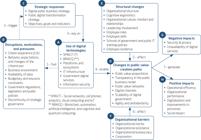
Figure 7 presents the definitive digital transformation framework for public nonprofit organizations, validated by a committee of expert professors and PhD researchers in DT, as well as by professionals from public nonprofit organizations with DT experience. The definitive framework consists of eight dimensions and 40 criteria and their relationships, as follows: the ‘use of digital technologies’ dimension (6 criteria), which fuels the ‘disruptions/motivations/pressures’ dimension (7), which acts as a trigger for the ‘strategic responses’ dimension (3), which in turn feeds back into the ‘use of digital technologies’ dimension.
The ‘use of digital technologies’ dimension enables the ‘changes in pathways of public value creation’ dimension (6) and is affected by the ‘organizational changes’ dimension (8) and the ‘organizational barriers’ dimension (4). Finally, the dimension ‘changes in public value creation paths’ generates the dimension ‘negative impacts’ (2) and the dimension ‘positive impacts’ (4).
This is considered the final version, as it consolidates the key elements and criteria for digital transformation within the existing frameworks of Vial (2019), Gong et al. (2020), Mergel et al. (2019), and Van Veldhoven and Vanthienen (2022) used in the development of this digital transformation framework, in addition to incorporating the contributions of experts (academics and industry professionals), while respecting the unique characteristics of public nonprofit organizations.
Analysis and discussion of the results
As seen, DT is a complex process that encompasses more than just digital tools, as indicated by (Cosa, 2024). Thus, the theoretical framework formulated in this research is multidimensional, as it considers not only the most recent digital tools, such as SMACIT (an acronym for social media, mobile devices, data analytics for decision-making, cloud storage, and the Internet of Things), but also BRAICQ (an acronym for Blockchain, robotization, artificial intelligence, and cognitive and quantum computing), also indicated in the models of Van Veldhoven and Vanthienen (2022) and Mergel et al. (2019). Furthermore, the proposed framework also addresses internal structural organizational changes (Hanelt et al., 2021), resilience, and organizational culture change (Carroll et al., 2023) as well as external changes, such as new public policies and CX (citizen experience) (Lobo & Noronha, 2023; Osborne et al., 2022; Çubuk et al., 2019).
Conversely, the framework preserves the conceptual structure of established models, especially the model developed by Vial (2019), but stands out for its adaptations to the specific context of public nonprofit organizations, that is, it adds new criteria for analyzing td, such as in the “disruptions/motivations/pressures” dimension, which incorporates regulatory elements present in Gong et al. (2020) and in Brazilian public policies (Brasil, 2018; Brasil, 2024).
The work of Ürü et al., (2024) and Zhang et al., (2023) on the dimension “Organizational Changes” encompasses multiple criteria related to changes in organizational structure and culture, as well as leadership (Karakuş & Yalçin, 2024) and employee competencies and resiliency (Kitsios et al., 2023), thereby acknowledging aspects inherent to public nonprofit organizations.
In addition, the “use of digital technologies” dimension includes emerging technologies such as artificial intelligence, the Internet of Things (IoT), and blockchain, which are particularly relevant to smart cities. The dimension ‘changes in public value creation paths’ (Osborne et al., 2021) presents criteria for public nonprofit organizations to strategically position themselves regarding the design and implementation of digital transformation (DT) in their processes for delivering value to citizens through digital means (Çubuk et al., 2019). In contrast, the framework developed in this research also considers the social aspect of the production and delivery of digital public services based on the criteria indicated in the ‘positive impacts’ dimension, which includes elements such as digitization (Góes et al., 2023) and improvements in internal organizational processes. However, public nonprofit organizations must consider the criteria indicated in the ‘negative impacts’ dimension, which address data security of citizens (Cereola & Dynowska, 2019) and the unavailability of digital services (Djatmiko et al., 2025).
The framework developed here is particularly applicable to public nonprofit organizations in emerging countries, which have unique characteristics and deal with complex networks of actors (Hendra et al., 2024) involved in TD implementation, such as the State, the private sector, and civil society. For this reason, this framework can help map such interactions to propose coordination mechanisms for the ecosystem in which they operate (Van Veldhoven and Vanthienen, 2022). For example, in the context of the state, there is a need to strengthen institutional governance (Mergel et al., 2019) of the public nonprofit organization. In the context of partners operating in the private sector, emphasis is placed on developing strategic partnerships (Menezes & Vieira, 2022) for the advancement and adoption of technologies that are accessible to the realities of emerging countries. Finally, in the context of civil society, the framework established in this research includes guiding criteria to shape the delivery of public value (Bryson et al., 2014) in the TD of public nonprofit organizations to society, organizations, and citizens.
Although the unavailability of digital public services is not directly synonymous with digital exclusion, it represents a relevant issue that warrants discussion, as the digitalization of public services may create barriers for citizens (Rösler et al., 2021) who lack access to technologies or adequate digital literacy. It is also important to consider that digital transformation and the digitalization of public services may generate barriers for more vulnerable citizens (Djatmiko et al., 2025), including those with limited access to technology, those affected by regional inequalities, or groups with lower levels of cognitive understanding and specific needs (Higgins et al., 2023).
The framework developed in this research presents a structure, dimensions, and criteria validated in the scientific literature and by academic experts and industry professionals. However, the wide variety of criteria for analyzing the DT process in public nonprofit organizations may pose challenges for managers when applying the framework. Thus, it is recommended that such professionals understand the dimensions presented by the framework systematically, to ensure the appropriate and progressive application of the criteria for each dimension when conducting the DT analysis of the company.
CONCLUSIONS, LIMITATIONS, AND SUGGESTIONS FOR FUTURE RESEARCH
After searching for and selecting various relevant studies representing the state of the art on the topic focused on in this research, four main frameworks were identified: Vial (2019), Gong et al. (2020), Mergel et al. (2019) and Van Veldhoven and Vanthienen (2022) along with a respective set of criteria for analyzing digital transformation (DT) in organizations. This theoretical framework supported the development of a structured DT framework specific to public nonprofit organizations (Vial, 2019). The framework designed in this research was initially reviewed by a committee of doctoral-level academic researchers specializing in digital transformation and subsequently analyzed by 65 professionals and managers involved in digital transformation across 30 different public nonprofit organizations at the federal, state, and municipal levels.
The framework presented in this study is structured into eight dimensions and 40 criteria and their relationships, namely: ‘use of digital technologies’ (6 criteria), ‘disruptions/motivations/pressures’ (7), ‘strategic responses’ (3), ‘changes in public value creation paths’ (6), ‘organizational changes’ (8), ‘organizational barriers’ (4), ‘negative impacts’ (2), and, finally, ‘positive impacts’ (4). The framework presented in this study is specifically geared toward public nonprofit organizations, offering criteria for reflection by managers and professionals involved in the strategic development of digital technology (DT) within their organizations. Accordingly, the dimensions and criteria established in this framework may assist managers in defining their strategies, particularly regarding the application of digital technologies, while considering the disruptions, motivations, and pressures arising from the complex contemporary environment of digital transformation. Based on the established strategic positioning, managers of public nonprofit organizations will be able to set organizational objectives, goals, and indicators, using the established proposal as a foundation to deliver value to citizens, organizations, and society.
Furthermore, the framework highlights key areas of attention for managers of publicly funded nonprofit organizations regarding the organizational change process in digital transformation, as well as potential organizational barriers to consider. It also identifies potential impacts, both positive and negative, on society that managers should carefully evaluate to guide these organizations’ digital transformation.
The contribution of this study is the proposal of a framework specifically tailored toward public nonprofit organizations, since previous studies have focused primarily on private companies or public agencies in isolation. Thus, the framework developed in this research provides a conceptual basis for the strategic analysis of DT in public nonprofit organizations, positioning their business to deliver appropriate public value to society.
The conceptual framework presented in this study contributes to a better understanding of the TD phenomenon among academic researchers in the context of public nonprofit organizations, notably by outlining key dimensions and corresponding criteria for conducting cause-and-effect analyses of TD in these organizations. In addition, the practical contributions of this research should be emphasized, as they relate to its potential application by professionals and managers of publicly funded, nonprofit organizations in real-world business environments. This is reinforced by the fact that the validated framework was also assessed by professionals and managers directly involved in digital transformation processes within their organizations. It is expected that the framework validated in this study will be used as a support tool to guide discussions and inform strategic decision-making regarding the design and implementation of digital transformation in publicly funded nonprofit organizations.
The scope of this framework is limited exclusively to public nonprofit organizations in developing countries, considering their political context, budgetary resources, and technological infrastructure, as well as their digital resilience and maturity. This is because the framework considers criteria related to public governance, regulation, compliance, maturity metrics, and public performance indicators, making it operational for diagnosing and informing future studies on DT in public nonprofit organizations.
The limitations of this study include difficulty securing participation from academic researchers due to nonresponse from several invited scholars, as well as challenges in recruiting professionals from publicly funded nonprofit organizations engaged in digital transformation. Another limitation concerns the specific nature of the research object, namely, publicly funded, nonprofit organizations, given their distinct characteristics, modes of operation, and regulatory constraints, among other unique features. As such, the applicability of the framework developed in this study may be limited when applied to other types of public-sector organizations. As directions for future research, it is recommended to pursue statistical validation of the proposed framework and to expand the panel of academic experts by incorporating additional profiles related to digital transformation. Furthermore, future studies may seek to include a larger, more diverse sample of publicly funded nonprofit organizations across countries.
Open Data:
the contents underlying the research text are included in the manuscript.
-
RAM does not have permission from the authors or evaluators to publish this article’s review.
REFERENCES
-
Alvarenga, A., Matos, F., Godina, R., & C. O. Matias, J. (2020). Digital Transformation and knowledge management in the public sector. Sustainability, 12(14), 5824. https://doi.org/10.3390/su12145824
» https://doi.org/10.3390/su12145824 -
Avgerou, C., & Bonina, C. (2020). Ideologies implicated in IT innovation in government: A critical discourse analysis of Mexico’s international trade administration. Information Systems Journal, 30(1), 70-95. https://doi.org/10.1111/isj.12245
» https://doi.org/10.1111/isj.12245 -
Bejaković, P., & Mrnjavac, Ž. (2020). The importance of digital literacy on the labor market. Employee Relations: The International Journal, 42(4), 921-932. https://doi.org/10.1108/ER-07-2019-0274
» https://doi.org/10.1108/ER-07-2019-0274 - Bisogno, M., Cuadrado-Ballesteros, B., & Abate, F. (2024). The role of institutional and operational factors in the digitalization of large local governments: Insights from Italy. International Journal of Public Sector Management, 38(2), 238-258.
-
Brasil. (2024). Aggregate report on federal state-owned enterprises 2024: Base year 2023 Brazilian Federal Government. https://www.gov.br/gestao/pt-br/central-de-conteudo/relatorios-das-estatais/relatorio_empresas_estatais_federais_2024.pdf
» https://www.gov.br/gestao/pt-br/central-de-conteudo/relatorios-das-estatais/relatorio_empresas_estatais_federais_2024.pdf -
Brazil. (2018). Law No. 13,9 General Personal Data Protection Law (LGPD). Federal Government. https://www.gov.br/mds/pt-br/acesso-a-informacao/governanca/integridade/campanhas/lgpd
» https://www.gov.br/mds/pt-br/acesso-a-informacao/governanca/integridade/campanhas/lgpd -
Bryson, J. M., Crosby, B. C., & Bloomberg, L. (2014). Public value governance: Moving beyond traditional public administration and the new public management. Public Administration Review, 74(4), 445-456. https://doi.org/10.1111/puar.12238
» https://doi.org/10.1111/puar.12238 - Cardoso, B. B.(2021). Digital transformation and public action: How the digitization of public action instruments can affect the implementation of public policies [Master’s thesis, Institute of Applied Economic Research]. IPEA.
-
Carroll, N., Hassan, N. R., Junglas, I., Hess, T., & Morgan, L. (2023). Transform or be transformed: the importance of research on managing and sustaining digital transformations. European Journal of Information Systems, 32(3), 347-353. https://doi.org/10.1080/0960085X.2023.2187033
» https://doi.org/10.1080/0960085X.2023.2187033 -
Cereola, S., & Dynowska, J. (2019). Investigating the impact of publicly announced information security breaches on corporate risk factor disclosure tendencies. Journal of Cybersecurity Education, Research and Practice, 2019(2), 1-28. https://digitalcommons.kennesaw.edu/jcerp/vol2019/iss2/3
» https://digitalcommons.kennesaw.edu/jcerp/vol2019/iss2/3 -
Chen, C. L., Lin, Y. C., Chen, W. H., Chao, C. F., & Pandia, H. (2021). Role of government to enhance digital transformation in small service businesses. Sustainability, 13(3), 1-26. https://doi.org/10.3390/su13031028
» https://doi.org/10.3390/su13031028 -
Cosa, M. (2024). Business digital transformation: strategy adaptation, communication, and future agenda. Journal of Strategy and Management, 17(2), 244-259. https://doi.org/10.1108/JSMA-09-2023-0233
» https://doi.org/10.1108/JSMA-09-2023-0233 -
Costa, G. M., Junior, J. C. D. S. F., Brinkhues, R. A., & Cabral, P. M. F. (2023). An essay on a framework for digital transformation. Journal of Management and Secretarial Studies, 14 https://doi.org/https://doi.org/10.7769/gesec.v14i7.2340
» https://doi.org/https://doi.org/10.7769/gesec.v14i7.2340 -
Cubuk, E. B. S., Karkin, N., & Yavuz, N. (2019, June 19). Public sector innovativeness and public values through information and communication technologies [Conference presentation]. 20th Annual International Conference on Digital Government Research, Dubai. https://doi.org/10.1145/3325112.3325215
» https://doi.org/10.1145/3325112.3325215 -
Dahlström, C., & Lapuente, V. (2022). Comparative Bureaucratic Politics. Annual Review of Political Science, 25(1), 43-63. https://doi.org/10.1146/annurev-polisci-051120-102543
» https://doi.org/10.1146/annurev-polisci-051120-102543 -
Das Graças Murici, M. (2022). Digital transformation: Impacts on Brazilian organizations [PhD dissertation, Federal University of Minas Gerais]. UFMG. https://repositorio.ufmg.br/items/e08a714e-1d9d-4d17-b72b-668efef3b085
» https://repositorio.ufmg.br/items/e08a714e-1d9d-4d17-b72b-668efef3b085 -
Davydov, S., Logunova, O., Maltseva, D., Sharikov, A., & Zadorin, I. (2020). Digital literacy concepts and measurement. In Chepurenko, A., Larsen, S. U., Reisinger (eds.), Societies and political orders in transition (pp. 103-120). Springer. https://doi.org/10.1007/978-3-030-33016-3_6
» https://doi.org/10.1007/978-3-030-33016-3_6 -
De Paula Ribeiro, G., & Cappellozza, A. (2022). Transformação Digital dos Canais de Atendimento a Clientes de uma Instituição Financeira no Brasil [Conference presentation]. XLVI Encontro da ANPAD, https://www.mackenzie.br/fileadmin/ARQUIVOS/Public/6-pos-graduacao/upm-higienopolis/mestrado-doutorado/admin-desen-negocios/2023/18_Transformação_Digital_dos_Canais_de_Atendimento.pdf
» https://www.mackenzie.br/fileadmin/ARQUIVOS/Public/6-pos-graduacao/upm-higienopolis/mestrado-doutorado/admin-desen-negocios/2023/18_Transformação_Digital_dos_Canais_de_Atendimento.pdf -
Djatmiko, G. H., Sinaga, O., & Pawirosumarto, S. (2025). Digital transformation and social inclusion in public services: A qualitative analysis of e-government adoption for marginalized communities in sustainable governance. Sustainability, 17(7), 2908. https://doi.org/10.3390/su17072908
» https://doi.org/10.3390/su17072908 -
Dubey, U. K. B., & Kothari, D. P. (2022). Research Methodology Taylor & Francis. https://doi.org/10.1201/9781315167138
» https://doi.org/10.1201/9781315167138 -
Durkiewicz, J., & Janowski, T. (2021). Is digital government advancing sustainable governance? A study of OECD/EU countries. Sustainability, 13(24), 13603. https://doi.org/10.3390/su132413603
» https://doi.org/10.3390/su132413603 -
Gong, C., & Ribiere, V. (2021). Developing a unified definition of digital transformation. Technovation, 102, 102217. https://doi.org/10.1016/j.technovation.2020.102217
» https://doi.org/10.1016/j.technovation.2020.102217 -
Gong, Y., Yang, J., & Shi, X. (2020). Towards a comprehensive understanding of digital transformation in government: Analysis of flexibility and enterprise architecture. Government Information Quarterly, 37(3), 101487. https://doi.org/10.1016/j.giq.2020.101487
» https://doi.org/10.1016/j.giq.2020.101487 -
Hanelt, A., Bohnsack, R., Marz, D., & Antunes Marante, C. (2021). A systematic review of the literature on digital transformation: Insights and implications for strategy and organizational change. Journal of Management Studies https://doi.org/10.1111/joms.12639
» https://doi.org/10.1111/joms.12639 -
Helbin, T. (2019, May 29-30). Investigating how business process ambidexterity facilitates business-it alignment in public sector organizations [Conference presentation]. 13th International Conference on Research Challenges in Information Science, Brussels, Belgium. https://doi.org/10.1109/RCIS.2019.8877023
» https://doi.org/10.1109/RCIS.2019.8877023 -
Hendra, O., Prasojo, E., Fathurrahman, R., & Pilbeam, C. (2024). Vertical-horizontal Actor Collaboration in Governance Network: A Systematic Review. Public Organization Review, 24(4), 1233-1252. https://doi.org/10.1007/s11115-024-00794-w
» https://doi.org/10.1007/s11115-024-00794-w -
Higgins, N., Ferri, D., & Donnellan, K. (2023). Enhancing access to digital culture for vulnerable groups: The role of public authorities in breaking down barriers. International Journal for the Semiotics of Law-Revue Internationale de Sémiotique Juridique, 36(5), 2087-2114. https://doi.org/10.1007/s11196-022-09959-6
» https://doi.org/10.1007/s11196-022-09959-6 - Jonathan, G. M. (2022, September 20-23). IT Alignment: A Management Paradigm for Digital Transformation in Public Organizations [Conference presentation]. 21st International Conference on Perspectives in Business Informatics Research, Rostock, Germany.
-
Jonathan, G. M., Yalew, S. D., Gebremeskel, B. K., Rusu, L., & Perjons, E. (2023). IT alignment: A path towards digital transformation success. Procedia Computer Science, 219, 471-478. https://doi.org/10.1016/j.procs.2023.01.314
» https://doi.org/10.1016/j.procs.2023.01.314 -
Ju, X., Ferreira, F. A. F., & Wang, M. (2020). Innovation, agile project management and firm performance in a public sector-dominated economy: Empirical evidence from high-tech small and medium-sized enterprises in China. Socio-Economic Planning Sciences, 72, 100779. https://doi.org/10.1016/j.seps.2019.100779
» https://doi.org/10.1016/j.seps.2019.100779 -
Karakuş, M., & Yalçin, C. (2024). Digital Transformation and Organizational Change Management: Theoretical Models and Case Studies. In U. Özkaya (ed.), New Trends and Frontiers in Engineering (pp. 344-376). All Sciences Academy. https://www.researchgate.net/publication/385238671_Digital_Transformation_and_Organizational_Change_Management_Theoretical_Models_and_Case_Studies
» https://www.researchgate.net/publication/385238671_Digital_Transformation_and_Organizational_Change_Management_Theoretical_Models_and_Case_Studies -
Kitsios, F., Kamariotou, M., & Mavromatis, A. (2023). Drivers and outcomes of digital transformation: The case of public sector services. Information, 14(1), 43. https://doi.org/10.3390/info14010043
» https://doi.org/10.3390/info14010043 -
Kyriakogkonas, P., Garefalakis, A., Gonidakis, F. K., Trihas, N., & Zampoulakis, N. (2023). Prospects of the digital transformation of the greek public sector through private-public partnerships: A perception study. Theoretical Economics Letters, 13(3), 568-596. https://doi.org/10.4236/tel.2023.133036
» https://doi.org/10.4236/tel.2023.133036 -
Lanzaro, J., & Ramos Larraburu, C. (2021). Decentralization and co-participation in the public sector: A historical feature of uruguayan pluralist democracy. International Journal of Public Administration, 44(1), 14-29. https://doi.org/10.1080/01900692.2020.1750029
» https://doi.org/10.1080/01900692.2020.1750029 -
Lobo, A. E., & Noronha, S. D. (2023). Review on factors affecting digital citizen experience while using online government services. International Journal of Case Studies in Business, IT, and Education, 7(3), 35-61. https://doi.org/10.47992/IJCSBE.2581.6942.0287
» https://doi.org/10.47992/IJCSBE.2581.6942.0287 -
Meijer, A. (2025). Futures for the public sector. In G. Bouckaert, A. Hondeghem, T. Steen, & S. Van de Walle (eds.), Futures for the public sector Leuven University Press. https://doi.org/10.11116/9789461666246
» https://doi.org/10.11116/9789461666246 -
Menezes, D. C., & Vieira, D. M. (2022). Stakeholders, critical success factors, and value creation in public-private partnerships. Revista de Administração Pública, 56(1), 47-79. https://doi.org/10.1590/0034-761220200659
» https://doi.org/10.1590/0034-761220200659 -
Mergel, I., Edelmann, N., & Haug, N. (2019). Defining digital transformation: Results from expert interviews. Government Information Quarterly, 36(4), 101385. https://doi.org/10.1016/j.giq.2019.06.002
» https://doi.org/10.1016/j.giq.2019.06.002 -
Mergel, I., Ganapati, S., & Whitford, A. B. (2021). Agile: A new way of governing. Public Administration Review, 81(1), 161-165. https://doi.org/10.1111/puar.13202
» https://doi.org/10.1111/puar.13202 -
Mergel, I., Edelmann, N., & Haug, N. (2025). Co-production phases in the development and implementation of digital public services. Perspectives on Public Management and Governance, 8(2), 93-105. https://doi.org/10.1093/ppmgov/gvaf002
» https://doi.org/10.1093/ppmgov/gvaf002 -
Monteiro, M. de S., Batista, G. O. da S., & Salgado, L. C. de C. (2023). Investigating usability pitfalls in Brazilian and Foreign governmental chatbots. Journal on Interactive Systems, 14(1), 331-340. https://doi.org/10.5753/jis.2023.3104
» https://doi.org/10.5753/jis.2023.3104 -
Nguyen, T. T. B., Akbari, M., & Nguyen, K. D. (2024). Unlocking the potential of the vietnamese supply chain through digitalization: A bibliometric analysis and systematic literature review. Operations and Supply Chain Management, 17(1), 123-141. https://doi.org/10.31387/oscm0560418
» https://doi.org/10.31387/oscm0560418 -
Nguyen, V. T., Siengthai, S., Swierczek, F., & Bamel, U. K. (2019). The effects of organizational culture and commitment on employee innovation: Evidence from Vietnam’s IT industry. Journal of Asia Business Studies, 13(4), 719-742. https://doi.org/10.1108/JABS-09-2018-0253
» https://doi.org/10.1108/JABS-09-2018-0253 -
Osborne, S. P., Nasi, G., & Powell, M. (2021). Beyond co-production: Value creation and public services. Public Administration, 99(4), 641-657. https://doi.org/10.1111/padm.12718
» https://doi.org/10.1111/padm.12718 -
Osborne, S. P., Powell, M., Cui, T., & Strokosch, K. (2022). Value creation in the public service ecosystem: An integrative framework. Public Administration Review, 82(4), 634-645. https://doi.org/10.1111/puar.13474
» https://doi.org/10.1111/puar.13474 -
Peffers, K., Tuunanen, T., Rothenberger, M. A., & Chatterjee, S. (2007). A design science research methodology for information systems research. Journal of Management Information Systems, 23(3), 45-77. https://doi.org/10.2753/MIS0742-1222240302
» https://doi.org/10.2753/MIS0742-1222240302 -
Qu, F., Tang, Q., Li, C.-M., & Liu, J. (2025). Exploring the impact of digital transformation on productivity: The role of artificial intelligence technology, green technology, and energy technology. Technological and Economic Development of Economy, 31(5), 1499-1530. https://doi.org/10.3846/tede.2025.23009
» https://doi.org/10.3846/tede.2025.23009 -
Ren, Z., & Liu, Q. (2025). How digital transformation drives the value enhancement of SMTEs from the perspective of technology, business, and social interaction. Social Indicators Research, 178(3), 1367-1390. https://doi.org/10.1007/s11205-025-03522-z
» https://doi.org/10.1007/s11205-025-03522-z -
Rösler, J., Söll, T., Hancock, L., & Friedli, T. (2021). Value co-creation between public service organizations and the private sector: An organizational capabilities perspective. Administrative Sciences, 11(2), 55. https://doi.org/10.3390/admsci11020055
» https://doi.org/10.3390/admsci11020055 -
Sacavém, A., De Bem Machado, A., dos Santos, J. R., Palma-Moreira, A., Belchior-Rocha, H., & Au-Yong-Oliveira, M. (2025). Leading in the digital age: The role of leadership in organizational digital transformation. Administrative Sciences, 15(2), 43. https://doi.org/10.3390/admsci15020043
» https://doi.org/10.3390/admsci15020043 -
Safari, M., Bicudo de Castro, V., & Steccolini, I. (2020). The interplay between home and host logics of accountability in multinational corporations (MNCs): The case of the Fundão dam disaster. Accounting, Auditing & Accountability Journal, 33(8), 1761-1789. https://doi.org/10.1108/AAAJ-03-2019-3912
» https://doi.org/10.1108/AAAJ-03-2019-3912 -
Schwaeke, J., Kanbach, D. K., & Kraus, S. (2025). Unravelling the great enigma: Dynamic capabilities for digital transformation in entrepreneurial ventures. Journal of Small Business and Enterprise Development, ahead-of-print(ahead-of-print), 1-23. https://doi.org/10.1108/JSBED-04-2025-0255
» https://doi.org/10.1108/JSBED-04-2025-0255 -
Sebastian, I. M., Ross, J. W., Beath, C., Mocker, M., Moloney, K. G., & Fonstad, N. O. (2020). How big old companies navigate digital transformation. In R. D. Galliers, D. E. Leidner, & B. Simeonova (eds.), Strategic Information Management: Theory and Practice (5th ed., pp. 133-150). Routledge. https://doi.org/10.4324/9780429286797-6
» https://doi.org/10.4324/9780429286797-6 -
Stankovski, S., Ostojic, G., Baranoviski, I., Babic, M., & Stanojević, M. (2020, March 18-20). The Impact of Edge Computing on Industrial Automation [Conference presentation]. 19th International Symposium INFOTEH-JAHORINA (NFOTEH), East Sarajevo, Bosnia and Herzegovina. https://doi.org/10.1109/INFOTEH48170.2020.9066341
» https://doi.org/10.1109/INFOTEH48170.2020.9066341 -
Straub, V. J., Morgan, D., Bright, J., & Margetts, H. (2023). Artificial intelligence in government: Concepts, standards, and a unified framework. Government Information Quarterly, 40(4), 101881. https://doi.org/10.1016/j.giq.2023.101881
» https://doi.org/10.1016/j.giq.2023.101881 -
Sundberg, L., & Holmström, J. (2024). Fusing domain knowledge with machine learning: A public sector perspective. The Journal of Strategic Information Systems, 33(3), 101848. https://doi.org/10.1016/j.jsis.2024.101848
» https://doi.org/10.1016/j.jsis.2024.101848 -
Tosi, F. (2020). Design for Ergonomics University of Florence. https://doi.org/10.1007/978-3-030-33562-5
» https://doi.org/10.1007/978-3-030-33562-5 -
Unesco. (2023). Artificial intelligence and digital transformation: Competencies for civil servants UNESCO. https://unesdoc.unesco.org/ark:/48223/pf0000383325
» https://unesdoc.unesco.org/ark:/48223/pf0000383325 -
Ürü, F. O., Gözükara, E., & Ünsal, A. A. (2024). Organizational ambidexterity, digital transformation, and strategic agility for gaining competitive advantage in SMEs. Sosyal Mucit Academic Review, 5(1), 1-23. https://doi.org/10.54733/smar.1386357
» https://doi.org/10.54733/smar.1386357 -
Van Noordt, C., Medaglia, R., & Tangi, L. (2025). Policy initiatives for Artificial Intelligence-enabled government: An analysis of national strategies in Europe. Public Policy and Administration, 40(2), 215-253. https://doi.org/10.1177/09520767231198411
» https://doi.org/10.1177/09520767231198411 -
Van Veldhoven, Z., & Vanthienen, J. (2022). Digital transformation as an interaction-driven perspective between business, society, and technology. Electronic Markets, 32(2), 629-644. https://doi.org/10.1007/s12525-021-00464-5
» https://doi.org/10.1007/s12525-021-00464-5 - Verhoef, P. C., Broekhuizen, T., Bart, Y., Bhattacharya, A., Qi Dong, J., Fabian, N., & Haenlein, M. (2021). Digital transformation: A multidisciplinary reflection and research agenda. Journal of Business Research, 122, 889-901.
-
Vial, G. (2019). Understanding digital transformation: A review and a research agenda. Journal of Strategic Information Systems, 28(2), 118-144. https://doi.org/10.1016/j.jsis.2019.01.003
» https://doi.org/10.1016/j.jsis.2019.01.003 -
Wessel, L., Baiyere, A., Ologeanu-Taddei, R., Cha, J., & Blegind-Jensen, T. (2021). Unpacking the Difference Between Digital Transformation and IT Enabled Organizational Transformation. Journal of the Association for Information Systems, 22(1), 102-129. https://doi.org/10.17705/1jais.00655
» https://doi.org/10.17705/1jais.00655 -
Wright, J. T., & Giovinazzo, R. A. (2000). Delphi: A tool to support prospective planning. Caderno de Pesquisas em Administração, 1(12), 54-65. https://regeusp.com.br/wp-content/uploads/sites/8/2025/04/c12-art05.pdf
» https://regeusp.com.br/wp-content/uploads/sites/8/2025/04/c12-art05.pdf -
Zhang, H., Ding, H., & Xiao, J. (2023). How organizational agility promotes digital transformation: An empirical study. Sustainability, 15(14), 11304. https://doi.org/10.3390/su151411304
» https://doi.org/10.3390/su151411304
Edited by
-
EDITORIAL BOARD
Editor-in-chiefAlmir Martins VieiraAssociated editorMaurício Reinert do NascimentoTechnical supportVitória Batista Santos Silva
-
EDITORIAL PRODUCTION
Publishing coordinationAndreia Ferreira CominettiEditorial InternSofia LelisLanguage editorBardo EditorialLayout designerLibroGraphic designerLibro

 Source:
  Source:
  Source:
  Source:

