 Humor in public communication
Abstract
Public institutions have used humor to communicate with the public on digital platforms, especially through memes. Pieces featuring extravagant imagery and informal language aim to draw attention to serious topics, such as financial education or import taxation. Despite their success in engagement and visibility, these strategies are criticized as superficial or inappropriate. This resistance reflects a historical bias against humor in the public sphere. However, digital humor ‒ such as memes and GIFs ‒ operates through a global language and demonstrates high communicative effectiveness. This study investigates the use of such resources by the Central Bank of Brazil on Instagram, assessing their legitimacy, limitations, and advantages. The article is grounded in a comparative case study that combines digital methods with interpretive analysis to reflect on the strategic uses of meme humor in public communication. The findings support the communicative effectiveness of humor, although its use must be accompanied by a critical perspective and careful attention to its appropriateness and acceptability among the general public.
Keywords:
public communication; humor; memes
Resumo
O humor tem sido usado por instituições públicas para se comunicar com o público nas plataformas digitais, especialmente por meio de memes. Peças com imagens extravagantes e linguagem descontraída visam chamar a atenção para temas sérios, como educação financeira ou taxação de importações. Apesar do sucesso em engajamento e visibilidade, essas estratégias enfrentam críticas por serem consideradas superficiais ou inadequadas. Tal resistência revela um preconceito histórico contra o cômico na esfera pública. No entanto, o humor digital, como memes e GIFs, opera com linguagem global e alta eficácia comunicativa. O estudo propõe investigar o uso desses recursos pelo Banco Central no Instagram, avaliando sua legitimidade, limites e vantagens. O artigo está ancorado em um estudo de caso comparado, que combina uma abordagem proveniente dos métodos digitais à análise interpretativa a fim de refletir sobre os usos estratégicos do humor dos memes na comunicação pública. Os achados sustentam a eficácia comunicativa do gênero humorístico, embora, naturalmente, sua utilização deva se cercar de um olhar crítico e de cuidados sobre a adequação e aceitabilidade pelo público em geral.
Palavras-chave:
comunicação pública; humor; memes
Resumen
El humor ha sido utilizado por instituciones públicas para comunicarse con la ciudadanía en las plataformas digitales, especialmente a través de memes. Piezas con imágenes extravagantes y lenguaje distendido buscan llamar la atención sobre temas serios, como la educación financiera o la tributación de importaciones. A pesar del éxito en compromiso (engagement) y visibilidad, estas estrategias enfrentan críticas por ser consideradas superficiales o inadecuadas. Tal resistencia revela un prejuicio histórico contra lo cómico en la esfera pública. No obstante, el humor digital ‒ como los memes y GIF‒ opera con un lenguaje global y una alta eficacia comunicativa. El estudio propone investigar el uso de estos recursos por parte del Banco Central en Instagram, evaluando su legitimidad, límites y ventajas. El artículo se fundamenta en un estudio de caso comparado, que combina un enfoque proveniente de los métodos digitales con el análisis interpretativo, a fin de reflexionar sobre los usos estratégicos del humor de los memes en la comunicación pública. Los hallazgos respaldan la eficacia comunicativa del género humorístico, aunque, naturalmente, su utilización debe estar acompañada de una mirada crítica y de cuidados sobre la adecuación y aceptabilidad por parte del público en general.
Palabras clave:
comunicación pública; humor; memes
1. INTRODUCTION
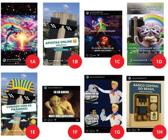
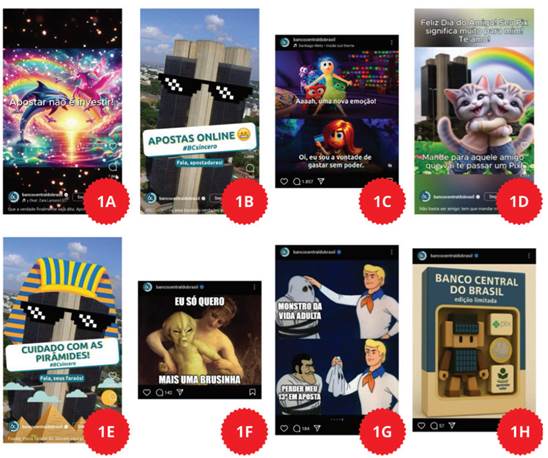
Adorned with a hallucinatory image of dolphins leaping from the sea to meet a pink unicorn before a sunset crowned by a luminous rainbow, the phrase “Betting is not investing” characterizes a piece by the Central Bank of Brazil (BC, in the Portuguese acronym) on its Instagram account (Figure 1A), intended to draw attention to the debate surrounding financial education and the exponential rise of betting platforms—known in Brazil as “bets”.
In another BC post, an iconographic montage based on the painting Disarmed Cupid (c. 1715), by Antoine Watteau, shows a woman holding an extraterrestrial by the arms, with the highlighted caption: “I just want one more brusinha” (Figure 1F) - referring to the controversy surrounding the federal government’s taxation of imports, where “brusinha” is a corruption of the original term in Portuguese “blusinha”, which stands for shirt and refers to slang for low-quality products imported via shopping apps.
These are two examples of the use of meme humor in communication by public institutions with society, a practice that also extends to the capybaras of Curitiba’s City Hall on Facebook or to the witty videos about electronic voting machines on the TikTok profile of Brazil’s Superior Electoral Court. In all these cases, the use of a relaxed language, visually extravagant and strongly appealing to a young and connected generation, has routinely been questioned by the press and by some specialists as inappropriate and superficial.
Labeled by the newspaper Folha de S. Paulo as a language “not necessarily young, but youthful,” and by Estadão as a “loose” and “informal” language, this editorial line is openly controversial. According to the head of the Communication and Audiovisual Production division of the BC’s Communication Department, Gustavo Igreja, interviewed by Folha, the adoption of this model is not unanimous but has found support by the government recently (Garcia, 2024).
Opposition representatives such as Bia Kicis and Damares Alves openly attacked the editorial policy, describing it as “absurd” and of “extremely low level,” even though they do not mention that this policy began under the administration of Roberto Campos Neto at the helm of the BC, who was considered an ally of former president Jair Bolsonaro (Souza, 2025). Public figures such as the former Big Brother Brasil participant Gil do Vigor, whose academic background in economics lends him credibility as an influential voice on the topic in the media, also spoke out against it, warning that “this is not serious and transparent communication” and that “one cannot communicate in this way” (Miranda, 2025, post on X).
Despite this, the strategy demonstrates a high potential for engagement on social networks and successfully fulfills the prerogatives of visibility, access, and facilitation of debate established in the literature through the factual, normative, and critical dimensions that condition the recognition of public communication (Weber, 2017). Frequently, the use of the humorous genre is relegated to a lower status in public communication, as if institutions should prioritize a tenacious and stern language. This rejection is the legacy of a longstanding prejudice against the comic, which suggests that the political scene should not be sullied by the playful at the expense of the atmosphere of gravity inspired by the management of the public interest (van Zoonen, 2005).
Added to this is the fact that digital languages such as memes, animated GIFs, and stickers produce an experience that Alice Marwick and danah boyd (2010) call context collapse; that is, they create overlaps of multiple audiences within the same communicative arena, generating difficulties in controlling the flow, circulation, and reception of certain messages. The clearest examples refer to situations in which a message of an intimate and personal tone, written in relaxed language and directed at friends and family on online networks, may be read as inappropriate in a professional context when, by chance, it is received by a colleague or hierarchical superior.
Digital culture also often relies on a challenging aesthetic, marked by strong amateur traits and references to global pop culture (Douglas, 2014; Chagas & Stefano, 2024), mobilized in order to constitute a kind of media lingua franca (Milner, 2018). What might initially represent a communicative advantage can instead be read as carelessness or casualness. Thus, the fear that memes, and digital humor more broadly, may be labeled as practices of lesser value, despite potentially constituting an expression of great scope and communicative effectiveness, decisively contributes to the ostracism of these languages within institutional and public environments.
This study aims to investigate the use of meme humor in the communication of public institutions on their official social media accounts and the questions that this type of practice raises. Based on a case study of the Central Bank on Instagram, the article reflects on the legitimacy of these uses, their limitations and advantages, and contributes to a broader inquiry into the incorporation or rejection of humor as a strategy of political communication.
In practical terms, the article is structured into four sections. Beginning with the objections, the first section seeks to understand the critique of humor in public communication, while the second discusses the reservations regarding memes. The following section presents the methodology of the case studied and the results of this research, before the article concludes with some final considerations.
2. USES AND REFUSES TO HUMOR IN PUBLIC AND INSTITUTIONAL COMMUNICATION
Public communication is described simultaneously as a concept and as a set of practices that confer quality upon democracies (Weber, 2017). Embedded in its definition are commitments to access to information, the valorization of public debate, transparency, and orientation toward the public interest - and, naturally, mediation between society, media organizations, and public institutions.
The foundational debate for the field, however, since John Dewey (1927/1954), has already identified a series of issues inherent to this uneasy juxtaposition. For the pragmatist philosopher, communication fulfills a pedagogical and harmonizing function in social life. According to Dewey, rather than merely collecting and presenting facts, the role to be played by the media would involve equipping the community so that it can confront the great “eclipse of the public.” This set of factors would include intense contemporary political apathy; the privilege granted to non-specialist voices and interest groups; and the growing industrialization accompanied by urbanization that promotes intellectual uniformity and contributes to the decline of the population’s levels of public education.
The diagnosis of crisis in public communication is also grounded by Jay G. Blumler and Michael Gurevitch (1995) in a thesis that produced a profound inflection in the field. As main components and symptoms of this turbulence, the authors list a series of aggregated factors, among them: depoliticization, encouraged by the independent media and by public figures and celebrities who increasingly occupy the political stage; the encouragement of cynicism and the stereotyped and depreciative projection of the political actor as exclusively interested in the dynamics of power and personal gain; a chronic war between politicians and the press that has contributed to deteriorating the image of media organizations themselves as reckless adversaries; and, as a result, an informational diet increasingly poor in political content, with a predominance of frames that translate politics as a game and provide ever more rapid and decontextualized cuts of debate, referred to by some researchers as soundbites.
Accustomed to grounding its debates in the paradigm of crisis, public communication is therefore often guided by a simultaneously normative and apocalyptic perspective, which frequently leads researchers in the field to scrutinize failures and anomalies that must imminently be corrected. Among the advocates of the theoretical current of public journalism, the situation is not much different (Blumler & Gurevitch, 1995).
It is also common to find, in this literature, prescriptive formulations about the social responsibility of the press. Idyllic readings attribute to public journalism the role of a “problem-solver,” an enterprise that “promotes understanding,” a “philosophy of vigilance,” or a “storyteller and facilitator of conversation” (Campbell, 1999). Such gravity of functions positions the critical debate on public communication, in general, at a heightened level of agitation and makes it difficult to adopt a pragmatic understanding of practices considered controversial or non-orthodox, such as the use of the humorous genre.
There are essentially two argumentative lines that depreciate humor in the context of public communication. The first is that humor violates communicative liturgy, that is, that there is no place for cheerful, playful, or witty communication in an environment of such sensitivity. The second is that humor undermines the rationality required for the public sphere and encourages affected, emotional, or pathological behaviors and actions, which, supposedly, would prevent the neutral and unburdened apprehension that functions as a basic requirement for deliberation.
Notably in relation to the public communication of science, the debate surrounding the use of humor has intensified in the face of the proliferation of digital influencers who have been operating on the front lines of scientific dissemination regarding climate change and the global health emergency. Authors such as Kaltenbacher and Drews (2020) warn that these communicators must remain vigilant about the risk of undermining the credibility of science or trivializing serious issues - despite the fact that humor presents positive potential for the response of certain audiences, including the creation of spaces for engagement, the breaking of taboos, and the promotion of awareness. Budnitsky (2023), in turn, warns of pernicious effects in the adoption of a provocative and humorous style in diplomatic communication, which, according to the author, would contribute to an exacerbation of epistemic and geopolitical fragmentation and would fuel mutual distrust among nations.
On the other hand, the experiment conducted by Suka and Shimazaki (2023) concludes that the appeal to a humorous language can facilitate the acceptance of messages directed toward public health communication and personal care. Meanwhile, Zorzi (2022) emphasizes that comedy, particularly television comedy in talk shows, has been regarded in the literature as an innovative and efficient genre for fostering debate within the public sphere and, therefore, should be better utilized as a strategy of public communication.
While there seems to be no consensus in the field, given a certain scarcity of more systematic analyses specifically devoted to state institutional communication or to the communication of public agents and figures, the debate tends to sustain a position of estrangement toward humor that echoes reservations similar to those found in common sense.
The guidelines proposed by Jay G. Blumler and Michael Gurevitch (1995) regarding the foundations upon which public communication rests, for instance, make it clear - although the authors do not mention the category of humor or any similar vocabulary - that public service implies extensive and well-grounded news coverage, rationalist and based on prior reflection and well-defined planning - and, above all, predominantly serious and substantive. At different moments throughout their argument, the authors emphasize that so-called “serious” communication is an indispensable element for arousing interest in the audience and expanding the circle of politically aware citizens.
Nevertheless, they evoke a dilemma according to which, at the same time that public communication seeks to deepen political news coverage, excessive exposure to it can become a tedious and exhausting practice. Thus, although it is fundamental to assume the disposition to inform and to fulfill the civic-democratic role normally associated with the seriousness of language, there is an internal conflict that often leads journalism to adopt a cynical, dramatic, and episodic coverage, favoring gossip, rumor, and scandal as manifestations of a phenomenon recognized by some analysts as the tabloidization of the press.
Tabloidization is defined as a process of contamination of the agenda of prestigious media outlets by a mode of production and understanding of communicative dynamics permeated by sensationalism, emotions, and the superficiality and frivolity typical of entertainment (Sparks, 2000). Its objective, naturally, is to contain the effects of a supposed crisis in commercial journalism. Although it refers to a routine typical of private media, its critique can easily be extended to public communication as well. After all, the debate is the heir to a long tradition of studies that seek to associate politics with an environment of intense seriousness and rationality.
Authors such as John Street (1997) and Liesbet van Zoonen (2005) have long drawn attention to the strong entanglement between politics and pop culture or entertainment. The refractory position of public communication, in this sense, follows a long-standing dissociation between politics and political culture, which has largely relegated to ostracism in analyses of behavior the symbolic dimension, affects, and playful-performative action as essential components of engaged manifestations, contentious practices, and even institutional communication.
In sum, what becomes evident is that the two arguments previously mentioned in the devaluation of humor unfold into other equally contentious ones. From the first refusal, that humor undermines the seriousness of public communication, derive two other controversial readings, according to which humor is either uncommitted and irresponsible, or colloquial, shallow, and inappropriate.
With regard to the latter case, a set of studies highlights the role of humor as a favorable component for mobilization and political literacy. Authors such as Becker and Bode (2018) emphasize that satire can be as valuable a source for understanding political and social reality and perceiving the challenges and limits of the democratic scenario as exposure to a more neutral and conventional form of communication. Regarding the former consideration, Baumgartner and Lockerbie (2018) view satirical humor as a device for inclusion and participation, capable of mobilizing individuals toward direct political action.
A similar conclusion is reached by Sternthal and Craig (1973), who recognize the persuasive capacity of humor in commercial advertising and in state communication. These authors warn that research on humor has been limited to two experimental models of study: those that verify the effectiveness of humor based on an approach that measures attitudes before and after exposure to a humorous message; and those that involve comparing the persuasive effect of humorous messages with those considered serious.
For them, the use of humorous resources in advertising communication must take into account the credibility of the informational source, the characteristics of the audience, and evidence of objective comprehension of the message. From the authors’ perspective, a humorous message provided by a highly credible source may increase persuasion and even improve the public’s perception of that source, creating a positive climate, even when it conveys a tedious communication. However, a humorous message provided by a source of low credibility may produce a reasonably unknown effect on the audience (Sternthal & Craig, 1973).
However, as indicated earlier, one of the reservations about humor lies in its close relationship with an emotional order that escapes strict rationality and, therefore, harms the neutral apprehension of facts and decision-making guided by the principles of impartiality and reasonableness. In this case, two other arguments emerge: that the humorous resource should be avoided because it mystifies and alienates; or that it harms, that is, excludes, offends, or violates. Regarding the first of these, it seems contradictory to sustain simultaneously that humor leads to alienation and results in the exaltation of passions, yet this is a discursive effect typical of political rhetoric that operates through myths and through a proximity to populist strategy (Miguel, 2000).
Humor, according to this understanding, is not a cause but a symptom. Avoiding its use in public communication does not reduce or prevent susceptibility to populist discourse. Moreover, studies such as those by Yeo and McKasy (2021) indicate that humor and emotional appeal may provide a kind of antidote to disinformation when employed in public communication, since these rhetorical elements are also present in fake news. Thus, much like a principle in which like cures like, the humorous tone would add a kind of inoculating effect to communication.
Finally, although it is true that the relationship between humor and the exercise of power has been extensively debated by the so-called critical humor studies (Chagas, 2023), at least with regard to public communication, offense is not an exclusive prerogative of the humorous genre. The comic effect can indeed contribute to trivializing jocular aggression; in this sense, its adoption could help naturalize exclusionary positions. However, once again, the rejection of humor does not guarantee sober, balanced, and non-discrepant communication.
Thus, although these last two arguments are not entirely incoherent, they refer more to the normative principles that should guide public communication than to humor itself. Resistance to humorous language, in this sense, finds little support in a critical reading of any of these positions. And yet humor continues to be seriously rejected as a communicative genre.
3. THE IN-BETWEEN LOCUS OF MEMES
“We reassure all citizens that this image, recently posted on Instagram, is not real. Thank you.” The caption in a post on the former Twitter topped an image montage simulating a capybara whose eyes emitted laser beams that destroyed the Ópera de Arame, a famous tourist landmark in the city of Curitiba. The nonsensical humor also gave rise to a series of other posts featuring the gigantic capybara ravaging the city. Curitiba has populations of capybaras living in some of its parks, but it was the strategy adopted by the city hall’s social media team that turned the animal into a symbol of the city.
According to Martino and Aleixo (2016), the capybara figure was created by Álvaro Borba, who was part of the city hall’s social media team. Its function was to create a kind of rupture with the serious and institutional language traditionally adopted by the city hall, mixing information and interaction. More than ten years later, the memes of the Curitiba City Hall - or “Prefs,” for insiders (a humorous abbreviation of “Prefeitura,” City Hall) - still evoke a certain experimentalism in public communication.
Perhaps because of their proximity to the electorate, municipal governments are among those that most frequently adopt heterodox solutions in communication with the public. Besides the Curitiba City Hall, which received numerous awards between 2013 and 2016, the city halls of Rio de Janeiro, Niterói, and São Paulo are also among those that have ventured to incorporate the language of memes. Political actors such as João Campos, mayor of Recife, and Vice President Geraldo Alckmin, in addition to the Speaker of the Chamber, Hugo Motta, have been noted in the press for communication strategies that seek to reposition their public images through memes. In the judiciary, the Superior Tribunal de Justiça (STJ, the country’s highest court for non-constitutional federal law) has also led social media communication featuring memes full of references to pop culture products such as the series Star Wars (Lisboa, 2015).
As a language that strongly borders on humor, memes share criticisms similar to those usually directed at the use of the humorous genre more broadly. The main reservations regarding the use of memes in public communication channels evoke two argumentative pillars. The first advances the critique that memes suppress, invalidate, or debase communication because they encourage a light and colloquial approach, often regarded as foolish or of low quality, instead of anchoring themselves in a tone that conveys gravity. Furthermore, according to this reasoning, they display an extravagant, grotesque, or amateur character that does not do justice to the professionalization of the field, placing them among practices to be avoided, under the risk of misinforming or hindering access to information.
The second argument maintains that, whether because they emphasize a language full of references to global pop culture and prioritize communication with younger audiences, or because they adopt a tone typical of commercial advertising by creating and nurturing brands, memes would not properly fulfill a public function.
Indeed, it is important to explain that although there are no reliable data on the audiences of institutional profiles, whether public or private, it is possible to assume that the demographics of the followers of these accounts are not representative of their broader public. Many of these profiles on social media, for instance, are followed by young people, whereas what one might suppose to be an ordinary citizen is not necessarily interested in subscribing to the status updates of these services through such platforms, nor in consuming digital memes.
However, as a media language, memes are not invested with a deontologically positive or negative meaning; they are products of interaction and of the negotiation of social values and norms (Denisova, 2020). They can and are frequently criticized for the way they summarize and trivialize debate, but they are also regarded as important repertoires for social change (Mina, 2019).
If it is true that they can make debate shallow and unproductive, they can equally constitute a window of opportunity and access for segments of the population traditionally excluded from public debate. This ambivalent characteristic is highlighted by authors such as Phillips and Ryan M. Milner (2017) as an intrinsic element of meme language, and one often valued by digital culture itself, since it allows memes to occupy a kind of in-between space, simultaneously as banal and harmless content and as a powerful weapon for mobilizing discourses surreptitiously. For this reason, particularly in the context of culture wars, memes have been cultivated as a consolidated communicative strategy (Donovan et al., 2022). However, when it comes to their use in public communication, a series of reservations is expressed, mostly based on their ontological properties.
For example, a common criticism of memes, frequently present in comments responding to relaxed posts by public agencies and institutions on social media, is the description of meme use as “pantomime,” “decadence,” “mediocrity,” or “low-level” communication that could be produced by “any kid.” In all these cases, what is at stake is an understanding of memetic content as something that tends to render debate simplified, stripped of the quality required of information provided to the public. Yet little consideration is given to the fact that the meme is a strategy capable of condensing significant amounts of information within a short space.
It is a language that, although not limited to a specific format - such as the static image, audiovisual content, looped animations, among others - efficiently materializes within a strict duration of time not only an important referential framework but also a set of discourses and arguments with persuasive effect. Phillips and Milner (2017) indicate that this language constitutes deep memetic frames, which favor, among other aspects, the configuration of a scenario of panic around certain imaginaries.
The conservative critique of the use of memes, in this case, seems similar to the one voiced by Pierre Bourdieu (1997) regarding television, when he argued that the need for brevity in language imposes significant losses on communication; or to the analysis presented by Rinke (2016) when addressing the impact of soundbites in contemporary journalism - something that is now revived with the “shorts” or “clips” circulating on digital platforms. Such a condition favors a certain reduction in the substance of content, suppressing contextual factors and addressing broad themes through a referential framework that may be restricted and simplified.
For Denisova (2020), informational abbreviation, combined with an extravagant and attention-grabbing style, turns memes into fast-food content, that is, they present low nutritional value but are tasty for immediate consumption. The researcher’s analogy proposes that memes translate media discourse and highlight the use of quick emotional triggers in the pursuit of likes and shares (Denisova, 2020). When this logic applies in the context of public communication, however, it may raise criticisms of excessive superficiality in issues that demand informational objectivity, transparency, and depth. Even so, when strategically conceived, memetic materials can operate as lures for the appreciation of complex topics. Denisova (2020) notes that, in situations where there is a broad background discussion, they function as teasers that announce content of greater nutritional value, enabling deeper engagement later on.
The idea that the use of memes is inappropriate for public communication also stems from a reaction to the extravagant and deliberately anti-professional nature of the language. Critics argue that, in the case of politicians such as the deputy Hugo Motta, whose social media team has invested heavily in memes and created the slogan “Vitamin H” to stamp some of his campaigns, these contents not only fail to inform but also appeal to excessive colloquialism and transform public communication into a “vale-tudo” or No Holds Barred championship (Brandt, 2025).
They forget, however, that this is a deliberate and strategic movement of approximation with the public, guided by error, failure, and amateurism, in order to position public figures outside the scaffold on which they are traditionally placed. Douglas (2014) refers to the use of the “ugly” as a strategic repertoire characteristic of the memetic universe. According to the author, this is a long-term trend on the web, frequently activated intentionally as an element that provides identity and belonging to certain groups.
It is important to emphasize that amateurism does not constitute a justification for memetic communication to be carried out without care or strategy. On the contrary. An effective message usually employs this resource as a way to reach specific audiences. This was acknowledged by the current minister of the Secretariat of Social Communication (Secom, in the Portuguese acronym), Sidônio Palmeira, after indicating a shift in the government’s strategic communication:
Beauty lies in difference. If you make [sic] everything pasteurized, everything the same, everything neatly assembled and polished, it doesn’t work. Social media likes things a little messy, messy in a good sense, something looser, simpler. That’s what we need to pursue [...] that’s what allows us to seek engagement (Gularte, 2025, paragraph 4).
Engagement, naturally, is only one among several ways of measuring success in public communication and refers to a set of indicators that should not be essentialized. Nevertheless, as a tangible response on digital platforms, such metrics allow us to argue that the use of memes and a more relaxed and humorous tone can indeed have an effect on audiences, as will be seen below in the case of the Central Bank of Brazil on Instagram.
In any case, another strand of common reservations holds that memes discredit public and institutional communication. From this assessment derive mainly two distinct judgments: that memes emphasize young audiences and pop culture, and that they privatize public service by prioritizing the creation of brands and products rather than the provision of information to the public. Comments directed at social media posts are often laden with questions about the “seriousness” and “credibility” of the messages and suggest a break in performative coherence with the idea that the accounts must have been “hacked.”
For institutional communication, a frequent problem arising from this interdiscursive practice is the violation of intellectual property and image and personality rights. Content derived from memes must take into account the rights of third parties, as it is grounded in the mediation between original works and their derivations. This concern has intensified particularly with the development of generative technologies that employ deep learning and, as a rule, incorporate data of unknown and poorly transparent origin. An exemplary case was the recent trend that led users to digitally transform photographs into illustrations loosely inspired by the style of the Japanese animation company Studio Ghibli.
Within the sphere of public communication, the meme has been widely adopted, including by official accounts of city halls, such as the City Hall of Recife, public agencies, and officeholders. The Minister of the Environment, Marina Silva, was one of the figures who joined the trend and subsequently received critical comments. Her profile chose to delete the post and then shared an image from the film Princess Mononoke as a way of paying tribute to the studio and apologizing for the alleged improper use.
Another case involving Instagram posts occurred in September 2023, when the City Hall of Cabo Frio, a coastal municipality in the state of Rio de Janeiro, circulated humorous content about expectations regarding summer tourism during a long holiday weekend (Guimarães, 2023). The video’s caption referred to visitors from the state of Minas Gerais and showed images of a group of women, some with shirts covering their faces like criminals, descending a staircase while carrying sound equipment and coolers. Although the initial idea was likely to make use of memetic content as a humorous piece to generate interaction on social networks, the post was widely criticized for creating a pejorative connotation of people from Minas Gerais as “farofeiros” (a slang used to refer to rowdy or boisterous vacationers) based on an interpretation suggestively shaped by class discrimination and recreational racism.
The debate sparked by these two episodes makes clear that the use of memes can not only provoke a certain estrangement due to interpretive ambivalence, but also generate a series of diplomatic conflicts and disputes over related rights, which represent a deterrent to experimentation. On the other hand, public communication in a conventional and neutral approach rarely takes advantage of the affects and passions mobilized on digital platforms.
In this sense, the use of memes can represent a skillful repertoire for audience loyalty, converting citizens into fans and instituting a communicative dynamic that resembles the logic of the permanent campaign, that is, a continuous action of communication or mobilization that seeks to keep specific agendas and imaginaries in evidence. Not by chance, as will be seen below, institutional channels begin to rely on jargon and affectionate nicknames, recurring characters with popular appeal, as well as planned interactions with the public.
4. THE TWO CENTS OF THE CENTRAL BANK
The Central Bank of Brazil (also called BCB or Bacen) is the country’s main monetary authority, responsible for ensuring the stability of the currency and of the financial system in the face of inflationary risks and fiscal imbalances. Among its responsibilities are defining the basic interest rate (Selic); issuing paper money through the Casa da Moeda do Brasil; and managing reserves, including possible interventions in the exchange rate in order to mitigate fluctuations caused by speculative attacks and occasional crises. It was created in December 1964 and, in February 2021, obtained formal autonomy, initiating a regime in which its presidency is exercised through fixed terms that do not coincide with that of the President of the Republic; thus, at least in theory, its actions are guaranteed to be grounded in technical decisions without direct interference from the government.
On Instagram, the Central Bank began its activities in November 2017, still under the administration of Ilan Goldfajn, appointed to the position by former president Michel Temer. After him, Roberto Campos Neto, appointed in 2019 by Jair Bolsonaro, inaugurated, following Complementary Law No. 179 of February 24, 2021, the period of fixed four-year terms, remaining in office until January 2025. He also substantially changed the bank’s communication policy on digital platforms.
Currently, the Central Bank is chaired by Gabriel Galípolo, appointed by Luiz Inácio Lula da Silva for the period between 2025 and 2029. In the first months of his administration, he became involved in controversies related to several Instagram posts about the episode involving the government’s back-and-forth regarding the monitoring of high-value transfers through the Pix system (a Brazilian digital system for transferring funds and making payments). In the Central Bank’s posts, the informal and humorous language, full of memes, drew attention. The press covered the case, although since June 2024, still under the Campos Neto administration, the use of memes in the Central Bank’s public communication had already been noted by specialized media outlets (G1, 2024).
This article proposes to carry out a comparative case study on the use of meme humor by the official Instagram profile of the Central Bank across three different administrations (Yin, 2001). In two distinct empirical stages, the study prioritizes a combination of digital methods (Rogers, 2015) and interpretive analysis (Schwartz-Shea & Yanow, 2012), consolidating an exploratory analysis guided by attention to the strategic uses of meme humor in public communication.
Methodologically, therefore, the study is anchored in two distinct yet interconnected stages. First, the results of this communication policy are evaluated through descriptive statistics of engagement metrics from the posts; second, specific cases of this use and their repercussion are highlighted according to user comments, critically observing the effects of such utilization.
By articulating quantitative engagement data with a qualitative reading of interactions, the analysis allows for methodological triangulation (Yin, 2001), expanding the validity of the findings and the inferences drawn from the data. Thus, the study does not limit itself to measuring communicative performance but seeks to understand how and under what circumstances the use of humor in public communication is legitimately accepted by the general public.
From a strictly operational standpoint, the contents of the Central Bank’s Instagram were scraped using the API of the Meta Content Library. The data were then input into statistical analysis software. For the collection of images, the R programming language was used in combination with the data obtained from the previous operation.
It should be noted that between November 2017 and March 2025, the period of data collection for this study, the Central Bank’s Instagram account published 4,002 posts. Of this total, 3,754 (93.8%) were published during the administration of Roberto Campos Neto, 164 (4.1%) during the period of Ilan Goldfajn, and 84 (2.1%) during that of Gabriel Galípolo. Considering the unequal duration of the mandates, Campos Neto, who remained in office for 69 months, averaged 54.4 posts per month; Goldfajn, whose presidency lasted 32 months, of which only 15 included an Instagram profile, averaged 10.4 posts per month; finally, Galípolo, the most recently appointed, averaged 28 posts per month at the time of the research. As can be seen from the figures presented in Table 1, the data confirm the Central Bank’s intense activity on social media during the period of Campos Neto’s presidency.
On the other hand, despite the short period available for analysis, and considering the metric of likes as the one that best reflects average engagement with posts, Galípolo appears to have inherited from Campos Neto a high level of engagement on social media. The average number of likes on Instagram during his administration is 5,749, while the average during the Campos Neto period is 2,099, and that of Goldfajn does not exceed 539 likes.
As a point of reference, one of the most controversial posts during the recent period, published on February 26, 2025, already with Gabriel Galípolo at the head of the Central Bank, reached 81,870 likes. And although it is not the absolute record-holder in engagement, it occupies third place, behind two others that also use humor and incorporate trending formats on Instagram at the time, reaching 427,813 and 113,443 likes respectively.
Observing only the outliers during each of the three most recent administrations, that is, those posts that are significantly distant from the results obtained by others and indicate extreme and atypical variations according to the Interquartile Range (IQR) calculation, it is possible to identify how many and which posts received the most likes. During the period of Campos Neto, 414 (11.2%) posts generated atypical engagement, compared with 16 (9.8%) under the Goldfajn administration and 6 (7.1%) under the Galípolo administration.
The data show that the communication policy during Campos Neto’s term was the one that achieved the most expressive results. The qualitative analysis of the posts, which seeks to distinguish content associated with a humorous genre from that produced in a more conventional language and a more serious tone, again suggests that Galípolo retains a legacy established through the shift promoted by Campos Neto while leading the bank.
Considering only the posts that generated atypical engagement on the Central Bank’s Instagram profile, 33.3% (N = 2) of those published during Galípolo’s administration adopt a more relaxed tone, while 12.1% (N = 50) correspond to the period led by Campos Neto. None of the posts published during Goldfajn’s term, in turn, made use of a more humorous tone. The conclusion is that, if the use of humor is not solely responsible for good metrics, it can indeed contribute to increasing engagement on institutional profiles such as that of the Central Bank - despite the criticisms, after all, the most evident proof of this is precisely the media visibility gained by the Central Bank’s official account in recent months in the press.
Additionally, the BC’s communication strategy has prioritized series of posts, some of them identified and indexed through markers such as hashtags and distinctive styles. One of the most widely discussed is #BCSincero, a set of videos with agile editing and hard cuts, full of special effects and marked by a strongly humorous language (Figures 1B and 1E). In some videos in the series, the BC refers to itself as “Scrooge McDuck,” and there are multiple references to pop culture, especially animations, films, and television series (Figures 1C and 1G), as well as social media trends (Figures 1D and 1H).
The captions of the videos generally begin with an intimate, playful, or provocative vocative that varies depending on the episode (“Heeey my pharaohs,” in a post about bitcoins; “Heeey my buyers of trinkets of dubious origin,” about the taxation of Chinese online imports; “Heeey my lovers of conspiracy theories,” about the monitoring of transactions via Pix). In what became one of the most famous videos in the series (Figure 1B), the soundtrack and title allude to one of the country songs that topped the charts, “Descer para BC” (Going to BC, in a literal translation), by the duo Brenno & Matheus, whose lyrics refer to the acronym for Balneário Camboriú, a coastal city in the state of Santa Catarina, not the Central Bank.
One indication that the strategy has been recognized as successful was the Central Bank’s nomination for the Social Media Gov 2025 award in the Attitude category, intended for public bodies that adopted a bolder approach in dialogue with the public. Moreover, the familiarity with which users address the team managing the profile is another sign of the positive perception held by a significant portion of the audience.
Among compliments and greetings, a form of address stands out that is close, simultaneously affectionate and teasing, greeting or asking for a promotion for the “intern” and creating bonds of belonging that are only very occasionally perceived in the relationship between citizens and state institutions. The initial sense of strangeness dissolves amid the recognition of an effort to communicate with the platform’s specific audience.
It is true that high engagement metrics do not necessarily indicate success, especially when compared with the indexes achieved by media public figures and digital influencers, such as the deputy Nikolas Ferreira, who obtained record engagement within 24 hours with an Instagram video that surpassed 300 million views.
Even so, a proportional evaluation of the Central Bank’s numbers, combined with the qualitative and interpretive analysis of the posts on the official profile and of the behavior of its fan audiences, seems sufficient to sustain that, within the realm of digital communication, the humor of memes has been configuring itself as an important repertoire. Despite a possible break in coherence and the restriction imposed on segments of the public that do not fully grasp the intertextual references mobilized, it is a form of communication that invests in a specific population niche and that obviously must be complemented by other strategies aligned with different media formats.
5. CONCLUSIONS
As analyzed in this study, some of the posts on the Central Bank’s Instagram that obtained the highest number of interactions used comedy as a discursive resource to deal with issues related to the public interest. In these contents, topics that permeated social debates with noise and misinformation - such as the monitoring of transactions via Pix, the taxation of imported products, and, more recently, fraud through bank transfers, were addressed by the BC with memetic language that encouraged sharing, without losing the quality and integrity of the communication.
While public communication should promote a broad, non-exclusive message, adopting a language that allows and encourages political pluralism and cultural and sociodemographic diversity, there is no precept that, based on these principles, recommends neutrality as the only style.
Recent moves by the Executive, the Judiciary, and other public bodies toward simpler forms of expression (Cappelli et al., 2023) even signal how language itself can constitute a barrier to access to information. Moreover, although simplicity is not the necessary packaging of the humorous genre, and although humor itself can be employed with the aim of excluding and discriminating, it is worth noting that responsible communication is not synonymous with gravity and austerity.
By adopting a potentially disruptive stance in a politically polarized and socially diverse environment, public communication therefore faces challenges such as the demand for coherent performative expression (Polivanov & Carrera, 2019), often guided by a third-person effect (Azevedo, 2020). This phenomenon may lead individuals to understand that humor in public communication exerts greater or lesser influence over others, reinforcing attitudes of moral judgment or censorship.
It is true that the use of humorous language in the environment of social media is subject to the vicissitudes inherent to the way content circulating on these platforms is treated. In this sense, platforms such as Instagram and TikTok, among others, are known to value light and humorous content through their recommendation algorithms (Chagas & Stefano, 2023). There is therefore a dependency established in relation to the platform that may, ultimately, culminate in the strategic and instrumental use of humor to maximize the reach of certain messages, even though it is not necessarily an efficient communication model for other environments.
In addition, it is necessary to acknowledge the limitations to which the present study is subject, particularly with regard to its dataset and the inferences that can be drawn from it. This is a sample taken as a case study of reasonably limited proportions and one that presents a longitudinally unbalanced composition across the three periods compared, which, in practice, hinders the evaluation of the strategic use of humor distributed throughout the different administrations of the Central Bank.
Even so, the use of humor by the BC’s institutional communication on Instagram also allows us to understand that, at least in part, resistance to the comic in public communication is justified on the basis of a positional critique, largely deriving from the political-ideological affinity spectrum of its sender. For example, the same audience aligned with the conservative field that supported the BC’s humorous publications during the Campos Neto administration began to criticize them during the Galípolo administration, and vice versa. Comments such as “and the interest rate?,” “the central bank should be worried about not letting the exchange rate drift [sic],” or “funny would be to see the next Selic cut” reinforce this understanding, exposing committed judgments that, rather than focusing on the variable of humor, are concerned with the institution’s decision-making autonomy.
Indeed, the place of humor in public communication still appears to be restricted, especially when related to organizations with a more traditional profile, such as those in the economic or legal fields. Excessive fear of forms of expression grounded in emotion and playfulness, such as the humorous genre, however, may become an obstacle for institutions seeking to reach broader population groups, expand public debate, and establish a dialogical channel close to citizens. Furthermore, best practices in professional institutional communication recommend that the language adopted be consistent with the brand profile the organization wishes to assume.
For this reason, the humorous character of memes may constitute an element that breaks coherence in specific cases. On the other hand, humor may serve the elaboration of an institutional metafiction, that is, a form of self-reflexive communication capable of critically and naturally evaluating its own role before the public. One way or another, as this study has sought to demonstrate, there are sufficient reasons to believe that humor is a key element for attracting attention and facilitating the understanding of complex messages, as well as for establishing an empathetic and close bond with the public, consequently making language more accessible, effective, and sensitive.
ACKOWLEDGMENTS
The authors would like to thank colleagues from the National Institute of Science and Technology for Digital Democracy for the debate that originated this article, especially Maria Helena Weber, Emerson Cervi, and Fábio Vasconcellos. We also thank the colleagues who commented on a previous version of the study, especially Fiorenza Carnielli and Caroline Casali.
References
-
Azevedo, D. (2020). Vejo, mas não acredito: o efeito de terceira pessoa no contexto da campanha presidencial de 2018. Revista Compolítica, 10(3), 79-108. https://doi.org/10.21878/compolitica.2020.10.3.383
» https://doi.org/10.21878/compolitica.2020.10.3.383 -
Baumgartner, J. C., & Lockerbie, B. (2018). Maybe it is more than a joke: satire, mobilization, and political participation. Social Science Quarterly, 99(3), 1060-1074. https://doi.org/10.1111/ssqu.12501
» https://doi.org/10.1111/ssqu.12501 -
Becker, A., & Bode, L. (2018). Satire as a source for learning? The differential impact of news versus satire exposure on net neutrality knowledge gain. Information, Communication & Society, 21(4), 612-625. https://doi.org/10.1080/1369118X.2017.1301517
» https://doi.org/10.1080/1369118X.2017.1301517 - Blumler, J., & Gurevitch, M. (1995). The crisis of public communication Routledge.
- Bourdieu, P. (1997). Sobre a televisão: seguido de A influência do jornalismo e os jogos olímpicos Zahar.
-
Brandt, R. (2025, abril 6). Políticos invadem as redes para mirar os jovens - mas nem sempre a tática funciona. Veja https://veja.abril.com.br/brasil/politicos-invadem-as-redes-para-mirar-os-jovens-mas-nem-sempre-a-tatica-funciona
» https://veja.abril.com.br/brasil/politicos-invadem-as-redes-para-mirar-os-jovens-mas-nem-sempre-a-tatica-funciona -
Budnitsky, S. (2023). Global disengagement: public diplomacy humor in the Russian-Ukrainian War. Place Branding and Public Diplomacy, 19(2), 211-217. https://doi.org/10.1057/s41254-022-00291-1
» https://doi.org/10.1057/s41254-022-00291-1 - Campbell, C. (1999). Foreword: journalism as a democratic art. In T. L. Glasser(Ed.), The idea of public journalism (pp. 9-31). Guilford.
-
Cappelli, C., Oliveira, R., & Nunes, V. (2023). Linguagem simples como pilar da transparência. Humanidades & Inovação, 10(9), 32-45. https://revista.unitins.br/index.php/humanidadeseinovacao/article/view/8997
» https://revista.unitins.br/index.php/humanidadeseinovacao/article/view/8997 -
Chagas, V. (2023). Dolce farmeme: a retórica da brincadeira política. Revista Brasileira de Ciências Sociais, 38(111), e3811008. https://doi.org/10.1590/3811008/2023
» https://doi.org/10.1590/3811008/2023 -
Chagas, V., & Stefano, L. M. (2023). Estratégias de uso do TikTok por políticos brasileiros. Revista de Sociologia e Política, 31, 1-18. https://doi.org/10.1590/1678-98732331e022
» https://doi.org/10.1590/1678-98732331e022 -
Chagas, V., & Stefano, L. M. (2024). A linguagem dos memes: aspectos estéticos e semióticos dos conteúdos digitais. DeSignis, 41, 143-154. http://dx.doi.org/10.35659/designis.i41p143-154
» https://doi.org/10.35659/designis.i41p143-154 - Denisova, A. (2020). Internet memes and society: social, cultural, and political contexts Routledge.
- Dewey, J. (1954). The public and its problems Swallow. (Original work published 1927).
- Donovan, J., Dreyfuss, E., & Friedberg, B. (2022). Meme wars: the untold story of the online battles upending democracy in America Bloomsbury.
-
Douglas, N. (2014). It’s supposed to look like shit: the internet ugly aesthetic. Journal of Visual Culture, 13(3), 314-339. https://doi.org/10.1177/1470412914544516
» https://doi.org/10.1177/1470412914544516 -
G1. (2024, junho 25). Em meio a atritos com o governo, Banco Central faz post com meme de Divertida Mente 2: “A vontade de gastar sem poder”. https://g1.globo.com/economia/noticia/2024/06/25/banco-central-faz-post-com-meme-de-filme-e-indireta-ao-governo-a-vontade-de-gastar-sem-poder.ghtml
» https://g1.globo.com/economia/noticia/2024/06/25/banco-central-faz-post-com-meme-de-filme-e-indireta-ao-governo-a-vontade-de-gastar-sem-poder.ghtml -
Garcia, N. (2024, outubro 20). ‘BC sincero’ fura bolha nas redes com linguagem informal e conquista público. Folha de S. Paulo https://www1.folha.uol.com.br/mercado/2024/10/bc-sincero-fura-bolha-nas-redes-com-linguagem-informal-e-conquista-publico.shtml
» https://www1.folha.uol.com.br/mercado/2024/10/bc-sincero-fura-bolha-nas-redes-com-linguagem-informal-e-conquista-publico.shtml -
Guimarães, A. C. (2023, setembro 6). Prefeitura de Cabo Frio debocha de turistas mineiros em postagem preconceituosa em rede social. O Globo https://oglobo.globo.com/blogs/ancelmo-gois/post/2023/09/prefeitura-de-cabo-frio-debocha-de-turistas-mineiros-em-postagem-preconceituosa-em-rede-social.ghtml
» https://oglobo.globo.com/blogs/ancelmo-gois/post/2023/09/prefeitura-de-cabo-frio-debocha-de-turistas-mineiros-em-postagem-preconceituosa-em-rede-social.ghtml -
Gularte, J. (2025, janeiro 23). Sidônio diz que mudará comunicação de Lula nas redes e prega estética “simples” e “sujinha”. O Globo https://oglobo.globo.com/politica/noticia/2025/01/23/sidonio-diz-que-mudara-comunicacao-de-lula-nas-redes-e-prega-estetica-simples-e-sujinha.ghtml
» https://oglobo.globo.com/politica/noticia/2025/01/23/sidonio-diz-que-mudara-comunicacao-de-lula-nas-redes-e-prega-estetica-simples-e-sujinha.ghtml -
Kaltenbacher, M., & Drews, S. (2020). An inconvenient joke? A review of humor in climate change communication. Environmental Communication, 14(6), 717-729. https://doi.org/10.1080/17524032.2020.1756888
» https://doi.org/10.1080/17524032.2020.1756888 -
Lisboa, L. V. (2015). Memes jurisprudenciais no Facebook do STJ: a constituição dialógica de um gênero verbo-visual [Dissertação de Mestrado, Universidade Federal de Goiás]. Repositório da Universidade Federal de Catalão. https://repositorio.ufcat.edu.br/items/5f71aa34-7745-4d12-bdc1-76055b81e675/full
» https://repositorio.ufcat.edu.br/items/5f71aa34-7745-4d12-bdc1-76055b81e675/full -
Martino, L. M., & Aleixo, T. (2016). Usos do entretenimento como estratégia de visibilidade política na página da prefeitura de Curitiba no Facebook. Rumores, 10(20), 68-89. https://doi.org/10.11606/issn.1982-677X.rum.2016.115736
» https://doi.org/10.11606/issn.1982-677X.rum.2016.115736 -
Marwick, A. E., & Boyd, D. (2010). I tweet honestly, I tweet passionately: Twitter users, context collapse, and the imagined audience. New Media & Society, 13(1), 114-133. https://doi.org/10.1177/1461444810365313
» https://doi.org/10.1177/1461444810365313 - Miguel, L. F. (2000). Mito e discurso político: uma análise a partir da campanha eleitoral de 1994 Imprensa Oficial.
- Milner, R. (2018). The world made meme: public conversations and participatory media MIT.
- Mina, A. X. (2019). Memes to movements: how the world’s most viral media is changing social protest and power Beacon.
-
Miranda, M. D. (2025, janeiro 16). Gil do Vigor critica BC no caso da fake do Pix: ‘Não é comunicação séria’. Estado de Minas https://www.em.com.br/politica/2025/01/amp/7036080-gil-do-vigor-critica-bc-no-caso-da-fake-do-pix-nao-e-comunicacao-seria.html
» https://www.em.com.br/politica/2025/01/amp/7036080-gil-do-vigor-critica-bc-no-caso-da-fake-do-pix-nao-e-comunicacao-seria.html - Phillips, W., & Milner, R. M. (2017). The ambivalent internet: mischief, oddity, and antagonism online Polity.
-
Polivanov, B., & Carrera, F. (2019). Rupturas performáticas em sites de redes sociais: um olhar sobre fissuras no processo de apresentação de si a partir de e para além de Goffman. Intexto, 44, 74-98. https://doi.org/10.19132/1807-8583201944.74-98
» https://doi.org/10.19132/1807-8583201944.74-98 -
Rinke, E. (2016). The impact of sound-bite journalism on public argument. Journal of Communication, 66(4), 625-645. https://doi.org/10.1111/jcom.12246
» https://doi.org/10.1111/jcom.12246 - Rogers, R. (2015). Digital methods MIT.
- Schwartz-Shea, P., & Yanow, D. (2012). Interpretive research design: concepts and processes Routledge.
-
Souza, C. (2025, janeiro 16). Banco Central usa “memes” e música hit para abordar polêmica do Pix nas redes sociais. Gazeta do Povo https://www.gazetadopovo.com.br/economia/banco-central-memes-musica-hit-abordar-polemica-pix/
» https://www.gazetadopovo.com.br/economia/banco-central-memes-musica-hit-abordar-polemica-pix/ - Sparks, C. (2000). Introduction: the panic over tabloid news. In C. Sparks & J. Tulloch(Eds.), Tabloid tales: global debates over media standards (pp. 1-40). Rowman & Littlefield.
-
Sternthal, B., & Craig, C. S. (1973). Humor in advertising. Journal of Marketing, 37(4), 12-18. https://doi.org/10.1177/002224297303700403
» https://doi.org/10.1177/002224297303700403 - Street, J. (1997). Politics and popular culture Temple University.
-
Suka, M., & Shimazaki, T. (2023). Effectiveness of using humor appeal in health promotion materials: evidence from an experimental study in Japan. Archives of Public Health, 81(212), 1-11. https://doi.org/10.1186/s13690-023-01226-9
» https://doi.org/10.1186/s13690-023-01226-9 - van Zoonen, L. van(2005). Entertaining the citizen: when politics and popular culture converge Rowman & Littlefield.
- Weber, M. H. (2017). Nas redes de comunicação pública, as disputas possíveis de poder e visibilidade. In M. H. Weber, M. P. Coelho, & C. Locatelli(Eds.), Comunicação pública e política: pesquisa e práticas(pp. 23-56). Insular.
-
Yeo, S. K., & McKasy, M. (2021). Emotion and humor as misinformation antidotes. Proceedings of the National Academy of Sciences, 118(15), 1-7. https://doi.org/10.1073/pnas.2002484118
» https://doi.org/10.1073/pnas.2002484118 - Yin, R. K. (2001). Estudo de caso: planejamento e métodos Bookman.
- Zorzi, V. (2022). Political comedy and the challenges of public communication during the COVID-19 crisis: a corpus-assisted study of Last Week Tonight’s coverage of the pandemic. In A. Musolff et al. (Eds.), Pandemic and crisis discourse: communicating COVID-19 and public health strategy(pp. 167-184). Bloomsbury Academic.
-
DATA AVAILABILITY
The entire dataset supporting the results of this study is available upon request from the authors. The dataset is not publicly available due to legal requirements related to the authorized extraction of data from the platform.
-
ARTIFICIAL INTELLIGENCE USAGE
No Artificial Intelligence tools were used for the planning, design, production, or writing of this text. The ChatGPT v5.3 artificial intelligence tool was used solely to assist in the grammatical revision of the English version of the manuscript, which had been previously prepared by the authors.
-
FUNDING
This article benefited from funding from CNPq (productivity and research grant, No. 305223/2025-9) and Faperj (Young Scientist of Our State grant, No. 204.347/2025).
-
Reviewers:
Beatriz Molari (Universidade Estadual de Londrina, Londrina / PR - Brazil)
-
Reviewers:
One reviewer did not authorize the disclosure of their identity.
-
Peer review report:
The peer review report is available at this link https://periodicos.fgv.br/rap/article/view/97069/90457
-
20
[Translated version] Note: All English quotes were translated by this article’s translator.
The entire dataset supporting the results of this study is available upon request from the authors. The dataset is not publicly available due to legal requirements related to the authorized extraction of data from the platform.

 Note: Translated texts from