
 Selectivity of post-emergence herbicides in direct-seeded onion
ABSTRACT
Limited chemical control options and high onion sensitivity to post-emergence herbicides hinder efficient weed management, especially under direct-seeding systems in semi-arid regions, increasing production costs. Reduced herbicide rates and split applications may improve crop selectivity while maintaining weed control. This study aimed to evaluate the selectivity of post-emergence herbicides applied at different doses and phenological stages in onion grown under Brazilian semi -arid conditions. Four field experiments were conducted in a randomized block design with three replications, each evaluating a single herbicide (oxyfluorfen, flumioxazin, pendimethalin, or oxadiazon). Fifteen treatments were evaluated, combining herbicide doses with three application timings (1-2, 3, and 5 fully expanded leaves), plus an untreated control. Crop injury was visually assessed at 7, 14, 21, and 28 days after application (DAA). Mild phytotoxicity symptoms (< 10%) were observed mainly at early growth stages, particularly when applications were performed at the 1- or 2-leaf stage, while treatments applied at more advanced stages (3 to 5 leaves) caused little or no injury. Symptoms were transient, with recovery observed by 21 DAA. Sequential applications occasionally prolonged low -intensity injury but did not exceed acceptable levels. No significant differences in commercial yield were detected among treatments. Bulb classification was predominantly concentrated in Class 3 (50-70 mm), with values generally above 60%, indicating high commercial quality and uniformity. The results demonstrate that the evaluated herbicides were selective for onion under semi-arid conditions when applied at appropriate doses and growth stages, with early stages being more sensitive and later stages more tolerant, without compromising yield or bulb quality.
Key words:
Allium cepa L.; chemical control; phytotoxicity; semi-arid; phenological stage
HIGHLIGHTS:
Post-emergence herbicides applied at split and reduced doses showed satisfactory crop selectivity.
Post-emergence herbicide applications caused only mild and transient phytotoxicity.
Post-emergence herbicides were selective for onion under semi-arid conditions, despite mild initial phytotoxicity.
RESUMO
A limitação de opções de manejo químico e a elevada sensibilidade da cebola a herbicidas pós -emergentes dificultam o controle eficiente de plantas daninhas, especialmente em sistemas de semeadura direta em regiões semiáridas, aumentando os custos de produção. Doses reduzidas e aplicações fracionadas de herbicidas podem melhorar a seletividade da cultura, mantendo o controle de plantas daninhas. Este estudo teve como objetivo avaliar a seletividade de herbicidas pós-emergentes aplicados em diferentes doses e estádios fenológicos da cebola cultivada no semiárido brasileiro. Quatro experimentos de campo foram conduzidos em delineamento de blocos casualizados, com três repetições, sendo cada experimento composto por um herbicida (oxyfluorfen, flumioxazina, pendimetalina e oxadiazon). Foram avaliados quinze tratamentos, combinando doses de herbicida com três épocas de aplicação (estágios de 1-2, 3 e 5 folhas), além de um controle sem herbicida. A fitotoxicidade foi avaliada aos 7, 14, 21 e 28 dias após a aplicação (DAA). Sintomas leves de fitotoxicidade (< 10%) foram observados principalmente nos estádios iniciais, especialmente nas fases de 1 ou 2 folhas, enquanto aplicações em estádios mais avançados (3 a 5 folhas) causaram pouca ou nenhuma injúria. Os sintomas foram transitórios, com recuperação aos 21 DAA. Aplicações sequenciais prolongaram levemente as injúrias, sem ultrapassar níveis aceitáveis. Não houve diferença significativa na produtividade comercial entre os tratamentos. A classificação dos bulbos concentrou-se na Classe 3 (50-70 mm), com valores superiores a 60%, indicando alta qualidade comercial. Os herbicidas avaliados mostraram-se seletivos para a cebola sob condições semiáridas, quando aplicados em doses e estádios adequados.
Palavras-chave:
Allium cepa L.; controle químico; fitointoxicação; semiárido; estádio fenológico
INTRODUCTION
Onion (Allium cepa L.) is one of the most important vegetable crops cultivated in Brazil and plays a significant socioeconomic role in the agricultural sector (Belem et al., 2020). National production is concentrated mainly in the states of Santa Catarina, Bahia, Minas Gerais, Goiás, São Paulo, Rio Grande do Sul, Paraná, and Pernambuco (IBGE, 2025). In the state of Rio Grande do Norte, onion production reached 6,980 tons in 2024, cultivated in approximately 640 hectares, with an average yield of 10,906 kg ha -1 (IBGE, 2025). Despite its economic importance, onion production faces several agronomic challenges that can compromise crop yield (El Wakeel et al., 2024).
Among these challenges, weed interference stands out as one of the main limiting factors for onion production. Onion plants have low competitive ability against weeds, especially during the early stages of crop development, due to their shallow root system, tubular leaf architecture, and slow initial growth (Souza et al., 2021; Olescowicz et al., 2021).
In many onion -producing regions of Brazil, the crop is traditionally established by transplanting seedlings (Maciel et al., 2019). However, direct seeding has been increasingly adopted due to its potential to reduce labor costs and simplify crop establishment (Singh et al., 2024). Under this production system, crop emergence may be slower and less uniform, increasing plant vulnerability to weed competition (EMBRAPA, 2020; Souza et al., 2020). As a result, efficient weed management becomes even more critical in direct-seeded systems. In this context, herbicide use becomes an efficient and economically viable strategy, particularly under the specific edaphoclimatic conditions of the Brazilian semi-arid region.
In this scenario, the choice of herbicides becomes a key factor for successful weed management. Among the herbicides available for weed control in onion, oxyfluorfen, oxadiazon, pendimethalin, and flumioxazin are commonly recommended due to their registered use in the crop, particularly under transplanting systems (BRASIL, 2026). However, the shift to direct seeding may alter herbicide dynamics in the soil -plant system and, consequently, their selectivity.
Considering these challenges, ensuring crop safety is a major concern in herbicide -based weed management. However, onion is particularly sensitive to herbicideinduced phytotoxicity, which limits the use of high doses or indiscriminate appli cations (Roozkhosh et al., 2025). Given this limitation, split applications of herbicides have been proposed as a promising strategy to increase crop selectivity and improve the safety of weed management practices (Kaur et al., 2024).
A study conducted by Lockhart & Howatt (2004) demonstrated that split application of pendimethalin in onion increased crop selectivity without compromising weed control efficiency. Similar results were reported by Kaur et al. (2024), who evaluated the herbicides pendimethalin, ethoxysulfuron, imazethapyr, and quizalofop-p-ethyl, and observed that dose fractionation significantly reduced foliar toxicity symptoms in onion plants. During the early growth stages, particularly from emergence to the twoto three-leaf stage, onion plants are more susceptible to herbicide injury due to their limited leaf area and reduced metabolic capacity for herbicide detoxification (Melo et al., 2019).
Thus, the hypothesis of this study is that split application of the herbicides oxyfluorfen, oxadiazon, pendimethalin, and flumioxazin, applied in post -emergence at specific doses and phenological stages, is selective for direct -seeded onion cultivated in the Brazilian semi-arid region. Therefore, the objective of this study was to evaluate the selectivity of oxyfluorfen, flumioxazin, pendimethalin, and oxadiazon applied at different doses and phenological stages in direct seeded onion under Brazilian semi-arid conditions.
MATERIAL AND METHODS
The experiments were conducted under field conditions in Mossoró (5° 03′ 37″ S, 37° 23′ 50″ W), Rio Grande do Norte state, Brazil, from October 2023 to February 2024.
The experimental area is situated at 72 m above sea level, under a climate classified according to Köppen as BSwh’, characterized as semi-arid, with rainfall concentrated in the summer and a well -defined dry period (Alvares et al., 2013). Meteorological data recorded during the experiment, including air temperature, relative air humidity, and rainfall, were obtained from a meteorological station of the Instituto Nacional de M eteorologia (Station A318) located near the experimental area and are presented in Figure 1.

Mean air temperature (° C), relative air humidity (%), and rainfall (mm) recorded by the Instituto Nacional de Meteorologia (INMET) during the experiment
The soil of the experimental area is classified as Argissolo (EMBRAPA, 2018), corresponding approximately to an Ultisol according to the USDA Soil Taxonomy (Soil Survey Staff, 2022). Before the experiment was established, soil samples were collected for physical and chemical characterization, including fertility and salinity (Teixeira et al., 2017), and the results are presented in Table 1.
Liming was performed prior to experiment establishment to adjust soil acidity. The lime requirement was estimated using the base saturation method, aiming to increase base saturation to approximately 60%. Dolomitic limestone (CaO = 33%; MgO = 16%; RNV = 95%) was applied at a rate of 0.5 t ha-1 and incorporated into the 0-20 cm soil layer before planting.
Onion (‘Campo Lindo’) was cultivated under a conventional system, with soil preparation carried out through plowing and harrowing, followed by bed formation using a rotary hoe. Each bed measured 1.50 m in width and 0.20 m in height. Fertilization was conducted according to crop requirements and based on soil analysis (Higashikawa & Menezes Júnior, 2017), using a basal application of 180 kg ha -1 of P2O5 (single superphosphate) incorporated into the soil.
Topdressing fertilization was applied via fertigation twice per week, starting at 20 days after planting (DAP) and ending at 104 DAP. The fertilizers applied, in equivalent doses (kg ha-1), were: urea (104.3), magnesium sulfate (146.0), calcium nitrate (250.0), potassium chloride (287.8), and potassium nitrate (137.6), supplying the following nutrient contents: N (100.9 kg ha -1), K 2O (234.6 kg ha -1), Mg (13.1 kg ha -1), and Ca (47.5 kg ha-1).
For micronutrient supply, the commercial product Rexolin BRA ® was applied at a total dose of 2.0 kg ha-1. Fertigation was split into four applications performed at 30, 37, 44, and 51 DAP. All irrigation-based applications were conducted using a Venturi-type injection system.
Direct seeding was performed using a mechanical planter. Plant spacing was 6 cm within rows and 10 cm between rows, resulting in a population density of approximately 167 plants m-2. Throughout the crop cycle, beds were kept free of weed interference through weekly manual weeding, ensuring that observed effects could be exclusively attributed to herbicide treatments. The incidence of pests and diseases was controlled whenever necessary in all treatments to avoid interference with the experimental results.
Irrigation was applied using a localized drip system, with irrigation depths scheduled based on reference evapotranspiration (ETo) and crop coefficients (Kc) for onion at different phenological stages (Allen et al., 1998). The adopted Kc values were approximately 0.70 for the initial stage (20 days), 0.85 for the vegetative stage (43 days), 1.05 for the bulbification stage (36 days), and 0.75 for the maturation stage (21 days). The irrigation depths applied in each stage were 87.60, 269.74, 270.22, and 99.07 mm, respectively, resulting in a total irrigation depth of 726.63 mm over the entire cycle. Each bed was equipped with four drip tapes spaced 0.20 m apart, with emitters distributed every 0.30 m and a nominal flow rate of 1.6 L h-1 per emitter.
Four experiments were conducted to evaluate herbicide selectivity, with each experiment corresponding to a single herbicide. The herbicides evaluated were oxyfluorfen (Galigan ®, Adama), flumioxazin (Sumyzin ®, Sumitomo Chemical), pendimethalin (Prowl ®, BASF), and oxadiazon (Ronstar ®, Bayer CropScience), tested at different doses and applied at distinct crop developmental stages (1-2, 3, and 5 fully expanded leaves). The initial application stage for each herbicide was defined based on label recommendations. For oxadiazon, applications were initiated at the two -leaf stage, as recommended for post-emergence use, whereas the other herbicides were evaluated starting at the one -leaf stage (Table 2).
Application timings, onion developmental stages, and doses for post-emergence application herbicides
The reference doses were established based on label recommendations for onion, corresponding to 120 g a.i. ha-1 for oxyfluorfen, 60-90 g a.i. ha-1 for flumioxazin, 910 g a.i. ha -1 for pendimethalin, and 125 to 250 g a.i. ha -1 for oxadiazon, depending on the number of applications. From these baseline values, reduced rates and doses within or close to the recommended range were defined and combined with sequential application strategies to create a dose - response gradient. This approach allowed the evaluation of crop selectivity under different levels of herbicide exposure, particularly under reduced -rate and split application scenarios.
It is important to note that these herbicides are primarily registered for transplanted onion, whereas this study was conducted under direct-seeded conditions, in which the crop is generally more sensitive to herbicide injury. Therefore, the inclusion of reduced doses and split applications aimed to simulate safer and more realistic management strategies for this production system.
The experimental design was a randomized complete block with 15 treatments, including a manually weeded control, and three replications. Treatments were structured based on herbicide doses and application timings at three crop phenological stages described above. Experimental units consisted of plots measuring 2.0 × 1.5 m, containing eight onion rows spaced 0.10 m apart and plants spaced 0.06 m apart within rows. The usable area was defined as the four central rows, excluding two border rows on each side and 0.5 m from each end of the rows. Thus, the effective plot area was 0.4 m2.
Applications were carried out using a precision CO 2pressurized backpack sprayer (Herbicat ® - Catanduva, São Paulo, Brazil), calibrated to deliver a spray volume of 500 L ha-1. The sprayer was equipped with three flat-fan nozzles (Teejet XR 110.02), spaced 0.50 m apart. Calibration was performed prior to application by measuring the time required to cover a known area (15 m2), resulting in an application time of approximately 20 s and a spray volume of 0.75 L, corresponding to 500 L ha-1. The spray boom was maintained at a height of 0.50 m above the crop canopy to ensure uniform coverage. During herbicide application, the mean meteorological conditions obtained from station A318 were 25.3 °C (air temperature), 77% (relative air humidity), and 2.3 m s -1 (wind speed), remaining within the recommended limits for safe herbicide application.
Herbicide-induced phytotoxicity was visually assessed at 7, 14, 21, and 28 days after application (DAA), using a percentage scale ranging from 0% (no symptoms) to 100% (plant death), according to the methodology proposed by the Brazilian Weed Science Society (SBCPD, 1995).
At 120 DAP, when approximately 70% of the plants exhibited natural lodging (leaf flattening), bulbs were harvested. After harvesting, bulbs were sun -cured and subsequently manually cleaned to remove soil residues and dried leaves.
The bulbs were then counted and classified according to transverse diameter (CEAGESP, 2001), as follows: Class 1 (< 35 mm), Class 2 (35-50 mm), Class 3 (50-70 mm), Class 4 (70-90 mm), and Class 5 (> 90 mm), to determine the proportion of commercial bulbs (Classes 2, 3, 4, and 5) and non-commercial bulbs (Class 1). Finally, bulbs were weighed to calculate total yield (t ha-1).
The data obtained were subjected to analysis of variance individually for each herbicide evaluated using R software (version 4.4.1) and the ExpDes.pt package (Ferreira et al., 2014). Means were compared using Tukey’s test at p ≤ 0.05. Homogeneity of variances was verified using the O’Neill Mathews test, and normality of residuals was assessed using the Shapiro-Wilk test. When necessary, data were transformed using square root or logarithmic transformations to meet the assumptions of ANOVA, and analyses were performed using the transformed data.
Bulb classification data were analyzed descriptively, based on the percentage distribution among classes, and were not subjected to inferential statistical analysis, as this approach was considered more appropriate to characterize the production pattern of the crop under different treatments.
RESULTS AND DISCUSSION
After the application of oxyfluorfen, very mild and mild symptoms of phytotoxicity were observed in the onion crop, according to SBCPD (1995) criteria, particularly in the initial assessments conducted after application (Table 3).
Phytotoxicity percentage in onion at 7, 14, 21, and 28 days after application (DAA) of oxyfluorfen at different phenological stages (1, 3, and 5 leaves)
At 7 DAA, phytotoxicity symptoms were mainly observed in treatments where the herbicide was applied at the 1 -leaf stage, either alone or in sequential applications with other phenological stages, with values ranging from 3.33 to 10%. Although some treatme nts showed numerically higher values, no statistically significant differences were detected among treatments (Table 3).
Oxyfluorfen is an herbicide belonging to the protoporphyrinogen oxidase (PPO) inhibitor group, an enzyme essential for chlorophyll biosynthesis (Zhao et al., 2022). As a contact -action herbicide, typical initial visual symptoms include chlorosis or necrosis on affected leaves due to intense, localized oxidative damage, which compromises photosynthesis (Park et al., 2018). The intensity of these symptoms is dose -dependent, with higher herbicide doses resulting in more severe tissue damage, which is consistent with the greater phytotoxicity observed in treatments with higher doses applied at early phenological stages.
Treatments receiving the herbicide only at the 3- and 5-leaf stages did not exhibit phytotoxicity at 7 DAA (Table 3), indicating higher selectivity of the product when applied at more advanced phenological stages. This behavior may be related to anatomical characteristics of more developed leaves, which have thicker cuticles and greater deposition of epicuticular waxes, acting as a physical barrier to foliar absorption and reducing the effect, particularly for contact action herbicides like oxyfluorfen (Mendes et al., 2022).
At 21 DAA, treatments that had shown injury symptoms at 7 and 14 DAA demonstrated complete recovery, with phytotoxicity values returning to zero (Table 3), indicating the onion crop’s ability to fully recover from oxyfluorfen effects. This recovery is closely related to the contact mode of action of oxyfluorfen, which causes localized injury only in the tissues directly exposed to the herbicide (Karaismailoğlu, 2022; Aulakh et al., 2024). As a result, newly formed leaves, which were not exposed to the herbicide, develop without symptoms. In addition, the plant’s ability to metabolize and detoxify the active ingredient over time, combined with the dilution effect caused by plant growth, contributes to the restoration of normal physiological processes (Zhang & Yang, 2021; Zhang et al., 2024). These results were consistent with the transient nature of injury caused by PPO -inhibiting herbicides, particularly when applied at early growth stages.
However, at 28 DAA, treatments 11 and 12, which received two herbicide applications, showed mild phytotoxicity symptoms, attributed to the second application at the 5 -leaf stage, resulting in low-intensity injury (Table 3), reinforcing the cumulative effect of sequential applications, although without compromising crop recovery.
As shown in Figure 2, bulb production was predominantly concentrated in Class 3 across all treatments, with values ranging from 45.71% (treatment 7) to 67.35% (treatment 15, control). Most treatments had Class 3 proportions above 50%, confirming the predominance of commercially desirable bulb sizes and good uniformity under oxyfluorfen application. The proportion of non -commercial bulbs remained relatively low across treatments, generally below 10%, with the exception of treatment 7 (17.85%), treatment 14 (14.12%), and treatment 9 (11.78%) (Figure 2).

Classification of onion bulbs after post -emergence application of oxyfluorfen at different doses and phenological stages (1, 3, and 5 leaves)
Regarding intermediate classes, Class 2 showed greater variability among treatments, ranging from 21.92 to 44.06%, suggesting some redistribution among commercial size classes depending on application timing and dose. However, this variation did not result in a consistent reduction in Class 3 bulbs. Higher classes (Class 4) were observed at low proportions, generally below 6%, although slightly higher values were recorded in treatments 12 (7.54%) and 13 (10.77%), indicating that in some cases the herbicide did not limit the production of larger bulbs. No bulbs were classified as Class 5 in any treatment.
Overall, no clear trend was observed indicating that increasing herbicide dose or application at different phenological stages negatively affected bulb classification. The distribution pattern remained comparable to that of the control, supporting the selectivity of oxyfluorfen for onion under the conditions of this study.
Classification of bulbs according to transverse diameter is a fundamental step in the post -harvest process, as it defines the commercial standard and directly influences market value. In Brazil, the most demanded category is Class 3, which includes bulbs with a diameter between 50 and 70 mm, and therefore represents the most marketed bulbs with the highest added value. Classes 2, 4, and 5 are also considered commercial, although they have lower added value compared to Class 3. Conversely, bulbs classified as Class 1 are considered non-commercial due to their small diameter and are generally discarded or used for alternative purposes.
Analysis of variance for commercial onion bulb yield revealed no statistically significant differences among treatments, including in comparison with the untreated control (Figure 3).

Commercial onion yield after post -emergence application of oxyfluorfen at different doses and phenological stages
When applied judiciously, oxyfluorfen represents a viable option for onion weed management, maintaining both yield and bulb commercial quality. Previous studies have demonstrated good crop selectivity under different production systems. For instance, Ferreira et al. (2000) reported satisfactory tolerance of direct-seeded onion to oxyfluorfen, particularly when the herbicide was applied in split doses. Similarly, Carvalho et al. (2014) observed high selectivity of sequential applications in transplanted onion under drip irrigation conditions. In addition, Olescowicz et al. (2021) demonstrated that onion tolerance varies according to dose and phenological stage, with greater sensitivity during early development.
In the present study, oxyfluorfen applications began at 24 days after planting (DAP), using increasing doses that did not exceed 0.057 kg ha-1 during the early stages of the crop cycle.
This approach differs from that adopted by Ferreira et al. (2000), in which applications were initiated earlier (19 DAS) and at higher doses, conditions that were associated with reduced crop tolerance. However, the same authors also demonstrated that dose fractionation increased onion tolerance, supporting the strategy adopted in the present study.
The importance of application timing is further supported by Olescowicz et al. (2021), who reported that early -stage applications, even at reduced doses, may cause severe injury or plant death, indicating a high -sensitivity window during initial crop development. Similarly, Guerra et al. (2022), working with garlic, observed significant yield reduction following post-emergence application of oxyfluorfen at early phenological stages.
Therefore, the results of this study reinforce that oxyfluorfen selectivity in onion is strongly influenced by the interaction between phenological stage and application rate. Management strategies that consider these factors can increase the safety margin of the herbicide, ensuring effective weed control while maintaining crop performance.
Application of the herbicide flumioxazin resulted in visual phytotoxicity symptoms in onion plants, with intensity ranging from very mild to mild, depending on the applied dose and the crop’s phenological stage at the time of application, characterized by chlorotic spots on the leaves (Table 4).
Phytotoxicity percentage in onion at 7, 14, 21, and 28 days after application (DAA) of flumioxazin at different phenological stages (1, 3, and 5 leaves)
In the first evaluation, conducted at 7 DAA, treatments 7 (10.0/20.0 g a.i. ha -1) and 8 (15.0/25.0 g a.i. ha -1) showed very slight phytotoxicity symptoms, with values of 3.33% in both cases, without statistically significant differences between them (Table 4). These symptoms may be related to the application of the herbicide at the 1 -leaf phenological stage, a period in which the crop tends to be more sensitive to herbicide action (Mendes et al., 2022). Flumioxazin is a protoporphyrinogen oxidase (PPO) inhibitor, which leads to the accumulation of reactive oxygen species and subsequent membrane lipid peroxidation (Geng et al., 2025). As a result, typical phytotoxicity symptoms include chlorosis and necrosis on leaf tissues, especially in areas directly exposed to the herbicide (Yin et al., 2025). The low severity of symptoms observed in this study suggests limited oxidative damage and indicates a satisfactory level of crop tolerance under the evaluated conditions.
At 14 DAA, very slight to slight phytotoxicity symptoms were observed in treatments that involved both lower and intermediate doses of flumioxazin, ranging from 10.0 to 30.0 g a.i. ha -1, applied either individually or sequentially across different phenological stages (Table 4). In general, slightly higher symptom intensity was associated with sequential applications combining doses (e.g., 15.0/25.0 and 15.0/25.0/30.0 g a.i. ha -1), suggesting a cumulative effect of the herbicide on the crop. However, despite this variation, no statistically significant differences were observed among treatments, indicating that onion plants tolerated both lower and higher doses under the evaluated conditions.
At 21 DAA, no phytotoxicity symptoms were observed in any treatment, suggesting physiological recovery of the plants or, alternatively, partial herbicide degradation in the environment. Similar results were reported by Melo et al. (2019), who observed complete recovery of direct -seeded onion at 60 DAA after the application of reduced doses of flumioxazin.
However, at 28 DAA, phytotoxicity symptoms were observed in treatments involving both single and sequential applications, with doses ranging from 25 to 70 g a.i. ha-1 (Table 4). These symptoms were classified as very slight to slight. The treatment with a single application of 25 g a.i. ha-1 at the 5-leaf stage also showed phytotoxicity, which may be associated with the shorter interval between herbicide application and evaluation, resulting in more evident residual symptoms.
Among the treatments with sequential applications, those with accumulated doses ranging from 35 to 70 g a.i. ha-1 showed slightly higher phytotoxicity levels, suggesting a cumulative effect of the herbicide. In particular, the treatment with an accumulated dose of 35 g a.i. ha -1 had the highest intoxication index (10%), differing statistically from the other treatments, whose values ranged from 3.33 to 6.67%. Despite this, symptom severity remained low, reinforcing the selectivity of flumioxazin even under sequential applications.
Regarding bulb classification, Class 3 predominated across all treatments, with values ranging from 50.96% (treatment 6) to 71.66% (treatment 2), including values comparable to that of the control (56.76%) (Figure 4). Most treatments showed Class 3 proportions above 60%, highlighting the prevalence of commercially desirable bulb sizes and good uniformity under flumioxazin application.

Classification of onion bulbs after post-emergence application of flumioxazin at different doses and phenological stages (1, 3, and 5 leaves)
The proportion of non -commercial bulbs remained low across treatments, generally below 9%, with values similar to or even lower than that of the control (9.32%), suggesting that flumioxazin did not negatively affect bulb development. Class 2 showed moderate variability, ranging from 19.50 to 35.67%, indicating some redistribution among commercial classes depending on application conditions. However, this variation did not result in a consistent reduction in Class 3 bulbs. Higher classes (Class 4) were observed at relatively low proportions, generally below 8%, although slightly higher values were recorded in treatments 6 (8.26%) and 13 (7.24%), indicating that the herbicide did not limit the production of larger bulbs. Class 5 bulbs were practically absent across treatments, with only a negligible value observed in treatment 14 (0.74%).
Overall, no clear trend was observed indicating that increasing herbicide dose or application strategy negatively affected bulb classification. The distribution pattern remained comparable to that of the control, reinforcing the selectivity of flumioxazin and its potential for safe use in onion under the evaluated conditions.
Analysis of crop yield revealed no statistically significant differences among the evaluated treatments (Figure 5). The treatments that received flumioxazin applications showed yields equivalent to that obtained in the untreated control. This result demonstrates that onion, when grown under no-tillage conditions in the semiarid region, exhibits good selectivity to the tested herbicide, maintaining yield levels comparable to those observed under weed-free conditions.

Commercial onion yield after post-emergence application of flumioxazin at different doses and phenological stages
The results obtained in this study corroborate those of Durigan et al. (2005), who reported mild necrotic symptoms in onion plants following flumioxazin application, with satisfactory recovery over time. Similarly, Olescowicz et al. (2021) demonstrated that herbicide selectivity is strongly influenced by phenological stage, with greater sensitivity observed when applications are performed early in the crop cycle.
In the present study, the first applications were carried out at 24 DAP, at the fully expanded one-leaf stage, using doses of 10 and 15 g a.i. ha-1. Under these conditions, the crop showed high selectivity, with only very mild phytotoxicity symptoms (Table 4).
Even at higher doses (up to 30 g a.i. ha ⁻1), tolerance was maintained, indicating that application at more advanced stages contribute to reducing herbicide injury.
This behavior is consistent with reports that increased plant development enhances tolerance due to greater biomass accumulation and the formation of protective structures, such as epicuticular wax a nd imbricated leaf sheaths, which reduce herbicide absorption (Srimathi et al., 2025).
Thus, although transient phytotoxicity symptoms were observed, they did not result in yield reduction, confirming the selectivity of flumioxazin for onion when applied at appropriate growth stages and doses.
The application of the herbicide pendimethalin in onion resulted in visual phytotoxicity symptoms classified as very mild to mild throughout the crop cycle, not exceeding 10% in visual intensity (Table 5), indicating a low level of crop injury under the evaluated conditions.
Phytotoxicity percentage in onion at 7, 14, 21, and 28 days after application (DAA) of pendimethalin at different phenological stages (1, 3, and 5 leaves)
In the evaluation conducted at 7 DAA, treatment 7 (455 + 455 g a.i. ha-1) showed the highest level of phytotoxicity, with a mean value of 6.67%. Treatments 2 (910 g a.i. ha-1), 8 (910 + 910 g a.i. ha-1), 10 (910 + 910 g a.i. ha-1), 13 (455 + 455 + 455 g a.i. ha-1), and 14 (910 + 910 + 910 g a.i. ha -1) exhibited lower levels of intoxication, without significant differences among them, with mean values of 3.33, 3.33, 1.67, 3.33, and 1.67%, respectively (Table 5).
This result indicates that phytotoxicity did not follow a proportional dose-response pattern under the evaluated conditions. This pattern may be associated with differences in the synchroniz ation between herbicide application and the actual physiological stage of the plants, as well as variability in plant development within the same nominal phenological stage. Additionally, pendimethalin has a mode of action related to inhibition of cell division, with effects that are more dependent on root uptake and soil interaction than on direct foliar contact, which may contribute to this non -linear response (Kim et al., 2023).
At 14 DAA, treatment 13 (455 + 455 + 455 g a.i. ha -1) showed the highest phytotoxicity index (6.67%). Treatments 8 (910 + 910 g a.i. ha-1) and 14 (910 + 910 + 910 g a.i. ha-1) also exhibited mild symptoms, albeit less intense, with mean values of 1.67% for both (Table 5). These results indicate that, although phytotoxicity persisted longer in certain treatments, the severity of symptoms remained within acceptable limits, suggesting that even repeated applications did not result in critical damage to the crop.
At 21 DAA, none of the evaluated treatments showed visible symptoms of phytotoxicity, demonstrating that the effects observed in previous evaluations were transient and that the crop was able to fully recover. These results demonstrate the feasibility of using pendimethalin as a selective alternative for weed management in onion, when applied under appropriate conditions. Moreover, this herbicide exhibits prolonged soil residual activity, which contributes to maintaining weed control over an ex tended period, favoring the reduction of reinfestation (Mallik et al., 2017).
At 28 DAA, treatments 10 (910 + 910 g a.i. ha-1), 11 (455 + 455 g a.i. ha-1), 12 (910 + 910 g a.i. ha-1), and 13 (455 + 455 + 455 g a.i. ha -1) showed visual symptoms of phytotoxicity, likely due to reapplication of the herbicide at the 5-leaf stage. Among these, treatment 13 stood out with a mean value of 6.67%, statistically higher than the others. In the remaining treatments, symptoms were classified as very mild, without significant interference in crop development, with a mean value of 3.33% for each (Table 5).
This response may be associated with the mode of action of pendimethalin, which inhibits cell division by affecting microtubule formation, primarily impacting root growth and early plant development (Lee et al., 2022; Kim et al., 2023). In addition, its residual activity in the soil may prolong crop exposure to the herbicide, especially under sequential applications (Luks et al., 2021). Thus, reapplication at later phenological stages may result in a cumulative effect, explaining the persistence of mild phytotoxicity symptoms observed at 28 DAA. Despite this, the low intensity of symptoms indicates that the crop was able to tolerate the herbicide without significant impairment of its development.
As shown in Figure 6, bulb production was predominantly concentrated in Class 3 across all treatments, with values ranging from 58.91% (treatment 7) to 72.73% (treatment 4). Most treatments had Class 3 proportions above 60%, demonstrating a consistent distribution of commercially desirable bulb sizes under pendimethalin application.

Classification of onion bulbs after post-emergence application of pendimethalin at different doses and phenological stages (1, 3, and 5 leaves)
The proportion of non-commercial bulbs remained low across treatments, generally below 8%, with slightly higher values observed in treatments 1 (8.05%) and 8 (8.33%) (Figure 6). Regarding intermediate classes, Class 2 showed moderate variability among treatments, ranging from 17.53 to 30.14%, suggesting some redistribution among commercial size classes depending on application timing and dose. However, this variation did not result in a consistent reduction in Class 3 bulbs.
Higher classes (Class 4) were observed at low to moderate proportions, generally below 8%, although higher values were recorded in treatments 11 (10.29%) and 12 (8.23%), indicating that, in some cases, pendimethalin did not limit the production of larger bulbs. No bulbs were classified as Class 5 in any treatment.
Overall, no clear trend was observed indicating that increasing herbicide dose or application at different phenological stages negatively affected bulb classification. The distribution pattern remained consistent across treatments, supporting the selectivity of pendimethalin for onion under the conditions of this study.
The onion crop yield did not show statistically significant differences between the treatments that received pendimethalin application and the control treatment (Figure 7). The lack of impact on yield indicates that the crop was able to recover from the initial effects of the herbicide, particularly when applications were performed at more advanced growth stages, in which onion plants tend to exhibit greater tolerance.

Commercial onion yield after post-emergence application of pendimethalin at different doses and phenological stages
This behavior is consistent with the findings of Olescowicz et al. (2021), who observed high selectivity of pendimethalin when applied after crop establishment (21 DAP), without compromising onion development. In contrast, applications performed at earlier stages, such as during emergence (15 DAP), resulted in high levels of phytotoxicity, indicating greater sensitivity of the crop during initial development. These results reinforce that application timing is a key factor for pendimethalin selectivity, with crop tolerance increasing as plants progress through vegetative development.
Similarly, Bordignon et al. (2025), working with another Amaryllidaceae species (garlic), reported complete plant recovery at 45 DAA following post-emergence applications of pendimethalin, even at higher rates (1600 and 1820 g a.i. ha-1) than those used in the present study (455 and 900 g a.i. ha -1). This finding supports the interpretation that, when applied after crop establishment, the herbicide allows plant recovery over time without compromising final yield.
Additionally, pendimethalin has a high octanol/water partition coefficient (K ₒw), reflecting its lipophilic nature (Silva & Monquero, 2013). In theory, this characteristic may favor interactions with plant structures at more advanced developmental stages, such as increased epicuticular wax deposition (Ray et al., 2022). However, in the present study, phytotoxicity levels remained low throughout the crop cycle, suggesting that the doses used (455 to 910 g a.i. ha -1) were sufficiently safe across the evaluated phenological stage.
These findings highlight the need for further studies on pendimethalin in onion, particularly to refine the optimal dose range. Establishing a balance between weed control efficacy and crop safety is essential, considering the agronomic and environmental factors that influence onion response to the herbicide (Reddy et al., 2025). Such adjustments may contribute to more sustainable production systems, especially in semi -arid regions where weed pressure and resource limitations are more pronounced (Lee & Thierfelder, 2017).
Phytotoxicity assessments in the treatments with oxadiazon indicated the presence of symptoms ranging from very mild to mild, starting from 14 DAA (Table 6). During this period, only treatment 2 exhibited visual symptoms, classified as very mild, with no signs of impairment in plant development.
Phytotoxicity percentage in onion at 7, 14, 21, and 28 days after application (DAA) of oxadiazon at different phenological stages (2, 3, and 5 leaves)
At 21 DAA, all treatments that received oxadiazon application at the 3-leaf stage (treatments 3, 4, 7, 8, 11, 12, 13, and 14) exhibited visual symptoms of phytotoxicity (Table 6). The main symptom observed was a slight delay in plant growth compared to the untreated control. Among the evaluated treatments, treatments 4 (250 g a.i. ha ⁻1) and 14 (250 + 250 + 250 g a.i. ha ⁻1) stood out, showing the highest phytotoxicity percentage, with a mean of 8.33%, statistically differing from the other treatments. Treatments 3 (125 g a.i. ha⁻1), 7 (125 + 125 g a.i. ha⁻1), 8 (250 + 250 g a.i. ha⁻1), 9 (125 + 125 g a.i. ha ⁻1), 11 (125 + 125 g a.i. ha ⁻1), 12 (250 + 250 g a.i. ha⁻1), and 13 (125 + 125 + 125 g a.i. ha ⁻1) showed lower mean intoxication values of 6.67, 3.33, 3.33, 5.00, 5.00, 1.67, and 1.67%, respectively (Table 6).
At 28 DAA, only treatments 4 (250 g a.i. ha⁻1) and 14 (250 + 250 + 250 g a.i. ha⁻1) continued to show visual symptoms of phytotoxicity, indicating that, in these cases, the plants did not fully recover from the effects of the second application (Table 6). Treatment 14 had the highest mean phytotoxicity (6.67%), while treatment 4 recorded a lower value of 3.33% (Table 6).
These results indicate that, although the overall selectivity of oxadiazon was satisfactory, intermediate and high doses can cause more persistent stress in the plants, particularly when applied at phenological stages that are more sensitive. Oxadiazon is a protoporphyrinogen oxidase (PPO) inhibitor, which disrupts chlorophyll biosynthesis and leads to the accumulation of reactive oxygen species, causing membrane lipid peroxidation and cellular damage (Correia, 2021; Jing et al., 2025). As a contact herbicide, its effects are typically localized, resulting in symptoms such as chlorosis, necrosis, and temporary growth suppression in treated tissues (Fontes et al., 2021). The growth delay observed in this study is consistent with these mechanisms, particularly under higher doses or sequential applications, which may intensify oxidative stress and prolong recovery time.
This physiological response pattern has also been reported in other studies, reinforcing the consistency of the results observed here. The data obtained in this study are partially consistent with the findings of Guerra et al. (2020), who evaluated the effect of oxadiazon (1000 g a.i. ha-1) in another Amaryllidaceae species (garlic) and reported initial phytotoxicity symptoms followed by progressive recovery during the crop cycle, with no negative impact on yield. However, it is important to highlight that the dose used by those authors was substantially higher than the rates evaluated in the present study (125-250 g a.i. ha-1), indicating that the recovery response may occur even under contrasting levels of herbicide exposure. Similarly, the growth delay observed at early stages in the present study suggests that oxadiazon induces temporary physiological stress in the crop, without compromising its final performance (Arsenijevic et al., 2021).
As shown in Figure 8, bulb production was predominantly concentrated in Class 3 across all treatments, with values ranging from 55.80% (treatment 13) to 73.78% (treatment 2). Most treatments had Class 3 proportions above 60%, demonstrating the predominance of commercially valuable bulb sizes and good uniformity under oxadiazon application.
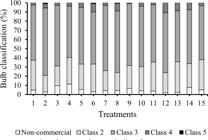
Classification of onion bulbs after post-emergence application of oxadiazon at different doses and phenological stages (1, 3, and 5 leaves)
The proportion of non-commercial bulbs remained low across treatments, generally below 10%, with slightly higher values observed in treatments 3 (9.64%) and 4 (11.40%) (Figure 8). Regarding intermediate classes, Class 2 showed moderate variability among treatments, ranging from 17.88 to 33.15%, suggesting some redistribution among commercial size classes depending on application timing and dose. However, this variation did not result in a consistent reduction in Class 3 bulbs.
Higher classes (Class 4) were observed at low to moderate proportions, generally below 9%, although higher values were recorded in treatments 12 (10.62%) and 6 (9.14%), indicating that, in some cases, oxadiazon did not limit the production of larger bulbs. Class 5 bulbs were rarely observed, with very low proportions in treatments 2 (0.87%), 6 (0.76%), and 8 (0.58%).
Overall, no clear trend was observed indicating that increasing herbicide dose or application at different phenological stages negatively affected bulb classification. The distribution pattern remained consistent across treatments, supporting the selectivity of oxadiazon for onion under the conditions of this study.
This distribution profile, characterized by a predominance of commercial classes (Classes 2, 3, and 4) and a low proportion of non -commercial bulbs, is highly desirable in commercial production systems, as it combines effective weed control with the maintenance of bulb quality and yield, which is essential for the economic sustainability of the crop (Milner et al., 2025).
These findings are consistent with previous studies, which reported that oxadiazon can provide 70 to 100% weed control when applied at 480 g a.i. ha -1 at 14 and 28 days after onion emergence (Eldin & Gabbar, 2018). However, crop selectivity has been more consistently observed at doses up to 250 g a.i. ha-1, as demonstrated in the present study.
Under semi-arid conditions, factors such as high temperatures, intense solar radiation, and low air humidity may increase herbicide availability and enhance plant sensitivity, particularly during early growth stages (Mou et al., 2025). In addition, soils with low organic matter content, typical of these regions, may reduce herbicide sorption, increasing its potential for phytotoxic effects (Chagas et al., 2020). Therefore, under these conditions, careful adjustment of both dose and application timing is essential to ensure crop safety, especially in direct-seeded systems, where plants tend to be more susceptible to herbicide injury (Melo et al., 2019).
Despite the slower physiological recovery observed in some treatments, the end-of-cycle yield data indicate that all plants fully recovered from the initial phytotoxicity symptoms (Figure 9). Statistical analysis revealed no significant differences between the treatments and the untreated control, demonstrating that oxadiazon application, even at higher doses, did not compromise crop yield. These findings are supported by Olescowicz et al. (2021), who observed complete recovery of onion plants after application of 750 g a.i. ha⁻1 of the herbicide, despite initial phytotoxicity symptoms. Similarly, Souza et al. (2015) reported that phytotoxicity caused by oxadiazon was limited to the first 10 DAA, followed by recovery of the crop.

Commercial onion yield after post-emergence application of oxadiazon at different doses and phenological stages
The slower recovery observed in some treatments in this experiment may be associated with the effect of dose on the physiological response time of the plants. Treatments exhibiting more prolonged symptoms coincided with those that received the highest doses for the respective phenological stage, suggesting a direct relationship between increased dose and the duration of phytotoxic effects (Olescowicz et al., 2021). However, the fact that all treatments showed equivalent yield reinforces the resilience of the crop to the temporary and reversible effects of oxadiazon.
Overall, the herbicides showed distinct selectivity patterns, although all were considered safe under the evaluated conditions. Oxyfluorfen, flumioxazin, and oxadiazon (PPO inhibitors) caused mild and transient injury, with greater sensitivity at early growth stages and rapid recovery over time. In contrast, pendimethalin showed lower and more stable phytotoxicity across application timings, although slight cumulative effects were observed under sequential applications.
Crop tolerance was strongly influenced by phenological stage, with applications at the 3- to 5-leaf stages representing the safest condition for all herbicides. Early applications increased the risk and intensity of phytotoxicity, especially for PPO inhibitors, likely due to reduced leaf area and lower metabolic capacity of young plants. Sequential applications occasionally prolonged injury symptoms, but did not compromise final yield.
From a practical perspective, these results indicate that safer weed management in direct-seeded onion under semi arid conditions can be achieved by prioritizing applications at more advanced growth stages and adjusting doses, particularly for PPO -inhibiting herbicides. This approach allows the reduction of phytotoxic effects while maintaining crop yield and operational flexibility.
Further studies are recommended focusing on the control efficiency of predominant weed species under different management strategies, aiming to optimize integrated weed management in onion crops and reduce reliance on manual control methods.
Conclusions
-
1. The herbicides oxyfluorfen, flumioxazin, pendimethalin, and oxadiazon were considered selective for onion grown under direct seeding conditions in a semi-arid environment.
-
2. The early developmental stages of onion were more sensitive to herbicide application, with mild phytotoxicity symptoms observed shortly after application; however, the plants showed recovery over time, indicating the transient nature of these effects.
-
3. Despite the initial symptoms, no negative effects were observed on bulb yield or commercial classification, demonstrating that the use of these herbicides did not compromise crop yield or quality.
-
1
Research developed at Experimental Farm of the Universidade Federal Rural do Semi-Árido, Mossoró, RN, Brazil
-
Ref. 300092
-
Financing statement:
This work was supported by the Coordenação de Aperfeiçoamento de Pessoal de Nível Superior - Brasil (CAPES) - Finance Code 001 and Conselho Nacional de Desenvolvimento Científico e Tecnológico (CNPq).
Data Availability Statement:
The data supporting the findings of this study are not publicly available but can be obtained from the corresponding author upon reasonable request.
Literature Cited
-
Allen, R. G. et al. Crop evapotranspiration: guidelines for computing crop water requirements. Rome: FAO, 1998. 300p. FAO Irrigation and Drainage Paper, 56. Available on: <http://www.fao.org/3/X0490E/x0490e00.htm>. Accessed on: Mar 2026.
» http://www.fao.org/3/X0490E/x0490e00.htm -
Alvares, C. A. et al. Köppen’s climate classification map for Brazil. Meteorologische Zeitschrift, v.22, p.711-728, 2013. https://doi.org/10.1127/094-2948/2013/05017
» https://doi.org/10.1127/094-2948/2013/05017 -
Arsenijevic, N. et al. Influence of sulfentrazone and metribuzin applied preemergence on soybean development and yield. Weed Technology, v.35, p.210-215, 2021. https://doi.org/10.1017/wet.2020.99
» https://doi.org/10.1017/wet.2020.99 -
Aulakh, J. S. et al. Ornamental plant and weed response to oxyfluorfenplusprodiamine. HortTechnology, v.34, p.227-233, 2024. https://doi.org/10.21273/HORTTECH05372-23
» https://doi.org/10.21273/HORTTECH05372-23 -
Belem, A. B. et al. Yield of onion in soil with cattle manure and nitrogen. Revista Brasileira de Engenharia Agrícola e Ambiental, v.24, p.149-153, 2020. https://doi.org/10.1590/180-71929/agriambi.v24n3p149-153
» https://doi.org/10.1590/180-71929/agriambi.v24n3p149-153 -
Bordignon, L. et al. Weed control efficiency and selectivity of preemergent herbicides for garlic crop. Bioscience Journal, v.41, e41022, 2025. https://doi.org/10.14393/B-Jv41n0a2025-76881
» https://doi.org/10.14393/B-Jv41n0a2025-76881 -
BRASIL. Ministério da Agricultura e Pecuária. AGROFIT: Sistema de agrotóxicos fitossanitários. Available on: <https://agrofit.agricultura.gov.br/agrofit_cons/principal_agrofit_con>s Accessed in: Mar. 2026.
» https://agrofit.agricultura.gov.br/agrofit_cons/principal_agrofit_con>s -
Carvalho, D. R. de. et al. Eficiência do oxyfluorfen no controle de plantas daninhas na cultura da cebola transplantada irrigada por gotejamento. Revista Agro@mbiente On -line, v.8, p.127-133, 2014. https://doi.org/10.18227/198-28470ragro.v8i1.1553
» https://doi.org/10.18227/198-28470ragro.v8i1.1553 -
CEAGESP - Companhia de Entrepostos e Armazé ns Gerais de São Paulo. Programa brasileiro para a melhoria dos padrões comerciais e embalagens de hortigranjeiros: Classificação da cebola (Allium cepa ). 2001. Available on: < https://ceagesp.gov.br/>. Accessed on: Jan 2025.
» https://ceagesp.gov.br/ -
Chagas, P. S. F. das. et al. Increases in pH, Ca 2+, and Mg2+ alter the retention of diuron in different soils. Catena, v.188, 104440, 2020. https://doi.org/10.1016/j.catena.2019.104440
» https://doi.org/10.1016/j.catena.2019.104440 -
Correia, N. M. Selectivity of herbicide oxadiazon to processing tomato and control of American black nightshade plants. Horticultura Brasileira, v.39, p.32-38, 2021. https://doi.org/10.1590/s010-20536-20210105
» https://doi.org/10.1590/s010-20536-20210105 -
Durigan, J. C. et al. Eficácia e seletividade do herbicida flumioxazin aplicado em pré -emergência na cultura transplantada da cebola. Revista Brasileira de Herbicidas, v.4, p.11-17, 2005. https://doi.org/10.7824/rbh.v4i3.33
» https://doi.org/10.7824/rbh.v4i3.33 - Eldin, K. A. N.; Gabbar, T. B. A. Herbicidal efficacy and selectivity of pendimethalin, oxadiazon and their tank mixtures to direct seeded onion. Shendi University Journal of Applied Science, v.1, p.28-37, 2018.
-
El-Wakeel, M. A. et al. Exploiting soybean and flaxseed meal byproducts as safe weed management approaches in onion field. Journal of Soil Science and Plant Nutrition, v.24, p.5898-5914, 2024. https://doi.org/10.1007/s42729-024-01948-x
» https://doi.org/10.1007/s42729-024-01948-x -
EMBRAPA - Empresa Brasileira de Pesquisa Agropecuária. Sistema brasileiro de classificação de solos. 5.ed. Brasília: Embrapa, 2018. Available on: < https://www.embrapa.br/busca-de-publicacoes/-/publicacao/1094003/sistemabrasileiro-de-classificacao-de-solos>. Accessed in: Feb. 2026.
» https://www.embrapa.br/busca-de-publicacoes/-/publicacao/1094003/sistemabrasileiro-de-classificacao-de-solos -
EMBRAPA - Empresa Brasileira de Pesquisa Agropecuária. Sistema de produção de cebola: semeadura direta e transplantio. 2020. Available on: < https://www.embrapa.br/agenci-adeinformacao-tecnologica/cultivos/cebola/producao/metodosde-plantio/semeadura-direta>. Accessed on: Jun. 2025.
» https://www.embrapa.br/agenci-adeinformacao-tecnologica/cultivos/cebola/producao/metodosde-plantio/semeadura-direta -
Ferreira, E. B. et al. ExpDes: an R package for ANOVA and experimental designs. Applied Mathematics, v.5, p.2952-2958, 2014. http://dx.doi.org/10.4236/am.2014.519280
» http://dx.doi.org/10.4236/am.2014.519280 -
Ferreira, L. R. et al. Seletividade e eficácia da aplicação sequencial de oxyfluorfen e de ioxynil -octanoato, em semeadura direta de cebola. Planta Daninha, v.18, p.39-50, 2000. https://doi.org/10.1590/S010-083582000000100004
» https://doi.org/10.1590/S010-083582000000100004 -
Fontes, J. R. A. et al. Selectivity and efficiency of herbicides in cassava on the floodplain of the Solimões river. Revista Agro@mbiente On -line, v.15, p.1-15, 2021. https://doi.org/10.18227/198-28470ragro.v15i0.6393
» https://doi.org/10.18227/198-28470ragro.v15i0.6393 -
Geng, W. et al. Discovery of novel N -phenylphthalimide protoporphyrinogen IX oxidase inhibitors. Journal of Agricultural and Food Chemistry, v.73, p.4585-4593, 2025. https://doi.org/10.1021/acs.jafc.4c09708
» https://doi.org/10.1021/acs.jafc.4c09708 -
Guerra, N. et al. Weed control and selectivity herbicides pre emerging in garlic cultivars. Planta Daninha, v.38, e020228966, 2020. https://doi.org/10.1590/S010-083582020380100074
» https://doi.org/10.1590/S010-083582020380100074 -
Guerra, N. et al. Application timing affects the selectivity of herbicides for garlic crops. Comunicata Scientiae, v.13, e3845, 2022. https://doi.org/10.14295/CS.v13.3845
» https://doi.org/10.14295/CS.v13.3845 -
Higashikawa, F. S.; Menezes-Júnior, F. O. G. de. Adubação mineral, orgânica e organomineral: efeitos na nutrição, produtividade, pós-colheita da cebola e na fertilidade do solo. Scientia Agraria, v.18, p.1-10, 2017. https://doi.org/10.5380/rsa.v18i2.51219
» https://doi.org/10.5380/rsa.v18i2.51219 -
IBGE - Instituto Brasileiro de Geografia e Estatística. Produção de cebola. 2025. Available on: <https://www.ibge.gov.br/explica/producao-agropecuaria/cebola/br>. Accessed on: Mar 2026.
» https://www.ibge.gov.br/explica/producao-agropecuaria/cebola/br -
Jing, C. et al. The effect of weed control with pre -emergence herbicides on the yield level of mung bean yield. Plants, v.14, 275, 2025. https://doi.org/10.3390/plants14020275
» https://doi.org/10.3390/plants14020275 -
Karaismailoğlu, C. Cytotoxic and genotoxic effects of oxyfluorfen on the somatic cells of Allium cepa Kahramanmaraş Sütçü İmam Üniversitesi Tarım ve Doğa Dergisi, 25, 207, 2022. https://doi.org/10.18016/ksutarimdoga.vi.864929
» https://doi.org/10.18016/ksutarimdoga.vi.864929 -
Kaur, R. et al. Sequential herbicide application coupled with mulch enhances the productivity and quality of winter onion (Allium cepa L.) while effectively controlling the mixed weed flora. Frontiers in Sustainable Food Systems, v.7, 1271340, 2024. https://doi.org/10.3389/fsufs.2023.1271340
» https://doi.org/10.3389/fsufs.2023.1271340 -
Kim, M. et al. Pendimethalin exposure disrupts mitochondrial function and impairs processes related to implantation. Reproduction, v.165, p.491-505, 2023. https://doi.org/10.1530/REP-22-0397
» https://doi.org/10.1530/REP-22-0397 -
Lee, H. S. et al. Pendimethalin induces apoptotic cell death through activating ER stress-mediated mitochondrial dysfunction in human umbilical vein endothelial cells. Food and Chemical Toxicology, v.168, 113370, 2022. https://doi.org/10.1016/j.fct.2022.113370
» https://doi.org/10.1016/j.fct.2022.113370 -
Lee, N.; Thierfelder, C. Weedcontrolunderconservationagriculture in dryland smallholder farming systems of southern Africa. A review:. Agronomy for Sustainable Development, v.37, 48, 2017. https://doi.org/10.1007/s1359-3017-0453-7
» https://doi.org/10.1007/s1359-3017-0453-7 -
Lockhart, S. J.; Howatt, K. A. Split applications of herbicides at reduced rates can effectively control wild oat (Avena fatua) in wheat. Weed Technology, v.18, p.369-374, 2004. https://doi.org/10.1614/WT-03-100R1
» https://doi.org/10.1614/WT-03-100R1 -
Luks, A. K. et al. Fate of pendimethalin in soil and characterization of non -extractable residues (NER). Science of the Total Environment, v.753, 141870, 2021. https://doi.org/10.1016/j.scitotenv.2020.141870
» https://doi.org/10.1016/j.scitotenv.2020.141870 -
Maciel, G. M. et al. Onion genotype skills in different planting systems. Revista Ciência Agrícola, v.17, p.35-41, 2019. https://doi.org/10.28998/rca.v17i2.5281
» https://doi.org/10.28998/rca.v17i2.5281 - Mallik, S. et al. Herbicidal options in managing weeds towards growth and yield dynamics of single clove garlic. International Journal of Agriculture Sciences, v.9, p.3627-3630, 2017.
-
Melo, C. A. D. et al. Effectiveness of reduced doses of flumioxazin herbicide at weed control in direct sow onions. Revista Colombiana de Ciencias Hortícolas, v.13, p.71-80, 2019. https://doi.org/10.17584/rcch.2019vl3il.7938
» https://doi.org/10.17584/rcch.2019vl3il.7938 -
Mendes, K. F. et al. Retention, absorption, translocation, and metabolism of herbicides in plants. Applied Weed and Herbicide Science, s/v, p.157-186, 2022. https://doi.org/10.1007/97-83-031-01938-8_5
» https://doi.org/10.1007/97-83-031-01938-8_5 -
Milner, H. et al. High planting density twin -row arrangement produces favorable bulb size distribution in short -day onion. HortTechnology, v.35, p.513-516, 2025. https://doi.org/10.21273/HORTTECH05628-25
» https://doi.org/10.21273/HORTTECH05628-25 -
Mou, S. S. et al. Climate -driven challenges in weed management for ornamental crop production in the United States: A review. Frontiers in Agronomy, v.7, 1556418, 2025. https://doi.org/10.3389/fagro.2025.1556418
» https://doi.org/10.3389/fagro.2025.1556418 -
Olescowicz, D. et al. Seletividade de herbicidas com atividade residual em cebola cultivada em semeadura direta. Weed Control Journal, v.20, e202100739, 2021. https://doi.org/10.7824/wc.j2021;20:00739
» https://doi.org/10.7824/wc.j2021;20:00739 -
Park, J. et al. Biochemical and physiological mode of action of tiafenacil, a new protoporphyrinogen IX oxidase -inhibiting herbicide. Pesticide Biochemistry and Physiology, v.152, p.38-44, 2018. https://doi.org/10.1016/j.pestbp.2018.08.010
» https://doi.org/10.1016/j.pestbp.2018.08.010 -
Ray, S. et al. Diffusion of volatile organics and water in the epicuticular waxes of petunia petal epidermal cells. The Plant Journal, v.110, p.658-672, 2022. https://doi.org/10.1111/tpj.15693
» https://doi.org/10.1111/tpj.15693 -
Reddy, S. S. et al. Weed control and crop safety with premixed tolpyralate and bromoxynil on cereals. Weed Technology, v.39, e55, 2025.https://doi.org/10.1017/wet.2025.22
» https://doi.org/10.1017/wet.2025.22 -
Roozkhosh, M. et al. Evaluating the efficacy of herbicide options in controlling purple nutsedge (Cyperus rotundus L.) in onion (Allium cepa L.) fields. Crop Protection, v.190, 107084, 2025. https://doi.org/10.1016/j.cropro.2024.107084
» https://doi.org/10.1016/j.cropro.2024.107084 -
SBCPD - Sociedade Brasileira da Ciência das Plantas Daninhas. Procedimentos para instalação, avaliação e análise de experimentos com herbicidas. 1995. Available on: < https://books.google.com.br/books/about/Procedimentos_para_instala%C3%A7%C3%A3o_avalia%C3%A7.html?id=9uoBaAEACAAJ&redir_esc=y>. Accessed in: Jun. 2025.
» https://books.google.com.br/books/about/Procedimentos_para_instala%C3%A7%C3%A3o_avalia%C3%A7.html?id=9uoBaAEACAAJ&redir_esc=y -
Silva, P. V.; Monquero, P. A. Influência da palha no controle químico de plantas daninhas no sistema de cana crua. Revista Brasileira de Herbicidas, v.12, p.94-103, 2013. https://doi.org/10.7824/rbh.v12i1.235
» https://doi.org/10.7824/rbh.v12i1.235 -
Singh, S. K. et al. Direct-seeded rice: potential benefits, constraints and prospective. Journal of Scientific Research and Reports, v.30, p.272-280, 2024. https://doi.org/10.9734/jsrr/2024/v30i72143
» https://doi.org/10.9734/jsrr/2024/v30i72143 -
Soil Survey Staff. Keys to soil taxonomy. 13.ed. Lincoln: USDA - Natural Resources Conservation Service, 2022. 401p. Available at: < https://www.nrcs.usda.gov/resources/guide-sand-instructions/keys-to-soiltaxonomy>. Accessed on: Mar. 2026.
» https://www.nrcs.usda.gov/resources/guide-sand-instructions/keys-to-soiltaxonomy -
Souza, J. I. de. et al. Response to sequential herbicides application in delayed post -emergence in onion crop transplanted in distinct plants densities. Applied Research & Agrotechnology, v.8, p.25-33, 2015. https://doi.org/10.5935/PAeT.V8.N2.03
» https://doi.org/10.5935/PAeT.V8.N2.03 -
Souza, M. de F. et al. Can irrigation systems alter the critical period for weed control in onion cropping? Crop Protection, v.147, 105457, 2021.https://doi.org/10.1016/j.cropro.2020.105457
» https://doi.org/10.1016/j.cropro.2020.105457 -
Souza, M. de F. et al. Soil water availability alter the weed community and its interference on onion crops. Scientia Horticulturae, v.272, 109573, 2020. https://doi.org/10.1016/j.scienta.2020.109573
» https://doi.org/10.1016/j.scienta.2020.109573 -
Srimathi, K. et al. Cuticular wax composition and anatomical features of Cyperus rotundus L. in relation to herbicide uptake and translocation. Plant Science Today, v.12, p.1-9, 2025. https://doi.org/10.14719/pst.8763
» https://doi.org/10.14719/pst.8763 -
Teixeira, P. C. et al. Manual de métodos de análise de solo. 3.ed. Brasília: Embrapa, 2017. 573p. Available on: < https://www.embrapabr/busca-de-publicacoes/-/publicacao/1085209/manual-de-metodos-de-analise-de-solo>. Accessed in: Mar. 2026.
» https://www.embrapabr/busca-de-publicacoes/-/publicacao/1085209/manual-de-metodos-de-analise-de-solo -
Yin, C. et al. Impact of overhead irrigation timing on ornamental plant phytotoxicity following preemergence herbicide applications. Plants, v.14, 1710, 2025.https://doi.org/10.3390/plants14111710
» https://doi.org/10.3390/plants14111710 -
Zhang, B. et al. Pesticides toxicity, removal and detoxification in plants: A review. Agronomy, v.14, 1260, 2024. https://doi.org/10.3390/agronomy14061260
» https://doi.org/10.3390/agronomy14061260 -
Zhang, J. J.; Yang, H. Metabolism and detoxification of pesticides in plants. Science of the Total Environment, v.790, 148034, 2021. https://doi.org/10.1016/j.scitotenv.2021.148034
» https://doi.org/10.1016/j.scitotenv.2021.148034 -
Zhao, L. X. et al. Design, synthesis, and herbicidal activity of diphenyl ether derivatives containing a five -membered heterocycle. Journal of Agricultural and Food Chemistry, v.70, p.1003-1018, 2022.https://doi.org/10.1021/acs.jafc.1c05210
» https://doi.org/10.1021/acs.jafc.1c05210
Edited by
-
Editors:
Antônio Gustavo de Luna Souto & Walter Esfrain Pereira


 Error bars represent standard error (± SE; n = 3). No significant differences were observed among treatments according to Tukey’s test (p ≤ 0.05)


