 Spatial distribution of nutrients in banana leaves under the effect of liming
ABSTRACT
Correcting soil acidity is a key practice to enhance nutrient availability and improve crop yield. This study aimed to evaluate the effects of incorporating limestone into the soil compared to surface application on the nutrient content of banana leaves. The research was conducted in a banana orchard in the city of Cristino Castro, Piauí state, Brazil. The experimental area was divided using a statistical approach, with 42 georeferenced sampling points representing the replicates of two treatments. The area was split into two subareas, each one with 21 points, representing either limestone incorporation and surface application. Leaf samples were collected at each point to determine the concentrations of phosphorus, potassium, calcium, magnesium, copper, iron, manganese, and zinc. Spatial variability was assessed through descriptive statistics and geostatistical analysis. Limestone incorporation increased the levels of phosphorus, calcium, magnesium, copper, manganese, and zinc in banana leaves, while potassium content was higher in the area with surface-applied limestone. Principal component analysis indicated that incorporating limestone into the soil led to greater nutrient distribution uniformity and reduced spatial variability in the leaves. This method improves both the availability and uniformity of nutrients in banana leaves, enhancing the nutritional status of the plants.
Key words:
Musa spp.; nutritional analysis; soil acidity; spatial variability
HIGHLIGHTS:
Limestone incorporation reduced nutrient variability in banana leaves.
The method of limestone application directly affects the nutritional efficiency of banana plants.
Incorporating limestone increased the levels of phosphorus, calcium, magnesium, copper, manganese, and zinc in banana leaves.
RESUMO
A correção da acidez do solo é uma prática fundamental para aumentar a disponibilidade de nutrientes e otimizar a produtividade de culturas. Assim, o objetivo foi avaliar os efeitos do calcário incorporado ao solo em comparação com sua aplicação na superfície do solo sobre o teor de nutrientes nas folhas de bananeira. O estudo foi conduzido em um pomar de banana no município de Cristino Castro, no Estado do Piauí, Brasil. Usando o método estatístico, a área experimental foi delimitada com 42 pontos georeferenciados que representaram as repetições dos dois tratamentos estudados. A área total foi dividida em duas subáreas cada uma com 21 pontos e representando um método de aplicação do calcário (incorporação de calcário no solo e aplicação de calcário na superfície do solo). Amostras de folhas foram coletadas em cada ponto para determinar os teores de fósforo, potássio, cálcio, magnésio, cobre, ferro, manganês e zinco. A variabilidade espacial foi avaliada por meio da estatística descritiva e geoestatística. Os resultados mostraram que a incorporação de calcário aumentou os teores de fósforo, cálcio, magnésio, cobre, manganês e zinco nas folhas, enquanto o teor de potássio foi maior na área com aplicação de calcário na superfície do solo. A análise de componentes principais evidenciou que a incorporação do calcário no solo proporcionou maior homogeneidade na distribuição de nutrientes e redução da variabilidade espacial nas folhas. A incorporação de calcário no solo, melhora a disponibilidade e a uniformidade dos nutrientes nas folhas de bananeira, beneficiando o estado nutricional da bananeira.
Palavras-chave:
Musa spp.; análise nutricional; acidez do solo; variabilidade espacial
Introduction
Banana (Musa spp.) is one of the most widely cultivated tropical fruit crops worldwide. Brazil is among the leading global producers, with banana cultivation occupying approximately 32% of small farms, where most of the production is destined for local markets (Cândido et al., 2022). Banana yield is closely linked to soil fertility, and soil acidity is one of the main limiting factors in tropical regions. Correcting soil acidity is therefore a crucial agricultural practice, particularly in acidic soils, which are predominant in Brazil (Smaniotto et al., 2024).
Correcting soil acidity aims to raise soil pH, which has a significant impact on nutrient availability for banana plants. The optimal pH range for banana cultivation is between 6.6 and 7.2 (Lima Neto et al., 2024). pH values above this range may reduce the availability of certain nutrients, such as phosphorus (P) (Barrow & Hartemink, 2023), while increasing the availability of others, such as calcium (Ca) and magnesium (Mg) (Carvalho Júnior et al., 2019).
However, the effectiveness of liming depends on the method of application (Moreira et al., 2024). Incorporating limestone into the soil significantly increases pH in deeper layers compared to surface application without incorporation (Arrobas et al., 2023). Additionally, nutrient levels in the soil can vary considerably within the same area (Dahal, 2024), leading to differences in nutrient concentrations in banana leaves (Orr et al., 2023). These variations highlight the need for site-specific recommendations.
Therefore, applying fertilizers solely based on soil analysis recommendations without accounting for spatial variability and the nutritional status of the crop may compromise the effectiveness of fertilization (Velamala & Pant, 2024). The study by Yadav et al. (2023) highlights significant spatial variability in soil nutrient levels, such as nitrogen (N), phosphorus, and potassium (K), emphasizing that this variability affects nutrient use efficiency and crop yield.
Achieving satisfactory yields requires good soil fertility and proper nutrient management, both of which are essential for high banana production. Lima Neto et al. (2024) identified critical levels of P, potassium, Ca, Mg, iron (Fe), copper (Cu), manganese (Mn), and zinc (Zn) in banana leaves, underscoring the significance of this data in assessing the nutritional status of the crop.
Widespread use of liming notwithstanding, there is a notable gap in literature regarding the effects of limestone incorporation on nutrient availability and spatial variability. Studies indicate that in acidic soils, incorporating limestone increases the availability of macronutrients, although it may reduce levels of certain micronutrients, such as Fe (Moreira et al., 2024). In contrast, when limestone is not incorporated, its effect is limited to the surface layer, restricting nutrient movement to deeper soil levels (Auler et al., 2017).
The hypothesis tested in this study was that incorporating limestone into the soil increases nutrient availability to banana plants more effectively than surface application, while also reducing spatial variability in nutrient content. The aim of this study was to evaluate the effects of limestone incorporation compared to surface application on the nutrient content in banana leaves.
Material and Methods
The study was conducted in a banana orchard located in the city of Cristino Castro, Piauí state, Brazil, at an altitude of 223 m (8° 49′ 38″ S, 44° 13′ 04″ W). According to the Köppen classification, the region has an Aw climate, characterized by dry winters and hot, rainy summers, with an average temperature of 27 °C and annual rainfall of 900 mm (Alvares et al., 2013). The climatic conditions during the leaf sampling period are shown in Figure 1.

Average daily values of maximum and minimum temperature, maximum and minimum air humidity, and rainfall recorded during the leaf sampling period in Cristino Castro, PI state, Brazil
The study area was originally covered by native vegetation and had flat terrain, with slope variation ranging from 0 to 10%. The soil was classified as Neossolo Flúvico (EMBRAPA, 2018) and Entisol Fluvent (Soil Survey Staff, 2022). The experiment was conducted in an established banana orchard planted with the cultivars Prata, Maçã, and Grande Naine, spaced 3 m between plants and 5 m between rows, under microsprinkler irrigation (Figure 2).

The orchard was established in 2016 using planting holes measuring 0.5 × 0.5 × 0.5 m, with three plants placed in each hole. Daily irrigation was performed using microsprinklers installed between the rows, with a flow rate of 70 L h-1, to meet the crop’s water requirements and compensate for the regional water deficit, as precipitation during the period was below expected levels (Serviço Geológico do Brasil, 2017).
The experimental area was mapped using 42 georeferenced points arranged in a regular sampling grid of 35 × 30 m, covering a total of 5 ha. The sampling points were distributed across five planting rows, excluding the first two rows along the edges to avoid border effects. Only plants with no more than two suckers were selected to minimize nutrient competition. The area was divided into two subareas of 2.5 hectares each (with 21 points per subarea), distinguished by the method of limestone application, which was implemented at the beginning of 2016. In one subarea, 4 t ha-1 of dolomitic limestone with a relative neutralizing power (RNP) of 60% (containing 24% CaO and 12% MgO) was applied on the soil surface along the planting rows, without incorporation. In the second subarea, the same rate of 4 t ha⁻¹ was applied, followed by mechanized incorporation into the soil to a depth of 0.30 m, in a linear and uniform manner.
The soil initially had a pH of 4.5, which is considered acidic for banana cultivation, and a base saturation (V%) of 23%. The base saturation method was used to correct the pH, targeting a level of 60%. Nutrient levels were low; therefore, according to Sousa & Lobato (2004), 0.2 kg of simple superphosphate and 0.2 kg of monoammonium phosphate (9% N and 48% P2O5) were applied in each planting hole at the time of planting. After crop establishment, 50 kg ha-1 of a 20-00-20 fertilizer formulation was applied monthly via fertigation.
Approximately 2 years after the orchard was established, in March 2019 when the plants were 3 years old and already producing (mother plants) leaf samples were collected. A total of 42 samples were taken from the georeferenced points, following the methodology proposed by Sousa & Lobato (2004). The middle section of the leaf blade was collected, excluding the central vein, from the third leaf from the apex at the early inflorescence stage. After collection, the leaves were washed with distilled water to prevent contamination by residues. They were then dried in a forced-air circulation oven at approximately 65 °C for 72 hours, until a constant weight was reached.
Nutrient contents were determined using the dry digestion method. For this analysis, approximately 0.5 g of the dried and ground leaf sample was weighed and ashed in a muffle furnace at 500 °C for 4 hours until complete combustion. A 3 mol L-1 hydrochloric acid (HCl) solution was then added to the ash, and the resulting extract was filtered for subsequent element analysis. P was determined by vanadate yellow spectrophotometry, with readings taken at 420 nm using a spectrophotometer. K was determined by flame photometry. Ca, Mg, Cu, Fe, Mn, and Zn were determined by atomic absorption spectroscopy at wavelengths of 422.7 nm (Ca), 285.2 nm (Mg), 324.7 nm (Cu), 248.3 nm (Fe), 279.5 nm (Mn), and 213.9 nm (Zn), respectively (EMBRAPA, 2009).
Data were analyzed using descriptive statistics, including measures of central tendency, dispersion, and shape such as mean, CV, skewness, kurtosis, maximum, minimum, and range using Minitab software. The normality of the evaluated variables was assessed using the Kolmogorov-Smirnov test.
Semivariograms were modeled based on the assumption of intrinsic stationarity to assess spatial dependence. Adjustments were performed using GS+ software, testing spherical, exponential, and Gaussian models to identify the best fit. Model selection was based on the sum of squared residuals (SQR), the coefficient of determination (R2), and the correlation coefficient obtained through cross-validation (CRVC). Spatial variability was mapped using the kriging interpolation method according to the selected models (Vieira, 2000). Predictions of each attribute in unsampled areas were generated using Surfer software.
For each evaluated attribute, both the range and the degree of spatial dependence (GDE) were determined. GDE was classified according to Cambardella et al. (1994), based on the ratio between the nugget effect and the sill: weak when >75%, moderate between 25 and 75%, and strong when <25%.
A principal component analysis (PCA) was performed to evaluate the relationship between the treatments and leaf nutrient content. The analysis was conducted using RStudio software (R Core Team, 2017) and the “FactoMineR” package (Lê et al., 2008).
Results and Discussion
Based on the descriptive analysis of nutrient contents in banana leaves under different limestone application methods, average values of P, Ca, Mg, Cu, and Zn were slightly higher in the area where limestone was incorporated into the soil. These nutrients showed moderate variation and a predominantly symmetric distribution in both application methods (Table 1). Mn and Fe contents were similar between treatments, differing only at the decimal level, i.e., numerically rather than statistically. In the case of K, no treatment effect was observed, likely due to its high mobility in the soil. Data showed mostly symmetric distributions, as indicated by the proximity of the mean and median values. Skewness was generally positive, suggesting a slight deviation from normality.
In this study, the results demonstrate that incorporating dolomitic limestone into the soil increased nutrient contents in banana leaves by 20.2% for P, 19.5% for Ca, 13.73% for Mg, 51.64% for Cu, and 15.81% for Zn, compared to surface application. This effect is mainly attributed to the rise in soil pH and enhanced nutrient availability, both of which are essential for plant development. Matos et al. (2022) also confirmed that limestone application increases the availability of macronutrients such as Ca and Mg in the soil, which subsequently elevates their concentrations in banana leaves.
Foliar K content was higher in areas where limestone was applied to the soil surface. This effect is directly related to the interaction dynamics among Ca, Mg, and K in the soil. When limestone is applied without incorporation, it acts more superficially, increasing Ca levels mainly in the upper soil layers. As dolomitic limestone also contains Mg, its content likewise increases in these layers. This leads to intensified competition among Ca, Mg, and K for adsorption sites in the soil exchange complex. Given the general adsorption preference order K > Ca > Mg; K is preferentially retained over Ca and Mg (Gacitúa et al., 2008). This mechanism favors the release of previously retained K, increasing its availability in the soil solution and, consequently, its uptake by banana roots (Han et al., 2019).
Except for Mg in the limestone-incorporated area and Cu in both application methods, skewness values were positive, with means higher than medians (Table 1). Limestone application especially when applied to the soil surface without incorporation can increase the availability of certain nutrients in the upper soil layers, thereby enhancing plant uptake. This was reflected in the higher contents of nutrients such as P, Ca, and K in banana leaf tissue. These localized high concentrations, resulting from the lack of limestone incorporation, may explain the positive skewness observed for most nutrients, particularly those sensitive to pH values above 5.5.
For P, K, and Mn in the limestone-incorporated area and Zn in the non-incorporated area, kurtosis values were >3, indicating the presence of outliers. According to Oliveira et al. (2021), such values deviate from normality, as ideal kurtosis should be close to 0, and values are only considered acceptable if they fall between +2 and -2.
Regardless of the limestone application method, the CV was greater than 30% for K, Mg, Cu, and Mn (Table 1), indicating high variability in the contents of these nutrients. Several factors may contribute to this variability, including soil formation processes, management history, and agricultural practices (Agegnehu et al., 2023). High CV values may also be associated with low-fertility areas (Sanches et al., 2020) and the spatial distribution of nutrients within the leaves, which can be influenced by environmental conditions and intrinsic characteristics of banana leaves, such as leaf size (Borges et al., 2006; Herrera et al., 2009).
Table 2 shows that the foliar nutrient contents in banana plants grown under limestone incorporation and surface application exhibit varying degrees of spatial dependence. Most nutrients fit the Gaussian model, except for Ca, Fe, and Zn in the limestone-incorporated area, which followed the spherical model. Variations in the nugget effect and sill were observed depending on the nutrient and treatment. The R2 values indicate a good fit for certain nutrients, such as P and Mg, under both application methods. However, the cross-validation regression coefficient (CRVC) varied considerably, reflecting the complexity of spatial variability.
The nugget effect was highest for Mn content in banana leaves under both limestone application methods. Nutrients with lower nugget effects, such as P, Mg, and Cu, exhibited greater spatial continuity, which facilitates site-specific management. Mn also presented higher sill values, particularly in the area without limestone incorporation, reflecting high total variability and the low effectiveness of surface application.
Ca and Fe exhibited strong spatial dependence in areas with limestone incorporation, suggesting that their distribution is influenced by the corrective incorporation process (Raghupathi & Srinivas, 2014). Incorporating limestone into the soil can promote a more uniform nutrient distribution, increasing availability in specific zones and enhancing uptake by banana plants, thereby improving growth and yield (Arunkumar et al., 2024).
For Ca and Fe, the Spherical model provided the best fit when limestone was incorporated into the soil, suggesting a more irregular and abrupt spatial distribution, with sharper changes over short distances (Table 2). For the other nutrients, regardless of the limestone application method, the Gaussian model showed the best fit, indicating a more uniform spatial distribution and smoother, gradual variation in nutrient contents (Bernardi et al., 2016).
With regard to the range, the evaluated attributes showed variation between the two limestone application methods (Table 2). In the area with limestone incorporation, the range varied from 40.2 m (Zn) to 138.5 m (Ca), while in the area with surface application, it ranged from 29.6 m (Mn) to 90.41 m (Zn). The range represents the maximum distance over which one sampling point influences another for a given variable. Overall, a greater range indicates a more homogeneous distribution of that variable across the study area (Vogado et al., 2020).
The R2 ranged from 0 to 0.99. The lowest values were observed for variables that followed the Spherical model, indicating greater fluctuation in the leaf contents of Ca, Fe, Mn, and Zn (Table 2). R2 expresses, in percentage terms, the proportion of variation in the estimated semivariance values explained by the model, thus indicating whether the semivariogram is suitable for spatial interpolation (Oliveira et al., 2021).
Areas with limestone incorporation exhibited a more consistent spatial distribution, with lower nutrient variability. In contrast, areas with surface application showed greater spatial variability and more irregular patterns particularly for K and Mg suggesting that surface application may have limited the uniform distribution of these nutrients (Figure 3).

Spatial distribution of leaf macronutrient contents in banana plants cultivated under limestone incorporation into the soil and surface application
Areas without limestone incorporation showed greater spatial variability, with irregular patterns for Mn and Fe, indicating that the absence of incorporation may have limited the homogeneous distribution of these nutrients (Figure 4).

Spatial distribution of leaf micronutrient contents in banana plants cultivated under limestone incorporation into the soil and surface application
These results support previous findings showing that limestone incorporation improves soil pH, thereby enhancing nutrient availability and absorption. In contrast, surface application is less effective in promoting spatial homogeneity of nutrient distribution (Moreira et al., 2024).
Figures 3 and 4 highlight clear differences in foliar nutrient contents between areas with and without limestone incorporation. Incorporation tended to promote greater homogeneity in the distribution of P, Ca, Mg, Mn, and Zn, resulting in increased availability of these nutrients. In contrast, the non-incorporated treatment resulted in higher K levels in banana leaves, ranging from 20 to 120 g kg-1. Fe contents were similar under both application methods.
The differences observed in nutrient contents in banana leaves reflect the direct influence of the limestone application method on nutrient dynamics. Incorporating limestone improves nutrient-root interactions, particularly in soils with low initial fertility, thereby supporting better plant growth. Similar results were reported by Mahmud & Chong (2022), who demonstrated that incorporated limestone enhances nutrient uptake efficiency by neutralizing soil acidity and increasing the availability of nutrients such as P, K, Ca, and Mg.
These differences underscore the advantages of incorporating limestone into the soil, a practice that not only improves nutrient absorption but also promotes a more uniform nutrient distribution. This relationship is supported by spatial distribution maps presented by Matos et al. (2024), which show how corrective incorporation can optimize site-specific fertilization strategies, improving nutrient use efficiency and crop yield.
Analysis of Figures 3 and 4 shows that nutrient levels in banana leaves from both incorporated and non-incorporated limestone areas fall within the sufficiency ranges established for the crop. According to Lima Neto et al. (2024), the adequate foliar concentrations for Prata banana are 1.4-2.0 g kg-1 for P, 26.5-35.6 g kg-1 for K, 5.4-7.3 g kg-1 for Ca, and 2.0-2.6 g kg-1 for Mg. For micronutrients, the sufficiency ranges are 5.0-8.1 mg kg-1 for Cu, 56.3-72.6 mg kg-1 for Fe, 102.1-199.5 mg kg-1 for Mn, and 13.5-18.2 mg kg-1 for Zn. These findings highlight that limestone incorporation is more effective in promoting nutrient availability and absorption in banana plants. This management practice not only enhances spatial uniformity but also contributes to the sustainability of production systems.
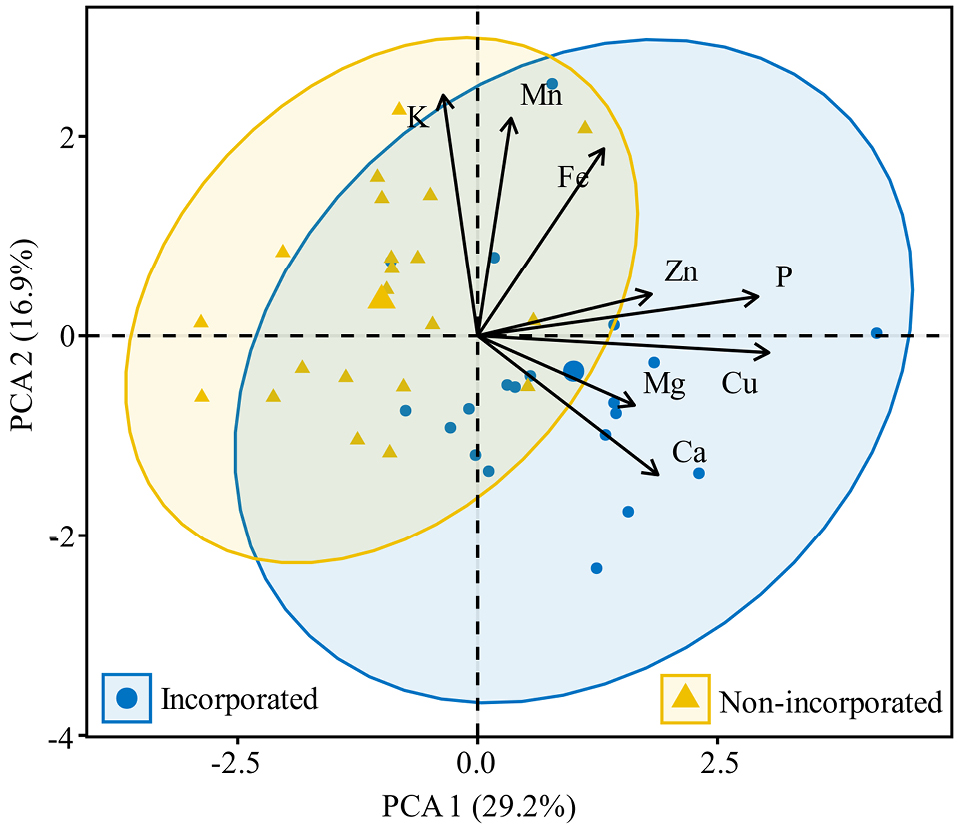
Principal component analysis (PCA) was conducted to evaluate the relationship between foliar nutrient contents in banana plants grown under limestone incorporation and surface application. The first principal component (PC1) accounted for 29.2% of the total variance, while the second principal component (PC2) accounted for 16.9% (Figure 5). The PCA results showed a clear separation between the two limestone application methods, indicating significant differences in foliar nutrient composition. Limestone incorporation influenced the levels of all nutrients, with notable contributions from Ca, Mg, P, Zn, and Cu. In contrast, the absence of incorporation affected the contents of Fe, Mn, and K, with K showing the most pronounced response to surface application.

Principal component analysis showing the relationship between leaf micronutrient contents in banana plants cultivated under limestone incorporation into the soil and surface application
The results indicate that the incorporation of limestone directly affects the foliar nutrient composition of banana plants. The higher nutrient contents observed in plants grown in areas with limestone incorporation are closely linked to reduced soil acidity, which is critical for improving nutrient solubility and availability (Abdi, 2024; Jing et al., 2024).
The separation observed in the PCA between application methods further confirms that limestone incorporation can reduce spatial variability, promoting greater uniformity in the uptake of essential nutrients. This effect is particularly important for perennial crops such as bananas, which have high and continuous nutritional demands throughout their production cycle. Moreover, recent studies have emphasized the importance of assessing spatial nutrient distribution and delineating management zones for precise fertilization strategies. This approach can help minimize variability and enhance nutrient uptake, particularly for nutrients that are vital for banana cultivation (Shukla et al., 2024).
Conclusions
-
Incorporating dolomitic limestone into the soil at a depth of 0.30 m promotes greater spatial homogeneity in nutrient distribution in banana leaves particularly for P, Ca, Mg, Cu, Mn, and Zn compared to surface application.
-
The comparison between application methods revealed significant differences, showing that soil incorporation improves nutrient availability and uniformity in the crop, except for K, which had higher contents under surface application. These findings reinforce the influence of the liming method on banana nutrition and nutrient dynamics.
-
This study underscores the impact of liming management on nutrient uptake in banana cultivation. Incorporating dolomitic limestone enhances the availability and absorption of most nutrients, as reflected in foliar levels, while surface application favors the availability of specific nutrients, with K being the most affected.
Literature Cited
-
Abdi, B. T. Studies on the effects of liming acidic soil on improving soil physicochemical properties and yield of crops: A review. Middle East Research Journal of Agriculture and Food Science, v.4, p.95-103, 2024. https://doi.org/10.36348/merjafs.2024.v04i03.001
» https://doi.org/10.36348/merjafs.2024.v04i03.001 -
Agegnehu, G.; Amede, T.; Desta, G.; Erkossa, T.; Legesse, G.; Gashaw, T; Van, A. R.; Harawa, R.; Degefu, T.; Mekonnen, K.; Schulz, S.; Less, S. Improving fertilizer response of crop yield through liming and targeting to landscape positions in tropical agricultural soils. Heliyon, v.9, e17421, 2023. https://doi.org/10.1016/j.heliyon.2023.e17421
» https://doi.org/10.1016/j.heliyon.2023.e17421 -
Alvares, C.; Stape, J. L.; Sentelhas, P. C.; Gonçalves, J. L. de M.; Sparovek, G. Köppen’s climate classification map for Brazil. Meteorologische Zeitschrift, v.22, p.711-728. 2013. https://doi.org/10.1127/0941-2948/2013/0507
» https://doi.org/10.1127/0941-2948/2013/0507 -
Auler, A. C.; Pires, L. F.; Caires, E. F. Surface and incorporated liming effects on clay dispersion, water availability, and aeration capacity of a Dystrudept soil. Bragantia, v.76, p.433-446, 2017. https://doi.org/10.1590/1678-4499.290
» https://doi.org/10.1590/1678-4499.290 -
Arunkumar, V.; Ananthi, K.; Manikandan, K.; Vijayakumar, M.; Yuvaraj, M. Integrating GEO-spatial techniques for reflecting micro-nutrients and sulfur variations and spatial distribution to support farm management practices. Journal of Geography, Environment and Earth Science International, v.28, p.54-64, 2024. https://doi.org/10.9734/jgeesi/2024/v28i3757
» https://doi.org/10.9734/jgeesi/2024/v28i3757 -
Arrobas, M.; Conceição, N.; Pereira, E.; Martins, S. F.; Raimundo, S.; Brito, C.; Correia, C.; Rodrigues, M. Â. Dolomitic limestone was more effective than calcitic limestone in increasing soil pH in an untilled olive orchard. Soil Use and Management, v.39, p.1437-1452, 2023. https://doi.org/10.1111/sum.12948
» https://doi.org/10.1111/sum.12948 -
Barrow, N. J.; Hartemink, A. E. The effects of pH on nutrient availability depend on both soils and plants. Plant and Soil, v.487, p.1-17, 2023. https://doi.org/10.1007/s11104-023-05960-5
» https://doi.org/10.1007/s11104-023-05960-5 -
Borges, A. L.; Silva, S. D. O.; Caldas, R. C.; Ledo, C. A. D. S. Teores foliares de nutrientes em genótipos de bananeira. Revista Brasileira de Fruticultura, v.28, p.314-318, 2006. https://doi.org/10.1590/S0100-29452006000200036
» https://doi.org/10.1590/S0100-29452006000200036 -
Bernardi, A. D. C.; Bettiol, G. M.; Ferreira, R. D. P.; Santos, K. E. L.; Rabello, L. M.; Inamasu, R. Y. Spatial variability of soil properties and yield of a grazed alfalfa pasture in Brazil. Precision Agriculture, v.17, p.737-752, 2016. https://doi.org/10.1007/s11119-016-9446-9
» https://doi.org/10.1007/s11119-016-9446-9 -
Cambardella, C. A.; Moorman, T. B.; Novak, J. M.; Parkin, T. B.; Karlen, D. L; Turco, R. F.; Konopka, A. E. Field-scale variability of soil properties in Central Iowa Soils. Soil Science Society American Journal, v.58, p.1501-1511, 1994. https://doi.org/10.2136/sssaj1994.03615995005800050033x
» https://doi.org/10.2136/sssaj1994.03615995005800050033x -
Carvalho Júnior, I. S.; Moreira, E. D. S.; Pegoraro, R. F.; Frazão, L. A.; Sampaio, R. A.; Fernandes, L. A. Critical levels and nutritional evaluation of irrigated “Prata-Anã” banana. Revista Brasileira de Ciências Agrárias, v.14, p.1-7, 2019. https://doi.org/10.5039/AGRARIA.V14I4A6291
» https://doi.org/10.5039/AGRARIA.V14I4A6291 -
Cândido, H. T.; Duarte Filho, J.; Romeiro, J. C. T.; Leonel, M. Produção da banana-nanica no município de Botucatu, estado de São Paulo: importância socioeconômica e aspectos tecnológicos. Revista de Economia Agrícola, v.69, p.1-18, 2022. https://doi.org/10.56468/1983-7747.erea0920.2022
» https://doi.org/10.56468/1983-7747.erea0920.2022 -
Dahal, H. A new approach to measure spatial variability of soil parameters and field technique to test-value specific fertilizer recommendations. Advances in Modern Agriculture. v.5, e2401, 2024. https://doi.org/10.54517/ama.v5i1.2401
» https://doi.org/10.54517/ama.v5i1.2401 - EMBRAPA - Empresa Brasileira de Pesquisa Agropecuária. Manual de análises químicas de solos, plantas e fertilizantes / editor técnico, Fábio Cesar da Silva. - 2. ed. Revisado e ampliado. - Brasília, DF: Embrapa Informação Tecnológica, 2009. 627p.
- EMBRAPA - Empresa Brasileira de Pesquisa Agropecuária. Sistema Brasileiro de Classificação de Solos. 5. ed. Brasília, DF: Embrapa Solos, 2018. 356p.
-
Gacitúa, M.; Antilén, M.; Briceño, M. K-Ca-Mg binary cation exchange in saline soils from the north of Chile. Soil Research, v.46, p.745-750, 2008. https://doi.org/10.1071/SR07228
» https://doi.org/10.1071/SR07228 -
Han, T.; Cai, A.; Liu, K.; Huang, J.; Wang, B.; Li, D.; Qaswar, M.; Feng, G.; Zhang, H. The links between potassium availability and soil exchangeable calcium, magnesium, and aluminum are mediated by lime in acidic soil. Journal of Soils and Sediments, v.19, p.1382-1392, 2019. https://doi.org/10.1007/s11368-018-2145-6
» https://doi.org/10.1007/s11368-018-2145-6 - Herrera, J. M.; Parra Sánchez, L. N.; Torres, K. R. C. Determinación del nivel de nutrición foliar en banano por espectrometría de reflectancia. Revista Facultad Nacional de Agronomía, v.62, p.5089-5098, 2009.
-
Jing, T.; Li, J.; He, Y.; Shankar, A.; Saxena, A.; Tiwari, A.; Maturi, K. C.; Solanki, M. K.; Singh, V.; Eissa, Z. D.; Xie, J.; Awasthi, M. K. Role of calcium nutrition in plant physiology: Advances in research and insights into acidic soil conditions - A comprehensive review. Plant Physiology and Biochemistry, v.210, e108602, 2024. https://doi.org/10.1016/j.plaphy.2024.108602
» https://doi.org/10.1016/j.plaphy.2024.108602 -
Lê, S.; Josse, J.; Husson, F. FactoMineR: An R Package for Multivariate Analysis. Journal of Statistical Software, v.25, p.1-18, 2008. https://doi.org/10.18637/jss.v025.i01
» https://doi.org/10.18637/jss.v025.i01 -
Lima Neto, A. J. d; Natale, W.; Deus, J. A. L.; Rozane, D. E. Establishment of critical nutrient levels in the soil and leaf of ‘Prata’ banana using the boundary line. Scientia Horticulturae, v.328, e112923, 2024. https://doi.org/10.1016/j.scienta.2024.112923
» https://doi.org/10.1016/j.scienta.2024.112923 -
Mahmud, M. S.; Chong, K. P. Effects of liming on soil properties and its roles in increasing the productivity and profitability of the oil palm industry in Malaysia. Agriculture, v.12, e322, 2022. https://doi.org/10.3390/agriculture12030322
» https://doi.org/10.3390/agriculture12030322 -
Matos, A. P.; Matias, S. S. R.; Landim, J. S. P.; Nunes, T. P. M. Variabilidade espacial dos micronutrientes, granulometria e susceptibilidade magnética do solo em área de bananeira com e sem incorporação de calcário. Revista Brasileira de Geografia Física, v.17, p.3700-3714, 2024. https://doi.org/10.26848/rbgf.v17.5.p3700-3714
» https://doi.org/10.26848/rbgf.v17.5.p3700-3714 -
Matos, A. P.; Matias, S. S. R.; Nóbrega, J. C. A.; Nunes, T. P. M. Spatial distribution of soil attributes and macronutrients in banana leaves under the application of limestone. Revista Ciência Agronômica, v.53, e20207293, 2022. https://doi.org/10.5935/1806-6690.20220047
» https://doi.org/10.5935/1806-6690.20220047 -
Moreira, S. G.; Moraes, F. A.; Peixoto, D. S.; Silva, J. C. R.; Gaudencio, J. R.F.; Silva, B. M.; Silva, M. M.; Macedo, J. R. Deep incorporation of high limestones rates affects the macro and micronutrients availability and the accumulated grain yield in three acidic sites in Brazil. European Journal of Agronomy, v.154, e127074, 2024. https://doi.org/10.1016/j.eja.2023.127074
» https://doi.org/10.1016/j.eja.2023.127074 -
Oliveira, B. A.; Campos, L. P.; Matias, S. S. R.; Silva, T. S. D.; Gualberto, A. V. S. Spatiality of soil chemical attributes in a banana cultivation area in west Bahia. Revista Caatinga, v.34, p.177-188, 2021. https://doi.org/10.1590/1983-21252021v34n118rc
» https://doi.org/10.1590/1983-21252021v34n118rc -
Orr, R.; Northfield, T. D.; Pattison, A. B.; Nelson, P. N. Soil physicochemical characteristics and leaf nutrient contents on banana farms of North Queensland, Australia. Crop & Pasture Science, v.74, p.483-493, 2023. https://doi.org/10.1071/CP22306
» https://doi.org/10.1071/CP22306 -
Raghupathi, H. B.; Srinivas, S. Spatial variability studies in banana for identification of nutrient imbalance using diagnosis and recommendation integrated system. Communications in Soil Science and Plant Analysis, v.45, p.1667-1686, 2014. https://doi.org/10.1080/00103624.2014.907914
» https://doi.org/10.1080/00103624.2014.907914 -
R Core Team. R: A language and environment for statistical computing. Vienna: R Foundation for Statistical Computing, 2017. Available on: < Available on: https://www.r-project.org/ >. Accessed on: Dec. 2024.
» https://www.r-project.org/ -
Sanches, G. M.; Magalhães, P. S. G.; Luciano, A. C. S.; Camargo, L. A.; Franco, H. C. J. Comprehensive assessment of spatial soil variability related to topographic parameters in sugarcane fields. Geoderma, v.362, e114012, 2020. http://dx.doi.org/10.1016/j.geoderma.2019.114012
» http://dx.doi.org/10.1016/j.geoderma.2019.114012 - Serviço Geológico do Brasil - CPRM. Relatório situacional dos recursos hídricos superficiais da bacia hidrográfica do rio Parnaíba. SACE - Sistema de Alerta De Eventos Críticos Residência de Teresina - RETE, 2017.
-
Soil Survey Staff. Keys to Soil Taxonomy. 13.ed. USDA - Natural Resources Conservation Service, 2022. 401p. Available at: < Available at: https://www.nrcs.usda.gov/resources/guides-and-instructions/keys-tosoil-taxonomy >. Accessed on: Mar 31, 2025
» https://www.nrcs.usda.gov/resources/guides-and-instructions/keys-tosoil-taxonomy -
Shukla, A. K.; Behera, S. K.; Basumatary, A.; Sarangthem, I.; Mishra, R.; Dutta, S.; Sikaniya, Y.; Sikarwar, A.; Shukla, V.; Datta, S. P. PCA and fuzzy clustering-based delineation of soil nutrient (S, B, Zn, Mn, Fe, and Cu) management zones of sub-tropical Northeastern India for precision nutrient management. Journal of Environmental Management, v.365, e121511, 2024. https://doi.org/10.1016/j.jenvman.2024.121511
» https://doi.org/10.1016/j.jenvman.2024.121511 -
Smaniotto, A. O.; Castoldi, G.; Adorno Laurindo, A. K. O.; Silva, T. L.; Tempesta, I. F.; Paim, T. do P.; Costa, C. H. M.; Cruz, S. C. S. Subsoiling operations concurrent to the distribution of acidity amendments in the soil profile: The response from soybeans. Agronomy, v.14, e1893, 2024. https://doi.org/10.3390/agronomy14091893
» https://doi.org/10.3390/agronomy14091893 - Sousa, D. M. G.; Lobato, E. Cerrado: Correção do solo e adubação. 2. ed. Brasília: Embrapa Cerrados, 2004. 416p.
-
Velamala, R. R.; Pant, P. K. Modeling and spatial variability of soil nutrients - A case from soil health Card Project, India. International Journal of Environment and Geoinformatics, v.11, p.90-105, 2024. https://doi.org/10.30897/ijegeo.1465671
» https://doi.org/10.30897/ijegeo.1465671 - Vieira, S. R. Geoestatística em estudos de variabilidade espacial do solo. Tópicos em ciência do solo. Viçosa: Sociedade Brasileira de Ciência do Solo, v.1, p.1-53, 2000.
-
Vogado, R. F.; Souza, H. A.; Matias, S. S. R.; Gualberto, A. V. S.; da Cunha, J. R.; Leite, L. F. C. Spatial variability of carbon and nitrogen stocks in integrated management systems and pasture in a cerrado region. Research, Society and Development, v.9, e67291110220, 2020. http://dx.doi.org/10.33448/rsd-v9i11.10220
» http://dx.doi.org/10.33448/rsd-v9i11.10220 -
Yadav, T. C.; Singh, Y. P.; Yadav, S. S.; Singh, A.; Patle, T. Spatial variability in soil properties, delineation site-specific management division based on soil fertility using fuzzy clustering in Gwalior, Madhya Pradesh, India. International Journal of Plant & Soil Science, v.35, p.49-78. 2023. https://doi.org/10.9734/IJPSS/2023/v35i62840
» https://doi.org/10.9734/IJPSS/2023/v35i62840
Financing statement
No supplementary materials were submitted.


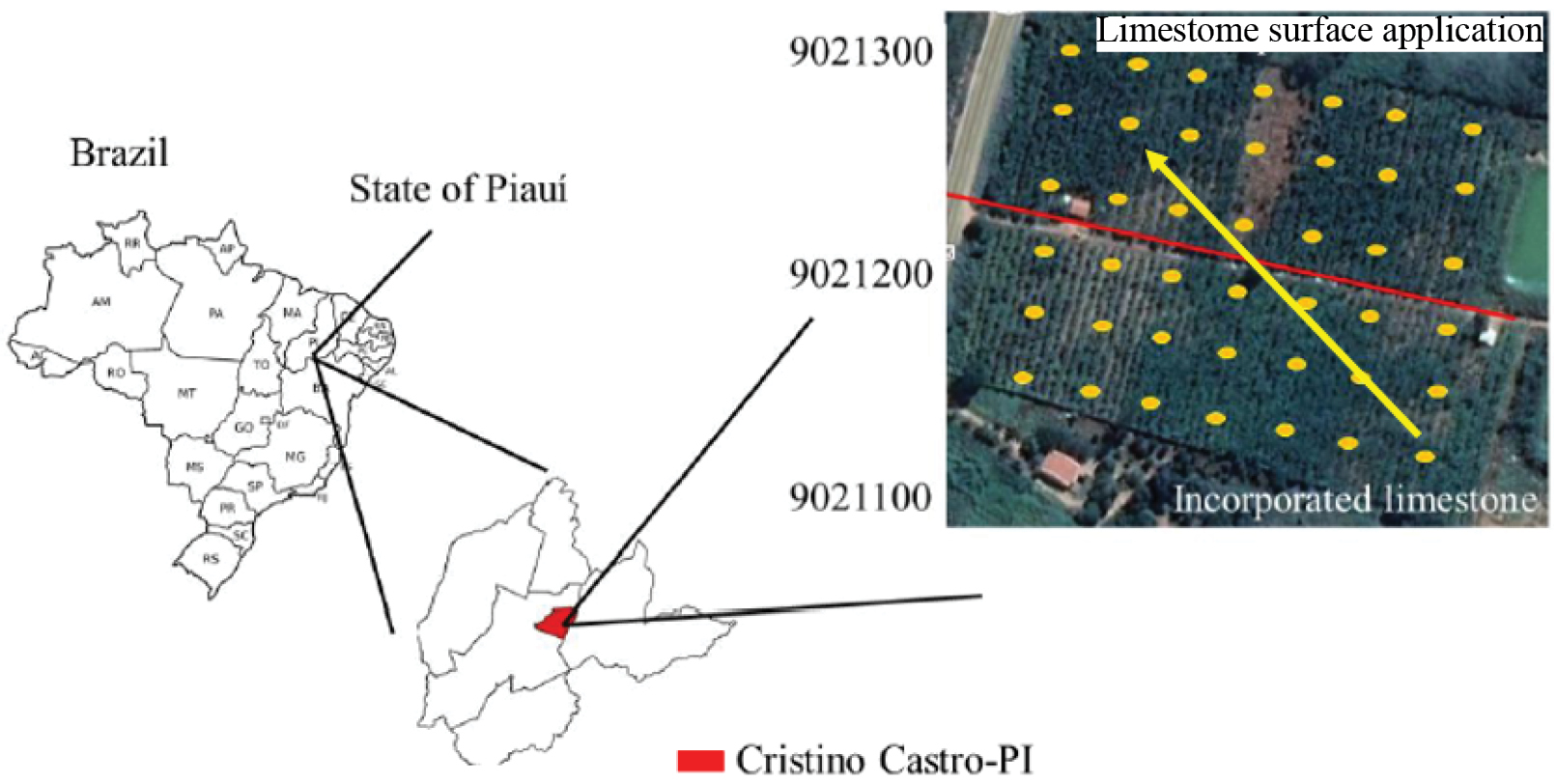 The arrow indicates the direction of the water. Fonte:
  The colors indicate the variation in the values of each nutrient in the area
 The colors indicate the variation in the values of each nutrient in the area