
 Physiological aspects and growth of cashew under salt stress and salicylic acid in pre-flowering phase
ABSTRACT
The use of water with high concentration of salts in cashew cultivation is a necessity in the semi-arid region of Northeast Brazil, due to water scarcity and poor rainfall distribution. Excess salts in water are a limiting factor for agricultural production. In this scenario, strategies have been employed to mitigate the harmful effects of salt stress on plants, and the use of salicylic acid stands out. With this, the aim of this study was to evaluate the effects of foliar application of salicylic acid on the physiology and growth of early dwarf cashew grown under salt stress in the pre-flowering stage. The experiment was conducted in a greenhouse using a randomized block design, in a 5 × 4 factorial arrangement, with five levels of electrical conductivity of irrigation water (ECw - 0.4, 1.2, 2.0, 2.8, and 3.6 dS m-1) and four concentrations of salicylic acid (SA - 0, 1, 2, and 3 mM), with three replicates. Salicylic acid, applied at a concentration of 1 mM, mitigated the negative impacts of salt stress on the morphophysiology of cashew during the pre-flowering phase, especially in plants irrigated with ECw of up to 1.2 dS m-1. On the other hand, the concentration of 3 mM SA exacerbated the effects of salt stress on the relative water content, electrolyte leakage, photosynthetic pigments, gas exchange, and growth of early dwarf cashew, particularly at ECw of 3.6 dS m-1.
Key words:
Anacardium occidentale; salinity; phytohormone
HIGHLIGHTS:
The positive effect of salicylic acid depends on the concentration used and on the electrical conductivity of the water.
Photosynthetic pigments of cashew are the most sensitive variables to salt stress.
The concentration of 3 mM salicylic acid causes electrolyte leakage.
RESUMO
O uso de águas com alta concentração de sais no cultivo do cajueiro se faz necessário na região semiárida do Nordeste brasileiro, devido à escassez hídrica e à má distribuição das chuvas. O excesso de sais na água é um fator limitante para a produção agrícola. Nesse cenário, estratégias têm sido empregadas para mitigar os efeitos nocivos do estresse salino sobre as plantas, destacando-se o uso do ácido salicílico. Com isso, o objetivo deste trabalho foi avaliar os efeitos da aplicação foliar de ácido salicílico sobre os aspectos fisiológicos e crescimento do cajueiro anão precoce cultivado sob estresse salino na fase de pré-floração. O experimento foi conduzido em casa de vegetação utilizando o delineamento em blocos casualizados, em arranjo fatorial 5 × 4, com cinco níveis de condutividade elétrica da água de irrigação (CEa - 0,4; 1,2; 2,0; 2,8 e 3,6 dS m-1) e quatro concentrações de ácido salicílico - AS (0, 1, 2 e 3 mM), com três repetições. O ácido salicílico, aplicado na concentração de 1 mM, atenuou os efeitos do estresse salino na morfofisiologia do cajueiro durante a fase de pré-floração, especialmente em plantas irrigadas com CEa de até 1,2 dS m-1. Por outro lado, a concentração de 3 mM AS elevou os efeitos negativos do estresse salino no teor relativo de água, extravasamento de eletrólitos, pigmentos fotossintéticos, trocas gasosas e crescimento de cajueiro anão precoce, particularmente em CEa de 3,6 dS m-1.
Palavras-chave:
Anacardium occidentale; salinidade; fitormônio
Introduction
Cashew (Anacardium occidentale L. - Anacardiaceae), a plant widely exploited in Brazil, mainly in the Northeast region, plays a fundamental role in the development of this region (Oliveira et al., 2020). Its cultivation is for the production of cashew nuts and the pseudofruit cashew, which are used as raw materials in the pharmaceutical industry and in the processed food industry for the production of sweets, juices, and other derivatives (Lima et al., 2020).
In the Brazilian Northeast, farmers often resort to using brackish water for irrigation as a solution to water shortages; however, the use of saline waters cause osmotic effects, affecting water and nutrient absorption, chlorophyll fluorescence, and gas exchange, besides inhibiting plant growth (Soares et al., 2018; Ramos et al., 2022). However, the intensity of salt effects on plants depends on the species, genotype, development stage, edaphoclimatic conditions, fertilization, and irrigation management. Lima et al. (2020) studied the development of cashew clones in the formation of rootstocks, irrigated with brackish waters (ECw of 0.4 and 3.6 dS m-1) and found harmful effects on morphophysiology even with electrical conductivity of 0.4 dS m-1.
Several techniques are used as strategies to reduce the damage caused by salts in plants. In this case, salicylic acid (SA) stands out. Salicylic acid is a phytohormone naturally synthesized by the plant that plays the role of activating enzymes and acts mainly against oxidative stresses arising from reactive oxygen species (Kumar et al., 2022). Recent studies indicate that SA at concentrations of 1 to 2 mM reduced the effects of salt ions, as observed in passion fruit (Galvão Sobrinho et al., 2023), guava (Lacerda et al., 2022), and soursop plants (Silva et al., 2022).
From this perspective, the objective of the research was to analyze the impacts of the application of salicylic acid on the physiology and growth of early dwarf cashew under irrigation with saline water in the pre-flowering phase.
Material and Methods
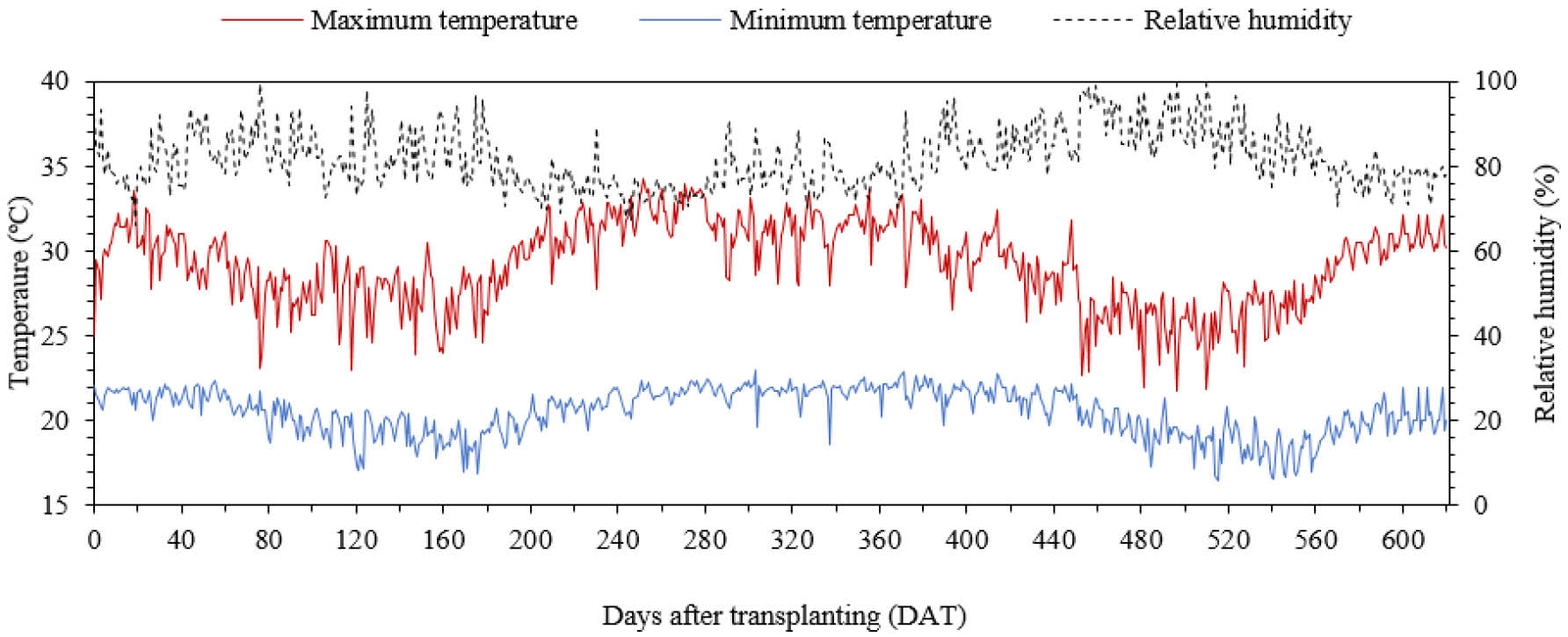
The research was performed from February 2022 to October 2023 in a greenhouse belonging to the Academic Unit of Agricultural Engineering (UAEA) of the Universidade Federal de Campina Grande (UFCG), located in Campina Grande, PB, Brazil (07° 15’ 18” S, 35° 52’ 28” W, with average altitude of 550 m). The values of maximum air temperature, minimum air temperature and average relative humidity of the air inside the greenhouse during the study period are presented in Figure 1.

Maximum and minimum air temperature and relative humidity of the air observed during experimental period (March 12, 2023 to October 3, 2024)
Treatments corresponded to the combination of two factors: five levels of electrical conductivity of irrigation water (ECw - 0.4, 1.2, 2.0, 2.8, and 3.6 dS m-1) and four concentrations of salicylic acid (SA - 0, 1, 2, and 3 mM), in randomized block design, in a 5 × 4 factorial scheme with three replicates. Electrical conductivity levels were based on a study carried out by Lima et al. (2020), with cashew seedlings, while SA concentrations were similar to those used in a study carried out by Silva et al. (2022) with soursop.
The cashew seedlings were obtained from a commercial nursery in the city of Pacajus, CE, grown in polyethylene bags measuring 10 × 20 cm (volume of 0.5 L), and grafted in a full cleft. The clones CCP 76 and BRS 226 Planalto were used as rootstock and scion, respectively, at the age of 150 days after grafting. Water with an ECw of 0.4 dS m-1 was used until 45 days after transplanting (DAT).
Plastic containers with a volume of 250 L were used as drainage lysimeters, with a diameter and length of 55 cm and 90 cm, respectively. The containers were drilled at the base and connected to a 20-mm-diameter transparent drain to allow drainage of excess water. The end of the drain inside the lysimeter was wrapped with a non-woven geotextile (Bidim OP 30) to prevent clogging by soil material. A plastic bottle was placed below each drain to collect drained water, which permitted to estimate water consumption.
The lysimeters were filled with a 0.5-kg layer of crushed stone followed by 260 kg of soil material classified as Neossolo Litólico Hístico (Entisol - United States, 2014), collected at 0-30 cm depth in Riachão do Bacamarte, PB (7° 10′ 8” S and 35° 51′ 20” W at average altitude of 634 m), whose chemical and physical-hydraulic attributes are shown in Table 1 (Teixeira et al., 2017).
The different ECw levels were prepared by dissolving NaCl, CaCl2.2H2O, and MgCl2.6H2O salts, in the equivalent ratio of 7:2:1, between Na:Ca:Mg, respectively, in local-supply water (ECw = 0.39 dS m-1). This saline proportion in water is common in the Brazilian Northeast (Silva Junior et al., 1999). The amount of salts to be added was calculated using the methodology described by Richards (1954).
After preparation, the respective ECw values were checked with a conductivity meter before each irrigation event and, when necessary, due adjustments were performed. Irrigation with brackish water began at 46 days after transplanting (DAT), adopting a two-day irrigation interval.
Prior to transplanting the seedlings to the lysimeters, the volume of water needed to raise the soil moisture to the level corresponding to field capacity was determined. The volume of water to be applied in each irrigation was determined according to the water requirement of the crop.
The salicylic acid solutions were prepared by dissolving in 30% ethanol (95.5%) due to the compound’s low solubility in water at room temperature. To improve the adhesion of the droplets on the leaf surface, the adjuvant Wil fix from the company Charmon Destyl® was added at a concentration of 0.5 mL L-1 of solution.
Foliar applications of SA began at 30 DAT, while subsequent applications were performed at 30-day intervals, using a knapsack sprayer between 05:00 p.m. and 05:45 p.m. A knapsack sprayer with a capacity of 12 L was used, applying on an average 348 mL of the solution per plant in each application.
Fertilization was performed according to Oliveira (2008), using per plant 60 g N, 200 g P2O5, and 40 g K2O per year, divided 24 times with a 15-day interval. The sources of nitrogen, phosphorus, and potassium used were, respectively, calcium nitrate (14% N), monoammonium phosphate (61% P2O5 and 11% N), and potassium sulfate (48% K2O).
On the adaxial and abaxial surfaces of the leaves, a nutrient solution was applied with a knapsack sprayer, every 15 days, at a concentration of 1.0 g L-1, as recommended by the manufacturer, consisting of: Mg (1.1%), Zn (4.2%), B (0.85%), Fe (3.4%), Mn (3.2%), Cu (0.5%) and Mo (0.05%).
At 600 DAT, the relative water content (RWC), electrolyte leakage (%EL), leaf gas exchange, photosynthetic pigments, and growth in plant height (PH), stem diameter below the grafting point (Dbg), at the grafting point (Dgp), and above the grafting point (Dag), and vegetative vigor index (VVI) were evaluated.
Relative water content (RWC) and electrolyte leakage (%EL) were determined using the methods of Weatherley (1950) and Scotti-Campos et al. (2013), respectively.
For gas exchange the equipment used was “LCPro+” from ADC BioScientific Ltd., with photosynthetic photon flux density of 1200 μmol photons m-2 s-1 and air flow of 200 mL min-1, at ambient CO2 level, evaluated on the third leaf, obtaining the following variables: internal CO2 concentration - Ci (μmol CO2 mol-1 air); stomatal conductance - gs (mol H2O m-2 s-1); transpiration - E (mmol H2O m-2 s-1); CO2 assimilation rate - A (μmol CO2 m-2 s-1). Instantaneous water use efficiency - WUE (A/E) [(μmol CO2 /mmol H2O m-2 s-1)-1] and intrinsic carboxylation efficiency - A/Ci (iCE) (μmol CO2 m2 s-1/μmol CO2 mol-1 air) were also quantified.
Chlorophyll a, chlorophyll b, chlorophyll total, and carotenoids were determined by the methodology of Arnon (1949), after collecting a sample of leaf discs of known weight from the third leaf at the apex of the plant. The discs were placed in a glass container with 5 mL of dimethyl sulfoxide (DMSO) solution and placed in a dark environment at room temperature for a period of 48 hours for the extraction of pigments. After this period, a spectrophotometer with quartz cuvettes was used to read chlorophyll and carotenoid concentrations at absorbance wavelengths (ABS) (470, 647, and 663 nm). Photosynthetic pigment data were expressed in μg mL-1, according to Silva et al. (2022).
Plant height was measured by taking as reference the distance from the plant collar to the insertion of the apical meristem. Diameter below the grafting point (Dbg) was measured close to the plant collar (5.0 cm from the soil), diameter at the grafting point (Dgp) was measured at the union point between rootstock and scion, and diameter above the grafting point (Dag) was measured 5.0 cm above the grafting point with a digital caliper.
The data underwent normality test (Shapiro-Wilk test) and homogeneity test (Levene test), followed by principal component analysis (PCA) (Jolliffe & Cadima, 2016). This analysis condensed the relevant information from the original dataset into a smaller set of dimensions. These dimensions were formed through linear combinations of the initial variables, derived from eigenvalues (λ ≥ 1.0) of the correlation matrix, and accounted for more than 10% of the total variance (Govaerts et al., 2007).
Following dimensional reduction, the scores of each principal component were analyzed using multivariate analysis of variance (MANOVA), applying the Hotelling’s (1947) test. This was done to evaluate the electrical conductivity values of the irrigation water, the SA concentrations, and the interaction between these two factors. Only variables with a correlation coefficient of 0.65 or higher were retained for each principal component (PC) (Hair et al., 2009). All statistical analyses were performed using Statistica software v. 7.0 (Statsoft, 2004).
Results and Discussion
Two principal components (PCs) with eigenvalues (λ) greater than 1.0 and variance percentages (s2 %) exceeding 10% were generated from a linear combination of 17 original variables measured in early dwarf cashew plants exposed to varying values of irrigation water electrical conductivity (ECw) and salicylic acid (SA) concentrations. Together, these PCs accounted for 91.65% of the total variance, with PC1 explaining 79.40% and PC2 accounting for 12.25% (Table 2). Multivariate analysis of variance revealed significant effect of the interaction (p ≤ 0.01) between the ECw values and SA concentrations in both principal components (Table 2).
Analysis of the correlations between the variables (Table 3) shows that PC1 was affected by the following variables: relative water content, electrolyte leakage, stomatal conductance, internal CO2 concentration, transpiration, intrinsic carboxylation efficiency, photosynthetic pigments (Chl a, Chl b, Chl t, and Car) and growth variables (PH, Dbg, Dgp, Dag, and VVI), with correlation coefficients greater than 0.85. On the other hand, CO2 assimilation rate and instantaneous water use efficiency showed a significant effect for PC2, with correlation coefficients greater than 0.75. It is also observed that CO2 assimilation rate is negatively associated with WUE, i.e., as the instantaneous water use efficiency decreases, the CO2 assimilation rate is also reduced.
Figures 2A and B show the two-dimensional projections of the effects of the treatments and the variables on the first and second principal components (PC1 and PC2). When analyzing the PC1, it was observed that early dwarf cashew plants cultivated under ECw of 0.4 and 1.2 dS m-1, with application of SA at a concentration of 1 mM (S1C2 and S2C2), stood out from those under the other treatments.

Two-dimensional projection of the principal component scores for the factors electrical conductivity of irrigation water - S and salicylic acid concentrations - C (A) and the analyzed variables (B) in the two principal components (PC1 and PC2)
Plants irrigated with ECw of 0.4 dS m-1 and under foliar application of SA at concentration of 1 mM (S1C2) had the highest values of RWC (83.9%), gs (0.183 mol H2O m-2 s-1), Car (398.4 μg mL-1), PH (1.32 m), Dbg (58.45 mm), Dgp (61.37 mm), Dag (50.74 mm), and VVI (6.15) (Table 4). When comparing plants of the S1C2 treatment with plants subjected to the S1C1 treatment (0.4 dS m-1 and 0 mM), the following increments were observed: 6.7% in RWC, 13.04% (0.021 mol H2O m-2 s-1) in gs, 12.89% (398.4 μg mL-1) in Car, 8.20% (0.1 m) in PH, 11.16% (5.87 mm) in Dbg, 13.21% (7.16 mm) in Dgp, 7.80% (3.67 mm) in Dag, and 11.21% (0.62) in VVI.
The results found in the present study indicate that the plants were negatively affected under salt stress. However, foliar application of SA at concentration of 1 mM attenuated the effects of salt ions up to ECw of 3.6 dS m-1. The beneficial effect of SA can be explained by its ability to reduce sodium (Na+) and chloride (Cl-) ions, in addition to increasing the K+/Na+ ratio and catalyzing the activity of antioxidant enzymes (Hundare et al., 2022). Furthermore, SA, when used appropriately, can become a catalyst for POD, SOD, and CAT, which makes its use viable, especially with regard to reactive oxygen species (Hundare et al., 2022). For these authors, SA applied at a concentration of 0.5 mM increases the levels of photosynthetic pigments.
On the other hand, plants irrigated with ECw of 1.2 dS m-1 and cultivated with SA at concentration of 1 mM (S2C2) obtained the highest values of E (1.66 mmol H2O m-2 s-1), iCE (0.108 [μmol CO2 m-2 s-1/μmol CO2 mol-1 air]), Chl a (1018.2 μg mL-1), Chl b (337.6 μg mL-1), and Chl t (1355.8 μg mL-1), corresponding to increments of 7.10% (0.11 mmol H2O m-2 s-1) in E, 21.35% (0.02 [μmol CO2 m2 s-1/μmol CO2 mol-1 air]) in iCE, 5.0% (48.5 μg mL-1) in Chl a, 12.31% (37 μg mL-1) in Chl b, and 6.76% (85.5 μg mL-1) in Chl t, compared to plants irrigated with ECw of 1.2 dS m-1 and without SA application (S2C1).
In this study, it was observed that SA increased the gas exchange parameters of the cashew, which were related to the climatic data of the study. On the other hand, the increase in temperature and reduction in relative humidity associated (Figure 1) with the increase in ECw levels contributed to the intensification of salt stress, resulting in inhibition of plant growth.
The damage caused by high or low temperatures is related to a decrease in the rate of CO2 assimilation, oxygenation in respiration, impairment of water absorption, damage to the cell membrane in DNA and enzymes, cellular malnutrition, delayed flowering, and greater vulnerability to pests and diseases (Song et al., 2023). Galvão Sobrinho et al. (2023), evaluating the influence of SA concentrations and ECw levels (0.8 to 4.0 dS m-1), observed that SA applied at a concentration of 1.2 mM increased Ci, gs, E, and A in passion fruit by 5.06, 4.24, 4.82, and 4.36%, respectively.
Also in PC 1, it is possible to observe that the application of SA at concentration of 3 mM intensified the effects of salt stress, especially in plants irrigated with ECw of 3.6 dS m-1 (S5C4), which showed the highest values of EL (43.4%) and Ci (230.5 μmol CO2 m-2 s-1) and the lowest values of RWC (59.8%), gs (0.096 mol H2O m-2 s-1), E (1.20 mmol H2O m-2 s-1), iCE (0.029 [μmol CO2 m2 s-1/μmol CO2 mol-1 air]), Chl a (605.8 μg mL-1), Chl b (207.4 μg mL-1), Chl t (813.3 μg mL-1), Car (117.8 μg mL-1), PH (0.92 m), Dbg (34.15 mm), Dgp (36.06 mm), Dag (36.41 mm), and VVI (3.78).
Salicylic acid plays a fundamental role in promoting the synthesis of photosynthetic pigments, such as chlorophyll and carotenoids, which are essential for photosynthesis (Yang et al., 2023). This organic compound not only increases the enzymatic activity involved in pigment production but also enhances the photosynthetic efficiency of plants (Hasanuzzaman et al., 2022). Additionally, salicylic acid helps regulate oxidative stress by balancing the production and elimination of reactive oxygen species, which, at high levels, can cause cellular damage (Batista et al., 2019; Song et al., 2023).
Salt stress increased EL in the leaf blade of early dwarf cashew. Electrolyte leakage is a variable that determines the degree of lesions in leaf tissues, which causes an imbalance in the production of lipids, proteins, and nucleic acids, affecting the maintenance of cell turgor (Soares et al., 2022). However, the electrolyte leakage observed in this study did not cause significant damage to the structure of leaf cell tissue, since lesion in the cell is considered to occur if EL exceeds 50% (Sullivan, 1972). The increment in ECw increased electrolyte leakage in cashew seedlings with additions of 25.25% for the CCP 09 clone and 29.55% for the CCP 76 clone (Sousa et al., 2023).
When analyzing PC2, it was observed that plants under foliar application of SA at concentration of 1 mM had increments in CO2 assimilation rate and instantaneous water use efficiency, especially in cashew plants irrigated with ECw of 1.2 dS m-1 (S2C2), which had the highest values of A (12.69 μmol CO2 m-2 s-1) and WUE (7.66 [(μmol CO2 /mmol H2O m-2 s-1)-1]). On the other hand, foliar application of SA at concentration of 3 mM reduced A and WUE, with the most severe effects on plants irrigated with ECw of 3.6 dS m-1, which showed the lowest values of A (6.64 μmol CO2 m-2 s-1) and WUE (5.55 [(μmol CO2 /mmol H2O m-2 s-1)-1]).
SA plays an important role in cell expansion, causing the plant to grow better when it is under stress. This may be linked to the way SA acts on the plant’s physiology, increasing gas exchange and inducing the synthesis of ABA, causing stomatal closure to reduce leaf transpiration (Emamverdian et al., 2020, Arikan et al., 2023).
The increase in CO2 assimilation rate (A) may be a response to the efficiency of ribulose-1,5-bisphosphate carboxylase-oxygenase (RuBisCO) activity promoted by the beneficial effect of SA on carbon fixation, potentially an indirect effect on the carboxylase activity of RuBisCO (Song et al., 2023). According to Fatima et al. (2018), who investigated gas exchange in cashew seedlings used for rootstock production and irrigated with saline water (0.3 to 3.1 dS m-1), there was a decrease in stomatal conductance, transpiration, internal CO2 concentration, and CO2 assimilation as ECw exceeded 0.3 dS m-1. These findings are consistent with the observations made in the present study.
The reduction in the growth of cashew can be explained by the osmotic effect caused by the salts, which reduces the amount of water available to the plant, triggering a nutritional imbalance that subsequently affects stomatal conductance, reducing transpiration, carbon concentration, and CO2 assimilation rate, which ultimately affects the morphological and growth variables of the plants (Soni et al., 2021, Arikan et al., 2023). Salicylic acid, when applied via spraying, increases plant resistance to biotic and abiotic stresses by reducing water loss (Kim et al., 2022). In addition, it promotes physiological metabolism, which increases plant tolerance to diseases (Moustakas et al., 2023).
Conclusions
-
Salicylic acid, when applied at concentration of 1 mM, reduced the effects caused by salt stress on pigment variables, gas exchange, and growth of cashew plants in the pre-flowering stage, up to conductivity of irrigation water of 1.2 dS m-1.
-
The application of salicylic acid above 3 mM intensified the damage caused by the salinity of the irrigation water.
Acknowledgments
To the National Council for Scientific and Technological Development - CNPq for the research productivity grant to the fourth author (Proc. 309696/2021-6) and to the Graduate Program in Agricultural Engineering of the Federal University of Campina Grande - PPGEA/UFCG.
Literature Cited
-
Arikan, B.; Yildiztugay, E.; Ozfidan-Konakci, C. Responses of salicylic acid encapsulation on growth, photosynthetic attributes and ROS scavenging system in Lactuca sativa exposed to polycyclic aromatic hydrocarbon pollution. Plant Physiology and Biochemistry, v.203, e108026, 2023. https://doi.org/10.1016/j.plaphy.2023.108026
» https://doi.org/10.1016/j.plaphy.2023.108026 -
Arnon, D. I. Copper enzymes in isolated cloroplasts: polyphenoloxidases in Beta vulgaris Plant Physiology, v.24, p.1-15, 1949. https://doi.org/10.1104/pp.24.1.1
» https://doi.org/10.1104/pp.24.1.1 -
Batista, V. C. V.; Pereira, I. M. C.; Paulo-Marinho, S. de O.; Canuto, K. M.; Pereira, R. de C. A.; Rodrigues, T. H. S.; Daloso, D. de M.; Gomes Filho, E.; Carvalho, H. H. de. Salicylic acid modulates primary and volatile metabolites to alleviate salt stress-induced photosynthesis impairment on medicinal plant Egletes viscosa Environmental and Experimental Botany, v.167, e103870, 2019. https://doi.org/10.1016/j.envexpbot.2019.103870
» https://doi.org/10.1016/j.envexpbot.2019.103870 -
Dantas, M. V.; Lima, G. S. de; Gheyi, H. R.; Silva, A. A. R. da; Melo, A. S. de; Medeiros, L. C. de. Gas exchange and photosynthetic pigments of West Indian cherry under salinity stress and salicylic acid. Comunicata Scientiae, v.12, e3664, 2021. https://doi.org/10.14295/cs.v12.3664
» https://doi.org/10.14295/cs.v12.3664 -
Emamverdian, A.; Ding, Y.; Mokhberdoran, F. The role of salicylic acid and gibberellin signaling in plant responses to abiotic stress with an emphasis on heavy metals. Plant Signaling & Behavior, v.15, e1777372, 2020. https://doi.org/10.1080/15592324.2020.1777372
» https://doi.org/10.1080/15592324.2020.1777372 -
Fatima, R. T. de; Nobre, R. G.; Souza, L. de P.; Lima, G. S. de; Gheyi, H. R.; Silva, E. M.; Silva, E. L. da; Oliveira, S. G. de. Morphophysiology of “Crioulo” cashew rootstock seedlings under saline water irrigation and potassium silicate doses. Journal of Experimental Agriculture International, v.23, p.1-11, 2018. https://doi.org/10.9734/JEAI/2018/42289
» https://doi.org/10.9734/JEAI/2018/42289 -
Galvão Sobrinho, T.; Silva, A. A. R. da; Lima, G. S. de; Lima, V. L. A. de; Borges, V. E.; Nunes, K. G.; Soares, L. A. dos A.; Saboya, L. M. F.; Gheyi, H. R.; Gomes, J. P.; Fernandes, P. D.; Azevedo, C. A. V. de. Foliar applications of salicylic acid on boosting salt stress tolerance in sour passion fruit in two cropping cycles. Plants, v.12, e2023, 2023. https://doi.org/10.3390/plants12102023
» https://doi.org/10.3390/plants12102023 -
Govaerts, B.; Sayre, K. D.; Lichter, K.; Dendoover, L.; Decker, J. Influence of permanent raised bed planting and residue management on physical and chemical soil quality in rainfed maize/wheat systems. Plant and Soil, v.291, p.39-54, 2007. https://doi.org/10.1007/s11104-006-9172-6
» https://doi.org/10.1007/s11104-006-9172-6 - Hair, F. J.; Black, C. W.; Badin, B. J.; Anderson, R. E.; Tathan, R. L. Análise multivariada de dados. 6. ed. Tradução Adonai Schlup Sant’Anna. Porto Alegre: Bookman. 2009, 688p.
-
Hasanuzzaman, M.; Ahmed, N.; Saha, T.; Rahman, M.; Rahman, K.; Alam, M. M.; Rohman, M. M.; Nahar, K. Exogenous salicylic acid and kinetin modulate reactive oxygen species metabolism and glyoxalase system to confer waterlogging stress tolerance in soybean (Glycine max L.). Plant Stress, v.3, e100057, 2022. https://doi.org/10.1016/j.stress.2022.100057
» https://doi.org/10.1016/j.stress.2022.100057 - Hotelling, H. Multivariate quality control. In: Eisenhart, C.; Hastay, M. W.; Wallis, W. A. (eds.). Techniques of statistical analysis. New York: John Wiley & Sons. 1947. 73p.
-
Hundare, A.; Joshi, V.; Joshi, N. Salicylic acid attenuates salinity-induced growth inhibition in vitro raised ginger (Zingiber officinale Roscoe) plantlets by regulating ionic balance and antioxidative system. Plant Stress, v.4, e100070, 2022. https://doi.org/10.1016/j.stress.2022.100070
» https://doi.org/10.1016/j.stress.2022.100070 -
Jolliffe, I. T.; Cadima, J. Principal component analysis: a review and recent developments. Philosophical Transactions of the Royal Society A: Mathematical, Physical and Engineering Sciences. v.374, e20150202, 2016. https://doi.org/10.1098/rsta.2015.0202
» https://doi.org/10.1098/rsta.2015.0202 -
Kim, J. H.; Castroverde, C. D. M.; Huang, S.; Li, C.; Hilleary, R.; Seroka, A.; Sohrabi, R.; Medina-Yerena, D.; Huot, B.; Wang, J.; Nomura, K.; Marr, S. K.; Wildermuth, M. C.; Chen, T.; MacMicking, J. D.; He, S. Y. Increasing the resilience of plant immunity to a warming climate. Nature, v.607, p.339-344, 2022. https://doi.org/10.1038/s41586-022-04902-y
» https://doi.org/10.1038/s41586-022-04902-y -
Kumar, S.; Ahanger, M. A.; Alshaya, H.; Jan, B. L.; Yerramilli, V. Salicylic acid mitigates salt induced toxicity through the modifications of biochemical attributes and some key antioxidants in Capsicum annuum Saudi Journal of Biological Sciences, v.29, p.1337-1347, 2022. https://doi.org/10.1016/j.sjbs.2022.01.028
» https://doi.org/10.1016/j.sjbs.2022.01.028 -
Lacerda, C. N.; Lima, G. S. de; Soares, L. A. dos A.; de Fátima, R. T.; Gheyi, H. R.; Azevedo, C. A. V. Morphophysiology and production of guava as a function of water salinity and salicylic acid. Revista Brasileira de Engenharia Agrícola e Ambiental, v.26, p.451-458, 2022. https://doi.org/10.1590/1807-1929/agriambi.v26n6p451-458
» https://doi.org/10.1590/1807-1929/agriambi.v26n6p451-458 -
Lima, G. S. de; Silva, J. B. da; Souza, L. de P.; Nobre, R. G.; Soares, L. A. dos. A.; Gheyi, H. R. Tolerance of precocious dwarf cashew clones to salt stress during rootstock formation stage. Revista Brasileira de Engenharia Agrícola e Ambiental , v.24, p.474-481, 2020. https://doi.org/10.1590/1807-1929/agriambi.v24n7p474-481
» https://doi.org/10.1590/1807-1929/agriambi.v24n7p474-481 -
Moustakas, M.; Sperdouli, I.; Moustaka, J.; Şaş, B.; İşgören, S.; Morales, F. Mechanistic insights on salicylic acid mediated enhancement of photosystem II function in oregano seedlings subjected to moderate drought stress. Plants, v.12, e518, 2023. https://doi.org/10.3390/plants12030518
» https://doi.org/10.3390/plants12030518 -
Oliveira, N. N.; Mothé, C. G.; Mothé, M. G.; Oliveira, L. G. de. Cashew nut and cashew apple: a scientific and technological monitoring worldwide review. Journal of Food Science and Technology, v.57, p.12-21, 2020. https://doi.org/10.1007/s13197-019-04051-7
» https://doi.org/10.1007/s13197-019-04051-7 - Oliveira, V. H. Cultivo do cajueiro Anão Precoce. Fortaleza: Embrapa Agroindústria Tropical, 2008.42p.
-
Ramos, J. G.; Lima, V. L. A. de; Lima, G. S. de; Pereira, M. O.; Silva, A. A. R. da; Nunes, K. G. Growth and quality of passion fruit seedlings under salt stress and foliar application of H2O2 Comunicata Scientiae , v.13, p.1-11, 2022. https://doi.org/10.14295/cs.v13.3393
» https://doi.org/10.14295/cs.v13.3393 -
Richards, L. A. Diagnosis and improvement of saline and alkali soils. Washington: U.S. Department of Agriculture USDA Handbook 60. 1954. 160p. https://doi.org/10.2136/sssaj1954.03615995001800030032x
» https://doi.org/10.2136/sssaj1954.03615995001800030032x -
Scotti-Campos, P.; Pham-Thi, A. T.; Semedo, J. N.; Pais, I. P.; Ramalho, J. C.; Matos, M. C. Physiological responses and membrane integrity in three Vigna genotypes with contrasting drought tolerance. Emirates Journal of Food and Agriculture, v.25, p.1002-1013, 2013. http://dx.doi.org/10.9755/ejfa.v25i12.16733
» http://dx.doi.org/10.9755/ejfa.v25i12.16733 -
Silva, A. A. R. da; Lima, G. S. de; Azevedo, C. A. V. de; Gheyi, H. R.; Soares, L. A. dos A.; Veloso, L. L. de S. A. Salicylic acid improves physiological indicators of soursop irrigated with saline water. Revista Brasileira de Engenharia Agrícola e Ambiental , v.26, p.412-419, 2022. https://doi.org/10.1590/1807-1929/agriambi.v26n6p412-419
» https://doi.org/10.1590/1807-1929/agriambi.v26n6p412-419 -
Silva Junior, L. G. de A.; Gheyi, H. R.; Medeiros, J. F. de. Composição química de águas do cristalino do Nordeste Brasileiro. Revista Brasileira de Engenharia Agrícola e Ambiental , v.3, p.11-17, 1999. https://doi.org/10.1590/1807-1929/agriambi.v3n1p11-17
» https://doi.org/10.1590/1807-1929/agriambi.v3n1p11-17 -
Soares, L. A. dos A.; Fernandes, P. D.; Lima, G. S. de; Suassuna, J. F.; Pereira, R. F. Gas exchanges and production of colored cotton irrigated with saline water at different phenological stages Revista Ciência Agronômica, v.49, p.239-248, 2018. https://doi.org/10.5935/1806-6690.20180027
» https://doi.org/10.5935/1806-6690.20180027 -
Soares, M. D. M.; Dantas, M. V.; Lima, G. S. de; Oliveira, V. K. N.; Soares, L. A. dos A.; Gheyi, H. R. Physiology and yield of ‘Gaúcho’ melon under brackish water and salicylic acid in hydroponic cultivation. Arid Land Research and Management, v.1, p.1-20, 2022. https://doi.org/10.1080/15324982.2022.2087120
» https://doi.org/10.1080/15324982.2022.2087120 -
Song, W.; Shao, H.; Zheng, A.; Zhao, L.; Xu, Y. Advances in roles of salicylic acid in plant tolerance responses to biotic and abiotic stresses. Plants, v.12, 3475, 2023. https://doi.org/10.3390/plants12193475
» https://doi.org/10.3390/plants12193475 -
Soni, S.; Sharawat, N.; Kumar, A.; Kumar, N.; Lata, C.; Mann, A. Effect of saline irrigation on plant water traits, photosynthesis and ionic balance in durum wheat genotypes. Saudi Journal of Biological Sciences , v.2, p.2510-2517, 2021. https://doi.org/10.1016/j.sjbs.2021.01.052
» https://doi.org/10.1016/j.sjbs.2021.01.052 -
Sousa, V. F. de O.; Santos, G.; Maia, J. M.; Maia Júnior, S de O.; João, S. P. de O.; Costa, J. E.; Silva, A. F. da; Dias, T. J.; Ferreira-Silva, S. L.; Taniguchi, C. A. K. Salinity-tolerant dwarf cashew rootstock has better ionic homeostasia and morphophysiological performance of seedlings. Revista Brasileira de Engenharia Agrícola e Ambiental , v.27, p.92-100, 2023. https://doi.org/10.1590/1807-1929/agriambi.v27n2p92-100
» https://doi.org/10.1590/1807-1929/agriambi.v27n2p92-100 - Sullivan, C. Y. Mechanisms of heat and drought resistance in grain sorghum and methods of measurement. In Rao, N. G. P.; House, L. R. (eds.). Sorghum in the seventies. New Delhi: Oxford and IBH Publishing. 1972. p.247-264.
- StatSoft, Inc. Statistica (data analysis software system), version 7. Tulsa, OK: StatSoft; 2004.
- Teixeira, P. C.; Donagemma, G. K.; Fontana, A.; Teixeira, W. G. Manual de métodos de análise de solo. 3.ed. Brasília: Embrapa Solos, 2017. 573p.
-
United States. Soil Survey Staff. Keys to soil taxonomy (12th ed.) USDA NRCS. 2014. Available at: <Available at: https://www.nrcs.usda.gov/wps/portal/nrcs/main/soils/survey/ >. Accessed on: Nov 13, 2020.
» https://www.nrcs.usda.gov/wps/portal/nrcs/main/soils/survey/ -
Weatherley, P. E. Studies in water relations of cotton plant. I. The field measurament of water deficits in leaves. New Phytology, v.49, p.81-97, 1950. https://doi.org/10.1111/j.1469-8137.1950.tb05146.x
» https://doi.org/10.1111/j.1469-8137.1950.tb05146.x -
Yang, H.; Fang, R.; Luo, L.; Yang, W.; Huang, Q.; Yang, C.; Hui, W.; Gong, W.; Wang, J. Uncovering the mechanisms of salicylic acid-mediated abiotic stress tolerance in horticultural crops. Frontiers in Plant Science, v.14, e1226041, 2023. https://doi.org/10.3389/fpls.2023.1226041
» https://doi.org/10.3389/fpls.2023.1226041
Financing statement
There are no supplementary documents.

 Electrical conductivity of irrigation water (ECw) = 0.4 dS m-1 - S1; ECw = 1.2 dS m-1 - S2; ECw = 2.0 dS m-1 - S3; ECw = 2.8 dS m-1 - S4; and, ECw = 3.6 dS m-1 - S5; C1 = 0 mM; C2 = 1 mM; C3 = 2 mM and C4 = 3 mM salicylic acid. For details of variables in Figure B consult