 The patient-centered clinical method: learning in the family medicine residency
ABSTRACT
Introduction: The Patient-Centered Clinical Method (PCCM) emerged amid currents of opposition to a mechanistic view of medicine. Today, it is part of educational curricula in several countries, with positive impacts on medical care, and it’s a central element in the training of Family physicians.
Objective: This study aimed to analyze the perception of graduates of the Family Medicine Residency Program of the Recife Health Department about the factors that influence learning about the PCCM.
Methods: The study is descriptive and qualitative and was conducted through focus groups, with subsequent thematic analysis.
Results and discussion: Six topics were identified in the content of the groups, on which the analysis was structured: Medical graduation; Mental health; Importance of PCCM; Practical teaching; Theoretical teaching and Structuring of the program.
Conclusion: Among the factors that hinder learning, hierarchical medical graduation and weaknesses in the practice scenario of the residency were highlighted. As facilitators, adequate theoretical teaching, the creation of reflective mechanisms on medical practice (such as Balint Groups, reflective journals and self-care spaces), student-centered teaching and initiation to teaching were discussed. The shoulder-to-shoulder preceptorship model and active learning methodologies appear to be beneficial, as long as they are closely monitored and open to identifying difficulties. The discussions fostered in this study should be taken into consideration in the pedagogical planning of Family Medicine residency programs, aiming at the creation of strategies to minimize the difficulties of teaching the patient-centered clinical method.
Keywords:
Internship and Residency; Family Practice; Learning; Patient-Centered Care
RESUMO
Introdução: O método clínico centrado na pessoa (MCCP) surgiu em meio a correntes de oposição a uma visão mecanicista da medicina. Hoje, ele integra currículos educacionais de diversos países, com impactos positivos na assistência médica, sendo um elemento central na formação dos médicos de família e comunidade.
Objetivo: Este estudo teve como objetivo analisar a percepção dos egressos do Programa de Residência em Medicina de Família e Comunidade da Secretaria Municipal de Saúde do Recife sobre os fatores que influenciam a aprendizagem do MCCP.
Método: O estudo é do tipo descritivo e qualitativo, e foi realizado por meio de grupos focais, com posterior análise temática.
Resultado: Identificaram-se seis temas no conteúdo dos grupos, sobre os quais a análise foi estruturada: graduação médica, saúde mental, importância do MCCP, ensino prático, ensino teórico e estruturação do programa.
Conclusão: Entre os fatores que dificultam seu aprendizado, destacaram-se a graduação médica hierarquizada e fragilidades do cenário de prática da residência. Como facilitadores, houve comentários sobre o adequado ensino teórico, a criação de mecanismos reflexivos sobre a prática médica (como grupos Balint, jornais reflexivos e espaços de autocuidado), o ensino centrado no educando e a iniciação à docência. O modelo de preceptoria ombro a ombro e as metodologias ativas de aprendizagem parecem ser benéficos, desde que acompanhados de perto e com abertura para identificação de dificuldades. As discussões fomentadas neste trabalho podem ser levadas em consideração no planejamento pedagógico de programas de residência em MFC, visando à criação de estratégias para minimizar as dificuldades de ensino do MCCP.
Palavras-chave:
Internato e Residência; Medicina de Família e Comunidade; Aprendizagem; Assistência Centrada no Paciente
INTRODUCTION
Historically, the teaching used in medical schools is based on the biomedical model, in which the patient is often seen not as an autonomous subject and strongly involved in their paths of illness and cure, but as a mere object of medical intervention1. Parallel to the advance of this model, currents of opposition to this way of practicing medicine emerged2. In the last decades of the twentieth century, there were changes in medical education, with some interest in expanding the meaning of paradigms in the field of health3. Such a reframing proposes that medicine based on objective sources of evidence also encompasses the patient’s subjectivity in decision-making4.
In line with this critical movement, several counterpoints emerged, such as the proposal of George Engel’s biopsychosocial model, which believed that an adequate response to patient suffering could only be given if the different dimensions of illness were considered and not only the biological one, without discarding the importance of the advances in medical science until then5. In the 1970s, Balint et al. introduced the phrase “patient-centered medicine,” referring to an approach that distanced itself from the biomedical model and sought to understand the patient within a broader context. Aiming to articulate and systematize these concepts, researchers from the University of Western Ontario (Canada) developed a model consisting - after revisions - of four components: exploring health, disease and the experience of disease; understanding the person as a whole; developing a joint plan for managing problems and intensifying the relationship between person and physician6),(7.
This model, called the Person-Centered Clinical Method (PCCM), was proposed as a central element of clinical practice, based on evidence that proves the correlation between the patient-centered approach and the improvement in health outcomes. Although this premise is widely recognized, the literature identifies persistent gaps in medical education regarding the development of the competencies necessary for this approach, resulting in care deficiencies and reduced patient satisfaction7)-(9. Considering the proven relationship between medical education based on the PCCM and the improvement of health indicators, the method has been incorporated into undergraduate curricula in several countries, both for its positive impact on clinical outcomes and for its rationalization of costs7)-(9.
One of the principles of Primary Health Care (PHC) is comprehensiveness, which, among other meanings, seeks to meet people’s needs without reducing them to biological devices or systems10. Thus, it is understood that the training of family and community physicians encompasses an integral view of the human being, aiming to strengthen their own field of practice. In 2014, the “I Workshop for the construction of a Brazilian competency-based curriculum” was held, with the participation of Brazilian and Canadian specialists and resulted in the creation of a competency-based curriculum for the specialty. This document, which aims to guide the structuring of residency programs, cites the person-centered approach as essential for the training process, making clear the importance of this competence for family and community physicians11.
Medical residency is a Lato sensu postgraduate model, having as its main characteristic the training inserted in the fields of practice. The consequences of this teaching-service integration are the extension of the professional’s training and their integration into the workforce of the institutions responsible for the programs. Medical residency then brings theory as an instrument and practice as a guide12. According to Teixeira, learning is “gaining a way of acting”13, which occurs when we are able to act according to what we have learned and assimilated. In this sense, teaching is an active process of those who learn, not only absorbing, but transferring content to processes and intellectual understanding to practice14.
In view of what has been exposed so far, it is understood that the Person-Centered Clinical Method is a central element in the training of family and community doctors. However, there are neuralgic issues to be explored that include aspects of how the method is inserted into the residents’ practice, how they perceive it and the effects of its incorporation into the practice of care. In addition, the content of training in medical residencies, the way residents learn and what they learn are still little discussed15.
Through these issues to be explored and based on the empirical assumption of the experience as a resident of Family and Community Medicine (FCM), a position aligned with the idea that the care process should be centered on the person who is cared for was identified in the Pedagogical Project (PP) of the Residency Program in Family and Community Medicine of the Municipal Health Department of Recife (PRMFC Sesau-Recife). This study was then structured, which aims to analyze the perception of graduates of the Residency Program in Family and Community Medicine of the Municipal Health Department of Recife about the factors that influence the learning of the PCCM.
METHODS
This is a descriptive qualitative study, carried out within the scope of the PRMFC Sesau-Recife, with data collection in 2023. This study was carried out after approval by the Research Ethics Committee of the Pernambuco School of Health, under substantiated Opinion number 6,123,555.
To achieve the objectives of the study, and considering the exploratory phenomenological nature of the research, focus groups of homogeneous compositions were conducted. The selection of the research subjects took into account the assumptions of participant selection in small exploratory qualitative studies that use focus groups as a data collection tool. Based on this premise and to ensure compatibility, “participants should ideally have something to say on the topic and need to feel comfortable saying it to others” (Byrne, 2022)16, Thus, physicians who graduated from the PRMFC Sesau-Recife and who had completed their residency in the years 2021, 2022, or 2023 were included in the study. Professionals who were involved in preceptorship or teaching activities of the residency program were excluded, since this could generate conflicts of interest.
The number of focus groups was anticipated based on the homogeneity of the participants, the exploratory nature of the topic, and the repetitiveness of the findings. In an exploratory study, authors indicated that 1-2 focus groups would be sufficient, or that, in relatively simple research questions with a homogeneous population of interest, a single group could be sufficient16. A total of 3 focus groups were anticipated, and finally only two were conducted due to the repetitiveness achieved in the analysis. The number of participants per focus group followed the recommendation that the size of the group should ensure adequate discussion of the topic. It was estimated that the participants were 6 to 8 people. Recruitment included invitations to a larger number of people, which would make it possible to reach the quantitative. Even with this overestimation, the number of participants on the day of the focus groups was 4 and 5 participants, respectively, which is close to the recommendation of other authors regarding the total number of participants17),(18. To conduct the focus groups, a script was structured that went through stages of refinement, with the help of volunteers with a profile similar to the potential subjects of the research. This stage of refinement of the data collection instrument meets the assumptions to ensure that the exploratory research achieves its objectives with the groups19.
The PRMFC Sesau-Recife was approved by the municipal Medical Residency Commission in May 2013 and started its first class of residents in March 2014. The program was implemented after adhering to the Ministry of Health’s public notice of Pro-Residencies, as part of the expansion project for the training of specialists in strategic areas. The program is part of the health care network in Recife with residents linked to a family health team in the first year and another in the second. The internships carried out at other points of the care network, whether in medium complexity or even in partner hospital services, are complemented by the longitudinal internship so that residents ensure comprehensiveness and coordination of care. The preceptors who perform direct supervision of residents in family health teams are, in their entirety, specialists in Family and Community Medicine through medical residency. The PRMFC Sesau-Recife is one of the three medical residency programs linked to a municipal residency coordination, which includes eleven more programs in a uni- or multiprofessional area. The theoretical and evaluative structuring of the program is based on three axes: communicational, clinical and bases and tools; intertwined to ensure the acquisition of skills in an integral way.
All eligible physicians were invited to participate through a text sent via electronic messaging application. Of the twenty-four people who met the inclusion criteria, five were excluded for involvement in teaching or preceptorship activities in the studied program, three refused to participate and two did not answer the contact. Of the remainder, five were unable to participate due to incompatibility of schedules. The final sample consisted of nine graduates, four women and five men. Among the participants, two completed the FCM residency in 2021, four in 2022 and three in 2023.
Data collection was carried out through two focus groups online, via videoconferencing platform. The groups consisted of different participants, four in the first group and five in the second, as shown in Chart 1.
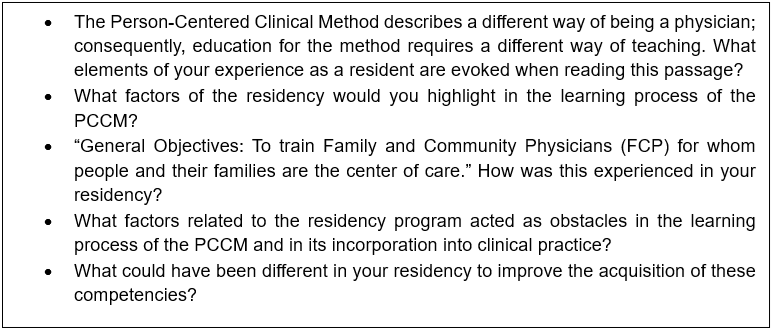
Initially, the researcher made an introduction, in which he explained the objectives of the meeting and how the discussion would be conducted. During the collection, the moderator conducted the study based on a semi-structured script (Figure 1) previously prepared, in order to guide the debate to topics that contemplated the objectives of the research. The topics of the script were read as triggers and, based on them, the free chaining of participants’ ideas was allowed. At the end, the closure was made and possible pending doubts were clarified20. The first group lasted approximately one hour and twenty-five minutes and the second lasted one hour and fifteen minutes.

The focus groups were recorded in audio and video and the speeches were transcribed into text files using the Cockatoo software, resulting in a total of 27 transcription pages for the two groups. With the material generated, an inductive thematic analysis was carried out from a constructionist perspective21),(22. For this purpose, the transcriptions were repeatedly read, allowing the researcher to have direct and intense contact with the material, always having the hypothesis and objectives of the work as reading parameters, and codes being produced from their excerpts23. Subsequently, according to their interrelations, the codes were grouped into topics and categories, from which inferences and interpretations were generated about the subjects discussed22. The material prepared in the thematic analysis was reviewed by a second researcher who did not participate in the conduction of the focus groups.
RESULTS AND DISCUSSION
The analysis process identified six topics, within which the results of this study were structured, resulting in eight categories, as described in Table 1.
Medical graduation: disconnection between future doctors and their patients
In the focus groups, the discussion was initially driven by the reading of the following sentence: “The Person-Centered Clinical Method describes a different way of being a doctor; consequently, education for the method requires a different form of teaching”7, after which the participants were encouraged to evoke experiences from their residencies that were related to the excerpt. Such recalls spontaneously brought with them a comparative character of residency with graduation, with some participants highlighting a hierarchical trait of the teaching experienced by them before entering residency.
I came out of an experience in college in which we brought everything very ready to the patient. So it wasn’t that kind of thing, you wait for the person to bring their involvement and experience with the disease and then you try, together with them, to conduct the case. It was very much a vertical thing from the doctor to the patient. (Participant 1)
In addition to the professional impacts, vertical relationships in the medical course can interfere in the learning process itself, bringing out feelings of insecurity, denial of doubts and uncertainties, fear of making mistakes and feelings of inadequacy or non-belonging24. Among the participants in the focus groups, this perception of inadequacy in their previous training environments was recalled as an element that generated suffering and difficulties.
The teaching of the PCCM in undergraduate medical courses still seems to be incipient. It is perceived that the teaching of the PCCM is treated as secondary to the biomedical knowledge to deal with diseases, indirectly causing the undergraduate students to minimize the need to communicate well, demonstrate empathy and recognize the patients as a whole beyond their pathologies7.
According to the reports of the graduates, the medical course stimulates a hierarchical distance between doctors and patients, mainly because of its hidden curriculum, either because of the way it is learned and how people relate to each other in the course, or because of the lack of appreciation of some topics (such as PCCM), which are on the margins of the curriculum and what is passed on in the classrooms, and it is up to the students themselves or their graduate paths to build or rescue this comprehensive, integral and adjacent view that the physician must have about their patients.
Since graduation is the foundation on which the specialized knowledge of the residency will be built, it can be inferred that the weaknesses of this base will have profound effects on the subsequent construction of new learning. It is necessary that the undergraduate program provide greater space and attention to the PCCM, in view of the magnitude of the transformations it generates in clinical practice, as it is not only a new technique or curricular particularity, but also a redefinition of what it means to be a physician25.
It was possible to note, during the focus groups, that the lack of previous contact with the PCCM when entering the residency can increase the complexity of this teaching process, since the starting point will not be a previous concept of person-centered medicine, but rather a whole baggage of clinical knowledge centered on the disease. Perceiving these weaknesses in the theoretical-practical arsenal of its residents can and should be part of the evaluative attributions of a good FCM residency program, so that strategies can be built to remedy what was neglected in university.
Practical teaching
Considering its educational particularities, it is unequivocal the need, within the context of medical residencies, to discuss the teaching-learning process in the fields of practice, both from the field itself and its structure and organization for good learning, and from the preceptorship, which performs the function of teaching in service. In the focus groups, both topics emerged from the discussions: the role of Basic Health Units in the training of professionals and the relevance of preceptors and their pedagogical skills in achieving educational objectives.
Theoretical-practical articulation: acquisition and application of competencies in the UBS
For the participants in the focus groups, the relationship between practical work in the UBS and learning the PCCM is close. In the content of their statements, it was possible to perceive that they consider the merely theoretical teaching insufficient to absorb the method, and the application in the real-life clinic is an essential component for this construction.
I think it needs this experience of being there on a daily basis using that. If you rely only on theory, only on study, I think it doesn’t work. You need to experience that, because then it ends up becoming a mechanical thing. (Participant 1)
Understanding a context, broadening that view that we have, and this sometimes in the chaotic context [of the UBS] that we are in, does not happen. (Participant 3)
In this sense, they highlighted that some particularities of their practice scenarios in PHC, such as work overload, fragile communication with management, high demand from the population, and adversity in implementing changes, can hinder the person-centered approach by residents. Studies have already suggested that weaknesses in the teaching scenario are among the main obstacles to learning the PCCM in the context of medical residency, including aspects such as overcrowded teams, care pressure, lack of resources, and precarious structure26.
Preceptorship: structuring role in resident learning
In the PRMFC Sesau-Recife, the “shoulder-to-shoulder” preceptorship model is used, in which the preceptor is the team’s reference physician and the resident is inserted in this same team27. In the focus groups, some statements highlighted positive aspects of this preceptorship model, such as greater horizontality in the preceptor-resident relationship, greater security and even greater easiness to work and deepen the issues that arise when developing a form of care based on the PCCM.
Preceptorship, to the extent that it is more horizontal, closer to us, I think it makes it easier for us to be able to deal with these issues of ours that are evoked during our process, and the patient’s issues as well, I think that this preceptorship model specifically facilitates this contact, this... it orchestrates this situation better, you know? (Participant 3)
The resident’s learning must rely on a climate of preceptor-resident cooperation and an adequate degree of independence: not too much to the point that the resident feels helpless, nor scarce, impairing the development of skills28. This delicate balance must always be reevaluated and calibrated, being part of a continuous process of analysis by the preceptor and the supervision of the program, always taking into account the particular educational needs of each resident.
As potentially negative aspects of shoulder-to-shoulder preceptorship, the participants of the focus groups highlighted that the intense relationship between preceptor and resident this model provides can generate difficulties, especially when there is noise in the coexistence. Knowing how to relate is one of the greatest challenges of the preceptor, having the need to see the other, self-evaluate and build bonds of cooperation that favor the personal development of both29. The relational aspects of the preceptorship function must also be constantly reviewed and must be part of the appropriate training of those who will exercise such a position.
But then there is also this part of the challenge. Shoulder-to-shoulder preceptorship is a very intense, daily relationship. And when it doesn’t match, there is no such harmony, it becomes difficult. (Participant 4)
The attributions of a good preceptorship require specific skills that were generally not developed during graduation, in which didactic-pedagogical skills are relegated to a secondary plan. Thus, pedagogical training programs (preceptorship courses and workshops) can represent an apparatus that seeks the difference between satisfactory preceptorship and average or poor preceptorship30. Preceptorship failures were reported in the focus groups of this study, even though they were not the majority. An approach of the coordination to evaluate the progress and quality of the preceptorship was raised as important so that such situations are quickly corrected and the proper support is given to those who need it, seeking to remedy, for example, the didactic deficits that are identified.
Another suggestion that was raised during the focus groups was the establishment of clearer criteria for the selection of preceptors for the program. The lack of financial incentives for the preceptorship of the PRMFC Sesau-Recife and the extra workload were highlighted as issues that hinder this selection, since the position becomes less attractive, which may limit the number of interested parties.
Theoretical teaching: teaching methodologies for the construction of knowledge
At the PRMFC Sesau-Recife, the theoretical bases of the PCCM are worked on in a space called “How I Do It”, aimed at the knowledge of the technical and philosophical bases of FCM. In the program, there is an incentive for the use of active learning methodologies31. The participants of the focus groups differed on this topic. Although many have listed active methodologies as facilitators of learning, some have even disagreed. Although the literature suggests that a more active process, incorporating students’ ideas and aspirations about what they want to learn, is more appropriate for the teaching of PCCM, participants in the present study reported difficulties in dealing with this type of space7.
Something unanimously highlighted as positive in the focus groups was the opening of the residency collective for debates within the spaces of theoretical discussion. Disagreements or additions made in a respectful and constructive manner seem to contribute to the improvement of the arguments and shared knowledge. Another theoretical space carried out by the PRMFC Sesau-Recife in which the PCCM is intensively worked on is the communication laboratory (LabCom), where residents exhibit real consultations that have been recorded with proper authorization, so that other residents and preceptors can evaluate and give feedback on communicational aspects of consultations using the Global Visualization Method32),(33. In the focus groups, the graduates highlighted the potential of LabCom in improving skills and contributing to their training.
PCCM and clinical communication: deconstruction of the medical-centered view
The PCCM, whose second component is “Understanding the person as a whole”7, is a powerful tool for legitimizing the individual’s integrality, as it indicates the need to understand the family context, life cycle, beliefs, customs, health history, among others34. The method seeks to overcome the hierarchical notion that the physician is solely responsible for decision-making, proposing a style of consultation with shared decisions in favor of common objectives35. As already discussed, residents commonly have gaps in undergraduate education in relation to comprehensiveness and come from an extremely hierarchical medical education. Thus, participants reported that intense contact with the PCCM in the residency can be configured as a completely new situation, requiring a change in posture or even in the view on medical practice on the part of the residents. The participants in the focus groups were able to perceive, in addition to the importance of the PCCM, its positive impact on the quality of their consultations, whether in the structuring of care or in the contextualization of cases.
I think that the contact with the PCCM brings a new perspective of dealing with reality, of seeing reality. (Participant 4)
The practical application of the Person-Centered Clinical Method converges to the removal of power centered on the medical figure, seeking the autonomy of the individual and their inclusion as the protagonist of the care process, which, in a way, goes against the biomedical paradigm so rooted in our society25. The understanding by the graduates that the PCCM is not only important, but essential for their professional lives and the benefits that are linked to its use demonstrates that, regardless of whether or not their previous training was deficient in this regard, passing through the PRMFC Sesau-Recife managed to generate a change in their actions in the sense of building a truly person-centered care, which is in line with the program Pedagogical Project.
FCM Anguish: processing of experiences
It is known that there are several ways to get sick and to report the illness. When the Person-Centered Clinical Method is used, it is expected that a space will be opened for these reports to emerge in the most complete way possible, which allows aspects of the emotional field to manifest themselves more easily, reverberating not only in the patient, but also in the professional36. During the focus groups, the participants reported that the more intense contact with human suffering and the expansion of the clinic to a comprehensive look, carried out through the use of the PCCM, act as generators of anguish and exhaustion.
When we come with a thought that is very focused on diseases, pathologies, solving those problems, and then the complexity of people and families kind of destroys that. You run out of ground, you get lost. (Participant 8)
Developing the resident’s self-perception of the factors that may interfere in their performance is important within the PCCM learning process. The calibration of personal awareness, through the discussion of beliefs and attitudes, emotional responses, challenging clinical situations, and self-care can improve their clinical care and increase their satisfaction with work and their relationships7),(37. In the focus groups, the need for institutional spaces focused on sharing experiences and self-perception was mentioned to help residents deal with these anxieties and questions. Among the participants of this study, three space formats were mentioned for this purpose: the story tent, the Balint group and the self-care space.
The story tent is configured as an integrative health practice that starts from the encouragement of autonomy through the encounter of singular narratives. In it, participants are invited to report facts or stories related to life experiences based on triggering objects38. The Balint group, in turn, is a model of group practice in which the doctor-patient relationship and the emotions linked to it are worked on through the report and discussion of real cases39. The self-care space was implemented at PRMFC Sesau-Recife in 2022, at the suggestion of the residents themselves. It is a monthly shift organized by residents for self-care practices, group dynamics of relaxation or reflection and discussion about the progress of the residency. Something highlighted by the participants was the fact that, during their residencies, this type of space did not occur uniformly. During the periods in which there were no spaces for sharing, residents missed these moments.
In addition to the collective moments, more individual tools for reflection and self-knowledge were also suggested during the focus groups, such as individual psychotherapy and the reflective journal. It should be noted that the second is one of the mandatory evaluation methods of the PRMFC Sesau-Recife and is a portfolio of texts written by the resident about the processes experienced in their training, including situations of professional practice, relationship with the team, colleagues and patients31.
Since clinical practice, even more so when centered on the person, is extremely emotionally and cognitively demanding, the reports point to the importance of having, in the context of FCM residencies, the incorporation of tools for reflection on what is experienced and what causes anguish and restlessness. Several studies have shown that “promoting meaning at work increases physician satisfaction and reduces burnout.” Spaces about attention and awareness promote significant improvement in mood, burnout, and attitudes related to person-centered care7. Whether through individual or collective methods, self-managed or mediated, the institutionalization of these spaces seems to be beneficial for the quality of life and the residents’ academic performance.
Structuring of the program
Regarding the structuring of the PRMFC of Sesau-Recife, the participants of the focus groups of the present study commented on resident-centered teaching, the constant reevaluations and reformulations to which the program is subject, and the initiation to teaching within the program, which was later structured in the following categories: “Student-centered residency: the path is made by walking on it” and “Residency: path and purpose”.
Student-centered residency: the path is made by walking on it
In the book “Person-Centered Medicine: Transforming the Clinical Method”7, there is a session dedicated to teaching the Person-Centered Clinical Method. In it, the authors draw a parallel between the PCCM and the most appropriate way to teach it. If the method seeks to center the consultation on the one who needs it, so should its teaching: centered on the one who learns and taking into account the relational aspects between learner and educator. This same parallel emerged spontaneously in the statements of the focus groups, suggesting an alignment of the PRMFC Sesau-Recife with what is recommended in the literature for the teaching of PCCM.
I keep thinking that, in the same way that when we apply the Person-Centered Clinical Method, you are looking for a positive view of the person there in front of you, when we teach or learn this method we also put this view in the student, in the learner, so to speak. And then, at the same time, it brings a theoretical load for us to read and model ourselves from that, but there is an empirical and practical part in which our own experience was never dispensed with, like: “how am I going to ignore the existence of that apprentice and teach them not to do this to the person they are caring for?”. It doesn’t make sense, it would be kind of dissonant. (Participant 8)
The participants of the focus groups highlighted the perception of resident-centered teaching within the PRMFC Sesau-Recife and the view that this is beneficial for the program. One of the factors that contribute to this perception is the proximity and openness of the coordination, allowing a constant evaluation of the pedagogical effectiveness and restructuring of the training spaces according to the understanding of the collective of residents about what works and what should be improved. Another factor mentioned was the alignment of the preceptorship with what the program recommends and the relationship between preceptors and residents, from the division of residents to practical experience. The greater horizontality between these two actors seems to foster a more favorable space for the perception of learning needs and for the development of strategies for their resolution.
Learner-centered teaching seems to make sense when discussing ways to learn the Person-Centered Clinical Method. The actual practice of the method and its teaching must be aligned, so that the process makes sense. The learning of the method, as well as any other knowledge, is gradual and not necessarily linear. A dynamic trajectory that is always open to being modified according to constant evaluations is necessary so that residents can be part of the construction of their own professional training, making it more effective and satisfactory.
Residency: path and purpose
The Residency Program in Family and Community Medicine at Sesau-Recife brings the development of teaching skills by graduates as one of the general objectives of its Pedagogical Project. One of its theoretical spaces, “How I Do It”, has classes planned and executed by residents, under the guidance of predefined preceptors, enabling residents to have contact with pedagogical tools that they can use in the future, either as teachers or as preceptors31.
In addition to the theoretical spaces, it was reported by the participants that the coexistence with interns and even with other residents in the fields of practice is also a favorable moment to exercise teaching skills. The observation of care, the discussion of cases and the exchange of experiences are a rich substrate for working on these skills, with learning through models being the main method observed when residents are teaching40.
CONCLUSION
It is noteworthy that the present study, despite raising important discussions on its topic, has the limitation of a reduced total number of participants, mainly due to the low availability of time for graduates to participate, resulting in focus groups with fewer members than recommended as ideal41. In addition to the aforementioned limitation, it is worth noting that the study focused on self-analysis and internal confrontation of the proposal and can be applied to programs that are based on the same framework of the Person-Centered Clinical Method, with a limited possibility of extrapolation.
At the same time, the discussions produced in the focus groups of this study point to the limits and potentialities of the PCCM within a program that recognizes it as structuring to quality education. Among the findings, the participants have a positive view of the Person-Centered Clinical Method, considering it a central element in the structuring of specialized training in Family and Community Medicine. Furthermore, this positive view also extends to the role of the PCCM in general medical education and good medical performance. This position may indicate an alignment between the Pedagogical Project of the FCM Residency Program at Sesau-Recife (based on person-centered care) and what is experienced in practice by its residents, being incorporated into their professional view and clinical performance. The main obstacles to learning the PCCM refer to factors external to the residency program. Hierarchical medical graduation, little marked by comprehensiveness and which encourages (directly or indirectly) the distancing between doctors and patients, is already a hindrance a priori, as some physicians may arrive at residency with a baggage poor in tools for a person-centered approach.
As for the main practice scenario, it was commented that the UBS with inadequate structure, overloaded professionals, a team resistant to change and a weak communication with the management weaken the theoretical-practical articulation and, consequently, learning. Thus, it is suggested that structural and managerial improvements in the Health Units could contribute to residents’ greater learning. The preceptors who work in this scenario were also highlighted as having a fundamental role. The participants considered that shoulder-to-shoulder preceptorship can facilitate the teaching process, as long as there is adequate training for this and the preceptor-resident relationship is always being evaluated, since there is a much more intense contact in this preceptorship model than in others27. The implementation of a financial incentive for preceptorship was considered as something that can favor the adequate selection of professionals to occupy this role and enable the imposition of greater requirements for the position.
The anxieties that tend to arise during the process of professional and personal development of the residency and, especially, during the maturation of a practice based on the PCCM can make this journey more arduous and even fruitless. To get around this issue, it is essential that the residency program provide critical-reflective and self-knowledge mechanisms, such as the Balint groups, the story tent, self-care spaces and portfolios (reflective writing).
In the focus groups, it was considered that an adequate theoretical basis is important for the development of a person-centered medicine. Active learning methodologies can facilitate this process, but it is necessary to pay special attention to residents who have greater difficulties with such methods, since some are used to more traditional and expository methodologies. The opening for discussions and debates in theoretical spaces and the creation of feedbacks on recorded consultations can also be encouraged to build these theoretical foundations.
The participants expressed the relevance of student-centered teaching for the adequate learning of the PCCM, as already recommended in the literature7. Open communication between residents, preceptors, and coordination allows a continuous process of reassessment and reformulation, generating a more fluid progress that is more easily adapted to the particular educational needs of each resident. The initiation to teaching within the residency program, in addition to being beneficial to the clinical training of residents, stimulates the dissemination of knowledge about the PCCM, facilitating its teaching and incorporation into practice.
We chose to limit the scope of this study to fundamental aspects of the analysis, refraining from including systematic comparisons between different methods or models of comprehensive care - both at the individual and community levels - aiming to maintain the focus on the proposed approach. Such methodological delimitation opens space for future investigations dedicated specifically to comparative analyses between strategies, as well as reflections on the limitations and discrepancies of historical time of the PCCM. New studies with more participants, a deeper focus on each topic analyzed, or a broader debate, with comparisons with other ways of promoting comprehensive care, are suggested for further understanding of the topic. It is considered that the discussions raised in this work should be taken into account in the pedagogical planning of residency programs in FCM, aiming at the creation of strategies to minimize the difficulties of teaching the Person-Centered Clinical Method. It is also considered that the considerations made can be used as generators of reflection in the analysis and restructuring of medical education as a whole, not only in residency.
References
- 1 Almeida MJ de. Gestão da escola médica: crítica e autocrítica. Rev Bras Educ Med. 2008; 32:202-9.
- 2 Ballester D, Zuccolotto SMC, Gannam S de SA, Escobar AMU. A inclusão da perspectiva do paciente na consulta médica: um desafio na formação do médico. Rev Bras Educ Med . 2010;34(4):598-606.
- 3 Rios IC, Sirino CB. A humanização no ensino de graduação em medicina: o olhar dos estudantes. Rev Bras Educ Med . 2015;39(3):401-9.
- 4 Miles A. Moving from a reductive anatomico-pathological medicine to an authentically anthropocentric model of healthcare: current transitions in epidemiology and epistemology and the ongoing development of person-centered clinical practice. Int J Pers Centered Med. 2012;2(4):615-21.
- 5 Borrell-Carrió F, Suchman AL, Epstein RM. The biopsychosocial model 25 years later: principles, practice, and scientific inquiry. Ann Fam Med. 2004;2(6):576-82.
- 6 Yeheskel A, Biderman A, Borkan JM, Herman J. A Course for teaching patient-centered medicine to family medicine residents: Acad Med. 2000;75(5):494-7.
- 7 Stewart M, Brown JB, Weston WW, McWhinney IR, McWilliam CL, Freeman TR. Medicina centrada na pessoa: transformando o método clínico. Porto Alegre: Artmed; 2021.
- 8 Yogui JO dos S, Magalhães TM, Bivanco-Lima D. Ensinando o método clínico centrado na pessoa na graduação em Medicina: uma revisão narrativa. Rev Bras Educ Med . 2024;48(04):e120.
- 9 Barbosa MS, Ribeiro MMF. O método clínico centrado na pessoa na formação médica como ferramenta de promoção de saúde. 26(Supl 8):S216-22.
- 10 Pinheiro R. Integralidade em saúde. In: Pereira IB, Lima JCF. Dicionário da educação profissional em saúde. 2a ed. Rio de Janeiro: Escola Politécnica de Saúde Joaquim Venâncio; 2008. p. 255-62.
- 11 Costa LB, Esteche FF, Augusto Filho RF, Bomfim ALB, Ribeiro MTAM. Competências e atividades profissionais confiáveis: novos paradigmas na elaboração de uma matriz curricular para residência em medicina de família e comunidade. Rev Bras Med Fam Comunidade. 2018;13(40):1-11.
-
12 Lima JC de S. A residência médica: articulações entre a prática e o ensino. 190 f. Tese (Doutorado em Saúde Coletiva) - Instituto de Medicina Social, Universidade do Estado do Rio de Janeiro, Rio de Janeiro, 2008. [acesso em 5 abr 2025]. Disponível em: Disponível em: https://www.bdtd.uerj.br:8443/handle/1/4641
» https://www.bdtd.uerj.br:8443/handle/1/4641 - 13 Teixeira A. Pequena introdução à filosofia da educação: a escola progressiva ou a transformação da escola. 6. ed. Rio de Janeiro: DP&A; 2000. 173p.
- 14 Botti SH de O, Rego S. Processo ensino-aprendizagem na residência médica. Rev Bras Educ Med . 2010;34(01):132-40.
- 15 Botti SH de O. O papel do preceptor na formação de médicos residentes: um estudo de residências em especialidades clínicas de um hospital de ensino. [tese]. Rio de Janeiro: Escola Nacional de Saúde Pública Sergio Arouca; 2009. 104 f.
- 16 Vingilis E, Yildirim-Yenier Z, Vingilis-Jaremko L, Seeley J, Wickens CM, Grushka DH, et al. Young male drivers’ perceptions of and experiences with YouTube videos of risky driving behaviours. Accid Anal Prev. 2018; 120:46-54.
- 17 Trad LAB. Grupos focais: conceitos, procedimentos e reflexões baseadas em experiências com o uso da técnica em pesquisas de saúde. Physis. 2009; 19:777-96.
- 18 Corrêa AM de C, Oliveira G de, Oliveira AC de. O grupo focal na pesquisa qualitativa: princípios e fundamentos. Prisma. 2021;2(1):34-47.
- 19 Crabtree BF, Miller WL, organizers. Doing qualitative research. 2nd ed. Thousand Oaks: Sage; 1999. 424 p.
- 20 Kind L. Notas para o trabalho com a técnica de grupos focais. Psicol Rev. 2004; 10:124-36.
- 21 Souza LK de. Pesquisa com análise qualitativa de dados: conhecendo a análise temática. Arq Bras Psicol. 2019;71(2):51-67.
- 22 Braun V, Clarke V. Using thematic analysis in psychology. Qual Res Psychol. 2006;3(2):77-101.
- 23 Byrne D. A worked example of Braun and Clarke’s approach to reflexive thematic analysis. Qual Quant. 2022;56(3):1391-412.
- 24 Benbassat J. Undesirable features of the medical learning environment: a narrative review of the literature. Adv Health Sci Educ Theory Pract. 2013;18(3):527-36.
- 25 Florentino ED de V. Processo de ensino-aprendizagem do método clínico centrado na pessoa: o olhar dos preceptores de um programa de residência de medicina de família e comunidade. [dissertação]. Recife: Instituto Aggeu Magalhães. 94 f. 2019.
-
26 Paiva MBP. O médico de família e a abordagem centrada na pessoa: desfechos do processo ensino-aprendizagem. Rio de Janeiro: Instituto de Medicina Social, Universidade do Estado do Rio de Janeiro; 2020 [acesso em 5 abr 2025]. Disponível em: Disponível em: https://www.bdtd.uerj.br:8443/handle/1/17381
» https://www.bdtd.uerj.br:8443/handle/1/17381 - 27 Maggioni L, Pessoa BHS, Trindade TGD, Pessoa EDAHG. Modelos de preceptoria de residência em medicina de família e comunidade: um estudo Delphi. Rev Bras Educ Med . 2024;48(1):e005.
- 28 Skare TL. Metodologia do ensino na preceptoria da residência médica. Rev Med Resid. 2012; 14:1-5 [acesso em 5 abr 2025].
-
29 Peixoto LS, Tavares CMDM, Daher DV. A relação interpessoal preceptor-educando sob o olhar de Maurice Tardif: reflexão teórica. Cogitare Enferm. 2014;19(3):612-616 [acesso em 6 abr 2025]. Disponível em: Disponível em: http://revistas.ufpr.br/cogitare/article/view/30468
» http://revistas.ufpr.br/cogitare/article/view/30468 - 30 Ferreira IG, Cazella SC, Costa MR da. Preceptoria médica: concepções e vivências de participantes de curso de formação em preceptoria. Rev Bras Educ Med . 2022;46(04):e162.
- 31 Secretaria de Saúde do Recife. Projeto político-pedagógico do programa de residência em medicina de família e comunidade. Recife: Secretaria de Saúde do Recife; 2022.
- 32 Dias SR de S, Mendonça MOL de, Silva RCF da, Maggioni L. Além das palavras: o papel do Laboratório de Comunicação Clínica na formação em medicina de família e comunidade. Rev Bras Med Fam Comunidade . 2024;19(46):4223-4223.
- 33 Dohms M. Comunicação clínica: aperfeiçoando os encontros em saúde. Porto Alegre: Artmed ; 2021.
- 34 Alcântara CM de, Moraes MAB de. As contribuições do método clínico centrado na pessoa em publicações brasileiras: uma revisão de literatura. Obs Econ Latinoam. 2023;21(8):9941-64.
- 35 Valle IM, Glaser IF, Lima JHC de, Franco CAG dos S, Franco RS, Bisetto A. Adaptação cultural e validação da versão brasileira do questionário autopercepção do desempenho da medicina centrada na pessoa em medicina geral e familiar. Rev Bras Med Fam Comunidade . 2023;18(45):3881-3881.
-
36 Bonet O. Emoções e sofrimentos nas consultas médicas. Implicações de sua irrupção. Teor Cult. 2006;1(1):117-138 [acesso em 6 abr 2025]. Disponível em: Disponível em: https://periodicos.ufjf.br/index.php/TeoriaeCultura/article/view/12134
» https://periodicos.ufjf.br/index.php/TeoriaeCultura/article/view/12134 - 37 Novack DH, Suchman AL, Clark W, Epstein RM, Najberg E, Kaplan C. Calibrating the physician. Personal awareness and effective patient care. Working Group on Promoting Physician Personal Awareness, American Academy on Physician and Patient. JAMA. 1997;278(6):502-9.
- 38 Félix-Silva AV, Nascimento MV, Albuquerque MMR, Cunha M do SG, Gadelha MJA. A tenda do conto como prática integrativa de cuidado na atenção básica. Natal: Edunp; 2014. 78p.
-
39 Fonseca ARGT da. Grupos Balint - um processo de desenvolvimento profissional contínuo na profissão médica [tese]. Évora: Universidade de Évora; 2014 [acesso em 6 abr 2025]. Disponível em: Disponível em: https://dspace.uevora.pt/rdpc/handle/10174/31348
» https://dspace.uevora.pt/rdpc/handle/10174/31348 - 40 Feijó LP, Fakhouri SA, Nunes M do PT, Augusto KL. Residente como professor: uma iniciação à docência. Rev Bras Educ Med . 2019;43(2):225-30.
- 41 Powell RA, Single HM. Focus groups. Int J Qual Health Care. 1996;8(5):499-504.
Research data are only available upon request.

 Source: Prepared by the authors.