
 Review of The grieving brain, by Mary-Frances O’Connor
This review examines the book “The grieving brain: the surprising science of how we learn from love and loss” (2022)1 by Mary-Frances O’Connor, through the lens of medical training and care in contexts of loss. By articulating affective neuroscience, Thanatology, and medical education, it offers a critical reflection on the emotional unpreparedness of health professionals in the face of death, highlighting grief as a formative and ethical experience.
Although universal, death remains an avoided topic in everyday clinical practice. Over the centuries, it has shifted from homes to hospitals, without a corresponding development of the emotional and ethical preparation of health professionals. Medical training-still guided by a curative and technicist logic-contributes to the invisibility of dying within medical curricula. It is in this scenario that reading The grieving brain, by Mary-Frances O’Connor, proves to be particularly powerful.
A neuroscientist and psychologist, O’Connor proposes an innovative understanding of grief considering affective neuroscience. Combining empirical evidence, clinical accounts, and accessible language, the author presents grief as an adaptation of the brain to the lasting absence of someone significant. It is an “incongruence” between what we expect (the presence of the loved one) and the reality of the loss, involving the restructuring of mental and identity maps that once organized life around the other person.
O’Connor’s central thesis is that grief is a form of learning-painful yet essential-that unfolds in the social and affective brain. One of her key illustrative resources is Lois Tonkin’s metaphor2, which proposes that grief does not necessarily shrink over time; rather, it is life that grows around the pain.

The author also revisits the dual model of grief, proposed by Stroebe et al3, which conceptualizes the grieving process as non-linear - an oscillation between two coping modes: loss orientation (focused on emotional pain, longing, and sadness) and restoration orientation (related to reorganizing life and resuming roles). By integrating this view into daily medical practice, it is possible to consider more realistic and compassionate ways of supporting professionals and students in the face of their own losses and the losses they experience in caring for others.

Reading The grieving brain invites reflection on grief in the daily life of medicine. Despite its inevitability, patient death is often silenced or rationalized throughout medical training. Students and residents encounter loss in highly technical environments that overvalue objectivity, frequently without institutional space to process the emotional impact of these experiences. This training gap was evidenced in a national systematic review4) that analyzed the reactions of students and resident physicians to death: most reported feelings of fear, insecurity, sadness, anger, and guilt. This points to institutionalized unpreparedness and the absence of formal disciplines focused on Thanatology and Palliative Care. Of the 1,828 students analyzed in the systematic review, only 13% were prepared to deal with death through disciplines present in their curricula4.
In parallel, recent literature has highlighted the impact of this unpreparedness on professionals’ mental health. Compassion fatigue emerges as a growing threat to the emotional health of those working in end-of-life settings, especially when involved in dysthanasia decisions. An integrative literature review5 identified that professionals who deal directly and recurrently with death are more likely to develop this type of affective exhaustion. Coping strategies, such as team case discussions, spirituality, leisure time, and colleague support, have proven to be fundamental to the mental health of these workers.
O’Connor’s work engages with contemporary proposals for more humane curricula that embrace the emotional dimension of clinical practice. Incorporating discussions about grief into curricula - through narratives, reflective supervision, and values-based education - can help students build coping resources, empathy, and self-care. The concept of “learning from grief,” proposed by the author, can be expanded as moral training: in losing the other, the medical student finds parts of themselves. In this scenario, the myth of Chiron functions as a powerful metaphor for the role of educators and healthcare professionals in the face of suffering6. Chiron, a wise centaur and ally of humans, mentored Asclepius and imparted teachings on medicine, music, and ethics. After being struck by an incurable arrow, he was forced to live with constant pain that even his vast knowledge could not alleviate. This ambiguous experience - of being a healer who also suffers - made him more empathetic and able to embrace the pain of others. The experience of pain, both personal and that of others, can thus be understood as a formative path towards ethics and compassion. The oscillation proposed by the dual model of grief finds a new symbol here: the cycle between vulnerability and wisdom that marks authentic care.
The grieving brain is essential reading for healthcare professionals, educators, and students, as it offers a deep and sensitive understanding of grief as a human and neurobiological experience. By combining science and narrative, O’Connor shows that the pain of loss is not weakness, but evidence of the bond that constitutes us. At a time when medical education still fails to care for its caregivers, this book is a call for listening, recognition, and compassion - not only towards patients, but also towards physicians in training.
Keywords: Grief; Medical Education; Thanatology; Moral Formation; Palliative Care.
References
- 1 O’Connor M.-F. O cérebro de luto: como a mente nos faz aprender com a dor e a perda. Tradução de Clóvis Marques. São Paulo: Fontanar; 2022.
- 2 Tonkin L. Growing around grief - another way of looking at grief and recovery. Bereavement Care. 1996;15(1):10.
- 3 Stroebe M, Schut H. The dual process model of coping with bereavement: rationale and description. Death Stud. 1999;23(3):197-224.
- 4 Santos TF, Pintarelli VL. Sentimentos dos estudantes de Medicina e médicos residentes ante a morte: uma revisão sistemática. Rev Bras Educ Med. 2020;44(4):e20200082.
- 5 Souza JV, Vieira JB, Santana LL, Ferreira JN, Silva ACD. Fadiga por compaixão e estratégias de enfrentamento diante da finitude: revisão integrativa. Rev Bioét. 2023;31:e2023271.
- 6 Silva GSN, Ayres JRCM. O encontro com a morte: à procura do mestre Quíron na formação médica. Rev Bras Educ Med. 2010;34(4):487-96.
Research data are available in the body of the document.

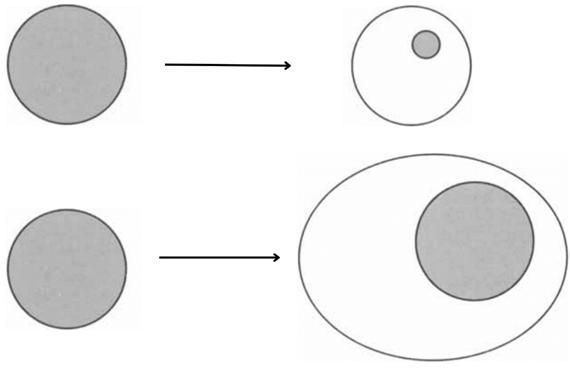 Source: Adapted from Tonkin
 Source: Reproduced from O’Connor