 A rare new Darwin wasp Labena (Ichneumonidae: Labeninae) from Chile, with two new species-groups and an updated key to Chilean species
ABSTRACT
The genus Labena Cresson is composed of parasitoid wasps that attack wood-boring Coleoptera. In Chile, two species have been recorded, and neither fits into any known Neotropical species-group. We propose two new species-groups: the canelensis group, to include L. canelensis Porter, and the pucon group, to include L. pucon Porter and the newly described L. barrigai sp. nov. In addition, a taxonomic key for all Chilean species is provided.
Keywords:
Biodiversity; Labeninae; Parasitoid wasp; Taxonomy
1 Introduction
Labena Cresson, 1864, is a moderately large genus of Ichneumonidae (Darwin wasps) that occurs in the Australasian, Nearctic, and Neotropical regions (Gauld et al., 2000; Santos et al., 2022). It comprises 49 species (González-Moreno et al., 2015; Marinho and Fernandes, 2025; Zuñiga and Hanson, 2025). In Chile, two species have been previously reported, L. canelensis Porter, 2005, and L. pucon Porter, 2005 (Porter, 2005). Porter (2005) mentioned that these Chilean species did not show affinity to Neotropical or Australian clades and that they were so different from other species that they could well be placed in a separate genus. However, a recent phylogenetic analysis showed that these two species clustered within Labena and formed a sister group to a clade of Australian species (Santos et al., 2022).
Labena species are ectoparasitoids of the immature stages of wood-boring Coleoptera belonging to the families Buprestidae, Cerambycidae, and Curculionidae (Gauld et al., 2000; Yu et al., 2016). Most of the host records belong to the North American species L. grallator (Say, 1835) (Gauld et al., 2000). In the Neotropical region, host records are known only for two unidentified species from Chile, which were reared from Hephaestion lariosi Bosq, 1951 (Cerambycidae) and the buprestids Pygicera scripta (Laporte & Gory, 1837) and Lasionota conjuncta Chevrolat, 1838 (Barriga, 1990).
As noted by Porter (2005), the two Chilean species of Labena are morphologically distinct and do not fit within any of the species-groups proposed by Gauld et al. (2000) for the Costa Rican fauna. This apparent taxonomic singularity is consistent with broader patterns observed in the Chilean ichneumonid fauna, which is remarkably diverse yet remains incompletely documented and undersampled (Pádua et al., 2024; Araujo et al., 2025). The first comprehensive checklist of Chilean Ichneumonidae recorded 306 species in 141 genera and 23 subfamilies, of which approximately 68% are considered endemic to Chile, highlighting the uniqueness of this fauna (Araujo et al., 2025). However, that study also emphasized that many genera remain poorly known, suggesting that current diversity estimates are conservative and likely to increase with further taxonomic research. In the same vein, a recent biogeographic analysis revealed substantial knowledge gaps in the distribution of Chilean Darwin wasps and reinforced the need for continued sampling to uncover this “hidden biodiversity” (Pádua et al., 2024).
In this context, the discovery of a rare Labena species and the re-evaluation of Chilean congeners represent important steps toward refining the taxonomy and biogeographic understanding of Ichneumonidae in southern South America. As such, in this paper, we propose two species-groups for the Chilean species and describe a new species. In addition, a taxonomic key for Chilean Labena is presented.
2. Material and methods
This work is based on specimens housed in the following institutions (curators in parentheses):
-
LEGA-UCM: Laboratorio de Entomología General y Aplicada, Universidad Católica del Maule, Chile (Rodrigo Araujo);
-
MNNC: Museo Nacional de Historia Natural, Chile (Mario Elgueta);
-
MUSM: Natural History Museum of the Universidad Nacional Mayor de San Marcos, Lima, Peru (Mabel Alvarado).
Type material of the previously described Chilean species was not examined, as the original descriptions are sufficient (Porter, 2005).
Specimens were examined at two institutions. At MUSM, examinations were conducted with a Nikon SMZ800N stereomicroscope, and measurements were taken using an ocular micrometer (millimeter-scale eyepiece). Multi-focus photomicrographs were taken using a Zeiss Stereo Discovery V20 equipped with a microscope camera and stacked using Zerene Stacker. At LEGA/UCM, specimens were examined under a Leica S9i stereomicroscope equipped with an integrated 10 MP camera. Morphometric measurements were obtained using a WF 10×/22 focusing eyepiece fitted with a 10 mm/100-division reticle, previously calibrated with a precision scale. Digital images were acquired using Leica Application Suite X (version 3.7.6.25997) in combination with a scalable and modular LED illumination dome following Kawada and Buffington (2016). Image stacks were subsequently processed using Helicon Focus Pro version 5.3.
The morphological terminology and style of descriptions follow those of Gauld et al. (1997). In this study, the measures and proportions between the structures are given as the value of the holotype [in brackets], followed by the minimum and maximum number of variations. The sections “Type material” and “Examined material” include the details provided on the label. The specimen labels are transcribed verbatim.
3. Results
3.1 Labena Cresson, 1864
-
Labena Cresson, 1864: 399. Type-species: Cryptus grallator Say, by subsequent designation (Viereck, 1914: 80)
-
Caryecus Walsh, 1866: 30. Type-species: Mesochorus fuscipennis Brullé (=grallator Say), by monotypy
-
Dyseidopues Kriechbaumer, 1889: 307. Type-species: Microtritus apicalis Kriechbaumer, by monotypy
-
Dysidopus Schulz, 1906: 103. [Unjustifiable emendation of Dyseidopues Kriechbaumer]
-
Neonotus Parrott, 1955: 230. Type-species: Neonotus chadwickii Parrott, by original designation
-
Diagnosis. Clypeus generally with a weak transverse ridge below clypeofacial suture; last flagellomere of female apically flattened; notauli faintly traceable toward base of mesoscutum; fore wing with areolet large, about 1.7× as wide as high, second recurrent vein with 2 bullae; apex of fore tibia with a strongly projecting spine or thorn on its outer margin; fore tarsus of female with third segment elongated and produced below into a lobe that overlaps the fourth and fifth segments; mid tibia of female generally strongly inflated and twisted; metasoma inserted high up on apical face of propodeum, well above insertion of hind coxae; ovipositor often as long as or longer than metasoma (Gauld et al., 2000; Porter, 2005).
3.2 Key to the Labena species occurring in Chile
-
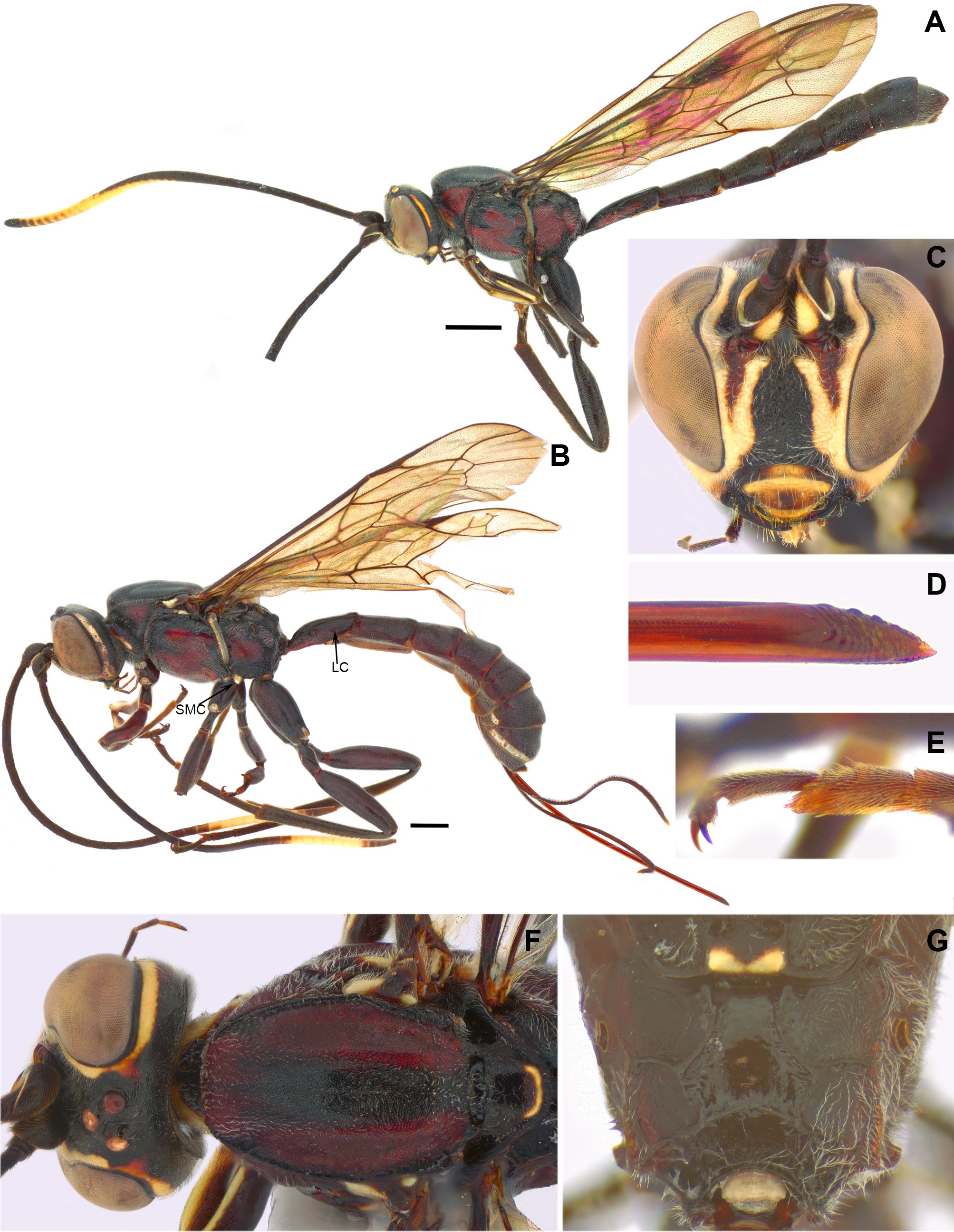
Occipital carina complete throughout (Fig. 1F); metasomal tergite I with lateral carina present between spiracle and distal end of tergite (Fig. 1B); submetapleural carina on its basal 0.5 strongly produced ventrad into a very large triangular tooth which overlies base of mid coxa (Fig. 1B); male with greatly inflated M&RS vein ................................................................................................................................... L. canelensis Porter
 Figure 1
Labena canelensis Porter, 2005, non-type specimens. A) Male habitus. (B–G) Female: B) habitus; C) face, frontal view; D) ovipositor apex, lateral view; E) fore tarsus, lateral view; F) head, dorsal view, and mesoscutum; G) propodeum. Scale bar: 1.0 mm. SMC = submetapleural carina; LC = lateral carina.
-
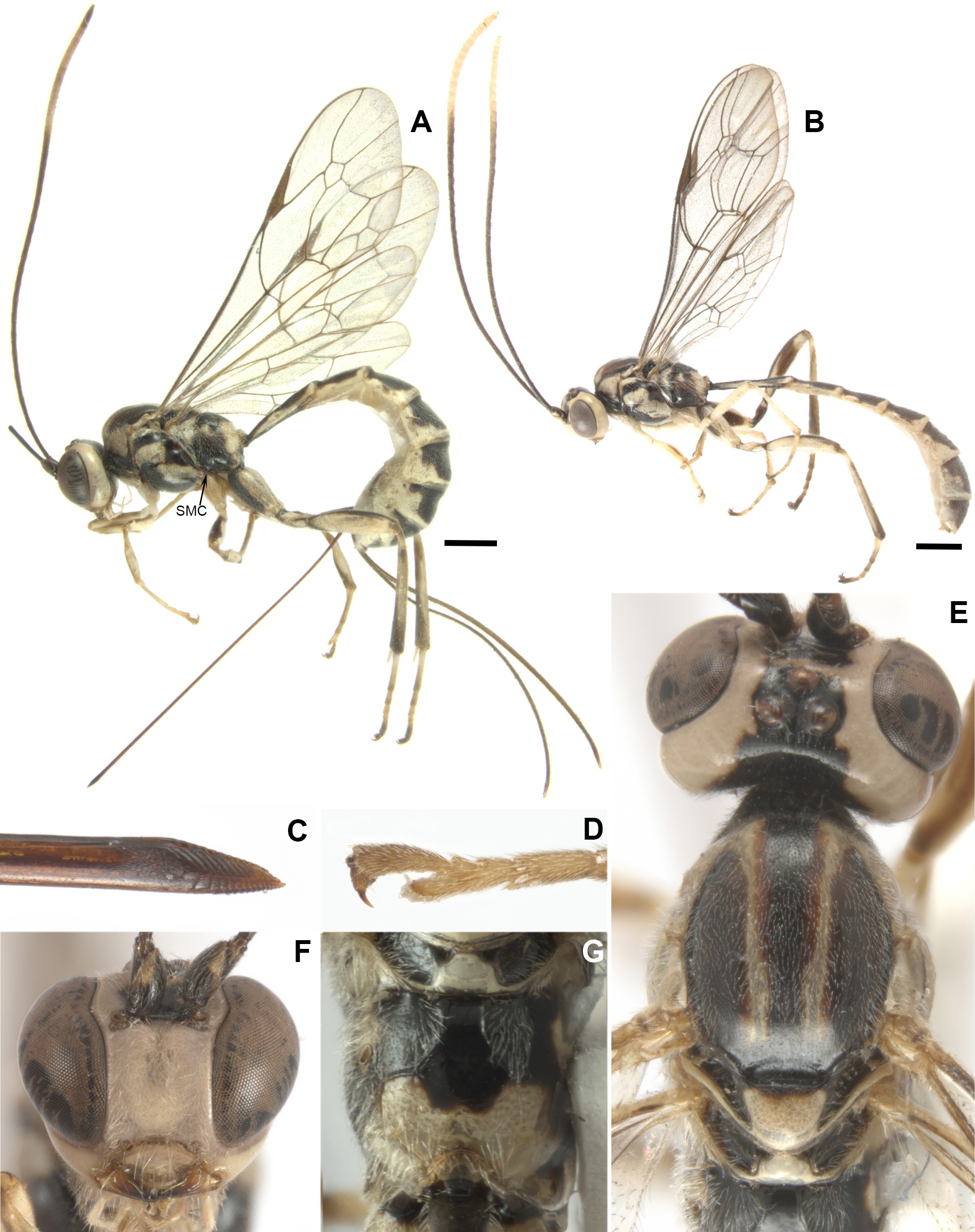
- Occipital carina absent (Figs 2E, 3E); metasomal tergite I without lateral carina between spiracle and distal end of tergite (Fig. 3A); submetapleural carina strong throughout, a little elevated toward base but not triangularly produced (Fig. 3A); male without an inflated M&RS vein ……………………………………. 2
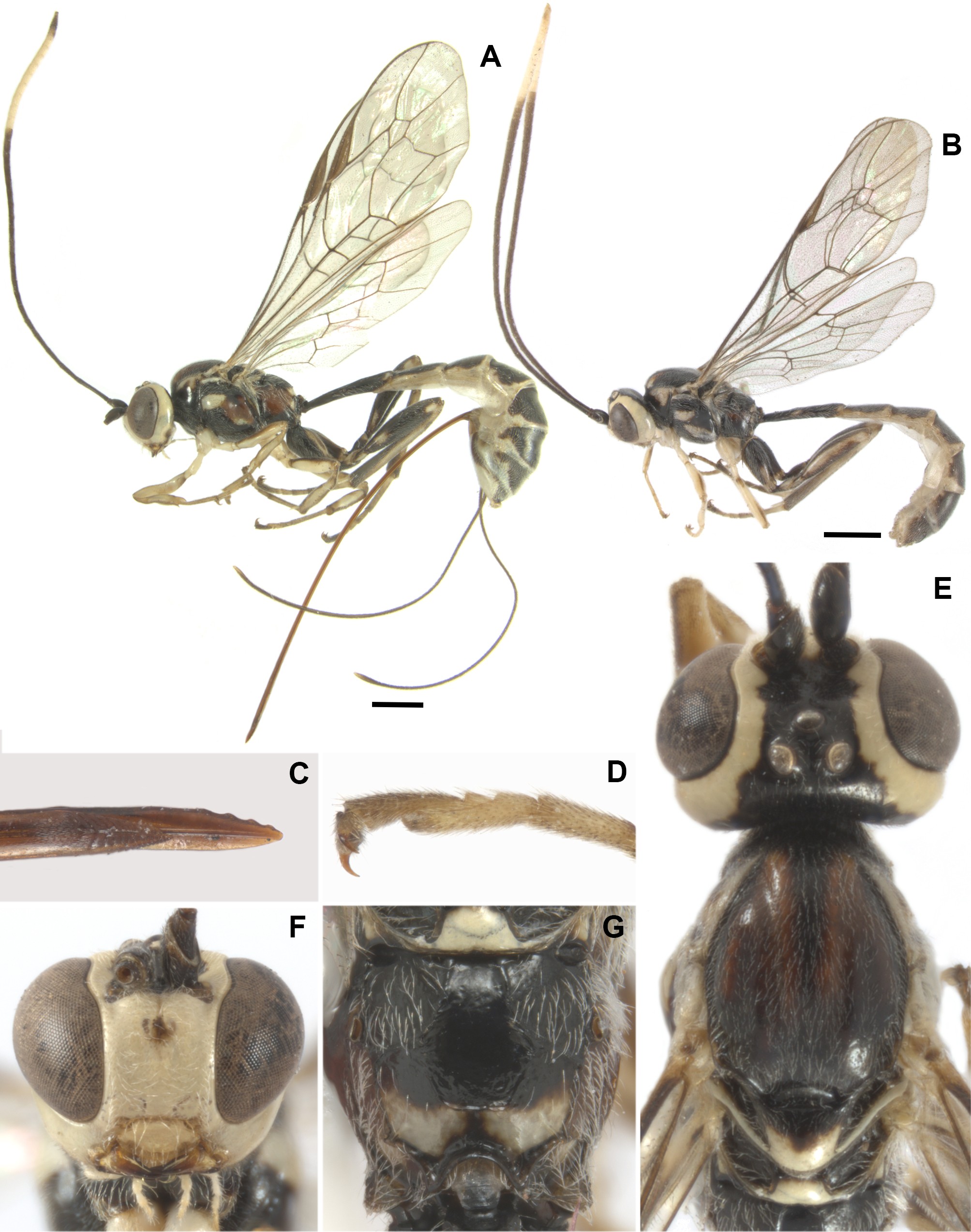
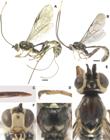 Figure 2
Labena barrigai Alvarado, sp. nov.: A) habitus of female (holotype); B) habitus of male (paratype); C) apex of ovipositor, lateral view, with upper valve exposed; D) fore tarsus, in lateral view; E) head, dorsal view, and mesoscutum; F) face, frontal view; G) propodeum. Scale bar: 1.0 mm.
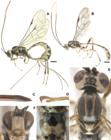 Figure 3
Labena pucon Porter, 2005, non-type specimens: A) habitus of female; B) habitus of male; C) apex of ovipositor, lateral view; D) fore tarsus, in lateral view; E) head, dorsal view, and mesoscutum; F) face, frontal view; G) propodeum. Scale bar: 1.0 mm. SMC = submetapleural carina; LC = lateral carina.
-
-
Metasomal tergite II 1.4× as long as posteriorly wide; frons in front of median ocellus black (Fig. 2E); first metasomal tergite only with an apical white band, medially interrupted (Fig. 2A) …..… L. barrigai sp. nov.
3.3 The Labena canelensis species-group
This species-group is characterized by having the male last flagellomere apically cylindrical; occipital carina complete throughout; the pronotum with a velvet-like area of dense, fine pubescence; propodeum with area basalis and superomedia confluent, pleural carina complete, posterior transverse carina complete; fore tarsus of female with third tarsomere ventrally elongated, this elongation (without bristles) reaching the basal quarter of fifth tarsomere; fore tarsus of male with fifth tarsomere ventrally unspecialized; fore and mid tibia of the female inflated; outer surface of mid tibia with about thirteen conspicuous, dark, spine-like bristles; M&RS vein thickened in the lower part, conspicuously thicker in males; metasomal tergite I with lateral carina between spiracle and distal end of tergite; apex of the ovipositor compressed with fine file-like teeth. It comprises a single species, L. canelensis Porter, 2005.
3.4 Labena canelensis Porter, 2005 Fig. 1
-
Comments. Besides the features mentioned in the key, it is characterized by having the fore wing with areolet transverse, 0.4× as broad as the length of distal abscissa of M, 3rs-m 0.8× as long as 2rs-m; metasoma with tergite I slender, 2.3–3.0× as long as posteriorly broad, sternite I unusually long, reaching about 0.3–0.5 of length of tergite; tergite II 1.2× as long as broad, with isolated pale hairs; ovipositor projecting beyond apex of metasoma by 1.9× the length of the hind tibia, the apex strongly compressed laterally, with fine file-like teeth.
-
Examined material: 1♀ “CHILE, prov. Mellipila, Pichi-Alhué, 8–28.XI.1998, Malaise trap, leg. G. Barriga” (LEGA-UCM); 1♂ “CHILE, prov. Cauquenes, 20 km W Cauquenes; 1 Oct 2003, s/ ruil-gualo (Nothofagus alessandrii, N. glauca), leg. J. R. Barriga-Tuñón” (LEGA-UCM).
-
Biological note. Host unknown.
3.5 The Labena pucon species-group
This species-group is characterized by having the male last flagellomere apically cylindrical; occipital carina absent; the pronotum with a velvet-like area of dense, fine pubescence; propodeum with area basalis and superomedia confluent, pleural carina complete, posterior transverse carina faint but discernible at the middle; fore tarsus of female with third tarsomere ventrally elongated, this elongation reaching the middle of fifth tarsomere; fore tarsus of male with fifth tarsomere ventrally unspecialized; fore and mid tibia of the female inflated; outer surface of mid tibia with five to seven conspicuous, dark, spine-like bristles; male with M&RS vein not thickened in the lower part; metasomal tergite I without lateral carina between spiracle and distal end of tergite; apex of the ovipositor compressed with fine file-like teeth. It comprises two species in Chile, L. pucon Porter and L. barrigai sp. nov.
3.6 Labena barrigai Alvarado, sp. nov. urn:lsid:zoobank.org:act:403977E2-06D-44C7-9091-FF0B591B7022 Fig. 2
-
Diagnosis. This new species can be distinguished from Labena pucon by having the propleuron black, in some individuals with a distal margin white (vs. white except black near base); propodeum (Fig. 2G) black but posterior part to posterior transverse carina white (vs. white over areae dentipara, petiolaris, and postero-externa (Fig. 3G)); female with mesoscutum (Fig. 2E) reddish black (vs. black with reddish tinges and with a pair of broad longitudinal white stripes which follow the notauli (Fig. 3E)); and metasomal tergite I (Figs 2A-B) laterally black (vs. laterally white (Figs 3A-(B)).
-
Description. Female. Fore wing [7.4] 7.3–8.2 mm.
-
Head. Mandible weakly tapered toward distal end; clypeus, in anterior view, basal most area flat, remaining concave, with apical margin convex; clypeofacial suture with scattered long setae; malar space [0.6]× as long as basal mandibular width; posterior ocellus separated from eye by [1.2]× its own maximum diameter; head in dorsal view with gena stout, rounded; occipital carina absent; antenna with [31] 31–32 flagellomeres. Mesosoma. Upper hind part of pronotum weakly swollen; mesoscutum with fine setiferous punctures, with notauli impressed, reaching to level of centre of tegula, without any trace of a transverse crest at anterior end; scutellum weakly convex, with weak lateral carina; mesopleuron with fine setiferous punctures and smooth and polished centrally, with upper end of epicnemial carina reaching to about level of lower [0.25] of hind margin of pronotum. Metapleuron weakly convex, smooth with fine setiferous punctures, without an impression above the submetapleural carina. Propodeum in profile evenly declivous; pleural carina complete, lateromedian longitudinal carina absent behind posterior transverse carina, posterior transverse carina incomplete between longitudinal carinae; areae dentipara, postero-externa, and petiolaris confluent; areae basalis and superomedia confluent. Mid leg with about five fine bristles on the tibia. Hind coxa about [2.3]× as long as deep, with only a very short impression anteriorly. Fore wing with areolet transverse, 0.4× as broad as the length of the distal abscissa of M, 3rs-m 0.9× as long as 2rs-m. Metasoma. Tergite I slender, [3.5] 3.5–3.6× as long as posteriorly broad, sternite I unusually long, reaching about 0.7 of the length of tergite; tergite II 1.4× as long as broad, with isolated pale hairs. Ovipositor projecting beyond apex of metasoma by [3.2] 2.9–3.5× the length of the hind tibia, the apex strongly compressed laterally, with fine file-like teeth.
-
Coloration. Head predominantly white, but antennae black with white band on flagellomeres [19–29] 19–31 and last two flagellomeres brown; scape ventroapically off-white; face centrally with or without dot and mandible towards middle brown, frons centrally, vertex centrally, and occiput black. Mesosoma predominantly black but dorso-posterior corner of pronotum, one paratype with distal margin of propleuron, tegula, subalar prominence, two spots on mesopleuron, distal half of scutellum, metanotum, propodeum after posterior transverse carina white; a large spot on mesopleuron, mesoscutum anterolaterally, dorsal half of metapleuron and area lateralis and area spiracularis reddish brown; fore and mid legs white but trochantellus dorsally and ventrally, tibia dorsally and ventrally, femur dorsally and ventrally and tarsomeres light brown; hind leg black but coxa with a macula dorsally, trochanter dorsally, trochantellus ventrally, femur with four maculae, tibia dorsobasally white, tarsomeres brown. Metasoma black, but distal margin of tergite I (interrupted at middle), laterodistal margins of tergites II–VIII, laterotergites II–VII white; ovipositor sheath dark brown with distal apex white.
-
Male. Similar to female, but with fore wing length 6.3 mm. Hind leg with tarsomeres unspecialized, cylindrical; hind coxa about 2.5× as long as deep. Metasoma with tergite I slender, 4.5× as long as posteriorly broad, sternite I short, reaching about 0.8 of the length of tergite; tergite II 1.9× as long as broad, with isolated pale hairs; hind margins of tergites III–V transverse. Clasper apically rounded, densely pubescent. Color similar to female, but with brown maculae smaller, white maculae on mesopleuron larger and with or without red marks; mesoscutum with a white mark at the level of notaulus.
-
Etymology. The specific epithet barrigai is a patronym honoring Juan Enrique Barriga Tuñón, the collector of the species.
-
Type material. Holotype. 1♀ “CHILE, prov. Curicó, 15 km E Potrero Grande, Puente Morongos, 35º12.9'S 70º58.6'W, 4 nov 2003, leg J. E. Barriga-Tuñón” (MNNC); Paratypes, 2♀♀, 1♂ “CHILE, prov. Valdivia, Puente Curiñanco. 39º42.788’S 73º24.323W 117m., 9.I.2007, fogging s/Aextoxicon punctatum. Leg J.E. Barriga-Tuñón” (MNNC).
-
Biological note. Host unknown. Most of the specimens used to describe Labena barrigai sp. nov. were collected using fogging on the tree Aextoxicon punctatum Ruiz et Pav. (Aextoxicaceae).
3.7 Labena pucon Porter, 2005 Fig. 3
-
Comments. Besides the features mentioned in the key and diagnosis of Labena barrigai sp. nov., L. pucon is also characterized by having the fore wing with areolet transverse, 0.4× as broad as the length of distal abscissa of M, 3rs-m 0.9× as long as 2rs-m; metasoma with tergite I slender, 3.0× as long as posteriorly broad, sternite I unusually long, reaching about 0.7 of length of tergite; tergite II 1.2× as long as broad, with isolated pale hairs; ovipositor projecting beyond apex of metasoma by 3.0× the length of the hind tibia, the apex strongly compressed laterally, with fine file-like teeth. The specimens examined differ from the original species description in the length of tergite I, 3.0× as long as posteriorly broad, not 4.0×.
-
Examined material: 1♀ “CHILE, prov. Curicó, 15 km E Curicó Zapallar, Cerro Hueca-Huecan. 35º3.97’S 71º7.45W, 12-23.XII.1997, Malaise trap. Leg J.E. Barriga-Tuñón” (LEGA-UCM); 1♂ “CHILE, prov. Valdivia, Estancilla, Camino a Niebla, 39º51’S 73º21’W, 15 de enero 2007, fogging s/Nothof. dombeyi, Myrceugenia sp. leg. J.E. Barriga-Tuñón” (LEGA-UCM).
-
Biological note. Host unknown.
4. Discussion
With the description of Labena barrigai sp. nov., the Chilean fauna of Labena now comprises three species, all apparently endemic and restricted to southern South American temperate forest ecosystems. Previous studies have already highlighted the morphological singularity of L. canelensis and L. pucon, which do not fit within any of the Neotropical species-groups proposed for the genus (Gauld et al., 2000; Porter, 2005). The discovery of L. barrigai sp. nov. further reinforces the distinctiveness of the Chilean assemblage and supports the recognition of two independent species-groups restricted to this region.
From a biogeographic perspective, this finding is particularly significant, as Labena is one of only a few Chilean ichneumonid genera assigned to an Australasian (Transantarctic) faunistic element, reflecting ancient Gondwanan connections within the southern temperate biota (Santos et al., 2022; Pádua et al., 2024; Araujo et al., 2025). The apparent restriction of L. barrigai sp. nov. to Chile adds to the high proportion of endemic Darwin wasps in the country and fits well within the Neantarctic realm (sensu Porter, 1991), characterized by unique lineages largely absent from other Neotropical regions.
Most specimens of L. barrigai sp. nov. were collected using canopy fogging on Aextoxicon punctatum (Aextoxicaceae), suggesting cryptic and possibly arboreal habits, which may partly explain the rarity of Chilean Labena species in collections, a pattern also observed for L. canelensis and L. pucon (Porter, 2005). Despite the taxonomic advances presented here, the biology and ecological associations of Chilean Labena species remain largely unknown. Species of this genus are generally recognized as ectoparasitoids of wood-boring Coleoptera (Gauld et al., 2000), but host records from Chile are limited to unidentified species reared from Cerambycidae and Buprestidae (Barriga, 1990), and no host data are available for L. barrigai sp. nov.
Recent phylogenetic analyses place the Chilean species within Labena as a lineage sister to Australian taxa (Santos et al., 2022), suggesting a complex evolutionary history possibly linked to Gondwanan vicariance. Future studies integrating molecular data, expanded geographic sampling, and biological observations will be essential to refine species limits, test biogeographic hypotheses, and better understand the evolutionary and ecological roles of these rare and endemic parasitoids. Given that all Chilean Labena species appear to be restricted to temperate forest ecosystems under increasing anthropogenic pressure, their documentation also highlights the importance of conserving these habitats, which likely harbor additional, still undocumented ichneumonid diversity.
Acknowledgments
We thank the anonymous reviewers and the editor for their careful evaluation of the manuscript and for their constructive comments and suggestions.
Data statement
The entire dataset supporting the results of this study is available within the article itself.
-
Funding
ROA and DGP (as coinvestigators) thank “Agencia Nacional de Investigación y Desarrollo” (ANID), Chile, for supporting this study through the FONDECYT Regular no. 1260149 project.
References
-
Araujo, R. O., Fernandes, D. R., Dal Pos, D., Di Giovanni, F., Moreira-Muñoz, A., Pádua, D. G., 2025. Unveiling the secrets of South American Darwin wasps, part I: a comprehensive checklist of the Chilean Ichneumonidae (Hymenoptera: Ichneumonoidea). Zootaxa 5631 (1), 1-51. https://doi.org/10.11646/zootaxa.5631.1.1
» https://doi.org/10.11646/zootaxa.5631.1.1 - Barriga, J. E., 1990. Parásitos y depredadores de larvas de Cerambycidae y Buprestidae (Coleoptera) de Chile. Rev. Chil. Entomol. 18, 57-59.
- Gauld, I. D., Wahl, D., Bradshaw, K., Hanson, P., Ward, S., 1997. The Ichneumonidae of Costa Rica, 2. Introduction and keys to species of the smaller subfamilies, Anomaloninae, Ctenopelmatinae, Diplazontinae, Lycorininae, Phrudinae, Tryphoninae (excluding Netelia) and Xoridinae, with an appendix on the Rhyssinae. Mem. Am. Entomol. Inst. 57, 1-485.
- Gauld, I. D., Ward, S., Mallet, V., 2000. The Ichneumonidae of Costa Rica, 3. Introduction and keys to species of the subfamilies Brachyicyrtinae, Cremastinae, Labeninae, and Oxytorinae, with an appendix on the Anomaloninae. Mem. Am. Entomol. Inst. 63, 1-453.
-
González-Moreno, A., Bordera, S., Sääksjärvi, I. E., 2015. Description of three new species of Labena Cresson from Mexico (Hymenoptera, Ichneumonidae, Labeninae), with notes on tropical species richness. Zootaxa 3948 (3), 573-586. https://doi.org/10.11646/zootaxa.3948.3.9
» https://doi.org/10.11646/zootaxa.3948.3.9 -
Kawada, R., Buffington, M. L., 2016. A scalable and modular dome illumination system for scientific microphotography on a budget. PLoS One 11 (5), e0153426. https://doi.org/10.1371/journal.pone.0153426
» https://doi.org/10.1371/journal.pone.0153426 -
[REMOVED IF= FIELD]Marinho, L. S., Fernandes, D. R., 2025. Taxonomy of Labena Cresson, 1864 (Hymenoptera: Ichneumonidae: Labeninae) from Brazil, with description of two new species. Zootaxa, 5660(1), 1-52. https://doi.org/10.11646/zootaxa.5660.1.1
» https://doi.org/10.11646/zootaxa.5660.1.1 -
Pádua, D. G., Moreira-Muñoz, A., Morales-Fierro, V., Araujo, R. O., 2024. Chilean Darwin wasps (Ichneumonidae): biogeographic relationships and distribution patterns. Insects 15 (6), 415. https://doi.org/10.3390/insects15060415
» https://doi.org/10.3390/insects15060415 - Porter, C. C., 1991. Biogeography of Chilean Ichneumonid Flies (Hymenoptera: Ichneumonidae). Acta Entomol. Chil. 16, 37-68.
- Porter, C. C., 2005. The Transantarctic genus Labena (Hymenoptera: Ichneumonidae: Labenini) in Chile. Insecta Mundi 19, 177-185.
-
Santos, B. F., Sandoval, M., Spasojevic, T., Giannotta, M. M., Brady, S. G., 2022. A parasitoid puzzle: phylogenomics, total-evidence dating, and the role of Gondwanan vicariance in the diversification of Labeninae (Hymenoptera, Ichneumonidae). Insect Syst. Divers. 6 (5), 1-13. https://doi.org/10.1093/isd/ixac015
» https://doi.org/10.1093/isd/ixac015 -
Viereck, H. L., 1914. Type species of the genera of Ichneumon flies. Bull. U. S. Natl. Mus. 83 (83), 1-186. https://doi.org/10.5479/si.03629236.83.1
» https://doi.org/10.5479/si.03629236.83.1 - Yu, D. S. K., Achterberg, C., Horstmann, K., 2016. Taxapad 2016, Ichneumonoidea 2015. Taxapad, Ottawa, Database on flashdrive.
-
Zuñiga, R., Hanson, P., 2025. Three new species of Labeninae (Hymenoptera: Ichneumonidae) from Costa Rica. Zootaxa 5728 (3), 579-587. https://doi.org/10.11646/zootaxa.5728.3.8
» https://doi.org/10.11646/zootaxa.5728.3.8
Edited by
-
Associate Editor:
Luiz Roberto Faria Jr.
Data citations
Yu, D. S. K., Achterberg, C., Horstmann, K., 2016. Taxapad 2016, Ichneumonoidea 2015. Taxapad, Ottawa, Database on flashdrive.