 Bad but not so bad: Jalysus sobrinus Stål, 1862 (Hemiptera: Heteroptera: Berytidae: Metacanthinae) on tomato, integrative taxonomy and progress in the knowledge of its feeding habits
ABSTRACT
A brief diagnosis of Jalysus sobrinus, along with its measurements and synthesis of its host plants and distribution, is provided. Morphological and molecular identification using barcoding techniques is also presented, integrating species-level information for the first time. Damage to tomato fruits on crops from northern and southern Uruguay is reported as a potential risk to this productive sector. A new host plant species is reported. Predation on nymphs of Trialeurodes vaporariorum is confirmed through laboratory assay. This is the first record of J. sobrinus preying on T. vaporariorum and causing damage to tomato fruits.
Keywords:
Hemiptera; Metacanthini; Solanum lycopersicum; Phytophagy; zoophytophagy
Introduction
In recent years, horticultural production in Uruguay has shown a shift towards adopting safer disease and pest control methods, aiming for greater sustainability in the sector. This transition involves moving away from conventional farms with high chemical input use towards farms that adopt a more rational approach, integrating biological control agents, primarily for pest management. These farms, commonly referred to as “transition farms”, gradually incorporate strategies aligned with integrated pest management (IPM) or agroecological principles (Basso and Cibils, 2020). Tomato is the main greenhouse crop produced in Uruguay, cultivated by 596 growers across 243 hectares. Production is concentrated in the north (64%) and south (36%) regions (DIEA, 2024). Recently, in the horticultural areas of several departments in Uruguay, such as Montevideo, Canelones, Salto and Artigas (Bella Unión), the presence of a bug capable of damaging tomato fruits under certain conditions has been registered, particularly in organic and transition farms, where the species observed is Jalysus sobrinusStål 1862 (Hemiptera: Berytidae).
The most recent global catalog of Berytidae was published by Henry and Froeschner (1998), who mention 35 genera and 168 world species. Henry (2000) mentions the same number of genera with 170 world species. In recent years, these numbers increased to 39 genera and 182 species, according to the works of Henry (2016, 2022), Henry and Wall (2019), Henry and Dellapé (2021) and Tatarnic (2022). In the New World, 13 genera with 52 species were recorded (Henry 1997a), but after that these numbers have risen to 15 genera and 61 species with the works of Henry (2002, 2007, 2022), Dellapé and Carpintero (2007), Henry and Wall (2019), and Henry and Dellapé (2021). The family is divided into three monophyletic subfamilies: Berytinae, Gasmpsocorinae and Metacanthinae (Henry and Froeschner, 1998). Among the 12 known genera in the subfamily Metacanthinae (11 in the tribe Metacanthini and one in the tribe Metatropini), only two, from the Metacanthini are found on South America: the cosmopolitan Metacanthus Costa, with three species and Jalysus Stål, an exclusively New World genus with 12 species (Henry and Froeschner, 1998; Henry, 2007). Of these, only three species, Jalysus albidus Ŝtusák, 1968, Jalysus macer (Stål, 1859) and Jalysus sobrinus reach Uruguay’s latitude, with J. sobrinus being the only species recorded for the country (Ruffinelli and Pirán, 1959).
Although Berytidae bugs are primarily considered phytophagous, some species exhibit predatory tendencies. This is observed in the North American species Jalysus wickhami Van Duzee, 1906 and Jalysus spinosus (Say, 1824) (Henry, 2000). Jalysus. wickhami, for instance, has been reported as an occasional pest of tomatoes (Somes, 1916; Phipps, 1924) but was also reared and released in tobacco crops as a biological control agent for Manduca sp. hornworms due to its zoophagous habit (Elsey, 1975).
Regarding its host plants, J. sobrinus has been recorded on cultivated Solanaceae species such as tobacco, Nicotiana tabacum L., red pepper Capsicum annuum L. and tomato Solanum lycopersicum L. (Quintanilla et al., 1981; Henry, 1997a; Henry, 1998; Cáceres 2020; Carpintero et al., 2021). One of its most common host plants is tobacco, where damage caused by this bug has been reported in Brazil (Costa Lima, 1940).
J. sobrinus has also been reported in Argentina in La Plata Horticultural Belt (Buenos Aires province, Montiel Cáceres et al., 2023) and the province of Corrientes (Cáceres, 2020), where the insect appears late in the season when tomato crop is in decline, but no damage was detected, despite of previous reports that other species of the same genus can cause damage to tomato plants (Somes, 1916; Phipps, 1924). In Uruguay J. sobrinus is the only reported species of this family, with a low-frequency presence, recorded in both the north (1952) and south (1943) of the country (Ruffinelli and Pirán, 1959), but damage to crops were not observed (Ruffinelli and Pirán, 1959; Bentancourt et al., 2009).
In recent years, J. sobrinus has been increasingly reported in Uruguayan tomato crops, with some instances of phytophagy. Apart from the aesthetic damage that Jalysus can cause to the fruit, affecting its appearance, the main problem occurs in cherry tomatoes, where bug-inflicted wounds lead to fruit rot, often developed post-harvest, during transportation to market (Cecilia Orihuela, personal communication).
This study aims to improve the integrative identification of J. sobrinus through morphological and molecular characterization while improving knowledge of its zoophytophagous behavior and potential prey range, also providing background information for future studies.
Materials and methods
Sampling on tomato crops
Samples were collected in northern (Salto) and southern Uruguay (Canelones and Montevideo) based on reports from tomato growers who observed a “long-legged mosquito” on their cultivated tomato crops.
Specimens were collected from tomato crops exhibiting damage in Canelones (San Bautista, 34°28'19.0”S 55° 57' 39.8 “W, collectors: Bao L., Seijas L.: 19/II/2020) on different tomato varieties (Cherry pear type, Santa Paula: Pear type, Ichiban Seminis ®: American type). In Salto, specimens were collected on Elpida Enza Zaden ® pear type variety (Colonia 18 de Julio, 31°20'52.7”S 57°53'31.9”W, collectors: Lorenzo M. E., Méndez L, 13/XII/21) and in Montevideo, individuals were also collected on Elpida Enza Zaden (Melilla, 34°46'19.1”S 56°18'04.4”W, collectors: Bao L., Seijas L.: 11/III/2021). At all locations, different developmental stages were collected. In total, specimens were collected from six farms.
Specimens were manually collected and kept in 96% alcohol for further examination. Fruits and plant material showing signs of phytophagy were also collected, and photographs of affected crops were taken.
Some specimens were kept alive in a controlled temperature room (25 ± 1°C, 65 ± 10% RH, 16:8 h L:D), with tomato plants (Solanum lycopersicum L.) cv. Elpida and supplemented with Ephestia kuehniella Zeller, 1879 eggs (Lepidoptera, Pyralidae) (Biobest group, Belgium) to explore different development stages (Castañé et al., 2007). To confirm that the damage observed in the field was caused by J. sobrinus, healthy tomato fruits were placed in glass cages at room temperature in the laboratory, with each cage containing a single individual of J. sobrinus per fruit. After one week, the fruit surfaces were examined for signs of damage.
Additionally, interviews were conducted with tomato farmers affected by this species. More recently, from November to December 2024, a nationwide survey was carried out. Tomato growers from several regions were contacted through agronomists from the Regional Horticultural Management Program. The survey inquired about the presence of Jalysus on their farms, the period of its occurrence, and any observed damage to the crop.
Morphological measurements
All samples were morphologically identified as J. sobrinus using the keys of Ŝtusák (1968, 1977), Ŝtusák and Cobben (1975), Henry (1997a, 1997b). Measurements are provided in millimeters (mm). Specimens are deposited in the following collections: the “Museo Argentino de Ciencias Naturales, Bernardino Rivadavia”, Entomology Collection, Buenos Aires, Argentina (MACN); the National Museum of Natural History, Smithsonian Institution, Washington D.C., USA (USNM); the “Unidad de Entomología, Facultad de Agronomía”, Montevideo Uruguay (FAE); and the “Colección de Hexapoda de la Facultad de Ciencias”, Montevideo, Uruguay under the codes FCE-He 0721, FCE-He 0722 and FCE-He 0723 (molecular vouchers). Macrophotographs were taken and assembled by a Leica DMC2900 coupled to a Leica M205 A stereomicroscope.
Molecular characterization of Jalysus sobrinus
DNA extraction was performed on three individuals from the same collection site (Canelones, San Bautista), which were ethanol-fixed following the protocol of Medrano et al (1990) with slight modifications, incorporating 5M NaCl for protein precipitation.
PCR was carried out to amplify a fragment of the mitochondrial cytochrome oxidase I (coI) gene using the conserved primers LCO1490 and HCO2198 (Folmer et al. 1994). PCR products were evaluated via agarose gel electrophoresis. Amplified coI PCR products were sent to MACROGEN, inc. (Korea) for purification and bidirectional sequencing.
The resulting ab1 files were processed using the R package sangeranalyseR (Chao et al., 2021) for quality trimming and consensus sequence generation for each individual. A BLAST search was performed to compare the consensus sequences against the NCBI standard nr database.
Predation tests on Trialeurodes vaporariorum in the laboratory
Nymphs and adults of J. sobrinus employed in these tests were collected on a spontaneous plant, Smallanthus connatus (Spreng.) H.Rob. (Asterales: Asteraceae), in the experimental greenhouse of the Entomology Unit at Facultad de Agronomía, Montevideo, Uruguay (34°50′16.9′′S, 56°13′ 15.25′′W) between February and March 2024. Specimens were collected using glass vials and transferred to a glass cage containing tomato plants, where they were fed with E. kuehniella eggs (Biobest group, Belgium).
To assay the predation capacity of J. sobrinus on Trialeurodes vaporariorum Westwood, 15 fourth to fifth-instar nymphs and 15 adult females of the potential predator were starved for 24 hours before exposure to second to fourth-instar whitefly nymphs. Each individual was placed in a Petri dish (9 mm diameter x 14 mm height) lined with a filter paper disc and provided with tomato leaf sections containing T. vaporariorum nymphs ad libitum, along with small soaked cotton balls as a water source. On the second day, a fresh tomato leaf section with additional T. vaporariorum nymphs was introduced into each Petri dish.
The number of preyed on individuals at 24 and 48 hours was recorded under a stereomicroscope (Nikon SMZ745). The assay was conducted under a controlled temperature of 21.4±1.2°C, a photoperiod of 12:12 L:D, and a relative humidity of 50±4.2%.
Results
Sampling on tomato crops
Eggs of J. sobrinus had an elongated, oval-shaped, and yellow color and were observed on leaves (Fig. 1 A). Nymphs (Fig. 1 B) and adults (Figs. 1 C and 1 D), sometimes during copulation, were observed on the aerial parts of plants. The observed damage to fruits consisted of yellow punctures, which appeared in crops with high population densities (Fig. 1).

Jalysus sobrinus on tomato crops. A: Egg on leaflet, B: Nymph feeding on tomato fruit, C: Adult on leaflet, D: Male (upside) and female (downside) coupling on a damaged fruit, female is inserting its stylet on tomato.
In Canelones, in the location of San Bautista (south of the country), during a visit in February 2020, a high proportion of fruits on the plant exhibited extensive damaged across the entire fruit surface (Fig. 2).

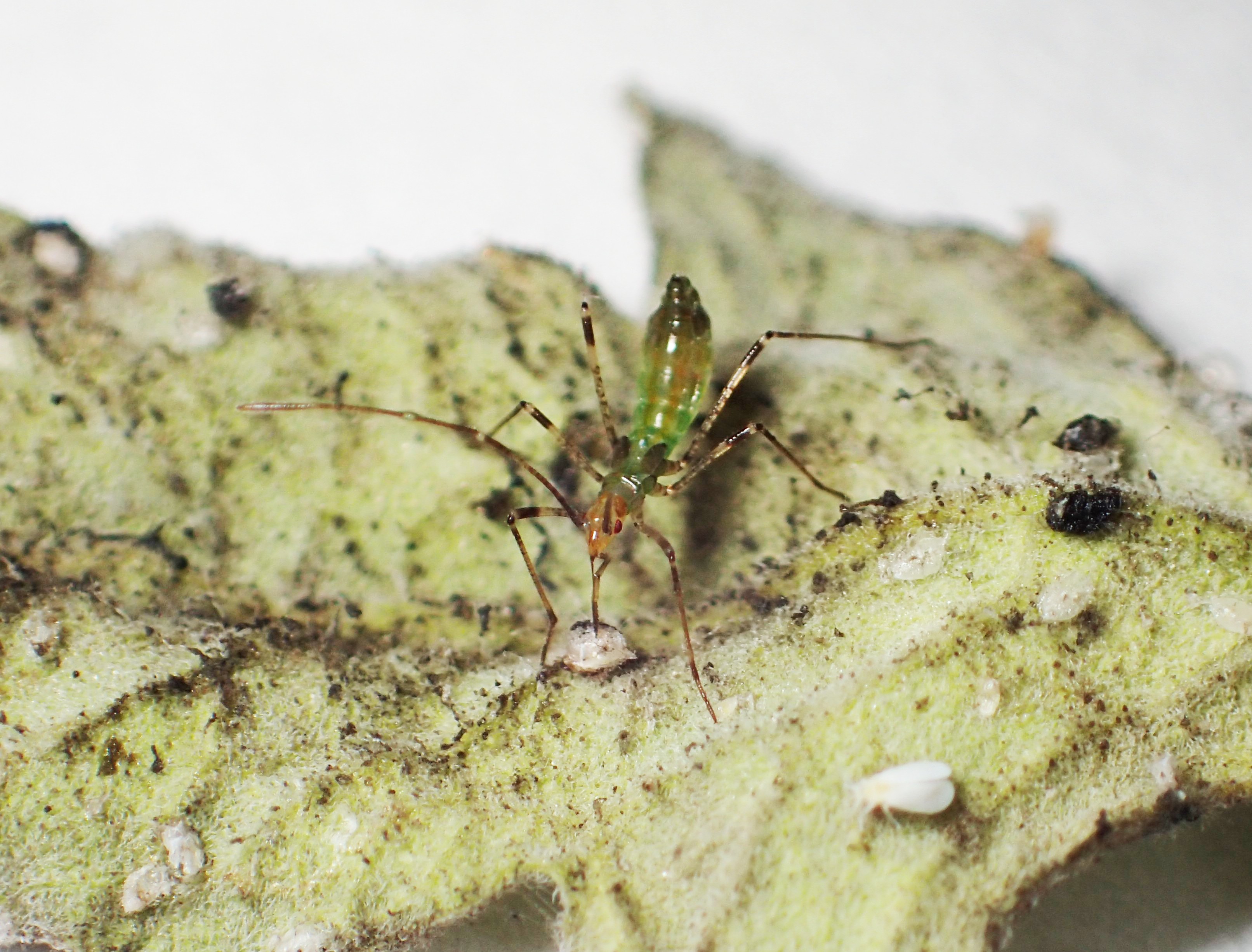
Some specimens collected in February 2020 in San Bautista (Canelones) were kept alive and placed in a rearing cage with tomato plants (Elpida Enza Zaden), following the protocol described by Castañé et al. 2007. The rearing was conducted in growth chambers under controlled conditions (25±1 °C, 60±5% RH, 16:8 h L:D). Given the limited information available on the diet of J. sobrinus, and following Henry (2000), who mentioned that berytids exhibit strong predatory tendencies, we decided to provide the collected specimens with E. kuehniella eggs as a food source. Eggs were added twice a week, and the tomato plants were replaced every two weeks. Using this method, the insects were reared for two months in the Entomology Laboratory at the Experimental Station San Antonio (EEFAS) from the Salto population and for six months in the Entomology Laboratory at Facultad de Agronomía, Montevideo, from the Canelones (San Bautista) population (Fig. 3).
Nymph IV of Jalysus sobrinus feeding on Trialeurodes vaporariorum pupa provided in the rearing unit.
Tomato growers in Canelones reported that Jalysus populations were associated with prior whitefly infestations. During the 2019-2020 growing season, when Jalysus populations were particularly high, an insecticide treatment with matrine for control of J. sobrinus was ineffective against the insect.
On the other hand, growers in Montevideo (Melilla) noted that Jalysus is observed every year with varying population levels. Still, to date, insecticide treatments have not been necessary, despite its increasing presence.
In northern Uruguay, particularly in Artigas (Bella Unión), growers have been noting increasing Jalysus populations, sometimes requiring insecticide treatments. In 2024, a survey was conducted with 30 growers from seven departments. Jalysus sobrinus was detected by 30% of the surveyed farmers, primarily in Artigas, Paysandú, Florida, Canelones and Montevideo. This group of farmers reported the presence of the insect on different tomato varieties (Elpida Enza Zaden, Eterei Seminis®, Belfast Enza Zaden, Lapataia Enza Zaden and Alamina Rijk Zwaan), primarily during the spring and summer. Notably, 77% of the farmers who observed J. sobrinus concurrently observed it with whitefly infestations.
The highest incidence of J. sobrinus was recorded in the north of the country. Fruit damage was reported in Artigas, Paysandú (both in the north) and on one farm in Canelones (south). Farmers from Artigas (Bella Unión, north of the country) emphasized the difficulty in controlling this insect, particularly in organic farms.
Morphological identification and measurements
Studied material. URUGUAY: 4♂♂, 4♀♀, Montevideo, ex cría, Jalysus sobrinus Stål, T. J. Henry det. (MACN_EN42437 - 42440); 2♂♂, 2♀♀, Idem (USNM); 4♂♂, 4♀♀, Salto, ex cría, Jalysus sobrinus Stål, T. J. Henry det. (MACN_EN42441); 2♂♂, 2♀♀, Idem (USNM); 2♂♂, 4♀♀, Montevideo, ex cría, Jalysus sobrinus Stål (FAE), 4♂♂, 8♀♀, Salto, ex cría, Jalysus sobrinus Stål (FAE); 1♂♂, 2♀♀, Montevideo, ex cría, Jalysus sobrinus Stål (FCE), 4♂♂, 10♀♀, Salto, ex cría, Jalysus sobrinus Stål (FCE).
Diagnosis
Berytidae
Head subspherical often with clypeus produced anteriorly; antennae located above a line through middle of eye; antenniferous tubercles reduced; antennal segment IV usually short and somewhat swollen; distal ends of femora usually swollen; peritreme of metathoracic scent gland usually uniquely produced, often as an elongate spine; corium usually in part desclerotized; nymphs with dorsal abdominal scent-gland openings between terga III/IV and IV/V, or only between terga III/IV; nymphs usually with glandular setae.
Metacanthinae
Head anteriorly annulate or subtruncate, but lacking a forward-projected spinelike process; pronotum more or less trituberculate or trispinose posteriorly, sometimes spinose laterally; antennae and legs usually annulated with dark rings; usually macropterous; scutellum with a dorsally directed spine; abdomen impunctate ventrally or with at most scattered punctures.
Metacanthini
Distinctive elongate ostiolar spout on the metapleural area.
Jalysus Stål
Elongate, slender body, the long, threadlike legs, with each leg having the combined lengths of the femur and tibia longer than the length of the body, and by the unique ostiolar process that ends in an acute spine.
Jalysus sobrinus
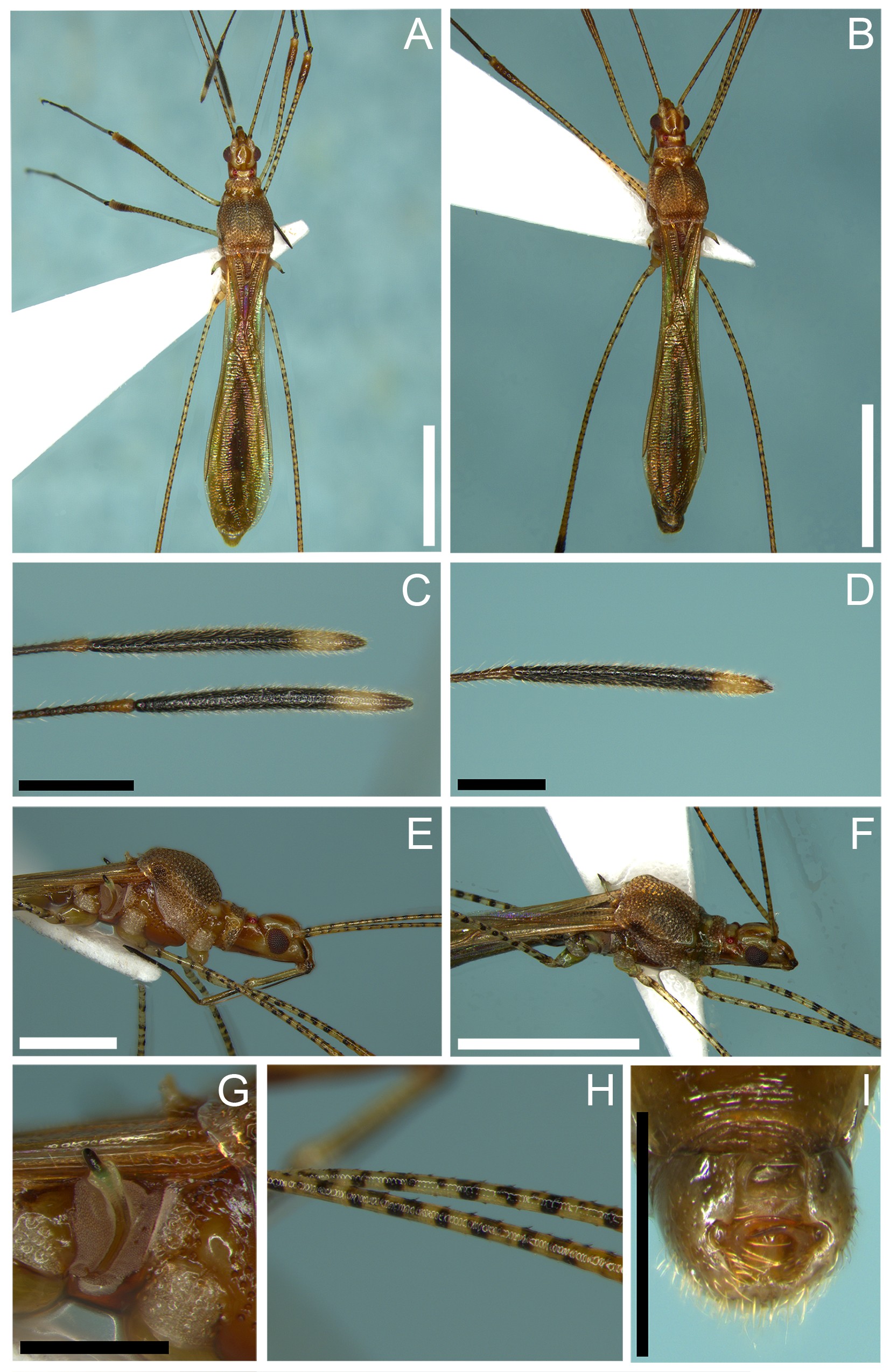
Strongly spotted appendages, impunctate head, peritreme (spout shaped), and the male genital capsule and parameres. The mesal spike on the basal edge of the aperture, visible from a caudal view, distinguish this species from all others except J. albidus Ŝtusák, 1968. This species is very similar but differs externally only by the more extensively white antennal segment IV (distiflagellomere) and by the often coalescing spots on the legs of J. albidus (Schuh and Slater, 1995; Henry, 1997a) (Fig. 4).

A Jalysus sobrinus dorsal view, ♀; B J. sobrinus dorsal view, ♂; C antennae ♀, D antenna ♂, E head and thorax lateral view ♀, F head and thorax lateral view ♂, G ostiole with ostiolar process, H spots on legs, I male pygophore and genital capsule, caudal aspect. Black scale: 500um, white scale: 2 mm.
Measurements
Male (Minimum – mean – maximum) (n = 5). Total length 6.12 – 6.47 – 6.71, maximum width in hemelytra 0.85 – 0.91 – 0.94. Head: length 0.62 – 0.63 – 0.65, width across the eyes 0.62 – 0.62 – 0.63, interocular space 0.35 – 0.36 – 0.38. Labium: length 2.12 – 2.21 – 2.23. Antenna: segment I (scape), length 4.82 – 4.84 – 4.88, segment II (pedicel) 2.12 – 2.16 – 2.23, segment III (basiflagellomere) 2.35 – 2.55 – 2.71, segment IV (distiflagellomere) 1.29 – 1.35 – 1.41. Pronotum: Median length 0.82 – 0.86 – 0.94, posterior width 1.00 – 1.06 – 1.12.
Female (Minimum – mean – maximum) (n = 5). Total length 6.94 – 7.37 – 7.65, maximum width in hemelytra 1.06 - 1.10 - 1,18. Head: length 0.71 – 0.75 – 0.79, width across the eyes 0.71, interocular space 0.38 – 0.40 – 0.41. Labium: length 2.35 – 2.45 – 2.53. Antenna: segment I (scape), length 4.94 – 5.10 – 5.18, segment II (pedicel) 2.23 – 2.41 – 2.65, segment III (basiflagellomere) 2.35 – 2.51 – 2.71, segment IV (distiflagellomere) 1.29 – 1.37 – 1.47. Pronotum: Median length 0.88 – 0.98 – 1.06, posterior width 1.12 – 1.20 – 1.29.
Hosts:Jalysus sobrinus was recorded on “blood amaranth”, Amaranthus cruentus L. (Amaranthaceae), “coyo”, Persea schiedeana J. bost. (Lauraceae) (Henry, 1997a), Nicotiana tabacum L. (Solanaceae) (D´Utra, 1903); Azzi, 1936; Costa Lima, 1940) mentioned by Henry, 1997a), Brachiaria ruziziensis (Poaceae) (Vélez et al., 2020), Amaranthus cruentus (Amaranthaceae), Persea pittieri (Lauraceae) (Ballou, 1937 mentioned by Henry, 1997a); Machaerium aculeatum (Leguminosae) (apparently probing galls of a cecidomyiid fly) (Henry, 1997a) and Gossypium sp. (Malvaceae) (Silvie et al., 2014). In Argentina, Quintanilla et al. (1981) observed this species in Misiones on Capsicum annuum L. (Solanaceae), Cáceres (2020) mentioned this species from Corrientes and for the first time on Solanum lycopersicum L. (Solanaceae) and recently was observed in Buenos Aires on “hairy Indian mallow”, Abutilon grandifolium (Willd.) Sweet (Malvaceae), “Spanish flag” Lantana camara L. (Verbenaceae) and “field mallow” Modiolastrum malvifolium (Griseb.) K. Schum. (Malvaceae) (Carpintero et al., 2021). Some members of the genus Jalysus can feed on moth eggs, such as those of Heliothis virescens (F.) (Lepidoptera, Noctuidae) and Manduca sp. (Lepidoptera, Sphingidae) (Elsey, 1972, 1975). It was also collected on “duckbill jacaranda” Machaerium aculeatum Raddi (Fabaceae), apparently probing galls of a cecidomyiid (Diptera) (Henry, 1998).
Distribution: This species is known from Argentina, Bolivia, Brazil (Amazonas, Bahia, Ceará, Espírito Santo, Goiás, Mato Grosso, Minas Gerais, Pará, Paraná, Pernambuco, Rio de Janeiro, Rio Grande do Norte, Rio Grande do Sul, Roraima, Santa Catarina and São Paulo States), Colombia, Costa Rica, Ecuador, El Salvador, Guatemala, Honduras, Jamaica, Mexico, Nicaragua, Panama, Paraguay, Peru, Trinidad and Tobago, Uruguay and Venezuela (Henry, 1998). In Argentina this species is known from the provinces of Buenos Aires, Chaco, Corrientes, Entre Ríos, La Pampa, La Rioja, Misiones, Salta, Santiago del Estero and Tucumán (Coscarón, 2017). This species was recorded for the first time for Uruguay by Ruffinelli and Pirán (1959) for the departments of Artigas (1952) and Colonia (1943), in the north and southwest of Uruguay, respectively.
Molecular characterization of Jalysus sobrinus
After aligning and trimming the sequences, all were found to be identical, hence all belonging to the same haplotype. This sequence was submitted to GenBank under the accession number PP069739. A blast search was conducted on NCBI website in November 2023, using the obtained sequence for J. sobrinus. The results revealed high similarity (92 to 93% identity and 96 to 98% of query coverage) with three deposited sequences (OM600284, OM608034, OM613631), which are from unidentified Jalysus species of Argentinean origin. No sequences of J. sobrinus were deposited in GenBank up to date.
Predation tests on Trialeurodes vaporariorum in laboratory
Jalysus specimens for predation test were collected in Montevideo from Smallanthus connatus (plant identification by Jolochin G.) which represents a new host species record for J. sobrinus. After 24 hours of starvation, all J. sobrinus nymphs tested preyed on T. vaporariorum whitefly nymphs, consuming an average of 6.47 ± 2.50 individuals during the first period (0-24 hours) and 8.06 ± 3.51 individuals during the second period (24-48 hours). Under the same conditions, adults consumed an average of 8.07±3.33 whitefly nymphs during the first period (0-24 hours) and 7.73±4.65 individuals during the second period (24-48 hours). These results show that J. sobrinus preys on T. vaporariorum and can consume about 15 whitefly nymphs over a 48-hours period.
Discussion
This study highlights the emerging role of J. sobrinus as both a potential pest and a predator in tomato agroecosystems in Uruguay. The morphological and molecular characterization provided here represents an important progress in the taxonomy of this species. The identification of J. sobrinus as a specific pest affecting tomato crops, especially in organic and transition farming systems, highlights the need for further research into its biology and control methods.
This work provides the first integrative taxonomy of J. sobrinus, reporting barcoding information at the species level. Previous works only reported barcoding sequences at the genus level or for other Jalysus species (GenBank https://www.ncbi.nlm.nih.gov/genbank/). This information gives the taxonomic basis for further investigations into this species. The presence of J. sobrinus on many tomato crops and its damage to fruits through puncturing represent a potential risk for the tomato production in South America, which warrants further investigation.
Berytids, commonly called stilt bugs, seem to be primarily phytophagous (Henry, 1997a), despite some have been recognized as predators in agroecosystems (Henry, 1997a; Kohno and Hirose, 1997; Nelson et al., 2019). The type of damage observed in this work differs from that caused by J. wickhami, as described by (Wheeler Junior and Henry (1981), who noted that adults and nymphs puncture fruit stems, causing the stems to die beyond the feeding sites. Blossom damage that prevents fruit set was also reported for J. wickhami (Somes, 1916). However, in the present study, no such damage was observed in the case of J. sobrinus. The damage we observed was on fruits as little yellow punctures or spots, but in the case of some cherry-type tomatoes that rot after puncturing lesions, during the packaging and transporting process, which is worrying for producers, given that it destroys part of the production.
Important aspects of its biology, including its zoophagous feeding habits and prey range, remain poorly understood. Further research into its biological cycle and environmental conditions that promote its development will help clarify the increasing incidence of J. sobrinus in tomato crops in Uruguay.
This work also demonstrates, for the first time, that under laboratory conditions, J. sobrinus prey on T. vaporariorum nymphs. This characteristic could potentially be exploited in future IPM strategies. Moreover, J. sobrinus was observed by growers in tomato greenhouses, often in association with high whitefly populations. These observations suggest that J. sobrinus may enter greenhouses looking for the pest, which could serve as a resource for increasing its population levels. However, more research is needed to explore its biology and prey preferences, as well as to understand the balance between its zoophagous and phytophagous behaviors as the mechanisms that regulate the switch between these feeding strategies.
When compared to other predator species, the number of whiteflies consumed by J. sobrinus is not negligible. For instance, Tupiocoris cucurbitaceus (Spinola, 1852) (Hemiptera: Miridae), a natural occuring whitefly predator also commercially available in Uruguay for tomato crops, consumes between 8 and 11 whitefly individuals in 24 hours (López et al., 2012), which is comparable to the predation rates observed in this work for J. sobrinus. Given that other Jalysus species prey on lepidopteran eggs (Elsey and Stinner, 1971), it is worth considering that J. sobrinus may also target such kind of preys in Uruguayan tomato crops.
Although J. sobrinus may pose a risk of fruit damage in tomato crops under high population levels, its potential role as a zoophagous insect should also be investigated to better understand its ecological role or ecosystem service within this agroecosystem.
Acknowledgements
Special thanks to Dr Thomas J. Henry (USNM) for confirming our identifications of this species. We also give special thanks to CONICET for its support to the author Diego Carpintero for research conducted in this paper. We also thank tomato growers Jorge Garrido, Andrés Angiolini and Juan Bentancur who kindly permitted us to collect samples and/or make the interviews. We thank Gastón Zubarán who kindly provided us with reference information on the individuals deposited in the MACN collection. Thanks to RDT UdelaR and SNI-ANII for financial support of Leticia Bao and María E. Lorenzo. We dedicate this work to the memory of Diego Carpintero.
References
-
Basso, C., Cibils, X., 2020. Foundations and developments of pest management in Uruguay: a review of the lessons and challenges. Agrociencia Uruguay 24, 409-410. Available in: http://agrocienciauruguay.uy/ojs/index.php/agrociencia/article/view/409 (accessed 21 February 2025).
» http://agrocienciauruguay.uy/ojs/index.php/agrociencia/article/view/409 - Bentancourt, C.M., Scatoni, I.B., Morelli, E., 2009. Insectos del Uruguay, Universidad de la República, Montevideo.
- Cáceres, S., 2020. Guía Práctica para la Identificación y el Manejo de las Plagas del Tomate, INTA, Buenos Aires.
-
Carpintero, D.L., De Magistris, A.A., Petti, C., 2021. Lista preliminar de especies de Heteroptera (Hemiptera) de la Reserva Santa Catalina (Lomas de Zamora, Buenos Aires). Revista de Divulgación Técnica Agropecuaria, Agroindustrial y Ambiental 8, 16-56. Available in: http://hdl.handle.net/11336/212148 (accessed 21 February 2025).
» http://hdl.handle.net/11336/212148 -
Castañé, C., Alomar, O., Riudavets, J., Gemeno, C., 2007. Reproductive biology of the predator Macrolophus caliginosus: effect of age on sexual maturation and mating. Biol. Control 43 (3), 278-286. http://doi.org/10.1016/j.biocontrol.2007.08.009
» http://doi.org/10.1016/j.biocontrol.2007.08.009 -
Chao, K., Barton, K., Palmer, S., Lanfear, R., 2021. SangeranalyseR: simple and interactive processing of Sanger sequencing data in R. Genome Biol. Evol. 13 (3), evab028. http://doi.org/10.1093/gbe/evab028
» http://doi.org/10.1093/gbe/evab028 -
Coscarón, M.C., 2017. A catalogue of the Heteroptera (Hemiptera) or true bugs of Argentina. Zootaxa 4295 (1), 1-432. http://doi.org/10.11646/zootaxa.4295.1.1
» http://doi.org/10.11646/zootaxa.4295.1.1 - Costa Lima, A., 1940. Insetos do Brasil 2: Hemipteros Capítulo XXII, Escola Nacional de Agronomia, Rio de Janeiro.
-
Dellapé, P.M., Carpintero, D.L., 2007. Cuscohoplininus pagoreni: a new genus and species of Hoplinini stilt bug from Peru (Heteroptera: Berytidae). Rev. Biol. Trop. 55 (2), 673-676. http://doi.org/10.15517/rbt.v55i2.6043
» http://doi.org/10.15517/rbt.v55i2.6043 - DIEA, 2024. Anuario Estadístico Agropecuario, Ministerio de Ganadería Agricultura y Pesca, Montevideo.
-
Elsey, K.D., 1972. Predation of eggs of Heliothis spp. on tobacco. Environ. Entomol. 1 (4), 433-438. http://doi.org/10.1093/ee/1.4.433
» http://doi.org/10.1093/ee/1.4.433 - Elsey, K.D., 1975. Jalysus spinosus: increased numbers produced on tobacco by early-season releases. Tob. Sci. 19, 13-15.
-
Elsey, K.D., Stinner, R.E., 1971. Biology of Jalysus spinosus, an insect predator found on tobacco. Ann. Entomol. Soc. 64 (4), 779-783. http://doi.org/10.1093/aesa/64.4.779
» http://doi.org/10.1093/aesa/64.4.779 - Folmer, O., Black, M., Hoeh, W., Lutz, R., Vrijenhoek, R., 1994. DNA primers for amplification of mitochondrial cytochrome c oxidase subunit I from diverse metazoan invertebrates. Mol. Mar. Biol. Biotechnol. 3, 294-299.
- Henry, T.J., 1997a. Monograph of the stilt bugs, or Berytidae (Heteroptera), of the Western Hemisphere. Mem. Entomol. Soc. Wash. 19, 1-149.
- Henry, T.J., 1997b. Cladistic analysis and revision of the stilt bug genera of the World (Heteroptera: berytidae). Contrib. Am. Entomol. Inst. 30, 1-100.
- Henry, T.J., 1998. Catalog of the stilt bugs, or berytidae, of the world (Insecta: Hemiptera: Heteroptera). Am. Entomol. Inst. 30 (4), 72.
-
Henry, T.J., 2000. Berytidae. In: Schaefer, C.W., Panizzi, A.R. (Eds.), Heteroptera of Economic Importance. CRC Press, Boca Raton, pp. 725-735. http://doi.org/10.1201/9781420041859.ch31
» http://doi.org/10.1201/9781420041859.ch31 -
Henry, T.J., 2002. Review of the stilt bug genus Yemmatropis (Insecta: Hemiptera: Heteroptera: Berytidae), with the description of a new species from Vietnam. Species Divers. 7 (2), 165-172. http://doi.org/10.12782/specdiv.7.165
» http://doi.org/10.12782/specdiv.7.165 - Henry, T.J., 2007. A newly discovered Brazilian species of the stilt bug genus Jalysus (Hemiptera: Heteroptera: Berytidae) associated with myrmecophytic plants. Proc. Entomol. Soc. Wash. 109, 324-330.
- Henry, T.J., 2016. A new species of the stilt bug genus Gampsocoris from Senegal and new generic combination for Gampsocoris gomeranus (Hemiptera: Heteroptera: Berytidae). Entomol. Am. 122 (1-2), 24-30.
-
Henry, T.J., 2022. Two new species of Hoplinine stilt bugs (Heteroptera: Berytidae: Gampsocorinae) from Brazil, with new country records for three other species. Proc. Entomol. Soc. Wash. 124 (1), 66-74. http://doi.org/10.4289/0013-8797.124.1.66
» http://doi.org/10.4289/0013-8797.124.1.66 -
Henry, T.J., Dellapé, P.M., 2021. Revision of the neotropical stilt bug genus Metajalysus Štusák (Hemiptera: Heteroptera: Berytidae), with descriptions of three new species. Zootaxa 4958 (1), 690-701. http://doi.org/10.11646/zootaxa.4958.1.44
» http://doi.org/10.11646/zootaxa.4958.1.44 - Henry, T.C., Froeschner, R.C., 1998. Catalog of the stilt bugs or Berytidae of the World (Insecta: Hemiptera: Heteroptera). Contrib. Am. Entomol. Inst. 30, 1-72.
-
Henry, T.J., Wall, M.A., 2019. Bajacanthus immaculatus: a new hoplinine genus and species of stilt bug (Hemiptera: Heteroptera: Berytidae) from Baja California Sur, Mexico, with a revised key to genera of the tribe. Proc. Entomol. Soc. Wash. 121 (4), 616-624. http://doi.org/10.4289/0013-8797.121.4.616
» http://doi.org/10.4289/0013-8797.121.4.616 -
Kohno, K., Hirose, Y., 1997. The Stilt Bug Yemma exilis (Heteroptera: Berytidae) as a Predator of Aphis gossypii (Homoptera: Aphididae) and Thrips palmi (Thysanoptera: Thripidae) on Eggplant. Appl. Entomol. Zool. 32 (2), 406-409. http://doi.org/10.1303/aez.32.406
» http://doi.org/10.1303/aez.32.406 -
López, S.N., Rojas, F.A., Villalba Velásquez, V., Cagnotti, C., 2012. Biology of Tupiocoris cucurbitaceus (Hemiptera: Miridae), a predator of the greenhouse whitefly Trialeurodes vaporariorum (Hemiptera: Aleyrodidae) in tomato crops in Argentina. Biocontrol Sci. Technol. 22 (10), 1107-1117. http://doi.org/10.1080/09583157.2012.705260
» http://doi.org/10.1080/09583157.2012.705260 - Medrano, J.F., Aasen, E., Sharrow, L., 1990. DNA extraction from nucleated red blood cells. Biotechniques 8, 43.
-
Montiel Cáceres, R., Salas Gervassio, N.G., Minghetti, E., Dellapé, P.M., Luna, M.G., Rocca, M., 2023. Heteropteran bugs assemblage associated to organic tomato farms: knowledge for pest management. Neotrop. Entomol. 52 (2), 251-262. http://doi.org/10.1007/s13744-022-01007-z
» http://doi.org/10.1007/s13744-022-01007-z -
Nelson, P.N., Burrack, H.J., Sorenson, C.E., 2019. Imidacloprid is compatible with control provided by the predator Jalysus wickhami Van Duzee (Hemiptera: Berytidae) in flue-cured tobacco (Nicotiana tabacum L.). Crop Prot. 118, 15-20. http://doi.org/10.1016/j.cropro.2018.12.002
» http://doi.org/10.1016/j.cropro.2018.12.002 -
Phipps, C.R., 1924. A Stilt-Bug, Jalysus spinosus say, destructive to the tomato. J. Econ. Entomol. 17 (3), 390-393. http://doi.org/10.1093/jee/17.3.390
» http://doi.org/10.1093/jee/17.3.390 - Quintanilla, R.H., Rizzo, H.F., De Nuñez, A.S., 1981. Catálogo preliminar de hemípteros hallados en la provincia de Misiones (Argentina). Rev. Fac. Agron. Buenos Aires. 23, 145-161.
- Ruffinelli, A., Pirán, A.A., 1959. Hemipteros Heteropteros del Uruguay. Bol. Fac. Agron. Montev. 51, 1-60.
- Say, T., 1824. American Entomology. Philadelphia, Pennsylvania, I: 1-18. [see also LeConte, J.L., reprint, 1859. The complete writings of Thomas Say on the Entomology of North America]. Bailliere Bros, New York.
- Schuh, R.T., Slater, J.A., 1995. True Bugs of the World (Hemiptera: Heteroptera): Classification and Natural History. Cornell University Press, Ithaca and London.
- Silvie, J.P., Gomez, V.A., Aberlenc, H.P., Bonfils, J., Cardozo, R., Michel, B., 2014. Diversité des Arthropodes rencontrés en culture cotonnière au Paraguay. 1. Insectes et acariens phytophages. Entomol. Faun. 67, 165-178.
-
Somes, M.P., 1916. Some insects of Solanum carolinense L., and their economic relations. J. Econ. Entomol. 9 (1), 39-44. http://doi.org/10.1093/jee/9.1.39
» http://doi.org/10.1093/jee/9.1.39 - Stål, C., 1859. Hemiptera, species novas descripsit. Konglika Svenska Fregattens Eugenies Resa Omkring Jorden. Zoology 4, 219-298.
- Stål, C., 1862. Bidrag till Rio Janeiro-Traktens Hemipter-fauna. Part II. Svenska Vetenskaps - Akademiens Handlingar. 3, 1-75. [Stål himself used 1860 when referring to this paper].
- Ŝtusák, J.M., 1968. New records and two new forms of Berytidae (Heteroptera). Acta Faunistica Entomol. Musei Nationalis Pragae. 13, 143-148.
- Ŝtusák, J.M., 1977. New records on distribution, synonyms and a new form of Berytidae (Heteroptera). Acta Entomol. Mus. Natl. Pragae 39, 337-344.
- Ŝtusák, J.M., Cobben, R.H., 1975. The heteroptera of the Netherlands Antilles - X. Berytinidae (Stilt Bugs). Studies on the Fauna of Curaçao and other Caribbean Islands. 48, 63-78.
-
Tatarnic, N.J., 2022. New genus and species of stilt bug (Hemiptera: Berytidae) from Western Australia. Austral Entomol. 31 (1), 29-36. http://doi.org/10.1111/aen.12579
» http://doi.org/10.1111/aen.12579 -
Vélez, M., Coelho, L.A., Martins, D.S., Ferreira, P.S.F., 2020. Survey of the Heteroptera (Hemiptera) on pastures from Espírito Santo state, Brazil: new records, range extension, and notes of potential pests. EntomoBrasilis 13, e907. http://doi.org/10.12741/ebrasilis.v13.e907
» http://doi.org/10.12741/ebrasilis.v13.e907 -
Wheeler Junior, A.G., Henry, T.J., 1981. Jalysus spinosus and J. wickhami: taxonomic clarification, review of host plants and distribution, and keys to adults and 5th instars. Ann. Entomol. Soc. Am. 74 (6), 606-615. http://doi.org/10.1093/aesa/74.6.606
» http://doi.org/10.1093/aesa/74.6.606