Ophthalmoparesis secondary to stiff-person syndrome - a case report
ABSTRACT
Stiff-Person syndrome is a rare neuro-immunological condition predominantly affecting proximal and axial limb muscles, with a higher incidence in females aged between the third and seventh decades of life. Ophthalmological involvement is a significant aspect, often correlated with cerebellar dysfunction and various nystagmus forms. A 53 year-old female with a history of hypothyroidism and rectal polypectomy, presenting with diplopia, dizziness, and postural instability, eventually diagnosed with Stiff-Person syndrome. Treatment involves medications like diazepam and gabapentin, besides intravenous immunoglobulin therapy and pulse therapy. The patient's ocular manifestations included diplopia, nystagmus, and visual acuity decline. Despite treatment yielding limited ocular improvements, pain reduction and tremor relief were notable. Differential diagnosis excluded other neuromuscular disorders, emphasizing the guarded prognosis of Stiff-Person syndrome, with a negative impact on patients’ quality of life. Recognizing the significance of Stiff-Person syndrome lies not only in its association with common autoimmune diseases but also in its profound impact on ocular health. While early diagnosis and management are crucial to improve the quality of life and allow the patients more independence in their activities, a deeper understanding of its ophthalmological implications is essential for optimizing patient care and outcomes. Further research into the ocular aspects of Stiff-Person syndrome is warranted to enhance our comprehension and therapeutic approaches in this complex condition.
Keywords:
Stiff-Person syndrome; Autoimmune diseases; Eye health
RESUMO
A síndrome de stiff-person é uma condição neuro imunológica rara que afeta predominantemente musculatura proximal e axial dos membros, com maior incidência em mulheres entre a terceira e sétima década de vida. O acometimento oftalmológico é um ponto relevante, geralmente correlacionado com disfunção cerebelar e várias formas de nistagmo. Mulher, 53 anos, com histórico de hipotireoidismo e polipectomia retal apresentou com diplopia, tontura e instabilidade postural, diagnosticado como síndrome de Stiff-Person. O tratamento envolveu medicamentos como diazepam e gabapentina, além de terapia com imunoglobulina intravenosa e pulsoterapia. As manifestações oculares da paciente foram diplopia, nistagmo e baixa acuidade visual. Apesar do tratamento ter limitada melhora dos movimentos oculares, a redução da dor e alívio dos tremores foram evidentes. A diferenciação diagnóstica excluiu outros distúrbios neuromusculares, enfatizando o prognóstico reservado da síndrome de Stiff-Person, com um impacto negativo na qualidade de vida do paciente. O reconhecimento da importância da síndrome de Stiff-Person reside não apenas em sua associação com doenças autoimunes comuns, mas também em seu impacto profundo na saúde ocular. Embora o diagnóstico precoce e o tratamento sejam cruciais para melhorar a qualidade de vida e proporcionar maior independência nas atividades dos pacientes, um entendimento mais profundo de suas implicações oftalmológicas é essencial para otimizar o cuidado e os resultados dos pacientes. Mais pesquisas sobre os aspectos oculares da síndrome de Stiff-Person são necessárias para aprimorar nossa compreensão e as abordagens terapêuticas dessa condição complexa.
Descritores:
Rigidez muscular espasmódica; Doenças autoimunes; Saúde ocular
INTRODUCTION
Stiff-Person syndrome (SPS) is a neuro-immunological condition that manifests within the central nervous system, predominantly affecting the muscles of the proximal and axial limbs. Initially documented in 1956, this affliction is considered rare, with an incidence rate of up to two cases per 1 million individuals. It exhibits a predilection for females, occurring twice as frequently as in males, with no discernible racial preference, and typically manifests between the third and seventh decades of life.(1–4)
Stiff-Person syndrome is characterized by disorder of the central nervous system with ophthalmological involvement, which significantly influences the disease's trajectory. This involvement correlates, for instance, with cerebellar dysfunction and various forms of nystagmus.(5)
Common ocular manifestations of SPS encompass diplopia, spontaneous nystagmus, mild saccadic pursuit, photopsia, and diminished visual acuity.(6,7) Additionally, there may be paralysis of downward gaze, although some patients may also experience paralysis of upward gaze.(5) The patient in question exhibits abnormalities in extraocular muscle ductions and versions, resulting in challenges with convergence, impaired saccadic movements, diplopia, and decreased visual acuity. These ocular manifestations, coupled with muscular rigidity, significantly contribute to her falls and diminished quality of life.(6)
CASE REPORT
A 53-year-old female patient, with a medical history of hypothyroidism, underwent partial thyroidectomy due to a suspicious nodule and rectal polypectomy over 13 years ago. In 2020, she initially experienced an abrupt onset of vertical diplopia, which spontaneously resolved after 5 months but was followed by a decline in visual acuity in both eyes, described by the patient as visual blurring. Subsequently, she developed recurrent episodes of non-rotational dizziness and postural instability in the following year, leading to multiple falls and resulting fractures. Concurrently, she had symptoms of weakness in the hip and lower limbs, necessitating restricted mobility and assistance for ambulation.
In 2022, she was admitted to a public hospital for clinical evaluation due to the persistence of her symptoms and the emergence of right-sided paresis, where cerebrovascular causes were excluded. In 2023, upon clinical suspicion of SPS, anti-glutamic acid decarboxylase (anti-GAD) testing was conducted, revealing a result exceeding 2,000 U/mL, thus confirming the diagnosis of SPS. She started treatment with diazepam and gabapentin, but subsequent hospitalization ensued due to symptom persistence and exacerbation of painful spasms.
Neurological examination revealed grade IV global strength, spasticity affecting all four limbs with accentuation on the right side, and dystonic posture in the right foot. Coordination tests demonstrated delayed responses in the index-nose test, instability in static and dynamic balance, and bilateral spastic gait characterized by rigidity and robotic gait pattern.
Electroneuromyography exhibited continuous activity of motor unit action potentials in paravertebral, lumbar, thoracic, and right gastrocnemius muscles. During hospitalization, treatment modalities such as intravenous immunoglobulin therapy, pulse therapy, escalated diazepam dosage, and initiation of baclofen and rituximab were implemented, resulting in partial amelioration of symptoms. Additionally, paraneoplastic screening yielded negative results, and she was referred for multidisciplinary therapy comprising speech therapy and physiotherapy. Magnetic resonance imaging of the skull and orbit, cerebrospinal fluid, infectious serology, and rheumatology laboratory tests were performed without significant changes.
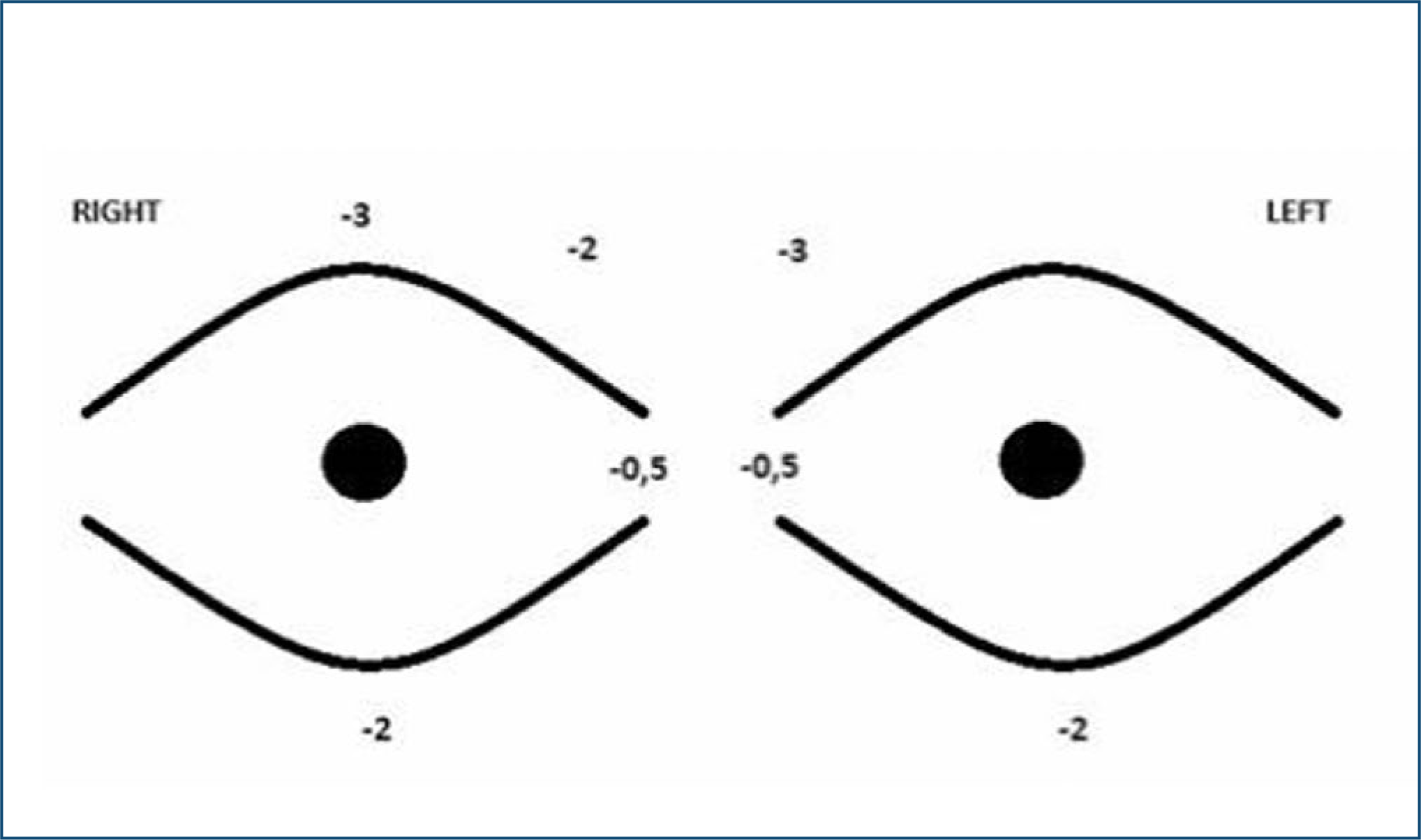
In September 2023, upon assessment by neuro-ophthalmology, visual acuity with correction (AVCC) was recorded as 20/70 in both eyes without relative afferent pupillary defect. However, deficient convergence, absent postural movements, hypo-saccades movements, and alterations in extrinsic ocular motility were noted, with deviations including −2 for the right inferior oblique, −3 for the right superior rectus, −2 for both inferior rectus, and −3 for the left inferior oblique. Additionally, ductions were limited to −0.5 for the medial rectus in both eyes (Figure 1). Optical coherence tomography (OCT) findings were unremarkable. Anterior and posterior biomicroscopy, tonometry, and saturation of red color did not show alterations.

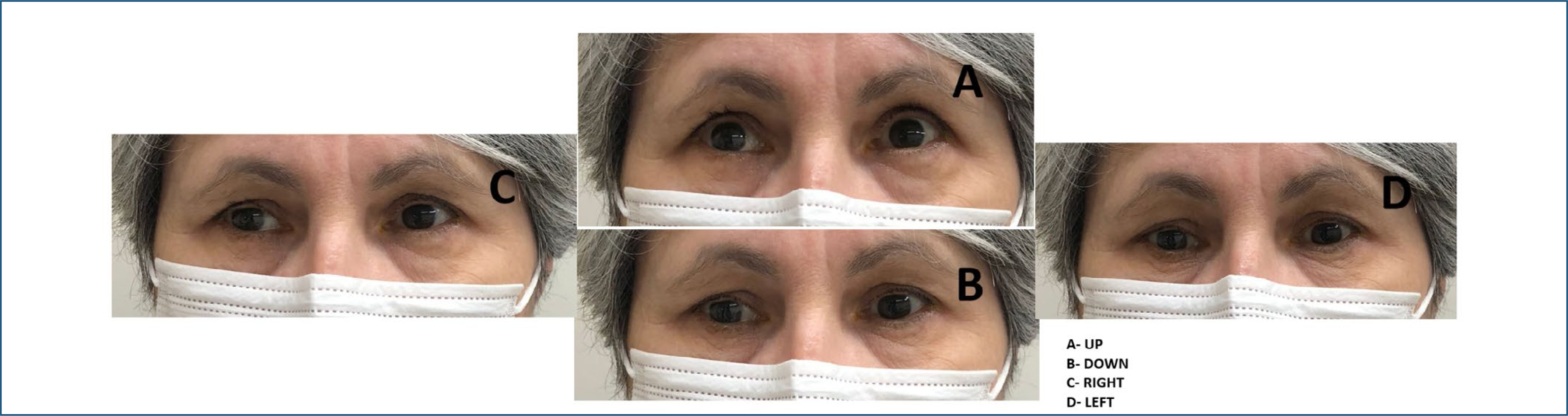
The treatment started with alternating eye patching, subsequently enhancing ocular motor function for the patient. Hospitalization included IV immunoglobulin, pulse therapy, escalated diazepam dosage, and initiation of baclofen and rituximab, yielding improvement. After these treatments and refractive assessment, the patient progressed with VA 20/20, could write again write, walk by herself, keeping limitation of extra ocular muscles, illustrated in figure 2.

Extra ocular muscle movements after treatment. Limitation −0,5 medial rectus in both eyes and −3 in other positions.
DISCUSSION
The patient under consideration falls within the demographic most affected by SPS, being a 53-year-old woman. Furthermore, she carries a diagnosis of autoimmune disorder, notably hypothyroidism, and a medical history of rectal polyps. Both of these comorbidities are significantly linked to the syndrome.(1–3)
Furthermore, although the patient in question does not present this change, thinning of retinal layers can be observed in OCT scans, with the ganglion cell layer and internal plexiform layer correlating with the extent of body regions affected. Additionally, elevated levels of anti-GAD65 are associated with reduced thickness of the inner nuclear layer.(8)
The administration of intravenous immunoglobulin and pulse therapy resulted in modest ophthalmological improvements for the patient. However, notable enhancements were observed in pain reduction and tremor mitigation. Analogous reports in the literature underscore instances where patients exhibited substantial alleviation of symptoms with the adoption of this therapeutic regimen.(1,2)
Investigations were conducted with this patient, including clinical evaluations and complementary tests, such as electroneuromyography, orbital and cranial magnetic resonance imaging, cerebrospinal fluid analysis, and laboratory examinations, thereby excluding the main differential diagnoses, including parkinsonism, tetanus, muscular dystrophy, progressive multiple sclerosis, and autoimmune encephalopathy.(1,2)
The prognosis for SPS is marked by restricted social interaction and reduced quality of life for those affected. Accordingly, time has proven to be a vital factor in ensuring that timely diagnosis, along with prompt treatment initiation, improves patient management and overall quality of life.(1,2)
Recognizing the relevance of Stiff-Person syndrome goes beyond its association with common autoimmune diseases. It also encompasses its profound impact on ocular health. Early diagnosis and management play pivotal roles, yet delving deeper into the intricacies of its ophthalmological implications is imperative for optimizing patient care and outcomes. Further research into the nuanced ocular aspects of SPS is warranted to refine our understanding and therapeutic approaches for this complex condition, thereby enhancing the quality of life for affected individuals.
REFERENCES:
-
1 Muranova A, Shanina E. Stiff person syndrome. [Updated on July 10, 2023]. In: StatPearls. Treasure Island (FL): StatPearls Publication; 2023 January-. Available at: https://www.ncbi.nlm.nih.gov/books/NBK573078/
» https://www.ncbi.nlm.nih.gov/books/NBK573078/ - 2 Newsome SD, Johnson T. Stiff person syndrome spectrum disorders; more than meets the eye. J Neuroimmunol. 2022;369:577915.
- 3 McKeon A, Robinson MT, McEvoy KM, Matsumoto JY, Lennon VA, Ahlskog JE, et al. Stiff-man syndrome and variants: clinical course, treatments, and outcomes. Arch Neurol. 2012;69(2):230-8.
- 4 Baizabal-Carvallo JF, Jankovic J. Stiff-person syndrome: insights into a complex autoimmune disorder. J Neurol Neurocir Psiquiatry. 2015;86:840.
- 5 Lambe J, Rothman A, Prince J, Saidha S, Calabresi PA, Newsome SD. Retinal pathology occurs in stiff-person syndrome. Neurology. 2020 9;94(20):e2126-e2131.
- 6 Tilikete C, Vighetto A, Trouillas P, Honnorat J. Potential role of anti-GAD antibodies in abnormal eye movements. Ann NY Acad Sci. 2005;1039:446-54.
- 7 Eggenberger ER, Lee AG, Thomas M, Lai EC. Neuro-ophthalmologic findings in patients with the anti-gad antibody syndrome. Neuro-Oftalmol. 2006;30(1):1-6.
- 8 Steffen H, Menger N, Richter W, Nölle B, Krastel H, Stayer C, et al. Immune-mediated retinopathy in a patient with stiff-man syndrome. Graefes Arch Clin Exp Ophthalmol. 1999;237(3):212-9.