
 Factors associated with Common Mental Disorders (CMD) in graduate faculty: structural equation modeling
Abstract
Objective To analyze the factors associated with Common Mental Disorders (CMD) among graduate professors, with an emphasis on psychosocial factors at work.
Methods This is a cross-sectional study with a non-probabilistic sample of faculty members from two Federal Universities in Bahia. CMDs were assessed using the Self-Reporting Questionnaire (SRQ-20). Exposure variables included psychosocial aspects, measured by the Job Content Questionnaire (JCQ), sociodemographic data, length of service, and lifestyle habits. Direct and indirect effects were assessed using Structural Equation Modeling (SEM), with standardized regression coefficients.
Results 149 faculty members participated, with a predominance of women (62.4%), white race/ethnicity (43.2%), and those aged 40-59 years (79.1%). Most had more than six years of teaching experience (88.6%), were exposed to unfavorable conditions regarding workload, control, and social support at work (57.5%), and participated in leisure activities (70.2%). The prevalence of CMD was 40.3%. There was a direct association (p < 0.05) between CMD and occupational stressors (β = 0.229), younger age (β = -0.200), and lack of leisure activities (β = -0.255). Regarding indirect effects, stressors mediated the relationship between working hours and CMD (p = 0.038).
Conclusion A high frequency of common mental disorders and a complexity of factors affecting mental health were observed.
Keywords
Mental Disorders; Psychology; Faculty; Occupational Health; Cross-Sectional Studies
Resumo
Objetivo Analisar os fatores associados à ocorrência de Transtornos Mentais Comuns (TMC) entre docentes de pós-graduação stricto sensu, com ênfase nos fatores psicossociais do trabalho.
Métodos Estudo transversal com amostra não probabilística de docentes de duas Universidades Federais na Bahia. Os TMC foram avaliados pelo Self-Reporting Questionnaire (SRQ-20). As variáveis de exposição incluíram aspectos psicossociais, mensurados pelo Job Content Questionnaire (JCQ), dados sociodemográficos, tempo de trabalho e hábitos de vida. Os efeitos diretos e indiretos foram avaliados por Modelagem de Equações Estruturais, com coeficientes de regressão padronizados.
Resultados Participaram 149 docentes, com predomínio de mulheres (62,4%), raça/cor branca (43,2%) e idade de 40-59 anos (79,1%). A maioria possuía mais de seis anos de docência (88,6%), estava exposta a condições desfavoráveis de demanda, controle e apoio social no trabalho (57,5%) e participava de atividades de lazer (70,2%). A prevalência de TMC foi 40,3%. Houve associação (p < 0,05) direta entre TMC e estressores ocupacionais (β = 0,229), menor idade (β = -0,200) e ausência de lazer (β = -0,255). Nos efeitos indiretos, os estressores mediaram a relação entre tempo de trabalho e TMC (p = 0,038).
Conclusão Observou-se elevada frequência de TMC e complexidade dos fatores que afetam a saúde mental.
Palavras-chave
Transtornos Mentais; Fatores Psicossociais; Professores de Ensino Superior; Saúde do Trabalhador; Estudos Transversais
Introduction
The work of faculty in public higher education is complex and multifaceted, encompassing teaching, administration, outreach, and research activities1,2. Work in strictu sensu graduate programs (PPG) represents a considerable increase in faculty members’ workload and stress, primarily due to the demands arising from their role as researchers, such as conducting scientific studies, advising master’s and doctoral students, and securing funding in a competitive environment with limited investment in science1,2.
However, these demands do not affect faculty members uniformly. Racial and gender disparities are reflected in the unequal distribution of the workload in university teaching3. In PPGs, stable positions with greater academic prestige are mostly held by white people, primarily men4. Black people, especially women, are underrepresented in these spaces, and when they do hold such positions, they suffer from unequal and unfair workloads, as well as a lack of recognition in their scientific careers3,4.
The complexity of work in stricto sensu graduate programs is further compounded by their subjection to neoliberal logic, as reflected in the adoption of a managerialist model in public universities5. This dynamic manifests itself both in the orientation of scientific production toward meeting market demands, prioritizing areas and outputs with immediate economic returns6, and in the evaluation of faculty work by research funding agencies, which subjects faculty to a culture of academic productivity1. Consequently, faculty members are subjected to high targets, intensified workloads, and academic competitiveness5,7.
Given this reality, graduate-level faculty members are prone to experiencing work-related psychosocial stressors7. Psychosocial factors at work are interactions between the work environment, task content, organizational conditions, and worker characteristics, which can influence health, performance, and job satisfaction8. One of the most widely used models for assessing psychosocial aspects at work is the Demand-Control Model (DCM), according to which occupational stress arises from the interactions between high psychological demand and low control over work activities9,10. As a strategy to broaden the measurement of occupational stressors, a third dimension was proposed: social support at work (SSW), which can moderate or intensify the impacts of work demands and control11.
Occupational stressors have been identified as factors contributing to the occurrence of Common Mental Disorders (CMDs) in various groups of workers10,12. CMDs correspond to a set of non-psychotic signs and symptoms, such as insomnia, fatigue, irritability, difficulty concentrating, and forgetfulness, which affect people’s mental functioning, with diverse consequences across various dimensions of life and work15. This condition has a high prevalence among university faculty members, as observed in the study by Campos, Véras, and Araújo16, which identified a CMD prevalence of 29.9% among those surveyed.
Despite the importance of faculty-researchers in stricto sensu graduate programs for the advancement of science and society, scientific research on psychosocial factors and mental health in this group remains in its infancy17. Recent evidence, such as the literature review conducted by Glatz, Yaegashi, and Caetano18, which identified only ten Brazilian studies published between 2019 and 2023, confirms this research gap and the neglected nature of the topic. Above all, the lack of quantitative epidemiological research underscores the importance of analytical studies that use structural modeling to measure the interactions between psychosocial factors and CMD among graduate-level faculty members.
Thus, the objective of this study was to analyze the factors associated with the occurrence of CMD among graduate faculty in strictu sensu graduate programs, with an emphasis on psychosocial factors in the workplace.
Methods
Study Design and Context
This study is an analytical sub-study of a broader survey titled “Faculty Work and Health During the Pandemic (COVID-19) – Phase 2.” It is a cross-sectional study involving faculty members affiliated with stricto sensu graduate programs at two public universities located in the interior of the state of Bahia: the Universidade Estadual de Feira de Santana (UEFS) and the Universidade Federal do Recôncavo da Bahia (UFRB).
In 2023, UEFS had a total of 947 faculty members on its general staff – not limited to graduate programs – and maintained 18 stricto sensu PPG, four of which were professional master’s programs and the rest were academic master’s and doctoral programs. UFRB, on the other hand, had 873 faculty members in its total faculty and 14 PPG, six of which were professional master’s programs and eight were academic programs (master’s and doctoral). It was not possible to identify the total number of faculty members affiliated with graduate programs at the institutions surveyed, which made it impossible to estimate the proportion of respondents.
Study Size
A total of 454 volunteer university faculty members participated in the survey. Of these, 149 faculty members affiliated with stricto sensu PPG were selected; therefore, no sample size calculation was performed.
Although this sample size may limit the statistical power to detect associations of smaller magnitude, the model’s adequacy was supported by the fit indices obtained, which met the criteria established for structural equation modeling with small samples (< 200)19.
Participants
The study included university faculty members affiliated with stricto sensu PPG who were actively teaching during the data collection period and who were interested in and available to participate in the study. Those who were not teaching due to leave for professional development, illness, vacation, special leave, or maternity leave were excluded.
Data Source
Data was collected from August through November 2023 via an online form made available on the REDCap platform. This was a closed survey, and invitations were sent to the institutional email addresses of faculty members at both universities. To increase participant engagement, strategies were adopted such as publicizing the study at faculty meetings and through official union channels, as well as sending periodic reminders.
Access to the questionnaire was preceded by the reading and electronic acceptance of the Informed Consent Form (ICF). Participants then completed the self-administered questionnaire, consisting of 145 questions spread over 10 pages, with an average completion time of 20 minutes. The questionnaire was organized into five sections: I – Sociodemographic characteristics; II – Characteristics of teaching work; III – Household activities; IV – Health status characteristics; and V – Lifestyle habits. Responses were not mandatory, and participants could review the questionnaire before final submission; however, it was not possible to save or resume the questionnaire after the session ended. A manual consistency check of the records was performed to identify potentially duplicate responses.
Variables and Measurement
The outcome variable was CMD, measured using the Self-Reporting Questionnaire (SRQ-20), and the primary exposure variable was psychosocial factors at work, assessed by the Job Content Questionnaire (JCQ).
The Self-Reporting Questionnaire (SRQ-20) is an instrument developed by the World Health Organization (WHO) for screening and identifying suspected nonpsychotic disorders. It consists of 20 self-report questions with simple dichotomous responses (no, yes) that are easy to understand and demonstrate good internal consistency across different occupational groups20,21. The SRQ-20 assesses a set of symptoms that enable the identification of the most common mental disorders in populations. Studies evaluating its performance have classified four symptom groups: depressive-anxious mood (four items), somatic symptoms (six items), decreased energy (six items), and depressive thoughts (four items)22.
CMDs were analyzed in two ways: i) in the descriptive analysis, the prevalence of CMDs was estimated using cutoff scores to define presence/absence as ≥ 7 for women and ≥ 5 for men20; ii) in Structural Equation Modeling (SEM), CMDs were analyzed as a continuous variable based on the total scores obtained in each of the four symptom groups of the SRQ-20, which represented the latent variable.
By treating CMDs as a latent variable using the scores from the four symptom clusters, even though the SRQ-20 does not assess symptom intensity, the score obtained in each domain represents the variation in the number of symptoms presented by the individual, which highlights distinct degrees of psychological distress along a continuum. This approach finds theoretical and methodological support in the literature23, which recognizes the usefulness of factor models and latent class models for better understanding how symptoms relate to one another and to overall psychological distress, and offers an innovative way to represent CMD by allowing the visualization of different gradients of psychological distress, overcoming the strictly dichotomous logic of traditional cutoff points.
The JCQ is an instrument used to measure psychosocial factors at work, with a version validated in Brazil for university faculty members24. It consists of 49 items, rated on a Likert scale ranging from 1 (strongly disagree) to 4 (strongly agree). The JCQ is based on Karasek’s DCM9, in which psychological demands refer to the mental and emotional demands associated with work, and control refers to the degree of autonomy and decision-making power that workers have. Social support was added to the model; this refers to the support workers receive from colleagues, supervisors, or the organization and can act as a moderator or enhancer of the negative impact of stressful work situations11.
The demand and control indicators were dichotomized into low/high based on the second tertile. Their combinations form four categories: low demand (low demand/high control), passive work (low demand/low control), active work (high demand/high control), and high demand (high demand/low control). For combined analysis, DCM was dichotomized into: unexposed (low demand: high control and low control) and exposed (the remaining groups, which included situations of high demand or low control). The AST score was also categorized into low (exposure) and high (reference category) levels based on the second tertile. The combination of DCM and SSW resulted in complete DCM (DCM/SSW), a variable representing psychosocial stressors at work (presence of high demand, low control, or low social support). The DCM/SSW exposure gradient was: 0 = Not exposed to either; 1 = Exposed to SSW and not exposed to DCM; 2 = Not exposed to SSW and exposed to DCM; 3 = Exposed to SSW and exposed to DCM25.
Gender was assessed using a question with the following response options: cis woman, cis man, trans woman, trans man, non-binary person, and “I prefer not to say.” However, in the subgroup of faculty members in stricto sensu PPG, responses were obtained only for the categories “cis man” and “cis woman.” The gender perspective is adopted, considering that gender is a sociocultural construct that impacts social relations, integration and position in the labor market, and patterns of illness26.
Race was assessed based on self-reported skin color, following the criteria of the Brazilian Institute of Geography and Statistics (IBGE), with response categories including white, Black, Asian, mixed-race, or Indigenous. For analytical purposes, faculty members were grouped into “white/Asian” and “Black/mixed-race/Indigenous.” This categorization considers the similarity in socioeconomic conditions and the history of structural inequalities among these groups, particularly regarding access to opportunities such as stricto sensu PPG, in which Black (Black/Brown) and Indigenous people are underrepresented4.
At the intersection between gender and race, four analytical groups were constructed: white/Asian men (reference group), Black/Indigenous men, white/Asian women, and Black/Indigenous women (group exposed to dual social vulnerability). This structure allows for an assessment of the effects of the gradient from lower to higher vulnerability in the interplay of race and gender on mental health27.
The age variable was measured in full years of life and, for the analyses, was categorized as follows: 20 to 39 years, 40 to 59 years, and 60 years or older. Length of service in the profession was assessed by the number of full years worked as a higher education faculty member. For the analyses, length of service was dichotomized into: five years or less and six years or more, with the aim of distinguishing different stages of the faculty member’s professional trajectory. This categorization aims to differentiate the early career phase, a time of instability and the development of professional identity, from the phase of greater consolidation, characterized by an accumulation of duties, increased responsibility, and burnout over time17. It is acknowledged, however, that this strategy resulted in an asymmetrical distribution among the groups, which may limit the detection of differences among individuals with longer tenure.
Leisure activities were measured using the question “Are you currently engaging in any leisure activities for fun or relaxation?”, with the response options: no and yes.
Statistical Methods
This study adopted a conceptual theoretical model developed based on possible factors associated with common mental disorders (CMD) among university faculty members in stricto sensu graduate programs. In this model, distinctions are made between the associations among variables treated as directly observed – the intersection of gender and race, age, length of service, participation in leisure activities, and DCM/SSW – and the latent variable CMD (Figure 1).
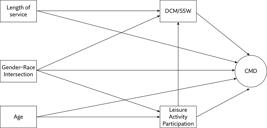
Conceptual framework of determinants of CMD among stricto sensu graduate students, Bahia, Brazil
Based on the model, the following hypotheses were defined:
-
H1: The greater the vulnerability at the intersection of gender and race, the greater the symptoms of CMD.
-
H2: The older the age, the more severe the symptoms of CMD.
-
H3: The longer the length of service, the greater the symptoms of CMD.
-
H4: The greater the exposure to DCM/SSW, the more severe the symptoms of TMC.
-
H5: The greater the vulnerability at the intersection of gender and race, the greater the exposure to DCM/SSW and the more severe the symptoms of TMC.
-
H6: In the absence of leisure activities, TMC symptoms are more severe.
-
H7: The greater the vulnerability at the intersection of gender and race, the less leisure activities are practiced, and the more severe the symptoms of TMC.
-
H8: The older the age, the lower the engagement in leisure activities and the more severe the symptoms of TMC.
-
H9: The longer the work hours, the greater the exposure to DCM/SSW and the more severe the TMC symptoms.
The Statistical Package for Social Sciences (SPSS®), version 24.0, was used to support the descriptive analysis for characterizing the sample. For qualitative (categorical) variables, absolute (n) and relative (%) frequencies were used, while measures of central tendency and dispersion were employed for continuous variables.
Subsequently, the database was exported to a format compatible with Mplus software, version 8.4, in which the Structural Equation Modeling (SEM) analyses were performed. To evaluate the SEM measurement model, consisting of the latent variable CMD, Exploratory Factor Analysis (EFA), and Confirmatory Factor Analysis (CFA) were conducted to test whether the factor structure of the latent construct was consistent with the recommendations for validating the SRQ-20 scale20. Items were considered to have a potential factor loading if they had a standardized factor loading (λ) greater than or equal to 0.3 and a residual variance (δ) less than or equal to 0.73528.
To analyze the structural model – comprising the latent variable (CMD) and directly observed variables (interaction of gender and race, age, length of employment, participation in leisure activities, and DCM/SSW) – standardized regression coefficients (β) were calculated at a 5% level of statistical significance. The magnitude of the direct, indirect, and total effects was classified as: small (around 0.10), moderate (close to 0.30), and large (> 0.50)29. The Weighted Least Squares Means and Variance Adjusted (WLSMV) estimator was used in this analysis, and to respecify the model, Modification Indices greater than or equal to 10 and Expected Changes in Parameters greater than or equal to 0.25 were considered30.
Model fit was assessed using the Root Mean Square Error of Approximation (RMSEA), which was less than 0.0630, with the lower limit of the 90% confidence interval below 0.05, given that this was a small sample (n < 200)19; the Comparative Fit Index (CFI) and the Tucker-Lewis Index (TLI) were greater than or equal to 0.9529.
Bias
Measures were taken to minimize potential sources of bias. Selection bias was reduced by using up-to-date institutional lists of faculty members from the participating universities, as well as through widespread dissemination of the study via institutional channels, with the aim of reaching as many eligible participants as possible.
To minimize information bias, validated instruments, such as the SRQ-20, with a defined recall period, were used to standardize the collection of self-reported data. Additionally, the possibility of healthy worker bias cannot be ruled out, since the study included only active faculty members; this limitation was considered in the interpretation of the results.
Ethical Considerations
The study was approved by the Research Ethics Committee of the Universidade Federal do Recôncavo da Bahia (CEP/UFRB), with approval number 6.137.234 (CAAE: 69857923.6.1001.0056), issued on June 22, 2023. All participants acessed the informed consent form and agreed to participate in the study.
Results
A total of 149 university faculty members from stricto sensu PPG participated in the study. Among the sociodemographic characteristics, there was a predominance of women (62.4%), white race/skin color (43.2%), women of mixed race/Indigenous/Black (31.8%), ages between 40 and 59 years (79.1%), with a median age of 51 years (IQR: 46–56; Min.: 31 and Max.: 69), and living with a partner (65.3%) (Table 1).
Regarding occupational characteristics, the majority had six or more years of work experience (88.6%), with a median of 15 years (IQR: 11–25; Min.: < 1 and Max.: 42); it was observed that 76.8% of teachers experienced high psychological demands, 31.9% had low control over their own work, and 68.1% had low social support. It was found that 21.9% of the participants were exposed to high-demand work, considered highly stressful. In addition, 57.5% were exposed to occupational stressors – high demand, low control, or low social support (referred to in the model as DCM/SSW). Regarding lifestyle habits, 29.8% of the teachers did not engage in leisure activities. The overall prevalence of CMD was 40.3%. The mean SRQ-20 score was 5.62 (SD: 4.72), with the highest mean score for symptoms of decreased energy (mean: 1.90; SD: 1.93) (Table 1).
The indicators of the latent variable CMD were the four symptom clusters comprising the SRQ-20, represented by the total scores for these dimensions. The EFA of these indicators revealed a unidimensional solution, as evidenced by a single eigenvalue greater than 1. The model’s fit indices were considered adequate, with strong (λ > 0.6) and significant factor loadings for all items, which exhibited low residual variance (δ < 0.61). The item with the highest factor loading was “Decrease in vital energy” (λ = 0.886), and the item with the lowest factor loading was “Depressive thoughts” (λ = 0.625). CFA confirmed this structure, with satisfactory fit indices (Table 2).
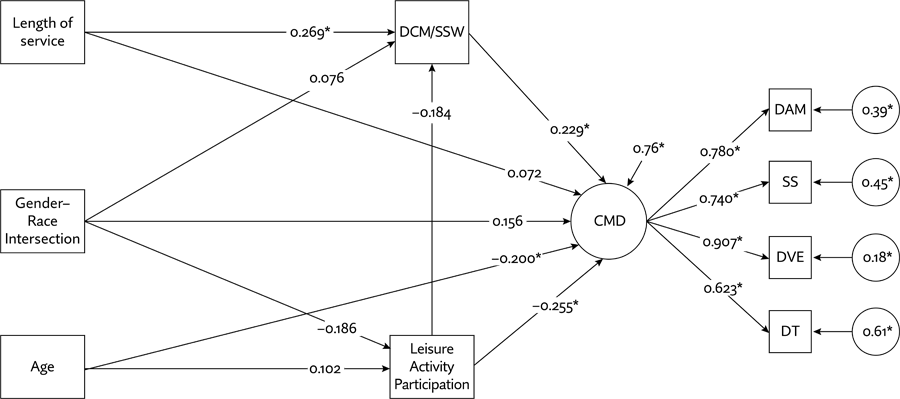
The final structural model includes the following explanatory variables: the interaction between gender and race, age, length of employment, participation in leisure activities, and the full DCM/SSW model; the response variable was the CMD (Figure 2). All fit indices for the structural model were satisfactory: X2/gl = 1.04; RMSEA = 0.016, with 90% CI = 0.000–0.075; CFI = 0.994; TLI = 0.990.

Structural equation model showing specific direct and indirect effects of determinants of CMD among faculty members in stricto sensu PPG. Bahia, Brazil, 2023 (n = 149)
Of the new hypotheses tested, three were confirmed (H4, H6, and H9), one was partially confirmed (H1), and five were not confirmed (H2, H3, H5, H6, and H7). The following variables had a moderate and statistically significant direct effect on CMD: age (β = -0.200; p-value = 0.040), participation in leisure activities (β = -0.255; p-value = 0.020), and occupational stressors (DCM/SSW) (β = 0.229; p-value = 0.031) (confirming H4 and H6) (Figure 2). H2 was not confirmed in the expected direction: the effect of age on CMD symptoms was the opposite of what was hypothesized, with younger age associated with greater CMD symptoms.
The evaluation of specific indirect paths with statistical significance showed that faculty members with longer tenure exhibited higher levels of stress on the DCM/SSW and, consequently, a greater increase in CMD symptoms, with a moderate effect of tenure on stress (β = 0.269; p-value = 0.038), confirming H9 (Figure 2). Hypotheses H3, H5, H7, and H8 were not confirmed, as no statistically significant direct or indirect effects were identified in the tested pathways.
The largest total effects of the explanatory variables on CMD were associated with not engaging in leisure activities (β = -0.297; p-value = 0.005), younger age (β = -0.230; p-value = 0.020), greater vulnerability at the intersection of gender and race (β = 0.229; p-value = 0.007), and DCM/SSW (β = 0.229; p-value = 0.031), with moderate and statistically significant effects. H1 was partially confirmed, since although no significant direct effect of the intersection of gender and race on CMD symptoms was identified, the total effect was significant. There were no specific indirect paths with a statistically significant total effect (Table 3).
Discussion
The results revealed a high prevalence of CMD symptoms among faculty members in stricto sensu graduate programs, with direct effects of occupational stressors (DCM/SSW), younger age, and not engaging in leisure activities. Occupational stressors acted as mediators of the relationship between working hours and CMD, revealing that the longer the working hours, the greater the level of exposure to stressors and the higher the levels of CMD symptoms. The interaction between gender and race, although it did not show a statistically significant direct effect on CMD, revealed a significant total effect.
Regarding the high prevalence of CMD among stricto sensu graduate faculty in this study (40.3%), this rate was higher than that found in other studies involving university faculty in general. Two studies conducted in the Northeast region of Brazil identified lower and similar prevalences: 29.9%16among faculty members at a public university in rural Bahia and 29%31among university faculty in rural Ceará.
In this study, it was found that psychosocial stressors contributed to an increase in CMD symptoms. This finding corroborates the existing literature, which widely recognizes the effects of work-related psychosocial factors on the occurrence of mental disorders in different occupational groups12. In the meta-review by Harvey et al.13, it was found that workers subjected to high job strain -characterized by high demands, low control, and low social support – exhibit poorer mental health outcomes.
Although documented in various occupations, such as elementary and secondary school teachers32 and healthcare workers14, research exploring these issues among graduate-level teachers is limited. Studies conducted more than a decade ago with teachers at other educational levels already indicated a possible association between psychosocial stressors and mental disorders. Early childhood and elementary school teachers with high-demand jobs had a 1.5-fold higher prevalence of mental disorders compared to those with low-demand jobs32.
In the context of stricto sensu graduate programs, teaching work is characterized by the coexistence of multiple responsibilities (teaching, research, advising, academic administration, and fundraising), the accumulation of which can intensify exposure to psychosocial stressors and contribute to psychological distress5,17. The pressure for productivity and scientific publication is associated with increased occupational stress7. This scenario of high demands and limited resources18,33 is consistent with the findings of the present study, which identified an association between psychosocial stressors and symptoms of CMD among PPG faculty members.
Another relevant aspect is that occupational stressors acted as mediators between teaching hours and CMD; that is, the longer the teaching hours, the greater the exposure to stressors and the higher the level of symptoms. A study in China34 showed similar results, indicating that years of teaching experience increase occupational stress among faculty members. This effect can be explained by the accumulation of responsibilities, pressure for scientific productivity, and the heightened expectations that come with seniority17,35.
On the other hand, younger faculty members also exhibited higher levels of symptoms – a finding that appear contradictory but can be explained by the fact that age and length of teaching experience reflect distinct stages of the professional trajectory35. While years of teaching reflect cumulative exposure to stressors specific to graduate programs, younger age captures a stage of life marked by job insecurity, pressure to establish a career, and a double workload17.
The literature on age and mental health among university faculty is controversial. A systematic review on burnout identified faculty members under 40 as the most vulnerable group in 33 of the 60 studies analyzed, linking this risk to job insecurity and limited coping strategies35. However, the same studies indicate that senior faculty members also face a high risk, attributed to the chronic accumulation of stress and increasing institutional demands35. These results suggest that both entry into and consolidation of a teaching career in graduate education constitute critical moments, albeit through distinct mechanisms, reinforcing the need for tailored mental health care strategies throughout the entire academic trajectory17,35.
The lack of leisure activities contributed to an increase in CMD symptoms in the study group. Leisure – defined as a voluntary, non-work-related activity undertaken during free time for the purpose of promoting pleasure and well-being – is associated with improved mental health by fostering positive emotions that strengthen resilience and enhance the ability to cope with stress36.
A study of medical professionals highlights this relationship: participation in leisure activities, especially those with cultural and social content, was associated with a lower prevalence of CMD, revealing that involvement in cultural activities has a moderate and positive relationship with mental health37.
Vieira et al.38 found that faculty members in stricto sensu graduate programs have difficulty disconnecting from work-related activities during their free time, which could otherwise be devoted to leisure. The evening hours, theoretically set aside for rest, are often used for academic reading, submitting institutional documents, responding to emails, and preparing for the next day’s activities38. This intense routine causes the workload to encroach on free time, leading to the neglect of recreational activities. In this context, hyperconnectivity exacerbates the situation by facilitating the intrusion of work at any time, making it difficult to separate work from leisure/rest, which harms mental health.
Regarding the intersection of gender and race and the symptoms of CMD, no statistically significant direct association was observed. However, a statistically significant total effect was found, suggesting that this relationship may occur through mediated mechanisms yet to be investigated. The absence of a direct effect may also reflect the predominance of Black, Brown, and Indigenous women in the sample, which may have reduced variability between groups and the statistical power to detect differences. Thus, the results should not be interpreted as an absence of inequality, but rather as a limitation of the study in capturing it.
The scarcity of studies on the intersection of gender and race among graduate faculty makes it difficult to compare these findings with empirical evidence from this context. In other occupational settings, a higher prevalence of mental disorders has been observed among Black women, followed by non-Black women, with non-Black men being the least affected39. Although these findings cannot be directly extrapolated to the population under investigation, they help contextualize the complexity of structural inequalities in the academic environment and underscore the need for future research with larger and more diverse samples.
This study has limitations that should be considered when interpreting the results. The cross-sectional design prevents the establishment of temporal relationships between exposures and the outcome. In other words, it does not allow for the exclusion of reverse causality; it is plausible, for example, that faculty members with more severe CMD symptoms reduce their leisure activities over time, and not just the other way around. The inclusion of only currently active faculty members may imply a healthy worker bias, with a possible underestimation of the prevalence of CMD.
Convenience sampling, restricted to two public universities in the interior of Bahia, limits the generalizability of the findings. Furthermore, participant self-selection bias may have influenced the estimates, since faculty members who are more aware of the issue tend to participate in greater numbers. No prior sample size calculation was performed, and because this was an analytical subset of a broader study, it was not possible to estimate the response rate, which makes it difficult to assess the sample’s representativeness.
The sample studied, although reduced for multiple-pathway MEE, showed adequate fit indices. However, the statistical power may have been insufficient to detect associations of smaller magnitude, increasing the possibility of Type II error. Thus, non-significant effects, particularly direct and indirect effects related to the intersectionality of gender and race, should be interpreted with caution.
The dichotomization of the length of service variable resulted in an asymmetric distribution across categories, with the sample concentrated in the group with the longest tenure, which may have limited the detection of differences within that group. Similarly, measuring leisure activities using a single dichotomous item without a validated instrument may compromise its validity; the use of psychometric instruments is recommended in future studies.
Finally, the scarcity of studies involving faculty members in stricto sensu graduate programs limits the direct comparison of findings. It is recommended that future studies employ larger samples, longitudinal designs, and probabilistic sampling strategies to enhance the robustness of the evidence regarding factors associated with mental health issues in this population.
Based on the data from this study, the complexity of the factors that interrelate with the mental health of faculty members in stricto sensu graduate programs is evident, and there are no simple solutions to transform this reality. It is necessary to propose structural changes in research evaluation paradigms and implement public policies that hold higher education institutions accountable for promoting a less stressful work environment, providing spaces and time for rest and leisure, and establishing support networks and welcoming spaces for listening. It is also important to encourage the collective organization of these workers.
References
-
1 Leite JL. Publicar ou perecer: a esfinge do produtivismo acadêmico. Rev Katálysis. 2017;20(2):207-15. https://doi.org/10.1590/1982-02592017v20n2p207
» https://doi.org/10.1590/1982-02592017v20n2p207 -
2 Ruza FM, Silva EP. As transformações produtivas na pós-graduação: o prazer no trabalho docente está suspenso? Rev Subj. 2016;16(1):91-103. https://doi.org/10.5020/23590777.16.1.91-103
» https://doi.org/10.5020/23590777.16.1.91-103 -
3 Misra J, Kuvaeva A, O'Meara K, Culpepper DK, Jaeger A. Gendered and racialized perceptions of faculty workloads. Gend Soc. 2021;35(3):358-94. https://doi.org/10.1177/08912432211001387
» https://doi.org/10.1177/08912432211001387 -
4 Grupo de Estudos Multidisciplinares da Ação Afirmativa. Desigualdades raciais na ciência brasileira. Rio de Janeiro: IESP/UERJ; 2023 [citado 4 jun 2025]. Disponível em: https://gemaa.iesp.uerj.br/infografico/desigualdades-raciais-na-ciencia-brasileira/
» https://gemaa.iesp.uerj.br/infografico/desigualdades-raciais-na-ciencia-brasileira/ -
5 Reis TD, March C. Trabalho docente, saúde e gênero: implicações da conjuntura político-econômica na educação superior. Rev Katálysis. 2021;24(2):310-20. https://doi.org/10.1590/1982-0259.2021.e77246
» https://doi.org/10.1590/1982-0259.2021.e77246 -
6 Guimarães AR, Brito CS, Santos JAB. Expansão e financiamento da pós-graduação e desigualdade regional no Brasil (2002-2018). Praxis Educ. 2020;16(41):47-71. https://doi.org/10.22481/praxisedu.v16i41.7244
» https://doi.org/10.22481/praxisedu.v16i41.7244 -
7 Teixeira TSC, Marqueze EC, Moreno CRC. Produtivismo acadêmico: quando a demanda supera o tempo de trabalho. Rev Saúde Pública. 2020;54:117. https://doi.org/10.11606/s1518-8787.2020054002288
» https://doi.org/10.11606/s1518-8787.2020054002288 - 8 Committee on Occupational Health. Psychosocial factors at work: recognition and control. Geneva: International Labour Office; 1986.
-
9 Karasek RA. Job demands, job decision latitude, and mental strain: implications for job redesign. Adm Sci Q. 1979;24(2):285-308. https://doi.org/10.2307/2392498
» https://doi.org/10.2307/2392498 -
10 Araújo TM, Graça CC, Araújo E. Estresse ocupacional e saúde: contribuições do modelo demanda-controle. Cienc Saude Colet. 2003;8(4):991-1003. https://doi.org/10.1590/S1413-81232003000400021
» https://doi.org/10.1590/S1413-81232003000400021 - 11 Karasek RA, Theorell T. Healthy work: stress, productivity, and the reconstruction of working life. New York: Basic; 1990.
-
12 Campos FM, Araújo TM, Viola DN, Oliveira PCS, Sousa CC. Estresse ocupacional e saúde mental no trabalho em saúde: desigualdades de gênero e raça. Cad Saude Colet. 2020;28(4):579-89. https://doi.org/10.1590/1414-462X202028040559
» https://doi.org/10.1590/1414-462X202028040559 -
13 Harvey SB, Modini M, Joyce S, Milligan-Saville JS, Tan L, Mykletun A et al. Can work make you mentally ill? A systematic meta-review of work-related risk factors for common mental health problems. Occup Environ Med. 2017;74(4):301-10. https://doi.org/10.1136/oemed-2016-104015
» https://doi.org/10.1136/oemed-2016-104015 -
14 Mattos AIS, Araújo TM, Almeida MMG. Interaction between demand-control and social support in the occurrence of common mental disorders. Rev Saúde Pública. 2017;51:46. https://doi.org/10.1590/s1518-8787.2017051006446
» https://doi.org/10.1590/s1518-8787.2017051006446 - 15 Goldberg D, Huxley P. Common mental disorders: a bio-social model. London: Tavistock; 1992.
-
16 Campos TC, Véras RM, Araújo TM. Transtornos mentais comuns em docentes do ensino superior. Avaliação. 2020;25(3):745-68. https://doi.org/10.1590/S1414-40772020000300012
» https://doi.org/10.1590/S1414-40772020000300012 -
17 Hammoudi Halat D, Soltani A, Dalli R, Alsarraj L, Malki A. Understanding and fostering mental health and well-being among university faculty: a narrative review. J Clin Med. 2023;12(13):4425. https://doi.org/10.3390/jcm12134425
» https://doi.org/10.3390/jcm12134425 -
18 Glatz ETMM, Yaegashi SFR, Caetano LM. A saúde mental do docente na Pós-Graduação Stricto Sensu: uma revisão de literatura. Plurais Rev Multidiscip. 2024;9(spe.1):1-26. https://doi.org/10.29378/plurais.v9iesp.1.19404
» https://doi.org/10.29378/plurais.v9iesp.1.19404 -
19 Chen F, Curran PJ, Bollen KA, Kirby J, Paxton P. An empirical evaluation of the use of fixed cutoff points in RMSEA test statistic in structural equation models. Soc Methods Res. 2008;36(4):462-94. https://doi.org/10.1177/0049124108314720
» https://doi.org/10.1177/0049124108314720 -
20 Santos KOB, Araújo TM, Pinho PS, Silva ACC. Avaliação de um instrumento de mensuração de morbidade psíquica: estudo de validação do Self-Reporting Questionnaire (SRQ-20). Rev Baiana Saude Publica. 2010;34(3):544-60. https://doi.org/10.22278/2318-2660.2010.v34.n3.a54
» https://doi.org/10.22278/2318-2660.2010.v34.n3.a54 -
21 Santos KOB, Araújo TM, Oliveira NF. Estrutura fatorial e consistência interna do SRQ-20 em população urbana. Cad Saúde Pública. 2009;25(1):214-22. https://doi.org/10.1590/S0102-311X2009000100023
» https://doi.org/10.1590/S0102-311X2009000100023 -
22 Santos KOB, Carvalho FM, Araújo TM. Internal consistency of the SRQ-20 in occupational groups. Rev Saúde Pública. 2016;50:6. https://doi.org/10.1590/S1518-8787.2016050006100
» https://doi.org/10.1590/S1518-8787.2016050006100 -
23 Barreto do Carmo MB, Santos LM, Feitosa CA et al. Screening for common mental disorders using the SRQ-20 in Brazil. Braz J Psych. 2018;40(2):115-22. https://doi.org/10.1590/1516-4446-2016-2139
» https://doi.org/10.1590/1516-4446-2016-2139 - 24 Araújo TM, Karasek R. Validity and reliability of the job content questionnaire in formal and informal jobs in Brazil. Scand J Work Environ Health Suppl. 2008;34(6):52-9.
-
25 Gomes MR, Araújo TM, Soares JFS, Sousa CC, Lua I. Estressores ocupacionais e acidentes de trabalho entre trabalhadores da saúde. Rev Saúde Pública. 2021;55:98. https://doi.org/10.11606/s1518-8787.2021055002938
» https://doi.org/10.11606/s1518-8787.2021055002938 -
26 Heidari S, Babor TF, De Castro P, Tort S, Curno M. Sex and gender equity in research: rationale for the SAGER guidelines and recommended use. Res Integr Peer Rev. 2016;1:2. https://doi.org/10.1186/s41073-016-0007-6
» https://doi.org/10.1186/s41073-016-0007-6 -
27 Smolen JR, Araújo EM, Oliveira NF, Araújo TM. Intersectionality of race, gender, and common mental disorders in Northeastern Brazil. Ethn Dis. 2018;28(3):207-14. https://doi.org/10.18865/ed.28.3.207
» https://doi.org/10.18865/ed.28.3.207 -
28 Reichenheim ME, Hökerberg YHM, Moraes CL. Assessing construct structural validity of epidemiological measurement tools: a seven-step roadmap. Cad Saude Publica. 2014;30(5):927-39. https://doi.org/10.1590/0102-311X00143613
» https://doi.org/10.1590/0102-311X00143613 - 29 Kline RB. Principles and practice of structural equation modeling. New York: Guilford Press; 2015.
- 30 Brown TA. Confirmatory factor analysis for applied research. New York: Guilford; 2015.
-
31 Vieira CAL, Pinheiro FPHA, Furtado NRX, Cunha ES, Aguiar HMT, Escórcio GF et al. Prevalência e preditores de transtornos mentais comuns entre professores universitários do interior cearense. Rev Psicol Organ Trab. 2023;23(1):2373-82. https://doi.org/10.5935/rpot/2023.1.23038
» https://doi.org/10.5935/rpot/2023.1.23038 -
32 Porto LA, Carvalho FM, Oliveira NF, Silvany Neto AM, Araújo TM, Reis EJFB et al. Associação entre distúrbios psíquicos e aspectos psicossociais do trabalho de professores. Rev Saúde Pública. 2006;40(5):818-26. https://doi.org/10.1590/S0034-89102006005000001
» https://doi.org/10.1590/S0034-89102006005000001 -
33 Lei W, Li J, Li Y, Castaño G, Yang M, Zou B. The boundary conditions under which teaching-research conflict leads to university teachers' job burnout. Stud High Educ. 2021;46(2):406-42. https://doi.org/10.1080/03075079.2020.1811218
» https://doi.org/10.1080/03075079.2020.1811218 -
34 Meng Q, Wang G. A research on sources of university faculty occupational stress: a Chinese case study. Psychol Res Behav Manag. 2018;11:597-605. https://doi.org/10.2147/PRBM.S187295
» https://doi.org/10.2147/PRBM.S187295 -
35 Cadena-Povea H, Hernández-Martínez M, Bastidas-Amador G, Torres-Andrade H. What pushes university professors to burnout? A systematic review of sociodemographic and psychosocial determinants. Int J Environ Res Public Health. 2025;22(8):1214. https://doi.org/10.3390/ijerph22081214
» https://doi.org/10.3390/ijerph22081214 -
36 Fancourt D, Aughterson H, Finn S, Walker E, Steptoe A. How leisure activities affect health: a narrative review and multi-level theoretical framework of mechanisms of action. Lancet Psych. 2021;8(4):329-39. https://doi.org/10.1016/S2215-0366 (20)30384-9
» https://doi.org/10.1016/S2215-0366 (20)30384-9 -
37 Rocha SV, Cardoso JP, Correia RA, Silva NN, Araújo TM. Atividades de lazer e transtornos mentais comuns entre médicos de municípios baianos. Rev Bras Saude Ocup. 2024;49:e14. https://doi.org/10.1590/2317-6369/15122pt2024v49e14
» https://doi.org/10.1590/2317-6369/15122pt2024v49e14 -
38 Vieira MHP, Fontes ARM, Gemma SFB, Montedo UB. Produtivismo na pós-graduação na perspectiva da ergonomia da atividade. Educ Pesq. 2020;46:e220223. https://doi.org/10.1590/S1678-4634202046220223
» https://doi.org/10.1590/S1678-4634202046220223 -
39 Sousa CC, Araújo TM, Maturino MM. Occupational stressors and mental illness in healthcare work: an intersection between gender, race, and class. Am J Ind Med. 2024;67(2):143-53. https://doi.org/10.1002/ajim.23558
» https://doi.org/10.1002/ajim.23558
-
Information on academic work:
This article is based on the master’s thesis titled “Fatores psicossociais do trabalho e a saúde mental dos docentes da pós-graduação: modelagem de equações estruturais (Psychosocial factors at work and the mental health of graduate faculty: structural equation modeling)”, defended by the author Débora Ramos de Araújo Souza in the Graduate Program in Public Health at the Universidade Estadual de Feira de Santana, in February 27, 2025.
-
Data Availability:
The data are not publicly available to preserve the anonymity of the participants. They may be made available upon justification and request to the corresponding author.
-
Statement on the use of Artificial Intelligence:
The authors declare that no AI tools were used.
-
Presentation at a scientific event:
The authors report that the study was not presented at a scientific event.
-
Funding:
The authors declare that the study was not subsidized.
Edited by
-
Responsible editor:
Leila Posenato Garcia https://orcid.org/0000-0003-1146-2641 Fundação Jorge Duprat Figueiredo de Segurança e Medicina do Trabalho - FUNDACENTRO
The data are not publicly available to preserve the anonymity of the participants. They may be made available upon justification and request to the corresponding author.

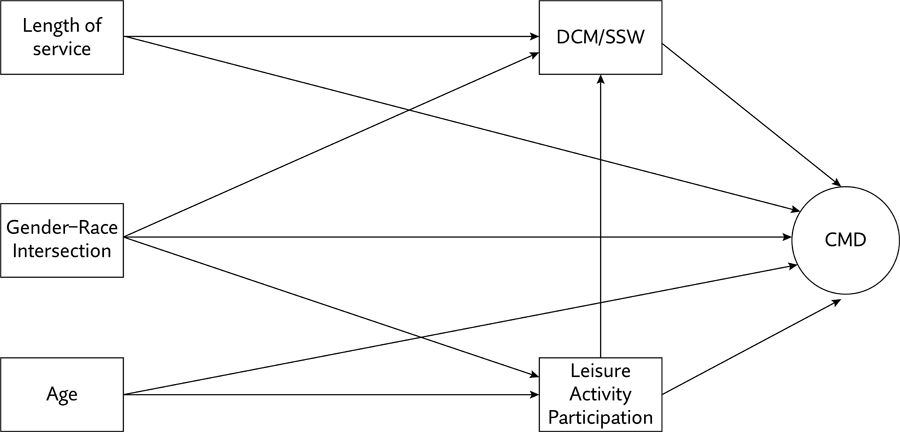 DCM/SSW: Comprehensive Demand-Control and Social Support at Work Model; CMD: Common Mental Disorders.
 DCM/SSW: Demand-Control Model// Social Support at Work; DAM: Depressive-Anxious Mood; SS: Somatic Symptoms; DVE: Decrease in Vital Energy; DT: Depressive Thoughts.*5% statistical significance