 Africanized bee (Hymenoptera: Apidae) sting accidents and honey production: An epidemiological analysis in the state of Piauí (2014–2023)
ABSTRACT
Piauí ranks among the states with the largest honey production in Brazil, with a growing number of beekeepers concentrated especially in the semi-arid region. Despite its socioeconomic relevance, concerns arise regarding the increased risk of accidents involving Africanized bees, particularly when considering the precarious medical care provided to victims of venomous animal accidents in inland cities. The objective was to analyze the relationship between honey production in the state and the spatial distribution of bee-related accidents, as well as to describe their epidemiological characteristics. The study is exploratory-retrospective, using data available from the IBGE Automatic Recovery System and the Piauí State Health Department, covering the period from 2014 to 2023. The variables analyzed regarding accident characteristics were age group, sex, occupation, sting location, clinical manifestation, and final case classification. A total of 5,984 bee-related accidents were recorded in 176 municipalities of Piauí, representing 10.4% of venomous animal accidents in the state, with 13 deaths and an average lethality rate of 0.22%. Although a strong correlation was observed between the occurrence of bee accidents and honey production (r=0.85), there was no higher incidence of accidents among the state's main production hubs, possibly due to greater professionalization of beekeeping in these municipalities. Accidents predominantly occurred in urban areas, involving adult men, which indicates the presence of established colonies or transient swarms in the urban environment. It is concluded that there is no relationship between beekeeping production and the occurrence of accidents in Piauí.
Keywords
venomous animal; beekeeping; public health; one health
RESUMO
O Piauí figura entre os maiores produtores de mel do país, com crescente número de apicultores lotados especialmente na região semiárida. Apesar da relevância socioeconômica, emerge a preocupação com o maior risco de acidentes envolvendo as abelhas africanizadas, especialmente quando se considera a precariedade no atendimento médico prestado às vítimas de acidentes com animais peçonhentos nas cidades do interior. Objetivou-se analisar a relação entre a produção de mel no estado e a distribuição espacial dos acidentes com abelhas, além de descrever as suas características epidemiológicas. O estudo é exploratório-retrospectivo, com a utilização de dados disponíveis no Sistema IBGE de Recuperação Automática e na Secretaria de Saúde do Piauí, com recorte temporal de 2014 a 2023. Em relação às características dos acidentes, foram analisadas as variáveis: faixa etária, sexo, ocupação, local da ferroada, manifestação clínica e classificação final dos casos. Foram registrados 5.984 acidentes com abelhas em 176 municípios do Piauí, representando 10,4% dos acidentes com animais peçonhentos no estado, com 13 óbitos e taxa de letalidade média de 0,22%. Embora tenha sido observada uma forte correlação entre a ocorrência de acidentes com abelhas e a produção de mel (r=0,85), não houve maior incidência de acidentes entre os principais polos produtivos do estado, possivelmente devido a maior profissionalização da atividade apícola nesses municípios. O estudo ressalta a necessidade de investigações adicionais sobre os fatores que influenciam a ocorrência desses eventos, incluindo possíveis impactos da apicultura migratória e da urbanização.
Palavras-chave
animais peçonhentos; apicultura; saúde pública; saúde única
1. Introduction
The honeybee, Apis mellifera L., is the most bred and managed bee species in the world (vanEngelsdorp & Meixner, 2010). According to Crane (1999), the greatest expansion of the area of its distribution was a consequence of human movements, especially during colonial periods. In this context, different subspecies of Apis mellifera were introduced to Brazil by Jesuits in the 19th century and by European immigrants at the end of the 20th century. However, Brazilian beekeeping is particularly marked by the introduction of the African subspecies (Apis mellifera scutellata) in 1956 and its crossbreeding with other European subspecies, which resulted in the Africanized honeybee (Stort & Gonçalves, 1994).
Although the emergence of this polyhybrid has positively impacted the Brazilian economy, boosting the development of beekeeping in Brazil, which currently stands out as one of the world's largest honey exporters (Ferreira Junior et al., 2012), the defensive behavior of these bees has resulted in severe and fatal envenomations for humans and other domestic animals (Fighera et al., 2007; Fonteque et al., 2018; Marques et al., 2020; Ribeiro et al., 2020; Santos & Mendes, 2016; Sousa et al., 2015).
In the state of Piauí, technified beekeeping began in the early 1980s and gained prominence from 2001 onwards (Veloso Filho et al., 2012) with the entry of Brazilian honey into the international market (Pasin et al., 2012; Perosa et al., 2004). This scenario encouraged the inclusion of a greater number of people in beekeeping, with the state multiplying its production more than fivefold, making it the second-largest honey-producing state in the country (Brazilian Institute of Geography and Statistics [IBGE], 2024). This has generated employment and income opportunities for many families, especially in regions covered by the semi-arid climate (Carvalho et al., 2019; Veloso Filho et al., 2012).
On the other hand, there has been a gradual increase in the number of accidents involving bees throughout Brazil (Terças et al., 2017). According to data from the National Notifiable Diseases Information System of the Ministry of Health (Brazil, 2025), consulted directly from this open-access platform, just over 12,000 accident cases were recorded in the country in 2016, 23,553 in 2019, and 33,427 in 2023. According to Kono et al. (2021), the Northeast is the region with the second-most recorded accidents.
Piauí ranks 21st among federation units and 5th among Northeast states in the number of referral hospitals for the care of victims of accidents caused by venomous animals per capita (Brazil, 2022). This evidences a precariousness in the medical care provided to patients who are victims of venomous animal accidents (Cunha et al., 2019). Considering the growing importance of beekeeping in Piauí and the increase in bee accidents in the Northeast, there is a gap in the understanding of the spatial distribution of these events and their correlation with honey production in the state.
Given this scenario, this study aimed to analyze the spatial distribution of bee accidents in Piauí and investigate their correlation with the state's honey production, as well as to describe the epidemiological characteristics of these events.
2. Material and methods
This is an exploratory-retrospective study based on secondary data from the Piauí State Health Department (SESAPI) and the IBGE Automatic Recovery System (SIDRA), with data on bee-related accidents and honey production, respectively. The geographical scope adopted was the state of Piauí (Figure 1).

Map of the state of Piauí, with municipalities in light green and Brazilian state borders in gray.
The period from 2014 to 2023 was selected to ensure the inclusion of recent and consolidated data and to avoid inconsistencies arising from underreporting or delays in SESAPI records. The information provided by SESAPI was chosen because the records are organized according to the municipality of occurrence of the health event, unlike the data available in the National Notifiable Diseases Information System of the Ministry of Health, which only provides the municipality of notification.
2.1. Analysis of the spatial distribution and the relationship between honey production and the occurrence of accidents involving bees and humans
Data regarding honey production for each year within the same period was extracted from SIDRA (IBGE, 2024). The quantity of honey produced (in kilograms) was converted into georeferenced data using the spatial coordinates provided by IBGE to ensure consistency in cartographic visualization. The map was created using QGIS v3.40 software, which allowed for the spatial visualization of accidents and honey production in the state.
The association between honey production and the occurrence of accidents was assessed using non-parametric tests (Spearman's correlation and Kendall's Tau-B), suitable for non-normally distributed data. Causality analyses were not performed, given the observational design of the study. Results with p < 0.05 were considered significant, and all analyses were performed using the Jamovi v2.3.28 software.
2.2. Epidemiological characteristics
Data on accidents — age group, sex, occupation, sting location, clinical manifestation, and final case classification — were retrieved for the 224 municipalities of the state. The study exclusively used secondary data, which are publicly accessible and do not identify participants, thus being exempt from the need for approval by the Research Ethics Committee, in accordance with resolution 510/2016 of the National Health Council.
3. Results and Discussion
During the study period, 5,984 cases of accidents involving bees and humans were reported in 176 of the 224 municipalities of Piauí, representing 10.4% of venomous animal accidents in the state. The number of accidents varied among years, with a significant increase during the study period (Figure 2).

Evolution of honey production and the number of bee accident notifications in Piauí, from 2014 to 2023.
Honey production and the number of accidents in Piauí were strongly positively correlated over the studied time frame (r = 0.85, p = 0.005). Although this significant correlation points to a simultaneous growth of these two variables, the influence of secondary effects cannot be dismissed, such as improvements in the accident notification system (Kono et al., 2021; Sousa et al., 2015) and the professionalization of beekeepers regarding bee management and accident prevention.
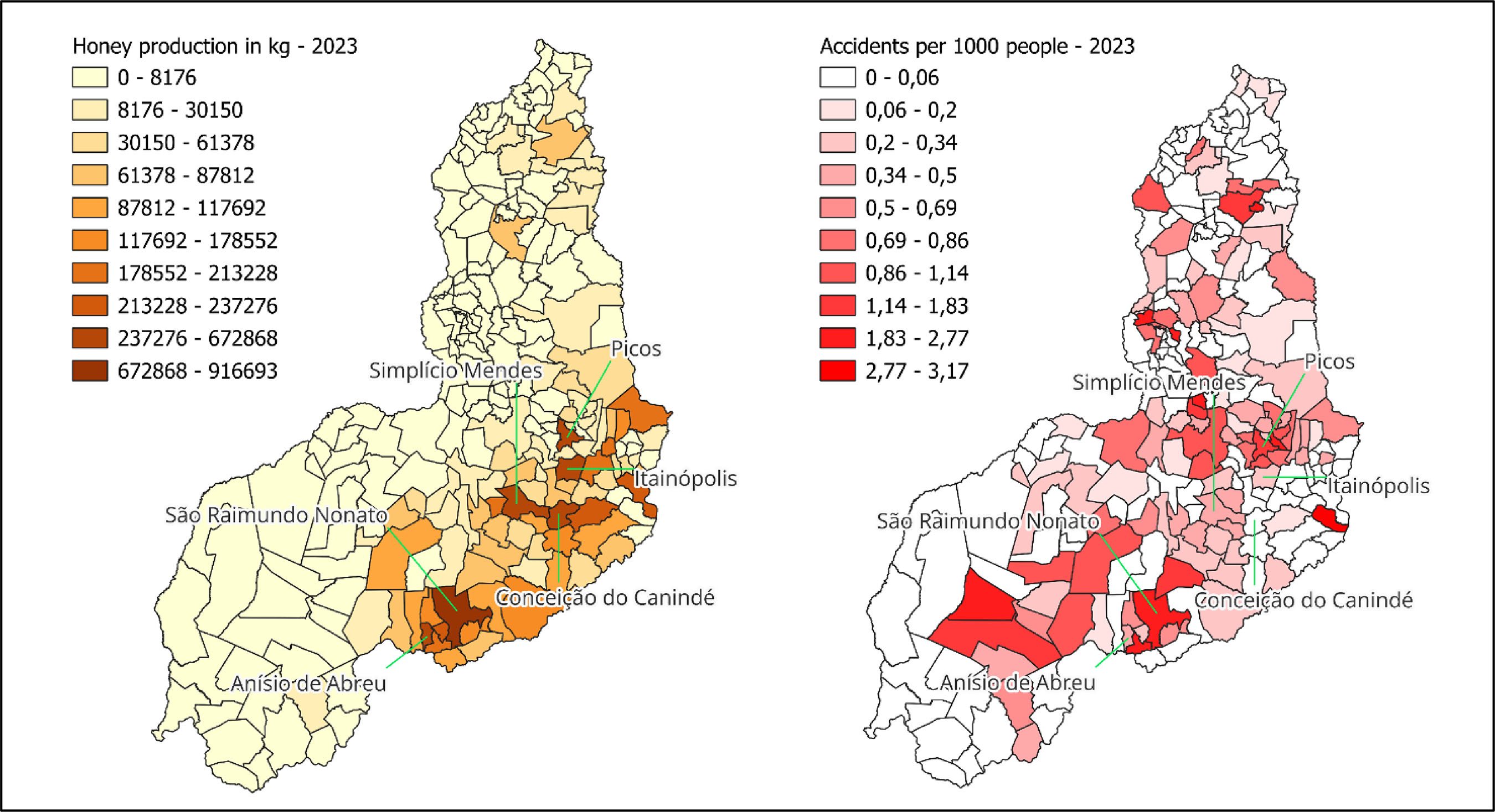
On the other hand, a high prevalence of accidents involving humans and bees was not observed among the main honey production hubs in Piauí (São Raimundo Nonato, Picos, Itainópolis, Anísio de Abreu, Conceição do Canindé, and Simplício Mendes, respectively), demonstrating the absence of a spatial relationship between honey production and these events (Figure 3).
Piauí is the state of the Northeast Region with the greatest tradition in beekeeping (Khan et al., 2014). The cooperative structure of the activity is noteworthy in the state as it involves different levels of organization and intermediary actors between the beekeeper and the exporter (Vidal, 2018). Among these actors, rural extension agencies play an important role in the professionalization of these producers. A.E.P. Araújo et al. (2022) highlight the adoption of good management practices among beekeepers in the semi-arid region of Piauí regarding the prevention of bee accidents, emphasizing that the proper use of personal protective equipment (PPE) and adequate spacing between hives, apiaries, and public roads are practices that minimize the occurrence of accidents for both beekeepers and the general population.

Honey production and accident incidence per thousand inhabitants in the municipalities of Piauí in 2023.
Furthermore, it is noted that only 2.37% of the cases were related to the victims' work. Thus, it can be inferred that the tradition and professionalization of beekeepers may explain the lower prevalence of bee accidents in these beekeeping hubs. Even with an average growth of 276% in honey production between 2014 and 2023 (IBGE, 2024), with São Raimundo Nonato being a highlight, this trend does not apply to the growth of the accident rate in the same municipalities (165%). Moreover, the familiarity of residents of these municipalities with the activity may encourage the adoption of certain precautions that contribute to accident prevention.
Exploratory analysis of the annual variation in notifications showed that May, June, July, and August are the months with the highest occurrence of accidents involving humans and bees. It should be noted that, in Piauí, most municipalities are in the semi-arid region, characterized by high temperatures, low relative humidity, and irregular rainfall. During the dry season, these factors reduce the availability of floral resources, leading to the weakening and absconding of bee colonies (Melquíades et al., 2020), which forces many beekeepers in the region to migrate with their hives to other areas in search of better production conditions.
Although the relationship between migratory beekeeping and accidents involving bees and humans was not a central objective of this study, data on the issuance of Animal Transit Permits (GTA) from the Agricultural Defense Agency of the state of Piauí (ADAPI) indicate a greater migratory flow of hives during the months with the highest incidences of accidents. This possible relationship suggests the need for future studies for a better understanding of the link between hive movement and accidents involving bees.
Several authors (Freitas et al., 2007; Maciel et al., 2016; Silva et al., 2018; Toledo et al., 2006; Zaluski et al., 2014) have observed the occurrence of established Africanized bee colonies and transient swarms in urban areas. Thus, the higher occurrence of accidents involving bees and humans in urban areas observed in the present study (55.6%) may be related to the fact that 69.4% of the population of Piauí is concentrated in such areas (IBGE, 2022). It is also important to underline that, as previously mentioned, the availability of blooms is greatly reduced during much of the year in the semi-arid region, which can lead to the natural migration of swarms towards urban areas. This favors accidents that may occur when people inadvertently pass near a bee colony, throw objects and/or chemical products at it, or attempt to remove or destroy it without adequate protection (Mello et al., 2003).
Considering the high occurrence of bee accidents in urban areas, bee colony removal projects have been carried out in Brazil to provide an appropriate destination for these insects, which is a valuable tool for reducing accidents (Silva et al., 2018; Toledo et al., 2006). In Piauí, the Federal University of Piauí, through a university extension project in partnership with the Environmental Police, conducted training for military personnel for the safe removal of colonies and transient urban swarms in the municipality of Teresina. Similarly, training was provided to the municipal Fire Department in the municipality of Picos. Nonetheless, the sustainability of these university extension projects depends on greater governmental incentives for better service systematization.
Analysis of the epidemiological characteristics of the accidents reveals an incidence of 37.9 cases/100,000 inhabitants in 2023. Thirteen deaths as a direct result of stings were recorded throughout the entire study period, representing a lethality rate of 0.22% of cases (Table 1, Figure 4). The majority of accidents and deaths involved adult males (60.1% and 61.5%, respectively), corroborating several studies conducted in the country (Diniz et al., 2016; A.E.P. Araújo et al., 2022; Marques et al., 2020; Oliveira et al., 2019; 2020; Silva et al., 2019). K. A.M. Araújo et al. (2022), Kono et al. (2021) and Sousa et al. (2015) observed that this trend is likely related to work activities, predominantly performed by men, which provide greater opportunity for contact with bees. Women's participation in beekeeping remains low (Correia-Oliveira et al., 2010; Khan et al., 2014), including in the state of Piauí (Carvalho et al., 2019), reflecting sociocultural and historical factors related to the role of female labor in rural areas. The higher number of deaths can also be explained by the propensity of men to develop more allergic reactions to hymenopteran stings, which is twice as high as that for women (Pitchon et al., 2014).
Socioeconomic and epidemiological characterization (n (%)) of victims of bee accidents reported in the state of Piauí (2014–2023). Absolute numbers and percentages are presented by year of study.

Infographic with the total socioeconomic and epidemiological characterization of bee accidents reported in the state of Piauí (2014–2023).
Although the victim profile observed in this study predominantly indicates the adult age group, there was a higher prevalence of those with the occupation of student, who are mostly children and young people (Anísio Teixeira National Institute for Educational Studies and Research [INEP], 2020). This prevalence corroborates the findings of Kono et al. (2021) and Silva et al. (2019) regarding accidents with venomous animals in Brazil. According to Kono et al. (2021), young people are more susceptible to these accidents due to a limited perception of risks, as well as curiosity and socio-environmental stimuli. Furthermore, Kono et al. (2021) point out that seeking medical care for bee stings tends to be more frequent when the victim is a child. However, it is important to note that information on occupation is not a mandatory field on the notification form for accidents with venomous animals, which is filled out by health professionals during consultations. Only 29% of the forms in the analyzed dataset contained this information, which may compromise the representativeness of the data.
The clinical manifestations of most accidents caused by one or a few stings are basically local pain, edema, paresthesia, ecchymosis, and inflammation. However, occasionally, cases can progress to a severe allergic reaction, which can result in death due to complications such as glottal edema and/or anaphylactic shock (Almeida et al., 2011). Furthermore, the authors emphasize that accidents involving multiple stings often result in a systemic toxic condition known as envenomation syndrome, which can lead to death as a consequence of complications such as acute respiratory failure, acute renal failure, electrolyte disturbances, shock, and rhabdomyolysis.
The information evaluated in the present study reveals that the majority of cases resulted in a cure (99.7%). This corroborates the study by Terças et al. (2017), which found that, for the most part, cases studied in Brazil are considered mild and that the severity of accidents depends on sting location, number of stings, sensitivity of the stung individual, and the toxicity of the venom. However, the frequency of systemic manifestations varied throughout the analyzed period (Table 1), highlighting the need for additional investigations to understand this variation.
The present study found the head to be the main target of bee attacks, accounting for 452 occurrences in the year with the highest number of accidents (2023), followed by the hands (161), trunk (152), and arms (139) (Figure 4). Diniz et al. (2016) hypothesized that the prevalence of attacks to the head may be because flying insects generally fly at human head height. The upper limbs are frequently used in an attempt by people to ward off bees when attacked, and so they also end up being more affected.
According to Martins and Becil Junior (2018), the scientific literature on bee accidents is still scarce in Brazil, which reinforces the need to conduct studies aiming to strengthen appropriate preventive and therapeutic measures. In this sense, the present study contributes to a greater understanding of the epidemiology of accidents in the state of Piauí and the spatial distribution of occurrences. Although a positive correlation was observed between honey production and bee accidents during the studied time frame, the spatial distribution of accidents does not coincide with the municipalities that are considered production hubs. Due to the scarcity of information on the subject and the high rates of underreporting in the context of the epidemiology of accidents with venomous animals, the influence of beekeeping on the dynamics of these events has yet to be measured.
4. Conclusions
The number of reported accidents involving bees and humans in Piauí increased between 2014 and 2023, and there was a positive correlation between honey production and the total number of registered cases in the state. However, the spatial distribution of the occurrences was not concentrated in the municipalities with the highest beekeeping production, suggesting that the professionalization of beekeepers has played an important role in reducing accidents in these areas. There is a clear need for further investigation into the factors influencing the occurrence of these events, including the possible impacts of migratory beekeeping and urbanization.
Acknowledgments
This study was financed in part by the “Coordenação de Aperfeiçoamento de Pessoal de Nível Superior – Brasil (CAPES) – Finance Code 001” and by “Fundação de Amparo à Pesquisa do Estado do Piauí (FAPEPI)”.
References
-
Almeida, R. A. M. de B., Olivo, T. E. T., Mendes, R. P., Barraviera, S. R. C. S., Souza, L. do R., Martins, J. G., Hashimoto, M., Fabris, V. E., Ferreira Junior, R. S., & Barraviera, B. (2011). Africanized honeybee stings: How to treat them. Revista da Sociedade Brasileira de Medicina Tropical, 44(6), 755–761. https://doi.org/10.1590/S0037-86822011000600020.
» https://doi.org/10.1590/S0037-86822011000600020 -
Anísio Teixeira National Institute for Educational Studies and Research (INEP). (2020). Censo escolar Ministry of Education. https://www.gov.br/inep/pt-br/areas-de-atuacao/pesquisas-estatisticas-e-indicadores/censo-escolar
» https://www.gov.br/inep/pt-br/areas-de-atuacao/pesquisas-estatisticas-e-indicadores/censo-escolar - Araújo, A. E. P., Melquíades, C. D. C. V., & Bendini, J. (2022). Ocorrência de acidentes com abelhas entre os apicultores do semiárido piauiense. Ciência Animal, 32(4), 37–48.
-
Araújo, K. A. M., de Araújo, J. M. D., & de Souza Leite, R. (2022). Epidemiological study of the bee stings in the state of Bahia, northeastern Brazil, from 2010 to 2019. Revista de Ciências Médicas e Biológicas, 21(1), 73–78. https://doi.org/10.9771/cmbio.v21i1.45286.
» https://doi.org/10.9771/cmbio.v21i1.45286 -
Brazil. (2022). Hospitais de referência para atendimento Ministry of Health. https://www.gov.br/saude/pt-br/assuntos/saude-de-a-a-z/a/animais-peconhentos/hospitais-de-referencia
» https://www.gov.br/saude/pt-br/assuntos/saude-de-a-a-z/a/animais-peconhentos/hospitais-de-referencia -
Brazil. (2025). Sistema de Informação de Agravos de Notificação – Sinan Ministry of Health http://tabnet.datasus.gov.br/cgi/deftohtm.exe?sinannet/cnv/animaisbr.def Accessed June 6, 2025.
» http://tabnet.datasus.gov.br/cgi/deftohtm.exe?sinannet/cnv/animaisbr.def -
Brazilian Institute of Geography and Statistics (IBGE). (2022). Censo Demográfico SIDRA. https://sidra.ibge.gov.br
» https://sidra.ibge.gov.br -
Brazilian Institute of Geography and Statistics (IBGE). (2024). Pesquisa da Pecuária Municipal SIDRA. https://sidra.ibge.gov.br
» https://sidra.ibge.gov.br -
Carvalho, D. M., Amorim, L. B., Souza, D. C., & Costa, C. P. (2019). Apicultura em São Raimundo Nonato, Piauí. Revista Verde de Agroecologia e Desenvolvimento Sustentável, 14(1), 85–91. https://doi.org/10.18378/rvads.v14i1.5889.
» https://doi.org/10.18378/rvads.v14i1.5889 - Correia-Oliveira, M. E., Poderoso, J. C. M., Ferreira, A. F., Ribeiro, G. T., & Araujo, E. D. (2010). Apicultores do Estado de Sergipe, Brasil. Scientia Plena, 6(1), 019901.
- Crane, E. (1999). The world history of beekeeping and honey hunting. Routledge.
-
Cunha, V. P., Santos, R. V. S. G., Ribeiro, E. E. A., Maia Filho, A. L. M., & Marques, R. B. (2019). Perfil epidemiológico de acidentes com animais peçonhentos no Piauí. Revinter, 12(1), 76–87. https://doi.org/10.22280/revintervol12ed1.399.
» https://doi.org/10.22280/revintervol12ed1.399 -
Diniz, A. G. Q., Belmino, J. F. B., Araújo, K. A. M. D., Vieira, A. T., & Leite, R. D. S. (2016). Epidemiology of honeybee sting cases in the state of Ceará, Northeastern Brazil. Revista do Instituto de Medicina Tropical de São Paulo, 58(40). https://doi.org/10.1590/S1678-9946201658040.
» https://doi.org/10.1590/S1678-9946201658040 -
Ferreira Junior, R. S., Almeida, R. A. M. D. B., Barraviera, S. R. C. S., & Barraviera, B. (2012). Historical perspective and human consequences of Africanized bee stings in the Americas. Journal of Toxicology and Environmental Health, Part B, 15(2), 97–108. https://doi.org/10.1080/10937404.2012.645141.
» https://doi.org/10.1080/10937404.2012.645141 -
Fighera, R. A., Souza, T. M. D., & Barros, C. S. L. D. (2007). Acidente provocado por picada de abelhas como causa de morte de cães. Ciência Rural, 37, 590–593. https://doi.org/10.1590/S0103-84782007000200050.
» https://doi.org/10.1590/S0103-84782007000200050 -
Fonteque, J. H., Mendes, R. P., Souza, A. F., Granella, M. C. S., Schade, J., Casa, M. S., Yonezawa, L. A., & Volpato, J. (2018). Systemic toxic reaction due to multiple honeybee stings in equine: Case report. Arquivo Brasileiro de Medicina Veterinária e Zootecnia, 70(3), 767–772. https://doi.org/10.1590/1678-4162-10012.
» https://doi.org/10.1590/1678-4162-10012 -
Freitas, B. M., Sousa, R. M., & Bomfim, I. G. A. (2007). Absconding and migratory behaviors of feral Africanized honey bee (Apis mellifera L.) colonies in NE Brazil. Acta Scientiarum. Biological Sciences, 29(4), 381–385. https://www.redalyc.org/articulo.oa?id=187115754007
» https://www.redalyc.org/articulo.oa?id=187115754007 -
Khan, A. S., Vidal, M. D. F., Lima, P. V. P. S., & Brainer, M. S. D. C. P. (2014). Perfil da apicultura no Nordeste brasileiro Banco do Nordeste do Brasil: Série Documentos do ETENE, 33. https://www.bnb.gov.br/s482-dspace/handle/123456789/219
» https://www.bnb.gov.br/s482-dspace/handle/123456789/219 -
Kono, I. S., Freire, R. L., Caldart, E. T., Rodrigues, F. S., Santos, J. A., Freire, L. G. D., & Faccin, T. C. (2021). Bee stings in Brazil: Epidemiological aspects in humans. Toxicon, 201, 59–65. https://doi.org/10.1016/j.toxicon.2021.08.014.
» https://doi.org/10.1016/j.toxicon.2021.08.014 -
Maciel, E. de S., Silva, S. J. R. da, & Cruz, V. R. R. da. (2024). Análise das ocorrências com abelhas africanizadas de 2020 a 2023 em Roraima, Brasil. Contribuciones a las Ciencias Sociales, 17(3), e5639. https://doi.org/10.55905/revconv.17n.3-160.
» https://doi.org/10.55905/revconv.17n.3-160 -
Marques, M. R. D. V., Araújo, K. A. M. D., Tavares, A. V., Vieira, A. A., & Leite, R. D. S. (2020). Epidemiology of envenomation by Africanized honeybees in the state of Rio Grande do Norte, Northeastern Brazil. Revista Brasileira de Epidemiologia, 23, e200005. https://doi.org/10.1590/1980-549720200005.
» https://doi.org/10.1590/1980-549720200005 - Martins, A., & Becil Junior, M. R. (2018). Acidentes com animais peçonhentos da ordem hymenoptera (abelhas e vespas): principais complicações em países da América Latina e Caribe. Brazilian Journal of Health Review, 1(1), 220–232.
-
Mello, M. H. S. H. D., Silva, E. A. D., & Natal, D. (2003). Abelhas africanizadas em área metropolitana do Brasil: Abrigos e influências climáticas. Revista de Saúde Pública, 37, 237–241. https://doi.org/10.1590/S0034-89102003000200012.
» https://doi.org/10.1590/S0034-89102003000200012 - Melquiades, C. D. C. V., Bendini, J. N., & Moura, S. G. (2020). Internal water supply in Africanized beehives during the dry season in the Brazilian semiarid. Revista Agro@mbiente On-line, 14
-
Oliveira, S. K. D., Trevisol, D. J., Parma, G. C., Ferreira, R. S., Barbosa, A. N., Barraviera, B., & Schuelter-Trevisol, F. (2019). Honey bee envenoming in Santa Catarina, Brazil, 2007 through 2017: An observational, retrospective cohort study. Revista da Sociedade Brasileira de Medicina Tropical, 52, e20180418. https://doi.org/10.1590/0037-8682-0418-2018.
» https://doi.org/10.1590/0037-8682-0418-2018 - Pasin, L. E. V., Tereso, M. J. A., & Barreto, L. M. R. C. (2012). Análise da produção e comercialização de mel natural no Brasil no período de 1999 a 2010. Agroalimentaria, 18(34), 29–42.
- Perosa, J. M. Y., Arauco, E. M. R., Santos, M. D. A., & Albarracín, V. N. (2004). Parâmetros de competitividade do mel brasileiro. Informações Econômicas, 34(3), 41–8.
-
Pitchon, R., Reis, A. P., Silva, G. D. C. G., Zogheib, J. B., & Reis, D. P. (2014). Alergia a himenópteros: Do ambulatório à urgência. Revista Médica de Minas Gerais, 24(Supl 2), S6–S12. https://dx.doi.org/10.5935/2238-3182.20140033.
» https://doi.org/10.5935/2238-3182.20140033 -
Ribeiro, P. R., Bianchi, M. V., Henker, L. C., Gonzales, F., & Pavarini, S. P. (2020). Acute renal failure in a horse following bee sting toxicity. Ciência Rural, 50, e20190940. https://doi.org/10.1590/0103-8478cr20190940.
» https://doi.org/10.1590/0103-8478cr20190940 -
Santos, A. M. M., & Mendes, E. C. (2016). Abelha africanizada (Apis mellifera L.) em áreas urbanas no Brasil: Necessidade de monitoramento de risco de acidentes. Revista Sustinere, 4(1). https://doi.org/10.12957/sustinere.2016.24635.
» https://doi.org/10.12957/sustinere.2016.24635 - Silva, E. H. da, Barbosa, J. B., Lacerda, D. C. de O., & Wolff, L. F. (2018). Resgate de enxames em áreas urbanas como ferramenta de preservação de Apis mellifera e educação ambiental. Caderno Verde de Agroecologia e Desenvolvimento Sustentável, 8(1), 07.
- Silva, W. N. T., Carmo, D. M., Marques, A. S., Nakajima, N. R., Silva Filho, A. G., Oliveira, C. J. B., Santos M. H. C. & Oliveira, S. V. (2019). Perfil epidemiológico dos acidentes causados por picadas de abelhas no estado de Minas Gerais, Brasil. Revista Saúde e Meio Ambiente, 9(3), 50–63.
- Sousa, G. S, Alves, J. E., Neto, F. R. G. X., & Braga, P. E. T. (2015). Epidemiologia e distribuição espacial de acidentes por abelhas no estado do Ceará, 2003 a 2011. SaBios-Revista de Saúde e Biologia, 10(3), 75–86.
- Stort, A. C., & Gonçalves, L. S. (1994). A africanização das abelhas Apis mellifera nas Américas. In: B. Barraviera (Org.), Venenos animais: Uma visão integrada. EPUC, 33–47.
- Terças, A. C. P., Vivi, V. K., & de Lemos, E. R. S. (2017). Aspectos epidemiológicos dos acidentes por picada de abelha africana. Journal Health NPEPS, 2(1), 58–72.
-
Toledo, V. D. A. A., Toral, F. L. B., de Miranda, S. B., Shiraishi, A., Hashimoto, J. H., & da Silva, W. R. (2006). Ocorrência e coleta de colônias e de enxames de abelhas africanizadas na zona urbana de Maringá, Estado do Paraná, Brasil. Acta Scientiarum. Animal Sciences, 28(3), 353–359. https://doi.org/10.4025/actascianimsci.v28i3.53.
» https://doi.org/10.4025/actascianimsci.v28i3.53 -
VanEngelsdor, D., Meixner, M. D. (2010). A historical review of managed honey bee populations in Europe and the United States and the factors that may affect them. Journal of Invertebrate Pathology, 103, S80–S95. https://doi.org/10.1016/j.jip.2009.06.011.
» https://doi.org/10.1016/j.jip.2009.06.011 - Veloso Filho, F. A., Souza, D. C., Veras, F. R., & de Carvalho, F. P. A. (2012). A importância da cooperação produtiva nos arranjos produtivos do mel piauiense: Caso Simplicio Mendes. Informe Econômico (UFPI), 28(2), 33–39.
- Vidal, M. (2018). Produção de mel na área de atuação do BNB entre 2011 e 2016 Caderno Setorial ETENE, 30(3).
-
Zaluski, R., Kadri, S. M., Souza, E. A. D., Silva, V. M. C. D., Silva, J. R. C. D., Rodrigues-Orsi, P., & Orsi, R. D. O. (2014). Africanized honeybees in urban areas: a public health concern. Revista da Sociedade Brasileira de Medicina Tropical, 47(5), 659–662. https://doi.org/10.1590/0037-8682-0254-2013.
» https://doi.org/10.1590/0037-8682-0254-2013
Edited by
-
Editor:
Gregório Miguel Ferreira de Camargo