
 Essential oil compounds as strategic additives for rehydrated corn grain silage
ABSTRACT
This study aimed to evaluate commercially purified essential oil compounds to assess molecule-specific effects when applied as additives to rehydrated corn grain silage (RCGS). Dry ground corn grains were rehydrated to 350 g/kg moisture and packed (>1,000 kg/m3) in 5-L plastic buckets. Treatments were prepared as a factorial arrangement of two storage lenghts (30 and 60 d) × fifteen strategies (compound × application rate), being: control RCGS; carvacrol at 200, 600 and 1,000 mg/kg fresh matter (FM); cinnamaldehyde at 200, 600 and 1,000 mg/kg FM; D-limonene at 200, 600 and 1,000 mg/kg FM; citral at 200, 600 and 1,000 mg/kg FM; commercial microbial inoculant (MI) containing Lentilactobacillus buchneri CCT 3746 (1.12 × 10⁵ cfu/g FM), Lactiplantibacillus plantarum ATCC 8014 (9.6 × 10⁴ cfu/g FM) and Propionibacterium acidipropionici CCT 4843 (1.12 × 10⁵ cfu/g FM); and sodium benzoate at 2 g/kg FM (SB). The MI and SB strategies were considered positive controls. The RCGS samples were evaluated for dry matter (DM) losses, microbial and fermentative profiles, and aerobic stability. The SB strategy reduced storage losses and improved aerobic stability on RCGS, whereas MI had no effect within the evaluated storage lengths. Carvacrol compromised the silage acidification and increased storage losses, along with enhancing clostridial activity. Cinnamaldehyde applied at 1,000 mg/kg FM reduced storage losses to levels comparable to those obtained with SB standard and enhanced aerobic stability. The extended storage length from 30 to 60 d, however, seemed to compromise the efficiency of cinnamaldehyde as an antimicrobial agent. D-limonene and citral did not consistently promote desirable outcomes for RCGS within the application rates and storage lengths evaluated in this study.
Keywords
aerobic stability; conservation; corn grain silage; essential oil compounds
1. Introduction
Increasing emphasis has been placed on the adoption of natural compounds as replacements for synthetic chemical additives in various agribusiness systems. In silage production, interest in essential oils as additives remains limited, and the available literature is limited to trials with forages (Kung Jr. et al., 2008; Chaves et al., 2012; Soycan-Önenç et al., 2015; Foskolos et al., 2016; Hodjatpanah-Montazeri et al., 2016; Maghsoudloo et al., 2017; Soycan Önenç et al., 2017; Turan and Önenç, 2018; Önenç and Turgud, 2019; Besharati and Niazifar, 2020; Besharati et al., 2020; Cantoia Júnior et al., 2020). Essential oils have shown favorable results on the fermentation and aerobic stability of whole plant corn, sugarcane and alfalfa silage, probably due to the antimicrobial properties of terpenes and phenolic compounds in their composition (Chao et al., 2000; Dorman and Deans, 2000), which interfere with the development and the activity of epiphytic microbiota.
Except for the work of Foskolos et al. (2016), however, the reported effects on silage have been associated with crude oils extracted from plants rather than with specific molecular compounds isolated from essential oils. Furthermore, there is a lack of information regarding the use of essential oils as additives for grain silage, particularly those based on cereals such as corn and sorghum. Corn grains, for instance, can be rehydrated and ensiled both to preserve a surplus from the harvest and as a processing technique to increase starch availability for ruminants (Santos et al., 2016). From a processing perspective, the greatest improvements in starch digestibility are achieved within the first 60 days of storage due to the accelerated degradation of zeins (Fernandes et al., 2021; Oliveira et al., 2023). In emergency storage scenarios, it is important to determine whether the silos can be used earlier without compromising conservation or nutritional value. Shorter storage lengths of 15 and 30 days have been evaluated with rehydrated corn grain silage (RCGS) (Hoffman et al., 2011; Oliveira et al., 2023; Silva Neto et al., 2023). Rehydrated corn grain silage, however, may present favorable conditions for undesirable clostridial development when epiphytic fermentation is not capable of adequately acidifying and preserving the silage.
Thus, the present study aimed to evaluate commercially purified essential oil compounds to assess molecule-specific effects when applied as additives for RCGS. These compounds were expected to modulate silage fermentation toward improved conservation quality and to enhance post-opening aerobic stability after 30 and 60 d of storage.
2. Material and methods
2.1. Silage preparation and treatments
Approximately 525 kg of dry corn grains were ground in a hammer mill, equipped with a 5 mm sieve. Particle size distribution of the ground dry grains was determined using a sample of approximately 100 g by an electromagnetic shaker (Bertel® Ltda., Caieiras, Brazil) equipped with screens of 4.75, 3.35, 2.36, 1.70, 1.18 and 0.60 mm plus the bottom pan. The geometric mean particle size of 1,023 μm was calculated using a logarithmic normal distribution (Baker and Herrman, 2002). The rehydration of the ground grains was performed with mineral water to reach a moisture concentration of 350 g/kg of fresh matter (FM). To calculate the amount of water needed, the dry matter (DM) content of the ground grains was determined by drying in an oven at 105 °C for 24 h. Fifteen strategies (compound application rate) were prepared with the rehydrated corn grains: control (CT); carvacrol (99.88%, Quinarí®, Paraná, Brazil) at 200 (CA200), 600 (CA600) and 1,000 (CA1000) mg/kg FM; cinnamaldehyde (99.67%, Quinarí®, Paraná, Brazil) at 200 (CI200), 600 (CI600) and 1,000 (CI1000) mg/kg FM; D-limonene (96.80%, Quinarí®, Paraná, Brazil) at 200 (LI200), 600 (LI600) and 1,000 (LI1000) mg/kg FM; citral (97.70%, Quinarí®, Paraná, Brazil) at 200 (CR200), 600 (CR600) and 1,000 (CR1000) mg/kg FM; commercial microbial inoculant (MI) containing Lentilactobacillus buchneri CCT 3746 (1.12 × 10⁵ cfu/g FM), Lactiplantibacillus plantarum ATCC 8014 (9.6 × 10⁴ cfu/g FM) and Propionibacterium acidipropionici CCT 4843 (1.12 × 10⁵ cfu/g FM) following the manufacturer’s instructions; and sodium benzoate at 2 g/kg FM (SB). The range of application rates selected for the compounds was based on an unpublished database from our laboratory compiling studies on the use of essential oils as additives across different silage matrices. The compounds were applied once by spraying during rehydration in a 150-L mixer, and samples were collected to characterize the treated rehydrated corn before ensiling (Table 1). The treated rehydrated corn grains were divided into replicate piles and ensiled in 120 5-L plastic buckets, corresponding to fifteen strategies two storage lengths (30 and 60 d) × four replicates, with manual packing applied to achieve a minimum density of 1,000 ± 0.020 kg/m3. Buckets were sealed and weighed, then stored in a ventilated environment at room temperature.
2.2. Chemical, fermentative and microbial analysis
After 30 and 60 d of storage, the respective buckets were weighed to determine DM losses. After removal of the lid, the top layer of the silage was discarded, and the remaining content was transferred to a sterilized plastic box for homogenization and sampling. A sample of 500 g was collected for immediate drying in a forced-air circulation oven at 55 °C for 72 h and subsequent grinding in a Wiley-type mill equipped with a 1-mm sieve for determination of DM at 105 °C for 24 h (AOAC, 1990; 934.01). A fresh sample of 100 g was used for the preparation of an aqueous extract using 25 g of fresh sample and 225 mL of deionized and sterilized water, followed by homogenization for four minutes and filtration through a triple layer of cheesecloth for immediate pH measurement and subsequent analysis of lactic acid (Pryce, 1969), ammonia nitrogen (NH3-N) (Weatherburn, 1967), and volatile compounds using a gas chromatograph equipped with a mass detector (GCMS QP2010 Plus; Shimadzu®, Kyoto, Japan). From three replicates, sequential dilutions and plating in duplicate were performed to enumerate lactic acid bacteria (LAB) (de Man, Rogosa, and Sharpe agar supplemented with antifungal nystatin at 0.25 g/L; incubation at 32 °C for 48 h), yeasts, and fungi (Dichloran Rose Bengal Chloramphenicol agar; incubation at 32 °C for 48 h and 5–7 d, respectively). Clostridium spores were determined after 60 d of storage by subjecting the respective aqueous extracts to a water bath at 80 °C for 15 min, followed by plating in Reinforced Clostridial Medium broth supplemented with agar, neutral red, and cycloserine, and incubation at 37 °C for 7 d (Jonsson, 1990).
For the aerobic stability assay, 3.5 kg of fresh RCGS from each bucket was transferred, without packing, into clean plastic buckets, which were placed in a temperature-controlled room at 24 ± 1.2 °C for ١٠ d. The temperature of the RCGS throughout the assay was monitored through automatic sensors (Elitech® model RC-5) inserted at the geometric center of the silage mass in each bucket, programmed to record temperature every 15 min. Automatic sensors distributed in the assay room recorded the room temperature. Aerobic stability was considered disrupted when the silage temperature exceeded the room temperature by 2 °C (Moran et al., 1996). Samples were collected at the end of the assay for determination of DM content and preparation of aqueous extracts for pH measurement.
2.3. Statistical analysis
Data was analyzed as a completely randomized design with factorial arrangement of treatments (15 strategies × 2 storage lenghts) using the MIXED procedure of SAS 9.4 (SAS Institute Inc., Cary, NC), according to the following statistical model:
(1)in which yij = response variable, μ = overall mean, αi = effect of strategy (i = 1 to 15), βj = effect of storage length (j = 30, 60 d), αi × βj = interaction between strategy and storage length, and eij = residual error. When the interaction strategy × storage length was significant, a SLICE command was applied to analyze the effect of strategy within each storage length, and the effect of storage length within each strategy. Both MI and SB were considered positive controls. To allow direct comparisons of each compound strategy with the negative and positive controls, least square means (LSmeans) were compared by Tukey test, declaring significance when P≤0.05.
3. Results
There was effect of strategy (P = 0.01) on DM content, although only the CA1000 silage presented a lower DM content than the CA200 silage, and none of the strategies differed from the control silage (Table 2). There was a decrease in DM content (P = 0.03) when storage length was extended from 30 to 60 d. There was an interaction effect between strategy and storage length (P<0.01) on DM losses. The SB strategy decreased DM losses, whereas the MI strategy did not differ from the control silage. At 30 d of storage, the CA600 strategy increased DM losses, whereas the CI600, CI1000, and LI200 strategies decreased DM losses compared with the control silage; however, only the CI600 and CI1000 strategies did not differ from the SB strategy (Table 2). At 60 d of storage, CA600 and CA1000 strategies presented greater DM losses than the control silage, while CI600 and CI1000 strategies decreased DM losses, although only the CI1000 strategy did not differ from the SB strategy. Dry matter losses increased in the CA1000 strategy when storage length was extended from 30 to 60 d. There was an interaction effect between strategy and storage length (P<0.01) on silage pH (Table 2). In comparison to the control silage, both SB and MI strategies decreased pH at 30 days of storage, and only SB decreased pH at 60 d. Both CA600 and CA1000 silage presented greater pH values than the control silage at both storage lengths. At 30 d of storage, all strategies for cinnamaldehyde, D-limonene and citral (except CR200) reduced pH values relative to the control silage, and at 60 d of storage, only the cinnamaldehyde-treated silage mantained lower pH values than the control silage (Table 2). There was an increase in pH with the extension of storage length from 30 to 60 d for all strategies.
There was effect of interaction between strategy and storage length (P<0.01) on LAB counts (Table 3). The SB silage presented the lower counts at both storage lengths, while the MI silage had greater LAB counts at 30 d of storage, but lower counts at 60 d in comparison to the control silage (Table 3). At 30 d of storage, LAB counts for all essential oil compound-based strategies did not differ from the control silage, and at 60 d of storage, all strategies for cinnamaldehyde, D-limonene and citral reduced LAB counts relative to the control silage (Table 3). All strategies reduced LAB counts as storage length was extended from 30 to 60 d. There was an effect of interaction between strategy and storage length (P<0.01) on yeast counts (Table 3). The SB strategy decreased yeast counts to below the minimum threshold for counting at both storage lengths, while the MI silage did not differ from the control silage. At 30 d of storage, CA600 and CI1000 silage also presented lower yeast counts than the control silage, with CI1000 not differing from the SB silage. At 60 days of storage, only the CA1000 silage presented lower yeast counts than the control silage, also not differing from the SB silage. When storage length was extended from 30 to 60 days, there was an increase in yeast counts in CA200, CA600, CI1000, LI600, CR200 and CR600 silage, and a decrease only on the CA1000 silage. There was an effect of strategy (P<0.01) on filamentous fungi counts (Figure 1). The SB strategy decreased fungi counts relative to the control silage, while MI silage did not differ from the control silage. The CI1000 strategy also decreased fungi counts, and it did not differ from the SB strategy. There was a decrease in fungi counts when storage length was extended from 30 to 60 d (P<0.01). There was an effect of strategy (P<0.01) on clostridial spore counts. Neither the SB nor the MI silage differed from the control silage, and there was an increase in spore counts in the CA1000, CI200, and LI1000 silages relative to the control silage. There was an interaction effect between strategy and storage length (P<0.01) on lactic acid concentration (Table 4). Both the SB and MI strategies did not differ from the control silage at either storage length. At 30 d of storage, the CA200, CA600, CA1000, LI600, and LI1000 silages presented lower lactic acid concentrations than the control silage. At 60 d of storage, the CA600, CA1000, CI1000, LI200, LI600, and LI1000 silages presented lower lactic acid concentrations than the control silage. There was a decrease in lactic acid concentration as storage length was extended from 30 to 60 d in the CI1000, LI200, and LI600 silages, and an increase in the CI200, CI600, and CR200 silages. For NH3-N concentration (Figure 2), there was only a strategy effect (P<0.01). The SB strategy reduced NH3-N concentration relative to the control silage, whereas the MI strategy and all essential oil compound-based strategies did not differ from the control silage. There was an interaction effect between strategy and storage length (P<0.01) on acetic acid concentration (Table 4). The SB strategy did not differ from the control silage, whereas the MI strategy increased acetic acid concentration only at 30 d of storage. All essential oil compound-based strategies increased acetic acid concentration relative to the control silage at 30 d of storage, whereas at 60 d, only the CI200, LI200, LI1000, and CR200 silages still presented greater concentrations than the control silage. Extending storage length from 30 to 60 d increased acetic acid concentration in the control, SB, MI, CA200, CI200, LI1000, and CR200 silages. There was an interaction effect between strategy and storage length (P<0.01) on propionic acid concentration (Table 4). Both the SB and MI strategies did not differ from the control silage. At 30 d of storage, the CA600, CA1000, CI1000, and CR200 strategies increased propionic acid concentration relative to the control silage. At 60 d of storage, only the CA600 and CA1000 silages still presented greater concentrations than the control silage. Extending storage length from 30 to 60 d increased propionic acid concentration in the CA600 and CA1000 silages and decreased it in the CI1000 and LI200 silages. There was an interaction effect between strategy and storage length (P<0.01) on butyric acid concentration (Table 4). Both the SB and MI strategies did not differ from the control silage. An increase in butyric acid concentration was observed in the CA600 silage at 30 d of storage and in the CA600 and CA1000 silages at 60 d of storage. Extending storage length from 30 to 60 d increased butyric acid concentration in the CA600, CA1000, and CI200 silages. There was an effect of strategy (P<0.01) on ethanol concentration (Figure 3). The SB strategy decreased ethanol concentration, whereas the MI strategy did not differ from the control silage. Both the CA600 and CA1000 strategies increased ethanol concentration relative to the control silage, whereas a decrease was observed with the CI600, CI1000, LI200, and CR1000 strategies, although only the CI1000 strategy did not differ from the SB strategy. Extending storage length from 30 to 60 d increased ethanol concentration (P<0.01).

Filamentous fungi counts on rehydrated corn grain silage according to the treatments (strategy × storage length).

Ammonia nitrogen (NH3-N) content of rehydrated corn grain silage according to the treatments (strategy × storage length).
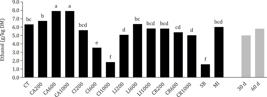
Ethanol content of rehydrated corn grain silage according to the treatments (strategy × storage length).
There was an interaction effect between strategy and storage length (P<0.01) on aerobic stability (Table 5). The SB strategy served as the positive reference, achieving 240 h at both storage lengths, whereas the MI strategy did not differ from the control silage. At 30 d of storage, the CA1000, CI1000, and LI600 strategies also enhanced aerobic stability, although the improvement was still lower than that achieved by the SB strategy. At 60 d of storage, the CA600, CA1000, and CI1000 strategies enhanced aerobic stability, and only the CA1000 strategy achieved 240 h, not differing from the SB strategy. Extending storage length from 30 to 60 d increased aerobic stability in the CA600 and CA1000 silages and decreased it in the CI1000, LI600, CR200, CR600, and MI silages. There was an interaction effect between strategy and storage length (P<0.01) on the maximum temperature (Tmax) achieved during aerobic exposure (Table 5). The SB strategy achieved a lower Tmax at both storage lengths, whereas the MI strategy did not differ from the control silage. At 30 d of storage, all essential oil compound-based strategies did not differ from the control silage. At 60 d of storage, the CA600 and CA1000 strategies achieved lower Tmax values than the control silage, although only the CA1000 strategy did not differ from the SB strategy. When storage length was extended from 30 to 60 d, Tmax decreased in the CA600, CA1000, CI200, and LI200 silages and increased in the LI600 and CR200 silages. There was an effect of strategy (P<0.01) on the time required to achieve Tmax during aerobic exposure (Figure 4), with only the CA1000 and CI1000 silages requiring more time to achieve their respective Tmax than the control silage. There was an interaction effect between strategy and storage length (P<0.01) on pH variation (ΔpH) during aerobic exposure (Table 5). The SB strategy decreased ΔpH at both storage lengths, whereas the MI strategy did not differ from the control silage. At 30 d of storage, the CI1000 strategy reduced ΔpH relative to the control silage, although it remained higher than that of the SB silage. At 60 d of storage, the CA600 and CA1000 strategies also reduced ΔpH relative to the control silage, and only the CA1000 strategy did not differ from the SB strategy. Extending storage length from 30 to 60 d reduced ΔpH in the CA600 and CA1000 silages and increased ΔpH in the CI600 and CI1000 silages. There was an effect of strategy (P<0.01) on post-opening DM losses during aerobic exposure (Table 5). The SB strategy decreased post-opening DM losses, whereas the MI strategy did not differ from the control silage. The CA600, CA1000, and CI1000 strategies also reduced post-opening DM losses, although only the CA600 and CA1000 strategies did not differ from the SB strategy.

Time to maximum temperature (Tmax) during aerobic exposure of rehydrated corn grain silage according to the treatments (strategy × storage length).
4. Discussion
The treatment with sodium benzoate at 2 g/kg FM improved the quality of conservation by decreasing DM losses and suppressing yeast and mold populations, which also markedly enhanced the aerobic stability of RCGS. Although the lower pH in the SB treatment was an unexpected outcome (Morais et al., 2017), it may be explained by the decreased NH3-N content and the unaffected lactic acid production. The treatment with a microbial inoculant combining L. buchneri, L. plantarum and P. acidipropionici did not achieve better outcomes for conservation and aerobic stability in RCGS within the storage lengths evaluated. Longer storage lenghts may be required for the practical effects of the inoculant treatment to become apparent. Thus, the SB strategy was chosen as the positive control reference treatment for discussing the results for the essential oil compound-based strategies evaluated in this study.
Carvacrol is one of the most active monoterpenes in terms of antimicrobial activity, exhibiting a broad spectrum of action against both Gram-positive and Gram-negative bacteria, as well as yeasts and fungi (Dorman and Deans, 2000; Chao et al., 2000). Carvacrol did not inhibit LAB, but it decreased lactic acid production especially at the higher application rates (600 and 1,000 mg/kg FM) and compromised the acidification of RCGS, with the CA600 and CA1000 silages presenting the highest pH values in our study. Foskolos et al. (2016) reported similar results for ryegrass silage treated with carvacrol at application rates varying from 50 to 2,000 mg/kg FM, including decreased lactic acid content and greater pH values without any change in LAB counts. The impaired acidification probably favored undesirable fermentations in RCGS, as greater DM losses were observed, along with evidence of enhanced clostridial development occurred in the CA1000 silage, which also presented an exceptionally high butyric acid concentration. Aerobic stability was enhanced by CA600 and CA1000 strategies and by extending the storage length to 60 d. Only the CA1000 strategy was able to emulate the effects the SB strategy, managing to keep aerobic stability throughout the whole 240-h trial, decreasing DM losses in aerobic exposure and keeping pH practically unchanged, suggesting minimum or no degradation of organic acids by yeasts and molds. This outcome may be explained by greater concentrations of acetic, propionic and butyric acids promoted by the CA600 and CA1000 strategies, which are related to antifungal properties in silage during aerobic exposure (Daniel, 2019). An inhibitory effect of carvacrol itself on yeast and fungal populations would also be expected (Chao et al., 2000). However, fungi counts were not affected by carvacrol strategies, and despite microbial counts at 60 d suggest reduced persistence of yeasts on CA1000 silage, both CA600 and CA1000 silages exhibited the highest contents of ethanol. It is possible that carvacrol is more effective in reducing the persistence of viable yeast cells than in inhibiting their activity at the initial stages of silage fermentation, a hypothesis that should be investigated in future studies. Overall, it seems that increasing application rates of carvacrol in RCGS may replicate the enhanced aerobic stability promoted by the SB strategy, but at the expense of greater DM losses if the grains are contaminated with undesirable organisms, such as clostridia bacteria. Based these results, carvacrol cannot be safely recommended as an additive for RCGS.
Cinnamaldehyde is a highly active phenylpropanoid against a broad spectrum of bacteria and fungi (Chao et al., 2000). There was no change in LAB counts at 30 d of storage, but a marked suppression of LAB persistence occurred at 60 d, especially in the CI600 and CI1000 silages. Despite the absence of differences in lactic acid and NH3-N concentrations relative to the control silage, all cinnamaldehyde-based strategies promoted lower pH values in RCGS at both storage lengths. This greater acidification probably enhanced silage conservation quality, as the CI600 and CI1000 strategies were able to emulate the reduced DM losses observed with the SB strategy. Although the CI200 strategy favored clostridial development, increasing application rates prevented this effect. Only the CI1000 strategy was able to enhance the aerobic stability of RCGS, although the improvement was still lower than that observed in the SB silage. The CI1000 strategy was effective in suppressing yeasts and was the only strategy, besides SB, capable of suppressing fungi. Both the CI600 and CI1000 strategies were able to decrease ethanol concentration, although only the CI1000 strategy matched the response obtained with the SB strategy. Interestingly, extending the storage length from 30 to 60 d reduced the positive effect of the CI1000 strategy on aerobic stability, as well as its efficiency in suppressing yeast persistence, and this was accompanied by a decrease in lactic acid concentration. Overall, increasing application rates of cinnamaldehyde may emulate the enhanced RCGS conservation quality promoted by the SB strategy and improve aerobic stability. However, storage length appears to be an important factor influencing the efficiency of cinnamaldehyde as an antimicrobial agent in grain silage. Further studies are needed to determine whether storage length would remain a limiting factor when higher application rates of this compound are used.
D-limonene is a monoterpene with a more restricted antimicrobial spectrum, being more active against Gram-negative bacteria (Dorman and Deans, 2000) and fungi (Chao et al., 2000). In a graduate report from Brazil, Silva (2021) observed that sweet orange essential oil (940 g/kg of limonene) applied at rates ranging from 250 to 750 mg/kg FM favored crude protein preservation and reduced DM losses in RCGS stored for 60 d, despite increasing silage pH to values as high as 4.29. In the present study, D-limonene strategies were associated with a consistent decrease in lactic acid concentration, increased acetic acid production, and no effect on NH3-N concentration relative to the control silage. All D-limonene strategies, however, promoted lower silage pH values at 30 d of storage relative to the control silage, although this effect was no longer observed when storage length was extended to 60 d. Despite a decrease in ethanol concentration with the LI200 strategy, there was no evidence of yeast or fungal inhibition by any of the D-limonene strategies. As D-limonene did not consistently prevent DM losses or improve aerobic stability at application rates ranging from 200 to 1,000 mg/kg FM, this isolated compound was not considered a promising additive for RCGS in the present study. However, limonene-rich essential oils have been associated with favorable outcomes for conservation quality and aerobic stability, not only in RCGS, as reported by Silva (2021), but also in other silage matrices (Chaves et al., 2012; Andrade et al., 2024; Silva et al., 2024). This represents a promising scenario for investigating the synergistic effects of secondary compounds on the efficacy of essential oils as silage additives.
Citral is a mixture of two isomeric monoterpenes with an aldehyde functional group, geranial and neral, being active against a moderate spectrum of bacteria and fungi (Dorman and Deans, 2000). In our study, citral-based strategies decreased LAB counts at 60 d of storage, although no effect was observed on yeast or fungal counts. Despite having no effect on lactic acid and NH3-N yields, RCGS treated with CR600 and CR1000 strategies presented lower pH values than the control silage at 30 d of storage, which could be related greater acetic acid production. As none of the citral-based strategies led to any improvement in silage quality or aerobic stability, citral also did not prove to be a promising compound as an additive to RCGS in our study.
5. Conclusions
Carvacrol compromised RCGS acidification and increased storage losses, favoring increased clostridial activity. Cinnamaldehyde reduced storage losses in RCGS at application rates of at least 600 mg/kg FM, whereas the application rate of 1,000 mg/kg FM further reduced storage losses to levels comparable to those achieved with SB standard and enhanced aerobic stability. The extended storage length from 30 to 60 d, however, seemed to compromise the efficiency of cinnamaldehyde as an antimicrobial agent. D-limonene and citral did not consistently promote desirable outcomes for RCGS within the application rates and storage lengths evaluated in this study.
Acknowledgments
The authors are grateful to the São Paulo Research Foundation (FAPESP) for the first author’s scholarship (grant #2023/09508-9) and research financial support (grant #2024/01303-1). We are grateful to all students of the Forage Quality and Conservation research team and to the Department of Animal Science of Luiz de Queiroz College of Agriculture of University of São Paulo for their support to this work. Luiz Gustavo Nussio and Evandro Maia Ferreira are recipients of research productivity fellowship from CNPq (National Council of Scientific and Technological Development).
References
-
Andrade, R. C.; Orrico Junior M. A. P.; Silva, Y. A.; Retore, M.; Fernandes, T.; Orrico, A. C. A.; Vargas Junior, F. M. and Amaral, I. P. O. 2024. Impact of monensin sodium and essential limonene oil on the fermentation and chemical composition of total mixed ration silages with moisture variations. Agriculture 14:1319. https://doi.org/10.3390/agriculture14081319
» https://doi.org/10.3390/agriculture14081319 - AOAC - Association of Official Analytical Chemists. 1990. Official methods of analysis. 15th ed. AOAC, Washington, DC.
- Baker, S. and Herrman, T. 2002. Evaluating particle size. MF-2051. Kansas State University, Cooperative Extension Service, Manhattan, KS.
-
Besharati, M. and Niazifar, M. 2020. The effect of lemon seed essential oil on composition, chemical characteristics, and gas production parameters of alfalfa silage. Journal of Animal Science 30:93-104. https://doi.org/10.22034/AS.2020.11018
» https://doi.org/10.22034/AS.2020.11018 -
Besharati, M.; Palangi, V.; Niazifar, M. and Nemati, Z. 2020. Comparison study of flaxseed, cinnamon and lemon seed essential oils additives on quality and fermentation characteristics of lucerne silage. Acta Agriculturae Slovenica 115:455-462. https://doi.org/10.14720/aas.2020.115.2.1483
» https://doi.org/10.14720/aas.2020.115.2.1483 -
Cantoia Júnior, R.; Capucho, E.; Garcia, T. M.; Del Valle; T. A.; Campana, M.; Zilio, E. M. C; Azevedo, E. B. and Morais, J. P. G. 2020. Lemongrass essential oil in sugarcane silage: fermentative profile, losses, chemical composition, and aerobic stability. Animal Feed Science and Technology 260:114371. https://doi.org/10.1016/j.anifeedsci.2019.114371
» https://doi.org/10.1016/j.anifeedsci.2019.114371 -
Chao, S. C.; Young, D. G. and Oberg, C. J. 2000. Screening for inhibitory activity of essential oils on selected bacteria, fungi and viruses. Journal of Essential Oil Research 12:639-649. https://doi.org/10.1080/10412905.2000.9712177
» https://doi.org/10.1080/10412905.2000.9712177 -
Chaves, A. V.; Baah, J.; Wang, Y.; McAllister, T. A. and Benchaar, C. 2012. Effects of cinnamon leaf, oregano and sweet orange essential oils on fermentation and aerobic stability of barley silage. Journal of the Science of Food and Agriculture 92:906-915. https://doi.org/10.1002/jsfa.4669
» https://doi.org/10.1002/jsfa.4669 - Daniel, J. L. P. 2019. Produtos de fermentação em forragens conservadas para vacas leiteiras. In: I Simpósio Internacional de Produção e Nutrição de Gado de Leite. UFU, Uberlândia.
-
Dorman, H. J. D. and Deans, S. G. 2000. Antimicrobial agents from plants: antibacterial activity of plant volatile oils. Journal of Applied Microbiology 88:308-316. https://doi.org/10.1046/j.1365-2672.2000.00969.x
» https://doi.org/10.1046/j.1365-2672.2000.00969.x -
Fernandes, J.; Silva, E. B.; Carvalho-Estrada, P. A.; Daniel, J. L. P. and Nussio, L. G. 2021. Influence of hybrid, moisture, and length of storage on the fermentation profile and starch digestibility of corn grain silages. Animal Feed Science and Technology 271:114707. https://doi.org/10.1016/j.anifeedsci.2020.114707
» https://doi.org/10.1016/j.anifeedsci.2020.114707 -
Foskolos, A.; Cavini, S.; Ferret, A. and Calsamiglia, S. 2016. Effects of essential oil compounds addition on ryegrass silage protein degradation. Canadian Journal of Animal Science 96:100-103. https://doi.org/10.1139/cjas-2015-0025
» https://doi.org/10.1139/cjas-2015-0025 - Hodjatpanah-Montazeri, A.; Mesgaran, M. D.; Vakili, A. and Tahmasebi, A. M. 2016. Effect of essential oils of various plants as microbial modifier to alter corn silage fermentation and in vitro methane production. Iranian Journal of Applied Animal Science 6:269-276.
-
Hoffman, P. C.; Esser, N. M.; Shaver, R. D.; Coblentz, W. K.; Scott, M. P.; Bodnar, A. L.; Schmidt, R. and Charley, R. C. 2011. Influence of ensiling time and inoculation on alteration of the starch-protein matrix in high-moisture corn. Journal of Dairy Science 94:2465-2474. https://doi.org/10.3168/jds.2010-3562
» https://doi.org/10.3168/jds.2010-3562 -
Jonsson, A. 1990. Enumeration and confirmation of Clostridium tyrobutyricum in silages using neutral red, D-cycloserine, and lactate dehydrogenase activity. Journal of Dairy Science 73:719-725. https://doi.org/10.3168/jds.S0022-0302 (90)78725-5
» https://doi.org/10.3168/jds.S0022-0302 (90)78725-5 -
Kung Jr, L.; Williams, P.; Schmidt, R. J. and Hu, W. 2008. A blend of essential plant oils used as an additive to alter silage fermentation or used as a feed additive for lactating dairy cows. Journal of Dairy Science 91:4793-4800. https://doi.org/10.3168/jds.2008-1402
» https://doi.org/10.3168/jds.2008-1402 - Maghsoudloo, F.; Bayatkouhsar, J.; Ghanbari, F. and Taliea, F. 2017. Effect of bacterial inoculation and essential oils of rosemary, fennel and Carum copticum as additive on fermentation process, microbial population and nutritional value of corn silage. Iranian Journal of Animal Science Research 8:553-568.
- Morais, G.; Daniel, J. L. P.; Kleinshmitt, C.; Carvalho, P. A.; Fernandes, J. and Nussio, L. G. 2017. Additives for grain silages: A review. Slovak Journal of Animal Science 50:42-54.
- Moran, J. P.; Weinberg, Z. G.; Ashbell, G.; Hen, Y. and Owen, T. R. 1996. A comparison of two methods for the evaluation of the aerobic stability of whole crop wheat silage. p.162-163. In: Proceedings of XI International Silage Conference. Aberystwyth, UK.
-
Oliveira, K. S.; Salvati, G. G. S.; Morais, G.; Carvalho-Estrada, P. A.; Santos, W. P.; Salvatte, J. M. S.; Gritti, V. C.; Salvo, P. A. R.; Arthur, B. A. V.; Nazato, L. M. and Nussio, L. G. 2023. Effect of length of storage and chemical additives on the nutritive value and starch degradability of reconstituted corn grain silage. Agronomy 13:209. https://doi.org/10.3390/agronomy13010209
» https://doi.org/10.3390/agronomy13010209 -
Önenç, S. S. and Turgud, F. K. 2019. Effect of oregano, cumin and cinnamon essential oils on fermentation quality in alfalfa silages. Ege Üniversitesi Ziraat Fakültesi Dergisi 56:367-373. https://doi.org/10.20289/zfdergi.516234
» https://doi.org/10.20289/zfdergi.516234 - Pereira, L. M. 2016. Uso de óleos essenciais como aditivos em silagens de milho ( Zea mays ) e cana-de-açúcar ( Saccharum officinarum ). Dissertação (M.Sc.) Universidade Federal do Paraná, Curitiba.
-
Pryce, J. D. 1969. A modification of Baker-Summerson method for the determination of lactic acid. Analyst 94:1151-1152. https://doi.org/10.1039/an9699401151
» https://doi.org/10.1039/an9699401151 -
Santos, F. A. P.; Marques, R. S. and Dórea, J. R. R. 2016. Grain processing for beef cattle. p.213-241. In: Millen, D. D.; Arrigoni, M. D. B. and Pacheco, R. D. L. (eds). Rumenology. Springer, Cham. https://doi.org/10.1007/978-3-319-30533-2_8
» https://doi.org/10.1007/978-3-319-30533-2_8 -
Silva Neto, A. B.; Ribeiro, A. P.; Volpato, A.; Machado, J.; Nazato, L. M.; Santos, D. P.; Francisco, L. F.; Arthur, B. A. V.; Morais, G.; Reis, R. H. P.; Daniel, J. L. P.; Greco, L. F. and Nussio, L. G. 2023. Propionic acid-based additive with surfactant action on the feeding value of rehydrated corn grain silage for dairy cows performance. Livestock Science 275:105292. https://doi.org/10.1016/j.livsci.2023.105292
» https://doi.org/10.1016/j.livsci.2023.105292 -
Silva, T. N. 2021. Uso do óleo essencial de laranja doce em silagem de grãos de milho reidratado. Instituto Federal Goiano, Rio Verde. Available at: <https://repositorio.ifgoiano.edu.br/handle/prefix/2185> Accessed on: Feb. 16, 2023.
» https://repositorio.ifgoiano.edu.br/handle/prefix/2185> -
Silva, I. N.; Oliveira, T. S.; Aniceto, E. S.; Meirelles Júnior, J. R.; Mozelli Filho, E. J. L.; Fernandes, A. M.; Souza Filho, G. A. and Gressley, T. 2024. Evaluation of sweet orange essential oil on fermentation and aerobic stability of corn silage. Scientia Agricola 81:e20230229. https://doi.org/10.1590/1678-992X-2023-0229
» https://doi.org/10.1590/1678-992X-2023-0229 -
Soycan Önenç, S.; Coskuntuna, L.; Koç, F.; Özdüven, M. L. and Gümüs, T. 2017. Effects of essential oils of oregano and cinnamon on fermentation quality and in vitro metabolic energy of field pea silages. Hayvansal Üretim 58:39-44. https://doi.org/10.29185/hayuretim.331326
» https://doi.org/10.29185/hayuretim.331326 -
Soycan-Önenç, S.; Koc, F.; Coskuntuna, L.; Özdüven, M. L. and Gümüs, T. 2015. The effect of oregano and cinnamon essential oils on fermentation quality and aerobic stability of field pea silages. Asian-Australasian Journal of Animal Sciences 28:1281-1287. https://doi.org/10.5713/ajas.15.0122
» https://doi.org/10.5713/ajas.15.0122 -
Turan, A. and Önenç, S. S. 2018. Effect of cumin essential oil usage on fermentation quality, aerobic stability and in vitro digestibility of alfalfa silage. Asian-Australasian Journal of Animal Sciences 31:1252-1258. https://doi.org/10.5713/ajas.17.0834
» https://doi.org/10.5713/ajas.17.0834 -
Weatherburn, M. W. 1967. Phenol-hypochlorite reaction for determination of ammonia. Analytical Chemistry 39:971-974. https://doi.org/10.1021/ac60252a045
» https://doi.org/10.1021/ac60252a045
-
Data availability:
The entire dataset supporting the results of this study is available upon reasonable request to the corresponding author.
Edited by
-
Editors:
Gustavo José BragaJoão Luiz Pratti Daniel
The entire dataset supporting the results of this study is available upon reasonable request to the corresponding author.

 CT - control; carvacrol at 200 (CA200), 600 (CA600) and 1,000 (CA1000) mg/kg FM; cinnamaldehyde at 200 (CI200), 600 (CI600) and 1,000 (CI1000) mg/kg FM; D-limonene at 200 (LI200), 600 (LI600) and 1,000 (LI1000) mg/kg FM; citral at 200 (CR200), 600 (CR600) and 1,000 (CR1000) mg/kg FM; SB - sodium benzoate at 2 g/kg FM; MI - microbial inoculant. Effect of strategy, P<0.01; effect of storage length, P<0.01; interaction strategy × storage length, P = 0.61. SEM = 0.11. Strategies with different letters differ by Tukey test (P<0.05).
 CT - control; carvacrol at 200 (CA200), 600 (CA600) and 1,000 (CA1000) mg/kg FM; cinnamaldehyde at 200 (CI200), 600 (CI600) and 1,000 (CI1000) mg/kg FM; D-limonene at 200 (LI200), 600 (LI600) and 1,000 (LI1000) mg/kg FM; citral at 200 (CR200), 600 (CR600) and 1,000 (CR1000) mg/kg FM; SB - sodium benzoate at 2 g/kg FM; MI - microbial inoculant. Effect of strategy, P<0.01; effect of storage length, P = 0.41; interaction strategy × storage length, P = 0.10. SEM = 0.01. Strategies with different letters differ by Tukey test (P<0.05).
 CT - control; carvacrol at 200 (CA200), 600 (CA600) and 1,000 (CA1000) mg/kg FM; cinnamaldehyde at 200 (CI200), 600 (CI600) and 1,000 (CI1000) mg/kg FM; D-limonene at 200 (LI200), 600 (LI600) and 1,000 (LI1000) mg/kg FM; citral at 200 (CR200), 600 (CR600) and 1,000 (CR1000) mg/kg FM; SB - sodium benzoate at 2 g/kg FM; MI - microbial inoculant. Effect of strategy, P<0.01; effect of storage length, P<0.01; interaction strategy × storage length, P = 0.19. SEM = 0.18. Strategies with different letters differ by Tukey test (P<0.05).
 CT - control; carvacrol at 200 (CA200), 600 (CA600) and 1,000 (CA1000) mg/kg FM; cinnamaldehyde at 200 (CI200), 600 (CI600) and 1,000 (CI1000) mg/kg FM; D-limonene at 200 (LI200), 600 (LI600) and 1,000 (LI1000) mg/kg FM; citral at 200 (CR200), 600 (CR600) and 1,000 (CR1000) mg/kg FM; SB - sodium benzoate at 2 g/kg FM; MI - microbial inoculant. Effect of strategy, P<0.01; effect of storage length, P = 0.07; interaction strategy × storage length, P = 0.30. SEM = 4.0. Strategies with different letters differ by Tukey test (P<0.05).