 Hepatic metabolism of guanidinoacetic acid on broilers
ABSTRACT
The objective of this study was to evaluate the hepatic metabolism and performance of broilers fed reduced-energy diets (50 kcal/kg less), with or without guanidinoacetic acid (GAA). A total of 432-day-old male chicks of the Cobb 500 lineage were distributed in a completely randomized design with three treatments and eight replications. The treatments consisted of a basal diet (BD), basal diet with a reduction of 50 kcal/kg (RBD) and a basal diet with a reduction of 50 kcal/kg supplemented with GAA (GAAD). The parameters evaluated were broiler performance, lipid metabolism, and hepatic histomorphometry. A multivariate analysis of lipid profile, hepatic histopathology, and energy intake was performed. At 21 and 28 days, birds fed BD and GAAD exhibited lower feed intake (FI) and birds fed BD showed the best feed conversion ratio (FCR) (P<0.05). At 41 days, the best FCR was observed in birds fed BD and GAAD (P<0.05). There was no difference in energetic intake of broilers at 41 days (P>0.05). However, birds fed BD had a higher FI (P<0.05). Birds fed GAAD showed a higher level of very low-density lipoprotein (VLDL) and triglycerides (TGL) and a lower level of albumin (ALB) (P<0.05). The hepatic histopathology showed a higher level of inflammation infiltrated in birds fed BD and GAAD (P<0.05). A multivariate analysis showed that birds fed GAAD had higher levels of high-density lipoprotein (HDL), VLDL, and TGL and a better liver interstitial pattern. The use of GAA improves the performance of birds fed GAAD compared with RBD and increases the availability of VLDL and TGL in the birds’ blood.
Keywords:
creatine; energy; metabolism; poultry
1. Introduction
The use of feed additives in the poultry industry has been studied to optimize production costs and performance. Guanidinoacetic acid (GAA) is the main creatine precursor. It can be particularly important for broiler lines with fast initial development due to the high demand for energy for growth and muscular development, in this case the energy comes from the creatine (Brosnan et al., 2009). The creatine synthesis starts in the kidney with the participation of glycine, arginine, and methionine. In the kidney, the arginine transfers its amidino group to glycine to form GAA, which is then transmethylated to creatine in the liver. Methionine is the main donor of methyl groups to the transmethylation reaction through S-adenosylmethionine (SAM). SAM is demethylated to S-adenosylhomocysteine and transfers its methyl group for the synthesis of creatine, phosphatidylcholine (PC) and methylated DNA (McBreairty et al., 2013). Creatine is transported through the blood to cells with high energy demand, where it is stored in tissues with elevated energy requirements (Verhoeven et al., 2005). Once inside the cells, creatine is phosphorylated to phosphocreatine, which then serves as an energy source for the cells. This reaction occurs with the participation of the creatine kinase enzyme.
To utilize GAA, it’s useful to determine its equivalency to metabolizable energy (ME) in broiler diets (Khajali et al., 2020). The first studies with ME reduction showed that GAA supplementation can contribute with 47.8 kcal/kg (Çenesiz et al., 2020) and 50 kcal/kg (Ceylan et al., 2021). Salgado et al. (2023) concluded that the average metabolizable energy equivalence of 600 mg/kg of GAA is 88.5 kcal/kg for broilers. This energy comes from GAA metabolism starting in the liver, producing creatine that will be stored in the muscle as phosphocreatine (Verhoeven et al., 2005). The liver plays a key role in the metabolism of GAA, as this process occurs within the liver and leads to metabolic consequences in birds. Furthermore, GAA supplementation can increase the level of metabolizable energy bypassing the self-regulation of endogenous energy production (FEEDAP, 2009).
In avian species, the liver makes the most significant contribution to lipogenesis, accounting for approximately 95% of de novo fatty acid synthesis. In addition, the liver is also a vital organ for the intermediary metabolism of lipids and energy (Huang et al., 2013), in which several key enzymes, such as acyl-CoA oxidase 1 (ACOX1), carnitine palmitoyltransferase-1 (CPT1), fatty acid synthase (FASN), and peroxisome proliferation-activated receptor α (PPARα), play a central role in the normal process of lipid metabolism (Oaxaca-Castillo et al., 2007; Schlaepfer et al., 2014; Pawlak et al., 2015).
We hypothesized that supplementation with GAA in broiler diets allows the reduction of energy content without compromising the metabolism and performance of birds. The main objective of this study was to evaluate the hepatic metabolism and performance of broilers fed GAA in diets with reduced energy content.
2. Material and methods
Animal research was conducted in accordance with the guidelines of the institutional committee on animal use (case number 050/23). The experiment was carried out in Goiânia, Goiás, Brazil (16°35ʹ48.3ʺ S and 49°17ʹ08.8ʺ W).
2.1. Experimental design and broiler management
The study was performed in an industrial chicken facility with an area of 1,500 m2 (12 × 125 m), 0.40-m masonry side walls, 2.80-m high wire mesh, and a ceiling height of 3.20 m. A total of 432-day-old male Cobb 500 chicks were randomly distributed, with three treatments and eight replications of 18 birds per treatment.
The treatments consisted of a basal diet (BD), a basal diet with a 50 kcal/kg reduction (RBD), and a basal diet with a 50 kcal/kg reduction supplemented with 600 g/ton of GAA source product, that contain 96% of GAA (Table 1). The experiment lasted 41 days and was divided into five rearing stages: pre-initial (1 to 7 days), initial (8 to 21 days), growth 1 (22 to 28 days), growth 2 (29 to 35 days) and final (36 to 41 days). Birds received the same diet until seven days of age, after which the experimental diets were provided starting in the initial phase (day 8).
The birds were housed in 24 experimental pens measuring 1.80 × 1.60 m made of plastic mesh and PVC pipes and placed inside an industrial chicken house. Each pen contained drinkers, feeders, and reused rice husk litter. Water and feed were made available ad libitum throughout the experimental period. The internal heating of the house was monitored by measuring air temperature and relative humidity. Constant lighting was provided by fluorescent lamps. The lighting program adopted was continuous with 12 hours of light during the day and 6 to 10 hours of lighting at night during the experimental period. Artificial lighting was generated by 15 W LED lamps distributed throughout the aviary, providing 22 lux/m2.
2.2. Analyzed parameters
Bird performance was evaluated at 7, 21, 28, 35, and 41 days of age. Feed intake (FI; g/bird) was calculated as the difference between the amount of feed supplied and the amount left over in the feeders. Body weight gain (BWG; g) was obtained as the difference between the initial and final body weight in each phase. The feed conversion ratio (FCR) was estimated from the ratio between FI and BWG. Data were corrected for mortality.
At 41 days of age, 5 mL of blood were taken from the ulnar vein of the right wing of three birds from each treatment. Birds were then euthanized following electronarcosis. The birds represented the average weight of each replication, with a standard deviation of 5%. Each bird was weighed and identified. During evisceration, abdominal (retroperitoneal) fat was removed, and liver samples were taken immediately.
Blood samples were stored in sterile tubes to obtain the serum. The sample was centrifuged at 3000 rpm for 15 minutes. Two milliliters of serum were then collected and transferred to Eppendorf tubes.
The following parameters were analyzed by spectrophotometry in an automatic analyzer CM250 (Wiener®, Rosario, Argentina), as recommended by the supplier (Bioclin®, Belo Horizonte, MG): albumin (ALB), cholesterol (COL), high-density lipoprotein (HDL), low-density lipoprotein (LDL), very low-density lipoprotein (VLDL) and triglycerides (TGL).
Liver samples (2 × 2 cm) were collected from the left side and preserved in 10% formalin for 48 hours. The samples were then treated and stained using the Hematoxylin-Eosin method. One slide per sample was prepared and analyzed individually. The slides were assessed at five different points, with the final score being the average of these. The following parameters were scored (1 = good, 2 = fair, and 3 = bad): interstitial pattern, congestion, and inflammatory infiltrate. Grade 1 (mild): steatosis (predominantly macrovacuolar) affecting up to 66% of hepatocytes. Occasional ballooning in zone 3. Scattered foci of intralobular polymorphonuclear inflammatory infiltrate. Absent or discrete portal inflammation. Grade 2 (moderate): steatosis of any degree. Obvious ballooning of hepatocytes in zone 3. Polymorphonuclear inflammatory infiltrate more important than in zone 1, which may be associated with pericellular fibrosis in zone 3. Mild to moderate portal inflammation. Grade 3 (marked): panacinar steatosis (typically > 66%). Marked ballooning in zone 3. Lobular inflammation more pronounced than in grade 2. Mild to moderate portal inflammation (Brunt et al., 1999).
2.3. Statistical analyses
Data on broiler performance, blood and liver samples were analysed using analysis of variance (ANOVA), with means compared by the Scott-Knott’s test at the 5% probability level. A multivariate analysis of principal components was performed to assess the interrelationships between variables and treatments. The R Version: 2024.09.1+394 (The R Project for Statistical Computing) computer software was used for the analysis.
The statistical model used was:
in which yik = an observation in level i of factor a (i = 1,2,3) and repetition k (k = 1,2,…,8); m = the overall mean; ai = the fixed effect of factor a (i = 1,2,3); and eik = the random error with mean 0 and variance σ2.
3. Results
Birds fed GAAD showed a better FCR than birds fed RBD (P = 0.0137) at 41 days. However, the FCR was the same for broilers fed RBD and GAAD at 21 (P = 0.001) and 28 days (P = 0.0215; Table 2).
There were no differences in energy intake between broilers fed different feeds (P>0.05). However, a difference in feed intake was observed at 21 (P = 0.0182), 28 (P = 0.0131) and 35 days (P = 0.0291). Birds fed RBD had a higher FI (Table 2).
The low energy level in the RBD diet reduced the level of the inflammatory infiltrate in the birds (P = 0.02; Table 3).
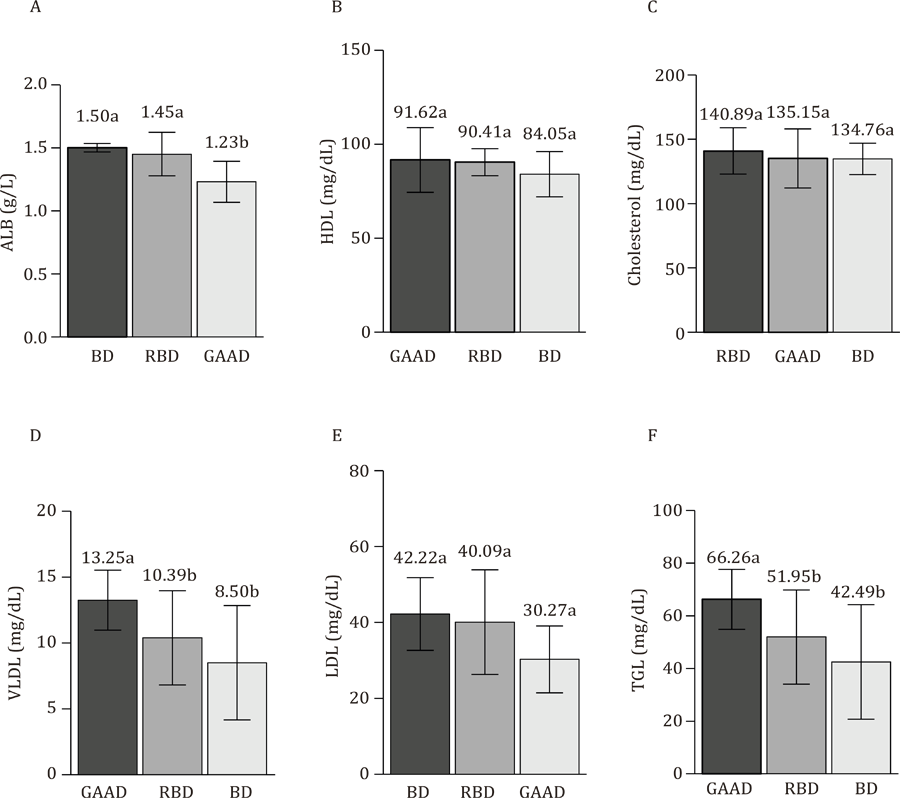
Birds fed GAAD had a higher level of VLDL (P = 0.04), TGL (P = 0.04) and a lower level of ALB (P = 0.002; Figure 1).

Lipid profile and albumin level of broilers fed different energy level and supplementation of GAA or not.
BD - basal diet; RBD - basal diet with reduction of 50 kcal/kg; GAAD - basal diet with reduction of 50 kcal/kg and supplemented with GAA; ALB - albumin; HDL - high-density lipoprotein; VLDL - very low-density lipoprotein; LDL - low-density lipoprotein; TGL - triglycerides.
Means followed by different letters in the row differ from each other by Scott-Knott’s test at 5% probability.
The multivariate analysis of principal components showed an interrelationship between variables and treatments (Figure 2). The PCA biplot is depicted in Figure 2. The first principal component (PC), PC1, accounted for by approximately 56% of the total variance, whereas PC2 accounted for most of the remaining variance (~44%). In general, all traits explained variance in both PCs, except for HDL, which was only associated with PC2. In addition, apart from VLDL and TGL for PC1, and CEI_Final, FI_Final, COL, PAD, Inf., and ME_Final for PC2, all traits explained similar portions of the variance of their respective PCs. A high correlation was observed amongst CEI_Final, FI_Final, and COL, between ALB and LDL, and between VLDL and TGL. PC1 indicates that animals fed RBD had overall greater values of CEI_Final, FI_Final, COL, ALB, and LDL, compared to those fed GAAD, who had greater values of Cong, ME_Final, Inf., PAD, VLDL, and TGL. In contrast, PC2 shows that animals fed BD had greater values for Inf., ME_Final, Cong, ALB, and LDL, compared to those fed GAAD or RBD, who had greater values of PAD, VLDL, TGL CEI_Final, FI_Final, COL, and HDL.

Principal component biplot of lipid profile, hepatic histopathology and energy intake.
BD - basal diet; RBD - basal diet with reduction of 50 kcal/kg; GAAD - basal diet with reduction of 50 kcal/kg and supplemented with GAA; PAD - interstitial pattern; Cong - congestion; Inf - inflammatory infiltrate; HDL - high-density lipoprotein; LDL - low-density lipoprotein; VLDL - very low-density lipoprotein; COL - cholesterol; TGL - triglycerides; ALB - albumin; ME_Final - metabolic energy intake; CEI_Final - cumulated energy intake; FI_Final - feed intake.
4. Discussion
Birds fed GAAD showed a better FCR than birds fed RBD at 41 days. The use of GAA as a precursor of creatine performed well as an energy provider, and the reduction of energy by the feed was covered by the synthetic energy source. These results agree with the results found by Pirgozliev et al. (2022), who observed better FCR in birds fed diets with a 50 kcal/kg reduction in metabolizable energy (ME) and supplemented with GAA. Up to 28 days, there was no difference in FCR between birds fed RBD and GAAD. Due to the initial fast growth rate, the FCR was low because of the good feed response; however, after 28 days, the growth rate tends to decrease and the FCR tends to increase. Therefore, the energy level coming from the GAAD is helpful to keep a lower FCR. According to Salgado et al. (2023), 600 mg/kg of GAA supplementation contributed with 88.5 kcal/kg in broiler diet. Birds fed RBD consumed more feed during this period to meet their energy requirements, which resulted in an increased FCR.
Feed intake was higher for birds fed RBD up to 35 days, which impacted the FCR due to the higher body weight gain until 41 days. The low energy level of RBD diet can explain the higher FI.
Birds fed RBD had the same cumulative energy intake (CEI) from 8 to 41 days as those fed BD and GAAD, indicating that their energy requirements were met through higher feed intake during this period. Although final FI was higher for birds fed RBD, there was no statistically significant difference in final BW. Birds fed RBD had to consume more to support growth and maintain metabolic balance, but this did not result in a statistically significant change in final BW. Verhelle and Saremi (2024) also observed that reduction of dietary energy by 50 and 100 kcal did not significantly influence the performance of birds at all stages of growth, but the GAA supplementation at 0.06% or 0.12% alleviated the lower performance of broiler fed arginine deficiency.
Regarding the histopathology and the blood parameters, birds fed RBD showed the fewest changes in liver and blood markers compared to the other two groups. The dietary energy dilution impacted the level of inflammatory infiltrate for birds fed RBD when compared with the other treatments. The metabolism of animals fed a diluted diet appears to be less demanding on the liver compared to that fed a concentrated diet with different energy sources (either from feed or GAA). In contrast to these results, Fathi et al. (2024), concluded that dietary GAA supplementation can alleviate inflammation response by decreasing lipid peroxidation, TNF-α, and IL-1β in broiler chickens. Blood parameters remained similar to those fed BD and were lower than those observed in birds fed GAAD.
Birds fed GAAD had the same FI as birds fed BD up to 41 days, indicating that GAA delivered the same energy level as the conventional ingredients used in the BD feed. The lipid profile levels of birds fed GAAD were higher compared to those fed BD and RBD, with increased levels of VLDL and triglycerides (TGL), while albumin (ALB) levels were lower. Wu et al. (2024) reported that de GAA resulted in lower triglycerides in the liver of ducks, but higher intramuscular fat in breast compared to ducks fed without a GAA. According to these authors, the lipoprotein lipase (LPL) increased with GAA in diets. In birds, the lipogenesis occurs in the liver, and the lipids are transported until the tissues by VLDL, where are deposited in the adipose tissue through the action of LPL.
The energy metabolism in the liver of birds fed GAAD was higher than that of birds fed BD and RBD. Under normal conditions, once the required energy level is reached, the body inhibits creatine synthesis through negative feedback. Using GAA as a precursor for creatine bypasses the regulatory system, allowing energy production and storage to occur without the usual feedback mechanism. Increasing levels of dietary GAA gradually increased creatine concentration in breast muscle and liver tissues in broiler (Tossenberger et al., 2016) and creatine contents in breast muscle of ducks (Wu et al., 2024).
The elevation in TGL levels is expected, as TGL serves as the primary carrier of energy in the body. The increased levels of TGL and VLDL indicate that the primary source of energy is derived from adipocytes as free fatty acids but rather from the liver in the form of esterified fatty acids.
5. Conclusions
The use of GAA improves bird performance and increases the availability of VLDL and TGL in the blood.
Acknowledgments
The authors would thank Fundação de Amparo à Pesquisa do Estado de Goiás (FAPEG) for the scholarship provided and São Salvador Alimentos (SSA) for providing the birds used during this trial.
References
-
Brosnan, J. T.; Wijekoon, E. P.; Warford-Woolgar, L.; Trottier, N. L.; Brosnan, M. E.; Bruinton, J. A. and Bertolo, R. F. P. 2009. Creatine synthesis is a major metabolic process in neonatal piglets and has important implications for amino acid metabolism and methyl balance. Journal of Nutrition 139:1292-1297. https://doi.org/10.3945/jn.109.105411
» https://doi.org/10.3945/jn.109.105411 -
Brunt, E. M.; Janney, C. G.; Di Bisceglie, A. M.; Neuschwander-Tetri, B. A. and Bacon, B. R. 1999. Nonalcoholic steatohepatitis: a proposal for grading and staging the histological lesions. American Journal of Gastroenterology 94:2467-2474. https://doi.org/10.1111/j.1572-0241.1999.01377.x
» https://doi.org/10.1111/j.1572-0241.1999.01377.x -
Ceylan, N.; Koca, S.; Adabi, S. G.; Kahraman, N.; Bhaya, M. N. and Bozkurt, M. F. 2021. Effects of dietary energy level and guanidinoacetic acid supplementation on growth performance, carcass quality and intestinal architecture of broilers. Czech Journal of Animal Science 66:281-291. https://doi.org/10.17221/11/2021-CJAS
» https://doi.org/10.17221/11/2021-CJAS -
Çenesiz, A. A.; Yavas, I.; Çiftci, I.; Ceylan, N. and Taskesen, H. O. 2020. Guanidinoacetic acid supplementation is favourable to broiler diets even containing poultry by-product meal. British Poultry Science 61:311-319. https://doi.org/10.1080/00071668.2020.1720909
» https://doi.org/10.1080/00071668.2020.1720909 -
Fathi, M.; Saeedyan, S.; Mohammed, H. N.; Kavyani, K. Z. and Rezaee, V. 2024. Effects of guanidinoacetic acid on antioxidant status, inflammation and growth performance of broilers under cool temperature and excessive salt-induced ascites: GAA and ascites. Journal of the Hellenic Veterinary Medical Society 75:8181-8190. https://doi.org/10.12681/jhvms.33475
» https://doi.org/10.12681/jhvms.33475 - FEEDAP. 2009. Scientific Opinion of the Panel on Additives and Products or Substances used in Animal Feed on a request from the European Commission on the safety and efficacy of CreAmino (guanidinoacetic acid) as feed additive for chickens for fattening. EFSA Journal 988:1-30.
-
Huang, J. B.; Zhang, Y.; Zhou, Y. B.; Zhang, Z. Z.; Xie, Z. W., Zhang, J. S. and Wan, X. C. 2013. Green tea polyphenols alleviate obesity in broiler chickens through the regulation of lipid-metabolism-related genes and transcription factor expression. Journal of Agricultural and Food Chemistry 61:8565-8572. https://doi.org/10.1021/jf402004x
» https://doi.org/10.1021/jf402004x -
Khajali, F.; Lemme, A. and Rademacher-Heilshorn, M. 2020. Guanidinoacetic acid as a feed supplement for poultry. World's Poultry Science Journal 76:270-291. https://doi.org/10.1080/00439339.2020.1716651
» https://doi.org/10.1080/00439339.2020.1716651 -
McBreairty, L. E.; McGowan, R. A.; Brunton, J. A. and Bertolo, R. F. 2013. Partitioning of [methyl- 3 H] methionine to methylated products and protein is altered during high methyl demand conditions in young Yucatan miniature pigs. Journal of Nutrition 143:804-809. https://doi.org/10.3945/jn.112.172593
» https://doi.org/10.3945/jn.112.172593 -
Oaxaca-Castillo, D.; Andreoletti, P.; Vluggens, A.; Yu, S.; van Veldhoven, P. P.; Reddy, J. K. and Cherkaoui-Malki, M. 2007. Biochemical characterization of two functional human liver acyl-CoA oxidase isoforms 1a and 1b encoded by a single gene. Biochemical and Biophysical Research Communications 360:314-319. https://doi.org/10.1016/j.bbrc.2007.06.059
» https://doi.org/10.1016/j.bbrc.2007.06.059 -
Pawlak, M.; Lefebvre, P. and Staels, B. 2015. Molecular mechanism of PPARa action and its impact on lipid metabolism, inflammation and fibrosis in non-alcoholic fatty liver disease. Journal Hepatology 62:720-733. https://doi.org/10.1016/j.jhep.2014.10.039
» https://doi.org/10.1016/j.jhep.2014.10.039 -
Pirgozliev, R. V.; Rose, S. P.; Mirza, M. W.; Whiting, I. M.; Malins, H.; Bauer, L. and Lemme, A. 2022. Feeding guanidinoacetic acid to broiler chickens can compensate for low dietary metabolisable energy formulation. British Poultry Science 63:368-374. https://doi.org/10.1080/00071668.2021.2014399
» https://doi.org/10.1080/00071668.2021.2014399 -
Salgado, H. R.; Rocha, G. C.; Petrolli, T. G.; Schmidt, M.; Rivera, J. A.; Nunes, R. A.; Borges, S. O. and Calderano, A. A. 2023. Metabolizable energy equivalence of guanidinoacetic acid in corn soybean meal-based broiler diets. Revista Brasileira de Zootecnia 52:e20220071. https://doi.org/10.37496/rbz5220220071
» https://doi.org/10.37496/rbz5220220071 -
Schlaepfer, I. R.; Rider, L.; Rodrigues, L. U.; Gijón, M. A.; Pac, C. T.; Romero, L.; Cimic, A.; Sirintrapun, S. J.; Glodé, L. M.; Eckel, R. H. and Cramer, S. D. 2014. Lipid catabolism via CPT1 as a therapeutic target for prostate cancer. Molecular Cancer Therapeutics 13:2361-2371. https://doi.org/10.1158/1535-7163.MCT-14-0183
» https://doi.org/10.1158/1535-7163.MCT-14-0183 -
Tossenberger, J.; Rademacher, M.; Németh, K.; Halas, V. and Lemme, A. 2016. Digestibility and metabolism of dietary guanidino acetic acid fed to broilers. Poultry Science 95:2058-2067. https://doi.org/10.3382/ps/pew083
» https://doi.org/10.3382/ps/pew083 -
Verhelle, A. and Saremi, B. 2024. An evaluation of the arginine requirements of broiler chickens and the potential arginine and energy-saving effects of guanidinoacetic acid. Animals 15:4. https://doi.org/10.3390/ani15010004
» https://doi.org/10.3390/ani15010004 -
Verhoeven, N. M.; Salomons, G. S. and Jakobs, C. 2005. Laboratory diagnosis of defects of creatine biosynthesis and transport. Clinica Chimica Acta 361:1-9. https://doi.org/10.1016/j.cccn.2005.04.022
» https://doi.org/10.1016/j.cccn.2005.04.022 -
Wu, H.; Xie, J.; Peng, W.; Ji, F.; Qian, J.; Shen, Q. and Hou, G. 2024. Effects of guanidinoacetic acid supplementation on liver and breast muscle fat deposition, lipid levels, and lipid metabolism-related gene expression in ducks. Frontiers in Veterinary Science 11:1364815. https://doi.org/10.3389/fvets.2024.1364815
» https://doi.org/10.3389/fvets.2024.1364815
-
Data availability:
Data will be available upon request.
Edited by
-
Editors:
Ines AndrettaValdir Ribeiro Junior
Data will be available upon request.