Potential of Zaprionus as agricultural pests in semi-arid fruit growing regions
ABSTRACT
This study aimed to characterize the population dynamics and temporal variation of Zaprionus indianus and Zaprionus tuberculatus (Diptera: Drosophilidae) in guava orchards located in the semi-arid region of Paraíba, Brazil, evaluating their potential as agricultural pests. Sampling was conducted between August 2021 and July 2022 in two areas: the UFPB Experimental Station (São João do Cariri) and the Fazenda Almas Private Natural Heritage Reserve. The methodology included monthly collection of ripe guava fruits, standardized exposure of fruits in plastic trays in the orchards, and monitoring of adults using PET bottle traps containing molasses or hydrolyzed protein. Infestation indices (pupae/fruit and pupae/kg), pupal viability, and the FTD index (flies per trap per day) were estimated. The results revealed higher infestation and abundance of Zaprionus at Fazenda Almas, where the FTD index reached values above 3.5 in some months, exceeding the action threshold (0.5). In São João do Cariri, the indices were considerably lower. Both species were recorded at Fazenda Almas, whereas only Z. indianus was observed in São João do Cariri. Incidence occurred during the rainy season, although no statistically significant correlation was observed with climatic variables. The results reinforce the invasive and agricultural potential of these species in the Brazilian semi-arid region, indicating the need for continuous monitoring and the development of management strategies focused on regional fruit production.
Keywords:
Zaprionus indianus; Zaprionus tuberculatus; exotic fruit flies; population dynamics.
RESUMO
Este estudo teve como objetivo caracterizar a dinâmica populacional e a variação temporal de Zaprionus indianus e Zaprionus tuberculatus (Diptera: Drosophilidae) em pomares de goiaba localizados na região semiárida da Paraíba, Brasil, avaliando seu potencial como pragas agrícolas. As coletas foram realizadas entre agosto de 2021 e julho de 2022 em duas áreas: a Estação Experimental da UFPB (São João do Cariri) e a Reserva Particular Fazenda Almas. A metodologia incluiu a coleta mensal de frutos de goiaba, exposição padronizada de frutas em bandejas plásticas nos pomares e monitoramento de adultos usando armadilhas PET contendo melaço ou proteína hidrolisada. Foram estimados os índices de infestação (pupários/fruto e pupários/kg), viabilidade pupal e o índice MAD (moscas por armadilha por dia). Os resultados revelaram maior infestação e abundância de Zaprionus na Fazenda Almas, onde o índice MAD atingiu valores acima de 3,5 em alguns meses, ultrapassando o nível de ação (0,5). Em São João do Cariri, os índices foram consideravelmente mais baixos. Ambas as espécies foram registradas na Fazenda Almas, enquanto apenas Z. indianus foi observado em São João do Cariri. A incidência ocorreu durante a estação chuvosa, embora nenhuma correlação estatisticamente significativa tenha sido observada com as variáveis climáticas. Os resultados reforçam o potencial invasivo e agrícola dessas espécies na região semiárida brasileira, indicando a necessidade de monitoramento contínuo e o desenvolvimento de estratégias de manejo focadas na fruticultura regional.
Palavras-chave:
Zaprionus indianus; Zaprionus tuberculatus; moscas-das-frutas exóticas; dinâmica populacional.
INTRODUCTION
Fruit growing is present in all regions of Brazil, with a greater concentration in areas with tropical and subtropical climates. However, the presence of fruit flies represents one of the main challenges for the expansion of this activity (FIORAVANCO; PAIVA, 2012). Due to the wide diversity of environments, the vast territorial extension and the climatic conditions, the country is home to a great diversity of fruit flies (ZUCCHI; MORAES, 2026).
Several factors, such as climate, altitude, geographic location, phenology, and succession of hosts (primary or secondary), can influence the abundance of certain species of fruit flies in orchards throughout the year (MONTES; RAGA; SOUZA FILHO, 2011). Among the species of fruit flies, exotic species represent a potential risk to biodiversity conservation, as they can overcome competition with native species and cause long-term environmental imbalances (VILÀ; HULME, 2017). Examples of this group are the species of the genus Zaprionus (Coquillett, 1902), originating in the Afrotropical region (YASSIN; DAVID, 2010), characterized by the presence of longitudinal white stripes on the frons and mesonotum.
Zaprionus populations have a generalist habitat or broad niche characteristics, that is, they use various food resources and adapt to variable climatic conditions (VALADÃO et al., 2019). However, knowledge of preferred and alternative host plants of these potentially invasive species with pest status is still rudimentary in some Brazilian regions, although it is essential for the development of integrated pest management programs (GARCIA, 2021).
In tropical regions, the dynamics of these species are evolutionary, changing in response to abiotic and biotic factors over space and time (GLEASON et al., 2019). Thus, understanding this dynamic in communities throughout the seasons can provide information both about the biology and ecology of organisms and about more effective methods for controlling agricultural pests.
Given the rapid dispersal of drosophilids in the Brazilian territory, the broad economic growth associated with fruit growing, in addition to the generalist habit and invasive potential, as well as the scarcity of information on the ecology and influence of habitats on the populations of these fruit flies, this study aimed to evaluate the potentiality of species of the genus Zaprionus as agricultural pests and the interference of climatic factors in population fluctuation.
MATERIAL AND METHODS
STUDY AREA
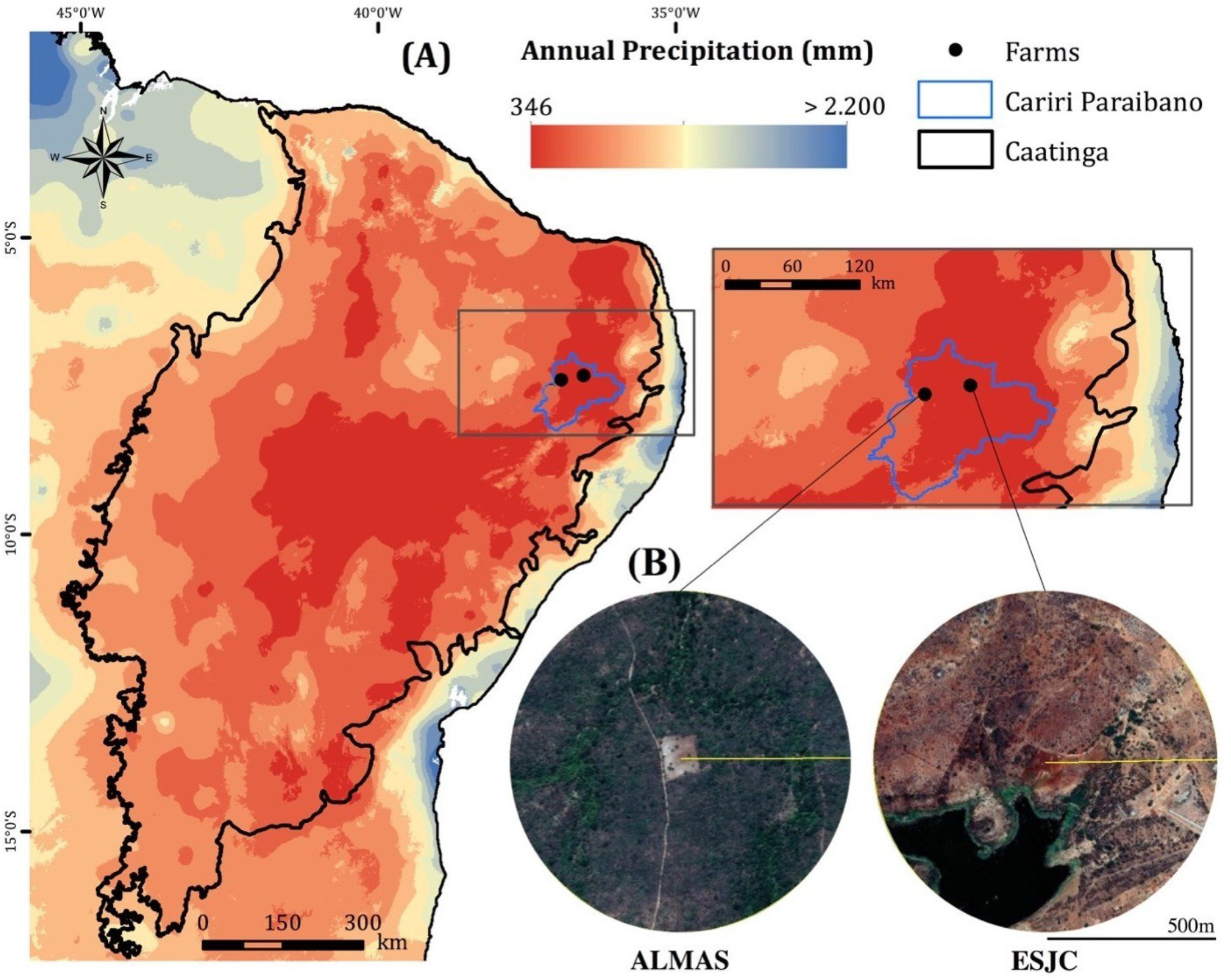
The study was carried out between August 2021 and July 2022 in the Cariri Paraibano region, characterized by annual precipitation ranging from 350 to 800 mm, with more than 60% of rainfall concentrated in the months of February, March, and April (Figure 1A). Air temperature and humidity have annual averages of 25 °C and 65%, respectively.
(A) The study area is located in Cariri Paraibano, a sub-region of the Caatinga, Brazil. (B) ALMAS: RPPN Fazenda Almas and ESJC: São João do Cariri, Paraíba State, Brazil. The guava orchards are located in the center of each image. Source: Araujo, Nascimento and Brito (2022).
The experiment was carried out in two guava (Psidium guajava var. „paluma‟, Myrtaceae) orchards, which were established using cuttings and are approximately four to five years old, with a spacing of 5 meters between rows and 6 meters between plants, under a micro-sprinkler irrigation system. The management adopted is fruiting pruning, in the months prior to the rains and fertigation, and the orchards are located under different influences of vegetation cover in the surrounding landscape.
The first study area is located at the Experimental Station of the Federal University of Paraíba (UFPB) (7° 24"00S and 36°32"00W), managed by the Center for Agrarian Sciences (CCA), in the municipality of São João do Cariri, PB (Figure 1B). The second study area is located at the Fazenda Almas Private Natural Heritage Reserve (hereinafter referred to as RPPN Fazenda Almas) (7°28"00S and 36°52"00W), which stands out for being a private reserve, maintaining a vast diversity of natural habitats (Figure 1B).
Fruit collection and obtaining of adult insects
Evaluation of infestation rates
Fruit collection was carried out monthly in guava orchards located at the sites already described above. Fruits were collected at maturity stages 5, 6 and 7 (VIEIRA et al., 2008; VENCESLAU et al., 2022), both from the soil and from the plant. After collection, the fruits were placed in plastic bags and transported to the Invertebrate Laboratory (LABIN), linked to the Department of Biosciences of the Center for Agrarian Sciences of the Federal University of Paraíba, Areia Campus.
In the laboratory, the fruits were counted, weighed on a semi-analytical scale to determine the fresh mass (g) and individualized in plastic trays with dimensions of 34.9 × 28.9 × 7.5 cm (length × width × height), with a capacity of 5.5 L, covered with voile fabric and containing a 2-cm-thick layer of sterilized sand. The samples were kept under these conditions for a period of 10 to 13 days, in order to obtain pupae. After this period, the fruits in an advanced stage of decomposition were visually examined to locate third instar larvae, which were removed from the trays and discarded in sequence.
The trays were periodically examined and the pupae found were stored in Petri dishes (140 × 15 mm) containing sterilized sand, covered with voile fabric and kept under controlled laboratory conditions (temperature of 25 ± 2 ºC, relative humidity of 60 ± 10% and photophase of 12 hours) until the emergence of the adults. Subsequently, the specimens were stored in universal collectors containing 70% alcohol for taxonomic identification.
The parameters evaluated based on the fruit collections were:
The pupal viability index (PV) expressed as a percentage and calculated using the formula of Portilla (2002), according to Equation 1 with adaptations.
The infestation indices were determined in two ways: (1) by dividing the total number of pupae by the number of fruits collected (pupae/fruit) and (2) by dividing the total number of pupae by the weight (kg) of the fruits (pupae/kg) (GARCIA; NORRBOM, 2011).
Evaluation of Zaprionus abundance across areas
As the abundance of flies can vary between areas due to the variation in the availability of fruits produced in them, an experiment was carried out with fruits introduced in plastic trays with dimensions of 24.5 cm x 18.1 x 2.2 cm (length × width × height) in the two orchards. A total of five fruits at maturity stage 5 (VIEIRA et al., 2008; VENCESLAU et al., 2022) were arranged in plastic trays containing sterilized sand (2 cm), covered by a galvanized hexagonal wire mesh with a 2.5-cm-mesh opening, to prevent other animals from damaging or feeding on the fruits. In each orchard, 10 trays were distributed with an equidistance of 5 m from each other, fixed between the branches of the plants with the help of string, in the middle portion of the crown, where a greater number of flies are usually concentrated (SOUZA et al., 2016; ALVES et al., 2019). The trays with the fruits remained on site for eight days and were later removed and transported to LABIN, where the screening was carried out following the methodology of the previous experiment.
Temporal evaluation of fly abundance using PET bottle traps
Temporal monitoring of fruit fly adults was carried out with the aid of PET bottle-type plastic traps, using 10 traps per orchard. Of these, five traps each contained 200 mL of aqueous solution of 5% hydrolyzed protein as food attractant, prepared from the dilution of 50 mL of hydrolyzed protein in 950 mL of water, obtaining 1 L of solution. The other five traps each contained 250 mL of 10% aqueous solution of sugarcane molasses, prepared by diluting 125 mL of molasses in 1125 mL of water, totaling 1.25 L of solution. The traps were installed in the central part of the trees, 1.50 m above the ground. The bottles were inspected monthly, at which time the specimens of captured flies were collected and the food attractant was replaced. These specimens were washed with water in a sieve and thus put into plastic containers with 70% hydrated alcohol, properly labeled and sent to LABIN, where the specimens were sorted and preserved in 70% hydrated alcohol for subsequent identification of the species.
From the insects collected in traps, it was also possible to obtain the FTD index (number of flies captured/number of traps installed/number of days of collection), calculated using Equation 2 (ARAUJO; ZUCCHI, 2003).
Where:
F: number of flies collected T: Number of traps inspected;
D: number of days between collections.
Data analysis
Statistical analyses were all performed using R Studio, a graphical interface of the R software in version 4.4.1 (R CORE TEAM, 2023). The diversity of drosophilids in each study area was measured using a Generalized Linear Model (GLM) with Quasi-Poisson and Negative Binomial distributions, selected due to their superior performance and their suitability in correcting for overdispersion. The model was implemented using the “multcomp” package for conducting multiple comparisons and “hnp” package for residual analysis, which was performed using normal envelope plots.
A descriptive analysis of the data on the incidence of drosophilids in each area was performed in order to obtain the values of means, standard deviation and confidence intervals of these data. Subsequently, a matrix of correlations was generated to relate the data to the climatic variables (precipitation, temperature and relative air humidity). The matrix of correlations was created using the “rcor” function and, soon after, the correlation graph was generated using the “ggcorrplot” function of the “ggplot2” package. The climatic data were obtained from the meteorological station of São João do Cariri and from the database of the Executive Agency for Water Management of the Paraíba State (AESA).
RESULTS AND DISCUSSION
The results of this study confirm the occurrence of species of the genus Zaprionus in the state of Paraíba, specifically in the Cariri Paraibano region. In addition, they highlighted the potential of these species as insect pests, based on the infestation rates recorded, detected both in fruit collections and in traps.
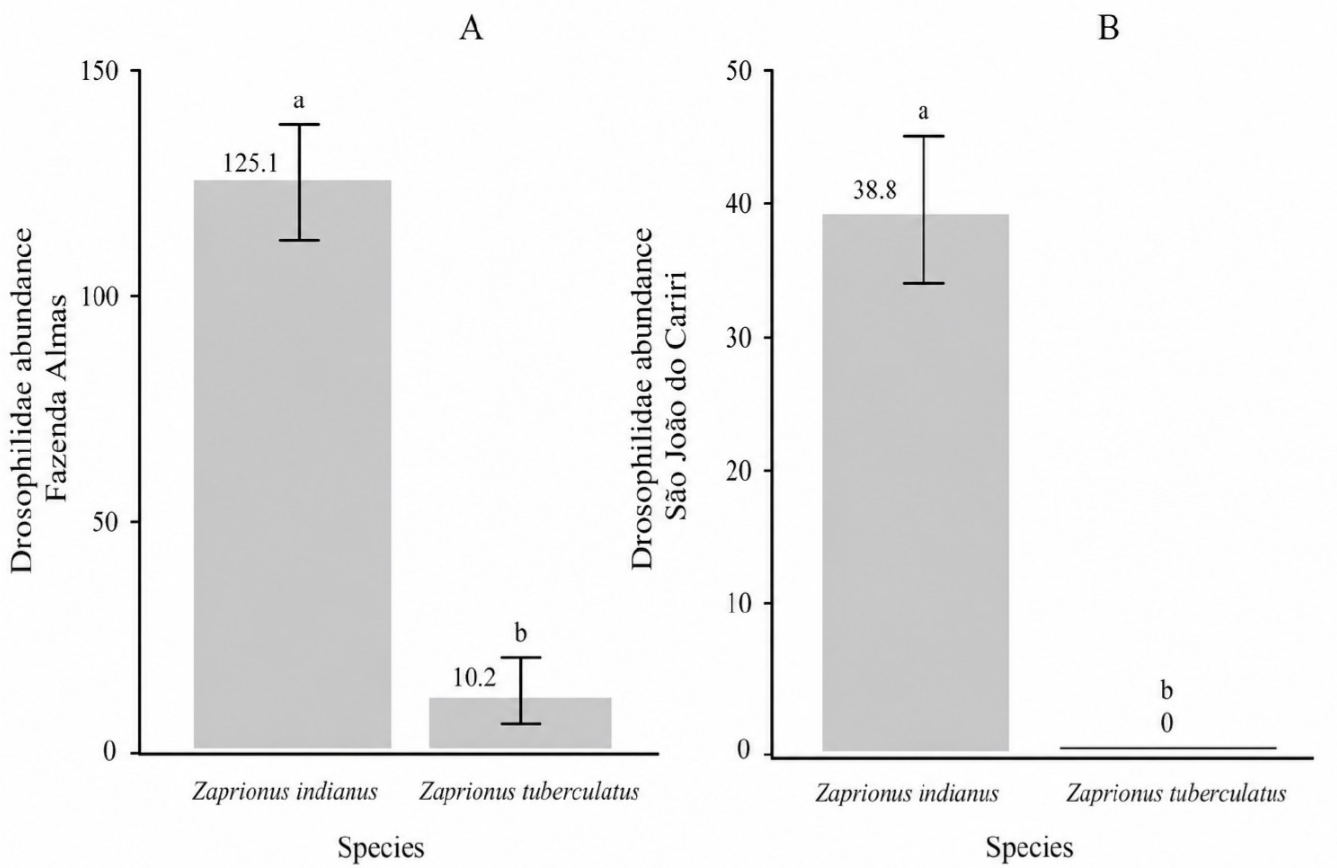
Through the collected fruits, a greater diversity of Drosophilidae species was observed in the RPPN Fazenda Almas, and two species were identified, Zaprionus indianus (Gupta, 1970) and Zaprionus tuberculatus (Malloch, 1932), with means of 125.1 and 11.0 specimens, respectively (Figure 2A). In contrast, in São João do Cariri, only Z. indianus was collected, with a mean of 38.8 specimens (Figure 2B).

Mean of drosophilids in RPPN Fazenda Almas (A) and mean of drosophilids in São João do Cariri (B), Paraíba State, Brazil.
The infestation index for the fruits collected in São João do Cariri was 0.32 pupae/fruit (79 fruits collected) and 4.84 pupae/kg (mean value of 5.164 kg of fruits collected), with a pupal viability of 52%. However, the same index for the RPPN Fazenda Almas orchard was 1.8 pupae/fruit (222 fruits collected) and 27.62 pupae/kg (mean value of 14.482 kg of fruits collected), with a pupal viability of 94%. Sampling was carried out according to the availability of fruits in each locality (Table 1).
Incidence of Zaprionus in fruits collected in guava orchards in the semi-arid region of Paraíba State, Brazil.
The population fluctuation of the species and the possibility of them acting as insect pests were also observed through the FTD index in both areas, adopting the level of 0.5, the FTD threshold for fruit flies of the genera Anastrepha and Ceratitis (ALVES et al., 2020). The number of drosophilids collected per trap/day varied throughout the year in the two localities. In the RPPN Fazenda Almas, there was fluctuation in the FTD index, oscillating between 0.5 and 3.5, between the months of March, April, May and June, with the highest index of these drosophilids observed in May (Figure 3A). For the São João do Cariri orchard, this index ranged from 0 to 0.1 in February, March, April, May and June (Figure 3B), months corresponding to the highest availability of fruits.

Temporal variation of the FTD index (flies/trap/day) of fruit flies in the orchards of RPPN Fazenda Almas (A) and São João do Cariri (B), Paraíba State, Brazil.
Regarding climatic factors and the incidence of flies of the genus Zaprionus, no significant correlations were identified according to a p-value < 0.05 in Spearman‟s correlation, although positive and negative correlations were observed for the variables (Figures 4A and 4B).

Correlation matrix (Spearman) for the incidence of Zaprionus spp. and climatic factors (x = non-significant at p < 0.05) for RPPN Fazenda Almas (A) and São João do Cariri (B), Paraíba State, Brazil.
The results obtained in this study contribute to the record of drosophilids, Z. indianus and Z. tuberculatus, in the state of Paraíba, Brazil, and provide essential information about the population dynamics of these species in the region, in addition to their potential as agricultural pests.
Currently, the EPPO lists seven species of the genus Zaprionus, among which Z. indianus and Z. tuberculatus were categorized as „Alert List‟ in 2016. However, in 2020, EPPO researchers on Phytosanitary Regulations decided to remove them from this list, since no specific action had been requested against them by any of the member countries for a period of more than three years (EPPO, 2020). Despite this removal, these species remain included in the list of pests of the Center for Agriculture and Biosciences (CABI) due to their reproductive behavior in fruits and the potential to cause damage in cultivated areas (CABI, 2024).
The high abundance of Z. tuberculatus and Z. indianus in guava fruits in the present study reinforces their potential to become agricultural pests. It is worth mentioning that several hosts have already been reported for both species, which have exhibited the ability to occupy similar niches (VIEIRA et al., 2019) and can cause damage to intact fruits (KUYULU; YÜCEL; GENÇ, 2019). In Brazil, Z. tuberculatus has been documented reproducing on whole and viable fruits of Eugenia uniflora and Malpighia emarginata (VIANA et al., 2025), posing a significant threat to fruit production systems.
Additionally, the values of the FTD index found in the present study corroborate the potential of these species, so it is important to consider the incidence of Zaprionus and the possibility of adopting control measures, based on the FTD threshold observed in other species of fruit flies, such as those of the genera Anastrepha and Ceratitis, being 1 fly/day or 7 flies/week (ALVES et al., 2020).
The potential of Z. indianus and Z. tuberculatus is further expanded due to their high adaptability to different environmental conditions, reinforcing the findings of this study, which did not reveal a significant correlation between the incidence of these species and the climatic factors analyzed.
The species Z. indianus has a high capacity to adapt to adverse environmental conditions, standing out for its survival and fertility in different climates, including in temperate climate areas (LAVAGNINO; FANARA; MENSCHI, 2020). Evidence indicates that the colonization of the American continent by Z. indianus occurred mainly through the transport of fruits traded by air or sea (SETTA; CARARETO, 2005). The first record of the species in Brazil was in 1998 (VILELA, 1999), followed by rapid expansion to all regions of the country (SETTA; CARARETO, 2005), and later its presence was confirmed in other South American countries.
Another species of the genus, Z. tuberculatus, has an equally efficient dispersal pattern, regardless of climatic conditions. This species was first recorded in citrus orchards in Malta, in 1991 (EBEJER, 2001). Since then, Z. tuberculatus has been identified in different locations. In Brazil, its initial detection occurred in urban parks in Brasília, in the Federal District (CAVALCANTI et al., 2022), being recorded quickly and effectively in other states in the country.
CONCLUSION
The data obtained in this study highlight the potential of Zaprionus indianus and Zaprionus tuberculatus as agricultural pests in guava orchards in the Brazilian semi-arid region. Their predominant occurrence during the rainy season suggests a possible influence of seasonal factors on the population dynamics of these species. Therefore, it is essential to conduct long-term studies that consider the interaction between environmental variables and the population fluctuation of these species, in order to support more effective monitoring and integrated management strategies.
ACKNOWLEDGMENTS
We would like to thank the Coordination for the Improvement of Higher Education Personnel (CAPES) and the Federal University of Paraíba for their financial support. This study was funded by the National Council for Scientific and Technological Development (CNPq) [process number 405298/2021-8] and by the Paraíba State Research Support Foundation (FAPESQ-PB) [process number 3101/202].
Data Availability:
The data that support the findings of this study can be made available, upon reasonable request, from the corresponding author.
REFERENCES
- ALVES, J. et al. Food Attractants Used in the Fruit Fly Monitoring (Diptera: Tephritidae) in a Commercial Orchard of Psidium guajava. Journal of Experimental Agriculture International, 34: 1-10, 2019.
- ALVES, E. C. et al. Fruit fly (Diptera: Tephritidae) associated with mango tree in the eastern Seridó region of Paraíba, Brazil. Revista Verde, 15: 127-132, 2020.
- ARAUJO, E. L.; ZUCCHI, R. A. Moscas-das-frutas (Diptera: Tephritidae) em goiaba (Psidium guajava L.), em Mossoró, RN. Arquivos do Instituto Biológico, 70: 73-77, 2003.
- ARAUJO, H. F. P.; NASCIMENTO, N. F. F.; BRITO, C. H. Natural cover surrounding the farm field reduces crop damage and pest abundance in brazilian dryland. Revista Caatinga, 35: 68-78, 2022.
-
CABI. Zaprionus tuberculatus 2024. Available at: https://www.cabidigitallibrary.org/doi/full/10.1079/cabicompendium.117928 . Access on: Mar. 14, 2025.
» https://www.cabidigitallibrary.org/doi/full/10.1079/cabicompendium.117928 - CAVALCANTI, F. A. G. S. et al. Geographic expansion of an invasive fly: first record of Zaprionus tuberculatus (Diptera: Drosophilidae) in the Americas. Annals of the Entomological Society of America, 115: 267-274, 2022.
- EBEJER, M. J. A contribution to the knowledge of the Ephydroidea (Diptera: Camillidae, Campichoetidae and Drosophilidae) of Malta. Central Mediterranean Naturalist, 3: 85-88. 2001.
-
EPPO - European and Mediterranean Plant Protection Organization. 61st Meeting of the Panel on Phytosanitary Measures 2020. Available at: https://www.eppo.int/MEETINGS/2020_meetings/p_pm Access on: Mar. 14, 2025.
» https://www.eppo.int/MEETINGS/2020_meetings/p_pm - FIORAVANCO, J. C.; PAIVA, M. C. Competitividade e fruticultura brasileira. Informações Econômicas, 32: 24-40, 2012.
- GARCIA, F. R. M.; NORRBOM, A. L. Tephritoid flies (Diptera, Tephritoidea) and their plant hosts from the State of Santa Catarina in Southern Brazil. The Florida Entomologist, 94: 151-157, 2011.
-
GARCIA, F. R. M. Basis for area-wide management of Drosophila suzukii in Latin America. In: Drosophila suzukii management Cham: Springer International Publishing, 2021. p. 93-110. Available at: <http://dx.doi.org/10.1007/978-3-030-62692-1_5>. Access on: Mar. 23, 2025.
» http://dx.doi.org/10.1007/978-3-030-62692-1_5 - GLEASON, J. M. et al. Phenology of Drosophila species across a temperate growing season and implications for behavior. PLoS One, 14: e0216601, 2019.
- KUYULU, A.; YÜCEL, S.; GENÇ, H. Molecular identification of invasive drosophilid Zaprionus tuberculatus Malloch (Diptera: Drosophilidae) in Çanakkale, Turkey. Turkish Journal of Zoology, 43: 531-535, 2019.
- LAVAGNINO, N. J.; FANARA, J. J.; MENSCH, J. Comparison of overwintering survival and fertility of Zaprionus indianus (Diptera: Drosophilidae) flies from native and invaded ranges. Journal of Thermal Biology, 87: 102470, 2020.
- MONTES, S. M. N. M.; RAGA, A.; SOUZA FILHO, M. F. Levantamento de espécies de Anastrepha (Diptera: Tephritidae) em áreas de cucurbitáceas sob sistema de mitigação de risco. Arquivos do Instituto Biológico, 78: 317-320, 2011.
- PORTILLA, N. E. A. C. Acerola (Malpighia punicifolia L., 1972) como hospedeiro de moscas-das-frutas (Diptera: Tephritidae) no Recôncavo da Bahia 2002. 63 f. Dissertação (Mestrado em Agronomia) - Universidade Federal da Bahia, Cruz das Almas, 2002.
- R CORE TEAM. A language and environment for statistical computing R Foundation for Statistical Computing, Vienna, Austria, 2023.
- SETTA, N.; CARARETO, C. M. A. Fitness components of a recently-established population of Zaprionus indianus (Diptera: Drosophilidae) in Brazil. Iheringia. Série Zoologia, 95: 47-51, 2005.
- SOUZA, M. et al. Traps to capture fruit fly Ceratitis capitata Wiedemann (Diptera: Tephritidae). African Journal of Agricultural Research, 11: 4819-4823, 2016.
- VALADÃO, H. et al. Fruit-breeding drosophilids (Diptera) in the Neotropics: playing the field and specializing in generalism? Ecological Entomology, 44: 721-737, 2019.
- VENCESLAU, W. C. D. et al. Qualidade de goiabas „Paluma‟ em diferentes estádios de maturação. Meio Ambiente, 4: 1-5, 2022.
- VIANA, J. P. C. et al. Assessing the potential spread of Zaprionus tuberculatus (Diptera: Drosophilidae) in the Americas: insights for proactive management and agricultural protection. Journal of Economic Entomology, 118: 195-202, 2025.
- VIEIRA, S. M. et al. Características físicas de goiabas (Psidium guajava L.) submetidas a tratamento hidrotérmico. Revista Brasileira de Engenharia Agrícola e Ambiental, 12: 408-414, 2008.
- VIEIRA, J. G. A. et al. Infestation levels of Zaprionus indianus (Diptera: Drosophilidae) in different host fruits. Revista de Ciências Agroveterinárias, 18: 268-273, 2019.
- VILÀ, M.; HULME, P. E. Impact of Biological Invasions on Ecosystem Services 1. ed. Cham: Springer, 2017. 354 p.
- VILELA, C. R. Is Zaprionus indianus Gupta, 1970 (Diptera, Drosophilidae) currently colonizing the Neotropical region? Drosophila Information Service, 82: 37-39, 1999.
- YASSIN, A.; DAVID, J. R. Revision of the Afrotropical species of Zaprionus (Diptera, Drosophilidae), with descriptions of two new species and notes on internal reproductive structures and immature stages. Zookeys, 51: 33-72, 2010.
-
ZUCCHI, R. A.; MORAES, R. C. B. Fruit flies in Brazil - Hosts and parasitoids of the Mediterranean fruit fly Available at: < http://www.lea.esalq.usp.br/ceratitis/>. Access on: Apr. 7, 2026.
» http://www.lea.esalq.usp.br/ceratitis
Edited by
-
Editor in Chief:
Aurélio Paes Barros Júnior