
 Morphophysiological and nutritional responses in maize hybrids competing with Digitaria insularis
ABSTRACT
This study aimed to evaluate the competitive interaction between maize hybrids in the presence of Digitaria insularis through experiments in a series of substitutions. The experiments were conducted in a randomized block design with four replicates. Six maize hybrids were used, and the plant density of maize and D. insularis hybrids was set for constant final production of 463 plants m-2. Competition had a detrimental effect on plant growth in both species. Competition and demand for environmental resources were the same for maize hybrids competing with D. insularis. Digitaria insularis had a negative effect on the physiological characteristics of maize hybrids, regardless of the plant density in the association. The hybrids showed greater relative growth than the weed. However, the increase in weed density decreased the nutrient concentration, especially P and K, in maize hybrids. There was competition between maize and D. insularis for the same resources in the environment. Interspecific competition was more pronounced for nutrients N, P, and K, whereas intraspecific competition was more pronounced for Ca and Mg.
Keywords:
Zea mays; Competitive ability; Sourgrass
RESUMO
O objetivo deste estudo foi avaliar a interação competitiva entre híbridos de milho na presença de D. insularis, por meio de experimentos em série substitutiva. Os experimentos foram conduzidos em delineamento de blocos ao acaso, com quatro repetições. Seis híbridos de milho foram utilizados, e a densidade de plantas dos híbridos de milho e D. insularis foi previamente determinada para uma produção final constante de 463 plantas m-2. A competição foi prejudicial ao crescimento das plantas para ambas as espécies. A competição e a demanda por recursos ambientais foram as mesmas para híbridos de milho em competição com D. insularis. Digitaria insularis afetou negativamente as características fisiológicas dos híbridos de milho, independentemente da densidade de plantas na associação. Os híbridos apresentaram maior crescimento relativo do que a planta daninha. No entanto, o aumento da densidade de plantas daninhas diminuiu a concentração de nutrientes, principalmente P e K, nos híbridos de milho. Observou-se que existe competição entre milho e D. insularis pelos mesmos recursos no ambiente. A competição interespecífica foi mais pronunciada para os nutrientes N, P e K, e a competição intraespecífica foi mais pronunciada para Ca e Mg.
Palavras-chave:
Zea mays; Habilidade competitiva; Capimamargoso
INTRODUCTION
Maize (Zea mays L.) is the third most cultivated cereal in the world, and Brazil is the third largest producer worldwide, with more than 113 million tons, following China and the United States (CONAB, 2022; USDA, 2022). The national maize area was estimated at more than 21 million hectares for the 2021/22 season, with an average productivity of 5.2 t ha-1 (CONAB, 2022). One of the major challenges for farmers is the spread of weeds, which, if left unchecked, compete for water, light, and nutrient resources (CHU et al., 2022; GALON et al., 2020; SMITH; BURNS, 2022).
Weeds increase production costs, reduce grain quality, and lead to significant productivity losses, which can be up to 80% without proper management (CHU et al., 2022; GALON et al., 2018). The percentage of losses depends on the degree of competition, which depends on the weed species and density, the maize hybrid used, the period of coexistence, applied management methods, and climate and soil conditions (CHU et al., 2022; FRANDOLOSO et al., 2019; SMITH; BURNS, 2022).
One of the weeds that has a negative impact on the maize crop is sourgrass (Digitaria insularis), a perennial monocotyledonous species belonging to the same botanical family as maize (Poaceae) and with a C4 metabolic type, which gives it a highly competitive ability (TAKANO et al., 2020). In addition, about 45 days after the emergence of D. insularis, the first rhizomes begin to form and the aerial part of the plants begins to dry out. This causes exponential biomass accumulation, which makes chemical control with herbicides difficult.
Due to strong selection pressure from the repeated use of Roundup Ready (RR®) crops, more than 57% of Brazilian D. insularis biotypes have been found to be resistant to glyphosate in at least 12 Brazilian states (LOPEZ OVEJERO et al., 2017). Recently, D. insularis has also been reported to be resistant to herbicides containing acetyl-CoA carboxylase (ACCase) inhibitors (HEAP, 2022), which makes controlling this species in crops even more difficult, both during desiccation and in the cleaning of annual or perennial plants.
Crop plant density is generally constant; however, weed populations vary depending on the soil seed bank and environmental conditions (AGOSTINETTO et al., 2013; FRANDOLOSO et al., 2019). Plant individuals can compete within the same species (intraspecific competition) or between species (interspecific competition). To quantify the losses caused by interspecific competition, the best ratio between the crop and the weed must be evaluated to express a greater production potential for the crop (AGOSTINETTO et al., 2013; BIANCHI; FLECK; LAMEGO, 2006; GALON et al., 2020).
The higher competitiveness of one species compared to another indicates a greater ability to appropriate environmental resources and thus a greater potential for growth and development (AGOSTINETTO et al., 2013; GALON et al., 2020). Understanding the factors that influence competition is of great importance for the development of management methods to control weeds and increase crop yields (CHU et al., 2022).
Therefore, this study aimed to evaluate the relative competitive interaction between maize hybrids in the presence of D. insularis through experiments with a series of substitutions.
MATERIAL AND METHODS
Thirteen experiments were conducted between October and December 2020 in a greenhouse at the Universidade Federal da Fronteira Sul (UFFS), Erechim Campus, Erechim, RS, Brazil. The experimental units consisted of plastic pots with a capacity of 8 dm3 filled with soil from an agricultural area characterized as humic Aluminoferric Red Latosol (SANTOS et al., 2018). Soil fertility was performed according to the technical recommendations for maize cultivation and based on physico-chemical analysis (SBCS, 2016). The chemical and physical properties of the soil were: pHwater 4.8; OM = 3.5%; P= 4.0 mg dm-3; K= 117.0 mg dm-3; Al3+ = 0.6 cmolc dm-3; Ca2+= 4.7 cmolc dm-3; Mg2+= 1.8 cmolc dm-3; CEC(t) = 7.4 cmolc dm-3; CEC(TpH = 7.0) = 16.5 cmolc dm-3; H+Al = 9.7 cmolc dm-3; SB = 6.8 cmolc dm-3; V = 41%; and clay = 60%.
The experimental design was in randomized blocks, with four replicates. Competitors tested included the maize hybrids Dekalb (235 PRO3), Pioneer (3016 VYHR), Agroeste (9025 PRO 3), Morgan (MG 20A78 PW), Sempre (22S18 TOP 3), and KWS (K9006 VIP 3) which were grown with the weed sourgrass (Digitaria insularis (L.) Fedde. (DIGIN). The most important characteristics of the maize hybrids tested are listed in Table 1.
Initially, seven experiments were carried out in monoculture with maize hybrids and D. insularis to determine the plant density at which the final dry matter production reaches a constant yield (BIANCHI; FLECK; LAMEGO, 2006). For this purpose, the densities of 1, 2, 4, 8, 16, 24, 32, 40, 48, 56, and 64 plants pot-1 (corresponding to 25, 49, 98, 196, 392, 587, 784, 980, 1,176, 1,372, and 1,568 plants m-2) were used. 60 days after the emergence of the species, the dry matter (DM) of the shoots was determined by removing all plants and drying them in an oven with forced air circulation at 65 ± 5ºC until a constant mass was reached. With the DM values, a constant production was achieved with a density of 20 plants pot-1, corresponding to 463 plants m-2.
Six further experiments were then carried out in a series of substitutions to evaluate the competitiveness of maize hybrids with D. insularis. The ratio of plants used was: 100:0, 75:25, 50:50, 25:75, and 0:100%, corresponding to a ratio of 20:0, 15:5, 10:10, 5:15, and 0:20 plants pot-1 (maize hybrid: competitor), respectively, while the total plant density was kept constant (20 plants pot-1). To achieve the desired densities in each treatment and to ensure seedling uniformity, seeds of D. insularis and maize were sown in trays beforehand and transplanted into pots later on the same day.
Morphological, physiological, and nutritional variables were evaluated 60 days after emergence (DAE) when the maize was at the V8 stage of development. Photosynthetic rate (A, µmol m-2 s-1), stomatal conductance (gS, mol m-1 s-1), transpiration rate (E, mol H2O m-2 s-1), internal CO2 concentration (Ci, µmol mol-1), and water use efficiency (WUE, mol CO2 mol H2O-1) were determined in the middle third of the plants using the infrared gas analyzer (IRGA) (LCA PRO, Analytical Development Co. Ltd, Hoddesdon, UK). The physiological assessments were carried out between seven and eleven o'clock in the morning.
Plant height (PH) and leaf area (LA) were determined using a folding rule and a leaf area meter (LI-3100, LI-COR Biosciences, Lincoln, USA), respectively. The shoots of the plants were then packed in kraft paper bags and dried in a forced air circulation oven at a temperature of 65 ± 5 ºC to obtain the dry matter (DM).
For the analysis of nitrogen (N), phosphorus (P), potassium (K), calcium (Ca), magnesium (Mg), and sulfur (S), 20 cm of the middle part of 5 leaves randomly collected in each experimental unit were used. The collected leaves were cleaned with distilled water, oven-dried, and ground in a Willey-type mill with a 1-mm sieve. Nitrogen was determined according to the Kjeldahl method by digestion with sulfuric acid in the presence of selenium, copper, and sodium and distillation with sodium hydroxide and hydrochloric acid. The N concentration was determined using the nitrogen distillation apparatus (MA 036, Marconi Equipamentos para Laboratório Ltda, Piracicaba, Brazil). Nutrients P, K, Ca, Mg, and S were extracted from the leaf samples by nitroperchloric digestion. Nutrients P and S were quantified using a spectrophotometer (E-225D, CELM, São Caetano do Sul, Brazil) at 725 nm and 420 nm, respectively. K was determined by flame emission photometry (B 462, Micronal, São Paulo, Brazil), and Ca and Mg by atomic absorption spectrophotometry (A 20, Varian, Palo Alto, USA).
The data obtained were analyzed using the method of graphical analysis of variation or relative productivity (BIANCHI; FLECK; LAMEGO, 2006; COUSENS, 1991). This method, also known as the conventional method for experiments in a series of substitutions, consists of drawing a graph based on relative productivity (RP) and total productivity (TRP) or variation. If the RP result is a straight line, it means that the abilities of the species are equivalent. If the RP results in a concave line, the growth of one or both species is impaired. If, on the other hand, the RP results in a convex line, the growth of one or both species is favored. If TRP is equal to 1 (straight line), there is competition for the same resources; if it is greater than 1 (convex line), competition is avoided. If TRP is less than 1 (concave line), there is mutual damage to growth (COUSENS, 1991).
Indices for the relative competitiveness (RC), the relative clustering coefficient (K), and the aggressiveness (AG) of the species were also calculated. RC represents the comparative growth of the maize hybrids (X) against competitor D. insularis (Y); K indicates the relative dominance of one species over the other, and AG indicates which of the species is more aggressive. The indices RC, K, and AG thus indicate which species is more competitive, and the interpretation provides information about the competitiveness of the species with greater certainty (COUSENS, 1991; HOFFMAN; BUHLER, 2022). Maize X hybrids are more competitive than competitor D. insularis Y if RC > 1, Kx > Ky, and AG > 0. On the other hand, Y competitors are more competitive than maize X hybrids when RC < 1, Kx < Ky, and AG < 0 (HOFFMAN; BUHLER, 2022). To calculate these indices, the 50: 50 ratios of the species involved in the experiment (maize versus D. insularis) were used, i.e. populations of 10:10 plants pot-1, using the following equations: RC = RPx/RPy; Kx = RPx/(1-RPx); Ky = RPy/(1-RPy); AG = RPx-RPy, (COUSENS; O’NEILL, 1993).
The analysis of productivity or relative variation involved the calculation of the differences for the RP values (DRP) obtained in the 25%, 50%, and 75% ratios in relation to the values of the hypothetical line in the respective ratios, i.e. 0.25, 0.50, and 0.75 for RP (AGOSTINETTO et al., 2013; BIANCHI; FLECK; LAMEGO, 2006). The t-test was used to test the differences in relation to the DRP, TRP, RC, K, and AG indices. The null hypothesis for the differences in DRP and AG was that the means were equal to zero (Ho = 0); for TRP and RC, the means were equal to one (Ho = 1); and for K, the means of the differences between Kx and Ky were equal to zero [Ho = (Kx - Ky) = 0]. The criterion for the deviation of the RP and TRP curves from the hypothesized lines was that there were significant differences in at least two ratios in the t-test (AGOSTINETTO et al., 2013; BIANCHI; FLECK; LAMEGO, 2006). The presence of differences in competitiveness was also assumed for the RC, K, and AG indices if there was a significant difference in at least two of them in the t-test (p ≤ 0.05).
The results for the physiological (A, gS, E, Ci, and WUE), morphological (PH, LA, and DM), and nutritional (N, P, K, Ca, Mg, and S) values of the maize hybrids and D. insularis were subjected to analysis of variance using the Ftest and, if significant, the means were compared with the control treatment (monocultures) using Dunnett´s test (p ≤ 0.05).
RESULTS AND DISCUSSION
The experiments in a series of substitutions allow an evaluation of the variation or relative productivity in relation to each morphological variable studied through a graphical analysis. The combinations between maize and D. insularis showed a similar competition between the crop and the weed, with differences in plant height (AP), leaf area (AF), and shoot dry matter (DM) between the plant ratios (Figures 1, 2, 3 and Table 2).
Relative differences in plant height (PH), leaf area (LA), and shoot dry matter (DM) of maize hybrids (Agroceres - AG 9025 PRO3, Dekalb 235 PRO3, KSW 9006 VIP3, Morgan 20A78 PW, Pioneer 3016 VYHB, and Sempre 22S18 TOP3) and sourgrass (Digitaria insularis).

Relative productivity (RP) for the relative plant height of maize - M (●), sourgrass - D (Digitaria insularis) (○), and the total relative productivity (TRP) of the community (▲) as a function of the ratio of plants (maize: sourgrass). The dashed lines represent the expected values, in the absence of competition, and the solid lines the observed values when the species competed in different ratios of plants.

Relative productivity (RP) for the relative leaf area of maize - M (●), sourgrass - D (Digitaria insularis) (○), and the total relative productivity (TRP) of the community (▲) as a function of the ratio of plants (maize: sourgrass). The dashed lines represent the expected values, in the absence of competition, and the solid lines the observed values when the species competed in different ratios of plants.
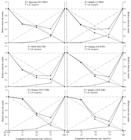
Relative productivity (RP) for the relative shoot dry matter of maize - M (●), sourgrass - D (Digitaria insularis) (○), and the total relative productivity (TRP) of the community (▲) as a function of the ratio of plants (maize: sourgrass). The dashed lines represent the expected values, in the absence of competition, and the solid lines the observed values when the species competed in different ratios of plants.
In terms of TRP, there were significant differences between expected and estimated values in at least two ratios for PH, LA, and DM when competing with D. insularis in all maize hybrids, with concave lines and mean values below 1 (Figures 1, 2 and 3; Table 2).
It can also be noted that in PH the observed and estimated values are very close to each other, in contrast to the TRP of LA and DM where a larger distance between them was observed. This result may be explained by the etiology of the maize plants, as the RP in the ratios for PH (Figure 1) remained above the dashed lines (expected values). However, this behavior was not reflected in the increase in RP for LA (Figure 2) and the greater accumulation of DM (Figure 3). The straight or slightly convex RP lines for PH in the maize hybrids can be attributed to competition for light, which is confirmed by the greater elongation of the stem in competition with weeds that suppress the development of LA and DM (PIERIK; BALLARÉ, 2021).
The estimated TRP for LA and DM showed significant differences, with the presence of concave lines and mean values below 1 in all plant simulations. This indicates competition for the same resources in the environment, affecting the development of the crop and the competitor. These losses are observed even at the lowest weed ratios, suggesting that this species can cause damage to the crop even at low densities (Figures 2 and 3; Table 2). Other weeds such as Brachiaria brizantha and Commelina benghalensis (CARVALHO et al., 2011), and Sorghum sudanense (WANDSCHEER et al., 2014) were also found to be more competitive with maize plants. The results of the TRP with concave lines and values below 1 indicate competition between maize and D. insularis for the same resources in the environment. There is mutual antagonism, which is confirmed by TRP with values below 1. This also applies to competition between rice and red rice (RUBIN et al., 2014), maize hybrids, such as DKB 240 YG, in the presence of Sorghum sudanense (WANDSCHEER et al., 2014), maize hybrids such as Agroeste 1551 PRO 2, Morgan 300 PW, Nidera 92 PRO, and Syngenta Velox TL with Urochloa plantaginea (FRANDOLOSO et al., 2019), Euphorbia heterophylla (GALON et al., 2021), or in the presence of Digitaria ciliaris and Ipomoea indivisa (GALON et al., 2020).
In all situations, there was a difference for RP, except for PH, which competed with Morgan 20A78 (Figure 1; Table 2). Among the variables evaluated, the relative LA and DM in the RP curve suffered greater losses than the relative PH of the plants (Figures 1, 2, and 3). The lower loss of interaction compared to PH could be related to the plant's strategy to improve light uptake, leading to the formation of long stems, with less energy invested in the development of LA or DM (PIERIK; BALLARÉ, 2021). A similar result was observed in the competition between maize and Sorghum sudanense, where the crop had a greater height than the weed (WANDSCHEER et al., 2014). It should be noted that light is one of the most important limited resources in plant communities and plays an important role in the initial response of a plant with greater competitive potential.
The RPs also showed differences when maize hybrids competed with D. insularis. Significant differences were observed in at least two ratios of plants compared to their respective hypothesized lines for PH, LA, and DM (Figures 1, 2, and 3; Table 2). The condition for significance between the lines requires that at least two ratios of the plants are different (BIANCHI; FLECK; LAMEGO, 2006). For the morphological variables analyzed (PH, LA, and DM), differences between the obtained and expected lines were found for all evaluated ratios of the plants.
The relative RPs of LA (Figure 2) and DM (Figure 3), both for the crop and the competitor, were all represented by concave and significant lines (Table 2), except for the maize hybrids Pioneer 3016 VYHR and Sempre 22S18TOP3 in a ratio of 75:25, in which the DM lines of the crop were superior to those observed with convex lines. This indicates that the crop and the weed compete for the same resources in the environment in which they are used, resulting in mutual damage to the growth of the two species.
Maize plants competing with S. sudanense (WANDSCHEER et al., 2014), U. plantaginea (FRANDOLOSO et al., 2019), D. ciliaris and/or I. indivisa (GALON et al., 2020), and soybean weeds (FORTE et al., 2017) also showed the occurrence of concave lines for the crop and the competitor for the evaluated variables, confirming the results observed in the present study.
The relative growth of the maize hybrids (Agroceres 9025, Dekalb 235, KSW 9006, Morgan 20A78, Pioneer 3016, and Sempre 22S18) was generally greater compared to the growth of D. insularis, regardless of the ratio of plants evaluated (Figures 1, 2, and 3; Table 2). The greater growth of maize could be due to the greater height of the plants, which allows for greater light uptake (WANDSCHEER et al., 2014). There is little evidence of qualitative changes due to increased density in experiments in a series of substitutions, i.e. the dominance of one species over another rarely changes with changes in plant density (BIANCHI; FLECK; LAMEGO, 2006).
In general, maize hybrids were found to have less PR losses compared to D. insularis, regardless of the ratio of plants in the association (Table 2). It was possible to verify an increase in TRP with the increase in the ratio of maize plants, a significant situation for both variables studied. This behavior shows that the species compete with each other and that one does not contribute more than expected to the total productivity of the other (RUBIN et al., 2014).
The morphological variables PH, LA, and DM of the six maize hybrids studied were reduced when they competed with D. insularis, regardless of the ratio of plants in the association (Table 3). The higher the ratio of competitors in the association with the maize hybrids, the greater the morphological damage to the plant. Greater reductions in LA and DM were observed in D. insularis plants with the same or a lower ratio of plants compared to the maize hybrids (Table 3).
Differences in plant height (PH), leaf area (LA), and shoot dry matter (DM) in maize hybrids and sourgrass (Digitaria insularis) in monoculture or in combination.
Several studies report damage to the growth of crops and weeds when they compete with each other (AGOSTINETTO et al., 2013; CHU et al., 2022; FRANDOLOSO et al., 2019). The lowest values of LA and DM indicate high interspecific competition, where species compete for the same resources in the environment. Interspecific competition was also reported in a study with maize and U. plantaginea (FRANDOLOSO et al., 2019). The competitive ability of maize may be increased when the plant is well distributed, while when it is distributed in rows, as is generally used in the field, the damage caused by the weed community increases.
The results showed that PH, LA, and DM had the highest average values per plant of the crop or even of the competitors when they were present in lower density in the association, regardless of the ratio of plants (Table 3).
Interspecific competition was found to be more detrimental than intraspecific competition for both species involved in the study. These data confirm the results of maize hybrids in competition with U. plantaginea (FRANDOLOSO et al., 2019) and E. heterophylla (GALON et al., 2021).
The reduction in growth of species involved in intraor interspecific combinations is due to spatial competition between plant groups occupying the same space. However, the greatest interspecific competition is not limited to maize hybrids competing with weeds. Several other works with competing plant species have found similar effects to the present study, e.g. rice and soybean in the presence of D. ciliaris (AGOSTINETTO et al., 2013), wheat x Raphanus raphanistrum (TAVARES et al., 2019), and soybean x Bidens pilosa and Euphorbia heterophylla (FORTE et al., 2017).
The analysis of gas exchange parameters showed that the photosynthetic rate (A) was generally reduced in maize hybrids with a plant ratio of 75:25 (maize: competitors), except for the hybrid KSW 9006 (Table 4). The reduction in A was associated with lower stomatal conductance and lower internal CO2 concentration, suggesting stomatal limitation of photosynthesis by competition (RODRIGUES et al., 2021; LOU et al., 2022). At a ratio of 50:50 or 25:75 (maize: competitor), the photosynthetic rate of maize plants remained similar to the control without competition despite the changes in stomatal conductance, including an increase in A in the hybrids Dekalb 235 and Sempre 22S18 at 25:75 (maize: competitor), likely due to increased water use efficiency.
Photosynthetic rate (A, μmol m-2 s-1), stomatal conductance (gS, mol m-2 s-1), transpiration (E, mol m-2 s-1), internal CO2 concentration (Ci, μmol mol-1), and water use efficiency (WUE, mol CO2 mol H2O-1) of maize hybrids (Agroceres - AG 9025 PRO3, Dekalb 235 PRO3, KWS 9006 VIP3, Morgan 20A78 PW, Pioneer 3016 VYHB, and Sempre 22S18 TOP3) in competition with sourgrass (Digitaria insularis), in experiments in a series of substitutions.
The changes in stomatal parameters suggest that competition with weeds leads to some adaptive changes in maize physiology to withstand stress (LOU et al., 2022). On the other hand, the hybrid Morgan 20A78 showed a lower photosynthetic rate compared to the control, regardless of the ratio of plants. This is probably due to the greater sensitivity of these very early hybrids to competition from weeds in the early growth stages.
The changes in the gas exchange of maize hybrids in competition with weeds thus lead to similar effects. The efficient use of environmental resources such as water, light, CO2, and nutrients has a direct effect on the photosynthesis rate, water use efficiency, growth, and productivity of the plants present on the site (BIANCHI; FLECK; LAMEGO, 2006).
The increase in plant density of the competitors resulted in a lower concentration of nitrogen (N) in the maize hybrids Agroceres 9025 PRO3, Morgan 20A78 PW, and Pioneer 3016 VYHB (Table 5). This could be a clear indication of the higher nitrogen fertilizer requirements of these hybrids when competing with D. insularis. The foliar nitrogen content of maize plants intercropped with U. brizantha is known to be below the range considered appropriate for the crop, with more than 22 weeds m-2 (SILVA et al., 2015).
Responses of maize hybrids (Agroceres - AG 9025 PRO3, Dekalb 235 PRO3, KSW 9006 VIP3, Morgan 20A78 PW, Pioneer 3016 VYHB, and Sempre 22S18 TOP3) to sourgrass (Digitaria insularis) interference, expressed by nutrient content. Nitrogen (N, dag kg-1 - %), phosphorus (P, dag kg-1 - %), potassium (K, dag kg-1 - %), calcium (Ca, dag kg-1 - %), magnesium (Mg, dag kg-1 - %), and sulfur (S, dag kg-1 - %) of the plants conducted experiments in a series of substitutions.
The maize hybrids had higher concentrations of phosphorus (P) and potassium (K) at the lowest competitor densities but with lower values than maize grown without D. insularis (Table 5). This indicates interspecific competition between the maize hybrids and the weed, especially for the nutrients P and K. In a similar work, increasing the density of U. brizantha led to a linear decrease in P content in the maize leaves (SILVA et al., 2015). Silva et al. (2015) confirmed the present results and found that the root system of the weed is initially larger, which leads to a better attachment of the plant to the soil and a rapid accumulation of nutrients. Consequently, this leads to greater competition for P in the soil from the weeds to the detriment of the plants (FREITAS et al., 2019). Thus, the greater the ratio of D. insularis plants competing with maize, the lower the P content in the leaves of the crop. With higher availability of N, P, and K, weeds usually show higher biomass production and growth, which means that these species are characterized by their competitiveness in attacking crops (LITTLE et al., 2021), i.e. in the case of the present study, the growth and development of maize were affected.
Increasing the density of D. insularis plants decreased the concentration of calcium (Ca) and magnesium (Mg) in the maize hybrids (Table 5). This could be due to intraspecific competition, where the plant competes with itself for the uptake of Ca and Mg, as the monoculture (control) has a lower concentration of these nutrients. On the other hand, it has also been reported that the Ca content in maize leaves decreases with increasing weed density, e.g. in U. brizantha (SILVA et al., 2015).
Sulfur (S) content was reduced only in the maize hybrids KSW 9006 VIP3 and Sempre 22S18 TOP3, with increasing in density of D. insularis (Table 5), indicating greater interspecific competition. As with the other maize hybrids evaluated, plant competition for S may not be a limiting factor.
Relative competitiveness (RC), clustering coefficient (Kmaize and Ksourgrass), and aggressiveness coefficient (AG) showed a significant effect for the variables PH, LA, and DM in the maize hybrids coexisting with D. insularis. The maize plants showed RC > 1, Kmaize > Ksourgrass, and AG > 0 in all situations evaluated (Table 6). The maize hybrids Agroeste 9025 PRO 3, Dekalb 235 PRO 3, KWS K9006 VIP 3, Morgan - MG 20A78 PW, Pioneer 3016 VYHR and Sempre 22S18 TOP 3 showed higher competitiveness against D. insularis. Similar results were also observed when maize hybrids competed with U. plantaginea (FRANDOLOSO et al., 2019) or I. indivisa (GALON et al., 2020), where maize plants were characterized by greater efficiency in the uptake of environmental resources and consequently by greater relative growth. When crops are sown together with weeds and the plants ratio varies, crops generally have an advantage in terms of relative productivity, suggesting that intraspecific competition exceeds interspecific competition (WANDSCHEER et al., 2014). However, when weeds occur in high plant density, they usually lead to a reduction in crop productivity (ETHRIDGE et al., 2022).
Competitiveness indices between maize hybrids (Agroceres - AG 9025 PRO3, Dekalb 235 PRO3, KSW 9006 VIP3, Morgan 20A78 PW, Pioneer 3016 VYHB, and Sempre 22S18 TOP3) or sourgrass (Digitaria insularis), expressed by relative competitiveness (RC), relative clustering coefficient (K) and aggressiveness (AG).
In the overall analysis of the data (Figures 1 to 3 and Tables 2 to 6), we found that the maize hybrids (Agroeste 9025 PRO 3, Dekalb 235 PRO 3, KWS K9006 VIP 3, Morgan - MG 20A78 PW, Pioneer 3016 VYHR, and Sempre 22S18 TOP 3) have negative effects due to competition with D. insularis. In other words, the weed species are highly competitive with the crop. Knowledge of the dynamics and competition between plants, especially maize, and D. insularis is important for decision-making when controlling weeds at a certain density to avoid negative effects on the crop, especially since this species has biotypes resistant to EPSPs and ACCAse inhibitor herbicides in several Brazilian maizegrowing regions.
CONCLUSIONS
The competitive ability of maize hybrids was observed in the presence of D. insularis. Considering RPs and TRPs, maize hybrids (Agroeste 9025 PRO 3, Dekalb 235 PRO 3, KWS K9006 VIP 3, Morgan - MG 20A78 PW, Pioneer 3016 VYHR, and Sempre 22S18 TOP 3) are very similar in terms of competitive ability for environmental resources in association with D. insularis. Physiological variables were negatively affected when the density of D. insularis plants increased. The occurrence of differences in the behavior of RC, Kx/Ky, and AG for PH, LA, and DM indicates that there are differences in the competitive ability of maize hybrids with D. insularis, i.e. the crop shows greater relative growth than the weed. The nutrient content is affected by the increase in plant density of D. insularis, which has a negative effect on the harvest. Interspecific competition causes greater damage to the morphological, physiological, and nutritional variables of the species than intraspecific competition. Maize and weeds compete for the same resources in the environment.
REFERENCES
- AGOSTINETTO, D. et al. Habilidade competitiva relativa de milhã em convivência com arroz irrigado e soja. Pesquisa Agropecuária Brasileira, 48: 1315-1322, 2013.
- BIANCHI, M. A.; FLECK, N. G.; LAMEGO, F. P. Proporção entre plantas de soja e plantas competidoras e as relações de interferência mútua. Ciência Rural, 36: 1380-1387, 2006.
- CARVALHO, F. P. et al. Alocação de matéria seca e capacidade competitiva de cultivares de milho com plantas daninhas. Planta Daninha, 29: 373-382, 2011.
- CHU, S. A. D. et al. Critical period of weed control in an interseeded system of corn and alfalfa. Weed Science, 70: 680-686, 2022.
-
CONAB - Companhia Nacional de Abastecimento. Safra brasileira de grãos Disponível em: <http://www.conab.gov.br>. Acesso em: 31 out. 2022.
» http://www.conab.gov.br - COUSENS, R. Aspects of the design and interpretation of competition (interference) experiments. Weed Technology, 5: 664-673, 1991.
- COUSENS, R.; O’NEILL, M. Density dependence of replacement series experiments. Oikos, 66: 347, 1993.
- ETHRIDGE, S. R. et al. Crop physiological considerations for combining variable-density planting to optimize seed costs and weed suppression. Weed Science, 70: 687-697, 2022.
- FORTE, C. T. et al. Habilidade competitiva de cultivares de soja transgênica convivendo com plantas daninhas. Revista Brasileira de Ciências Agrárias, 12: 185-193, 2017.
- FRANDOLOSO, F. et al. Competition of maize hybrids with alexandergrass (Urochloa plantaginea). Australian Journal of Crop Science, 13: 1447-1455, 2019.
- FREITAS, C. D. M. et al. Effect of competition on the interaction between maize and weed exposed to water deficiency. Revista Caatinga, 32: 719-729, 2019.
- GALON, L. et al. Chemical management of weeds in corn hybrids. Weed Biology and Management, 18: 26-40, 2018.
- GALON, L. et al. Competição entre híbridos de milho com plantas daninhas. South American Sciences, 2: e21101, 2020.
- GALON, L. et al. Relative competitiveness between maize hybrids and wild poinsettia. Revista Caatinga, 34: 298-309, 2021.
-
HEAP, I. The international survey of herbicide resistant weeds Disponível em: <http://www.cambridge.org>. Acesso em: 19 out. 2022.
» http://www.cambridge.org - HOFFMAN, M.; BUHLER, D. Utilizing sorghum as a functional model of crop-weed competition. I. Establishing a competitive hierarchy. Weed Science, 50: 466-472, 2022.
- LITTLE, N. G. et al. Effects of fertility amendments on weed growth and weed-crop competition: a review. Weed Science, 69: 132-146, 2021.
- LOPEZ OVEJERO, R. F. et al. Frequency and dispersal of glyphosate-resistant sourgrass (Digitaria insularis) populations across Brazilian agricultural production areas. Weed Science, 65: 285-294, 2017.
- LOU, Z. et al. Hyperspectral remote sensing to assess weed competitiveness in maize farmland ecosystems. Science of the Total Environment, 844: 157071, 2022.
- PIERIK, R.; BALLARÉ, C. L. Control of plant growth and defense by photoreceptors: from mechanisms to opportunities in agriculture. Molecular Plant, 14: 61-76, 2021.
- RODRIGUES, A. J. O. et al. Gas exchange and leaf area of banana plants under salt stress inoculated with growthpromoting bacteria. Revista Brasileira de Engenharia Agrícola e Ambiental, 25: 779-786, 2021.
- RUBIN, R. S. et al. Habilidade competitiva relativa de arroz irrigado com arroz-vermelho suscetível ou resistente ao herbicida imazapyr + imazapic. Arquivos do Instituto Biológico, 81: 173-179, 2014.
- SANTOS, H. G. et al. Sistema brasileiro de classificação de solos 5 ed. Brasília, DF: Embrapa, 2018. 356 p.
- SBCS - Sociedade Brasileira de Ciência do Solo. Manual de adubação e calagem para os estados do Rio Grande do Sul e de Santa Catarina 11 ed. Porto Alegre, RS: Sociedade Brasileira de Ciência do Solo, Núcleo Regional Sul, Comissão de Química e Fertilidade do Solo - RS/SC, 2016. 365 p.
- SILVA, D. V. et al. Produtividade e teor de nutrientes do milho em consórcio com braquiária. Ciência Rural, 45: 13941400, 2015.
- SMITH, A. M.; BURNS, E. E. Impacts of drought intensity and weed competition on drought-tolerant corn performance. Weed Science, 70: 455-462, 2022.
- TAKANO, H. K. et al. Trp2027Cys mutation evolves in Digitaria insularis with cross-resistance to ACCase inhibitors. Pesticide Biochemistry and Physiology, 164: 1-6, 2020.
- TAVARES, L. C. et al. Criteria for decision making and economic threshold level for wild radish in wheat crop. Planta Daninha, 37: e019178898, 2019.
-
USDA - United States Department of Agriculture. Production, supply and distribution Disponível em: <http://www.usda.gov/wps/portal/usda/usdahome?navid=DATA_STATISTICS >. Acesso em: 31 out. 2022.
» http://www.usda.gov/wps/portal/usda/usdahome?navid=DATA_STATISTICS - WANDSCHEER, A. C. D. et al. Capacidade competitiva da cultura do milho em relação ao capim-sudão. Revista Brasileira de Milho e Sorgo, 13: 129-141, 2014.


