Growth, yield and irrigation water efficiency of ‘Brs Imperial’ pineapple cultivated with plastic mulching
ABSTRACT
The use of mulch combined with drip irrigation is a common crop management technique in orchards and contributes to increasing yields while saving water. This work aimed to evaluate the effects of using plastic film mulching as soil cover and as an underground percolation barrier on the growth, yield, fruit quality, and irrigation water productivity of pineapple. Crop development, yield, fruit quality and irrigation water productivity were evaluated. The experiment was set up in a randomized block design with six replications, with a 2 x 2 split-plot arrangement for the treatments studied: With (WC) and without (NC) soil surface cover in the plots and with (WPB) and without (NPB) percolation barrier in the subplots. A plastic film (biodegradable agricultural mulching) was used to cover the ground and to prevent percolation. Plastic film mulching as soil surface cover reduced about nine times the water used for irrigation along the crop cycle, increased plant growth, fruit size and yield, improved fruit quality, and enhanced irrigation water productivity. The plastic percolation barrier did not significantly affect plant growth and production, but significantly enhanced irrigation water productivity.
Keywords:
Ananas comosus; Soil cover; Percolation; Crop development; Water productivity
RESUMO
O uso de cobertura morta combinada com irrigação por gotejamento é uma técnica comum de manejo de culturas em pomares e contribui para aumentar a produtividade e ao mesmo tempo economizar água. O objetivo deste trabalho foi avaliar os efeitos do uso do filme plástico como cobertura morta e como barreira à percolação da água do solo, no crescimento, produtividade, qualidade dos frutos e produtividade da água de irrigação do abacaxizeiro. Foram avaliados o desenvolvimento da cultura, a produtividade, a qualidade dos frutos e a produtividade da água de irrigação. O experimento foi instalado em delineamento experimental de blocos casualizados com seis repetições, em esquema de parcelas subdivididas 2 x 2 para os tratamentos estudados: Com (WC) e sem (NC) cobertura do solo nas parcelas e com (WPB) e sem (NPB) barreira de percolação nas subparcelas. Foi utilizada uma película plástica (cobertura agrícola biodegradável) para cobrir o solo e evitar a percolação. O uso de cobertura morta com filme plástico como cobertura da superfície do solo reduziu em cerca de nove vezes o uso de água para irrigação ao longo do ciclo da cultura, aumentou o crescimento das plantas, o tamanho e a produção dos frutos, melhorou a qualidade dos frutos e aumentou a produtividade da água de irrigação. A barreira plástica de percolação não resultou em efeitos significativos no crescimento e produção das plantas, mas melhorou significativamente a produtividade da água de irrigação.
Palavras-chave:
Ananas comosus; Cobertura morta; Percolação; Desenvolvimento de culturas; Produtividade hídrica
INTRODUCTION
Pineapple (Ananas comosus var. comosus) is considered one of the most commercially appreciated fruits all over the world, mainly because of its unique flavor and aroma. It is a monocotyledonous herbaceous plant, with a crassulacean acid metabolism (CAM) (TAIZ et al., 2017). Among pineapple cultivars, „BRS Imperial‟ stands out for being the first hybrid cultivar resistant to fusariosis (Fusarium guttiforme), and is the result of a cross between the cultivars Perolera and Smooth Cayenne. In addition, „BRS Imperial‟ has smooth leaves and yields good quality fruits with high sugar content, moderate acidity, and excellent flavor (SILVA et al., 2024). This cultivar produces small to intermediate-weight fruits of cylindrical shape and, depending on the plant density used, yield may reach up to 42 t ha-1 (OLIVEIRA et al., 2015).
Environmental conditions and management have a great influence on the pineapple crop cycle (BRITO et al., 2021). When grown under tropical climate with periods of water deficit, as occurs in the semiarid region of Itaberaba, Bahia, Brazil, the crop cycle is about 17 to 19 months, but with irrigation it may be reduced to about 14 to 16 months. Irrigation of pineapple becomes more and more necessary in regions where rainfall rates are below the appropriate range, or in regions where periods of prolonged drought may occur (MARENGO; TORRES; ALVES, 2017). Thus, the cultivation of irrigated pineapple becomes a strategy as the grower can induce flowering in pre-established periods to harvest off-season fruits and to obtain better prices. Although pineapple is a crop with low water demand when compared to other fruits such as mango, banana and passion fruit, an appropriate application of water is necessary during the different stages of development (RUFINI et al., 2019).
Pineapple water demand is still not well defined, since several authors in the literature report different single crop coefficients. Most of them indicate coefficients above 0.5, which means that pineapple is a high or moderate water demand crop. However, the values of the crop coefficients do not match with the fact that pineapple is a CAM plant with transpiration as low as 0.3 to 0.5 mg of water per cm2 of leaf area per hour and with its capacity for water storage in the tissue of the leaf hypoderm.
The use of plastic mulch as soil surface cover is a common technique used by farmers for horticultural crops. Pineapple is one of these crops in which mulch combined with drip irrigation impacts positively on soil water and nutrient distribution for the root system (COELHO et al., 2022). Soil cover reduces soil water evaporation, modifies the microclimate, can efficiently control weeds, promotes plant growth and increases fruit yield and quality, as well as some chemical properties of plants, including the contents of chlorophyll, soluble sugar, and protein in pineapple leaves and roots. A large number of studies has shown that the combination of soil surface cover and irrigation contributes to water saving with increase in crop yield.
The pineapple plant has shallow roots and this allows the use of an underground biodegradable plastic at root depth to prevent loss of water and nutrients below the root system. The literature does not show results about the use of this practice. Therefore, the objective of this work was to evaluate the effects of using plastic film mulch both as soil surface cover and as an underground percolation barrier on the growth, yield and quality of fruits and irrigation water productivity.
MATERIAL AND METHODS
Environmental conditions
The experiment was carried out at the experimental field of Embrapa Cassava & Fruits, located in the municipality of Cruz das Almas, on the Coastal tablelands of Bahia State, Brazil (12º40‟12‟‟ S, 39º06‟07‟‟W, 220 m above sea level). The climate is tropical humid, type Aw to As, according to the Köppen classification, with annual average rainfall, temperature and relative humidity of 1,131 mm, 24.5 °C, and 80%, respectively.
The soil physical properties and chemical attributes within the 0-0.30 m layer are described in Tables 1 and 2. The soil field capacity was considered as the soil water content at 10 kPa tension (0.2192 cm3cm-3).
Physical properties at 0-0.30 m of the soil at the experimental field of Embrapa Cassava and Fruits.
Soil chemical evaluation before planting at the experimental field of Embrapa Cassava and Fruits.
Experiment characterization
„BRS Imperial‟ pineapple plantlets, selected to uniformity by size, were planted during November, 2017, at a spacing of 0.90 m x 0.40 m x 0.40 m with a distance of 0.50 m between ridges. The ridges were at 0.20 m above the ground surface level. A black plastic film mulch was used as ground cover on the surface of the ridges and as percolation barrier at 0.20 m below the ground level and at 0.40 m below the top of the ridges.
Floral induction was performed in the late afternoon at 300 days after planting (DAP) with ethephon, urea, calcium hydroxide and water, applied into the central rosette of each plant.
A drip irrigation system was used to meet the crop‟s water needs. The system consisted of a lateral line with a drip tape, with drippers having a flow rate of 1.6 L h-1, spaced 0.30 m, and watering two rows of plants. Irrigation scheduling was based on the soil water status, and the soil water content was the indicator for irrigating timing and amount of water to supply. Two TDR (Time Domain Reflectometer) probes were installed at 0.15 m depth, between a plant and a dripper in each experimental plot with four replications. TDR readings were done during the early morning three times a week, throughout the crop cycle and were converted to gravimetric soil moisture on volume basis with a calibration equation. The net irrigation depth was determined based upon the difference between the soil water content at field capacity and the actual one, considering the wetted area (KELLER; BLIESNER, 1990).
Experimental design
The experiment was set up in a randomized block design with five replications, in a 2 x 2 x 5 split-split plot arrangement with 50 plants per plot. The factors concerning the use or not of plastic film as groundcover (C) and plastic film as percolation barrier (PB): WC - with groundcover; NC - no groundcover; WPB - with percolation barrier and NPB - no percolation barrier. The third factor is the time after planting (90, 180, 270, 360 and 450 days after planting).
Growth, yield, fruit quality and irrigation water productivity
Crop growth was determined at 90, 180, 270, 360 and 450 days after planting (DAP) when fruits began to be harvested. Number of leaves (NL), plant „D‟ leaf length (DLL), width (DLW), mass (DLM) and leaf area (LA) were determined in one plant of each replication per treatment. „D‟ leaf was considered as the longest leaf of the plant. Leaf area was determined by the disc method (PIEROZAN JUNIOR; KAWAKAMI, 2013). Plants were split into roots, stems, and leaves. The mass of each part was dried in a forced air oven at 65 °C until reaching constant weight. Then, root dry mass (RDM), stem dry mass (SDM), and leaf dry mass (LDM) were determined. The total plant dry mass was the result of the sum of RDM, SDM, and LDM.
The harvest season started at 490 DAP. The averages of fruit weight, length, and diameter were based on 20 fruits per plot. The number of days from planting to flowering (DPF), the number of days from flowering to harvest (DFH), and from planting to harvest (DPH) defined the duration of the different crop cycle stages. Irrigation water productivity (IWP) was calculated as the ratio of fruit yield (kg ha-1) to gross irrigation depth (mm) expressed in kg. ha-1 mm-1. Fruit pulp soluble solids (SS) were obtained using a portable refractometer, and the results were expressed in °Brix (PEARSON, 1973). The total titratable acidity of the fruit pulp (TTA) and the percentage of malic acid (g 100 g-1 of fresh tissue) were determined according to AOAC (1975). Fruit maturation index (TSS/TTA) was obtained from the relationship between total soluble solids (TSS) and total titratable acidity (TTA) (SINCLAIR, 1961). Fruit pulp pH was determined with a benchtop pH meter). All chemical attributes were determined for an average of 20 fruits per subplot.
Statistical analysis
Data of growth, yield and fruit quality variables were subjected to analysis of variance to detect effects of the sources of variation on the dependent variables (F-Test). The means of dependent variables of growth, yield and fruit quality were compared using Tukey test (5% probability) and the regression analysis was used for quantitative sources of variation (FERREIRA, 2019).
RESULTS AND DISCUSSION
Irrigation water depth
The water depth applied throughout the crop cycle for the different treatments was 72.32 mm (T1 - WCWPB- with ground cover and with percolation barrier), 122.42 mm (T2 - WCNPB- with ground cover and no percolation barrier), 827.13 mm (NCWPB - no ground cover and with percolation barrier) and 970.98 mm (NCNPB - no ground cover and no percolation barrier). These data demonstrate the significant effect of the soil surface cover compared with the plastic film used as a percolation barrier. Drip irrigation is a highly efficient irrigation system with low percolation loss. Its association with plastic-film ground cover reduces soilsurface evaporation, which reduces irrigation needs, whereas the bare soil condition with no percolation barrier loses water either by soil surface evaporation or by percolation below the shallow roots of pineapple.
Crop growth
The variance analysis of the data obtained at 450 DAP did not show a significant effect of the use of plastic film as a percolation barrier on plant growth variables. However, the use of plastic film mulch as soil surface cover affected (p<0.05) all plant growth variables in a positive way (Table 3).
Effect of soil surface cover on growth variables of drip irrigated pineapple cv. BRS Imperial. NL - Number of leaves, DLL - D-leaf length, DWL - D-leaf width, DLM - D-leaf mass, TLM - total leaf mass, SDM - stem dry mass, RDM - root dry mass, TDM - Total dry mass, LA - Total Leaf Area.
The use of soil surface cover contributed to higher values of all growth variables, regardless of the presence of the percolation barrier. The interaction between the two variables did not affect the plant growth.
Total leaf mass and total dry mass of plants increased in response to mulching at the soil surface. Pádua et al. (2020), when studying pineapple in an organic system under irrigation, in the highland of Bahia, reported increases in leaf number and stem diameter for both cvs. Imperial and Pérola in response to soil surface plastic mulching, but observed a reduction of „D‟ leaf mass and length for cv. Imperial.
When observing the evolution of plant growth along the cycle, as influenced by the treatments (Figure 1), the significant positive effects of the plastic film ground cover is evident from the first evaluation done at 90 days after planting, especially for the number of leaves (Figure 1A) and for the D-leaf length and width (Figures 1B and 1C). These effects became stronger with increase of plant age, especially for the plant leaf area (Figure 1D). These results are in agreement with the ones analyzed by Pereira et al. (2021), who reported that plastic mulching promoted an increase in the average number of leaves of 'BRS Imperial' and 'Pérola' pineapple plants. D-leaf is of great importance for decision making when conducting experiments with pineapple, particularly in the assessment of plant development and, consequently, in defining the moment to carry out floral induction (PY; LACOEUILHE; TEISSON, 1984). D-leaf length (Figure 1B) and width (Figure 1C) increased linearly with time until 270 DAP with a reduction in the rate of increase after that. Since the floral induction at 300 DAP, ending the vegetative cycle and starting the reproduction period, the lowering of the plant growth rate is expected. As a result, a second-degree polynomial function represented the increase of these two dimensions of the leaves. The average D -leaf length found in treatments with groundcover was higher than the one reported by Sampaio, Fumis and Leonel (2011), but lower than that obtained by Silva et al. (2017) for the same cultivar in the region of Bebedouro, São Paulo state, Brazil.

Effects of soil surface cover and percolation barrier on growth of drip-irrigated pineapple cv. BRS Imperial along its cycle: (A) number of leaves; (B) D-leaf length; (C) D-leaf width; (D) plant leaf area.
The percolation barrier effect on plant growth was rather small, even though the curves of the treatment with percolation barrier are above those representing the treatment with not such a barrier, for all the variables studied, except for D-leaf length, during a major part of the plant cycle (Figure 1). This effect was more evident for the plant leaf area variable in the last part of the cycle (Figure 1D).
A second-degree polynomial function represents the increase of these two dimensions of the leaves (length and width), indicating higher rate of growth until 270 DAP. Rios et al. (2018) noticed that the width of the D-leaf reached an average greater than 4 cm at 375 days of planting when carrying out a study with the Imperial cultivar. The values found by the authors were lower than the ones obtained in this study. The leaf area of plants in the treatment with ground cover were larger than the one of the plants without it for most of the cycle (Figure 1D), regardless of the percolation barrier.
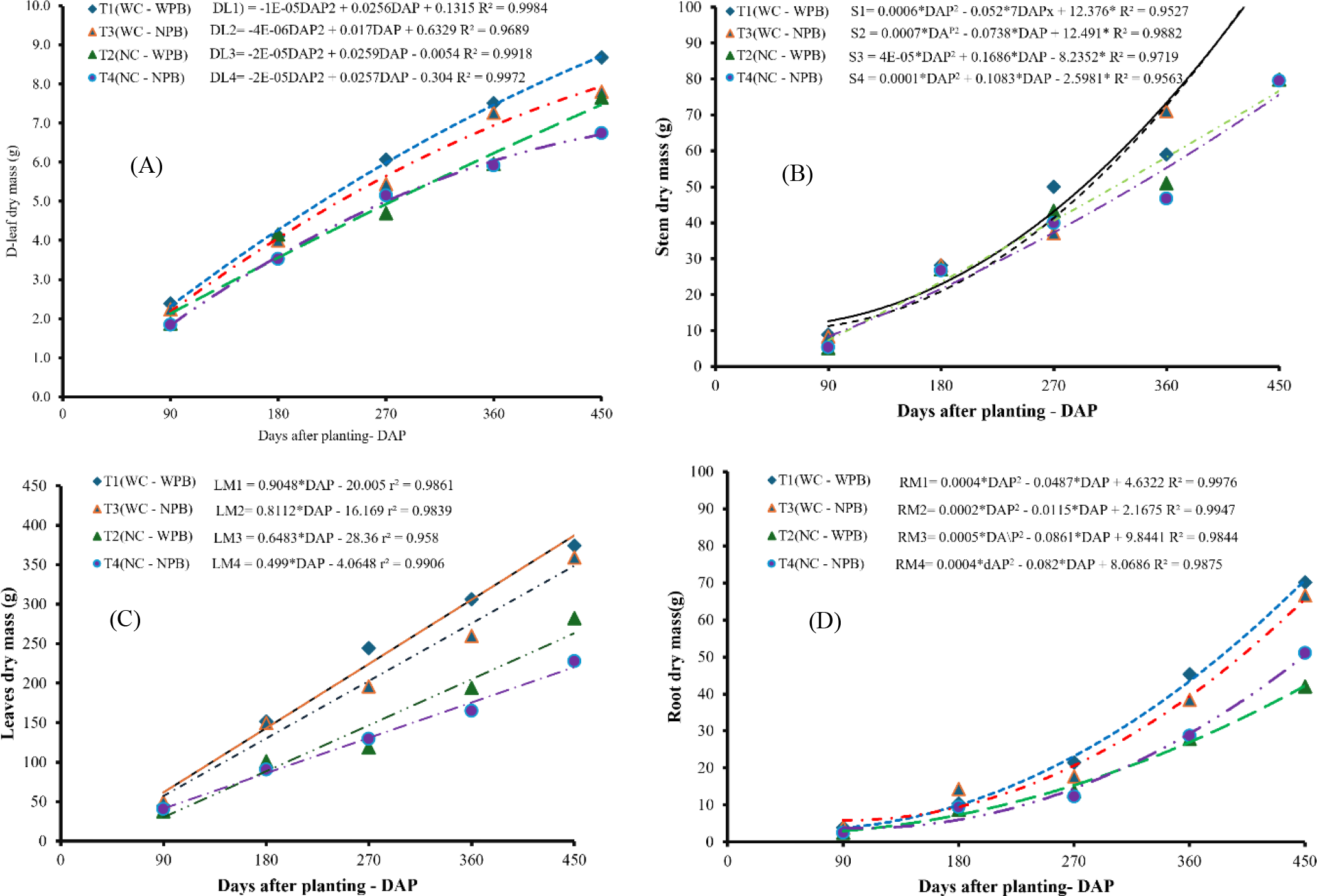
Dry mass accumulation in the plant and in its organs along the cycle, shown in Figure 2, confirms the positive influence of the plastic film soil groundcover on plant growth. Leaf dry mass showed a positive linear rate with time. (Figures 2A and 2C). All the curves of the groundcover treatments were superior to those without the use of this soil cover, whereas the same cannot be observed for the percolation barrier treatment. This indicates that the groundcover is more effective than the percolation barrier on pineapple plant growth expressed as dry mass of morphological variables. There was a continuous increase of dry mass, even along the fruit formation period after floral induction at 300 DAP.
Effects of ground cover and percolation barrier on growth organs, based on dry mass, of drip-irrigated pineapple cv. BRS Imperial along its cycle: (A) D-leaf; (B) stem; (C) Leaves and (D) roots (D).
Fruit size, yield and irrigation water productivity
The positive effects of soil surface cover by plastic mulch on plant growth shown before, as expected, did reflect on the production variables of pineapple cv. Imperial. Fruit weight and dimensions, fruit crown weight (Table 4) and crop yield (Table 5) increased significantly (p<0.05) with the use of mulching as ground cover. Fruit weights were higher than the ones found by Sampaio, Fumis and Leonel (2011), Oliveira et al. (2015) and Pádua et al. (2020) for the same cultivar. However, the values were lower than those reported by Rufini et al. (2019) and Pádua et al. (2020) for „Pérola‟ pineapple, which represents a typical genetic difference among these cultivars. „Pérola‟ fruits are also longer, but are of smaller diameter. In this work the average value obtained for the „BRS Imperial‟ fruit diameter was 11.18 cm, higher than those found for „Pérola‟ fruits by Pádua et al. (2020), Sampaio, Fumis and Leonel (2011) and Silva et al. (2020), who evaluated yield and fruit quality of 'Pérola' pineapples as a function of drip irrigation levels.
Effect of soil surface mulching on pineapple cv. BRS Imperial fruit and crown weight and dimensions.
Effect of soil surface cover on the yield, crop cycle length, and water productivity of pineapple cv. BRS Imperial.
Even though the crown adds beauty to the fruit, large crowns are not welcome for the customers, as they are not edible and may represent waste for the consumers. In the present study, the crowns were of acceptable size (16.62 cm) and weight (0.116 kg). This weight was lower and the length higher when compared to the values reported by Silva et al. (2020). According to the fruit quality requirements for importation to the United States, the crown must not be shorter than 9.2 cm and not be longer than twice the length of the fruit (BENGOZI et al., 2007).
Yield and irrigation water productivity were also significantly influenced by the use of soil surface mulching, whereas the days elapsed from planting to harvest (length of crop cycle) were not different between the treatments (Table 5).
As expected, larger fruits obtained in the treatments with soil surface mulching, determined significantly higher yields (54%) when compared to the unprotected soil treatments. The average yield of 47.23 t ha-1 is higher than the Brazilian average for pineapple in 2020, which was 25,269 fruits per hectare, corresponding to 37.90 t ha-1 (IBGE, 2019). According to Silva et al. (2020), fruit size may decrease as the competition of plants for water, light, and nutrients increases.
The use of mulching allows a favorable environment that reduces the competition for water and nutrients, because the soil surface cover prevents water loss through evaporation, keeping adequate soil moisture in the root zone, and reduces water loss through percolation. Therefore, soil surface cover provides greater availability of water (Table 6) and nutrients in the effective rooting zone (BRAGA et al., 2017). The soil water availability under soil surface cover was near or at its upper limit during the crop cycle. This may have resulted in positive effects on partitioning and allocation of photoassimilates to the fruits (REZZO et al., 2020). Soil water availability was equal to or smaller than 69% for treatments with cultivation in bare soil during the crop cycle (Table 6).
Effect of soil surface cover on means of soil water availability before irrigation of pineapple cv. BRS Imperial during its cycle.
The use of plastic mulch affects the „BRS Imperial‟ pineapple yield more as soil surface cover than its use as underground percolation barrier (Table 7). Regardless of the presence of plastic mulch as percolation barrier, plastic soil surface cover determined very significant increases in crop yield and water use efficiency.
Effect of soil surface cover interaction with soil underground percolation barrier on yield and irrigation water productivity of pineapple cv. BRS Imperial.
However, the use of percolation barrier significantly enhances the effect of the use of groundcover on yield. The increase of yield was about 59% with the use of the groundcover under the presence of the percolation barrier and 42% with the use of groundcover without the percolation barrier. On the other hand, there was no statistically significant effect of the percolation barrier on yield for both situations of groundcover (Table 7). The differences of yields when using or not the percolation barrier with and without groundcover were equal to or less than 12%. The use of mulching as soil surface cover and as percolation barrier promoted a significant increase in irrigation water productivity for „BRS Imperial‟ pineapple (Table 7). Irrigation water productivity was the highest in the soil surface-mulched treatment together with the percolation barrier (91.58 kg mm-1), an increase of 92% in irrigation water productivity compared with the bare soil condition under the use of percolation barrier. The presence of a percolation barrier contributed to an increase of 92% in irrigation water productivity compared with the no use of it when under the presence of a soil surface cover. The worst scenario of the irrigation water productivity is the cultivation of pineapple on bare soil without percolation barrier (33 kg mm-1). The means of irrigation water productivity obtained in this work when using groundcover or percolation barrier were within the range of 47.5 - 91.8 kg mm-1, near the values reported by some authors according to Carr (2012).
Fruit quality
Fruit quality was positively affected by the use of plastic soil surface cover. Total titratable acidity was reduced and the maturation index and pulp pH were increased (Table 8). The interaction between the evaluated factors (soil surface cover x percolation barrier) did not show a significant influence on any variable. For total soluble solids (TSS), there was no significant difference between the means of the two treatments (with and without groundcover). The means of total soluble solids were higher than the ones obtained by Berilli et al. (2011), who compared sensory attributes of pineapple cultivars (Vitória, Pérola and Gold) for fresh consumption. Soluble solids are of great relevance for assessing fruit quality. In this study, most samples evaluated obtained values of soluble solids within the range (14 - 16 ºBrix) proposed by Chitarra and Chitarra (2005) for good quality fruits for fresh consumption.
Effect of soil surface cover on fruit quality attributes of pineapple cv. BRS Imperial. TTA - total titratable acidity, TSS - total soluble solids, SS/TA - maturation index, pH - hydrogen potential.
Acidity (TTA) and pH are related to the ripening process of harvested fruits (REINHARDT; MEDINA, 1992). Fruit acidity decreased and pH values increased for BRS Imperial when cultivated with soil surface cover. The pH values found in this study are within the range of those reported by Silva et al. (2020) and were higher than those observed by Pinheiro et al. (2006), who detected pH ranging from 3.46 to 3.63 for concentrated pineapple juices. Total titratable acidity of BRS Imperial was lower than the mean of the Vitória cultivar and close to the means of Pérola and Gold cultivars (BERILLI et al., 2011). The relationship between soluble solids and titratable acidity (TSS/TTA) ranged from 23.95 (bare soil) to 30.48 (groundcover). These values were lower than those found by Silva et al. (2020). Pérez et al. (2005), when using plastic mulch in the cultivation of pineapple, obtained significantly better results for TSS and TTA than for the un-mulched soil.
CONCLUSIONS
The use of plastic film mulching as soil surface cover reduced about nine times the water use for irrigation along the crop cycle, increased plant growth, fruit size and yield, improved fruit quality and increased irrigation water productivity of drip-irrigated pineapple cv. BRS Imperial.
The underground plastic percolation barrier did not result in significant effects on plant growth and production, but significantly enhanced irrigation water productivity.
REFERENCES
- AOAC - Association of Official Analytical Chemists. Official methods of analysis 12. ed. Washington, D. C.: Association of Analytical Chemistry, 1975. 1094 p.
- BENGOZI, F. J. et al. Qualidades ísicas e químicas do abacaxi comercializado na CEAGESP. Revista Brasileira de Fruticultura, 29: 540-545, 2007.
- BERILLI, S. S. et al. Avaliação sensorial dos frutos de cultivares de abacaxi para consumo in natura. Revista Brasileira de Fruticultura, 33: 592-598, 2011.
- BRAGA, M. B. et al. Coberturas do solo e uso de manta agrotêxtil (TNT) no cultivo do meloeiro. Horticultura Brasileira, 35: 147-153, 2017.
- BRITO, C. F. B. et al. Abacaxi „Pérola‟ irrigado com água salina: correlações entre morfofisiologia-produção e estimativa da área foliar. Nativa, 9: 135-141, 2021.
- CARR, M. K. V. The water relations and irrigation requirements of pineapple (Ananas comosus var. comosus): a review. Experimental Agriculture, 48: 488-501, 2012.
- CHITARRA, A. B.; CHITARRA, M. I. F. Pós-colheita de frutos e hortaliças: fisiologia e manuseio Lavras, MG: UFLA, 2005. 783 p.
- COELHO, E. F. et al. Water regimes on soil covered with plastic film mulch and relationships with soil water availability, yield, and water use efficiency of papaya trees. Agricultural Water Management, 269: 107709, 2022.
- FERREIRA, D. F. SISVAR: A computer analysis system to fixed effects split plot type designs. Brazilian Journal of Biometrics, 37: 529-535, 2019.
-
IBGE - Instituto Brasileiro de Geografia e Estatística. Produção Agrícola Municipal 2019 2019. Available at: https://sidra.ibge.gov.br/tabela/1612 Access on: Oct. 25, 2023.
» https://sidra.ibge.gov.br/tabela/1612 - KELLER, J.; BLIESNER, R. D. Sprinkle and Trickle Irrigation 1. ed. New York: Springer US, 1990. 652 p.
- MARENGO, J. A.; TORRES, R. R.; ALVES, L. M. Drought in Northeast Brazil - past, present, and future. Theoretical and Applied Climatology, 129: 1189-1200, 2017.
- OLIVEIRA, A. M. G. et al. Adubação NK no abacaxizeiro „BRS Imperial‟ - II. Efeito no solo, na nutrição da planta e na produção. Revista Brasileira de Fruticultura, 37: 764-772, 2015.
- PÁDUA, L. et al. Individual grapevine analysis in a multitemporal context using UAV-based multi-sensor imagery. Remote Sensing, 12: 139, 2020.
- PEARSON, D. Laboratory Techniques in Food Analysis London: Butterworths, 1973. 323 p.
- PEREIRA, L. S. et al. Standard single and basal crop coefficients for vegetable crops, an update of FAO56 crop water requirements approach. Agricultural Water Management, 243: 106196, 2021.
- PÉREZ, P. G. et al. Planting densities and plastic mulching for “Smooth Cayenne” pineapple grown in an AW2 climate fluvisol soil in Veracruz, Mexico. Acta Horticulturae, 666: 271-275, 2005.
- PIEROZAN JUNIOR, C.; KAWAKAMI, J. Efficiency of the leaf disc method for estimating the leaf area index of soybean plants. Acta Scientiarum Agronomy, 35: 487-493, 2013.
- PINHEIRO, A. M. et al. Avaliação química, físico-química e microbiológica de sucos de frutas integrais: abacaxi, caju e maracujá. Food Science and Technology, 26: 98-103, 2006.
- PY, C.; LACOEUILHE, J. J.; TEISSON, C. L. Ananás: sa culture, sés produits. 1. ed. Paris, France: Maisonneuve, 1984. 617 p.
- REINHARDT, D. H. R. C.; MEDINA, V. M. Crescimento e qualidade do fruto do abacaxi cvs. Pérola e Smooth Cayenne. Pesquisa Agropecuária Brasileira, 27: 435-447, 1992.
- REZZO, D. D. P. Z. et al. Fitomassa e produtividade da melancieira cultivada sob diferentes números de frutos e espaçamento de plantio. Research, Society and Development, 9: e568985795, 2020.
- RIOS, E. S. C. et al. Quality of „Imperial‟ pineapple infructescence in function of nitrogen and potassium fertilization. Revista Brasileira de Ciências Agrárias, 13: 18, 2018.
- RUFINI, J. C. M. et al. Crescimento vegetativo, rendimento e qualidade de frutos de abacaxizeiro em lâminas de irrigação. Scientia Agraria Paranaensis, 18: 289-296, 2019.
- SAMPAIO, A. C.; FUMIS, T. F.; LEONEL, S. Crescimento vegetativo e características dos frutos de cinco cultivares de abacaxi na região de Bauru-SP. Revista Brasileira de Fruticultura, 33: 816-822, 2011.
- SILVA, D. C. et al. Pineapple breeding: development of new pineapple cultivars without leaf spines and resistant to fusariosis. Euphytica, 220: 1-11, 2024.
- SILVA, R. R. et al. Desenvolvimento vegetativo de variedades de abacaxi na região de Bebedouro-SP. Science and Technology Innovation in Agronomy, 1: 13-21, 2017.
- SILVA, T. R. G. et al. Produtividade e qualidade dos frutos do abacaxi “pérola” em função de lâminas de irrigação. Brazilian Journal of Development, 6: 40140-40152, 2020.
- SINCLAIR, W. B. Principal juice constituents. In: SINCLAIR, W. B. (Ed.) The Orange: Its Biochemistry and Physiology Riverside, CA: University of California, Division of Agricultural Sciences, 1961. cap. 3, p. 131-160.
- TAIZ, L. et al. . Fisiologia vegetal, 6. ed. Porto Alegre, RS: UFRS, 2017. 888 p.