Complexed calcium sources improve the quality of sour passion fruit seedlings under salt stress
ABSTRACT
Salinity stress is one of the main limitations to the expansion of sour passion fruit areas in the semi-arid region of Brazil. Studies have shown that the application of calcium reduces the deleterious effects of salinity, especially when sources of rapid availability and absorption are used. The objective of this study was to evaluate the effect of complexed calcium sources on the growth and quality of sour passion fruit seedlings under salt stress. The experiment was conducted in a randomized block design, in a 2 × 2 × 3 factorial arrangement, relating to two sour passion fruit cultivars (BRS GA1 and BRS SC1), two levels of water salinity (0.5 and 4.0 dS m-1), and sources of complexed calcium (without calcium, complexed in organic acids, and complexed in amino acids). The following parameters were evaluated: height, stem diameter, root length, leaf area, dry mass (aerial part, root, and total), and Dickson's quality index. The results indicate that irrigation water with a salinity of 4.0 dS m-1 negatively affects the growth and quality of sour passion fruit seedlings, reducing plant height by 72.44% in BRS GA1 and 58.76% in BRS SC1 in the treatment without calcium. Under saline conditions, calcium complexed in organic acids showed more consistent mitigating effects, increasing total dry mass by 43.77% compared to the treatment without calcium. The use of calcium complexed with organic acids represents a promising strategy to mitigate salt stress during the seedling stage of sour passion fruit.
Keywords:
Passiflora edulis Sims; Complexing agents; Cultivars; Calcium fertilization; Water salinity.
RESUMO
O estresse salino é uma das principais limitações para a expansão das áreas de maracujazeiro-azedo na região semiárida do Brasil. Estudos têm mostrado que a aplicação de cálcio reduz os efeitos deletérios da salinidade, especialmente quando são utilizadas fontes de rápida disponibilidade e absorção. O objetivo deste estudo foi avaliar o efeito de fontes de cálcio complexadas sobre o crescimento e a qualidade de mudas de maracujazeiro-azedo sob estresse salino. O experimento foi conduzido em delineamento de blocos casualizados, em um arranjo fatorial 2 × 2 × 3, relacionado a duas cultivares de maracujazeiro-azedo (BRS GA1 e BRS SC1), dois níveis de salinidade da água (0,5 e 4,0 dS m⁻1), e fontes de cálcio complexado (sem cálcio, complexado em ácidos orgânicos, e complexado em aminoácidos). Os parâmetros avaliados foram: altura, diâmetro do caule, comprimento de raiz, área foliar, massa de matéria seca (parte aérea, raiz e total), e índice de qualidade de Dickson. Os resultados indicam que a água de irrigação com salinidade de 4,0 dS m⁻1 afeta negativamente o crescimento e a qualidade das mudas de maracujazeiro-azedo, reduzindo a altura das plantas em 72,44% na BRS GA1 e 58,76% na BRS SC1 no tratamento sem cálcio. Sob condições salinas, o cálcio complexado em ácidos orgânicos mostrou efeitos mitigadores mais consistentes, aumentando a massa seca total em 43,77% em comparação ao tratamento sem cálcio. O uso de cálcio complexado com ácidos orgânicos representa uma estratégia promissora para mitigar o estresse salino durante o estágio de muda do maracujá-azedo.
Palavras-chave:
Passiflora edulis Sims; Agentes complexantes; Cultivares; Fertilização com cálcio; Salinidade da água.
INTRODUCTION
Northeastern Brazil stands out as the main region producing sour passion fruit (Passiflora edulis Sims), particularly the states of Bahia and Ceará, which account for around 57.4% of total production (IBGE, 2023). In this region, plantations are located in semi-arid areas, which have ideal climatic and soil conditions for cultivation (LIMA et al., 2023; SANTOS et al., 2025). However, water limitations, mainly due to irregular rainfall, restrict the expansion of cultivated areas and the crop‟s production potential (SOUTO et al., 2024).
Given these conditions, many sour passion fruit producers use low-quality water with considerable levels of soluble and toxic salts as the sole source to meet the crop's water needs (SOUTO et al., 2024). In terms of salinity tolerance, the crop is classified as a sensitive to moderately sensitive species, with the initial phase of growth being most susceptible to salt stress (LIMA et al., 2023; CAVALCANTE et al., 2024). This is because salt stress has negative effects on plant development due to the direct effect of high concentrations of toxic ions, such as sodium (Na+) and chloride (Cl-), and indirect effects due to the osmotic effect and nutritional imbalance (TÁRTARI et al., 2024).
In sour passion fruit seedlings, salt stress impairs gas exchange, with negative effects on growth and seedling quality (GUEDES et al., 2023; GUEDES et al., 2025). However, due to genetic variability and the presence of tolerance genes, there are genotypes that vary in their threshold tolerance to salt stress (BEZERRA et al., 2016). Thus, the evaluation and selection of promising sour passion fruit materials for biosaline cultivation should be a viable strategy. In this context, the cultivars BRS GA1 and BRS SC1 were selected due to their contrasting responses to salinity reported in previous studies, allowing the evaluation of differential responses to complexed calcium sources (LIMA et al., 2023; SOUTO et al., 2024).
Adequate mineral nutrition for sour passion fruit, adjusted for saline conditions, appears to be a promising alternative. Calcium (Ca2+), for example, stands out as a secondary macronutrient in plant nutrition, contributing to plant growth and development (JOSHI et al., 2022; WENG et al., 2022). In this context, the use of calcium has been associated with improvements in growth and quality of sour passion fruit seedlings under saline conditions, reflected in increases in plant height, biomass accumulation, and overall seedling quality (GUEDES et al., 2023; GUEDES et al., 2025; SOUTO et al., 2024).
However, calcium in plants is a challenge due to its low mobility within them. Research using complexing agents shows a greater capacity for calcium ion absorption, demonstrating the influence of these elements on improving the morphophysiological characteristics of plants, in addition to influencing the bioactivity of other minerals (TAN et al., 2024). Complexing agents act to protect calcium from unwanted and inappropriate chemical reactions and improve its availability, which makes them essential for balanced nutrition (HAMOUD et al., 2024). Therefore, the use of natural complexing agents, such as amino acids and organic acids, can aid in the bioavailability of calcium in plants, in addition to mitigating the deleterious effects of salt stress (GUEDES et al., 2025).
However, further information is needed on how different sources of complexed calcium affect the growth and quality of sour passion fruit seedlings under saline conditions, particularly considering differences between cultivars. Therefore, we hypothesized that the application of complexed calcium sources would mitigate the effects of salt stress on seedling growth and quality, and that the response would vary between cultivars. The objective of this study was to evaluate the effect of complexed calcium sources on these variables under saline conditions.
MATERIAL AND METHODS
The experiment was conducted from October to December 2023, in a greenhouse located in the Department of Agronomic and Forest Sciences (DCAF) of the Federal Rural University of the Semi-Arid Region (UFERSA), in Mossoró, Rio Grande do Norte, Brazil (5°12'12'' S, 37°19'26'' W, 17 m above sea level). The site has a low-density, transparent polyethylene cover with UV protection, an arched structure measuring 6.5 m × 12 m, with side and front walls made of anti-aphid screens (50%) and a 0.24-m tall masonry dwarf wall. During the experiment, the average air temperature and humidity inside the greenhouse were recorded daily using a digital thermohygrometer (model HTC-2, KLX) (Figure 1).
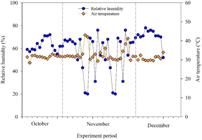
Daily values of air temperature and relative humidity inside the greenhouse during the experiment.
The experiment was conducted in a randomized block design, in a 2 × 2 × 3 factorial arrangement, with three replicates and two plants per plot. The treatments consisted of two sour passion fruit cultivars (BRS GA1 and BRS SC1), irrigated with low and moderate salinity water (0.5 and 4.0 dS m-1, respectively) and the application of complexed calcium sources as a mitigator of water salinity stress (without calcium [WCa], calcium complexed in organic acids [Ca-OA], and calcium complexed in amino acids [Ca-AA]).
The F1 seeds of the sour passion fruit cultivars BRS GA1 and BRS SC1 were obtained from parent plants at Embrapa Cerrado, Brasília, Brazil. Low-salinity water (0.5 dS m-1) was sourced from the local supply, while moderately saline water (4.0 dS m-1) was prepared by diluting a stock solution (8.0 dS m-1) with sodium chloride (NaCl; MW = 58.44), calcium chloride (CaCl2·H2O; MW = 147.01), and magnesium chloride (MgCl2·6H2O; MW = 203.30) in a 7:2:1 ratio in supply water (0.5 dS m-1). This proportion was adopted to simulate the ionic composition commonly found in saline waters used for irrigation in semi-arid regions (SOUTO et al., 2024). The electrical conductivity of the irrigation water was monitored daily using a digital conductivity meter to ensure the maintenance of the desired salinity levels. The calcium sources used were the commercial products Codasal® and Hendosar®, as sources of Ca complexed in organic acids and amino acids, respectively, both at a concentration of 2% (v:v).
The substrate used for seedling formation consisted of a mixture of soil collected from a depth of 0.0-0.2 m and cured cattle manure, in a ratio of 2:1, in which the chemical composition was analyzed for substrate fertility according to the methodologies contained in Silva (2009), as shown in Table 1. It is important to note that the substrate showed a slightly alkaline pH (7.7) and an initial electrical conductivity of 1.45 dS m⁻1, which were considered in the interpretation of the results.
Next, the substrate was placed in black polyethylene bags with a capacity of 1.5 dm3. In each bag, three seeds were sown at a depth of 2 cm and then covered with a thin layer of substrate. Seedling emergence began on the seventh day and stabilized 28 days after sowing (DAS), considering as normal seedlings those that emerged completely and showed adequate development, according to the criteria of Brasil (2009). Ten days after emergence stabilized, thinning was performed, keeping the most vigorous seedling per bag.
Irrigation was performed daily using irrigation water by the weighing method, replacing the volume of water corresponding to the evapotranspiration of the plants in the last 24 hours, ensuring that the substrate moisture remained at 90% of field capacity (GUEDES et al., 2023). No leaching fraction was applied, as irrigation was performed by daily weighing, replacing only the volume of water lost by evapotranspiration to restore the substrate to its initial weight at field capacity. The amount of water to be applied was in accordance with the methodology of Souto et al. (2024), which corresponded to the difference between the weight of the polyethylene bag at field capacity and the weight on the day of irrigation, in order to maintain the substrate at 90% of field capacity.
The attenuators (Codasal® and Hendosar®) were applied at 12 and 32 days after emergence (DAE) at a dose of 50 mL per plant. The solution was prepared by diluting the attenuators in low salinity water (0.5 dS m-1) to a concentration of 2%, as recommended by the manufacturers. The application was made gradually over the surface of the substrate, allowing maximum infiltration. Codasal® is a dark-colored liquid organomineral fertilizer containing calcium complexed in organic acids (lignosulfonate) and has a composition of 6.0% N, 8.7% CaO, 14.7% lignosulfonate complexing agent, and a salt index of 40.74%. Hendosar® is a light red liquid mineral fertilizer containing calcium complexed in amino acids: L-Threonine ≈3.56%, L-Aspartic Acid -3.45%, L-Serine ≈4.49%, L-Glutamic Acid 9.12%, L-Proline ≈3.50%, L-Glycine -2.43%, L-Alanine ≈2.20%, L-Cystine 2.45%, L-Valine ≈3.10%, L-Methionine -0.23%, L-Isoleucine ≈1.70%, L-Leucine -2.80%, L-Tyrosine ≈1.02%, L-Phenylalanine -1.78%, L-Lysine ≈2.30%, L-Histidine - 0.90%, L-Arginine ≈5.20%), with a composition of 9.0% N, 6.0% K2O, 7.5% Ca, 1.2% Mg, and a salt index of 49.52%. It is important to note that, in addition to differences in calcium complexation, the commercial formulations also differ in their chemical composition, including nitrogen, potassium, magnesium, lignosulfonate content, and reported salt index.
At 60 DAE, the growth parameters of the seedlings were evaluated in terms of plant height (PH) (cm) using a graduated ruler, root length (RL) (cm) using a ruler graduated in millimetres, and stem diameter - SD (mm) with a Mitutoyo Absolute AOS digital caliper (Mitutoyo, Takatsu-ku, Japan). In addition, the number of leaves (NL) was counted, considering those that were fully expanded, and the leaf area (LA) was calculated by measuring the length (L) and width (W) of the leaves and using the equation proposed by Souto et al. (2017), Equation 1:
where:
LA is leaf area (cm2);
L is leaf length (cm), and;
W is leaf width (cm).
During the same period, the plants were separated into roots and aerial parts, placed in properly labeled paper bags, and dried in an air-circulating oven at a temperature of 60±3 ° C for 72 hours. Then, the samples were weighed on a semi-analytical balance (0.001 g), with values expressed in g plant-1, of the shoot dry mass (SDM) and root dry mass (RDM). The total dry mass (TDM) of the plants was determined by summing SDM and RDM. The Dickson Quality Index (DQI) was determined according to Dickson, Leaf and Hosner (1960), as shown in Equation 2.
The data were subjected to normality analysis using the Shapiro-Wilk test and homogeneity of variance using the Bartlett test. Subsequently, analysis of variance was performed using the F test (p ≤ 0.05). When a significant effect was found, the means for the cultivar and salinity factors were compared using the F test (p ≤ 0.05), while the calcium sources were compared using the Tukey test (p ≤ 0.05). The data were analyzed using SISVAR statistical software version 5.6 (FERREIRA, 2019). In addition, multivariate analyses were performed in relation to principal component analysis (PCA) and Pearson's correlation (p ≤ 0.05) using R Studio® statistical packages: „tidyverse‟, „factoextra‟, „ggrepel‟, and corrplot (R CORE TEAM, 2023). Principal component analysis and Pearson‟s correlation were used to better understand the relationships among variables and treatment effects. PCA allowed the reduction of data dimensionality and identification of the most relevant variables contributing to variability, while Pearson‟s correlation quantified the strength and direction of associations between variables. Together, these analyses provided a more integrated and robust interpretation of the results.
RESULTS AND DISCUSSION
According to Table 2, it can be seen that the cultivars × saline water × calcium sources interaction had a significant effect (p ≤ 0.05) on the height, diameter, root length, leaf area, root dry mass, and Dickson quality index of sour passion fruit seedlings. Shoot dry mass responded to the interaction cultivars and saline water, while the total dry mass responded to the interactions between cultivars × saline water and saline water × calcium sources (p ≤ 0.05). Water salinity influenced leaf production in seedlings (p ≤ 0.05).
Summary of analysis of variance, by mean square values, for growth and quality variables of sour passion fruit cultivars (Cul) irrigated with saline water (SW) and application of complexed calcium sources (CaS) as attenuators.
Irrigation with moderately saline water reduces plant height, regardless of the cultivars used and the application of calcium sources in the substrate (Figure 2A). In the substrate without attenuators, an increase in water salinity from 0.5 to 4.0 dS m⁻1 reduced seedling height by 72.44% (BRS GA1) and 58.76% (BRS SC1), respectively. Under salinity conditions, the water available to plants is reduced due to the osmotic effect caused by the high concentration of salts in the substrate solution (TÁRTARI et al., 2024), which decreases the ability of roots to extract water and nutrients. As a result, there is a loss of cell turgor, stomatal closure, and reductions in CO2 assimilation, which affects plant growth (LIMA et al., 2021).
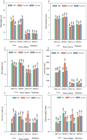
Plant height (A), stem diameter (B), root length (C), leaf area (D), root dry mass (E), and Dickson quality index (F) of sour passion fruit cultivars as a function of irrigation water salinity and complexed calcium sources.
Under irrigation with low-salinity water, the use of complexed calcium influenced seedling height, with variation in the source depending on the cultivar (Figure 2A). In BRS GA1, the highest height values were observed in the Ca-OA application, but did not differ from the treatment without calcium, while in BRS SC1, the highest value was observed in the Ca-AA treatment, with increases of 37.45% compared to the treatments without calcium.
Calcium is an essential element for plant growth, acting in the regulation of tolerance and growth genes and in the maintenance of cell division under stressful conditions (WENG et al., 2022). Calcium is essential for plant growth, acting in the formation and stability of the cell wall, which ensures greater structural integrity and promotes cell expansion (WANG et al., 2019). Furthermore, it plays a fundamental role in cell signalling, regulating physiological processes and promoting better plant development (FENG et al., 2023). This element has low mobility in the plant, and its absorption depends on the transpiration process for efficient transport to different organs (SOUTO et al., 2024). In this context, the use of complexing agents, which have a neutral charge, can improve the absorption and translocation of Ca2+ to growth zones, preventing fixation reactions and the formation of other complexes (SOURI; HATAMIAN, 2019). In seedlings irrigated with lowand moderate-water, Souto et al. (2024) found that the application of complexed calcium sources improves the photosynthetic efficiency of sour passion fruit, which is associated with the stimulation of plant growth.
The stem diameter of the seedlings was reduced when irrigated with moderately saline water, with losses of 40.48% (BRS GA1) and 30.30% (BRS SC1), respectively, in the treatment without calcium (Figure 2B). However, in cv. BRS GA1, the use of complexed calcium sources attenuated the effects of salinity, with significant increases in SD of 11.62% (Ca-OA) and 12.79% (Ca-AA) compared to the treatment without Ca. In cultivar BRS SC1, no significant effect was observed for calcium sources, showing that the genetic factor of calcium utilization is variable under salinity conditions.
Salt stress induces physiological and morphological changes in plants, negatively interfering with physiological processes related to CO2 influx and fixation, which reduces the formation of growth metabolites (GUEDES et al., 2023; HAO et al., 2021). Similarly, Guedes et al. (2025) observed a 10% reduction in the stem diameter of Guinezinho sour passion fruit seedlings irrigated with water at 4.0 dS m-1. Ca2+ can act as a receptor or secondary messenger in stressful situations, causing a rapid response from the plant through morphophysiological adjustment as a way of acclimatizing to unfavorable environmental conditions (FENG et al., 2023). Thus, the use of complexing agents in calcium fertilizers can enhance the mitigating effect of calcium by reducing competitive action with other cations, increasing bioavailability, and reducing the amount needed for better absorption and utilization by the plant, especially under stress conditions (SOURI; HATAMIAN, 2019; SOUTO et al., 2024).
Salt stress reduced the leaf area of seedlings, with greater reductions in the BRS GA1 cultivar (92.82%) (Figure 2D). However, the application of calcium sources mitigated the effect of salinity, with increases of 257.48% and 217.18%, respectively, in the substrate with Ca-OA and Ca-AA. In the BRS SC1 cultivar, the leaf area of the seedlings was reduced by 72.13% when irrigated with moderately saline water, but without a positive effect from the application of calcium sources. The reduction in leaf area in sour passion fruit seedlings may be associated with limitations in physiological processes such as CO2 assimilation and the effects of toxic ions under saline conditions, which can affect plant growth (HAO et al., 2021; LIMA et al., 2021; GUEDES et al., 2023).
However, the application of calcium can reduce the effects of sodium chloride on plants, which is associated with signaling action in the mediation mechanisms for recognizing and responding to salt stress. By increasing the intracellular cytosolic concentration of Ca, plants make a series of physiological and biochemical adjustments in response to salinity (WANG et al., 2019; HAGAGG et al., 2020). In this context, the complexing agents (organic acids and amino acids) contained in complexed calcium fertilizers act as mineral encapsulants, which, under saline conditions, prevent losses in the soil and release Ca2⁺ for more efficient absorption by plants (HAGAGG et al., 2020). In addition, because they have long organic chains, they diffuse easily into the cell cytoplasm, promoting greater efficiency in responses (ELSAWY et al., 2022).
Under salt stress conditions, the BRS SC1 cultivar showed a higher leaf area value compared to BRS GA1, with a 305.57% superiority (Figure 2D). However, cv. BRS GA1 was more responsive to the application of calcium complexed with organic acids under salt stress conditions (62.29%), and there was no significant difference in Ca-AA application between cultivars. Under field conditions, Lima et al. (2023) observed that the BRS SC1 cultivar has greater tolerance to salinity than BRS GA1, with respective salinity thresholds of 1.0 and 0.3 dS m-1. The authors emphasize that the identification or selection of sour passion fruit cultivars that are more tolerant to salinity is an important strategy for managing saline irrigation and semi-arid conditions.
Irrigation with moderately saline water reduced the length and dry mass of seedling roots, except for plants of the BRS SC1 cultivar in the substrate with calcium complexed with amino acids, which showed no significant difference (Figures 2C and 2E). The greatest reduction in root length was observed in the BRS GA1 cultivar, with losses of 42.40%, while the reduction in root dry mass in the BRS SC1 cultivar was 13.63%, both in the treatment without calcium. The reduction in growth and accumulation of root biomass in sour passion fruit seedlings is associated with the negative effects of salt stress, due to osmotic and ionic effects, which reduce the plant's ability to extract water and nutrients from the substrate, negatively affecting cell division and elongation in the meristematic regions of the root (LIMA et al., 2021; GUEDES et al., 2025).
However, the application of Ca-OA reduced the effects of salt stress, increasing root length by 19.64% and dry mass of seedlings of the BRS GA1 cultivar under salt stress by 107% (Figures 2C and 2E). In the BRS SC1 cultivar, no significant differences were found between the calcium sources and the absence of application. It is known that Ca2+ acts on the stability and integrity of root cells and competes with Na+ for absorption and transport sites, reducing sodium accumulation in the apoplast and cytoplasm (JOSHI et al., 2022; MAHMOOD et al., 2024). The use of organic acids and lignosulfonate with complexing agents optimizes the efficiency of Ca2⁺ as a salinity mitigator, functioning mainly as a carrier of the element through cell membranes (ELSAWY et al., 2022; GUEDES et al., 2023; HAMOUD et al., 2024).
Under low-salinity conditions, no significant differences in root length were observed between cultivars (Figure 2C). However, under salt stress, cultivar BRS SC1 showed superiority in RL in the substrate with and without calcium complexed in amino acids, with increases of 20% and 38.22%, respectively. The dry mass of the roots of seedlings in cv. BRS GA1 was higher with the application of Ca-OA under irrigation with moderately saline water. Cultivar BRS SC1 showed higher RDM under low-salinity conditions, while BRS GA1 was more responsive to the application of Ca-AA under the same condition.
In the case of cv. BRS GA1, the increase in root dry mass with the application of Ca-AA under salinity shows that, although more sensitive to stress, this genotype responds positively to calcium supply, which favors the synthesis of structural tissues and inhibits the absorption of toxic ions by the roots (WANG et al., 2019). The higher RDM observed in cv. BRS SC1 under low-salinity conditions, in contrast to the higher responsiveness of BRS GA1 to Ca-AA application, reinforces the existence of genotypic differences in salinity tolerance strategies: while BRS SC1 has intrinsic adaptation mechanisms, such as higher photosynthetic efficiency and cell stability (SOUTO et al., 2024), BRS GA1 depends on the external supply of complexed calcium to mitigate the deleterious effects of salt stress on root growth.
The application of Ca-OA improved the quality of seedlings of the BRS GA1 cultivar under salt stress (DQI = 0.72), showing a 63.6% improvement over the substrate without calcium (0.44). Meanwhile, in cv. BRS SC1, there was no significant difference in DQI for calcium application (Figure 2F). The presence of organic acids and lignosulfonate in Ca-OA may favor the availability and mobility of calcium near the root zone of seedlings, potentially reducing precipitation and insolubilization of the nutrient (SOURI; HATAMIAN, 2019; MAHMOOD et al., 2024). In the present study, the higher DQI values observed in the BRS GA1 cultivar under saline conditions suggest improved seedling quality in response to Ca-OA application, which may be partially associated with these effects. Calcium, in turn, may contribute to the stabilization of cell membranes and improved ion balance under saline conditions, which may help maintain root function and support plant growth (SILVA et al., 2022; SOUTO et al., 2024).
Among the cultivars, cv. BRS SC1 had seedlings with higher quality, irrigated with lowsalinity water and under salt stress, with increases of 92.3% and 34.0%, respectively, in compared to cv. BRS GA1 (Figure 2F). The higher DQI values observed in cv. BRS SC1 suggest that this cultivar has greater intrinsic tolerance to salinity (LIMA et al., 2023), maintaining ionic and osmotic balance even without external calcium supplementation. In addition, its performance reinforces its physiological efficiency (SOUTO et al., 2024) and the possible presence of Na⁺ exclusion and Ca2⁺ and K⁺ maintenance mechanisms (SOUTO et al., 2023), which are characteristics of more tolerant materials, ensuring a better balance between growth and biomass.
The salinity of the water inhibited leaf production in sour passion fruit seedlings, causing a reduction of 36.27% (Figure 3A). The reduction in the number of leaves in seedlings irrigated with moderately saline water is explained by the osmotic effect that plants are exposed to under salt stress, since the substrate with excess soluble salts makes the water energy more negative, which causes metabolic changes that impair cell division, expansion, and elasticity (HAO et al., 2021; SILVA et al., 2022).
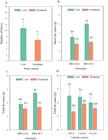
Number of leaves on sour passion fruit seedlings irrigated with saline water (A), shoot and total dry mass of the sour passion fruit seedlings irrigated with saline water (B and C), and total dry mass of sour passion fruit seedlings irrigated with saline water and under application of complexed calcium sources (D).
The shoot and total dry mass of the seedlings of cv. BRS SC1 were reduced by 50% and 38.7%, respectively, in seedlings irrigated with moderately saline water (Figures 3B and 3C). In cultivar BRS GA1, the shoot dry mass of the seedlings was reduced by 30.45%. The increase in salt concentration in the solution reduces the water potential of the substrate and hinders water absorption (osmotic stress), which limits cell expansion and photosynthetic rate (HAO et al., 2021; JOSHI et al., 2022). In addition, the accumulation of toxic ions, such as Na⁺ and Cl⁻, interferes with the absorption of essential nutrients, mainly K⁺, Ca2+, and Mg2+, causing nutritional imbalance and physiological damage, such as degradation of photosynthetic pigments and disorganization of cell membranes (GUEDES et al., 2023; SOUTO et al., 2023). As a consequence, there is a reduction in leaf area and lower carbon assimilation, which compromises the synthesis of photoassimilates and, consequently, the accumulation of biomass (LIMA et al., 2021; GUEDES et al., 2025).
Under irrigation with low-salinity water, the sour passion fruit seedlings cv. BRS SC1 showed higher SDM and TDM, with 56.55% and 44.13% higher values, respectively (Figures 3B and 3C). However, there was no significant difference between cultivars in the shoot and total dry masses of the seedlings irrigated with moderately saline water. In studies evaluating the genetic potential of commercial sour passion fruit cultivars irrigated with lowand moderate-saline water, it was found that cv. BRS SC1 stood out from other cultivars (BRS GA1, “Redondo Amarelo”, and SCS 437 Catarina), both in seedling formation and production capacity, demonstrating that it is a material more adapted to the soil and climate conditions of the semiarid region (LIMA et al., 2023; BEZERRA et al., 2016).
Except for the treatment with amino acid-complexed calcium, salinity reduced the total dry mass of the seedlings, with losses of 46.68% and 20.69%, respectively, in the treatments without and with Ca-OA (Figure 3D). When the seedlings were irrigated with moderately salt water, it was found that the application of Ca-OA reduced the effects of saline stress on the total dry mass of sour passion fruit seedlings, with increases of 43.77% compared to the treatment without calcium (Figure 3D). However, there was no significant effect of calcium sources when the seedlings were irrigated with low salinity water.
Under salt stress conditions, calcium complexed with organic acids promotes greater biomass accumulation compared to that complexed with amino acids due to the greater stability of calcium complexed with lignosulfonates, ensuring a more gradual and efficient release of Ca2+ (SOUTO et al., 2024). This characteristic favour cell wall formation and tissue expansion, while its lower salinity reduces negative osmotic effects on initial growth (GUEDES et al., 2023; GUEDES et al., 2025). On the other hand, although Ca-AA contains amino acids that stimulate metabolism, its higher salinity load and the presence of other ions may limit calcium absorption. In addition, organic complexes can act as natural chelators, facilitating the absorption and translocation of calcium within the plant, which contributes to the maintenance of metabolism under adverse conditions (SOURI; HATAMIAN, 2019).
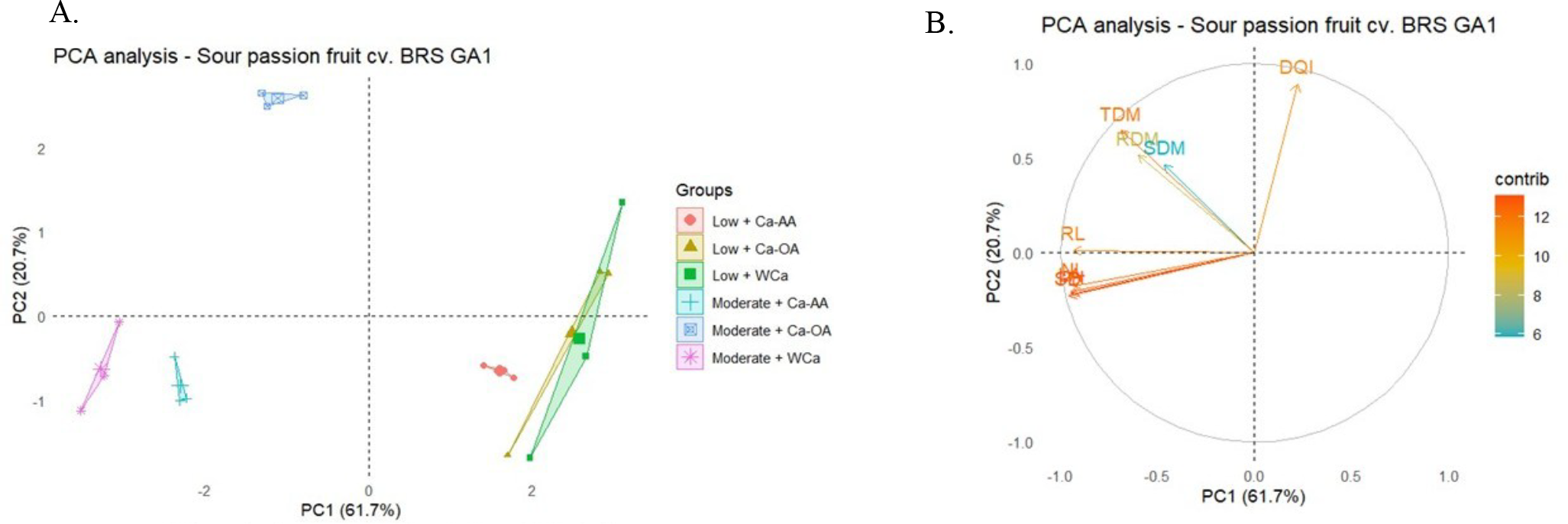
Principal component analysis (PCA) was performed as a complementary multivariate approach to explore the relationships between treatments and growth and quality traits in BRS GA1 seedlings (Figure 4). The first two principal components explained 82.4% of the total variance, with PC1 accounting for 61.7% and PC2 for 20.7%. PC1 was mainly associated with variation in growth-related traits, showing positive loadings for plant height (PH; 0.401), stem diameter (SD; 0.407), number of leaves (NL; 0.397), leaf area (LA; 0.403), and root length (RL; 0.396). PC2, in turn, was associated with variation in biomass-related and quality traits, with higher contributions from Dickson quality index (DQI; 0.654), total dry mass (TDM; 0.471), root dry mass (RDM; 0.376), and shoot dry mass (SDM; 0.340).

Principal component analysis (PCA) of growth characteristics, biomass accumulation, and quality of sour passion fruit cv. BRS GA1 seedlings irrigated with lowand moderate-salinity water and under application of complexed calcium sources (A and B).
The score distribution indicated a clear separation of treatments according to salinity levels along PC1, while variation along PC2 suggested differences among calcium sources. Notably, the treatment combining moderately saline water with calcium complexed with organic acids (Ca-OA) was positioned distinctly along PC2, indicating a different multivariate response compared to the other treatments. In the biplot, DQI was more closely associated with this treatment, whereas growth-related variables were more closely associated with treatments under low salinity. These patterns suggest that salinity was the main factor structuring the variation in growth traits, while differences among calcium sources were more related to variation in biomass and quality attributes. Overall, the PCA highlights the multivariate relationships among treatments and variables, supporting trends observed in the univariate analyses, without implying direct causal relationships.
The PCA was performed as a complementary multivariate approach to explore the relationships between treatments and growth and quality traits in sour passion fruit seedlings cv. BRS SC1 (Figure 5). The first two principal components explained 86.5% of the total variance, with PC1 accounting for 68.4% and PC2 for 18.1%. PC1 was strongly associated with growth-related variables, including stem diameter (SD; 0.398), leaf area (LA; 0.382), total dry mass (TDM; 0.374), shoot dry mass (SDM; 0.372), number of leaves (NL; 0.368), plant height (PH; 0.364), and root length (RL; 0.366), all with positive loadings, indicating that this axis represents variation in overall seedling growth and biomass accumulation. In contrast, PC2 was mainly associated with quality and biomass allocation traits, with greater contributions from Dickson quality index (DQI; 0.684), root dry mass (RDM; 0.584), and root length (RL; 0.203), while plant height (PH; -0.278) showed a negative loading, suggesting a gradient related to biomass partitioning and seedling quality.

Principal component analysis (PCA) of the growth characteristics, biomass accumulation, and quality of sour passion fruit cv. BRS SC1 seedlings irrigated with lowand moderate-salinity water and under application of complexed calcium sources (A and B).
The distribution of treatments along PC1 indicated a clear separation according to salinity levels, with low-salinity treatments positioned on the negative side and moderate-salinity treatments on the positive side, highlighting salinity as the main source of variation in the dataset. Variation along PC2 suggested differences among calcium sources; however, the substantial overlap among treatments within each salinity level indicates a relatively consistent multivariate response of this cultivar. In the variable biplot, DQI and RDM were more closely associated with treatments under moderate salinity, whereas shoot-related traits such as SDM and TDM were more closely associated with low-salinity conditions. Regarding calcium sources, slight shifts along PC2 indicated that treatments with calcium complexed with organic acids (Ca-OA) and calcium complexed with amino acids (Ca-AA) tended to be positioned closer to variables related to seedling quality and root development, while treatments without calcium were more dispersed. However, the overlap between Ca-OA and Ca-AA suggests similar multivariate patterns, with differences less pronounced than those associated with salinity. Overall, the PCA highlights the structure of associations among variables and treatments, indicating that salinity was the main factor related to variation in growth traits, while differences among calcium sources were associated with more subtle variation in biomass allocation and seedling quality, consistent with the univariate results.
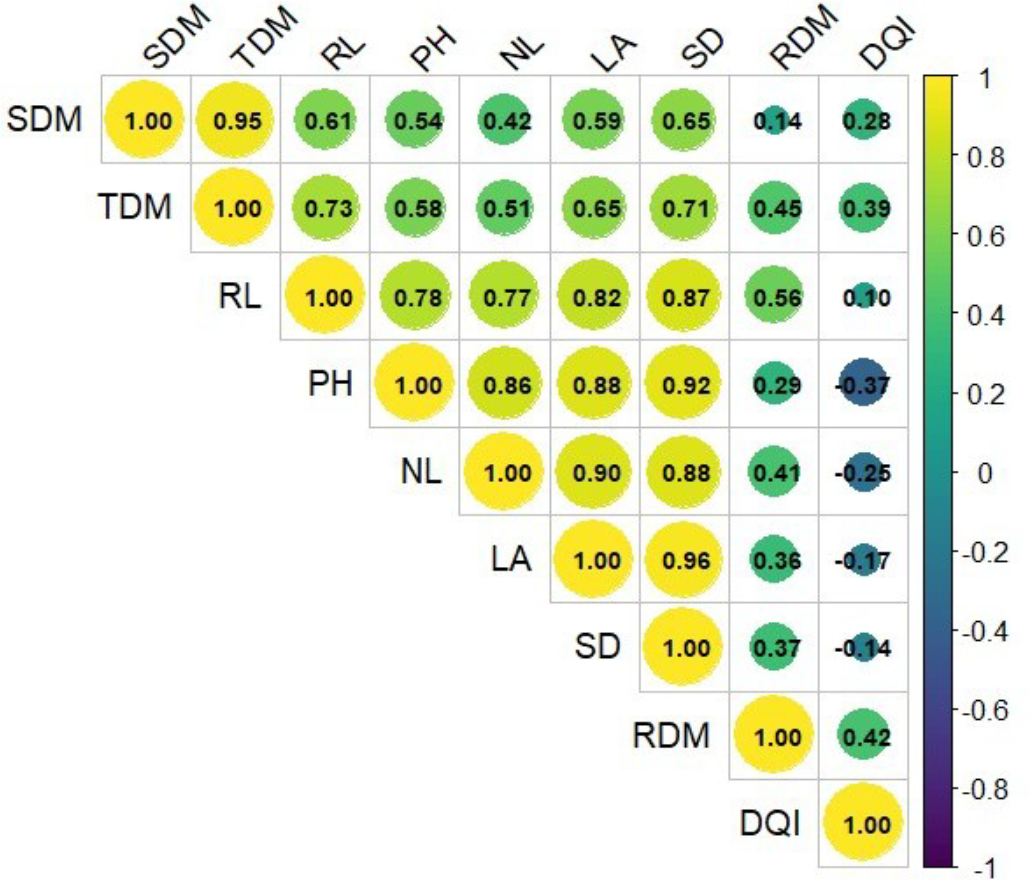
According to Pearson‟s correlation analysis (Figure 6), strong positive associations were observed among key morphological traits of sour passion fruit seedlings. Notably, leaf area (LA) and number of leaves (NL) showed a high correlation (r = 0.96), indicating that seedlings with a greater number of leaves tend to develop a larger photosynthetically active surface. This relationship is directly linked to enhanced light interception and potentially higher CO2 assimilation, contributing to improved plant growth (SOUTO et al., 2024). Additionally, positive correlations between leaf-related traits and biomass variables suggest that shoot development plays an important role in overall seedling performance. These results highlight the importance of canopy development as a determinant of growth and quality in sour passion fruit seedlings.
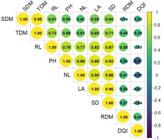
Pearson correlation analysis between growth variables, biomass, and quality of sour passion fruit seedlings, as a function of cultivars, irrigation with saline water, and application of complexed calcium sources (p ≤ 0.05).
In addition, seedlings with higher height values showed a strong positive correlation with stem diameter (r = 0.92), number of leaves (r = 0.83), and leaf area (r = 0.86), indicating coordinated growth among these variables. Furthermore, a moderate positive correlation was observed between root length and leaf area (r = 0.82) and number of leaves (r = 0.78), suggesting a balance between root and shoot development. These relationships indicate that more vigorous seedlings tend to exhibit simultaneous increases in both aerial and root growth, which is an important aspect of seedling quality (LIMA et al., 2021; SOUTO et al., 2024).
CONCLUSIONS
Under moderate salinity, calcium complexed with organic acids (Ca-OA) showed the most consistent mitigating effect, improving biomass accumulation and seedling quality, particularly in BRS GA1. In contrast, calcium complexed with amino acids (Ca-AA) showed positive effects only under specific conditions, without consistent mitigation under salt stress. Overall, the response to calcium sources was dependent on the cultivar and on the evaluated variables, with BRS SC1 showing greater intrinsic tolerance and lower responsiveness to calcium application.
Data Availability:
The data that support the findings of this study can be made available, upon reasonable request, from the corresponding author.
REFERENCES
- BEZERRA, J. D. et al. Crescimento de dois genótipos de maracujazeiro-amarelo sob condições de Salinidade. Revista Ceres, 63: 502-508, 2016.
- BRASIL. Regras para análise de sementes 1. ed. Brasília, DF: Ministério da Agricultura, Pecuária e Abastecimento, 2009. 399 p.
- CAVALCANTE, L. F. et al. Maracujá-amarelo. In: FERNANDES, P. D. et al. (Eds.). Biossalinidade: produção de alimentos e produtos agroindustriais, Campina Grande, PB: EDUEPB 2024. v. 1, cap. 2, 471-504 p.
- DICKSON, A.; LEAF, A. L.; HOSNER, J. F. Quality appraisal of white spruce and white pine seedling stock in nurseries. The Forestry Chronicle, 36: 10-13, 1960.
- ELSAWY, H. I. A. et al. Calcium lignosulfonate can mitigate the impact of salt stress on growth, physiological, and yield characteristics of two barley cultivars (Hordeum vulgare L.). Agriculture, 12: 1459, 2022.
- FENG, D. et al. Exogenous Calcium: Its mechanisms and research advances involved in plant stress tolerance. Frontiers in Plant Science, 14: 1143963, 2023.
- FERREIRA, D. F. Sisvar: A Computer Analysis System to Fixed Effects Split Plot Type Designs: Sisvar. Revista Brasileira de Biometria, 37: 529-535, 2019.
- GUEDES, L. R. et al. Liquid fertilizers as salt stress mitigators on growth and quality of sour passion fruit seedlings. Revista Caatinga, 38: e12630, 2025.
- GUEDES, L. R. et al. Liquid fertilizers on photochemical efficiency and gas exchange in yellow passion fruit under saline stress. Revista Brasileira de Engenharia Agrícola e Ambiental, 27: 839-847, 2023.
- HAGAGG, L. F. et al. Ameliorative effect of foliar application of calcium on vegetative growth and mineral contents of olive trees kalmata and manzanillo cultivars irrigated with saline water. Bulletin of the National Research Centre, 44: 128, 2020.
- HAMOUD, Y. A. et al. Calcium lignosulfonate-induced modification of soil chemical properties improves physiological traits and grain quality of maize (Zea mays) under salinity stress. Frontiers in Plant Science, 15: 1397552, 2024.
- HAO, S. et al. A review on plant responses to salt stress and their mechanisms of salt resistance. Horticulturae, 7: 132, 2021.
-
IBGE - Instituto Brasileiro de Geografia e Estatística. Produção de Maracujá no Brasil 2023. Available at: <https://www.ibge.gov.br/explica/producao-agropecuaria/maracuja/br> Access on: Oct. 17, 2025.
» https://www.ibge.gov.br/explica/producao-agropecuaria/maracuja/br - JOSHI, S. et al. Ion transporters and their regulatory signal transduction mechanisms for salinity tolerance in plants. Physiologia Plantarum, 174: e13702, 2022.
- LIMA, G. S. et al. Gas exchange, growth, and quality of passion fruit seedlings cultivated with saline water. Semina: Ciências Agrárias, 42: 137-154, 2021.
- LIMA, G. S. et al. Tolerance of sour passion fruit cultivars to salt stress in a semi-arid region. Revista Brasileira de Engenharia Agrícola e Ambiental, 27: 785-794, 2023.
- MAHMOOD, M. Z. et al. Low apoplastic Na+ and intracellular ionic homeostasis confer salinity tolerance upon Ca2SiO4 chemigation in Zea mays L. under salt stress. Frontiers in Plant Science, 14: 1268750, 2024.
-
R CORE TEAM. R: A language and environment for statistical computing. R Foundation for Statistical Computing, Vienna, Austria. 2023. Available at: <https://www.r-project.org/>. Access on: Oct. 10, 2025.
» https://www.r-project.org/ - SANTOS, I. S. et al. Determination of the critical level of saline stress in yellow passion fruit seedlings with two phenological phases. Journal of Plant Growth Regulation, 44: 5665-5681, 2025.
- SILVA, F. C. Manual de análises químicas de solos, plantas e fertilizantes12 ed. Brasília, DF: Embrapa, 2009. 627 p.
- SILVA, F. A. et al. Calcium pyruvate as a salt stress mitigator in yellow passion fruit seedlings. Revista Brasileira de Engenharia Agrícola e Ambiental, 26: 763-770, 2022.
- SOURI, M. K.; HATAMIAN, M. Aminochelates in plant nutrition: A review. Journal of Plant Nutrition, 42: 67-78, 2019.
- SOUTO, A. G. L. et al. Non-destructive estimation of leaf area in passion fruit (Passiflora edulis L.). Australian Journal of Crop Science, 11: 1534-1538, 2017.
- SOUTO, A. G. L. et al. Potential of Ca-complexed in amino acid in attenuating salt stress in sour passion fruit seedlings. Plants, 13: 2912, 2024.
- SOUTO, A. G. L. et al. Salinity and mulching effects on nutrition and production of grafted sour passion fruit. Plants, 12: 1035, 2023.
- TAN, H. et al. Exogenous application of sorbitol-chelated calcium enhances salt tolerance in rapeseed (Brassica napus L.). Journal of Soil Science and Plant Nutrition, 24: 4196-4210, 2024.
- TÁRTARI, G. G. et al. Germination and development of passion fruit seedlings under saline and water stresses. Pesquisa Agropecuária Brasileira, 59: e03278, 2024.
- WANG, Q. et al. The significance of calcium in photosynthesis. International Journal of Molecular Sciences, 20: 1353, 2019.
- WENG, X. et al. Calcium regulates growth and nutrient absorption in poplar seedlings. Frontiers in Plant Science, 13: 88709, 2022.


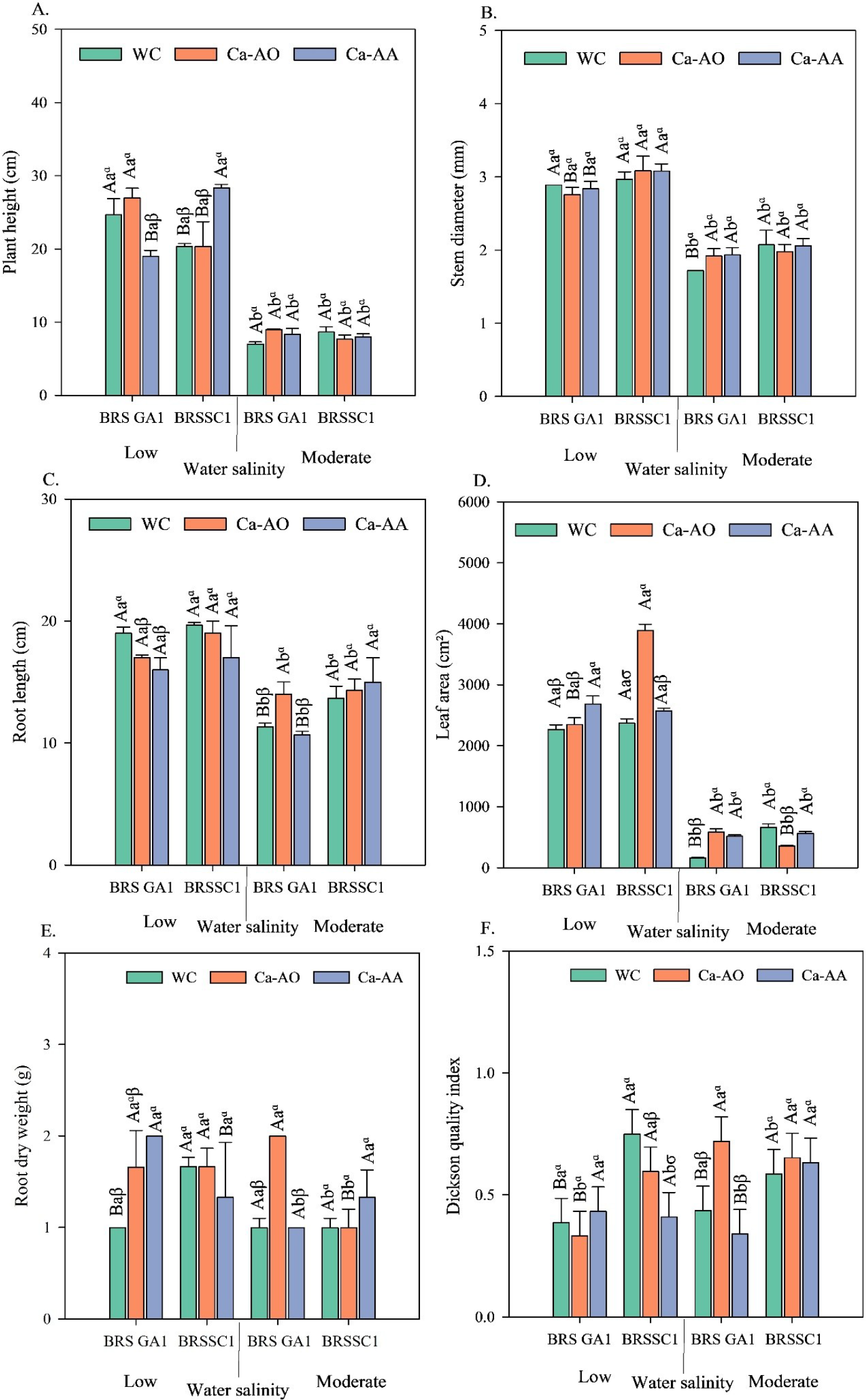 Means followed by the same uppercase letters do not differ for cultivars within each irrigation water salinity and calcium source application according to the F test (p > 0.05). Means followed by the same lowercase letters do not differ for irrigation water salinity within each cultivar and calcium sources by the F test (p > 0.05). Means followed by the same Greek letters do not differ for calcium sources within each cultivar and irrigation water salinity by the Tukey test (p > 0.05).
 Identical lowercase letters do not differ from each other for saline waters according to the F test at 5% probability (A). Identical uppercase letters do not differ from each other for cultivars within each water salinity level, and identical lowercase letters do not differ from each other for saline waters within each cultivar by the F test at 5% probability (B and C). Identical uppercase letters do not differ from each other for saline waters within each calcium source by the F test at 5% probability, and identical lowercase letters do not differ from each other for calcium sources within each saline water by the Tukey test at 5% probability (D).