Physiological Variability in Seeds of a Natural Population of Hymenaea martiana Hayne in Paraíba, Brazil
ABSTRACT
Seed quality is essential for developing conservation, management, and ecological restoration techniques, selecting highquality seed lots, and understanding the genetic variability of species. Thus, the objective of this study was to evaluate the physiological quality of seeds from 80 mother trees in a natural population of Hymenaea martiana in Areia, Paraíba, Brazil. Seed vigor was assessed based on traits related to emergence and early seedling development. The data were subjected to analysis of variance (ANOVA), with means compared using the Scott-Knott test at a 5% significance level, and complemented by Pearson correlation and Principal Component Analysis (PCA). Mother trees M86, M145, M157, M171, M184, and M187 demonstrated superior performance in emergence traits, while M8, M86, M88, M117, and M152 exhibited greater shoot length. Mother trees M10, M11, M12, M14, M21, M24, M73, and M152 produced seedlings with greater root length, while M187 produced seedlings with higher root dry weight. In PCA, three principal components explained 81.63% of the total data variance, with emergence traits contributing most to PC1, mean emergence time to PC2, and root length and dry weight to PC3. In this context, the evaluated natural population of H. martiana mother trees exhibited variability in seed physiological quality, primarily driven by first emergence count, emergence speed index, and final emergence percentage.
Keywords:
Jatobá; Mother trees; Physiological quality; Seed vigor.
RESUMO
A qualidade das sementes é importante para o desenvolvimento de técnicas de conservação, manejo e restauração ambiental, seleção de lotes de alta qualidade e compreensão da variabilidade genética das espécies. Logo, objetivou-se avaliar a qualidade fisiológica das sementes de 80 plantas matrizes de uma população natural de Hymenaea martiana, em Areia, Paraíba. Vigor de sementes foi avaliado com base em características relacionadas a emergência e ao desenvolvimento inicial de plântulas. Os dados foram submetidos a análise de variância, com as médias comparadas pelo teste de Scott-Knott a 5% de significância, e complementados com correlação de Pearson e Análise de Componentes Principais (PCA). As plantas matrizes M86, M145, M157, M171, M184 e M187 tiveram performance superior em características de emergência, enquanto M8, M86, M88, M117 e M152 apresentaram maior comprimento da parte aérea. As plantas matrizes M10, M11, M12, M14, M21, M24, M73 e M152 produziram plântulas com maior comprimento de raiz, e M187 originou plântulas com maior massa seca de raízes. Na PCA, três componentes principais explicaram 81,63% da variância total dos dados, com as variáveis de emergência contribuindo mais para PC1, tempo médio de emergência para PC2 e comprimento e massa seca de raízes para PC3. Diante do exposto, a população natural de plantas matrizes de H. martiana avaliada exibiu variabilidade em qualidade fisiológica de sementes, principlamente influenciada por primeira contagem, índice de velocidade e porcentagem de emergência.
Palavras-chave:
Jatobá; Plantas matrizes; Qualidade fisiológica; Vigor de sementes.
INTRODUCTION
Hymenaea martiana Hayne (Fabaceae) is a tree species distributed across the Northeast Region and the states of Minas Gerais, Goiás, and Tocantins, Brazil, occurring in multiple biomes, including the Caatinga, Cerrado, and Atlantic Forest (FLORA BRASIL, 2025). Its bark and resins contain bioactive metabolites recognized for their medicinal properties for treating various ailments (SILVA et al., 2024).
Furthermore, species of the genus Hymenaea hold significant economic importance, being widely used in the forestry sector for their dense wood, which is employed in furniture manufacture and outdoor construction. Additionally, these species are suitable for use in agroforestry and silvopastoral systems, as well as in programs for the restoration of degraded areas (SANTOS et al., 2023). Thus, producing high-quality H. martiana seedlings is critical for the success of restoration initiatives.
Conservation and restoration of degraded areas generate a high demand for seeds of native tree species, particularly given the increasing emphasis on environmental preservation and biodiversity (ARAÚJO et al., 2023). In this context, seed physiological quality is fundamental, as highly vigorous seeds are essential for producing high-quality seedlings, which are critical for ecological restoration programs.
Seed physiological quality is determined by the ability to perform vital functions under favorable or unfavorable environmental conditions, while vigor tests aim to detect variations in physiological quality, enabling the classification of seed lots based on different vigor levels (MAIA et al., 2024). In this context, seed quality encompasses genetic purity, health, viability, germination capacity, and vigor (MARCOS-FILHO, 2015; SILVA et al., 2022).
Despite the ecological and economic relevance of H. martiana, studies on the physiological quality of its seeds remain limited, particularly regarding variability among mother trees within the species. Understanding this variability is essential for supporting conservation, management, and seedling production strategies, as well as contributing to the selection of seeds with superior physiological performance. In this context, the objective of this study was to evaluate the physiological quality of seeds from 80 mother trees in a natural population of H. martiana in Areia, Paraíba, Brazil.
MATERIAL AND METHODS
Fruit collection
H. martiana fruits were collected from 80 mother trees in Areia, Paraíba, Brazil (6°57'46"S, 35°41'31"W, altitude 618 m) (Figure 1). The region's climate is classified as As, hot and humid with rainy autumn and winter, according to the Köppen classification, with an annual mean rainfall of 1,317.6 mm and a mean temperature of 22.5 °C (LIMA, 2019).

Fruits were collected between November 2019 and January 2020, when they were fully ripe and had naturally fallen from the trees. Fruits were collected from beneath the tree canopies and transported to the Seed Analysis Laboratory (LAS) of the Department of Phytotechnics, Center for Agricultural Sciences, Federal University of Paraíba (DFCACCA/UFPB), where seeds were processed. Fruits were opened by cracking them with a wooden stick, excess pulp was manually removed with a serrated knife, and seeds were soaked in water for six hours to facilitate the removal of residual pulp. After washing, seeds were subjected to an emergence test.
Physiological quality
Seedling emergence test
Seeds were scarified on the side opposite the hilum using 120-grit sandpaper attached to an electric callus remover to overcome seed coat dormancy. Seeds were then disinfected with a 3% sodium hypochlorite solution for five minutes. Seeds were planted at a depth of 3 cm in plastic pots (30 cm diameter, 22 cm height) filled with medium-grain sand (particle size between 0.42 and 2 mm) autoclaved at 120 °C, using four 25-seed replicates per pot.
The test was conducted in a greenhouse at a mean temperature of 32 °C and 60% relative humidity, measured with a thermo-hygrometer. Final seedling emergence was evaluated based on cotyledons fully exposed above the substrate, with results expressed as a percentage. The test lasted 32 days, the period required for the emergence to stabilize.
First emergence count
Concurrently with the seedling emergence test, the first emergence count was conducted 25 days after sowing (DAS), with results expressed as a percentage.
Emergence speed index
Emergence speed index (ESI) was calculated based on daily counts of emerged seedlings, performed until 32 DAS, using the equation proposed by Maguire (1962): , where E1, E2, ..., and En represent the number of emerged seedlings counted on the first, second, ..., and final counts, respectively; and N1, N2, and Nn represent the number of days from sowing to the first, second, and final counts, respectively.
Mean emergence time
Mean emergence time (MET; days) was calculated based on daily counts of emerged seedlings, using the equation proposed by Edmond and Drapalla (1958): , where S1, S2, ..., and Sn distance between mother trees, excluding non-representative represent the number of seedlings emerged on the first, second, ..., and final days, respectively; D1, D2, and Dn represent the number of days for seedling emergence; and Stotal represents the total number of emerged seeds in each treatment.
Shoot and root length
At 32 DAS, upon completion of the seedling emergence test, seedlings were removed from the sand. Shoot length was measured from the stem base to the apical meristem, and root length was measured from the stem base to the tip of the primary root, using a graduated ruler, with results expressed in centimeters per seedling.
Shoot and root dry weights
After measuring shoot and root lengths for each replicate, shoots and roots were separated using scissors, placed in labeled Kraft paper bags, and dried in a forced air oven at 65 °C for 72 hours to determine their dry weights. After drying, shoots and roots were weighed on an analytical balance, with results expressed in grams per seedling.
Experimental design and statistical analysis
The experiment was conducted using a completely randomized design with four replicates. Data were subjected to analysis of variance (ANOVA), and significant means, determined by the F-test, were grouped using the Scott-Knott test at a 5% significance level. Pearson correlation coefficients were calculated for all variable combinations, with significance determined using the t-test (p ≤ 0.05).
Principal Component Analysis (PCA) was conducted to assess the contribution of each principal component and the components based on eigenvalues and variance explained. Statistical analyses were performed using R software (R CORE TEAM, 2022), with multivariate analyses conducted using the FactoShiny package (VAISSIE; MONGE; HUSSON, 2024).
RESULTS AND DISCUSSION
The variables related to emergence, initial growth, and development of H. martiana seedlings from different mother trees exhibited a significant effect, as determined by the F-test (p < 0.01) (Table 1).
Analysis of variance for emergence and initial development of Hymenaea martiana seedlings from seeds from 80 mother trees.
Eight distinct groups were identified for the first emergence count of seedlings (Table 2). The group with the highest seedling emergence percentages included mother trees M86, M157, and M187, with values ranging from 87% to 76%. In contrast, the group with the lowest emergence percentages comprised 11 mother trees (M9, M13, M14, M15, M92, M125, M128, M146, M150, M185, and M192), with means ranging from 6% to 18%.
First emergence count (FEC), final emergence percentage (FEP), emergence speed index (ESI), mean emergence time (MET), shoot length (SL), root length (RL), shoot dry weight (SDW), and root dry weight (RDW) of Hymenaea martiana seedlings from seeds from 80 mother trees.
First emergence count is widely employed to assess seed vigor, based on the principle that seed lots with a higher percentage of normal seedlings in the initial evaluation are considered more vigorous (KRZYZANOWSKI et al., 2020). Therefore, it serves as an effective tool for detecting reductions in vigor during the early stages of seedling development (MARCOS-FILHO, 2015).
The final emergence percentage also showed significant differences among mother trees (Table 2). Mother trees M15, M86, M145, M157, M171, M184, and M187 exhibited superior performance, with higher means, indicating that seed lots from these mother trees can improve efficiency in the use of this propagative material for nursery seedling production and direct seeding for the restoration of degraded areas.
However, mother trees M9, M17, M82, M114, M125, M128, M135, M146, and M152 exhibited the lowest emergence percentages, with means ranging from 11% to 29%, representing a reduction of over 50% compared to the most vigorous mother trees (Table 2).
Variations in seedling emergence can be attributed to genetic characteristics of mother trees, as well as to adverse environmental conditions during seed development, such as temperature, light, humidity, and rainfall (REIS et al., 2020). Although collected within the same municipality, some mother trees were in denser vegetation areas (e.g., M15, M157, M171) and open vegetation areas (e.g., M86, M145, M184, and M187). Previous studies support these findings, as Lima et al. (2014) reported significant differences in the physiological quality of seeds from 28 mother trees (Poincianella pyramidalis (Tul.) L. P. Queiroz) within a single collection area.
Emergence speed index is another important indicator of seedling vigor. M6, M20, M86, M88, M117, M141, M145, M157, M164, M166, M171, M184, and M187 showed the best performance in physiological processes, representing 16% of the mother trees (Table 2). The faster their emergence, the greater their ability to establish in the environment, optimizing the use of favorable conditions.
A faster seed germination speed is associated with more rapid initial seedling growth, thus increasing the likelihood of successful establishment. Rapid growth of the primary root and shoot facilitates more efficient utilization of soil water and nutrient reserves, promoting the development of physiological processes (SMIDERLE et al., 2022).
Araújo et al. (2020) classified the vigor of Mimosa caesalpiniifolia Benth. seedlings based on emergence speed index, identifying seeds from trees 6 and 9 as highly vigorous, and those from tree 1 as less vigorous. Correia et al. (2019) observed variations in vigor, based on emergence speed index, when evaluating seeds from different mother trees of Aspidosperma pyrifolium Mart.
Based on the mean emergence time, seedlings from M9, M13, M14, M15, M22, M92, M120, and M192 exhibited longer emergence times, whereas those from M6 and M8 had the lowest mean emergence times. Shorter emergence time indicates greater seed vigor (Table 2).
The differences observed in this study for emergence percentage, emergence speed index, and mean emergence time were attributed to variability in physiological quality of seeds from mother trees, likely resulting from possible genetic and/or environmental variations during seed development.
The quality of seeds from forest species, even when harvested at physiological maturity, can be affected by various factors, including genetic characteristics and vigor of the mother tree (ERMIS et al., 2022), harvesting and processing challenges, climate stress during maturation, and inadequate storage conditions (MACIEL et al., 2020).
In this study, all seeds were collected, processed, and stored under uniform conditions. Therefore, the differences in genetic potential and vigor of the mother trees likely contributed to variations in reserve accumulation, resulting in seeds with distinct physiological potentials.
Seed vigor significantly influenced shoot length of H. martiana seedlings, with seeds from M8, M86, M88, M117, and M152 producing seedlings with greater shoot length, whereas those from M9 produced less vigorous seedlings (Table 2).
Mother trees were categorized into three groups based on root length. The first group included M10, M11, M12, M14, M21, M24, M73, and M152, whose seeds produced seedlings with longer roots; the second group comprised 12 mother trees, which produced seedlings with intermediate root length; and the third group consisted of 60 mother trees, whose seedlings exhibited the shortest roots (Table 2).
Normal seedlings with greater root lengths are considered more vigorous due to the greater translocation of reserves from storage tissues to the embryonic axis during growth. Consequently, mother trees producing more vigorous seeds tend to generate seedlings with longer roots, while those producing less vigorous seeds produce seedlings with reduced growth. Therefore, the differences in physiological quality observed among seeds from each mother tree result from a combination of genetic, physical, physiological, and sanitary characteristics that determine the seed quality potential (CHEN et al., 2018).
Five distinct groups of mother trees were identified based on shoot and root dry weights (Table 2). Seedlings from seeds of mother trees M8, M17, M88, M114, M115, and M152 exhibited higher shoot dry weights, indicating greater capacity for reserve translocation to support plant growth. In contrast, seedlings from M92 and M170 exhibited the lowest shoot dry weights. Seedlings from mother tree M187 showed the highest, whereas those from M10 exhibited the lowest root dry weight.
Seedling performance, assessed by the length or dry weight of individual parts or the entire seedling, is used to differentiate seed lots with similar germination, with those exhibiting the highest means considered the most vigorous (KRZYZANOWSKI et al., 2020). The use of vigorous and morphologically normal seedlings from species with potential for restoring degraded areas enhances their adaptability to the environment (GIANLUPPI et al., 2023).
Felix et al. (2023) determined the physiological quality of seeds from different mother trees of Pityrocarpa moniliformis Benth. through tests based on seedling development and found that seedling length and dry weight were effective for selecting the most vigorous mother trees. Seedling length and dry weight measurements were effective in distinguishing seeds of Aspidosperma pyrifolium with varying vigor levels (CORREIA et al., 2019).
The physiological quality tests conducted on H. martiana seeds identified three to eleven distinct groups among the 80 evaluated mother trees, depending on the variable, highlighting the most vigorous mother trees.
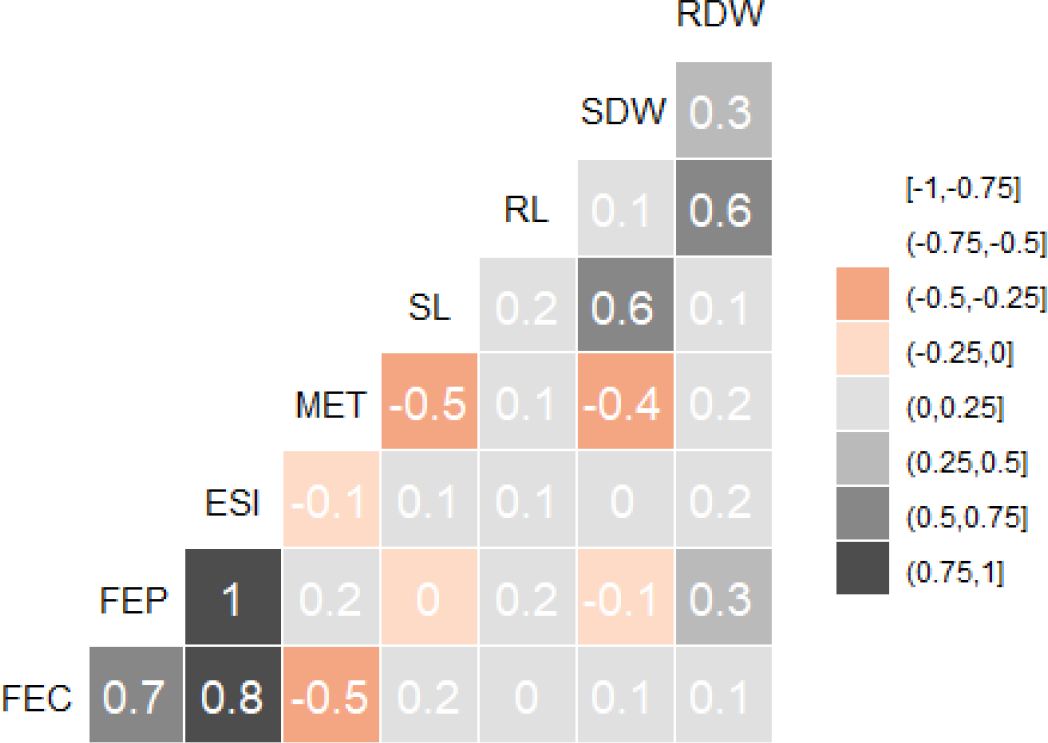
Pearson correlation coefficients (Figure 2) revealed that the first emergence count was positively correlated with emergence percentage (0.65) and emergence speed index (0.82), while exhibiting a negative correlation with mean emergence time (-0.50). Emergence percentage exhibited a strong positive correlation with emergence speed index (0.95). This suggests that mother trees with higher first emergence counts tend to yield higher final emergence percentages, with a greater number of seedlings emerging daily and shorter emergence times. These traits are critical for seedling production, as seed lots with these characteristics tend to exhibit uniform development.

Pearson correlation among variables related to emergence and initial development of Hymenaea martiana seedlings: first emergence count (FEC), final emergence percentage (FEP), emergence speed index (ESI), mean emergence time (MET), shoot length (SL), root length (RL), shoot dry weight (SDW), and root dry weight (RDW).
Shoot length and root length were positively correlated with shoot dry weight (0.61) and root dry weight (0.60), respectively (Figure 2). This indicates that dry weight increases as shoot and root lengths increase.
The analysis of correlation coefficients assesses the relationship among various plant characteristics and identifies components that can serve as a basis for selection aimed at improving genetic yield (DEEP et al., 2017). According to Zuffo et al. (2016), the correlation among characteristics is important because it elucidates the degree of influence of one characteristic on another of economic interest, while also enabling indirect selection.
In the Principal Component Analysis (PCA), the first three components (PC1, PC2, and PC3) explained 81.63% of the total data variance (Figure 3A). This suggests that these three components are sufficient to capture most of the information. Regazzi and Cruz (2020) recommended retaining components that explain 80% or more of the cumulative total variance, along with eigenvalues greater than 1.0, based on the Kaiser criterion. This finding confirms that PCA effectively summarized the variables contributing to the variability in the physiological quality of H. martiana seeds from different mother trees.

Cumulative variance and eigenvalues for physiological quality of Hymenaea martiana seeds across principal components (A) and eigenvector loadings of characteristics in the first three principal components (PC1, PC2, PC3) (B). First emergence count (FEC), final emergence percentage (FEP), emergence speed index (ESI), mean emergence time (MET), shoot length (SL), root length (RL), shoot dry weight (SDW), and root dry weight (RDW).
The studied variables exhibited varying loadings on the principal components, reflecting their distinct contributions to the explained variance (Figure 3B). Emergence speed index, first emergence count, and final emergence percentage showed high loadings on PC1, with coefficients of 0.91, 0.86, and 0.82, respectively, indicating their significance for this component. Conversely, mean emergence time exhibited a negative loading on PC1, suggesting that an increase in this variable is associated with a decrease in PC1. Mean emergence time contributed most significantly to PC2 (0.69), followed by final emergence percentage (0.52). Shoot length and shoot dry weight exhibited negative loadings, indicating an inverse relationship with this component, which may reflect an opposition between mean emergence time and final emergence percentage relative to shoot length and dry weight.
Root length and root dry weight exhibited the highest contributions to PC3, with coefficients of 0.78 and 0.77, respectively, indicating their greater relevance to this component.Firstemergencecountexhibiteda negative loading on PC3, indicating an inverse relationship with PC3.
A scatter plot of the first two principal components, based on the physiological quality of H. martiana seeds from 80 mother trees, was generated (Figure 4). This plot revealed significant variation among mother trees, enabling the identification of those exhibiting greater distances along the principal component axes, based on the degree of phenotypic similarity among the grouped mother trees.
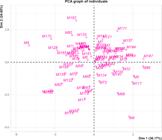
Principal component analysis (biplot) of the first two principal components (PC1 and PC2) for physiological quality of Hymenaea martiana seeds from 80 mother trees.
PCA is a multivariate statistical method designed to evaluate complex and extensive datasets (ZAFAR et al., 2021). It can be used to assess differences among adult trees based on morphophysiological characteristics in plants, fruits, and seeds (MENEGATTI et al., 2017). PCA aids in the selection of descriptors that best represent population diversity, providing valuable information for conserving genetic resources, simplifying gene banks, and establishing core collections (GOMES et al., 2022). Thus, groups were differentiated based on the first three principal components according to seed physiological quality: the first principal component is related to emergence capacity, the second to speed, and the third to seedling vigor.
PCA serves as an effective multivariate approach for evaluating seed physiological quality and can be employed to identify mother trees with superior potential for initial vigor, which is relevant for conservation and breeding programs, as observed for mother trees M187, M86, M6, and M117.
Consequently, the variability among mother trees highlights the population's potential as a source for seed collection to support seedling production for breeding programs aimed at the restoration of degraded areas, reforestation, urban arborization, and the conservation of this species (PIMENTA et al., 2024).
CONCLUSION
A natural population of 80 H. martiana mother trees from Areia, PB, Brazil, exhibited variation in seed physiological quality, with first emergence count, emergence speed index, and emergence percentage contributing the most to this variability.
ACKNOWLEDGMENTS
The authors thank the Brazilian National Council for Scientific and Technological Development (CNPq) for providing the master's scholarship to the first author, the research productivity scholarship to the last author, and the senior postdoctoral scholarship (process no. 1018672024-7) to the seventh author. The authors also acknowledge the approval of the project under CNPq/MCTI Call No. 10/2023 Universal Track B Consolidated Groups, granted under no. 4064722023-8.
Data Availability:
The data that support the findings of this study can be made available, upon reasonable request, from the corresponding author.
REFERENCES
- ARAÚJO, F. S. et al. Seed quality and genetic diversity of a cultivated population of Mimosa caesalpiniifolia Benth. Revista Caatinga, 33: 1000-1006, 2020.
- ARAÚJO, J. O. et al. Selection of superior Senna macranthera seeds, carbon stock, and seedling survival, and costs for habitat restoration. Sustainability, 15: 9875, 2023.
- CHEN, S. et al. Genetic parameters for growth and wood chemical properties in Eucalyptus urophylla × E. tereticornis hybrids Annals of Forest Science, 75: 2-11, 2018.
- CORREIA, L. A. D. S. et al. Morphometric descriptors and physiological seed quality for selecting Aspidosperma pyrifolium Mart. matrix trees. Revista Caatinga, 32: 751-759, 2019.
- DEEP, R. et al. Genetic variability study for yield and yield components in rice (Oryza sativa L.). International Journal of Agriculture Environment and Biotechnology, 10: 171-176, 2017.
- EDMOND, J. B.; DRAPALLA, W. J. The effects of temperature, sand and soil, and acetone on germination of okra seeds. Proceedings of the American Society Horticutural Science, 71: 428-434, 1958.
- ERMIS, S. et al. The radicle emergence test and storage longevity of cucurbit rootstock seed lots. Seed Science and Technology, 50: 1-10, 2022.
- FELIX, F. C. et al. A condição climática de origem das árvores afeta a incidência de fungos e a qualidade de sementes de Pityrocarpa moniliformis?. Ciência Florestal, 33: e71378, 2023.
-
FLORA BRASIL. Hymenaea in Flora e Funga do Brasil Jardim Botânico do Rio de Janeiro. Available at: <https://floradobrasil.jbrj.gov.br/FB83203>. Access on: May 26, 2025.
» https://floradobrasil.jbrj.gov.br/FB83203 - GOMES, B. H. et al. Genetic diversity of Caryocar brasiliense Cambess. (Caryocaraceae: Malpighiales) among genotypes producing fruits with and without thorns in the endocarp. Scientia Forestalis, 50: e3788, 2022.
- GIANLUPPI, D. et al. Práticas para semeadura direta em área de cerrado melhorado: Emergência, sobrevivência e crescimento inicial de espécies florestais. International Seven Journal of Multidisciplinary, 2: 834-850, 2023.
- KRZYZANOWSKI, F. C. et al.. Testes de vigor baseados no desempenho das plântulas. In: KRZYZANOSWKI, F. C. et al. (Eds.). Vigor de sementes: conceitos e testes 2. ed. Londrina, PR: ABRATES, 2020. cap. 2, p. 79-127.
- LIMA, C. R. et al. Qualidade fisiológica de sementes de diferentes árvores matrizes de Poincianella pyramidalis (Tul.) L. P. Queiroz. Revista Ciência Agronômica, 45: 370-378, 2014.
- LIMA, P. R. C. Tipo de clima anual para Campina Grande e Areia: variabilidade e tipologia 2019. 67 f. Monografia (Graduação em Engenharia Ambiental) - Universidade Federal da Paraíba, João Pessoa, 2019.
- MAGUIRE, J. D. Speed of germination-aid in selection and evaluation for seedling emergence and vigor. Crop Science, 2: 176-177, 1962.
- MAIA, S. S. et al. Do storage of Eugenia stipitata seeds affect their germination and efficacy of the tetrazolium viability test?. Bioagro, 36: 113-120, 2024.
- MARCOS-FILHO, J. Fisiologia de sementes de plantas cultivadas 2. ed. Piracicaba, SP: FEALQ, 2015. 660 p.
- MACIEL, C. G. et al. Storage of ipê seeds in different packages and environments. Scientific Electronic Archives, 13: 36-39, 2020.
- MENEGATTI, R. D. et al. Genetic divergence among provenances of Mimosa scabrella Benth. based on seed analysis. Revista Brasileira de Ciências Agrárias, 12: 366-371, 2017.
- PIMENTA, J. M. A. et al. Divergência fenotípica de Handroanthus impetiginosus por meio de imagens digitais. Pesquisa Florestal Brasileira, 44: 1-11, 2024.
-
R CORE TEAM. R: A Language and Environment for Statistical Computing; R Foundation for Statistical Computing: Vienna, Austria, 2022; Available at: https://www.R-project.org/ Access on: Oct. 10, 2024.
» https://www.R-project.org/ - REGAZZI, A. J; CRUZ, C. D. Análise Multivariada Aplicada Viçosa, MG: UFV, 2020. 401 p.
- REIS, L. P. et al. Relationships between substrate and the mobilization of reserve with temperature during seed germination of Ormosia coarctata Jack. Journal of Seed Science, 42: e202255017, 2020.
- SANTOS, C. C. et al. Ecofisiologia da germinação e produção de mudas de jatobazeiro. In: ANDRADE, J. K. B. (Ed.). Estudos em Ciências Florestais e Agrárias Campina Grande, PB: Licuri, 2023, cap. 7, p. 101-127.
- SILVA, J. J. et al. Conservation and physiological quality of Handroanthus spongiosus (Rizzini) S. Grose (Bignoniaceae) seeds. Journal of Seed Science, 44: e202244007, 2022.
- SILVA, J. M. D. S. et al. Chemometric studies in Hymenaea martiana Phytochemistry Letters, 61: 158-165, 2024.
- SMIDERLE, O. J. et al. Do Stimulate® and Acadian® promote increased growth and physiological indices of Hymenaea courbaril seedlings? Revista Brasileira de Fruticultura, 44: e-872, 2022.
- VAISSIE, P.; MONGE, A.; HUSSON F. Perform Factorial Analysis from 'FactoMineR' with a Shiny Application R Package Version 2.6; 2024.
- ZAFAR, M. M. et al. Exploiting agronomic and biochemical traits to develop heat resilient cotton cultivars under climate change scenarios. Agronomy, 11: 1885, 2021.
- ZUFFO, A. M. et al. Caracterização biométrica de frutos e sementes de mirindiba (Buchenavia tomentosa Eichler) e de inajá (Attalea maripa [Aubl.] Mart.) na região sul do Piauí, Brasil. Revista de Ciências Agrárias, 39: 331-340, 2016.
Edited by
-
Editor in Chief:
Aurélio Paes Barros Júnior
-
Section Editor:
Salvador Barros Torres