Phytosociology of weed species and soybean productivity under different cropping systems in brazilian cerrado oxisol
ABSTRACT
Understanding effects of agricultural systems on ecological interactions between crops and weeds is essential for sustainable management. This study evaluated weed phytosociology and soybean productivity under conventional tillage (CT), no-tillage (NT), and integrated crop-livestock-forestry (CLF) systems in an Oxisol of the Brazilian Cerrado. A split-plot design was adopted, with three cropping systems assigned to main plots and three phytosociological survey periods to subplots, with eight replicates. Phytosociological assessments were conducted at 5 and 30 days after emergence (DAE) and at pre-harvest. Weed species were identified and quantified using the quadrat method. The following parameters were determined: density, relative density, frequency, relative frequency, abundance, relative abundance, relative importance index (Ri%), and similarity index. Soybean productivity was also assessed. Thirteen weed species were identified, belonging to seven botanical families. Poaceae predominated across systems and evaluation periods. Portulaca oleracea, Cenchrus echinatus, Digitaria insularis, and Digitaria horizontalis showed the highest mean Ri% values in all cropping systems and evaluation periods. Species distribution showed high variability in phytosociological parameters; however, similarities were observed among cropping systems and evaluation periods. NT and CLF systems resulted in significantly higher soybean productivity.
Keywords:
Glycine max; No-tillage; Integrated crop-livestock-forestry System; Conventional tillage; Phytosociological indices.
RESUMO
Compreender os efeitos dos sistemas agrícolas sobre as interações ecológicas entre culturas e plantas daninhas é fundamental para o manejo sustentável. Este estudo teve como objetivo avaliar a fitossociologia de plantas daninhas e o desempenho produtivo da soja sob os sistemas convencional (CS), plantio direto (NT) e Integração Lavoura-Pecuária-Floresta (ILPF), em um Latossolo no Cerrado brasileiro. Foi adotado delineamento em parcelas subdivididas, com três sistemas de cultivo nas parcelas principais e três períodos de levantamento fitossociológico nas subparcelas, com oito repetições. A fitossociologia foi avaliada em três momentos: 5 e 30 dias após a emergência (DAE) e na pré-colheita. As plantas daninhas foram identificadas e quantificadas pelo método do quadrante. Foram determinados os seguintes parâmetros: densidade, densidade relativa, frequência, frequência relativa, abundância, abundância relativa, índice de importância relativa e índice de similaridade. A produtividade da soja também foi avaliada. Foram identificadas treze espécies de plantas daninhas, pertencentes a sete famílias botânicas, com predominância da família Poaceae. De modo geral, as espécies Portulaca oleracea, Cenchrus echinatus, Digitaria insularis e Digitaria horizontalis apresentaram os maiores valores médios do índice de importância relativa (IR%) nos três sistemas de cultivo, em todos os períodos de avaliação. O comportamento das espécies revelou alta variabilidade nos parâmetros fitossociológicos; no entanto, foram observadas semelhanças entre as espécies presentes nos sistemas de cultivo, bem como entre os períodos de avaliação. Os sistemas plantio direto (NT) e ILPF apresentaram produtividade de soja estatisticamente superior.
Palavras-chave:
Glycine max; Sistema de semadura direta; Sistema de Integração Lavoura-Pecuária-Floresta; Sistema convencional; Índices fitossociológicos.
INTRODUCTION
Brazil has committed to reducing greenhouse gas emissions under the Paris Agreement (UNFCCC COP21). In agricultural states such as Mato Grosso do Sul, sustainable production systems play a strategic role in reconciling productivity with environmental conservation. Among these systems, integrated crop-livestock -forestry (CLF) has gained prominence as a model of sustainable intensification, promoting diversification, improved resource use efficiency, and economic resilience compared with conventional monocropping systems (GIL; GARRETT; BERGER, 2016; BIELUCZYK et al., 2023). In addition, recent evidence indicates that both CLF and no-tillage (NT) systems enhance soil quality by increasing soil organic matter, nutrient accumulation, and enzymatic activity, which are key indicators of soil biological functioning (INACIO et al., 2025).
Beyond productivity gains, CLF alters agroecosystem structure and functioning by modifying soil cover, light interception, nutrient cycling, and microclimatic conditions. Presence of trees, pasture species, and crop rotation influences soil temperature, moisture dynamics, and residue input, directly affecting seed germination, emergence patterns, and competitive interactions among weed species. These environmental changes can shift species composition and alter weed abundance compared with conventional systems (CARVALHO et al., 2018; SINGH et al., 2024).
Similarly, no-tillage systems promote permanent soil cover and greater residue accumulation, which can suppress certain weed species through physical barriers and allelopathic effects while favoring others adapted to reduced soil disturbance. In diversified systems such as CLF, exploitation of distinct ecological niches over time reduces dominance of a single species and promotes communities composed of moderately adapted species (MCLAREN et al., 2020).
Understanding how management practices in different agricultural systems affect ecological interactions between crops and weeds is essential for sustainable management. Identification of weed flora in the field forms basis for effective control strategies and is achieved through phytosociological surveys.
Phytosociological surveys provide an overview of weed species composition and distribution (PRATES et al., 2019). Understanding these distribution patterns supports selection of appropriate agronomic practices. In Brazil, studies addressing weed phytosociology across soybean production systems in Oxisols remain limited. Therefore, this study aimed to identify and quantify predominant weed species and to evaluate soybean productivity under conventional tillage, no-tillage, and integrated crop-livestock-forestry systems in an Oxisol, to improve understanding of crop-weed interactions.
MATERIALS AND METHODS
Location
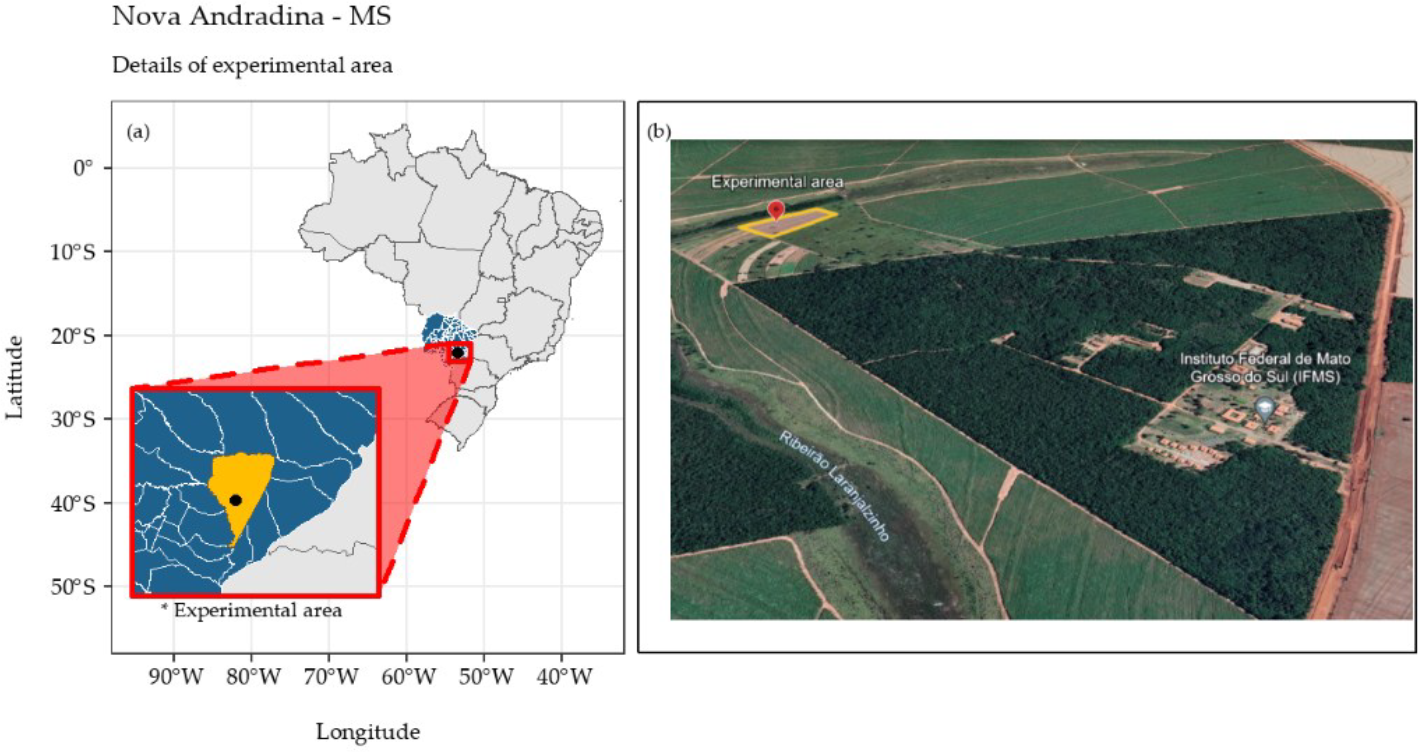
The study was conducted at the Instituto Federal de Mato Grosso do Sul (IFMS), in Nova Andradina, MS, Brazil (Figure 1), on an Oxisol. Daily rainfall and temperature data during soybean cultivation are presented in Figure 2.

Experimental field at the Instituto Federal de Mato Grosso do Sul (IFMS), in Nova Andradina, Mato Grosso do Sul, Brazil (22°04′ 48″ S, 53°28′14″ W, 345 m a.s.l.). (a) Map created using the geobr package and plotted in R software. (b) Image source: Google Earth.

Meteorological data recorded at the IFMS weather station, Nova Andradina, Mato Grosso do Sul, Brazil. Temporal variation in maximum and minimum air temperature and global radiation (lines), and rainfall (bars), during the experimental period spanning the 2022 (a) and 2023 (b) growing seasons.
On October 9, 2022, thirty soil samples were randomly collected from the upper 0-20 cm layer to evaluate soil chemical properties. Particle size analysis indicated clay, silt, and sand contents of 100, 60, and 840 g kg⁻1, respectively.
Soil chemical analysis showed pH (CaCl₂ 0.01 M) of 4.6; phosphorus (Mehlich-1), boron (hot water), copper (DTPA), iron (DTPA), manganese (DTPA), and zinc (DTPA) at 0.9, 0.2, 0.1, 15, 13, and 0.75 mg dm⁻3, respectively; and potassium (resin), calcium (resin), magnesium (resin), H + Al (SMP buffer), and cation exchange capacity at 0.5, 8, 2, 14, and 24.5 mmolc dm⁻3, respectively.
Soybean Sowing
The experiment was established in September 2021 (2021/2022 growing season) in an area previously occupied by degraded pasture. Three soybean production systems were evaluated: conventional tillage (CT), no-tillage (NT), and integrated crop-livestock-forestry (CLF). The weed phytosociological survey was conducted in the second year of system establishment.
The soybean cultivar used in both growing seasons was TMG 7062 IPRO. In the second season, sowing was performed in November 2022. Fertilization consisted of 300 kg ha⁻1 of the formulation 04-20-20 (N-P₂O₅-K₂O). Seeds were treated with fungicides (carboxin + thiram at 100 g + 100 g a.i. per 100 kg of seeds) before inoculation and sowing.
Seed inoculation was performed one hour before sowing by coating seeds with an inoculant containing strains SEMIA 5079 (Bradyrhizobium japonicum) and SEMIA 5080 (Bradyrhizobium diazoefficiens). Phytosanitary treatments followed standard recommendations for soybean cultivation. Sowing density was 13 seeds per linear meter, targeting 300,000 plants ha⁻1, with row spacing of 0.45 m and sowing depth of 3 cm.
Conventional, No-Tillage, and Integrated Crop-Livestock-Forestry Systems
Under CT, in the first growing season (2021/2022), soil was prepared using heavy disk harrowing, leveling harrowing, and chiseling. In NT and CLF systems, degraded pasture was desiccated with glyphosate (3 L ha⁻1) and 2,4-D (1 L ha⁻1) to establish surface mulch from existing vegetation.
Soybean was subsequently sown in all systems. In the CLF system, eucalyptus (Eucalyptus urograndis) clone A217 was previously established as the tree component. Trees were planted in double rows, with 3.0 m spacing between plants and between rows within each double row. Double-row sets were spaced every 14 soybean rows. Initial plant height was 0.30 m, reaching approximately 1.50 m in the second year.
In the second growing season (2022/2023), CT followed the same soil preparation practices. In NT and CLF systems, millet (Pennisetum glaucum L.) was sown to provide mulch. Soybean sowing occurred in November 2022 across all systems.
Experimental Design
A randomized block design in a split-plot arrangement was used, with cropping systems assigned to main plots (CT, NT, and CLF) and phytosociological survey periods to subplots (5 days after emergence DAE, 30 DAE, and pre-harvest), with eight replicates.
Plot area was 0.06 ha in CT and NT systems and 0.15 ha in the CLF system. Total experimental area per system was 0.50 ha (CT), 0.50 ha (NT), and 1.50 ha (CLF), totaling 2.50 ha.
Phytosociological Survey of Weeds
Phytosociological surveys were conducted in the second growing season at 5 and 30 DAE and at pre-harvest. Evaluation periods were defined based on regional weed management practices and the critical period of weed interference in soybean.
Weed species were identified and quantified using the quadrat method with a 1.0 × 1.0 m frame. Four quadrats were sampled per plot.
In each sampling, aboveground biomass was cut near soil surface, collected, separated by species, and transported to the laboratory in paper bags for identification and counting. Phytosociological parameters were calculated as follows:
where: A and B represent number of species in each community, and C represents number of shared species.
After each evaluation, weeds were controlled using herbicides recommended for soybean. Species identification was based on morphological characteristics, supported by specialized literature and taxonomic keys, and confirmed with herbarium specimens when necessary.
Soybean Production Variables
At a density of 300,000 plants ha⁻1 (30 plants m⁻2), approximately 162 plants were evaluated per plot within a 5.4 m2 useful area. The following variables were measured: plant height (PH), number of pods per plant (NPP), number of grains per plant (NGP), and grain yield (kg ha⁻1).
All plants within the useful area were harvested to determine yield. Grain moisture was measured immediately after harvest using the oven-drying method (130 ± 1 °C for 19 h) and adjusted to 13%. Yield was expressed in kg ha⁻1.
Data Analysis
Descriptive statistics were used for phytosociological data. Relative importance index and similarity index were presented using bar graphs.
Productivity variables and selected phytosociological parameters (number of individuals - NI, number of quadrats - NQ, density - D, frequency - F, and abundance - A) were subjected to analysis of variance. Normality was assessed using the Shapiro-Wilk test. Data were transformed using √(x + 1) when necessary; however, original data are presented for clarity.
Means were compared using Tukey’s test at 5% significance. Analyses of variance were performed using SAS software, and graphs were generated using SigmaPlot.
RESULTS AND DISCUSSION
Phytosociological Survey of Weeds
When inferential statistical analysis was applied, means were compared using Tukey’s test at the 5% significance level. Weed community composition across cropping systems and assessment periods was heterogeneous.
Thirteen weed species were identified, belonging to seven botanical families (Tables 1, 2 and 3). Among these, Poaceae showed the highest number of individuals (NI) across all cropping systems, regardless of evaluation period.
Number of individuals (NI), number of occurrences in quadrats (NS), frequency (F), density (D), and abundance (A) of weed species in soybean under no-tillage (NT) and integrated crop-livestock-forestry (CLF) systems at 5 days after emergence (DAE). Means followed by the same letter within each variable (NI, NS, F, D, and A) and cropping system do not differ significantly according to Tukey’s test at the 5% significance level.
Number of individuals (NI), number of occurrences in quadrats (NS), frequency (F), density (D), and abundance (A) of weed species in soybean under conventional tillage (CT), no-tillage (NT), and integrated crop-livestock-forestry (CLF) systems at 30 days after emergence (DAE). Means followed by the same letter within each variable (NI, NS, F, D, and A) and cropping system do not differ significantly according to Tukey’s test at the 5% significance level.
Number of individuals (NI), number of occurrences in quadrats (NS), frequency (F), density (D), and abundance (A) of weed species in soybean under conventional tillage (CT), no-tillage (NT), and integrated crop-livestock-forestry (CLF) systems at pre-harvest. Means followed by the same letter within each variable (NI, NS, F, D, and A) and cropping system do not differ significantly according to Tukey’s test at the 5% significance level.
In CT, no weeds were identified at 5 days after emergence (DAE); therefore, corresponding data are not presented in Table 1.
In the CLF system, at 5 DAE, higher mean values of number of individuals (NI) and total density (D) were observed (p < 0.05) compared with NT (Table 1). At pre-harvest, NI and D differed significantly among treatments (p < 0.05), with lower values in CLF than in CT and NT (Table 3).
At 30 DAE, CT showed a higher mean number of individuals (NI) (426 individuals) (p < 0.05). However, despite this higher abundance, CT generally showed a lower number of weed species (Table 2).
The Poaceae family showed the highest number of individuals (NI) across all cropping systems, regardless of evaluation period. Species in this family exhibit C4 photosynthetic metabolism, which confers competitive advantages when coexisting with C3 crops such as soybean (SANTOS et al., 2017). This predominance can be partially attributed to interactions between local climatic conditions and intrinsic biological traits, highlighting adaptability of Poaceae species to diverse ecological environments (RODRIGUES et al., 2022). These traits include ecological dominance, high propagule production, efficient dispersal, and tolerance to defoliation, which contribute to competitive success across environments (LINDER et al., 2018). This information is relevant for selecting effective strategies in integrated weed management, improving efficiency and sustainability of control programs (CAMPOS et al., 2023).
The absence of weeds in CT at 5 DAE can be attributed to plowing and harrowing, which provided effective mechanical control (Table 1). In the CLF system at 5 DAE, higher mean values of number of individuals (NI) and total density (D) were observed compared with NT. At 30 DAE, CT showed a significant higher mean NI than NT and CLF (Table 2). At pre-harvest, NI and D were lower in CLF than in CT and NT (Table 3). Weed density is a key determinant of crop impact, and it is influenced by topography, climate, crop genotype, and management practices. Therefore, understanding weed distribution patterns is essential for developing effective management strategies (FERREIRA, 2020).
The lower weed density in NT and CLF compared with CT at 30 DAE reinforces the suppressive role of pearl millet residue in these systems. In addition to the physical barrier effect of mulch, pearl millet residues may exert allelopathic effects through release of bioactive compounds. Aqueous extracts from different plant parts of that plant reduce weed germination and early seedling development, indicating presence of soluble allelochemicals released during residue decomposition (DONG et al., 2020; QURESHI et al., 2021). These compounds may disrupt membrane integrity, enzymatic activity, and energy metabolism in emerging seedlings. More recent evidence suggests that allelopathic activity of pearl millet may also involve metabolic disruption and oxidative stress induction in weed seedlings, with compounds such as palidol contributing to phytotoxic effects (MANTOVANELLI et al., 2025).
At pre-harvest, CLF showed lower weed abundance (53 individuals) than CT (106 individuals) and NT (108 individuals). This result is extremely relevant because weed presence at harvest can reduce operational efficiency and crop quality. Weeds compete for light, nutrients, and water, reducing yield, and can interfere with harvesting and post-harvest processes. In addition, weeds may act as hosts for pests and diseases, increasing phytosanitary risks (BARLA; BINJHA; UPASANI, 2022).
Similarity index
According to the similarity index (SI%), high similarity (>50%) in weed species composition was observed among soybean cropping systems and across evaluation periods (Figure 3). The highest SI% was recorded between conventional tillage (CT) and no-tillage (NT) at pre-harvest (83.33%) (Figure 3B). At 30 days after emergence (DAE), the lowest SI (57.14%) occurred between CT and CLF (Figure 3A).

Similarity index (SI, %) of weed species across evaluation periods (5 DAE, 30 DAE, and pre-harvest). (A) Comparison among soybean cropping systems (CT, NT, and CLF) within each evaluation period. (B) Comparison among evaluation periods within each cropping system (CT, NT, and CLF).
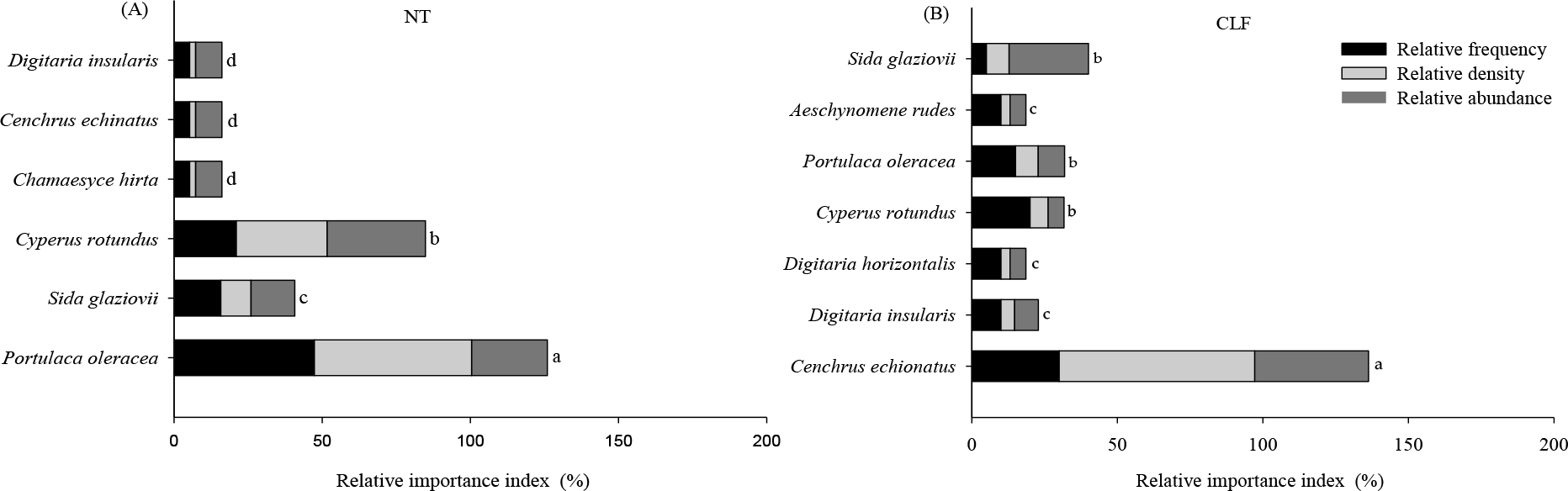
For exploratory data analysis, relative density (RD), relative frequency (RF), and relative abundance (RA) of weed species across cropping systems and evaluation periods were used to calculate the relative importance index (Ri%) (Figures 4, 5 and 6). According to Felfili and Venturoli (2000), the similarity index (SI) is considered high when it exceeds 50%.

Relative importance index (Ri%) of weed species in soybean under no-tillage (NT) (A) and integrated crop-livestock-forestry (CLF) (B) systems at 5 days after emergence (DAE). Means of Ri% followed by the same letter within each cropping system do not differ significantly according to Tukey’s test at the 5% significance level.

Relative importance index (Ri%) of weed species in soybean under conventional tillage (CT) (A), no-tillage (NT) (B), and integrated crop-livestock-forestry (CLF) (C) systems at 30 days after emergence (DAE). Means of Ri% followed by the same letter within each cropping system do not differ significantly according to Tukey’s test at the 5% significance level.

Relative importance index (Ri%) of weed species in soybean under conventional tillage (CT) (A), no-tillage (NT) (B), and integrated crop-livestock-forestry (CLF) (C) systems at pre-harvest. Means of Ri% followed by the same letter within each cropping system do not differ significantly according to Tukey’s test at the 5% significance level.
Based on SI values among treatments, high similarity (>50%) in weed species composition was observed among soybean cropping systems and across evaluation periods.
These results indicate homogeneity among cropping systems (CT, NT, and CLF) and evaluation periods (5 DAE, 30 DAE, and pre-harvest).
The highest SI value (83.33%) was observed between conventional tillage (CT) and no-tillage (NT) at pre-harvest (Figures 6A and 6B). This result indicates strong similarity in weed flora among the evaluated systems, reflecting comparable ecological conditions across treatments.
Prates et al. (2019) reported that SI is influenced not only by soil properties and spatial distance but also by management practices. At 30 DAE, the lowest SI was observed between CT and CLF, indicating differences in weed community composition across systems (Figures 5A and 5C). This result highlights the role of agricultural practices in shaping weed community structure.
In CT and NT systems, P. oleracea consistently showed high relative importance index (Ri%) values across all evaluation periods, whereas this pattern was not observed in CLF (Figures 4, 5 and 6). The forest component in the CLF system consisted of eucalyptus, a species reported to inhibit weed germination and/or emergence through shading and allelopathic effects. Studies have demonstrated the herbicidal potential of eucalyptus essential oils (AMRI et al., 2023).
At 30 DAE, D. horizontalis showed an Ri% value close to 200% in CT, indicating strong association with this cultivation system (Figure 5A). Maintenance of soil cover reduces occurrence of this species by acting as a physical barrier, modifying light quality, and releasing allelopathic compounds that inhibit weed growth (SOUSA et al., 2023). These effects were evident in NT and CLF systems.
In the CLF system, C. echinatus showed the highest Ri% at 30 DAE (Figure 5C). Similarly, Lopes et al. (2021) reported dominance of this species in soybean systems, attributed to persistence of its seed bank from previous infestations. Calculation of phytosociological indices supports identification of dominant species, allowing prioritization of control strategies and reducing their impact on crop productivity (BATISTA et al., 2017).
In addition to phytosociological assessment, soybean production components were evaluated in the second growing season (Figure 7). Evaluation in the second year was conducted to assess system effects after establishment. Plant height, total number of grains per plant, and number of pods per plant showed similar trends across cropping systems (Figures 7A, 7B and 7C). These variables showed significantly higher mean values (p < 0.05) in CLF compared with CT and NT. As expected, CT showed the lowest productivity values (Figure 7). In the CLF system, plant height reached a mean value of 77.89 cm (Figure 7A).

Mean (± standard error) values of plant height (A), number of pods per plant (B), number of grains per plant (C), and grain yield (D) of soybean under conventional tillage (CT), no-tillage (NT), and integrated crop-livestock-forestry (CLF) systems during the 2022/2023 growing season, evaluated at pre-harvest. Means followed by the same letter do not differ according to Tukey’s test at the 5% significance level.
Productive components of soybean in the CLF system (such as plant height, total number of grains per plant, and number of pods per plant) showed higher values than those observed in CT and NT. In contrast, CT showed significantly lower productivity. These results are consistent with findings of Ribeiro, Passos, and Aker (2020), who reported an average plant height of 85.05 cm in soybean cultivated under CLF in the southwestern Brazilian Amazon. Plant height is an important indicator of vegetative development, as it influences light interception and, consequently, photosynthetic efficiency and biomass accumulation.
Soybean yield, except in CT, exceeded the Brazilian national average of 3,029 kg ha⁻1 (CONAB, 2022). In integrated production systems in Mato Grosso, soybean yield has reached high levels. According to Reis et al. (2025), the highest yield among evaluated systems was 3,243 kg ha⁻1 year⁻1. In addition, these systems contributed to sequestration of greenhouse gases equivalent to 3.03 million tons of CO₂ (REIS et al., 2023).
These results indicate that CLF reduces weed infestation, increases soybean yield, and enhances production sustainability. Lower productivity observed in CT over two growing seasons may be associated with sandy soil conditions, low organic matter, limited water retention, and higher evapotranspiration and temperature. In contrast, NT and CLF systems maintained soil cover, highlighting the role of mulch in improving soil conservation, enhancing water retention, and reducing evapotranspiration, which likely contributed to higher yields.
This study provides a novel contribution by presenting a phytosociological assessment of weed communities across three soybean production systems (CT, NT, and CLF) in an Oxisol of the Brazilian Cerrado. These findings support planning and decision-making in integrated weed management. Results also demonstrate that CLF is an effective strategy for weed suppression, as combined effects of crop presence, cover vegetation (millet), and tree component (eucalyptus) reduce availability of light, nutrients, and space for growth and development. Therefore, adoption of CLF represents a promising approach to improve weed management efficiency and promote more resilient and sustainable agricultural systems.
CONCLUSIONS
This study provides a novel phytosociological assessment of weed communities across three soybean production systems (CT, NT, and CLF) in an Oxisol of the Brazilian Cerrado, offering relevant insights for integrated weed management. The Poaceae family predominated across systems and evaluation periods, with P. oleracea, C. echinatus, D. insularis, and D. horizontalis showing the highest relative importance index (Ri%) values.
At 30 DAE, weed density was highest in CT, whereas NT and CLF achieved higher soybean yields (5,306.47 and 4,603.69 kg ha⁻1, respectively), exceeding the national average and highlighting benefits of these systems for weed suppression and crop productivity.
Data Availability:
The data that support the findings of this study can be made available, upon reasonable request, from the corresponding author.
REFERENCES
- AMRI, I. et al. Essential Oils and Biological Activities of Eucalyptus falcata, E. sideroxylon and E. citriodora Growing in Tunisia. Plants, 12: 816, 2023.
- BARLA, S.; BINJHA, K. K.; UPASANI, R. R. Weed Dynamics, Growth, Yield and Correlation Study as Affected by Weed Control Methods in Soybean [Glycine max (L.) Merril.]. Legume Research-An International Journal, 1: 7, 2022.
- BATISTA, P. S. C. et al. Phytosociological survey of weeds in erect prostrate cowpea cultivars. Planta Daninha, 35: e017160273, 2017.
- BIELUCZYK, W. et al. Fine root dynamics in a tropical integrated crop-livestock-forestry system. Rhizosphere, 26: 100695, 2023.
- CAMPOS, M. L. et al. Weed interference periods in cowpea crop. Revista Caatinga, 36: 1-8, 2023.
- CARVALHO, P. C. F. et al. Animal production and soil characteristics from integrated crop-livestock systems: toward sustainable intensification. Journal of Animal Science, 96: 3513-3525, 2018.
- CONAB - Companhia Nacional de Abastecimento. Acompanhamento da safra brasileira de grãos: Grãos Safra - Safra 2021/22 - 10º Levantamento. Brasília, DF, v. 9, n. 10 - Safra 2021/22 n.10 - Décimo levantamento; CONAB - Companhia Nacional de Abastecimento, Brasília, Brasil, 2022. 88 p.
- DONG, S. Q. et al. Allelopathic effects of water extracts from different parts of foxtail millet straw on three kinds of weeds. The Journal of Applied Ecology, 31: 2243-2250, 2020.
- FELFILI, J. M.; VENTUROLI, F. Tópicos em análise de vegetação Brasília, DF: Universidade de Brasília, 2000. 34 p. (Comunicações Técnicas Florestais, 2).
- FERREIRA, M. Weed community assessment and response to smother cropping strategies at George, South Africa. Journal of Experimental Biology and Agricultural Sciences 8: 369-380, 2020.
- GIL, J. D. B.; GARRETT, R.; BERGER, T. Determinants of crop-livestock integration in Brazil: Evidence from the household and regional levels. Land Use Policy, 59: 557-568, 2016.
- INACIO, K. A. M. et al. Soil organic matter and enzyme activity in tropical sandy soils under integrated and conventional land uses. Soil Science Society of America Journal, 89: e70151, 2025.
- LINDER H. P. et al. Global grass (Poaceae) success underpinned by traits facilitating colonization, persistence and habitat transformation. Biological Reviews, 93: 1125-44, 2018.
- LOPES, C. C. et al. Phytosociological survey of weed plants in soybean culture in the Gurguéia Valley. Scientia Agraria Paranaensis, 20: 75-80, 2021.
- MANTOVANELLI, G. C. et al. Pearl Millet Cover Crop Extract Inhibits the Development of the Weed Ipomoea grandifolia by Inducing Oxidative Stress in Primary Roots and Affecting Photosynthesis Efficiency. Plants, 14: 222, 2025.
- MCLAREN, C. et al. An ecological future for weed science to sustain crop production and the environment. A review. Agronomy for Sustainable Development, 40: 1-29, 2020.
- PRATES, C. J. N. et al. Weed Phytosociology in Cassava Cultivation in Two Periods in Southwestern Bahia, Brazil. Planta Daninha, 37: e019208668, 2019.
- QURESHI, I. A. et al. Pearl millet (Pennisetum glaucum L.) yields as affected by allelopathic and self-toxic effects under monocropping conditions. Pakistan Journal. Botany, 53: 2207-2211, 2021.
- REIS, J. C. et al. Economic and environmental impacts of integrated systems adoption in Brazilian agriculture-forest frontier. Agroforestry Systems, 97: 847-863, 2023.
- REIS, J. C. et al. Integrated crop-livestock-forest systems: a path to improved agro-economic performance in the Brazilian Amazon and Cerrado. Frontiers in Sustainable Food Systems, 9: 1518747, 2025.
- RIBEIRO, R. D. S.; PASSOS, A. M. D.; AKER, A. M. Agronomic performance of soybean crops under integrated production systems in the Southwestern Brazilian Amazon biome. Revista Brasileira de Engenharia Agrícola e Ambiental, 24: 793-799, 2020.
- RODRIGUES, R. J. A. et al. Phytosociology of weeds on Cerrado Mineiro coffee growing farms. Advances in Weed Science, 40: e020220029, 2022.
- SANTOS, F. L. S. et al. Phytosociological survey of weed plants in intercrops of common beans and castor beans. Planta Daninha, 35: e017162166, 2017.
- SINGH, N. K. et al. Building soil health and fertility through organic amendments and practices: a review. Asian Journal of Soil Science and Plant Nutrition, 10: 175-197, 2024.
- SOUSA E. R. et al. Weed-Hoeing Periods in Cowpea Cultivation under Direct and Conventional Systems. Plants, 17: 2668, 2023.
Edited by
-
Editor in Chief:
Aurélio Paes Barros Júnior
-
Section Editor:
Daniel Valadão Silva