 Comparison of two male-to-female sexual reassignment surgery techniques - experience with 59 consecutive cases
ABSTRACT
Introduction: Despite recent expansion and standardization of therapies for transgender people, the scientific evidence related to these treatments, including surgical ones, is still improving.
Objective: To compare the complication rates between two male-to-female (MtF) techniques of sex reassignment surgery (SRS): penile inversion with positioning of the glans at the bottom of the vaginal canal (VG) and penile inversion using the glans to make the clitoris (VC).
Methods: This is a retrospective observational cohort that included 59 transgender women who underwent sex reassignment surgery with VG (group I, n=25) and VC (group II, n=34) techniques, operated on between 2015 and 2019. We compared groups by age, weight, height, body mass index, length of hospital stay, death, and types of complications, such as urinary tract infection, vaginal canal conformation, vaginal canal lining, fistulas, intestinal perforations, vulvar volume on sexual stimulation, vulvar appearance, thromboembolic events, and need for reoperation. We used the Student’s t, the Fischer’s, and the Pearson’s tests for statistical analysis.
Results: The groups did not differ in terms of age, weight, BMI, and length of hospital stay. There were also no differences regarding complications such as infection/dehiscence (p=0.569), fistulas (p=0.71), rectal perforations (p=0.424), increased vulvar volume during sexual stimulation (p=0.122), vulvar aspect (p=0.630) and thromboembolic events (p=0.302). The groups differed as to the conformation of the urinary canal (p=0.020) and vaginal canal (p=0.002), neovaginal lining (p=0.011), and need for reoperation (p=0.006), with lower complication rates in the VC group. There were weak correlations between the complication pairs urinary complaints and increased vulvar volume during sexual stimulation (ρ=0.462), small lesions of the vaginal canal and fistulas (ρ=0.482), small lesions of the vaginal canal and the need for surgical reintervention (ρ=0.477), and increased vulvar volume during sexual stimulation and the need for reintervention (ρ=0.494). All other Pearson tests showed no or very weak correlations between variables.
Clinical Implications: The comparison of the two SRS techniques performed in the same service allows us to affirm that the VC technique has advantages, with lower rates of some types of complications.
Strengths and Limitations: This is the first known publication comparing two types of SRS in trans women, performed in the same service. However, this is a retrospective review of patients initially operated with the glans technique at the bottom of the vaginal canal (VG) followed by the group operated with the VC technique, which may generate bias.
Conclusion: The VC technique had a lower incidence of urinary complications, conformation of the vaginal canal, and vaginal lining and, consequently, less need for surgical reinterventions than the VG technique.
Keywords:
Gender Dysphoria; Transgender people; Genitalia; Urogenital Surgical Procedures; Sex Reassignment Procedures
RESUMO
Introdução: Apesar da recente expansão e padronização das terapias para pessoas transgênero, as evidências científicas relacionadas a esses tratamentos, incluindo os cirúrgicos, ainda estão em processo de aprimoramento.
Objetivo: Comparar as taxas de complicações entre duas técnicas cirúrgicas de redesignação sexual (CRS) de homem para mulher: inversão peniana com posicionamento da glande no fundo do canal vaginal (VG) e inversão peniana utilizando a glande para confecção do clitóris (VC).
Método: Trata-se de uma coorte observacional retrospectiva que incluiu 59 mulheres transgênero submetidas à cirurgia de redesignação sexual utilizando as técnicas VG (grupo I, n=25) e VC (grupo II, n=34), operadas entre 2015 e 2019. Os grupos foram comparados por idade, peso, altura, índice de massa corporal, período de internação, óbito e tipos de complicações, como infecção do trato urinário, conformação do canal vaginal, revestimento do canal vaginal, fístulas, perfurações intestinais, volume vulvar à estimulação sexual, aspecto vulvar, eventos tromboembólicos e necessidade de reoperação. A análise estatística foi realizada utilizando o teste t de Student, o teste de Fischer e o teste de Pearson.
Resultados: Os grupos não apresentaram diferença quanto à idade, peso, IMC e período de internação. Também não houve diferenças em relação a algumas complicações, como infecção/deiscência (p=0,569), fístulas (p=0,71), perfurações retais (p=0,424), excesso de volume vulvar durante a estimulação sexual (p=0,122), aspecto vulvar (p=0,630) e eventos tromboembólicos (p=0,302). Houve diferença entre os grupos em relação à conformação do canal urinário (p=0,020) e vaginal (p=0,002), revestimento neovaginal (p=0,011) e necessidade de reoperação (p=0,006), com menores taxas de complicação no grupo VC. As complicações mostraram correlação fraca ao comparar queixas urinárias com volume vulvar durante a estimulação sexual (ρ=0,462); pequenas lesões do canal vaginal com fístulas (ρ=0,482); pequenas lesões do canal vaginal versus necessidade de reintervenção cirúrgica (ρ=0,477) e excesso de volume vulvar na estimulação sexual versus necessidade de reintervenção (ρ=0,494). Todos os outros testes de Pearson mostraram correlação nula ou muito fraca entre as variáveis.
Implicações Clínicas: A comparação das duas técnicas de cirurgia de redesignação sexual (CRS) realizadas no mesmo serviço permite afirmar que a técnica VC apresenta vantagens, com menores taxas de alguns tipos de complicações.
Pontos Fortes e Limitações: Esta é a primeira publicação conhecida a comparar dois tipos de CRS em mulheres trans, realizadas no mesmo serviço. Porém, trata-se de revisão retrospectiva de pacientes operadas inicialmente com a técnica da glande no fundo do canal vaginal (VG) seguidas pelo grupo operado com a técnica VC, o que pode gerar viés e esta é uma limitação do nosso estudo.
Conclusão: A técnica VC apresentou menor incidência de complicações urinárias, de conformação do canal vaginal e do revestimento vaginal e, consequentemente, menor necessidade de reintervenções cirúrgicas do que a técnica VG.
Palavras-chave:
Disforia de Gênero; Pessoas Transgênero; Genitália; Procedimentos Cirúrgicos Urogenitais; Procedimentos de Redesignação Sexual
INTRODUCTION
Care for gender incongruence has advanced considerably since Magnus Hirschfeld first described the concept of transsexualism1. Recent studies have reported improvements in surgical techniques and a growing focus on long-term outcomes2-5, as well as continued efforts to improve patients’ quality of life6,7.
In developed countries, the coverage of health insurance has improved access to medical care for people with gender incongruence8.
The World Professional Association for Transgender Health (WPATH) is an organization composed of surgeons, primary health professionals, mental health professionals, and advocacy groups. Through its Gender Education Initiative program, it promotes evidence-based care, education, research, support for public policies, and respect for the health and equality of this population, which has increased knowledge on the subject9.
Vaginoplasty occurs at the end of a multidisciplinary process involving a social worker, psychologist, psychiatrist, endocrinologist, urologist, gynecologist, proctologist, otorhinolaryngologist, plastic surgeon, and speech therapist9.
Dupuytren performed the first reported surgical attempt to construct a neovagina in 182710. Currently, vaginoplasty is a more frequently performed procedure than neophalloplasty.
Of the vaginoplasty techniques, the one that covers the neovagina with a skin graft is in decline, as it presents inferior results due to the difficult integration into the recipient bed and the high incidence of neovaginal stenosis11,12.
Techniques that use flaps to line the neovagina have superior results, with better coverage quality, lower incidence of urethral stenosis, and easier gradual dilation of the neovagina in the postoperative period. These techniques can be categorized as those that invert the skin flap of the penile shaft13,14 and those that use an intestinal segment with a mucosal lining15,16.
The penile inversion technique with positioning of the glans at the base of the vaginal canal (VG) has been used in sex reassignment surgeries (SRS) for transgender women. However, currently, the inversion of the penile skin flap to line the neovagina, associated with the separation of the glans to form a structure similar to the clitoris (VC), is the international standard technique for male-to-female (MtF) SRS17,18.
The present study presents consecutive cases of patients undergoing MtF SRS, comparing two neovaginoplasty techniques and their complications.
METHODS
This is a comparative, retrospective study of female transgender patients operated sequentially between May 2015 and February 2019. We included all cases in the study.
The research protocol was approved by the Ethics in Research Committee of the ABC Medical School under opinion No. 4,258,142, and by CONEP - National Research Ethics Committee / Plataforma Brasil under CAAE No. 30532720.6.0000.0082.
The study involved the analysis of information from the medical records of 59 patients. Of these, 25 underwent the VG technique, consisting of penile inversion with positioning of the glans at the base of the neovagina (Group I), and 34, VC, with penile inversion and separation of the glans from the skin flap of the penile shaft (Group II).
Patients in Group I were operated on between May 2015 and June 2017 by a team of urologists and plastic surgeons. Individuals in Group II underwent surgery in the subsequent period, between July 2017 and February 2019, by the same team.
Inclusion criteria: transgender female patients aged between 21 and 70 years, who underwent multidisciplinary evaluations by an endocrinologist, a psychologist, and a psychiatrist for a minimum period of two years prior to surgery, with a diagnosis of gender identity disorder and indication for SRS.
In both groups, the common surgical steps were: 1. dissection of a tunnel-like space, at the level of the perineal tendon raffia, between the urinary system and the rectum, with a minimum depth of 11 cm; 2. shortening of the urethra; 3. bilateral orchiectomy; 4. resection of the corpus cavernosum; and 5. resection of excess skin and repositioning of the subcutaneous tissue of the scrotum to form the labia majora.
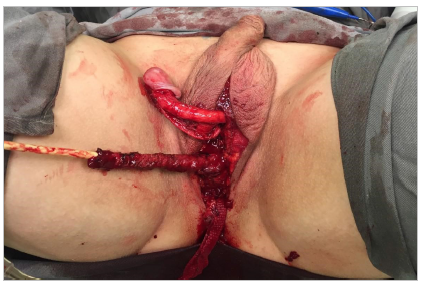
While in Group I the penis skin was dissected along with the glans in a single flap to line the new vaginal canal (VG), as described by Gillies and Millard19 (Figures 1-6), in Group II these two structures were separated into individual flaps, the penis skin being used to line the neovagina, and the glans flap, reduced in size and positioned to form a neoclitoris (VC), as described by Perovic et al.20 (Figures 7-9).

Preoperative demarcation of the perineal dissection site to create the new vaginal canal - arrow (Group I).


Appearance after separation of the penile urethra (arrow), resection of the erectile tissue and orchiectomy, leaving a penile flap containing skin and glans (group I).

Inversion of the penile skin with the glans located inside the inverted tissue - arrow (group I).

Creation of the new urethral meatus (arrow) after counter-opening transposition and urethral shortening (Group I).

Final appearance after resection of excess skin, closure by planes, and vacuum drainage, showing the coverage of the penile skin in the new vaginal canal using a vaginal speculum (group I).

Separation of the penile urethra, penile skin, and glans. The skin will be inverted and used to line the neovagina, the urethra will be shortened, and the glans will be reduced to form a structure similar to the clitoris (group II).

Construction of the neoclitoris with part of the glans (arrow). Immediate postoperative period (group II).

All patients used conjugated estrogens and cyproterone. No associated surgeries were performed.
Procedures were performed under general anesthesia associated with epidural block, with the patients kept in the gynecological position, using compression stockings and intermittent pneumatic compression devices in the lower limbs. We used low molecular weight heparin prophylactically for thromboembolic events in both groups. Antibiotic therapy consisted of first-generation cephalosporin during seven days of hospitalization. All surgeries included vacuum drainage in a closed system, introduction of a mold into the neovagina, and bladder catheterization during hospitalization.
All patients in both groups were discharged from the hospital on the eighth day of hospitalization, with weekly follow-up until the end of the first postoperative month, and follow-up visits at two, four, and six months after surgery (Figure 9).
We collected data on age, weight, height, and body mass index (BMI). The variables were grouped into the following categories: infectious/scarring (infections, abscesses, necrosis); urinary (urethral bleeding, urinary tract infection accompanied by dysuria, incontinence, urinary urgency, urinary retention, urethral meatus stenosis); related to neovaginal dilation (glans prolapse, bleeding); neovaginal lining (minor ulcerations or perforations); neovaginal fistulas; rectal perforation; increase in the volume of the urethral bulb with sexual stimulation; vulva/neoclitoris appearance (excess glans/neoclitoral remnant); thromboembolic events (DVT/PTE); need for surgical reintervention (dehiscence, resutures); and death.
The dilation methodology was the same for both groups, with the use of silicone vaginal dilators, starting seven days after surgery, three times a day for 30 minutes each, for a period of six months.
The period of immobilization of the patient in bed during hospitalization was two days after surgery. Bed mobilization began on the second postoperative day, followed by a two-month period of reduced mobility and avoided physical exertion. After this period, the patients in both groups were allowed to exercise.
Sexual intercourse in the neovagina was allowed six months after surgery.
There was no evaluation of patient satisfaction or functionality for the present study.
Statistical analysis included the Student’s t-test for continuous variables and the Fisher’s test for categorical ones. We used the Pearson’s correlation test for all categorical variables (complications). The level of statistical significance was 5%. All the variables analyzed were evaluated and presented equal variances and normal distribution. The null hypothesis showed no difference between the two groups.
RESULTS
The descriptive analysis showed a mean age of 40(SD=9) years, mean weight of 74(SD=14) kg, and mean BMI of 25.45(SD=4) kg/m².
Inferential statistical analysis showed no difference between the two groups in terms of age, weight, and BMI (Table 1).
In both groups, 28 patients (47.45%) had complications; major complications (thromboembolic events and rectal perforation) were observed in 8.47% of cases. Other complications included infections/abscesses, necrosis (Figure 10), need for resuture, bleeding, urinary retention, urethral meatus stenosis, prolapse of the glans/neovagina (Figure 11), excess skin, fistulas, excess volume in the urethral bulb, and excess glans/clitoral remnant.

Suture dehiscence on the vaginal lip (left) and slight asymmetry after healing by second intention (right), in a patient in group I.

The most frequent adverse events were minor dehiscence of up to 1 cm (47.5%), exudate (42.4%), granulomas (23.7%), dysuria (18.6%), and pain (16.9%).
One death was related to the SRS procedure (1.7%). The initial postoperative course had been uneventful. The patient had constipation and, while attempting to evacuate, sustained a rectal perforation into the neovagina, requiring intestinal diversion with colostomy performed by the hospital’s gastrointestinal surgery team. She subsequently experienced episodes of intestinal subocclusion, abdominal distension, and electrolyte imbalance, which led to several visits to the emergency department. Later, she developed sudden complications at home, received care at a Basic Health Unit, and died.
There was another death (1.7%) caused by a laryngeal tumor, diagnosed late after surgery, not SRS-related.
The two groups also did not show differences as to infections/dehiscence, neovaginal complications, fistulas, rectal perforation, increased urethral bulb volume during sexual stimulation, complaints related to vulvar aspect, and thromboembolic events (Table 2).
There was a significant difference between the groups as to urinary complications (p=0.020), neovaginal dilation (p=0.002), lining of the neovagina (p=0.011), and need for surgical reintervention (p=0.006), the VC group presenting lower rates for these four variables (Table 2).
In this sample, urinary complications were urethral bleeding, urinary infection with dysuria, urinary incontinence, urinary urgency, urinary retention, and urethral meatus stenosis, being more frequent in patients operated by the VG technique (36.0%) than by VC (8.8%) (p=0.020).
We used the Pearson’s test to assess correlations between all complication variables, as shown in Table 3. There was no significant correlation (ρ = 0-0.3, positive or negative) between them.
DISCUSSION
Gender Identity Disorder is a condition that involves multidisciplinary treatment and follow-up. Patients are often misunderstood by both physicians and society13.
In addition to multidisciplinary treatment involving a psychologist, psychiatrist, endocrinologist, and social worker, SRS is part of the healthcare system and can also be called gender affirmation surgery or gender confirmation surgery. One of the challenges is to properly identify candidates for such procedures. In Brazil, the legislation requires multidisciplinary follow-up for a minimum period of one year to confirm the diagnosis, that is, the team of professionals concludes that the adequacy of the sexual character will lead to an improvement in quality of life, with an indication for surgical treatment.
There are many techniques described in the literature for male-to-female SRS. The surgical steps common to these different techniques are: 1. dissection between the urethra/bladder and the rectum to create a cavity that will be the neovagina; 2. shortening of the urethra; 3. resection of the penile erectile tissue; 4. Orchiectomy; 5. Use of the scrotum’s skin and subcutaneous tissue for construction of the labia majora.
On the other hand, these techniques differ regarding the tissues used to line the neovagina, aiming to control scar contracture and preserve the lumen. These can be skin, both graft and flap, oral mucosa, small intestine, or sigmoid segment. The way of use and the positioning of the glans, a tissue with great erogenous sensitivity, are also differentiating factors between these techniques.
Despite the considerable number of scientific articles on these techniques, there are few studies comparing them.
In the present study, there were different complications in the two techniques, VG and VC. The latter is considered the international standard for MtF SRS17,18,21.
The two groups were similar in age, weight, height, and BMI, indicating that they were comparable. The mean age was higher than that reported in the literature, likely because this was a public healthcare service, where patients waited an average of nine years between enrollment in the program and surgery.
Vaginal stenosis and loss of depth were the main functional complications, although the persistence of the use of vaginal dilators generally led to satisfactory results. A review of different advanced techniques reported final stenosis in 6-15% of cases using skin flaps22-24, in 5-55% of cases with penile skin inversion20,25-28, and in 8-45% of cases using grafts29-32.
Regarding the conformation of the neovagina, the present sample presented the following complications: stenosis of the canal, vaginal shortening, prolapse and/or malpositioned glans, excess skin, and insufficient vaginal canal dilation that rendered penetration impossible. The comparison between the two techniques demonstrated better and statistically significant results with the VC technique. There were also complications in the lining of the neovagina, such as small ulcerations of the vaginal canal and minor perforations of the vaginal wall, related to the postoperative dilation procedure, with Group II presenting lower complication rates. In Group I, there were difficulties in dilating the neovagina, since the positioning of the glans at the base of the canal brought discomfort during the application of the pressure necessary for expansion. This caused patients to dislocate the tip of the dilator, leading to deviated or insufficient vaginal canal dilation. This sensitivity at the base of the vaginal canal was lower in Group II (glans used to form the neoclitoris), with a significant reduction in complications related to the vaginal canal.
Other complications, such as cellulitis, surgical wound exudation, abscess, epidermolysis, dehiscence, necrosis, and granuloma did not show statistically significant difference between the two techniques, with 30.5% of patients presenting any of these complications. This highlights characteristics of this type of surgical procedure, with manipulation close to the urinary and digestive systems, in a topography that presents specific humidity and bacterial flora, and with a new anatomical conformation.
As for the increased urethral bulb volume in response to erogenous stimulus, vulvar appearance, labia volume, and clitoris oversize, there was no statistically significant difference between groups. The literature states that an increase in clitoral volume may be due to the mobilization of the subcutaneous tissue to the pubic symphysis, which would cause cutaneous ptosis and, consequently, a more prominent clitoris33. However, we did not observe this in the patients analyzed.
There was one rectal perforation during surgery in the first year of the team’s experience, representing a serious complication. Treatment consisted of immediate suspension of the procedure, closure of the perforation, laminar drainage, and broadening of the antibiotic spectrum. There was a favorable response, and the patient underwent SRS five months after the incident. The increase in surgical experience in the series was later responsible for the absence of inadvertent complications33, which can be considered a bias linked to the learning curve of the surgical team. Although this rectal perforation occurred in a patient submitted to VG, it did not statistically affect the comparison of results between the two techniques.
Urinary complications, characterized by painful urinary obstruction disorders due to meatal stenosis, are the main adverse events in the overall complication rates20, with surgical reintervention in up to 25% of cases34. Transient stress urinary incontinence has also been described35. However, the tendency is for all patients to regain urinary continence after pelvic surgery. It is believed that dissection of the neovaginal space can lead to partial lesions of the sphincter fibers, resulting in this transient dysfunction.
The frequency of urinary complications (urethral bleeding, urinary infection accompanied by dysuria, incontinence, urinary urgency, urinary retention, and meatal stenosis) was 20.3% in our sample, with a lower rate in the group of patients undergoing VC.
The use of hormones, smoking, and obesity, as well as the intraoperative positioning of the patient and increased surgical time, are related to a higher incidence of thromboembolic events and postoperative pulmonary complications7. The occurrence of two cases of deep vein thrombosis and one of pulmonary embolism in this study showed no statistical difference between the two techniques.
The evaluation of all the results in the operated patients, despite a rate of minor complications of 47.45% and a rate of major ones of 8.47%, showed a mean need for surgical reintervention in 18.6% of the patients (Group I, 36.0% and Group II, 5.9%; p=0.006).
The sequential allocation of patients to the two groups should be interpreted with caution, particularly because improvements in the surgical team’s experience over time may have influenced the results through a learning-curve effect.
CONCLUSIONS
In agreement with the literature, in the present sample of 59 patients, the VC technique had a lower incidence of complications related to the conformation of the urinary and vaginal canals and the vaginal lining and, consequently, a lower number of surgical reinterventions when compared with the VG technique.
REFERENCES
-
1 Benjamin H. Transsexualism and transvestism as psychosomatic and somatopsychic syndromes. Am J Psychother. 1954; 8(2): 219-30. DOI: 10.1176/appi.psychotherapy.1954.8.2.219.
» https://doi.org/10.1176/appi.psychotherapy.1954.8.2.219 -
2 Krege S, Bex A, Lümmen G, Rübben H. Male-to-female transsexualism: a technique, results and long-term follow-up in 66 patients. BJU Int. 2001; 88(4): 396-402. DOI: 10.1046/j.1464-410x.2001.02323.x.
» https://doi.org/10.1046/j.1464-410x.2001.02323.x -
3 Soli M, Brunocilla E, Bertaccini A, Palmieri F, Barbieri B, Martorana G. Male to female gender reassignment: modified surgical technique for creating the neoclitoris and mons veneris. J Sex Med. 2008; 5(1): 210-6. DOI: 10.1111/j.1743-6109.2007.00632.x.
» https://doi.org/10.1111/j.1743-6109.2007.00632.x -
4 Imbimbo C, Verze P, Palmieri A, Longo N, Fusco F, Arcaniolo D, et al. A report from a single institute's 14-year experience in treatment of male-to-female transsexuals. J Sex Med. 2009;6(10): 2736-45. DOI: 10.1111/j.1743-6109.2009.01379.x.
» https://doi.org/10.1111/j.1743-6109.2009.01379.x -
5 Sutcliffe PA, Dixon S, Akehurst RL, Wilkinson A, Shippan A, White S, et al. Evaluation of surgical procedures for sex reassignment: a systematic review. J Plast Reconstr Aesthet Surg. 2009; 62(3): 294-306; discussion 306-8. DOI: 10.1016/j.bjps.2007.12.009.
» https://doi.org/10.1016/j.bjps.2007.12.009 -
6 Baranyi A, Piber D, Rothenhäusler HB. Male-to-female transsexualism. Sex reassignment surgery from a biopsychosocial perspective. Wien Med Wochenschr. 2009; 159(21-22): 548-57. DOI: D10.1007/s10354-009-0693-5.
» https://doi.org/D10.1007/s10354-009-0693-5 -
7 Klein C, Gorzalka BB. Sexual functioning in transsexuals following hormone therapy and genital surgery: a review. J Sex Med. 2009; 6(11)2922-39; discussion 2940-1. DOI: 10.1111/j.1743-6109.2009.01370.x.
» https://doi.org/10.1111/j.1743-6109.2009.01370.x -
8 Padula WV, Baker K. Coverage for Gender-Affirming Care: Making Health Insurance Work for Transgender Americans. LGBT Health. 2017; 4(4): 244-7. DOI: 10.1089/lgbt.2016.0099.
» https://doi.org/10.1089/lgbt.2016.0099 -
9 World Professional Association for Transgender Health. Available from: https://www.wpath.org/about/mission-and-vision [Accessed 14rd November, 2019].
» https://www.wpath.org/about/mission-and-vision -
10 Witacre FE, Alden RH. Changes in squamous epithelium following the surgical treatment of absence of the vagina. Ann Surg. 1951; 133(6): 814-8. DOI: 10.1097/00000658-195106000-00008.
» https://doi.org/10.1097/00000658-195106000-00008 - 11 Abbe R. New methods of creating a vagina in a case of congenital absence. Med Rec. 1898; 54: 836-8.
- 12 McIndoe AH, Banister JB. An operation for the cure of congenital absence of the vagina. J Obstet Gynaecol Br Emp. 1938; 45: 490-4.
-
13 Selvaggi G, Ceulemans P, De Cuypere G, Van Landuyt K, Blondee P, Hamdi M, et al. Gender identity disorder: general overview and surgical treatment for vaginoplasty in male-to-female transsexuals. Plast Reconstr Surg. 2005; 116(6): 135e-145e. DOI: 10.1097/01.prs.0000185999.71439.06.
» https://doi.org/10.1097/01.prs.0000185999.71439.06 -
14 Selvaggi G, Bellringer J. Gender reassignment surgery: an overview. Nat Rev Urol. 2011; 8(5): 274-82. DOI: 10.1038/nrurol.2011.46.
» https://doi.org/10.1038/nrurol.2011.46 - 15 Baldwin JC. Formation of an artificial vagina by intestinal transplantation. Am J Obstet Gynecol. 1907; 56: 636-8.
-
16 Ravat J, Ahmed I, Pandey A, Khan TR, Singh S, Wahklu A, et al. Vaginal agenesis: experience with sigmoid colon neovaginoplasty. J Indian Assoc Pediatr Surg. 2010; 15(1): 19-22. DOI: 10.4103/0971-9261.69136.
» https://doi.org/10.4103/0971-9261.69136 - 17 Hage JJ. Vaginoplasty in male-to-female transsexuals by inversion of penile and scrotal skin. In: Ehrlich RM, Alter GJ. Reconstructive and plastic surgery of the external genitalia. Philadelphia: WB Saunders; 1999. pp. 294-300.
-
18 Giraldo F, Mora MJ, Solano A, González C, Smith-Fernández V. Male perineogenital anatomy and clinical applications in genital reconstructions in male-to-female sex reassignment surgery. Plast Reconstr Surg. 2002; 109(4): 1301-10. DOI: 10.1097/00006534-200204010-00014.
» https://doi.org/10.1097/00006534-200204010-00014 - 19 Gillies H, Millard Jr RD. Genitalia. The principles and art of plastic surgery. London: Butterworth; 1957. pp. 369-88.
-
20 Perovic SV, Stanojevic DS, Djordjevic ML. Vaginoplasty in male transsexuals using penile skin and a urethral flap. BJU Int. 2000; 86(7): 843-50. DOI: 10.1046/j.1464-410x.2000.00934.x.
» https://doi.org/10.1046/j.1464-410x.2000.00934.x - 21 Karim RB, Hage JJ, Mulder JW. Neovaginoplasty in male transsexuals: review of surgical techniques and recommendations regarding eligibility. Ann Plast Surg. 1996; 37(6): 669-75. PMID: 8988784.
-
22 Small MP. Penile and scrotal inversion vaginoplasty for male to female transsexuals. Urology. 1987; 29(6): 593-7. DOI: D10.1016/0090-4295(87)90098-7.
» https://doi.org/D10.1016/0090-4295(87)90098-7 - 23 Eldh J. Construction of a neovagina with preservation of the glans penis as a clitoris in male transsexuals. Plast Reconstr Surg. 1993; 91(5): 895-900; discussion 901-3. PMID: 8460193.
-
24 van Noort DE, Nicolai JP. Comparison of two methods of vagina construction in transsexuals. Plast Reconstr Surg. 1993; 91(7): 1308-15. DOI: 10.1097/00006534-199306000-00018.
» https://doi.org/10.1097/00006534-199306000-00018 - 25 Rubin SO. Sex-reassignment surgery male-to-female. Review, own results and report of a new technique using the glans penis as a pseudoclitoris. Scand J Urol Nephrol Suppl. 1993; 154: 1-28. PMID: 8140401.
-
26 Jarolim L. Surgical conversion of genitalia in transexual patients. BJU Int. 2000; 85(7): 851-6. DOI: 10.1046/j.1464-410x.2000.00624.x.
» https://doi.org/10.1046/j.1464-410x.2000.00624.x -
27 Turner UG 3rd, Edlich RF, Edgerton MT. Male transsexualism: a review of genital surgical reconstruction. Am J Obstet Gynecol. 1978; 132(2):119-33. DOI: 10.1016/0002-9378(78)90913-4.
» https://doi.org/10.1016/0002-9378(78)90913-4 -
28 Karim RB, Hage JJ, Bouman FG, de Ruyter R, van Kesteren PJ. Refinements of pre, intra and postoperative care to prevent complications of vaginoplasty in male transsexuals. Ann Plast Surg. 1995; 35(3):279-84. DOI: 10.1097/00000637-199509000-00010.
» https://doi.org/10.1097/00000637-199509000-00010 -
29 Laub DR, Fisk N. A rehabilitation program for gender dysphoria syndrome by surgical sex change. Plast Reconstr Surg. 1974; 53(4):388-403. DOI: 10.1097/00006534-197404000-00003.
» https://doi.org/10.1097/00006534-197404000-00003 -
30 Foerster DW, Reynolds CL. Construction of natural appearing female genitalia in the male transsexual. Plast Reconstr Surg. 1979; 64(3):306-12. DOI: 10.1097/00006534-197909000-00003.
» https://doi.org/10.1097/00006534-197909000-00003 -
31 Glenn JF. One-stage operation for male transsexuals. J Urol. 1980; 123(3):396-8. DOI: 10.1016/s0022-5347(17)55952-2.
» https://doi.org/10.1016/s0022-5347(17)55952-2 -
32 Siemssen PA, Matzen SH. Neovaginal construction in vaginal aplasia and sex-reassignment surgery. Scand J Plast Reconstr Surg Hand Surg. 1997; 31(1):47-50. DOI: 10.3109/02844319709010504.
» https://doi.org/10.3109/02844319709010504 -
33 Neto RR, Hintz F, Krege S, Rübben H, Vom Dorp F. Gender reassignment surgery - a 13-year review of surgical outcomes. Int Braz J Urol. 2012; 38(1):97-107. DOI: 10.1590/s1677-55382012000100014.
» https://doi.org/10.1590/s1677-55382012000100014 -
34 Lawrence AA. Factors associated with satisfaction or regret following male-to-female sex reassignment surgery. Arch Sex Behav. 2003; 32(4): 299-315. DOI: 10.1023/a:1024086814364.
» https://doi.org/10.1023/a:1024086814364 -
35 Schechter LS, D'Arpa S, Cohen MN, Kocjancic E, Claes KEY, Monstrey S. Gender confirmation surgery: guiding principles. J Sex Med. 2017; 14(6): 852-6. DOI: 10.1016/j.jsxm.2017.04.001.
» https://doi.org/10.1016/j.jsxm.2017.04.001
Datasets related to this article will be available upon request to the corresponding author