
 Limestone reaction and crop yield in sandy soil of Bahia’s Cerrado, Brazil
ABSTRACT
Soil amendment is an essential step toward the introduction or maintenance of intensified agricultural production systems. The aim of the present research is to assess lime’s response to crops rotation and sandy soil yield in Bahia’s Cerrado region, Brazil, under controlled conditions. The experiment was conducted at completely randomized design with four replications. The crops were grown in pots filled with 20 kg of Oxisol (14% of clay). Treatments consisted of lime rates: 0, 1, 2, and 4 Mg ha-1 (standard dose 1 Mg ha-1). Soybean, millet and Brachiaria crops grown in a crop sequence were assessed - the subsequent crop was grown after harvest. The aforementioned crops production components (mass of fresh and dry matter and weigh of pods), nutrients extraction and soil chemical (pH, P, K, Ca, Mg, H+A, SB, CEC, BS, SOM, S-SO4 2-, B, Cu, Fe, Mn and Zn) properties measured at 1, 2, 3, 6, and 12 months after lime application were the measured variables. There was linear increase in Ca, Mg and sum of bases, as well as in pH, and acidity potential reduction (H+Al) and Mn due to the adopted lime rates. The limestone reaction decreased, overtime, but to a lesser extent at doses 2.0 and 4.0 Mg ha-1 than the doses recommended in official handbooks (1.0 Mg ha-1). These findings pointed out sandy soils responsiveness to higher lime levels in comparison to those supported by official methods.
Keywords
soil acidity; acidity correction; crop succession
INTRODUCTION
From the 1980s onwards, Brazilian agriculture expanded into Western Bahia sandy soils, in Northeastern Brazil hinterlands, where medium- and sandy-textured soils prevail.(1)
Lower land prices and likely mechanization boosted this expansion, mainly the prevailing flat terrains on these areas. However, according to Donagemma et al.(1), these soils physical (sandy soils), chemical (poor fertility) and biological (low concentrations of organic carbon) limitations derive from their high acidity and low nutrient concentration, clay content and, most of all, organic matter concentration, impacting water retention and lower biological activity.(2)
Accordingly, the liming technique is essential to amend soil acidity and to provide Ca and Mg to plants, in addition to improve the environment for higher microbiological activity and soil carbon retention.(3) However, farmers often adopt lime rates higher than those recommended in amendment and fertilization handbooks, such as those by Alvarez et al.(4) and Sousa et al.(5) This scenario demands research aimed at better understanding lime responses in the soil and its association with crop yield in sandy soils that, in their turn, have gotten little attention in comparison to other soil types.(6-8)
The application of higher limestone doses, mainly in areas converted form forest or pasture to agriculture is justified by the belief that doses recommended in handbooks do not lead to high crop yield. Additionally, reports indicate that the delayed response of soil amendments can compromise crop performance, particularly when applied during the dry season without rainfall. Consequently, limestone only begins to react with the return of the rains, dangerously close to the planting window for high-yielding crops like soybeans, where timing is critical.(9)
The application of high lime doses leads to immediate soil acidity amendment, and this is an essential aspect for the soybean culture in the first year of planting. Estimates show that from 20% to 40% of the managed amendment reacts with the soil; thus, the application of higher doses means facing the need for the right amount of lime to amend soil acidity and to meet crop demands in order to get higher yield rates in the first growing season.(2,9)
Balbinotti et al. (10) corroborates these reports by pointing out the need for applying higher limestone doses in order to achieve higher soybean yield. Furthermore, Barth et al.(11) have shown that doses recommended by the Al neutralization method, and increased Ca and Mg levels,(4) were not enough to achieve adequate Ca and Mg soil levels. Bossolani et al.(12) carried out a long-term experiment with clayey soil based on surface limestone application. They highlighted the need for higher amendment doses to ensure soil fertility maintenance at adequate levels and, consequently, to guarantee higher yield in soybean and other crops comprising the production systems.
On the other hand, some studies have shown possible negative effects, such as clay dispersion and lower micronutrient availability, among others, associated with the application of higher doses than the official ones.(13-15) Most of these studies were carried out with clayey soils, since studies with sandy soils remain scarce.
Accordingly, the current research aimed to assess limestone responsiveness and the yield of successive crops planted in sandy soil in Bahia’s Cerrado region, Brazil, under controlled conditions.
MATERIALS AND METHODS
The experiment was carried out at Embrapa Maize and Sorghum greenhouse, Sete Lagoas City, Minas Gerais State, Brazil, from November 2018 to December 2019 within a crop succession system, under conditions similar to those observed in the field for sandy soils in Western Bahia.
The experiment consisted of four commercial limestone doses that corresponded to 0, 1, 2, and 4 times the standard dose (SD) calculated based on the method supported by Al neutralization, and Ca and Mg concentration increase.(4) Limestone requirement (Mg ha-1) = (Y x Al3+) + (X – [Ca2+ + Mg2+]), where Ca2+ and Mg2+ in cmolc dm-3.(4) This process took into consideration the Y and X values at 76% limestone PRNT (standard dose = 1.0 Mg ha-1). The Y value changes depending on soil texture: Y = 1 for sandy soils (< 15% clay), Y = 2 for medium-textured soils (15 and 35% clay) and Y = 3 for clayey soils (> 35% clay). The X value changes based on the crop’s Ca and Mg requirements: X = 1 for eucalyptus; X = 2 for most crops, including soybean; X = 3 for coffee.(4)
Thus, the calculated limestone doses corresponded to 0, 1, 2, and 4 Mg ha-1 limestone (standard dose = 1.0 Mg ha-1). Commercial limestone features expressed in percentage were limestone reactivity (RE Brazilian acronyms) = 85.5%, calcium carbonate equivalent (PN Brazilian acronyms) = 88.8%, effective calcium carbonate equivalent (PRNT Brazilian acronyms) = 76%, CaO = 27.3% and MgO = 16.1%.
The study followed a completely randomized design with four repetitions, and four treatments - doses of limestone (main factor), specific for soil variables split-plot analysis was used to assess soil chemical properties because factor time (soil collection times) was taken into consideration.
Pots filled with 20 kg of sandy soil, which was previously sieved through 2 mm mesh, were used in the experiment. The soil was classified as Oxisol with sandy texture. It was provided by Fazenda Trijunção, which is located in Western Bahia State Cerrado region. The soil was treated with limestone and gypsum at doses = 1 Mg ha-1, 20 cm down in the soil, back in October 2013 – it had also been cultivated with pasture (Urochloa brizantha). The soil for the experiment was collected in January 2018 and its chemical and physical features (0-20 cm layer) before experiment installation were set through methodologies described in Teixeira et al.,(18) namely: pHH2O = 5.9, P = 2.3, K = 15.4, and S = 16.9 mg dm-3, Ca = 0.9, Mg = 0.3, Al = 0.0, H+Al = 0.7 and CEC (cation exchange capacity) = 1.9 cmolc dm-3, BS (base saturation) = 59%, B = 0.06, Cu = 2.6, Fe = 31.7, Mn = 0.4 and Zn = 1.1 mg dm-3, sand = 850, silt = 10 and clay = 140 g kg-1.
The limestone doses set for each treatment were applied in November 2018, as well as the reagent-form fertilizers (pure, per analysis), according to the soil fertility analysis and to recommendations for experiments conducted in pots, based on Novais et al.(16) The soil was irrigated with deionized water in order to maintain field capacity at 80% (0.30 cm³ cm⁻³) after inputs were applied. This management procedure lasted 1 month and featured the incubation phase. It was done to favor the reaction and inputs’ dissolution.
Soybean cultivar M9144 RR was sown in December 2018 by using six seeds per pot that were treated and inoculated with B. japonicum. Subsequently, thinning was performed in order to only leave four plants per pot. Soybean was harvested at physiological maturity (R8), in March 2019. Subsequently, millet cultivar ADR 500 was planted and five plants were left per pot; they were harvested at the booting stage (R2 - Panicle boot stage), in May 2019. Forage Urochloa brizanta cv. Piatã was planted in June 2019 and six plants were left per pot; they were harvested in October 2019. Fertigation, during the crop cycle, followed doses established through the soil analysis performed at each experiment collection, according to recommendations for cultivation in pots.(16)
Soybean biomass production was assessed at flowering and harvest; all shoot material was collected, namely: green and dry mass at flowering (vegetative part) (collected from two plants); and pods + grains green and dry mass, number of pods and number of grains at harvest (collected from the two remaining plants). Pearl millet plants at the booting developmental stage and forage shoot parts (the entire above-ground part of the Brachiaria grass) were also collected to assess green and dry matter production.
Subsequently, all dry plant material from the shoot of the three crops (soybean, millet and Brachiaria) was ground in Willey mill through 20-mesh sieve to extract macro and micronutrients based on the methodology described by Silva et al.(17) The plant samples were subjected to sulfuric digestion followed by distillation based on the Kjeldahl method in order to find the N concentration. Boron (B) concentration was set through the azomethine-H method after samples’ incineration in muffle furnace and subsequent quantification in a molecular absorption spectrophotometer. Ca, Mg, K, P, S, Fe, Cu, Mn, and Zn concentrations were analyzed through nitric–perchloric digestion and determined by Ca, Mg, K, Fe, Cu, Mn, and Zn atomic absorption spectrophotometry, P metavanadate colorimetry and S barium sulfate turbidimetry. Total nutrient content was multiplied by shoot dry mass to find the accumulation, which corresponds to nutrient extraction.
Assessments aimed at limestone reaction in the soil were also carried out based on soil collection by mini-auger at 1, 2, 3, 6 and 12 months after limestone application. Routine chemical analyses were performed based on the methodology by Teixeira et al.(18) Soil pH was found through the potentiometer method at soil:water ratio equals 1:2.5. The available potassium (K+) and phosphorus (P) were extracted in Mehlich-1 solution - K+ availability was determined through atomic absorption spectroscopy and P availability was found through spectrophotometry; calcium (Ca2+) and magnesium (Mg2+) were determined by atomic absorption spectroscopy after extraction in 1 mol L-1 KCl. Sulfate (S-SO42-) was determined through turbidimetry in spectrophotometer after extraction in Ca(H2PO4)2 added with 500 mg L-1 P in HOAc 2 mol L-1. Micronutrients zinc (Zn), copper (Cu), iron (Fe) and manganese (Mn) were extracted in Mehlich-1 solution and determined through atomic absorption spectroscopy. Boron (B) was determined through spectrophotometry after applying the hot water extraction method. Cation exchange capacity (CEC), sum of bases (SB) and base saturation (BS) were also calculated.
Data normality and homogeneity of variance were verified prior to analysis of variance (ANOVA). Linear and non-linear regression analyses were applied for significant effects (p < 0.05). In the presence of significant interactions, factor levels were partitioned and analyzed separately.
RESULTS
Plants
With respect to soybean biomass, only the green mass showed significant difference at the vegetative phase (GMV) in the F test (Table 1, Supplementary Material). The maximum GMV production reached 184.69 g pot-1 and it was recorded at limestone dose equals 2.43 Mg ha-1 (Figure 1A). In the soybean value of foliar Mn showed decreasing linear behavior and this finding highlighted that limestone dose increase reduced nutrient absorption (Figure 1B). Boron (B) showed better fit to the quadratic model with maximum extraction point estimated at 16.18 mg plant⁻¹ at limestone dose = 1.89 Mg ha⁻¹ (Figure 1B). The other nutrients did not differ in relation of limestone doses.

A - Green mass at the vegetative phase and B - Manganese and Boron contents extracted from soybeans as limestone dose function.
Millet and Piatã Brachiaria biomass production did not show significant differences in the F test, for any of the analyzed variables (Table 3, Supplementary material).
Soil
Calcium (Ca), magnesium (Mg) and sum of bases (SB) concentrations were significantly affected by limestone application rates and time (days after application (DAA), but they were not affected by interaction (Table 4, Supplementary material). Phosphorus (P) and potassium (K) concentrations, cation exchange capacity (CEC) and soil organic matter (SOM) were only influenced by DAA. On the other hand, pH, H+Al and base saturation (BS) showed significance for the rate/application time interactions (Table 4, Supplementary material).
The maximum pH points in the soil, at doses = 0, 1, 2 and 4 Mg ha-1, were 5.81, 5.69, 6.04 and 6.37, at 250, 166.66, 166.66 and 125 DAA, respectively (Figures 2A and B).
Potential acidity (H + Al) showed quadratic response for all used doses in relation of DAA (interaction doses of limestone and DAA) (Figure 2C). The lowest H + Al values at doses = 0, 1, 2 and 4 Mg ha-1 were 2.57, 1.98, 1.34 and 0.82 cmolc dm-3 at 83, 149, 155 and 144 DAA, respectively. Responses were linear negative in the unfolding of the doses at each DAA (Figure 2D); the concentration of potential acidity decreased as limestone doses increased.

Soil pH values as A function - Days after application (DAA) interaction breakdown at each dose and B - Limestone dose interaction breakdown at each DAA. Potential acidity (H + Al) as C function - Days after application (DAA) interaction breakdown at each dose and D - doses interaction breakdown at each DAA.
Soil P and K concentrations showed quadratic responses as DAA function (Figure 3A). The lowest P availability was recorded at 360 DAA (60.78 mg dm-3) whereas K presented the lowest availability at 220 DAA (54.43 mg dm-3).
The sum of bases increased under the corrective doses and it reached 2.63 cmolc dm⁻³ at the maximum dose (4 Mg ha-1) (Figure 3B). With respect to the DAA factor, SB presented negative linear response with minimum value equals 0.97 cmolc dm-3, at 365 days (Figure 3C). Cation exchange capacity (CEC) showed significant decrease with 5.28 cmolc dm-3 at 30 DAA (Figure 3D).
The highest Ca and Mg contents were observed at 30 DAA: 1.83 and 0.99 cmolc dm⁻³, respectively, and they were followed by reduction in the other assessments (Figure 3E). Ca and Mg concentrations presented increase proportional to the amounts of applied correctives, and they reached 1.79 and 0.7 cmolc dm-3, respectively, at the highest applied limestone dose (Figure 3F).

A - Phosphorus (P) and potassium (K) soil levels as days after lime application (DAA) function. Sum of bases in the soil, B – as lime doses function and C – of DAA. D – Cation exchange capacity (CEC) as DAA function. Calcium (Ca) and magnesium (Mg) levels, E – as doses function and F – as DAA function.
Base saturation (BS%) showed a decreasing linear response at the days after application (DAA), and this finding has shown reduced amendment effectiveness, overtime (Figure 4). The most significant decreases were observed at the lowest levels: 61% and 87% reduction for 0 and 1 Mg ha⁻¹, respectively, and it points out soil acidification (dose zero) and lower residual effect (dose = 1 Mg ha-1). However, the reductions were less significant (46% and 42%) at the higher levels (2 and 4 Mg ha⁻¹), and it suggests greater buffering effect due to the addition of doses higher than those recommended in the handbooks.

Table 1 makes it clear that only macronutrient sulfur (S) showed significant standard limestone dose/time assessment (DAA) interaction. Significant effect of nutrients copper (Cu) and boron (B) was only observed for the DAA factor. Manganese (Mn) showed significant differences for both corrective doses and DAA, but they were independent. Iron (Fe) and zinc (Zn) did not show significant difference.
Soil S concentration reached its maximum without limestone application (0 Mg ha-1) at 180 DAA, and it reached 16.56 mg dm⁻³. On the other hand, 92.75% reduction in S concentration was observed between the lowest and highest applied doses at 365 DAA, which means negative linear response (Figure 5A).
Soil S concentrations were higher at 180 DAA than at 365 DAA: 34.12%, 47.78% and 84.91% increase at doses equal to 1, 2 and 4 Mg ha-1, respectively, if the comparison between time assessments and each standard dose is taken into consideration (Figure 5B).
The minimum soil Cu concentration was observed at 255 DAA: 1.27 mg dm-3 (Figure 5C). Mn concentration showed negative linear response in comparison to DAA: 49.90% reduction from 90 to 365 DAA (Figure 5C). Furthermore, Mn decreased as limestone dose increased: 4.11 and 3.47 mg dm-3 were recorded at doses equal to 0 and 4 Mg ha-1, respectively (Figure 5D).
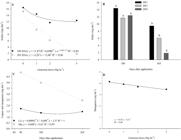
A - Soil sulfur (S) concentration as lime rate breakdown function at 180 and 365 days after application (DAA). B - Soil sulfur concentration as DAA breakdown function at 1, 2, and 4 Mg ha-1 (letters compare the rates at each DAA). C - Soil copper (Cu) and manganese (Mn) concentrations as DAA function. D - Soil Mn concentration as lime rate function.
Soil organic matter (SOM) concentration reached its maximum value at 166 DAA: 7.08 g kg-1 (Figure 6A). Soil B concentration was 0.19 mg dm-3 at 180 days after lime application (DAA) and 0.33 mg dm-3 at 365 DAA (Figure 6B).

A - Soil organic matter (SOM) concentration as function of limestone days after application (DAA). B - Soil boron (B) concentration as DAA function.
DISCUSSION
Low, or lack, of crop biomass production response can be explained by millet and Brachiaria crops’ lower soil fertility requirements. Another possible explanation for it lies on the fact that initial soil fertility levels were enough to meet these crops’ nutritional demands.
Soybean, in its turn, is a more demanding and responsive crop to fertility management. It has positive response at lime rates close to 2.5 Mg ha-1 recorded for green mass, at the vegetative phase. However, there was no difference in dry mass or grain yield, as expected. This finding can be explained by the initial soil analysis, which highlighted this oilseed crop’s adequate fertility levels. Thus, Ca and Mg levels, and the initial soil pH value, did not limit crop yield, even with the recorded lime rates.
According to other studies, soybeans are responsive to soil amendment, including the application of doses higher than those recommended in handbooks available for use in the Brazilian Cerrado.(19)
The reduced Mn content absorbed by the soybean plant due to higher limestone doses is explained by the fact that Mn solubility decreases as limestone doses increase. This finding corroborates what was observed in the soil, because there was insoluble Mn oxides and hydroxides formation due to pH increase. Manganese makes the transition from its readily available form to plants (Mn²⁺) to its less soluble forms, which reduces its bioavailability in the soil. Therefore, less Mn will be extracted by the crop.(20)
On the other hand, boron (B) extraction showed quadratic response to limestone doses, and it can be explained by boron adsorption by soil minerals like iron and aluminum oxides, which are pH-dependent and reach the maximum value under slightly alkaline conditions. However, despite this optimal pH range, boron becomes less available due to increased adsorption and precipitation, which reduces its availability to plants.(21) applied 6.6 Mg ha⁻¹ limestone and found the maximum B point at concentration equals to 0.8 mg dm⁻³, which was followed by decline due to adsorption processes.
Increasing lime rates raise soil pH. However, this effect tends to decrease overtime due to acidification caused by successive crops and nitrogen fertilization. Proton (H⁺) exudation by the roots, as osmotic balance mechanism combined to Ca and Mg absorption and N topdressing, helps restoring soil acidity.(22)
Studies have shown that liming does not excessively increase pH in sandy soils, even at high rates, unlike what is observed in soils with higher CEC. Classical literature tends to point out more significant increases, but recent studies highlight that pH values rarely exceed the 7.0 to 7.5 range, even with very high lime applications.(19,23,24)
Esper Neto et al.(23) assessed different limestone doses (0, 2, 4 and 8 Mg ha⁻¹) in sandy soil with 120 g kg⁻¹ clay planted with soybean and observed that the maximum pH in H₂O (5.94) was observed at dose 5.25 Mg ha⁻¹, in the 0-0.1 m layer. The maximum soybean yield (2,929 kg ha⁻¹) was recorded at 4.6 Mg ha⁻¹ limestone. This behavior can be explained by sandy soils’ low CEC, which limits Ca and Mg sink, and leads to limestone reaction stabilization at a certain chemical equilibrium point.
It is important bearing in mind that, although the lime reaction time often used for agricultural management is close to 90 days after application (DAA), there is evidence that soil pH maximum effect can take place over a longer period. These results indicate that the neutralizing effect of liming extends beyond the standard evaluation window, which must be considered when planning acidity correction strategies. In rainfed systems, lime reaction is governed by soil moisture availability post-application rather than the application timing. This requires special attention in newly incorporated marginal areas, where rainfall distribution departs from the patterns observed in traditional agricultural regions of Brazil.
The present results have shown reduced availability of nutrients such as phosphorus (P), potassium (K), calcium (Ca) and magnesium (Mg) over the course of the conducted assessments. This finding can be associated with these elements’ on-going absorption by crops planted under sequence or rotation systems. This outcome reinforces the relevance of monitoring soil nutritional status throughout the agricultural cycle and of adopting appropriate replacement strategies to avoid nutritional deficiencies that could compromise plant development. The observed P and K decease can be linked to their low replacement by the nutrient solution. However, with respect to Ca and Mg, the adopted lime rates could be higher, as shown by the linear behavior for these features at the tested levels.
In addition to lime’s known effects on both soil acidity amendment and exchangeable aluminum (Al³⁺) neutralization, its application also acts as calcium (Ca²⁺) and magnesium (Mg²⁺) source. Accordingly, its increased levels are expected to lead to these nutrients’ higher levels in the soil, which reflects a positive response proportional to the amount of applied amendment. This behavior meets previous studies conducted under similar soil and management conditions, which have reported increased Ca²⁺ and Mg²⁺ levels due to liming.(24)
However, it would be necessary to increase lime rates, as indicated by the adjusted models and the observed results, to achieve higher soil Ca + Mg levels – compatible to the requirements of higher-yield genotypes and systems (ranging from 2.7 to 5.2 cmolc dm⁻³).(25) This aspect highlights the possible need for reviewing the liming recommendations currently used for sandy soils, as already suggested by Oliveira et al.(19) and Santos et al.(24)
H+Al value reductions are in compliance with limestone application. If one bears in mind limestone's DAA, the subsequent increase in potential acidity follows the soil pH decrease due to acidification caused by crop cultivation and nitrogen fertilization, as previously reported. Furthermore, acidity (H+) increase consequently leads to toxic aluminum (Al+3) level increase, and this finding corroborates the observed results.
Nutrients calcium (Ca+2) and (Mg+2) are the most influential to the sum of bases (SB) and base saturation (BS%) due to the significant occupation of cation exchange capacity (CEC) associated with these elements’ charge, mainly in comparison to other cationic nutrients. Therefore, the increased amount of applied limestone is expected to increase SB and BS%, because limestone is not only a Ca+2 and Mg+2 source, but it also corrects acidity and neutralizes aluminum (Al+3), which frees up the space in other cations’ CEC. However, SB and BS% follow a linear decrease trend over the DAA, which is justified by crop sequence (with consequent base extraction) and acidification caused by fertilization.
As observed by Santos et al.,(24) base saturation did not exceed 80%, even at the highest dose, due to limestone’s lower reaction in sandy soils caused by lower Ca and Mg drain. The cation exchange capacity (CEC) showed the same behavior.
The low copper concentration observed at 255 DAA (Figure 5C) is explained by soil pH increase, which reduces this nutrient’s availability. Holland et al.(26) assessed the application of 2 to 6 Mg ha-1 calcitic limestone for 365 DAA in sandy loam soils. They observed that liming reduced Cu and Mn availability, mainly at pH levels higher than 7.
Unlike many reports in the classical literature,(13,27) there was no decrease in iron and zinc availability due to liming. This finding is reinforced by Moreira et al.(28) and Moreira et al.(29) studies, according to which, micronutrient levels in the soil showed little association with plant levels. They also suggested that the Mehlich-1 extractor cannot be properly used to assess micronutrient availability in the soil. The study by Santos et al.(24) also found no significant limestone effect on micronutrient availability decrease in the soil by using the same extractor. The use of the nutrient solution added with micronutrients was another justification for lack of micronutrient responses (depletion) to lime application, except for Mn.
Assumingly, the dynamics involved in the soil/plant association based on rhizosphere addition, release of root metabolites, among others, help nutrients’ absorption by plants, even under higher pH conditions. Thus, the expected effect of reducing micronutrients availability by increasing soil pH is not observed in all elements.(20,30,31)
In first-crop areas of the Matopiba region, optimal soybean yield requires lime application rates below 10 t ha⁻¹ (or up to twice the rate prescribed by official recommendation methods). Rates exceeding 10 t ha⁻¹ negatively impact soil chemical availability—specifically lowering P, K, and cationic micronutrient levels—which ultimately impairs foliar uptake of both macro- and micronutrients.(32)
CONCLUSIONS
There was a linear increase in soil Ca, Mg, SB concentration and in pH, and potential acidity (H+Al) reduction due to the applied limestone doses. This finding pointed out sandy soils’ responsiveness to higher limestone levels in comparison to those recommended by official methods.
The limestone reaction decreased, overtime, but to a lesser extent at doses 2.0 and 4.0 times higher than the doses recommended in official handbooks. Higher doses (higher than those recommended in official handbooks) decreased the soil Mn concentration, but it did not happen with other micronutrients.
ACKNOWLEDGMENTS, FINANCIAL SUPPORT, AND FULL DISCLOSURE
Funding for the development of the research was received from Fazenda Trijunção and the Brazilian Agricultural Research Corporation (EMBRAPA).
1
DATA AVAILABILITY STATEMENT
All datasets supporting the findings of this study have been deposited in SciELO Data and are available at https://doi.org/10.48331/SCIELODATA.0EA5N.
SUPPLEMENTARY MATERIAL
Supplementary material is available at: https://doi.org/10.48331/SCIELODATA.0EA5NW
REFERENCES
-
1 Donagemma GK, Freitas PL de, Balieiro F de C, Fontana A, Spera ST, Lumbreras JF, et al.. Characterization, agricultural potential, and perspectives for the management of light soils in Brazil. Pesq agropec bras [Internet]. 2016 [cited 2024 Sep 1]; 51(9):1003–20. Available from: https://doi.org/10.1590/S0100-204X2016000900001
» https://doi.org/10.1590/S0100-204X2016000900001 -
2 Lustosa Filho JF, Hernández Z, & de Figueiredo T. Potencial para a elaboração de fertilizantes à base de Biochars produzidos a partir de bagaço de azeitona em Portugal. Revista de Ciências Agrárias [Internet]. 2023 [cited 2024 Oct 3]; 46(especial): 87-92. Available from: https://doi.org/10.19084/rca.33387
» https://doi.org/10.19084/rca.33387 -
3 Jones DL, Cooledge EC, Hoyle, FC, Griffiths RI, Murphy DV. pH and exchangeable aluminum are major regulators of microbial energy flow and carbon use efficiency in soil microbial communities. Soil Biology and Biochemistry [internet]. 2019 [cited 2024 Nov 5]; 138-107584. Available from: https://doi.org/10.1016/j.soilbio.2019.107584
» https://doi.org/10.1016/j.soilbio.2019.107584 - 4 Alvarez VVH, Ribeiro AC. Calagem. In: Ribeiro AC., Guimarães PTG, Alvarez V VH. editors. Recomendação para o uso de corretivos e fertilizantes em Minas Gerais: 5a. Aproximação. Viçosa: Comissão de Fertilidade do Solo do Estado de Minas Gerais; 1999 [cited 2024 Dec 7]. p.43-60.
- 5 Sousa, DMG, Lobato, E. Cerrado: Correção Do Solo e Adubação. 2. ed. Brasília, DF: Embrapa Informação Tecnológica. 2004 [cited 2025 Jan 9]; p. 416.
-
6 Yost JL, Hartemink AE. Chapter four—Soil organic carbon in sandy soils: A review. In Advances in Agronomy [internet], 2019 [cited 2025 Feb 11]; 1st ed.; Sparks, D.L., Ed.; Academic Press: Newark, DE, USA; p. 217–230. Available from: https://doi.org/10.1016/bs.agron.2019.07.004
» https://doi.org/10.1016/bs.agron.2019.07.004 -
7 Huang J, Hartemink, AE. Soil and environmental issues in sandy soils. Earth Sci. Rev [internet]. 2020 [cited 2025 Mar 13]; 208, 103295. Available from: https://doi.org/10.1016/j.earscirev.2020.103295
» https://doi.org/10.1016/j.earscirev.2020.103295 -
8 Santos FC, Viana JHM, Batista, MA, de Resende, ÁV, de Albuquerque Filho, MR. Agricultural Use of Sandy Soils in Brazilian Cerrado (Brazilian Savanna). In: Hartemink, A.E., Huang, J. (eds) Sandy Soils [internet]. 2023 [cited 2025 Apr 15]; Progress in Soil Science. Springer, Cham. Available from: https://doi.org/10.1007/978-3-031-50285-9_15
» https://doi.org/10.1007/978-3-031-50285-9_15 -
9 Sharma UC, Datta M, Sharma V. Managing Soil Acidity. In: Soil Acidity. Progress in Soil Science [internet]. 2025 [cited 2025 May 17]; Springer, Cham. Available from: https://doi.org/10.1007/978-3-031-76357-1_5
» https://doi.org/10.1007/978-3-031-76357-1_5 -
10 Balbinotti M, Molin C, Britto JS, Bordignon K, Barbieri M, Huzar‐Novakowiski J. Effect of limestone dose on the incidence of Rhizoctonia root rot and soybean yield in four soil types. Plant Pathology [internet]. 2023 [cited 2025 Jun 19]; 72(3), 476-488. Available from: https://doi.org/10.1111/ppa.13677
» https://doi.org/10.1111/ppa.13677 -
11 Barth G, Francisco E, Suyama JT, Garcia, F. Nutrient uptake for modern, high-yielding soybean. Better Crops [internet]. 2018 [cited 2025 Jul 21]; 102: 11–14. Available from: https://doi.org/10.24047/BC102111
» https://doi.org/10.24047/BC102111 -
12 Bossolani JH, Crusciol CAC, Portugal JR, Moretti LG, Garcia A, Rodrigues VA, Fonseca MC, Bernart L, Vilela RG, Mendonça LP, Reis AR. Long-term liming improves soil fertility and soybean root growth, reflecting improvements in leaf gas exchange and grain yield. European Journal of Agronomy [internet]. 2021 [cited 2025 Aug 23]; 128: 126308. Available from: https://doi.org/10.1016/j.eja.2021.126308
» https://doi.org/10.1016/j.eja.2021.126308 -
13 Fageria NK, Nascente AS. Chapter six – Management of soil acidity of South American soils for sustainable crop production. Advances in Agronomy [internet]. 2014 [cited 2025 Sep 25]; 128, p. 221-275. Available from: https://doi.org/10.1016/B978-0-12-802139-2.00006-8
» https://doi.org/10.1016/B978-0-12-802139-2.00006-8 -
14 Nunes MR, Vaz CMP, Denardin JE, Van Es HM, Libardi PL, Da Silva AP. Physicochemical and Structural Properties of an Oxisol under the Addition of Straw and Lime. Soil Sci. Soc. Am. J [internet]. 2018 [cited 2025 Oct 27]; 81:1328–1339. Available from: https://doi.org/10.2136/sssaj2017.07.0218
» https://doi.org/10.2136/sssaj2017.07.0218 -
15 Ferreira TR, Pires LF, Wildenschild D, Brinattia AM, Borges JAR, Auler AC, Reis AMH. Lime application effects on soil aggregate properties: Use of the mean weight diameter and synchrotron-based X-ray μCT techniques. 2019. Geoderma [internet]. 2019 [cited 2025 Nov 29]; 338:585–596. Available from: https://doi.org/10.1016/j.geoderma.2018.10.035
» https://doi.org/10.1016/j.geoderma.2018.10.035 - 16 Novais RD, Neves JCL, Barros ND, Oliveira AD, Garrido WE, Araújo JD, Lourenço S. Métodos de pesquisa em fertilidade do solo. 1991 [cited 2025 Dec 31]; Brasília: EMBRAPA SEA, 189-253.
- 17 Silva FC. Manual de análises químicas de solos, plantas e fertilizantes. 2009 [cited 2025 Nov 30]; 2 ed. Embrapa Informação Tecnológica, Brasília.
- 18 Teixeira PC, Donagemma GK, Fontana A, Teixeira WG. Manual de métodos de análise de solo. 2017 [cited 2025 Oct 28]. Empresa Brasileira de Pesquisa Agropecuária. Embrapa Solos. Ministério da Agricultura, Pecuária e Abastecimento. 34-46.
-
19 Oliveira DBD, Lacerda JJDJ, Cavalcante AP, Bezerra KG, Silva APMD, Miranda ACG, Souza HAD. Lime and Gypsum Rates Effects in New Soybean Areas in the Cerrado of Matopiba, Brazil. Agriculture [internet]. 2024 [cited 2025 Sep 26]; 14(7), 1034. Available from: https://doi.org/10.3390/agriculture14071034
» https://doi.org/10.3390/agriculture14071034 -
20 Barrow, NJ, Hartemink AE. The effects of pH on nutrient availability depend on both soils and plants. Plant Soil [internet]. 2023 [cited 2025 Aug 24]; 487: 21–37. Available from: https://doi.org/10.1007/s11104-023-05960-5
» https://doi.org/10.1007/s11104-023-05960-5 -
21 Borges WLB, Gatto Juliano PH, Dalto de Souza IM, Fuzaro Rodrigues LN, Hipólito JL, Andreotti M. New Methodologies for the Surface Application of Limestone and Gypsum in Different Crop Systems. Sustainability [internet]. 2022 [cited 2025 Jul 22]; 14: 8926. Available from: https://doi.org/10.3390/su14148926
» https://doi.org/10.3390/su14148926 -
22 Tian D, Niu S. A global analysis of soil acidification caused by nitrogen addition. Environ. Res. Lett [internet]. 2015 [cited 2025 Jun 20]; 10 024019. Available from: https://doi.org/10.1088/1748-9326/10/2/024019
» https://doi.org/10.1088/1748-9326/10/2/024019 -
23 Esper Neto M, Coneglian CF, Costa ACS, Inoue TT, Batista MA. Short-term effects of liming on chemical attributes of tropical sandy soil and soybean (Glycine max L.) yield. Australian Journal od Crop Science [internet]. 2019 [cited 2025 May 18]; 13 (06): 889-894. Available from: https://doi.org/10.21475/ajcs.19.13.06.p1614
» https://doi.org/10.21475/ajcs.19.13.06.p1614 -
24 Santos FC, Resende AV, Soares JR, Viana JHM, Santana MLT, Moreira SG, Albuquerque Filho MR. Limestone reaction in sandy soil: Rate effects, limestone type, moisture regime, and time. Agrosystems, Geosciences & Environment [internet]. 2024 [cited 2025 Apr 16]; 7, e70008. Available from: https://doi.org/10.1002/agg2.70008
» https://doi.org/10.1002/agg2.70008 - 25 Sako, H.; Alves, M.; Moraes, M.F.; Teixeira, W.W.R.; Silva, R.O.L.; Shiozaki, E.A. Fatores decisivos para se obter produtividade de soja acima de 4.200 kg/ha. Circular Técnica 2. 2016 [cited 2025 Mar 14]; 29p.
-
26 Holland JE, Bennett AE, Newton AC, White PJ, McKenzie BM, George TS, Hayes RC. Liming impacts on soils, crops and biodiversity in the UK: A review. Science of the total environment [internet]. 2018 [cited 2025 Feb 12]; 610, 316-332. Available from: http://dx.doi.org/10.1016/j.scitotenv.2017.08.020
» http://dx.doi.org/10.1016/j.scitotenv.2017.08.020 -
27 Suganya A, Saravanan A, Manivannan N. Role of zinc nutrition for increasing zinc availability, uptake, yield, and quality of maize (Zea mays L.) grains: An overview. Commun. Soil Sci. Plant Anal [internet]. 2020 [cited 2025 Jan 10]; 51(15), 2001-2021. Available from: https://doi.org/10.1080/00103624.2020.1820030
» https://doi.org/10.1080/00103624.2020.1820030 -
28 Moreira SG, Prochnow LI, Pauletti V, Silva BM, Kiehl JC, Silva CGM. Effect of liming on micronutrient availability to soybean grown in soil under different lengths of time under no tillage. Acta Scienitarum [internet]. 2017 [cited 2024 Dec 8]; 39, 89–97. Available from: https://doi.org/10.4025/actasciagron.v39i1.30691
» https://doi.org/10.4025/actasciagron.v39i1.30691 -
29 Moreira SG, Moraes FA, Peixoto DS, Silva JCR, Gaudencio JRF, Silva BM, Silva MM, Macedo JR. Deep incorporation of high limestones rates affects the macro and micronutrients availability and the accumulated grain yield in three acidic sites in Brazil. European Journal of Agronomy [internet]. 2024 [cited 2024 Nov 6]; 154. Available from: https://doi.org/10.1016/j.eja.2023.127074
» https://doi.org/10.1016/j.eja.2023.127074 -
30 Souza LH, Novais RF, Alvarez VVH, Villani MA. Efeito do pH do solo rizosférico e não rizosférico de plantas de soja inoculadas com Bradyrhizobium japonicum na absorção de boro, cobre, ferro, manganês e zinco. Fertilidade do solo e nutrição de plantas • Rev. Bras. Ciênc. Solo [internet]. 2010 [cited 2024 Oct 4]; 34 (5). Available from: https://doi.org/10.1590/S0100-06832010000500017
» https://doi.org/10.1590/S0100-06832010000500017 -
31 Sardans J, Lambers H, Preece C, Alrefaei AF, Penuelas J. Role of mycorrhizas and root exudates in plant uptake of soil nutrients (calcium, iron, magnesium, and potassium): has the puzzle been completely solved?. Plant J [internet]. 2023 [cited 2024 Sep 2], 114: 1227-1242. Available from: https://doi.org/10.1111/tpj.16184
» https://doi.org/10.1111/tpj.16184 -
32 Oliveira D B d, Lacerda J J d J, Cavalcante A P, Bezerra K G, Silva A P M d, Miranda A C G, Rambo T P, Maschio R, Andrade H A F d, Costa, P M, et al. Lime and Gypsum Rates Effects in New Soybean Areas in the Cerrado of Matopiba, Brazil. Agriculture [internet]. 2024; 14, 1034. Avaliable from: https://doi.org/10.3390/agriculture14071034
» https://doi.org/10.3390/agriculture14071034


