 Mapping actions to promote physical activity in light of Health Promoting Schools
ABSTRACT
Objectives: to map actions to promote physical activity and health for children and adolescents in light of the Health Promoting School model.
Methods: a documentary study, mapping the proposed actions in 18 documents from the World Health Organization, the Brazilian Ministry of Health and systematic reviews on the subject. Researchers performed the convergence and summary of actions using Health Promoting School model as well as analysis of clarity and semantics of recommended actions.
Results: after analyzing the 360 actions initially verified, 36 were mapped, covering governance standards (20 actions in four standards) and school context structuring (16 actions in four other standards) to be an Health Promoting School.
Conclusions: this mapping is a tool to support the planning and implementation of studies and educational intervention programs that aim to develop health promotion in Brazilian schools in in light of Health Promoting School guidelines.
Descriptors:
Health; Child; Adolescent; School Health Services; Health Promotion.
RESUMO
Objetivos: mapear ações de promoção da atividade física e saúde de crianças e adolescentes à luz do modelo Escola Promotora da Saúde.
Métodos: estudo documental, com mapeamento das ações propostas em 18 documentos da Organização Mundial da Saúde, Ministério da Saúde brasileiro e revisões sistemáticas sobre o tema. Pesquisadores realizaram a convergência e sumarização destas pelo modelo Escola Promotora da Saúde, como a análise de clareza e semântica das ações recomendadas.
Resultados: após análise das 360 ações inicialmente verificadas, 36 foram mapeadas, contemplando os padrões de governança (20 ações em quatro padrões) e estruturação do contexto escolar (16 ações em outros quatro padrões) para ser uma Escola Promotora da Saúde.
Conclusões: este mapeamento é uma ferramenta para apoiar o planejamento e implementação de estudos e programas de intervenção educativa que almejam desenvolver a promoção da saúde na escola no contexto brasileiro à luz das diretrizes da Escola Promotora da Saúde.
Descritores:
Saúde; Criança; Adolescente; Serviços de Saúde Escolar; Promoção da Saúde.
RESUMEN
Objetivos: mapear acciones para promover la actividad física y la salud entre niños y adolescentes a la luz del modelo de Escuela Promotora de Salud.
Métodos: estudio documental, con mapeo de las acciones propuestas en 18 documentos de la Organización Mundial de la Salud, del Ministerio de Salud de Brasil y revisiones sistemáticas sobre el tema. Los investigadores realizaron la convergencia y resumen de acciones utilizando el modelo Escuela Promotora de Salud, así como el análisis de claridad y semántica de las acciones recomendadas.
Resultados: luego de analizar las 360 acciones inicialmente verificadas, se mapearon 36, abarcando estándares de gobernanza (20 acciones en cuatro estándares) y estructuración del contexto escolar (16 acciones en otros cuatro estándares) para ser una Escuela Promotora de Salud.
Conclusiones: este mapeo es una herramienta para subsidiar la planificación e implementación de estudios y programas de intervención educativa que busquen desarrollar la promoción de la salud en las escuelas en el contexto brasileño a la luz de las directrices Escuela Promotora de Salud.
Descriptores:
Salud; Niño; Adolescente; Servicios de Salud Escolar; Promoción de la Salud.
INTRODUCTION
Schools have historically been recognized as a fruitful space for health promotion policies, programs and actions(1). Although a Health Promoting School (HPS) approach and others that seek to promote health have been in place for over 25 years, having been developed in the late 1980s with the values established in the Ottawa Charter, it was only in 2018 that the World Health Organization (WHO), in collaboration with the United Nations Educational, Scientific and Cultural Organization, announced an initiative that included a commitment to develop global standards and indicators. More recently, starting in 2021, WHO, in partnership with other institutions, has been releasing documents with recommendations to support health promotion actions in the school context(1-18).
In particular, WHO detailed the categories and indicators in an implementation guide that allows “transforming every school into a HPS”. In this document, a HPS is described as one that is constantly creating and reinforcing conditions to provide a healthy setting for coexistence, learning and work. To this end, actions in eight distinct categories (called standards in the English document and translated into Portuguese) were recommended and seek to strengthen governance (management of resources and leadership) (1) government policy and resource variables (resources, investments, sectors involved in the elaboration of municipal, state and federal policy); 2) school policies and resources (action plans, objectives, priorities, goals and deadlines); 3) school governance and leadership; 4) school-community partnerships; and school context structuring (in the curriculum, in the organization of physical and social settings and healthcare services). To promote the health and development of its community, the following categories were observed: 5) school curriculum; 6) school socio-emotional setting; 7) school physical setting; and 8) healthcare services at school(2,19).
These WHO-HPS categories have been fundamental for the creation of guidelines for health promotion in schools that are developed with different topics relevant to health. For instance, the action to promote physical activity in schools, developed by WHO(3), is based on HPS to guide how the school context can favor conditions for an active and healthy life in children and adolescents. This ensures that physical activity promotion is permeated by relevant principles of health promotion, such as equity, social participation and empowerment/self-care(20).
Although these recommendations for action have been reinforced and tested in several intervention studies over the years, the literature has highlighted the challenge of how to adapt them to everyday school life in different contexts and realities. In this regard, reviews have systematized evidence on the implementation of interventions based on WHO-HPS(4,21-24) and the need to expand knowledge about possibilities of actions/strategies that can be implemented in schools and education networks that aim for an WHO-HPS in a flexible and adjustable manner to different realities(24).
In Latin America, in particular, a literature review highlighted the lack of studies that could support the implementation of health promotion actions in schools(22). In Brazil, a scoping review mapped more than 40 intervention studies to promote physical activity and body literacy in the country(5). However, substantial actions in structuring WHO-HPS are still organized according to the dimensions represented by WHO standards on governance and school context structuring. This makes it difficult to understand how to carry out and adapt health actions in schools to ensure implementation, as proposed by WHO-HPS. Evidence points to the need for stronger alliances between health and education for the effective implementation of actions(23,25), given the social determinants of health that produce severe vulnerabilities and health inequities, as in Brazil and other Latin American countries.
Therefore, it is important to map actions that have been identified as possibilities for addressing the dimensions represented by WHO-HPS standards. This will enable the synthesis of a diversity of actions that can be adapted and used according to the local context, i.e., the Brazilian reality. Furthermore, it can support reflection on elements that ratify WHO-HPS multidisciplinary and intersectoral proposal, offering health and education professionals resources for implementing the actions.
OBJECTIVES
To map actions to promote physical activity and health for children and adolescents in light of the World Health Organization’s Health Promoting School (WHO-HES) model.
METHODS
Ethical aspects
Since this study used data available for public consultation and did not involve human beings, it was not forwarded for consideration by the Research Ethics Committee. However, it is important to note that the ideas of the authors who supported this research were duly cited and referenced.
Study design
This is a documentary study that adopted mapping methodological strategies(26) and followed the Preferred Reporting Items for Systematic reviews and Meta-Analyses extension for Scoping Reviews(27) writing guidelines. This study design was adopted because it allows the description and summary of the state of evidence for the issue or topic under study, a stage that is therefore relevant to support implementation sciences. It is important to note that this type of study differs from reviews, since the eligible documents that served as the basis for this mapping are widely recognized and consolidated in a specific topic, and are available on the websites of research institutions or organizations that generate guidelines for the area under study. Therefore, the synthesis in mapping of actions extracted from these references allows the generation of products for evidence-based decision-making in a more targeted manner.
Research question
The study was based on the following question: what actions to promote physical activity and health can or have been carried out/recommended so that schools meet HPS model proposed by WHO?
Study period and sources
The study was carried out between March and December 2022, comprising the stages of extraction, deepening, reading and convergence of actions selected from the archives.
Since this is a specific proposal from WHO, the documents were identified by searching the institution’s websites and regional offices of WHO and the United Nations. The Brazilian Ministry of Health’s Primary Care Department website was also consulted to search for documents on the subject. Furthermore, systematic reviews that served as a basis for the institutional documents were also included based on the references contained in the websites. To identify the reviews published after these publications, the search equation “Health promoting school” AND Review was constructed in three databases (LILACS/via VHL, MEDLINE/via VHL and Scopus).
Study protocol
The four stages of this research were conducted to outline actions focused on the mapping issue, as shown in Figure 1.

Stages of mapping physical activity and health promotion actions carried out/recommended in light of the Health Promoting School proposal
Stage 1 - Bibliographic survey of actions
The first stage was characterized by a bibliographic survey to support the adoption of actions that would be in line with WHO-HPS proposal. For this stage, the following criteria for inclusion of documents were considered:
-
International documents with theoretical models that underpin WHO-HPS provided fundamental conceptual support for the development of actions, in addition to being the official WHO documents for theoretical detailing of the proposal in favor of its implementation;
-
Systematic reviews that detailed interventions to promote physical activity and health in schools in different countries were included when they had WHO-HPS as their methodological basis (study selection and synthesis), either in citing the main reference on the subject(6) or in WHO documents that detail WHO-HPS;
-
Documents and systematic reviews that dealt with actions to promote physical activity and health in the Brazilian reality were considered, as long as they were structured (methodological basis) with direct reference to WHO-HPS(6) or organization of evidence that allowed identification of WHO-HPS standards.
Based on this process, 18 documents were analyzed, six of which were international documents based on WHO-HPS model, seven were reviews based on HPS model and five were documents and reviews based on HPS model for the Brazilian context, as shown in Chart 1 and Chart 2.
Scoping or systematic review studies that brought a Health Promoting School model, 2024 (N = 10)
Institutional documents that brought recommendations on active schools and/or a Health Promoting School model, 2024 (N = 8)
Stage 2 - Extraction of actions according to the World Health Organization’s Health Promoting School model
After the bibliographic survey, stage 2 began with the reading of the materials in full. The qualitative information reported was recorded and organized using the content analysis technique, structuring the data for better interpretation. No qualitative tool was used. Categorical analysis classifies the constituent elements of a set by differentiation, regrouping them according to common characteristics(28). In this way, a pre-analysis of collected material was carried out in order to organize those that had a pattern to be analyzed. After this stage, significant excerpts were coded, and, finally, they were categorized according to WHO-HPS dimension, making the semantic, phrasal, expression convergence and the frequency with which they appeared (see supplementary material), followed by the extraction of actions that addressed aspects related to the eight WHO-HPS standards. All excerpts that made clear the action (verbs such as build, participate, execute, among others) or a construct of physical activity and health that could be promoted and that was articulated with the WHO-HPS eight standards were considered: 1) variables of government policies and resources (resources, investments, sectors involved in the elaboration of municipal, state and federal policy); 2) school policies and resources (action plans, objectives, priorities, goals and deadlines); 3) school governance and leadership; 4) school-community partnerships; 5) school curriculum; 6) school socio-emotional setting; 7) school physical setting; and 8) healthcare services at school(2,19).
All actions were extracted and organized into charts according to standards. Documents and reviews in the original language and translated into the final version were included. This process was carried out by a list of four researchers, and reviewed by another author. They were trained based on the action selection criteria and WHO-HPS standards to avoid selection and analysis errors. Consensus meetings were held weekly to monitor the process of extracting the actions. After that, the meetings were aligned to review the content and actions that dialogued with WHO-HPS model. At the end of this stage, the general list of all physical activity and health promotion actions was generated (see supplementary material 1, “extraction” tab).
Stage 3 - Part 1: Grouping and semantic review of action convergences
Stage 3 consisted of grouping and organizing actions that presented a similar operational direction (e.g., similar actions and were carried out in the classroom) for the WHO-HPS eight standards. This process was carried out because it allowed a thematic synthesis that considered the multidimensionality and complexity of extracted content. The dynamic and deductive-inductive process (i.e., groupings were created and discussed in groups until theoretical saturation was achieved) represents an essential procedure for synthesizing evidence on complex issues(29).
The process of organizing and categorizing the content was carried out during extraction by one of the four authors, and was validated in consensus meetings among the other authors to ensure that the topics found were correctly grouped and categorized until theoretical saturation of the topics was achieved.
This construction was primarily based on reflections based on WHO-HPS model. During the process, aspects related to the Brazilian context were also presented, with the aim of creating a facilitating mapping for the insertion of this recommendation into practice. Therefore, the rewriting of actions occurred through their refinement, especially through textual review among researchers.
After the grouping process, the same reviewers summarized WHO-HPS recommendations aimed at promoting physical activity and health in schools. The final version of actions was structured considering the following elements: the action performed (represented by the verb in the infinitive); the recommended strategy (focused on HPS principle or its contribution to health); the context (target audience); and HPS dimensions involved (governance, school resources, curriculum, community, healthcare professionals, teachers, students). Thus, this stage was concluded with the preliminary version of actions (see supplementary material 1, “convergences” tab).
Stage 3 - Part 2: semantic and content review of actions
In the third stage, actions were reviewed semantically and in content by experts who research health in schools. Experts were identified because they were authors of several scientific studies on physical activity and health in schools, based on the list of references of review articles included in this study. Then, snowball sampling was also applied to indicate other experts for this stage. To this end, ten expert evaluators in the area were invited to participate in the final review of the text of actions. Of these, only five returned with suggestions for improving the writing of actions, including reviewing the chosen verbs, seeking their standardization and thus improving their understanding.
Stage 4 - Final summary of actions
Finally, the process of adaptation to criticisms and suggestions was carried out to create the final version of the mapping. Due to the volume of suggestions, new consensus meetings were necessary for correction and adaptation. With this, the final version of actions to promote physical activity and health in light of WHO-HPS was established (see supplementary material 2).
RESULTS
In the extraction process (first stage), the 18 documents assessed allowed the identification of 360 distinct actions, which were organized according to the WHO-HPS eight standards (see supplementary material 1). The convergence stage allowed the alignment, reorganization and grouping of actions that had similar content. After several consensus and theoretical saturation meetings, these actions were grouped into 36 actions, covering the WHO-HPS proposal eight standards (Figure 2). The finalized actions, after the semantic and content analysis process by experts, were compiled in a chart (see supplementary material 2).
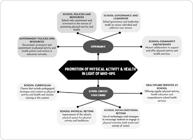
In total, 20 actions covered the four standards on school governance: government policies and resources (eight actions; 22.22%); school policies and resources (five actions; 13.9%); school governance and leadership (three actions; 8.33%); school-community partnerships (four actions; 11.11%).
A total of 16 actions were also mapped, covering the four standards on structuring the school context: school curriculum (seven actions; 19.44%); school socio-emotional setting (three actions; 8.33%); school physical setting (three actions; 8.33%); and healthcare services at school (three actions; 8.33%).
DISCUSSION
This documentary research presented a mapping of actions that can be a tool to support the planning and implementation of studies and intervention programs that aim to develop the promotion of physical activity and health in schools in the Brazilian context and that are based on WHO-HPS recommendations.
The strategy map has a greater number of actions focused on governance. In particular, actions on government and school policies and resources are directed towards governance that involves the availability of financial and material resources to be allocated to schools to enable an educational network that is committed to promoting health. This highlights that the agenda for promoting physical activity and health in schools involves ensuring resources, governance and political commitment to building settings with favorable conditions and opportunities for physical activity in students’ and school community’s lives(2-18).
Seven actions were mapped regarding school leadership and management, with emphasis on including the community in actions to promote physical activity and health at school. This is a challenge, since alternatives will have to be thought of and worked on to involve individuals on an ongoing basis. In order for health promotion actions to have greater added value in participants’ lives, they need to be maintained for a long time. These actions have multiple influences on the lives of people involved in this process, since, in order for healthy conditions to last, a support network that coincides with these perspectives is needed. In other words, a HPS proposal construction involves ongoing aspects of health promotion(30,31).
The 16 actions for structuring the school context had a greater concentration of actions involving curricular components (n=7). This denotes part of the challenges encountered in the proposal, given that it centralizes in curriculum responsibilities related to different purposes, such as academic performance. A study indicates that several factors contribute to academic performance, with emphasis on the curriculum in settings with intersectoral collaborative learning(32).
Most of the actions observed involved the development of physical activities in schools, addressing topics with dimensions of healthy practices with a focus on both the individual and collective levels(12,30). This is in line with HPS model, since the dimensions must involve health promotion practices that go beyond physical activity, including an integral perspective and a holistic view of human development. In other words, in addition to a behavioral aspect, it is necessary to consider the social, cultural and emotional aspects that influence and need to be addressed in school health promotion policies(9,33). Hence, we can say that the promotion of physical activity in school settings tend to gain a broader focus when it is treated as a pedagogical issue linked to health education(34,35).
Actions still arise, most of the time, from national physical activity plans(12,13,17,31). In view of this, many focus on physical activity in school settings, which is seen as one of the priority strategies in the documents. The importance of this element in promoting school health is reinforced, but attention is drawn to the importance of expanding actions that involve aspects related to school members’ mental health. Studies point to the need to address this issue, since it has a direct impact on the physical health of students(36-39).
There is a need for changes to the curriculum. However, this strategy is hindered by a system in which national guidelines are based on biological divisions, ignoring the intersectoral nature of the topics. Therefore, the curricula reproduce technical biases and HPS strategy assumes interrelated prevention and promotion practices.
Study limitations
Some limitations of this study need to be highlighted. The search was restricted to documents published in English and Portuguese. This is also because HPS model is not yet widely disseminated, with the studies found coming from more comprehensive school health actions and with specific topics as previously mentioned. Furthermore, the convergence of the 36 actions represents a strategy to dimensionally several actions. However, details of each possible action end up being hidden when grouping them. Therefore, the analysis of convergence of the 36 actions by readers should be accompanied by the initial list of actions (see supplementary material 1) so that it is possible to analyze and adapt the details of actions to each reality and possibility.
Contributions to nursing, health, or public policy
The documents with WHO-HPS(2,19) standards and indicators direct their recommendations to the groups of school stakeholders who can collaborate to promote health in the aforementioned context, including researchers on school health, policy and program makers, school administrators, representatives of school councils and committees, teachers, healthcare professionals, students, and family members. For the Brazilian context, it is expected that the mapping of actions presented here can support these stakeholders in their actions, with potential implications for pedagogical and research practices, namely:
-
Governance actions (standards 1 to 4) can be considered by health managers and professionals (in dialogue with education managers and professionals) to align public policies and municipal, state and federal programs in the development and management of school health programs. Education networks can include in their public health policy implementation plans the increase in actions based on this strategy map adapted to different realities and that nurture a system with greater potential for implementation, effectiveness and sustainability;
-
School managers, coordinators and teachers can also include the implementation of WHO-HPS actions in school routine, including in the Pedagogical Political Project to organize the policy, resources, methodologies, and social involvement and engagement in the promotion of physical activity and health at school.
-
Teachers of both conventional curricular components (physical education, mathematics, science, arts, among others) and those who work in schools with innovative curricular proposals (with elective curricular components or a diversified base) can consider the curricular actions proposed here for the formulation of projects and pedagogical actions as a way of guaranteeing an intersectoral and interdisciplinary approach to learning in health that has real meaning in people’s lives;
-
The entire school community can support the implementation of actions to develop the physical and socio-emotional setting that promote healthcare and are appropriate to different realities and contexts. In this sense, the community must be encouraged by participatory management in the development of a collective policy.
This study provides the basis for the creation of scientifically refined proposals for actions and strategies, which include the social actors involved in this process. Future research may include the implementation of these actions and strategies in different local and regional contexts of the country, as it will provide a more comprehensive assessment. In this sense, an assessment of the implementation of actions and strategies of this nature is relevant, considering the economic, social and cultural aspects of the countries.
CONCLUSIONS
The mapping of actions based on WHO-HPS model allowed us to identify the convergence of 36 actions that can serve as a basis for the development of governance and organization of Brazilian schools, favoring the promotion of physical activity and health in light of international models and standards for health promotion in schools. Studies and interventions can consider and rely on this mapping to promote the implementation of public policies and programs for health education and health promotion in Brazil and other similar contexts.
-
FUNDING
The individual grants from the Brazilian National Council for Scientific and Technological Development for VCBF (Opinion 312091/2021-4). The authors would also like to thank the Coordination for the Improvement of Higher Education Personnel for the grants granted to JFF. The funding agencies had no influence on the content or conduct of this review.
AVAILABILITY OF DATA AND MATERIAL
The research data are available in a repository: https://doi.org/10.48331/scielodata.8WDPXC.
REFERENCES
-
1 Lee A, Lo A, Li Q, Keung V, Kwong A. Health promoting schools: an update. Appl Health Econ Health Policy. 2020;18(suppl 5):605-23. https://doi.org/10.1007/s40258-020-00575-8
» https://doi.org/10.1007/s40258-020-00575-8 -
2 World Health Organization (WHO). UNESCO. Making every school a health-promoting school: implementation guidance[Internet]. 2021 [cited 2024 Mar 27]. Available from: https://iris.who.int/handle/10665/341908
» https://iris.who.int/handle/10665/341908 -
3 World Health Organization. Promoting physical activity through schools: a toolkit. Geneva: World Health Organization [Internet]. 2021 [cited 2024 Mar 27]. Available from: https://www.who.int/publications/i/item/9789240035928
» https://www.who.int/publications/i/item/9789240035928 -
4 Pearson M, Chilton R, Wyatt K, Abraham C, Ford T, Woods HB, et al. Implementing health promotion programmes in schools: a realist systematic review of research and experience in the United Kingdom. Implementation Sci. 2015;10(suppl 149):1-20. https://doi.org/10.1186/s13012-015-0338-6
» https://doi.org/10.1186/s13012-015-0338-6 -
5 Barbosa Filho VC, Pereira WMG, Farias BO, Moreira TMM, Guerra PH, Queiroz ACM, et al. Scoping review on interventions for physical activity and physical literacy components in Brazilian school-aged children and adolescents. Int J Environ Res Public Health. 2021;18(suppl-16):8349. https://doi.org/10.3390/ijerph18168349
» https://doi.org/10.3390/ijerph18168349 -
6 Langford R, Bonell CP, Jones HE, Pouliou T, Murphy SM, Waters E, et al. The WHO health promoting school framework for improving the health and well-being of students and their academic achievement. Cochrane Database Syst Rev. 2014;(4):CD008958. https://doi.org/10.1002/14651858.CD008958.pub2
» https://doi.org/10.1002/14651858.CD008958.pub2 -
7 Active Schools. School implementation guide for active schools. Chicago, Il: Action for Healthy Kids [Internet]. 2022 [cited 2024 Mar 27]. Available from: https://www.activeschoolsus.org/wp-content/uploads/2022/08/Active-Schools-Implementation-Guide.pdf
» https://www.activeschoolsus.org/wp-content/uploads/2022/08/Active-Schools-Implementation-Guide.pdf -
8 Bastos PO, Cavalcante ASP, Pereira WMG, Castro VHS, Ferreira Júnior AR, Guerra PH, et al. Health promoting school interventions in Latin America: a systematic review protocol on the dimensions of the RE-AIM framework. Int J Environ Res Public Health. 2020;17(suppl-15):5558. https://doi.org/10.3390/ijerph17155558
» https://doi.org/10.3390/ijerph17155558 -
9 McIsaac JL, Hernandez KJ, Kirk SF, Curran JA. Interventions to support system-level implementation of Health Promoting Schools: a scoping review. Int J Environ Res Public Health. 2016;13 (suppl 2):200. https://doi.org/10.3390/ijerph13020200
» https://doi.org/10.3390/ijerph13020200 -
10 McHugh C, Hurst A, Bethel A, Lloyd J, Logan S, Wyatt K. The impact of the World Health Organization Health Promoting Schools framework approach on diet and physical activity behaviours of adolescents in secondary schools: a systematic review. Public Health. 2020;182:116-24. https://doi.org/10.1016/j.puhe.2020.02.006
» https://doi.org/10.1016/j.puhe.2020.02.006 -
11 World Health Organization (WHO). UNESCO. Making every school a health-promoting school: global standards and indicators. World Health Organization [Internet]. 2021 [cited 2024 Mar 27]. Available from: https://iris.who.int/handle/10665/341907
» https://iris.who.int/handle/10665/341907 -
12 Boronyai Z, Bailey R, Heck S, Raya Demidoff A, Repond RM, Vašíčková J, et al. Healthy and physically Active Schools in Europe: guidelines for implementation. Luxembourg: University of Luxembourg; 2022. https://doi.org/10.5281/zenodo.5909635
» https://doi.org/10.5281/zenodo.5909635 -
13 Brandes B, Busse H, Sell L, Christianson L, Brandes M. A scoping review on characteristics of school-based interventions to promote physical activity and cardiorespiratory fitness among 6- to 10-year-old children. Prev Med. 2022;155:106920. https://doi.org/10.1016/j.ypmed.2021.106920
» https://doi.org/10.1016/j.ypmed.2021.106920 -
14 Bada E, Darlington E, Masson J, Santos RM. European standards and indicators for Health Promoting Schools. Haderslev: Schools for Health in Europe Network Foundation [Internet]. 2019 [cited 2024 Mar 27]. 56 p. Available from: https://www.schoolsforhealth.org/sites/default/files/editor/Teachers%20resources/european_standards_and_indicators_on_hps_en.pdf
» https://www.schoolsforhealth.org/sites/default/files/editor/Teachers%20resources/european_standards_and_indicators_on_hps_en.pdf -
15 Dumith SC, Prazeres Filho A, Cureau FV, Farias Júnior JC, Mello JB, Silva MP, et al. Atividade física para crianças e jovens: Guia de Atividade Física para a População Brasileira. Rev Bras Ativ Fís Saúde [Internet]. 2021 [cited 2024 Mar 6];26:1-9. https://doi.org/10.12820/rbafs.26e0214
» https://doi.org/10.12820/rbafs.26e0214 -
16 Silva KS, Bandeira AS, Ravagnani FCP, Camargo EM, Tenório MC, Oliveira VJM, et al. Educação física escolar: Guia de Atividade Física para a População Brasileira. Rev Bras Ativ Fís Saúde [Internet]. 2021 [cited 2024 Mar 6];26:1-18. Available from: https://doi.org/10.12820/rbafs.26e0214
» https://doi.org/10.12820/rbafs.26e0214 -
17 Ministério da Saúde (BR). Secretaria de Atenção Primária à Saúde. Departamento de Promoção da Saúde. Guia de Atividade Física para a População Brasileira [Internet]. 2021 [cited 2024 Mar 27]. 54 p. Available from: http://bvsms.saude.gov.br/bvs/publicacoes/guia_atividade_fisica_populacao_brasileira.pdf
» http://bvsms.saude.gov.br/bvs/publicacoes/guia_atividade_fisica_populacao_brasileira.pdf -
18 Programa das Nações Unidas para o Desenvolvimento (PNUD). Instituto Nacional de Estudos e Pesquisas Educacionais Anísio Teixeira (INEP). Caderno de Desenvolvimento Humano sobre Escolas Ativas no Brasil[Internet] Brasília: PNUD; INEP; 2016 [cited 2024 Mar 27]. 68 p. Available from: https://www.unirios.edu.br/internas/biblioteca/servicos/arquivos/ebooks/caderno_de_desenvolvimento_humano_sobre_escolas_ativas_no_brasil.pdf
» https://www.unirios.edu.br/internas/biblioteca/servicos/arquivos/ebooks/caderno_de_desenvolvimento_humano_sobre_escolas_ativas_no_brasil.pdf -
19 World Health Organization (WHO). Guideline on school health services. Geneva: World Health Organization [Internet]. 2021 [cited 2024 Mar 27]. Available from: https://www.who.int/publications/i/item/9789240029392
» https://www.who.int/publications/i/item/9789240029392 -
20 Jancey J, Vidler AC, Leavy JE, Chamberlain D, Riley T, Pollard CM, et al. Understanding prevention networks in a local government area: insights from a social network analysis among western Australian nutrition, physical activity, and obesity prevention programs. Health Promot Pract. 2023;24(suppl 1):103-110. https://doi.org/10.1177/15248399211050661
» https://doi.org/10.1177/15248399211050661 -
21 Bennett L, Burns S. Implementing health promoting schools to prevent obesity. Health Educ. 2020;120(suppl 2):197-216. https://doi.org/10.1108/HE-11-2019-0054
» https://doi.org/10.1108/HE-11-2019-0054 -
22 Afonso CMC, Tavares MFL, Luiza VL. Escolas promotoras da saúde na América latina: uma revisão do período 1996-2009. Rev Bras Promoç Saúde [Internet]. 2013 [cited 2024 Mar 27];26(suppl 1):117-27. Available from: https://www.redalyc.org/articulo.oa?id=40827988017
» https://www.redalyc.org/articulo.oa?id=40827988017 -
23 Langford R, Bonell C, Jones H, Campbell R. Obesity prevention and the health promoting schools framework: essential components and barriers to success. Int J Behav Nutr Phys Act. 2015;12(suppl 15). https://doi.org/10.1186/s12966-015-0167-7
» https://doi.org/10.1186/s12966-015-0167-7 -
24 Lee A, Lo ASC, Keung MW, Kwong CMA, Wong KK. Effective health promoting school for better health of children and adolescents: indicators for success. BMC Public Health. 2019;19(suppl 1):1088. https://doi.org/10.1186/s12889-019-7425-6
» https://doi.org/10.1186/s12889-019-7425-6 -
25 Mũkoma W, Flisher AJ. Evaluations of health promoting schools: a review of nine studies. Health Promot Int. 2004;19(suppl 3):357-368. https://doi.org/10.1093/heapro/dah309
» https://doi.org/10.1093/heapro/dah309 -
26 Campbell F, Tricco AC, Munn Z, Pollock D, Saran A, Sutton A, et al. Mapping reviews, scoping reviews, and evidence and gap maps (EGMs): the same but different- the “Big Picture” review family. Syst Rev. 2023;12(suppl 45). https://doi.org/10.1186/s13643-023-02178-5
» https://doi.org/10.1186/s13643-023-02178-5 -
27 Bauer MS, Kirchner J. Implementation science: what is it and why should I care?. Psychiatry Res. 2020;283:112376. https://doi.org/10.1016/j.psychres.2019.04.025
» https://doi.org/10.1016/j.psychres.2019.04.025 - 28 Bardin, L. Análise de Conteúdo. São Paulo: Edições 70, 2016. 288p.
-
29 Fereday J, Muir-Cochrane E. Demonstrating rigor using thematic analysis: a hybrid approach of inductive and deductive coding and theme development. Int J Qual Methods. 2006;5(suppl 1):80-92. https://doi.org/10.1177/160940690600500107
» https://doi.org/10.1177/160940690600500107 -
30 World Health Organization (WHO). Regional Office for the Eastern Mediterranean. Mental health in schools: a manual. Cairo: WHO; [Internet]. 2021 [cited 2024 Mar 27]. Available from: https://applications.emro.who.int/docs/9789290225652-eng.pdf
» https://applications.emro.who.int/docs/9789290225652-eng.pdf -
31 Blodgett J. Celebration of Faculty Scholars 2022 Condensed Program: Celebration of Faculty Scholars [Internet]. 2022 [cited 2024 Mar 27]. Available from: https://digscholarship.unco.edu/cfs/2
» https://digscholarship.unco.edu/cfs/2 -
32 Qureshi MA, Khaskheli A, Qureshi JA, Raza SA, Yousufi SQ. Factors affecting students’ learning performance through collaborative learning and engagement. Interact Learn Environ. 2021;31(suppl 4):2371-2391. https://doi.org/10.1080/10494820.2021.1884886
» https://doi.org/10.1080/10494820.2021.1884886 -
33 Silva MRI, Almeida AP, Machado JC, Silva LS, Cardoso JAF, Costa GD, et al. Processo de acreditação das escolas promotoras de saúde em âmbito mundial: revisão sistemática. Cien Saude Coletiva [Internet]. 2017 [cited 2024 Mar 27];24(suppl 2):475-486. Available from: http://www.cienciaesaudecoletiva.com.br/artigos/processo-de-acreditacao-das-escolas-promotoras-de-saude-em-ambito-mundial-revisao-sistematica/16152?id=16152
» http://www.cienciaesaudecoletiva.com.br/artigos/processo-de-acreditacao-das-escolas-promotoras-de-saude-em-ambito-mundial-revisao-sistematica/16152?id=16152 - 34 Oliveira VJM. Educação Física para a saúde: uma aposta em (form)ação. 2. ed. Curitiba: CRV; 2023. 144 p.
-
35 Quennerstedt M. Healthying physical education: on the possibility of learning health. Phys Educ Sport Pedag. 2018;24(suppl 1):1-15. https://doi.org/10.1080/17408989.2018.1539705
» https://doi.org/10.1080/17408989.2018.1539705 -
36 Chadi N, Ryan NC, Geoffroy MC. COVID-19 and the impacts on youth mental health: emerging evidence from longitudinal studies. Can J Public Health. 2022;113(suppl-1):44-52. https://doi.org/10.17269/s41997-021-00567-8
» https://doi.org/10.17269/s41997-021-00567-8 -
37 Dale R, Jesser A, Pieh C, O’Rourke T, Probst T, Humer E. Mental health burden of high school students, and suggestions for psychosocial support, 1.5 years into the COVID-19 pandemic in Austria. Eur Child Adolesc Psychiatry. 2023;32(suppl 6):1015-24. https://doi.org/10.1007/s00787-022-02032-4
» https://doi.org/10.1007/s00787-022-02032-4 -
38 LaBelle B. Positive outcomes of a social-emotional learning program to promote student resiliency and address mental health. Contemp School Psychol. 2023;27:1-7. https://doi.org/10.1007/s40688-019-00263-y
» https://doi.org/10.1007/s40688-019-00263-y -
39 Hoskote AR, Croce E, Johnson KE. The evolution of the role of U.S. school nurses in adolescent mental health at the individual, community, and systems level: an integrative review. J Sch Nurs. 2023;39(suppl 1):51-71. https://doi.org/10.1177/10598405211068120
» https://doi.org/10.1177/10598405211068120
Edited by
-
EDITOR IN CHIEF:
Dulce Barbosa
-
ASSOCIATE EDITOR:
Márcia Ferreira


 WHO-HPS - World Health Organization’s Health Promoting School.