 Recovery of gold from refractory ore employing pressure oxidation
Abstract
The extraction of gold from refractory gold mineral deposits is becoming increasingly necessary. The presence of gold encapsulated within the crystalline matrix of iron sulfide minerals, such as pyrite, pyrrhotite, and arsenopyrite significantly reduces the efficiency of cyanidation. Therefore, the use of oxidative pretreatments, such as calcination, pressure oxidation, or bacterial leaching, enables a high gold recovery from refractory deposits. Calcination has been widely employed. However, it has a high energy cost and environmental issues due to the release of toxic gases containing arsenic. In the treatment of refractory gold ores containing arsenic, pressure oxidation (POX) represents an attractive approach for arsenic immobilization, since the conditions are suitable for both sulfide oxidation and the formation of stable arsenates. In the present study, tests of alkaline and acidic pressure oxidation followed by sodium cyanide leaching were conducted on a composite sample of the Faina Project, owned by Jaguar Mining Inc., located in de northwest portion of the Iron Quadrangle, Minas Gerais, Brazil. The mineralization is hosted by metabasalts and komatiitics metabasalts of an archean metavulcano sedimentary sequence, in the Greenstonebelt Pitangui. The tests demonstrated that it is possible to achieve a 98.40% gold recovery using a concentrate initially containing 12% sulfur, which underwent acidic oxidation with a 0.28 M H2SO4 solution at a temperature of 220°C, oxygen pressure of 500 kPa, and a residence time of three hours. This result was 19.19% higher than that obtained in an alkaline medium using a 3.0 M NaOH solution.
Keywords:
refractory ore; pressure oxidation; gold recovery.
1. Introduction
Gold has been used in various industrial fields due to its high malleability, ductility, corrosion resistance, and high electrical conductivity (Fu et al., 2017).
Despite environmental and occupational health issues, the cyanidation process for gold recovery has been employed as the preferred hydrometallurgical route since 1890. Even though cyanidation involves a high residence time, typically up to 24 hours, this method is not suitable for leaching refractory gold ores or floated concentrates (Xu et al., 2018). With the rapid depletion of easily treatable gold deposits, numerous research efforts have been undertaken to develop technologies for the utilization of refractory gold ores (Wang et al., 2019). Currently, refractory gold ores account for approximately one-third of the total gold production from natural ores (Qin et al., 2021).
A gold ore can be classified as refractory when the gold recovery through cyanidation is less than 80%. This low efficiency can be attributed to various factors, including the physical encapsulation of gold by reactive gangue minerals, often sulfides, the presence of minerals that consume significant amounts of oxygen, cyanide, and lime, the presence of organic matter that adsorbs gold (preg-robbing), and when gold is associated with minerals that exhibit very slow gold leaching kinetics (Nazari et al., 2017).
Refractory sulfidic gold ore is an important resource for gold extraction. In these deposits, gold particles are finely disseminated or encapsulated within the matrix of minerals such as pyrite, arsenopyrite, and chalcopyrite. Despite using gravity and flotation techniques to reject a portion of the gangue, the gold recovery efficiency through cyanidation remains low. Sulfide-bearing gold minerals can be processed through chemical or biological oxidation to release the gold from the associated sulfide before gold extraction.
The primary objective of refractory material pretreatment is the oxidation of gold-hosting minerals, breaking down their crystal structures and releasing the gold particles (Zvontsov & Rogozhnikov, 2020; Wu et al., 2021).
The ore's mineralogy and deposit location are crucial factors in determining the most suitable pre-treatment process. However, the extended residence time and limitations in treating materials with high arsenic content hinder the industrial application of bio-oxidation (Wu et al., 2021).
Conventionally, the three chemical oxidation techniques employed are roasting, pressure oxidation (POX) and oxidation with hypochlorite (Du-chao et al., 2016). In comparison with oxidative roasting, pressure oxidation is conducted in an aqueous solution without emitting polluting gases and provides better arsenic fixation. Arsenic can be stabilized in the form of ferric arsenate (Wu et al., 2021).
Pressure oxidation has the advantages of wide applicability to raw materials, complete decomposition of sulfides, rapid reaction rates, high gold recovery, and low environmental pollution (Zhang et al., 2022).
Since the mid-1980s pressure oxidation (POX) has been employed as a pre-treatment method for refractory gold ores where gold particles are occluded by sulfide minerals, mainly pyrite /arsenopyrite (FeS2/FeAsS), and conventional cyanidation has not been efficient. The commonly used operating temperatures range from 190 to 225°C, with a maximum overpressure of O2 at 700 kPa (Guzman et al., 2018). With the global depletion of ores containing high gold content and low arsenic levels, pressure oxidation (POX) under acidic conditions becomes the preferred option for pre-treating refractory ores or concentrates with high arsenic contente, 1-10% by weight. (Strauss et al., 2021).
One of the advantages of pressure oxidation is the reduction of arsenic concentration in effluents compared to process waters, due to the fact that iron arsenates are less soluble than arsenopyrite.
The gold recovery after sulfide oxidation in an autoclave is typically 5 to 10% higher compared to oxidation in a roaster, and this can be justified by the possibility of gold particles becoming occluded within the particles of hematite (Fleming, 2010). In addition to lower gold recovery, the implementation of a gold ore roasting plant should take into account the high energy consumption and environmental concerns such as the generation of greenhouse gases, production of gases containing sulfur species, and the potential for the volatilization of toxic arsenic and mercury vapors (Wei, 2020).
Pressure oxidation (POX) can be employed as a pre-treatment method for copper and gold porphyry ore, aiming to extract copper and release gold from the sulfide mineral matrix. Wu et al. (2022) achieved a high copper leaching efficiency during the POX stage and a gold recovery of 85% when a concentration of 250 g/L of NaCN was utilized in the cyanidation step.
The acid oxidation temperature should be above 175°C to prevent the formation of elemental sulfur, as it can absorb or encapsulate the gold, reducing gold recovery in the cyanidation step. In addition, sulfur can react with cyanide, forming thiocyanate, which increases operational costs (Thomas & Pearson, 2016). Operating within temperatures ranging from 119°C (the sulfur melting point) to 160°C is influenced by the peculiar behavior of the viscosity of elemental sulfur, which varies between 0.007 Pa.s and 0.012 Pa.s. Beyond 160°C, the viscosity of sulfur increases rapidly, reaching a peak of 93 Pa.s around 190°C (Gertenbach, 2016).
Furthermore, alkaline oxidation operates at lower temperatures and corrosion issues in autoclaves are less severe. However, the costs of reagents are higher when compared to the acidic route (Koslides & Ciminelli, 1992).
The use of acidic pressure oxidation in refractory gold ore with a high carbonate content, besides leading to increased acid consumption, results in autoclave pressure instability due to the generation of CO2 and higher safety requirements for the unit. To address this issue, Du-chao et al. (2016) proposed conducting a pre-leaching process with atmospheric conditions at 80°C for a period of two hours, which was able to decompose approximately 98% of the carbonate.
In principle, carbon compounds are partially decomposed under the influence of pressure acid oxidation. To reduce the preg-robbing effect, Ng et al. (2022) conducted fine grinding (P80 < 20μm) on the POX feed, which enabled the oxidation of 30% of the native carbon and a gold recovery of 90% when the operating temperature was maintained at 225°C.
Dyson et al. (2022) conducted pressure oxidation tests on a double refractory ore (carbonaceous/sulfides) of the Carlin type from a mine located in the state of Nevada, USA. The researchers were able to oxidize approximately 90% of the carbonaceous matter and recover 95% of the gold while maintaining an operating temperature of 300°C, a residence time of 60 minutes, an oxygen overpressure of 3.5 bar, and a rotation speed of 700 rpm.
During pressure acid oxidation, the iron contained in minerals enters into solution as ferrous sulfate (FeSO4) and other ferrous complexes, which are rapidly oxidized to ferric sulfate (Fe2(SO4)3), basic iron sulfate (BFS - FeOHSO4), and jarosite. A high consumption of lime to adjust the pH for cyanidation between 10.5 to 11.0 can be attributed to the formation of BFS, since it consumes an excessive amount of lime when compared to hematite and jarosite. To reduce lime consumption in cyanidation, the residue from pressure acid oxidation can be subjected to a curing process at moderate temperatures of around 140°C in high concentrations of H2SO4. This process converts basic iron sulfate to ferric sulfate, which can later be neutralized to form goethite and/or ferridrite phases using limestone (Gunaratnam et al., 2018).
Alkaline pressure oxidation for arsenopyrite oxidation in an alkaline environment has the advantage of occurring at low oxidation potentials. The reagent used for alkaline oxidation significantly influences the oxidation mechanism of arsenopyrite, with NaOH being the most effective reagent due to the formation of a porous film of hydrated iron oxide that enables the continuity of oxidation (Espitia & Lapidus, 2015).
The generation of high volumes of acid effluents contains significant concentrations of metals, such as Cu, Co and Ni. If chemical precipitation using quicklime or hydrated lime is the process chosen for treating the effluent, a large volume of cake will be generated, representing an environmental risk (Ricci et al., 2017).
Despite ores and floated gold concentrates, even those subject to the preg-robbing effect, the cost of local energy, availability of large quantities of high-quality water, deadlines for the manufacturing and installation of autoclaves must be taken into account (Lunt & Briggs, 2016).
Of all the available oxidation processes, acidic pressure oxidation generally yields the best gold recoveries. A wide variety of ores and concentrates have been tested, with gold recoveries typically ranging from 90% to 95%. Some carbonaceous ores do not respond as well because of adsorption of dissolved gold onto ore constituents. However, in some cases pressure oxidation has been applied successfully to treat ores containing carbonaceous, preg-robbing constituents (Marsden, 2009).
The present study aimed to evaluate the recovery of gold in a floated concentrate subjected to pressure oxidation in an alkaline environment using NaOH and Na2CO3 solutions and in a sulfuric acid medium.
2. Materials and methods
The study was carried out in a composite sample defined from the union of 32 subsamples of drill holes (half of the drill cores were not sampled for chemical analysis). This drilling campaign was executed by Jaguar Mining in 2022, as part of the project development, aiming to obtain and refine metallurgical and geological data, and to convert resources. The premisses for the selection of these subsamples were: i) spatial distribution along the trend and plunge of the deposit; and ii) composites honoring a minimum thickness of 3 meters and a cut-off grade of 2.50 g/ton, seeking a global average content of 5.0 g/ton, considering that the mine studies were completed in 2021. These samples resulted in a final mass of 416 kg, at an average content of 5.11 g/ton Au, considering the chemical data available at Jaguar Mining database, from the sampling of the first half of the drill cores.
An analyzed sample from the Faina deposit yielded 7.8 g/t of Au and 3.4% of S and P80 from milling at 75 μm, At the end of the sulphide flotation tests, two batches of concentrates were tested with P80 75 μm and were sent for oxidation, roasting and cyanidation studies. The first batch had lower Au and S content values, around 22 g/t and 10% of S and another batch had richer contents, with 22% of S and 62 g/t of Au.
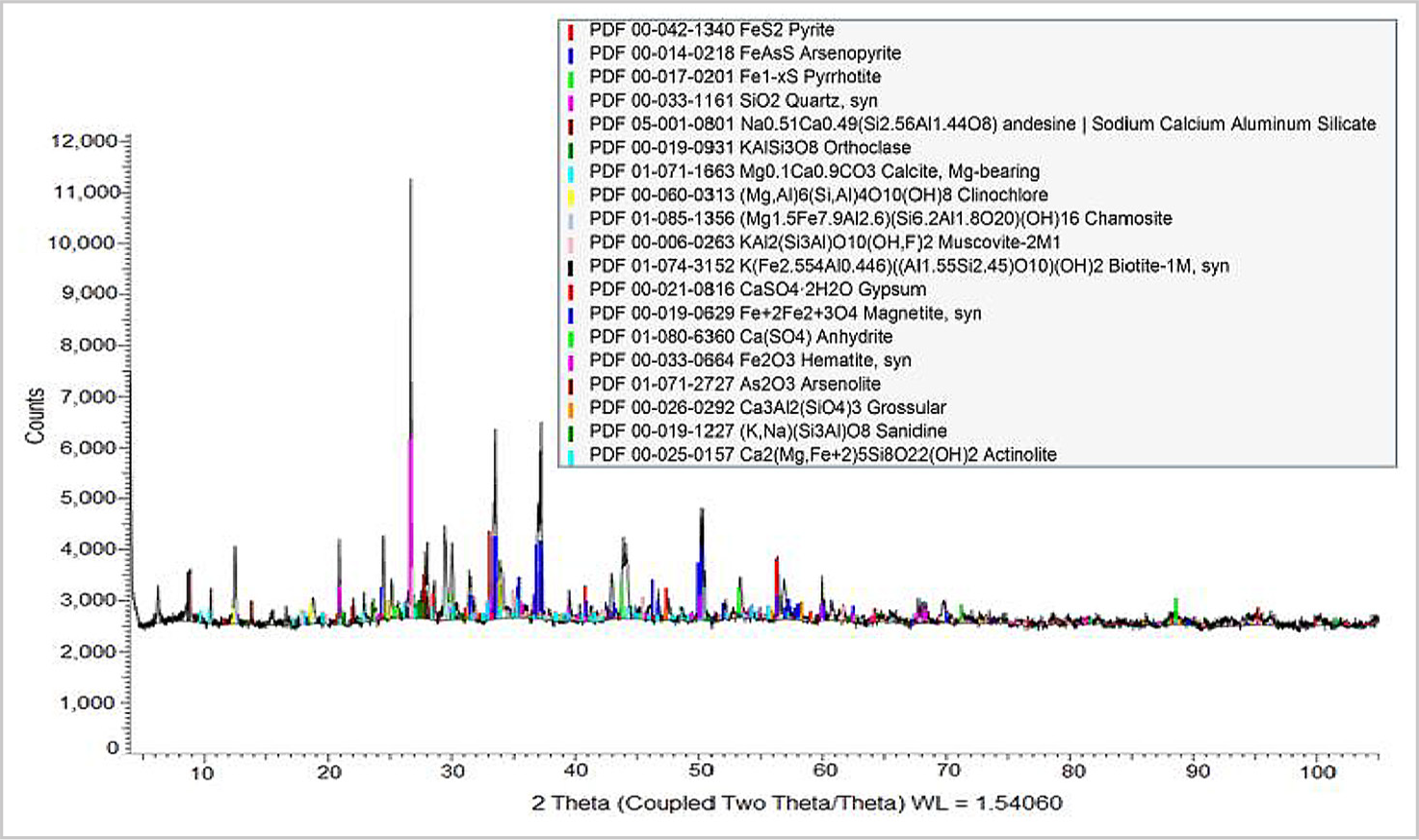
The mineralogical characterization of the sample via DRX (Rietveld Refinement) indicated that the pyrrhotite, arsenopyrite and pyrite content is around 4.6%, 4.3% and 0.5%; quartz is the most abundant gangue mineral with 33.6%, followed by feldspars and micas with 20.3%. The analyses performed by SEM and EDS identified gold particles in the +150 μm fraction, one of them being large and associated with arsenopyrite and some small dispersed in muscovite. In Figure 1, the X-ray diffractogram of the floated gold concentrate can be seen.

2.1 Pressure oxidation tests (POX)
The pressure oxidation tests employed a setup similar to that used by Ng et al. (2022), consisting of a stainless-steel Parr autoclave with a 600 mL capacity placed in a heating mantle attached to a stand. Agitation and temperature control were carried out using a Parr 4848 controller, which was connected to the stirrer, thermocouple, and heating mantle. Agitation was performed using a four-blade rotor turbine operating at 600 rpm. Oxygen was stored in a high-pressure burette equipped with gas inlet and outlet valves and a pressure gauge, which maintained a constant partial pressure of oxygen within the autoclave. pH measurements of the suspensions were obtained using a Hanna pH211 pH meter.
Oxygen flow was introduced into the autoclave once the working temperature was reached, and the adjustment of the partial pressure of oxygen was carried out over the course of 3.0 hours of reaction. Subsequently, the slurry was cooled for vacuum filtration and washing of the cake, which was dried at a temperature of 60°C for 24 hours before undergoing cyanidation tests.
2.2 Cyanidation tests
Cyanidation tests were conducted using 70 grams of oxidized floated concentrate with a solid content of 20% and 30% in 250 mL beakers. The suspension was agitated using Cole-Parmer model 50006-03 stirrers.
Sodium cyanide was then added, with a consumption rate of 10 kg NaCN/t of oxidized concentrate. In the preliminary tests, the cyanidation time was set at 24 hours, while in the subsequent complementary tests, this time was extended to 40 hours.
Throughout the cyanidation process, medical-grade oxygen (purity 99.5%) was bubbled into each beaker at a flow rate of 0.033 m3/h. pH control was maintained by adding CaO as needed to keep the pulp pH between 10.5 and 11.0. Dissolved oxygen levels were monitored using a digital oxygen meter with a polarographic probe and built-in temperature control (Lutron model DO-5510). Free cyanide concentrations were determined using a cyanide ion-selective electrode (Orion model 9606BNWP) coupled with a Mettler Toledo Seven Compact pH meter.
At the end of the cyanidation process, samples were vacuum-filtered and washed with water. The obtained cakes were dried in ovens at a temperature of 60°C for a period of 24 hours. The gold contents in the cyanidation residues were determined through fire assaying combined with atomic absorption spectroscopy.
2.3 X-ray diffraction analysis (XRD) and interpretation
The aliquots for quantitative analysis by XRD were ground in a MacCrone oscillating mill with an agate grinding medium, mounted on a backload-type support (to reduce preferential orientation) and analyzed on an X-ray diffractometer.
XRD analyses, using the powder method, were performed on a Bruker-AXS D4 Endeavor device under the following operating conditions: Co Kα radiation (40 kV/40 mA), with a step size of 0.02° 2θ, counting time of 184 seconds per step with a LynxEye silicon drift linear position-sensitive detector, collected from 5 to 105° 2θ. Qualitative spectrum interpretation was performed by comparison with standards contained in the PDF-02 database using Bruker-AXS DiffracPlus software. The total acquisition time for each spectrum, for this stage of the work, was approximately 90 minutes.
Quantitative analyses, from the X-ray data, were calculated using the total multiphase spectrum refinement method (Rietveld method), with Bruker-AXS Topas software, v. 6. The crystal structure information of the refined phases originates from the Bruker-AXS crystal structure database, or obtained from the Crystallography Open Database (Grazulis et al. 2009) or the International Crystal Structure Database.
3. Results and discussions
The present study was conducted in three stages. In the first stage, cyanidation tests were performed on the flotation concentrate without pre-treatment to serve as a reference. The second stage aimed to compare the efficiency of gold recovery in alkaline and acidic media, where solutions of Na2CO3, NaOH, and H2SO4 were employed. In the final stage, operational conditions were altered to maximize gold recovery.
Due to the quantity of available flotation concentrate, cyanidation tests were conducted in beakers equipped with mechanical agitation. It is worth noting that the results obtained were similar to those previously obtained in bottle roll tests using concentrates with similar characteristics.
3.1 Cyanidation of the flotation concentrate without pre-treatment
Table 1 presents the average results of cyanidation tests conducted in triplicates on flotation concentrates with sulfur contents of 12% and 20%, respectively.A gold recovery of around 50% is consistent with various previous tests conducted on flotation concentrates with similar mineralogical characteristics and composition.
3.2 Pressure oxidation in alkaline and acidic media
In this stage of the study, experimental factorial designs (2^3) were employed with replicates at the central point, in order to quantify the influence of temperature, oxygen pressure, and solution concentration on the recovery of gold through cyanidation of the oxidized floated concentrate. The levels of the variables were chosen based on previous studies conducted with floated concentrate having similar mineralogical characteristics and composition.
In the pressure oxidation step, a solid content of 20% and a residence time of three hours were used, with the addition of oxygen occurring only after reaching the operating temperature. Cyanidation took place for a period of 24 hours, with oxygen bubbling, pH adjustment with lime, and monitoring of free cyanide and dissolved oxygen concentrations.
The observations from the 10 pressure oxidation experiments using Na2CO3 solutions are presented in Table 2. A second-order model was employed to fit the experimental data and predict gold recovery in the oxidized floated concentrate. The results obtained in the cyanidation tests of the oxidized concentrate with Na2CO3 solutions indicated that in most cases, reductions in gold recovery occurred, suggesting a blockage of gold particles.
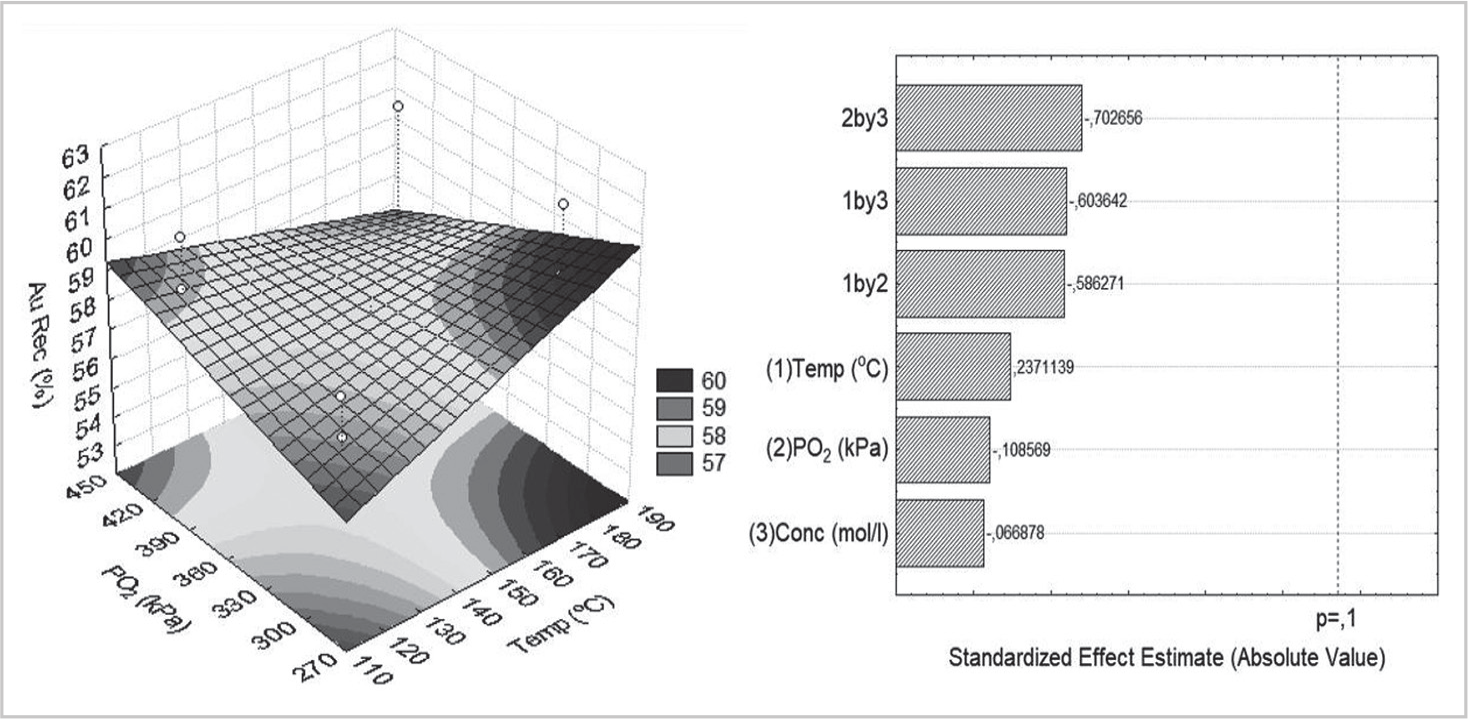
The response surface plots and Pareto diagram for gold recovery as a function of oxidation temperature, oxygen pressure, and Na2CO3 solution concentration are shown in Figure 2. The uppermost extreme point on the response surface indicates a maximum recovery of 58% within the studied limits. The steep slope suggests that temperature had a strong influence on gold recovery (Zhao et al., 2020). The Pareto diagram indicates that temperature was the only significant variable, and gold recovery would be favored when operating at a working temperature below 120°C. The coefficient of determination (R2) of the model was 0.9, suggesting a satisfactory model prediction in relation to the experimental data.

Response surface and Pareto diagram for gold recovery by cyanidation of oxidized floated concentrate using Na2CO3 solutions.
The observations from the 10 pressure oxidation experiments using NaOH solutions are presented in Table 3. Despite the oxidation results indicating a higher gold recovery when using NaOH solutions compared to those obtained with Na2CO3, the best outcome achieved was only 6.43% higher than the tests conducted with the untreated floated concentrate.
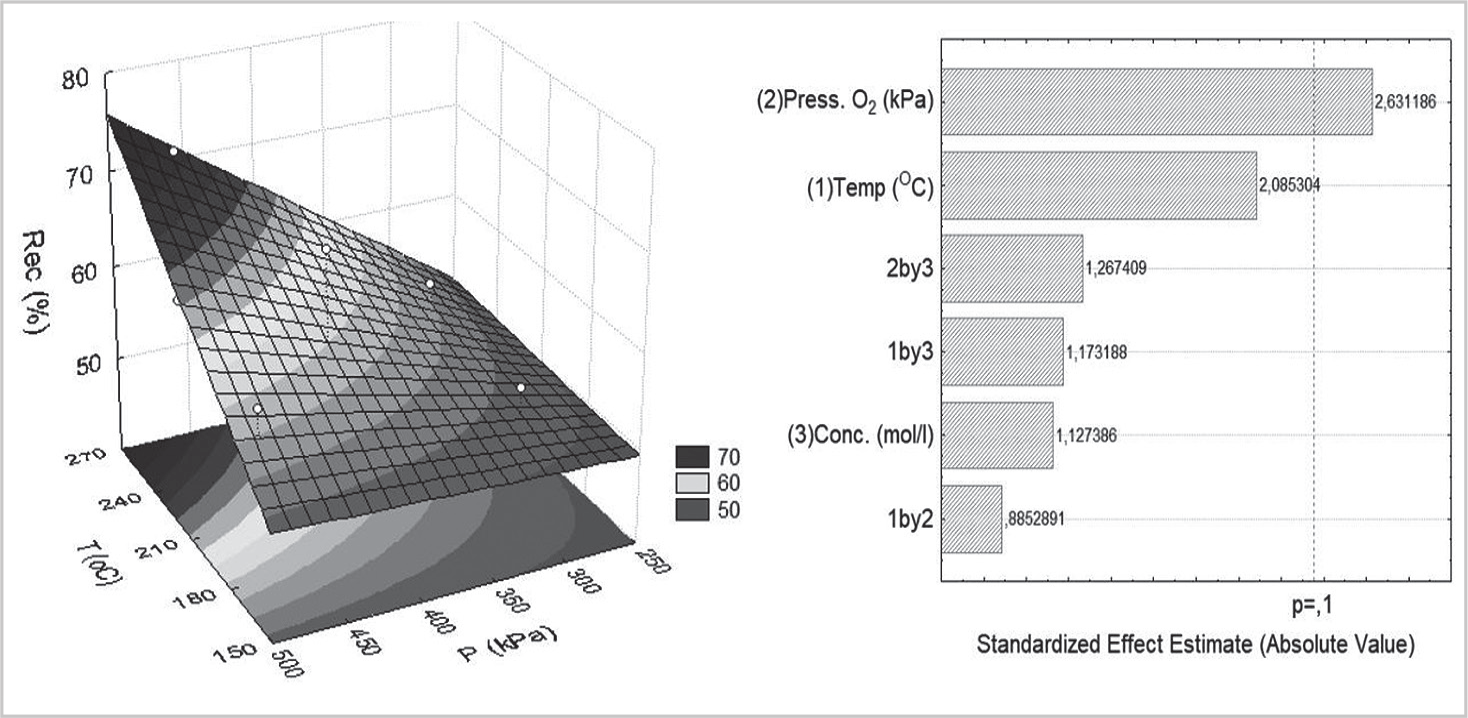
The gentle slope of the response surface for gold recovery using NaOH solutions, as shown in Figure 3, suggests that within the set limits of the study, both temperature and oxygen pressure had a low influence on gold recovery. This observation is further supported by the Pareto diagram.

Response surface and Pareto diagram for gold recovery by cyanidation of oxidized floated concentrate using NaOH solutions.
The response surface projects a maximum gold recovery of 60.2% at a temperature of 180°C. The low R2 value indicates that the model explains only 29.8% of the variation in gold recovery. This suggests a need for a revision of the levels of the independent variables and conducting a greater number of experiments.
The results of the 10 experiments of the pressure oxidation and cyanidation stages can be observed in Table 4.
The response surface, as shown in Figure 4, predicts a maximum gold recovery of around 75% at temperatures of 270°C and an oxygen pressure of 500 kPa. Meanwhile, the Pareto diagram indicates that oxygen pressure was the only significant variable within the defined study limits. The value of 0.84 for the coefficient of determination suggests a satisfactory prediction of the model in relation to the experimental data of the acid pressure oxidation.

Response surface and Pareto diagram for gold recovery by cyanidation of oxidized floated concentrate using H2SO4 solutions.
In Figure 5, the best gold recovery results from the three studied mediums were plotted. It can be observed that the gold recovery from the concentrate oxidized in a sulfuric acid medium had a 13% higher yield compared to that obtained in an alkaline medium using NaOH. Where FC represents the gold recovery obtained in the cyanidation of the floated ore.

Comparison of the highest gold recoveries obtained in the cyanidation of oxidized floated concentrates using Na2CO3, NaOH, and H2SO4 solutions.
Gold recovery through alkaline pressure oxidation generally exhibits a 10% lower gold recovery compared to oxidation and requires a longer residence time. This can be explained by the entrapment of gold in oxidation products and encapsulation of unoxidized sulfides. In acid oxidation, the oxidation product (FeSO4) is soluble in acidic solution and will diffuse into the solution, away from the reactive pyrite surface, subsequently undergoing hydrolysis and precipitating as hematite. On the other hand, the construction materials of autoclaves for alkaline oxidation are more conventional, reducing operational and capital costs (Thomas & Pearson, 2016).
3.3 Optimization of pressure oxidation operating conditions
For this phase of the study, the oxidation tests were conducted using a one-hour warm-up time at the operating temperature, and the cyanidation time was extended from 24 to 40 hours.
3.3.1 Alkaline pressure oxidation using NaOH solutions
In Table 5, it can be observed that the best gold recovery occurred when the pressure oxidation temperature was maintained at 180°C, using a 3.0 M NaOH solution. Increasing the temperature to 220°C did not improve the gold recovery.
Gold recovery in oxidized floated concentrate using concentrated NaOH solutions and oxygen partial pressure of 500 kPa.
In the research carried out by Soleymani et al. (2022), a lower gold recovery from alkaline POX (65.3%) compared to acidic POX (75.5%) was also observed. It was noted that the acidic POX process resulted in a higher quantity of liberated gold particles, whereas the ore subjected to alkaline POX showed more gold particles locked within the crystal structure of pyrite and iron hydroxide precipitates.
The recovery of gold is indeed influenced by the mineralogical characteristics of the material and the operational conditions employed. For example, Bidari & Aghazadeh (2018) conducted alkaline oxidation tests using an Iranian Carlin-type refractory gold ore with a particle size of less than 20 μm and a low-solids pulp (1.0%). They achieved a 95% gold recovery while maintaining a temperature of only 80°C and an oxygen pressure of 100 kPa. Similar to the present study, they observed an increase in gold recovery with the increase in NaOH concentration.
3.3.2 Acidic pressure oxidation using a 0.28 M H2SO4 solution
In acid pressure oxidation, the H2SO4 concentration was maintained at 0.28 M (10 kg/t concentrate), and the solids content was reduced to 20%.
The decrease in suspension pH at the end of acid oxidation can be attributed to the generation of H2SO4 resulting from the oxidations of arsenopyrite, ferrous sulfate, and dioxoarsenic acid, as described in the Equations (1) to (4) (Thomas & Pearson, 2016).
The results presented in Table 6 are in accordance with the work of Ahn et al. (2019), who conducted tests with ore samples collected from a gold mine located in Mexico. While the calcined material yielded a gold extraction of only 70%, the highest gold extraction using POX was 90.7% when the temperature was maintained at 200°C for 2 hours, using a pulp with 10% density. There was no observed increase in efficiency when the temperature was raised to 220°C.
Gold recovery in floated concentrate containing 12% sulfur using a 0.28 M H2SO4 solution at different temperatures and oxygen pressures with a rotation speed of 600 rpm.
The operational conditions under which the best gold recovery was achieved using acid pressure oxidation are similar to those used by Zhang et al. (2022), where the suspensed solid content was 20%, the suspension’s pH ranged from 1.0 to 1.5, the operating temperature was maintained at 220°C, the oxygen pressure was at 8.0 bar, agitation was set to 550 rpm, and the residence time was fixed at 2.5 hours.
The compilation of the data presented in Table 6 can be seen in Figure 6, which shows that the best gold recovery, 98.68%, occurred when the pressure oxidation temperature was maintained at 220°C and the oxygen pressure was 500 kPa. The increases in temperature to 240°C and oxygen pressure to 700 kPa did not result in an increase in gold recovery.

Gold recovery as a function of temperature and oxygen pressure using a 0.28 M H2SO4 solution, 20% solids content, 600 rpm rotation, and a residence time of three hours.
The best conditions found for gold recovery in the present study are in accordance with the gold recovery process from a mine located in the Macraes region, New Zealand. In this unit, the process involves an initial stage of concentrating a pyrite/arsenopyrite ore (15% sulfides), followed by high-pressure acid oxidation and cyanidation. The POX stage occurs with continuous feeding of a flotation concentrate slurry in an autoclave at 225°C, an oxygen overpressure of 3.8 bar, and a residence time of 1 hour. Since the sulfide oxidation increases the acidity of the slurry, the pH of the medium is maintained between 1.0 and 2.0 with the addition of CaCO3 (Craw, 2006).
Similar operational conditions were employed by Du-chao et al. (2016), who achieved approximately 99% oxidation of the sulfur when the ore was subjected to pressure acid oxidation for 4 hours, maintaining the temperature at 210°C, oxygen partial pressure at 8.0 bar, and impeller agitation at 600 rpm.
The greater gold recovery using solutions with lower acidity may be due to the type of iron precipitate formed. After the oxidation of Fe (II) to Fe (III) by oxygen, iron undergoes hydrolysis reactions, the extent of which depends on the acidity conditions of the solution. At higher temperatures above 150°C, the main hydrolysis reactions are described in Equations (5) and (6), as per Papangelakis & Demopoulos (1990):
Two exploratory tests were conducted using floated concentrate containing 20% sulfur. As can be observed in Table 7, there was a significant drop in gold recovery compared to the ore containing 12% sulfur. An alternative that can be employed is to increase the residence time, as the temperature and oxygen pressure used were already close to the safety limit of the autoclave.
Gold recovery in floated concentrate containing 20% sulfur using a 0.28 M H2SO4 solution at different temperatures and oxygen pressures with a rotation speed of 600 rpm.
The mineral phase analyses indicate that the iron in the floated concentrate is in the form of arsenopyrite and pyrrhotite, which were almost completely oxidized at a POX temperature between 220°C and 240°C. The data presented in Table 7 also indicate that pressure oxidation in an acidic medium promoted the breakdown of the crystalline phases of biotite [K(Mg,Fe)3(AlSi3O10)] and magnesian calcite (Mg0.13Ca0.87CO3).
In Figure 7, the voltammograms of the oxidized sample (POX) at 240°C can be seen, with the measured values represented by blue dots, the calculated values by the red line, and the differences represented by the gray line.

X-ray diffractogram of an oxidized gold concentrate sample under pressure in a sulfuric medium at 240°C for 3 hours and using a partial O2 pressure of 500 kPa. Blue dots: values; red line: calculated values; gray line: differences.
Table 8 presents the mineral phases of the oxidized concentrate at different temperatures using 0.28 M (10 kg/t conc.) H2SO4 and 20% solids content. The appearance of rutile in the cyanation residue of the oxidized concentrate is due to the corrosion process suffered by the autoclave as a result of operating conditions.
Mineral phases present in the floated concentrate and in the oxidized concentrates in an acidic medium using different temperatures.
The mineral phases formed in POX depend on the operational conditions of the autoclave and the presence of metal cations in solution. The formation of hematite is favored at temperatures above 200°C and acidity below 20 g/L H2SO4, whereas in temperature ranges between 160 to 200°C and acidity above 20 g/L, the formation of basic iron sulfate is enhanced. Meanwhile, jarosite compounds are favored in the presence of cations such as Na+, K+, NH4+, Ag+, or Pb2+, and acidity above 20 g/L H2SO4 (Fleming, 2010).
As stated by Gudyanga et al. (1999), mineralogical examinations of the residue conducted after acid pressure leaching revealed extensive disruption of the sulfide minerals, which were primarily oxidized to hematite. The resulting porous structures allowed both cyanide and dissolved oxygen to access the previously occluded gold, resulting in high gold dissolution.
In the present study, arsenic concentrations in the POX effluent were not analyzed. However, the absence of mineral phases containing arsenic suggests that the majority of it is likely present in the acidic forms H3AsO4 and H2AsO4. A low concentration of arsenic in the effluent of pressure acid oxidation can occur with the formation of scorodite (FeAsO4.2H2O), a crystalline ferric arsenate that exhibits good stability and favorable settling and filtration properties. However, the hydrothermal formation of scorodite occurs at extended reaction times, which can lead to high capital and operational costs (Liu et al., 2024).
4. Conclusions
The results indicated that for the pretreatment using pressure oxidation in an acidic medium, a gold recovery of 98.40% was achieved using a 0.28 M H2SO4 solution, a temperature of 220°C, oxygen pressure of 500 kPa, and a residence time of three hours. On the other hand, the best result for pressure oxidation in an alkaline medium was 79.21%, achieved using a 3.0 M NaOH solution, a temperature of 180°C, oxygen pressure of 500 kPa, and a residence time of three hours. This approximately 10% difference between acidic and alkaline pressure oxidation aligns with findings in other literature.
Despite the high gold recovery, some factors should be considered before implementing this process in an industrial setting, such as the presence of arsenic in the POX effluent and the high lime consumption.
Acknowledgements
To Jaguar Mining Inc. for the technical and financial support, essential for the completion of this study, and to the Conselho Nacional de Desenvolvimento Científico e Tecnológico (CNPq) for awarding research grants.
References
- AHN, J.; WU, J.; AHN, J.; LEE, J. Comparative investigations on sulfidic gold ore processing: a novel bio oxidation process option. Minerals Engineering, v. 140, n. 15, 2019.
- BIDARI, E.; AGHAZADEH, V. Pyrite from Zarshuran Carlin-type gold deposit: characterization, alcaline oxidation pretreatment, and cyanidation. Hydrometallurgy, v. 179, p. 222-231, 2018.
- CRAW, D. Geochemical changes in mine tailings during a transition to pressure-oxidation process discharge, Macraes mine, New Zealand. Journal of Geochemical Exploration, v. 80, n. 1, p. 81-94, 2003.
- DU-CHAO, Z.; QING-KAI, X.; WEI-FENG, L.; LIN, C.; TIAN-ZU, Y.; YOU-NIAN, L. Acid leaching decarbonization and following pressure oxidation of carbonic refractory gold ore. Journal of Central South University, v. 23, p. 1584-1590, 2016.
- DYSON, D.; YOPPS, S.; LANGHANS, J.; DIMOV, S.; HART, B. Near technical limit gold recovery from a double refractory carlin type ore after pre treatment by high temperature pressure oxidation. Mining, Metallurgy & Exploration, v. 39, p. 1563-1570, 2022.
- ESPITIA, S. L. M.; LAPIDUS, G. T. Pretreatment of a refractory arsenopyrite gold ore using hydroxyl ion. Hydrometallurgy, v. 153, p. 106-113, 2015.
- FLEMING, C. A. Basic iron sulfate - a potential killer in the processing of refractory gold concentrates by pressure oxidation. Minerals & Metallurgical Processing, v. 27, n. 2, p. 81-88, 2010.
- FU, L.; ZHANG, L.; WANG, S.; CUI, W., PENG, J. Synergistic extraction of gold from the refractory gold ore via ultrasound and chlorination-oxidation. Ultrasonics Sonochemistry, v. 37, p. 471-477, 2017.
- GERTENBACH, D. D. Scaleup of pressure oxidation processes. Minerals & Metallurgical Processing, v. 33, n. 4, p. 178-186, 2016.
- GRAŽULIS, S.; CHATEIGNER, D.; DOWNS, R. T.; YOKOCHI, A. T.; QUIROS, M.; LUTTEROTTI, L.; MANAKOVA, E.; BUTKUS, J.; MOECK, P.; LE BAIL, A. Crystallography open database - an open-access collection of crystal structures. Journal Applied Crystallography, v. 42, p. 726-729, 2009.
- GUDYANGA, F. P.; T. MAHLANGU, R. J.; ROMAN, J.; MUNGOSHI, K. MBEVE. An acid pressure oxidation pre-treatment of refractory gold concentrates from the Kwekwe roasting plant, Zimbabwe. Minerals Engineering, v. 12, n. 8, p. 863-875, 1999.
- GUNARATNAM, A. A.; DREISINGER, D. B.; CHOI, Y. Characterisation of solid phases in the iron-sulphate-water system where silver is presente. Canadian Metallurgical Quarterly, v. 57, n. 2, p. 1-11, 2018.
- GUZMAN, I.; THORPE, S. J.; PAPANGELAKIS, V. G. Redox potential measurement during pressure oxidation (POX) of a refractory gold ore. Canadian Metallurgical Quarterly, v. 57, n. 4, p. 382-389, 2018.
- KOSLIDES, T.; CIMINELLI, V. S. T. Pressure oxidation of arsenopyrite and pyrite in alkaline solutions. Hydrometallurgy, n. 30, p. 87-106, 1992.
- LIU, Y.; NG, W. S.; CHEN, M. Optimization of arsenic fixation in the pressure oxidation of arsenopyrite using response surface methodology. Mineral Processing and Extractive Metallurgy Review, v. 46, n. 2, p. 101-113, 2024.
- LUNT, D.; BRIGGS, N. Gold ore processing: project development and operations. In: Elsevier B.V 2 ed., 2016. 1020 p, cap 48 - Refractory sulfide ores: case studies.
- MARSDEN, J. O. The chemistry of gold extraction. In: House. 2 ed. Colorado: The Society for Mining Metallurgy and Exploration inc., 2009. 651 p., cap. 5, p. 147-224.
- NAZARI, A. M.; GHAHREMAN, A.;BELL, S. A comparative study of gold refractoriness by the application of QEMSCAN and diagnostic leach process. International Journal of Mineral Processing, v. 169, p. 35-46, 2017.
- NG, W. S.; QIANKUN, W.; MIAO, C. A review of Preg-robbing and the impact of chloride ions in the pressure oxidation of double refractory ores. Mineral Processing and Extractive Metallurgy Review, v. 43, n.1, p. 69-96, 2022.
- NG, W. S.; YANHUA, L.; MIAO C. The effect of curing on arsenic precipitation and kinetic study of pressure oxidation of pyrite and arsenopyrite. Minerals Engineering, v.185, p. 1-15, 2022.
- PAPANGELAKIS, V. G.; DEMOPOULOS, G. P. Acid pressure oxidation of arsenopyrite: part I, reaction chemistry. Canadian Metallurgical Quarterly, v. 29, n.1, p. 1-12, 1990.
- QIN, H.; GUO, X.; TIAN, Q.; YU, D.; ZHANG, L. Recovery of gold from sulfide refractory gold ore: oxidation roasting pretreatment and gold extraction. Minerals Engineering, v. 164, 2021.
- RICCI, B. C.; FERREIRA, C. D.; MARQUES, L. S.; MARTINS, S. S.; REIS, B. G.; AMARAL, M. C. S. Assessment of the chemical stability of nanofiltration and reverse osmosis membranes employed in treatment of acid gold mining effluent. Separation and Purification Technology, v. 174, n. 1, p. 301-311, 2017.
- SOLEYMANI, M.; SADRI, F.; GHAHR, A. Effect of mixing acidic and alkaline pressure oxidation discharges with different ratios on gold thiosulfate leaching efficiency. Hydrometallurgy, v. 205, 2021.
- STRAUSS, J. A.; BAZHKO, V.; VENTRUTI, G.; LIGUO, X.; GOMEZ, M. O. A. Arsenic behavior during the treatment of refractory gold ores via POX: characterization of Fe-AsO4-SO4 precipitates. Hydrometallurgy, v. 203, 2021.
- THOMAS, K. G.; PEARSON, M. S. Pressure oxidation overview. In: ADAMS, M. D. (ed.). Gold ore processing. Ken Thomas & Murray Pearson, Elsevier, 2016. 993 p., cap. 21, p. 341-358.
- XU, B.; LI, K.; ZHONG, Q.; LI, Q.; YANG, Y.; JIANG, T. Study on the oxygen pressure alkaline leaching of gold with generated thiosulfate from sulfur oxidation. Hydrometallurgy, v. 177, p. 178-186, 2018.
- WANG, X.; QIN, W.; JIAO, F.; YANG, C.; CUI, Y.; LI, W.; ZHANG, Z.; SONG, H. Mineralogy and pretreatment of a refractory gold deposit in Zambia. Minerals, v. 9, n. 406, 2019.
- WU, J.; AHN, J.; LEE, J. Gold deportment and leaching study from a pressure oxidation residue of chalcopyrite concentrate. Hydrometallurgy, v. 201, 2021.
- WU, J.;AHN, J.; LEE, J. Characterization of gold deportment and thiosulfate extraction for a copper gold concentrate treated by pressure oxidation. Hydrometallurgy, v. 207, 2022.
- ZHANG, L.; GUO, X.; TIAN, Q.; ZHONG, S.; QIN, H. Extraction of gold from typical Carlin gold concentrate by pressure oxidation pretreatment - sodium jarosite decomposition and polysulfide leaching. Hydrometallurgy, v. 208, 2022.
- ZHAO, Q.; TONG, L.; KAMALI, A. R.;SAND, W.; YANG, H. Role of humic acid in bioleaching of copper from waste computer motherboards. Hydrometallurgy, v. 197, 2020.
- ZVONTSOV, N. O.; ROGOZHNIKOV, D A. Research features of opening of refractory arsenopyrite concentrates by using low-temperature roasting. Materials Science and Engineering, v. 966, 2020.