 Social representations of the adult LGBTQIAPNb+ population regarding experienced interpersonal violence
ABSTRACT
Objective: To analyze the social representations of the adult LGBTQIAPNb+ population regarding experienced interpersonal violence.
Method: Analytical study with a qualitative approach, held in the municipality of Campina Grande, Paraíba, Brazil, in the year 2023; based on the theoretical-methodological framework of the Theory of Social Representations. A sociodemographic questionnaire, the Free Word Association Test, and semi-structured interview guide were applied. In addition to descriptive statistical analysis for participant characterization, the data were submitted to prototypical analysis using IRAMUTEQ® software.
Results: The central core of social representation was strongly associated with fear and suffering, whereas the periphery revealed connections with pain, anguish, and hatred. Furthermore, peripheral elements such as silencing, prejudice, intolerance, and repression were identified in the representations. It was also possible to observe, through class markers, how violence influences the biopsychosocial dimensions of individual’s lives, leaving traces from childhood that resonate to the present day. Under these circumstances, psychological violence proved to affect individuals more significantly compared with other forms.
Conclusion: Emotional and psychological impact was directly associated with violence, highlighting the social mechanisms that perpetuate aggression and hinder the search for support and justice among the LGBTQIAPNb+ population.
Descriptors:
Sexual and Gender Minorities; Violence; Social Representation
RESUMO
Objetivo: analisar as Representações Sociais da população adulta LGBTQIAPNb+ sobre a violência interpessoal sofrida.
Método: estudo analítico com abordagem qualitativa, realizado no municipío de Campina Grande, Paraíba, Brasil, no ano de 2023; sob o referencial teórico-metodológico da Teoria das Representações Sociais. Foi aplicado formulário sociodemográfico, Teste de Associação Livre de Palavras e roteiro de entrevista semiestruturada. Além da análise estatística descritiva para caracterização dos participantes, os dados foram submetidos à análise prototípica junto ao software IRAMUTEQ®.
Resultados: o núcleo central da representação social foi fortemente ligado ao medo e ao sofrimento, enquanto a periferia apresentou ligação com a dor, angústia e ódio. Além disso, identificaram-se elementos periféricos nas representações, como o silenciamento, o preconceito, a intolerância e a repressão. Foi possível observar também, pelos marcadores de classes, como a violência influencia o biopsicossocial da vida do sujeito, deixando marcas na infância que ressoam até os dias atuais. Nessas circunstâncias, nota-se, que a violência psicológica afeta o indivíduo de maneira mais significativa em comparação às demais tipificações.
Conclusão: o impacto emocional e psicológico foi associado à violência, destacando-se os mecanismos sociais que perpetuam as agressões e dificultam a busca por apoio e justiça por parte da população LGBTQIAPNb+.
Descritores:
Minorias Sexuais e de Gênero; Violência; Representação Social
RESUMEN
Objetivo: Analizar las representaciones sociales de la población adulta LGBTQIAPNb+ respecto a la violencia interpersonal sufrida.
Método: Estudio analítico con enfoque cualitativo, realizado en el municipio de Campina Grande, Paraíba, Brasil, en 2023; basado en el marco teórico-metodológico de la Teoría de las Representaciones Sociales. Se aplicó un formulario sociodemográfico, la Prueba de Asociación de Palabras Libre y una guía de entrevista semiestructurada. El análisis se realizó mediante estadística descriptiva para caracterizar a los participantes. Los datos se organizaron mediante el programa IRAMUTEQ® y se sometieron a análisis prototípico.
Resultados: El núcleo central de la representación social se vinculó fuertemente con el miedo y el sufrimiento, mientras que la periferia se vinculó con el dolor, la angustia y el odio. Además, se identificaron elementos periféricos en las representaciones, como el silenciamiento, el prejuicio, la intolerancia y la represión. También fue posible observar, a través de marcadores de clase, cómo la violencia influye en los aspectos biopsicosociales de la vida del sujeto, dejando huellas en la infancia que resuenan hasta la actualidad. En este contexto, se observa que la violencia psicológica tiene un impacto más significativo en comparación con otras tipificaciones.
Conclusión: Se asoció el impacto emocional y psicológico a la violencia y se destacan los mecanismos sociales que perpetúan la agresión y dificultan que la población LGBTQIAPNb+ busque apoyo y justicia.
Descriptores:
Minorías Sexuales y de Género; Violencia; Representación Social
INTRODUCTION
In Brazil, constitutionally, the laws declare full protection and fundamental rights granted to the people, establishing that it is the duty of the family and society to ensure dignity, respect and freedom to all citizens, without discriminating against any condition that distinguishes them from the social majority of the country. However, a failure in guaranteeing these rights is still perceived, since the culture of violence persists in society 1,2.
Vulnerability and exposure to violence are more intense among marginalized and minority groups. In this context, the LGBTQIAPNb+ population (lesbians, gays, bisexuals, transvestites, transsexuals, transgender people, queers, intersex, agender, asexual, pansexual, non-binary and other identities) stands out. This group is particularly susceptible to social exclusion, bullying, prejudice and different forms of violence, resulting from socio-historical constructions3. In Brazil, between 2020 and 2021, cases of violence against this population increased from 9.5% to 20.4%. In the 2015-2021 period, most victims were black individuals aged 20-39 years4.
According to the Brazilian Yearbook of Public Security (2024), cases of violence against the LGBTQIAPNb+ population have shown a significant number of hate crimes based on sexual orientation and/or gender identity, indicating a 41.7% increase in homicides and an 87.9% increase in racism due to homophobia or transphobia compared to the year 2023. In Paraíba, notifications of violence against this community have been underreported, and the Brazilian Yearbook of Public Security (2021) categorizes the occurrences as unavailable information, referring to the invisibility in describing such situations5.
Conceptions contrary to the understanding of gender identity and diversity contribute to social inequality, prejudice and the increase in aggressive practices against the LGBTQIAPNb+ population, whether lethal, explicit or subtle, in their physical, psychological, sexual or self-inflicted nature6, therefore, the negative reaction to the revelation of an individual's sexual orientation and gender identity negatively impacts their quality of life, as well as causing a predisposition to mental illnesses, directly interfering with the healthy development of the individual, becoming a public health problem7.
To understand this phenomenon in its complexity, we have the Theory of Social Representations (TSR), which is based on socially elaborated knowledge, the result of social interaction evidenced by what is consciously shared8. The TSR explains reality through the common knowledge among individuals shared socially (knowledge function); which produces the definition of social identities (identity function), and consequently justifies the actions of individuals in society (orientation and justification function)9.
The use of Social Representations stands out in understanding the dynamics of human relations for the promotion of human values that underpin life in society, starting from the perspective of collective sense in explaining socially defined phenomena and their relations, and in understanding the causal perceptions of violence10.
Therefore, this study is justified by the social, scientific, and political relevance of understanding the Social Representations of violence experienced by the LGBTQIAPNb+ population. The persistence of stigmas, stereotypes, and prejudices has contributed to the maintenance of scenarios of vulnerability, exclusion, and violations of human rights. By investigating how these forms of violence are perceived and given meaning by the victims themselves, the aim is to highlight not only the individual impacts but also the sociocultural mechanisms that sustain such practices. The results may provide support for the formulation of prevention, support, and protection strategies that strengthen public policies aimed at promoting the dignity, equity, and citizenship of this population.
The gap in scientific production regarding the experiences of violence lived by LGBTQIAPNb+ people reinforces the relevance of this study, especially in light of evidence that indicates both an increase in the number of individuals who declare their sexual orientation11) and a significant increase in cases of violence against this population12). Thus, the present study attempts to answer the following question: What aspects permeate violence against this population, from the perspective of adults, and what are the Social Representations of these situations for the victims?
In view of the above, the present research aims to analyze the Social Representations of the adult LGBTQIAPNb+ population regarding the interpersonal violence they have suffered.
METHODS
Analytical study with a qualitative approach based on the theoretical-methodological framework of the Theory of Social Representations. Qualitative research is expressed in a narrative form, driven by the expressed conception of social phenomena, understanding their values and beliefs, and examining the peculiarities of the empirical context of the group investigated13.
To ensure the methodological rigor of qualitative research, the study was structured based on the recommendations of the Consolidated Criteria for Reporting Qualitative Research (COREQ), encompassing all 32 criteria.
The study was directed at the population registered at the Luciano Bezerra State Reference Center for the Rights of the LGBTQIAPNb+ Population, located in the municipality of Campina Grande, Paraíba, Brazil, with 793 registrations in 2023. The unit provides psychosocial and legal assistance in cases of violation of the rights of the aforementioned population and covers the entire community of the aforementioned municipality and other cities in Paraíba, from the Agreste to the Sertão regions of the state, with the aim of strengthening gender policy and combating discrimination and prejudice directed at this population, promoting respect and dignity for all.
The participants were selected by convenience using the theoretical saturation criterion to define the sample size. In a convenience sample, the researcher collects data from participants who are most accessible, willing and cooperative to participate in the development of the study, as well as meeting the inclusion criteria, with participants being approached as they arrive at the research site14.
As for theoretical saturation, on the other hand, it consists of exhausting the narrative elements of the respondents whereby the discourse becomes repetitive and no further data are provided that delineate and deepen the theorization of the study15) . In the present study, the researcher who conducted the interviews identified repetition of the participants' discourse from the third interview conducted onwards; however, she continued conducting other interviews to confirm the repetition of the statements. Upon reaching fourteen interviews, the repetition of discourses on the topic was confirmed in all questions of the semi-structured interview script. Thus, four more interviews were conducted to exhaust the theme under study, totaling 18 interviews.
The inclusion criteria were: LGBTQIAPNb+ adults registered at the Luciano Bezerra LGBTQIAPNb+ Reference Center, aged between 18 and 59 years old; and the exclusion criteria were: emotional instability at the time of data collection and recent experience of interpersonal violence at the time of the researcher's approach, this criterion being justified by the need to maintain the mental integrity of the participants.
The research was conducted in April 2023 after approval by the Ethics and Research Committee of the Center for Higher Education and Development of the Faculdade de Ciências Médicas (CESED/FCM), under protocol number 5.969.331 and CAAE 67451423.50000.5175.
Under the supervision of a professor with a doctorate in Nursing and experience in qualitative research in the study field, data was collected by a female researcher who was an undergraduate nursing student at the time the interviews were conducted. The referred researcher underwent training prior to her first contact with the data collection setting, being instructed on the technique of conducting semi-structured interviews and the ethical aspects inherent in this data collection procedure.
Before approaching the research participants, the researcher made prior contact with the coordinator of the LGBTQIAPNb+ Luciano Bezerra Reference Center to agree on the best procedure for approaching the research collaborators. Thus, a Google Forms was created to present the research, invite individuals registered at the Reference Center to participate in data collection, and schedule the most appropriate time for conducting interviews for those who expressed interest in participating.
Based on the responses to the online form, the researcher contacted the individuals by telephone to schedule a date and time for the interviews, which took place at the Reference Center in a private environment free from interference or the presence of third parties. In addition to the contacts via the form, individuals seeking the services of the Reference Center were also approached and invited to participate. During the data collection procedure there were no dropouts or refusals to participate voluntarily. No pilot test was conducted in this study.
After voluntary acceptance, participants were directed to a private, secluded location, free from exposure and the presence of third parties, in order to guarantee confidentiality and provide a comfortable environment for the respondents. At this point, participants were given access to the Informed Consent Form (ICF), which contains ethical information related to the research, as well as the voice recording permission form. Each participant was given a copy of the ICF form. The researcher and research interests were also reaffirmed, and the participant was allowed to freely choose whether to participate or not.
Upon signing the aforementioned terms, data collection began, for which three instruments were used: a) a sociodemographic form to collect general information about the participants, containing the following aspects: age, gender identity, sexual orientation, marital status, length of marital status, and education; b) a Free Word Association Test (FWAT); and c) a semi-structured script of open-ended questions as a guide for conducting the interview to meet the research objectives.
The first instrument used was a sociodemographic questionnaire; followed by the Free Word Association Test, a self-administered questionnaire aimed at stimulating the free formation of words by the participant, using images as the stimulus. This data collection phase was carried out in three stages: first, participants were shown an image on an A4 sheet representing "psychological violence" and asked to write down the first five words that came to mind upon seeing the image, then rank them in order of importance, with 1 being the most important word and 5 the least important; second, the technique was repeated using an image of "physical violence"; and finally, third, an image of "sexual violence".
The Free Word Association Technique developed by Jung16) in the field of Social Psychology has been widely used in studies focusing on Social Representations, as it helps in identifying the Social Representations of subjects, since it accesses the mental organization of individuals, revealing fundamental desires, elements of conflict, evocation of significant moments in life history, and social representations of phenomena based on the associative network of evoked contents regarding each inducing stimulus.
Finally, a semi-structured interview was conducted based on an interview guide, which was recorded using an MP3 voice recorder. Data collection time lasted an average of 30 minutes per participant, and there were no repeated interviews or notes taken in the field.
The data contained in the forms was analyzed using simple descriptive statistics to characterize the group of participants; the words evoked from the TALP and their hierarchical ranking were subjected to prototypical analysis to define the core and periphery of social representations using the software Interface de R pour les Analyses Multidimensionnelles de Textes et de Questionnaires (IRAMUTEQ®) using the standard parameters recommended by the software manual17.
The prototypical analysis is configured in the construction of a four-squared table widely used for exploring the structure of Social Representations, as it investigates the relationship between the object of study and the Social Representation based on two criteria: frequency of evocation and average position of evocation of each word. Thus, there are four quadrants, the first represents the central core (NC) of Social Representations, the second the first periphery, the third the contrast zone and the last called the second periphery. In the NC are the words with high frequency of evocation and immediately evoked; in the first periphery, the words of late evocation and high frequency; in the contrast zone, words of low frequency and immediately evoked and in the second periphery, the least frequent and least evoked terms10.
The interviews were transcribed and organized into a textual corpus format compatible with analysis using the IRAMUTEQ® software. These were then subjected to analysis using Descending Hierarchical Classification (DHC), which transforms the corpus into Elementary Context Units (ECUs) that are grouped by homogeneity and semantic connection through classes. The classes are graphically represented by a dendrogram that highlights the most significant words for each class.
The total findings from TALP and the interviews were organized and interpreted in the light of the Theory of Social Representations18) seeking to highlight the central core of social representations, that is, the homogeneous element that constitutes the most significant area for the participating individuals; as well as the terms of the peripheries that complement the central core, but represent the heterogeneity of the group. This establishes the central and peripheral elements that form the participants' representations of interpersonal violence.
The findings were not sent to each participant individually, but the researchers made it clear at the time of data collection that each respondent would have full access to the materials upon prior request through the communication channels provided in the informed consent form.
The present study was based on Resolution No. 466/2012 of the National Health Council, which ensures the privacy of participants with coding for the interviews: where “P” stands for participant and the number following this letter categorizes the order of the interviews, as well as gender identity. This ensures the preservation of autonomy and allows the right to withdraw at any time during data collection.
RESULTS
A group of 18 participants was obtained from the collected data. The variable "age" was divided into three categories: 18-25, 26-35, and 35+. Most respondents (11; 61.1%) fell within the 18-25 age range, indicating that the main profile of the study is concentrated on young adult individuals. Regarding gender identity, most participants identified as transgender female (8; 44.4%), and regarding sexual orientation, most (7; 38.9%) identifed as heterosexual.
Most respondents are single (12; 66.7%), while a significant percentage (6; 33.3%) are married or in a stable relationship. The distribution regarding education reveals a diversity of educational levels. The largest percentage (7; 38.9%) have incomplete higher education, followed by complete secondary education (4; 22.2%) and complete higher education (3; 16.7%).
Analysis of the participants' monthly earnings shows that most (10; 55.6%) earn below the minimum wage. Also, many participants (8; 44.4%) have informal jobs and 4 (22.2%) said they are not working.
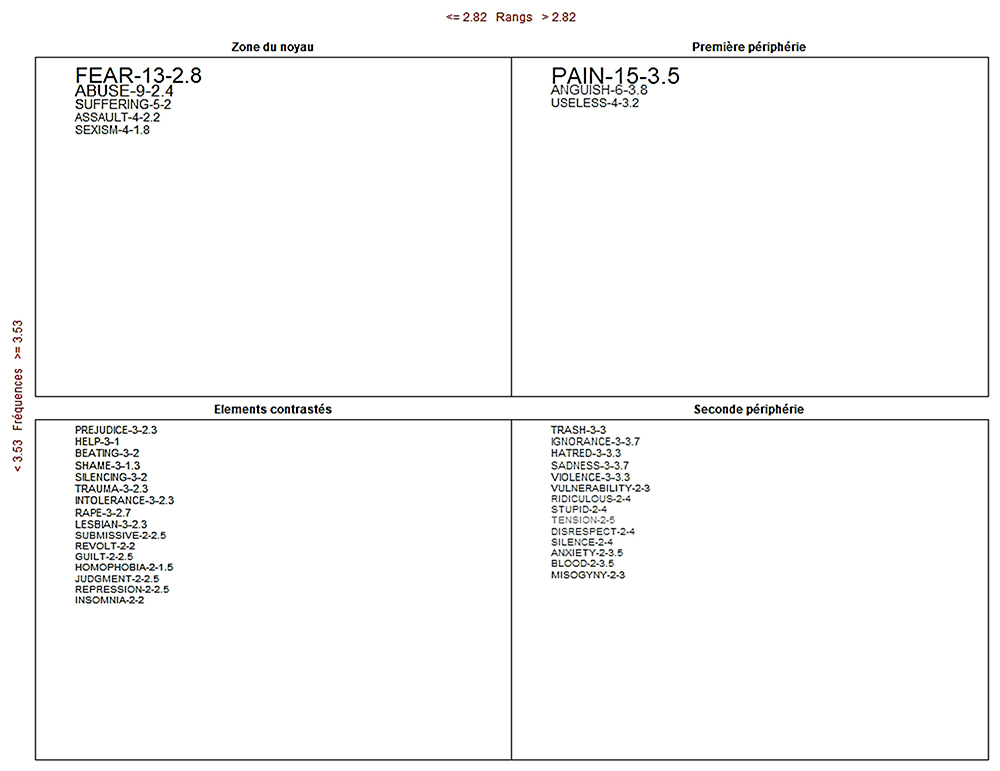
Figure 1 includes the corpus of words evoked by the participants, showing that social representations of violence are centered on "fear" and "pain," associated with experiences of abuse, suffering, and assault, while elements such as discrimination, prejudice, humiliation, and vulnerability emerge peripherally.
Based on the prototypical analysis of the image, the words in the first quadrant (upper left) are those with above-average frequency and were readily evoked, indicating key aspects of the participants' social representation of interpersonal violence. These words are Fear-Abuse-Suffering-Sexism-Assault, with the lowest Mean Order of Evocations (MEE).
In the second quadrant (upper right) is the first periphery, which is composed of words with high frequency, however, they were not so readily evoked: Pain-Anguish-Useless.
In the third quadrant (lower left), we find the contrast zone, which contains elements that were readily evoked, but with a frequency below average. These words are Shame-Rape-Silencing-Beating-Help-Trauma-Prejudice-Lesbian-Intolerance-Revolt-Repression-Submissive-Insomnia-Guilt-Judgment-Homophobia.
Finally, in the fourth quadrant (lower right), we find the second periphery, which is composed of elements with lower frequency and higher order of evocation: Hatred-Violence-Ignorance-Sadness-Tension-Stupid-Trash-Ridiculous-Disrespect-Misogyny-Blood-Anxiety-Silence-Vulnerability (Figure 2).
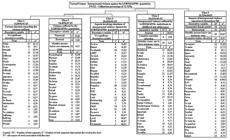
Lexicographical analysis of interviews with participants from the LGBTQIAPNb+ State Reference Center
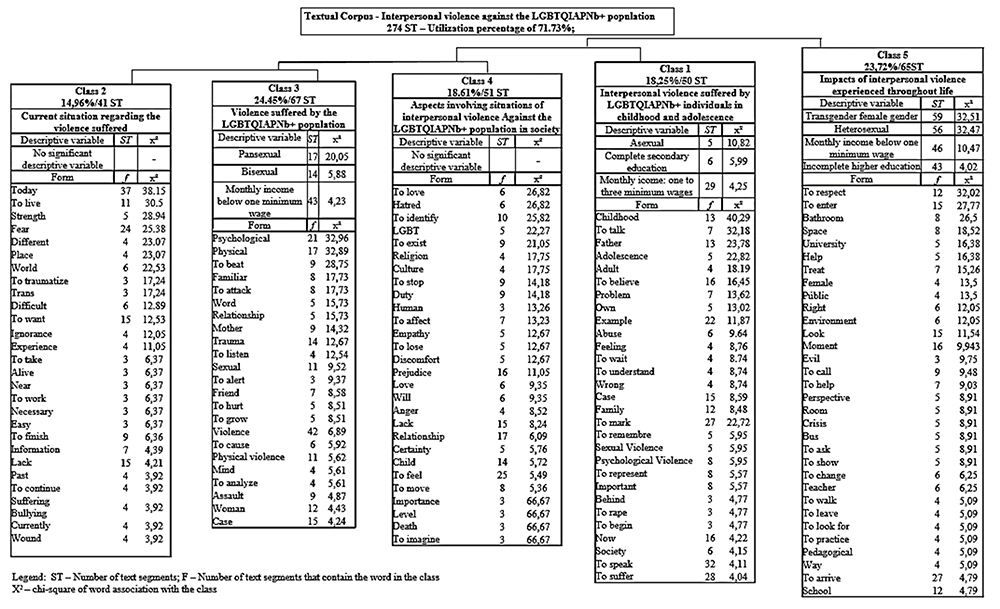
Regarding the lexicographical analysis of the content of the interviews, for the 18 participants in the research, the following description of the textual corpus is detailed: number of texts = 18; word occurrences = 13863; number of text segments = 382, with 274 segments selected, representing a utilization percentage of 71.73%; number of forms = 2205; and hapax = 697, corresponding to 5.03% of word occurrences.
Regarding Descending Hierarchical Classification (DHC), the content of the interviews was categorized into five classes: Class 5 with 65 ST (23.72%), Class 1 with 50 ST (18.25%), Class 4 with 51 ST (18.61%), Class 3 with 67 ST (24.45%), Class 2 with 41 ST (14.96%).
The classes generated by the lexicographical analysis are subdivided into five, branching out, initially, from the corpus called Class 5, which encompasses the impact of interpersonal violence on the interviewed participants. Next, Class 1 is derived, which points to interpersonal violence occurring in the family environment; continuously, Class 4 highlights aspects involving situations of interpersonal violence against the LGBTQIAPNb+ population in our society; branching into Class 3, which comprises the types of violence that affect the respondent most significantly; and finally, Class 2, which exposes the participants' current situation regarding the violence suffered.
A diagram was created to illustrate the classes in more detail, using a list of words representative of each one. The following diagram was constructed based on the chi-square test, using a cutoff point of x² > 3.84. The objective was to highlight the similar associations within each class and the differences in relation to the other classes, highlighting their specific characteristics.
Class 5 - Impacts of interpersonal violence experienced throughout life
Class 5 presented four strongly linked descriptive variables, namely: transgender female gender X² (32.51), heterosexual sexual orientation X² (32.47), monthly income below one minimum wage X² (10.47), and incomplete higher education X² (4.02). The discourses of the participants in this class focus on the impact that interpersonal violence has had and continues to have on their personal and social lives.
One of the topics discussed during the interviews focused on the experiences of transgender women who face challenges when using women's restrooms, as can be seen in the excerpts below:
Now I can't go into public spaces like shared restrooms, supermarket restrooms, I just can't! I have to go to the men's restroom, unfortunately. I feel like I'm not prepared to deal with all these restrictions. (P15, trans woman) Issues related to online violence make me very afraid to go to the women's restroom. I only go in cases of extreme necessity, because I'm afraid of being threatened with being kicked out. (P5, trans woman)
From this perspective, participants expressed their opinions about the social pressure they experienced during their gender transition and the consequences of this situation, resulting in the development of anxiety, depression, and even suicide:
So, at work, for example, you have to demonstrate greater ability than you would actually like. (P13, Non-binary) But this ends up putting pressure on us, it kind of puts us in a box, labels us and leads to other situations, the consequences... depression, suicide, anxiety, crises[...]. (P15, trans woman)
Following this line of reasoning, the impact of social isolation caused by the violence suffered was emphasized in the statements described below:
I didn't communicate well with the people, and I didn't connect with them, nor they with me. Anyone who looked at me with a dirty face, staring at me in the classroom, I thought that person was judging me. (P6, trans woman)
Class 1 - Interpersonal violence suffered by LGBTQIAPNb+ individuals in childhood and adolescence.
In class 1, the following associated variables were mentioned: Asexual X² (10.82), Completed Primary Education X² (5.99), and monthly income of one to three minimum wages X² (4.25). The interviews in this class focused on experiences of interpersonal violence suffered during childhood and adolescence, with significant impacts on the lives of the respondents, as shown in the participants' statements:
These are life history issues, and when I think about my childhood, it unfolds throughout both childhood and adolescence, with a lot of psychological violence, and I was always answering questions related to physical violence. (P5, trans woman) Ah! It represents traumas, traumas that stay with us for life. When a person is abused like that in childhood, we usually grow up with traumas and more disorders, like anxiety, depression, and then we live with that despite the passage of time. (P9, cis man)
The presence of these traumas in childhood and adolescence is marked as a negative influence on the formation of identity and the emotional well-being of the participants, and many of them report suffering violence at the hands of parents, guardians, and family members who had the responsibility to protect them. The accounts follow:
And it wasn't until I was 13 that the abuse by my own father was truly consummated. On some occasions I would sleep on the floor and I would wake up with him on top of me, drunk, and I was just a teenager. (P2, trans woman) But these wounds leave permanent scars: the family abandonment, the rejection by my adoptive parents, and the violence I suffered at the hands of my own biological parents. This leaves a deep mark, so today I live with very fragile psychological health. (P2, trans woman)
Class 4 - Aspects involving situations of interpersonal violence against the LGBTQIAPNb+ population in society.
Class 4 addresses aspects involving situations of interpersonal violence against the LGBTQIAPNb+ population in society, without categorizing significant descriptive variables. Class 4 seeks to understand and analyze interpersonal violence in its complexity and multidimensionality, allowing for a comprehensive view of the challenges faced by the LGBTQIAPNb+ community in relation to violence, recognizing the importance of considering intersectionality and the multiple forms of oppression that affect this population, as observed in the following narratives:
I think this is very ingrained in our culture, heavily encouraged by religion, especially regarding the Christian religion. (P7, trans man) I think it's very much related to issues of hate, I don't even think it's a lack of information, because we have information, we have a lot of information! These are things I identify with. (P5, trans woman) Ah, I think it's the hatred, the prejudice, the lack of acceptance that ends up affecting us. We, specifically, are part of the LGBT population; we trans women, transvestites... are marked by this prejudice in society in a very clear way. (P2, trans woman)
Class 3 - Violence suffered by the LGBTQIAPNb+ population
Class 3 corresponds to the types of violence that significantly affect the participant's life, evoking the corresponding descriptive variables: pansexual (20.05) X²; bisexual X² (5.88) and monthly income below one minimum wage X² (4.23).
This class addresses the various forms of violence that these individuals face and those that have left the deepest scars. This is justified by the narratives below:
Psychological violence, I also think that's the most complicated... dealing with the voices you heard, the words you heard, it keeps echoing inside you. (P17, cis woman) Psychological abuse! I've suffered various types, from sexual to physical abuse like assault, but what shocked me the most was the psychological aspect. (P10, non-binary) I believe that the psychological aspect is important because the physical aspect heals, it leaves that connection in your mind as well, but the psychological aspect shapes how you see things and how you see yourself. (P14, non-binary) I believe that psychological issues, if we were to rank them in order, would be the first. (P15, trans woman)
Class 2 - Current situation regarding experiences of violence suffered.
Class 2 encompasses the current situation of victims regarding their experiences of interpersonal violence, without mentioning significant descriptive variables. In this context, the accounts focus on the individual experiences of the victims and the current repercussions of these experiences on their lives, as evidenced below:
Currently I don't isolate myself, sometimes I do, but I'm afraid of something and I don't do it, but also today I miss what I could have experienced. (P5, trans woman) Today I'm okay, but I'm still a little scared, even when I'm just interacting with people I get a bit uneasy. In general, even going out to do things makes me a little afraid. (P12, trans woman) Today, right now, at this moment, I feel like I've lost things in my life because I've missed out on so much and experienced so much because of these issues of violence. (P5, trans woman) I feel like a pearl! I'm trying to salvage, I've salvaged everything, I'm trying to salvage everything, all this suffering, and transform it into good things. Today I'm working, today I'm studying at college, and I'm trying to forget. (P2, trans woman)
DISCUSSION
TRS is an approach composed of mental and collective constructions that subjects use to understand and interpret society, formed from the interaction between individuals and the sociocultural context in which they are embedded. These representations consist of ideas, beliefs, values, images and symbols that allow people to attribute meaning and organize information related to certain social phenomena. However, social representations can also be influenced by stereotypes, prejudices and ideologies, and can reinforce inequalities and discrimination10.
From this perspective, the study provides an understanding of how socially shared beliefs, values, and attitudes influence the perception and treatment of the LGBTQIAPNb+ population. It recognizes the role of social representations in transforming these perceptions and building a more egalitarian and inclusive society for all, regardless of their sexual orientation or gender identity.
In the prototypical analysis adopted in light of TRS, it was found that in the central core the word “Machismo” (sexism) was interconnected and associated with the image of interpersonal violence presented to the participants. The LGBTQIAPNb+ community learns from a very young age to restrict natural expressions and behaviors that may expose its members to dangerous situations, especially in contexts in which they face a hierarchy of sexual power. The patriarchal system sustains “machismo” and reinforces that heterosexuality and masculinity are superior to any other gender expression. Furthermore, the intersectionality of “machismo” intensifies the nature of violence and oppression faced by people who are targets of these assaults19.
The first periphery, evoking the words "Pain" and "Anguish," directly connects to the central core of the words "Fear" and "Suffering," as it refers to the subject's feelings and emotions. These emotions are constantly felt by individuals in the LGBTQIAPNb+ community as a direct consequence of the physical, verbal, and psychological aggressions they have suffered.
In the contrast zone, participants evoke the silencing, prejudice, intolerance, and repression associated with interpersonal violence suffered by the LGBTQIAPNb+ population. From the perspective of social representations, this can be understood as a result of the negative, stereotypical, and stigmatizing representations present in society.
Social representations associated with the second periphery emphasize stereotypes linked to prejudice and discrimination. The hatred and violence evoked are fueled by the reproduction of these representations, since the LGBTQIAPNb+ population is on the margins of vulnerability, being led to social exclusion, which hinders their access to basic rights and limits their search for jobs and career advancement20.
Education plays a crucial role in individual development, opening doors to employment opportunities. However, the violence and stigma faced by these individuals make it more difficult for them to remain in school, leading to dropout and limiting access to a first-rate education, resulting in professional exclusion of the individual, leading to fewer job opportunities and lower financial income21,22.
Thus, this educational gap is directly reflected in the difficulty of entering and remaining in the job market. Furthermore, transgender people face more difficulties in seeking formal employment compared to other groups within the LGBTQIAPNb+ population. Stereotypes and stigmas associated with transgender gender identity often result in barriers to employment access, limiting their professional opportunities and contributing to their occupational vulnerability. This cycle of social exclusion not only reduces financial independence and access to dignified living conditions, but also reinforces the vulnerability that impacts the life expectancy of the community21,23.
Studies reveal that transgender people face a number of challenges that contribute to low life expectancy, in average 35 years, while that of the cisgender Brazilian population is 75 years. The main reasons for the low life expectancy of this population are violence, discrimination and social stigma, the latter of which motivates difficulty in accessing adequate health services, including medical care for their gender identity21,22) .
The results of the study on the impacts of interpersonal violence throughout life (class 5) include participants' accounts of fear and apprehension when entering the women's restroom and feeling judged by others, as well as the feeling of not being prepared to deal with negative societal reactions.
Using public restrooms is an activity that presents no obstacles for most people. However, for trans and transvestite individuals, this simple action can become a source of distress, as they are frequently confronted with questions about their image. This reality is rarely or never experienced by cisgender heterosexual people, as they conform to the established cisheteronormative standards24.
Constantly living with fear can have a significant impact on people's psychological and emotional well-being23, as fear is a common experience for many trans people due to the threat of violence, discrimination and rejection from society18. This emotion experienced constantly can lead to high levels of stress, anxiety, depression and other mental health problems. Moreover, this situation can restrict communication and limit opportunities for personal and social development25.
In this regard, the results of this study reveal that fear also proved to be at the center of social representations, with this emotion being the central core of the representations that shape violence.
Research reveals that the LGBTQIAPNb+ community faces high levels of depression and anxiety, compared to the general population, which indicates vulnerability to mental disorders in this group, associated not only with depression and anxiety, but also with suicidal thoughts, suicide attempts, psychological stress, fears, feelings of guilt and hopelessness26.
Thus, these psychological sufferings are not due exclusively to sexual orientation or assumed gender identity, but rather to belonging to a stigmatized social group, subject to various stressors related to sexuality, such as rejection, discrimination and violence26.
Throughout life, experiences lived in childhood (class 1) have a significant impact on emotional maturation, as well as on the subject's social interactions throughout their life. The impressions formed during childhood shape expectations of social connection, influencing interpersonal relationships at different stages of life7.
The LGBTQIAPNb+ population faces various types of impacts during childhood and adolescence, such as social, psychological, emotional and identity traumas, due to discrimination, stigmatization and rejection that they may encounter in the family environment7). It is important to note that the expression of gender identity in childhood and adolescence can be a complex process, in which the individual explores their identity and seeks to understand who they are.
For those who do not fit into traditional gender expectations, violence can exacerbate the challenges faced in this process, as exposure to violence at this stage because of their gender expression, or because they are perceived as different from the heteronormative standard, leads to a series of negative consequences such as feelings of shame, low self-esteem, psychological problems and isolation, in addition to facing a hostile reaction from the family27.
The narratives presented by the participants reveal experiences of interpersonal violence lived within their family environment, the consequences of which still resonate in the present. Rejection, family abandonment, and violence perpetrated by parents are also cited as factors that negatively impacted their psychological health.
For trans people, family rejection can be especially damaging. Research indicates that, on average, at age 13, transvestites and transsexual women face the painful scenario of being kicked out of their homes by their parents. Family abandonment can manifest itself in various ways, from being kicked out of the home to a lack of emotional and financial support23.
This significant factor contributes to the social vulnerability of the LGBTQIAPNb+ population. The process of acceptance and support from the family plays a key role in the emotional well-being and healthy development of individuals, especially during childhood and adolescence27.
Thus, the fact that there is minimal progress in the recognition of the gender identity and sexual orientation of LGBTQIAPNb+ people directly affects how families see and understand their members, which leads to emotional abandonment, as some families fail to recognize that they are deserving of love, respect and care, regardless of their sexual orientation or gender identity22.
From the statements highlighted, among the aspects involving situations of interpersonal violence against the LGBTQIAPNb+ population in society (class 4), cases are observed in which religious intolerance and LGBTphobia intersect, resulting in physical, emotional, or psychological violence against these individuals by people with religious motivations.
The justification for these violent acts is often based on religious and cultural interpretations that condemn homosexuality and diverse gender identity. These extremist interpretations foster a climate of hostility and intolerance, jeopardizing the safety and well-being of LGBTQIAPNb+ people28.
Other participants point to hatred as a motivating factor for the attacks and emphasize that violence against the aforementioned community is more than just a matter of lack of knowledge, since current society is surrounded by sources of wisdom.
Crimes motivated by hate against the LGBTQIAPNb+ population are violent acts committed specifically out of repulsion towards a subject's sexual orientation, gender identity, or gender expression20. In this context, it is evident that hate crimes are not isolated incidents, but rather reflections of a culture of intolerance and discrimination rooted in society.
Overall, the accounts describe the multifaceted nature of interpersonal violence against the LGBTQIAPNb+ community in society, involving cultural, religious, emotional, and behavioral elements.
From this perspective, healthcare professionals, as part of society, have a fundamental role in promoting health and adequately welcoming the population regardless of sexual orientation and gender identity.
However, in the context of providing care to the LGBTQIAPNb+ population, some professionals may perpetuate stigmas and prejudices through discrimination, stigmatization, or inappropriate treatment. Therefore, healthcare professionals must be aware of their own biases and work to provide compassionate, non-judgmental care through training and education on the specific needs of this population26.
Among the types of violence suffered (class 3), psychological violence is portrayed as the most prevalent in the LGBTQIAPNb+ community, presenting significant consequences in the biopsychosocial development of the individual29. The victims participating in this study report facing mental health problems as a consequence of this violence, in addition to feeling socially isolated, as it affects their interpersonal relationships and self-acceptance regarding their gender identity, and can lead the individual to self-destructive behaviors.
Psychological violence has a significant impact on the identity construction and personal development of LGBTQIAPNb+ people as it can lead to the internalization of stigmas and prejudices, causing people to doubt themselves, feel ashamed of their sexual orientation or gender identity, and deny their authenticity. This can result in a process of self-denial and repression, harming emotional health and preventing the full development of their potential7.
At present, regarding the experiences of violence suffered (class 2), some statements emphasize the personal transformation that occurred after experiencing violence, pointing to a process of maturation and a search for inner strength. In this perspective, the need to deal with traumas and emotional scars left by interpersonal violence is highlighted. Conversely, the presence of fear in interacting with other people, a result of the violence suffered, is noted.
The consequences of missed opportunities and life experiences, the feeling of having missed out on life, and the sensation of having been negatively impacted during different phases of their lives were also discussed. However, participants stated that they are recovering, reclaiming their lives, and transforming their suffering into positive things.
Support services play a crucial role in the lives of LGBTQIAPNb+ people, providing a safe and welcoming space for support and guidance29. The Luciano Bezerra LGBTQIAPNb+ State Reference Center is an example, as it has a specialized multidisciplinary team that provides emotional support, legal assistance, psychological guidance and socialization that help not only to restore self-esteem and confidence, but also play a vital role in building a support network that promotes well-being and inclusion.
The importance of the service network for the LGBTQIAPNb+ population cannot be underestimated. Beyond referral centers, there are other valuable resources, such as support groups and non-governmental organizations, ranging from emotional counseling to access to specialized healthcare, including medical care, hormone therapy, and gender transition procedures.
It is also important to consider the limitations of the study. The research was based on specific samples and may not represent the full diversity of the LGBTQIAPNb+ population, since most participants were transgender. Therefore, studies with a diverse sample that represents the composition of this community are needed. Furthermore, social representations are influenced by specific sociocultural contexts, which highlights that the results pertain to the reality investigated in this study.
FINAL CONSIDERATIONS
The social representations of the LGBTQIAPNb+ population regarding the interpersonal violence they have suffered have a central core strongly linked to fear and suffering, reflecting the emotional and psychological impact associated with these experiences. This also reveals peripheral elements such as silencing, prejudice, intolerance, and repression. These elements highlight the social mechanisms that perpetuate violence and hinder the LGBTQIAPNb+ population's pursuit of support and justice.
Class markers also emerged as relevant components in the social representations of interpersonal violence suffered by the LGBTQIAPNb+ population. It was observed that violence affects a subject's life biopsychosocially, leaving marks from childhood that resonate to the present day.
It is important to emphasize that psychological violence has proven to be the most impactful in contemporary life, affecting individuals more significantly compared to other forms of violence, as it shapes how people perceive the world and themselves, stemming from society, family, work, and community spaces as a whole.
Finally, the continued importance of research and interdisciplinary dialogue in understanding interpersonal violence against the LGBTQIAPNb+ population should be highlighted. Based on this foundation, it will be possible to advance the development of effective strategies for preventing, combating, and supporting victims of violence, aiming to build a more egalitarian, inclusive, and respectful society for all people, regardless of their sexual orientation or gender identity.
Acknowledgments
This study was carried out with the support of the Coordination for the Improvement of Higher Education Personnel - Brazil (CAPES) - Financing Code 001.
REFERENCES
-
1. Presidência da República (BR). Lei 8.742, de 7 de dezembro de 1993. Dispõe sobre a organização da Assistência Social e dá outras providências [Internet]. Brasília: Diário Oficial da União; 1993 [cited 2022 Oct 15]. Available from: http://www.planalto.gov.br/ccivil_03/leis/l8742.htm#:~:text=Art.%201%C2%BA%20A%20assist%C3%AAncia%20social,o%20atendimento%20%C3%A0s%20necessidades%20b%C3%A1sicas
» http://www.planalto.gov.br/ccivil_03/leis/l8742.htm#:~:text=Art.%201%C2%BA%20A%20assist%C3%AAncia%20social,o%20atendimento%20%C3%A0s%20necessidades%20b%C3%A1sicas -
2. Cremer MOD, Faria EO. Da efetividade do texto legislativo na proteção da comunidade LGBTQIA+. Rev Ibero-Am Hum, Ciênc Educ. 2022;8(2):1276-91. https://doi.org/10.51891/rease.v8i2.4343
» https://doi.org/10.51891/rease.v8i2.4343 -
3. Silva EMPP, Freires LA, Melo WC, Silva RD, Silva FilhoJAC, Araújo HMS. “Tenemos tanto que contar…”: representaciones sociales de la maternidad con hijas e hijos LGBTQIAPNb+. qpsicologia. 2025;27(1):e2143. https://doi.org/10.5565/rev/qpsicologia.2143
» https://doi.org/10.5565/rev/qpsicologia.2143 -
4. Boehm C. Número de mortes violentas de pessoas LGBTQI+ subiu 33,3% em um ano [Internet]. Brasília: Agência Brasil; 2022 [cited 2024 Oct 15]. Available from: https://agenciabrasil.ebc.com.br/direitos-humanos/noticia/2022-05/numero-de-mortes-violentas-de-pessoas-lgbti-subiu-333-em-um-ano#:~:text=Em%202021%2C%20houve%20no%20Brasil,anterior%2C%20quando%20foram%20237%20mortes
» https://agenciabrasil.ebc.com.br/direitos-humanos/noticia/2022-05/numero-de-mortes-violentas-de-pessoas-lgbti-subiu-333-em-um-ano#:~:text=Em%202021%2C%20houve%20no%20Brasil,anterior%2C%20quando%20foram%20237%20mortes -
5. Bueno S, Lima RS. Anuário Brasileiro de Segurança Pública [Internet]. São Paulo: Fórum Brasileiro de Segurança Pública; 2021 [cited 2022 Nov 28]. 380 p. Available from: https://forumseguranca.org.br/wp-content/uploads/2021/10/anuario-15-completo-v7-251021.pdf
» https://forumseguranca.org.br/wp-content/uploads/2021/10/anuario-15-completo-v7-251021.pdf -
6. Guzzo JuniorNA, Martins DAMC, Bigler S. Violência contra a comunidade LGBTQIA+. RECITE. 2022;7(1):128-46. https://doi.org/10.29327/2283237.7.1-9
» https://doi.org/10.29327/2283237.7.1-9 -
7. Jonas L, Pablo GS, Shum M, Nosarti C, Abbott C, Vaquerizo‐Serrano J. A systematic review and meta‐analysis investigating the impact of childhood adversities on the mental health of LGBT+ youth. JCPP advances. 2022;2(2):e12079. https://doi.org/10.1002/jcv2.12079
» https://doi.org/10.1002/jcv2.12079 -
8. Jodelet D. Représentations sociales: un domaine en expansion. In: Les représentations sociales [Internet]. 2001[cited 2022 Sep 12];17(44):1-21. Available from: https://classiques.uqam.ca/contemporains/jodelet_denise/representations_soc_domaine_en_expansion/representations_soc_domaine_en_expansion_texte.html
» https://classiques.uqam.ca/contemporains/jodelet_denise/representations_soc_domaine_en_expansion/representations_soc_domaine_en_expansion_texte.html - 9. Abric JC. A abordagem estrutural das representações sociais. In: Moreira A, Oliveira DC. (orgs.). Estudos interdisciplinares de representação social. 2. ed. Goiânia: AB; 2000. p.27-37.
-
10. Camelo LCSD, Araújo LF, Castro JLC. Análise prototípica das representações sociais da depressão entre mulheres idosas. Rev Psicol (PUCP). 2023;41(2):859-84. https://doi.org/10.18800/psico.202302.009
» https://doi.org/10.18800/psico.202302.009 -
11. Office for National Statistics. Sexual orientation UK: 2023 [Internet]. London: ONS; 2025 [cited 2025 Sep 11]. Available from: https://www.ons.gov.uk/peoplepopulationandcommunity/culturalidentity/sexuality/bulletins/sexualidentityuk/2023
» https://www.ons.gov.uk/peoplepopulationandcommunity/culturalidentity/sexuality/bulletins/sexualidentityuk/2023 -
12. Vasconcelos NM, Silva AV, Baptista E, Silva CC, Silva AP, Ribeiro ES, et al. Violence Against LGB+ people in Brazil: analysis of the association between self-reported sexual orientation and violence in the Brazilian population. Rev Bras Epidemiol. 2023;26:e230071. https://doi.org/10.1590/1980-549720230005.supl.1
» https://doi.org/10.1590/1980-549720230005.supl.1 -
13. Lim WM. What is a qualitative research? an overview and guidelines. AMJ. 2024;33(2):199-229. https://doi.org/10.1177/14413582241264619
» https://doi.org/10.1177/14413582241264619 -
14. Freitag RMK. Amostras sociolinguísticas: probabilísticas ou por conveniência?. Rev Estud Ling. 2018;26(2):667-86. https://doi.org/10.17851/2237-2083.26.2.667-686
» https://doi.org/10.17851/2237-2083.26.2.667-686 -
15. Fontanella BJB, Luchesi BM, Saidel MBG, Ricas J, Turato ER, Melo DG. Amostragem em pesquisas qualitativas: proposta de procedimentos para constatar saturação teórica. Cad Saúde Pública. 2011;27(2):388-94. https://doi.org/10.1590/S0102-311X2011000200020
» https://doi.org/10.1590/S0102-311X2011000200020 - 16. Rapaport D, Schafer R, Gill M. Testes de diagnóstico psicológico. Buenos Aires: Editorial Paidós; 1971.
-
17. IRaMuTeQ. Tutorial IRaMuTeQ em português [Internet]. 2021 [cited 2025 Sep 9]. Available from: http://www.iramuteq.org/documentation/fichiers/Tutorial%20IRaMuTeQ%20em%20portugues_22.11.2021.pdf
» http://www.iramuteq.org/documentation/fichiers/Tutorial%20IRaMuTeQ%20em%20portugues_22.11.2021.pdf -
18. Abric JC. L'étude expérimentale des représentations sociale. Paris: Presses Universitaires de France; 2003. pp. 203-223. https://doi.org/10.3917/puf.jodel.2003.01.0203
» https://doi.org/10.3917/puf.jodel.2003.01.0203 -
19. Campos MS, Queiroz MC. Difamação e pânico como estratégia discursiva: análise do discurso conservador sobre os direitos da comunidade LGBTQIA+. Simpósio Gênero e Políticas Públicas. 2020;6:1848-76. https://doi.org/10.5433/SGPP.2020v6.p1848
» https://doi.org/10.5433/SGPP.2020v6.p1848 -
20. Paterson JL, Walters MA, Hall L. Ingroup empathy, help, and blame after anti-LGBT+ hate crime. J Interpers Violence. 2024;39(3-4):707-34. https://doi.org/10.1177/0886260523120021
» https://doi.org/10.1177/0886260523120021 -
21. Tesser ZC, Paim MB, Selau BL, Bortoli FR, Kovaleski DF. A invisibilidade das pessoas LGBT no acesso à saúde. Trab Educ Saúde. 2024;22:e2743254. https://doi.org/10.1590/1981-7746-ojs2743
» https://doi.org/10.1590/1981-7746-ojs2743 -
22. Nunes EC, Garcia BP. O abandono afetivo de LGBT na sociedade brasileira à luz dos direitos humanos. Direito Rev. 2022;7(7):28-45. https://doi.org/10.5281/zenodo.7497005
» https://doi.org/10.5281/zenodo.7497005 -
23. Barbosa BRSN, Medeiros RA. Direito, saúde e suicídio: impactos das leis e decisões judiciais na saúde dos jovens LGBT. Rev Bras Polít Públicas. 2018;8(3):250-88. https://doi.org/10.5102/rbpp.v8i3.5720
» https://doi.org/10.5102/rbpp.v8i3.5720 -
24. Rodrigues PLR, Santos LF, Santos LMM, Silva WM, Queiroz IS. Corpos em disputa: experiências de travestis e mulheres trans no acesso aos banheiros públicos. Rev Psicol. 2022;22(4):1458-7. https://doi.org/10.12957/epp.2022.71746
» https://doi.org/10.12957/epp.2022.71746 -
25. Henriques CGP, Merçon-Vargas EA, Rosa EM. Vivências de violência e percepção do medo entre estudantes universitários. Estud Pesqui Psicol. 2023;23(1):49-70. https://doi.org/10.12957/epp.2023.75298
» https://doi.org/10.12957/epp.2023.75298 -
26. Costa-Val A, Manganelli MDS, Moraes VMFD, Cano-Prais HA, Ribeiro GM. O cuidado da população LGBT na perspectiva de profissionais da Atenção Primária à Saúde. Physis. 2022;32(2):e320207. https://doi.org/10.1590/S0103-73312022320207
» https://doi.org/10.1590/S0103-73312022320207 -
27. Silva MO. Possíveis origens dos impactos da violência de gênero na infância e na adolescência. Rev Bras Estud Homocult. 2020;3(9):169-86. https://doi.org/10.31560/2595-3206.2020.9.10267
» https://doi.org/10.31560/2595-3206.2020.9.10267 -
28. Pires AM. Entrelaçamentos entre religião e diversidade sexual e de gênero: análise do discurso de cristãs/ãos brasileiras/os. Rev Periódicus. 2020;1(14):160-83. https://doi.org/10.9771/peri.v1i14.37073
» https://doi.org/10.9771/peri.v1i14.37073 -
29. Fernandes H, Bertini PVR, Hino P, Taminato M, Silva LCPD, Adriani PA, et al. Violência interpessoal contra homossexuais, bissexuais e transgêneros. Acta Paul Enferm. 2022;35:eAPE01486. https://doi.org/10.37689/acta-ape/2022AO014866
» https://doi.org/10.37689/acta-ape/2022AO014866
Access to the dataset may be granted upon request to the corresponding author.