 Breaking bad news by pediatric nurses: a scoping review
ABSTRACT
Objective: To map characteristics of bad news communication by nurses in pediatrics.
Method: Scoping review according to JBI and PRISMA-ScR recommendations. Searches were conducted between March and May 2024 in six databases, one virtual library, and seven thesis/dissertation repositories, without temporal or language restrictions. Two independent/blinded reviewers performed the selection, and a third resolved disagreements. Data collection used an instrument adapted from the Cochrane Data Collection form, with descriptive synthesis and analysis according to scientific literature.
Results: 31 studies comprised the sample, 13 addressing the communication of bad news to the child/adolescent, 10 to their families, and eight encompassing both audiences. Breaking bad news in pediatrics has specific characteristics, considering the child’s developmental stages, family context, and cultural factors. Facilitating factors include the collaboration of the multiprofessional team and the bond established through the nurse’s longer contact time with the child/adolescent. Among the difficulties, the lack of preparation, knowledge, self-confidence, experience, and security stand out. The nurse’s actions include supporting, welcoming, and encouraging the family and child/adolescent.
Conclusion: Breaking bad news communication is a complex practice that requires adaptation to the cognitive and emotional aspects of the child/adolescent and family, and is hindered by limitations in professional preparation.
Descriptors:
Nurses; Pediatric nurses; Truth disclosure; Health communication; Child Health; Adolescent Health
RESUMO
Objetivo: Mapear características da comunicação de más notícias por enfermeiros em pediatria.
Método: Revisão de escopo conforme recomendações do JBI e do PRISMA-ScR. As buscas ocorreram entre março e maio de 2024 em seis bases de dados, uma biblioteca virtual e sete repositórios de teses/dissertações, sem restrição temporal ou de idioma. Dois revisores independentes/cegados realizaram a seleção e um terceiro resolveu divergências. A coleta de dados utilizou instrumento adaptado do Cochrane data collection form, com síntese descritiva e análise conforme literatura científica.
Resultados: A amostra foi composta por 31 estudos, 13 abordando a comunicação de más notícias à criança/adolescente, 10 aos seus familiares e 8 contemplando ambos os públicos. Comunicar más notícias em pediatria possui características específicas, considerando estágios de desenvolvimento da criança, contexto familiar e fatores culturais. Como facilidades, destacam-se a colaboração da equipe multiprofissional e o vínculo pelo maior tempo de contato do enfermeiro com a criança/adolescente. Entre dificuldades, sobressaiu-se a falta de preparo, conhecimento, autoconfiança, experiência e segurança. As ações do enfermeiro incluem apoiar, acolher e encorajar a família e a criança/adolescente.
Conclusão: A comunicação de más notícias é uma prática complexa que exige adequação aos aspectos cognitivos e emocionais da criança/adolescente e da família, sendo prejudicada por limitações no preparo profissional.
Descritores:
Enfermeiros; Enfermagem Pediátrica; Revelação da Verdade; Comunicação em saúde; Saúde da Criança; Saúde do Adolescente
RESUMEN
Objetivo: Mapear las características de la comunicación de malas noticias por parte de enfermeras en pediatría.
Método: Revisión exploratoria según las recomendaciones del JBI y PRISMA-ScR. Las búsquedas se realizaron entre marzo y mayo de 2024 en seis bases de datos, una biblioteca virtual y siete repositorios de tesis/disertaciones, sin restricciones temporales ni de idioma. Dos revisores independientes/ciegos realizaron la selección y un tercero resolvió las discrepancias. La recolección de datos se realizó mediante un instrumento adaptado del Cochrane Data Collection form, con síntesis descriptiva y análisis según la literatura científica.
Resultados: La muestra se compuso de 31 estudios, 13 sobre la comunicación de malas noticias al niño/adolescente, 10 a sus familias y ocho abarcando ambos públicos. La comunicación de malas noticias en pediatría presenta características específicas, considerando las etapas de desarrollo del niño, el contexto familiar y los factores culturales. Entre los factores facilitadores se incluyen la colaboración del equipo multidisciplinario y el vínculo establecido a través del mayor tiempo de contacto de la enfermera con el niño/adolescente. Entre las dificultades, destacan la falta de preparación, conocimientos, confianza en sí mismo, experiencia y seguridad. Las acciones de la enfermera incluyen apoyar, acoger y animar a la familia y al niño/adolescente.
Conclusión: Comunicar malas noticias es una práctica compleja que requiere adaptación a los aspectos cognitivos y emocionales del niño/adolescente y la familia, y se ve obstaculizada por limitaciones en la preparación profesional.
Descriptores:
Enfermeros; Enfermería Pediátrica; Revelación de la Verdad; Comunicación en Salud; Salud Infantil; Salud del Adolescente
INTRODUCTION
Communication is understood as an essential process for social relations, involving verbal and nonverbal dynamics between sender and receiver1-2. In the field of health, it constitutes an indispensable therapeutic tool, promoting comprehensiveness, participation, reflection, problem-solving and solidarity in care3. Its effectiveness directly impacts the quality of care, configuring as one of the six international goals of Patient Safety, by preventing avoidable harm through the inclusion of patients, families and professionals4.
Within this context, there is the communication of bad news, understood as the transmission of information that causes a substantial and negative change in the individuals’ future perspective by threatening their physical or mental condition or way of life. It is a communicational act capable of changing expectations and triggering emotional repercussions such as fear, anxiety, sadness, suffering and grief, both in those receiving the news and the professionals, responsible for transmitting it2,5-6.
Managing this process requires specific communication, emotional, and ethical skills, such as the ability for qualified listening, empathy, clarity in transmitting information, managing one’s own emotions, and sensitivity to recognize the cognitive, cultural, and affective needs of the patient and their family. Nurses due to their continuous presence with the patient and family, plays a central role in communication, using it as an inherent instrument of care in all its dimensions2,5,7. Such perspective is reaffirmed by the National Humanization Policy of the SUS (Política Nacional de Humanização do SUS), which values dialogue and the participation of individuals in the health-disease process8.
In the pediatric context, communication presents peculiarities related to cognitive, social, and psychological development, which make children and adolescents especially vulnerable in the face of serious conditions or risk of death5-6,9. Studies point out that the main types of bad news in this age group involves diagnoses of chronic and serious diseases, such as cancer and HIV, genetic syndromes, disabilities and developmental disorders, as well as situations of severe hospitalization, terminal illness, and death5-7,10. Furthermore, in Brazil, the Child and Adolescent Statute ensures the right to be informed about one’s health condition, in line with the progressive autonomy of this population10-11.
Despite this legal and ethical recognition, evidence shows that silence and postponement of communication still prevail, often motivated by fear of adverse consequences. However, studies reveal that omission tends to intensify suffering, while timely communication favors better acceptance and coping2,12. In this scenario, pediatric nurses deal daily with situations that require specific communication skills but often feel insecure and unprepared, which may compromise the quality and safety of care7.
Therefore, this study is justified by the need to understand the characteristics of breaking bad news communication by nurses in pediatrics. In addition, scientific production on the subject is still scarce, which represents a significant gap9-10,12, making the scoping review the most appropriate method to comprehensively map the available evidence, identify characteristics of this practice, and recognize knowledge gaps. Such understanding can support the development of care protocols, guide professional training strategies, and support the development of communication competencies from undergraduate education to continuing education. Thus, this study aims to map the characteristics of breaking bad news communication performed by nurses in pediatrics.
METHOD
This is a scoping review developed based on the recommendations of the Joanna Briggs Institute Reviewer’s Manual and the international guide PRISMA Extension for Scoping Reviews (PRISMA-ScR)(13. The protocol for this review was registered on the Open Science Framework (OSF) platform, identified by the DOI: https://doi.org/10.17605/OSF.IO/QYFSV.
As recommended by the Joanna Briggs Institute (JBI), this review was structured in eight steps, namely: 1) definition of the question consistent with the objective; 2) inclusion criteria consistent with the objective and the question; 3) description of the approach for evidence search, selection, extraction and mapping; 4) evidence search; 5) evidence selection; 6) evidence extraction; 7) evidence mapping; and 8) summary of evidence in relation to the objective and the question14.
Data collection
The research question was developed based on the PCC mnemonic (Population, Concept, and Context), as recommended by the JBI for scoping reviews. This conceptual model guides the formulation of research questions and the definition of the inclusion criteria. Thus, the population (P) corresponds to nurses - individuals with a nursing degree, members of the multiprofessional team, and who practice the nursing profession; the concept (C) corresponds to the communication of bad news - the process of communicating news that may cause negative feelings; and the context (C) corresponds to pediatrics - care for individuals aged 0 to 19 years, 11 months, and 29 days in different health care contexts. Therefore, the following research question was formulated: "How is breaking bad news communication by nurses in pediatrics characterized?”.
The search was conducted in three stages. The first stage consisted of a preliminary search in PubMed, the Virtual Health Library (VHL), and Web of Science to investigate whether similar studies already existed. Additionally, a search was conducted in the OSF to identify review protocols similar to this study. However, no results were obtained in any of these sources. Thus, the need and originality of this research were confirmed, allowing the continuation to the second stage: the search in databases and the library.
Next, the descriptors used were searched and found in the Health Sciences Descriptors (DeCS), namely: Nurses, Truth Disclosure, Health Communication, Pediatrics, Adolescent Health and Child Health, with their corresponding terms in the Medical Subject Headings (MeSH) vocabulary. In addition, to broaden the search, the following keywords were used: Pediatric nurses, Health Information and Communication, Child and Adolescent.
Thus, the Boolean operators AND and OR were used, as described in the search strategies presented in Chart 1. The search strategies were developed by the researchers and reviewed by a librarian with experience in systematic health searches, who validated their suitability, and they were applied consistently across all sources in this study.
The electronic search for studies was conducted on March 26, 2024, in the following databases, portals, and libraries: National Library of Medicine (PubMed/MEDLINE), Virtual Health Library (VHL), Cumulative Index to Nursing & Allied Health Literature (CINAHL), SCOPUS, Web of Science, COCHRANE, Latin American and Caribbean Literature in Health Sciences (LILACS). It should be noted that the search in the databases was conducted through the Periodicals Portal of the Coordination for the Improvement of Higher Education Personnel (Coordenação de Aperfeiçoamento de Pessoal de Nível Superior- CAPES), by identification in the Federated Academic Community (Comunidade Acadêmica Federada - CAFe), using access through the Universidade Federal do Rio Grande do Norte.
Subsequently, in the third stage, between April 16 and May 15, 2024, a search of gray literature was conducted using national and international thesis and dissertation repositories, aiming to identify publications that addressed the proposed research question. The following repositories were used: CAPES Theses and Dissertations Portal, The National Library of Australia (TROVE), Electronic Theses Online Service (EThOS), Open Access Scientific Repository of Portugal (RCAAP), Theses Canada - Library and Archives Canada, Latin American Theses and Dissertations, and the Digital Library of Theses and Dissertations of the Universidade de São Paulo.
In addition, a backward search was performed in the reference lists of the selected articles, and eligible publications were included in the final sample of the study. Furthermore, a search was conducted in Google Scholar, analyzing the first 500 results, in accordance with methodological recommendations for scoping reviews, aiming to increase search sensitivity and retrieve relevant studies not indexed in other sources. Finally, materials were also sought on websites of pediatric specialist organizations, with the aim of expanding the retrieval of materials such as technical standards, protocols, manuals, guidelines, and recommendations.
Selection criteria
Considering the proposed research question, the following inclusion criteria were defined: 1) related to the population: studies and/or dissemination materials that identified the nurse as a member of the multiprofessional team or specifically addressed the nurse’s role in breaking bad news; 2) related to the concept: studies and/or dissemination materials addressing breaking bad news communication, including its technical, relational, or organizational aspects; and 3) related to the context: studies and/or dissemination materials developed in pediatrics, across different levels of healthcare. The exclusion criteria were: editorials/letters to the editor, abstracts, and studies and/or materials not available in full-text open access.
The searches did not use time delimitation, language restriction, or restriction on study design type. The Rayyan Intelligent Systematic Review® tool15 was used to support the identification of duplicates and the selection process, and no additional software was used before importing the records into Rayyan Intelligent Systematic Review®. Study selection for the sample was performed independently and blindly by two reviewers, with disagreements resolved by a third reviewer.
The selection process began with reading the titles and abstracts of the documents. Then, those that met the inclusion criteria and aligned with the research objective were assessed in full text. The reasons for excluding the eliminated records were quantified and justified. After full-text reading, the documents selected for the final sample were categorized according to the methodological approach and the theme, and the data were extracted for evidence synthesis.
Data collection instrument
Regarding data collection, it was carried out using a standardized instrument adapted from the Cochrane data collection form, containing the following categories: year of publication, country, type of material, methodological design, study objective(s), healthcare context, strategies used for breaking bad news communication by nurses in pediatrics, facilitators and barriers in the communication process, the nurse’s role in breaking bad news communication in pediatrics, and study conclusions.
It is also noteworthy that, before definitive data collection, the instrument underwent pre-testing through pilot completion using a set of selected studies, in order to assess its clarity, adequacy, and operationalization. The pre-test proved satisfactory, and no modifications were necessary. Data extraction was performed independently and blindly by two reviewers using the instrument. After this stage, disagreements were resolved by a third reviewer to ensure consistency and reliability of the information.
Data processing and analysis
The findings were processed and analyzed descriptively, in compliance with the objective of the scoping review, and considering the scientific literature relevant to the topic. The results were organized according to the previously defined variables of interest, without employing content analysis, and presented through narrative synthesis and simple descriptive statistics, with absolute and relative frequencies.
RESULTS
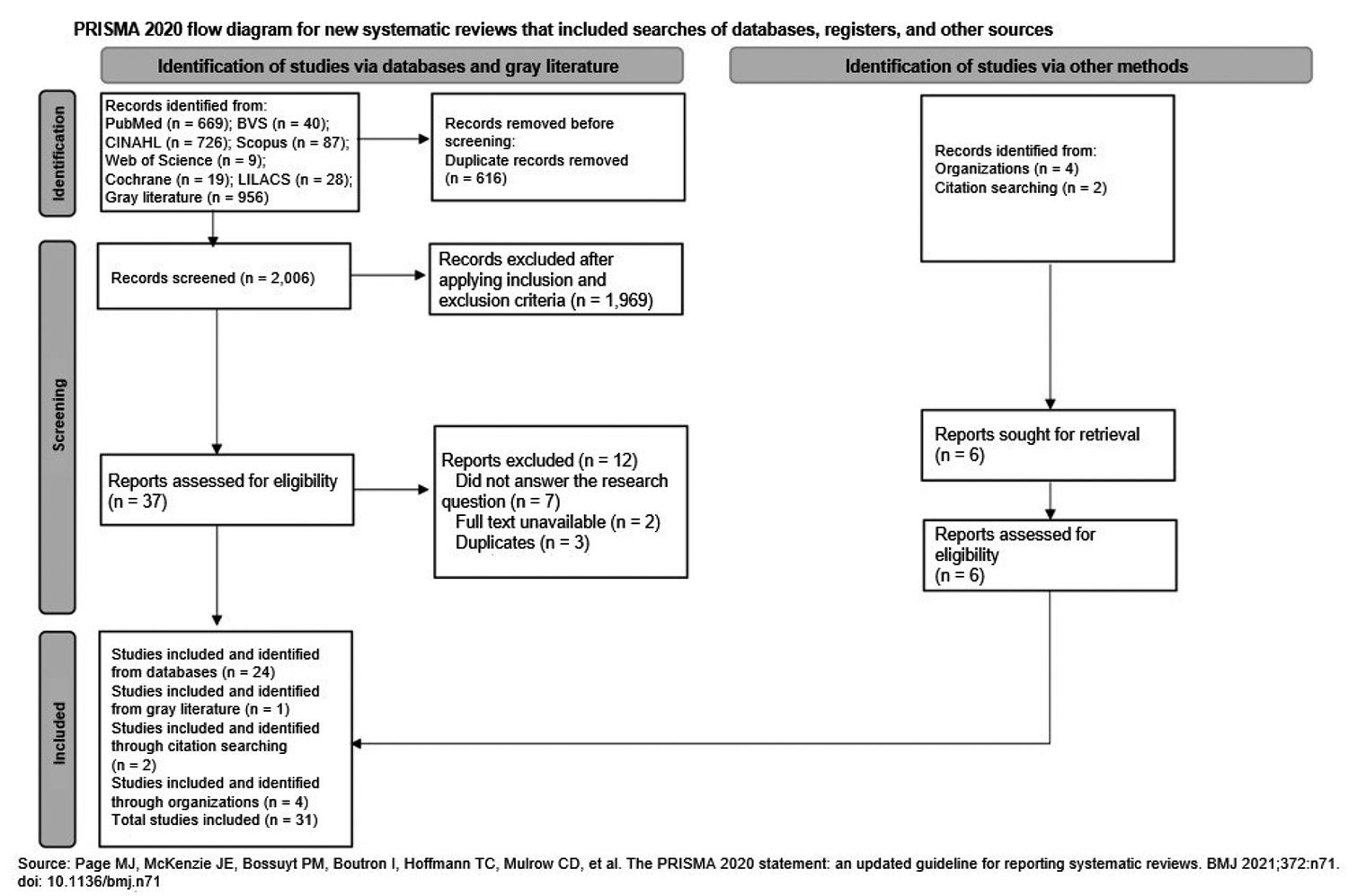
A total of 2,622 records were identified in the databases, with 6 additional records identified from other sources. At the end of the selection process, 31 sources of evidence were included in this review synthesis, comprising 26 articles, 1 dissertation, 1 book, 1 manual, and 2 guides. The number of identified records, as well as the stages of screening, eligibility, and inclusion, are presented in the PRISMA-ScR flow diagram (Figure 1).
It should be noted that, initially, 616 duplicates were identified with the support of the Rayyan® tool. Subsequently, during the eligibility stage, three additional duplicates were identified manually.
Studies conducted in 11 countries were identified, with emphasis on the United Kingdom (25.8%) and Brazil (19.35%), which accounted for the highest number of publications. Regarding methodological design, qualitative exploratory approaches predominated (22.6%), followed by mixed methods (12.9%). In terms of temporal distribution, the year 2018 had the highest number of publications (19.35%), followed by 2013 (9.67%).
Regarding care settings, most studies were conducted in hospital care contexts (74.19%), while 25.8% addressed specialized outpatient care. Of the 31 articles included, 28 (90.32%) highlighted the nurse as a member of the multiprofessional team in the process of breaking bad news in pediatrics and 3 (9.67%) focused exclusively on the nurse’s role independently. Furthermore, 13 (41.93%) publications addressed the communication of bad news directed at children/adolescents, 10 (32.25%) discussed the communication process aimed at family members, and 8 (25.82%) considered both groups. The selected publications were descriptively organized in Chart 2.
The communication strategies identified were grouped into three main dimensions: those related to the communicative act (64.5%), to the child/adolescent and family (35.48%), and to the tools or resources used (32.25%), as shown in Chart 3. In the first group, stood out the gradual and continuous conduction of communication (40%), clarity and honesty of information (35%), and collaborative care within inter- or multiprofessional teams (35%). In the dimension focused on the child/adolescent and family, the most notable aspects were adapting communication to levels of cognitive development, maturity, prior knowledge, and questioning (72.72%), consideration of cultural, religious, and emotional factors (45.45%), and encouraging parents to express their feelings (45.45%).
Among the resources used, the use of play-based approaches (80%) stood out, in addition to support groups and community resources (60%). Finally, among the specific responsibilities of the nurse in this process, the most notable were providing support, welcoming, and encouragement to the family and team, as well as training, education, and counseling for parents, children, and adolescents (85.18%).
Strategies for breaking bad news communication in pediatrics and the nurse’s role, Natal/RN, 2025.
In turn, facilitators for breaking bad news communication mainly included collaboration within inter- or multiprofessional teams (12.9%) and the longer time nurses spend with patients and their families (9.67%). Conversely, the most frequent barriers included lack of knowledge, preparation, confidence, experience, and security (80.76%), shortage of human and structural resources, lack of appropriate spaces (30.76%), and the presence of stigma, prejudice, and discrimination (100%), as presented in Chart 4.
Facilitators and barriers in breaking bad news communication by nurses in pediatrics, Natal/RN, 2025.
These findings show that communication strategies and the nurse’s role are predominantly focused on relational and family-centered approaches, highlighting gradual and continuous communication, adaptation of language to the developmental level, and the use of play-based resources. The nurse’s role is mainly associated with emotional support, welcoming, and encouragement of the family and the multiprofessional team.
On the other hand, facilitators and barriers reveal that, although there are favorable conditions related, for example, to teamwork and the development of trusting relationships, facilitated by the longer time nurses spend with the child/adolescent and family, structural, formative, and emotional barriers persist that hinder the consolidation of systematized communication practices in pediatric nursing.
DISCUSSION
The results of this scoping review reveal that breaking bad news communication in pediatrics has been predominantly addressed in the hospital setting, with nurses most often acting as members of the multiprofessional team. The communication strategies described focus on the communicative act, the adaptation of language to the child, adolescent, and family, as well as the use of play-based resources and emotional support. However, difficulties persist related to lack of preparation, confidence, and resources, in addition to the presence of social stigma, reinforcing the need to strengthen training, systematization of practices, and recognition of the nurse’s role in breaking bad news communication in pediatrics.
In this context, the United Kingdom stood out for the largest number of publications on the subject, a result of the consolidated development of research, legislation and public policies in Palliative Care since the 1960s, when Dame Cicely Saunders introduced the concept, integrating psychological, social and spiritual dimensions into care and inaugurating a paradigm for the prevention and relief of human suffering47. This scenario highlights the international tradition and scientific maturity of the topic in that country, contrasting with the need for greater investment in research in the Brazilian context.
A predominance of qualitative and mixed-methods studies was observed. This methodological choice can be explained by the complexity of breaking bad news communication, a phenomenon permeated by subjective, emotional, and cultural dimensions48. Qualitative methods make it possible to explore experiences and meanings, while mixed methods allow for a more comprehensive analysis by combining qualitative depth with the explanatory robustness of quantitative data49.
The hospital environment was the most frequent setting, giving greater visibility to communication in complex clinical situations and unfavorable prognoses. However, the restriction of production to this setting indicates the need to expand to other points of the Health Care Network, especially Primary Health Care, where nurses routinely deal with difficult news related to growth and development consultations, diagnosis of infectious diseases, and chronic conditions, reinforcing the importance of understanding the phenomenon in contexts beyond the hospital setting50-52.
In the studies analyzed, nurses appear as members of the multiprofessional team, but their participation is not always effectively recognized27,32-33,41,44. Considering the proximity of this professional to patients and families, it is essential that their role be strengthened and valued, since their involvement before, during, and after communication contributes to minimizing negative emotional impacts and expanding the comprehensiveness of care21,24,33,35,42-43.
The literature indicates that communication should occur gradually and continuously, structured in stages that involve preparation, defining the time and place, transmitting information and subsequent follow-up17,35. It is recommended that this process be conducted with clarity, honesty, and accessible language, avoiding excessive technical terminology that may compromise understanding19,30,32-33,38,45. In this sense, the widely disseminated Setting, Perception, Invitation, Knowledge, Emotions, and Strategy (SPIKES) protocol constitutes a relevant resource to support professionals, by systematizing communication into six stages that favor the development of communication skills53.
Adapting language to individual characteristics is essential, requiring nurses to be sensitive to the age, level of cognitive development, maturity, and interests of children and adolescents16-20,30-31,33. In addition, cultural, religious, and affective factors of families must be respected, as they influence how information is received, assimilated, and experienced30-31,41,54.
In this context, nursing practice can be supported by the NANDA International Taxonomy, which includes diagnoses related to common human responses in this process, such as impaired resilience, impaired verbal communication, impaired religiosity, and excessive anxiety55. These diagnoses reinforce that communicating bad news goes beyond the informative dimension, configuring itself as a care intervention that must be planned, executed, and evaluated. The integration of NANDA-I into the communication process strengthens the Nursing Process, expanding the systematization of clinical practice in pediatrics.
Among the strategies employed, play-based resources stand out - such as therapeutic toys, analogies, storytelling, and drawings - for children, and virtual tools, videos, and letters for adolescents17,29,31,33,42,56. These resources favor the expression of feelings, the protagonism of the subjects, and the understanding of information. Another facilitator is the longer time nurses spend with the child and their family, enabling the development of bonds and therapeutic relationships, as proposed by Hildegard Peplau’s Theory of Interpersonal Relations16,41,44,57-58.
Despite advances, difficulties persist related to lack of preparation, experience, confidence, and security, which may generate emotional stress in nurses and negatively affect care, including family perceptions of communication during hospitalization and the end-of-life process19,21,25,29,37,40,43. To overcome these gaps, studies indicate the need for continuing education through training and workshops that enable nurses and students to communicate difficult news with greater competence and confidence25,36,43,46.
Another barrier identified relates to the presence of social stigmas and prejudices related to diseases such as cancer, HIV and syphilis, which interfere with how the news is transmitted and assimilated27,29,34,37,40,42. The nurse, due to their proximity in care, assumes a strategic role in clarifying and confronting these stigmas, in articulation with the multidisciplinary team, contributing to reducing barriers and broadening understanding17,59.
From this perspective, nurses should be recognized as educators and advocates for the child and their family. They are responsible not only for coordinating but, in some situations, for leading or initiating the communication process, ensuring the inclusion of caregivers and the child’s and adolescent’s right to access information about their health condition16,18,22,25,30,37,40-41,46. The institutionalization of protocols, guides, and training strategies can strengthen this role, improve care and ensure greater communication safety in the pediatric context.
In view of the above, relevant knowledge gaps are evident, such as the scarcity of studies focusing on nurses as protagonists of the process, since most research describes them primarily as members of the multiprofessional team. The concentration of scientific production in the hospital setting is also highlighted, with limited exploration of other levels of the Health Care Network. The fragility in the systematization of nursing interventions is also evident, as the articulation of communication practices with theoretical frameworks specific to nursing and with its work process remains underexplored. Additionally, there is a noticeable lack of evaluation of protocols, educational strategies, and specific training interventions for nurses.
As limitations of this review, it is recognized that the search strategy, although broad, did not encompass all potentially relevant databases, which may have limited the retrieval of some studies. Still, this potential bias was mitigated by conducting searches in multiple databases relevant to the areas of nursing and health, by including grey literature in national and international repositories, and by reverse searching the references of the selected studies. Furthermore, methodological choices inherent to the review process, such as the definition of descriptors, languages, and search strategies, may have influenced the scope of the findings. Finally, it should be noted that, since this is a scoping review, there was no assessment of the methodological quality of the studies.
The findings of this review have important implications for clinical practice, professional training, and nursing research. They may support the development of institutional protocols for breaking bad news communication in pediatrics, strengthening the nurse’s role in a systematic and safe manner, as well as contributing to the development of educational strategies in undergraduate education and continuing education, with a focus on improving communication competencies.
Therefore, it is recommended that studies be developed linking breaking bad news communication to nursing diagnoses and interventions, to deepen the analysis in light of the Nursing Process and broaden its applicability in the clinical practice of nurses.
CONCLUSION
It is concluded that breaking bad news communication by nurses in pediatrics is a complex practice, poorly systematized, and marked by a gap between the recognition of the nurse’s role and their effective centrality in the communication process. Although frequently included in multiprofessional teams, their role is predominantly described as complementary to the process.
The findings highlight recurring challenges such as lack of knowledge, unpreparedness, insecurity, lack of confidence, and lack of professional experience. On the other hand, facilitating factors stand out, particularly the longer time nurses spend with the child/adolescent and family, which favors the development of therapeutic bonds and continuity of care. The identified strategies reveal the adoption of gradual, sensitive, and child, adolescent, and family-centered approaches, including the use of playful resources and virtual tools, as well as actions of support, welcoming, counseling, clarification of doubts, and coordination of communication.
However, such practices are poorly grounded in nursing theoretical frameworks and poorly integrated with the Nursing Process, which compromises their standardization, evaluation, and implementation. Therefore, there is a need to strengthen nurses’ communication competencies through structured training strategies, the institutionalization of protocols, and the expansion of evidence production, in order to improve the practice of breaking bad news communication in pediatric care.
REFERENCES
-
1. Flausino DA, Oliveira AR, Misko MD, Eduardo AHA. Scenario for simulation training on the communication of hard news: a validation study. Esc Anna Nery. 2022;26:e20210037. https://doi.org/10.1590/2177-9465-EAN-2021-0037
» https://doi.org/10.1590/2177-9465-EAN-2021-0037 -
2. Alves TML, Tenani GD. Comunicação de más notícias em cuidados paliativos pediátricos: revisão integrativa. CERES-Health Educ Med J. 2023;2(2):e50-e50. https://doi.org/10.62234/ceresv2n2-002
» https://doi.org/10.62234/ceresv2n2-002 -
3. Pimentel VRM, Sousa MF, Mendonça AVM. Comunicação em saúde e promoção da saúde: contribuições e desafios, sob o olhar dos profissionais da Estratégia Saúde da Família. Physis. 2022;32(3):e320316. https://doi.org/10.1590/S0103-73312022320316
» https://doi.org/10.1590/S0103-73312022320316 -
4. Figueiredo AP, Souza CP, Santa Rosa FA, Maia LFS, Bianco MM, Função JM. Atuação da enfermagem nas metas internacionais de segurança do paciente. Rev Remecs. 2024;9(15):388-9. https://doi.org/10.24281/rremecs2024.9.15.388398
» https://doi.org/10.24281/rremecs2024.9.15.388398 -
5. Cintra DCE, Dias PLM, Cunha MLR. Communication of bad news in pediatric emergencies: experiences of professionals in the pre-hospital context. Rev Baiana Enferm. 2022;36. https://doi.org/10.18471/rbe.v36.44267
» https://doi.org/10.18471/rbe.v36.44267 -
6. Soeiro ACV, Vasconcelos VCS, Silva JAC. Challenges in breaking bad news in a pediatric intensive care unit. Rev Bioét. 2022;30(1):45-53. https://doi.org/10.1590/1983-80422022301505PT
» https://doi.org/10.1590/1983-80422022301505PT -
7. Morais MT, Vieira JFM. A dificuldade dos profissionais de saúde ao comunicar más notícias na emergência pediátrica: revisão narrativa. Rev Delos. 2025;18(66):1-7. https://doi.org/10.55905/rdelosv18.n66-079
» https://doi.org/10.55905/rdelosv18.n66-079 -
8. Ferreira JL Neto, Ferreira MEC, Oliveira MEC, Penido CMF. A Formulação da Política Nacional de Humanização e seus Antecedentes Históricos . Psicol Cienc Prof. 2024;44:e268625. https://doi.org/10.1590/1982-3703003268625
» https://doi.org/10.1590/1982-3703003268625 -
9. Silva ER da Júnior, Ferreira RKG, Souto PANG. Breaking bad news in pediatrics. Rev Bioét . 2023;31:e3536PT. https://doi.org/10.1590/1983-803420233536PT
» https://doi.org/10.1590/1983-803420233536PT -
10. Guaranha DDFK, Antunes BS, Motta MGC. The right of children and adolescents living with HIV to participate in health care. Esc Anna Nery . 2023;27:e20220444. https://doi.org/10.1590/2177-9465-EAN-2022-0444pt
» https://doi.org/10.1590/2177-9465-EAN-2022-0444pt -
11. Oliveira WHR, Gonçalves ICL. Direito à saúde da criança e do adolescente sob perspectiva do ECA. Rev JRG. 2024;7(14):e141203. https://doi.org/10.55892/jrg.v7i14.1203
» https://doi.org/10.55892/jrg.v7i14.1203 -
12. Dias R da S, da Silva TASM. Communicating difficult news in oncologic nursing: implications in the interpersonal relationship with the patient-family dyad. Rev Enferm UFJF. 2024;10(1). https://doi.org/10.34019/2446-5739.2024.v10.39703
» https://doi.org/10.34019/2446-5739.2024.v10.39703 -
13. Tricco AC, Lillie E, Zarin W, O’Brien KK, Col-quhoun H, Levac D, et al. PRISMA extension for scoping reviews (PRISMA-ScR): checklist and explanation. Ann Intern Med. 2018;169(7):467-73. https://doi.org/10.7326/M18-0850
» https://doi.org/10.7326/M18-0850 -
14. Aromataris E, Munn Z, editors. JBI Manual for Evidence Synthesis Adelaide: JBI; 2020. https://doi.org/10.46658/JBIMES-20-12
» https://doi.org/10.46658/JBIMES-20-12 -
15. Ouzzani M, Hammady H, Fedorowicz Z, Elmagarmid A. Rayyan: a web mobile app for systematic reviews. Methodol. 2016;5(210). https://doi.org/10.1186/s13643-016-0384-4
» https://doi.org/10.1186/s13643-016-0384-4 -
16. Ali ME, Ayyub M, Douglas M, Graham E. Truth-telling to the seriously ill child: nurses’ experiences, attitudes, and beliefs. Nurs Ethics. 2023;31(5):930-50. https://doi.org/10.1177/09697330231215952
» https://doi.org/10.1177/09697330231215952 -
17. D’Alessandro MPS, Soboll LA, Santos RS, Coelho MS, Godoy AR. Manual de cuidados paliativos [Internet]. 2ª ed. revisada e ampliada. São Paulo: Hospital Sírio-Libanês; Ministério da Saúde; 2023[cited 2025 Sep 2]. Available from: https://www.gov.br/saude/pt-br/centrais-de-conteudo/publicacoes/guias-e-manuais/2023/manual-de-cuidados-paliativos-2a-edicao/view
» https://www.gov.br/saude/pt-br/centrais-de-conteudo/publicacoes/guias-e-manuais/2023/manual-de-cuidados-paliativos-2a-edicao/view -
18. Bubadué RM, Cabral IE, Carnevale F. Nurses’ patterns of knowing about HIV disclosure to children. Rev Bras Enferm 2022 ;75:1-9. https://doi.org/10.1590/0034-7167-2021-0103
» https://doi.org/10.1590/0034-7167-2021-0103 -
19. Cust F. Using simulation to help paediatric nurses learn to break bad news. Nurs Times J Club [Internet]. 2022[cited 2025 Sep 2];118(3). Available from: https://www.ovid.com/journals/nrtm/abstract/00006203-202203000-00021~using-simulation-to-help-paediatric-nurses-learn-to-break
» https://www.ovid.com/journals/nrtm/abstract/00006203-202203000-00021~using-simulation-to-help-paediatric-nurses-learn-to-break -
20. Madiba S, Diko C. Telling children with perinatal HIV about their HIV serostatus: healthcare workers’ practices and barriers to disclosing in a South African rural health district. J Prim Care Community Health. 2021;12:1-12. https://doi.org/10.1177/2150132720984757
» https://doi.org/10.1177/2150132720984757 -
21. Das MK, Dutta A, Bapat P, Sahoo M, Mondal S. Perceptions of the parents of deceased children and of healthcare providers about end-of-life communication and breaking bad news at a tertiary care public hospital in India: a qualitative exploratory study. PLoS One. 2021 ;16(3). https://doi.org/10.1371/journal.pone.0248661
» https://doi.org/10.1371/journal.pone.0248661 -
22. Newman AR, Haglund K, Rodgers CC. Pediatric oncology nurses' perceptions of prognosis-related communication. Nurs Outlook. 2019;67(1):101-14. https://doi.org/10.1016/j.outlook.2018.11.001
» https://doi.org/10.1016/j.outlook.2018.11.001 -
23. Seddon L, Dick K, Carr SB, Balfour-Lynn IM. Communicating cystic fibrosis newborn screening results to parents. Eur J Pediatr. 2020;180(4):1313-16. https://doi.org/10.1007/s00431-020-03829-8
» https://doi.org/10.1007/s00431-020-03829-8 -
24. Makworo D, Odero T. Caring for HIV-positive children: healthcare providers' pre-and post-disclosure experiences in Nairobi, Kenya. Afr J Midwifery Womens Health. 2019;13(3):1-7. https://doi.org/10.12968/ajmw.2018.0022
» https://doi.org/10.12968/ajmw.2018.0022 -
25. Neilson S, Reeves A. The use of a theatre workshop in developing effective communication in paediatric end of life care. Nurse Educ Pract. 2019 ;36:7-12. https://doi.org/10.1016/j.nepr.2019.02.014
» https://doi.org/10.1016/j.nepr.2019.02.014 -
26. Glasper EA. Promoting honesty and truthfulness when things go wrong during care delivery for sick children. Compr Child Adolesc Nurs. 2018;41(2):83-88. https://doi.org/10.1080/24694193.2018.1467159
» https://doi.org/10.1080/24694193.2018.1467159 -
27. Bubadué RM, Cabral IE. Advocacy care on HIV disclosure to children. Nurs Inq. 2018;26(2). https://doi.org/10.1111/nin.12278
» https://doi.org/10.1111/nin.12278 -
28. Myburgh H, Bachmann MO, Nyonyane E, Nglazi MD, Milligan P, Godfrey-Faussett P. Breaking down barriers to tell: a mixed methods study of health worker involvement in disclosing to children that they are living with HIV in rural South Africa. J Assoc Nurses AIDS Care. 2018;29(6):902-13. https://doi.org/10.1016/j.jana.2018.04.009
» https://doi.org/10.1016/j.jana.2018.04.009 -
29. Kalembo FW, Kendall GE, Ali M, Chimwaza AF. Need and acceptability of story books intended to help with the process of informing children about their HIV status in Malawi: a mixed methods study. AIDS Care. 2018;31:3-8. https://doi.org/10.1080/09540121.2018.1497137
» https://doi.org/10.1080/09540121.2018.1497137 -
30. Chambers L. A guide to children’s palliative care: supporting babies, children and young people with life-limiting and life-threatening conditions and their families [Internet]. 4th ed. England: Together for Short Lives; 2018[cited 2025 Sep 2]. Available from: https://www.togetherforshortlives.org.uk/app/uploads/2018/03/TfSL-A-Guide-to-Children%E2%80%99s-Palliative-Care-Fourth-Edition-5.pdf
» https://www.togetherforshortlives.org.uk/app/uploads/2018/03/TfSL-A-Guide-to-Children%E2%80%99s-Palliative-Care-Fourth-Edition-5.pdf -
31. World Health Organization (WHO). Integrating palliative care and symptom relief into paediatrics: a WHO guide for health-care planners, implementers and managers [Internet]. Geneva: World Health Organization; 2018[cited 2025 Sep 2]. https://www.who.int/publications/i/item/integrating-palliative-care-and-symptom-relief-into-paediatrics
» https://www.who.int/publications/i/item/integrating-palliative-care-and-symptom-relief-into-paediatrics -
32. Newman AR. Pediatric oncology nurses' experiences with prognosis-related communication[Tese] [Internet]. Marquette University, United States. 2017[cited 2025 Sep 2]. Available from: https://epublications.marquette.edu/dissertations_mu/699/
» https://epublications.marquette.edu/dissertations_mu/699/ -
33. Zanon BP, Paula CC, Padoin SMM. Revelação do diagnóstico de HIV para crianças e adolescentes: subsídios para prática assistencial. Rev Gaúcha Enferm. 2016;37:1-11. https://doi.org/10.1590/1983-1447.2016.esp.2016-0040
» https://doi.org/10.1590/1983-1447.2016.esp.2016-0040 -
34. Aderomilehin O, Hanciles-Amu A, Ozoya OO. Perspectives and practice of HIV disclosure to children and adolescents by health-care providers and caregivers in sub-Saharan Africa: a systematic review. Front Public Health. 2016 ;4:1-12. https://doi.org/10.3389/fpubh.2016.00166
» https://doi.org/10.3389/fpubh.2016.00166 -
35. Bell SK, Smulowitz PB, Woodward AC, Mello MM, Truog RD, Meyer GS, et al. Should we tell parents when we've made an error? Pediatrics. 2015;135(1):159-63. https://doi.org/10.1542/peds.2014-0293
» https://doi.org/10.1542/peds.2014-0293 -
36. Madiba S, Mokgatle M. Health care workers' perspectives about disclosure to HIV-infected children; cross-sectional survey of health facilities in Gauteng and Mpumalanga provinces, South Afr Par J. 2015 ;3:1-15. https://doi.org/10.7717/peerj.893
» https://doi.org/10.7717/peerj.893 -
37. Brondani JP, Pedro ENR. A story for children to help children with HIV understand the health-disease process. Rev Artigo Original. 2014 ;34(1):14-21. https://doi.org/10.1590/S1983-14472013000100002
» https://doi.org/10.1590/S1983-14472013000100002 -
38. Crawford D, Robinson S, Tayler E, Walls J. Educating children’s nurses for communicating bad news. Nurs Child Young People. 2013 ;25(8):28-33. https://doi.org/10.7748/ncyp2013.10.25.8.28.e365
» https://doi.org/10.7748/ncyp2013.10.25.8.28.e365 -
39. Campbell LM, Amin N. Dilemmas of telling bad news: paediatric palliative care providers' experiences in rural KwaZulu-Natal, South Africa. South Afric J Child Health [Internet]. 2013[cited 2025 Sep 2];7(3):113-6. Available from: https://www.scielo.org.za/pdf/sajch/v7n3/08.pdf
» https://www.scielo.org.za/pdf/sajch/v7n3/08.pdf -
40. Watermeyer J. Are we allowed to disclose?': a healthcare team's experiences of talking with children and adolescents about their HIV status. Health Expect. 2013;18(4):590-600. https://doi.org/10.1111/hex.12141
» https://doi.org/10.1111/hex.12141 -
41. Pirie A. Pediatric palliative care communication: resources for the clinical nurse specialist. Clin Nurse Spec. 2012 ;26(4):212-5. https://doi.org/10.1097/nur.0b013e31825aeb97
» https://doi.org/10.1097/nur.0b013e31825aeb97 -
42. Instituto Nacional de Câncer (Inca). Comunicação de notícias difíceis: compartilhando desafios na atenção à saúde [Internet]. Rio de Janeiro: INCA; 2010[cited 2025 Sep 2]. https://bvsms.saude.gov.br/bvs/publicacoes/comunicacao_noticias_dificeis.pdf
» https://bvsms.saude.gov.br/bvs/publicacoes/comunicacao_noticias_dificeis.pdf -
43. Wayman K, Yaeger K, Sharek PJ, Trotter S, Wise L, Halamek LP. Simulation-based medical error disclosure training for pediatric healthcare professionals. J Healthc Qual. 2007 ;29(4):12-9. https://doi.org/10.1111/j.1945-1474.2007.tb00200.x
» https://doi.org/10.1111/j.1945-1474.2007.tb00200.x -
44. Price J, McNeilly P, Surgenor M. Breaking bad news to parents: the children's nurse's role. Int J Palliat Nurs. 2006 ;12(3):115-20. https://doi.org/10.12968/ijpn.2006.12.3.20695
» https://doi.org/10.12968/ijpn.2006.12.3.20695 -
45. Boyd JR. A process for delivering bad news: supporting families when a child is diagnosed. J Neurosci Nurs. 2001;33(1):14-20. https://doi.org/10.1097/01376517-200102000-00003
» https://doi.org/10.1097/01376517-200102000-00003 -
46. Farrell M, Ryan S, Langrick B. Breaking bad news' within a paediatric setting: an evaluation report of a collaborative education workshop to support health professionals. J Adv Nurs. 2001;36(6):765-75. https://doi.org/10.1046/j.1365-2648.2001.02042.x
» https://doi.org/10.1046/j.1365-2648.2001.02042.x -
47. Corrêa JCB, Zaganelli MV. Derecho de acceso a los cuidados paliativos: reflexiones bioéticas a la luz del escenario británico. Derecho Cambio Soc [Internet]. 2020[cited 2025 Sep 2];(59):1-14. Available from: https://ojs.revistadcs.com/index.php/revista/article/view/2657
» https://ojs.revistadcs.com/index.php/revista/article/view/2657 -
48. Wolffenbuttel CR. Pesquisa qualitativa e quantitativa: compreendendo as abordagens e construindo possíveis combinações. Editora e-Publicar. 2023;1:39-53. https://editorapublicar.com.br/ojs/index.php/publicacoes/article/view/165
» https://editorapublicar.com.br/ojs/index.php/publicacoes/article/view/165 -
49. Santos JLG, Erdmann AL, Meirelles BHS, Lanzoni GMM, Cunha VP, Ross R. Pesquisa de métodos mistos na América Latina: iniciativas e oportunidades de expansão. Texto Contexto Enferm. 2020;29:e20200101. https://doi.org/10.1590/1980-265X-TCE-2020-0001-0001
» https://doi.org/10.1590/1980-265X-TCE-2020-0001-0001 -
50. Chaves LA, Andrade EIG, Santos AF. Configuração das Redes de Atenção à Saúde no SUS: análise a partir de componentes da atenção básica e hospitalar. Ciênc Saúde Coletiva. 2024;29(6). https://doi.org/10.1590/1413-81232024296.18392022
» https://doi.org/10.1590/1413-81232024296.18392022 -
51. Amorim CB, Tavares CMM, Rodrigues PF, Amorim CL. Comunicação de notícias difíceis na atenção básica à saúde: barreiras e facilitadores percebidos por enfermeiras. Rev Gaúcha Enferm . 2019;40(1):1-8. https://doi.org/10.1590/1983-1447.2019.20190017
» https://doi.org/10.1590/1983-1447.2019.20190017 - 52. Silva BC. Exame citopatológico alterado e a comunicação de más notícias pelo enfermeiro da atenção primária à saúde 2022. [Internet]. [Dissertação] Universidade Federal de Campina Grande, Paraíba. 2022[cited 2025 Sep 2]. http://dspace.sti.ufcg.edu.br:8080/xmlui/handle/riufcg/24569
-
53. Agnese BL, Daniel ACQG, Pedrosa RBS. Communicating bad news in the practice of nursing: an integrative review. Einstein. 2022 ;20:1-8. https://doi.org/10.31744/einstein_journal/2022RW6632
» https://doi.org/10.31744/einstein_journal/2022RW6632 -
54. Tomaz APK. O uso da espiritualidade/religiosidade por enfermeiros residentes em oncologia na assistência de enfermagem. Rev Bras Enferm . 2024 ;77(2). https://doi.org/10.1590/0034-7167-2023-0383pt
» https://doi.org/10.1590/0034-7167-2023-0383pt - 55. North American Nursing Diagnosis Association. Diagnósticos de enfermagem da Nanda-I: Definições e Classificação 2024-2026. 13th ed. Porto Alegre: Artmed; 2024.
-
56. Medeiros KF. Aplicação do brinquedo terapêutico instrucional sobre o cateterismo vesical em crianças hospitalizadas 2024. [Internet].[Dissertação] 2024 . Universidade Federal do Rio Grande do Norte: Rio Grande do Norte. [cited 2025 Sep 2] Available from: https://repositorio.ufrn.br/handle/123456789/58410
» https://repositorio.ufrn.br/handle/123456789/58410 -
57. Galvão MIZ. Comunicação interpessoal em cuidados paliativos: um estudo à luz da teoria de Peplau 2016. ][Internet] [Dissertação. Universidade de Brasília: Distrito Federal. 2016[cited 2025 Sep 2]. Available from: http://repositorio.unb.br/handle/10482/21635
» http://repositorio.unb.br/handle/10482/21635 -
58. Morais AOC, Branco ALC. Teoria de Peplau para a telenfermagem com à família de pacientes com COVID-19. Rev Cuidarte 2024 ;15(1):1-10. https://doi.org/10.15649/cuidarte.3139
» https://doi.org/10.15649/cuidarte.3139 -
59. Almeida DR, Araujo MC. Avaliação da aplicabilidade do protocolo SPIKES na comunicação de más notícias pelo profissional de enfermagem 2020. [Internet][Dissertação]. Pontifícia Universidade Católica de Goiás, Goiás, 2020[cited 2025 Sep 2]. Available from: https://repositorio.pucgoias.edu.br/jspui/handle/123456789/801
» https://repositorio.pucgoias.edu.br/jspui/handle/123456789/801
Access to the dataset is available upon request from the corresponding author.