
 The prevention of sexually transmitted infections among lesbian women - a study of social representations
ABSTRACT
Objective: To analyze the social representations of lesbian women regarding the prevention of sexually transmitted infections (STIs).
Method: Qualitative study, supported by the theory of social representations, conducted in 2022, in Rio de Janeiro, with 100 self-identified lesbian women, aged 18-29. Data were collected through a questionnaire for sociodemographic characterization and form to capture free associations with the inducing term “STI Prevention”. Data analyzed using prototypical structural analysis and similarity techniques, supported by EVOC® software. Ethical procedures for research involving human subjects were respected.
Results: A total of 462 words were evoked, with 99 different terms. The central core of the representation is composed of condom and care. The peripheral system reveals the need for prevention to maintain sexual health and highlights practices that may contribute to infection prevention, such as hygiene and vaccines. In the contrast zone, an educational dimension is observed, reinforced by the recognition of the individual role in self-care as part of infection prevention.
Conclusion: The women demonstrated knowledge of infection prevention strategies that do not address the specificities of lesbian women sexual practices. The heteronormative representation observed manifests as a conditioning factor for the non-adoption of protective practices, making educational actions aimed at this group relevant.
Descriptors:
Women who have sex with women; Sexually transmitted infections; Prevention; Social representations
RESUMO
Objetivo: analisar as representações sociais de mulheres lésbicas sobre a prevenção das infecções sexualmente transmissíveis.
Método: estudo qualitativo, com suporte da teoria de representações sociais, realizado em 2022, no Rio de Janeiro, com 100 mulheres autodeclaradas lésbicas, idades entre 18-29 anos. Dados coletados através de um questionário para caracterização sociodemográfica e um formulário para captação das evocações livres ao termo indutor “Prevenção de DST”. Dados analisados com as técnicas de análise estrutural prototípica e de similitude, com apoio do software EVOC®. Procedimentos éticos de pesquisa envolvendo seres humanos foram respeitados.
Resultados: foram evocadas 462 palavras, sendo 99 diferentes. O núcleo central da representação é constituído por camisinha e cuidado. O sistema periférico revela a necessidade de prevenção para a manutenção da saúde sexual e destaca práticas que podem contribuir para prevenção das infecções, como higiene e vacinas. Na zona de contraste, observa-se a dimensão educativa reforçada pelo reconhecimento do papel individual de cuidar de si implicados na prevenção das infecções.
Conclusão: as mulheres demonstraram conhecimento das estratégias de prevenção das infecções que não contemplam as especificidades das práticas sexuais de mulheres lésbicas. A representação heteronormativa observada manifesta-se como condicionante para a não adoção de práticas de proteção, sendo relevantes ações educativas voltadas para esse grupo.
Descritores:
Mulheres que fazem sexo com mulheres; Infecções sexualmente transmissíveis; Prevenção; Representações sociais
RESUMEN
Objetivo: Analizar las representaciones sociales de mujeres lesbianas sobre la prevención de infecciones de transmisión sexual (ITS).
Método: Estudio cualitativo, con apoyo de la teoría de las representaciones sociales, realizado en 2022, en Río de Janeiro, con 100 mujeres que se autodeclararon lesbianas, edades entre 18 y 29 años. Los datos se recolectaron mediante un cuestionario para la caracterización sociodemográfica y un formulario para captar evocaciones libres al término inductivo “Prevención de ITS”. Los datos fueron analizados mediante la técnica de análisis estructural prototípico, con el apoyo del software EVOC®. Se respetaron los procedimientos éticos de investigación con seres humanos.
Resultados: Se evocaron 462 palabras, siendo 99 diferentes. El núcleo central de la representación está compuesto por preservativo y cuidado. El sistema periférico revela la necesidad de prevención para el mantenimiento de la salud sexual y destaca prácticas que pueden contribuir a la prevención de infecciones, como la higiene y las vacunas. En la zona de contraste, se observa una dimensión educativa reforzada por el reconocimiento del papel individual en el autocuidado implicado en la prevención de infecciones.
Conclusión: Las mujeres demostraron conocer las estrategias de prevención de infecciones que no contemplan las especificidades de las prácticas sexuales de mujeres lesbianas. La representación heteronormativa observada se manifiesta como un factor determinante para la no adopción de prácticas de protección, por lo que son relevantes las acciones educativas dirigidas a este grupo.
Descriptores:
Mujeres que tienen sexo con mujeres; Infecciones de transmisión sexual; Prevención; Representaciones sociales
INTRODUCTION
Sexual diversity is a relevant aspect incorporated in 2004 into the reformulation of the National Policy for Comprehensive Women’s Health Care (Política Nacional de Atenção Integral à Saúde da Mulher - PNAISM). However, there are particularities of lesbian women that are unknown, such as access to health information and healthcare services, prevention of sexually transmitted infections (STIs), among other specific demands, the lack of which increases the vulnerability of this group1-3.
Although considered to be at lower risk, there is a possibility of STI transmission between women. A study4) evaluated the demographic and social factors that contribute to knowledge about STI/HIV transmission among lesbian women in southern Africa. It indicates that the belief that women have minimal risk of STIs and HIV (human immunodeficiency virus) is recurrent, even in regions where HIV prevalence is high. A retrospective repeated cross-sectional cohort study5 conducted in Melbourne, Australia, compared differences in sexual practices and positivity for STIs, as well as other genital infections, among women with different sexual partners. The presence of certain genital infections, such as bacterial vaginosis, was observed among lesbian women. Chlamydia positivity in this group increased (from 0.0% to 2.7%, ptrend = 0.014), as did syphilis positivity among women who had sex with both men and women (WSMWs) (from 0.0% to 0.7%, ptrend = 0.028).
Studies have demonstrated the existence of infections, such as human papillomavirus (HPV), chlamydia, syphilis, and genital herpes among lesbian women, resulting from low risk perception, trust in the partner, and limited use of barrier methods1,6-7. Research conducted in Botucatu (SP), between 2015 and 2017, with 150 women who had sexual relations with other women, revealed that 10.6% had already been diagnosed with STI, 56.7% did not perceive themselves as vulnerable to infection, and 82% used condoms inconsistently in sexual practices1. These findings corroborate results from studies that also point out to low rates of barrier method use and limited availability of specific information for this group6,8.
Among the methods indicated for the prevention of STIs among lesbian women, especially in the practice of oral sex, are the use of gloves, finger cots, dental dam, and the use of adapted condoms in practices involving the sharing of sexual toys6-7. However, these strategies are little known and rarely used, either due to the lack of supplies in health services or the absence of educational campaigns that consider the specificities of sexual practices among women9.
It is known that the perception of low risk of infection in this group is associated with the belief in the lower transmissibility of STIs in sexual relations among same-sex couples, especially when compared to heterosexual relations or relations between men. In this context, the belief in immunity to infections, combined with the lack of adequate supplies and guidance from health professionals, reinforces the distancing of lesbian women from preventive practices and maintains their invisibility in discourses on sexual health4,6-7,9. Thus, the vulnerability of this group must be understood not only in individual aspects, but also collective and symbolic dimensions, through social, cultural and institutional determinants3,5,8-9.
Studies that use Social Representations Theory (SRT) to understand health phenomena are relevant because they reveal, in the psychosocial and cognitive fields, the knowledge constructed by the group from practical experiences with the object under investigation. In the field of STIs among lesbian women, such knowledge can contribute to the selection of more specific and appropriate STI prevention and coping strategies for the group’s sexual practices, as well as to strengthening measures that prove effective in reducing the number of cases.
Studies show8,10 that the (external) condom is present in the representation of different groups, characterizing a hegemonic representational content of STI prevention in the general population. A study conducted with young lesbian women identified the presence of this term as a central element in the structure of the group’s social representation11.
Thus, this study sought the contribution of the Social Representations Theory (SRT), which understands social representation (SR) as a specific type of knowledge that performs a prescriptive function of behaviors and guides communication between individuals in everyday life12. SRT is understood as enabling the comprehension of how scientific knowledge about prevention is incorporated into the common-sense knowledge of lesbian women, in addition to investigating how interpersonal relationships and group behaviors develop in the field of STIs12-13.
In this context, it is understood that, in order to develop a social representation of a given object, the subject and the group constitute it in their cognitive system and reconstruct it, making it suitable to their system of values and personal references, through a process that is influenced by the social and ideological context in which each group is inserted12. In this way, each representation is capable of restructuring reality, allowing the characteristics of the object to be integrated with the previous experiences, norms and values of the group13.
This research is justified by the incidence of STIs in the general population, highlighting that in Brazil, between 2012 and June 2023, 1,340,090 cases of acquired syphilis were registered14. It is also justified by the scarcity of studies addressing sexual behaviors, knowledge and social representations regarding the prevention of these infections among lesbian women, which represents a gap in the field of sexual and reproductive health2.
In this scenario, this study aims to analyze the social representations of lesbian women regarding the prevention of sexually transmitted infections.
METHOD
Study design
This is a descriptive, qualitative study, supported by the structural approach of SRT12-13 and its prototypical and similarity analysis techniques.
Setting
The study was conducted in the municipality of Rio de Janeiro, located in the state of Rio de Janeiro, Southeast region of Brazil.
Participants
A total of 100 women who met the following inclusion criteria participated in the study: self-declared homosexual women, sexually active and who had sexual intercourse in the last 12 months, aged between 18 and 29 years, residing in the municipality of Rio de Janeiro. This sample size is recommended by authors15 for structural studies of social representation (SR) that use the free word association technique. All women contacted agreed to participate in the study. Women who did not respond to one of the data collection instruments were excluded from the research.
The composition of the study group was carried out using the snowball sampling technique, a non-probabilistic sampling method that uses referral chains and is indicated for researching groups that are difficult to access or study16. The data collection process began with the selection of a seed participant, from whom other participants were identified. The seed participant was selected from the network of friends of the first author, who was responsible for data collection and self-identified as homosexual. She was invited to participate, the objectives of the research were explained, and she was asked to indicate other names that met the inclusion criteria. The seed participant indicated 30 other names; these individuals were contacted individually by telephone and asked to indicate additional participants, and so on, until the sample of 100 participants was reached.
Data Collection Techniques and Instruments
Two instruments were used for data collection: a questionnaire for participant characterization, consisting of sociodemographic variables, and a form for collecting free evocations. The evocation data collection instrument and the inducing term were tested in a group of 20 women with the same characteristics as the study participants. In this pre-test, it was observed that the inducing term “Prevention of STDs” (sexually transmitted diseases) best expressed the object of the study and was the term most familiar to the group, when compared to “Prevention of STIs”.
Data Collection Procedures
Data collection was conducted by the first author, a master’s student at the time, a specialist in intensive care, working in an intensive care unit (ICU) of a private hospital in Rio de Janeiro. She is a woman and had received prior training in free word evocation data collection from her academic advisor and through coursework completed during the master’s program.
Participants were previously contacted by telephone by the interviewer, without any prior relationship established before the start of the study. They were informed about the objectives of the study and its linkage to an academic master’s thesis developed by the researcher. After agreeing to participate, the women were invited to a in-person meeting to conduct the interview, without the presence of other individuals.
Data collection was carried out in person, on date and time scheduled by mutual agreement, between July and October 2022. The data collection site was chosen by the participant and included the following: workplace, residence, or public establishments where privacy could be ensured.
The data collection process consisted of asking participants to freely and spontaneously produce the first five words or expressions that came to mind upon hearing the inducing term “Prevention of STDs”13. This technique was applied in a single in-person interview session, and each interview lasted an average of 30 minutes. The evoked words were recorded in cursive handwriting by the interviewer on a specific form, in the order in which they were evoked.
Data Analysis
After data collection, the evocations were entered into a Microsoft Word database for later analysis. Sociodemographic data were analyzed using descriptive statistics. Free evocations were analyzed using the software Ensemble de Programmes Permettant L’analyse des Evocations (EVOC®), version 2005, which enabled the statistical analysis of the evoked words and the construction of the four-quadrant table. This table allows for the distribution of the terms evoked by the participants, crossing the criteria of frequency and order of evocation of each word as a function of their respective averages (average frequency and weighted average of the position of the set of words)13. The four-quadrant chart makes it possible to observe the structure and content of a particular social representation, presented in terms of the central core, peripheral system, and contrast elements12-13. The representational themes or dimensions were derived from the collected data through the identification of meanings conveyed by the evoked terms.
A second technique for analyzing the evocations was used, the similarity analysis, aiming to corroborate the centrality of the elements present in the central core of the four-quadrant chart. This technique allows for the verification of connections, by co-occurrence, between words present in the corpus composed of free evocations. These results are represented by a similarity graph, demonstrating the strength of the connections between the terms. These connections are expressed in similarity indices ranging from 0 to 115. This analysis allows the researcher to observe the existence and strength of connections among the elements participating in a prototypical analysis13. In this technique, interpretation is performed directly on the words produced by participants that appear in the chart.
Ethical Considerations
The research was conducted in compliance with ethical principles and approved by the Research Ethics Committee under Opinion No. 5,672,857, CAAE 52805121,0,0000.5282. All participants were informed about the objectives of the research, instructed on the voluntary participation, and signed the Informed Consent Form.
RESULTS
In the group investigated, there was a concentration of women aged 25 to 29 years (60%); self-declared Black and Brown skin color (69%); they were employed in paid work (70%) and lived with their parents (41%).
Regarding romantic relationships, most participants reported not having a girlfriend or steady partner (72%); they did not use condoms during sexual intercourse, regardless of the type of sexual partner, with steady partners (57%) and with casual partners (64%); they had between two and seven sexual partners in the last 12 months; they reported knowledge about the transmission of STIs (95%); they sought health care in public services (52%), and they underwent STI testing (61%).
The corpus formed by the participants’ evocations totaled 462 words, 99 of which were different. The four-quadrant chart of evocations of the inducing term “STD Prevention” is presented in Figure 1, which was constructed using the following criteria: mean order of evocation (MOE) of 2.9, mean frequency (mf) of 18, and minimum frequency of evocation of 6.
In Chart 1, it can be observed that in the upper-left quadrant-the central nucleus of the representation-the word condom presented f = 65 and MOE = 1.667, indicating that it was the most frequent word in the analysis and was evoked in the earliest positions by the group, demonstrating its importance in the centrality of the representation of STD prevention. The presence of this term in this position indicates the incorporation of biomedical scientific knowledge regarding a form of STI prevention widely recommended for heteronormative groups or male homosexual groups, now present in the representation of a group of lesbian women. The term care showed f = 38 and MOE = 2.816, occupying the second position in frequency and highlighting the need for individual and collective care in STI prevention.
In the first periphery, located in the upper-right quadrant, the term exams showed f = 35 and MOE = 3.114; treatment showed f = 20 and MOE = 2.950; and affective relationship showed f = 18 and MOE = 3.222. The terms in the first periphery are those evoked with high frequency, above the group average, but not promptly evoked. Together, they denote a general biomedical dimension that conceives testing and treatment as modalities of prevention, as well as an affective-attitudinal dimension related to affective relationships involved in STI prevention present in this quadrant.
Within these representational contents, a complementary relationship can be observed between the second element of the central nucleus - care - and the words exams and treatment, which indicates a certain concern among participants regarding self-care from a general biomedical perspective. However, the affective dimension appears to be closely related to the identity of the group of lesbian women participating in the study.
In the second periphery, in the lower-right quadrant, are the words prevention (f = 17; MOE = 3.118), health professional, health, and knowledge (f = 12; MOE = 3.222, 3.250, and 3.417, respectively); hygiene (f = 11; MOE = 3.455), sexuality (f = 9; MOE = 3.222), and vaccine (f = 8; MOE = 3.375). These terms reinforce the need for prevention to maintain sexual health, indicate that health professionals and knowledge are involved in the issue, and represent practices that may contribute to STI prevention, such as hygiene and vaccines.
In the contrast zone, in the lower-left quadrant, the words protection (f = 17; MOE = 2.294), information (f = 17; MOE = 2.882), education (f = 11; MOE = 2.455), and self-care (f = 8; MOE = 1.875) are noted. In the contrast zone, the presence of two terms related to an educational dimension (information and education) is highlighted, reinforced by recognition of the individual role of self-care involved in STI prevention. This dimension does not appear prominently in the other quadrants and may represent a subgroup that does not share the markedly biomedical representational profile of the overall group, which is present in the other quadrants.
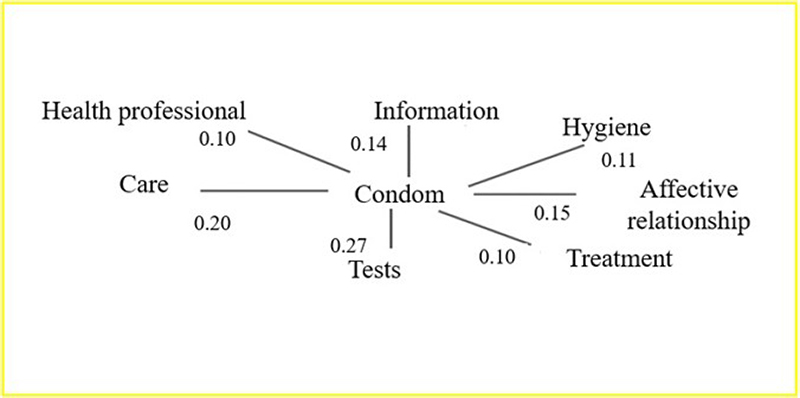
The results of the similarity analysis are presented in Figure 1, where a central term radiates seven connections with other evoked terms.
Figure 1 presents the connections between the evocations expressed by similarity indices. In it, the cogneme condom appears as the source of all other connections, which confirms that the participants perceive the condom as an important resource for the prevention of sexually transmitted infections, confirming its centrality, even considering its inadequacy for the protection of the specific group.
Two terms with stronger connections are observed - test (0.27) and care (0.20). The term care shows the second highest co-occurrence index with condom and, in the four-quadrant framework, both appear in the central core, indicating that the participants understand the use of this device as a necessary care practice for protection, thus confirming its indication of centrality. The word test presents the highest co-occurrence index and is in the first periphery in the prototypical analysis; however, its MOE value does not allow it to be indicated as central in the representation. This term gains importance in the representation due to the strong link it establishes with condom, presenting itself as the second attribute of STI prevention.
The terms information (0.14) and affective-relationship (0.15) have the second highest rates, being part of the first periphery and contrast zone of the four-cell framework, which may indicate that an intimate affective relationship without information can lead to the occurrence of STIs. The other cognemes, treatment (0.10), hygiene (0.11), and health professional (0.10), have the lowest rates of co-occurrence and, in the four-cell framework, were recalled later, respectively in the first and second peripheries. These terms denote a pramatic attribute of STI prevention.
Taken together, the results of the similarity analysis point to the confirmation of the centrality of the cogneme condom as a modality of care and as a structuring element of the social representation of STI prevention. This modality of care, although possibly having low adherence to the sexual practices of the group studied, is associated with testing and treatment as reified prevention practices identified by the group and mediated by health professionals. Additionally, it is observed that condom use requires personal hygiene practices and the search for information in order to be effective as an STI prevention practice.
DISCUSSION
The profile of the group of women investigated shows a concentration of participants in the age range between 25 and 29 years. It is known that this is a time of transition to adulthood, when affective and sexual identities are consolidated. It should be added that issues inherent to sexuality and STI prevention are particularly critical during youth, when more frequent sexual practices are common and access to prevention information may be limited, which may contribute to making this group more vulnerable to sexually transmitted infections10.
In this study, 69% of the participants self-identified as Black or Brown, making it relevant to consider the specificities of racial identity in the analysis of sexual and reproductive health. It is known that Black women face multiple challenges related to structural racism, marginalization of sexual identities, among others, which may be reflected in sexual health care practices17.
Regarding the analysis of the social representation of STI prevention, this is defined based on the elements condom and care, as structuring elements of the SR, since they are part of the central core and are confirmed in the similarity analysis. The central elements have the generating and organizing functions of the social representation, the first refers to the element that creates or undergoes transformations so that other elements can exist later, and the second, the organizing function, makes the connection between one element and another, connecting them to one another13.
The term condom simultaneously expresses the incorporation of scientific knowledge regarding the universal prescription for prevention, but also a defining image of STI prevention, considering its presence in different studies on the subject and its strong iconic charge8,10. However, what was observed in this study was that the use of condoms is not a consistent practice adopted by the group of participants, even considering that the sharing of sex toys without protection, oral sex without barriers and direct contact with vaginal secretions represent a significant risk of STI transmission9. In this context, national studies have demonstrated an increase in the incidence of STIs, such as HPV, chlamydia, syphilis and genital herpes in this group8-9. International studies also indicate the presence of STIs in lesbians4-5. In the present study, it is evident that the participants demonstrate the adoption of risky sexual behaviors, resulting in increased vulnerability, even though the condom is a central element of the group’s social representation.
In this respect, it is considered that all representation is prescriptive of behaviors and practices12, however, within the scope of studies of social practices, authors have developed the theory of conditionality12,18. This theory presents two types of prescribers: absolute and conditional. Absolute or normative prescriptions are general and abstract, whereas conditional prescriptions modulate the general prescription for specific situations18. The latter is what is observed in this study, given that the condom appears as a central element and, therefore, its use in sexual relations is prescribed. However, considering certain conditions or particular situations, its use may be abandoned, for example, depending on the type of sexual partnership.
For the specific group studied, preventive measures are recommended such as: proper hand hygiene, keeping nails short, use of latex or disposable gloves with topical antimicrobial gel solutions to reduce contact with vaginal secretions during manual penetration practices, use of condoms on sex toys, use of internal or external condoms when appropriate, use of latex barriers (dental dams) during oral sex, and periodic screening tests, which are fundamental for promoting sexual health and preventing STIs in this population6-7,9.
There are two types of content or elements in the central core of a social representation: normative and functional. Normative elements originate from the value system of individuals and constitute the social dimension of the representation, being linked to the history and ideology of the group, determining judgments and positions taken in relation to the object. Functional contents are associated with descriptive characteristics and the inscription of the object in social practices, determining behaviors related to the object13.
By observing the contents present in the central core, it can be inferred that they are functional elements, since condoms and care, although they require knowledge, have a strong correspondence with practices, especially because they are related to an object that presupposes a set of actions or measures to prevent infections. It should also be highlighted that the peripheral system encompasses several modalities of care related to STI prevention.
When reflecting on STI prevention among lesbians, a certain discomfort is perceived among these women due to the fear of being compared to heterosexual men. It should be emphasized that there still persists, in the male community, a dialogue of delegitimization of lesbian sex due to the physical absence of the penis and even of affection between women, referring this relationship only to eroticism, an idea historically fueled by heteronormativity, in an attempt to make sex between women unviable6,19) . However, condoms remain central to the social representation of lesbian women, demonstrating an understanding of their protective function, even if they do not use them during sexual intercourse, since this practice is related to conditional prescribers, as mentioned earlier./
In this context, it is important to emphasize that the vulnerability of this group is heightened not only by exposure to STIs, but above all by gender and the stigma suffered by women, who are exposed to the most varied forms of violence, including sexual, psychological, physical and socioeconomic aggression by family members, affective partners, among others6,18,20-21.
Care emerges as a central element in the analyzed health system, which highlights the need for self-care and care for others in order to prevent STIs. Studies indicate that there is a gap in the health process of the lesbian group regarding self-care, since many do not seek assistance to carry out STI prevention, either due to social issues or due to a lack of knowledge of the risks to which they are exposed8-9,20. International studies also point out to the low demand for health care and STI prevention6-7.
UNAIDS and Todxs developed the LGBTI+ Health Booklet, which mentions as a specific guideline for lesbians, bisexuals and transmasculine people the prevention of gynecological cancers and qualified treatment and, as a general guideline, the STI prevention, with special attention to HIV/AIDS. Studies conducted in Australia and Brazil, however, show that lesbian women refuse to undergo gynecological examinations because the procedure requires the insertion of a speculum8,22.
Research with primary care nurses showed weaknesses in care for women, associated with the assumption that all women are heterosexual, resulting in the provision of inadequate care and difficulty in breaking with stereotypical gender views23. A lack of professional training aimed at recognizing the diversity of ways of being and living and respecting them was evidenced23. International studies2,7,22,24 present similar results and indicate the need for training health professionals to meet the needs of this group. In this way, the guarantee of the right to health is committed, ensured through ethical care, free from discrimination and based on the principles of comprehensive care23.
The peripheral system of the SR includes cognemes that refer to prevention modalities, translated into potentially preventive practices, such as preventive screening tests, treatment of already established infections, vaccination against certain STIs - such as HPV, physical hygiene practices aimed at maintaining health, demonstrating knowledge of biomedical strategies for STI prevention, which are related to the cogneme care present in the central core. There is also recognition of the health professional as being involved in prevention and sexuality, as a dimension in which prevention should be carried out.
When evoking the cognema hygiene, participants associated this practice with disease prevention or health promotion, that is, general measures to ensure the maintenance of individual or collective health. Studies have shown that this term alludes to general measures used to prevent diseases, such as keeping nails short and clean, hands clean, avoiding the use of nail polish, taking care not to cause small fissures in the fingers, showering before sexual relations, sanitizing sex toys, among other measures18,21.
Vaccination against HPV, which is one of the forms of prevention against cervical cancer, remains at low coverage among lesbian women24. A study conducted in the United States found that only 2.9% of lesbian participants were encouraged to undergo preventive screening and/or receive the HPV vaccine24. Lack of knowledge about the specificities of lesbians intensifies the absence or scarcity of information for this group24-25.
One dimension observed in the peripheral system, dissonant from those discussed previously, is the identification of prevention in relation to affective relationships, indicating a possible association between STI prevention and the identity of the group of lesbian women, in a manner similar to that reported in studies with heterosexual groups8,10.
In the contrast zone, the presence of representational contents aligned with health education as a prevention strategy is noteworthy, reinforced by recognition of the individual role of self-care implicated in STI prevention. Considering the function of the contrast zone in revealing subgroups with central elements different from those of the general group13, health education may be regarded as a dimension that contrasts with the markedly biomedical representational profile of the other quadrants. Confirmation of this hypothesis would require further analyses that were not developed in this study.
The women investigated showed that they perceive prevention as an important topic; however, the guidelines made available for STI prevention in general are generic and insufficiently sensitive to the specificities of sexual practices between women, such as the use of cut condoms for oral sex or gloves for manual stimulation26. When these recommendations are perceived as distant from reality or refer to biomedical and hospital contexts, they tend to be rejected, which can compromise both adherence and the relationship of trust with health professionals26. / In this context, international studies highlight the relevance of actions targeted at lesbian women to promote better sexual health within this group4,7,24-25.
The gap between knowledge about STI transmission and the actual adoption of preventive practices is frequently related to a perception of invulnerability, fueled by the belief that sexual relations between women entail a lower risk of exposure4-5,27. Furthermore, the scarcity of specific educational materials appropriate to the sexual practices developed by the group, coupled with the invisibility of the lesbian women population served by health services, compromises access to qualified information and the promotion of effective preventive practices4,6,9,21,24-27.
The findings of this study reveal that, beyond the perception of invulnerability, the very configuration of a non-specific social representation of prevention that is not aligned with the group’s sexual practices emerges as an important conditioning factor for the non-adoption of protective practices, since social representations precede practices, that is, they constitute a condition for their development13. Overall, the participants demonstrate the existence of a structured SR for STI prevention that is not aligned with the group, since it does not present the peculiarities of the sexual practices of lesbian women and the needs for infection prevention.
It is noteworthy that, although the participants valued traditional prevention devices, such as condoms and routine examinations, their daily practices are not always consistent with these SR. Many resort to alternative, low-lubrication methods for prevention, such as the use of latex gloves, dildos, PVC films, or other adapted objects, based on the perception that conventional methods, especially external condoms, do not adequately address the peculiarities of sexual practices between women6-7,9. Such resources, besides being improvised, are not always used with proper hygiene, which may increase the risk of infections. Protection during digital-vaginal and/or digital-anal sex practices and the shared use of sex toys remains insufficiently incorporated, revealing a gap between normative knowledge of prevention and its practical application in daily life26.
Furthermore, many women do not recognize themselves as part of a group with their own preventive needs, which contributes to the invisibility of their demands within the context of public health6-7,22,24-28. This perception may hinder access to and adherence to essential care, such as vaccination against HPV and hepatitis B, as well as the periodic performance of gynecological preventive examinations. Even while recognizing the importance of prevention, this group of women continues to face structural and symbolic challenges to the effective implementation of protective actions24-25.
The use of protective barriers in sexual practices is relevant for the prevention of STI transmission, in addition to regular preventive tests24,26. Awareness of preventive measures and the implementation of more inclusive and sensitive health care to the specificities of the sexual and reproductive health of lesbian women are crucial to ensure equitable access to health care and promote the health safety of this group24,26-28.
For a more effective approach to STI prevention, it is essential that public health strategies be expanded to include systematic immunization against HPV and hepatitis B, as well as the periodic performance of gynecological examinations, such as oncotic cytology, commonly known as the preventive test29-30. These tests are fundamental for the early detection of cervical lesions that may progress to cancer29, a condition frequently associated with heterosexual sexual practice, but which can also affect lesbian women. Regular monitoring allows the identification of pathological changes and contributes to the reduction of morbidity associated with these conditions29-30.
This study has the limitation of having been conducted in a city in the Southeast region of Brazil, in the state of Rio de Janeiro, making its replication in other regions with distinct social and cultural characteristics opportune. A second limitation refers to the absence of a complementary technique that would allow for the semantic contextualization of the evocations, to more adequately identify their meanings. Nevertheless, the results are similar to those of other investigations and highlight the social representations and prevention practices of lesbian women.
This study contributes to a better understanding of the symbolic limitations placed on prevention practices and to the visibility of lesbian women on the public health agenda, pointing to the need for public policies and care practices that consider their specificities. For teaching, the study broadens the discussion on sexuality, disease prevention, and inclusive practices; for research, it opens avenues for more in-depth investigations on gender, sexuality, and health.
FINAL CONSIDERATIONS
The results of this study reveal that the social representations of sexually transmitted infections prevention among lesbian women refer to a biomedical dimension, with features characteristic of a heteronormative representation of STI prevention, failing to encompass the specificities of female same-sex sexual practices.
Although the condom is recognized by the women investigated as a relevant device for the prevention of sexually transmitted infections, this resource is not incorporated daily into their sexual practices. In this sense, lesbian women have a heteronormative representation of STI prevention, materialized in the figure of the condom, a representation that is more consistent with heterosexual subjects.
For STI prevention among lesbian women, it is essential that the specificities of this group be considered, recognizing the biological, social, and symbolic conditions that permeate their experiences. It was observed that, given the group’s perception of invulnerability, the configuration of the studied SR emerges as an important condition for the non-adoption of protective practices, which requires reflections on the need for strategies to transform this social representation, in order to incorporate the specificities of the group’s sexual practices and their needs.
Additionally, it is recognized that the scarcity of specific educational campaigns, combined with a heteronormative approach from health services, favors the distancing between social representation and practices. Disseminating accessible information and training healthcare professionals to be more sensitive to diversity, recognizing the specific vulnerabilities of lesbian women, are fundamental strategies for promoting the sexual health of these women, ensuring comprehensive, humane, and prejudice-free care.
Acknowledgments
The present study was carried out with the support of the Research Support Foundation of the State of Rio de Janeiro - Brazil (Fundação de Amparo à Pesquisa do Estado do Rio de Janeiro - FAPERJ), Call for Proposals E_26/2021 - Basic Research Grant (APQ1) in state ICTs UERJ and UEZO - 2021, process SEI-260003/015578/2021-APQ1.
REFERENCES
-
1. Souto K, Moreira MR. National Policy for Integral Attention to Women’s Health: leading role of the women’s movement. Saúde Debate. 2021;45(130). https://doi.org/10.1590/0103-1104202113020
» https://doi.org/10.1590/0103-1104202113020 -
2. Obón‑Azuara B, Vergara‑Maldonado C, Gutiérrez‑Cía I, Iguacel I, Gasch‑Gallén Á. Gaps in sexual health research about women who have sex with women. A scoping review. Gaceta Sani. 2022;36(5):439‑45. https://doi.org/10.1016/j.gaceta.2022.01.008
» https://doi.org/10.1016/j.gaceta.2022.01.008 -
3. Silva ADN, Gomes R. Access to health services for lesbian women: a literature review. Cienc Saude Colet. 2021;26(Suppl3):5351-60. https://doi.org/10.1590/1413-812320212611.3.34542019
» https://doi.org/10.1590/1413-812320212611.3.34542019 -
4. Paschen-Wolff MM, Reddy V, Matebeni Z, Southey-Swartz I, Sandfort T. HIV and sexually transmitted infection knowledge among women who have sex with women in four Southern African countries. Cult Health Sex. 2020;22(6):705-21. https://doi.org/10.1080/13691058.2019.1629627
» https://doi.org/10.1080/13691058.2019.1629627 -
5. Engel JL, Fairley CK, Greaves KE, Vodstrcil LA, Ong JJ, Bradshaw CS, et al. Patterns of sexual practices, sexually transmitted infections and other genital infections in women who have sex with women only (WSWO), women who have sex with men only (WSMO) and women who have sex with men and women (WSMW): findings from a sexual health clinic in Melbourne, Australia, 2011-2019. Arch Sex Behav. 2022;51:2651-65. https://doi.org/10.1007/s10508-022-02311-w
» https://doi.org/10.1007/s10508-022-02311-w -
6. Gil-Llario MD, Morell-Mengual V, García-Barba M, Ballester-Arnal R. HIV and STI prevention among Spanish women who have sex with women: factors associated with the use of dental dams and condoms. AIDS Behav. 2023;27:161-70. https://doi.org/10.1007/s10461-022-03752-z
» https://doi.org/10.1007/s10461-022-03752-z -
7. Binse J. The representation of women who have sex with women (WSW) in sexual health promotion in England: a frame analysis. Brit Stud Doc. 2021;5(2):4-20 https://doi.org/10.18573/bsdj.264
» https://doi.org/10.18573/bsdj.264 -
8. Moura SLO, Silva MAM, Moreira ACA, Freitas CASL, Pinheiro AKB. Percepção de mulheres quanto à sua vulnerabilidade às Infecções Sexualmente Transmissíveis. Esc Anna Nery. 2021;25(1). https://doi.org/10.1590/2177-9465-EAN-2019-0325
» https://doi.org/10.1590/2177-9465-EAN-2019-0325 -
9. Dal Santo A, Zambenedetti G. Prevenção às ISTs/HIV entre mulheres lésbicas e bissexuais: uma revisão bibliográfica (2013-2017). Psi Unisc. 2021;5(1):111-26. https://doi.org/10.17058/psiunisc.v5i1.14846
» https://doi.org/10.17058/psiunisc.v5i1.14846 -
10. Spindola T, Santana RSC, Antunes RF, Machado YY, Moraes PC. A prevenção das infecções sexualmente transmissíveis nos roteiros sexuais de jovens: diferenças segundo o gênero. Cienc Saude Colet. 2021;26(7):2683-94. https://doi.org/10.1590/1413-81232021267.08282021
» https://doi.org/10.1590/1413-81232021267.08282021 -
11. Conceição LKL, Oliveira JF, Jesus MEF, Santana BCG, Mota GS. "De que forma podemos nos proteger melhor?": representações sociais de jovens lésbicas sobre saúde sexual. Cien Saude Colet[Internet]. 2025[cited 2025 Oct 14]. Available from: Available from: http://cienciaesaudecoletiva.com.br/artigos/de-que-forma-podemos-nos-proteger-melhor-representacoes-sociais-de-jovens-lesbicas-sobre-saude-sexual/19732?id=19732
» http://cienciaesaudecoletiva.com.br/artigos/de-que-forma-podemos-nos-proteger-melhor-representacoes-sociais-de-jovens-lesbicas-sobre-saude-sexual/19732?id=19732 - 12. Moscovici S. Representações sociais: investigações em psicologia social. Petrópolis (RJ): Vozes; 2003. 408 p.
- 13. Abric JC. Abordagem estrutural das representações sociais: desenvolvimentos recentes. In: Campos PHF, Loureiro MCS, organizadores. Representações sociais e práticas educativas. Goiânia: Ed. UCG; 2003. p. 37-57.
-
14. Ministério da Saúde (Br). Boletim Epidemiológico Sífilis 2023 [Internet]. Brasília: Ministério da Saúde; 2023 [cited 2025 Aug 14]. Available from: Available from: https://www.gov.br/saude/pt-br/centrais-de-conteudo/publicacoes/boletins/epidemiologicos/especiais/2023/boletim-epidemiologico-de-sifilis-numero-especial-out.2023/view
» https://www.gov.br/saude/pt-br/centrais-de-conteudo/publicacoes/boletins/epidemiologicos/especiais/2023/boletim-epidemiologico-de-sifilis-numero-especial-out.2023/view - 15. Oliveira DC, Marques SC, Gomes AMT, Teixeira MCTV. Análise das evocações livres: uma técnica de análise estrutural das representações sociais. In: Moreira ASP, Camargo BV, Jesuíno JC, Nóbrega SM, organizadores. Perspectivas teórico-metodológicas em representações sociais. João Pessoa: Editora da Universidade Federal da Paraíba; 2005. p. 573-603.
-
16. Vinuto J. A amostragem em bola de neve na pesquisa qualitativa: um debate em aberto. Temáticas. 2014;22(44):203-20. https://doi.org/10.20396/tematicas.v22i44.10977
» https://doi.org/10.20396/tematicas.v22i44.10977 -
17. Gaudenzi P, Chagas A, Castro AM. Efeitos subjetivos do racismo e cuidado: vivências e memórias de mulheres negras. Cienc Saude Colet. 2023; 28(9):2479-88. https://doi.org/10.1590/1413-81232023289.14062022
» https://doi.org/10.1590/1413-81232023289.14062022 - 18. Peixoto ARS. Práticas sociais e abordagem estrutural das representações sociais: histórico, teoria e aplicação [Tese]. Vitória (ES): Universidade Federal do Espírito Santo, Programa de Pós-Graduação em Psicologia; 2023.
-
19. Souza AC. Representações do sujeito poético lésbico. Estud Lit Bras Contemp. 2024;61:1-13. https://doi.org/10.1590/2316-4018613
» https://doi.org/10.1590/2316-4018613 -
20. Nunes MCA, Lima RFF, Morais NA. Violência sexual contra mulheres: um estudo comparativo entre vítimas adolescentes e adultas. Rev Psicol: Ciên Prof. 2017;37(4):956-69. https://doi.org/10.1590/1982-3703003652016
» https://doi.org/10.1590/1982-3703003652016 -
21. Silveira AP, Cerqueira-Santos E. Fatores associados à prevenção sexual e reprodutiva de mulheres lésbicas. Rev Subjetividades. 2022;21(3):e11404. https://doi.org/10.5020/23590777.rs.v21i3.e11404
» https://doi.org/10.5020/23590777.rs.v21i3.e11404 -
22. Curmi C, Peters K, Salamonson Y. Barriers to cervical cancer screening experienced by lesbian women: a qualitative study. J Clin Nurs. 2024;25(23-24):3643-51. https://doi.org/10.1111/jocn.12947
» https://doi.org/10.1111/jocn.12947 -
23. Farias GM, Lima VLA, Lima MLC, Martini JG, Oliveira MFV, Sanes MS, et al. A atenção básica e a saúde de mulheres lésbicas. Saúde Coletiva. 2023;13(85):12552-63. https://doi.org/10.36489/saudecoletiva.2023v13i85p12552-12563
» https://doi.org/10.36489/saudecoletiva.2023v13i85p12552-12563 -
24. Solazzo AL, Tabaac AR, Agénor M, Austin SB, Charlton BM. Sexual orientation inequalities during provider-patient interactions in provider encouragement of sexual and reproductive health care. Prev Med. 2019;126(1). https://doi.org/10.1016/j.ypmed.2019.105787
» https://doi.org/10.1016/j.ypmed.2019.105787 -
25. Kratzer TB, Star J, Minihan AK, Bandi P, Scout NFN, Gary M, et al. Cancer in people who identify as lesbian, gay, bisexual, transgender, queer, or gender‐nonconforming. Cancer. 2024; 130:2948-67. https://doi.org/10.1002/cncr.35355
» https://doi.org/10.1002/cncr.35355 -
26. Cavalcante DR, Ribeiro SG, Pinheiro AKB, Soares PRAL, Aquino PS, Chaves AFL. Práticas sexuais de mulheres que fazem sexo com mulheres e o uso do preservativo. Rev Rene. 2022;23:e71297. https://doi.org/10.15253/2175-6783.20222371297
» https://doi.org/10.15253/2175-6783.20222371297 -
27. Parenti ABH, Ignácio MAO, Buesso TS, Almeida MAS, Parada CMGL, Duarte MTC. Conhecimento de mulheres que fazem sexo com mulheres sobre Infecções Sexualmente Transmissíveis e Aids. Cienc Saude Colet. 2023;28(1):303-3. https://doi.org/10.1590/1413-81232023281.09882022
» https://doi.org/10.1590/1413-81232023281.09882022 -
28. Araruna VHC, Leite GMS, Souza CAS, Batista MIO, Alves HLC, Albuquerque GA. Vulnerabilidade de mulheres lésbicas às infecções sexualmente transmissíveis. Tempus Actas Saúde Colet. 2021;15(3). https://doi.org/10.18569/tempus.v15i3.2774
» https://doi.org/10.18569/tempus.v15i3.2774 -
29. Carvalho NS, Silva RJC, Val IC, Bazzo ML, Silveira MF. Protocolo Brasileiro para Infecções Sexualmente Transmissíveis 2020: infecção pelo papilomavírus humano (HPV). Epidemiol Serv Saúde. 2021;30(spe1):e2020790. https://doi.org/10.1590/S1679-4974202100014.esp1
» https://doi.org/10.1590/S1679-4974202100014.esp1 -
30. Duarte G, Pezzuto P, Barros TD, Mosimann Junior G, Martínez-Espinosa FE. Protocolo Brasileiro para Infecções Sexualmente Transmissíveis 2020: hepatites virais. Epidemiol Serv Saúde. 2021;30(spe1):e2020834. https://doi.org/10.1590/S1679-4974202100016.esp1
» https://doi.org/10.1590/S1679-4974202100016.esp1
Access to the dataset is available upon request from the corresponding author.

 Source: The authors, 2025.