
 At the limits of pain: perceptions of health care for people experiencing homelessness
ABSTRACT
Objective: To understand the health needs and the main forms of access to healthcare among people experiencing homelessness.
Method: This is a qualitative study based on the theoretical framework of social phenomenology, conducted in Porto Alegre/RS with 12 participants between October and November 2024. The interviews were subjected to phenomenological analysis.
Results: Needs related to sexual practices, nutrition, good physical capacity, spirituality, and self-care management were identified. Drug use to cope with pain and feelings of hopelessness is also highlighted. Drug use is not perceived as a health issue. The “Consultório na Rua” (Street Clinic) is the service with the strongest bond with this population, and hospital emergency services are sought during acute situations.
Final considerations: The needs are grounded in basic survival, with barriers related to drug use and stigma. The main forms of access to healthcare services occur through the Street Clinic and hospital emergency services.
Descriptors:
Homeless Persons; Health Conditions; Nursing; Qualitative Research; Health Inequities; Health Care
RESUMO
Objetivo: Compreender as necessidades de saúde e as principais formas de acesso à assistência em saúde pela população em situação de rua.
Método: Trata-se de um estudo qualitativo sob o referencial teórico da fenomenologia social realizado em Porto Alegre/RS com 12 entrevistados entre outubro e novembro de 2024. As entrevistas foram submetidas a análise fenomenológica.
Resultados: Evidenciam-se necessidades relacionadas à prática sexual, alimentação, boa capacidade física, espiritualidade e gestão do autocuidado. Também se destaca o uso de drogas para lidar com a dor e com sentimentos de desesperança. O uso de drogas não é visto como uma questão de saúde. O consultório na rua é o serviço de maior vínculo com a população e as emergências hospitalares são locais procurados em momentos agudos.
Considerações finais: As necessidades são ancoradas em sobrevivência básica, com barreiras relacionadas ao uso de drogas e ao estigma. As principais formas de acesso a serviços de saúde são pelo Consultório na Rua e através da emergência hospitalar.
Descritores:
Pessoas em situação de rua; Condições de saúde; Enfermagem; Pesquisa Qualitativa; Desigualdade em Saúde; Assistência à Saúde
RESUMEN
Objetivo: Comprender las necesidades de salud y las principales formas de acceso a la atención sanitaria por parte de la población en situación de calle.
Método: Se trata de un estudio cualitativo basado en el marco teórico de la fenomenología social, realizado en Porto Alegre/RS con 12 participantes entre octubre y noviembre de 2024. Las entrevistas fueron sometidas a análisis fenomenológico.
Resultados: Se evidencian necesidades relacionadas con la práctica sexual, la alimentación, una buena capacidad física, la espiritualidad y la gestión del autocuidado. También se destaca el uso de drogas para afrontar el dolor y los sentimientos de desesperanza. El uso de drogas no es percibido como un problema de salud. El “Consultório na Rua” (Consultorio en la Calle) es el servicio con mayor vínculo con esta población, y los servicios de emergencia hospitalaria son buscados en situaciones agudas.
Consideraciones finales: Las necesidades están ancladas en la supervivencia básica, con barreras relacionadas con el uso de drogas y el estigma. Las principales formas de acceso a los servicios de salud se dan a través del Consultorio en la Calle y de los servicios de emergencia hospitalaria.
Descriptores:
Personas en situación de calle; Condiciones de salud; Enfermería; Investigación cualitativa; Desigualdad en salud; Atención sanitaria
INTRODUCTION
The 1988 Constitution is fundamental in guaranteeing social rights such as health, education, work, and housing, having promoted universalist and social protection advances in Brazil. However, regardless of the importance the Constitution holds for constitutional democracy, gaps related to political culture and the lack of structuring and regulation are still observed, contributing to the aggravation of social vulnerability in contemporary society1.
Among the existing social vulnerabilities, the existence of people experiencing homelessness (PEH) stands out, which is generally marginalized by society and lives daily with the invisibility imposed by the lack of state commitment. In the face of this social erasure, there are consequences for this population regarding the precariousness of the implementation of public policies aimed at assessing their needs, focusing on the social, educational, and health dimensions in order to provide an environment of possibilities and dignity2.
PEH is considered to be the population group, of diverse origin, in situation of extreme poverty, with broken or weakened family ties, without regular conventional housing, who use public space, overnight accommodation units (shelters) and degraded areas as a place of residence and subsistence, temporarily or permanently3.
In 2023, the Ministry of Human Rights and Citizenship released a report with data from the Unified Registry for Social Programs (Cadastro Único para Programas Sociais - CadÚnico) identifying 221,113 people experiencing homelessness in Brazil. Characteristics of this population were also identified, with a majority of men (87%), people self-identified as Black (68%, with 51% being mixed-race and 17% Black) and adults (55% aged between 30 and 49 years old)4.
A significant number of PEH live in Brazil (1 in every 1,000 people), and it is the responsibility of the Unified Health System (Sistema Único de Saúde - SUS) to ensure these populations’ access to health care, with a focus on comprehensive care that considers their needs and subjectivities5. However, exclusionary health care practices, marked by institutional rigidity, low tolerance toward psychoactive substance use, and stigmas associated with violence, may distance this population from health services6. Consequently, access often occurs only in situations of worsening clinical conditions, requiring more complex attention6,7.
Parallel to the barriers within the health field, there is the persistence of state actions, understood by the authors as hygienist actions, which, with the support of public security, promote the compulsory removal of people experiencing homelessness from their places of residence, accompanied by the removal or destruction of their belongings7. In recent years, this scenario has been intensified by political discourses and practices that reinforce social exclusion, contributing to the temporary invisibility of an unresolved structural problem8.
Therefore, it becomes fundamental to recognize the PEH as a set of social subjects endowed with historicity, culture and knowledge, overcoming traditional exclusionary approaches5. As a possibility of listening to these dissonant voices, their different ways of life and the existing relationship with health care, this study sought to understand the motivations of their actions regarding health care, in order to map their health needs and future action in the face of these perceptions.
Despite the relevance of the topic, qualitative studies that, based on direct listening to this population, seek to understand their health needs and forms of accessing services remain scarce, especially from the perspective of care and comprehensiveness5.
Therefore, this article aims to understand the health needs and the main forms of accessing health care by the homeless population.
METHOD
This is a descriptive study with a qualitative approach based on the theoretical framework of Alfred Schutz's social phenomenology. The research was conducted in downtown Porto Alegre, Rio Grande do Sul. In 2025, the municipality had 1.39 million inhabitants and 5,226 people experiencing homelessness registered by the Unified Registry for Social Programs, which corresponds to an increase of 14.8% after the floods of May 20249.
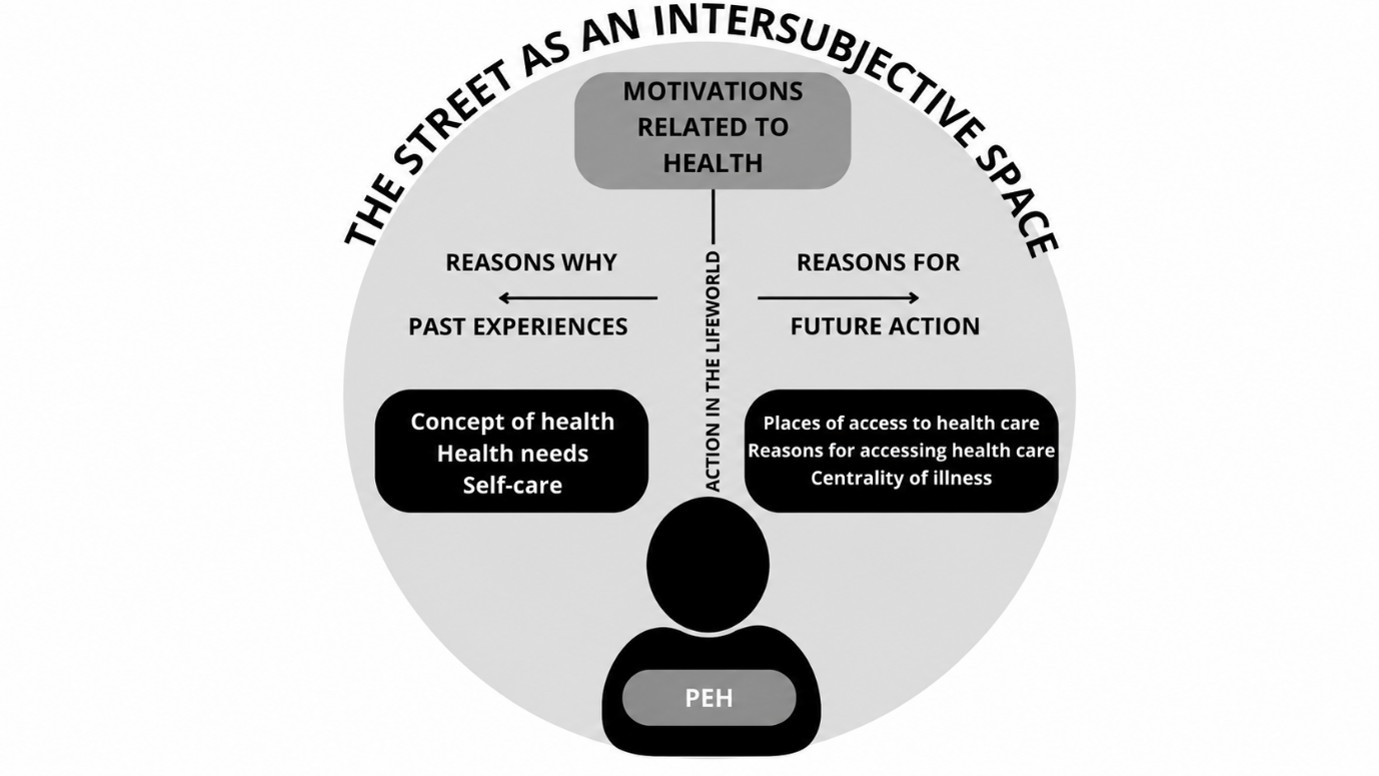
The social phenomenology of Alfred Schutz is grounded on looking at subjects in the social world, through motivated behaviors, investigating the implication of the experience of a subject who experiences the world in a given biographical situation - knowledge/lived experience - in relation to the meaning of an action10. Social action theory is understood from a phenomenological perspective, based on motivated behaviors subdivided into “reasons why” and “reasons for”. The “reasons why” refer to the subjects’ past experiences, which structure their schemes of interpreting reality. The “reasons for” refer to future-oriented intentions that guide action in the lifeworld. Thus, social action is constituted within the historicity of subjects, articulating past and future in an intersubjective relationship10.
Phenomenological research aims to unveil the phenomenon experienced by the studied population, considering its historicity, culture, and inequities, through attentive listening to what subjects have to say about their lives in the everyday world. This approach assumes a non-neutral stance by the researcher, recognizing that knowledge is produced through the interaction between researchers, participants, and the social context11.
The study population consisted of people experiencing homelessness who live in the downtown area where the research was conducted. The study included 12 participants, who met the following inclusion criteria: being 18 years of age or older and experiencing homelessness for more than six months. Individuals who, at the time of the approach, presented evident signs of acute intoxication from alcohol or other psychoactive substances, or significant alterations in mental state that compromised their understanding of the Informed Consent Form (ICF) and their ability to communicate, were not included. These exclusion criteria are based especially on safeguarding the autonomy of the participants regarding their capacity to consent to participate in the research, as well as on the fact that such a state prevents the subject from producing comprehensible and consistent narratives for the unveiling of the phenomenon in its essence according to the adopted phenomenological framework.
Due to the nature of the study, the data saturation criterion was adopted, which was reached through the repetition of information regarding the elements sought to achieve the study objective. Thus, data saturation was considered achieved, and data collection was concluded with the number of study participants (n=12).
Data were collected by a nursing undergraduate student and a nurse with a master's degree and experience in providing psychosocial care to people experiencing homelessness. Before data collection began, the assumptions about data collection in qualitative research were discussed in a meeting with the supervising professor, considering the subjectivities in the approach with PEH. Data collection was conducted between October and November 2024 through a semi-structured questionnaire with open-ended questions. Interviews were conducted in the downtown area of the city, at the participants’ places of residence, and participants were selected by convenience sampling. No health service intermediated the recruitment process, since the purpose was precisely to understand health and access to services beyond PEH already followed by public policies.
Within the possible conditions of conducting research on the streets, researchers sought locations with minimal interference from the external environment for the interviews and sitting on the ground in order to establish a closer relationship with participants. Initially, the ICF was presented and later signed in duplicate by the participant, with one copy remaining with the participant and the other with the researcher. Then, a questionnaire was applied to characterize the participants, and subsequently, the semi-structured questionnaire containing open-ended questions related to the meaning of health and the difficulties faced in accessing health services in Porto Alegre. The interviews, which lasted between 5 and 50 minutes, were conducted in the downtown area, audio-recorded with the researchers’ cell phones, and later fully transcribed in Google Docs®. It should be noted that all participants approached were in full condition to understand and communicate.
Data analysis was conducted in light of the Schutzian theoretical-methodological framework, following the recommendations proposed by researchers of this phenomenological approach12. The analytical process was carried out collaboratively and complementarily by three researchers, aiming to ensure methodological rigor, internal consistency, and interpretative reliability. First stage - Initial analysis (Researchers 1 and 2): Two researchers independently conducted a comprehensive and in-depth reading of the interview transcripts, with the objective of identifying the social actions expressed in the participants’ discourses. Second stage - Analytical validation (Researcher 3): A third researcher proceeded with the analytical reading and interpretative review of the previously coded material, in order to validate the interpretations and ensure the consistency of the process.
-
The analysis process followed the following operational stages:
-
Careful reading and immersion in the data: exhaustive reading of the transcribed material to apprehend the situation experienced by participants;
-
Identification of social actions: recognition of the actions present in the discourses, considering the context and intentionality of the subjects;
-
Thematic grouping: organization of discourse fragments presenting similar characteristics according to thematic affinity criteria;
-
Conceptual categorization: construction of two concrete analytical categories grounded in the coding of the discourses according to Schutzian analytical categories:
-
Category 1 - “Health Needs”: related to the “reasons why,” referring to previous experiences that underlie participants’ perceptions and the main health needs identified;
-
Category 2 - “Main Forms of Access to Health Care”: related to the “reasons for,” understood as intentional projections oriented toward future action, expressed in the health care locations sought to meet their demands;
-
Phenomenological interpretation: interpretative analysis of the meanings of the actions contained in the discourse fragments, subdivided into the two established categories(12).
Stages 3, 4, and 5 were systematized in a spreadsheet using Google Sheets®, stored in a Google Drive® folder with restricted access to the researchers. The data were organized into two columns corresponding to the Schutzian analytical categories: “reasons why” (past experiences underlying the perceptions of PEH regarding their health needs) and “reasons for” (intentional projections oriented toward future action, expressed in the search for support from health services)11,12.
The study complied with the ethical principles established in Resolution No. 466/2012 of the National Health Council, as well as the recommendations of Resolution No. 510/2016, which establishes the standards applicable to research in the Human and Social Sciences involving the use of data obtained from participants or information that may identify them or expose them to risks greater than those encountered in everyday life. Thus, the study was submitted to Plataforma Brasil and approved by the Research Ethics Committee of the Moinhos de Vento Hospital Institute of Education and Research under Opinion No. 7.17.831 and CAAE: 82674924.0000.5330.
Participants’ statements were identified by the letter “I,” referring to “interviewee,” followed by the interview number, ensuring participant anonymity. The transcribed data will be stored in the Google Drive®, in a folder accessible only to the main researcher, for a period of five years. After this period, the files will be permanently deleted from the platform and cloud storage.
RESULTS
A total of twelve people experiencing homelessness participated in the study. Eleven of them (91.67%) were male, with an average age of 51 years, and ten (83.33%) were single. Regarding race and ethnicity, there was a predominance of people who identified as non-white. Of the ten people (83.33%), six (50%) identified as black, three (25%) as mixed-race, and one identified as indigenous (8.33%). Only two people identified as white (16.67%). As for the place of birth, nine (75%) were from Porto Alegre and three (25%) came from other locations in the state of Rio Grande do Sul.
It was also identified that most participants had been experiencing homelessness for at least six years. Most interviewees had children, usually slept on the streets, and rejected shelter facilities. In addition, the predominant educational level among participants was incomplete elementary education. Regarding government benefits, there was no predominant adherence among participants, since most were not enrolled in government assistance programs.
After analysis of the information, the results were organized according to the theoretical framework-in which the intersubjective world is identified as the street environment, the place where people experiencing homelessness establish their relationships, based on a unique biographical situation lived by the subject, who positions themselves in the lifeworld through motivated behaviors-identifying the “reasons why and for” within the analyzed discourses. The “reasons why” were related to the conception of health, health needs, and self-care, while the “reasons for” were identified in statements referring to places of access to health care, reasons for seeking care, the centrality of the disease, as illustrated in the figure below:
Such distinction is justified because the understanding of health care comes from past experiences, which will produce future action related to the movement of accessing healthcare services. Thus, for the presentation of the results, the discourses were divided into two categories: Main health needs of PEH and Main forms of access to health services among PEH.
Main health needs of PEH
Affective-social, physical-biological, and spiritual needs are identified as characteristics that give meaning to health for people living on the street, such as sexual life, food, ability to take care of one’s own life, and faith as support to cope with difficulties. The last of the following statements describes the relationship with spirituality, in addition to physical health, as one of the most relevant dimensions in life:
Health is about having sex, using condoms, eating properly, taking care of your own life. [...] I cling to my angels in difficult times and ask them for strength, to have health. (I4)
We must have health, walk, move around, to be able to see. (I7)
Without health, a person can't do anything, can't live, right? After God, our health is the priority. (I5)
However, some statements reinforce dissatisfaction with their own health. They pointed out physical impairments that cause pain, in addition to malnutrition, caused both by lack of food and by drug use. To deal with such issues, drug use becomes a subterfuge to cope with pain:
I'm all messed up from drugs. Do you see here? You see here? This bone sticking out. (I8)
I drink [...] and I'm bad. I have ulcers, and varicose veins, right? (I10)
I use alcohol and rock, crack, but mostly for pain, because my whole body is broken, broken finger, broken foot. (I6)
Statements of hopelessness, resignation, and fatalism regarding life itself were also identified, relating death as destiny and drug use as part of everyday life, without critical reflection on the harms caused by this consumption:
Because if I have to die, you know? My destiny. (I4) I'm throwing my life away. Using drugs, alcohol. I drink liquor, I smoke crack. And that's it. (I2)
Drug use is not seen as a health issue, as something that would require monitoring in a health service. The discourses make it clear that seeking health services does not stem from issues related to drug use, but from physical health issues:
I'm addicted to alcohol and drugs. I don't use everything at once, but lately it's been constant. I don't get treatment for that, I don't need it. (I6) I don't consider myself sick. It's just the alcohol addiction. I don't have access to that. (I12)
Main forms of access to health services among PEH
The street clinic is cited as the main support service for people experiencing homelessness. In addition to supporting the care of acute needs, it also provides guidance regarding sexual health prevention practices:
There’s my boyfriend, my steady one, right? [...] we had support from the street clinic, we used to do rapid tests for HIV, syphilis, hepatitis, all transmissible diseases, right? (I5)
Despite the previous statement highlighting preventive practices, the use of health services exclusively for biological issues, such as administering medication, seeking medication, or treating illnesses, is still very present:
I took four Benzetacil shots there [referring to the street clinic]. The service was spectacular. (I2) I go there directly, get Buscopan, and leave. (I8) No, I only seek care sometimes, when I suddenly catch a cold. (I9) After getting a prescription, I usually just go to the pharmacy to get some basic medicine. (I11)
During the flooding period, the headquarters of the street clinic was affected. As a result, many people experiencing homelessness were left without health care, as they chose not to seek other care settings due to the lack of bonds with other health units. Because people experiencing homelessness exist within a particular biographical situation, the last statement below highlights the issue of identification with the health service that meets their needs as a person experiencing homelessness:
It's been more than seven or eight months since they've been around here after the flood, the Street Clinic, I used to only go there. (I11) I used to go to the Street Clinic for help, but now it's gone, I don't go anywhere else. (I12) Yes. Santa Marta [location of the street clinic] , because I'm registered as a homeless person there, right? I receive good care there. (I7)
Not all interviewees consider Primary Health Care (PHC) as their preferred gateway for addressing their needs. Some of them, when necessary, resort to hospital emergency rooms as their main support:
I don't waste time at health centers [...] Because they don't give you proper care. You understand? Look, if I feel any little pain here, I run to the emergency room, because there they direct you to the right place. This business of going to the health center first, that's a lie. (I7)
It is also noticeable that many people living on the street adopt their own therapeutic behaviors, based on their own perception of health, avoiding seeking assistance in health services:
What ECU? There's no care, I'm from the street. I treat myself on the street. (I8) I don't access [referring to health services]. Regarding health, health stuff, it's not necessary. I have diabetes, but I've managed to control it on my own. (I1)
Through the records of stories involving access to health services, the existence of comorbidities that required intervention from emergency services, as well as hospitalization, is observed - but which, if assessed early, might not have required such interventions:
A short time ago I had a problem with my hand, I almost lost my arm, and I was treated at the hospital. I had a virus in my hand, almost lost my arm. (I7) [...] a little while ago I got sick and had to call SAMU, the security guards called SAMU and took me to Cruzeiro [referring to the Emergency Care Unit], right? (I5) It's good, but it takes a little while, because there are a lot of people, right? But I was treated at Vila Nova, at Cruzeiro [referring to emergency care locations], very well treated, because I stayed eight days at Cruzeiro and 21 days at Vila Nova because of a bacterial infection. (I6)
DISCUSSION
Based on the characterization data of the study, two factors stands out that shows the precarious access of these populations to public health, housing, and social assistance policies: the long period of time spent living on the streets - at least six years, considering the total number of people interviewed - and the difficulty of accessing income transfer programs.
It is estimated that the longer an individual makes the streets their place of living and survival, with all the exposure to social prejudice, precariousness, and socioeconomic instability present in everyday life, the greater the feeling of belonging to that reality becomes, making public policy actions aimed at providing better quality of life more difficult. These are years of a life burdened with trauma from social stigma, street violence, the search for water and food for survival, and poorly paid informal work, generating profound impacts on the physical and mental health of the subjects13.
It is also highlighted that the PEH has greater difficulty accessing information in the contemporary world, whose processes are increasingly digitalized. This increases the barriers to seeking rights, including access to social benefits, since their application increasingly depends on internet access14.
Considering the adverse reality of people living on the streets, the needs highlighted in their discourses related to food, physical well-being, and self-care are basic characteristics necessary for the health of a population. According to Maslow’s Hierarchy of Needs Theory, food, hydration, breathing, sleep, sex, and an adequate place for physiological functions are basic human needs. They must be met so that the individual can seek to fulfill higher needs, such as safety, belonging, esteem, and self-actualization15.
In this sense, people experiencing social vulnerability, such as those experiencing homelessness, often focus on satisfying these fundamental needs, leaving them with few resources to pursue broader conditions of well-being and personal development. This reinforces the importance of a comprehensive health approach that considers not only medical care but also living conditions and access to resources that allow the fulfillment of these essential needs14.
The spiritual dimension was also identified as necessary for coping with difficult situations among PEH. A quantitative study with PEH conducted in São Paulo identified that positive religious and spiritual experiences are associated with a reduction in depressive symptoms. However, when strategies are negative, related to guilt, punishment, and insecurity, they can increase depressive thoughts, worsening this population’s health condition16.
The way interviewees identify their health needs is related to the context of deprivation and violence to which they are subjected, generating traumatic and defining marks in their self-perception. Because of these experiences, the individuals cannot recognize themselves as someone of relevance in the social world, which is noted in some statements expressed with content of worthlessness about their self-care, a situation in which the only paths seem to be to maintain drug use or await death17,18.
Such hopelessness may be related to self-stigma - the internalization of society’s negative perception - causing PEH not to consider themselves as individuals endowed with rights14. In a qualitative study conducted in Bangor, a city in the American state of Maine, discourses of self-awareness and guilt for living on the streets were identified among PEH, in order to attribute responsibility for their life situation exclusively to themselves17. This prerogative is understood by the authors as stemming from the modus operandi of the capitalist world, which operates to legitimize individualistic discourses, blaming the subject for not making “the best choices for their life.” Thus, self-stigma can inhibit PEH from seeking help, internalizing the hegemonic meritocratic and normative discourse in the subjects.
Self-stigma, combined with the stigmatization and criminalization of PEH, may contribute both to drug use as a means of coping with pain and to delays in seeking health care among this population, resulting in chronic or severe health conditions18. It was identified that care directed toward this population in health services carries stigmatizing characteristics related to dirtiness, bad odor, and the effects of drug use. Consequently, the health of this population is more neglected when compared to individuals who do not carry such labels19.
Considering both stigma and self-stigma, which affect the daily lives of subjects, Schutz conceptualizes that every human being comes from a determined biographical situation, which is defined through the physical and sociocultural environment experienced by the subject. Within this place, he has a position in the world of everyday life, both for himself, morally and ideologically, and for the other, from a social perspective12. Thus, individuals subjected to deprivation, exclusion and prejudice in the collective sphere will form their subjectivity - or, as defined by Schutz, their stock of knowledge - based on their experiences with the world, reproducing for themselves the social repressions of the intersubjective environment10.
The prevalence of chronic pain is also identified as higher among PEH when compared to the general world population, due to frequent health problems resulting from exposure to violence, overcrowding in shelters, the need for long walks for survival, impaired sleep, and poor hygiene20. Several studies establish a strong relationship between pain and substance use, suggesting that pain may motivate drug use as a means of symptom relief. In fact, the association between PEH and chronic pain is noted as a significant risk factor for overdose deaths in many countries facing opioid epidemics among this population20,21.
The lack of perception regarding what is considered “a health issue” is associated with delays in seeking health care, which are influenced by cultural, socioeconomic, and occupational reasons. These factors contribute to PEH presenting signs of pain and underestimating them due to unfavorable economic conditions. Lack of knowledge about disease often leads people to fear a health problem only when they are concerned about the proximity of death. Thus, it is justified that the services of the Emergency and Urgent Care Network, considered as gateways, are the most accessed by this population18,19.
It was identified in the interviewees’ statements that drug use is not treated as something that requires health care. This is extremely problematic, as the damage to health is not easily recognized, making identification and treatment more distant from health services, resulting in greater social, physical and mental health damage16.
It is worth remembering that drug use does not typify a disease, since the relationship that the person establishes with the substance must be evaluated, considering the individual’s subjectivity and the cultural context of consumption. This relationship with drugs can be problematic/abusive - directly interfering with health and socioeconomic issues - or recreational for transcendence, a situation in which consumption does not generate major harm to health and social relations. However, when considering PEH, drug use often appears as a subterfuge to cope with loneliness, hunger, loss of family ties, humiliation, and other everyday hardships. This motivation creates an environment conducive to the problematic/abusive use of these substances22.
To enable PEH to freely address issues related to drug use, as well as to look at health from a preventive perspective, a change in attitude is needed from health professionals towards openness to dialogue, based on respect and exchange, strengthening attentive listening to their needs, promoting bonding and care, not distancing and discrimination18.
It is noted that PEH lack a perception that health goes beyond the biological. Their conception is quite distant from the conception of the World Health Organization23, which defines health as “a state of complete physical, mental and social well-being and not merely the absence of disease or infirmity”. Although it is a consistent definition, it can be criticized for being unattainable for a large part of the population, especially for the PEH, as the conditions they face are those of vulnerable and hostile environments. There will always be a zone of tension between the vulnerable individual and society, and therefore, it is impossible to think of complete physical and social well-being13.
The biological model is grounded in medicalization and intervention. Although these may sometimes prove necessary, health services cannot base their actions solely on resolving immediate demands, since prevention and health promotion must also be part of everyday health care practices. The psychosocial dimension must also have a place within PHC, as health services should attentively listen to social and mental health demands in order to build care networks for PEH7.
It is observed that the “reasons why” reveal trajectories marked by social vulnerability, self-stigma, and the naturalization of suffering, while the “reasons for” reveal actions predominantly oriented toward resolving acute conditions, which contributes to the centrality of urgent and emergency services as the main gateway to the health system. This dynamic may be responsible for the phenomenon known in hospital emergency services as the “Revolving Door,” characterized by multiple readmissions within a period of 30, 60, or 90 days. This increase in hospital readmissions is strongly related to fragmented care in emergency settings, centered on biological aspects, resulting in early discharge without articulation with other health services; lack of family support, especially when dealing with PEH, most of whom have weakened family ties; and inadequate communication regarding the services that should be accessed for continuity of care23-24.
The main gateway to the SUS for comprehensive health care and for building a network of shared care is PHC for the entire population, which should have the role of organizing the Health Care Network (HCN)25. However, one interviewee’s statement revealed criticism regarding the lack of problem-solving capacity and delays in care when seeking the BHU.
The delay in care and the lack of resolution capacity are identified as barriers that hinder access for PEH. A quantitative study conducted in the Northeast Region to evaluate the dimensions of access, coverage and problem-solving capacity of services offered by PHC found that no state in the region reached the minimum parameter in the problem-solving dimension. Furthermore, within the dimension of “Access and Continuity of Care,” the organization of the network was found to be based on scheduled appointments, with low rates related to spontaneous demand26.
Thus, health care that prioritizes vulnerable populations is necessary, and it is the role of PHC to facilitate access rather than bureaucratize it through long-term scheduling processes26.
One possible approach is the implementation of “Advanced Access,” which aims to serve people according to their needs, generally on the day they seek care or within 48 hours. In this way, the aim is to eliminate appointments with long waiting times and prevent sensitive PHC demands from being referred to other levels of complexity. Such measures promote the reliability and link between PHC and the PEH, as this strengthens the relationship between need and resolution capacity27.
Despite the lack of access that still afflicts the PEH, it is evident in the statements that the Street Clinic (SC) occupies a prominent place in their lives, being easily identified as a place of assistance for their health demands. The SC is part of the Primary Care Policy (PNAB) as a specialized service for the PEH, mainly because it adapts to the realities and needs of users. The performance of its multidisciplinary teams stands out, as they adopt an approach focused on qualified listening and welcoming practices, essential elements for strengthening trust-based bonds with the population served28.
Although the SUS has made great progress in recent years in the development of health policies for the PEH, there is a need for the implementation at HCN care level of in meeting the demands of this public, in order to respect the most diverse ways of being in the world, grounded in a given biographical situation and in the individual’s unique lived experience.
In this study, the authors proposed to be close to people who experience the streets as their home. This approach provided the opportunity to capture the discourses of a population with fragile bonds with institutions, but it has limitations for the research process, since the participants’ places of residence are in busy areas of the city, without private environments, which may have caused external interferences and limitations in the depth of some reports. Within the framework of Alfred Schutz’s social phenomenology, it is understood that the meaning of the action emerges from the biographical situation and the intersubjective context in which it is narrated. Thus, the open setting and public exposure may have influenced the way certain experiences were verbalized.
Additionally, the lack of a prior relationship between researchers and participants may have impacted the degree of trust established during the interviews. Considering that the relationship appears in the findings themselves as a structuring element of care within the Street Clinic, it is possible that the absence of a prior relationship with the research team limited the expansion of certain experiences or the deepening of more sensitive aspects related to access to health care. These elements do not invalidate the results but indicate that the narratives should be interpreted in light of the concrete conditions under which the data were produced, reinforcing the need for future investigations involving more private environments or prior engagement strategies with participants.
This study allows health professionals to develop more sensitive and specific approaches for this population in health services, contributing to a perspective aimed at the comprehensiveness of care and not just the biological aspect, in order to strengthen care practice for this population. In addition, the study provides tools to reflect on social issues, promoting practices that integrate health, social assistance and public policies. In this way, nursing plays an essential role in building strategies that ensure dignity, equity and comprehensive health care.
FINAL CONSIDERATIONS
This study, anchored in the social phenomenology of Alfred Schutz, made it possible to understand the needs and forms of access to health of people experiencing homelessness based on the analysis of their “reasons why” (past experiences) and “reasons for” (projections for future action).
The “reasons why,” related to the participants’ biographical situation, revealed health perceptions constructed from a survival logic, anchored in experiences of deprivation, pain, and stigmatization, in which the use of psychoactive substances emerges as a coping strategy incorporated into their body of knowledge.
The “reasons for” showed that access to health services occurs predominantly in acute situations, with centrality placed on SAMU and hospital emergency services. The Street Clinic stands out as a structuring device for bonding, demonstrating that longitudinal relationships, built on intersubjectivity and respect for biographical singularity, are central to care.
In light of the Schutzian framework, the findings reinforce the need to reorganize practices in PHC from the perspective of equity, with an understanding of this population’s lifeworld, flexibility in service flows, strengthening of bonds, and intersectoral articulation, promoting comprehensive care that considers the meanings attributed to health within their natural attitude.
New phenomenological investigations are necessary to deepen the understanding of coping strategies and structural barriers to accessing healthcare, contributing to public policies and practices that recognize the complexity of the social world of people experiencing homelessness.
REFERENCES
-
1. Machado CV. Democracy, citizenship and health in Brazil: challenges to strengthening the Unified Health System (SUS). Ciênc Saúde Colet. 2024; 29:e02192024. https://doi.org/10.1590/1413-81232024297.02192024EN
» https://doi.org/10.1590/1413-81232024297.02192024EN -
2. Brito C, Silva LN. Unhoused people: stigma, prejudice, and health care strategies. Ciênc Saúde Colet . 2022;27(1):151-60. https://doi.org/10.1590/1413-81232022271.19662021
» https://doi.org/10.1590/1413-81232022271.19662021 -
3. Presidência da República (BR). Decreto n.º 7.053, de 23 de dezembro de 2009. Institui a Política Nacional para a População em Situação de Rua e seu Comitê Intersetorial de Acompanhamento e Monitoramento, e dá outras providências [Internet]. Brasília: Presidência da República; 2009[cited 2024 Jun 21]. Available from: https://www.planalto.gov.br/ccivil_03/_ato2007-2010/2009/decreto/d7053.htm
» https://www.planalto.gov.br/ccivil_03/_ato2007-2010/2009/decreto/d7053.htm -
4. Presidência da República(BR). Ministério dos Direitos Humanos e da Cidadania. População em situação de rua: diagnóstico com base nos dados e informações disponíveis em registros administrativos e sistemas do Governo Federal [Internet]. Brasília: MDHC; 2023[ cited 2025 Mar 16]. Available from: https://www.gov.br/mdh/pt-br/navegue-por-temas/populacao-em-situacao-de-rua/publicacoes/relat_pop_rua_digital.pdf
» https://www.gov.br/mdh/pt-br/navegue-por-temas/populacao-em-situacao-de-rua/publicacoes/relat_pop_rua_digital.pdf -
5. Mc Conalogue D, Maunder N, Areington A, Martin K, Clarke V, Scott S. Homeless people and health: a qualitative enquiry into their practices and perceptions. J Public Health (Oxf). 2021;43(2):287-94. https://doi.org/10.1093/pubmed/fdz104
» https://doi.org/10.1093/pubmed/fdz104 -
6. Martins ALJ, Souza AA, Fernandes LMM, Oliveira AMC, Cordeiro JC, Oliveira AF, et al. The interface between public policies for the unhoused population: an integrative review. Ciênc Saúde Colet. 2023;28(8):2403-16. https://doi.org/10.1590/1413-81232023288.14232022
» https://doi.org/10.1590/1413-81232023288.14232022 -
7. Couto JGA, Abreu D, Botazzo C, Ros MA, Mello ALSF, Carcereri DL. La salud de la población en situación de calle: reflexiones a partir de la determinación social de la salud. Saúde Soc. 2023;32(2):e220531pt. https://doi.org/10.1590/S0104-12902023220531pt
» https://doi.org/10.1590/S0104-12902023220531pt -
8. Giese JV, Silva LB, Menegat EM. Homeless people and public space: the contradictory manifestations of aporophobia and urban kindness at the present time. Rev Bras Gest Urbana. 2023;15:e20220227. https://doi.org/10.1590/2175-3369.015.e20220227
» https://doi.org/10.1590/2175-3369.015.e20220227 -
9. Ministério do Desenvolvimento e Assistência Social(BR). Observatório do Cadastro Único [Internet]. 2025[cited 2026 Mar 16]. Available from: https://paineis.mds.gov.br/public/extensions/observatorio-do-cadastro-unico/index.html
» https://paineis.mds.gov.br/public/extensions/observatorio-do-cadastro-unico/index.html -
10. Carvalho SL, Tissot ZL, Willrich JQ, Pinho LB, Tomielo CA, Ketzer N, et al. The crisis phenomenon in the care of people who use drugs: a phenomenological study. Cogitare Enferm. 2024;29:e91820. https://doi.org/10.1590/ce.v29i0.95021
» https://doi.org/10.1590/ce.v29i0.95021 -
11. Bispo Junior JP. Social desirability bias in qualitative health research. Rev Saude Publica. 2022;56:101. https://doi.org/10.11606/s1518-8787.2022056004164
» https://doi.org/10.11606/s1518-8787.2022056004164 -
12. Nasi C, Schneider JF, Pinho LB, Camatta MW, Carvalho SL, Souza NK. Meanings of nursing workers’ actions in a psychiatric inpatient unit. Rev Enferm UERJ. 2024;e87481. https://doi.org/10.12957/reuerj.2024.87481
» https://doi.org/10.12957/reuerj.2024.87481 -
13. Valle FAAL, Farah BF, Carneiro N Junior. Health-interfering streets experiences: homeless people’s perspective. Saúde Debate [Internet]. 2020;44(124):182-92. https://doi.org/10.1590/0103-1104202012413
» https://doi.org/10.1590/0103-1104202012413 -
14. Brito C, Silva LN, Xavier CCL, Antunes VH, Costa MS, Filgueiras SL. The way of life of the unhoused people as an enhance for COVID-19 care. Rev Bras Enferm. 2021;74:e20200832. https://doi.org/10.1590/0034-7167-2020-0832
» https://doi.org/10.1590/0034-7167-2020-0832 -
15. Blonigen DM, Elbogen EB, Hyde JK. A whole-person measurement strategy for vulnerable veterans: revisiting maslow’s hierarchy. Med Care. 2024;62(12 Suppl 1):S18-S20. https://doi.org/10.1097/MLR.0000000000002035
» https://doi.org/10.1097/MLR.0000000000002035 -
16. Alckmin-Carvalho, F., Camargo, P.H.F., de Moraes, J.V.G.N. et al. Associations between religiosity, spirituality and depressive symptoms among people experiencing homelessness in São Paulo, Brazil: an observational study. Psychiatr Q. 2025. https://doi.org/10.1007/s11126-025-10163-5
» https://doi.org/10.1007/s11126-025-10163-5 -
17. Jones B, Pitman B. They’re still blaming it on the person being lazy: stigma in the lives of precariously housed and unhoused people. Crit Crim. 2025;33:495-511. https://doi.org/10.1007/s10612-025-09847-y
» https://doi.org/10.1007/s10612-025-09847-y -
18. Oliveira DM, Expedito AC, Aleixo MT, Carneiro NS, Jesus MCP, Merighi MAB. Needs, expectations and care production of people in street situation. Rev Bras Enferm . 2018;71(Suppl 6):2689-97. https://doi.org/10.1590/0034-7167-2017-0612
» https://doi.org/10.1590/0034-7167-2017-0612 -
19. Braga NT, Brito LS, Garcia JBS. Homeless individuals and their vulnerability to pain, depression, and sleep: narrative review. BrJP. 2024;7:e20240042. https://doi.org/10.5935/2595-0118.20240042-en
» https://doi.org/10.5935/2595-0118.20240042-en -
20. Fine DR, Dickins KA, Adams LD, De Las Nueces D, Weinstock K, Wright J, et al. Drug overdose mortality among people experiencing homelessness: 2003 to 2018. JAMA Netw Open. 2022;5(1):e2142676. https://doi.org/10.1001/jamanetworkopen.2021.42676
» https://doi.org/10.1001/jamanetworkopen.2021.42676 -
21. O'Leary C, Ralphs R, Stevenson J, Smith A, Harrison J, Kiss Z. PROTOCOL: The effectiveness of abstinence-based and harm reduction-based interventions in reducing problematic substance use in adults who are experiencing severe and multiple disadvantage homelessness: a systematic review and meta-analysis. Campbell Syst Rev. 2022;18(3):e1246. https://doi.org/10.1002/cl2.1246
» https://doi.org/10.1002/cl2.1246 -
22. Marques LS, Costa JHM, Gomes MM, Silva MM. Knowledge, territories, and drug use: street ways of life and reinventing care. Ciênc Saúde Colet. 2022;27(1):123-32. https://doi.org/10.1590/1413-81232022271.19542021
» https://doi.org/10.1590/1413-81232022271.19542021 -
23. Bravo J, Buta FL, Talina M, Silva-dos-Santos A. Avoiding revolving door and homelessness: The need to improve care transition interventions in psychiatry and mental health. Front Psychiatry. 2022.26;13:1021926. https://doi.org/10.3389/fpsyt.2022.1021926
» https://doi.org/10.3389/fpsyt.2022.1021926 -
24. Andrade R, Costa AAS, Sousa ET, Rocon PC. Access to health services by the Homeless Population: an integrative review. Saúde Debate . 2022;46(132):227-39. https://doi.org/10.1590/0103-1104202213216
» https://doi.org/10.1590/0103-1104202213216 -
25. Belga SMMF, Jorge AO, Silva KL.Continuity of care from the hospital: interdisciplinarity and devices for integrality in health care networks. Saúde Debate . 2022;46(133):551-70. https://doi.org/10.1590/0103-1104202213321
» https://doi.org/10.1590/0103-1104202213321 -
26. Souza KOC, Ribeiro CJN, Santos JYS, Araújo DC, Peixoto MVS, Fracolli LA, et al. Acceso, alcance y capacidad resolutiva de la atención básica en salud en el nordeste brasileño. Acta Paul Enferm. 2022;35:eAPE01076. https://doi.org/10.37689/acta-ape/2022AO010766
» https://doi.org/10.37689/acta-ape/2022AO010766 -
27. Stelet BP, Modesto AAD, Oliveira Neto A, Aragão CM, Reigada CLL. “Advanced” or “precipitate”? about the advanced/open access model in primary health care. Trab Educ Saúde. 2022;20:e00588191. https://doi.org/10.1590/1981-7746-ojs588
» https://doi.org/10.1590/1981-7746-ojs588 -
28. Galvão MTL, Santos MVDR, Brito LM, Evaristo TAO, Sousa EL, Leitão JNAC, et al. Hospitalizations for mental and behavioral disorders due to alcohol and other psychoactive substance use among adolescents in Brazil, 2017-2022. Epidemiol Serv Saude. 2024;33:1-12. https://doi.org/10.1590/S2237-96222024V33E20231110.EN
» https://doi.org/10.1590/S2237-96222024V33E20231110.EN
The data are not publicly available due to ethical issues related to participant confidentiality but may be made available upon request to the corresponding author, according to ethics committee approval.

 Source: prepared by the authors, 2026.