 Technological innovations in primary care for disaster management: a scoping review
ABSTRACT
Objective: To analyze the scientific literature on technological innovations implemented in Primary Health Care services to manage disaster situations.
Method: Scoping review following the methodological framework of the Joanna Briggs Institute. It was carried out in November 2024 on the LILACS (VHL), PubMed (NLM/NCBI), Web of Science, CINAHL (Ebsco), EMBASE (Elsevier) and IEEE Xplore databases. Articles related to Primary Health Care, technological innovations and disaster management were included and organized in Rayyan®. Data were analyzed using Bardin’s Content Analysis structured into thematic categories.
Results: Out of 832 publications, 58 studies (predominantly from the Americas, 2021-2023) were selected. The analysis highlighted telehealth, artificial intelligence, and smart tools as strategic innovations in Primary Health Care for disaster management. These technologies facilitated care continuity for both disaster-specific needs and other health issues, significantly enhancing accessibility and reducing risk. Nevertheless, persistent challenges include digital inclusion, infrastructure limitations, and balancing technology with human-centered care.
Conclusion: Technological innovations are strategic tools in the continuity of care and to mitigate risks in disasters. However, investments in infrastructure, digital inclusion and sustainable public policies are still needed.
Descriptors:
Primary health care; Health management; Disaster preparedness; Health sciences, technology, and innovation management; Biomedical technology
RESUMO
Objetivo: Analisar a literatura científica acerca das inovações tecnológicas implementadas nos serviços da Atenção Primária à Saúde para a gestão de situações de desastres.
Método: Revisão de escopo seguindo o referencial metodológico de Joanna Briggs Institute, realizada em novembro de 2024, nas bases LILACS (BVS), PubMed (NLM/NCBI), Web of Science, CINAHL (Ebsco), EMBASE (Elsevier) e IEEE Xplore. Foram incluídos artigos com relação entre Atenção Primária à Saúde, inovações tecnológicas e gestão de situações de desastres, e organizados no Rayyan®.
Resultados: De 832 publicações, foram selecionados 58 estudos (predominantemente das Américas, entre 2021 e 2023). A análise destacou a telessaúde, a inteligência artificial e ferramentas inteligentes como inovações estratégicas na Atenção Primária à Saúde para a gestão de desastres. Essas tecnologias facilitaram a continuidade do cuidado tanto para necessidades específicas de desastres quanto para outros problemas de saúde, ampliando significativamente o acesso e reduzindo riscos. No entanto, permanecem desafios relacionados à inclusão digital, limitações de infraestrutura e ao equilíbrio entre tecnologia e cuidado centrado no ser humano.
Conclusão: As inovações tecnológicas são ferramentas estratégicas na continuidade do cuidado e para mitigar riscos em desastres. Entretanto, ainda são necessários investimentos em infraestrutura, inclusão digital e políticas públicas sustentáveis.
Descritores:
Atenção primária à saúde; Gestão em saúde; Preparação em desastres; Gestão de ciência tecnologia e inovação em saúde; Tecnologia biomédica
RESUMEN
Objetivo: Analizar la literatura científica sobre las innovaciones tecnológicas implementadas en los servicios de Atención Primaria de Salud para la gestión de situaciones de desastres.
Método: revisión de alcance siguiendo el marco metodológico del Instituto Joanna Briggs. Se realizó en noviembre de 2024, en las bases LILACS, PubMed, Web of Science, CINAHL, EMBASE e IEEE Xplore. Se incluyeron artículos que relacionaban Atención Primaria de Salud, innovaciones tecnológicas y gestión de situaciones de desastres, y fueron organizados en Rayyan®.
Resultados: De 832 publicaciones, se seleccionaron 58 estudios (predominantemente de las Américas, entre 2021 y 2023). El análisis resaltó la telesalud, la inteligencia artificial y las herramientas inteligentes como innovaciones estratégicas en la Atención Primaria de Salud para la gestión de desastres. Estas tecnologías facilitaron la continuidad del cuidado tanto para necesidades específicas de desastres como para otros problemas de salud, mejorando significativamente el acceso y reduciendo riesgos. Sin embargo, persisten desafíos relacionados con la inclusión digital, las limitaciones de infraestructura y el equilibrio entre la tecnología y una atención centrada en la persona.
Conclusión: Las innovaciones tecnológicas son herramientas estratégicas para la continuidad del cuidado y para mitigar riesgos en desastres. Aún se requieren inversiones en infraestructura, inclusión digital y políticas públicas sostenibles.
Descriptores:
Atención primaria de salud; Gestión en salud; Preparación ante desastres; Gestión de ciencia tecnología e innovación en salud; Tecnología biomédica
INTRODUCTION
Primary Health Care (PHC), the main entry point for users into health systems, plays a crucial role in the quality of the organization of services and coordination of care. Despite advances in PHC coverage1, there are still significant gaps in health management, such as insufficient public funding, lack of equipment, variation in the profile of professionals, problems in coordinating care, different management models, and infrastructure and professional qualification issues, exacerbated by socio-economic inequalities. These challenges demand continuous innovation in public policies and health practices, with investments in professional training, Health Information and Communication Technologies (HICTs) and better working conditions1.
In light of the challenges currently faced by global health systems, there is a growing need to strengthen PHC, particularly through research that contributes to exploring and validating innovation processes as one of the pathways to foster resilience and enhance care delivery. While not a standalone solution, such studies play a crucial role in shaping effective strategies to address the complex and evolving demands faced by healthcare worldwide. These studies should promote changes in the provision of services to the population, and may even lead to adjustments in health policies, with the ultimate aim of improving the quality of care provided2.
HICTs, as strategic resources in PHC management worldwide, have been evolving since the 1960s and have accelerated after the 2019 pandemic, becoming guiding instruments for the processes of evaluation, incorporation, dissemination, management and quality of user care, driving the development of research in the area of artificial intelligence aimed at improving work processes3-4.
The term “technological innovation in health” refers to the application of scientific and technological knowledge to solve problems that have an impact on changes in the diagnosis, treatment and prognosis of the individuals being cared for, reducing costs, helping professionals and improving the care process5. Health care is understood as a technology and defined as the art, the skill, the method, or the way of providing care. Hence, any advance or adaptation to meet the needs of the individual and their family is perceived and valued as innovation, since it provides improvement in living and health conditions5-6.
These innovations are extremely necessary in the health sector and urgent in disaster situations. The global frequency of disasters resulting in public health emergencies-affecting millions-underscores this reality. Society's vulnerability to extreme weather events as well as the emergence of endemics and epidemics has increased significantly, especially as a result of disorderly urbanization and a lack of adequate planning. The limitations of public health policies exacerbate the events and their consequences7, highlighting the need for more efficient and rapid action.
The introduction of technological innovations in PHC services has proved essential for the effective management of disaster situations. The perspective of the One Health model is particularly relevant in this context, as it recognizes the interdependence between human, animal and environmental health in preventing and responding to public health emergencies, promoting a collaborative approach, highlighting the importance of technological innovation to facilitate communication, monitoring and decision-making8.
Planning health actions in public health emergencies is essential to prevent, prepare for, respond to, mitigate and recover from impacts9. PHC plays a crucial role in all these stages, contributing significantly to risk reduction10. If it fulfills its role as a network organizer and is able to articulate multiprofessional and intersectoral work, PHC can act as an important strategic and management point for different types of disasters, as in the case of the Covid-19 pandemic.
The “Sendai Framework”, adopted in March 2015 and effective until 2030, is the latest United Nations agreement for substantial disaster risk reduction, recommending a comprehensive and grounded set of propositions and targets for stakeholders11. In addition, the Sustainable Health Agenda for the Americas (2018-2030) reinforces PAHO member countries' commitment to targets that address emerging public health challenges at both regional and national levels, in line with the Sustainable Development Goals (SDGs). This includes the implementation of strategic plans and policies that guarantee equitable access to health services, even in disaster situations12.
Thus, disaster management is a key challenge for global health systems, with PHC playing a critical frontline role. Integrating technologies into PHC enhances disaster preparedness and response. Reviewing scientific literature on this topic can reveal innovations and best practices to inform and strengthen health policies and strategies. Approaching the context of PHC, with a view to planning actions for multiprofessional teams that integrate risk management, especially at the community level, contributes to improving the health of populations from prevention to recovery through the series of circumstances involving public health emergencies10. A study identified gaps in this operation, including difficulties in protocolizing communication with the population, among team members, insufficient financial resources, a lack of knowledge regarding existing planning strategies and emergency protocols on the part of professionals, and the lack of time to develop strategies with the population, formulate plans, and conduct training. The evolution of risk perception can become the basis for the creation and development of successful interventions in PHC, facilitating communication with the population13.
Latin American countries, in particular, frequently contend with a high burden of natural disasters and public health emergencies, such as epidemics, floods, and earthquakes, which disproportionately affect marginalized communities. Experiences in the region underscore the importance of community-based approaches, intersectoral collaboration, and the adaptation of technological solutions to local contexts14-15. However, challenges persist, as evidenced by studies highlighting gaps in PHC disaster operations-including difficulties in standardizing communication with the population and among team members, insufficient financial resources, limited professional training on emergency protocols, and constraints on time and personnel for developing and implementing community-level strategies and training.
A more precise understanding of how technological innovations are being adopted and adapted within PHC globally is essential for informing effective policies and strengthening disaster risk management. Therefore, this study aimed to analyze the scientific literature concerning technological innovations implemented in PHC services for disaster situation management.
METHOD
This is a scoping review following the methodological framework of the Joanna Briggs Institute and the recommendations of the PRISMA Extension for Scoping Reviews tool. The research protocol was approved by two reviewers, both researchers with experience in the subject and method, to guarantee the applicability of the question in the search for studies. The protocol was registered with the Open Science Framework (OSF): https://osf.io/7s3qa/?view_only=d6d058b00c7b40a78a38f885ec94b834.
The PICo strategy was used to present the research problem, which refers to: P (population): health professionals or PHC managers, I (intervention/interest): technological innovations implemented, Co (context): management of disaster situations. Therefore, the research question was: What evidence is available on the technological innovations implemented in PHC to manage disaster situations?
Database searches were conducted in November 2024 from the LILACS (VHL), PubMed (NLM/NCBI), Web of Science, CINAHL (Ebsco), EMBASE (Elsevier) and IEEE Xplore databases, using the following terms (keywords and descriptors or Medical Subject Heading-MeSH) with the Boolean operator “AND” and “OR”, as shown in Chart 1.
The criteria adopted for this review are detailed in Chart 2. Articles duplicated in the databases were only considered once.
For the initial selection of titles and abstracts, the Rayyan Qatar Computing Research Institute (Rayyan® QCRI) tool was used, which facilitated the automation of the review, including identifying duplicates, incorporating a high level of usability and effectiveness of selection using the option of double blinding between reviewers. A PRISMA flowchart was constructed to represent the entire process of searching for and selecting articles and documents in the databases16. The PRISMA flowchart was drawn up with the help of the website17: https://estech.shinyapps.io/prisma_flowdiagram/.
To minimize possible selection bias, this selection was carried out in a double-independent manner by two researchers. When there was no consensus, a third (lead) researcher was consulted. The selected articles were then read in their entirety and analyzed based on the evaluation matrix which took into account the JBI recommendations: Bibliometric measurement data (Author; Year of publication; Journal of publication; and country where the research was conducted); Characterization of the primary studies (type of study); Answer to the research question (in descriptive form, with the studies subsequently grouped by category); and Level of evidence. The classification into seven levels of evidence was considered18: Level 1 (N1): Systematic review or meta-analysis of randomized controlled clinical trials; Level 2 (N2): Randomized controlled clinical trials; Level 3 (N3): Clinical trials without randomization; Level 4 (N4): Cohort and case-control; Level 5 (N5): Systemic review of descriptive and qualitative studies; Level 6 (N6): Descriptive or qualitative study; Level 7 (N7): Expert opinion.
The selected studies were organized in a summary table containing article reference; objective; study design; main results in response to the research question; level of evidence.
With regard to ethical and authorial aspects, a record was kept of all the stages of the review, and the ideas and definitions of the authors were respected, maintaining the authenticity of the articles researched, ensuring authorship and citation in the references in accordance with copyright regulations. The researchers declare that there is no conflict of interest that could influence the interpretation of the results.
The findings were organized, and data analysis was conducted using Content Analysis as proposed by Bardin19, structured in three phases: pre-analysis, material exploration, and treatment of results, inference, and interpretation. In alignment with the review objectives, thematic categories were adopted. This approach enabled a systematic and coherent interpretation of the findings, ensuring fidelity to the original information and the scope of the study.
To ensure conceptual homogeneity regarding “technological innovation” and “digital solutions,” a broad definition was adopted, considering technological innovation in health as the application of scientific and technological knowledge to address practical problems. Within this definition, digital solutions-such as telehealth, mathematical models, artificial intelligence, and information management systems-are considered contemporary manifestations of innovation. The search strategy employed a range of broad and specific descriptors, enabling the inclusion of various types of digital health interventions. During study selection, the principal criterion was whether the technology represented a novel approach aimed at improving care or management in PHC during disaster situations. This allowed for the diverse tools identified to be grouped thematically, ensuring analytical coherence throughout the review.
RESULTS
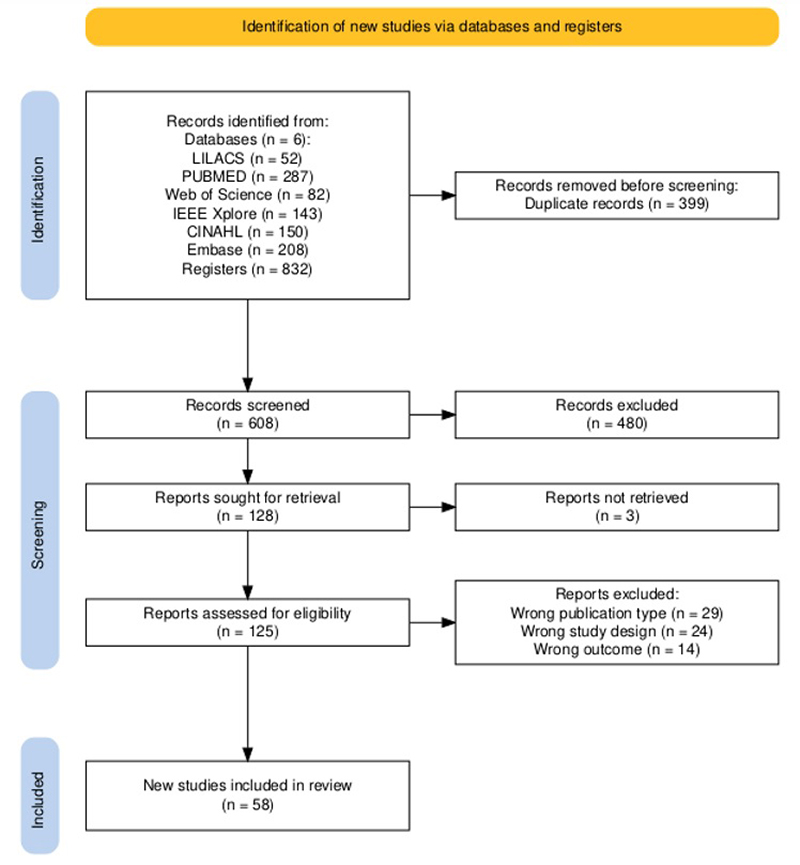
Of the 832 publications initially identified, two independent reviewers screened titles and abstracts according to predefined criteria, selecting 125 articles for full-text review. After detailed assessment for relevance and eligibility, 58 studies were included in the final sample. The Preferred Reporting Items for Systematic Reviews and Meta-Analyses (PRISMA) was used to describe the search and selection of studies (Figure 1).
The identified studies were primarily from countries in the Americas (n=36), including the United States (n=26), Brazil (n=5), and Canada (n=5). In terms of study design, most employed quantitative approaches (n=43), with cohort (n=14) and cross-sectional (n=13) types being prevalent. The remainder consisted of mixed-method (n=3) and qualitative (n=12) approaches, which included descriptive research (n=6), experience reports (n=3), and case studies (n=3). Regarding the publication period, there was a predominance of studies published in 2021 (n=19) and 2023 (n=18), underscoring the growing interest in this topic in recent years. The synthesis of the identified articles is detailed in Chart 3.
The analysis of the articles resulted in three thematic categories presented in Chart 4.
DISCUSSION
Theme 1: Technological innovations for care management in PHC during disaster situations
The scoping review analysis highlighted 22 articles investigating technological innovations for care management in PHC during disaster situations, where the Covid-19 pandemic was the primary focus (n=21).
In this context, telehealth emerged as a critical innovation for managing suspected or confirmed Covid-19 cases. Studies described telehealth as utilizing virtual platforms20,36,38,45,47, phone lines, and mobile messaging apps such as WhatsApp and SMS29,45,59,66,73. Studies56,59,66 showcased the adaptability of these pre-existing tools for new purposes during the pandemic, leveraging broad access to mobile devices, which ensured the flexibility of telemedicine, particularly for patients unable to attend video consultations. Furthermore, telehealth helped limit patient exposure to others, resulting in reduced case rates, hospitalizations, and mortality36,66.
On the use of intelligent tools and artificial intelligence, innovative systems were developed, such as CoSMoS, a bot-based symptom monitoring system developed in in Malaysia that used the Telegram messaging platform37; triage and tracking applications in South Africa70; and mathematical models in Turkey simulating outbreak scenarios67. In the United States, an algorithm identified patients that were more vulnerable to severe Covid-19 complications, utilizing demographic and chronic condition data27. In Brazil, spatial artificial intelligence optimized resources for the national Covid-19 vaccination campaign63, while in Italy, a deep learning-based decision tree was created to enhance triage and predict hospitalization needs for Covid-19 patients64.
Regarding management processes as a strategy to foster innovation in disaster situations in PHC, studies emphasize the organization of services and training of professionals to respond effectively to health emergencies. These studies highlight the importance of training health professionals32,69 on case management, the implementation of preventive measures, the appropriate use of personal protective equipment, safe handling of diagnostic samples, and psychological support for patients. Moreover, they underline the importance of public education by PHC teams during consultations, with the use of social media, online platforms, phone calls, and educational materials to disseminate reliable information32,70.
Other strategies identified as effective during the Covid-19 pandemic include: expanding the PHC workforce38,62; integrating resources for efficient regional use38,62; incorporating digital health into service delivery38,59,62,69; developing and implementing standardized operational procedures70 and teleconsultation manuals62; mobilizing PHC for surveillance and case diagnosis, providing community care, and conducting vaccination campaigns59,69-70; retaining highly trained teams experienced in public health emergencies62. Community health agents were highlighted as indispensable resources in delivering supplies and offering continuous patient follow-up69.
Additionally, one study on natural disasters75 stressed the critical importance of distinct phases in emergency management: preparation, response, and recovery. The study emphasized support for home care programs to assist teams and patients during natural disasters, including phone visits and the swift resumption of care for patients.
In the field of Nursing, technological innovations broaden the scope of practice, enabling remote monitoring, health education, coordination of multiprofessional teams, and epidemiological surveillance activities. However, they require preparation to handle digital platforms, critical evaluation of the algorithms used, and advocacy for the inclusion of the profession’s ethical principles in the governance of these technologies25,39,45,49. The recognition of nursing’s leadership, especially of community health workers in PHC69, highlights the need for articulation between technical-scientific training, professional recognition, and active participation in the definition and implementation of digital solutions, in order to ensure person-centered care and the reduction of inequalities.
Theme 2: Technological innovations and technologies for managing other health issues in PHC during disaster situations
This category included 33 articles that examined the expanded use of telehealth to manage various public health emergencies, such as the Covid-19 pandemic. It was evident that ICTs rapidly implemented during the pandemic were essential in maintaining healthcare quality, especially amid imposed physical restrictions21,25,34,42,57,77.
Telehealth was widely used across different types of consultations, especially for chronic conditions such as hypertension52 and diabetes mellitus23,52,58,69,72, allowing these conditions to be managed during and after the public health emergencies (23.
Researchers also detailed the use of telehealth for elderly patients31,33, stressing the necessity to improve the safety of care through investments in infrastructure and training policies. User privacy information and the benefits of telehealth were highlighted as essential33.
Innovations in using internet technology for communication and remote consultations were explored, including telephone consultations30, web platforms, and mobile health applications (mHealth)24,74. These technologies facilitate the collection and transmission of patient health data, like health history and biometric data, and integrate with connected devices like blood pressure cuffs and glucometers, providing PHC teams with crucial data for decision-making24.
A study identified telehealth as an efficient resource for vulnerable populations. For example, a study found that homeless populations maintained robust use of remote health services even with limited access to information technologies35. It was also crucial for the continuity of acute care sensitive to PHC28,among patients with acute myocardial infarction treated at home76, or in cases of pulmonary embolism managed without hospitalization43.
Programmatic PHC services, including pediatrics40 and mental health22,39,53,73, also benefited from telehealth, allowing continuity of care and mental health support even post-pandemic. This provides care opportunities for patients who otherwise might not attend a face-to-face consultation, such as higher-risk vulnerable populations, including elderly persons, pregnant women53, and rural patients39,71,73. Telepsychiatric triage models were developed to mitigate unmet mental health needs, especially in areas with professional shortages71.
Telehealth has proven to be an efficient resource for professional groups such as speech therapy services in PHC44, enabling remote service and expanding access for patients in regions with a shortage of specialized professionals, ensuring the continuity of necessary care. A study49 that explored telehealth use by occupational therapists, highlighted the development and implementation of new programs, as well as the expansion of existing initiatives in both disasters and day-to-day PHC delivery.
In management processes, innovations included the reordering of workflows to ensure preventive care and chronic disease management using both in-person and digital channels24. New analytical models were also proposed to optimize the primary care system and evaluate patient flow50, along with management strategies focused on patient centrality and interprofessional collaboration60. The development of public health information management systems61 and protocols, notably in opioid treatments integrated into PHC during disaster situations65, were other observed innovation fronts.
Satisfaction evaluations with telehealth usage indicated that elderly individuals and those with lower educational levels might require additional support to benefit from these technologies, resulting in lower satisfaction levels48,68. There were also reports of satisfaction with the implementation of electronic prescriptions68. The effectiveness of telehealth was greater when there were pre-existing clinical relationships between professionals and patients within the PHC context46,51. One study showed that telehealth did not increase the number of follow-up consultations or surpass the number of in-person consultations, often being considered an effective alternative to in-person consultations, depending on specific medical needs55.
Theme 3: Potentialities and challenges of technological innovations for disaster management in PHC
Technological innovations have shown various potentialities, such as accessibility provided by telehealth, benefiting particularly vulnerable patients and those in remote health areas30. This tool helped not only to reduce patient exposure during public health emergencies but also to protect professionals30,59.
These transformations are directly aligned with international guidelines, such as the WHO Global Digital Health Strategy (2020-2025), which emphasizes the role of technology in strengthening resilient and inclusive health systems. Additionally, frameworks like the Sendai Framework for Disaster Risk Reduction and the United Nations Office for Disaster Risk Reduction) (UNDRR) agenda reinforce the importance of digital governance, intersectoral integration, and community engagement for effective emergency response, especially in contexts of vulnerability.
However, challenges have emerged, such as digital inclusion, as older patients or those with lower educational levels might need more support to access these innovations48,54. Technical limitations, like the lack of equipment and appropriate infrastructure for video conferencing (such as broadband internet access), were also noted24,26, sometimes leading patients to prefer telehealth consultations with only audio53,56.
Another highlighted scenario is the limited capacity of these technologies to completely replace human contact in consultations, which restricts detailed physical examinations and impacts the building of a therapeutic bond30,45. As a result, some digital tools, like remote monitoring systems and health apps, are changing patient interactions with PHC professionals, leading to cost reductions24.
On the other hand, telehealth can also affect the work dynamics of health teams, exacerbating multitasking and requiring a careful assessment of the workload41,45. It is also imperative to address language and communication barriers to better integrate diverse communities and patients with disabilities24. Therefore, public policies should encourage and enhance these innovations with continuous support for learning and structural adaptation of PHC teams and cultural demands, effectively addressing inequalities in access between rural and urban areas25,39,45,49.
It is important for the nursing workforce to advocate for the integration of the profession’s ethical standards into the design, management, and governance of technological solutions, aligning with global guidelines from agencies such as the World Health Organization (WHO) and the Pan American Health Organization (PAHO)25,39,45,49.
CONCLUSION
Despite the expansion and positive impact of technological innovations in PHC during disaster situations, especially evident during the Covid-19 pandemic, important gaps remain. Digital access limitations, socioeconomic disparities, and communication barriers still restrict the reach and effectiveness of these solutions, particularly in vulnerable contexts.
For practice, it is recommended that health managers prioritize expanding digital infrastructure, promoting ongoing professional education, and adopting inclusive strategies to minimize digital exclusion. Strengthening management processes and adapting care flows to local realities are also essential for greater integration and rapid PHC response during emergencies.
In terms of public policy, there is an urgent need for regulatory frameworks that ensure the safe, ethical, and effective use of digital technologies, and for promoting intersectoral collaboration to address the social determinants underlying digital health inequities.
Future research should prioritize longitudinal and comparative studies on the impact of digital technologies in PHC, cost-effectiveness analyses, and investigations into user experiences and strategies to overcome contextual barriers.
In summary, digital innovations are strategic tools to strengthen the resilience and equity of PHC. Advancing public policies and research in this field is essential to ensure that the health system becomes more inclusive, prepared, and responsive to future emergencies.
Acknowledgments
This work was supported by the Research and Innovation Support Foundation of the State of Santa Catarina (FAPESC), Call No. 20/2024 - FAPESC Program to Promote Graduate Studies at Higher Education Institutions in the State of Santa Catarina - Postdoctoral Fellowships. Manuscript is part of the research project “Health promotion and training of professionals working in disasters: mixed intervention study” funded by FAPESC, Grant Agreement No.: 2024TR002332.
REFERENCES
-
1. Tasca R, Massuda A, Carvalho WM, Buchweitz C, Harzheim E. Recomendações para o fortalecimento da atenção primária à saúde no Brasil. Rev Panam Salud Publica. 2020;44:e4. https://doi.org/10.26633/RPSP.2020.4
» https://doi.org/10.26633/RPSP.2020.4 -
2. Ranzi DVM, Nachif MCA, Soranz DR, Marcheti PM, Santos MLM, Carli ADD. Laboratório de inovação na Atenção Primária à Saúde: implementação e desdobramentos. Ciênc Saúde Coletiva. 2021;26(6):1999-2011. https://doi.org/10.1590/1413-81232021266.02922021
» https://doi.org/10.1590/1413-81232021266.02922021 -
3. Silva CRDV, Lopes RH, Martiniano CS, Silva IS, Uchoa SAC. Conceito de saúde digital na atenção primária à saúde (2020-2022): um estudo baseado no método evolucionário de Rodgers. Bol Conjunt (BOCA). 2024;17(49):432-54. https://doi.org/10.5281/zenodo.10565467
» https://doi.org/10.5281/zenodo.10565467 -
4. Gonçalves LS, Wolff LD. Informática e Gestão em Enfermagem. In: Santos JLG, Lanzoni GMM, Erdmann AL. Gestão em Enfermagem e Saúde. Ponta Grossa, PR: Atena; 2023. https://doi.org/10.22533/at.ed.04923090619
» https://doi.org/10.22533/at.ed.04923090619 -
5. Avelar AFM, Santos LM. Technological innovation in health: back to origins. Rev Bras Enferm. 2021;74(Suppl 5):e74Suppl501. https://doi.org/10.1590/0034-7167.202174Suppl501
» https://doi.org/10.1590/0034-7167.202174Suppl501 -
6. OECD. Oslo Manual 2018: guidelines for collecting, reporting and using data on innovation. 4th Ed. Paris/Eurostat, Luxembourg: OECD Publishing; 2018. https://doi.org/10.1787/9789264304604-en
» https://doi.org/10.1787/9789264304604-en -
7. Noskoski LEC, Gysi E. Desafios climáticos e desastres naturais no Rio Grande do Sul: urgência de ações integradas e sustentáveis. Epitaya; 2024;1(76):41-6. https://doi.org/10.47879/ed.ep.2024486p41
» https://doi.org/10.47879/ed.ep.2024486p41 -
8. Rizzotto MLF, Costa AM, Dias AP, Corrêa HR Filho, Friedrich K, Augusto LGS. Saúde Única - um conceito ambíguo sob debate. Saúde Debate. 2024;48(143):e143ED. https://doi.org/10.1590/2358-28982024143ED-P
» https://doi.org/10.1590/2358-28982024143ED-P -
9. Lokmic-Tomkins Z, Block LJ, Davies S, Reid L, Ronquillo CE, von Gerich H, et al. Evaluating the representation of disaster hazards in SNOMED CT: gaps and opportunities. J Am Med Inform Assoc. 2023;30(11):1762-72. https://doi.org/10.1093/jamia/ocad153
» https://doi.org/10.1093/jamia/ocad153 -
10. Manfrini GC, Treich RS, Rumor PCF, Magagnin AB, Moncada MA, Furtado JR. Primary health care actions in natural disasters. Texto Contexto Enferm. 2020;29:e20180256. https://doi.org/10.1590/1980-265X-TCE-2018-0256
» https://doi.org/10.1590/1980-265X-TCE-2018-0256 - 11. Silveira TM. Contribuições do “Marco de Sendai” para a mineração no brasil. Pensar Acadêmico: Manhuaçu; 2021;19(3):900-28.
-
12. Organização Pan-Americana da Saúde (OPAS). Agenda de saúde sustentável para as Américas 2018-2030: um chamado à ação para a saúde e o bem-estar na Região [Internet]. 2019[cited 2025 Apr 2]. Available from: https://iris.paho.org/handle/10665.2/49172
» https://iris.paho.org/handle/10665.2/49172 -
13. Fernandes GCM, Treich RS, Costa MFBNA, Oliveira AB, Kempfer SS, Abeldaño RA. Atenção primária à saúde em situações de desastres: revisão sistemática. Rev Panam Salud Publica . 2019;43:e76. https://doi.org/10.26633/RPSP.2019.76
» https://doi.org/10.26633/RPSP.2019.76 -
14. Machado CV, Pereira AMM, Freitas CM, Souza MS, Tobar S, Oliveira SC. The response to COVID-19 in Argentina, Brazil, and Mexico: challenges to national coordination of health policies. Cad Saúde Pública. 2024;40(6):e00055023. https://doi.org/10.1590/0102-311XEN055023
» https://doi.org/10.1590/0102-311XEN055023 -
15. Rubinstein A. How Latin American Health Care Systems will respond to the next crises? lessons and challenges after the COVID-19 Pandemic. Arch Med Res. 2025;56(1):103069. https://doi.org/10.1016/j.arcmed.2024.103069
» https://doi.org/10.1016/j.arcmed.2024.103069 -
16. Galvão TF, Pansani TSA, Harrad D. Principais itens para relatar revisões sistemáticas e meta-análises: a recomendação PRISMA. Epidemiol Serv Saúde. 2015;24(2):335-42. https://doi.org/10.5123/S1679-49742015000200017
» https://doi.org/10.5123/S1679-49742015000200017 -
17. Haddaway NR, Page MJ, Pritchard CC, McGuinness LA. PRISMA2020: An R package and Shiny app for producing PRISMA 2020-compliant flow diagrams, with interactivity for optimised digital transparency and Open Synthesis. Campbell System Rev. 2022:18;e1230. https://doi.org/10.1002/cl2.1230
» https://doi.org/10.1002/cl2.1230 - 18. Melnyk BM, Fineout-Overholt E. Evidence-based practice in nursing and healthcare: a guide to best practice. Hagerstown, MD: Lippincott Williams & Wilkins; 2004.
- 19. Bardin L. Análise de Conteúdo. 70. ed. São Paulo: Almedina Brasil; 2016.
-
20. Oliveira FBM, Santos MBL, Santos CJA, Santos MS, Cunha HGSS, Silva LLL, et al. Teleconsulta de enfermagem: desenvolvimento de plataforma para atendimento de casos de Covid-19. Arq Ciên Saúde UNIPAR. 2023;27(2): 931-47. https://doi.org/10.25110/arqsaude.v27i2.2023-023
» https://doi.org/10.25110/arqsaude.v27i2.2023-023 -
21. Herrera AG, Piccioli S, Ruíz Yanzi MV, Luna DR, Plazzotta F, Kopitowski KS, et al. Mayor uso de teleconsultas programadas y mensajería asíncronica del portal en atención primaria. Rev Hosp Ital B Aires [Internet]. 2023[cited 2025 Apr 2];43(4):174-80. Available from: https://ojs.hospitalitaliano.org.ar/index.php/revistahi/article/view/257
» https://ojs.hospitalitaliano.org.ar/index.php/revistahi/article/view/257 -
22. Ponce de León E, Gallinal M, Fernández P, Bernardi RE. Experiencia de la línea 0800 1920 durante la emergencia sanitaria por la covid-19 en Uruguay durante el período abril-diciembre 2020. Rev Psiquiatr Urug. 2023;87(1): 7-29. https://doi.org/10.46706/PSI/87.1.1
» https://doi.org/10.46706/PSI/87.1.1 -
23. Silva-Tinoco R, Torre-Saldaña V. La imperiosa necesidad de telemedicina en la atención de diabetes durante la pandemia de COVID-19: un estudio de abordaje integral. Gac Méd Méx. 2021;157(3):323-26. https://doi.org/10.24875/gmm.20000674
» https://doi.org/10.24875/gmm.20000674 -
24. Jeong Y, Crowell T, Devon-Sand A, Sakata T, Sattler A, Shah S, et al. Building pandemic-resilient primary care systems: lessons learned from COVID-19. J Med Internet Res. 2024;26:e47667. https://doi.org/10.2196/47667
» https://doi.org/10.2196/47667 -
25. Tilhou AS, Jain A, DeLeire T. Telehealth expansion, internet speed, and primary care access before and during COVID-19. JAMA Netw Open. 2024;7(1):e2347686. https://doi.org/10.1001/jamanetworkopen.2023.47686
» https://doi.org/10.1001/jamanetworkopen.2023.47686 -
26. Friedman HR, Konstanzer J, Richman E, Cass B, Hodge B, Denslow S, Halladay J. Primary Care Practices in Western North Carolina: adaptation to the COVID-19 Pandemic and Ongoing Challenges. HCA Healthc J Med. 2021;2(6):433-440. https://doi.org/10.36518/2689-0216.1331
» https://doi.org/10.36518/2689-0216.1331 -
27. Amon C, King J, Colclasure J, Hodge K, DuBard CA. Leveraging Accountable Care Organization infrastructure for rapid pandemic response in independent primary care practices. Healthcare. 2022;10(2): 100623. https://doi.org/10.1016/j.hjdsi.2022.100623
» https://doi.org/10.1016/j.hjdsi.2022.100623 -
28. Li KY, Ng S, Zhu Z, McCullough JS, Kocher KE, Ellimoottil C. Association between primary care practice telehealth use and acute care visits for ambulatory care-sensitive conditions during COVID-19. JAMA Netw Open . 2022;5(3):e225484. https://doi.org/10.1001/jamanetworkopen.2022.5484
» https://doi.org/10.1001/jamanetworkopen.2022.5484 -
29. Margolius D, Hennekes M, Yao J, Einstadter D, Gunzler D, Chehade N, et al. On the Front (Phone) Lines: results of a COVID-19 Hotline. J Am Board Fam Med. 2021;34(Suppl):S95-S102. https://doi.org/10.3122/jabfm.2021.S1.200237
» https://doi.org/10.3122/jabfm.2021.S1.200237 -
30. Breton M, Deville-Stoetzel N, Gaboury I, Smithman MA, Kaczorowski J, Lussier MT, et al. Telehealth in Primary Healthcare : a portrait of its rapid implementation during the COVID-19 Pandemic. Healthc Pol. 2021;17(1):73-90. https://doi.org/10.12927/hcpol.2021.26576
» https://doi.org/10.12927/hcpol.2021.26576 -
31. Goldberg EM, Jiménez FN, Chen K, Davoodi NM, Li M, Strauss DH, et al. Telehealth was beneficial during COVID-19 for older Americans: a qualitative study with physicians. J Am Geriatr Soc. 2021;69(11):3034-43. https://doi.org/10.1111/jgs.17370
» https://doi.org/10.1111/jgs.17370 -
32. Tse DMS, Li Z, Lu Y, Li Y, Liu Y, Wong WCW. Fighting against COVID-19: preparedness and implications on clinical practice in primary care in Shenzhen, China. BMC Fam Pract. 2020;21:271. https://doi.org/10.1186/s12875-020-01343-2
» https://doi.org/10.1186/s12875-020-01343-2 -
33. Chen K, Davoodi NM, Strauss DH, Li M, Jiménez FN, Guthrie KM, et al. Strategies to ensure continuity of care using telemedicine with older adults during COVID-19: a qualitative study of physicians in primary care and geriatrics. J Appl Gerontol. 2022;41(11):2282-95. https://doi.org/10.1177/07334648221109728
» https://doi.org/10.1177/07334648221109728 -
34. Solans O, Vidal-Alaball J, Roig Cabo P, Mora N, Coma E, Bonet Simó JM, et al. Characteristics of Citizens and Their Use of Teleconsultations in Primary Care in the Catalan Public Health System Before and During the COVID-19 Pandemic: retrospective descriptive cross-sectional study. J Med Internet Res . 2021;23(5):e28629. https://doi.org/10.2196/28629
» https://doi.org/10.2196/28629 -
35. Leung LB, Zhang E, Chu K, Yoo C, Gabrielian S, Der-Martirosian C. Characteristics of veterans experiencing homelessness using telehealth for primary care before and after COVID-19 Pandemic Onset. J Gen Intern Med. 2024;39(Suppl 1):53-59. https://doi.org/10.1007/s11606-023-08462-3
» https://doi.org/10.1007/s11606-023-08462-3 -
36. Gruber E, Perman C, Grisham R, Adashi EY, Haft H. Association of participation in the maryland primary care program with COVID-19 outcomes among medicare beneficiaries. JAMA Netw Open . 2023;6(1):e2249791. https://doi.org/10.1001/jamanetworkopen.2022.49791
» https://doi.org/10.1001/jamanetworkopen.2022.49791 -
37. Lim HM, Abdullah A, Ng CJ, Teo CH, Valliyappan IG, Abdul Hadi H, et al. Utility and usability of an automated COVID-19 symptom monitoring system (CoSMoS) in primary care during COVID-19 pandemic: a qualitative feasibility study. Int J Med Inform. 2021;155:104567. https://doi.org/10.1016/j.ijmedinf.2021.104567
» https://doi.org/10.1016/j.ijmedinf.2021.104567 -
38. Gong F, Hu G, Lin H, Sun X, Wang W. Integrated healthcare systems response strategies based on the luohu model during the COVID-19 epidemic in Shenzhen, China. Int J Integr Care. 2021;21(1):1. https://doi.org/10.5334/ijic.5628
» https://doi.org/10.5334/ijic.5628 -
39. Leung LB, Yoo C, Chu K, O'Shea A, Jackson NJ, Heyworth L, et al. Rates of primary care and integrated mental health telemedicine visits between rural and urban veterans affairs beneficiaries before and after the onset of the COVID-19 pandemic. JAMA Netw Open . 2023;6(3):e231864. https://doi.org/10.1001/jamanetworkopen.2023.1864
» https://doi.org/10.1001/jamanetworkopen.2023.1864 -
40. Schweiberger K, Hoberman A, Iagnemma J, Schoemer P, Squire J, Taormina J, et al. Practice-Level variation in telemedicine use in a pediatric primary care network during the COVID-19 pandemic: retrospective analysis and survey study. J Med Internet Res . 2020;22(12):e24345. https://doi.org/10.2196/24345
» https://doi.org/10.2196/24345 -
41. Apathy NC, Zabala G, Gomes K, Spaar P, Krevat SA, Ratwani RM. Telemedicine and in-person visit modality mix and electronic health record use in primary care. JAMA Netw Open . 2024;7(4):e248060. https://doi.org/10.1001/jamanetworkopen.2024.8060
» https://doi.org/10.1001/jamanetworkopen.2024.8060 -
42. Gujral K, Scott JY, Dismuke-Greer CE, Jiang H, Wong E, Yoon J. The clinical resource hub telehealth program and use of primary care, emergency, and inpatient care during the COVID-19 pandemic. J Gen Intern Med . 2024;39(Suppl 1):118-26. https://doi.org/10.1007/s11606-023-08476-x
» https://doi.org/10.1007/s11606-023-08476-x -
43. Chang J, Isaacs DJ, Leung J, Vinson DR. Comprehensive management of acute pulmonary embolism in primary care using telemedicine in the COVID-era. BMJ Case Rep. 2021;14(6):e243083. https://doi.org/10.1136/bcr-2021-243083
» https://doi.org/10.1136/bcr-2021-243083 -
44. Dimer NA, Canto-Soares N, Santos-Teixeira L, Goulart BNG. Pandemia do COVID-19 e implementação de telefonoaudiologia para pacientes em domicílio: relato de experiência. CoDAS. 2020;32(3):e20200144. https://doi.org/10.1590/2317-1782/20192020144
» https://doi.org/10.1590/2317-1782/20192020144 -
45. Nkodo AF, Gonzalez MM, Reves S, Etz RS. Telemedicine Adoption During COVID-19 Pandemic: perspectives from primary care clinicians in safety-net settings. J Am Board Fam Med . 2024;37(3):409-17. https://doi.org/10.3122/jabfm.2023.230339R1
» https://doi.org/10.3122/jabfm.2023.230339R1 -
46. Lapointe-Shaw L, Salahub C, Austin PC, Bai L, Bhatia RS, Bird C, et al. Virtual visits with own family physician vs outside family physician and emergency department use. JAMA Netw Open . 2023;6(12):e2349452. https://doi.org/10.1001/jamanetworkopen.2023.49452
» https://doi.org/10.1001/jamanetworkopen.2023.49452 -
47. Marcolino MS, Diniz CS, Chagas BA, Mendes MS, Prates R, Pagano A, et al. Synchronous teleconsultation and monitoring service targeting COVID-19: leveraging insights for postpandemic health care. JMIR Med Inform. 2022;10(12):e37591. https://doi.org/10.2196/37591
» https://doi.org/10.2196/37591 -
48. Lifford KJ, Grozeva D, Cannings-John R, Quinn-Scoggins H, Moriarty Y, Gjini A, et al. Satisfaction with remote consultations in primary care during COVID-19: a population survey of UK adults. Br J Gen Pract. 2024;74(739):e96-e103. https://doi.org/10.3399/BJGP.2023.0092
» https://doi.org/10.3399/BJGP.2023.0092 -
49. Brown CL, Chartrand L, Vollebregt B, Kaur D, Crawford T, Thille P. Primary care occupational, physical, and respiratory therapy role adaptation in the first year of the COVID-19 pandemic. BMC Prim Care. 2024;25(1):3. https://doi.org/10.1186/s12875-023-02247-7
» https://doi.org/10.1186/s12875-023-02247-7 -
50. Prakash AM, Zhong X. Queueing Information Management of Primary Care Delivery With E-Visits. IEEE Transactions on Automation Science and Engineering. 2022;19(2):632-45. https://doi.org/10.1109/TASE.2021.3115355
» https://doi.org/10.1109/TASE.2021.3115355 -
51. Alghamdi A, Ramsay AIG, Abrams R, Bailey JV. The impact of COVID-19 on patient engagement with primary healthcare: lessons from the Saudi primary care setting. BMC Prim Care. 2023;24(1):177. https://doi.org/10.1186/s12875-023-02131-4
» https://doi.org/10.1186/s12875-023-02131-4 -
52. Dehghani Tafti A, Fatehpanah A, Salmani I, Bahrami MA, Tavangar H, Fallahzadeh H, et al. COVID-19 pandemic has disrupted the continuity of care for chronic patients: evidence from a cross-sectional retrospective study in a developing country. BMC Prim Care . 2023;24(1):137. https://doi.org/10.1186/s12875-023-02086-6
» https://doi.org/10.1186/s12875-023-02086-6 -
53. Tobin ET, Hadwiger A, DiChiara A, Entz A, Miller-Matero LR. Demographic predictors of telehealth use for integrated psychological services in primary care during the COVID-19 pandemic. J Racial Ethn Health Dispar. 2023;10(3):1492-98. https://doi.org/10.1007/s40615-022-01334-2
» https://doi.org/10.1007/s40615-022-01334-2 -
54. Hamilton Y, Cairns A, Jones R. Impact of the COVID-19 pandemic on primary care delivery in a remote aboriginal community. Aust J Prim Health. 2023;29(5):416-21. https://doi.org/10.1071/PY23026
» https://doi.org/10.1071/PY23026 -
55. Cao YJ, Chen D, Smith M. Use telehealth as needed: telehealth substitutes in-person primary care and associates with the changes in unplanned events and follow-up visits. BMC Health Serv Res. 2023;23(1):426. https://doi.org/10.1186/s12913-023-09445-0
» https://doi.org/10.1186/s12913-023-09445-0 -
56. Harada F, Takita M, Yamamoto K, Tachiya Y, Yamamoto C, Saito H, et al. Rethinking the utility of the audio-only encounter: a case of herpes zoster co-infection in asymptomatic SARS-CoV-2. Clin Med Insights Case Rep. 2023;16:11795476231218073. https://doi.org/10.1177/11795476231218073
» https://doi.org/10.1177/11795476231218073 -
57. Der-Martirosian C, Chu K, Steers WN, Wyte-Lake T, Balut MD, Dobalian A, et al. Examining telehealth use among primary care patients, providers, and clinics during the COVID-19 pandemic. BMC Prim Care 2022;23:155. https://doi.org/10.1186/s12875-022-01738-3
» https://doi.org/10.1186/s12875-022-01738-3 -
58. Swidan A, Alnoo NA, Makki I, Zidan M, Alhammadi H, Rahmani N, et al. Effect of COVID-19 pandemic on patient utilization of the telemedicine services in Dubai. Dubai Med J. 2022;5(2):110-6. https://doi.org/10.1159/000522346
» https://doi.org/10.1159/000522346 -
59. Goodyear-Smith F, Kidd M, Oseni TIA, Nashat N, Mash R, Akman M, et al. International examples of primary care COVID-19 preparedness and response: a comparison of four countries. Fam Med Community Health. 2022;10(2):e001608. https://doi.org/10.1136/fmch-2022-001608
» https://doi.org/10.1136/fmch-2022-001608 -
60. Ben Charif A, Zomahoun HTV, Massougbodji J, Khadhraoui L, Pilon MD, Boulanger E. Assessing the scalability of innovations in primary care: a cross-sectional study. CMAJ Open. 2020;8(4):E613-E618. https://doi.org/10.9778/cmajo.20200030
» https://doi.org/10.9778/cmajo.20200030 -
61. Zhao Y, Liu L, Qi Y, Lou F, Zhang J, Ma W. Evaluation and design of public health information management system for primary health care units based on medical and health information. J Infect Public Health. 2020;13(4):491-96. https://doi.org/10.1016/j.jiph.2019.11.004
» https://doi.org/10.1016/j.jiph.2019.11.004 -
62. Silva RS, Schmtiz CAA, Harzheim E, Molina-Bastos CG, Oliveira EB, Roman R, et al. O papel da telessaúde na pandemia Covid-19: uma experiência brasileira. Ciênc Saúde Coletiva . 2021;26(6):2149-57. https://doi.org/10.1590/1413-81232021266.39662020
» https://doi.org/10.1590/1413-81232021266.39662020 -
63. Rocha TAH, Boitrago GM, Monica RB, Almeida DG, Silva NC, Silva DM, et al. Plano nacional de vacinação contra a COVID-19: uso de inteligência artificial espacial para superação de desafios. Ciênc Saúde Coletiva 2021;26(5):1885-98. https://doi.org/10.1590/1413-81232021265.02312021
» https://doi.org/10.1590/1413-81232021265.02312021 -
64. Vetrugno G, Laurenti P, Franceschi F, Foti F, D'Ambrosio F, Cicconi M, et al. Gemelli decision tree Algorithm to Predict the need for home monitoring or hospitalization of confirmed and unconfirmed COVID-19 patients (GAP-Covid19): preliminary results from a retrospective cohort study. Eur Rev Med Pharmacol Sci. 2021;25(6):2785-94. https://doi.org/10.26355/eurrev_202103_25440
» https://doi.org/10.26355/eurrev_202103_25440 -
65. O'Gurek DT. Designing and Evaluating COVID-19 Protocols for an Office-Based Opioid Treatment Program in an Urban Underserved Setting. J Am Board Fam Med . 2021 Feb;34(Suppl):S136-40. https://doi.org/10.3122/jabfm.2021.S1.200207
» https://doi.org/10.3122/jabfm.2021.S1.200207 -
66. Tarn DM, Hintz C, Mendez-Hernandez E, Sawlani SP, Bholat MA. Using virtual visits to care for primary care patients with COVID-19 symptoms. J Am Board Fam Med . 2021;34(Suppl):S147-51. https://doi.org/10.3122/jabfm.2021.S1.200241
» https://doi.org/10.3122/jabfm.2021.S1.200241 -
67. Tunaligil V, Meral G, Dabak MR, Canbulat M, Demir SS. COVID-19 and the flu: data simulations and computational modelling to guide public health strategies. Fam Pract. 2021;38(Suppl 1):i16-i22. https://doi.org/10.1093/fampra/cmab058
» https://doi.org/10.1093/fampra/cmab058 -
68. Grosman-Dziewiszek P, Wiatrak B, Jęśkowiak I, Szeląg A. Patients' habits and the role of pharmacists and telemedicine as elements of a modern health care system during the COVID-19 Pandemic. J Clin Med. 2021;10(18):4211. https://doi.org/10.3390/jcm10184211
» https://doi.org/10.3390/jcm10184211 -
69. Ray S, Mash R. Innovation in primary health care responses to COVID-19 in Sub-Saharan Africa. Prim Health Care Res Dev. 2021;22:e44. https://doi.org/10.1017/S1463423621000451
» https://doi.org/10.1017/S1463423621000451 -
70. Rispel LC, Marshall C, Matiwane B, Tenza IS. Innovations, contestations and fragilities of the health system response to COVID-19 in the Gauteng Province of South Africa. PLoS One. 2021;16(12):e0261339. https://doi.org/10.1371/journal.pone.0261339
» https://doi.org/10.1371/journal.pone.0261339 -
71. Agley J, Barnes P, Tidd D, Todd A, Friedman K, Gordon S. Integrating telepsychiatry into rural primary care for upstream prevention: feasibility case study of the faith net program. Inquiry. 2022;59:469580221097428. https://doi.org/10.1177/00469580221097428
» https://doi.org/10.1177/00469580221097428 -
72. Nouri S, Lyles CR, Sherwin EB, Kuznia M, Rubinsky AD, Kemper KE, et al. Visit and between-visit interaction frequency before and after COVID-19 Telehealth Implementation. JAMA Netw Open . 2023;6(9):e2333944. https://doi.org/10.1001/jamanetworkopen.2023.33944
» https://doi.org/10.1001/jamanetworkopen.2023.33944 -
73. Mathews M, Liu T, Ryan D, Hedden L, Lukewich J, Marshall EG, et al. Practice- and system-based interventions to reduce COVID-19 transmission in primary care settings: a qualitative study. Healthc Policy. 2023;19(2):63-78. https://doi.org/10.12927/hcpol.2023.27232
» https://doi.org/10.12927/hcpol.2023.27232 -
74. Sanchez K, Kitzman H, Khan M, Graca B, Zsohar J, McStay F. Use of telehealth early and late in the COVID-19 public health emergency: policy implications for improving health equity. J Am Board Fam Med . 2023;36(5):746-54. https://doi.org/10.3122/jabfm.2023.230080R1
» https://doi.org/10.3122/jabfm.2023.230080R1 -
75. Wyte-Lake T, Der-Martirosian C, Chu K, Johnson-Koenke R, Dobalian A. Preparedness and response activities of the US Department of Veterans Affairs (VA) home-based primary care program around the fall 2017 hurricane season. BMC Public Health. 2020;20(1):1796. https://doi.org/10.1186/s12889-020-09888-8
» https://doi.org/10.1186/s12889-020-09888-8 -
76. Abrashkin KA, Zhang J, Poku A. Acute, post-acute, and primary care utilization in a home-based primary care program during COVID-19. Gerontologist. 2021;61(1):78-85. https://doi.org/10.1093/geront/gnaa158
» https://doi.org/10.1093/geront/gnaa158 -
77. Sturgiss E, Desborough J, Hall Dykgraaf S, Matenge S, Dut G, Davis S, et al. Digital health to support primary care provision during a global pandemic. Aust Health Rev. 2022;46(3):269-72. https://doi.org/10.1071/AH21263
» https://doi.org/10.1071/AH21263
Access to the dataset may be obtained upon request from the corresponding author.