 The potential of essential oils as mosquito (Diptera: Culicidae) bio-repellents: a systematic review
ABSTRACT
Controlling culicid-borne diseases remains a global public health challenge. While public health actions are vital, individual protection via repellents is essential. Concerns regarding synthetic compounds such as DEET have intensified the search for sustainable plant-derived alternatives. This systematic review analyzed 33 experimental studies that were published from 2020 to 2024. A comprehensive search was performed on SciELO, PubMed, Scopus, Web of Science, ScienceDirect, and LILACS using the keywords "Repellency," "Essential Oils," and "Mosquitoes." Data were independently selected and extracted to evaluate protection time and repellency percentages. The included studies showed low risk of methodological bias according to SYRCLE. Results showed that most of the tested essential oils possess high protective potential. Species such as Perilla frutescens, Leucas stachydiformis, Cymbopogon nardus, and Eucalyptus camaldulensis achieved up to 100% repellency, with protection exceeding eight hours. The cage test was the predominant laboratory method. Essential oils are promising, effective alternatives to synthetic repellents, offering reduced environmental and toxicological impacts. However, this evidence is based on controlled laboratory conditions rather than field trials. This limitation may affect real-world effectiveness, and further research in natural environments is recommended to validate these results for commercial application.
KEYWORDS:
Repellents; Essential oils; Culicidae; Pathogens
INTRODUCTION
Mosquito control configures a global public health challenge due to their role as vectors of arboviruses and parasites that cause disease, such as dengue, yellow fever, zika, chikungunya, filariasis, and malaria, which drives the growing search for effective and safe control methods1. These pathogens affect millions of people worldwide, significantly impacting tropical and subtropical regions1.
Traditional strategies for controlling mosquito vectors primarily rely on integrated management approaches. These commonly include the use of chemical larvicides and adulticides, the distribution of insecticide-treated bed nets, and environmental management that aim to eliminate breeding sites to reduce vector populations2,3.
Although actions by public health agencies are fundamental, individual protection via personal repellents is essential to reduce the frequency of bites and the risk of infection3. However, the continuous use of synthetic repellents, such as DEET (N,N-diethyl-3-methylbenzamide) and Icaridin, has raised concerns due to their potential adverse effects, including skin irritation, neurotoxicity, and environmental impact4,5. Despite their widespread use, these traditional methods face growing challenges, such as the emergence of insecticide resistance and the need for continuous community engagement2 hence the increasing interest in sustainable and eco-friendly alternatives, particularly plant-derived essential oils, which offer a promising path for safe and effective mosquito control6.
These oils show bioactive properties, including antimicrobial, antioxidant, and, notably, repellent activities5. Oils from species such as Corymbia citriodora (Hook.), citronella (Cymbopogon spp.), and andiroba (Carapa guianensis Aubl.) have been widely studied for their ability to repel mosquitoes such Aedes aegypti (the primary vector of dengue, zika, and chikungunya viruses) and Anopheles spp. (responsible for transmitting Plasmodium parasites that cause malaria)7,8.
This systematic review aims to investigate the scientific literature for evidence on the efficacy of essential oils as repellents to prevent contact with vector mosquitoes, focusing on safe and effective alternatives for individual protection.
MATERIALS AND METHODS
Protocol design and registration
This review sought to answer the guiding question: "What is the evidence for the efficacy of essential oil-based repellency tests against mosquitoes in humans?" For this end, this study was designed according to the Preferred Reporting Items for Systematic Reviews (PRISMA) 20209 and submitted to the International Prospective Register of Systematic Reviews for methodological analysis under registration Nº CRD42024613854.
Source of information and search strategy
Searches were conducted on the following electronic databases: Scientific Electronic Library Online, US National Library of Medicine, Web of Science, Scopus, ScienceDirect, and LILACS. The Boolean operator "AND" was used between the terms "Repellency," "Essential Oils," and "Mosquitoes."
Eligibility criteria
Studies were included in this review if they met the following criteria: (I) published in English, Portuguese, and Spanish; (II) studies that verified the repellent effect of essential oils on Culicidae; and (III) studies that reported efficacy using at least one of the following indicators: protection time (minutes/hours) or percentage of repellency. The following were excluded: systematic reviews, field studies with repellents, studies that used nanotechnology (e.g., nanoemulsions, emulsions), studies that used non-human animals in repellency tests, studies on repellents focusing on other organisms (such as ticks or agricultural fungicides), studies that used extracts in repellency tests, and studies prior to 2020. Moreover, studies from which it was impossible to extract information were also excluded. The screening of titles and abstracts was performed by three researchers (APR, ESD, and KCS), and the full text of the articles was read independently by two researchers (APR and ESD).
Study selection and data extraction
The search results were exported to the Mendeley reference manager (version 1.18) for duplicate removal. Subsequently, the files were uploaded to Rayyan QCRI for study selection. Initially, titles and abstracts were screened by three independent researchers (APR, ESD, and KCS), with a third researcher (KCS) acting as an arbiter in cases of disagreement. Following this initial screening, the full texts were read independently by two authors (APR and ESD).
The extracted data were plotted onto Microsoft Excel 2019 spreadsheets. The categories for extraction included study type (laboratory), publication period (2020–2024), target population (humans or different mosquito species), repellent types (comparison between natural and synthetic), language, and efficacy assessment methods. Additionally, methodological quality parameters, such as clear sample definition, experiment replicability, and statistical analysis, were recorded. Any discrepancies during data synthesis were resolved by a third researcher (KCS).
Risk of bias
Overall, two authors (APR and ESD) assessed the risk of bias using the systematic review centre for laboratory animal experimentation (SYRCLE) tool for animal studies, which is an adapted version of the Cochrane RoB tool10. The choice of this tool is justified by the methodological aspects related to the handling of mosquitoes (Culicidae), which constitute the animal model for the repellency assays. The tool includes domains such as selection, performance, detection, attrition, reporting, and other biases. Signaling questions are applied to the articles to aid in judgment: "Yes" indicates a low risk of bias, "No" indicates a high risk of bias, and "?" indicates an unclear risk of bias.
RESULTS
Study selection
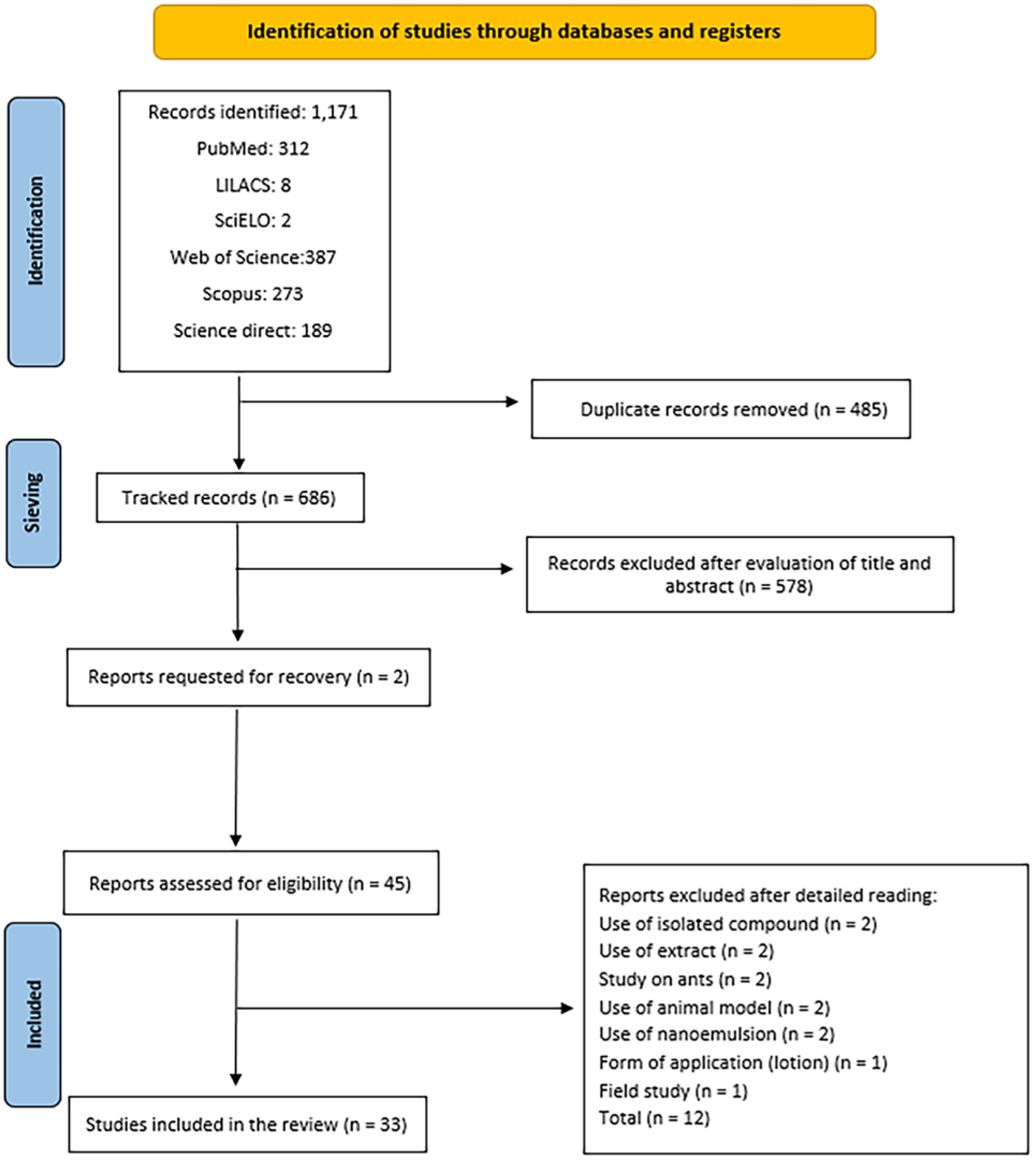
The initial search retrieved 1,171 records from the six electronic databases. After removing duplicates and selecting titles and abstracts, this study evaluated 45 full-text articles for eligibility. Of these, 33 studies were considered eligible for inclusion in this review. The PRISMA flow diagram (Figure 1) details the complete selection process and reasons for exclusion.

Regarding efficacy parameters, 26 studies (78.8%) reported protection time and repellency percentage, whereas seven (21.2%), only one of these metrics. To ensure a comprehensive synthesis, eligibility criteria included studies that provided at least one of these primary outcomes.
Characteristics of the included studies
This review only included studies that met the inclusion criteria for essential oil-based repellents against Culicidae. The selected studies were published from 2020 to 2024 and conducted in laboratories. Table 1 shows the characteristics and main results of the studies. Overall, the studies were conducted in several countries, with the following distribution: Pakistan (n=6; 18.2%), Thailand (n=4; 12.1%), China (n=3; 9.1%), India (n=3; 9.1%), Brazil (n=3; 9.1%), Indonesia (n=2; 6.1%), Vietnam (n=1; 3.0%), Ethiopia (n=1; 3.0%), Uganda (n=1; 3.0%), Ghana (n=1; 3.0%), Madagascar (n=1; 3.0%), Italy (n=1; 3.0%), Iran (n=1; 3.0%), Greece (n=1; 3.0%), Kenya (n=1; 3.0%), Malaysia (n=1; 3.0%), and one study fail to specify the location in which it was carried out (n=1; 3.0%).
Stratification of the description of studies included in the systematic review on the potential of essential oils as mosquito (Diptera: Culicidae) bio-repellents
Data analysis and synthesis of evidence
The essential oils were stratified according to their repellency percentage, ranging from 10% to 100%.
The highest repellency percentages occurred in Perilla frutescens, Leucas stachydiformis, Eucalyptus camaldulensis, Artemisia scoparia, Cymbopogon nardus, Lavandula latifolia, and Salvia moorcroftiana essential oils, all showing 100% repellency. Concentrations of 5% and 10% of Perilla frutescens essential oil achieved 100% repellency against Aedes aegypti.
Regarding the essential oils with the longest protection times, Leucas stachydiformis, Homalomena aromatica, Citrus macroptera, Eucalyptus benthamii, and Ocimum basilicum L. were notable against several culicid species. Of the 33 chosen articles, 24 had data on protection time and repellency percentage, whereas seven only described their results on repellency percentages.
The following section describes the essential oils from plant species most frequently investigated as repellents (that is, in more than two studies).
Cymbopogon spp (Citronella)
This research found that five studies investigated Cymbopogon spp. essential oils2,7,8,11,12, showing their prominence as candidates for natural repellents due to their high content of active compounds, such as citronellal, extracted from various species of this genus.
Brito et al.7 assessed the repellent activity of Cymbopogon winterianus essential oil against Aedes aegypti, with a protection rate of 70%. The authors also found citronella (22.8%) as one of the main constituents of the essential oil.
Haris et al.13 observed that the essential oil of Cymbopogon citratus provided 100% protection against female Aedes aegypti. Conversely, Mustapa et al.11 evaluated the repellent activity of essential oils from various plants, including Cymbopogon nardus, against Aedes aegypti, Anopheles stephensi, and Culex quinquefasciatus. At a concentration of 100 ppm, these oils showed high efficacy, with repellency rates ranging from 84% to 96% and providing protection for up to eight hours.
Kamaraj et al.8 also conducted studies with Cymbopogon nardus and other species against Aedes aegypti, Anopheles stephensi, and Culex quinquefasciatus, achieving repellency rates ranging from 84% to 96%, with a protection time of up to eight hours. Sutthanont et al.12 tested a 10% solution of Cymbopogon nardus against Aedes aegypti, Anopheles dirus, and Culex quinquefasciatus, recording protection time of 90, 180, and 360 min, respectively.
Eucalyptus spp.
Investigations were carried out on Eucalyptus species. Brito et al.7 chose Eucalyptus globulus for repellency tests against Aedes aegypti, achieving a protection rate above 70%. Haris et al.13 studied the essential oils of Eucalyptus camaldulensis and other species, obtaining protection rates ranging from 10% to 100% depending on the concentration (33 to 330 μg), as detailed in Table 1.
Kamaraj et al.8 and Sheikh et al.2 investigated the repellent effect of Eucalyptus globulus, reporting repellency rates greater than 83%. However, protection times varied considerably between studies, with Kamaraj et al.8 recording up to eight hours (at 100 ppm), whereas Sheikh et al.2 observed shorter protection periods, ranging from 15 to 45 min, depending on the concentration.
Ocimum basilicum (Basil)
Ocimum basilicum, a species of the Lamiaceae family, is known for its repellent activity. Opoku-Bamfoh et al.14 tested 20%, 40%, 60%, 80%, and 90% concentrations and obtained protection that ranged from 50% to 90% depending on the concentration and protection times of 84 to 105 min.
Sutthanont et al.12 reported the protection time against three culicid species (Aedes aegypti, Anopheles dirus, and Culex quinquefasciatus) using 100 µL of the undiluted essential oil. This study (carried out in Thailand) showed that the protection against Aedes aegypti totaled 180 min; Anopheles dirus, 90 min; and Culex quinquefasciatus, 360 min.
Ludia et al.3 observed similar results using 10%, 15%, 20%, and 25% essential oil concentrations in tests against Aedes aegypti. The concentrations showed a repellent effect of 98% to 100% in the first hour, which decreased to 67.6% and 81.3% after six hours.
Mentha spp. (Mint)
The genus Mentha is of great importance within the Lamiaceae family, with wide distribution and cultivation in various countries. The pharmaceutical industry extensively uses its essential oil for medicinal purposes due to its safety and popularity among consumers15. This research found that five of the included studies reported the repellent effects of Mentha spp..
Abbas et al.4 found that the essential oil of Mentha longifolia showed 100% repellency immediately after application (comparable to DEET), an effect that lasted for up to two hours. Iqbal et al.16 and Haris et al.13 also observed a similar effect with the same species but with a protection time of up to 90 min.
The retrieved research also evaluated other species. Manh et al.5 investigated Mentha arvensis L. against Aedes aegypti, obtaining 45% to 100% protection at concentrations of 25%, 50%, and 100%. Furthermore, Kamaraj et al.8 observed that 100 ppm of the Mentha arvensis L. essential oil provided 84% to 95% repellency for up to eight hours.
Citrus spp. (Citrus fruits)
This research found that four of its studies investigated the repellent effects of Citrus spp., a genus that includes various citrus fruits.
In Haris et al.13, the essential oil of Citrus reticulata at concentrations of 33, 165, and 330 µg/cm2 showed 100% repellency against Aedes aegypti, with protection time ranging from 60 to 135 min. Another study using Citrus macroptera found the protection time ranged from four to six hours17.
Kamaraj et al.8 studied Citrus limon L., which provided up to eight hours of protection. Sutthanont et al.12 evaluated the repellent activity of two species, Citrus bergamia (bergamot) and Citrus aurantium (bitter orange), using 100 µL of the undiluted essential oils against three culicid species: Aedes aegypti, Anopheles dirus, and Culex quinquefasciatus.
The Citrus bergamia oil provided 90 min of protection against Aedes aegypti and Anopheles dirus and 220 min against Culex quinquefasciatus. Meanwhile, the Citrus aurantium oil offered 270 min of protection against Aedes aegypti, 180 min against Anopheles dirus, and 360 min against Culex quinquefasciatus.
Cananga odorata
Cananga odorata, a tropical Asian plant from the Annonaceae family, is widely used in the cosmetics industry due to its pleasant aroma18. Its essential oil, at a volume of 2.8 mL, showed 80% repellency against Culex quinquefasciatus in non-contact and contact tests, as in Boonyuan et al.19.
In Thailand, Sukkanon et al.20 investigated excito-repellency in four culicid species (Aedes aegypti, Culex quinquefasciatus, Anopheles dirus, and Anopheles minimus), using 0.5%, 1.0%, 2.5%, and 5.0% essential oil concentrations. The authors considered repellency as promising, with rates above 50% for the tested species, except for Aedes aegypti, for which the repellency ranged from 31.7% to 39.3%.
Pogostemon cablin (Patchouli)
Pogostemon cablin, known as patchouli, is a perennial tropical herb with a long history of traditional use. It is widely used by the industry in the production of fragrances and cosmetics due to its pleasant and delicate aroma21.
In total, three studies reported the repellent efficacy of patchouli. Mustapa et al.11 observed that a 10% concentration of the essential oil provided 95% repellency for up to six hours. In the study by Deng et al.22, patchouli offered 55 min of protection against Aedes aegypti.
Sutthanont et al.12 found protection times of 60, 120, and 180 min using 100 µL of the undiluted essential oil against three culicid species: Aedes aegypti, Anopheles dirus, and Culex quinquefasciatus, respectively.
Repellent testing methodology
The predominant method was the cage assay, which was used in 25 of the 33 reviewed studies1,3-5,7,8,11-14,16,17,22-34. This method is considered the "gold standard" for evaluating repellent activity in the laboratory, as per the World Health Organization35.
Other methodologies included the excito-repellency test system19,20,36-39, the Y-tube olfactometer40, and the Klun & Debboun test module2.
To ensure the uniformity of the animal model, all 33 studies standardized the baseline characteristics of the mosquitoes (such as age, sex, and fasting period), rearing conditions, temperature, and humidity.
Risk of bias assessment
This review only included primary and experimental studies. Overall, most showed a low risk of bias.
Selection bias
The assessment of selection bias aims to ensure that experimental groups (animals) were formed fairly, guaranteeing an undistorted outcome. Selection bias is evaluated across three domains (Table 2, columns 1, 2, and 3): sequence generation, baseline characteristics, and allocation concealment. Sequence generation describes the methods (if any) for random distribution to prevent manipulation. This review rated all evaluated studies as having an unclear risk of bias in this domain as they had no clear description of the order of mosquito collection or manner of group distribution.
The domain for baseline characteristics seeks to describe all possible factors or characteristics of the animals being compared to determine if the groups were similar at the start of the experiment. All reviewed articles showed a low risk of bias in this domain; that is, they described having standardized all baseline characteristics of their mosquito groups (e.g., age, sex, feeding time).
The allocation concealment domain refers to the methods to conceal the allocation sequence in sufficient detail to determine whether the allocations could have been foreseen during the experiment. Regarding this, all studies shows a high risk of bias as their applicators were aware of the allocation of mosquitoes to the treatments.
Performance bias
Performance bias refers to any distortion that may occur in results whether by differences in how the groups were treated (administration of substances) or by their handling during the experiment. Performance bias is assessed across two domains (Table 2, columns 4 and 5): random housing and blinding.
Random housing examines how the animals were allocated within the experimental environment to ensure that no group was favored. This review classified all studies as having an unclear risk of bias in this domain as they lacked information on how the mosquitoes were distributed in the cages.
The blinding domain aims to describe what measures were taken to blind the caregivers or researchers in the study to prevent them from knowing which intervention each animal would receive. No study mentioned any attempt to blind their applicators; thus, all were aware of the intervention (application of the substance and the control), which suggests a high risk of bias.
Detection bias
Detection bias seeks to elucidate the effects of the intervention related to factors that could influence outcome measurement or description. It is assessed across two domains (Table 2, columns 6 and 7): random outcome assessment and blinding.
In this review, random outcome assessment verifies whether the mosquitoes were randomly selected for outcome evaluation (e.g., protection times, number of landings, bites, and escape rate). Regarding, all studies indicated a low risk of bias as they systematically assessed mosquitoes, showing organized monitoring.
The blinding domain describes all measures to blind outcome assessors, preventing them from knowing which treatment each animal would receive. In this domain, all studies showed a high risk of bias, suggesting that the assessors were aware of the applied treatment.
Attrition bias
Attrition bias occurs when there exists a risk of distortion in the results due to the loss of data throughout the experiment. This bias is assessed by one domain (Table 2, column 8): incomplete outcome data.
The "incomplete outcome data" domain assesses data completeness and whether the studies included all results in their outcomes. This review determined that the chosen studies included all results in their reported outcomes. Therefore, it classified all studies as having a low risk of bias in this domain.
Reporting bias
Reporting bias (Table 2, column 9) occurs when results are reported selectively; that is, only some outcomes are reported, whereas others are omitted. This bias is assessed by one domain: selective outcome reporting. This domain describes examined and found instances of selective reporting.
The selected studies reported all their outcomes (described in the methods as the number of landings and bites in the treatment and control groups) in their results with no apparent omission.
Other bias
Other sources of bias (Table 2, column 10, "other" domain) serve as an open category to check for any type of bias unidentified in the other domains. None of the studies analyzed showed other sources of bias, suggesting a low risk of bias for these studies in this domain.
DISCUSSION
Evidence of efficacy and mechanism of action
Repellents based on natural products are considered promising alternatives against culicids due to their safety and efficacy in various studies41. As evinced in this review, plants such as Pogostemon cablin (patchouli)11,12,21,22, Cananga odorata18-20, Citrus spp.,4,8,12,17 Mentha spp. (mint)5,8,13,16, Ocimum basilicum (basil)3,12,14 Eucalyptus spp.2,8,13 and Cymbopogon spp. (citronella)7,8,11,12 showed significant repellent activity, with protection percentages varying according to the concentration and the targeted mosquito species.
Over the years, plants have developed a wide variety of morphological and chemical defense strategies to reduce herbivory by insects42. These defense mechanisms fall into two categories: constitutive and induced. Constitutive defenses are always present (e.g., physical barriers), even in the absence of attacks. On the other hand, induced defenses are activated when the plant is under attack, primarily consisting of chemical responses43,44.
Regarding repellent effect specificity, the results indicate that efficacy varies across mosquito genera. For example, although Cymbopogon oils have shown high initial repellency against Aedes aegypti, their performance against Culex quinquefasciatus was often slightly lower regarding protection time6,11. Moreover, eucalyptus species performed remarkably well against Anopheles spp. mosquitoes, often with longer protection times than other botanical species12. These differences are likely due to the olfactory receptors and behavioral patterns of each genus, suggesting that the development of natural repellents should consider target species to optimize protection.
Essential oils stand out among chemical defenses. These complex mixtures of secondary metabolites had several ecological functions45. Approximately 100,000 secondary metabolites are produced by several metabolic pathways46. These compounds generally fall into four main categories: phenolics, terpenes, and nitrogen and sulfur containing metabolites47.
In this context, some plants are widely exploited for their repellent properties, such as Cymbopogon spp. species, which commonly serve as protection against Culicidae. The essential oils from these plants contain compounds such as citronellal, ledol, α-pinene, β-pinene, and others2, which can act at the receptor level by interfering with the sensory perception of mosquitoes.
Du et al.48 showed that citronellal derivatives can directly potentiate the TRPA1 gene antennal olfactory receptor in Anopheles gambiae. Another study found that citronella directly activates cation channels, being compared to the excito-repellent pyrethrin, another plant-derived repellent49. However, this mechanism contradicts the inhibitory influence exerted by DEET50. Although the protection offered by citronella is inferior to that of DEET, it still provides sufficient protection against culicids. For other plants, the underlying mechanisms require further explanation.
Formulations such as nanoemulsions can be developed to increase the efficacy of essential oils, prolonging their longevity and promoting controlled release. Studies have shown that a nanoemulsion of citronella essential oil showed high residual activity, maintaining its efficacy for up to 21 days51. Furthermore, nanoemulsions of Eucalyptus globulus and Mentha piperita significantly increased the bioavailability of these oils in the environment52.
Repellency methodologies and influencing factors
As previously described, cage assays were the predominant method in the reviewed studies. Recommended by the World Health Organization35, this assay applies the tested product to a delimited area on a volunteer's forearm, who then inserts their limb into a cage for a predetermined amount of time.
Interpreting the results of these assays requires caution. The first aspect to consider is the effect of perspiration on the efficacy of the repellent in cage assays, especially concerning the protection time. Rodriguez et al.53 highlight that, to achieve durability, repellents need to adhere via substantivity (non-penetrating adherence to the superficial layers of the skin), which reduces its loss by perspiration. Furthermore, different skin types may absorb the repellent at varying levels, which can also influence effectiveness54.
The second aspect to consider is that prolonged stress can influence the non-feeding behavior of mosquitoes in cage assays. Fradin et al.55 described that continuous exposure to the repellent in cage assays can fatigue the mosquitoes or prolong the blockage of their antennal chemoreceptors.
The third aspect to be considered concerns the possibility of skin irritation caused by some essential oils. Therefore, plants with irritant properties must be evaluated beforehand to ensure their safe use in future repellent formulations56.
The excito-repellency system evaluates treatments by measuring the escape of mosquitoes from a treated chamber to an untreated one57. Its evaluation has weaknesses: the complexity of the test and the impracticality of its execution in certain laboratories as not all possess the necessary infrastructure. Another critical point is that the treatment is not applied to human skin, which may prevent the results from reflecting the real-world application of a repellent. This necessitates additional tests58.
In contrast, the Y-tube olfactometer assay measures the spatial action of a treatment by evaluating the number of mosquitoes that fly toward it when compared to a control path59. Such assays commonly serve to study how arthropods locate their hosts60. According to Luker58, this assay model has strengths, such as being accessible, easy to implement, and practical for most laboratories. One of its limitations refers to its inability to test contact repellency, which requires additional tests for support.
Bias assessment and recommendations
Bias analysis must consider potential biases associated with human volunteers, a domain ignored by SYRCLE. Factors such as the lack of blinding of participants and assessors regarding the application of repellents can induce performance and detection biases. Furthermore, the selection of volunteers and the absence of reports on their individual characteristics (e.g., diet or skin metabolites)53, which are associated with mosquito attractiveness, may introduce a potential selection bias. Although SYRCLE can robustly evaluate animal models, this review recommends that future studies apply a specific tool for human studies (ROBINS-I) to ensure the validity of individual protection results.
The chosen studies evaluated repellent activity against various Culicidae species, such as Aedes spp., Culex spp., and Anopheles spp2,8,22,25,27.
Although methodological variability between studies poses a challenge, this review found plant species, such as Cymbopogon spp., and Eucalyptus spp., with consistent evidence of efficacy, providing a solid basis for candidates for the development of commercial repellents.
This review found heterogeneous results that vary regarding compound concentrations, dosage, mosquito species, and repellency assessment2,19,36,37. In this review, most studies (78.8%, n=26) described protection time and repellency percentage. However, to ensure a comprehensive analysis, we also included studies that only reported one of these metrics (21.2%, n=7); some focused on protection time1,5,7,13,14,23,24,40 and others, on efficacy percentages2,3,16,20,31,32,37-39.
The number of human volunteers varied between studies, ranging from 1 to 15 individuals per trial2,10,34. Similarly, the density and species of mosquitoes in the tests showed great heterogeneity, with some studies focusing on a single species, such as Aedes aegypti, whereas others tested the oils against up to four species (e.g., Aedes, Anopheles, and Culex)1,5,11,14,29.
Future research should clearly define the used repellents, volunteers’ characteristics, the tested mosquito species, and the evaluated parameters. These studies must consider protection time and efficacy percentage to more comprehensively assess repellent activity. Moreover, it is important to emphasize that the studies in this review were conducted under controlled laboratory conditions. Although laboratory tests provide essential standardized data, they fail to fully replicate environmental variables such as wind, humidity, temperature, and host-seeking behavior in nature. Therefore, future research should prioritize field tests to validate the efficacy of these essential oils, a crucial step in the development of commercial biorepellents.
To improve the reproducibility and comparability of results related to essential oils as biorepellents, subsequent investigations should follow standardized experimental and reporting protocols. We recommend that future studies standardize concentration units (preferably using mg/cm2 or absolute concentration) to avoid the ambiguity of percentages or volume/volume ratios that depend on the initial applied amount; harmonize methodologies and follow World Health Organization or ASTM International guidelines for repellent testing to ensure consistent exposure conditions; and detail the recruitment and preparation of volunteers, specifying a minimum sample size to ensure statistical power and describing pre-test restrictions (e.g., avoiding scented soaps, alcohol, or nicotine) that may interfere with mosquito attraction.
CONCLUSION
The data show that essential oils offer promising natural alternatives for mosquito protection, exhibiting significant repellent activity against Culicidae. While certain botanical families provide immediate repellency, others stand out for the longevity of their protection, with efficacy often specific to the genus. However, the transition from laboratory success to commercial application faces challenges due to the lack of standardized experimental protocols and the predominance of studies under controlled conditions rather than field trials. Future research should prioritize methodological harmonization and clinical validation in natural environments. These findings reinforce the potential of essential oils as key components in integrated vector management and the development of sustainable biorepellents.
ACKNOWLEDGMENTS
This study was carried out with support from the Brazilian Federal Agency for Support and Evaluation of Graduate Education – Brazil (CAPES) – Funding Code 88887004238/2024-00.
DATA AVAILABILITY
The complete anonymized dataset supporting the findings of this study is included within the article.
REFERENCES
- 1 Zhang R, Zhang W, Zheng J, Xu J, Wang H, Du J, et al. Toxic effects of Perilla frutescens (L.) Britt. essential oil and its main component on Culex pipiens pallens (Diptera: Culicidae). Plants (Basel). 2023;12:1516.
- 2 Sheikh Z, Amani A, Basseri HR, Kazemi SH, Sedaghat MM, Azam K, et al. Repellent efficacy of eucalyptus globulus and syzygium aromaticum essential oils against malaria vector, anopheles stephensi (Diptera: Culicidae). Iran J Public Health. 2021;50:1668-77.
- 3 Ludia RP, Shahabuddin S, Gatot DS. Characterization and evaluation of sweet basil (Ocimum basilicum L.) oil as larvicidal and repellent against the yellow fever mosquito. IOP Conf Ser Earth Environ Sci. 2022;1075:012017.
- 4 Abbas MG, Haris A, Binyameen M, Nazir A, Mozūratis R, Azeem M. Chemical composition, larvicidal and repellent activities of wild plant essential oils against Aedes aegypti. Biology (Basel). 2022;12:8.
- 5 Manh HD, Tuyet OT. Larvicidal and repellent activity of mentha arvensis l. Essential oil against aedes aegypti. Insects. 2020;11:198.
- 6 Peach DA, Almond M, Gries R, Gries G. Lemongrass and cinnamon bark: plant essential oil blend as a spatial repellent for mosquitoes in a field setting. J Med Entomol. 2019;56:1346-52.
- 7 Brito GA, Oliveira PF, Silva CM, Araújo Neto MF, Leite FH, Mesquita PR, et al. Identification of bioactive compounds against Aedes aegypti (Diptera: Culicidae) by bioassays and in silico assays. Chem Biodivers. 2021;18:e2100242.
- 8 Kamaraj C, Satish Kumar RC, Al-Ghanim KA, Nicoletti M, Sathiyamoorthy V, Sarvesh S, et al. Novel essential oils blend as a repellent and toxic agent against disease-transmitting mosquitoes. Toxics. 2023;11:517.
- 9 Page MJ, McKenzie JE, Bossuyt PM, Boutron I, Hoffmann TC, Mulrow CD, et al. A declaração PRISMA 2020: diretriz atualizada para relatar revisões sistemáticas. Rev Panam Salud Publica. 2022;46:e112.
- 10 Hooijmans CR, Rovers MM, de Vries RB, Leenaars M, Ritskes-Hoitinga M, Langendam MW. SYRCLE's risk of bias tool for animal studies. BMC Med Res Methodol. 2014;14:43.
- 11 Mustapa MA, Guswenrivo I, Zurohtun A, Khairul Ikram NK, Muchtaridi M. Analysis of essential oils components from aromatic plants using headspace repellent method against Aedes aegypti mosquitoes. Molecules. 2023;28:4269.
- 12 Sutthanont N, Sudsawang M, Phanpoowong T, Sriwichai P, Ruangsittichai J, Rotejanaprasert C, et al. Effectiveness of herbal essential oils as single and combined repellents against Aedes aegypti, Anopheles dirus and Culex quinquefasciatus (Diptera: Culicidae). Insects. 2022;13:658.
- 13 Haris A, Azeem M, Abbas MG, Mumtaz M, Mozūratis R, Binyameen M. Prolonged repellent activity of plant essential oils against dengue vector, Aedes aegypti. Molecules. 2023;28:1351.
- 14 Opoku-Bamfoh O, Kwarteng SA, Owusu FA, Akpanya R, Mensah KA, Badu M, et al. Repellent and larvicidal properties of selected indigenous plants in the control of Anopheles mosquitoes. J Vector Borne Dis. 2024;61:90-100.
- 15 Santoro MV, Cappellari LR, Giordano W, Banchio E. Plant growth-promoting effects of native Pseudomonas strains on Mentha piperita (peppermint): an in vitro study. Plant Biol (Stuttg). 2015;17:1218-26.
- 16 Iqbal S, Khan FA, Haris A, Mozūratis R, Binyameen M, Azeem M. Essential oils of four wild plants inhibit the blood seeking behaviour of female Aedes aegypti. Exp Parasitol. 2023;244:108424.
- 17 Dutta RS, Sahu S, Baishya R, Pachuau L, Kakoti BB, Mazumder B. Essential oils extracted from Citrus macroptera and Homalomena aromatica (Spreng.) Schott. exhibit repellent activities against Aedes aegypti (Diptera: Culicidae). J Vector Borne Dis. 2024;61:107-16.
- 18 Prosche S, Stappen I. Flower power: an overview on chemistry and biological impact of selected essential oils from blossoms. Planta Med. 2024;90:595-626.
- 19 Boonyuan W, Ahebwa A, Nararak J, Sathantriphop S, Chareonviriyaphap T. Enhanced excito-repellency of binary mixtures of plant-based mosquito repellents against Culex quinquefasciatus Say (Diptera: Culicidae), a night biting mosquito species. J Med Entomol. 2022;59:891-902.
- 20 Sukkanon C, Nararak J, Bangs MJ, Chareonviriyaphap T. Cananga odorata (Magnoliales: Annonaceae) essential oil produces significant avoidance behavior in mosquitoes. J Med Entomol. 2022;59:291-300.
- 21 Thakur A. Therapeutic potential of Pogostemon cablin herb: a comprehensive review. Pharm Pat Anal. 2022;11:213-24.
- 22 Deng W, Li M, Liu S, Logan JG, Mo J. Repellent screening of selected plant essential oils against dengue fever mosquitoes using behavior bioassays. Neotrop Entomol. 2023;52:521-9.
- 23 Fikru S, Tolossa K, Lindemann P, Bucar F, Asres K. Larvicidal, ovicidal, and repellent activities of Leucas stachydiformis (Hochst. ex Benth.) Briq essential oil against Anopheles arabiensis. J Trop Med. 2024;2024:1051086.
- 24 Haris A, Azeem M, Binyameen M. Mosquito repellent potential of Carpesium abrotanoides essential oil and its main components against a dengue vector, Aedes aegypti (Diptera: Culicidae). J Med Entomol. 2022;59:801-9.
- 25 Benelli G, Pavela R, Rakotosaona R, Nzekoue FK, Canale A, Nicoletti M, et al. Insecticidal and mosquito repellent efficacy of the essential oils from stem bark and wood of Hazomalania voyronii. J Ethnopharmacol. 2020;248:112333.
- 26 Parveen A, Abbas MG, Keefover-Ring K, Binyameen M, Mozūraitis R, Azeem M. Chemical composition of essential oils from natural populations of Artemisia scoparia collected at different altitudes: antibacterial, mosquito repellent, and larvicidal effects. Molecules. 2024;29:1359.
- 27 Tian Y, Dong F, Zhou X, Yang X. Repellent, insecticidal and antimicrobial activities of leaf essential oils from three Eucalyptus species. Chem Biodivers. 2020;17:e1900580.
- 28 Najar B, Pistelli L, Venturi F, Ferroni G, Giovanelli S, Cervelli C, et al. Salvia spp. essential oils against the arboviruses vector aedes albopictus (diptera: Culicidae): Bioactivity, composition, and sensorial profile: Stage 1. Biology (Basel). 2020;9:206.
- 29 Liakakou A, Angelis A, Papachristos DP, Fokialakis N, Michaelakis A, Skaltsounis LA. Isolation of volatile compounds with repellent properties against aedes albopictus (Diptera: Culicidae) using cpc technology. Molecules. 2021;26:3072.
- 30 Ndirangu EG, Opiyo SA, Ng’Ang’A MW. Chemical composition and repellency of nigella sativa L. seed essential oil against anopheles gambiae sensu stricto. Trends Phytochem Res. 2020;4:77-84.
- 31 Osei-Owusu J, Heve WK, Aidoo OF, Jnr Opoku M, Apau J, Dadzie KN, et al. Repellency potential, chemical constituents of Ocimum plant essential oils, and their headspace volatiles against Anopheles gambiae s. s., malaria vector. J Chem. 2023;2023:3848998.
- 32 Adhikari K, Sarma R, Rabha B, Khanikor B. Repellent activity of citrus essential oils and two constituent compounds against Aedes aegypti. Proc Natl Acad Sci India Sect B Biol Sci. 2022;92:621-8.
- 33 Abbas MG, Azeem M, Bashir MU, Ali F, Mozūratis R, Binyameen M. Chemical composition, repellent, and oviposition deterrent potential of wild plant essential oils against three mosquito species. Molecules. 2024;29:2657.
- 34 Paulraj S, Selvamohan T, Kumaraswamy K. GC-MS analysis of oil from Lavandula latifolia L. and its repellent activity against mosquito. Int J Pharm Sci Res. 2021;12:668-72.
-
35 World Health Organization. Guidelines for efficacy testing of mosquito repellents for human skin. Geneva: WHO; 2009. [cited 2026 Mar 4]. Availbale from: https://www.who.int/publications/i/item/WHO-HTM-NTD-WHOPES-2009.4
» https://www.who.int/publications/i/item/WHO-HTM-NTD-WHOPES-2009.4 - 36 Oliveira AA, França LP, Ramos AS, Ferreira JL, Maria AC, Oliveira KM, et al. Larvicidal, adulticidal and repellent activities against Aedes aegypti L. of two commonly used spices, Origanum vulgare L. and Thymus vulgaris L. S Afr J Bot. 2021;140:17-24.
- 37 Jhaiaun P, Panthawong A, Sukkanon C, Chareonviriyaphap T. Avoidance behavior to Guava leaf volatile oil by three medically important mosquito vectors. J Econ Entomol. 2021;114:2534-42.
- 38 Wahab IR, Jaliuddin AF, Anuar NA. Mosquito repellency effects of the essential oils from Cinnamomum iners leaves and barks. IOP Conf Ser Earth Environ Sci. 2020;596:012079.
- 39 Silva RL, Mello TR, Sousa JP, Albernaz LC, Magalhães NM, Morais LS, et al. Brazilian Cerrado biome essential oils to control the arbovirus vectors Aedes aegypti and Culex quinquefasciatus. Ind Crops Prod. 2022;178:114568.
- 40 Batume C, Mulongo IM, Ludlow R, Ssebaale J, Randerson P, Pickett JA, et al. Evaluating repellence properties of catnip essential oil against the mosquito species Aedes aegypti using a Y-tube olfactometer. Sci Rep. 2024;14:2269.
- 41 Asadollahi A, Khoobdel M, Zahraei-Ramazani A, Azarmi S, Mosawi SH. Effectiveness of plant-based repellents against different Anopheles species: a systematic review. Malar J. 2019;18:436.
- 42 Mithöfer A, Maffei ME. General mechanisms of plant defense and plant toxins. In: Gopalakrishnakone P, Carlini CR, Ligabue-Braun R, editors. Plant toxins. Dordrecht: Springer; 2017. p.3-24.
- 43 Maffei ME, Mithöfer A, Boland W. Before gene expression: early events in plant-insect interaction. Trends Plant Sci. 2007;12:310-6.
- 44 Mithöfer A, Boland W, Maffei ME. Chemical ecology of plant-insect interactions. In: Parker J, editor. Molecular aspects of plant disease resistance. Oxford: Wiley-Blackwell; 2009. p. 261-91.
- 45 Portella AC, Munaro M, Ascêncio SD, Siqueira CA, Ferreira TP, Aguiar RW. Caracterização físico-química do óleo essencial da Siparuna guianensis Aublet. Quim Nova. 2014;37:844-9.
- 46 Khare S, Singh NB, Singh A, Hussain I, Niharika K, Yadav V, et al. Plant secondary metabolites synthesis and their regulations under biotic and abiotic constraints. J Plant Biol 2020;63:203-16.
- 47 Upadhyay R, Saini R, Shukla PK, Tiwari KN. Role of secondary metabolites in plant defense mechanisms: a molecular and biotechnological insights. Phytochem Rev. 2024;24:953-83.
- 48 Du EJ, Ahn TJ, Choi MS, Kwon I, Kim HW, Kwon JY, et al. The mosquito repellent citronellal directly potentiates drosophila TRPA1, facilitating feeding suppression. Mol Cells. 2015;38:911-7.
- 49 Paluch G, Bartholomay L, Coats J. Mosquito repellents: a review of chemical structure diversity and olfaction. Pest Manag Sci. 2010;66:925-35.
- 50 Ditzen M, Pellegrino M, Vosshall LB. Insect odorant receptors are molecular targets of the insect repellent DEET. Science. 2008;319:1838-42.
- 51 Specos MM, García JJ, Tornesello J, Marino P, Vecchia DM, Tesoriero DM, et al. Microencapsulated citronella oil for mosquito repellent finishing of cotton textiles. Trans R Soc Trop Med Hyg. 2010;104:653-8.
- 52 Mohammadi R, Khoobdel M, Negahban M, Khani S. Nanoemulsified Mentha piperita and Eucalyptus globulus oils exhibit enhanced repellent activities against Anopheles stephensi. Asian Pac J Trop Med. 2019;12:520-7.
- 53 Rodriguez J, Maibach HI. Percutaneous penetration and pharmacodynamics: Wash-in and wash-off of sunscreen and insect repellent. J Dermatolog Treat. 2016;27:11-8.
- 54 Chedik L, Baybekov S, Cosnier F, Marcou G, Varnek A, Champmartin C. An update of skin permeability data based on a systematic review of recent research. Sci Data. 2024;11:224.
- 55 Fradin MS, Day JF. Comparative efficacy of insect repellents against mosquito bites. N Engl J Med. 2002;347:13-8.
- 56 Islam J, Zaman K, Duarah S, Raju PS, Chattopadhyay P. Mosquito repellents: an insight into the chronological perspectives and novel discoveries. Acta Trop. 2017;167:216-30.
- 57 Chareonviriyaphap T, Prabaripai A, Sungvornyothrin S. An improved excito-repellency test chamber for mosquito behavioral tests. J Vector Ecol. 2002;27:250-2.
- 58 Luker HA. A critical review of current laboratory methods used to evaluate mosquito repellents. Front Insect Sci. 2024;4:1320138.
- 59 Fernández-Grandon GM, Gezan SA, Armour JA, Pickett JA, Logan JG. Heritability of attractiveness to mosquitoes. PLoS One. 2015;10:e0122716.
- 60 Ballhorn DJ, Kautz S. How useful are olfactometer experiments in chemical ecology research? Commun Integr Biol. 2013;6:e24787.
Edited by
-
Editor:
Andrés Jimenez Galisteo Júnior https://orcid.org/0000-0003-1611-6721