
 Health education technologies for people with disabilities: scope review
Objective: to map educational technologies developed and applied in health education for people with disabilities.
Method: scope review based on the recommendations JBI, using the following inclusion criteria: addressing the topic under study; text available in full and written or translated into Portuguese, English, and/or Spanish. Four information sources and grey literature were consulted, in January 2024.
Results: the review covered eight studies, that addressed experiences with planning, construction, evaluation, and validation of technologies aimed at the health education process for people with disabilities and the professionals involved in their care.
Conclusion: educational technologies in health for people with disabilities constitute tools for promoting inclusion and autonomy. The predominance of methodological studies reveals gaps in effectiveness analysis and the need for more robust and diversified research.
Descriptors:
Educational Technology; Assistive Technology; Health Education; Person with Disability; Nursing; Revision.
Highlights:
(1) Educational technologies are relevant tools for people with disabilities. (2) They contribute to promoting the inclusion and autonomy of people with disabilities. (3) They have good acceptance, accessibility, and potential for inclusion, especially in nursing practice. (4) There is a predominance of methodological studies and a need for effectiveness research.
Objetivo: mapear as tecnologias educacionais desenvolvidas e aplicadas na educação em saúde para pessoas com deficiência.
Método: revisão de escopo baseada nas recomendações do JBI, a partir dos critérios de inclusão: abordar a temática em estudo; texto disponível na íntegra e ser redigido ou traduzido em português, inglês e/ou espanhol. Foram consultadas quatro fontes de informação e literatura cinzenta, no mês de janeiro de 2024.
Resultados: revisão abrangeu oito estudos que abordaram experiências com o planejamento, a construção, a avaliação e a validação de tecnologias voltadas para o processo de educação em saúde de pessoas com deficiência e dos profissionais envolvidos em seus cuidados.
Conclusão: as tecnologias educacionais em saúde às pessoas com deficiência constituem ferramentas para a promoção da inclusão e da autonomia. Predomínio de estudos metodológicos de desenvolvimento e validação, o que mostra lacunas na análise de efetividade e a necessidade de pesquisas mais robustas e diversificadas.
Descritores:
Tecnologia Educacional; Tecnologia Assistiva; Educação em Saúde; Pessoa com Deficiência; Enfermagem; Revisão.
Destaques:
(1) As tecnologias educacionais são ferramentas relevantes para pessoas com deficiência. (2) Contribuem para a promoção da inclusão e da autonomia da pessoa com deficiência. (3) Tem boa aceitação, acessibilidade e potencial de inclusão, especialmente na prática de enfermagem. (4) Predomínio de estudos metodológicos e necessidade de pesquisas de efetividade.
Objetivo: mapear las tecnologías educativas desarrolladas y aplicadas en la educación en salud para personas con discapacidad.
Método: revisión de alcance basada en las recomendaciones de JBI, según los criterios de inclusión: abordar el tema en estudio; texto disponible en su totalidad y ser escrito o traducido al portugués, inglés y/o español. Se consultaron cuatro fuentes de información y literatura gris en enero de 2024.
Resultados: a revisión abarcó ocho estudios que abordaron experiencias de planificación, construcción, evaluación y validación de tecnologías dirigidas al proceso de educación en salud de personas con discapacidad y los profesionales involucrados en su atención.
Conclusión: las tecnologías educativas en salud para personas con discapacidad constituyen herramientas para promover la inclusión y la autonomía. El predominio de estudios de desarrollo y validación metodológica revela lagunas en el análisis de efectividad y la necesidad de una investigación más sólida y diversificada.
Descriptores:
Tecnología Educativa; Tecnología de Asistencia; Educación para la Salud; Persona con Discapacidad; Enfermería; Revisión.
Destacados:
(1) Las tecnologías educativas son herramientas relevantes para las personas con discapacidad. (2) Contribuyen a promover la inclusión y la autonomía de las personas con discapacidad. (3) Tienen buena aceptación, accesibilidad y potencial de inclusión, especialmente en la práctica enfermera. (4) Predominan los estudios metodológicos y se necesita investigación sobre su eficacia.
Introduction
People with disabilities are defined by the World Health Organization (WHO) as those who have long-term physical, mental, intellectual, or sensory impairments that, in interaction with social, attitudinal, and environmental barriers, may hinder their full and effective participation in society on an equal basis with others1. It is estimated that more than one billion people worldwide live with some form of disability, a number that could reach two billion by 2050 because of population aging and the higher prevalence of chronic disabling diseases. In Brazil, data from the 2022 Census indicate that 18.6 million people aged two years or older have some disability, representing 8.9% of the Brazilian population in this age group1-2.
The recognition of disability as a human rights issue was consolidated in the 1948 Universal Declaration of Human Rights and reaffirmed in the Convention on the Rights of Persons with Disabilities3. These documents establish universal principles of dignity, equity, and social participation, requiring states to ensure that public policies promote accessibility, inclusion, and autonomy. This paradigm shift moves the understanding of disability from a biomedical model to a social approach, focused on eliminating barriers and valuing individuals’ abilities4-5.
In this context, Assistive Technologies (AT) are understood as resources, strategies, products, and services that aim to expand the functional abilities and social participation of people with disabilities6-7. They range from orthotics and prosthetics to screen-reading software, alternative communication systems, and architectural adaptations, constituting fundamental tools for autonomy and inclusion. At the same time, Educational Technologies (ET), whether printed, digital, or hybrid, have proven to be central to the teaching-learning process in health, enabling the mediation of knowledge and the construction of more accessible and participatory practices8-9.
The integration of AT and ET addresses practical challenges faced by people with diverse disabilities. Deaf people, for example, face communication barriers in health services, which can be minimized by Libras applications and bilingual materials10. Individuals with intellectual disabilities can benefit from digital educational games and simplified visual resources in the health education process11. Similarly, exergames have been used in the rehabilitation of individuals with physical or cognitive disabilities, promoting functional and social gains through playful activities12. Population aging and the increase in chronic diseases also expand the number of people who acquire disabilities throughout their lives, making the need for comprehensive care and rehabilitation actions urgent13. Beyond the clinical dimension, the health education process is a strategic tool, as it promotes not only the transmission of information but also the development of critical awareness, thereby fostering autonomy, protagonism, and social transformation14-15.
Meanwhile, the link between assistive technologies and health education is fundamental to increasing the autonomy and inclusion of people with disabilities. Assistive technologies, by providing resources that promote functional independence and social participation, serve as strategic tools when integrated into educational processes, thereby enhancing access to information and supporting health promotion. In this scenario, nursing plays a central role due to its continuous proximity to users, mediating the use of these technologies, translating information into accessible language, and encouraging individuals to take a leading role in their self-care. This articulation not only improves clinical and rehabilitation outcomes but also strengthens the social and civic dimensions of care5-6,11.
In this context, ET emerge as essential resources in health teaching and learning. They can take different forms: assistive technologies (resources that promote functionality and autonomy, such as prostheses, reading software, and physical adaptations); traditional educational technologies (primers, guides, manuals, printed games); and innovative digital technologies, such as exergames and interactive applications, which integrate playfulness, physical activity, and learning7-8,16. All of them share the potential to transform the educational process into a dialogical and participatory space, thereby strengthening citizenship and social inclusion17-20.
Health education practices, when directed at people with disabilities, should combine direct and indirect care, integrating physical, subjective, and social dimensions. Nursing professionals, due to their close and continuous involvement, play a central role in this process, both in rehabilitation and in promoting inclusion and empowerment, moving beyond the curative model and recognizing people with disabilities as active subjects of care21-22.
Given this scenario, this study aims to map the educational technologies developed and applied in health education for people with disabilities.
Method
This scoping review enabled evidence mapping by exploring the breadth and extent of the literature, to identify gaps and suggest future studies23. A scoping review is a type of research that provides an overview of the number and characteristics of available studies, intending to identify the nature and extent of scientific production24.
This research was based on the JBI scope review guide, which highlights the steps in the construction process: 1) Define and align the objectives and research question; 2) Develop and align the inclusion criteria with the objectives and research question; 3) Describe the planned approach to identifying the evidence; 4) Search for evidence; 5) Select the evidence; 6) Extract the data; 7) Present the results in graphs and tables; 8) Summarize the findings in relation to the objectives and research question23. The protocol for this study is published on the Open Science Framework platform: https://osf.io/a547g/https://osf.io/a547g/.
Identification of the research question
The PICo strategy was used to develop the guiding question and outline the search. This strategy includes the following elements summarized in the acronym: P = Problem (Health Education); I = Interest (Educational Technology) and Co = Context (People with Disabilities). Therefore, the guiding question of this research is: what educational technologies are used to promote health education among people with disabilities?
Search strategy
Among the virtual portals available for data collection, the following databases were selected: Medical Literature Analysis and Retrieval System Online (MEDLINE), Excerpta Medica database (Embase), Virtual Health Library (VHL), Latin American and Caribbean Health Sciences Literature (LILACS), and Google Scholar (for gray literature) were selected because they are widely recognized in the field of health. The objective was to analyze scientific production on the proposed theme in national and international contexts.
The advanced search for articles was conducted in January 2024, simultaneously in the five databases. The selection and evaluation of studies were conducted independently and blinded by two reviewers, and any disagreements were resolved by consensus with a third reviewer25. To select the initial studies and exclude duplicates, the reviewers read the titles and abstracts using the Rayyan online reference manager. The selections made by each reviewer were systematically sorted using the software and then compared with one another to validate the final sample26.
The keywords were selected from the Health Sciences Descriptors (DeCS), namely: “Educational Technology,” “Disabled Persons,” “Health Education,” using the Boolean operators OR and AND. They were combined in different ways, such as: Educational Technology OR Health Education AND Persons with Disabilities; Educational Technology AND Health Education AND Persons with Disabilities, in Portuguese and English. The results are shown in Figure 1 below:
Eligibility criteria
The selection of studies analyzed was based on the following inclusion criteria: addressing the topic under study; full text available and written or translated into Portuguese, English, and/or Spanish. The exclusion criteria were: incomplete texts or texts that were unavailable; repetition of the same article in more than one database; and lack of relevance to the subject under study. No time frame was set for the search to retrieve as many studies as possible.
Data processing and analysis
The PRISMA-ScR guidelines for scoping reviews27 were used to graphically represent the study screening procedure, as shown in the flowchart of the search and selection procedure for eligible studies in the review (Figure 2).
In its November 2024 edition, the JBI Manual for Evidence Synthesis underscores the importance of assessing the quality of evidence, even in scoping reviews. It is recognized that, although this type of review does not aim to critically evaluate all included studies , a systematic description of potential biases, methodological limitations, and evidence heterogeneity is recommended28.
According to the manual, at least the overall level of confidence and the characteristics of the studies (e.g., risk of bias, imprecision, inconsistency) should be classified so that reader understands the degree of robustness of the conclusions drawn in the synthesis. This approach contributes to methodological transparency and enables the identification of knowledge gaps, thereby guiding future reviews with more rigorous or specific methodologies28.
Results
The methodological procedures used in the composition of the research corpus were graphically represented by means of a flowchart, produced based on the PRISMA-ScR strategy guidelines for scope reviews, as shown in Figure 2 below:
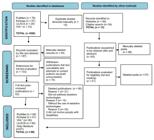
PRISMA-ScR flowchart used for study identification and selection. Campina Grande, PB, Brazil, 2024
Initially, by applying filters (full text; languages: Portuguese, English, and Spanish) to the selected databases, 200 articles were identified for this review; their data were imported into the Rayyan platform. The Rayyan software automatically summarizes the years of publication of the imported studies; this revealed that the first publication with these descriptors occurred in 2015, but between 2019 and 2023, publications have increased; in 2019, 49 publications were found; in 2020, there were 51; in 2021 and 2022, there were 34 publications in each year; and in 2023, the number of publications found involving the proposed theme fell to 24. This information was extracted from Rayyan.
The final sample comprised eight studies: seven articles published in scientific journals and one doctoral thesis. Regarding country of origin, seven were conducted in Brazil, and one in Romania; all were published in English. The publication period ranged from 2015 to 2022.
The target populations included different types of disabilities: three studies focused on people with hearing impairments, three on people with visual impairments, one on people with intellectual disabilities, and one on people with cognitive disabilities. In terms of the technologies used, digital and printed educational technologies (such as accessible booklets and online courses), assistive technologies (software, avatars, digital accessibility resources), and innovative technologies (exergames) were identified. The topics ranged from oral health, sexual and reproductive health, and sexual abuse prevention to high blood pressure, breast health, and physical activity.
Regarding authorship, most studies were conducted by nursing researchers, with collaborative participation from other disciplines in specific cases, such as physical education, computing, and education. In general, all studies reported positive results regarding the validity, accessibility, acceptability, and feasibility of the technologies, despite small sample sizes, the absence of a control group, and limited follow-up periods. Figure 3 presents the characteristics of the included studies.
The set analyzed consists predominantly of methodological studies on the development and validation of educational and assistive technologies, experience reports, and exploratory intervention studies, focusing on different types of disabilities (intellectual, visual, auditory, and cognitive). Most studies were conducted in Brazil, except for one in Romania, reflecting a concentration of production in Latin American contexts.
The main types of technologies identified were digital and printed educational technologies: virtual primers and accessible online courses developed for blind people, addressing topics such as sexual health, violence prevention, and high blood pressure. Assistive technologies: accessibility software (screen readers, automatic accessibility assessment), and adaptations for communication in Brazilian Sign Language. Innovative technologies, such as exergames and avatars, are used both to promote physical activity among people with cognitive disabilities and to facilitate oral health communication for deaf people.
Regarding the main findings, the studies indicated that the validated technologies showed high agreement among experts in terms of content and appearance, as in a study11 in which the technology on sexual violence prevention for young people with intellectual disabilities obtained a content validity index close to 1.0. Accessible educational resources for blind people, such as virtual primers and online courses, were considered feasible, understandable, and adequate, despite having been tested on small samples and, in general, lacking longitudinal impact assessments.
The use of exergames demonstrated pedagogical feasibility and potential to promote socialization, autonomy, and motor skills, despite the absence of control groups and the heterogeneity of the games employed. The use of avatars and videos in Brazilian Sign Language indicated benefits in health communication for deaf people, but the studies were limited to technical analyses or pilot studies with few participants.
About the assessment of evidence quality, in accordance with the guidelines of the JBI Manual for Evidence Synthesis28, a systematic description of potential biases, methodological limitations, and heterogeneity was conducted. In general, the studies had small samples, often selected for convenience, which creates a risk of selection bias and limits generalizability. Many studies have focused solely on validating content and appearance with experts, without testing effectiveness in user populations, thereby limiting the strength of evidence for assessing health impacts.
The heterogeneity across technologies (booklets, courses, software, exergames, avatars) and outcomes (content validity, acceptability, technical compliance, feasibility) precludes direct comparisons or meta-analyses, indicating the need for a narrative synthesis. The overall quality of the evidence was classified as moderate for validity and acceptability, and low for clinical efficacy or behavior change, because none of the studies employed robust designs, such as randomized clinical trials or longitudinal follow-up.
These findings demonstrate that, although existing research is limited in methodological rigor, the studies provide relevant insights into health education practice and the development of inclusive health technologies, particularly regarding the feasibility, accessibility, and cultural appropriateness of resources. The chart constructed (Figure 4), in accordance with the JBI Manual, details the potential biases, methodological limitations, and quality ratings assigned to each included study, serving as a complementary reference to the narrative synthesis.
Discussion
This scoping review identified eight studies, primarily methodological, focused on the development and validation of educational and assistive technologies. This predominance reflects the field’s still-emerging nature, in which scientific production focuses on proposing and testing innovative resources rather than on impact studies or systematic reviews. To ensure terminological clarity, it is essential to distinguish between educational technologies (ET), associated with teaching-learning processes, and assistive technologies (AT), aimed at promoting accessibility, autonomy, and inclusion for people with disabilities5-6. This differentiation guided the analysis of the findings and avoided term overlap.
The data were organized according to the types of technologies identified (educational, assistive, innovative digital), their contexts of application (oral health, sexual and reproductive health, disease prevention, physical activity, and health communication), and the population groups served (people with hearing, visual, intellectual, and cognitive disabilities). This systematization enabled us to understand the diversity of approaches and the convergence of results around common aspects, such as the validity, feasibility, accessibility, and acceptability of technologies.
In the field of sexual and reproductive health, one study stands out for validating an educational technology aimed at preventing sexual violence among young people with intellectual disabilities11, bringing to light a topic that is often silenced. Complementing this, another author developed a virtual booklet for people with visual impairments, also focusing on the prevention of sexual violence29, reinforcing the potential of educational technologies to address sensitive and neglected issues.
Health communication was another central theme, with emphasis on authors who developed an ET based on Libras (Brazilian Sign Language) to facilitate interaction between nurses and deaf people10, revealing that language barriers remain obstacles to full inclusion in health services. In the same field, other authors applied the Automatic System for Evaluating Software Accessibility (ASES) tool to digital content, identifying technical compliance but emphasizing the importance of also evaluating the experience of deaf users30.
The use of validated instructional design models has proven to be strategic for developing accessible technologies. Examples include the online courses on breast health31 and high blood pressure32, both developed at the Federal University of Ceará. These studies used the Falkembach model and demonstrated that consistent methodologies can ensure quality, accessibility, and safety in the development of digital resources for blind people.
In the area of oral health, an international contribution stands out. A study conducted in Romania compared the use of avatars and videos in applications for the deaf, showing that both resources facilitated communication in oral health, albeit with differences in cost and complexity33.
Finally, the use of exergames in physical activity programs for people with cognitive disabilities34 has demonstrated benefits related to socialization, motor skill acquisition, and autonomy, and has proven to be a low-cost and viable alternative for promoting health in this population.
Overall, the findings demonstrate that both ET and AT emerge as valuable resources for promoting inclusive health, contributing to health education, disease prevention, rehabilitation, and social inclusion. The synthesis shows that different areas (sexual and reproductive health, oral health, health communication, and physical activity) can benefit from technologies when they are developed and applied inclusively.
Nevertheless, most studies have focused on the initial stages of development and validation, without extending to analyses of effectiveness in real-world or large-scale contexts. It is essential to emphasize the need for future studies to expand their sample sizes, include control groups, and evaluate the impact of technologies on clinical and social outcomes. Finally, it should be noted that the COVID-19 pandemic, while posing health challenges, has also driven the adoption of inclusive digital tools, paving the way for new studies and innovative practices, but without eliminating access gaps and the need for public policies that ensure sustainability and equity.
Conclusion
The results revealed that digital and print educational technologies, assistive technologies, and innovative technologies encompass different formats (accessible online courses, digital primers, resources in Brazilian Sign Language, apps, avatars, and exergames) and were aimed at various audiences, including people with hearing, visual, intellectual, and cognitive disabilities. Overall, the studies indicated that the technologies developed are well accepted, have valid content, are accessible and viable, and contribute to empowerment, inclusion, and the strengthening of professional health practice, particularly in nursing.
Despite the diversity of proposals, most studies focused on the development and validation stages, without progressing to large-scale effectiveness analyses. In addition, methodological studies and exploration interventions predominated. This characteristic points to both the relevance of the expanding field and the need for more robust investigations, including larger samples, longitudinal follow-up, and controlled comparisons, to strengthen the quality of the evidence.
It is therefore concluded that this study achieved its objective, demonstrating that educational technologies in health for people with disabilities are relevant tools for promoting inclusion and autonomy. However, the review also highlights significant gaps, including limitations in the databases consulted, the geographic concentration of scientific production, and the scarcity of studies that evaluate the concrete impacts of these technologies. It is recommended that future research expand search strategies, diversify research contexts, and advance effective analyses to consolidate the contributions of educational technologies to inclusive health.
Data Availability Statement:
All data generated or analysed during this study are included in this published article.
References
-
1 World Health Organization. Global report on assistive technology [Internet]. Geneva: WHO; 2022 [cited 2023 Nov 12]. Available from: Available from: https://www.who.int/publications/i/item/9789240049451
» https://www.who.int/publications/i/item/9789240049451 -
2 Gomes I. Pessoas com deficiência têm menor acesso à educação, ao trabalho e à renda [Internet]. Rio de Janeiro: IBGE; 2023 [cited 2023 Nov 12]. Available from: Available from: https://agenciadenoticias.ibge.gov.br/agencia-noticias/2012-agencia-de-noticias/noticias/37317-pessoas-com-deficiencia-tem-menor-acesso-a-educacao-ao-trabalho-e-a-renda
» https://agenciadenoticias.ibge.gov.br/agencia-noticias/2012-agencia-de-noticias/noticias/37317-pessoas-com-deficiencia-tem-menor-acesso-a-educacao-ao-trabalho-e-a-renda -
3 Nações Unidas Brasil. Convenção sobre pessoas com deficiência reforça inclusão e acessibilidade [Internet]. Brasília: Casa ONU Brasil; 2006 [cited 2023 Sep 25]. Available from: Available from: https://brasil.un.org/pt-br/186941-conven%C3%A7%C3%A3o-sobre-pessoas-com-defici%C3%AAncia-refor%C3%A7a-inclus%C3%A3o-e-acessibilidade
» https://brasil.un.org/pt-br/186941-conven%C3%A7%C3%A3o-sobre-pessoas-com-defici%C3%AAncia-refor%C3%A7a-inclus%C3%A3o-e-acessibilidade - 4 Diniz D. O que é deficiência. São Paulo: Brasiliense; 2007. 89 p.
-
5 Mello AG. Disability, inability and vulnerability: on ableism or the pre-eminence of ableist and biomedical approaches of the Human Subjects Ethics Committee of UFSC. Cien Saude Colet [Internet]. 2016 Oct [cited 2023 Nov 8];21(10):3265-76. Available from: https://doi.org/10.1590/1413-812320152110.07792016
» https://doi.org/10.1590/1413-812320152110.07792016 - 6 Cook AM, Polgar JM. Assistive technologies: principles and practice. 4th ed. St. Louis, MO: Mosby; 2015. 496 p.
- 7 Bersch R. Tecnologia assistiva e educação inclusiva. In: Ministério da Educação (BR), Secretaria de Educação Especial. Ensaios pedagógicos. Brasília: Ministério da Educação; 2006. p. 281-6.
-
8 Aguiar ASC, Almeida PC, Grimaldi MRM, Guimarães FJ. Health education technologies for people with visual impairment: integrative review. Texto Contexto Enferm [Internet]. 2022 [cited 2023 Nov 15];31:e20210236. Available from: https://doi.org/10.1590/1980-265X-TCE-2021-0236en
» https://doi.org/10.1590/1980-265X-TCE-2021-0236en -
9 Arjona FBS, Meneses MN, Cárcamo MIC, Rocha CMF, Dias AP, Machado JMH, et al. The contribution of Paulo Freire’s thought to Popular Health Surveillance. Cien Saude Colet [Internet]. 2024 [cited 2023 Nov 15];29(6). Available from: Available from: https://www.scielo.br/j/csc/a/HNL5pdWvprfwNBLtDVqbkYx/?lang=pt
» https://www.scielo.br/j/csc/a/HNL5pdWvprfwNBLtDVqbkYx/?lang=pt -
10 Oliveira WSR, Sardinha DM, Franco EF, Baia EC, Pereira JPD, Gonçalves RCS, et al. Development and application of educational technology to assist communication between the hearing impaired and nurse: experience report. Rev Eletr Acervo Saude [Internet]. 2020 [cited 2024 Jan 30];44:e2269. Available from: https://doi.org/10.25248/reas.e2269.2020
» https://doi.org/10.25248/reas.e2269.2020 -
11 Nóbrega KBG, Marinus MWLC, Belian RB, Gontijo DT. Validation of the educational technology “abuse no more” for young people with intellectual disabilities. Cien Saude Colet. 2021;26(7):2793-806. https://doi.org/10.1590/1413-81232021267.09032021
» https://doi.org/10.1590/1413-81232021267.09032021 -
12 Ramírez-Granizo IA, Ubago-Jiménez JL, González-Valero G, Puertas-Molero P, San Román-Mata S. The effect of physical activity and the use of active video games in children and adolescents: a systematic review. Int J Environ Res Public Health [Internet]. 2020 [cited 2023 Nov 15];17(12):4243. Available from: https://doi.org/10.3390/ijerph17124243
» https://doi.org/10.3390/ijerph17124243 -
13 Macedo MS, Henrique JHS, Tavares LRC, Ribeiro KSQS, Silva SLA, Ferrari FP, et al. Primary health organization models and care practices for people with disabilities in Brazil. Cien Saude Colet [Internet]. 2025 [cited 2023 Nov 15];30(2). Available from: https://doi.org/10.1590/1413-81232025302.16312023
» https://doi.org/10.1590/1413-81232025302.16312023 - 14 Freire P. Pedagogia do oprimido. 17th ed. Rio de Janeiro: Paz e Terra; 1987. 107 p.
-
15 Cruz PJSC, Silva MRF, Pulga VL, Machado AMB, Brutscher VJ. Educação popular em saúde. Rev Educ Popular [Internet]. 2020 [cited 2024 Jan 23]:6-28. Available from: https://doi.org/10.14393/REP-2020-56014
» https://doi.org/10.14393/REP-2020-56014 -
16 Monteiro EMLM, Vieira NFC. Health education based on culture circles. Rev Bras Enferm [Internet]. 2010 May-Jun [cited 2024 Jan 23];63(3):397-403. Available from: https://doi.org/10.1590/S0034-71672010000300008
» https://doi.org/10.1590/S0034-71672010000300008 -
17 Chagas PML, Fernandes EM. Sexuality and the person with intellectual disability: proposal of the theme in schools. Perspect Dial Rev Educ Soc [Internet]. 2018 [cited 2023 Nov 12];5(9):199-216. Available from: Available from: https://periodicos.ufms.br/index.php/persdia/article/view/5019
» https://periodicos.ufms.br/index.php/persdia/article/view/5019 -
18 Santos SB, Ramos JLS, Machado APA, Lopes MTN, Abreu LC, Bezerra IMP. Educational technology for adolescents: construction and validation of an acquired syphilis flip chart. Rev Bras Promoc Saude [Internet]. 2020 [cited 2024 Jan 28];33:9970. Available from: https://doi.org/10.5020/18061230.2020.9970
» https://doi.org/10.5020/18061230.2020.9970 -
19 Wild CF, Nietsche EA, Salbego C, Teixeira E, Favero NB. Validation of educational booklet: an educational technology in dengue prevention. Rev Bras Enferm [Internet]. 2019 [cited 2024 Jan 28];72(5):1385-92. Available from: https://doi.org/10.1590/0034-7167-2018-0771
» https://doi.org/10.1590/0034-7167-2018-0771 -
20 Oliveira MGC, Rosas MA, Gontijo DT, Marcelino JFQ, Nóbrega KBG. Evaluation of an Educational Technology for the prevention of sexual violence of young women with Intellectual Disabilities. Rev Educ Inclusiva [Internet]. 2023 [cited 2024 Nov 12];8(1). Available from: Available from: https://revista.uepb.edu.br/REIN/article/view/1721/1513
» https://revista.uepb.edu.br/REIN/article/view/1721/1513 -
21 Jahn AC, Guzzo PC, Costa MC, Silva EB, Guth EJ, Lima SBS. Health popular education: potentializing methodology of the nurses’ actions. Rev Enferm UFSM [Internet]. 2012 [cited 2023 Nov 15];2(3):547-52. Available from: https://doi.org/10.5902/217976923522
» https://doi.org/10.5902/217976923522 -
22 Krug SBF, Mocelin G, Magedanz MC, Oliveira BR, Dubow C. Actions and strategies for permanent health education in the care network for people with disabilities. Physis (Rio J) [Internet]. 2021 [cited 2024 Jan 28];31(1):e310131. Available from: https://doi.org/10.1590/S0103-73312021310131
» https://doi.org/10.1590/S0103-73312021310131 -
23 Tricco AC, Lillie A, Zarin W, O’Brien KK, Colquhoun H, Levac D, et al. PRISMA Extension for Scoping Reviews (PRISMA-ScR): checklist and explanation. Ann Intern Med [Internet]. 2018 [cited 2024 Jan 28];169(7):467-73. Available from: https://doi.org/10.7326/M18-0850
» https://doi.org/10.7326/M18-0850 -
24 Grant MJ, Booth A. A typology of reviews: an analysis of 14 review types and associated methodologies. Health Info Libr J [Internet]. 2009 [cited 2024 Jan 28];26(2):91-108. Available from: https://doi.org/10.1111/j.1471-1842.2009.00848.x
» https://doi.org/10.1111/j.1471-1842.2009.00848.x -
25 Carvalho AT, Áfio ACE, Marques JF, Pagliuca LMF, Carvalho LV, Leite SS. Instructional design in Nursing: assistive technologies for the blind and deaf. Cogitare Enferm [Internet]. 2019 [cited 2024 Jan 28];24:e62767. Available from: https://doi.org/10.5380/ce.v24i0.62767
» https://doi.org/10.5380/ce.v24i0.62767 -
26 Santos MA, Marques FC, Pessa RP, Pillon SC, Peres RS, Oliveira WA, et al. Friendship Relationships in Eating Disorders: An Integrative Literature Review. Psico-USF [Internet]. 2023 [cited 2024 Jan 28];28(3). Available from: https://doi.org/10.1590/1413-82712023280313
» https://doi.org/10.1590/1413-82712023280313 -
27 Mattos SM, Cestari VRF, Moreira TMM. Scoping protocol review: PRISMA-ScR guide refinement. Rev Enferm UFPI [Internet]. 2023 [cited 2024 Jan 28];12:e3062. Available from: https://doi.org/10.26694/reufpi.v12i1.3062
» https://doi.org/10.26694/reufpi.v12i1.3062 -
28 Aromataris E, Lockwood C, Porritt K, Pilla B, Jordan Z, editors. JBI manual for evidence synthesis [Internet]. Adelaide: JBI; 2024 [cited 2025 Sep 22]. Available from: Available from: https://synthesismanual.jbi.global
» https://synthesismanual.jbi.global -
29 Marques JF. Cartilha educativa virtual sobre prevenção da violência sexual: promoção da saúde de pessoas cegas [dissertation]. Fortaleza: Universidade Federal do Ceará; 2017 [cited 2024 Jan 28]. Available from: Available from: http://repositorio.ufc.br/handle/riufc/34589
» http://repositorio.ufc.br/handle/riufc/34589 -
30 Áfio ACE, Carvalho AT, Carvalho LV, Silva ASR, Pagliuca LMF. Accessibility assessment of assistive technology for the hearing impaired. Rev Bras Enferm [Internet]. 2016 [cited 2024 Jan 28];69(5). Available from: https://doi.org/10.1590/0034-7167.2016690503
» https://doi.org/10.1590/0034-7167.2016690503 -
31 Carvalho AT, Pagliuca LMF, Fernandes AFC. Breast health to blind women: validation of accessible online course. Adv Internet Things [Internet]. 2015 [cited 2024 Jan 28];5(1):7-14. Available from: https://doi.org/10.4236/ait.2015.51002
» https://doi.org/10.4236/ait.2015.51002 -
32 Carvalho LV, Carvalho AT, Áfio ACE, Silva ASR, Silva MG, Pagliuca LMF. Construction of assistive technology as online course for the blind about hypertension. Rev Bras Enferm [Internet]. 2018 [cited 2024 Jan 28];71(4). Available from: https://doi.org/10.1590/0034-7167-2017-0056
» https://doi.org/10.1590/0034-7167-2017-0056 -
33 Chiriac IA, Stoicu-Tivadar L, Podoleanu E. Comparing video and avatar technology for a health education application for deaf people. Stud Health Technol Inform [Internet]. 2015 [cited 2024 Jan 28];210:516-20. Available from: Available from: https://ebooks.iospress.nl/publication/39395
» https://ebooks.iospress.nl/publication/39395 -
34 Vaghetti CAO, Alves DK, Ramson BP, Bandeira LF, Ferreira AR. GAMEPAD: utilizando exergames para promoção da saúde e inclusão social de pessoas com deficiência. Arq Cienc Saude UNIPAR [Internet]. 2022 [cited 2024 Jan 28];26(1). Available from: Available from: https://revistas.unipar.br/index.php/saude/article/view/8111
» https://revistas.unipar.br/index.php/saude/article/view/8111
-
How to cite this article:
Patrício DF, Coura AS, Barbosa MSA, Lima TNB, Lima MCL, Nascimento KC. Health education technologies for people with disabilities: scope review. Rev. Latino-Am. Enfermagem. 2026;34:e4861 [cited year month day ]. Available from: URL . https://doi.org/10.1590/1518-8345.8054.4861
Edited by
-
Associate Editor:
Maria Lúcia Zanetti

 *VHL = Virtual Health Library