 Acid cleaning of ceramic microfiltration membranes fouled by oil-in-water emulsions: effects on membrane stability and filtration performance
ABSTRACT
Ceramic membranes are widely recognized as robust alternatives for oily wastewater treatment; however, their long-term stability under repeated fouling and acid-cleaning cycles remains a critical challenge. This study investigated the structural evolution and performance of ceramic microfiltration membranes fabricated from raw clay (M1) and thermally pre-treated clay (M2) during successive oil-in-water emulsion filtration and acid-cleaning cycles. Structural characterization using X-ray diffraction (XRD) and scanning electron microscopy (SEM) showed that thermal pre-treatment promoted the formation of metakaolinite, which, together with calcium-rich additives (eggshell-derived compounds), improved the chemical resistance of the membrane matrix. As a result, the M2 membranes exhibited greater stability against chemical attack during successive acid-cleaning cycles. From a performance perspective, the M2 membranes exhibited approximately twofold higher hydraulic permeability than the M1 membranes (383 vs. 182 kg·m−2·h−1·bar−1) while maintaining high organic matter removal, as confirmed by total organic carbon (TOC) analysis. In contrast, the M1 membranes showed a progressive reduction in removal efficiency after repeated use. These results demonstrate that thermal pre-treatment of the clay before sintering improves membrane durability and operational performance under cyclic fouling–acid-cleaning conditions, contributing to the development of chemically resistant ceramic membranes for oily wastewater treatment.
Keywords:
Oil-Water Emulsion; Ceramic Membrane; Microfiltration; Crossflow
1. INTRODUCTION
Oily wastewater is generated in large volumes by petrochemical and several other industrial sectors, and its treatment remains a significant technological challenge due to the complexity and variability of its composition [1]. Membrane separation processes have been widely applied for oil–water separation, particularly due to their high efficiency, compact design, and relatively low energy consumption compared to conventional methods [1, 2, 3].
Ceramic membranes have attracted considerable attention due to their superior thermal, mechanical, and chemical stability, which are essential for operation under harsh conditions. In addition, the use of natural clays as low-cost precursors represents a promising approach for scalable membrane fabrication [4, 5]. From a materials science perspective, the performance of these membranes is intrinsically governed by the relationship between processing parameters, phase composition, and resulting microstructure, which collectively determine permeability, selectivity, and chemical resistance [6, 7, 8, 9].
However, membrane fouling (especially by oil) remains a critical limitation, leading to progressive flux decline and performance deterioration [8, 9, 10, 11, 12]. Chemical cleaning procedures are commonly applied to restore permeability, but repeated exposure to aggressive agents can induce microstructural changes, phase instability, and degradation of functional properties [13, 14]. Although previous studies have investigated fouling and cleaning phenomena in ceramic membranes, limited attention has been given to the relationship between thermal modification of clay precursors, microstructural evolution, and long-term membrane stability under repeated fouling and acid-cleaning cycles. Thermal pre-treatment of clays has been shown to promote phase transformations,such as the formation of metakaolinite, which can significantly influence pore structure and chemical stability. Likewise, the incorporation of calcium-rich additives has been associated with improved mechanical integrity and resistance to chemical attack [15, 16, 17, 18]. Nevertheless, these strategies are typically evaluated in terms of their initial properties, without establishing clear structure–property–performance relationships under long-term cyclic operation.
Despite the considerable number of studies on the fabrication and filtration performance of clay-based ceramic membranes, far fewer have examined how repeated fouling and acid-cleaning cycles affect their structural stability and long-term filtration performance. Understanding these changes is essential for assessing membrane durability under practical operating conditions.
In this context, the present study investigates the effects of repeated oil fouling and acid-cleaning cycles on the structural stability and filtration performance of ceramic microfiltration membranes fabricated from raw clay (M1) and thermally pre-treated clay (M2). Particular attention is given to evaluating how thermal pre-treatment influences membrane stability, hydraulic permeability, and organic matter removal under cyclic operating conditions. The findings are expected to contribute to the optimization of low-cost ceramic membranes for oily wastewater treatment by providing a better understanding of the relationships between thermal pre-treatment, microstructure, and long-term filtration performance under cyclic operating conditions.
2. MATERIALS AND METHODS
2.1. Membrane synthesis
Two tubular ceramic membranes were fabricated using natural faience clay supplied by Cermassas–Pastacer Ltda. (Brazil). The raw clay was initially dried for 12 h, ground in a ball mill, and sieved through a 60 Tyler mesh (250 μm). To produce the thermally pre-treated membrane (M2), the clay was calcined at 500 °C for 24 h using a heating rate of 5 °C min−1, followed by grinding and sieving under the same conditions applied to the raw clay (M1). Eggshell residue, used as a calcium-rich additive, was also ground and sieved through a 60 Tyler mesh before use.
Both membrane formulations contained 2.5 wt% cationic manioc starch, used as a pore-forming agent, and 2.5 wt% eggshell residue, used as a calcium-rich additive to improve the mechanical properties of the ceramic matrix. The solid components were homogenized with water to obtain a plastic paste suitable for extrusion. The tubular membranes were then shaped by extrusion, dried, and sintered at 1100 °C for 30 min using a heating rate of 5 °C min−1. The resulting membranes had an outer diameter of 18.8 mm, an inner diameter of 10.7 mm, a wall thickness of 4.05 mm, and a length of 200 mm.
The membrane compositions were selected based on the optimized formulation reported by XAVIER et al. [17]. Accordingly, the present study focuses on evaluating the influence of repeated oil fouling and acid-cleaning cycles on the structural stability and filtration performance of the membranes, rather than on the optimization of their fabrication process. Additional details regarding membrane preparation are available in XAVIER et al. [17].
2.2. Oil-in-water emulsion
Oil-in-water emulsions were prepared by homogenizing known amounts of crude oil and deionized water. A North Sea heavy crude oil was used in the experiments. Table 1 summarizes the main characteristics of this oil. Details regarding its characterization can be found in Reference [19]. The emulsions were prepared using a TURRATEC-TE100 mechanical homogenizer operated at 18.000 rpm for 10 min. The oil concentration was maintained at 1 g L−1 for all experiments. A fresh oil-in-water emulsion was prepared immediately before each filtration experiment using the same procedure and oil concentration to ensure consistent operating conditions throughout the study.
2.3. Experimental apparatus
Filtration experiments to determine the hydraulic permeability and emulsion retention of the tubular ceramic membranes were conducted using the experimental apparatus shown in Figure 1. The operating conditions were a volumetric flow rate of 6.94 × 10⁻⁵ m3 s−1, a transmembrane pressure ranging from 0.2 to 1.4 bar, and a temperature of 25 °C.

Schematic representation of the crossflow microfiltration system used in this study. The system consists of a feed tank (T-01), centrifugal pump (B-01), pressure control valve (V-01), pressure gauge (PEI-01), tubular membrane module (M-01), and permeate tank (T-02).
2.4. Assessment of membrane characteristics after cleaning cycles
The membranes underwent different experimental procedures to evaluate the influence of the cleaning protocol. Membrane performance was evaluated after successive physical and chemical cleaning cycles. After each filtration experiment, the filtration module was disassembled and the tubular ceramic membrane was carefully removed manually for cleaning. The cleaning procedure consisted of three consecutive steps: (i) physical rinsing by circulating deionized water through the system for 10 min; (ii) immersion of the disconnected membrane in boiling water; and (iii) ultrasonic cleaning in a 1 mol L−1 HCl solution for 15 min. After cleaning, the membrane was rinsed with deionized water, reinstalled in the filtration module, and a new hydraulic permeability test was performed before the subsequent filtration cycle. To evaluate the effects of repeated cleaning on membrane stability, XRD analyses were performed on virgin membranes and on membranes after two cleaning cycles, whereas SEM analyses were carried out on virgin membranes and on membranes after eight cleaning cycles for both M1 and M2. The chemical stability of the membranes was evaluated by measuring the mass loss after successive hydrochloric acid and ultrasonic cleaning treatments. For this purpose, the entire tubular membrane was dried in an oven to constant mass after each cleaning treatment and weighed using an analytical balance. The percentage of mass loss was determined by comparing the initial and final dry masses of the same membrane after the successive cleaning cycles.
2.5. Characterization of the ceramic membranes
X-ray diffraction (XRD) analyseswere conducted using an X-ray diffractometer (Empyrean, PANalytical) with an X’Celerator detector and a copper tube operating with Cu Kα radiation (λ=1.54060 Å). Scanning electron microscopy (SEM) was performed with a 10 kV beam voltage was used to estimate the particle size and morphologiy of the samples (Tescan, LMU; model Vega 3). The imaging was performed at the Center for Electronic Microscopy, UFPR. The pore size distribution of the M1 and M2 membranes were determined using an AutoPore IV 9500 V1.07 (Micromeritics Instrument Corporation).
2.6. Evaluation of the membrane performance
The permeate flux, J (kg m−2 h−1), was determined under different transmembrane pressures by using an electronic balance attached to the permeate flux output as described by Equation (1):
Where mP is the mass of the permeate (kg), AP is the membrane area (m2), and t is the operating time (h). The hydraulic permeability, Lp (kg m−2 h−1 bar−1), was obtained from the linear relationship between J and ΔP, as described by Equation 2.
For the critical flux experiments, the permeate flux was evaluated using with deionized water at seven different pressures with a stepping time of 3 min at each pressure. Subsequently, the oil-in-water emulsion was fed into the system, and the same stepping procedure was used to determine the critical flux. A plot of permeate flux (J) versus pressure was used to evaluate flux behavior. A deviation from linearity indicated the occurrence of the critical flux at that pressure.
To verify the permeate quality, the total organic carbon (TOC) concentration was determined for both virgin membranes and membranes after eight filtration–cleaning cycles under the best operating conditions. Filtration efficiency was evaluated based on TOC removal, calculated according to Equation (3). Carbon measurements were performed using a Shimadzu TOC-L total organic carbon analyzer. Permeate samples were filtered through a 0.22 μm syringe filter prior to analysis. The feed TOC concentration (TA) was determined by analyzing a 1 g L−1 oil-in-water emulsion diluted by a factor of 200. After correction for the dilution factor, the feed TOC concentration used in all experiments was 714 mg L−1.
where TP is the TOC concentration in the permeate and TA is the TOC concentration in the feed solution.
All filtration experiments were performed in duplicate under identical operating conditions. The experimental results are presented as the mean ± standard deviation of the duplicate measurements.
3. RESULTS AND DISCUSSION
3.1. Characterization of the membranes
The pore size distribution shown in Figure 2 indicates that the M2 membrane had a larger mean pore size and a broader pore size distribution than the M1 membrane.

(a) Cumulative pore volume and (b) pore size distribution of the M1 and M2 ceramic membranes determined by mercury intrusion porosimetry.
The main difference between the two membranes is the cumulative pore volume. The M1 membrane exhibited a maximum cumulative pore volume of 0.24 × 10⁻³ m3 kg−1, whereas the M2 membrane reached 0.32 × 10⁻³ m3 kg−1, corresponding to an increase of approximately 33%. These results indicate that the incorporation of thermally treated clay enhanced the membrane porosity [15, 16, 17].
The main difference between the M1 and M2 membranes is that the clay used to prepare the M2 membrane underwent thermal pretreatment before sintering. During this pretreatment, kaolinite was mainly transformed into metakaolinite (MKaol), according to the reaction shown in Equation (4):
According to the results reported by XAVIER et al. [17], the presence of amorphous MKaol instead of crystalline kaolinite in thermally treated clay may be responsible for the improved membrane performance. However, further studies are needed to establish the relationship between membrane structure and the properties associated with the presence of MKaol in ceramic membranes.
3.2. Effect of corrosion on membrane stability during acid and ultrasonic cleaning
The corrosion stability of the membranes was evaluated in terms of mass loss before and after successive acid-cleaning cycles, as shown in Figure 3. The M1 membrane exhibited greater mass loss than the M2 membrane after successive cleaning cycles. After eight cleaning cycles, the M1 membrane exhibited a mass loss of 21%, whereas the M2 membrane showed a mass loss of only 12%.

Membrane mass loss (%) as a function of the number of successive acid-cleaning cycles for the M1 and M2 ceramic membranes.
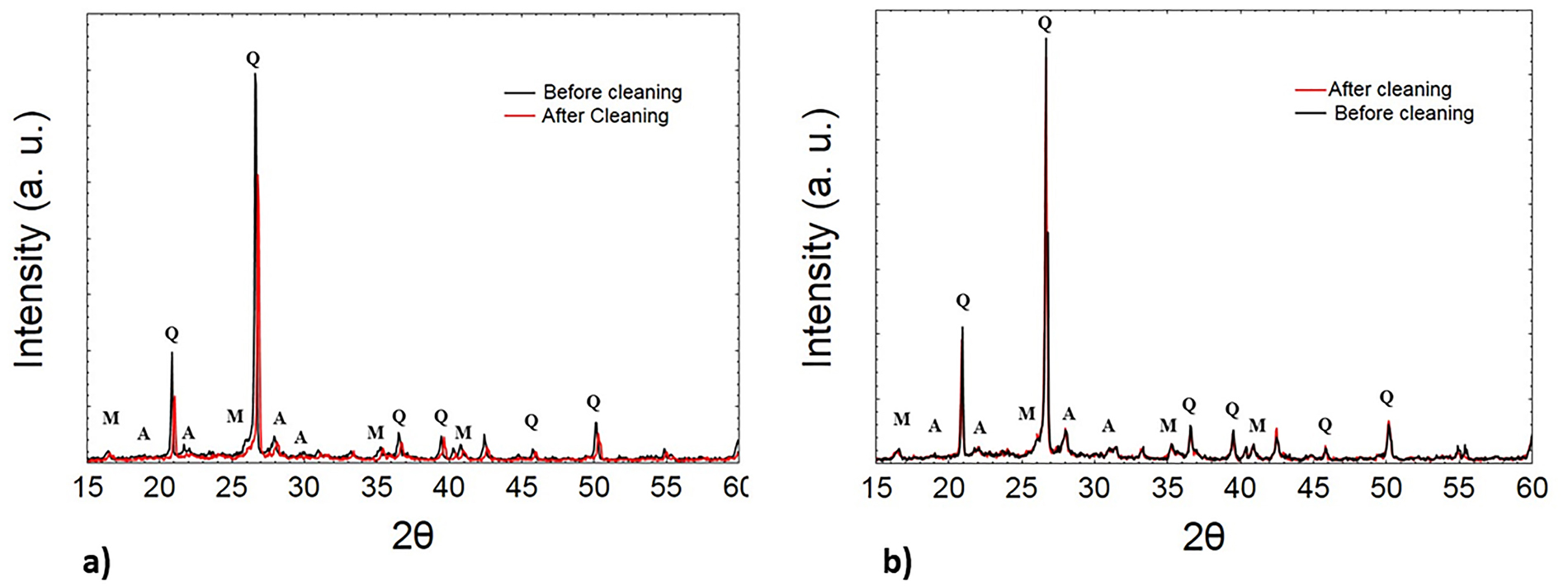
Previous studies have evaluated the chemical stability of ceramic membranes under acidic conditions. For example, MOUIYA et al. [19] investigated the mass loss of clay-based microfiltration membranes prepared from clay and banana peel powder after immersion in acidic and alkaline solutions for different exposure periods. The authors reported a maximum mass loss of 6.04% after 250 h of immersion in HNO3 solution (pH 1). These results are presented for comparison with the findings of the present study. DONG et al. [20], in the work entitled “Elaboration and chemical corrosion resistance of tubular macroporous cordierite ceramic membrane supports” reported a mass loss of up to 17.01 wt.% for porous cordierite in H2SO4, after boiling for 8h. In comparison to DONG et al. [20], the M2 membrane showed lower mass loss even though it was exposed to HCl under ultrasonic treatment. DAS et al. [21] studied the preparation and characterization of a macroporous SiC ceramic membrane for wastewater treatment. In corrosion tests using an HNO3 solution, they observed that higher porosity provided more contact area with the acid solution and resulted in greater mass loss. To verify the reason for this difference, XRD and SEM analyses were performed. Two samples from each membrane were evaluated: one before cleaning and the second after cleaning. The diffractograms of the M1 and M2 membranes are shown in Figure 4.

X-ray diffraction (XRD) patterns of the ceramic membranes before and after eight successive acid-cleaning cycles: (a) M1 and (b) M2. Q = quartz; M = mullite; A = albite and/or anorthite.
XRD patterns (Figure 4) indicated that the crystalline phases of the M2 membrane remained essentially unchanged after the successive acid-cleaning cycles, whereas the M1 membrane exhibited slight shifts in the 2θ positions of the quartz and albite/anorthite reflections after the eighth cleaning cycle. Both membranes presented quartz, albite/anorthite, and metakaolinite among their identified crystalline phases. The thermal pretreatment of the clay, which promotes the formation of metakaolinite, may have contributed to the higher porosity and the different structural stability observed for the M2 membrane after repeated acid-cleaning cycles. These interpretations are consistent with the experimental observations and previous studies [22, 23, 24], although no quantitative phase analysis was performed in the present study. In ceramic membranes, metakaolinite (MKaol) undergoes acid dissolution in the presence of HCl, according to Equation (5):
Previous studies [22, 23, 24] have suggested that the pozzolanic reaction between metakaolinite and calcium hydroxide (Ca(OH)2) may improve chemical resistance by promoting microstructural refinement and reducing pore connectivity. The enhanced chemical stability observed for the M2 membrane is consistent with these mechanisms reported in the literature. In the present study, a decrease in the anorthite peak was observed only for the M1 membrane (Figure 4), suggesting that this membrane was more susceptible to acid attack under the investigated conditions. The reaction between anorthite and hydrochloric acid can be represented by Equation (6).
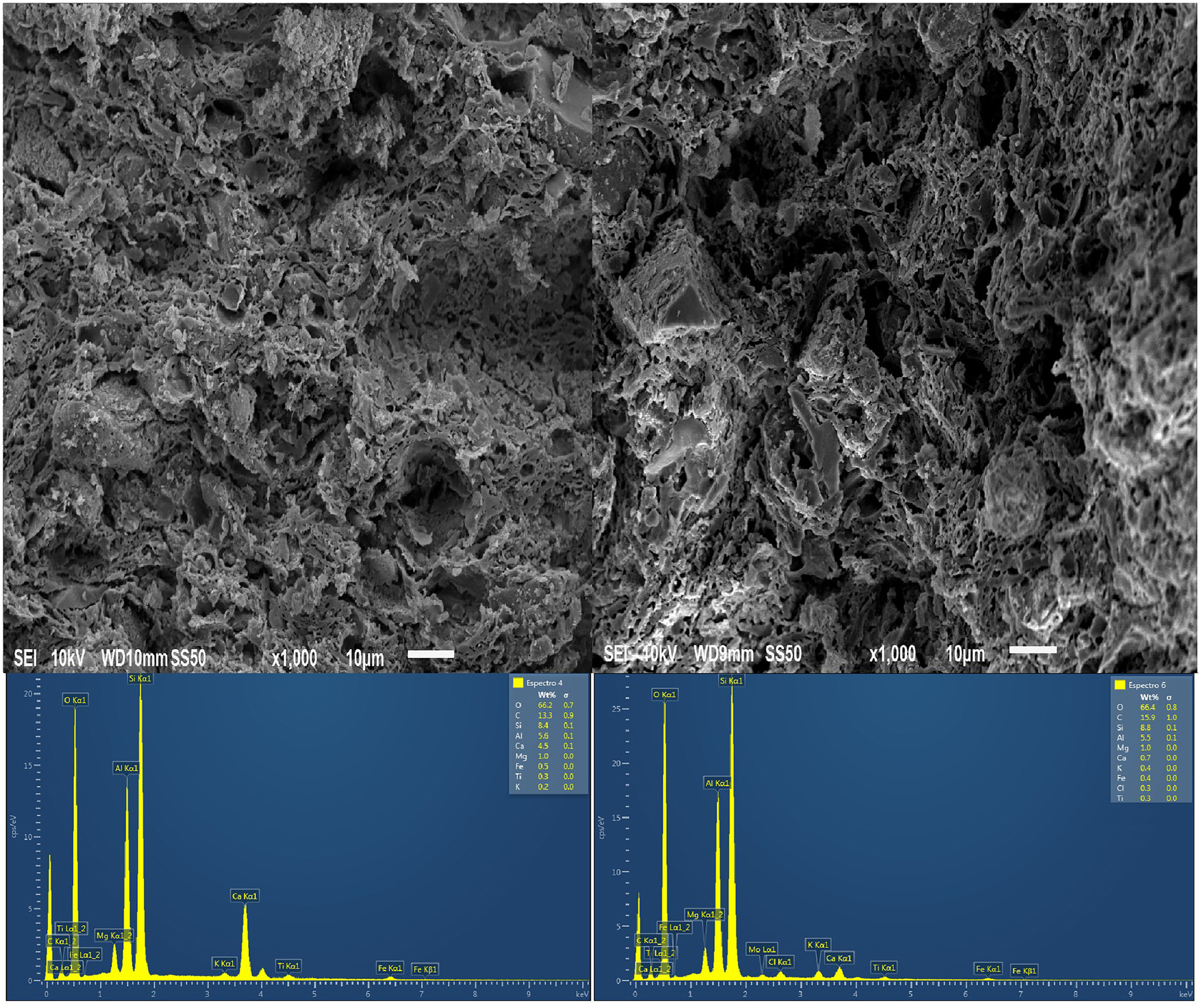
According to LIM et al. [25], CaAl2Si2O8 is significantly involved in acid leaching, particularly in HCl solutions. The SEM micrographs of the M1 and M2 membranes are shown in Figures 5 and 6.

Scanning electron microscopy (SEM) micrographs and corresponding energy-dispersive X-ray spectroscopy (EDS) spectra of the M1 ceramic membrane before and after eight successive acid-cleaning cycles.

Scanning electron microscopy (SEM) micrographs and corresponding energy-dispersive X-ray spectroscopy (EDS) spectra of the M2 ceramic membrane before and after eight successive acid-cleaning cycles.
Comparing the SEM images of the M1 and M2 membranes (Figures 5 and 6), pronounced structural differences were observed before and after the successive acid-cleaning cycles. The M1 membrane exhibited a substantial increase in apparent pore size and fragmentation of the ceramic matrix after cleaning, suggesting that acid attack preferentially affected the outer porous region of the membrane. In contrast, the M2 membrane showed only minor structural modifications, indicating greater resistance to the acid-cleaning process.
The quantitative EDS results (Table 2) corroborate these observations. For both membranes, the Ca content decreased after the successive acid-cleaning cycles, while small amounts of Cl were detected after cleaning, indicating residual chloride incorporation following the hydrochloric acid treatment. However, the decrease in Ca was more pronounced for the M1 membrane, whereas the M2 membrane exhibited a smaller change in elemental composition, consistent with its higher structural stability.
Quantitative elemental composition determined by EDS (wt.%) for the M1 and M2 ceramic membranes before and after eight successive acid-cleaning cycles.
The reduction in the Ca content is attributed to the partial dissolution of anorthite during the acid-cleaning process. This interpretation is consistent with the XRD results (Figure 4), which indicate that the M2 membrane retained its anorthite phase after the successive cleaning cycles. The higher metakaolinite content of the M2 membrane may have limited the extent of acid attack, such that anorthite dissolution was mainly restricted to the outer surface, with little effect on the inner regions of the membrane.
3.3. Microfiltration hydraulic permeability and critical flux
To evaluate the microfiltration performance of the membranes, hydraulic permeability and critical flux tests were performed. Figures 7(a) and 7(b) show the results for the M1 and M2 membranes, respectively.

(a) Hydraulic permeability as a function of transmembrane pressure and (b) permeate flux used to determine the critical flux of the M1 and M2 ceramic membranes.
The average permeability (Figure 7(a)) of the membranes was 182 and 383 kg·m−2·h−1·bar−1 for the M1 and M2 membranes, respectively. The stepwise pressure protocol (Figure 7(b)), in which the transmembrane pressure was alternately increased and decreased, enabled the estimation of the critical flux. At the beginning of the filtration (0.2 bar), the permeate flux was significantly lower for the M1 membrane. At transmembrane pressures above 0.3 bar, both membranes exhibited a linear flux–pressure relationship; however, the M2 membrane showed a more pronounced flux decline at pressures above 0.6 bar, indicating a higher fouling tendency. The critical flux was estimated to be approximately 260 kg·m−2·h−1, corresponding to the transition observed between the experimental pressure steps. Similar behavior has been reported by KUIPER et al. [26], who observed that membranes with higher porosity reached the critical flux at lower transmembrane pressures. Although the higher porosity of the M2 membrane promoted a greater initial flux decline, it also provided substantially higher hydraulic permeability and, more importantly, greater resistance to structural degradation during repeated acid-cleaning cycles. Therefore, under cyclic operating conditions, the improved long-term structural stability and performance retention of the M2 membrane outweighed its higher fouling tendency observed during individual filtration cycles. An operation below the critical flux (where the distinction is between no fouling and fouling) is favorable for the control of membrane fouling and thus for maintaining sustainable operation [27]. To ensure efficient cleaning, it is important to operate at an appropriate transmembrane pressure to minimize fouling. To evaluate the fouling conditions at different pressures, Figures 8(a) and 8(b) show the evolution of J/J0 (permeate flux/initial flux) for the M1 and M2 membranes, respectively.

Evolution of the normalized permeate flux (J/J0) during microfiltration of an oil-in-water emulsion at different transmembrane pressures for the (a) M1 and (b) M2 ceramic membranes.
Figure 8(a) shows that for the M1 membrane, at transmembrane pressures (TMP) of 0.4 and 0.6 bar, flux reductions followed a similar trend in both experiments, with reductions of 19 and 22%, respectively. At a TMP of 0.8 bar, the reduction in flux was 27%.
Figure 8(b) shows that for the M2 membrane, during operation at 0.4 bar, there was a 14% reduction in the initial flux, while at TMPs of 0.6 and 0.8 bar these values were 43 and 42%, respectively. These results indicate that the M2 membrane exhibited a higher fouling rate during microfiltration.
In Figure 9, the TOC removal at the different transmembrane pressures for the M1 and M2 membranes is presented.

Total organic carbon (TOC) removal efficiency of the M1 and M2 ceramic membranes operated at different transmembrane pressures.
Figure 9 shows that the TOC removal remained above 98% at all transmembrane pressures, indicating no loss of separation efficiency.
3.4. Characteristics of the permeate after successive use cycles
Figure 10 presents the TOC removal during successive membrane reuse cycles, with acid cleaning performed between cycles to evaluate the effectiveness of the cleaning procedure.

Total organic carbon (TOC) concentration in the permeate after successive filtration and acid-cleaning cycles for the M1 and M2 ceramic membranes.
The TOC concentration in the permeate increased from 6.02 mg·L−1 in the first cycle to 29.19 mg·L−1 after the eighth cycle for the M1 membrane, indicating a gradual reduction in separation performance with repeated fouling and acid-cleaning cycles. However, the overall TOC removal efficiency remained above 97% throughout the experiments. The M2 membrane consistently exhibited lower permeate TOC concentrations than the M1 membrane and only a slight increase in TOC over successive cycles, indicating better preservation of its separation performance. These results suggest that, although both membranes maintained high organic matter removal efficiencies, the M2 membrane exhibited greater operational stability under cyclic fouling and acid-cleaning conditions. TOC removal values reported in previous studies vary according to the distribution of oil between the free and dissolved phases and generally show only modest reductions in rejection with increasing transmembrane pressure for both surfactant-stabilized emulsions and real oily wastewaters [27, 28, 29, 30]. This study evaluated the effects of repeated oil fouling and acid-cleaning cycles on the structural stability and filtration performance of ceramic microfiltration membranes produced from raw clay (M1) and thermally pretreated clay (M2). The results indicate that thermal pretreatment of the clay before sintering improved the chemical stability of the membrane, resulting in greater resistance to degradation during successive cleaning cycles. The thermal pretreatment of the clay, together with the incorporation of calcium-rich additives, was associated with enhanced acid resistance, consistent with the structural and microstructural observations.
From an operational perspective, the M2 membrane exhibited higher permeability while maintaining high organic matter removal throughout the cleaning cycles, whereas the M1 membrane showed a progressive reduction in performance. These results suggest that thermal pretreatment is a promising approach for enhancing the durability and operational stability of low-cost ceramic membranes for oily wastewater treatment.
The present study contributes to the understanding of the effects of repeated acid-cleaning cycles on the structural stability and filtration performance of clay-based ceramic membranes. The findings provide valuable insights into the development of more chemically resistant ceramic membranes intended for long-term operation under cyclic fouling and cleaning conditions. Future investigations should further evaluate membrane performance under more representative industrial operating conditions and extended fouling–acid-cleaning cycles to support the practical application of these ceramic membranes.
4. CONCLUSIONS
This study evaluated the effects of repeated oil fouling and acid-cleaning cycles on the structural stability and filtration performance of ceramic microfiltration membranes produced from raw clay (M1) and thermally pretreated clay (M2). The results indicate that thermal pretreatment of the clay before sintering improved the chemical stability of the membrane, resulting in greater resistance to degradation during successive cleaning cycles. The thermal pretreatment of the clay, together with the incorporation of calcium-rich additives, was associated with improved chemical stability during successive acid-cleaning cycles, consistent with the structural and microstructural observations. From an operational perspective, the M2 membrane exhibited higher permeability while maintaining high organic matter removal throughout the cleaning cycles, whereas the M1 membrane showed a progressive reduction in performance. These results suggest that thermal pre-treatment is a promising approach to enhance the durability and operational stability of low-cost ceramic membranes for oily wastewater treatment. The present study contributes to the understanding of the effects of repeated acid-cleaning cycles on the structural stability and filtration performance of clay-based ceramic membranes. The findings provide valuable insights into the development of more chemically resistant ceramic membranes intended for long-term operation under cyclic fouling and cleaning conditions. Future investigations should evaluate membrane performance using real industrial oily wastewaters containing higher oil loadings and additional contaminants, together with complementary permeate quality analyses and extended fouling–acid-cleaning cycles, to further assess the applicability and long-term durability of these membranes under practical operating conditions.
5. ACKNOWLEDGMENTS
The authors acknowledge with gratitude the support of the Brazilian National Council of Scientific and Technological Development-CNPq Projects 425125/2018-1, 454669/2014-3. and the Araucaria Foundation-Support for Scientific and Techno logical Development of Paraná. They also thank the Federal University of Paraná (UFPR), Federal University of Uberlândia (UFU) and Technology Sector from UFPR for infrastructural support.
6. DATA AVAILABILITY
The data that support the findings of this study are available from the corresponding author upon reasonable request.
7. BIBLIOGRAPHY
-
[1] ABADI, S.R.H., SEBZARI, M.R., HEMATI, M., et al, “Ceramic membrane performance in microfiltration of oily wastewater”, Desalination, v. 265, n. 1–3, pp. 222–228, 2011. doi: https://doi.org/10.1016/j.desal.2010.07.055.
» https://doi.org/10.1016/j.desal.2010.07.055 -
[2] KAYVANI FARD, A., BUKENHOUDT, A., JACOBS, M., et al, “Novel hybrid ceramic/carbon membrane for oil removal”, Journal of Membrane Science, v. 559, pp. 42–53, 2018. doi: https://doi.org/10.1016/j.memsci.2018.05.003.
» https://doi.org/10.1016/j.memsci.2018.05.003 -
[3] NANDI, B.K., UPPALURI, R., PURKAIT, M.K., “Treatment of oily waste water using low-cost ceramic membrane: Flux decline mechanism and economic feasibility”, Separation Science and Technology, v. 44, n. 12, pp. 2840–2869, 2009. doi: https://doi.org/10.1080/01496390903136004.
» https://doi.org/10.1080/01496390903136004 -
[4] REGULA, C., CARRETIER, E., WYART, Y., et al, “Chemical cleaning/disinfection and ageing of organic UF membranes: A review”, Water Research, v. 56, pp. 325–365, 2014. doi: https://doi.org/10.1016/j.watres.2014.02.050. PubMed PMID: 24704985.
» https://doi.org/10.1016/j.watres.2014.02.050 -
[5] PORCELLI, N., JUDD, S., “Chemical cleaning of potable water membranes: A review”, Separation and Purification Technology, v. 71, n. 2, pp. 137–143, 2010. doi: https://doi.org/10.1016/j.seppur.2009.12.007.
» https://doi.org/10.1016/j.seppur.2009.12.007 -
[6] QIN, D., LIU, Z., BAI, H., et al, “A new nano-engineered hierarchical membrane for concurrent removal of surfactant and oil from oil-in-water nanoemulsion”, Scientific Reports, v. 6, n. 1, pp. 24365, 2016. doi: https://doi.org/10.1038/srep24365. PubMed PMID: 27087362.
» https://doi.org/10.1038/srep24365 -
[7] LIU, N., LIN, X., ZHANG, W., et al, “A pure inorganic ZnO-Co3O4 overlapped membrane for efficient oil/water emulsions separation”, Scientific Reports, v. 5, n. 1, pp. 9688, 2015. doi: https://doi.org/10.1038/srep09688. PubMed PMID: 25900797.
» https://doi.org/10.1038/srep09688 -
[8] SALAMA, A., “Modeling of flux decline behavior during the filtration of oily-water systems using porous membranes: Effect of pinning of nonpermeating oil droplets”, Separation and Purification Technology, v. 207, pp. 240–254, 2018. doi: https://doi.org/10.1016/j.seppur.2018.06.043.
» https://doi.org/10.1016/j.seppur.2018.06.043 -
[9] NG, L.Y., MOHAMMAD, A.W., LEO, C.P., et al, “Polymeric membranes incorporated with metal/metal oxide nanoparticles: A comprehensive review”, Desalination, v. 308, pp. 15–33, 2013. doi: https://doi.org/10.1016/j.desal.2010.11.033.
» https://doi.org/10.1016/j.desal.2010.11.033 -
[10] SILALAHI, S.H.D., LEIKNES, T.O., “Cleaning strategies in ceramic microfiltration membranes fouled by oil and particulate matter in produced water”, Desalination, v. 236, n. 1–3, pp. 160–169, 2009. doi: https://doi.org/10.1016/j.desal.2007.10.063.
» https://doi.org/10.1016/j.desal.2007.10.063 -
[11] KAZEMIMOGHADAM, M., MOHAMMADI, T., “Chemical cleaning of ultrafiltration membranes in the milk industry”, Desalination, v. 204, n. 1–3, pp. 213–218, 2007. doi: https://doi.org/10.1016/j.desal.2006.04.030.
» https://doi.org/10.1016/j.desal.2006.04.030 -
[12] CHEN, D., WEAVERS, L.K., WALKER, H.W., “Ultrasonic control of ceramic membrane fouling by particles: Effect of ultrasonic factors”, Ultrasonics Sonochemistry, v. 13, n. 5, pp. 379–387, 2006. doi: https://doi.org/10.1016/j.ultsonch.2005.07.004. PubMed PMID: 16162417.
» https://doi.org/10.1016/j.ultsonch.2005.07.004 -
[13] KOĹTUNIEWICZ, A.B., FIELD, R.W., “Process factors during removal of oil-in-water emulsions with cross-flow microfiltration”, Desalination, v. 105, n. 1–2, pp. 79–89, 1996. doi: https://doi.org/10.1016/0011-9164(96)00061-6.
» https://doi.org/10.1016/0011-9164(96)00061-6 -
[14] BLANPAIN-AVET, P., MIGDAL, J.F., BÉNÉZECH, T., “Chemical cleaning of a tubular ceramic microfiltration membrane fouled with a whey protein concentrate suspension-Characterization of hydraulic and chemical cleanliness”, Journal of Membrane Science, v. 337, n. 1–2, pp. 153–174, 2009. doi: https://doi.org/10.1016/j.memsci.2009.03.033.
» https://doi.org/10.1016/j.memsci.2009.03.033 -
[15] HENRIQUES, J.D.D.O., PEDRASSANI, M.W., KLITZKE, W., et al, “Fabrication and characterization of low cost ceramic membranes for microfiltration of Acutodesmus obliquus using modified clays”, Matéria (Rio de Janeiro), v. 24, n. 4, pp. e12501, 2019. doi: https://doi.org/10.1590/s1517-707620190004.0826.
» https://doi.org/10.1590/s1517-707620190004.0826 -
[16] DE OLIVEIRA HENRIQUES, J.D., PEDRASSANI, M.W., KLITZKE, W., et al, “Thermal treatment of clay-based ceramic membranes for microfiltration of Acutodesmus obliquus”, Applied Clay Science, v. 150, pp. 217–224, 2017. doi: https://doi.org/10.1016/j.clay.2017.09.017.
» https://doi.org/10.1016/j.clay.2017.09.017 -
[17] XAVIER, L.A., DE OLIVEIRA, T.V., KLITZKE, W., et al, “Influence of thermally modified clays and inexpensive pore-generating and strength improving agents on the properties of porous ceramic membrane”, Applied Clay Science, v. 168, pp. 260–268, 2019. doi: https://doi.org/10.1016/j.clay.2018.11.025.
» https://doi.org/10.1016/j.clay.2018.11.025 -
[18] MELO, W.D., LESAK, G.V.G., OLIVEIRA, T.V.D., et al, “Microfiltration of oil-in-water emulsion using modified ceramic membrane: surface properties, membrane resistance, critical flux, and cake behavior”, Materials Research, v. 25, pp. e20210365, 2021. doi: https://doi.org/10.1590/1980-5373-mr-2021-0365.
» https://doi.org/10.1590/1980-5373-mr-2021-0365 -
[19] MOUIYA, M., BOUAZIZI, A., ABOURRICHE, A., et al, “Fabrication and characterization of a ceramic membrane from clay and banana peel powder: Application to industrial wastewater treatment”, Materials Chemistry and Physics, v. 227, pp. 291–301, 2019. doi: https://doi.org/10.1016/j.matchemphys.2019.02.011.
» https://doi.org/10.1016/j.matchemphys.2019.02.011 -
[20] DONG, Y., FENG, X., DONG, D., et al, “Elaboration and chemical corrosion resistance of tubular macro-porous cordierite ceramic membrane supports”, Journal of Membrane Science, v. 304, n. 1–2, pp. 65–75, 2007. doi: https://doi.org/10.1016/j.memsci.2007.06.058.
» https://doi.org/10.1016/j.memsci.2007.06.058 -
[21] DAS, D., BAITALIK, S., HALDAR, B., et al, “Preparation and characterization of macroporous SiC ceramic membrane for treatment of waste water”, Journal of Porous Materials, v. 25, n. 4, pp. 1183–1193, 2018. doi: https://doi.org/10.1007/s10934-017-0528-5.
» https://doi.org/10.1007/s10934-017-0528-5 -
[22] KANNAN, V., GANESAN, K., “Chloride and chemical resistance of self compacting concrete containing rice husk ash and metakaolin”, Construction & Building Materials, v. 51, pp. 225–234, 2014. doi: https://doi.org/10.1016/j.conbuildmat.2013.10.050.
» https://doi.org/10.1016/j.conbuildmat.2013.10.050 -
[23] UYSAL, M., YILMAZ, K., IPEK, M., “The effect of mineral admixtures on mechanical properties, chloride ion permeability and impermeability of self-compacting concrete”, Construction & Building Materials, v. 27, n. 1, pp. 263–270, 2012. doi: https://doi.org/10.1016/j.conbuildmat.2011.07.049.
» https://doi.org/10.1016/j.conbuildmat.2011.07.049 -
[24] MOBASHER, B., SHEKARCHI, M., BONAKDAR, A., et al, “Transport properties in metakaolin blended concrete”, Construction & Building Materials, v. 24, n. 11, pp. 2217–2223, 2010. doi: https://doi.org/10.1016/j.conbuildmat.2010.04.035.
» https://doi.org/10.1016/j.conbuildmat.2010.04.035 -
[25] LIM, W.B., SHIN, D.W., MOHANTY, B.C., et al, “Chemical durability of anorthite-based low temperature co-fired ceramics”, Journal of the Ceramic Society of Japan, v. 117, n. 1370, pp. 1138–1140, 2009. doi: https://doi.org/10.2109/jcersj2.117.1138.
» https://doi.org/10.2109/jcersj2.117.1138 -
[26] KUIPER, S., VAN RIJN, C.J.M., NIJDAM, W., et al, “Determination of particle-release conditions in microfiltration: a simple single-particle model tested on a model membrane”, Journal of Membrane Science, v. 180, n. 1, pp. 15–28, 2000. doi: https://doi.org/10.1016/S0376-7388(00)00430-0.
» https://doi.org/10.1016/S0376-7388(00)00430-0 -
[27] ABDALLA, M., NASSER, M., KAYVANI FARD, A., et al, “Impact of combined oil-in-water emulsions and particulate suspensions on ceramic membrane fouling and permeability recovery”, Separation and Purification Technology, v. 212, pp. 215–222, 2019. doi: https://doi.org/10.1016/j.seppur.2018.11.017.
» https://doi.org/10.1016/j.seppur.2018.11.017 -
[28] ZHU, X., DUDCHENKO, A., GU, X., et al, “Surfactant-stabilized oil separation from water using ultrafiltration and nanofiltration”, Journal of Membrane Science, v. 529, pp. 159–169, 2017. doi: https://doi.org/10.1016/j.memsci.2017.02.004.
» https://doi.org/10.1016/j.memsci.2017.02.004 -
[29] MATOS, M., GUTIÉRREZ, G., LOBO, A., et al, “Surfactant effect on the ultrafiltration of oil-in-water emulsions using ceramic membranes”, Journal of Membrane Science, v. 520, pp. 749–759, 2016. doi: https://doi.org/10.1016/j.memsci.2016.08.037.
» https://doi.org/10.1016/j.memsci.2016.08.037 -
[30] ABBASI, M., SALAHI, A., MIRFENDERESKI, M., et al, “Oily wastewater treatment using mullite ceramic membrane”, Desalination and Water Treatment, v. 37, n. 1–3, pp. 21–30, 2012. doi: https://doi.org/10.1080/19443994.2012.661249.
» https://doi.org/10.1080/19443994.2012.661249