 Extended description and taxonomic notes on two recently rediscovered Myrcia (Myrtaceae) in the Brazilian Atlantic Forest
Abstract
In this paper, we present comprehensive data on two endemic and threatened species of Myrcia (Myrtaceae) from the Brazilian Atlantic Forest. Both belong to Myrcia sect. Aulomyrcia and were previously known only from a few collections made in the state of Rio de Janeiro. Apart from the type specimens and our recent collections, each species has been recollected on only three occasions. Considering the last collections of each species, Myrcia colpodes was rediscovered by our team after a collection gap of 64 years, while M. rubiginosa was found after 16 years. Myrcia colpodes can be recognized by vinaceous, exfoliating bark on the trunk, strongly bullate leaves and relatively long, glabrous panicles. Myrcia rubiginosa is characterized by fissured, greyish-brown bark on the trunk, conspicuous brownish and tomentose indumentum on young leaves and inflorescences, and pendular panicles with relatively small flowers. Data provided here include updated morphological descriptions for the taxa, along with notes on their morphological affinities and geographic distribution. Their fruits are here described and illustrated for the first time.
Key words:
Aulomyrcia; Endangered species; Neotropics; Rare species; Rio de Janeiro
Resumen
Neste artigo, apresentamos dados taxonômicos abrangentes para duas espécies endêmicas e ameaçadas de Myrcia (Myrtaceae) da Mata Atlântica brasileira. Ambas pertencem a Myrcia sect. Aulomyrcia e eram previamente conhecidas apenas por poucas coletas feitas no estado do Rio de Janeiro. Além dos espécimes-tipo e nossas coletas recentes, cada espécie foi coletada apenas em três ocasiões. Considerando a última coleta de cada espécie, Myrcia colpodes foi redescoberta por nossa equipe após um intervalo de 64 anos, enquanto M. rubiginosa foi encontrada após 16 anos. Myrcia colpodes pode ser reconhecida pelo tronco com casca vinácea e esfoliante, folhas fortemente buladas e panículas relativamente longas e glabras. Myrcia rubiginosa se caracteriza pelo tronco com casca fissurada e marrom-acinzentada, indumento marrom conspícuo e tomentoso nas folhas jovens e inflorescências, e panículas pendulares com flores relativamente pequenas. Os dados fornecidos aqui incluem descrições morfológicas atualizadas para os táxons, juntamente com notas sobre suas afinidades morfológicas e distribuição geográfica. Seus frutos são aqui descritos pela primeira vez.
Palavras-chave:
Aulomyrcia; Espécies ameaçadas; Neotrópico; Espécies raras; Rio de Janeiro
Introduction
MyrciaDe Candolle (1827: 401) is among the most species-rich Angiosperm genera with 790 species (POWO 2023). Phylogenetic hypotheses based on molecular data support its infrageneric division into nine sections (see Lucas et al. 2011, 2018). With 124 species, Myrcia sect. Aulomyrcia (O.Berg) Griseb. (1864: 234) is the most species-rich section, and is still far from being revised entirely, despite advances in reconstructing phylogenetic relationships (Staggemeier et al. 2015) and clarifying its taxonomy, including proposal of informal groups of species within it (Lucas et al. 2016). An identification key to the Brazilian species of Myrcia sect. Aulomyrcia is available in the Flora e Funga do Brasil (Santos et al. 2020).
Myrcia colpodes Kiaerskov (1893: 80) and M. rubiginosaCambessèdes (1832: 300) belong to M. sect. Aulomyrcia and, due to extreme unavailability of specimens, are among the species of Myrcia with least available data. Until now, these species were known only by their original descriptions and type collections from the 19th century. In the taxonomic conspectus of Lucas et al. (2016), relationships of these species with others could not be suggested, and no distribution or ecological data was noted due to the lack of available information. Our recent collections were therefore crucial for enhancing the understanding of the taxonomy and distribution of these taxa. Establishing varied distribution points is a primary step for accurately assessing species conservation status and may ultimately contribute to managing the threatened environments in which they occur. The conservation implications of these rediscoveries, along with updated risk assessments of the taxa, are discussed elsewhere (Fernandes et al. unpublished). Apart from the types and our recent collections made between 2021-2024, Myrcia colpodes is known from three additional collections (from 1867, 1880 and 1958). Myrcia rubiginosa was known only from the type collection, but its rediscovery led to identification of additional collections among misidentified material collected in three occasions: once in 1982, again in 2001, and finally in 2005. Considering this, Myrcia colpodes was rediscovered by our team after a collection gap of 64 years, while M. rubiginosa was found after 16 years.
Many other Myrcia species remain in similar “obscurity” for science. Ongoing analyses using a taxonomically verified dataset reveal that among 247 species of Myrcia occurring in the Atlantic Forest, 84 are represented in herbaria by less than 15 accurately determined specimens (Fernandes et al. unpublished). This number is considered a threshold by Goodwin et al. (2020) for minimally understanding fundamental aspects of a given taxon (e.g., circumscription, ecology, and conservation status).
Species with little or no available data beyond the protologue and type collections, have serious implications for biodiversity management. This issue is common to many other mega-species diverse groups of flowering plants and together contribute disproportionately to the “taxonomic impediment” (Ebach et al. 2011). Natural history collections are never completely representative of a species, however, when species are unknown to such extremes, morphological circumscription is seriously limited and intraspecific variation, so recurrent in Myrcia, cannot be assessed. Extreme data scarcity also increases the risk of supposedly new species being described when they are in fact already validly published but poorly known for various reasons such as lost, destroyed, or barely accessible type collections. It is also expected that these poorly known species are also more likely to be mistakenly relegated to synonym, especially in cases where they are completely unknown in the field. This highlights the importance of documenting and illustrating fresh material in taxonomic studies whenever possible.
This study presents the first comprehensive datasets and taxonomic accounts of two endemic species of Myrcia from the Brazilian Atlantic Forest in the state of Rio de Janeiro. Updated morphological description for each species is presented, along with notes on their taxonomy and distribution, including a map with the updated occurrence records. Duplicates of newly collected specimens have been distributed to some of the most representative herbaria worldwide and are recorded here. Fruits of both species are here described for the first time. Finally, we present morphological plates with the first photographic documentation of the live plants, and of herbarium specimens.
Material and Methods
This study was based on bibliographic revision of studies treating Myrcia sect. Aulomyrcia species from the Brazilian Atlantic Forest (e.g., Berg 1855, 1857; Sobral 2007; Lucas et al. 2016; Gaem et al. 2021), as well as examination of herbarium specimens deposited at BHCB, CAP, CEPEC, HB, HUENF, R, RFFP, RB, RBR, NIT, SP, SPF (acronyms following Thiers, continuously updated). High-resolution images of specimens from herbaria worldwide were examined through CRIA (2023), JSTOR (2023) and REFLORA (2023).
Field work was undertaken between 2020-2024 in forest remnants in the Brazilian state of Rio de Janeiro in the context of a taxonomic conspectus of Myrcia species occurring in the state (Fernandes et al. unpublished). Some of this field work was focused on finding the taxa being treated here, using specific information available on the protologue and specimen labels.
Measurements presented in the morphological descriptions were obtained from dried material. The morphological terminology follows Hickey (1973), Radford et al. (1974), and Beentje (2010). Inflorescence descriptive terminology follows Briggs & Johnson (1979) with some adaptations. The distribution map was made with software QGIS 2.16.3 (QGis Development Team 2023).
Results and Discussion
1. Myrcia colpodes Kiaersk., Enum. Myrt. Bras. 80. 1893. Type: BRAZIL. RIO DE JANEIRO: “Praia Grande, au Morro da Viracão” [Municipality of Niterói, Morro da Viração, currently Parque Natural Municipal de Niterói], 12.III.1862, fl. and fr., A.F.M. Glaziou 832 (lectotype C10015833!, designated by Lucas et al. (2016); isolectotypes BR0000005238972!, BR0000005239917, C10015834!, P00161301!). Figs. 1; 2
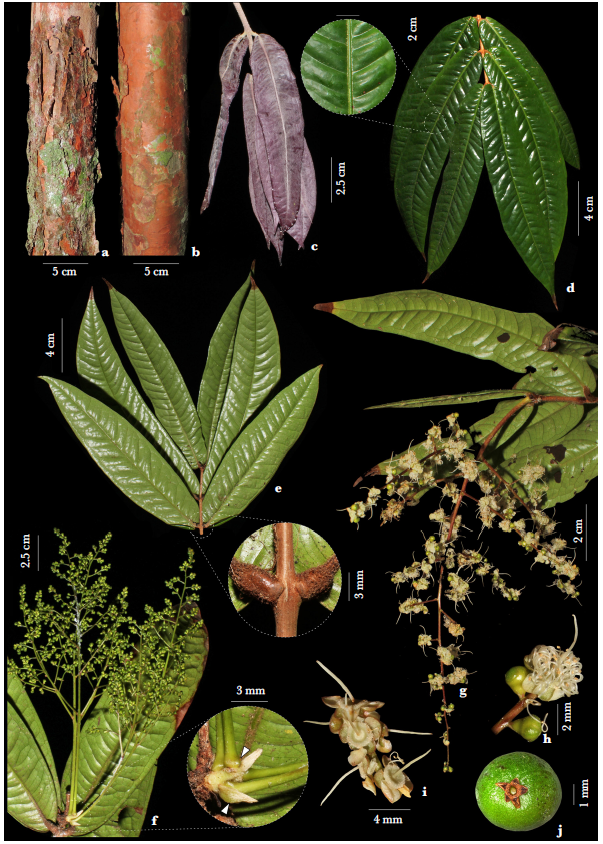
Treelets 2-4 m, usually scarcely ramified, with pendent branches. Trunk bark vinaceous, exfoliating. Apical bud light-brown, sericeous, young leaves purplish, tomentose abaxially, young twigs tomentose, the trichomes simple, light-brown, 1-1.2 mm long. Petioles 4.6-6.5 × ca. 3 mm, most visible abaxially, adaxially sulcate, pulvinate, when young pilose like the young twigs, when mature corky and transversally fissured; blades 14.7-28.3 × 3.4-7 cm, lanceolate or spathulate, chartaceous, strongly bullate, discolorous, drying usually dark-brown adaxially and light-brown abaxially, apex acuminate, base obtuse or cordate; both surfaces when young sericeous to puberulent with appressed, light-brown, simple trichomes up to 0.5 mm long, visibly concentrated on the midvein, when mature glabrous or nearly so, midvein raised on both surfaces; secondary veins 10-18 mm apart, leaving the midvein at angles 55-70º, marginal veins three, the inner one 5-8 mm from the margin, the middle one 1.5-3 mm, the outer one 0.8-1 mm; glands 0.1-0.2 mm in diameter, homogeneous, hyaline, slightly raised, visible only through lens on mature leaves but visible with the naked eye, vinaceous and raised on the abaxial surface of the young ones. Conflorescence terminal, comprising a single pair, or two decussate pairs of uniflorescences, the axis from which the paired panicles develop 3-12 mm long, tomentose, subtended by sessile bracts. Uniflorescence a pendulous, pyramidal panicle, main axis 15.3-22.3 cm long, secondary branches alternate, the basal one 8.8-18 cm, penducle 27-65 × 1-1.5 mm, swollen at the point of insertion on the axil, all axes green or sometimes vinaceous in fresh state, flattened, glabrous, blackish when dry, flowers sessile; bracts subtending uniflorescences 2.3-5.4 × 2-3.4 mm, navicular, narrowly elliptic, deltoid or triangular, base truncate, apex acute, sessile, pilose as the apical bud, subtending the whole inflorescence, persisting after anthesis; bracteoles (and bracts subtending the lateral axes) 1-1.5 × ca. 0.2 mm, sessile, navicular, filiform or triangular, base truncate, apex acute, glabrous, persisting after anthesis. Flower buds 2-3 × 1.2-2.8 mm, obconic, homogeneously glabrous, with the ovary occasionally slightly darker than the calyx, petal globe partially superposed by the calyx. Flowers after anthesis with hypanthial cup ca. 0.5 mm deep, internally glabrous, not tearing at anthesis; calyx lobes five, 0.7-1.6 × 0.9-1.8 mm, slightly unequal in size (usually two larger and petaloid or deltoid, 1-2 of median size and triangular, and 1-2 smaller and cucullate with mucronate apices, of which one may be displaced downwards, resembling a displaced bracteole), reflexed, not tearing but sometimes splitting irregularly at base at anthesis, externally glabrous, internally pubescent, with whitish to amber trichomes 0.1-0.3 mm long; petals five, 1.3-1.6 × 1.4-1.8 mm, rounded or narrowly elliptic, base truncate, apex obtuse or rounded, membranaceous, glands conspicuous, externally and internally glabrous; floral disk ca. 2.5 mm in diameter; staminal ring 0.4-0.7 mm thick, often tearing in a transversal slit, whitish, pubescent as the internal surface of the calyx, the trichomes hyaline ca. 0.2 mm long; stamens 60-65, filaments 4-5 mm long, anthers basifixed, bilocular, longitudinally dehiscing with thecal margins inrolled so that the pollen is only visible through a thin slit, pseudosepta not seen but possibly hidden by thecal margins, the connective eglandular; style 7.8-8.2 mm long (around twice the stamen filaments length), stigma punctiform to slightly capitate, minutely papillose, ovary with two locules, each with two ovules. Fruits (immature) 2.8-3.5 × 2.8-3.5 mm, globose to subglobose, surface smooth, glabrous; seeds not seen.
Examined material: Rio de Janeiro, estrada das furnas da Tijuca, 24.VI.1958, fr., “Liene” [L.T. Eiten] et al. 3914 (RB). Maricá, Ponta Negra, Sacristia, à beira da praia da Sacristia, 22º56’57.1”S, 42º41’1.1”W, 64 m elev., 18.III.2022, fl., T. Fernandes et al. 1006 (NIT, NY, K, RB, US); 2.V.2022, fl., T. Fernandes et al. 1013 (NIT, NY, RB); 5.VII.2022, fl., T. Fernandes et al. 1060 (NIT, K, RB); 23.VIII.2023, fr., T. Fernandes & R. Benvenuti 1484 (NIT, RB); divisa dos municípios de Maricá e Tanguá, Espraiado, Refúgio da Vida Silvestre de Maricá, trilha para o Pico da Lagoinha, 22º51’26”S, 42º40’1”W, 700 m elev., 22.IX.2024, D.N.S. Machado 3571 (RFFP, RB).
a-j. Myrcia colpodes in fresh state - a. trunk with papery plates attached; b. trunk after bark peeling; c. young leaves; d. adaxial surface of leaves, detail: midvein raised; e. abaxial surface of leaves, detail: petioles slightly pulvinate and tomentose; f. fflowering branch with flower buds (detail: uniflorescences swollen at base in upper arrowhead, and bracts subtending uniflorescences in lower arrowhead); g. pendular inflorescence; h. detail of a typical terminal portion of uniflorescences axes, flower buds and a terminal post-anthetic flower; i. post-anthetic flowers after stamen fall, showing the sericeous staminal ring and the long style; j. immature fruit. (a-f. Fernandes 1006; g-i. Fernandes 1060; j. Fernandes 1484). Photos: a-b. Thiago Fernandes; c-i. Carlos Ferreira.
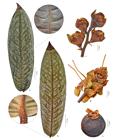
a-e. Myrcia colpodes in dry state - a. leaf adaxial surface (detail: raised midvein); b. leaf abaxial surface (detail: corky petiole and tomentose indumentum); c. detail of a typical terminal portion of uniflorescences axes with flower buds; d. post-anthetic flowers showing the pubescent staminal ring; e. lateral view of an immature fruit. (a-c. Fernandes 1006; d. Fernandes 1060; e. Fernandes 1484).
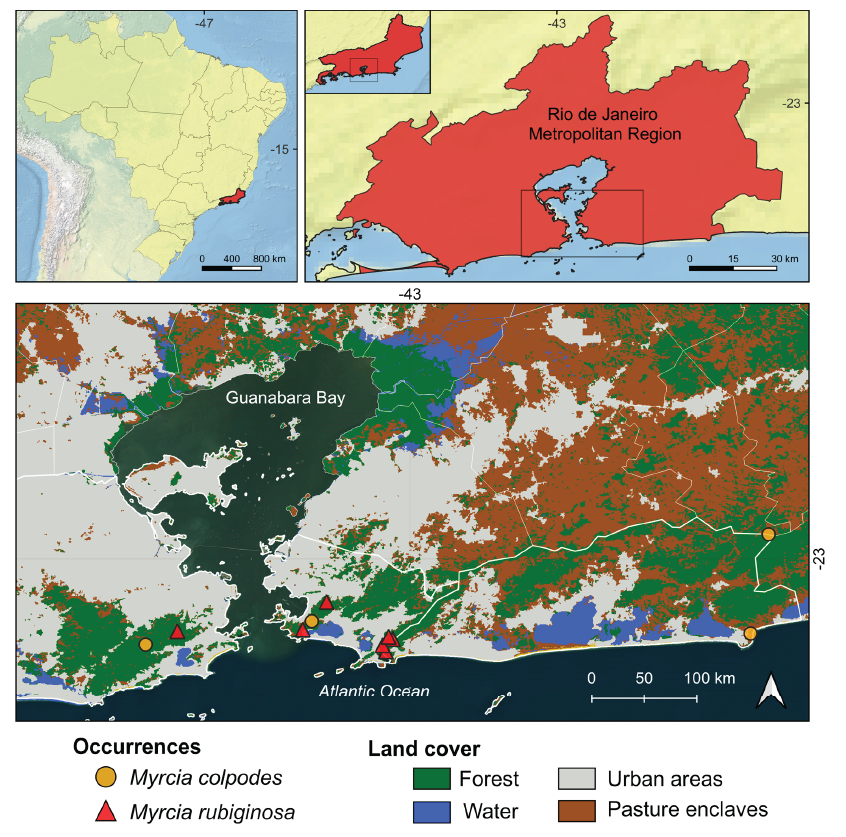
Myrcia colpodes is endemic to the Brazilian state of Rio de Janeiro, with records restricted to the municipalities of Maricá (from the rediscovered populations), Niterói (from the type collection) and Rio de Janeiro capital city (from a collection from 1958) (Fig. 3). This species inhabits inselberg forests near the sea at ca. 64 m elev. and montane rainforests at ca. 700 m elev. Flowers can be found from mid-March to August, fruits (immature) were collected only once in June.
Myrcia colpodes can be recognized in the field by its vinaceous and exfoliating trunk, young purplish and pendular leaves, lanceolate and strongly bullate mature leaves, pendulous, glabrous uniflorescences, in well-developed panicles, and externally glabrous flowers. This overall aspect fits the morphological concept of Myrcia sect. Aulomyrcia. Within this section, the characteristic long leaves with adaxially raised midveins, the terminal conflorescences with well-developed and whorled uniflorescences, combined with flower buds with free calyx lobes, suggests its placement in “species group A” as circumscribed in Lucas et al. (2016: 652). Myrcia colpodes is remarkable within this group due to its pubescent staminal ring, which contrasts with the internally glabrous flowers present in all other species of this group occurring in the Atlantic Forest.
Within the “species group A” of Myrcia sect. Aulomyrcia, bullate leaves also occur in the Amazonian species M. integra M.A.D. Souza & Sobral (in Sobral et al. 2015: 212) and M. maraana Sobral & M.A.D. Souza (in Sobral et al. 2015: 222), as well as in M. gigantea (O.Berg) Niedenzu (1895: 76) an Atlantic Forest species endemic from the Brazilian state of Bahia (Santos et al. 2020). These species also share subsessile leaves with barely visible petioles, but they can be distinguished by the characters given in Table 1.

Map with the current known occurrence records of Myrcia colpodes and M. rubiginosa. White lines represent limits between municipalities in the state Rio de Janeiro.
Comparison of morphological characters between species of Myrcia sect. Aulomyrcia, “species group A”, sensuLucas et al. (2016) with subsessile, bullate leaves.
2. Myrcia rubiginosa Cambess., Fl. Bras. Merid. (quarto ed.): 300. 1832. Type: BRAZIL. RIO DE JANEIRO: “Inter rupes ad rivulum vulgo Carioca prope Rio de Janeiro” (“Bois du ruisseau de la Carioca parmi les rocheen” on the label). [Rio de Janeiro, Tijuca Massif, at the banks of the Carioca River], 1816-1821, fl., A. Saint-Hilaire A1-670 (lectotype P00161371, designated by Lucas et al. 2016).
= Myrcia pyramidata O.Berg, Fl. bras. 14(1): 193. 1857. Type: BRAZIL. RIO DE JANEIRO: “Habitat in prov. Rio de Janeiro”, s.d., fl., F. Sellow s.n. (holotype B, probably destroyed; lectotype K000262404!, designated by Lucas et al. (2016); isolectotypes BR0000005238545!, P00161139!, W0037074!). Figs. 4; 5
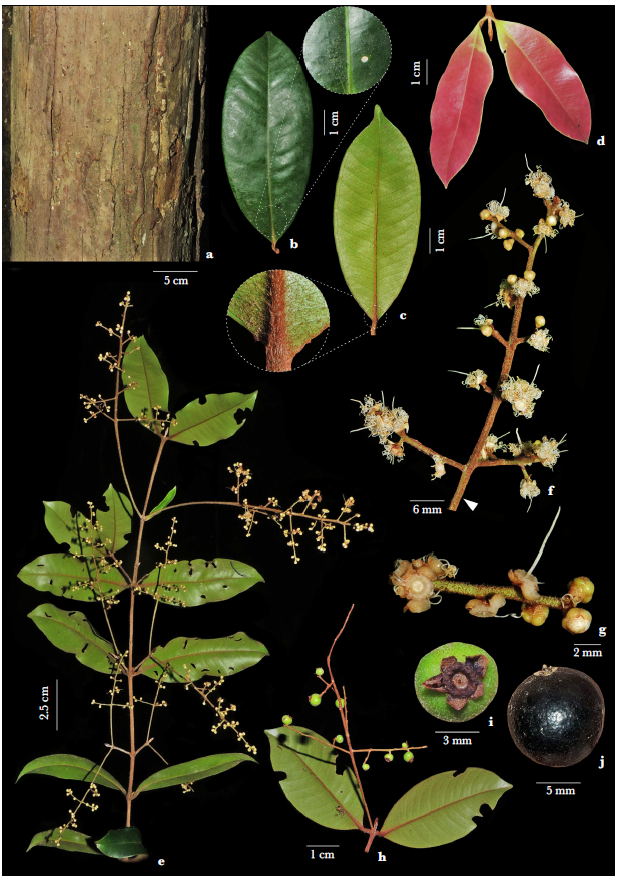
Trees 4-6 m, usually with multiple trunks, sometimes with pendent branches. Trunk bark greyish light-brown, longitudinally fissured, sometimes detaching in slightly thick, more or less rectangular strips. Apical bud golden to brownish, sericeous, sometimes pruinose, young leaves pinkish, glabrous, young twigs tomentose, sometimes pruinose, the trichomes simple, brownish to ochraceous, ca. 1 mm long. Petioles 6.6-12 × 1.5-1.8 mm, visible on both surfaces, adaxially sulcate, smooth, often resupinate, when young and mature pilose like the young twigs, occasionally glabrescent; blades 8.5-14 × 3.8-5.6 cm, elliptic, sometimes slightly obovate, rarely narrowly elliptic, chartaceous to subcoriaceous, discolorous, drying greyish-green or olive-green adaxially and light-brown abaxially, apex acuminate, base acute; adaxial surface when young puberulent with appressed, whitish to light-brown, simple trichomes up to 1 mm long, visibly concentrated on the midvein, glabrous when mature or nearly so, midvein finely canaliculate; abaxial surface when young pilose, when mature glabrous or nearly so, the trichomes equal to those on adaxial surface, midvein strongly raised; secondary veins 5-9.5 mm apart, leaving the midvein at angles of 60-65º, marginal veins two, the inner one 1.8-3 mm from the margin, the outer one 0.4-1 mm; glands 0.1-0.2 mm in diameter, homogeneous, hyaline, visible only through a lens on both surfaces, even in young leaves. Conflorescence mostly terminal or axillary, sometimes ramiflorous, comprising a single pair of uniflorescences. Uniflorescence a pendulous, pyramidal panicle, main axis 9.5-15 cm long, secondary branches alternate, the basal one 3.5-10 cm long, peduncle 50-90 × 1-2 mm, all axes slightly flattened, brownish and tomentose (in fresh and dry state), with trichomes like the young twigs, peduncle 51-90 × 1-2 mm, flowers sessile; bracts not examined, deciduous before anthesis; bracteoles 0.5-1 × ca. 0.5 mm, sessile, navicular, ovate, base truncate, apex acute, puberulent to glabrous on both surfaces, deciduous before or occasionally persisting after anthesis. Flower buds 2-2.5 × 1.8-2 mm, obconic, ovary tomentose, the trichomes light-brown, yellowish or amber, in two layers, the lower one papillose, markedly distinct from the calyx, the upper one adpressed, calyx shorter than the petal globe which it is conspicuous at the bud apex. Flower after anthesis with hypanthial cup ca. 0.5 mm deep, internally glabrous except for scattered, yellowish, simple trichomes on the bottom (i.e., top of the ovary), not tearing at anthesis; calyx lobes five, 1-1.2 × 1.5-2 mm, parallel to the disk or reflexed, anthesis by regular opening of the calyx lobes accompanied by some horizontal tearing between the lobes, remaining attached to staminal ring only by the central portion, especially the larger ones, papillose on both surfaces, with trichomes sparse to moderate, yellowish to golden, but internally glabrous at the base at the tearing region, base truncate or trullate (as result of the tearing margins), slightly unequal in size, usually the larger three membranaceous, with rounded apices, the smaller two coriaceous, cucullate in bud, often with acute to apiculate apices, sometimes at least one of these much reduced and slightly displaced below the level of the other lobes; petals five, 1.3-1.5 × 1.2-2.2 mm, rounded or narrowly elliptic, base truncate, apex obtuse or rounded, membranaceous, glands conspicuous, externally puberulent, internally glabrous; floral disk 1.8-2 mm in diameter; staminal ring ca. 0.5 mm in diameter, glabrous; stamens 50-60, filaments 3.3-5 mm long, anthers basifixed, bilocular, with longitudinally dehiscing with thecal margins reflexed exposing the pollen and the entire internal surface of the thecal halves, pseudoseptum visible, the connective eglandular; style 4.5-6 mm long, stigma punctiform, ovary with two locules, each with two ovules. Fruits 6-9.5 × 7-12 mm, globose to subglobose, sometimes with two swellings where the single reniform seed is lodged, green when immature, dark-purple when ripe, surface smooth, glabrous or with scattered trichomes, the pulp white and pleasant to taste; seeds 1-2, reniform, cotyledons green.

a-j. Myrcia rubiginosa in fresh state - a. trunk with rectangular strips; b. leaf adaxial surface (detail: raised midvein); c. leaf abaxial surface (detail: indumentum); d. young leaves; e. flowering branch with pendular inflorescences; f. uniflorescence (point of insertion is omitted, arrowhead points to the peduncle, i.e., first internode); g. lateral axis with flower buds and post-anthetic flowers; h. fruiting branch; i. topside detail of a fruit showing marcescent calyx lobes; j. mature fruit with dry calyx lobes. (a-g. Fernandes 934; h-i. Fernandes 1007; j. Fernandes 1088). Photos: Thiago Fernandes.
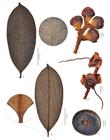
a-e. Myrcia rubiginosa in dry state - a. leaf adaxial surface; b. leaf abaxial surface; c. detail of a typical terminal portion of uniflorescences axes with flower buds; d. open flowers showing the horizontal tearing between the calyx lobes; e. frontal view of an immature fruit. (a-d. Fernandes 934; e. Fernandes 1007).
Examined material: Maricá, Itaipuaçu, Pico Alto Moirão, 14.I.1982, fl., R.H.P. Andreata 387 (RB). Niterói, Charitas, Parque Natural Municipal de Niterói (PARNIT), Morro da Viração, trilha em direção ao cume da Pedra do Santo Inácio, 22º55’12.6”S, 43º4’39.4”W, 296 m elev., 1.XII.2022, fl., T. Fernandes & R. Benvenuti 1332 (NIT, RB); Itaipu, Parque Estadual da Serra da Tiririca, Córrego dos Colibris, 15.III.2001, fr., E.N. Fontes 1 (RB, RFFP); 14.I.2005, fl., A.A.M. de Barros 2361 (RB); trilha em direção ao cume do morro, 22º57’16.4”S, 43º00’57.6”W, 270 m elev., 10.VII.2022, fr., T. Fernandes 1088 (K, NIT, RB); Piratininga, Tibau, Parque Natural Municipal de Niterói (PARNIT), Morro da Viração, trecho final da travessia Tupinambá, próximo à saída da trilha, 22º56’45”S, 43º5’59”W, 60 m elev., 22.XII.2021, fl., T. Fernandes 918 (K, NIT, NY, MBML, RB, RBR); 4.I.2022, fl., T. Fernandes 925 (NIT, NY, R, RB, US); 13.I.2022, fl., T. Fernandes 934 (K, NIT, P, RB, RBR, RFFP); 20.I.2022, fl., T. Fernandes 943 (MBM, NIT, RB, SPF); 28.III.2022, fr., T. Fernandes et al. 1007 (K, NIT, MBM, RB, RBR, RFFP, US).
Myrcia rubiginosa is endemic to the Brazilian state of Rio de Janeiro, with records restricted to the municipalities of Rio de Janeiro (from the type collection) and Niterói (from the rediscovered populations) (Fig. 3). This species inhabits inselberg forests near the sea at elevations ranging from 60-296 m, in a similar environment of that of Myrcia colpodes, with which it may co-occur (Fig. 3). Flowers can be found from December to January, fruits from March to July.
Myrcia rubiginosa can be recognized in the field by its greyish light-brown trunk and longitudinally fissured bark, detaching as slightly thick, more or less rectangular strips, pinkish and pendular young leaves, pendular uniflorescences (even when flower buds are only beginning to develop) with distinctively brownish and tomentose axes, and relatively small flowers. As previously highlighted by Lucas et al. (2016: 653), the morphology of Myrcia rubiginosa fits the morphological concept of M. sect. Aulomyrcia, specifically the “species group D”, proposed in the same study.
As mentioned earlier, apart from our recent collection effort, Myrcia rubiginosa was collected on three occasions: first in 1982, then in 2001, and finally in 2005. However, in all these instances, the collections were misidentified in herbaria. The 1982 collection (Andreata 387, RB) exemplifies the difficulty in accurately naming a specimen of Myrcia sect. Aulomyrcia. Initially, it was identified as Myrcia macrocarpaDe Candolle (1828: 249), then as M. insularisGardner (1842: 530), followed by M. amazonica De Candolle (1828: 250), and finally as M. rubiginosa. All these species belong to Myrcia sect. Aulomyrcia, although M. insularis and M. macrocarpa are assigned to the “species group A” (see Lucas et al. 2016), and can be distinguished from Myrcia rubiginosa as this species has tomentose inflorescences and flowers (vs. puberulent to glabrous in M. insularis and M. macrocarpa).
Myrcia rubiginosa is indeed morphologically closely related to M. amazonica, also placed in “species group D” of M. sect. Aulomyrcia (see Lucas et al. 2016). These species share elliptic leaves, well-developed panicles and small flowers. Myrcia amazonica, as currently circumscribed (see Santos et al. 2020), has a wide intraspecific variation and a relatively long list of synonyms. The presence and type of indumentum covering inflorescences and flowers, for instance, are considered polymorphic in this species. Specimens with tomentose inflorescences and ovaries may be more difficult to distinguish from Myrcia rubiginosa, but bark morphology on trunk and branches, along with the inflorescence display, are conclusive features to separate these species. In Myrcia amazonica, the bark on trunk and branches is reddish and exfoliating, and inflorescences are erect in display. In Myrcia rubiginosa, the bark is greyish-brown, longitudinally fissured and detaching as slightly thick, more or less rectangular strips, and inflorescences are pendular.
Acknowledgements
TF thanks CNPq (Conselho Nacional de Desenvolvimento Científico e Tecnológico), for the scholarship (Process n°. 141327/2020-0). NIT Herbarium staff (from Universidade Federal Fluminense, UFF) is gratefully acknowledged for company and help during the field work, and laboratory supplies. We are also especially grateful to Davi N.S. Machado and Carlos D.M. Ferreira, for their support during the fieldworks, which was essential for the rediscoveries presented here. Gustavo H. Shimizu is acknowledged for valuable discussion and help for interpreting Saint-Hilaire’s annotations.
Data availability statement
In accordance with Open Science communication practices, the authors inform that all data are available within the manuscript.
References
- Amorim BS (2017) Filogenia e taxonomia do clado Gomidesia (Myrcia s.l., Myrtaceae) na Floresta Atlântica do Brasil. Tese de Doutorado. Universidade Federal de Pernambuco, Recife. 191p.
- Beentje HJ (2010) Plant glossary. Kew Publishing, Royal Botanic Gardens, Kew. 171p.
- Berg O (1855) Revisio Myrtacearum Americae. Linnaea 27: 1-472.
- Berg O (1857) Myrtaceae. In: Martius K (ed.) Flora brasiliensis enumeratio plantarum in Brasilia hactenus detectarum quas suis aliorumque botanicorum studiis descriptas et methodo naturali digestas partim icone illustratas. R. Oldenbourg, Monachii et Lipsiae 14: 1-656.
- Briggs BG & Johnson LAS (1979) Evolution in the Myrtaceae - Evidence from inflorescence structure. Proceedings of the Linnean Society of New South Wales 102: 157-254.
-
Cambessèdes J (1832) Myrtaceae. In: Saint-Hilaire A, Jussieu A & Cambessèdes J (eds.) Flora Brasiliae Meridionalis. Vol. 2. A. Belin Bibliopolam, Parisiis [Paris]. Pp. 277-381. DOI: 10.5962/bhl.title.45474
» https://doi.org/10.5962/bhl.title.45474 -
CRIA - Centro de Referência em Informação Ambiental (2023) speciesLink - Herbário Virtual da Flora e dos Fungos. Available at <Available at http://inct.splink.org.br >. Access on 13 April 2023.
» http://inct.splink.org.br - De Candolle AP (1827) Myrtacées. In: Bory de Saint-Vincent JBGM (ed.) Dictionnaire classique d’histoire naturelle 11: 399-403.
- De Candolle AP (1828) Myrtaceae. In: De Candolle AP (aut.) Prodromus 3. Sumptibus Sociorum Treuttel et Würtz, Parisii. Pp. 207-296.
-
Ebach MC, Valdecasas AG & Wheeler QD (2011) Impediments to taxonomy and users of taxonomy: accessibility and impact evaluation. Cladistics 27: 550-557. DOI: 10.1111/j.1096-0031.2011.00348.x
» https://doi.org/10.1111/j.1096-0031.2011.00348.x -
Gaem PH, Lucas EJ, Andrade A, Vicentini A & Mazine FF (2021) A taxonomic account of Myrcia (Myrtaceae) at the sites of the Biological Dynamics of Forest Fragments Project, Amazonas, Brazil. Rodriguésia 72: e00712020. DOI: 10.1590/2175-7860202172139
» https://doi.org/10.1590/2175-7860202172139 - Gardner G (1842) Contributions towards a Flora of Brazil, being an enumeration of a series of collections of plants, made in various parts of Brazil, from 1836 to 1841; with brief descriptions of new genera and species. London Journal of Botany 1: 528-548.
-
Goodwin ZA, Muñoz-Rodríguez P, Harris DJ, Wells T, Wood JRI, Filer D & Scotland RW (2020) How long does it take to discover a species? Systematics and Biodiversity 18: 784-793. DOI: 10.1080/14772000.2020.1751339
» https://doi.org/10.1080/14772000.2020.1751339 - Grisebach AHR (1864) Flora of the British West Indian Islands. Lovell Reeve, London. 789p.
- Hickey LJ (1973) Classification of the architecture of Dicotyledonous leaves. American Journal of Botany 60: 17-33.
-
JSTOR (2023) JSTOR Global Plants. Available at <Available at https://plants.jstor.org >. Access on 13 April 2023.
» https://plants.jstor.org - Kiaerskou H (1893) Enumeratio myrtacearum brasiliensium quas collegiunt Glaziou, Lund, Mendonça, Raben, Reinhardt, Schenck, Warming alique. In: Warming E (ed.) Symbolarum ad floram Brasiliae Centralis cognoscendam 39: 1-199.
-
Lucas EJ, Amorim BS, Lima DF, Lima-Lourenço AR, NicLughadha EM, Proença CEB, Rosa PO, Rosário AS, Lima dos Santos L, Santos MF, Souza MC, Staggemeier VG, Vasconcelos TNC & Sobral M (2018) A new infra-generic classification of the species-rich Neotropical genus Myrcia s.l. Kew Bulletin 73: 9. DOI: 10.1007/s12225-017-9730-5
» https://doi.org/10.1007/s12225-017-9730-5 -
Lucas EJ, Matsumoto K, Harris SA, Nic Lughadha EM, Benardini B & Chase MW (2011) Phylogenetics, Morphology, and evolution of the large genus Myrcia s.l. (Myrtaceae). International Journal of Plant Sciences 172: 915-934. DOI: 10.1086/660913
» https://doi.org/10.1086/660913 -
Lucas EJ, Wilson CE, Lima DF, Sobral M & Matsumoto K (2016) A conspectus of Myrcia sect. Aulomyrcia (Myrtaceae). Annals of the Missouri Botanical Garden 101: 648-698. DOI: 10.3417/2014015
» https://doi.org/10.3417/2014015 -
Niedenzu F (1893) Myrtaceae. In: Prantl K & Engler A (eds.) Die natürlichen Pflanzenfamilien 3: 57-105. DOI: 10.5962/bhl.title.4635
» https://doi.org/10.5962/bhl.title.4635 -
POWO (2023) Plants of the World Online. Facilitated by the Royal Botanic Gardens, Kew. Available at <Available at https://powo.science.kew.org/ >. Access on 13 April 2023.
» https://powo.science.kew.org/ -
QGIS Development Team (2023) QGIS Geographic Information System. Open Source Geospatial Foundation Project. Available at <Available at http://qgis.osgeo.org/ >. Access on 17 August 2023.
» http://qgis.osgeo.org/ - Radford AE, Dickson WC, Massey JR & Bell CR (1974) Vascular plant systematics. Harper & Row, New York. 891p.
-
REFLORA (2023) Herbário Virtual. Available at <Available at http://floradobrasil.jbrj.gov.br/reflora/herbarioVirtual >. Access on 13 April 2023.
» http://floradobrasil.jbrj.gov.br/reflora/herbarioVirtual -
Santos MF, Amorim BS, Burton GP, Fernandes T, Gaem PH, Lourenço ARL, Lima DF, Rosa PO, Santos LLD, Staggemeier VG, Vasconcelos TNC & Lucas EJ (2020) Myrcia In: Flora do Brasil 2020 (continuously updated). Instituto de Pesquisas Jardim Botânico do Rio de Janeiro. Available at <Available at http://floradobrasil.jbrj.gov.br/reflora/floradobrasil/FB10660 >. Access on 17 August 2023.
» http://floradobrasil.jbrj.gov.br/reflora/floradobrasil/FB10660 -
Sobral M & Souza MAD (2015) Thirteen new Amazonian Myrtaceae. Phytotaxa 238: 201-229. DOI: 10.11646/phytotaxa.238.3.1
» https://doi.org/10.11646/phytotaxa.238.3.1 -
Staggemeier VG, Diniz-Filho JA, Forest F & Lucas EJ (2015) Phylogenetic analysis in Myrcia section Aulomyrcia and inferences on plant diversity in the Atlantic rainforest. Annals of Botany Company 115: 747-761. DOI: 10.1093/aob/mcv005
» https://doi.org/10.1093/aob/mcv005