 Synthesis of silver nanoparticles using umbu seed extract as a reducing agent
Abstract
Metallic nanoparticles have a wide range of applications due to their size-dependent properties. Their synthesis usually uses hydroxides as reducing agents; however, sustainable approaches are exploring the use of plant-derived bioactive compounds as greener alternatives. Umbu is a native fruit from the Brazilian Caatinga biome with significant socioeconomic importance. Its depulping process generates approximately 25% of waste, which is rich in antioxidant compounds that can be used for nanoparticle synthesis. Therefore, this work aims to develop a green synthesis route for silver nanoparticles (AgNPs), using umbu seed extract as both reducing and stabilizing agent. The antioxidant compounds extraction was performed via microwave-assisted extraction at 100 °C for 15 minutes, using 70% ethanol as solvent. Various parameters were investigated in the synthesis process, including AgNO3 concentration (0.004 to 0.1 M), extract-to-precursor ratio (1:1 to 10:1 v/v), stirring speed (0-600 rpm), temperature (25 to 40 °C) and reaction time (1 to 6 h). The best synthesis conditions were found to be 0.01 M AgNO3, extract-to-AgNO3 ratio of 10:1 v/v, stirring at 600 rpm, room temperature, and a reaction time of 6 h. Under these conditions, a conversion of 97.1% was achieved, producing AgNPs with an average size of 10.7 nm, mainly composed of silver oxides.
Key words:
AgNPs synthesis; antioxidant capacity; Spondias tuberosa
Resumo
Nanopartículas metálicas possuem amplas aplicações, uma vez que seu tamanho lhes confere propriedades diferenciadas. Sua síntese normalmente emprega hidróxidos como agentes redutores. Porém, processos sustentáveis vêm buscando substituí-los por compostos bioativos de plantas. O umbu é uma fruta nativa da Caatinga que desempenha um importante papel socioeconômico. Seu despolpamento gera cerca de 25% de resíduo, ainda rico em compostos antioxidantes que podem ser utilizados nestas sínteses. Portanto, este trabalho tem como objetivo desenvolver uma rota verde de síntese de nanopartículas de prata (AgNPs), empregando extrato de caroço de umbu como agente redutor e estabilizante. A extração dos compostos antioxidantes foi realizada em micro-ondas, a 100 °C por 15 minutos utilizando etanol 70% como solvente. Parâmetros como concentração de AgNO3 (0,004 a 0,1 M), proporção precursor:extrato (1:1 a 1:10 v/v), agitação (0 a 600 rpm), temperatura (25 a 40 °C) e tempo de reação (1 a 6 h) foram avaliados no processo de síntese das nanopartículas. O melhor resultado obtido utilizou AgNO3 0,01 M, proporção extrato: AgNO3 de 10:1 v/v, agitação de 600 rpm, a temperatura ambiente, por 6h de reação. Uma conversão de 97,1% das AgNPs foi alcançada, cujas partículas apresentaram tamanho médio de 10,7 nm, composta principalmente por óxidos de prata.
Palavras-chave:
síntese de AgNPs; capacidade antioxidante; Spondias tuberosa
Introduction
Nanoparticles (NPs) are materials with dimensions below 100 nm. This small size provides unique characteristics, altering their optical, catalytic, electronic, magnetic and mechanical properties. In addition, their extremely low surface area-to-volume ratio allows them to be incorporated in very small quantities while still achieving excellent percolation (Dutta et al. 2021). NPs have a wide range of applications in fields such as textiles, food, pharmaceuticals, medicine, electronics, agriculture, and more (Dutta et al. 2021).
Studies report the application of silver nanoparticles (AgNPs) in several fields, with one of their most proeminent being medicine, due to its antimicrobial and anticancer properties, as well as the gradual release of silver ions. In this context, AgNPs can be used in antibacterial formulations, bone prostheses, wound dressings, drug delivery systems, surgical instruments, and as anticancer and diagnostic agents (Ghasemi et al. 2025). Furthermore, AgNPs are considered promising antimicrobial agents and potential alternatives to antibiotics, as they can inhibit the growth of biofilm-proctective microbial communities that contribute to infection persistence, due to their high surface capacity and low environmental toxicity (Abdussalam-Mohammed et al. 2025).
In NPs synthesis, a reducing agent is typically used to facilitate the binding of -OH groups to the precursor cation, forming an intermediate hydroxide. However, the use of conventional reducing agents can generate toxic byproducts, making the process more expensive and limiting its applications in the food, cosmetics, and pharmaceutical industries (Al-Rajh et al. 2022). To replace these substances, many studies are evaluating the use of polyphenols and other bioactive compounds from plants as reducing agents in this process (Jimenez-Rosado et al. 2022), since they are molecules that have more than one hydroxyl group, which is correlated with their antioxidant activity and potential reducing power (Jimenez-Rosado et al. 2022).
The synthesis of silver nanoparticles (AgNPs) mediated by plant extracts typically begins by mixing the extract with AgNO3 at room temperature. The reaction occurs rapidly and can be visually confirmed by a noticeable color change, as well as by other characterization techniques. In the final stage of the synthesis, the plant extracts helps stabilize the NPs, promoting a more energetically stable morphology. In this way, the plant extract acts not only as a reducing agent, but also as a stabilizing agent for the nanoparticles (Sharma et al. 2022).
The umbu (Spondias tuberosa Arruda) is a fruit native to the Brazilian Caatinga that has important bioactive compounds in its composition, such as rutin, quercetin, carotenoids, and vitamin C (Ribeiro et al. 2019). Because of this, its fruit has interesting biological properties for different areas of industry. In addition, this fruit holds significant socioeconomic importance, as it is widely used in rural areas of the Northeastern Brazil as a food source and a mean of supplementing family income (Ribeiro et al. 2019). The umbu harvest is carried out through extractivist practices, in which small farmers or gatherers collect the fruits from trees naturally spread across the territory (Souza et al. 2019).
The main product of umbu agroindustrialization is frozen pulp; however, the depulping generates a significant amount of residue, which can account for up to 25% of the total fruit mass processed (Ribeiro et al. 2022). This residue consists of seeds, peels, and cake resulting from pulp refinement and contains high-value compounds. Therefore, utilizing this by-product is a promising opportunity to add value to the umbu production chain (Ribeiro et al. 2019). Umbu seeds are rich in dietary fiber and have minerals in their composition such as potassium, phosphorus, calcium, and manganese (Freitas et al. 2024), which perform various physiological functions in the human body’s systems. Besides that, studies showed the presence of palmitic, stearic, oleic, linoleic and linolenic acids in lipidic fraction analysis of umbu seed extracts (Dias et al. 2019). Cangussu et al. (2021) reported the presence of compounds such as trigonelline, gallotannins, and polysaccharides in the flours derived from the fruit’s peel and pulp. In this way, the residue of umbu can be a promising raw material to obatin reducing and stabilizing agents for metallic nanoparticles synthesis.
Therefore, this work aims to develop a green route for the synthesis of silver nanoparticles (AgNPs), using umbu seed extract as a reducing and stabilizing agent.
Materials and Methods
Samples
Umbu seeds used in this study were obtained from the depulping process carried out at the pilot plant of Embrapa Agroindústria de Alimentos (Guaratiba, Rio de Janeiro). Access to the genetic heritage was duly registered in the National System for the Management of Genetic Heritage and Associated Traditional Knowledge (SIsGen) under n° A87D2A7. The residue was dried at 50 °C in a forced air oven with and then ground in a knife mill to obtain powdered material. This powder was subsequently used for the extraction process of antioxidant compounds.
Umbu extraction
The extraction was performed in a microwave (Ethos 1, Milestone) at 100 °C for 25 minutes. To select the most suitable solvent for the process, two different solvents were used, one of 70% ethanol and the other consisting of 30% acetone. After each extraction, the extracts were vacuum filtered and stored frozen until further use. Each extract was then evaluated for its antioxidant capacity and total phenolic content.
Extraction kinetics
Based on the chemical evaluation of the extracts obtained previously, the best solvent was chosen, and a kinetic evaluation of the extraction process was performed by varying the extraction time from 5 to 30 min after reaching 100 °C. At the end of each extraction, the extracts were evaluated to determine the total phenolic content and antioxidant capacity.
Total phenolic compounds (TPC)
This analysis was performed using Folin-Ciocalteu reagent, according to the method described by Georgé et al. (2005). For that, 250 µL of each extract were mixed with 1,250 µL of 10% (v/v) Folin-Ciocalteu reagent and 1,000 µL of 7.5% (w/v) Na2CO3 solution. The mixtures were then heated to 50 °C for 15 minutes and subsequently cooled in an ice bath before measuring the absorbance at 760 nm. Quantification was carried out using a calibration curve prepared with gallic acid solutions with concentrations ranging from 10 to 100 mg/L. The total phenolic compounds (TPC) in the extracts was expressed as mg of gallic acid equivalents per 100 g of sample (mg GAE/100 g).
DPPH• assay
The DPPH• method was performed according to the methodology proposed by Hidalgo, Sanchez-Moreno & Pascual-Teresa (2010). For the reactions, 100 µL of each extract was added to 2,900 µL of DPPH• solution (6 × 10⁻⁵ M in methanol, diluted to obtain an absorbance of 0.700 at 517 nm) and allowed to react for 30 minutes at room temperature. Absorbance was then read at 517 nm using methanol as a blank. Antioxidant capacity was quantified using a standard calibration curve prepared with Trolox at concentrations ranging from 80 to 700 µmol. Results were expressed as μmol Trolox/g of sample.
ABTS•+ assay
The antioxidant capacity of the extracts was determined by the ABTS•+ assay, following the methodology described by Gião et al. (2007). Thirty microliters of each extract were mixed with 3,000 μL of the ABTS•+ radical solution and allowed to react at room temperature for 6 minutes. Absorbance was measured at 734 nm, using ultrapure water as a blank. Antioxidant capacity was quantified using a Trolox standard curve prepared with solutions ranging from 500 to 2,000 µmol. Results were expressed as μmol of Trolox/g of sample.
FRAP analysis
This assay was performed according to the method described by Benzie & Strain (1996), with slight modifications. The FRAP reagent was prepared by mixing 25 mL of 300 mM acetate buffer (pH 3.6) with 2.5 mL of 10 mM TPTZ solution in 40 mM HCl and 2.5 mL of 20 mM FeCl3•6H2O. A volume of 100 µL of each extract was added to 3 mL of FRAP reagent at 37 °C for 30 min. After incubation, absorbance was measured at 593 nm. The ferric reducing antioxidant power was determined using a standard calibration curve prepared with FeSO4•7H2O solutions with concentrations ranging from 150 to 1,200 µmol. Results were expressed as µmol Fe2+/g of sample.
Nanoparticles synthesis
To synthesize AgNPs, several tests were performed based on the literature (Kamaraj et al. 2023; Jain et al. 2017) and preliminary assays, using a completely randomized design. The variables evaluated included AgNO3 concentration (0.004 to 0.1 M), extract-to-precursor ratio (1:1 to 10:1 v/v), stirring (0 to 600 rpm), temperature (25 to 40 °C) and reaction time (1 to 6 h). The synthesis of nanoparticles followed these steps: first, the umbu seed extract was mixed with the AgNO3 solution and subjected to stirring and heating under different conditions of temperature, stirring speed, reaction time and AgNO3 concentration. After the reaction, the mixture was left to rest, then centrifuged, and the resulting precipitate was washed with ultrapure water. Finally, the particles were dried, collected and analyzed. These initial assays showed which condition that successfully produced the nanometric particles involved reacting 100 mL of umbu seed extract with 100 mL of a 0.01 M AgNO3 solution, under stirring at 600 rpm and room temperature for 1 h.
The mixture was then left to rest overnight, centrifuged at 3,500 rpm for 20 minutes, and the precipitate was washed, frozen in ultrapure water, and lyophilized to recover the nanoparticles. From this condition, further tests were conducted varying the extract-to-precursor ratio (5:1 to 10:1 v/v) and reaction time (3 to 6 h) to improve the synthesis efficiency.
Nanoparticles characterization SEM Analysis
The micrographs were obtained using a Hitachi High Technologies America Inc. (TM3000) scanning eletron microscope (SEM), integrated with an EDS (Energy Dispersive Spectroscopy) system.
Transmission electron microscopy analysis
High-resolution transmission electron microscopy (HR-TEM) images and selected area electron diffraction (SAED) patterns were acquired using a 200 kV Tecnai-20 G2 F30 TEM (FEI) instrument. Crystallographic analysis, including fast Fourier transform (FFT) of crystallographic planes and interplanar distance measurements, was performed using Digital Micrograph/GATAN software (v. 3.61). Particle size measurements were performed using ImageJ (1.54p). For statistical analysis, more than 100 particles were analyzed, and a histogram of the particle size distribution was generated.
XRD
X-ray diffraction (XRD) analysis was used to investigate the crystalline phases in the synthesized nanoparticles. All analyses were performed using a Bruker D8 Advance instrument with a Cu Kα radiation source, operating at 40 kV and 40 mA. The diffractograms were collected in the 2θ range of 10° to 90°, with a step size of 0.02° and a counting time of 1s/step. The crystalline phases present were identified using the ICSD database.
FTIR analysis
Fourier transform infrared spectroscopy (FTIR) analysis was used to characterize the reagents and monitor the synthesis. For this purpose, a Thermo Nicolet Nexus 470 spectrometer operating from 400 to 4,000 cm-1 with a resolution of 4 cm-1 was used. The KBr pelleting technique was employed.
Flame atomic absorption spectroscopy
Flame atomic absorption spectrometry (Varian - 280FS) was used to quantify the silver content in the supernatant collected after the reaction in order to calculate the conversion of AgNO3 to AgNPs.
Statistical analysis
Results from the antioxidant compounds extraction and AgNPs conversion were expressed as average ± standard deviation. Statistical analysis was performed using analysis of variance (ANOVA), followed by Tukey test at 95% confidence level by Statistica® Software v.13.0.
Results and Discussion
Chemical analysis of extracts
Table 1 shows the results of the analysis of total phenolic compounds (TPC) and antioxidant capacity of the extracts obtained using different solvents. Although the extract obtained using 30% acetone presented a higher TPC content than that obtained using 70% ethanol, the antioxidant capacity of this extract did not differ significantly from the 70% ethanol extract when measured by the ABTS•+ and FRAP methods. Furthemore, the extract obtained with 70% ethanol exhibited the highest antioxidant capacity according to the DPPH• method (p < 0.05). It is important to note that the TPC content may be influenced by other compounds present in the sample, potentially increasing its value without necessarily implying an increase in the extract antioxidant potential (Santos et al. 2025). Considering this, along with the lower toxicity of ethanol compared to acetone (Cendrowski et al. 2024), and the fact that acetone is a more flammable substance, 70% ethanol was selected as the solvent due to its greater safety ( Lee et al. 2024).
Extraction kinetics
Table 2 presents the results of the analysis of TPC and antioxidant capacity of the extracts obtained using 70% ethanol as the solvent, with extraction times ranging from 5 to 30 minutes after reaching 100 ºC under microwave heating.
From these data, it is possible to observe that increasing the extraction time led to an increase in the measured responses up to 15 min. Beyond that, no significant improvement in the antioxidant potential of the extract was observed. Although the TPC content was higher at 25 min, but the antioxidant capacity did not follow the same trend, indicating the presence of additional compounds that react with the Folin-Ciocalteu reagent, but do not exhibt antioxidant potential according to the other analytical methods. Therefore, to improve the efficiency of the extraction process by reducing both time and energy consumption, 15 min was selected as the optimal extraction performed in this study.
Under these conditions, TPC content was 1001 mg GAE/100 g. This value is higher than that reported by Freitas et al. (2022), who recovered antioxidant compounds from umbu seeds by a conventional extraction, under stirring of 150 rpm at room temperature for 1 h, using with acetone 30% as the solvent, obtaining 947 mg GAE/100 g. These results highlight the effectiveness of microwave-assisted extraction combined with ethanol as extraction system. Regarding antioxidant capacity, the values obtained by the ABTS●+, DPPH●, and FRAP methods were 37 µmol Trolox/g, 67 µmol Trolox/g and 196 µmol Fe2+/g, respectively.
Nanoparticles synthesis and characterization
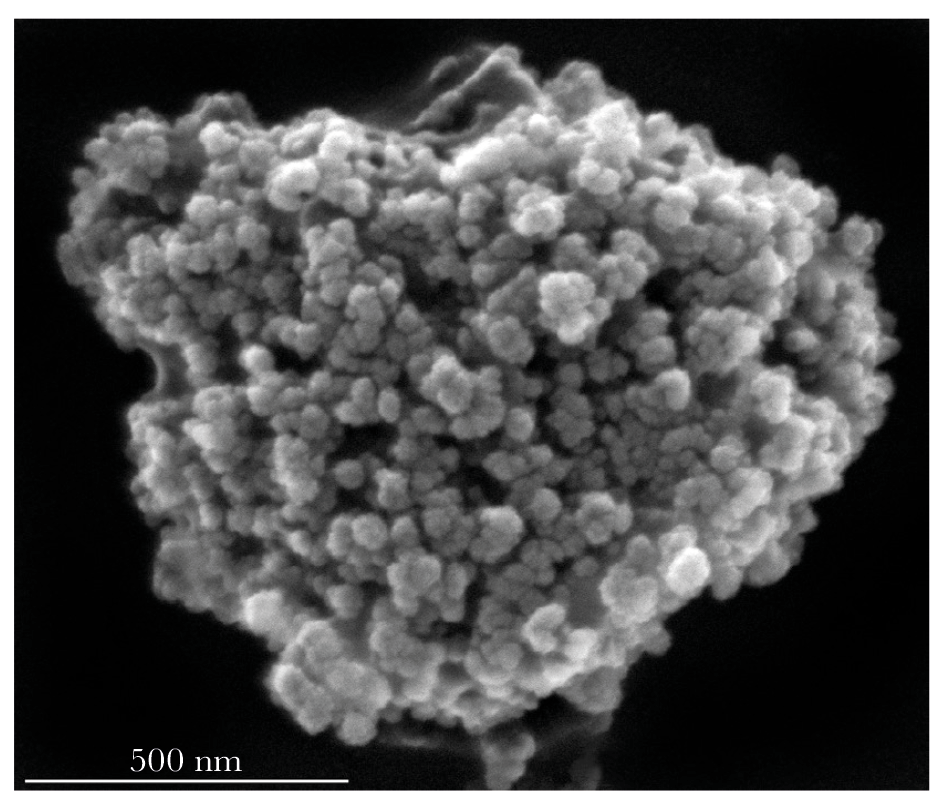
Considering the results of several tests, it was possible to produce particles within the desired size, as can be seen in Figure 1 (preliminary test). The SEM analysis (Fig. 2) confirmed that the particles were indeed within the nanoscale, i.e., smaller than 100 nm, in accordance with the classification of nanoparticles (Dutta et al. 2021). These nanoparticles were synthesized by reacting 100 mL of umbu seed extract with 100 mL of a 0.01 M AgNO3 solution, under magnetic stirring at 600 rpm, at room temperature, for 1 h. It is important to highlight that syntheses performed without stirring and using concentrated precursor solutions (> 0.01 M) yielded particles outside the desired size (data not shown).


SEM analysis of the nanoparticles of silver produced using umbu seed extract as reducing agent.
The formation of nanoparticles was also confirmed by FTIR analysis (Fig. 3). In the FTIR spectrum of the umbu seed extract, an intense and broad band was observed at 3,406.2 cm-1, indicating the presence of hydroxylated compounds such as phenolics. This band is characteristic of the O-H stretching vibrations. In the FTIR spectrum of silver nitrate, it was possible to observe an intense band at 1,384.05 cm-1, corresponding to the asymmetric stretching vibration (axial deformation) of the N-O bond of the NO2 group, confirming the presence of nitrate in the sample.
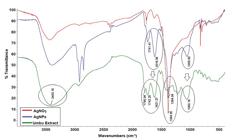
FTIR spectra of the nanoparticles of silver produced using umbu seed extract as reducing agent, umbu seed extract and silver nitrate.
From the comparison between the FTIR spectra of the AgNPs and the umbu seed extract, it is evident that compounds present in the extract were adsorbed onto the surface of the AgNPs, as similar peaks were found in both spectra. Furthemore, the decrease in the intensity of the band at 1,384 cm-1 in AgNPs spectra compared to that of AgNO3 indicates the consumption of nitrate ions during the reaction and their conversion into nanoparticles.
Finally, the conversion percentage obtained from the synthesis performed with different extract-to-AgNO3 ratios and rection times are shown in Tables 3 and 4. Based on these results, it was possible to observe that variations in the extract-to-precursor ratio did not significantly affect the conversion rate. However, the 10:1 ratio was selected to ensure an excess of antioxidant/reducing compounds in the final nanoparticles, thereby enhancing their multifunctional properties. The optimal time was determined to be 6 hours, which resulted in the highest yield (97.1%). Accordingly, the AgNPs obtained under these conditions were selected for further characterized by XRD and TEM as presented further ahead.
In the XRD spectra (Fig. 4) of the AgNPs, the broad reflection around 10-15° is attributed to the low crystallinity of the umbu seed extract in which the AgNPs are embedded. The presence of metallic Ag and Ag3O4 oxide was evidenced. However, other silver oxides may be present in smaller aumont, as shown in Figure 4. The broadening of the peaks could be due to the very small particle sizes.

X-ray diffraction pattern of the nanoparticles of silver produced using umbu seed extract as reducing agent and the reference patterns of the possible phases present in the sample Ag (ICSD 22434); Ag2O (ICSD 281041); Ag3O4 (ICSD 59225); AgO (ICSD 27659) and Ag2O3 (ICSD 59193).
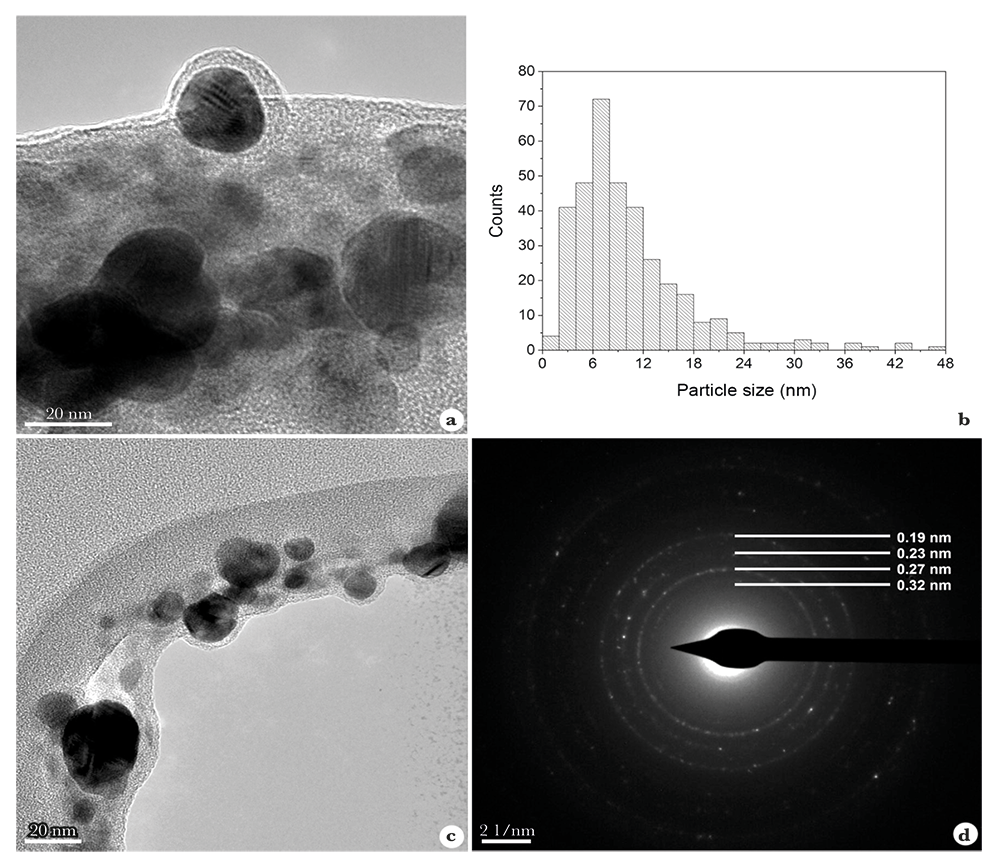
Dark-colored AgNPs with nanometric sizes were obtained, as observed in the micrographs by STEM (Fig. 5). It was confirmed that compounds present in the plant extracts encapsulate the synthesized AgNPs, as seen in Figures 5a and 5c, where an amorphous carbon layer surrounds the AgNPs, likely resulting from the plant extract. Similar results were reported by Hashemi et al. (2022), which obtained AgNPs by green synthesis using Sambucus ebulus phenolic extract. An organic layer surrounding the spherical nanoparticles was observed by TEM and confirmed by elemental analysis. The particle size distribution histogram (Fig. 5b) reveals the polydisperse nature of the AgNPs. However, the largest size observed is around 25 nm (Fig. 5a,c), highlighting the effectiveness of the umbu extract as both a reducing and stabilizing agent, preventing the synthesized AgNPs from agglomerating or growing excessively. The particles are mostly spherical, with an average size of 10.7 nm.

a-d. TEM micrographs of the nanoparticles of silver produced using umbu seed extract as reducing agent (a,c); the corresponding particle size distribution histogram (b); and the selected area electron diffraction pattern rings (d).
The selected area diffraction ring patterns (Fig. 5d) indicate the presence of polycrystalline nanoparticles oriented in different directions. Interplanar distances were obtained and show the presence of primarily Ag3O4, with distances of 0.32 nm, 0.27 nm, 0.23 nm, and 0.19 nm corresponding to the (110), (120), (131), and (022) planes, respectively (ICSD 59225). The interplanar distance of 0.23 nm may also correspond to the (111) plane of metallic Ag (ICSD 22434).
Considering all the results obtained, it is concluded that 70% ethanol is suitable as a solvent to extract antioxidant compounds from umbu seed under microwave-assisted heating. In addition to providing an extract with significant antioxidant capacity, ethanol presents a safer profile compared to acetone, making it more suitable for sustainable applications. Among the tested conditions, an extraction time of 15 minutes showed to be the most efficient way for extraction. Regarding nanoparticle synthesis, it was possible to obtain silver nanoparticles (AgNPs) using umbu seed extract as a natural reducing agent, achieving high conversion rates. The synthesized particles were predominantly spherical and composed of silver oxides, as confirmed by the characterization analyses. However, further studies are required for the practical application of these nanoparticles in fields such as food, pharmaceuticals, and cosmetics. These studies should include evaluations of toxicity, biocompatibility, and functional performance (e.g., antioxidant capacity) to ensure safety and efficacy in real-world applications.
Acknowledgements
To CNPq, for the scholarship; to LAQOI-INT and to CENANO - INT/SISNANO (CNPq n 442604/2019-0), for the microscopy analysis.
References
-
Abdussalam-Mohammed W, Edbey K, Farhat HE, Shah P, Shamsi SS & Bhattarai A (2025) Facile green synthesis of novel AgNPs using Hyoscyamus leaf extract as capping agent: characterization and their potential antibacterial activities. Inorganic Chemistry Communications 173: 113893. DOI: 10.1016/j.inoche.2025.113893
» https://doi.org/10.1016/j.inoche.2025.113893 -
Al-Rajh AMH, Salem SS, Alharbi AA & Abdelghany TM (2022) Ecofriendly synthesis of silver nanoparticles using Kei-apple (Dovyalis caffra) fruit and their efficacy against cancer cells and clinical pathogenic microorganisms. Arabian Journal of Chemistry 15: 103927. DOI: 10.1016/j.arabjc.2022.103927
» https://doi.org/10.1016/j.arabjc.2022.103927 -
Benzie IFF & Strain JJ (1996) The Ferric Reducing Ability of Plasma (FRAP) as a measure of “Antioxidant Power”: the FRAP assay. Analytical Biochemistry 239: 70-76. DOI: 10.1006/abio.1996.0292
» https://doi.org/10.1006/abio.1996.0292 -
Cangussu LB, Fronza P, Franca AS & Oliveira LS (2021) Chemical characterization and bioaccessibility assessment of bioactive compounds from umbu (Spondias tuberosa A.) fruit peel and pulp flours. Foods 10: 2597. DOI: 10.3390/foods10112597
» https://doi.org/10.3390/foods10112597 -
Cendrowski A, Studnicki M & Kalisz S (2024) Impact of different solvents and temperatures on the extraction of bioactive compounds from rose fruits (Rosa rugosa) pomace. Applied Sciences 14: 691. DOI: 10.3390/app14020691
» https://doi.org/10.3390/app14020691 -
Dias JL, Mazzutti S, Souza JAL, Ferreira SRS, Soares LAL, Stragevitch L & Danielski L (2019) Extraction of umbu (Spondias tuberosa) seed oil using CO₂, ultrasound and conventional methods: Evaluations of composition profiles and antioxidant activities. Journal of Supercritical Fluids 145: 10-18. DOI: 10.1016/j.supflu.2018.11.011
» https://doi.org/10.1016/j.supflu.2018.11.011 -
Dutta G & Sugumaran A (2021) Bioengineered zinc oxide nanoparticles: chemical, green, biological fabrication methods and its potential biomedical applications. Journal of Drug Delivery Science and Technology 66: 102853. DOI: 10.1016/j.jddst.2021.102853
» https://doi.org/10.1016/j.jddst.2021.102853 -
Freitas BP, Oliveira AH, Kunigami CN, Novo AA, Matta VM, Jung EP & Ribeiro LO (2022) Effect of solvent on the recovery of bioactive compounds from umbu residue. Available at <https://www.abq.org.br/cbq/2022/trabalhos/10/851-873.html>. Access on 18 September 2025.
» https://www.abq.org.br/cbq/2022/trabalhos/10/851-873.html -
Freitas EC, Ribeiro AB, Miranda AS, Santana RF, Matos TB, Gomes JR, Santana JM & Milagres MP (2024) Physicochemical composition, centesimal, and phytochemical profile of umbu seed flour (Spondias tuberosa Arruda). Food Science and Technology 44: 00242. DOI: 10.5327/fst.00242%20
» https://doi.org/10.5327/fst.00242%20 -
Georgé S, Brat P, Alter P & Amiot MJ (2005) Rapid determination of polyphenols and vitamin C in plant-derived products. Journal of Agricultural and Food Chemistry 53: 1370-1373. DOI: 10.1021/jf048396b
» https://doi.org/10.1021/jf048396b -
Ghasemi M, Govahi M & Rajaei Litkohi H (2025) Green synthesis of silver nanoparticles (AgNPs) and chitosan-coated silver nanoparticles (CS-AgNPs) using Ferula gummosa Boiss. gum extract: a green nano drug for potential applications in medicine. Journal of Biological Macromolecules 291: 138619. DOI: 10.1016/j.ijbiomac.2024.138619
» https://doi.org/10.1016/j.ijbiomac.2024.138619 -
Gião MS, González-SanJosé ML, Rivero Pérez MD, Pereira CI, Pintado ME & Malcata FX (2007) Infusões de plantas medicinais portuguesas: Dependência da capacidade antioxidante final e do conteúdo fenólico nas características da extração. Journal of the Science of Food and Agriculture 87: 2638-2647. DOI: 10.1002/jsfa.3023
» https://doi.org/10.1002/jsfa.3023 -
Hidalgo M, Sánchez-Moreno C & Pascual-Teresa S (2010) Flavonoid-flavonoid interaction and its effect on their antioxidant activity. Food Chemistry 121: 691-696. DOI: 10.1016/j.foodchem.2009.12.097
» https://doi.org/10.1016/j.foodchem.2009.12.097 -
Jain S & Mehata MS (2017) Medicinal plant leaf extract and pure flavonoid mediated green synthesis of silver nanoparticles and their enhanced antibacterial property. Scientific Reports 7: 15867. DOI: 10.1038/s41598-017-15724-8
» https://doi.org/10.1038/s41598-017-15724-8 -
Jiménez-Rosado M, Gómez-Zavaglia A, Guerrero A & Romero A (2022) Green synthesis of ZnO nanoparticles using polyphenol extracts from pepper waste (Capsicum annuum). Journal of Cleaner Production 350: 131541. DOI: 10.1016/j.jclepro.2022.131541
» https://doi.org/10.1016/j.jclepro.2022.131541 -
Hashemi Z, Mizwari ZM, Mohammadi-Aghdam S, Mortazavi-Derazkola S & Ebrahimzadeh MA (2022) Sustainable green synthesis of silver nanoparticles using Sambucus ebulus phenolic extract (AgNPs@SEE): optimization and assessment of photocatalytic degradation of methyl orange and their in vitro antibacterial and anticancer activity. Arabian Journal of Chemistry 15: 103525. DOI: 10.1016/j.arabjc.2021.103525
» https://doi.org/10.1016/j.arabjc.2021.103525 -
Lee JE, Jayakody JTM, Kim JI, Jeong JW, Choi KM, Kim TS, Seo C, Azimi I, Hyun J & Ryu B (2024) The influence of solvent choice on the extraction of bioactive compounds from Asteraceae: a comparative review. Foods 13: 3151. DOI: 10.3390/foods13193151
» https://doi.org/10.3390/foods13193151 -
Kamaraj C, Vimal S, Ragavendran C, Priyadharsan A, Marimuthu K & Malafaia G (2023) Traditionally used medicinal plants mediate the biosynthesis of silver nanoparticles: methodological, larvicidal, and ecotoxicological approach. Science of the Total Environment 873: 162402. DOI: 10.1016/j.scitotenv.2023.162402
» https://doi.org/10.1016/j.scitotenv.2023.162402 -
Ribeiro LO, Freitas BP, Lorentino CMA, Frota HF, Santos ALS, Moreira DL, Amaral BS, Jung EP & Kunigami CN (2022) Umbu fruit peel as source of antioxidant, antimicrobial and α-amylase inhibitor compounds. Molecules 27: 410. DOI: 10.3390/molecules27020410
» https://doi.org/10.3390/molecules27020410 -
Ribeiro LO, Viana ES, Godoy RLO, Freitas SC, Freitas SP & Matta VM (2019) Nutrients and bioactive compounds from umbu pulp, peel, and seed. Ciência Rural 49: e20180806. DOI: 10.1590/0103-8478cr20180806
» https://doi.org/10.1590/0103-8478cr20180806 -
Sharma NK, Vishwakarma J, Rai S, Alomar TS, AlMasoud N & Bhattarai A (2022) Green route synthesis and characterization techniques of silver nanoparticles and their biological adeptness. ACS Omega 7: 27004-27020. DOI: 10.1021/acsomega.2c01400
» https://doi.org/10.1021/acsomega.2c01400 -
Santos MF, Freitas BP, Freitas JS, Lage LSS, Novo AA, Kunigami CN, Jung EP & Ribeiro LO (2025) Tropical fruit residues: physicochemical characterization, fatty acid profile, and antioxidant capacity. Resources 14: 83. DOI: 10.3390/resources14050083
» https://doi.org/10.3390/resources14050083 -
Souza FX, Araújo CS & Lima MAC (2019) Quality and post-harvest of umbu (Spondias tuberosa Arruda). Embrapa Semiárido, Documentos, No. 296. Available at <https://www.embrapa.br/busca-de-publicacoes/-/publicacao/1120547/qualidade-e-pos-coheita-do-umbu>. Access on 18 September 2025.
» https://www.embrapa.br/busca-de-publicacoes/-/publicacao/1120547/qualidade-e-pos-coheita-do-umbu
Data availability statement
In accordance with Open Science communication practices, the authors inform that all data are available within the manuscript.