 Cactaceae from Itacolomi State Park, Minas Gerais, Brazil
Abstract
Cactaceae is a predominantly Neotropical plant family comprising approximately 1,450 species, of which 31% are currently threatened. In Brazil, 301 species across 35 genera are recorded, with 108 species documented in the state of Minas Gerais. This study aimed to produce a monographic treatment of the Cactaceae occurring in Itacolomi State Park (ISP), a protected conservation unit within the Atlantic Forest phytogeographic domain, located in the Iron Quadrangle region of southeastern Brazil. A preliminary floristic survey of the park had recorded only two species of the family; however, herbarium data (BHCB, OUPR, RB, VIC) and recent field collections pointed to the need for an updated and comprehensive inventory. A total of six genera and 11 species were identified: Rhipsalis (four spp.), Lepismium (two spp.), Pereskia (two spp.), and one species each of Brasiliopuntia, Epiphyllum, and Hatiora. Rhipsalis floccosa subsp. pulvinigera (epiphytic), and Hatiora salicornioides (rupicolous) were widely distributed across Campos Rupestres and seasonal forests, whereas Brasiliopuntia brasiliensis showed a more restricted distribution. Most species have small, localized populations; however, Rhipsalis crispata is currently considered threatened with extinction. This study provides an identification key, morphological descriptions, photographs, ecological data, and conservation assessments, contributing to the knowledge of the family within Itacolomi State Park.
Key words:
Atlantic Forest; cacti; Campos Rupestres; conservation; Iron Quadrangle
Resumo
Cactaceae é uma família predominantemente neotropical, com 1.450 espécies, das quais 31% estão ameaçadas. No Brasil, ocorrem 301 espécies distribuídas em 35 gêneros, sendo 108 registradas em Minas Gerais. Este estudo teve como objetivo realizar a monografia das Cactaceae no Parque Estadual do Itacolomi (PEI), unidade de conservação no Quadrilátero Ferrífero inserida no Domínio Fitogeográfico da Mata Atlântica. O levantamento prévio da flora do PEI registrava apenas duas espécies da família, porém consultas a herbários (BHCB, OUPR, RB, VIC) e coletas recentes indicavam a necessidade de atualização. Foram identificados seis gêneros e 11 espécies: Rhipsalis (quatro spp.), Lepismium (duas spp.), Pereskia (duas spp.), além de uma de cada, Brasiliopuntia, Epiphyllum e Hatiora. Rhipsalis floccosa subsp. pulvinigera (epífita) e Hatiora salicornioides (rupícola) apresentaram ampla distribuição nos Campos Rupestres e florestas estacionais, enquanto Brasiliopuntia brasiliensis mostrou ocorrência mais restrita. A maioria das espécies apresenta populações pequenas e pontuais, entretanto Rhipsalis crispata é a única espécie que está ameaçada de extinção. O estudo fornece chave de identificação, descrições morfológicas, fotografias, dados ecológicos e avaliação de conservação, contribuindo para o conhecimento da família no PEI.
Palavras-chave:
Floresta Atlântica; cactos; Campo Rupestre; conservação; Quadrilátero Ferrífero
Introduction
Cactaceae comprises approximately 129 genera and 1,450 species, distributed mainly across tropical and subtropical regions of the Americas, with significant occurrence in arid and semi-arid zones (Hunt et al. 2006). The main centers of diversity and endemism for the family are found in Mexico, the southwestern United States, the central Andes, and eastern Brazil (Taylor & Zappi 2004). In Brazil, 35 genera and around 301 species are currently recognized, of which 191 are endemic, according to the Zappi & Taylor (2025) in Flora and Funga of Brazil 2025 (continuously updated). In the state of Minas Gerais, 26 genera and 108 species are recorded, with a high concentration in the Atlantic Forest domain and the Campos Rupestres - habitats that support numerous endemic taxa (Taylor & Zappi 2004; Zappi & Taylor 2025). The family is of ecological and economic importance, but at least 30% of Brazilian species are considered threatened, primarily due to habitat destruction and illegal collection (Goettsch et al. 2015; IUCN 2025).
The Atlantic Forest domain is a global biodiversity hotspot, comprising forest formations as well as open vegetation types such as high-altitude grasslands, inselbergs, and rupestrian grasslands (Myers et al. 2000; Stehmann et al. 2009). Among studies of Cactaceae in this phytogeographic domain, at the broadest scale, the work by Taylor & Zappi (2004) stands out, covering the Cactaceae flora of eastern Brazil, including the entire state of Minas Gerais and the northern region of Rio de Janeiro. More specific studies have been conducted for individual states, such as Calvente et al. (2005) and Freitas et al. (2020), who carried out a survey of Cactaceae in Rio de Janeiro, and Zappi et al. (2007), who presented a treatment for the flora of São Paulo. For Minas Gerais, several floristic surveys have been conducted, including studies in Serra do Cipó (Zappi 1990), Ibitipoca State Park (Gonzaga et al. 2014a), and Serra Negra (Gonzaga et al. 2014b). However, no Cactaceae flora has been published from the Iron Quadrangle region of Minas Gerais (MG). The Iron Quadrangle is also a region of major interest for the Brazilian mineral industry. The strong threat and accelerated progress of mining exploration in ferruginous grasslands has led to a loss of half of their original area (Salles et al. 2019). Despite its high species richness, the region faces ongoing habitat loss, highlighting the importance of floristic studies within protected areas (Martinelli & Moraes 2013).
The Itacolomi State Park (ISP), located in the Iron Quadrangle, lies within the Atlantic Forest domain; its most recent floristic survey recorded 1,623 species of spermatophytes (Messias et al. 2017), but only two Cactaceae species [Hatiora salicornioides (Haworth 1819: 83) Britton & Rose (1915: 1433) and Rhipsalis floccosa subsp. pulvinigera (G.Lindberg 1890: 273) Barthlott & N.P.Taylor (1995:13)]. However, family-level studies typically result in a much higher number of records compared to general surveys, as the specialized focus tends to reveal more species. Family monographs for ISP have been conducted for Asteraceae, Bromeliaceae, Eriocaulaceae, Fabaceae, Myrtaceae, Orchidaceae, and Verbenaceae (Dutra et al. 2005, 2008a, b, 2009; Lima et al. 2007, 2010; Coser et al. 2010; Bünger et al. 2012; Alves et al. 2014; Almeida et al. 2014; Araújo-da-Silva et al. 2023). This work presents the first taxonomic treatment of Cactaceae for ISP, including morphological descriptions, an identification key, and ecological notes to support the park’s management.
Material and methods
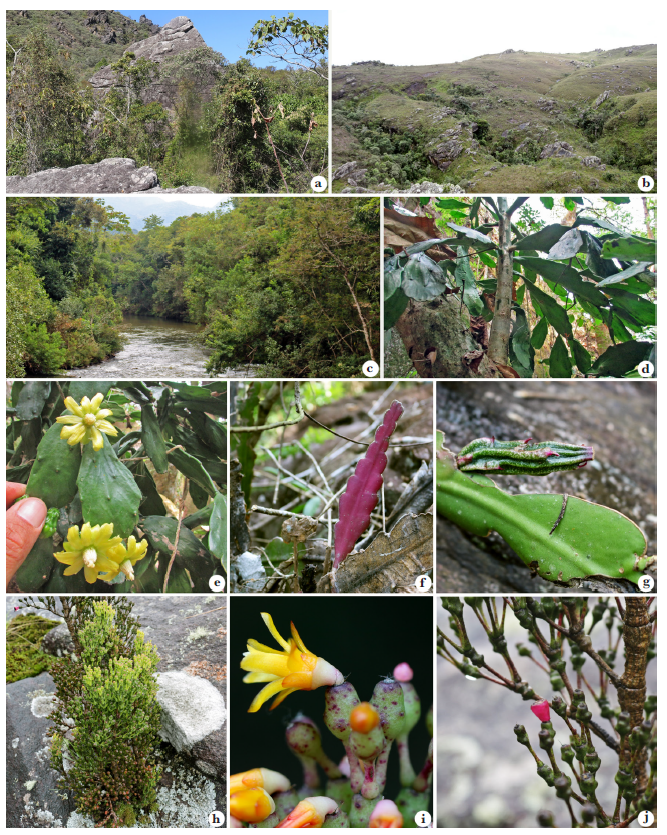
Itacolomi State Park encompasses the municipalities of Ouro Preto and Mariana and was established by Law No. 4,495 in 1967, covering an area of approximately 7,500 hectares. The park lies entirely within the Atlantic Forest domain, containing Seasonal Semideciduous Montane Forest (about 40% of the territory) in the lower areas and valleys, and Campos Rupestres (51%), mainly at the higher elevations, along with ruderal areas (9%) (Messias et al. 2017) (Fig. 1a-c). The main degradation factors in ISP are recurrent fires and invasive species. Nevertheless, well-preserved areas can still be found, especially associated with rocky outcrops, wetter locations, or more remote sites that have remained relatively protected from fires (Alves et al. 2014).

a-c. Area of study - a. Pedra da Pirâmide, rocky outcrops interspersed with adjacent vegetation; highlighting the Campos Rupestres in the elevated areas and forest fragments in the valleys; b. panoramic view of PEI, showing gallery forest in the region of Fundão; c. riverbank in the region of Fundão, located inside the PEI. d-e. Brasiliopuntia brasiliensis - d. habit; e. flower. f-g. Epiphyllum phyllanthus - f. habit; g. immature fruit. h-j. Hatiora salicornioides - h. habit; i. flower; j. fruit. (Photos: a-c, f-j. L. Echternacht; d,e. L.G. Pedrosa).
Field expeditions were conducted across all seasons over the course of one year (2024), with five expeditions, targeting the preferred habitats of Cactaceae. Fertile individuals were photographed, and specimens were deposited in the herbarium following standard herbarium preparation methods (Fidalgo & Bononi 1989), for accession in the OUPR herbarium (acronym according to Thiers, continuously updated). Data on habitat, substrate, flower coloration, estimated number of individuals, potential threats, and other relevant information were recorded. Morphological descriptions follow the family-specific terminology as outlined in Taylor & Zappi (2004), Hunt et al. (2006), and Gonzaga et al. (2020).
For sterile specimens, of which we failed to see flowers and/or fruits in the field or in the herbarium, we supplemented the descriptions with data from specimens reported in other studies, as follows: the works of Gonzaga et al. (2017, 2020) from Serra da Mantiqueira provided (i) the floral description of Epiphyllum phyllanthus (Linnaeus 1753: 469) Haw. (1812: 197), (ii) the floral bud description of Lepismium cruciforme (Vellozo 1829: 207) Miquel (1838: 49), (iii) the fruit description of Lepismium houlletianum (Lemaire 1858: 64) Barthlott (1987: 99); fruit and seed descriptions for Rhipsalis crispata (Haw. 1830: 11) Pfeiffer (1836: 186), (iv) flower description of Rhipsalis floccosa subsp. pulvinigera; (v) seed description of Rhipsalis lindbergiana K.Schumann (1890: 271), and (vi) descriptions of all fertile parts of Pereskia aculeataMiller (1768: 198). We also used the work from Serra da Tiririca by Vasconcelos et al. (2019) for (vii) the description of flowers and fruits of Brasiliopuntia brasiliensis (Willdenow 1814: 33) A.Berger (1926: 94). For the description of (viii) the floral buds, flowers, fruits, and seeds of Pereskia violacea (Leuenberger1986: 116) N.P.Taylor (2017: 5), we used the species protolog (Leuenberger 1986: 116-118, f. 5J, 14D-E, 15Ak).
In addition, we consulted images of herbarium specimens from VIC and BHCB, collected in the ISP, through the speciesLink platform, to assess the distribution range and habits of the recorded species. The map was generated using QGIS software. Geographic coordinates were assigned approximately, based on locality information provided on the specimen labels and the authors’ field experience. It should be noted, however, that the mapped points represent approximate locations with limited spatial precision, and positional deviations of up to 500 meters may occur.
Results and Discussion
Taxonomic treatment
Eleven species distributed among six genera were recorded in the study area, representing more than a fivefold increase over the number of species previously known (Figs. 1-3): B. brasiliensis, E. phyllanthus, H. salicornioides, L. cruciforme, L. houlletianum, P. aculeata, P. violacea, R. crispata, Rhipsalis elliptica G.Lindb. ex K.Schum. (1890: 293), R. floccosa subsp. pulvinigera and R. lindbergiana. The majority of species are associated with forest formations, whereas H. salicornioides is the only one recorded in association with rocky outcrops in Campos Rupestres (Fig. 4).

a-b. Lepismium cruciforme - a. flowers; b. fruits. c-d. Lepismium houlletianum - c. areoles details and frontal view flowers; d. lateral view of flowers. e. Rhipsalis crispata - population in rocky outcrop. f-i. Rhipsalis elliptica - f. habit; g. flowers; h. immature fruits and cladodes; i. mature fruits. (Photos: a,b,e-i. L.G. Pedrosa; c,d. C. Lélis).

a-d. Rhipsalis floccosa subsp. pulvinigera - a. population in rocky outcrop; b. epiphytic seedling; c. adult epiphytic specimen; d. flowers. e-f. Rhipsalis lindbergiana - e.habit; f. floral buds and flowers. g. Pereskia aculeata - vegetative part. h. Pereskia violacea (*) - flowers detail. (Photos: a-d,f. L.G.Pedrosa; e,g. L. Echternacht; h. D.R. Gonzaga (*) external to the study area (JBRJ).

a. Reference map showing altitude delimiting the Iron Quadrangle in the central region of Minas Gerais state, Brazil, with the borders of Itacolomi State Park in red. b. Borders of Itacolomi State Park (red line) and the municipalities (white line), showing Ouro Preto to the west and Mariana to the east; satellite image from Google Earth, with species occurrences mapped based on the locality information provided on the specimen labels.
The representativeness of Rhipsalis in the Itacolomi State Park reflects the fact that this is the richest genus among Cactaceae in Brazil, mainly because it is composed predominantly of epiphytic species that are especially diversified in the Atlantic Forest domain (Calvente 2010; Zappi et al. 2012). All Rhipsalis species recorded in the park are endemic to Brazil, with R. crispata, R. elliptica, and R. lindbergiana being the rarest locally, each represented by only a single collection. Only one species found is an arborescent terrestrial plant: B. brasiliensis, which has an extremely localized population, recorded in Semideciduous Seasonal Forest. Among the Cactaceae recorded in the park, P. aculeata deserves special mention as a possibly cultivated plant as it is found as a climbing plant in degraded, open Semideciduous Seasonal Forest, in an apparently early stage of regeneration, following abandonment of cropland.
Among the 11 Cactaceae species recorded in the Itacolomi State Park, comparison with other floristic surveys conducted in Minas Gerais shows that: (i) three species are shared with Serra do Cipó - E. phyllanthus, H. salicornioides, and P. violacea; (ii) three species also occur in the Ibitipoca State Park - H. salicornioides, R. elliptica, and R. floccosa subsp. pulvinigera; and (iii) five species are common to Serra Negra - H. salicornioides, L. houlletianum, R. elliptica, R. floccosa subsp. pulvinigera, and R. lindbergiana. Although the Itacolomi State Park (ISP) is geographically closer to Serra do Cipó, the diversity of species occurring as epiphytes results in an increased sharing of species with Serra Negra. This overlap highlights distribution patterns of Cactaceae in high-altitude areas of the state and underscores the role of Itacolomi State Park as an important protected area for the conservation of these species.
Cactaceae.
Herbaceous to arborescent, stems succulent, with or without spines; branches differentiated or not, leafless or with leaves; areoles producing spines and glochids; leaves modified or not, alternate and spiral, whole, inconspicuous penninerved venation or leaves modified into spines or scales. Determinate inflorescences, generally reduced to a solitary flower, terminal; flowers usually bisexual, radial to slightly bilateral, with short to elongated pericarpel; perianth segments numerous, in spiral arrangements, usually free, the inner ones petaloid, the outer ones sepaloid; stamens numerous; carpels 3 to numerous, connate; ovary inferior, but in some Pereskia species, the ovary is semi-inferior or superior; stigma with 3 to numerous, elongated, radial lobes; ovules numerous; fruits baccate, usually with spines and/or glochids on the areole, perianth segments persistent to deciduous; seeds with generally curved embryo, endosperm absent and perisperm sometimes present (adapted from Zappi et al. 2007; Judd et al. 2009).
Identification key for the Cactaceae species from the Itacolomi State Park (ISP)
-
1. Arborescent plants, glochids present.............................1. Brasiliopuntia brasiliensis
-
1’. Herbaceous or shrubby plants, glochids absent.........................................................2
-
2. Plants with well-developed leaves......................................................................3
-
2’. Plants lacking leaves...........................................................................................4
-
3. Prickles and spines present, flowers whitish...............10. Pereskia aculeata
-
3’. Prickles absent, spines present, flowers magenta.........11. Pereskia violacea
-
4. Cladodes cylindrical...............................................................................5
-
4’. Cladodes flattened or 3-5 winged..........................................................7
-
5. Cladodes clavate at the apex; flowers yellow, fruits clavate, pink..... 3. Hatiora salicornioides
-
5’. Cladodes non-clavate, terminal cladodes; flowers white to whitish, fruits globular, white to pink 6
-
6. Cladodes erect to pendulous, areoles lanuginous........................ 8. Rhipsalis floccosa subsp. pulvinigera
-
6’. Cladodes pendulous, areoles glabrous to glabrescent................. 9. Rhipsalis lindbergiana
-
7. Cladodes with elliptical segments, 4.5-11 × 2.5 cm..........8
-
7’. Cladodes with lanceolate segments, 8.3-13.5 × 2.5-7 cm.9
-
8. Cladodes with prominent crenels, stems deeply grooved, grooves 0.3-0.7 cm wide, spaced apart 0.8-1.5 cm apart..........................................................................6. Rhipsalis crispata
-
8’. Cladodes with slightly prominent crenels, stems deeply grooved , grooves 0.1-0.5 cm wide, spaced apart 1.3-1.9 cm apart............................................................. 7. Rhipsalis elliptica
-
9. Cladodes 3-winged, areoles pubescent......................4. Lepismium cruciforme
-
9’. Cladodes flattened, areoles glabrous...................10
-
10. Floral tube developed > 10 cm long, fruits oblong 2. Epiphyllum phyllanthus
-
10’. Floral tube absent, fruits globose...................... 5. Lepismium houlletianum
1. Brasiliopuntia brasiliensis (Willd.) A.Berger, Entwickl. Kakteen 17, 18, 94. 1926. Fig. 1d-e
Terrestrial, arborescent, ca. 8 m tall; dimorphic cladodes, the basal cylindrical, 3.8-5.3 mm diameter, the intermediate cylindrical, 8-15 mm diameter, the terminal flattened, 7.5-9 × 3.2-4 cm, green to yellowish, irregular margin, lateral branching; areole 2-3 mm diameter, marginal, spinescent, glochids present, spines 0.8-2.5 cm long, grayish, 1 per areole. Floral bud, light green and partially orange at the apex. Flowers ca. 1.1 × 2.8 cm, yellow, 1 per areole, terminal to lateral; pericarpel depressed-globose, ca. 1.2 × 0.7 cm, squamose, glochids present, light green; perianth segments ca. 21, the external triangular to obovoid, 5.3-26.5 mm, the internal oblanceolate to obovoid, 1.4-1.8 × 0.7-1.1 cm, yellow; stamens ca. 238, yellowish, filaments 2-7 mm long, style ca. 1.4 × 0.2 cm, brownish, stigma ca. 3 × 3 mm, 4-lobed, lobe ca. 2 mm long. Fruits globose, 2.4-2.9 × 1.9-2.5 cm, yellowish, truncated, perianth-segments deciduous, glochids present, brown to black; brown seeds, opaque, ovoid, ca. 1 × 0.7 cm, warty testa.
Material examined: Ouro Preto, Parque Estadual do Itacolomi, IX.2021, fl., L.G. Pedrosa 3747 (OUPR); XII.2021. fl., L.G. Pedrosa 3812 (OUPR).
Brasiliopuntia brasiliensis occurs in Argentina, Bolivia, Brazil, Paraguay, and Peru. In Brazil, it occurs in Rondônia (North), Bahia, Ceará, Sergipe, Paraíba, Pernambuco and Rio Grande do Norte (Northeast), Mato Grosso and Mato Grosso do Sul (Central-West), and in all states of the Southeast and South regions (Zappi & Taylor 2025). In ISP, only one individual of the species was found, on the southeast slope, between the Sibrão and Sertão regions, in a hillside forest, in Semideciduous Seasonal Forest. It is a species easily identified by its arborescent habit and dimorphic branches, with the main stem cylindrical and indeterminate, the terminal branches flattened. It was found in flower in September and December.
2. Epiphyllum phyllanthus (L.) Haw., Syn. Pl. Succ.: 197. 1812. Fig. 1f-g
Epiphyte to rupicolous, pendulous, cladodes flattened, lanceolate, waxy, green to vinaceous, crenate margins, ca. 48 × 3-4.5 cm, well-defined central rib, narrowed base and obtuse apex, areoles 1.5-2 mm diameter, 3.4-3.7 cm spaced apart, glabrous. Floral buds green, glabrous, lateral to terminal. Flowers ca. 2.5 × 2 cm, greenish-white, lateral, 1 per areole, nocturnal anthesis; pericarpel ca. 2.7 × 0.4 cm, green with reduced scales, floral tube 21 cm long, green, glabrous; perianth segments ca. 25, the external ca. 2.2 × 3.4 cm, lanceolate, green, the internal 1.9-2.6 × 0.3-0.4 cm, lanceolate to oblong, whitish; stamens ca. 61, adnate to the floral tube, filaments 8-12 mm long, style ca. 19.3 × 0.2 cm, stigma ca. 0.5 × 0.7 cm, 10-lobed, lobe ca. 0.3 cm long. Fruits oblong, when green with lanceolate vinaceous scales, mature magenta, ca. 6-7 × 3 cm, glabrous, dehiscent by longitudinal slit, white pulp, translucent, perianth-segments deciduous; black seeds, bright, reniform, ca. 3.2 × 3.2 mm, striated to warty testa.
Material examined: Ouro Preto, Parque Estadual do Itacolomi, I.2022, fl., L.G. Pedrosa 3931 (OUPR); Fundão, 16.V.2024, fr., LA. Echternacht et al. 2926 (OUPR).
Additional examined material: BRAZIL. MINAS GERAIS: Ouro Preto, Serra do Frazão, 26.VII.2023, fl., L.G. Pedrosa 5446 (OUPR).
Epiphyllum phyllanthus occurs in Argentina, Bolivia, Brazil, Colombia, Cuba, Ecuador, Guyana, French Guiana, Paraguay, Peru, Suriname, and Venezuela (Hunt et al. 2006). In Brazil, it occurs in all states, with the exception of the state of Amapá (Zappi & Taylor 2025). In ISP, a population was found located along the southeastern border, in the locality of Fundão, on the edges of the forest, with frequent but isolated individuals. It was observed on substrate within a quartzite outcrop in a riverbed, and as an epiphyte on Alchornea triplinervia (Sprengel 1821: 116) Müller Argoviensis (1886: 909), (Euphorbiaceae) and Mangifera indica L. (1753: 200), (Anacardiaceae) in conserved areas of Seasonal Forest in the secondary stage, as well as in anthropized rural areas. It is a species easily identified by its waxy cladodes with a prominent central vein and by the presence of magenta ripe fruits and greenish-white flowers with nocturnal anthesis. It was found in flower in January and in fruits in May, indicating that the reproductive period is concentrated in the first months of the year.
3. Hatiora salicornioides (Haw.) Britton & Rose, Stand. Cycl. Hort. 3: 1433. 1915. Fig. 1h-j
Rupicolous, erect, dark-green, light green to reddish, woody basal cladodes, 4.9-8 mm breadth, the terminal ca. 1.3-2.0 mm breadth, articles strongly clavate to cylindrical ca. 2.4-11.7 mm long, 2-3 forked, internodes 1.5-2.4 cm long, terminal areole ca. 1.5-3 mm diameter, pubescent, white trichomes. Floral buds reddish-orange, glabrous. Flowers ca. 7-8 × 8 mm, semi-tubular, yellowish-orange, apical, 1 per areole; pericarpel ca. 2 × 2 mm, light green, clavate, glabrous; perianth segments ca. 16, the external ca. 2-4 × 2 mm, triangular to elliptical, yellowish, the internal ca. 6-7 × 3 mm, lanceolate, yellowish-orange; stamens ca. 63, filaments 4-6 mm long, whitish; style ca. 6 × 1 mm, white, stigma ca. 2 mm long, 4-lobed, white, lobe ca. 1.5-2 mm long. Fruit obconic to clavate, truncated, pink, 4.5-6.7 × 3.8-5.5 mm, glabrous, white pulp, translucent, perianth-segments deciduous; brown to black seeds, reniform to pyriform, ca. 0.98-1.2 × 0.7 mm, slightly grooved testa.
Material examined: Ouro Preto, Parque Estadual do Itacolomi, estrada para a Fazenda do Manso, V.1994, fl., S. Dias & M.B. Roschel 7431 (OUPR); Tesoureiro, 4.VI.2004, M.C.T.B. Messias et al. 892 (OUPR); Mata do Morro do Cachorro, 2009, fr., J.F.V. Tófoli & C.M. Viana 65 (OUPR); 2009, J.F.V. Tófoli & CM Viana 66 (OUPR); 11.II.2010, fr., M.O. Bünger et al. 329 (OUPR); 21.IX.2010, A. Bueno et al. 139 (OUPR); 18.XI.2010, fl., F.T. Rezende & J.F.V. Tófoli 187 (OUPR); Serra do Itacolomi, 27.IV.2018, fl., L.G. Pedrosa 245 (OUPR); Alto do Itacolomi, 2.XI.2018, fl., L.G. Pedrosa 956 (OUPR); Mata do Morro do Cachorro, IX.2021, fl., L.G. Pedrosa 3725 (OUPR); XI.2023, fl., L.G. Pedrosa 5497 (OUPR); afloramentos na base da vertente oeste do Platô do Itacolomi - próximo ao Baú, 19.II.2024, fr., L.A. Echternacht et al. 2904 (OUPR); trilha entre a cachoeira do Icó e a pedra da Pirâmide, 26.VII.2024, fr., C. Lélis et al. 5 (OUPR).
Hatiora salicornioides is endemic to Brazil, being found in the state of Bahia (Northeast), in all states of the Southeast region and in the states of Paraná and Santa Catarina (South) (Zappi & Taylor 2025). The genus is endemic to the Atlantic Forest domain, with H. salicornioides being the most common and widely distributed species, while the other two species of the genus have a more restricted distribution. In ISP, it was found as an epiphyte or rupicolous, on the trails of Mata do Morro do Cachorro and, Alto do Itacolomi, and along the roads to Fazenda do Manso, Serra do Itacolomi and Tesoureiro. It is differentiated from the others by having cladodes segmented into clubs and having tiny, yellowish-orange flowers and obconic fruits. It was found in flower in April, May, September and November and in fruit in February and July.
4. Lepismium cruciforme (Vell.) Miq., Bull. Sci. Phys. Nat. Néerl. 1: 49. 1838. Fig. 2a-b
Epiphyte, pendulous, cladodes 3-winged, green; branching lateral to terminal, ca. 18 × 2.1 cm, crenate, areole 2-3 mm diameter, 1.1-1.6 cm spaced apart, lanuginous. Floral buds pink to whitish, glabrous. Flowers ca. 12 × 6 mm, white tinged with pink to pink, lateral, 1-2 per areole; pericarpel ca. 3 × 2 mm, strongly immersed, glabrous, vinaceous; perianth segments ca. 9, the external 2.5-4 × 1-3 mm, ovate, green, the internal 7-8 mm, style ca. 5 × 1 mm, yellowish, stigma ca. 2 × 3 mm, yellowish, 4-lobed, lobe 1-2 mm long. Fruits globose, truncated, pink, 8-9 × 7-8 mm, glabrous, white pulp, translucent, immersed, perianth-segments deciduous; brown to black seeds, reniform ca. 1.5 × 1 mm, little striated testa.
Material examined: Ouro Preto, Parque Estadual do Itacolomi, Boqueirão, 20.XI.2019, fr., L.G. Pedrosa 2176 (OUPR).
Lepismium cruciforme occurs in Argentina, Brazil, and Paraguay (Hunt et al. 2006). In Brazil, it occurs in Bahia and Pernambuco states (Northeast), Mato Grosso do Sul state (Central-West) and in all states of the Southeast and South (Zappi & Taylor 2025). In ISP, there was a single collection in Boqueirão, a region of rocky outcrops, with vegetation on a slope, in a humid and transitional location between Campos Rupestres and Gallery Forest. It differs from L. houlletianum by having 3-winged cladodes vs. flattened cladodes with acute crenae. It was found in fruit in November.
5. Lepismium houlletianum (Lem.) Barthlott, Bradleya 5: 99. 1987. Fig. 2c-d
Epiphyte to rupicolous, pendulous, flattened terminal branches, green, 8-32 × 2-3 cm; with a waxy layer on the surface, acute crenels, 1.5-2 × 2.5-3.5 cm; lateral areole not immersed, ca. 1.5-2.3 cm, spaced apart. Flowers white, developing on the lateral of the branches, 1 per areole, 10-8 × 7-8 mm, pericarpel ca. 3-3.5 × 2.5-3 mm, perianth segments 10-12, fused at the base, the external 1-5 × 1.5-2 mm oblong, the internal 5.5-6 × 1.5-2.5 mm, lanceolate, stamens 20-21, filaments 2.5-4 mm long; style 4.5-5 mm long, stigma 4-lobed, lobe 1-2 mm long. Fruit globose, pink, ca. 4 × 3 mm, truncated, perianth-segments deciduous; black seeds, reniform, ca. 1.5 × 1 mm long, little striated testa.
Material examined: Ouro Preto, Parque Estadual do Itacolomi, trilha entre a cachoeira do Icó e a pedra da Pirâmide, no lajão ao lado da Pirâmide, 26.XII.2024, fl., C. Lélis 2 (OUPR).
Lepismium houlletianum occurs in Argentina, Brazil, and Paraguay (Hunt et al. 2006). In Brazil it occurs in the Southeast and South regions (Zappi & Taylor 2025). In ISP, was found on the trail between the Cachoeira do Icó and the Pedra da Pirâmide, near Pirâmide, on quartzite outcrops within degraded Semideciduous Forest (invasive plants and signs of burning). It can be distinguished from R. elliptica by the branching that occurs from the base of the entire branches, with sharp crenae, and pinkish fruits. In contrast, R. elliptica presents articulated branches with growth at the apex, rounded crenae and pinkish to vinaceous fruits. It was found in flower in July.
6. Rhipsalis crispata (Haw.) Pfeiff., Allg. Gartenzeitung 4: 186. 1836. Fig. 2e
Epiphyte to rupicolous, ca. 30 cm long; winged cladodes with prominent crenels, in-depth 0.3-0.7 cm, the terminal 14.5-18.7 cm, terminal to lateral branching, 2-3 forked; areole 1 mm diameter, apical to marginal, pubescent, 0.8-1.5 cm spaced apart. Floral bud emersed, light brown. Flowers 7.5-9 × 7-10 mm, yellowish, 1-3 per areole, terminal to lateral; pericarpel depressed-globose, 2 × 3 mm, glabrous, whitish to orange; perianth segments 8, the external 1.5-3.2 × 1.5-2 mm, triangular to oblong, yellow, the internal 5-6 × 2.5 mm, elliptical to lanceolate or elliptical to oblong, white to whitish; stamens 43-64, white, filaments 2.5-5 mm long; style 4.5-5.5 mm long, white, stigma 1-1.5 mm long, 3-5-lobed, lobe 1.5-1.7 mm long, papilose. Fruit globose, ca. 6 × 6 mm, white, translucent, perianth-segments deciduous; black seeds, ellipsoids, 12-15 × 5 mm, verrucose test.
Material examined: Ouro Preto, Parque Estadual do Itacolomi, Platô da Serra do Itacolomi, 27.IV.2018, fr., L.G. Pedrosa 252 (OUPR).
Rhipsalis crispata is endemic to Brazil, occuring in Bahia and Pernambuco states (Northeast), in all states of the Southeast and in the state of Santa Catarina (South) (Zappi & Taylor 2025). In ISP, there was a single collection, on the plateau of Serra do Itacolomi, in an area of Semideciduous Seasonal Forest, growing attached to rocks, inside caves, and on rocky outcrops. It differs from other species of the genus in the study area by having deep crenels (0.3-0.7 cm deep) and by having white, translucent, globose fruits. Among the species recorded in the ISP, this is the only one classified as Endangered (EN) (Goettsch et al. 2015). Its first record in Minas Gerais was reported by Barbosa et al. (2021) in the Zona da Mata region, and this study expands the species’ geographic distribution within the state. It was found in fruit in April.
7. Rhipsalis elliptica G. Lindb. exK. Schum., In Martius Fl. bras. 4(2): 293. 1890. Fig. 2f-i
Epiphyte, pendulous, flattened cladodes, crenels slightly prominent, deep 0.1-0.5 cm, elliptical to rhombic, green, 9-13 × 1.5-6 cm, apical or lateral branches, crenate margin, rounded crenels, areole 1-1.5 mm diameter, glabrous to pubescent, 1.3-1.9 cm spaced apart. Floral bud pink, glabrous. Flowers 4-5 × 6-7 mm, white to whitish, lateral, 1-2 per areole; pericarpel ca. 4 × 3 mm, globose, emerged, whitish to greenish, glabrous; perianth segments 7-10, the external ca. 4.5 × 3 mm, obovate, pinkish to whitish, the internal ca. 6-8 × 2-3 mm, elliptical, white to whitish; stamens 62-91, white, filaments 2-5 mm long; style ca. 5 × 0.5 mm, stigma ca. 4.5 mm long, white, 5-lobed, lobe ca. 2 mm long. Fruit elliptical to obovate, pink to vinaceous, truncated, 8-10 × 6.5-8.8 mm, glabrous, perianth-segments deciduous; brown seeds, ellipsoid to reniform, 1 × 0.5 mm, slightly verrucose testa.
Material examined: Ouro Preto, Parque Estadual do Itacolomi, Carrasco, 21.VII.2019, fl., L.G. Pedrosa 1776 (OUPR); trilha entre a cachoeira do Icó e a pedra da Pirâmide, 26.VII.2024, fl., C. Lélis et al. 4 (OUPR); 26.VII.2024, C. Lélis et al. 3 (OUPR).
Additional examined material: BRAZIL. MINAS GERAIS: Ouro Preto, Antônio Pereira, trilha que segue para o Pico do Frazão, 14.II.2023, fr., V. Araújo-Silva 114 (OUPR).
Rhipsalis elliptica is endemic to Brazil and is widely distributed throughout the Atlantic Forest domain, being found in the Northeast only in the state of Bahia and throughout the Southeast and South (Zappi & Taylor 2025). Rhipsalis elliptica differs from other species of the genus in the study area due to its segmented branches, with growth concentrated at the apex, while other species of the genus have basal or lateral branching. The segment edges of R. elliptica have rounded crenae, contrasting with other species that have sharper crenae or entire margins. In ISP, it has been recorded in the Carrasco vegetation (sandy soil) and on the trail between the Cachoeira of Icó and the Pedra of Pirâmide. In Carrasco vegetation, with low forest vegetation, many epiphytes were observed in the region, such as bromeliads and orchids. We observed hanging individuals up to 3 meters long. It was found in flower in July.
8. Rhipsalis floccosa subsp. pulvinigera (G.Lindb.) Barthlott & N.P. Taylor, Bradleya 13: 55. 1995. Fig. 3a-d
Epiphyte to rupicolous, pendulous, cylindrical cladodes, black-green, terminal 11-14.5 × 4 cm, areole 3-5 mm diameter, lanuginous, along the cladodes, white and numerous bristles. Floral buds are red, pink, or whitish. Flowers 7 × 10 mm, white, whitish to light pink, lateral to sub-lateral, 1 per areole; pericarpel ca. 3 × 5 mm, triangular, perianth segments ca. 13, the external ca. 6 × 3-4 mm, triangular to ovate, the internal 7-10 × 3-4 mm, lanceolate; stamens 93-140, white, filaments ca. 4 mm long; style 4-5 mm long, white, stigma 2 mm long, 4-6-lobed, lobe 1.5-2 mm long. Fruit globose, light pink, slightly truncated at the apex, 4-7 × 6-7 mm, glabrous, perianth-segments persistent to deciduous; black seeds, reniform, ca. 1.5 × 0.8 mm, smooth testa.
Material examined: Ouro Preto, Parque Estadual do Itacolomi, 1936, fl., J. Badini (OUPR 2471); trilha entre a cachoeira do Icó e a pedra da Pirâmide, 25.II.1987, fr., T.S.M. Grandi et al. 2394 (BHCB); Lagoa Seca, 22.II.2007, fl. and fr., M.C.T.B. Messias 1223 (OUPR); Estrada da Lagoa Seca, 13.III.2007, fr., R.S. Araújo & T.S. dos Coser (VIC 19475); 13.III.2007, fr., R.S. Araújo & T.S. dos Coser (VIC 19520); Serra do Itacolomi, 27.IV.2018, fr., L.G. Pedrosa 246 (OUPR); 9.II.2020, fr., L.G. Pedrosa 2622 (OUPR); 26.VII.2024, C. Lélis et al. 1 (OUPR).
Rhipsalis floccosa subsp. pulvinigera is endemic to Brazil and is found throughout the Southeast and South regions (Zappi & Taylor 2025). The species is well characterized by the presence of bristly areoles, in which buds, flowers, and fruits are inserted, and can be differentiated from the other subspecies of R. floccosa due to the flowers being erupted and sparsely arranged on the branches. In ISP, it is found as an epiphyte in the forests associated with sinkholes in the Campos Rupestres on the Pico do Itacolomi plateau, near Lagoa Seca. It was found in flower in February and in fruit in February to April.
9. Rhipsalis lindbergianaK.Schum., In Martius Fl. bras. 4(2): 271. 1890.Fig. 3e-f
Epiphyte to rupicolous, pendulous, cylindrical cladodes, growth indeterminate, black green to light green, basal cladodes 3.5 mm diameter, the apical ca. 28 × 0.3-0.35 cm, branches at the apex, 2-forked, areole ca. 1 mm diameter, pubescent, distributed along the cladodes. Floral bud whitish-brown, glabrous. Flowers ca. 2 × 4 mm, white to whitish, lateral, 1 per areole; pericarpel ca. 1.5 × 1.5 mm, emerged, ovoid, whitish to whitish-brown, glabrous; perianth segments 7, the external 2-3.5 × 1.2-2 mm, triangular, whitish-brown, the internal ca. 3.5-5 × 1.5 mm, lanceolate, white to whitish; stamens ca. 47-55, white to whitish, filaments 1.5-4 mm long; style ca. 3-5 × 0.5-1 mm, stigma ca. 0.5 mm long, 3-lobed, lobe 0.5-1 mm long. Fruit globose, white-translucent, 3-4 × 3-4 mm, glabrous, perianth-segments persistent to deciduous; brown seeds, ovoid to reniform, 0.6-1 × 1 mm, slightly flattened laterally, verrucose testa.
Material examined: Ouro Preto, Parque Estadual do Itacolomi, XII.2021, fl. and fr., L.G. Pedrosa 3814 (OUPR); trilha entre a cachoeira do Icó e a pedra da Pirâmide, 26.VII.2024, C. Lélis et al. 6 (OUPR).
Rhipsalis lindbergiana is endemic to Brazil, being found in the states of Bahia, Paraíba, (Northeast), and in all states of the Southeast region and in the state of Paraná (South) (Zappi & Taylor 2025). In ISP, it occurs between the Boqueirão and Sertão regions, a transition area between Campos Rupestres and Atlantic Forest domain, as an epiphyte. It also occurs on the trail between the Cachoeira do Icó and the Pedra da Pirâmide, region close to the “Areião”. It can be distinguished from other Rhipsalis species in the study area by having thin, cylindrical cladodes with indeterminate growth (0.3-0.35 mm diameter) and whitish-brown flowers. It was found in flower and fruit in December.
10. Pereskia aculeataMill., Gard. Dict. (ed. 8). 1768.
Terrestrial, subshrub, scandent, ca. 3 m tall, stem segments erect to arched; areoles ca. 2 mm diameter, spinescent, spines recurved to erect, 2 per areole; alternate, petiolate leaves, 5.5-7 × 2.5-3 cm, green to vinaceous on the abaxial surface, lanceolate to elliptical, acuminate to acute apex, attenuate base, veins inconspicuous. Inflorescences terminal to lateral, racemose to paniculate. Floral buds emerged, green, glabrous. Flowers ca. 2.3 × 2 cm, white to whitish, pedicels 8-20 mm; turbinate pericarpel, ca. 5-7 mm, spinescent, 2 spines per areole, 3-7 mm long, bracts 0.6-2 × 0.3-0.4 cm, lanceolate, succulent, green with vinaceous margin, perianth segments ca. 19, the external 0.3-1.9 × 0.2-0.9 cm, triangular to ovoid, light green, the internal 1.8-2 × 0.7-0.9 cm, oblong, white; stamens ca. 170, filaments 0,8-1,2 cm long, red; style ca. 1.1 × 0.1-0.2 cm, white; stigma ca. 5 mm long, white, 5-lobed, lobe ca. 4 × 1 mm. Fruit globose, 1.2-1.7 × 1.2-2 cm, orange, with reduced scales and spines, perianth-segments deciduous; black seeds, globose, ca. 5 × 5 mm, truncated, smooth testa.
Material examined: Mariana, Parque Estadual do Itacolomi, Fundão, 16.V.2024, L.A. Echternacht 2927 (OUPR).
Pereskia aculeata is to South America and can be found in Argentina, Brazil, Paraguay, and Uruguay. In Brazil, it occurs in Alagoas, Bahia, Ceará, Maranhão, Pernambuco, and Sergipe states (Northeast), in Goiás states (Central-West) and throughout the Southeast and South regions (Zappi & Taylor 2025). In ISP, we report the first record, in a region of anthropized forest, apparently from abandoned cultivation (with sweet potato, mango, etc.), close to the road, on the southeast slopes of the park. It can be differentiated from Pereskia violacea by the shape of the leaves and spines, as well as the color of the flowers.
11. Pereskia violacea (Leuenb.) N.P.Taylor, Cactaceae Syst. Init. 38: 5. 2017. Fig. 3h
Terrestrial, shrubby, 2-4 m tall, thick stem, erect branches, alternate phyllotaxis. Leaf elliptical-lanceolate to oblong, 0.6-0.7 mm thick, green, oblong to elliptical, attenuate base, apex acuminate and recurved, areole 4-5 mm diameter, spinescent, spines 1-3.8 cm long, ca. 5 per areole. Floral bud pink, glabrous. Terminal inflorescences, solitary flowers ca. 2.5 × 2.2 cm, apical, absent pedicels; pericarpel ca. 8 × 7 mm, turbinated, green, scales ca. 5, lanceolate, acuminate, perianth segments ca. 18, triangular to elliptical, pinkish-greenish, oblong to elliptical, pink, filaments white, numerous, yellow anthers, style white, 8-lobed. Fruit obtriangular, green to reddish, persistent reduced scales, perianth-segments deciduous; black seeds, reniform, smooth testa.
Material examined: Ouro Preto, Parque Estadual do Itacolomi, IX.2021, fl., L.G. Pedrosa 3724 (OUPR).
Pereskia violacea is endemic to Brazil, with occurrence restricted to the states of Espírito Santo and Minas Gerais, in the Southeastern region of Brazil, in areas of Atlantic Forest domain (Zappi & Taylor 2025). In ISP, with only one record, it was found along a trail with Eucalyptus sp., in a disturbed area, among other cultivated species. It can be distinguished from the other species in the study area by its pink sessile flowers and 8-lobed stigma. Moreover, it can be distinguished from the other Pereskia species in the study area by the flower coloration and leaf size. It was found in flower in September.
The record of 11 Cactaceae taxa in Itacolomi State Park reinforces the need for floristic inventories focused on specific botanical families in Minas Gerais. This study increased the number of recorded taxa fivefold, based on new field expeditions and the identification of additional herbarium specimens. Although Itacolomi State Park has been historically well sampled, it still holds much to be discovered, despite the severe threats that directly and indirectly affect this important conservation unit in the central region of the state. The genus Rhipsalis was the most representative in the study area and shares several species with other key regions in Minas Gerais. These findings provide valuable insights into the geographic distribution of the genus within the state and contribute to knowledge of the Brazilian flora as a whole. Among the recorded species, only Rhipsalis crispata is currently classified as threatened with extinction. Finally, we emphasize the need for public policies aimed at minimizing damage to the natural heritage of Itacolomi State Park. The most serious threat to Cactaceae, as a predominantly forest-dwelling group in the Park, is fire, which can cause severe population losses and long-term habitat degradation. Further expeditions to unexplored areas within the conservation unit are essential, though they present considerable challenges for documentation and for filling existing knowledge gaps.
Acknowledgements
We are grateful to the Federal University of Ouro Preto (UFOP), for its support, particularly through the Research Initiation Program (PIP), which funded this study. We also thank the staff of the OUPR Herbarium and the Laboratory of Floristic Studies, for their assistance with the herborization process and species descriptions. We are further indebted to the Instituto Estadual de Florestas (IEF), for granting research permits within the conservation unit; and to Vitor Araújo, for his assistance with bibliographic research. Finally, we acknowledge the Rio de Janeiro State University (UERJ), for providing financial support for the field expeditions.
References
-
Almeida GSS, Carvalho-Okano RM, Nakajima JN & Garcia FCP (2014) Asteraceae Dumort nos campos rupestres do Parque Estadual do Itacolomi, Minas Gerais, Brasil: Barnadesieae e Mutisieae. Rodriguésia 65: 311-328. DOI: 10.1590/S2175-78602014000200003
» https://doi.org/10.1590/S2175-78602014000200003 -
Alves RJV (1990) The Orchidaceae of Itacolomi State Park in Minas Gerais, Brazil. Acta Botanica Brasilica 4: 65-72. DOI: 10.1590/S0102-33061990000200005
» https://doi.org/10.1590/S0102-33061990000200005 -
Araújo-da-Silva V, Cardoso PH & Echternacht L (2023) Verbenaceae in Itacolomi State Park, Minas Gerais, Brazil: richness, geographical distribution, and a new synonym for Stachytarpheta commutata Rodriguésia 74: e00642022. DOI: 10.1590/2175-7860202374024
» https://doi.org/10.1590/2175-7860202374024 -
Barbosa DEF, Basilio GA, Pereira LC, Gonzaga DR, Chautems A & Menini Neto L (2021) Too many floristic inventories? New records in seasonal semi-deciduous forest in the Serra da Mantiqueira in Minas Gerais state answer this question. Rodriguésia 72: e01142020. DOI: 10.1590/2175-7860202172106
» https://doi.org/10.1590/2175-7860202172106 -
Barthlott W (1987) New names in Rhipsalidinae (Cactaceae). Bradleya 5: 97-100.
» https://doi.org/97-100 - Barthlott W & Taylor NP (1995) Notes towards a Monograph of Rhipsalideae (Cactaceae). Bradleya 13: 43-79.
- Berger A (1926) Die Entwicklungslinien der Kakteen. Gustav Fischer, Jena. 105p.
- Britton N & Rose JN (1915) The standard cyclopedia of horticulture. Vol. 3. The Macmillan Company, London. 1433.
-
Bünger MO, Scalon VR, Sobral M & Stehmann JR (2012) Myrtaceae no Parque Estadual do Itacolomi, Minas Gerais, Brasil. Rodriguésia 63: 857-881. DOI: /10.1590/S2175-78602012000400009
» https://doi.org/10.1590/S2175-78602012000400009 - Calvente A (2010) Filogenia Molecular, evolução e Sistemática de Rhipsalis (Cactaceae). Tese de Doutorado. Universidade de São Paulo, São Paulo. 2010. 195p.
-
Calvente A, Freitas MF & Andreata RHP (2005) Listagem, distribuição geográfica e conservação das espécies de Cactaceae no estado do Rio de Janeiro. Rodriguésia 56: 141-162. DOI: 10.1590/2175-78602005568711
» https://doi.org/10.1590/2175-78602005568711 -
Coser TS, Paula CC & Wendt T (2010) Bromeliaceae Juss. nos campos rupestres do Parque Estadual do Itacolomi, Minas Gerais, Brasil. Rodriguésia 61: 261-280. DOI: 10.1590/2175-7860201061209
» https://doi.org/10.1590/2175-7860201061209 -
Dutra VF, Messias MCTB & Garcia FCP (2005) Papilionoideae (Leguminosae) dos campos ferruginosos do Parque Estadual do Itacolomi, MG, Brasil: florística e fenologia. Revista Brasileira de Botânica 28: 493-504. DOI: 10.1590/S0100-84042005000300007
» https://doi.org/10.1590/S0100-84042005000300007 -
Dutra VF, Garcia FCP & Lima HC (2008a) Mimosoideae (Leguminosae) nos campos rupestres do Parque Estadual do Itacolomi, Minas Gerais, Brasil. Rodriguésia 59: 573-585. DOI: 10.1590/2175-7860200859311
» https://doi.org/10.1590/2175-7860200859311 -
Dutra VF, Garcia FCP & Lima HC (2008b) Caesalpinioideae (Leguminosae) nos campos rupestres do Parque Estadual do Itacolomi, estado de Minas Gerais, Brasil. Acta Botanica Brasilica 22: 543-554. DOI: 10.1590/S0102-33062008000200021
» https://doi.org/10.1590/S0102-33062008000200021 -
Dutra VF, Garcia FCP & Lima HC (2009) Papilionoideae (Leguminosae) nos campos rupestres do Parque Estadual do Itacolomi, MG, Brasil. Acta Botanica Brasilica 23: 145-159. DOI: 10.1590/S0102-33062009000100018
» https://doi.org/10.1590/S0102-33062009000100018 - Fidalgo O & Bononi VLR (1989) Técnicas de coleta, preservação e herborização de material botânico. Instituto de Botânica, São Paulo. 62p.
-
Freitas MF, Calvente A & Gonzaga DR (2020) Flora do Rio de Janeiro: Cactaceae. Rodriguésia 71: e03162018. DOI: 10.1590/2175-7860202071127
» https://doi.org/10.1590/2175-7860202071127 -
Goettsch B, Hilton-Taylor C, Cruz-Piñón G, Duffy JP, Frances A, Hernández HM, Inger R, Pollock C, Schipper J, Superina M, Taylor NP, Tognelli M, Abba AM, Arias S, Arreola-Nava HJ, Baker MA, Bárcenas RT, Barrios D, Braun P, Butterworth CA, Búrquez A, Caceres F, Chazaro-Basañez M, Corral-Díaz R, Perea MV, Demaio PH, Duarte de Barros WA, Durán R, Yancas LF, Felger RS, Fitz-Maurice B, Fitz- Maurice WA, Gann G, Gómez-Hinostrosa C, Gonzales-Torres LR, Griffith MP, Guerrero PC, Hammel B, Heil KD, Hernández-Oria JG, Hoffmann M, Ishihara MI, Kiesling R, Larocca J, León-de la Luz JL, Loaiza CR, Lowry M, Machado MC, Majure LC, Ávalos JGM, Martorell C, Maschinski J, Méndez E, Mittermeier RA, Nassar JM, Negrón-Ortiz V, Oakley LJ, Ortega-Baes P, Ferreira ABP, Pinkava DJ, Porter JM, Puente-Martinez R, Gamarra JR, Pérez PS, Martínez ES, Smith M, J Manuel Sotomayor M del C, Stuart SM, Muñoz JLT, Terrazas T, Terry M, Trevisson M, Valverde T, Devender TRV, Véliz-Pérez ME, Walter HE, Sarah A Wyatt, Zappi D, Zavala-Hurtado JA & Gaston KJ (2015) High proportion of cactus species threatened with extinction. Nature Plants 1: 15142. DOI: 10.1038/nplants.2015.142
» https://doi.org/10.1038/nplants.2015.142 -
Gonzaga DR, Zappi DC, Furtado SG & Menini Neto L (2014a) Cactaceae no Parque Estadual do Ibitipoca, Minas Gerais, Brasil. Boletim de Botânica da Universidade de São Paulo 32: 1-8. DOI: 10.11606/issn.2316-9052.v32i1p1-8
» https://doi.org/10.11606/issn.2316-9052.v32i1p1-8 -
Gonzaga DR, Zappi DC, Furtado SG & Menini Neto L (2014b) Cactaceae na Serra Negra, Minas Gerais, Brasil. Rodriguésia 65: 443-453. DOI: 10.1590/S2175-78602014000200009
» https://doi.org/10.1590/S2175-78602014000200009 -
Gonzaga DR, Menini Neto L & Peixoto AL (2017) Cactaceae no Parque Nacional do Itatiaia, Serra da Mantiqueira, Brasil. Rodriguésia 68: 1397-1410. DOI: 10.1590/2175-7860201768420
» https://doi.org/10.1590/2175-7860201768420 -
Gonzaga DR, Menini Neto L & Peixoto AL (2020) Cactaceae na Serra da Mantiqueira, Brasil. Rodriguésia 71: e02572018. DOI: 10.1590/2175-7860202071080
» https://doi.org/10.1590/2175-7860202071080 - Haworth AH (1812) Synopsis Plantarum Succulentarum. Richardi Taylor, London. 334p.
- Haworth AH (1819) Supplementum plantarum succulentarum. J. Harding, London. 160p.
- Haworth AH (1830) Decas Duodecima Novarum Plantarum Succulentarum. Philosophical Magazine, or Annals of Chemistry, Mathematics, Astronomy, Natural History and General Science 7: 106-118.
- Hunt D, Taylor NP & Charles G (2006) The new cactus lexicon. Dh books, Milborne Port. 373p.
-
IUCN - The IUCN Red List of Threatened Species (2025) Version 2023-1. Version 2025-2. Available at < https://www.iucnredlist.org>. Access on 25 July 2025.
» https://www.iucnredlist.org - Judd WS, Campbell CS, Kellogg EA, Stevens PF & Donoghue MJ (2009) Sistemática vegetal: um enfoque filogenético. 3a ed. Artmed, Porto Alegre. 632p.
- Lemaire C (1858) Cactaceae. L’Illustration Horticole 5: misc. 64 (-65).
- Leuenberger BE (1986) Pereskia (Cactaceae). Memoirs of The New York Botanical Garden 41: 1-141.
-
Lima LCP, Garcia FCP & Sartori ALB (2007) Leguminosae nas florestas estacionais do Parque Estadual do Itacolomi, Minas Gerais, Brasil: herbáceas, arbustos, subarbustos, lianas e trepadeiras. Rodriguésia 58: 331-358. DOI: 10.1590/2175-7860200758209
» https://doi.org/10.1590/2175-7860200758209 -
Lima LCP, Garcia FCP & Sartori ALB (2010) As Leguminosae arbóreas das florestas estacionais do Parque Estadual do Itacolomi, Minas Gerais, Brasil. Rodriguésia 61: 441-466. DOI: 10.1590/2175-7860201061308
» https://doi.org/10.1590/2175-7860201061308 - Linnaeus C (1753) Species Plantarum. Vol. 1. Impensis Laurentii Salvii, Holmiae. 560p.
- Martinelli G & Moraes MA (2013) Livro Vermelho da Flora do Brasil. Instituto de Pesquisas Jardim Botânico do Rio de Janeiro, Rio de Janeiro. 1100p.
-
Messias MCTB, Sousa HC, Scalon VR, Roschel MB, Cândido ES & Fujaco MAG (2017) Phanerogamic flora and vegetation of Itacolomi State Park, Minas Gerais, Brazil. Biota Neotropica 17: e20160236. DOI: 10.1590/1676-0611-BN-2016-0236
» https://doi.org/10.1590/1676-0611-BN-2016-0236 - Miller P (1768) The gardeners dictionary. 8th ed. Worshipful Company of Apothecaries, London. 887.
- Miquel FAG (1838) Plantarum Cactearum Bulletin des Sciences Physiques et Naturelles en Néerlande 1: 49.
- Myers N, Mittermeier RA, Mittermeier CG, Fonseca GAB & Kent J (2000) Biodiversity hotspots for conservation priorities. Nature 403: 853-858.
- Pfeiffer LKG (1836) Allgemeine Gartenzeitung 4: 186.
-
Salles DM, Carmo FF & Jacobi CM (2019) Habitat loss challenges the conservation of endemic plants in mining-targeted Brazilian mountains. Environmental Conservation 46: 140-146. DOI: 10.1017/S0376892918000401
» https://doi.org/10.1017/S0376892918000401 - Schumann KM (1890) Cactaceae. In: Martius CFP & Urban I (eds.) Flora brasiliensis Fleischer, Leipzig. Vol. 4, pars 2, pp. 185-322.
- Stehmann JR, Forzza RC, Salino A, Sobral M, Costa DP & Kamino LHY (2009) Plantas da Floresta Atlântica. Instituto de Pesquisas Jardim Botânico do Rio de Janeiro, Rio de Janeiro. 515p.
- Taylor NP & Zappi D (2004) Cacti of Eastern Brazil. Royal Botanic Gardens, Kew. 499p.
- Taylor NP (2017) Cactaceae Systematics Initiatives: Bulletin of the International Cactaceae Systematics Group. England 38: 5.
-
Thiers B (continuously updated) Index Herbariorum: a global directory of public herbaria and associated staff. New York Botanical Garden’s Virtual Herbarium. Available at < http://sweetgum.nybg.org/science/ih/>. Access on 10 September 2025.
» http://sweetgum.nybg.org/science/ih/ -
Vasconcelos LVF, Gonzaga DR & Reis RCC (2019) Cactaceae no Parque Estadual da Serra da Tiririca, Rio de Janeiro, Brasil. Rodriguésia 70: e02832017. DOI: 10.1590/2175-7860201970020
» https://doi.org/10.1590/2175-7860201970020 - Vellozo JMC (1829) Florae Fluminensis Vol 4. Typographia Nationali, Rio de Janeiro. 352p.
- Willdenow CL (1814) Enumeratio Plantarum Horti Regii Berolinensis: Supplementum. In Taberna Libraria Scholae Realis, Berlin. 33p.
- Zappi DC (1990) Flora da Serra do Cipó, Minas Gerais: Cactaceae (1). Boletim de Botânica da Universidade de São Paulo 12: 43-59.
- Zappi DC, Aona LYS & Taylor N (2007) Cactaceae. In: Wanderley MGL, Shepherd GJ, Melhem TS & Giulietti AM (eds.) Flora fanerogâmica do estado de São Paulo. Instituto de Botânica, São Paulo. Vol. 5, pp. 163-193.
- Zappi DC, Taylor NP & Larocca J (2012) A riqueza das Cactaceae no Brasil. In: Ribeiro-Silva S, Zappi DC, Taylor NP & Machado MC (eds.) Plano de ação nacional para a conservação das cactáceas. ICMBio, Brasília. Pp. 15-26.
-
Zappi DC & Taylor NP (2025) Cactaceae in Flora e Funga do Brasil. Jardim Botânico do Rio de Janeiro. Available at < https://floradobrasil.jbrj.gov.br/FB1430>. Access on 24 March 2025.
» https://floradobrasil.jbrj.gov.br/FB1430