 Variation in sabinene content in the essential oil of Piper tuberculatum (Piperaceae) under the influence of abiotic factors
Abstract
Piper tuberculatum contains volatile substances in its essential oils (EO) with ecological and medicinal properties. This study aimed to analyze the correlation between sabinene content and abiotic factors. Leaves (90-100 g) were collected monthly, from January to December 2023, from three adult individuals (A, B and C) at different sites within the Rio de Janeiro Botanical Garden (JBRJ) and surrounding areas, with microclimate data recorded. The samples were subjected to hydrodistillation and analyzed by Gas Chromatography (GC) coupled with Mass Spectrometry (MS) and GC coupled with Flame Ionization Detector (FID). Sabinene was identified and quantified in the samples and showed a relative percentage ranging from 8.00% to 32.05%. Spearman correlations (p ≤ 0.05) showed a positive correlation between sabinene content and the rainfall index at all collection sites. Light intensity showed a significant negative correlation, suggesting that higher light intensity reduces the relative percentage of sabinene. This pioneering study with P. tuberculatum reveals that abiotic factors may influence the biosynthesis of sabinene.
Key words:
environmental factors; microclimate; monoterpenes; seasonality
Resumo
Piper tuberculatum contém substâncias voláteis em seus óleos essenciais (OE) com propriedades ecológicas e medicinais. Este estudo teve como objetivo analisar a correlação entre os teores percentuais de sabineno e fatores abióticos. Folhas (90-100 g) foram coletadas mensalmente, entre janeiro e dezembro de 2023, em três indivíduos adultos em pontos distintos (A, B e C) no Jardim Botânico do Rio de Janeiro (JBRJ) e cercanias, com dados microclimáticos registrados. As amostras foram submetidas à hidrodestilação e analisadas por Cromatografia em Fase Gasosa (CG) acoplada à Espectrometria de Massas (EM) e ao CG acoplada a Detector de Ionização de Chama (DIC). O sabineno foi identificado e quantificado nas amostras e registrou teores percentuais variando entre 8,00% e 32,05%. As correlações de Spearman (p ≤ 0,05) mostraram correlação positiva entre o teor percentual de sabineno e o índice pluviométrico em todos os pontos de coleta. A luminosidade apresentou correlação negativa significativa, sugerindo que maior luminosidade reduz o teor de sabineno. Este estudo inédito com P. tuberculatum revela que fatores abióticos podem influenciar a biossíntese do sabineno.
Palavras-chave:
fatores ambientais; microclima; monoterpenos; sazonalidade
Introduction
Secondary metabolites, also known as specialized metabolites, play an essential role in plant physiology, being synthesized and accumulated in a species-specific manner (Ramos et al. 2018). This chemical variability results from dynamic metabolic processes, which directly influence plant-environment interactions and their adaptation to different ecological niches (Pilon et al. 2020). The growing interest in these substances is due not only to their bioactive, nutritional, and pharmacological potential but also to their ecological importance (Borges & Amorim 2020).
Understanding the factors that regulate the biosynthesis of secondary metabolites is crucial for the discovery of new substances and optimizing the production of already known compounds. In this regard, essential oils (EOs) stand out as promising for study, as their chemical composition is highly influenced by genetic, biotic, and, especially, environmental factors (Gobbo-Neto & Lopes 2007; Ramos et al. 2020; De Brito-Machado et al. 2022, 2024).
EOs are complex mixtures of volatile and lipophilic substances, usually aromatic and odorous, liquid at room temperature, and typically colorless or slightly yellowish (Ramos et al. 2020). As mentioned, their scientific interest has grown considerably in recent decades due to their various ecological functions, including chemical communication between plants, defense against herbivores and pathogens, and attraction of pollinators and seed dispersers (Abbas et al. 2017; Ramos et al. 2020). In this context, many studies address this issue in various plant families rich in EOs, such as Piperaceae, especially species belonging to the genus Piper L.
Among the species of this genus, Piper tuberculatum, commonly known as “pimenta-dardo” or “pimenta-de-macaco,” has attracted attention due to its insecticidal, antifungal, and antiparasitic properties (Lima 2020; Queiroz et al. 2020). In Brazil, this non-endemic species occurs in all biomes, being especially frequent in anthropized areas, where it can be found in urban gardens (Queiroz et al. 2020).
Despite its extensive distribution across the Americas and the Antilles, significant gaps remain in the understanding of its chemical phenotypic plasticity and the influence of environmental factors on its composition. These gaps are primarily attributed to the scarcity of studies that focus specifically on these correlations. While some research has addressed the chemical composition and biological activity of P. tuberculatum EOs (Sales et al. 2022; Silva et al. 2024, 2023; Lima et al. 2024; Rodrigues et al. 2025), these studies often lacks a comprehensive analysis of the underlying environmental influences and their implications.
Souza et al. (2024) observed the variety of substances present in the EOs of different stages of P. tuberculatum inflorescences, highlighting the presence of sabinene as a major compound. This monoterpene is noted in the literature for its anti-inflammatory (Chaiyana et al. 2016), anxiolytic (Kamal et al. 2018), phytotoxic (Andrianjafinandrasana et al. 2013) antibacterial and antimicrobial (Park et al. 2019), antifungal, and antioxidant (Valente et al. 2013) effects.
Furthermore, Dobson (2006) highlights that both sabinene and other monoterpenes, such as limonene, pinene, and myrcene, have bat-attracting properties, as bats are visitors and feed on the fruits of Piper L. (Mikich 2002; Gerber et al. 2022). However, it is important to highlight that there is a lack of studies in literature focusing on isolated sabinene and its effectiveness as a pollinator attractant. Nevertheless, some studies indicate that this monoterpene, along with other compounds, may contribute to this function (Borg-Karlson et al. 1994; Byer et al. 2014).
In this context, given the importance of EOs and their chemical variability under different environmental conditions, and no studies have been found that correlate this monoterpene with these factors, the present research investigates the variation in sabinene composition in the EOs of P. tuberculatum, aiming to understand the relationships between this compound and the abiotic factors that may influence its production.
Material and Methods
Area of study
This research was carried out monthly, from January to December 2023, with three adult specimens near the Rio de Janeiro Botanical Garden (JBRJ). Between 90 and 100 g of leaves were collected from each individual between 10:00 a.m. and 11:00 a.m., with one-month intervals between samplings. Licenses for the investigations were granted by the Biodiversity Authorization and Information System-SISBIO (nº 57296-1) and the Genetic Heritage Management Council-CGEN (nº 010771/2014-0). Three collection sites were georeferenced using GPS, and their coordinates are as follows: Site A is situated inside the JBRJ, behind the Research Institute, near the João Carlos Silva Social and Environmental Responsibility Center (22°57’56.5”S, 43°13’41.2”W); Site B is at Pacheco Leão Street, near to n. 1.100 - Jardim Botânico/RJ (22°57’58.7”S, 43°13’46.7”W); Site C is also inside the JBRJ located near Aleia B. Pickel, in the Children’s Park (22°58’00.1”S, 43°13’36.1”W). The phenological activities of the specimens under study were recorded and all were in the reproductive phase.
One sample of each specimen was deposited at the Herbarium of the State University of Rio de Janeiro (HRJ) under registration numbers HRJ 14267, HRJ 14268, and HRJ 14269, respectively. Plant identification was done by Elsie F. Guimarães from JBRJ and George Azevedo from State University of Rio de Janeiro.
Climate data
During each collection, meteorological microclimate variables were also recorded for later analysis of potential correlations with the substances present in the EOs, using portable manual equipment: Digital Windmeter Anemometer (SIN2919025384-Brazil, Rio de Janeiro) - wind speed, temperature and relative air humidity; Ultraviolet Radiation MonitoR (KF-90, China) - ultraviolet A (UVA) and ultraviolet B (UVB); Luxmeter (INSTRUTEMP. 1712268 - Brazil) - light intensity; and Infrared Laser Thermometer (EXBOM - TDI 330, Brazil) - for measuring the surface temperatures of leaves (De Brito-Machado et al. 2022). Therefore, the environmental variables measured were: wind speed (ft/s), ambient temperature (°C), relative humidity (RH%), UVA (IUV), UVB (IUV), light intensity (lux), leaf temperature (°C) and rainfall index (mm). Climatological data related to rainfall indices were obtained from the “Estação 16 - Jardim Botânico” (22°97’27.8”S, 43°22’38.9”W), a Meteorological Station of Alerta Rio, a warning system for heavy rains and landslides on slopes in the city of Rio de Janeiro (COR-RIO 2024).
Essential oil extraction and analysis
Fresh leaves (90-100 g) of P. tuberculatum were weighed, manually cut with scissors, placed in a 2 L glass flask containing 700 mL of distilled water, and subjected to hydrodistillation for 2 h using a modified Clevenger-type apparatus (Wasicky 1963; Ramos et al. 2023; Souza et al. 2024). After the process was completed, the pure EOs were separated from the aqueous phase, dried with anhydrous sodium sulfate, and stored in dark amber vials, kept in a freezer at -20 °C until analysis.
The EOs were solubilized in dichloromethane P.A. (Tedia, Brazil) to a final concentration of approximately 1,000 ppm and analyzed by Gas Chromatography (GC) coupled with mass spectrometry (MS) on an HP Agilent GC 6890 - MS 5973 system to obtain mass spectra. For the quantification of the compounds present in EOs and determination of the retention index (RI), analyses were performed by GC coupled with Flame Ionization Detector (FID) on an HP-Agilent 6890 system. Both analyses were carried out at the Analytical Platform of Farmanguinhos, FIOCRUZ, Rio de Janeiro.
The GC-MS analysis conditions were as follows: HP-5MS column (30 m × 0.32 mm i.d. × 0.25 μm), temperature program from 60 °C to 240 °C, with a ramp of 3 °C/min, helium as the carrier gas at a constant flow rate at 1.0 mL/min, scanning between m/z 40-600, with an impact energy of 70 eV in positive mode. An aliquot of 1μL of the EO solution was injected, with an injector temperature of 270 °C, in splitless mode for 0.5 min.
The GC-FID analysis conditions were the same used for GC-MS, but using hydrogen and as carrier gas, at a constant flow rate at 1.0 mL/min. A sample of 1μL of the EO solution was injected, with an injector temperature of 270 °C, in splitless mode for 0.5 min.
Retention index (RIs) were determined using the retention times of a homologous series of saturated aliphatic hydrocarbons (C8-C28, Sigma-Aldrich) obtained by GC-FID under the same analysis conditions as the EOs. The sabinene in the EOs was identified by comparing its mass spectra with database records from Wiley and NIST and by comparing the calculated RIs with those found in the literature (Adams 2017).
Statistical analysis
Statistical analyses were performed using the PAST - Palaeontological Statistics program, version 4.03, and the significance level set at 5% (p < 0.05) (Antonio 2024). To assess the influence of environmental factors on sabinene content, a correlation analysis using Spearman’s coefficient was adopted due to the possible non-linearity between the variables. The correlation coefficient of this inspection can be positive (directly proportional) or negative (inversely proportional), assimilating quantitative values that suggest that the relationship between two or more variables is strong, moderate or weak.
Results
During the sampling period, variations in microclimatic factors were recorded, which may influence the chemical composition of P. tuberculatum EOs. Tables S1-S3 (available on supplementary material <10.6084/m9.figshare.30603986>) presents the environmental variables (abiotic factors) monitored at the collection sites A, B and C.
The region’s climate is classified as humid tropical, characterized by two well-defined seasons: a rainy season, predominant in summer, and a dry season, predominant in winter. Ambient temperature ranged from 24.5 °C to 34.5 °C throughout the year, with the highest values recorded in August and September, corresponding to a hot and dry period typical of late winter and early spring. Relative humidity changed between 40% and 86%, following an expected seasonal pattern, with higher humidity during the summer months (December to February) and lower during the transition to winter (October and November). Monthly rainfall ranged from 17.2 mm in June (the driest month) to 316 mm in October (the rainiest month), indicating a well-defined rainy season in spring. UV-A and UV-B radiation levels peaked in August and September, likely due to reduced cloud cover and increased solar exposure.
The average yields of the P. tuberculatum EOs for the three collection sites A, B and C were 0.135%, 0.136%, and 0.128% (w/v), respectively. Analysis of the chemical composition revealed that the monoterpene sabinene was present as a major compound in all samples with percentages ranging from 8.00% to 32.05% and with an annual mean ± standard deviation of 14.09% ± 5.44% at site A; 20.72% ± 8.13% at site B; and 15.32% ± 4.35% at site C, showing higher variability at site B and relatively more stable content at site C (Tab. 1).
The analysis of sabinene content at the three collection sites (A, B and C) throughout the year revealed distinct seasonal patterns and site-specific variations. In general, site B showed the highest relative percentage, with a peak in February (32.05%) and consistently elevated values, except for notable declines in March (10.24%) and July (13.90%). Similarly, site A showed considerable fluctuations, with higher content in January (21.85%), February (21.38%), April (20.16%), and October (20.69%), while the lowest values were registered in July (8.00%) and December (8.66%).
Site C followed a comparable trend, with sabinene content peaking in January (20.30%) and reaching its lowest percentage in September (8.45%). Intermediate values were recorded throughout the year, with modest increases in May (19.48%) and October (15.93%). Despite some site-specific differences, all three locations exhibited a sharp decline in March, followed by a gradual recovery in subsequent months.
To determine whether the variations in sabinene concentration among the collection sites were statistically significant, a one-way ANOVA was performed. The result indicated a significant difference between at least two groups (p = 0.02).
Following this, a Tukey post hoc test was conducted to identify which pairs of sites showed significant differences. The results revealed that sabinene concentration at site B was significantly higher compared to site A (p = 0.03). The comparison between sites B and C indicated a trend toward significance, but it was not statistically significant (p = 0.08). On the other hand, no significant difference was observed between sites A and C (p = 0.79), whose means were more similar.
These findings suggest that site B has a distinct chemical profile regarding sabinene production. In contrast, sites A and C exhibited more similar patterns, with lower average values and less variation throughout the months.
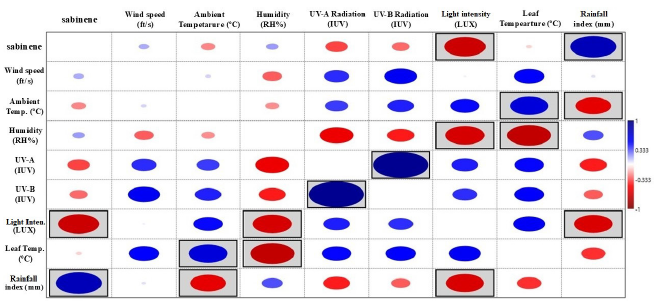
In all three sites, the correlations between the sabinene content and the analyzed abiotic factors showed interesting results. At site A (Fig. 1), a significant positive and strong correlation was observed between sabinene and the rainfall index (r = 0.78, p = 0.001), indicating that as the rainfall index increases, the concentration of sabinene also tends to increase. This pattern can be interpreted as a response of sabinene to variations in climatic conditions related to rainfall. In contrast, light intensity (r = -0.70, p = 0.01) showed a significant negative and strong correlation, suggesting that higher light levels are associated with lower concentrations of sabinene. However, the correlation with leaf temperature (r = -0.09, p = 0.79) and wind speed (r = 0.16, p = 0.61) were not statistically significant, indicating that these abiotic factors do not significantly influence the sabinene content at this collection site.
Spearman correlation between the sabinene content and the analyzed abiotic factors at Site A. Note: mm = millimeters; ft/s = feet per second; oC = degrees Celsius; RH = relative humidity; IUV = ultraviolet radiation index; Lux = luminous flux per unit area.
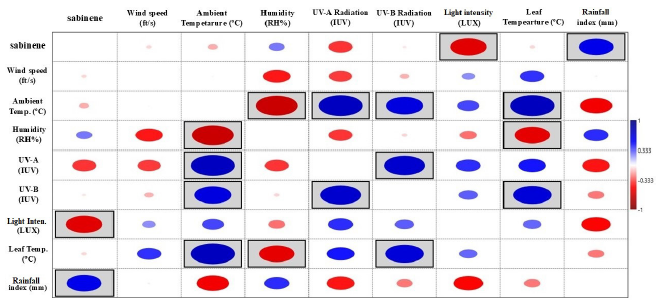
At site B (Fig. 2), tthe correlation between sabinene content and monthly rainfall was also positive and moderate (r = 0.58, p = 0.05), reinforcing the trend observed at site A, where increased rainfall is associated with higher sabinene content. The correlation with light intensity (r = -0.61, p = 0.04) was also negative and significant, indicating that greater light is correlated with lower sabinene content. Like site A, other correlations, such as with ambient temperature (r = -0.16, p = 0.62) and leaf temperature (r = -0.08, p = 0.80), did not show statistical significance, suggesting that these abiotic factors do not significantly affect sabinene at this collection site.
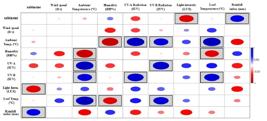
Spearman correlation between the sabinene content and the analyzed abiotic factors at Site B. Note: mm = millimeters; ft/s = feet per second; oC = degrees Celsius; RH = relative humidity; IUV = ultraviolet radiation index; Lux = luminous flux per unit area.
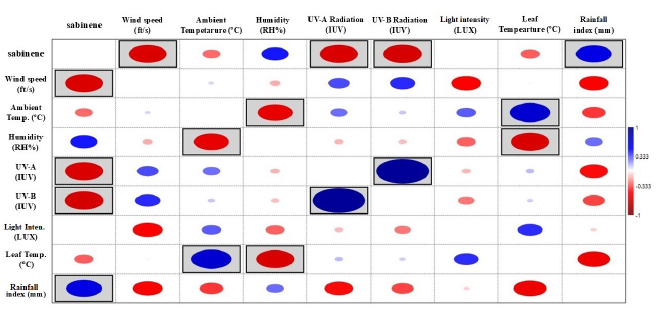
At site C (Fig. 3), the correlation between sabinene and the rainfall index was again positive and significant (r = 0.61, p = 0.04), confirming the previous observations for sites A and B, and reinforcing the influence of the rainfall index on sabinene content. Unlike what was observed at the other sites, the correlation with ambient temperature (r = -0.29, p = 0.36) and humidity (r = 0.46, p = 0.13) was not significant, but the correlation with UV-A radiation (r = -0.65, p = 0.02) was negative and significant, suggesting that higher UV-A radiation is associated with a decrease in sabinene content. This indicates that UV-A radiation may have an inhibitory effect on the production or accumulation of sabinene in the plants analyzed at site C.
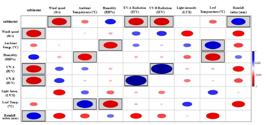
Spearman correlation between the sabinene content and the analyzed abiotic factors at Site C. Note: mm = millimeters; ft/s = feet per second; oC = degrees Celsius; RH = relative humidity; IUV = ultraviolet radiation index; Lux = luminous flux per unit area.
Discussion
Chemical composition of EOs from different species, such as Piper tuberculatum, may vary significantly due to the influence of intrinsic and extrinsic factors (Simões et al. 2017). This adaptive capacity in response to climatic and microclimatic conditions highlights the species’ ability to adjust the production of specialized metabolites, a crucial mechanism for their survival and interaction with the environment (Ramos et al. 2023).
Sabinene is widely recognized for its important ecological functions, acting as a secondary metabolite involved in plant defense. Studies indicate that this compound acts as a natural insecticide, repelling herbivores and protecting plants against insect attacks (Zhou et al. 2019; Stappen et al. 2021). There is also evidence of its allelopathic role, as it can inhibit the growth of competing plants nearby, providing a competitive advantage to the producing species (Andrianjafinandrasana et al. 2013; Qin et al. 2021).
In the present study, a significantly higher annual average concentration of sabinene was observed at site B, reaching 20.72%. This site is located in an urbanized area subject to multiple stresses resulting from human activities. In contrast, sites A and C, situated within a more preserved environment at the Jardim Botânico do Rio de Janeiro, exhibited lower concentrations.
This difference suggests that site B, under greater environmental pressure, may stimulate sabinene production as an adaptive response to abiotic and biotic stresses, reinforcing its ecological role as a defense agent and mediator of interactions, in accordance with evidence from the literature (Andrianjafinandrasana et al. 2013; Zhou et al. 2019).
Regarding environmental factors, outcomes of this research indicate a consistent trend of a positive correlation between sabinene content and the rainfall index at all collection sites, suggesting that precipitation plays an important role in the variation of this compound’s percentage. The literature indicates that the production of monoterpene compounds is significantly influenced by abiotic factors, including rainfall (Kopaczyk et al. 2020, Malik et al. 2023; Souza et al. 2024).
This relationship is highlighted in the work of Ramos & Moreira (2019), who examined the EOs of the aerial parts of Peperomia galioides, and in the study by Aizo et al. (2024), which explored the chemical variability of Piper obliquum. In contrast, the correlation between sabinene and other abiotic factors, such as temperature, UV radiation, and light intensity, demonstrated site-dependent variability. These factors were also investigated by De Brito-Machado et al. (2022), who identified significant correlations with the chemical constituents of the EOs of Piper mollicomum.
This variability suggests that the interaction between sabinene production and climatic factors is complex and may be influenced by specific environmental conditions at each site. This result corroborates studies by Malik et al. (2023), which reported that monoterpene emissions are influenced by ambient temperature and light. The extent and nature of these effects can vary depending on the plant species and environmental context. However, when focusing on the monoterpene sabinene, it is noteworthy that it is directly related to areas subject to more frequent or intense rainfall events, which contrasts with the results presented by the authors, who indicate that monoterpene emissions have seasonal patterns, showing increased emissions during warmer times of the year.
As previously discussed in this study, there remain significant gaps in understanding the influence of environmental factors on the production of specific secondary metabolites in plants of different species. While existing research highlights a general influence of abiotic conditions, the direct impact on the biosynthetic pathways of specific compounds remains largely unexplored. Therefore, further investigations are crucial to elucidate the regulatory mechanisms governing terpene biosynthesis.
In conclusion, although precipitation appears to be a key determinant in enhancing sabinene content, its interactions with other abiotic factors are complex and site-dependent. Thus, additional research is required to unravel the underlying mechanisms driving these relationships and to establish how multiple environmental variables collectively regulate the biosynthesis and accumulation of sabinene.
Acknowledgements
Conselho Nacional de Desenvolvimento Científico e Tecnológico (CNPq - Brazil); Fundação Carlos Chagas Filho de Amparo à Pesquisa do Estado do Rio de Janeiro (FAPERJ - Rio de Janeiro, Brazil); and Coordenação de Aperfeiçoamento de Pessoal de Nível Superior - Brasil (CAPES - Brazil), for financial support.
Data availability statement
In accordance with Open Science communication practices, the authors inform that there is no data sharing of this manuscript.
References
- Abbas F, Ke Y, Yu R, Yue Y, Amanullah S, Jahangir MM & Fan Y (2017) Volatile terpenoids: multiple functions, biosynthesis, modulation and manipulation by genetic engineering. Planta 246: 803-816.
- Adams RP (2017) Identification of essential oil components by gas chromatography/mass spectrometry. 4.1 ed. Allured Publishing Corporation, Carol Stream. 809p.
- Aizo JRS, Manzatto AG, Sampaio AF & Azevedo MS (2024) Variabilidade química do óleo essencial de Piper obliquum Ruiz & Pavan coletada na Estação Ecológica de Cuniã, Porto Velho-Rondônia. Scientia Plena 20: e202401001.
- Andrianjafinandrasana SN, Andrianoelisoa HS, Jeanson ML, Ramonta IR & Danthu P (2013) Allelopathic effects of volatile compounds of essential oil from Ravensara aromatica Sonnerat chemotypes. Allelopathy Journal 31: 333-344.
-
Antonio DC (2024) Análise uni e multivariada de dados empregando um software gratuito, executável e user-friendly. In: 62º Congresso Brasileiro de Química, Salvador. <Available at https://www.abq.org.br/cbq/2023/trabalhos/4/24595-29692.html >. Access on 23 January 2024.
» https://www.abq.org.br/cbq/2023/trabalhos/4/24595-29692.html - Borg-Karlson A, Valterová I & Nilsson A (1994) Volatile compounds from flowers of six species in the family Apiaceae: bouquets for different pollinators. Phytochemistry 35: 111-119.
- Borges LP & Amorim VA (2020) Metabólitos secundários de plantas. Revista de Agrotecnologia 11: 54-67.
- Byer KJRP, Bradshaw HD & Riffell JA (2014) Three floral volatiles contribute to differential pollinator attraction in monkeyflowers (Mimulus). Journal of Experimental Biology 217: 614-623.
- Chaiyana W, Anuchapreeda S, Leelapornpisid P, Phongpradist R, Viernstein H & Mueller M (2016) Development of microemulsion delivery system of essential oil from Zingiber cassumunar Roxb. rhizome for improvement of stability and anti-inflammatory activity. AAPS PharmSciTech 18: 1332-1342.
-
COR-RIO (2024) Sistema Alerta-Rio da Prefeitura do Rio de Janeiro. Dados meteorológicos. <Available at http://www.sistema-alerta-rio.com.br/dados-meteorologicos/download/dados-pluviometricos/ >. Access on 10 January 2024.
» http://www.sistema-alerta-rio.com.br/dados-meteorologicos/download/dados-pluviometricos/ - De Brito-Machado D, Ramos YJ, Defaveri ACAE, Queiroz GA, Guimarães EF & Moreira DL (2022) Volatile chemical variation of essential oils and their correlation with insects, phenology, ontogeny and microclimate: Piper mollicomum Kunth, a case of study. Plants 11: 3535.
- De Brito-Machado D, Felisberto JS, Queiroz GA, Guimarães EF, Ramos YJ & Moreira DL (2024) From leaves to reproductive organs: chemodiversity and chemophenetics of essential oils as important tools to evaluate Piper mollicomum Kunth chemical ecology relevance in the Neotropics. Plants 13: 2497.
- Dobson HEM (2006) Relationship between floral fragrance composition and type of pollinator. In: Biology of floral scent. CRC Press, Boca Raton. Pp. 147-198.
- Gerber D, Thompson BB, Jato MJ, Yamaguchi LF & Bechara FC (2022) Óleo essencial de Piper aduncum L. para atração de morcegos-da-fruta para restauração ecológica. Revista Brasileira de Agroecologia 17: 383-393.
- Gobbo-Neto L & Lopes NP (2007) Plantas medicinais: fatores de influência no conteúdo de metabólitos secundários. Química Nova 30: 374-381.
- Kamal BS, Kamal F & Lantela DE (2018) Cannabis and the anxiety of fragmentation - a systems approach for finding an anxiolytic cannabis chemotype. Frontiers in Neuroscience 12. DOI: 10.3389/fnins.2018.00730
-
Kopaczyk JM, Warguła J & Jelonek T (2020) The variability of terpenes in conifers under developmental and environmental stimuli. Environmental and Experimental Botany 180: 104197. DOI: 10.1016/j.envexpbot.2020.104197
» https://doi.org/10.1016/j.envexpbot.2020.104197 - Lima CNF (2020) Revisão sistemática do uso popular do gênero Piper para o tratamento da inflamação e avaliação da atividade anti-inflamatória de Piper tuberculatum Jacq. 114f. Tese de Doutorado. Universidade Federal Rural de Pernambuco, Crato. 24p.
- Lima SC, Oliveira AC, Tavares CPS, Costa MLL & Roque RA (2024) Essential oil from Piper tuberculatum Jacq. (Piperaceae) and its majority compound β-caryophyllene: mechanism of larvicidal action against Aedes aegypti (Diptera: Culicidae) and selective toxicity. Environmental Science and Pollution Research 31: 33454-33463.
- Malik TG, Sahu LK, Gupta M, Mir BA, Gajbhiye T, Dubey R, McCormick AC & Pandey SK (2023) Environmental Factors Affecting Monoterpene Emissions from Terrestrial Vegetation. Plants (Basel) 31;12: 3146.
- Mikich SB (2002) A dieta dos morcegos frugívoros (Mammalia, Chiroptera, Phyllostomidae) de um pequeno remanescente de Floresta Estacional Semidecidual do sul do Brasil. Revista Brasileira de Zoologia 19: 239-249.
- Park B, Kim B, Kim K & You Y (2019) Sabinene suppresses growth, biofilm formation, and adhesion of Streptococcus mutans by inhibiting cariogenic virulence factors. Journal of Oral Microbiology 11: 1632101.
- Pilon AC, Selegato DM, Fernandes RP, Bueno PCP, Pinho DR, Carnevale FN, Freire RT, Castro-Gamboa I, Bolzani VS & Lopes NP (2020) Metabolômica de plantas: métodos e desafios. Química Nova 43: 329354.
- Qin L, Miki NH, Zhang G & Funjii Y (2021) Allelopathic effects of the revegetation species Juniperus sabina L. in semiarid areas of China. Landscape Ecology and Engineering 17: 245-251.
- Queiroz GA, Barros AAM & Guimarães EF (2020) Piper (Piperaceae) do Parque Estadual da Serra da Tiririca, Niterói/Maricá, RJ, Brasil. Rodriguésia 71: e01992018.
- Ramos YJ (2018) Identificação de possíveis quimiotipos de Piper aduncum L. e Piper mollicomum Kunth (Piperaceae) com base no estudo dos componentes químicos de óleos essenciais. Dissertação de Mestrado. Universidade do Estado do Rio de Janeiro, Rio de Janeiro. 262p.
-
Ramos YJ & Moreira DL (2019) Seasonal study of the essential oil from aerial parts of Peperomia galioides Kunth (Piperaceae). Revista Virtual de Química 11: 1540-1550. DOI: 10.21577/1984-6835.20190107
» https://doi.org/10.21577/1984-6835.20190107 -
Ramos YJ, Felisberto JS, Costa-Barros C, Pontes ED, Brito-Machado D, Fonseca IC & Moreira DL (2020) Produção e variações químicas de óleos essenciais: uma breve revisão sobre os fatores que afetam a qualidade e a quantidade. In: Francisco ALO (org.) Avanços científicos, tecnológicos e de inovação na botânica. Ed. Atenas, Ponta Grossa. Pp. 78-104. DOI: 10.22533/at.ed.8512014027
» https://doi.org/10.22533/at.ed.8512014027 - Ramos YJ, Gouvêa-Silva JG, de Brito-Machado D, Felisberto JS, Pereira RC, Sadgrove NJ & Moreira DL (2023) Chemophenetic and chemodiversity approaches: new insights on modern study of plant secondary metabolite diversity at different spatiotemporal and organizational scales. Revista Brasileira de Farmacognosia 33: 49-72.
- Rodrigues SS, Gomes SL, Gaspar YMS, Silva MCF, Silva LB, Lima S, Silva WC & Araujo FDS (2025) Nanoemulsion based on Piper tuberculatum essential oil for the treatment of the crop pest Bemisia tabaci biotype B. Journal of the Brazilian Chemical Society 36: e-20250025.
- Sales VS, Cabral FR, Sales EPN, Carvalho TB, Costa MHN, Oliveira VAP, Rodrigues CKS, Nóbrega de Figueirêdo FRS, Bezerra DS, Delmondes GA, Coutinho HDM, Costa JGM, Menezes IRA, Felipe CFB & Kerntopf MR (2022) Central depressant effects of Piper tuberculatum Jacq essential oil in mice. Food Bioscience 48: 101813.
- Silva LYS, Paulo CLR, Moura TF, Alves DS, Pessoa RT, Araújo IM, Oliveira-Tintino CDM, Tintino SR, Nonato CFA, Costa JGM, Ribeiro-Filho J, Coutinho HDM, Kowalska G, Mitura P, Bar M, Kowalski R & Menezes IRA (2023) Antibacterial activity of the essential oil of Piper tuberculatum Jacq. fruits against multidrug-resistant strains: inhibition of efflux pumps and β-Lactamase. Plants 12: 2377.
- Silva LYS, Pessoa RT, Alcântara IS, Silva ES, Silva AB, Alves Junior SC, Saraiva RA, Oliveira-Tintino CDM, Ribeiro-Filho J & Menezes IRA (2024) Antiedematogenic and anti-inflammatory effects of the essential oil from the fruits of Piper tuberculatum Jacq. (Piperaceae) in animal models. Chemistry & Biodiversity 22: e-202402219.
- Simões CMO, Schenkel EP, de Mello JCP, Mentz LA & Petrovick PR (2017) Farmacognosia: do produto natural ao medicamento. Artmed Editora, Porto Alegre. 486p.
-
Souza F, Queiroz GA, Machado DB, Ramos YJ & Moreira DL (2024) Análise dos óleos essenciais de diferentes estágios do órgão reprodutivo de Piper tuberculatum Jacq. (Piperaceae). Anais do XI Simpósio Brasileiro de Óleos Essenciais, 11, 97. <Available at https://anais.infobibos.com.br/sboe/11/Resumos/Resumo11SBOE_0097.pdf >. Access on 20 April 2024.
» https://anais.infobibos.com.br/sboe/11/Resumos/Resumo11SBOE_0097.pdf - Stappen I, Wanner J, Tabanca N, Bernier UR & Kendra PE (2021) Blue tansy essential oil: chemical composition, repellent activity against Aedes aegypti and attractant activity for Ceratitis capitata Natural Product Communications 16: 1-8.
- Valente J, Zuzarte M, Gonçalves M, Lopes MC, Cavaleiro C, Salgueiro L & Cruz MT (2013) Antifungal, antioxidant and anti-inflammatory activities of Oenanthe crocata L. essential oil. Food and Chemical Toxicology 62: 349-354.
- Wasicky R (1963) Uma modificação do aparelho de Clevenger para extração de óleos essenciais. Revista Faculdade de Farmácia e Bioquímica 1: 77-81.
- Zhou S, Wei C, Zhang C, Han C, Kuchkarova N & Shao H (2019) Chemical composition, phytotoxic, antimicrobial and insecticidal activity of the essential oils of Dracocephalum integrifolium Toxins 11: 598.
Supplementary Materials
See supplementary material at <10.6084/m9.figshare.30603986>